


A polished corporate presentation is built before the first slide appears. Planning corporate presentation av hire melbourne around your message, audience and run sheet helps every technical choice serve a clear purpose, from intelligible audio to visuals that hold attention.
You already know how much is riding on the event: presenters need to feel confident, content must display as intended, and technical issues shouldn’t pull focus from the message. Coordinating speakers, venue access and timings can add pressure, especially when the room’s AV needs aren’t yet clear.
This guide explains how to shape a presentation-led AV plan for a Melbourne event, so the room, technology and production schedule work together. You’ll learn how to plan sound systems, screens, staging and technical direction around your audience and content, rather than treating each element as a separate hire decision.
With more than 30 years of experience across Victorian venues, NextGen AV manages the technical detail from planning through live delivery and pack-down. The aim is simple: give presenters a steady platform, keep the audience connected and let your team focus on delivering the event.
Key Takeaways
- Start with the presentation format, venue and audience to shape an AV plan around what attendees need to see, hear and follow.
- Match sound, display and staging choices to the content instead of relying on a standard equipment package.
- For corporate presentation av hire melbourne, plan beyond the equipment list by coordinating content, cues, operators and event timing.
- Use a clear organiser workflow to align the event brief, presenters, venue access and production schedule.
- See how technical direction and on-site management bring production details together from planning through pack-down.
Why corporate presentation AV hire in Melbourne shapes the audience experience
Your presentation may contain a sharp strategy, an important announcement or a product story worth remembering. But if people at the back can’t hear the speaker, a key slide is difficult to read or a changeover breaks the presenter’s flow, the technology becomes a distraction instead of support. The task is to make the message easy to see, hear and follow, while keeping the event moving with confidence.
Presentation AV is the coordinated use of sound, visuals, lighting and technical delivery to support a live event’s message. It brings the room, content and production cues into one considered plan. For a broader overview of audiovisual technology, the key principle is that audio and visual elements work together. At a corporate event, careful coordination helps attendees follow the speaker instead of working around the setup.
Start with the presentation outcome
Begin by identifying the event’s centrepiece: a keynote, conference session, internal briefing or product presentation. Then define what the audience should understand or remember. That outcome guides decisions about what must be clear on screen, how speech should carry across the room and whether lighting needs to support a speaker or a visual reveal.
Separate essential requirements from enhancements. Clear speech, legible content and smooth transitions are foundational. Additional lighting effects or scenic elements can add impact, but they should reinforce the presentation, not compete with it. For example, a product reveal may call for a deliberate lighting cue, while a data-heavy briefing needs screen content that remains easy to follow.
Plan for the room and audience
Room shape, seating position and sightlines all affect how people experience a presentation. A screen that works from the front may be obscured from the sides; a presenter who moves across the stage needs consistent visibility and sound coverage. Ambient light and the venue layout also influence how clearly slides appear and how evenly speech reaches attendees.
Melbourne venues each bring their own spaces and practical conditions. With more than 30 years of experience navigating Victorian event venues, NextGen AV plans with the room in view, aligning the setup with audience positions, presenter movement and the event format.
That is why corporate presentation av hire melbourne should begin with the experience you want attendees to have, not a standard equipment list. Give every technical choice a clear job: carry the speaker’s voice, make essential content readable or support a well-timed moment. When those elements are aligned, technology recedes into the background and the message takes centre stage.
The AV elements that make a corporate presentation clear and engaging
Choose each AV element for the job it needs to do. A keynote built around a speaker and a few slides has different priorities from a product presentation with multiple content changes or audience questions. For corporate presentation av hire melbourne, the right combination depends on the event format, venue, content and audience, not a fixed equipment package.
| Presentation need | AV element | Audience benefit |
|---|---|---|
| Speech reaches the room | Professional sound systems and a suitable microphone | Attendees can follow the speaker without straining to hear. |
| Slides and visuals read clearly | Display selected for the venue and content | Key information stays visible across the audience. |
| Presenter holds attention | Staging and considered lighting | The speaker is easy to see, with a setting that supports the event tone. |
This table is a starting point, not a specification. Room dimensions, seating arrangement, ambient light, presentation format and content all shape the production plan. For instance, compare the visibility of a representative slide from the front, sides and rear of the room, and consider whether the presenter will remain at a lectern or move across the stage. NextGen AV coordinates the screen, audio and stage so they support one another and keep attention on the presentation.
Match sound and microphones to speakers
Professional sound systems distribute speech across the room so attendees can listen comfortably from different seating positions. A wireless microphone can give a presenter freedom to move or support audience interaction. Microphone choice and placement should suit the speaker, the room and the session format.
During the event, a front of house engineer manages the sound mix heard by the audience. Live adjustments help maintain clear, consistent speech as speakers change or the programme moves between segments.
Choose screens and staging for the message
LED video walls can give presentation content a prominent visual presence when the event format and room call for them. Screen placement should account for sightlines, so attendees can see slides without losing sight of the speaker. Content matters too: a presentation built around detailed charts has different viewing needs from one using bold imagery or concise headlines. Review representative slides at the intended display size to catch small labels or dense layouts that may be hard to read from a distance.
Staging and set design shape how the presenter appears in the room. A layout that gives the speaker clear visibility and a natural place to present supports confidence, while lighting can keep attention on the stage without making visuals harder to read.
These decisions work best as one production plan, with technical direction connecting the content, operators and live cues. Melbourne corporate AV production brings those choices together around the presentation, helping your team keep the focus on the message.
Why presentation AV needs more than equipment hire
A list of microphones, screens and lights describes what’s in the room, but not how the presentation will run. Equipment alone can’t coordinate a late slide change, cue a speaker’s entrance or keep a session on sequence. The production plan needs to connect those moving parts, with assigned operators and a shared understanding of what the audience should experience.
Technical direction is the link between an event’s intent and the AV decisions and live cues that bring it to the room. It translates the brief into an operating plan, coordinates production teams and helps presenters understand how the technology will support their delivery. For corporate presentation av hire melbourne, this joined-up approach puts clear responsibility and communication alongside the equipment plan.
- An equipment list records what needs to be supplied.
- An integrated plan connects content, presenters, cues, operators and the audience experience.
- Live technical direction keeps those elements aligned as the programme unfolds.
Coordinate content, cues and presenters
Slide changes, speaker handovers, video playback and microphone adjustments should follow a shared run of show. For example, a presenter transition can identify who is speaking next, what content appears and which production cue supports the change. When presenters and crew receive the same sequence in advance, they can prepare for their part and reduce uncertainty on event day.
That preparation also creates a clear route for updates. If presentation content changes, the organiser and production team can communicate the revision and its effect on the sequence, rather than leaving the operator to guess during a live session. NextGen AV’s technical direction connects those planning details to on-site delivery, with decisions tied to the event brief.
Keep the technical plan precise and safe
Production planning should account for safe installation as well as smooth delivery. A Job Safety Analysis helps structure attention around tasks and their risks; power planning can include a circuit breaker where appropriate. Test and Tag supports checks of electrical equipment. These considerations belong in preparation, not as an afterthought during setup.
Where event rigging is part of the production, a qualified rigger and the relevant High-Risk Work Licence are important considerations. If an engineered structure is involved, a structural engineering certificate may form part of the project documentation. The requirements depend on the work and structure, so the technical plan should bring the relevant details together before delivery.
With an integrated plan, your team can focus on presenters and attendees while technical decisions, cues and setup are coordinated behind the scenes. NextGen AV technical direction brings that production oversight to corporate presentations, from planning through live delivery.

How to prepare for corporate presentation AV in Melbourne
A well-prepared production starts with useful information, not assumptions about a standard setup. Share the event format, content and run of show early. This gives the production team a clear basis for planning, while project-specific decisions about sound, displays, staging and technical delivery are managed as part of the production.
Brief the production team early
Bring the essential details together before plans are locked in: event purpose, audience profile, presentation format and venue information. Include Melbourne venue access windows, room layout and event timings in the early conversation. These details help the production team understand the practical conditions, coordinate setup and shape an AV plan around how the event will run.
- Set the brief. Describe the event objective, audience and format, whether it’s a keynote, briefing, conference session or product presentation. Note what attendees need to take away so production decisions support that outcome.
- Map the venue. Share the venue and room details, audience arrangement, access windows and known setup constraints. Flag the planned stage position and presenter movement so the production team can account for them in the technical setup.
- Outline the programme. Provide event timings, speaker numbers, session order and key moments that need cues, such as video playback, a speaker handover or audience interaction. A clear sequence helps align production activity with the agenda.
- Gather presentation needs. Identify content types, slide requirements and any planned audience participation. Name who is coordinating files and who can approve or communicate changes, so updates have a clear path.
- Align the run of show. Bring presenters and event stakeholders onto the same sequence of introductions, content changes and transitions. Share updates as the programme develops, rather than relying on last-minute verbal instructions.
Prepare presenters and content
Presentation files and speaker changes should follow the agreed running order. Give presenters a chance to become familiar with the stage and microphone before doors open, and allow time for a technical check in the event schedule. This helps speakers understand the setup and gives the crew an opportunity to work through planned cues.
- Run a technical check. Coordinate the check with the production team and presenters. Review the content and transitions in sequence, and clarify how any changes will be relayed during the event.
- Close out the event. Include pack-down and venue access arrangements in the production schedule, so equipment removal follows the event timing and site requirements.
For corporate presentation av hire melbourne, a clear brief and coordinated preparation turn a complex setup into a manageable process. Plan your Melbourne presentation AV with NextGen AV, from the first production conversation through to pack-down.
How NextGen AV delivers corporate presentation production in Melbourne
A successful presentation needs more than a collection of technical elements. NextGen AV works as a production partner, bringing technical direction, planning and on-site management together so the AV supports your purpose and presenters can stay focused on their audience. With more than 10 years in corporate events and over 30 years of industry experience, the team guides each project from the initial brief through live delivery and pack-down.
From event brief to live delivery
Planning begins with your objectives, presentation format and venue information. NextGen AV uses that context to develop a coordinated technical plan, aligning the production with the room and run of show. Each element has a clear role: professional audio carries the speakers, LED video walls present content when they suit the format, and lighting or staging supports presenter visibility and the event atmosphere.
As the event approaches, the production team coordinates the technical details and prepares for on-site delivery. During the presentation, technical management keeps operation aligned with the agreed sequence, including speaker transitions and content cues. The crew then manages pack-down as part of the production, so responsibility doesn’t stop when the final slide appears.
- Technical direction connects event objectives with production decisions and the live sequence.
- Planning brings venue details, content needs and presentation timing into one coordinated approach.
- On-site management supports delivery in line with the run of show and agreed cues.
- Pack-down completes the production process after the event.
Plan your Melbourne presentation with confidence
Local knowledge makes planning specific to the event. NextGen AV operates from a Melbourne-based warehouse and brings experience across Victorian venues, while also delivering events throughout Australia. That combination supports a venue-aware approach for Melbourne organisers and a production partner for teams presenting in other locations.
Corporate presentation AV hire in Melbourne can be tailored to the content, audience and event format, rather than built around a generic package. Share your presentation goals, venue information and run of show, and NextGen AV will shape the technical plan around what the audience needs to experience. For broader production planning, the full-service event production guide can help you consider how technical delivery fits into the wider event.
Ready to plan your presentation? Discuss your event goals with NextGen AV and start shaping a coordinated production plan for your Melbourne event.
Put your presentation message first
Your next planning decision can be simple: identify the one idea you want attendees to carry with them after the event. Let that priority guide the atmosphere, pacing and production choices, so each detail strengthens the experience rather than pulling focus from the message.
A useful brief doesn’t need to answer every technical question. For corporate presentation av hire melbourne, make your priorities clear: what the audience needs to understand, what the presenters need to deliver with confidence and which moments deserve particular attention. From there, NextGen AV can shape the technical approach around your goals and keep planning focused.
That clarity also gives your internal team room to concentrate on the people and purpose behind the event. With an experienced production team managing the technical detail, you can approach the day with confidence and give presenters space to connect with the audience.
Plan your Melbourne corporate presentation with NextGen AV and start shaping an event that puts your message in the spotlight. A clear first conversation can set the whole production in motion.
Frequently Asked Questions
What AV equipment is needed for a corporate presentation?
The right AV setup depends on what attendees need to take in and how the presentation is delivered. A speaker-led briefing may centre on voice reinforcement, while a session with demonstrations may call for displays that carry changing content. Microphones, staging and technical operation can also form part of the solution. Map each proposed element to a specific audience or presenter need, rather than adding equipment without a clear purpose.
How do I plan AV for a corporate presentation in Melbourne?
Give the production team a working brief that includes the event objective, venue, audience, presenters and running order. Add useful planning material, such as a room plan, a sample slide deck and notes on content that needs to appear on screen. For a Melbourne event, venue experience helps interpret the room details. Name an organiser who can approve changes, so decisions don’t get caught between stakeholders.
Do corporate presentations need a front of house engineer?
A front of house engineer shapes the audience-facing audio mix during the live programme. Their involvement is especially useful for sessions with several presenters, changing microphone handovers or audience questions, as sound needs can shift as the session progresses. The production plan determines the right technical support for the event. Agree in advance how cue changes will reach the engineer and who can communicate adjustments from the organiser’s team.
Are LED video walls suitable for corporate presentations?
LED video walls can suit a presentation where large-format visuals play a central role, such as a product reveal or a sequence of bold campaign images. The choice should account for the room, audience viewing positions and the material being displayed. For slide-heavy content, review a representative slide at the intended display scale so small labels or dense charts don’t undermine readability. The LED video wall planning guide offers more on display considerations.
What should presenters prepare before an AV rehearsal?
Presenters can make rehearsal more useful by checking that their files are the approved versions, media plays as intended and slide changes match the spoken delivery. Prepare a short cue script for moments such as a video start, demonstration or handover, and note any audience participation. This gives the presenter and crew specific details to work through together. Confirm one person is responsible for passing on final content amendments.
Can one AV team manage sound, screens and staging for a corporate presentation?
NextGen AV coordinates the elements required for a presentation, with the scope shaped by the event brief. A practical advantage is having a clear communication path for changes: the organiser can nominate who approves a revised slide or altered speaker order, while the production lead distributes the update to the relevant crew. This reduces conflicting instructions and keeps technical decisions connected to the programme.
How far in advance should I organise presentation AV?
There’s no single lead time that suits every presentation; the right planning window depends on the venue, scale, content and production requirements. Start the production conversation as the event format takes shape, then build key planning milestones into the organiser’s schedule. These might include confirming the room plan, agreeing the running order and circulating approved presentation files. Share changes promptly so the production plan can keep pace.
An awards night is remembered for the moment a winner’s name is announced, not the scramble behind the curtain. The right awards night av solutions coordinate each announcement, walk-on and award reveal so guests can focus on the people being recognised. When sound, screens, lighting and stage activity work together, every moment feels polished and purposeful.
A successful ceremony needs more than impressive visuals. Presenters need clear cues, recipients need a confident route to the stage, and guests need to hear and see each key moment. A technical hitch can draw attention away from the people the event is designed to celebrate.
This guide explains how to shape audio, LED video walls, lighting, staging and technical direction around your ceremony, from planning through live operation and pack-down. With NextGen AV’s Melbourne event production experience managing the detail behind the scenes, you can help presenters and recipients feel ready to take centre stage.
Key Takeaways
- Well-planned awards night av solutions coordinate audio, screens, lighting and stage cues around the ceremony’s key recognition moments.
- Match sound and screen content to speeches, acceptance remarks and walk-ons so guests can follow every announcement.
- Assess your Melbourne venue’s sightlines, stage position and audience zones before deciding where screens and production areas should go.
- Bring the run sheet and technical cues into one production plan, connecting presenters, recipients and content from start to finish.
- Professional technical direction and on-site operation manage complexity behind the scenes, keeping attention on the people being celebrated.
Awards night AV solutions: what makes the ceremony feel seamless?
Awards-night AV production coordinates sound, visuals, lighting, staging and live technical operation to make a ceremony clear, engaging and well paced. Each element supports the same story: guests hear the announcement, see the nominee or recipient, and understand what happens next. Strong awards night av solutions make that coordination feel effortless, keeping attention on the people being recognised rather than the equipment behind the moment.
The details matter because an awards ceremony changes pace throughout the evening. Arrival calls for a welcoming atmosphere and useful visual information. During dinner, sound should remain comfortable and allow guests to talk. Presentations call for focused attention, clear speech and well-timed cues. After the final award, lighting and sound can signal the next part of the event and help guests follow the transition.
Which moments need the most technical attention?
Map each change in the programme to a cue instead of treating the run sheet as a list of speeches. A cue sheet should show what the audience needs to hear and see, what changes on stage, and who is responsible for calling each transition. This gives presenters and recipients clear signals, so they can concentrate on their part in the ceremony.
- Guest arrival: Set the room with suitable background audio and arrival visuals. Keep welcome and wayfinding information easy to follow.
- Opening remarks: Direct attention to the stage with a clear microphone feed, an appropriate lighting change and the correct opening content on screen.
- Category introductions: Coordinate the category name, presenter introduction and approved visuals so guests can follow the award being announced.
- Winner announcements: Prepare the announcement audio and reveal content as a single cue, with stage lighting ready for the recipient’s walk-on.
- Closing transitions: Plan a shift in audio, visuals and lighting to move cleanly from the final presentation to the next event moment.
Technical direction connects those cues to the people delivering them. Presenters should know when to begin, where to stand and what signal indicates the next step. Recipients need a clear route to the stage. Rehearsing handovers helps identify timing clashes before guests enter the room.
What should guests experience?
Guests should be able to hear names and remarks from their seats, follow the programme without guessing, and see the stage action during recognition moments. Screen content can reinforce a category or identify a recipient, while considered lighting keeps the stage visible without making every transition a distraction.
That balance is the craft of audiovisual technology: sound and visuals work together, with a clear purpose for each. Keep cues consistent, content legible and transitions calm. The result feels celebratory and assured, with AV shaping the atmosphere while recipients remain at the centre of the ceremony.
How sound, screens and lighting shape awards-night moments
Sound, screens and lighting each carry a different part of the ceremony. Their impact comes from working as one production: clear speech makes announcements meaningful, prepared visuals help guests follow each category, and lighting directs attention without competing with people on stage. Start with a practical question: what does the audience need to hear, see or feel at this moment?
Every AV element should serve a defined audience need or ceremony moment, from hearing a winner’s name clearly to seeing their recognition across the room. That principle keeps creative choices purposeful and helps the production feel polished rather than overcomplicated.
Sound systems that keep every announcement clear
Plan audio around the people speaking and the guests listening. Choose presenter microphones to suit how each host moves and speaks, and make sure acceptance remarks remain audible as recipients step on stage. Playback cues for walk-on music also need clear timing, with a controlled start and finish that supports the transition instead of cutting across speech.
A front of house engineer manages the sound mix heard by guests, balancing speech and music as the programme unfolds. Plan wireless microphone use around who needs a microphone, where they will use it and how handovers will work. Recording those details in advance helps presenters stay composed and keeps the audience connected to each announcement.
LED screens and lighting that focus attention
LED screens can carry event visuals, category names, nominee information and approved presentation content. Organise each item against the run sheet so the right content is ready for the right cue. Use legible layouts and consistent visual styling, especially when guests are seated at different angles across the venue.
Lighting completes the focus. A planned cue can draw attention to the presenter, hold the stage during an announcement, then guide the room towards a recipient’s walk-on. Transitions can shift the atmosphere between dinner and the awards without distracting guests with unnecessary effects. The creative design should frame each recognition moment, not compete with it.
Screen planning starts with the audience and the room. Position, scale and content all affect whether guests can follow what is happening. For more detail on planning screens for an event, read this guide to LED video walls for events.
NextGen AV coordinates professional audio, LED video walls, lighting design and technical direction as one production. With the technical details managed behind the scenes, presenters can focus on the room and recipients can take centre stage.
How to assess awards-night AV for your Melbourne venue
The room is part of the production plan. Before selecting awards night av solutions, assess how guests will enter, dine, watch presentations and move through the venue. A screen that works for the front tables may be difficult to see from a side zone. A stage position that looks impressive on a floor plan may leave some guests with an obstructed view. Map the audience experience before finalising the technical design.
Match the production plan to the room
Start with the venue layout: room shape, seating arrangement, stage position and sightlines between guests, presenters and screens. Note where guests will sit during dinner and whether tables or columns could block their view. Identify suitable production areas for control positions, staging and equipment, then plan placement and operation around the space.
Melbourne venues each bring practical considerations. NextGen AV draws on over 30 years of experience navigating Victorian event venues to shape production around the room, rather than force the same layout into every space. A site-specific plan helps align the stage, screens and audience zones before the ceremony begins.
Review content as well as layout. Confirm the format of category graphics, names and presentation material, then plan screen positions for visibility throughout the room. Consider how the sound plan will support speech across the seating layout, and how lighting can focus attention on the stage without disrupting the atmosphere.
| Event need | Planning considerations |
|---|---|
| Clear announcements | Plan sound system coverage and microphone use around the room and programme. |
| Visible recognition | Position screens for audience sightlines and prepare readable category and recipient content. |
| Focused presentations | Coordinate lighting cues with presenter positions, stage activity and transitions. |
| Safe, practical staging | Fit the stage and production areas to the venue layout and the event’s operating needs. |
Choose a production partner, not just equipment
A venue-specific plan connects creative intent with technical direction and live operation. During pre-production, the team reviews the room layout, content requirements and run sheet, then coordinates how sound, screens, lighting and staging work together. On site, the crew operates to that plan while you focus on guests and event delivery.
NextGen AV manages production from planning and technical direction through on-site operation and pack-down. For broader guidance on coordinating these elements, read full-service event production. Aligning the room and production team helps the technical plan support the ceremony without competing with it.

Build an awards-night AV plan around the run sheet
A run sheet becomes a production plan when every programme moment connects to a person, a cue and a technical responsibility. For reliable awards night av solutions, start with what the ceremony needs to achieve, then map how presenters, recipients, approved content and crew will move through the evening. This gives everyone a shared reference and makes changes easier to manage during the live event.
Turn the programme into a cue sheet
Give each cue a clear trigger and owner. Record who speaks, what content appears, which audio or lighting change is needed, and how stage activity moves into the next moment. Use this briefing sequence to prepare organisers and production teams together:
- Set the objectives. Confirm the event’s tone, key recognition moments and the guest experience you want to create.
- Review the run sheet. Identify speakers, award categories, walk-ons, winner reveals, acceptance remarks and closing transitions. Note timing dependencies and planned changes.
- Build the cue sheet. Pair each moment with its screen content, audio playback, microphone handover and lighting cue. Name the person who calls or responds to each cue.
- Coordinate presenters and recipients. Brief them on entrances, stage positions, microphone use and the signals that guide their next step, so no one has to guess in front of the room.
- Rehearse and refine. Walk through key transitions with the relevant crew and participants. Adjust timing or handovers where the sequence is unclear.
A cue sheet works best when it stays practical. Use consistent cue names, keep the latest version accessible to the people who need it, and communicate approved changes to the production team. Rehearsal tests the handovers, while clear cue ownership helps operators respond confidently if the programme shifts.
Coordinate crew, equipment and safety
Technical direction brings sound, screens, lighting, staging and crew responsibilities into one plan. It also connects production choices to safe working practices. Include a Job Safety Analysis in preparation where applicable, and plan equipment placement, access and crew tasks around the venue and stage design. Where the work calls for them, assign qualified riggers and personnel holding the relevant High-Risk Work Licence.
For staging or structures that need independent assessment, include the structural engineering certificate in the production documentation. Consider the distributed load, meaning how weight is spread across a wider structural area rather than concentrated at one point. Test and Tag also belongs in equipment readiness planning. Include these checks alongside cue planning, not as an afterthought when the crew is ready to build.
NextGen AV coordinates pre-production, technical direction and on-site operation so organisers can stay focused on guests and recipients. Read more about planning your awards-night production with NextGen AV and bringing the run sheet, creative intent and technical details into one coordinated brief.
Deliver a polished awards night with NextGen AV
A memorable awards night reflects the people and achievements it celebrates. Creative intent gives the ceremony its identity; precise timing and dependable live operation let that identity come through without distraction. NextGen AV works as a production partner, shaping an experience that feels distinctive to your event while keeping the recognition itself in focus.
What an experienced production partner manages
A production partner translates your event’s creative direction into a cohesive live experience. That means considering how atmosphere, visual content and stage presentation support the tone you want, while keeping the most meaningful moments clear for guests. When those decisions form part of one production vision, technology feels intentional rather than like a series of separate effects.
NextGen AV brings more than 10 years in the corporate event space and over 30 years of industry experience to this work. The team takes ownership of technical complexity and helps protect the feel of the evening, so your attention stays with guests, presenters and recipients.
Melbourne experience, Australian event capability
With a Melbourne-based warehouse and experience delivering events throughout Australia, NextGen AV supports event organisers locally and across the country. Its past work illustrates the team’s production capability, although these projects were not awards nights. At a Melbourne gala, the team managed a lighting rig involving over 100 moving heads. For a CBD outdoor activation, it coordinated synchronised content across three modular walls.
That experience reflects the creative and technical care that can help an awards night feel polished and true to its purpose. Your ceremony has its own story to tell, and its production should reflect that.
Explore awards-night AV production with NextGen AV and see how a coordinated team can keep the people being celebrated at the centre of the event.
Set the stage for recognition
Your awards night deserves a production plan shaped around the people and achievements at its heart. Start by setting clear priorities: what should guests feel as they arrive, which moments deserve the strongest focus, and how should the evening move from one part of the programme to the next? Those decisions give your awards night AV solutions a purpose beyond presentation, helping technology support the significance of the occasion.
Bring your vision, venue details and programme together early, and the production team can shape a considered approach around them. NextGen AV combines creative thinking with precise technical planning, so you can hand over the complexity while staying connected to the experience you want guests to remember. The result is an evening designed to feel cohesive, assured and worthy of its recipients.
Plan your awards-night production with NextGen AV to bring your event vision and technical requirements into one coordinated plan. Your recipients are ready for their moment. Let’s make it count.
Frequently Asked Questions
What AV equipment is needed for an awards night?
The AV setup depends on the ceremony format. It may also need playback computers, signal distribution and an operator control position. These supporting elements help manage approved content and keep technical controls accessible during the event. Share whether presentations include video, how many speakers are involved and whether the programme includes a post-awards segment, so the plan covers the full evening.
How do you plan AV cues for an awards ceremony?
Use one approved version of the programme and content as the reference for production planning. Give each cue a consistent label and record changes in one place, so presenters and operators are not working from conflicting versions. Before the event, confirm who can approve late edits and how those edits will reach the technical team. This change-control process helps prevent outdated names, graphics or running orders from reaching the audience.
How can LED screens improve an awards night?
LED screens can make recognition more personal by pairing a recipient’s name with an approved portrait, organisation or project image. Give your design team final spellings and image files early, and keep layouts consistent across categories so guests can quickly understand what they are seeing. Review text at the intended display size, not only on a laptop. This helps keep key details readable for guests seated further from the screen.
What sound system is suitable for an awards night?
A suitable system is selected around the room’s acoustics and the balance between speeches, music and dining. Hard surfaces can make speech less distinct, while background conversation can affect how clearly guests hear announcements. A soundcheck with a speaker at the lectern and music at the planned level helps identify issues before doors open. Share priority speeches or performances with the audio team so the mix suits the programme.
How does lighting affect an awards ceremony?
Lighting also shapes how recipients appear in event photographs and video. Discuss planned camera positions and award-photo moments with the production team, then consider how the stage will look from those angles as well as from guest seating. Managing glare and keeping faces clearly visible supports both the in-room experience and the record of the evening. A considered lighting approach helps each recipient’s moment feel polished on stage and on screen.
Can one AV production team manage sound, screens and lighting?
Yes. A single production team can manage these elements through a shared plan and clear communication. For organisers, that means programme changes can go through an agreed production lead rather than being relayed separately to several technical contacts. Confirm decision-making responsibilities and how updates will be communicated before event day. That clarity helps the team respond consistently if timing or approved content changes.
What should Melbourne event organisers consider when planning awards-night AV?
For a Melbourne event, gather the venue’s current technical information before the production briefing. Useful details include access and loading arrangements, available power information, venue requirements for rigging, and the time allowed for setup and pack-down. Share the latest floor plan and nominate a venue contact for operational questions. These details help the production team build a plan around the venue’s practical conditions rather than assumptions.
The right rigging partner turns a creative concept into safe overhead architecture. For Melbourne event organisers, that means more than suspending lights or LED walls: equipment loads, venue requirements, qualified crew and bump-in sequencing all need to work together. This guide to stage rigging services melbourne event teams can rely on explains how careful planning supports both the production and the people beneath it.
You can create a striking stage while keeping structural safety, venue approvals and specialised rigging requirements in view. Certain rigging tasks require a High-Risk Work Licence under Victoria’s Occupational Health and Safety Regulations 2017, overseen by WorkSafe Victoria. NextGen AV’s Melbourne-based team brings more than 30 years of industry experience, coordinating rigging, LED walls and lighting through technical direction as part of one integrated production.
Here, you’ll learn how to plan flown elements, prepare safety documentation and navigate venue requirements while keeping creative design and compliance aligned. From the initial concept to the final checks, precision behind the scenes helps your event take centre stage with confidence.
Key Takeaways
- See how event rigging supports structural planning and the visual impact of your Melbourne production.
- Learn how trusses, motors and hardware work together to suspend event elements with precision.
- Understand how load calculations, relevant standards and engineering input contribute to a considered rigging plan.
- Use venue information and early coordination with in-house teams to prepare for a smoother bump-in.
- Explore how stage rigging services melbourne can integrate rigging with lighting, LED walls and technical direction.
The Critical Role of Stage Rigging in Melbourne Event Production
Professional stage rigging is more than suspending speakers above an audience. It is the planned positioning and support of event equipment, designed around the venue, the production brief and the people using the space. A flown lighting fixture, audio system or LED wall needs suitable support, considered placement and coordinated installation. Those decisions shape what the audience sees and hears while helping the production team work safely behind the scenes.
Rigging is also the invisible architecture of a compelling event. Trussing can define a stage, frame a screen or support layered lighting positions. Carefully placed flown elements add depth and focus. For example, an LED wall can form the visual centrepiece, with lighting positioned to complement its content rather than obscure it. The rigging plan links these creative choices to practical constraints, including the venue’s infrastructure and how loads are distributed.
The same principles apply across theatrical, arena and corporate productions. Entertainment Rigging Principles provides background on the discipline. At a Melbourne conference or gala, careful suspension and coordination help create a polished audience experience. NextGen AV brings rigging, LED walls and lighting together through technical direction, so the production feels like one considered design rather than a series of separate installations.
Safety and Compliance: The Non-Negotiables
In Victoria, event organisers need to manage contractor practices and make sure relevant requirements are addressed. WorkSafe Victoria enforces the Occupational Health and Safety Regulations 2017, under which certain rigging tasks require a High-Risk Work Licence. There is a difference between hanging an item and engineered rigging: the latter considers how equipment is supported, positioned and secured within the overall plan. Qualified riggers bring the training and practical judgement needed to carry out their assigned work carefully.
Creative Freedom Through Flown Elements
Flown equipment can free up floor space, support audience movement and keep sightlines clearer. Suspending audio or visual elements can also help the team position them around the stage design, instead of placing stands and equipment where they interrupt the room. Layered trussing can support distinct lighting zones and visual frames, creating an immersive setting without crowding the stage. The design must still suit the venue and its rigging points.
Precise coordination makes a complex production feel effortless to guests. NextGen AV’s Melbourne team integrates rigging with LED wall specialists and lighting designers, aligning technical requirements with the intended look and audience experience. With stage rigging services melbourne productions can rely on, the creative vision has a carefully planned structure behind it, from the overhead design to the finished room.
Essential Rigging Components: Truss, Motors, and Hardware
Truss, lifting equipment and connecting hardware form a support system, not a collection of interchangeable parts. Aluminium trussing creates a framework for lighting, audio and visual elements. Motors or fixed suspension points position that framework above the event floor. Each component needs to suit the intended design, the equipment it supports and the venue’s rigging conditions.
Truss profiles vary in shape and application. Box truss has a square profile and is often selected when a design calls for a substantial visual frame. Triangular truss can suit lighter-looking structures or particular layouts. Black truss can recede against a dark ceiling, while circular or custom configurations create a defined shape for a brand activation. Global and Eurotruss systems should be assessed using their documented specifications and component compatibility. Similar appearance alone does not make components interchangeable.
Trussing and Lifting Systems
Electric chain hoists provide controlled lifting, while the motor arrangement affects how a structure is raised and held in position. A fixed “dead hang” suspends a screen from set points; motorised points allow controlled adjustment during installation. The suitable approach depends on the design, venue and operating plan. Ground support can be an alternative where overhead loading is restricted, but its footprint and the floor’s capacity still need consideration.
Shackles connect compatible components, slings wrap or support loads, and spansets are textile slings used as part of a rigging connection. Check their condition, rated capacity and suitability for the application. The US reference OSHA Rigging Safety Standards addresses equipment in its jurisdiction. It does not replace Victorian requirements or project-specific engineering.
Planning for LED Video Walls
LED panels, their supporting frame, cabling and associated components all contribute to the suspended load. Establish the total using relevant equipment information, then consider how it is distributed across the truss and suspension points. Never estimate from the screen’s appearance: the panel configuration and support design affect the overall arrangement. A technical director can coordinate rigging and LED specialists early, aligning screen dimensions, sightlines and support requirements before the event build.
That integration matters in practice. A screen’s position affects truss layout, lighting angles and the audience’s view, so decisions made in isolation can undermine the finished stage. Explore how LED video walls for events fit into a production plan, then coordinate their support with the wider design. For stage rigging services melbourne organisers need to bring these elements together, NextGen AV’s technical direction connects structural planning with the audience-facing result.
Match Components to the Venue
Before selecting a system, map the equipment, intended positions and available support points. Where ceiling loading is limited, ground-supported structures may help shape the design, provided floor capacity and circulation space are considered. Early coordination lets the rigging plan support the creative brief without leaving critical decisions until bump-in.
Navigating Safety Standards and Load Calculations in Victoria
For a Melbourne event, safety planning becomes practical when the rigging design can be reviewed alongside the equipment schedule and venue information. AS 1418.17 is relevant to the design and use of lifting equipment. The technical team should identify which standards apply to the specific equipment and operation, rather than treating a reference to one standard as blanket approval. For a complex design, a structural engineer can assess the proposed arrangement and provide project-specific documentation.
Make sure design decisions are supported by clear information. Keep the current equipment schedule, venue details and rigging drawings together. If the screen size, lighting positions or production layout changes, pass the update to the technical director before issuing the plan for installation. This creates a traceable design process and gives the production team time to resolve issues before the build.
Load Calculations for Event Planners
Give your AV partner accurate equipment details, including models or specifications where available, quantities, planned positions and any movement during the event. Have the proposed loads at each support point assessed against the venue’s documented limits. For example, moving a screen from centre stage to one side can change how forces reach the supporting structure, even if the equipment list stays the same. Do not add items on site without a technical review.
Moving elements and outdoor installations need particular attention during design. The responsible technical team should account for how equipment will operate, assess site exposure and consider applicable wind conditions for temporary outdoor structures. The plan should set out how changes in conditions or production requirements will be handled, rather than relying on assumptions made during the initial design.
WorkSafe Victoria and Event Compliance
Build project records around the actual scope of work. Depending on the task and site, these may include a Job Safety Analysis, a Safe Work Method Statement where high-risk construction work applies, equipment inspection records and engineered drawings. Keep document versions clear, record design changes and make sure the crew has the current information. This document control connects planning decisions with on-site execution.
Address insurance arrangements through the event’s contracting and production planning. Define who is responsible for each part of the work, how changes are escalated and which records are shared with the venue. Clear ownership reduces uncertainty when multiple teams contribute to the build and gives organisers a reliable view of how the work will be managed.
Victoria University’s Event Production Management in Melbourne offers broader context on coordinating production components. For a rigging plan, the practical goal is to connect engineering review, accurate equipment information and controlled document updates. This helps the event design progress clearly from pre-production through to installation.

Planning Your Rigging Strategy: From Site Inspection to Bump-in
A rigging plan should take shape well before equipment arrives at the venue. A site inspection helps the technical team understand the room, access routes and production requirements, then build a plan around actual conditions. Melbourne venues vary widely: a purpose-built convention space such as MCEC and a heritage setting such as Melbourne Town Hall each have distinct layouts, access arrangements and operational considerations. Plan for the venue you have booked, not a generic room diagram.
During the inspection, map how equipment will travel from the loading area to the event space. Check loading dock access, lift dimensions, travel distances, storage areas and the routes crew will use during bump-in. These details can shape the installation sequence and affect how smoothly suppliers work together. Establish how the venue’s in-house technical team operates, including any exclusive rigging arrangements, then agree how the external production crew will coordinate with them.
Map the Venue Early
A useful site review records stage dimensions, access constraints, ceiling and support information supplied by the venue, and proposed positions for flown equipment. It should also capture practical details such as restricted corridors, shared loading areas and spaces that must stay clear for guests or venue operations. Keep approval responsibilities visible in the project schedule. Assign someone to track venue submissions and responses so design decisions do not stall while teams wait for information.
Coordinate the Production Plan
Pre-production drawings help the team visualise the rigging plot and identify clashes before installation. A 3D CAD view can bring truss positions, lighting, audio and LED screens together, making it easier to refine sightlines, cable routes and working space. Drawings should reflect the selected venue and current equipment plan. NextGen AV’s technical direction connects these elements, while clear version control helps every team work from the latest design.
Rigging is often among the first overhead work installed because lighting, audio and video elements may depend on it. It can also be among the last systems removed, after suspended equipment has been lowered and cleared. Build that sequence into the wider bump-in and bump-out schedule. Riggers, lighting crew and audio technicians should coordinate work zones, installation order and handovers, so one team’s progress does not block another’s access or create avoidable delays.
For outdoor or temporary structures, include the relevant approval pathway and supporting documentation in the project schedule. Requirements depend on the structure and site, so keep communication open with the venue and relevant approval contacts as plans develop. Stage rigging services melbourne event organisers can rely on should connect the site review, drawings, approvals and production schedule from the outset. This joined-up approach helps protect the creative vision from late changes and gives each crew member a clear role on site.
Bring your venue requirements and production concept together with NextGen AV’s Melbourne rigging and production team, coordinating technical details before bump-in.
Partnering with NextGen AV for Seamless Rigging and Production
Rigging works best when it is planned as part of the production, not added as a separate task after the stage design is settled. NextGen AV coordinates staging and rigging with lighting, professional audio and LED video walls, aligning technical decisions so every element supports the event’s intended look and audience experience. With extensive experience across Melbourne venues, the team brings practical knowledge to complex corporate productions and manages the details behind the scenes.
The “Invisible Expert” approach gives your production a clear technical lead while guests experience a confident, cohesive event rather than the logistics behind it. A technical director can connect the creative brief to the rigging plot, identify constraints early and coordinate the specialists responsible for each part of the build. That joined-up direction helps avoid clashes between the stage design, lighting positions and visual content.
One Coordinated Production Team
A single production partner can bring rigging, lighting and sound into the same planning conversation. That matters when a design includes flown fixtures, a large screen and a stage layout that needs to preserve sightlines. NextGen AV’s stage and lighting solutions connect structural decisions with the atmosphere you want to create, giving your brand a considered presence in the room.
Coordination also supports clearer decisions when venue conditions shape the design. If access, rigging points or the room layout affect the original concept, a production partner can bring the right technical specialists together to assess options and update the plan. You are not left to reconcile separate equipment schedules alone; the production details are managed as one connected project.
Built Around Your Event
A corporate gala and a product launch have different demands. A gala may call for layered lighting and a strong stage focal point; a launch may need screen content and lighting cues to work in a precise sequence. NextGen AV develops rigging plots around the event brief, venue and production elements, then coordinates the on-site work through bump-in and pack-down. The result is a plan shaped for your event, not a generic arrangement.
Safety and precision remain central throughout delivery. Clear technical direction helps the crew follow an agreed plan, communicate changes and keep rigging aligned with the wider production. That gives organisers more headspace to focus on presenters, guests and the experience they want people to remember.
If you are planning an event, speak with NextGen AV’s Melbourne team about your rigging and production brief. With stage rigging services melbourne organisers can integrate into a wider production, your concept has experienced technical partners from planning through to pack-down.
Shape the Event You Envision
Your rigging plan can do more than support the production; it can help define the atmosphere your guests remember. Bring technical planning into the creative process early, and your event design has room to develop around the venue, programme and moments you want to make stand out. That is the advantage of treating stage rigging services melbourne as part of the whole event experience, not a last-minute installation detail.
With NextGen AV, rigging is planned alongside lighting, audio and visual production, so your concept and practical requirements progress together. Focus on the message, the guests and the occasion, knowing experienced technical direction is managing the details.
Enquire about professional stage rigging services in Melbourne and take the next step towards a production designed with precision and purpose. Your vision deserves a team that helps it take shape with confidence.
Frequently Asked Questions
Do I need a permit for stage rigging in a Melbourne venue?
Permit requirements depend on the event structure and where it is being installed. Start by distinguishing formal approvals from a venue’s own technical approval process, as these can involve different teams and documents. For a Melbourne event, include approval responsibilities in the production schedule and have the organiser, venue and technical director work from the same event plan. This helps address approval requirements before the design is finalised.
How much does rigging typically cost for a corporate event?
A corporate rigging setup is scoped around the event brief rather than a standard package. Begin by defining what the audience needs to see and hear, such as a central LED screen, a clear stage view or a particular lighting look. NextGen AV’s technical team can translate that brief into a rigging and production plan, helping you understand the work involved and make informed decisions about the event design.
Can I use the venue’s in-house rigging services with NextGen AV?
Yes, NextGen AV coordinates production planning with a venue’s in-house rigging team. Establish one current version of the event plan, including the latest stage layout, screen positions and production schedule. This gives venue and production teams a shared reference as details develop, helping prevent outdated drawings or conflicting schedules from disrupting preparation.
What is the difference between basic trussing and engineered rigging?
Basic trussing describes a structural component, while engineered rigging refers to the planned scope around its use. For event planning, clarify whether the design covers only the truss or also the connected equipment, installation sequence and technical oversight. A clearly defined scope makes it easier to coordinate production responsibilities and understand how the proposed structure supports the event design.
How far in advance should I book rigging services for my event?
Start planning as soon as you have a likely venue and an initial event concept. That gives the technical team time to shape the design alongside your programme, stage layout and production schedule. If key details are still evolving, share the current brief and flag what may change. Early collaboration helps the rigging plan develop with the event instead of being added after other decisions are settled.
What safety documentation should I expect from a rigging provider?
Expect project records to match the final agreed design and clearly identify the version being used on site. If the stage layout or production equipment changes, the relevant drawings and records should be reviewed and updated as needed. For organisers, the practical check is consistency: documents shared with the venue and production crew should reflect the same installation plan.
Are there weight limits for hanging LED walls in Melbourne hotels?
Hotel rigging limits are specific to the property and may differ between rooms in the same building. Do not apply a ballroom’s information automatically to a smaller function room. For a Melbourne hotel event, use the documentation for the exact room and event date, and make sure the planned screen arrangement is assessed against that venue information before finalising production layouts.
What happens if my venue doesn’t have rigging points in the ceiling?
The event design can be adapted to the room rather than relying on a ceiling-mounted screen position. Options may include adjusting the screen location or incorporating it into a ground-level stage layout, with sightlines and audience movement considered as part of the revised design. NextGen AV coordinates these decisions with the wider production plan so the visual focus remains clear and practical for guests.
What if a better event experience begins before anyone chooses a screen, microphone or lighting cue? Knowing how to brief an av company effectively means starting with what your audience needs to see, hear and feel, then giving your production team the details to make it happen. You don’t need to arrive with technical answers. You do need a clear picture of the event and the experience you want to create.
An incomplete brief can affect planning, timing and delivery. A useful one connects your goals with practical production decisions early, giving your AV partner the context to plan around the programme, venue and audience instead of filling gaps at the last minute.
This guide explains what to include about your event format, run sheet, audience experience, venue and safety requirements, and how those details shape sound systems, LED displays, lighting, staging and technical direction. NextGen AV manages the production details behind the scenes, so you can focus on delivering an event that feels polished and runs with confidence.
Key Takeaways
- To understand how to brief an av company effectively, start with your event’s purpose and the experience you want the audience to have.
- Give your production team a clear sequence of event details, including the audience, programme, venue and key delivery contacts.
- Describe what each event moment should achieve rather than trying to specify technical solutions yourself.
- Share Melbourne venue information, access details and event timings early to support precise production planning.
- Use your brief as the starting point for a coordinated plan that aligns content, cues, crew and audience experience.
Why an effective AV brief starts with the event experience
An AV brief connects your event goals, the experience you want attendees to have and the production requirements that can bring it to life. It gives your production team a clear basis for technical decisions, from how speech is heard across the room to how key content appears on screen. For a foundational overview of the technology involved, see What is Audiovisual (AV)?.
Begin with the outcome, not a shopping list. Asking for screens and microphones identifies some equipment, but doesn’t explain how it should support the programme or audience. A conference might need delegates to follow presentations, take part in live questions and stay connected to a hybrid session. Those goals guide decisions about professional audio systems, visuals, lighting and technical direction. The result is a coordinated production plan, not a collection of disconnected items.
A strong AV brief turns your event purpose and audience needs into clear production decisions, so the technical plan supports every important moment. That’s the practical heart of how to brief an av company effectively: describe what success should look and feel like, then give your production partner the context to plan precisely.
Start with the audience, not the equipment
Describe what attendees should see, hear, understand or do. Note the expected audience size and whether the event is in person, hybrid or designed for active participation, such as polling or audience questions. Connect those details to an objective: for example, help conference delegates understand a new strategy, or give product-launch guests a clear view of a reveal. If attendance or format is still being finalised, label it as provisional.
Give the brief a clear purpose
State the event type, purpose, date and planned Melbourne location, then identify the decision-makers and main production contact. Separate confirmed details from items still in development, such as a draft programme or pending speaker list. This gives the brief practical value from the outset without presenting early assumptions as final instructions.
Make the purpose specific enough to guide decisions. “Annual conference” names the format; “bring members together to share industry updates and take part in discussion” describes the intended experience. Add what attendees should take away and flag moments that need particular focus, such as a keynote, award presentation or launch reveal. Your AV partner can use that direction to prioritise technical planning while keeping the wider event coherent.
How to build an AV brief step by step
Turn your event information into a working document the production team can act on. A practical brief moves from the reason for the event to the people, timings and materials needed to deliver it. If you’re working out how to brief an av company effectively, label each detail as confirmed, provisional or still to be decided. This gives the team useful direction without treating open questions as final instructions.
- Event purpose: State the event type and what it needs to achieve.
- Audience: Note expected attendance, format and participation needs, including any virtual or hybrid element.
- Programme: Attach the current run sheet, even if it’s a draft, and highlight moments requiring close coordination.
- Venue: Name the Melbourne venue and event spaces, then attach available venue information.
- Technical needs: Describe intended outcomes for audio, lighting, visuals, staging or audience interaction. You don’t need to prescribe technical specifications.
- Delivery contacts: List the main organiser, decision-makers, venue contact and people responsible for content approvals.
Keep the document easy to scan. Use headings, short notes and clear labels rather than burying an important change in an email chain. The AACP’s Principles of Effective Brief Writing offers useful guidance on concise, evidence-led briefing. For event production, that means stating what matters, what action or decision is needed, and which supporting material will help the team plan.
Set out the programme and key moments
Include session start and finish times, speaker transitions, presentations and audience participation. Flag entrances, reveals, awards or other cues that need coordinated timing. For each key item, note who supplies the content and who approves the final presentation files. Label provisional timings clearly so technical planning can progress as the programme develops.
Share the people and materials involved
List organisers, presenters, venue contacts and relevant suppliers, along with each person’s role and the best route for production questions. Attach draft presentations, branding assets, scripts or video content when available, and identify who owns each file. Note your team’s approval steps and deadlines. This gives the production team a clearer view of dependencies and helps keep content, cues and delivery aligned.
A useful AV brief brings together the event purpose, audience, programme, venue, production outcomes, people and supporting materials, with confirmed details distinguished from decisions still in progress. As the plan takes shape, your production partner can turn that information into a coordinated approach. For Melbourne event production planning, work with NextGen AV to connect your programme and creative direction with precise technical planning.
Describe AV requirements through outcomes, not jargon
You don’t need to specify equipment models or technical settings to give your production team useful direction. Describe what should happen for the audience at each important moment, then let technical direction shape the production approach. A clear priority, such as making every speaker easy to hear or ensuring guests can follow a product reveal, helps coordinate sound systems, lighting, staging and visuals around one intended experience.
Use a simple table to turn those priorities into practical planning notes. This example describes the result you want without prescribing the technical solution:
| Event moment | Audience outcome | Content or cue | Open questions |
|---|---|---|---|
| Keynote | Delegates hear and follow the speaker | Presentation and speaker introduction | Is audience Q&A planned? |
| Product reveal | Guests focus on the reveal and its key details | Video, reveal cue or presenter narration | Is the content final? |
| Networking | Guests can talk comfortably and move around | Background music | Which areas need coverage? |
Mark unresolved details as open questions rather than leaving the production team to interpret gaps. If speech clarity is a priority, describe the room, audience and speaking format. A professional sound system hire guide can also help explain the audio considerations behind a clear, comfortable listening experience.
Brief sound, visuals and lighting by purpose
For sound, note whether the programme includes speeches, music playback, video audio, audience questions or a mix. For visuals, explain what attendees need to see, such as a presentation, close-up detail or video during a key moment. Describe the atmosphere and visibility that lighting should support, from an energetic arrival to a focused presentation. These outcomes help your production team coordinate the elements rather than plan them in isolation.
Flag staging, rigging and content dependencies
Share any stage plans, set design concepts, suspended equipment plans or known access constraints. Include relevant structural information or a structural engineering certificate with the venue material so it can inform planning. Identify who supplies each presentation, video or script, and where it sits in the programme. Mark content still being developed and note approval responsibilities to help align final material with production cues.
The more clearly you describe the audience outcome, the more precisely the production team can shape its response. That’s how to brief an av company effectively without technical shorthand: connect each event moment to what people should experience, provide the content and context you have, and flag what remains undecided. Your technical partner can bring audio, visuals, lighting and staging into a coherent plan, with each decision serving the event.

Prepare Melbourne venue and delivery details early
A venue name alone won’t tell the production team how an event space will work on the day. Share the exact Melbourne venue and rooms in use, plus access information, known site constraints and the schedule for bringing production in and out. These details help shape a practical plan around the space as well as the creative vision.
Include timings that affect production: bump-in, setup, rehearsal, doors-open, programme start and pack-down. If timings are still being coordinated with the venue, label them as provisional and identify who is managing that discussion. Changes to room access or rehearsal time can affect the production schedule, so share updates as soon as they arise.
Give the production team useful venue context
Attach available floor plans, room layouts, site photographs and venue guidelines. Mark the event spaces in use, outdoor areas, audience layouts and planned movement between rooms. Note known access windows and venue coordination requirements, along with questions still awaiting an answer. This helps the production team plan for how people, content and technical elements will move through the event.
Separate practical details from assumptions. Identify a confirmed loading access window, for example, or note that access arrangements are still being finalised. Share information about power locations or staging restrictions provided by the venue. Don’t guess technical specifications; pass on what you know so the production team can assess requirements and coordinate the next steps.
Make safety and responsibilities visible
State who coordinates venue approvals and site access, who can make event-day decisions, and where production questions should go. Include relevant Job Safety Analysis, Test and Tag or rigging information with the venue material. If planned work involves event rigging, flag whether a qualified rigger or a High-Risk Work Licence is relevant so safety and technical planning can account for it.
- Venue: Name the location and each event space in use.
- Access: Share known loading, setup and pack-down windows, plus any access questions.
- Schedule: Provide bump-in, rehearsal, doors-open and pack-down timings, marking provisional items clearly.
- Site material: Attach available plans, photographs, venue guidelines and relevant safety documents.
- Responsibilities: Identify venue and organiser contacts for approvals, access and event-day decisions.
Melbourne venue experience helps make these details actionable. NextGen AV has more than 30 years of experience navigating Victorian event venues, bringing local knowledge to production planning. A clear site picture also helps align access, staging and technical delivery. For a closer look at local production considerations, explore this audio visual hire in Melbourne guide.
Knowing how to brief an av company effectively includes sharing the venue plan early, with confirmed details and open questions clearly marked. Share your venue information and schedule with NextGen AV’s production team to shape a precise, coordinated plan for your Melbourne event.
Turn the brief into a confident production partnership
A useful brief is the starting point, not the finished production plan. Your production partner can review your event goals, audience priorities, programme and venue details, then shape them into a coordinated technical approach. Technical direction brings the moving parts together, aligning content, crew, cues and production decisions so the event feels intentional from the first moment to the last.
The first review should turn assumptions and open questions into clear next steps. The team can identify dependencies, such as a presenter change affecting a cue or content approval affecting rehearsal planning. This is how to brief an av company effectively without arriving with technical answers: bring the context, then work through the production implications together.
Use the first production conversation well
Bring the event purpose, key audience outcomes, major programme moments and venue information to the discussion. Highlight decisions needing early attention and raise dependencies, such as who supplies a video or approves a final cue. You don’t need to know AV jargon. Agree how updates will be shared, who owns each action and when revised materials should be circulated.
A practical review sequence keeps planning focused:
- Review the brief: Align on event objectives, audience experience and the moments that matter most.
- Resolve open decisions: Assign an owner and next step to each item that could affect content, timing or delivery.
- Shape the production plan: Coordinate technical direction, crew, content handovers and programme cues.
- Confirm the working version: Record agreed responsibilities, current timings and the process for sharing changes.
This shared review gives everyone a clear reference point. If plans change, record what changed, who approved it and which programme or production details it affects. One current version helps prevent presenters, organisers and production crew from working from different information.
Keep the plan aligned through event day
Before the event, confirm who communicates programme changes, how presenters hand over content and when rehearsals or cue checks take place. Make sure responsibilities are clear to the organiser, presenters and production team. Defined communication points help the crew respond in step with the running order and keep the audience experience at the centre of each decision.
NextGen AV manages production complexity behind the scenes, bringing technical planning and event delivery together so you can focus on your guests and programme. If you’re planning a Melbourne event, discuss your event brief with NextGen AV and turn it into a coordinated production plan. You can also explore full-service event production to see how creative intent and technical delivery work together across an event.
Make your next event plan with confidence
A strong production partnership keeps the event’s purpose in view as details evolve. Treat the brief as a working reference: update it when decisions change, make ownership clear and keep the latest version accessible to the people delivering the event. This lets the team assess new ideas against the experience you want to create, instead of dealing with last-minute surprises.
Knowing how to brief an av company effectively isn’t about having every technical answer at the outset. It’s about giving your production partner a clear direction and making room for expert collaboration. NextGen AV’s Melbourne-based team supports events throughout Australia, coordinating production details behind the scenes so you can focus on the impact you want your event to make.
Ready to move from event vision to a considered production plan? Plan your next event with NextGen AV and take the next step with confidence.
Frequently Asked Questions
What should I include in an AV brief for an event?
Alongside the core event details, include anything that could affect production, such as accessibility considerations, language needs or a sensitive announcement that requires careful timing. If you’re drawing on a previous event, note what worked well and what caused difficulty rather than assuming the same approach will suit this one. This context helps the production team shape a considered plan.
How detailed does an event AV brief need to be?
Make it easy to review, with a short overview supported by relevant attachments rather than a long document that buries key decisions. Add a date or version label so everyone can identify the current file, and keep background material separate from actions requiring a response. If a detail is unknown, say who is investigating it and when you expect an update. That keeps planning moving without suggesting the answer is settled.
Can I brief an AV company if I do not know the technical terms?
Yes. Use everyday language and share references that explain your intent, such as a marked-up image, sample video or feedback from a previous event. If something was difficult before, describe what happened and who it affected. This gives your production team a useful starting point for focused questions and a suitable solution, without requiring you to diagnose the technical cause.
When should I brief an AV production company?
Bring production into the conversation before locking in choices that could shape the event experience, such as a room layout, stage concept or hybrid format. This gives the team an opportunity to consider technical implications while there’s still room to adjust the plan. If those decisions are already made, share them promptly with the current event information so the team can work from the actual constraints.
What venue information should I send with my AV brief?
Include the source and date of venue documents, especially if you’ve received more than one version. Point out discrepancies you’ve noticed, such as a room name that differs between the venue schedule and your event plan, rather than trying to resolve them yourself. This helps prevent planning against outdated or mismatched information and directs questions to the right venue contact.
How do I brief an AV company for a hybrid event?
Describe how remote attendees will join and take part, who will welcome them, and how their questions or contributions will reach the in-room programme. Identify any presenters joining remotely and who is responsible for communicating with them. If the online component has its own agenda or host, include that alongside the event schedule. These details help the production team coordinate the experience for both audiences.
What happens if my event programme changes after I send the brief?
Send the revised programme with changes clearly marked, then flag anything that could affect sequence, duration or a planned transition. A change to a speaker’s title may only need a content update, while moving a session can affect cue order and rehearsal priorities. Distinguishing a minor edit from a running-order change helps the production team focus its review where it matters most.
One overlooked cable run, suspended load or schedule change can put a polished production under pressure. A risk assessment for event AV gives your team a clear way to identify hazards, assign controls and keep decisions connected as plans evolve. With venues, suppliers and production timelines to coordinate, it’s understandable to worry that a technical risk or ownership gap could be missed.
This guide shows you how to build an AV-focused assessment from early planning through live operation and bump-out. You’ll learn what to consider across staging, event rigging, electrical equipment, sound systems, screens, access and changing site conditions, then turn those findings into practical controls with named owners and review points. NextGen AV brings technical direction and more than 30 years of industry experience to event production, helping teams manage complexity behind the scenes. The result is a clearer process for keeping people safer and delivering a seamless audience experience.
Key Takeaways
- A risk assessment for event av works best as a live process, with clear steps for identifying hazards, selecting controls and reviewing changes.
- Match controls to the production setup: indoor conferences, outdoor activations and staging or rigging each bring different considerations.
- Set named owners for key controls so crew, venue and suppliers know who is responsible before the event goes live.
- Use an event-day check to confirm plans are current, the crew is briefed and essential documentation is in place.
- See how technical direction can connect production planning and live operation to support a safer, seamless audience experience.
Why an event AV risk assessment matters before production begins
AV decisions shape more than the look and sound of an event. Equipment placement, cable paths, lighting positions and stage layouts can affect crew during setup, presenters moving on stage, attendees using access routes and the venue’s operation. A risk assessment for event av makes those connections visible early, while there’s still time to adjust the production plan rather than respond under pressure on event day.
It’s a documented review of the hazards linked to the production, the risks they may create, the controls selected and the people responsible for those controls. A hazard is a potential source of harm; risk considers how likely harm is and what its consequences could be. This distinction is central to the wider risk assessment process, and helps a team move from simply listing equipment to deciding what action each hazard calls for.
An AV assessment focuses on technical production, but it should connect with the organiser’s whole-event assessment. For example, a cable route may be an AV setup detail and an access concern for the wider event plan. When both assessments share relevant information, the team can coordinate controls across production, venue operations and the audience experience.
Plans also need to stay live. A room change, revised schedule, equipment substitution or altered production layout can introduce new hazards or make existing controls less effective. Review the assessment when these details change, and make sure the people affected understand any updated responsibilities.
What does an AV risk assessment cover?
Set the assessment around the actual production and venue. Depending on the design, it may cover sound systems, lighting, LED displays, cabling, staging and event rigging. Consider where equipment will be placed, how crew will access work areas, and how the setup interacts with presenters and attendees. A Melbourne venue’s layout and operating arrangements can make the relevant details different from one production to the next.
Record each hazard separately from its likelihood and potential consequence, then document the chosen control and its owner. This keeps the assessment practical: the team can see not only what could cause harm, but what will be done about it.
Who needs to be part of the process?
Bring together the event organiser, venue contact, production lead and relevant technical specialists. Each sees a different part of the picture: the organiser understands the programme, the venue contact knows site arrangements, and technical specialists can assess production-specific hazards.
Assign a named person to each control rather than relying on general team awareness. Clear ownership gives crew a direct point of reference during setup and live operation, helping changes and concerns reach the right person without confusion.
How to assess event AV hazards from planning through pack-down
A risk assessment for event AV should follow the production from the first venue plan to the final equipment load-out. Keep the process practical and repeatable: define the scope, identify hazards, assess risk, select controls, assign owners and review. Start with the venue, audience, programme, equipment plan, access routes and schedule. These details shape how technical work fits around people and venue operations.
For each item, record what controls are already in place, what further action is needed, who is accountable and when the control will be checked. The UK Health and Safety Executive’s event guide describes planning across stages such as setup and breakdown; its outline of duties as an event organiser is a useful reference, but Australian events should be assessed against requirements that apply locally.
Identify hazards across each production phase
At planning stage, consider venue constraints, audience layout, access, power requirements and the run sheet. During setup and pack-down, assess equipment movement, work areas, cable routes and event rigging. For live operation, account for programme changes, equipment performance and audience movement. A cable route that is clear during setup, for instance, may need another check once audience areas are in use.
Turn findings into active controls
Choose controls that address the specific hazard and can be followed in the actual event environment. Name who implements each control, who checks it and who communicates changes to affected crew. Set review triggers for a venue change, revised layout, weather exposure or programme update. Brief relevant crew before work starts, then revisit the assessment when a change could alter the risk or the effectiveness of a control.
Keep the process moving
Use this sequence to guide the review:
- Define scope: identify the event areas, production phases and AV activities covered.
- Identify hazards: review the venue, audience, equipment and work activities phase by phase.
- Assess risk: consider how harm could occur and its potential consequence.
- Select controls: note existing measures and any additional action required.
- Assign and review: name an owner and review point for each action, then update the record when plans change.
Clear technical direction can connect those actions across planning, setup and live operation. Explore how NextGen AV event production brings production planning and technical delivery together, so the team can manage changes with precision through to pack-down.
Compare AV risks and controls across common event setups
The right control depends on the room, production design and people moving through the space. An indoor conference, outdoor activation and staged production can use similar AV, but their hazards and control owners won’t necessarily be the same. This comparison helps you tailor your risk assessment for event av to the setup, while keeping clear sound, visible content and orderly audience movement in view.
| Setup | Example hazard | Potential consequence | Example control | Responsible role |
|---|---|---|---|---|
| Indoor conference | Cables cross a presenter or attendee access route | Someone trips, or movement around the room is disrupted | Plan cable routes away from walkways; secure and check them before doors open | Production lead, with the venue contact coordinating room access |
| Outdoor activation | Weather exposure affects equipment or the planned operating area | Equipment operation or audience movement may be affected | Document a weather response plan suited to the site and review it as conditions or the layout change | Event organiser, with the production lead managing AV-related actions |
| Staging or event rigging | Stage structure or suspended equipment is unsuitable for the planned production | People may be exposed to harm, and the event may be interrupted | Assess the structure and suspended equipment for the specific design; involve a qualified rigger where relevant and use a structural engineering certificate where applicable | Production lead and relevant technical specialist |
Sound, screens and power
For sound systems, assess equipment placement, cable runs and power arrangements against the venue plan. Poor placement or unclear cabling can create hazards while also compromising intelligible sound. For LED displays, consider sightlines, visibility from audience areas and signal paths, so content reaches the screen as intended without creating avoidable obstacles in production areas. Related planning considerations are covered in this LED video wall planning guide.
Use applicable technical standards and limits that have been checked for the specific work and context. AVIXA standards provide a reference point for professional AV practice; don’t assume a threshold applies without verifying the relevant standard and its scope.
Staging, rigging and outdoor conditions
Review structures, suspended equipment, access around work areas and how production activity interacts with other event operations. A structural engineering certificate or qualified rigger may be relevant depending on the structure and rigging work involved. Outdoor productions also need a documented response plan for relevant weather exposure, with controls and responsibilities clear to the team.
For further production context, see the stage and lighting hire guide. Treat each setup on its own merits: precise technical planning supports a safer working environment and a more assured experience for the audience.

Use this event AV risk assessment checklist on event day
A risk assessment for event av is most useful when the team can act on it at the venue. Treat this event-day check as a working control point, not paperwork to file away. Confirm what’s changed, who owns each action and how the team will respond if a control isn’t in place. That clarity supports a composed setup and a seamless experience for presenters and attendees.
Before crew access and setup
Before work begins, make sure the crew has the current production plan, relevant venue information and assessment. Brief everyone on work areas, communication channels and how to report a change or concern. Record any outstanding actions, identify who will resolve them and communicate the decision before setup proceeds.
- Plans: Check the production layout and schedule against the venue’s current arrangements.
- Responsibilities: Confirm control owners and who to notify if an action can’t be completed as planned.
- Equipment: Inspect relevant equipment and cabling for visible damage or issues that need attention before use.
- Work areas: Check cable management and keep access routes clear for crew and attendees.
- Documentation: Have relevant assessment records and production documents available to the team.
Before doors open and during the event
Before attendees enter, verify that planned controls are in place and ownership remains clear. Check that access routes are unobstructed and that technical arrangements still match the approved layout. For sound planning, review the professional sound system hire guide alongside the production plan, so audio decisions support clear communication in the room.
Keep the assessment active during the programme. A revised running order, relocated equipment or changed site condition can affect an existing control. Pause to review material changes with the relevant leads, agree any new action and brief the crew who need to know.
- Show-time review: Confirm what has changed and whether controls still suit the setup.
- Open actions: Check unresolved items, the person responsible and the agreed next step.
- Escalation: Ensure crew know the agreed contacts for raising a concern or seeking a decision.
- Follow-up: Record incidents, near misses and actions using the event’s agreed process.
A disciplined check keeps technical details connected to the audience experience, from intelligible sound to clear movement through the venue. Plan your event AV production with NextGen AV, with technical direction guiding the details from setup through live operation.
How NextGen AV manages risk as part of event production
Managing AV risk takes more than supplying equipment. It takes coordinated decisions about the production design, venue conditions, crew responsibilities and live programme. NextGen AV works as a production partner, using technical direction to connect those moving parts from planning through setup, live operation and pack-down. That gives you a clear line between the controls in the assessment and the experience your audience sees and hears.
Technical planning behind the scenes
Planning starts with the event’s objectives and conditions: the venue, schedule, audience, access, staging and the AV requirements that bring the experience to life. A risk assessment for event av helps make technical considerations part of production planning, rather than a separate document disconnected from the show. Equipment choices, work areas and crew coordination can then be shaped around the specific event.
With more than 30 years of industry experience and a Melbourne base, NextGen AV brings practical knowledge of Victorian event production to projects in Melbourne and across Australia. The team’s work includes planning, technical direction, setup, live operation and pack-down, helping clients coordinate production requirements as details develop.
From assessment to confident delivery
Technical direction helps keep controls, owners and production changes aligned. As plans evolve, the production lead can coordinate relevant updates with the crew and venue contact, so the team understands what has changed and who is responsible for the next action. This joined-up approach helps technical precision support a composed show, with clear sound, visible content and a smooth experience for attendees.
Safety measures are matched to the work and event. Depending on the production, relevant planning may include a Job Safety Analysis, Test and Tag, or the involvement of a qualified rigger for applicable rigging work. NextGen AV’s safety-related capabilities also include a structural engineering certificate and High-Risk Work Licence. These are considered in context, rather than treated as a blanket checklist for every event.
From corporate events to community productions, NextGen AV delivers events throughout Australia, bringing planning and technical delivery together behind the scenes. You stay connected to decisions, responsibilities and production changes, while the technical team works to keep each detail in step with the event.
Planning an event in Melbourne or elsewhere in Australia? Discuss your event production requirements with NextGen AV and take the next step towards a carefully coordinated AV plan.
Bring your production plan together
A safer production starts with an AV assessment that reflects the actual venue, setup and audience. Identify hazards across planning, live operation and bump-out, match controls to each risk, and give every action a clear owner. Keep the process active: when plans or site conditions change, review the controls and brief the people affected.
NextGen AV brings over 30 years of industry experience, a Melbourne-based warehouse and experience delivering events throughout Australia. Technical planning may draw on capabilities such as Job Safety Analysis, Test and Tag and qualified riggers, selected to suit the work and production. With the right technical direction, your risk assessment for event av becomes part of a coordinated production plan, helping manage complexity behind the scenes while your audience enjoys a seamless event.
Plan your next event with NextGen AV and take the next step towards a carefully coordinated production. Your team can focus on delivering the moment, with the technical details guided by experienced hands.
Frequently Asked Questions
What should a risk assessment for event AV include?
A risk assessment for event AV should record the production scope, venue, audience, equipment and hazards during setup, live operation and pack-down. Include relevant elements such as sound systems, screens, cabling, staging and event rigging. For each hazard, document the assessed risk, controls already in place, further actions, accountable owners and review points. Tailor the assessment to the specific production and venue rather than relying on a generic template.
Who is responsible for an event AV risk assessment?
Responsibility should be clearly assigned across the event and production teams. The organiser, venue representative, production lead and relevant technical specialists can contribute information and coordinate controls, according to their roles in the event. Name an owner for each action, and make sure the team knows who to tell about changes or unresolved issues. Clear ownership helps prevent important controls from being lost between planning, setup and live operation.
How do you assess AV risks at an event?
Use a repeatable sequence: define the scope, identify hazards, assess likelihood and potential consequence, select controls, assign owners and review. Consider hazards during planning, setup, live operation and pack-down, using the actual venue and production details. Reassess when a significant change to the venue, schedule, equipment or production plan could affect a hazard or control. This keeps the assessment aligned with the event as it develops.
What are common AV hazards at events?
Potential AV hazards include cables across access routes, moving equipment during setup, unsuitable power arrangements, staging concerns, suspended equipment and changing site conditions. These examples won’t apply to every event. A hazard is something with the potential to cause harm; risk considers the likelihood and possible consequence. For a Melbourne venue, assess the real room layout, production plan and audience movement rather than assuming a standard setup.
When should an event AV risk assessment be reviewed?
Review the assessment during planning and before relevant work begins, then revisit it when circumstances change. A revised room layout, equipment substitution, schedule update or changed site condition may affect existing controls. Record updates, identify who owns any new actions and share the current version with the people implementing those controls. Set review points around meaningful production milestones and changes, rather than relying on an arbitrary fixed interval.
Does an AV risk assessment replace the event safety plan?
No. An AV assessment focuses on hazards connected with technical production, while broader event safety arrangements consider the event as a whole. The documents should connect where risks overlap, such as when production cabling affects attendee access. Coordinate relevant information between the organiser, venue and production team. For Melbourne events, verify any statements about specific legal or compliance requirements against current official Victorian guidance for the circumstances.
For av equipment rental for large venues, the goal is not simply to bring in more equipment. It is to engineer a production that works as one system. In a vast room, powerful sound alone will not prevent dead spots, and a large screen will not impress if its content appears pixelated. Audio coverage, image clarity, rigging and crew coordination all need to suit the venue.
Planning AV for a large venue can feel daunting when you are responsible for an experience that must reach every attendee and run smoothly. NextGen AV brings more than 30 years of event production experience in Melbourne to the planning, technical direction and delivery behind the scenes, so you can focus on your guests and event objectives.
This guide explains how to plan sound systems for even coverage, select LED screens that deliver visual impact at scale, and account for event rigging and technical labour from the outset. You will also learn how a proactive AV partner can manage venue complexities with precision, helping transform a large space into a seamless event experience.
Key Takeaways
- Large-venue AV calls for carefully designed systems that deliver clear sound and compelling visuals across the room.
- LED wall pixel pitch and speaker configuration both shape the audience experience.
- A technical site survey helps identify power and rigging requirements before production begins.
- Look beyond equipment to technical direction and coordinated event delivery when planning AV for a large venue.
- NextGen AV’s Melbourne experience supports precise planning for high-impact events.
Scaling Up: Unique AV Challenges for Large Venues
For practical planning, large-venue AV means systems designed to serve 500 or more attendees across an expansive space. That could be a conference at the Melbourne Convention and Exhibition Centre (MCEC), a high-ceilinged hall or an outdoor event area. The challenge is not simply increasing volume or screen size. Audio, visuals and signal paths need to be designed around the venue so every part of the audience can follow the event clearly.
Acoustic Complexity in Expansive Spaces
Sound spreads as it travels. In a free field, the inverse square law means sound intensity falls as distance from a source increases. Sound pressure level drops by about 6 dB each time the distance doubles. A speaker placed at the front may sound loud near the stage yet fail to provide consistent clarity at the rear. Raising the volume can make nearby seats uncomfortable without fixing uneven coverage.
High ceilings and hard surfaces in convention centres can reflect sound, creating echo and reverberation that blur speech. Digital signal processing (DSP) helps shape and manage the audio system for the room, while planned speaker coverage directs sound towards listeners rather than relying on brute force. Specialist professional audio equipment is designed for live performance and event environments, unlike consumer-grade systems intended for smaller listening spaces. The aim is intelligible speech across the room, not simply more volume.
Visual Sightlines and Scale
In a room stretching 50 metres, a screen that looks impressive near the stage can leave text and detail difficult to read at the back. Plan for the furthest viewer: consider viewing distance, content size and whether additional screens are needed for distant or obstructed seating. Place screens with the room’s sightlines in mind, so pillars, stage elements and audience layout do not compromise the view.
Ambient light matters too. Daylight through glass walls or changing conditions at an outdoor stadium can reduce the perceived contrast of projected images. A display suited to the venue’s light and viewing distances helps keep presentations, graphics and live content legible. For a Melbourne venue, base the AV plan on the actual room and event layout rather than a generic equipment list.
Signal integrity is another large-room consideration. Long cable runs make signal distribution more complex, so the production plan needs to account for how video and audio travel from source equipment to screens and sound systems. Mapping those routes early helps the technical team coordinate connections, maintain a clean signal path and reduce avoidable disruptions. Technical direction brings acoustic, visual and signal requirements into one coordinated plan, giving your event a stronger foundation before production begins.
Essential Hardware for Massive Impact: LED Walls and Audio
Large-scale production depends on selecting technology as a coordinated system, not as a collection of impressive individual pieces. LED walls, professional audio systems, lighting and backup signal paths all shape what the audience sees and hears. Technical direction brings these elements together around the venue, content and camera requirements.
LED Technology: The Gold Standard for Visuals
Pixel pitch is the distance between the centres of neighbouring pixels. A 2.6mm pitch packs pixels more closely than a 3.9mm pitch, which can help preserve fine detail for viewers closer to the screen. The right choice depends on viewing distances, screen dimensions and content. For guidance on planning large-format displays, explore LED video walls for events.
LED panels can maintain strong brightness and contrast in ambient light, making them suited to rooms where daylight may affect projection. For events filmed or live-streamed, refresh rate matters too. An appropriate display setup helps reduce distracting flicker or scan lines on camera. A video processor and carefully prepared content complete the chain, keeping imagery consistent across the wall.
Pro Audio: Line Arrays and Frequency Management
In a deep venue, line array speaker systems can direct sound towards audience areas with more controlled coverage than speakers simply aimed from the stage. System design and tuning help balance levels across the room and manage sound spill, supporting clear speech without excessive volume. A front of house engineer then shapes the mix heard by attendees. NextGen AV provides professional sound systems as part of event production.
Melbourne CBD venues can have a busy radio-frequency environment for wireless microphone operation. Frequency coordination and equipment settings need to account for the location so microphones remain dependable throughout presentations and performances. Professional production also plans for continuity. Redundant playback or signal paths can provide a backup if a primary source fails, reducing the chance that a technical fault interrupts a high-profile moment.
Lighting and Continuity
Lighting design adds depth beyond a basic wash. Moving fixtures can shape the stage, draw attention to key moments and bring architectural features into the event’s visual language. The aim is an atmosphere that supports the content without distracting from speakers or screens.
These choices are part of live event production, where technical planning connects creative intent to precise execution. NextGen AV coordinates lighting, LED and audio as one production system, so you can focus on the experience your guests see and hear. Explore large-scale event production for your next Melbourne event.
Venue In-House AV vs. Professional Hire Specialists
Built-in venue AV can look like the simplest option, but convenience depends on how well the available system suits your event. A standard package may cover basic microphones and a screen, yet leave little room to adapt the setup to your brand, run sheet or audience layout. For a conference, gala or product launch, consider whether the production plan gives you clear technical ownership as well as the right equipment.
Compare the scope, not just the package label. An “all-inclusive” offer and a production proposal may cover different elements, such as equipment, setup, operation, technical direction and pack-down. A clear, itemised scope helps you understand who is responsible for each part of the production and how it supports your programme. With av equipment rental for large venues, full-service production means more than dry hire. Equipment is planned, integrated and operated as part of the event experience.
The Benefits of a Dedicated Production Partner
A dedicated production partner can align the technical plan with your creative brief, then coordinate audio, visuals, lighting and crew around it. That continuity is useful for a roadshow, where a consistent brand experience needs to be recreated across different venues. Rather than leaving you to join up the technical details, a production lead manages them behind the scenes and keeps the event team focused on delivery.
Equipment is selected for the project rather than assumed from a venue’s standard inventory. A dedicated crew works to the agreed production plan, with roles and responsibilities defined before the event. If a presentation file, microphone or playback source causes an issue mid-session, a clear technical lead can coordinate the response and help keep the programme moving.
When In-House Services Fit
Venue-provided AV can suit a straightforward meeting with minimal technical requirements, such as a speaker using a microphone and a single presentation screen. It may also suit a community gathering with a simple programme and modest production needs. Some venues manage access to their rigging points, so production involving overhead equipment needs to account for venue procedures and coordination.
For a more ambitious event, a specialist team can tailor staging, sound and visual production to your brand and format, while coordinating its work with the venue. NextGen AV brings more than 30 years of experience across Melbourne and Victorian venues, pairing technical direction with a clear execution plan. You get a production partner for a focused AV setup or an integrated event experience.

The Technical Site Survey: Safeguarding Your Live Event
A site survey turns venue details into a practical production plan. At a Melbourne convention venue, the loading dock, power access, ceiling structure and cable routes can all affect how an event is built and delivered. Addressing these details early helps prevent last-minute changes and gives your crew a coordinated path from bump-in to showtime.
Four Checks Before Bump-In
- Power: Map the planned equipment load against the venue’s available supply, including whether three-phase power is needed for the proposed rig. This helps the technical team plan distribution and avoid overloading circuits.
- Rigging: Identify approved rigging points and their documented capacities before planning suspended LED walls or speakers. Assess equipment weight and placement as part of a safe design, with event rigging handled by a qualified rigger.
- Loading dock: Plan vehicle access, delivery sequence and movement from the dock to the event space. For large semi-trailers, confirm that the route, access times and unloading area suit the production plan.
- Signal paths: Map cable routes and approximate run lengths between control positions, stage, screens and audio equipment. This reveals where signal distribution needs planning and helps the crew account for possible interference or other sources of disruption.
Safety and Compliance
Large-scale production calls for documented safety planning, not assumptions. A Job Safety Analysis helps identify task-specific hazards and control measures, while a structural engineering certificate can document that a temporary structure has been assessed for safety. NextGen AV’s safety strengths include qualified riggers, High-Risk Work Licences and Test and Tag. Electrical and rigging work must be planned with applicable Australian requirements and venue procedures in view. Clarify responsibilities and insurance requirements as part of event contractor planning, and do not treat a single document as a substitute for safe execution.
Technical Direction in Action
The technical director connects your event vision to what the venue can safely and practically support. They coordinate production details with venue teams, align technical requirements with the run sheet, and manage cues for presentations, lighting and media playback during the live show. That central oversight helps the crew work to the same plan, so a complex production feels composed from the audience’s perspective.
With more than 30 years of experience navigating Victorian event venues, NextGen AV brings venue knowledge and technical direction together from planning through delivery. Coordinated planning supports a seamless event. Make the site survey part of the production process, then plan your venue AV production with NextGen AV.
Partner with NextGen AV for Large-Scale Production
A high-impact event should feel effortless to the audience, even when production involves a complex venue, multiple technical systems and a tightly timed programme. NextGen AV brings more than 30 years of event production experience in Melbourne and across Australia, pairing technical direction with end-to-end production management so you can focus on your guests and message.
Melbourne Expertise, National Reach
From the Melbourne Convention and Exhibition Centre (MCEC) and Marvel Stadium to major hotel ballrooms, each venue has its own layout, access points and technical considerations. NextGen AV plans around the space and event brief, helping corporate AGMs, gala dinners and product launches make the right impression while keeping delivery practical.
Production can span concept planning, 3D renders, equipment coordination, show operation and post-event pack-down. LED video walls, professional audio systems, lighting and staging are selected and integrated to support your programme rather than treated as standalone hire items. This joined-up approach is particularly useful when a run sheet includes speaker presentations, video playback, lighting cues and live audience moments.
Quiet Power, Visible Impact
NextGen AV manages technical details in the background while your message takes centre stage. The right display format gives your content presence, carefully planned audio helps audiences follow each speaker, and lighting shapes the room around the event’s purpose. Whether you are producing a formal AGM or a celebratory launch, technical direction keeps those elements working as one experience.
For large-scale events, a clear production scope helps everyone understand the planned deliverables, responsibilities and technical requirements. Planning starts with your objectives, audience, venue and programme, then shapes a production plan around what the event needs. That means av equipment rental for large venues is part of a managed production solution, with the planning and coordination needed to help complex events run smoothly.
With experience supporting events across Australia, NextGen AV brings Melbourne-based expertise to productions in major venues and distinctive event spaces. You can focus on the occasion while an experienced team coordinates the details behind the scenes.
Discuss your large-scale event with the NextGen AV team and start planning a production shaped around your venue, audience and vision.
Make Your Next Large-Scale Event Seamless
Large-venue production succeeds when every technical choice serves the audience. Clear audio coverage and legible visuals matter, as do early checks of venue power, rigging, access and signal paths. A coordinated production plan brings these moving parts together and helps reduce pressure on your event team.
Choosing av equipment rental for large venues is about more than selecting screens and sound systems. It is about partnering with a team that shapes the technical plan around your venue, programme and brand, then manages the details behind the scenes. NextGen AV brings more than 30 years of technical experience and full-service production management to events across Australia.
Give your event the planning and technical direction its scale demands. Plan your large-scale event production with NextGen AV and move forward with confidence that your audience experience is in capable hands.
Frequently Asked Questions
What information do you need to plan AV for a large venue in Melbourne?
Start with your event format, audience size, venue, programme and content requirements. Details such as room layout, stage position, presentation format and planned cues help shape an AV plan around the experience you want to create. NextGen AV coordinates technical direction and production management, aligning equipment and crew with your event objectives so key details are planned before bump-in.
What is the difference between an LED wall and a projector for a large room?
An LED wall forms an image on its display panels, while a projector casts an image onto a screen or surface. LED walls can maintain strong brightness and contrast in rooms with ambient light, while projection can suit particular screen layouts or visual concepts. The right choice depends on viewing distance, room lighting, content and event design, including how attendees will see the image across the space.
Do I need a technical director for my 500-person conference?
A technical director is valuable when a conference combines multiple AV elements, speakers, presentations or live cues. They coordinate the technical plan, crew and run sheet, helping keep each part of the programme aligned. For a 500-person conference, AV equipment rental works best as part of an integrated production plan rather than a list of separate equipment. NextGen AV provides technical direction and production management.
Can I use the venue’s built-in sound system for my gala dinner?
A venue’s built-in sound system can suit a gala if its coverage and controls support the room, audience layout and programme. Speeches, music and presentations may each place different demands on the system. Assess how clearly guests can hear from different seating areas and whether the setup supports the event cues. Production planning can establish how the in-house system fits into the overall audio plan.
How long does it take to set up AV for a stadium-sized event?
Setup time depends on the production’s scale, venue access arrangements and equipment involved. A stadium event with staging, LED walls, audio, lighting and event rigging needs a coordinated bump-in plan rather than a standard timeframe. The technical team can map the work sequence around the venue and event schedule, organising installation, system checks and show preparation so production is ready before doors open.
What are the power requirements for a large LED video wall?
Power requirements depend on the LED wall configuration and wider production setup, so one figure will not apply to every event. A technical site survey assesses the equipment load against the venue’s available supply, including whether three-phase power is required. Planning power distribution early helps the crew coordinate the LED wall with other production equipment and the venue’s electrical arrangements.
Do you provide AV hire for outdoor venues in Australia?
Yes. NextGen AV delivers events throughout Australia, including outdoor productions requiring LED video walls, professional audio systems, lighting, staging and technical direction. Planning considers the site layout, audience coverage, ambient conditions and event logistics, so the technical solution suits the setting. From Melbourne activations to events elsewhere in Australia, production is tailored to the venue and the experience you want guests to enjoy.
How do you ensure audio clarity at the back of a deep convention hall?
Audio clarity starts with designing coverage for the room rather than simply increasing volume. Speaker placement and system tuning help distribute sound towards audience areas, while digital signal processing supports precise control. A front of house engineer manages the mix heard by attendees and adjusts it for the event. This coordinated approach helps keep speech intelligible from the front rows to the rear of the hall.
A graduation ceremony can look effortless on stage while depending on precise coordination behind the scenes. University graduation AV production brings sound, screens, lighting, staging and technical direction together so graduates and guests can see, hear and follow every moment.
You already know the running order leaves little room for missed cues. Speeches, presentations and processions must flow smoothly, while stage activity remains visible throughout the venue. Clear audio and well-planned transitions make the occasion easier to experience and easier to manage.
This guide explains how to connect your ceremony goals with the technical plan, from sound systems and LED video walls to sightlines, lighting and cue coordination. Thoughtful pre-production and on-site management help keep venue requirements, crew and production elements aligned, without adding unnecessary planning stress.
With more than 30 years of experience in Melbourne event production and Victorian venues, NextGen AV manages the technical detail from planning through pack-down. The result is a well-paced ceremony that feels polished in the room and memorable for everyone gathered to celebrate.
Key Takeaways
- Plan university graduation AV production around the running order so speeches, presentations and procession cues stay aligned.
- Plan professional sound systems around the room and audience, with a front of house engineer managing the mix guests hear.
- Use LED video walls to extend stage content and help guests follow key moments when sightlines are distant or obstructed.
- Map the production sequence from brief and venue planning through rehearsal, live operation and pack-down to keep transitions on track.
- Work with a production partner experienced in Melbourne events to coordinate the technical details behind the ceremony.
University graduation AV production: what a polished ceremony needs
University graduation AV production is the coordinated technical delivery of a live ceremony. It connects sound, screens, lighting, staging and technical direction to the running order. Each element serves a clear purpose: graduates need to hear their names, and guests need to follow speeches, presentations and stage activity from across the venue.
These elements work best as one planned experience, not as separate equipment choices. Professional sound systems carry spoken moments, LED video walls extend what’s happening on stage, and lighting and staging create a clear visual focus. This coordination reflects the core components of live event support, where production disciplines work together to serve the event and its audience.
From running order to live experience
The running order is the foundation for the technical cue plan. Entrances, speeches, graduate presentations and stage transitions each give the crew a moment to anticipate and support. Mapping these cues in advance clarifies what needs to happen, and when, so transitions feel deliberate rather than disruptive.
A useful definition is: Graduation AV production turns a ceremony schedule into a coordinated live experience, keeping technical cues in step with the people on stage. Technical direction connects those cues across the production, helping the ceremony maintain its pace while attention stays on the graduates.
The audience experience comes first
Clear speech audio matters when a graduate’s name is called or a speaker shares a message. Visible stage activity matters when guests want to follow each presentation. The production plan needs to consider how sound and visual content reach people throughout the room, not just how the stage looks.
Adding equipment alone doesn’t create that connection. The sound mix, screen content, lighting and staging need to support the same ceremony flow. During pre-production, align these choices with the schedule and venue. On the day, on-site management coordinates the technical operation as the event unfolds. This preparation gives the university events team more space to focus on guests and graduates while the crew manages production details behind the scenes.
The AV elements that make a Melbourne graduation ceremony work
A graduation venue can bring together a large audience, long sightlines and a programme with distinct live cues. Plan each technical element around the room and its audience, so speeches remain intelligible and the stage feels connected to every seating area.
Sound and screens for every seat
Plan professional sound systems around the room layout and audience arrangement, not simply the position of the stage. A front of house engineer manages the mix heard by guests, balancing speech levels so a name called at the lectern can be understood across the venue. Microphone planning should also account for how speakers move through the ceremony and where they need to address the audience.
LED video walls extend stage content for guests with a distant or obstructed view. They can carry presentation visuals and ceremony content, helping the audience follow what’s happening without shifting focus from the graduates. Plan screen placement and content together: consider sightlines from different seating areas and make sure on-screen information is easy to follow. For more guidance, read our LED video wall planning guide.
Lighting, staging and technical direction
Lighting gives the stage a clear visual focus, helping graduates, speakers and key moments stand out. Set design and staging shape how the ceremony appears to the audience, while considered lighting supports visibility without distracting from the proceedings.
Staging and event rigging need technical oversight that accounts for the planned layout and production requirements. NextGen AV’s safety processes include Job Safety Analysis, qualified riggers and a structural engineering certificate. Technical direction connects these practical considerations with the creative plan, coordinating equipment and live cues so each transition supports the ceremony’s pace. Explore our stage and lighting hire guide for further planning insight.
When sound, screens, lighting and staging are designed as connected parts of the experience, guests can follow the ceremony while graduates remain at the centre of attention. For a Melbourne event, NextGen AV’s graduation production team coordinates the technical detail from planning through live operation.
How coordinated production keeps graduation day on track
A detailed ceremony schedule can involve processions, speaker changes, graduate presentations and multiple technical cues. Coordinated university graduation AV production turns that schedule into a workable live plan, so the production team can anticipate transitions and respond in step with the ceremony. Your university events team has a technical partner managing the production detail behind the scenes.
Build the production plan around the ceremony
Planning begins with the ceremony format, running order, venue layout and the experience you want for graduates and guests. The production team can then map each scheduled moment to the relevant microphones, screen content, staging and transitions. Venue coordination helps align the plan with practical details such as access, room configuration and technical setup.
Safety planning is part of that preparation. NextGen AV incorporates Job Safety Analysis into its event production processes, bringing technical work and event requirements into the planning conversation.
- Production brief: Set out ceremony objectives, format and key moments.
- Venue planning: Review the room layout, stage position, access and technical requirements.
- Cue planning: Match processions, speaker changes, presentations and transitions to the schedule.
- Rehearsal and checks: Prepare speakers, content and technical handovers before guests arrive.
- Live operation and pack-down: Coordinate cues during the ceremony, then manage the production wrap-up.
Coordinate the live cues
During the ceremony, technical direction gives the crew a shared reference for what happens next. A speaker change, procession or presentation can trigger several actions, so clear cueing helps the team coordinate those changes without pulling focus from the graduates. Rehearsal and checks also give speakers and crew the chance to become familiar with microphones, content and transitions.
Sound checks help the team identify and address audio issues before the ceremony begins. For more detail on planning event audio, see the professional sound system hire guide.
Production cues connect the running order to live delivery, giving every person on the crew a clear role in keeping the ceremony moving. Carrying the plan through rehearsal, live operation and pack-down lets your team focus on the occasion while technical details stay coordinated. Explore NextGen AV event production for support that brings each stage of the plan together.
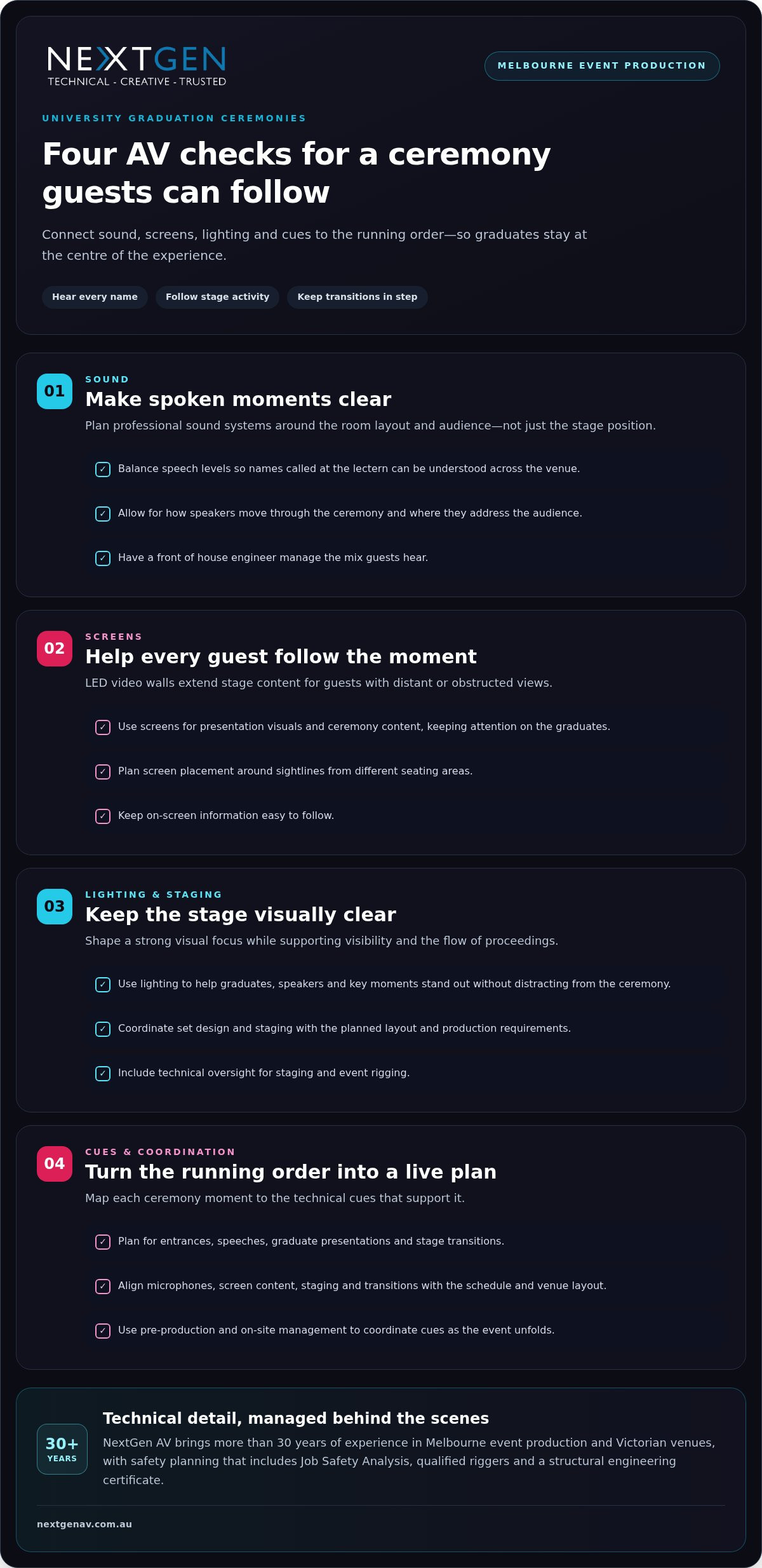
Planning university graduation AV production in Melbourne
Strong planning starts with the ceremony’s purpose and the experience you want graduates and guests to have. Shape university graduation AV production around the format, running order and venue, connecting technical decisions to the moments that matter instead of treating sound, screens and staging as separate requirements.
Set the brief and venue requirements
Begin by identifying the ceremony format, key moments and presentation content. Consider how graduates enter and move across the stage, where speakers will address the audience, and what guests need to see and hear. These details form a practical brief for the production team and guide choices across sound systems, LED video walls, lighting and staging.
Next, align the brief with the venue layout. Review the audience arrangement, stage position, sightlines and production access with the event team. For example, plan screen positions with both rear seating sightlines and presentation content in mind. Clear coordination at this stage helps the production plan fit the room and ceremony, while keeping venue requirements visible to everyone involved.
Bring production and event teams together
Before event day, establish who is responsible for each part of the running order, where key communication points sit, and how production cues relate to the schedule. This shared understanding helps the event team and technical crew work from the same plan, especially as speakers, graduates and presentations move through the programme.
Technical direction brings the production elements together. It connects creative intent with the practical coordination of sound, screens, lighting and staging, so each supports the audience experience and ceremony flow. NextGen AV brings more than 30 years of experience in Melbourne event production and Victorian venues to this planning process, helping university teams manage technical detail with confidence.
A proactive production partner can keep decisions and responsibilities aligned from the first brief through on-site coordination, rather than leaving the university team to join up every technical detail alone. Plan your event production with NextGen AV.
Deliver a memorable university graduation with NextGen AV
A polished graduation comes from technical decisions working together, from the first production brief to the final pack-down. NextGen AV partners with university event teams to shape ceremony objectives into a clear production plan, then coordinates the people and technical elements that bring it to life. The aim is a confident, well-paced event where production supports the occasion and graduates remain at the centre.
A production partner behind every moment
With more than 30 years of experience in Melbourne event production and Victorian venues, NextGen AV plans around the venue as well as the ceremony. Pre-production brings the brief, schedule and technical requirements into alignment. On the day, technical direction and on-site management coordinate professional sound systems, LED video walls, lighting, staging and rigging as one live operation.
That joined-up approach matters across every phase. The production team prepares the technical plan, coordinates cues during the ceremony and manages pack-down afterwards, while keeping communication clear with the university events team. NextGen AV manages more than 1,200 events annually, bringing production experience to the practical details. Your event plan can reflect its own format, venue and priorities.
From maintaining the ceremony’s pace to supporting a considered visual and audio experience, each production choice has a purpose. Technical coordination works quietly in the background, giving organisers more space to focus on graduates, guests and the significance of the day.
Take the next step
Start with your ceremony format, venue and key production goals. Sharing these priorities helps the production team understand the experience you want to create and shape the technical approach around it. With sound, screens, lighting, staging, rigging and technical direction coordinated through one plan, the complexity stays behind the scenes while your team focuses on welcoming guests and celebrating graduates.
For university graduation AV production in Melbourne, bring your event brief and production requirements to NextGen AV. Discuss your university graduation production.
Make the ceremony flow with confidence
A memorable graduation depends on more than a running order. University graduation AV production brings sound, LED video walls, lighting, staging and technical direction into one coordinated plan, so graduates are heard, stage activity is visible and transitions feel seamless. Early venue planning, considered sightline decisions and a clear cue plan connect each technical choice to the guest experience.
With more than 30 years of experience in Melbourne event production and Victorian venues, NextGen AV coordinates technical detail from pre-production through on-site delivery and pack-down. The team manages more than 1,200 events annually, bringing practical production experience to ceremonies with distinct formats and requirements. You can focus on graduates and guests while the crew manages the operation behind the scenes.
Share your ceremony format, venue and production goals with NextGen AV to start shaping a plan around your university’s needs. Discuss your university graduation production. Your graduates deserve a day that feels as significant as their achievement.
Frequently Asked Questions
What does university graduation AV production include?
University graduation AV production coordinates the technical elements that support a live ceremony, including professional sound systems, LED video walls, lighting, staging, rigging and technical direction. Planning connects these elements to the running order, venue layout and audience needs. The production team can manage preparation, on-site operation and pack-down, helping speeches, presentations and procession cues flow smoothly while graduates remain the focus.
How do you make sure guests can hear graduation speeches?
Clear speech audio starts with planning around the venue layout, audience arrangement and how speakers will use microphones. A front of house engineer manages the sound mix heard by guests, balancing levels to support intelligible speech throughout the room. Checks and rehearsal help prepare microphones and speakers before the ceremony begins. This is especially valuable when speeches and graduate name announcements need to remain clear across the venue.
Are LED screens useful for a university graduation ceremony?
Yes. LED video walls can extend stage content for guests seated far from the stage or whose view is obstructed. Screens can display presentation material and other ceremony visuals, helping guests follow key moments without relying on a direct view of the stage. Plan screen placement and content alongside the room layout and running order so visuals support the ceremony and remain easy to follow.
How far in advance should a university plan its graduation AV production?
Begin planning as soon as the ceremony format, venue and running order are taking shape. This gives the production team time to consider the room layout, stage position, sightlines, access, content and technical cues together. The planning timeline depends on the event’s requirements, so share the brief and key dates early. For Melbourne universities, coordination between the venue and production team helps keep responsibilities and technical details aligned.
Who manages AV cues during a live graduation ceremony?
A technical director coordinates production cues with the running order and keeps the technical crew aligned during live moments. Cues can cover processions, speaker changes, presentations and stage transitions, with each action planned to support the ceremony’s pace. Rehearsal and technical checks help the team prepare before guests arrive. On the day, clear coordination lets university organisers focus on graduates and guests.
Can university graduation ceremonies include live streaming?
Yes. A university graduation can include live streaming as part of a virtual or hybrid event plan, extending the ceremony to people who can’t attend in person. The production approach should connect the in-room programme with the experience for remote viewers, including how speech audio and presentation content are delivered. NextGen AV provides virtual and hybrid event solutions, with technical planning tailored to the ceremony format and audience.
What if an AV quote looks complete but leaves key event responsibilities unclear? Learning how to read an AV quote means looking beyond the equipment list to understand what happens before, during and after your event. A screen or sound system is only part of the picture. Planning, technical direction, crew, safe installation and pack-down all shape the result.
Comparing proposals can be difficult when each describes a different scope or uses technical line items without explaining their purpose. To compare them fairly, identify what’s included, who owns each task and how the production supports your event goals.
This guide explains how to assess AV proposals in plain language, compare equivalent deliverables and responsibilities, and spot details that can reduce event-day risk. We’ll cover production scope, technical roles, safety planning and the link between equipment choices and audience experience. With more than 30 years of experience navigating Victorian event venues, NextGen AV understands why access, timing and site requirements belong in the conversation from the start. The result is a clearer basis for choosing a production partner and a smoother path from planning to a polished event.
Key Takeaways
- Learn how to read an av quote by focusing on the production outcome, deliverables and responsibilities behind each line item.
- Separate equipment provision from the planning, crew and operation needed to bring the production together.
- Compare proposals against the same event brief, weighing suitability and audience coverage rather than equipment counts alone.
- Factor Melbourne venue access, schedules and site requirements into your assessment of production readiness.
- Use a clear approval sequence to align scope, resolve assumptions and establish who manages each stage of delivery.
How to Read an AV Quote: Start with the Event Outcome
An AV quote should describe the production solution your event needs, not just name the gear being supplied. An AV quote is a scoped proposal that sets out the technical deliverables, event requirements and responsibilities needed to deliver the planned experience. Start by checking whether it explains how the production supports your event, from the first presentation to the final pack-down.
Begin with the event format, audience and programme. A conference with keynote presentations, panel discussions and audience questions has different audio and screen needs from a product launch built around a reveal moment. The proposal should connect each major element, such as sound systems, lighting or LED video walls, to a specific purpose. For a useful overview of how staging, sound, lighting and video fit together, see this guide to live event support.
Match the scope to the event brief
Compare the proposal with your event brief. Does it reflect the format, running order and experience you want the audience to have? For a conference, microphones and screens should support clear presentations and smooth speaker transitions. For a launch, lighting and visuals may focus attention on a key moment. Each major technical choice should serve a defined part of the programme.
Check for pre-production planning and technical direction as well. These activities connect the creative brief with the practical decisions required for delivery, shaping the production around your event rather than assembling a generic equipment list.
Read beyond the equipment list
Equipment names alone don’t explain who plans the setup, installs and operates the systems, or packs them down. Look for responsibilities across each stage, including who coordinates technical requirements before the event and who manages live delivery. Clear ownership helps prevent gaps between a list of supplied equipment and a working production.
For audience-facing sound, check that the proposal identifies a front of house engineer. This audio engineer manages the mix heard by the audience, balancing speech and other programme audio so presenters can be heard clearly in the room. The role belongs in the production plan, not simply as another item beside the sound systems.
When planning and technical direction sit alongside equipment, crew and delivery responsibilities, the quote gives you a clearer picture of the complete production. You can then assess whether the proposal is built to support the event outcome you’ve briefed.
Decode AV Quote Line Items, Labour and Responsibilities
Line items are easier to assess when you group them by the work they represent: equipment, crew, planning, operation and logistics. Equipment describes the technical tools; labour and responsibilities explain how those tools are prepared, installed, operated and packed down. To understand how to read an av quote in practical terms, trace each item to the task it supports and the person or team responsible.
| Line item | What it means | Scope question it answers |
|---|---|---|
| Sound systems, screens, lighting or staging | Technical elements that support audience audibility, presentation visibility, atmosphere or the event environment. | What part of the programme or audience experience does each element serve? |
| Pre-production and technical direction | Planning and coordination that shape how technical elements work together. | Who develops the production plan and coordinates requirements? |
| Setup and pack-down crew | Labour to install, connect and remove equipment at the venue. | Are installation and pack-down responsibilities included? |
| Live technical operation | On-site expertise to manage systems during the programme. | Who operates the production as the event unfolds? |
| Logistics and access | Coordination of equipment movement and venue timing. | Are access arrangements and bump-in timing accounted for? |
Separate equipment from labour
A screen in the scope doesn’t, by itself, explain its installation, content feed or live operation. Sound systems support clear speech, while lighting and staging help shape the room and focus attention. A front of house engineer is a distinct role from the equipment: they manage the sound mix heard by the audience. Clear labour roles connect technical provision with a well-run programme. AVIXA’s audiovisual industry standards provide context for the professional standards that can inform system design.
Check assumptions and dependencies
Read for venue access, bump-in timing and pack-down arrangements, as these affect how the production can be delivered on site. Note dependencies on supplied presentation content, venue facilities or other event suppliers, and identify who coordinates each handover. The scope should also explain how changes to the programme or production requirements are recorded, so responsibilities remain clear as plans develop.
This framework helps you see whether the proposal connects equipment, people and logistics into a managed production. For a broader view of how planning and technical delivery work together, explore NextGen AV’s AV production guide.
Compare AV Quotes Fairly by Scope, Not by Equipment Count
A longer equipment list doesn’t automatically mean a stronger production. The real test is whether each proposal can deliver the same event outcomes, with suitable technical choices and clear responsibility for delivery. Proposals are comparable only when they define equivalent deliverables, crew, planning and responsibilities against the same event brief.
Start with one shared brief that records the event format, venue, audience, programme and intended experience. Assess each proposal against the same requirements. A conference with keynote presentations and panel discussions, for example, needs a technical plan that supports clear speech, visible content and smooth speaker transitions, not simply a larger quantity of equipment. Considering AV alongside event objectives is part of strategic event planning.
Build a like-for-like comparison
Create a comparison sheet and mark each requirement as included, excluded or dependent on another party. Record the assumptions beside each item. If one proposal relies on venue-provided facilities while another includes them in its scope, they aren’t equivalent until that difference is clear.
- Deliverables: What technical outcomes and systems are covered?
- Crew: Which roles are assigned to the production?
- Planning: What pre-event coordination and technical direction are described?
- Operation: Who manages the systems during the programme?
- Logistics: Are delivery, access, setup and pack-down responsibilities defined?
- Exclusions: What is outside the scope, or depends on the venue or another supplier?
This structure makes gaps visible and prevents different assumptions from being treated as matching deliverables. It also gives you a practical record of what each proposal commits to support.
Assess technical fit and accountability
Consider suitability, not just quantity. Do the audio, visual, lighting and staging choices fit the venue and programme? Will they support the audience throughout the event, including transitions between presentations, panels or other segments? A system’s value lies in how effectively it serves its role, not in how many line items describe it.
Look for clear coordination of technical decisions and live delivery. The proposal should show how planning connects the elements, who manages the production on the day, and how the team accounts for timing changes or contingencies. If a quote describes equipment but leaves operation or transitions undefined, record that as a difference in scope. Comparing on this basis helps you select a coordinated production solution, not simply the longest list.

Check Melbourne Venue Logistics, Safety and Production Readiness
A production plan has to work in the venue, not just on paper. When learning how to read an av quote, check that the scope accounts for site access, timing, safety planning and the people coordinating delivery. This is especially relevant for Melbourne CBD events, where venue arrangements and access windows can shape how equipment and crew reach the event space.
Review site logistics and timing
Trace the schedule from arrival through pack-down. The proposal should make clear how its production plan accounts for:
- Access: How the AV team coordinates entry and equipment movement with the venue and organiser.
- Bump-in: When setup can take place, and how that timing fits the event schedule and venue requirements.
- Live operation: Who manages technical delivery during the programme.
- Pack-down: How equipment removal is planned within the agreed site schedule.
Check that the quote reflects known venue requirements and the event running order. Identify coordination points between the AV team, venue and organiser, including who shares schedule updates and site information. With more than 30 years of experience navigating Victorian event venues, NextGen AV understands how early coordination helps align production plans with venue conditions.
Look for safety planning and technical oversight
Safety responsibilities should be visible in the production scope. Look for relevant Job Safety Analysis and Test and Tag arrangements, along with clear ownership of the associated planning and checks. Where staging or event rigging is part of the production, the proposal should identify qualified personnel and applicable structural documentation.
A structural engineering certificate provides documented evidence that a structure has been independently assessed for compliance and safety. Where relevant to the proposed structure, it clarifies the engineering documentation included in the production plan. These details connect the technical design with safe, considered delivery rather than leaving important responsibilities implicit.
Before approval, align the venue schedule, access arrangements, site requirements and named production responsibilities. This gives the venue and event teams a shared picture of how the technical plan will be delivered, from setup to pack-down.
For ideas on coordinating staging and lighting as part of a complete event environment, explore our stage and lighting production guide.
Turn the AV Quote into a Confident Production Decision
Once you’ve compared the proposals, make your decision through a clear sequence: align the scope with your event outcomes, resolve assumptions, assign responsibilities and confirm the final brief. This turns quote review into a practical production plan, with everyone working towards the same result.
Prepare a clear AV production brief
Bring the essential details into one place so technical planning starts with the right context. Include:
- Event format and audience: Describe the type of event and who will be attending.
- Programme: Outline key sessions, transitions and important moments.
- Venue and schedule: Share the location, known site requirements and timing details.
- Intended experience: Explain what you want guests to see, hear and feel.
- Deliverables and open decisions: Separate confirmed requirements from elements still being developed.
A clear brief helps connect technical choices to the event experience. It also makes it easier to resolve remaining assumptions before the scope is agreed.
Move from proposal to managed delivery
With the brief aligned, confirm who owns each part of the agreed scope, from pre-production planning and technical direction through on-site management and pack-down. NextGen AV coordinates these stages so equipment, crew and production decisions work together, supporting precise delivery for the audience rather than leaving separate tasks disconnected.
Melbourne venue experience can bring added confidence to local planning, where site requirements and schedules need careful coordination. NextGen AV also delivers events throughout Australia, bringing a consistent production approach to events across the country.
To make the decision, confirm the scope, document resolved assumptions, assign responsibilities and approve the event brief. You’ll then have a shared plan to guide delivery from preparation through pack-down.
Make Your Next Production Decision with Confidence
The clearest way to read an AV quote is to look past the equipment count and assess the full production picture: whether the scope supports your event brief, responsibilities are assigned, and venue logistics and safety planning are accounted for. Knowing how to read an av quote helps you compare proposals on equivalent deliverables and choose a partner focused on both the audience experience and technical execution.
NextGen AV brings more than 30 years of experience navigating Victorian event venues, with a Melbourne-based team delivering events throughout Australia. Production planning can include Job Safety Analysis, Test and Tag and qualified riggers, connecting technical decisions with considered delivery from setup through pack-down.
Your event deserves a production plan built around its purpose, not a generic equipment list. Plan your event production with NextGen AV to move forward with a team ready to manage the technical detail behind a seamless experience.
Frequently Asked Questions
What should an AV quote include?
An AV quote should set out the production scope, deliverables, responsibilities and event requirements, not just list equipment. Look for the technical systems, planning, crew, setup, live operation, logistics and pack-down relevant to your event. Each major item should support a clear programme need, such as clear speech, visible presentations or a planned lighting atmosphere. This makes it easier to understand what the proposal will deliver and how the work will be managed.
How do I compare two AV quotes fairly?
Compare both proposals against the same event brief and required outcomes. Use consistent categories such as deliverables, crew, planning, operation, logistics and exclusions, then mark each as included, excluded or dependent on another party. Consider whether the technical choices suit the venue and programme, and who coordinates decisions and live delivery. A longer equipment list doesn’t necessarily mean a stronger production if responsibilities or audience needs are left unclear.
Why does an AV quote list labour separately from equipment?
Equipment and labour describe different parts of production. Systems such as sound, screens, lighting and staging provide technical capability, while crew plan, install, operate and pack down those systems. Live operation also requires relevant technical expertise. For example, a front of house engineer manages the sound mix heard by the audience. Clear labour details show how equipment will become a coordinated event experience, rather than simply being supplied to the venue.
What does an AV quote exclusion mean?
An exclusion identifies work, equipment or responsibility that sits outside the proposal’s stated scope. It may also show that part of the delivery depends on the venue, organiser or another supplier. Read exclusions alongside included items to spot gaps and dependencies. For example, if a proposal relies on venue facilities or supplied presentation content, establish how that handover fits the production plan before approving the scope.
Should an AV quote cover event safety documentation?
The quote should make relevant safety planning and documentation responsibilities clear for the proposed production. Depending on the work, this may include Job Safety Analysis, Test and Tag arrangements, qualified riggers and applicable structural documentation. Where a structure requires it, a structural engineering certificate records that it has been independently assessed for compliance and safety. Clear documentation and ownership help connect technical planning with considered event delivery.
What details should I provide for an AV quote in Melbourne?
Provide the event format, audience, programme, venue, schedule and intended audience experience. Include known venue requirements, access arrangements, bump-in and pack-down timing, and details of other suppliers or content handovers that affect production. For Melbourne events, local venue coordination and CBD access can shape site planning, so sharing those details early gives the technical team useful context for developing a suitable scope.
Can an AV quote include technical direction and on-site management?
Yes. An AV production proposal can include pre-production planning, technical direction, on-site management and post-event pack-down alongside equipment and crew. NextGen AV coordinates these elements to connect the agreed scope with live delivery. With more than 30 years of experience navigating Victorian event venues, a Melbourne-based team and events delivered throughout Australia, NextGen AV supports a coordinated production from planning through pack-down.
Ready to turn your event brief into a coordinated production plan? Discuss your event with NextGen AV.
The presenter is ready, the room is full, and the microphone cuts out. In that moment, finding the right event av technician hire melbourne support is about more than getting equipment working again. It’s about protecting the programme and keeping the audience connected.
Urgent availability, arrival arrangements and the level of support provided aren’t always clear until you ask. An operator, a fault-finding technician and a production partner have different responsibilities, so confirm the scope before you commit.
This guide explains how to assess an urgent AV support request, match technical expertise to your event setup and clarify escalation arrangements. You’ll find practical questions to ask about audio, LED video walls, lighting, staging and technical direction, including who will make decisions on site if a fault affects the running order.
With more than 30 years of industry experience, NextGen AV provides end-to-end event solutions from Melbourne, including equipment hire, technical direction and on-site management. Clear planning and responsibilities help put technical decisions in capable hands, so you can focus on delivering the event.
Key Takeaways
- Before arranging event AV technician hire in Melbourne, clarify whether you need equipment-only hire, an operator or managed technical support.
- Match the technician’s experience to your event format and AV systems, then confirm who will attend and how technical issues will be escalated.
- Compare the agreed scope, system familiarity, confirmed availability and on-site responsibilities rather than relying on a general promise of help.
- Give the provider a concise briefing: describe the fault, affected system, when it began and how it could affect the programme.
- NextGen AV’s technical direction and on-site management can help connect production decisions with the audience experience.
What does event AV technician hire in Melbourne actually cover?
Event AV technician support is skilled help to plan, operate or troubleshoot the technology your event relies on. That may mean preparing professional audio systems for a conference, managing LED video walls for a product launch or investigating a fault during a live programme. The right support helps presenters stay confident, audiences follow what’s happening and the running order stay on track. For a grounding in the term, audiovisual (AV) technology describes the mix of sound and visual components used in settings such as live events.
With event av technician hire melbourne, clarify the scope before you commit. Equipment-only hire supplies technology but doesn’t necessarily include someone to operate or troubleshoot it. An operator runs specified equipment; a technician may also diagnose faults, depending on their experience and agreed role. Full event production brings broader planning and coordination around the event’s technical requirements.
Technician, operator or production partner?
An operator might mix audio or run presentation playback, while a technician’s role may also include tracing a failed signal and identifying a practical fix. These responsibilities can overlap, so ask exactly what the person attending will manage. Technical direction coordinates people, systems and show requirements, linking technical decisions to the programme. If audio, lighting, screens and staging need to work together, a production partner may be better placed to manage those connections than an equipment-only supplier.
For urgent support, confirm availability, arrival arrangements and escalation contacts directly with the provider. Don’t assume short-notice attendance or a particular response time is included.
Which event AV systems may need support?
Match the support to the systems in your event plan and the fault’s potential effect on attendees. Technicians don’t all have the same experience across every system, so confirm relevant capabilities and responsibilities.
- Professional sound systems and microphones: Clear speech helps delegates understand presentations and keeps questions audible.
- Lighting: Well-managed event lighting supports visibility on stage and helps transitions feel deliberate.
- LED video walls: Reliable visuals keep key information, speaker content and brand material visible to the room.
- Staging and rigging: Confirm how structures and equipment placement will be planned and who is responsible for the work.
For example, a presentation fault may affect both the content on an LED video wall and the timing of a speaker’s entrance. Ask whether the technician can assess the relevant signal path and equipment, and who will coordinate decisions if more than one area is affected. Clear scope gives you a more dependable plan and lets your team focus on the audience experience.
How to assess an event AV technician’s technical capability
A technician’s experience is most useful when it matches the work in front of them. For event av technician hire melbourne, assess the event format, the systems in use and the faults most likely to disrupt the programme. A conference with presentation playback and audience microphones calls for different practical experience from a production involving complex lighting, LED video walls and staging.
Years in the industry provide context, but they don’t confirm a precise fit. Ask for examples of comparable events and how the proposed technician’s experience relates to your requirements. NextGen AV has more than 30 years of industry experience; confirm who will attend your event and what they’ll be responsible for.
Questions that reveal practical experience
Ask direct questions that show how the technician approaches live conditions. For example: “Have you supported this type of event and these systems?” and “How would you investigate this fault, and who would you escalate it to?” The answers should make responsibilities and decision-making clear before the room is live.
- Which comparable corporate, community or conference environments have you worked in?
- Are you familiar with the specific sound, lighting or video systems at our event?
- Who will attend, what can they operate or diagnose, and who makes decisions if the fault affects multiple systems?
A technician experienced with professional audio may not have the same depth of knowledge in LED video walls or lighting control. Match the person’s stated capabilities to the systems and likely failure points in your brief.
Safety evidence and technical responsibility
Safety documentation should relate to the actual work, not appear as a generic credential list. If the plan includes a structure or event rigging, ask whether a structural engineering certificate is relevant and what documentation applies. Confirm whether a qualified rigger or High-Risk Work Licence is needed for the specific tasks, rather than assuming every event setup requires the same credentials.
Ask which Job Safety Analysis applies to the work and how Test and Tag records relate to the equipment being supplied. These checks help clarify who is responsible for each technical and safety matter before setup begins. They also give you a clearer basis for coordinating with your venue and event team.
Assess the production partner as well as the individual. NextGen AV provides technical direction and on-site management. Review its event production and technical support when deciding whether that broader coordination suits your brief.
What to compare when hiring urgent event AV support in Melbourne
Urgent support isn’t one standard service. Compare what the provider will supply, who will be responsible on site and how they’ll respond if an issue affects the programme. This makes event av technician hire melbourne easier to assess against your event’s format, technical risks and timing.
| Support option | What to confirm | Best suited to |
|---|---|---|
| Equipment-only hire | Which equipment is supplied, who sets it up and who troubleshoots faults? | Events with an experienced team already assigned to operate the systems. |
| Operator booking | Which equipment the operator will run and whether fault diagnosis is included. | A defined operating role, such as managing presentation playback or audio. |
| Managed technical production | Who coordinates connected systems, technical decisions and escalation. | Events where sound, lighting, screens and staging need to work together. |
Check that the provider’s experience matches your event. For a presentation, prioritise clear speech, playback checks and presenter support. A conference may need coordinated microphones, screens, cues and smooth programme transitions. For an outdoor activation, ask how the team will account for site conditions, display requirements and contingency planning.
Compare the details
Ask whether one team can coordinate the sound, lighting and screen requirements, or whether separate providers need to align. Melbourne venue familiarity can be useful, but don’t assume it. Ask whether the team knows your venue and what venue-specific information they need to plan the work.
Confirm urgent availability and response arrangements directly. Ask who will attend, when they can arrive, how to contact them and who makes decisions if the fault affects several systems. A Melbourne base may be relevant to planning, but it doesn’t confirm a particular dispatch time or availability.
Put the scope in writing
Before confirming, document the agreed responsibilities for:
- Arrival and setup, including who connects and checks each system.
- Operation during the event and any troubleshooting included.
- Escalation contacts and what falls outside the technician’s scope.
- Pack-down and handover responsibilities.
Clear boundaries prevent gaps between the equipment supplier, operator, venue and event organiser. If you’re planning connected technical requirements, you can discuss your event AV support requirements with NextGen AV.

How to brief an event AV technician when time is tight
A clear first briefing helps a provider assess whether they can support your event and what information they need. For event av technician hire melbourne, lead with the fault and its effect on the programme, then give the practical details needed to confirm availability, scope and next steps. Share what you know; don’t delay the call to investigate equipment yourself.
Prepare the key details
Use this order for the first conversation. Short, accurate answers help the provider understand the issue and its urgency.
- Event and venue: State the event format, venue name, room or activation location, access instructions and schedule.
- Fault: Describe the symptom in plain language, which system is affected and when the issue began. For example, say whether a microphone has stopped producing sound or presentation playback is no longer appearing on screen.
- Programme impact: Explain what’s happening now and which upcoming moment is affected, such as a speaker presentation, audience questions or a scheduled screen cue.
- AV setup: Identify the affected microphones, professional sound systems, LED screens, lighting or playback equipment. Share known equipment details, signal-flow notes or photographs if you already have them and can provide them safely.
- On-site contact: Give the name and contact details of the person who can meet the technician, coordinate venue access and answer questions.
Also explain the audience needs and key programme moments. A provider can assess a fault more accurately when they know whether clear speech, a visual presentation or a lighting cue is central to the next part of the event.
Agree the escalation plan
Before relying on support, ask the provider to confirm availability, who will attend, what they’ll manage and what happens next. Clarify arrival and access arrangements, the agreed scope, how to escalate an issue beyond that scope, and who will make technical decisions on site. Confirm availability and response arrangements directly rather than assuming them.
Agree who will update presenters, venue staff and the event team if a technical decision affects the running order. Prioritise the elements that keep the programme moving, such as restoring presenter audio or switching to an agreed alternative if screen content is unavailable. A named decision-maker and a clear communication path reduce crossed instructions under pressure.
For support planning that accounts for your technical brief and event context, speak with NextGen AV about your Melbourne event.
Why partner with NextGen AV for Melbourne event tech support
Choosing support is about more than finding someone who can operate equipment. You need a team that understands how technical decisions affect the audience, the programme and the people delivering it. NextGen AV combines event planning, technical direction and on-site management to help organisers coordinate the moving parts behind a polished event.
A production partner beyond equipment hire
NextGen AV provides audio-visual production and equipment hire for corporate and community events, with event solutions available across Australia. Its team brings more than 30 years of industry experience. That background can help inform practical questions about your event format, technical setup and the coordination required on site.
NextGen AV’s Melbourne base is one consideration when discussing equipment and logistics. It doesn’t confirm technician availability or a response time, so check those details for your specific request. Technical direction can connect audio, lighting, LED video walls and staging requirements, while on-site management helps keep responsibilities clear as the programme unfolds. This gives you a production team to coordinate technical details while you focus on presenters and guests.
For event av technician hire melbourne, the value of a production partner is this wider view. The right support considers not just an individual fault, but how resolving it affects the next cue, speaker or audience interaction. Agree the role and scope in advance so the technical team can work in step with your event team.
Confirm the right next step
Share your event date, Melbourne venue, technical issue or production brief, and the systems involved. Ask NextGen AV to confirm current availability, relevant capability, who would attend and the responsibilities included. Clarify escalation arrangements directly, particularly if the request is urgent or short notice. This gives both sides a clear basis for deciding whether the support fits your event.
With the scope understood, you can move forward with greater confidence and keep attention where it belongs: on a seamless experience for your audience. Plan your event AV support with NextGen AV.
Put your event in capable hands
Reliable AV support starts with a clear match between the technician’s skills, your event systems and the risks to the programme. Confirm who will attend, what they’ll manage, whether they’re available and how escalation will work before you rely on support. A precise brief helps the provider assess the issue and agree on practical next steps.
For event av technician hire melbourne, NextGen AV brings more than 30 years of industry experience and provides technical direction and on-site management. If your event involves rigging, structures or electrical equipment, confirm which credentials, safety documents and responsibilities apply to the specific work and agreed scope.
Share your event date, venue, AV setup and support needs to discuss fit and current availability. Discuss your Melbourne event AV requirements with NextGen AV, and take the next step towards a smoothly delivered event with your audience and programme at the centre.
Frequently Asked Questions
Can I hire an event AV technician at short notice in Melbourne?
Short-notice support may be possible, but availability depends on the event date, Melbourne venue, required skills and provider’s schedule. Give the provider a concise brief covering the fault, affected systems, venue access and programme deadline. Ask them to confirm whether they can attend, when, what they’ll manage and how escalation works before you rely on support. Don’t assume emergency call-outs or a particular response time are available.
What does an event AV technician do during a live event?
An event AV technician may set up, operate, monitor or troubleshoot agreed systems during a live event. This could include microphones and sound systems, lighting, screens or playback equipment. Responsibilities depend on the booking and event plan, so confirm which systems they’ll manage before the event starts. Also agree who directs technical decisions and how issues will be escalated, so the team can respond clearly if a fault affects the programme.
Should I hire an AV technician or an event production company?
Choose a technician for a defined operational or troubleshooting requirement; consider a production partner when planning, technical direction, equipment and on-site management need to work together. The right fit depends on how many systems connect and how complex the event is. For example, a single audio support role may have a narrower scope than coordinating conference microphones, screen cues and programme transitions. Ask the provider to set out responsibilities rather than assume every production task is included.
What information should I give an AV technician when reporting a fault?
Share the Melbourne venue, event timing, symptoms, affected system and when the issue began. Explain the programme impact, including what needs to happen next, such as restoring a presenter’s microphone before a speech. Provide equipment details, signal notes or photographs if available and safe to share. Name an on-site contact who can coordinate access and decisions. This briefing helps the provider assess technical fit and confirm whether they can assist.
How do I check an event AV technician’s safety credentials?
Ask which credentials and safety documents apply to the specific work, structure and equipment at your event. Depending on the agreed scope, this may include a structural engineering certificate, Job Safety Analysis, a qualified rigger, a High-Risk Work Licence or Test and Tag records. Don’t assume every item applies to every task. Ask the provider to explain what evidence is relevant and who is responsible for the associated work.
Can a technician support sound, lighting and LED screens at the same event?
Some production teams can coordinate multiple systems, but capability depends on the crew assigned and the agreed scope. Confirm who is responsible for professional audio, lighting and LED screens, how show cues will be coordinated, and whether specialist operators are required. Share the programme and technical setup early so the provider can assess the support needed. Clear responsibilities help connected systems work in step and keep transitions smooth for the audience.
What should an event AV support booking confirm?
Confirm the event date and venue, the technician’s responsibilities, systems covered, access and setup arrangements, operating period, escalation contact and pack-down scope. Ask the provider to document confirmed availability and any limits to the service. Clarify who will make technical decisions and who to contact if a fault falls outside the agreed work. Written responsibilities help prevent assumptions, especially since equipment hire alone doesn’t necessarily include operation or troubleshooting.
What if runway lighting could make every fabric, silhouette and movement read clearly while shaping the mood of the whole show? Fashion show runway lighting Melbourne productions need to do more than create drama: the design must help garments appear clear to the audience and account for camera views.
If you’re balancing creative impact with venue limits, rigging, power and a tightly timed runway schedule, early coordination matters. Lighting, staging and technical direction need to work together so the collection stays in focus and the production runs smoothly.
This guide explains how to plan lighting around garments, models, camera positions and the venue, along with practical details that help organise the production. NextGen AV provides lighting design, staging, rigging and technical direction for Melbourne events. Its team can support planning from pre-production through on-site management and pack-down, helping you coordinate the technical details behind the runway.
Key Takeaways
- Plan runway lighting as part of the overall production, aligning the collection, models, audience experience and schedule.
- Consider how lighting direction and garment texture affect what audiences see, and confirm photography and video needs with the production team.
- Choose between clean, garment-led illumination and a more atmospheric look by weighing the collection’s identity, runway scale and camera views.
- For fashion show runway lighting melbourne, confirm venue access, rigging information, runway layout and production timing early.
- Look for a production partner who coordinates lighting design, technical direction, safety planning and on-site delivery, not just equipment supply.
Why runway lighting in Melbourne shapes the whole fashion show
Runway lighting has to serve the collection, models, audience and event schedule at the same time. It’s not simply a matter of aiming lights at a catwalk. A useful plan considers what each look needs to communicate, where people will be watching from, and how lighting cues fit the running order.
The purpose of runway lighting is to make garments and model movement clear while creating an atmosphere that supports the collection. When the design reflects both the visual brief and the practical needs of the production, the runway feels connected to the rest of the event.
For organisers planning fashion show runway lighting in Melbourne, start by defining the experience the collection should create. A clear brief gives the production team direction for design decisions and helps balance creative ambition with the venue’s conditions.
What does fashion show runway lighting in Melbourne need to achieve?
Four goals need to work together: garment visibility, confident model movement, audience sightlines and the intended mood. A lighting angle that brings out the texture of a structured fabric may affect how a flowing or reflective material appears. Share the collection’s colours, materials and creative direction early so the lighting plan responds to the clothes rather than relying on a generic look.
Runway lighting also has a different job from ambient light around the event space. General room lighting helps people move around and orient themselves; focused runway lighting directs attention to each look. The stage lighting techniques overview offers background on principles that can inform a production, but the final design should respond to the show’s specific brief.
Why does a Melbourne venue change the plan?
Every room has its own layout and infrastructure. Ceiling height, available rigging positions, audience arrangement and production access can all affect where lighting can go and how the runway should be arranged. Confirm these details with the venue early, including any event-specific restrictions. Don’t assume a setup used at another venue will work in your space.
Access and timing matter, too. The production plan needs to account for when the team can enter, install and check the setup alongside the event schedule. Give your lighting team the intended runway layout and confirmed venue information so lighting design, staging, rigging and technical direction can be coordinated before show day. Early alignment helps keep the focus on the collection and audience experience.
How runway lighting brings garments, movement and camera views together
Lighting direction affects how fabric appears as a model moves. Front lighting can help reveal colour and detail, while side lighting can bring out texture and create dimension. The right balance depends on the garments, runway route and audience view. Reflective, textured and dark fabrics each bring different considerations, so share collection references, colours and material details during pre-production.
A runway lighting plan needs creative intent and camera awareness so the collection reads clearly in the room and in captured images. Photography and video can respond differently to lighting than a live audience does. Confirm camera positions, capture plans and any live-streaming needs with the production team, then review representative garments under the proposed lighting during a rehearsal or test if available. Advice on perfect fashion show lighting also highlights the value of considering models, garments and the runway as one visual composition.
How do colour and fabric affect the lighting brief?
Bring creative references into the technical conversation early. Dark garments may need careful attention to retain visible detail, while reflective material can respond strongly to the direction and character of light. Treat these as design factors to test, not outcomes to assume. Reviewing sample looks under the planned conditions gives the team a chance to assess how colour, texture and movement appear before the show.
How should lighting support models and cameras?
Map the full runway route, including model entrances and exits, stopping positions and photographer locations. This helps the lighting team consider how each look will appear as models approach, turn and pause, rather than designing for only one audience angle. Share the map with the lighting designer and camera team so their requirements can be coordinated.
Lighting cues should follow the agreed running order and be coordinated with the show caller or stage manager. Transitions can then support the pace of the show rather than compete with it. For broader context on how staging and lighting work together, see this stage and lighting hire guide.
For fashion show runway lighting in Melbourne, align the creative brief, garment tests, camera positions and cue sequence before production day. If you’re shaping the technical plan, talk with NextGen AV about runway lighting design as part of your production planning.
Runway lighting options in Melbourne: match the design to the show
The right lighting approach starts with the collection, not a preset effect. Clean, garment-led illumination keeps attention on colour, cut and detail. A more atmospheric design can make a show feel more dramatic, but effects should support the clothes rather than compete with them. For fashion show runway lighting in Melbourne, weigh the creative direction against runway scale, audience positions and photography or video plans before settling on a look.
Should the runway feel editorial, dramatic or understated?
Use references from the collection and event brief to describe the intended mood. Editorial and understated looks may call for a restrained approach that lets the garments lead; a more expressive design can shape the atmosphere and create a stronger visual frame. Neither approach is automatically better. First confirm garment visibility, sightlines and camera needs, then decide where effects add meaning and where they might distract.
The table below connects common event priorities with design considerations. Use it as a briefing prompt, not a fixed technical prescription.
| Event priority | Lighting-design consideration |
|---|---|
| Garments take centre stage | Prioritise clear, consistent visibility and keep effects secondary to the collection. |
| A distinctive mood | Use atmosphere to reinforce the creative brief while preserving clear views of each look. |
| Photography or video | Share camera positions and capture plans early so the design considers both the room and the lens. |
| A compact or unusual runway layout | Review audience positions and the route before deciding how the lighting should cover the space. |
When should lighting integrate with staging and sound?
Coordinate lighting positions with runway dimensions and stage layout from the outset. Changes to the route or staging can affect sightlines and the areas the lighting needs to cover. Align the creative plan with the production layout before finalising cues. This joined-up planning helps the technical team manage the details without pulling focus from the show.
Sound systems and lighting cues also need to follow the agreed show sequence, particularly when music sets the pace for model entrances. Coordinate cue timing with the show caller or stage manager, and share audio requirements with the production team. For related planning, see this professional sound system hire guide. If visual content is part of the concept, decide how it will complement the runway rather than compete with the collection.

Plan Melbourne runway lighting with venue, rigging and safety in mind
A well-designed runway also needs a practical production plan. For fashion show runway lighting in Melbourne, establish the creative brief, confirm venue details, coordinate lighting with the runway and staging, plan technical delivery, then rehearse before doors open. This sequence gives the production team a chance to resolve constraints before they affect the event schedule.
- Establish the brief: Define the collection’s visual direction, runway route and audience experience.
- Confirm the venue: Check access, schedule, available plans, power, ceiling details and rigging information.
- Coordinate the design: Align lighting positions with the runway layout, staging and camera views.
- Plan and rehearse: Confirm production responsibilities, cue timing and the rehearsal plan with the relevant teams.
What should organisers confirm with the venue?
Ask the venue for current information about access, available rigging points, power and its event approval process. Confirm who will provide the venue plans and who reviews or approves the proposed production design. These checks are venue-specific, not universal requirements for Melbourne events, so get the details directly from the venue rather than relying on assumptions.
Share the intended runway layout and schedule with the production team. A clear plan helps them assess how the room’s infrastructure and access arrangements affect lighting positions, staging and installation timing.
How should rigging and safety be planned?
Where the design calls for suspended lighting or other equipment, consider rigging as part of the overall production plan. The venue and qualified production personnel can confirm what the proposed setup involves and which people, checks and documents are relevant to that specific work. Safety planning should reflect the actual venue, equipment and scope rather than relying on a generic checklist.
Clarify responsibilities with the venue and production team, including who reviews the proposed setup and what checks or documentation apply. Requirements depend on the event and venue, so confirm the relevant details during planning. Coordinating lighting, staging, rigging and technical direction early helps keep responsibilities clear and supports an organised rehearsal and show-day schedule.
Bring the creative brief and venue information together with a production team that can manage the technical details. Discuss Melbourne event production with NextGen AV to plan runway lighting around your venue, schedule and staging requirements.
Choose a Melbourne end-to-end runway lighting partner
Fashion show runway lighting in Melbourne calls for more than a lighting concept or equipment list. Choose a partner who can connect the creative brief with technical direction, safety planning and on-site coordination, so production details support the show rather than becoming another task for your team to manage.
A supplier focused only on equipment may not coordinate how lighting fits with staging, rigging, venue requirements and the running order. An end-to-end production partner should explain what they’ll manage and where other teams need to be involved. Check that the proposed scope covers the stages you need, from pre-production and technical planning through installation, operation and pack-down where included.
What should a runway lighting partner manage?
Establish clear points of contact for your event, venue and creative teams. Ask who will coordinate production details, how lighting cues will be agreed, and how cue changes or schedule adjustments will be communicated on show day. These arrangements help everyone work from the same plan, particularly when a change to timing or runway layout affects more than one production element.
Before appointing a partner, check that their approach addresses:
- Lighting design shaped around the collection, runway and audience experience.
- Technical direction that connects lighting with staging, rigging and the event schedule.
- Project-specific safety planning coordinated with the venue and relevant production personnel.
- On-site roles, communication and cue management, with installation and pack-down responsibilities clearly scoped.
What experience and evidence should you ask for?
Request examples relevant to fashion or live events, then clarify what each project involved. The size of a lighting rig alone doesn’t explain the brief, venue or production responsibilities, so ask how an example relates to your event. Look for evidence that the proposed team can coordinate the design and practical details required for your show.
Also ask how technical direction, rigging and safety planning would apply to your proposed production. NextGen AV brings more than 30 years of industry experience. That’s useful context for planning, not a guarantee of a particular result. Confirm which personnel, documents and checks are relevant to your event’s specific scope.
With the right partner, creative intent and production planning stay connected from the first brief to show day. Plan your Melbourne fashion show with NextGen AV and discuss the lighting design, staging, rigging and technical direction your runway requires.
Bring your runway vision to life
Strong fashion show runway lighting in Melbourne connects the collection, model movement and audience experience in one considered design. A useful plan also accounts for camera views, venue conditions, rigging, safety and show timing, so creative ambition is matched by practical technical planning.
Choose a production partner who coordinates lighting design, staging, rigging and technical direction rather than focusing only on equipment. NextGen AV provides event production and equipment hire, with a team that handles pre-production planning, on-site management and pack-down. Its Melbourne-based team can help coordinate the technical details around your runway and venue.
With the production details planned behind the scenes, you can focus on the collection and the moment it meets the audience. Plan your Melbourne runway production with NextGen AV and discuss the lighting design, staging, rigging and technical direction your show requires.
Frequently Asked Questions
How do you light a fashion show runway so garments look clear?
Start with the collection, then plan light direction and coverage around its colours, materials and the audience’s view. Dark, reflective or textured garments may need particular consideration because they can appear differently under different lighting. Share garment references with the lighting team and, if a rehearsal or test is available, review representative looks under the proposed setup. This gives the team a chance to assess visibility before show time without assuming one look suits every collection.
What lighting is used for a fashion show runway?
A runway design may combine focused front lighting to reveal garments, side lighting to bring out shape and texture, and back lighting to separate models from the background. The balance depends on the collection, room layout and intended mood. Some shows favour clear, restrained illumination; others add more atmosphere. The lighting designer should develop the approach from your brief and venue details rather than selecting effects before the visual priorities are clear.
Can runway lighting work for both the audience and photographers?
Yes, if the plan accounts for both the live view and camera positions. Share photographer locations, video coverage and any streaming requirements with the production team early, as lighting that feels effective in the room may appear different on camera. Map sightlines along the runway, including model entrances, turns and stopping positions. Where possible, review representative garments during a rehearsal or test to check how the planned look translates to images.
How do I plan runway lighting for a Melbourne venue?
Planning fashion show runway lighting in Melbourne starts with a clear creative brief and early venue checks. Confirm access and production timing, request current venue plans, and ask about available rigging positions, power and the venue’s approval process. Share the intended runway layout with your production team so they can coordinate lighting, staging and technical direction around the actual room. Venue conditions and processes vary, so verify details with your chosen venue.
What should I ask a runway lighting company before booking?
Ask who will lead design and technical direction, what the proposed scope includes, and how the team will coordinate with your venue and creative contacts. Clarify whether installation, operation and pack-down are included, and who manages cue changes and show-day communication. Request relevant fashion or live-event examples, then confirm what each example involved. A clear answer should connect the creative approach with the practical production responsibilities for your event.
Does runway lighting need to be coordinated with staging and sound?
Yes. Runway dimensions and stage layout influence lighting positions and audience sightlines, while music and model entrances affect cue timing. Coordinate the lighting plan with staging and sound systems, and make sure the show caller or stage manager has the agreed running order and cue information. Early communication helps the teams manage transitions together, so the technical elements support the show’s pace rather than interrupting it.
What safety information should be confirmed before event rigging?
Confirm the venue’s rigging information and approval process, then ask qualified production personnel to assess what the proposed setup requires. Clarify who is responsible for the work and which safety documents, equipment checks and credentials apply to the specific event. Requirements vary with the venue and production, so confirm the relevant details rather than assuming every check or document applies.
For hybrid conference production melbourne, the best starting point is not the platform with the longest feature list. It’s the audience journey: how people onsite and online will watch, participate and connect. A platform may offer plenty of functions, but if they don’t support your event plan, they can add complexity without improving engagement.
Look beyond streaming quality. Remote attendees need a practical way to take part, and your team needs clear coordination between the platform, venue AV and live production. A structured evaluation can help you make those decisions before the technical plan is locked in.
This guide explains how to compare platform capabilities with your audience needs, session format and production requirements. You’ll learn what to confirm with platform providers, what to check during Melbourne venue scoping, and how technical direction can connect the online experience with the room. NextGen AV provides end-to-end event production and equipment hire, including planning, technical direction and on-site management, to help bring those elements together.
Key Takeaways
- Start with the audience journey, then shortlist platforms that fit your conference format and participation needs.
- Compare meeting-style, webinar-style and event-platform approaches against session flow, interaction and production integration.
- For hybrid conference production melbourne, assess the platform alongside venue AV, camera coverage, audio and presenter cues.
- Document your requirements and confirm platform features, integrations and accessibility tools directly with the provider.
- Clarify technical responsibilities early so your production team can connect platform decisions with live delivery in Melbourne.
Hybrid conference production in Melbourne starts with the audience journey
Hybrid conference production in Melbourne brings the in-room event and the live remote experience together, so both audiences can follow the programme and participate. The platform is important, but it’s one part of a wider production plan. A format that works for a small, conversational meeting may not suit a conference with multiple sessions or different kinds of interaction. Start by defining what each audience needs to do, then assess platform functions against that journey.
A Hybrid event brings in-person and remote participation together. For a conference, that connection needs to be planned rather than assumed. Choose a hybrid conference platform based on the functions it needs to provide for each audience. Confirm features, integrations and accessibility tools directly with the provider, then check that they fit your event format and production workflow.
Map the experience for both audiences
List what onsite attendees, remote attendees, speakers and moderators need at each stage. Consider registration and joining, how people will follow sessions and ask questions, and whether post-session access is part of the plan. A video meeting format may suit direct conversation, while a conference-focused experience may better support a scheduled programme. Compare the actual functions on offer instead of relying on the format label.
Plan how presenters will acknowledge questions from the room and online. A moderator can manage the flow, select questions and cue speakers, rather than asking presenters to monitor competing channels while delivering their session. Confirm that the platform supports the participation approach you intend to use.
Separate the platform from the production system
The platform carries the remote experience, but it doesn’t manage every part of the live event. Camera coverage shapes what remote attendees see, while sound systems and microphones help them hear presenters. Lighting supports visibility on camera, and the stream connects the room to the online audience. Confirm the venue’s connectivity, room layout and technical requirements during event scoping.
Involve the people planning and delivering onsite AV and technical direction in platform selection. Early coordination clarifies how cameras, audio, lighting, screen content and presenter cues will work together, and who is responsible for each part of the workflow. For a broader look at production planning, see our guide to hybrid event services in Australia. NextGen AV’s Melbourne-based team provides professional audio, lighting, LED video walls, staging and technical direction, helping align platform decisions with the practical needs of the room.
Compare hybrid conference platforms by the experience they support
Compare platforms against your programme, not just their feature lists. A meeting-style tool may suit a discussion-led session, while a webinar-style format may fit a presentation with managed audience participation. An event platform may support a broader programme, but you’ll still need to verify its specific functions with the provider. The right platform is the one that meets your event’s confirmed requirements.
| Approach | Event format | Audience interaction | Session flow | Production integration |
|---|---|---|---|---|
| Meeting-style | Consider for panel discussions or direct conversation. | Check how attendees can speak, submit questions or participate. | Confirm how speakers and moderators move between sessions. | Test how the platform fits the planned audio and video workflow. |
| Webinar-style | Consider for presentations with a more managed audience experience. | Verify available question and engagement functions. | Check how presenters, moderators and sessions are controlled. | Confirm how the stream and content connect with onsite production. |
| Event platform | Assess for conferences with multiple sessions or tracks. | Verify the functions needed for remote participation. | Check navigation between sessions and any planned follow-up. | Confirm integrations and technical requirements with the provider. |
Match format to sessions
Map the programme before shortlisting platforms. A panel discussion, a presentation followed by questions, and simultaneous tracks place different demands on speakers, moderators and remote participants. Consider how people will enter each session, how questions will reach the stage, and who will guide transitions. Don’t assume every conference needs the same level of interaction or platform complexity. Select functions that support the sessions you’re actually running.
Test interaction and access
Walk through the attendee journey, from invitation and login to live participation. If you plan to use audience engagement software for polls or questions, confirm those functions, moderation controls and required integrations directly with the platform provider. Verify recording options and access controls too, rather than assuming they’re included. For broader delivery considerations, read our guide to full-service event production.
For hybrid conference production melbourne, platform testing should be part of the production plan, including how session content and audience interaction will be managed onsite and online. If you’re aligning platform decisions with onsite AV and technical direction, explore NextGen AV’s event production services.
Will the platform alone deliver a seamless hybrid conference?
No. A platform can carry the online experience, but it can’t manage every onsite production requirement. Remote viewers rely on what the room sends them: clear presenter audio, useful camera framing, readable screen content and well-timed cues. If a presenter is difficult to hear or the camera misses a key moment, platform features alone won’t fix the experience.
That’s why hybrid conference production melbourne needs a coordinated plan for the platform and the production system. Agree early how the room, speakers and remote audience will connect, then assign responsibility for each part of delivery.
Connect the room to the remote audience
Plan audio for online listeners as well as people in the room. The sound system and microphones need to capture presenter speech clearly for the stream, while camera framing should help remote attendees follow the speaker, panel or relevant activity. Discuss room audio requirements with your production team, and see our guide to professional sound system hire for more on how audio shapes the audience experience.
Coordinate screen content as well. Where event displays are part of the setup, a video processor can manage content signals for those displays. Confirm how slides, playback and other planned visuals will appear both in the venue and on the stream, so remote attendees can follow the same key information.
Plan for ownership and failure points
Make responsibilities explicit across the organiser, platform provider, venue and production team. Name who handles platform administration, monitors the stream, supports speakers, and coordinates venue connectivity and room access. Confirm each responsibility with the relevant party instead of assuming it sits with another team.
- Organiser: Own the run sheet, speaker information and decisions about recording and post-event access.
- Platform provider: Confirm platform functions, access controls, recording options and relevant integrations.
- Venue: Confirm connectivity, room layout and available technical information during event scoping.
- Production team: Coordinate onsite audio, cameras, screen content and presenter cues with the agreed workflow.
Rehearse hand-offs and agree how teams will communicate if a connection, presentation file or speaker cue doesn’t go to plan. Set out who to contact and how an issue will be escalated, without assuming every problem can be prevented. Before selecting a platform, confirm who receives recordings, how content will be handed over and what post-event access is expected. A background technical production reference can support planning, but your event requirements and assigned responsibilities should guide the final workflow. For help aligning onsite AV and technical direction, learn about NextGen AV’s production services.

Use this Melbourne hybrid conference platform selection checklist
A clear selection process keeps platform decisions connected to the event you’re producing. For hybrid conference production melbourne, assess the attendee journey, platform functions and onsite technical workflow together, then confirm who owns each part of delivery.
Build a requirements brief before comparing providers
Start with a written brief. Record who will attend, how sessions will run, what remote participants need to do and what content they’ll see. Separate essential requirements from optional functions so a long feature list doesn’t distract from what the conference needs.
- 1. Document the audience and programme. List onsite and remote audience groups, session formats, speakers, moderators, panel discussions, tracks and question periods.
- 2. Define participation and content. Note planned polls, questions, presentations, video playback, recording or post-event access. Confirm directly with each provider which platform functions support these requirements.
- 3. Map the production workflow. Identify how the platform needs to connect with onsite sound systems, screens and cameras. Confirm requirements with the production team and platform provider, including how presenters and content will move through the programme.
- 4. Scope the Melbourne venue. Ask the venue team to confirm room layout, access arrangements, connectivity and relevant technical requirements. Share these details with production leads so the proposed workflow fits the room.
Validate the workflow before event day
A provider’s feature list isn’t a substitute for testing your planned event. Arrange a technical rehearsal with presenters, moderators and relevant production leads. Use it to check attendee access, content playback, speaker transitions and the audience interactions you intend to run.
- 5. Test the full sequence. Rehearse a representative session from joining through to questions and transitions. Check that the platform workflow and onsite production elements work together as intended.
- 6. Assign ownership. Name who administers the platform, supports speakers, monitors the stream and coordinates onsite production. Agree how issues will be communicated and escalated during rehearsal and live sessions.
- 7. Make the selection. Compare providers against the requirements brief, note any gaps, and verify outstanding features, integrations and access needs directly before confirming your choice.
In short: document requirements, check compatibility, rehearse the workflow and assign clear ownership. This gives your team a practical basis for selecting a platform and coordinating its role in the live event. If you’re planning a Melbourne conference, review NextGen AV’s hybrid production services.
Choose a Melbourne partner to bring the platform to life
A platform demonstration can confirm what the software does. It can’t show how well the platform will connect with your venue, speakers, event content and onsite AV. For hybrid conference production melbourne, assess whether the production partner can bring those moving parts into one coordinated plan, with clear responsibilities from preparation through to pack-down.
Assess experience beyond the platform demonstration
Ask how the team will coordinate platform requirements with room audio, cameras, screens and presenter cues. Clarify who leads technical direction, supports rehearsals, manages live operation and handles pack-down. Clear answers help you see whether the partner is planning for the audience experience, not simply supplying equipment.
NextGen AV is based in Melbourne and provides event production and equipment hire across Australia. Its services include professional audio systems, lighting design and equipment, LED video walls, staging and rigging, virtual and hybrid event solutions, and technical direction. Discuss your specific venue requirements during event scoping.
Look for a partner who raises dependencies early. Platform functions may need to align with the session schedule, content hand-offs and production workflow. Ask how decisions will be documented, how responsibilities will be shared between the organiser, venue, platform provider and production team, and how changes will be communicated before event day.
Turn your shortlist into an event-ready plan
Prepare a concise brief before your first production discussion. Include the event date, format, audience mix, venue and session outline, along with known platform requirements and content needs. This gives the production team a useful starting point to identify what needs confirmation, which decisions depend on others, and who owns each action.
Use the discussion to clarify how planning, setup, technical direction, live operation and pack-down fit together. Ask what information is still needed from the venue or platform provider, and how the agreed workflow will be checked before the conference. Early coordination keeps responsibilities visible and helps create a more connected experience for presenters and attendees.
NextGen AV can bring virtual and hybrid event solutions together with professional audio, lighting, LED video walls, staging and technical direction. Plan your hybrid conference production with NextGen AV by sharing your brief and aligning the platform with the live event from the outset.
Bring your hybrid conference plan together
The right platform fits your audience, programme and production workflow, not simply your preferred feature list. Confirm its functions with the provider, then test how it connects with the venue, onsite AV and remote attendee experience. Clear ownership and a technical rehearsal help your team prepare for live delivery.
For hybrid conference production melbourne, a production partner can connect platform decisions with the practical needs of the room. NextGen AV provides planning, technical direction, live operation and event AV, with a Melbourne base and event services across Australia.
Share your event format, audience mix, venue and session outline to start shaping a coordinated plan. Discuss your hybrid conference production with NextGen AV and plan for a connected experience for presenters and attendees, onsite and online.
Frequently Asked Questions
Is a dedicated platform necessary for a hybrid conference?
No, a dedicated conference platform isn’t necessary for every hybrid event. A meeting platform may suit a smaller or simpler programme, while a conference-focused platform may better support structured sessions or planned attendee interaction. Base the decision on your audience, event format and production requirements. Confirm current features with the provider, then check how the platform will connect with your in-room AV and live production workflow.
How do you choose a platform for a hybrid conference?
Start by documenting who will attend, how sessions will run and what participants need to do. Compare shortlisted platforms against those requirements, including access, interaction, content and production integration. Ask providers to confirm relevant functions rather than assuming they’re included. Before finalising the event plan, rehearse the complete workflow with speakers and production leads to check that the platform and onsite AV support the experience you’ve planned.
Can one platform serve both in-person and remote conference attendees?
A platform can support remote participation, but it can’t manage the entire in-room experience by itself. Onsite attendees rely on the venue’s AV, staging and event flow, while online viewers need clear audio, useful camera coverage and well-timed content. Plan how presenters, questions and session content will connect across both audiences. Confirm platform capabilities with the provider and assign responsibility for the online and onsite parts of delivery.
What equipment is needed for hybrid conference production?
The equipment depends on your room, event format and chosen platform workflow. A production plan may include sound systems, microphones, cameras, displays, lighting and equipment to deliver the online programme. Select these as part of a connected system, not as isolated items. During planning, confirm venue conditions, platform requirements and presenter needs with the production team so the setup supports clear communication for both audiences.
How do you test a hybrid conference platform before the event?
Rehearse the planned workflow with presenters, moderators and production leads. Check attendee access, content playback, speaker transitions and any planned audience interaction, such as questions or polls. Confirm who monitors the platform and onsite production, and agree how issues will be communicated and escalated. Make the rehearsal reflect the event format as closely as practical, so the team can identify gaps and clarify responsibilities before live delivery.
Why use a Melbourne production partner for a hybrid conference?
A Melbourne production partner can help coordinate venue planning, onsite AV and production responsibilities for a local event. When comparing teams, ask about technical direction, rehearsal planning, live operation and how they’ll work with your platform provider and other stakeholders. For hybrid conference production melbourne, look for a partner who connects platform decisions with the room’s production requirements, rather than treating AV as a separate equipment list.
When should a hybrid conference platform be selected?
Select a platform after defining the audience journey and session requirements, but early enough to coordinate it with production planning. This gives your team time to verify features with the provider, check the workflow against venue requirements and arrange a technical rehearsal. Confirm timing and dependencies with the platform provider, venue and production team. Early coordination helps clarify responsibilities before the event plan is locked in.
What if the right speaker brand still left people at the back of your Melbourne venue struggling to hear? If you’re considering d&b audiotechnik speaker hire melbourne, a model list alone won’t answer the key question: will the system provide clear, even coverage for your audience? Confirm availability for your event date before specifying D&B equipment.
Confidence depends on both the sound plan and the people responsible for delivering it. Venue layout, audience size, programme and staging all shape the system design, while setup, operation and pack-down need to fit the wider production plan. A conference in a hotel ballroom and a product launch in an exhibition space can have very different acoustic and operational demands. NextGen AV provides professional audio systems and technical direction to help coordinate these moving parts.
This guide explains what details to share when planning event audio, how to assess venue coverage and system design, and what to ask providers about on-site technical delivery. You’ll be better equipped to compare proposals on more than brand names and plan an event where presentations and performances reach the audience clearly.
Key Takeaways
- Start with your event programme, audience layout and venue conditions so the sound system is designed around real coverage needs.
- When assessing d&b audiotechnik speaker hire melbourne, confirm equipment availability for your event and ask how the proposed design will serve the room.
- Compare providers on their system-design process, operator, setup plan and event-day management, not just the brand or equipment list.
- Prepare venue details, audience layout, run sheet and access arrangements to help coordinate audio with staging, lighting and screens.
- Consider a production partner such as NextGen AV for professional audio systems and technical direction, while confirming D&B equipment availability before specifying it.
D&B Audiotechnik Speaker Hire in Melbourne: Start with the Event
Before choosing speakers, define the event they need to serve. A conference in a Melbourne CBD function space, a presentation in an exhibition hall and an outdoor event each place different demands on sound coverage. Audience size, seating or standing layout, programme content and venue conditions should guide the system-design conversation. Start with the brief, then consider the brand.
Event sound coverage means delivering clear, intelligible audio to the intended audience across the areas where they’ll listen. A recognised speaker brand alone can’t confirm that coverage will be even, speech will remain clear throughout the room or the system will be operated reliably on event day. Those outcomes depend on a suitable design, considered equipment placement and capable technical operation.
This is a temporary event production brief, not a permanent venue installation. Plan the system around the event’s audience and programme, then coordinate it with the venue and wider production requirements. For background on the manufacturer, see this overview of d&b audiotechnik. For your event, the practical question is whether the proposed system and delivery plan suit the room.
What the D&B Audiotechnik Search Confirms, and What It Does Not
A search for d&b audiotechnik speaker hire melbourne can help you identify a preferred brand, but it doesn’t confirm local stock or availability on your event date. It also doesn’t establish that a particular system suits your venue. Ask the provider to confirm availability for your date, describe the proposed system and explain how it will serve the audience’s listening areas. Don’t assume a specific model or component is included until the provider confirms it.
Build the Brief Around Audience and Venue
Give the production team a practical picture of the event. These details help them assess the sound requirements before recommending equipment:
- Audience: Share expected attendance and where people will sit or stand, including any areas beyond the main room.
- Room and listening areas: Provide the layout and identify where speech or performance needs to be heard clearly.
- Programme: Note whether the focus is speeches, panels, music or a mix, as each affects the design discussion.
- Site logistics: Include access details, load-in timing and available venue information the production team needs to plan delivery.
With this brief in place, you can assess d&b audiotechnik speaker hire melbourne against the event’s actual requirements, rather than treating a brand name as a guarantee of sound quality or operational readiness.
How to Specify D&B Audiotechnik Speakers for a Melbourne Event
A clear specification follows a practical sequence: define the programme, map the audience, assess the venue, confirm equipment supply, then plan operation. This keeps the conversation focused on the experience you need to deliver, rather than starting with a list of speaker components. As a simple rule, sound-system selection should follow the event brief and venue assessment.
For a Melbourne event, room shape and audience position matter as much as event format. A long room, wide seating plan or separate audience zones can affect where sound needs to reach and how the production team approaches coverage. Speeches and panel discussions call for intelligible spoken audio, while performances and playback introduce different requirements. Share the run sheet and available venue information during your enquiry so the proposed system can be assessed against the actual programme.
Translate the Run Sheet into Audio Requirements
Mark each audio element in the schedule: spoken-word sessions, panel discussions, performances and playback. Note transitions, such as a move from a presentation into a performance, and flag sessions happening at the same time in separate spaces. These details help the production team plan what needs to be heard, where and when. For a useful overview of the wider discipline, Berklee College of Music outlines key elements of live event sound engineering, including room acoustics.
Include your run sheet, venue plan, expected audience layout and known access or load-in details in the enquiry. A prepared brief gives the provider a practical basis for discussing the system and event-day operation. NextGen AV’s professional sound system hire guide offers further guidance on planning event audio.
Plan Coverage Before Confirming Equipment
Ask how the production team will consider audience zones and listening positions, including areas furthest from the stage and any side sections. A site discussion can help identify practical constraints before event day, such as room layout, possible equipment positions and venue information still needed to confirm a design. Check specific components and suitability directly with the provider. A search for d&b audiotechnik speaker hire melbourne doesn’t establish availability or confirm that a system fits your event.
Clarify who will manage the audience-facing mix. A front of house engineer balances and monitors the sound heard by attendees, responding to the programme as it unfolds. Confirm the proposed operator’s role and how audio operation fits the event schedule. If you’re developing an event brief, share these details with NextGen AV’s production team to inform a discussion about professional audio systems and technical direction.
Compare Melbourne D&B Speaker Hire on Delivery, Not Brand Alone
A provider comparison should reveal more than whether a preferred brand might be available. Separate confirmed D&B equipment for your event date from the provider’s broader professional audio and production capability. Then check how the system will be designed, operated and coordinated. Those details shape what your audience hears and how smoothly the programme runs.
Use these neutral questions with every prospective provider:
| Area | What to ask | What to confirm |
|---|---|---|
| Equipment | Which equipment is confirmed for our event date? | Get confirmation of D&B availability and the proposed system components. Don’t treat a general brand listing as confirmation. |
| Design process | How will you plan sound for our venue and audience layout? | Look for a clear explanation of how the design responds to the event brief and listening areas. |
| Operator | Who will manage the audience-facing mix? | Clarify the operator’s role and how they’ll work with the run sheet. |
| Setup and pack-down | What support is included for setup, sound checks and pack-down? | Agree on responsibilities and how these activities fit the venue schedule. |
| Event-day management | How will changes and communication be handled during the event? | Establish a clear contact point and process for programme adjustments. |
Questions to Ask About Equipment and Operation
Ask the provider to distinguish confirmed equipment from options that still need checking. Then clarify who operates the system, what sound checks are planned, and whether live operation and pack-down support are included in the proposed delivery. A capable operator can respond as sessions change, while clear communication supports continuity if the run sheet shifts. Confirm these responsibilities in advance rather than relying on assumptions.
What Technical Assurance Looks Like
Reliable delivery also depends on practical planning. Ask how the provider will coordinate venue access, equipment handling and worksite safety, and what information they need from your venue team. If event rigging is involved, check who is responsible, whether suitably qualified personnel will undertake the work and which safety documents are relevant to the scope. These questions help clarify accountability before the crew arrives.
Ask which safety measures and documentation apply to your specific production, and how they’ll be coordinated with the venue. With more than 30 years of industry experience, NextGen AV can discuss professional audio systems and technical direction as part of event delivery. To assess d&b audiotechnik speaker hire melbourne, confirm D&B availability separately, then compare the proposed design, operator and on-site plan. You can discuss professional audio planning with NextGen AV as you prepare your event brief.

Prepare a Melbourne Venue and Event-Day Sound Plan
Good event-day delivery starts before the production team arrives on site. Agree the sound plan with your provider in advance, including venue access, timings, technical responsibilities and how audio will fit the wider production. This is especially useful for outdoor or CBD events, where site conditions and access arrangements can affect the team’s plan. Keep the plan specific to your venue and confirm details with the relevant venue contacts.
Use this checklist to prepare the information the production team needs:
- Venue details: Share the venue plan, access instructions, known room constraints and relevant site information.
- Audience layout: Mark the main listening areas, seating or standing arrangements and any separate audience zones.
- Programme: Provide event timings, the current run sheet and details of sessions taking place at the same time.
- Access arrangements: Confirm the agreed load-in timing and any instructions the team needs to follow when arriving and moving equipment.
Information to Share Before the Site Plan
Small programme changes can affect the technical plan. If a panel becomes a performance, a session moves rooms or another area is added, tell the production team promptly so they can review the implications. Early communication gives everyone time to confirm responsibilities and adjust the plan before event day, rather than leaving key decisions until the crew is setting up.
Coordinate Sound with the Wider Production
Audio works alongside other elements of the event. Discuss how sound systems and microphones will interface with staging, lighting and screens, and identify who leads technical communication during setup and live operation. For example, a change to the stage layout or screen position may need to be shared across the production team so the event remains coherent for the audience. NextGen AV’s Melbourne audio visual hire guide offers broader guidance on coordinating production elements.
Keep safety planning clear. Where event rigging is part of the production, confirm who is responsible and ensure the work is planned with suitably qualified personnel. Agree on relevant documentation and coordination steps with the production team and venue before the event. This keeps technical responsibilities visible and avoids leaving important details to chance.
A clear plan is particularly valuable when assessing d&b audiotechnik speaker hire melbourne: confirm brand-specific equipment separately, then align the event schedule, site information and production responsibilities. For a coordinated discussion about professional audio systems and technical direction, share your Melbourne event brief with NextGen AV.
Book Event Audio Production with NextGen AV in Melbourne
For event audio, the right partner does more than discuss equipment. NextGen AV is a Melbourne-based production partner providing event solutions across Australia, with more than 30 years of industry experience. The team can discuss your brief, technical direction and event-day management needs so the audio plan fits the production as a whole.
If you’re considering d&b audiotechnik speaker hire melbourne, confirm availability for your specific event before treating D&B equipment as part of the proposed system. NextGen AV’s D&B inventory has not been confirmed, so equipment, components and suitability need to be checked directly. A clear conversation about your requirements lets the team discuss the production approach without making assumptions about brand availability.
What to Include in Your Enquiry
Give the production team enough detail to understand the event and its technical priorities. Include:
- Event details: The date, Melbourne venue, format and expected audience, along with relevant venue or access information.
- Programme: A run sheet or outline that identifies speeches, panels, performances, playback and significant transitions.
- Audio request: State that you’re seeking D&B Audiotechnik and ask the team to confirm availability for your date before proposing a system.
- Production needs: Note whether you’re discussing technical direction, sound operation, staging, lighting or screens as part of the wider event plan.
These details help focus the discussion on what the audience needs to hear and how audio fits the run of show. If your programme or venue plan changes, pass on the update so the proposed approach can be reviewed.
From Enquiry to Event Delivery
Once the brief is shared, the team can review the event requirements and discuss a suitable production approach. Confirm which elements are included, who will coordinate technical communication and how on-site management will keep agreed details aligned during delivery. This gives you a clearer picture of responsibilities before the production reaches the venue, while leaving the system specification subject to confirmed equipment and event requirements.
NextGen AV’s professional audio systems and technical direction support a production-led approach, rather than treating a brand name as a plan. For a considered discussion about your Melbourne event, discuss your Melbourne event audio requirements with NextGen AV. Share the date, venue, audience and programme, and ask the team to confirm D&B availability alongside your event’s technical requirements.
Plan Your Event Sound with Confidence
Clear event audio starts with the brief, not the brand name. Match the system design to your programme, audience and Melbourne venue, then confirm whether D&B equipment is available for your event date. If you’re weighing up d&b audiotechnik speaker hire melbourne, assess the proposed coverage, who will operate the sound and how event-day responsibilities will be coordinated.
NextGen AV brings more than 30 years of industry experience and provides event solutions across Australia from its Melbourne base. With planning and technical direction in place, you can focus on delivering a polished experience while the production details are coordinated behind the scenes.
Share your event date, venue, audience details and run sheet to start a practical conversation. Discuss your Melbourne event audio requirements with NextGen AV, including D&B availability and the technical support your programme calls for. With a clear plan and the right production partner, your audience can enjoy sound designed around the event.
Frequently Asked Questions
Can I hire D&B audiotechnik speakers in Melbourne?
D&B Audiotechnik availability must be confirmed for your specific event date. A provider’s general audio capability or a search result doesn’t confirm local stock or that a system is available for your booking. NextGen AV offers professional audio systems and technical direction, but its D&B inventory has not been confirmed. If you’re researching d&b audiotechnik speaker hire melbourne, state your preferred brand in your enquiry and ask the provider to confirm availability and suitability.
How do I choose D&B speakers for my event venue?
Choose a system based on your programme, audience layout and venue, then confirm which equipment is available. Share the room plan, audience positions and key listening areas with the production team. Explain whether the event centres on speeches, panels, music or mixed content, as this shapes the design discussion. Ask how the proposal addresses coverage and intelligibility across the intended audience, rather than relying on a brand name alone.
Do I need an audio engineer as well as speakers?
An audio engineer can manage the sound during the event, not just the equipment setup. For a conference, product launch or live performance, an operator can work with the run sheet, balance audio for the audience and respond as programme elements change. Ask whether live operation is included, who is responsible for sound checks and how the technical team will coordinate with your event lead. The right support helps keep audio delivery aligned with the programme.
What information should I provide when enquiring about speaker hire in Melbourne?
Provide your event date, Melbourne venue, format and expected audience, plus a run sheet or programme outline. Include a venue plan if available, audience layout, key listening areas and known access or load-in details. Note whether you prefer D&B Audiotechnik and ask the provider to confirm availability for your date. If you need technical direction or audio operation, include that in the enquiry so the discussion covers delivery as well as equipment.
Can one sound system cover speeches and live music?
A system can be planned for an event with both speeches and live music, but the production team needs to assess the programme and venue before confirming a suitable design. Share details about spoken-word sessions, performances, playback and transitions, along with the room layout and audience positions. Ask how the proposed system and operation will address each part of the programme. Don’t assume one equipment list will suit every venue or event format.
What does a front of house engineer do at an event?
A front of house engineer manages the sound mix heard by the audience. During an event, they monitor and adjust audio in response to speakers, panels, music and other programme elements, helping maintain clarity as the schedule progresses. Confirm who will fill this role, whether they’ll attend sound checks and how they’ll communicate with the event team. Their work connects the technical setup to the audience’s experience in the room.
How early should I enquire about D&B audiotechnik speaker hire?
Enquire as soon as you know the event date and venue, particularly if D&B Audiotechnik is your preferred brand. There’s no confirmed lead-time figure to rely on, and availability needs to be checked for the specific booking. Sharing details early also gives the provider time to review the programme, venue information and operational requirements with you. If your run sheet or layout changes, share updates promptly so the proposed technical plan can be reviewed.

