



The most expensive visual setup for your Melbourne keynote isn’t the one that costs the most upfront; it’s the one that disappears the moment the house lights go up. You’ve likely felt that visceral stress when a projector image dissolves into a washed-out haze against a sun-drenched window. Deciding between an led wall vs projector for conference events is a high-stakes choice for any organiser trying to justify a premium budget while avoiding the technical glitches that fail both in-person delegates and global live-stream audiences. We understand the pressure of ensuring zero technical downtime during your most critical moments.
This guide will show you exactly how to choose the technology that will captivate your audience and suit your venue’s unique lighting conditions. You’ll discover how modern “common cathode” technology reduces power consumption by up to 30 per cent and why MicroLEDs now offer a lifespan exceeding 100,000 hours. We’ll compare these advancements against traditional laser engines to provide the technical clarity you need to present a flawless case to your stakeholders.
Key Takeaways
- Master the fundamental difference between light-emitting and light-reflecting technology to ensure your presentation never fades into the background.
- Discover why comparing an led wall vs projector for conference use in 2026 requires looking beyond simple lumens to prioritise high-nit brightness and superior contrast ratios.
- Navigate the challenges of Melbourne’s sun-drenched venues by understanding how “true black” levels maintain visual impact even with the house lights at full capacity.
- Evaluate essential logistical constraints, including projector throw distances and venue rigging requirements, to streamline your setup and eliminate technical friction.
- Secure a professional edge for hybrid events by choosing the display tech that translates perfectly to camera while maintaining an immersive experience for in-person delegates.
The Battle for Visual Dominance: LED Walls vs Projectors
Visual dominance in a modern ballroom isn’t just about screen size. It’s about the physics of light and how that light interacts with your audience. When you evaluate the led wall vs projector for conference environments, you’re choosing between two fundamentally different delivery systems. Direct-view LED is an emissive technology, meaning it creates its own light. Projectors are reflective, casting an image onto a surface that must then bounce back to the viewer’s eye. This distinction dictates whether your content commands the room or merely suggests its presence.
By 2026, the Melbourne event circuit has undergone a seismic shift. Organisers are moving away from the “lights-off” era of presentations. In the current experience economy, visual impact equals brand authority. If your keynote slides look like a foggy morning in the Dandenongs, your message loses its prestige. High-stakes delegates expect to see the speaker, take their own notes, and engage with the person next to them, all without sitting in a dark, uninspiring cave. Choosing the right tech ensures your visual narrative remains crisp and vibrant, regardless of the venue’s architectural lighting.
What is an LED Video Wall?
An LED wall is a sophisticated mosaic of modular panels. Because these panels lock together without borders, we can build displays in almost any size or aspect ratio imaginable. To appreciate why this shift is happening, we must look at the foundation of LED display technology, which functions through tiny light-emitting diodes that act as individual pixels. This allows for a seamless visual surface with no distracting bezels or shadows from presenters walking in front of the beam.
Clarity is governed by pixel pitch, which is the distance between the centre of each LED. For an indoor led wall vs projector for conference comparison, a 2.5mm pitch has become a frequent standard. It provides stunning “front-row” clarity that remains sharp even when attendees are standing just metres away. This modularity gives us the precision to orchestrate custom shapes that wrap around stages or fit into unique Melbourne heritage spaces.
The Evolution of Professional Projectors
Projectors have not stood still. Modern high-lumen laser engines have replaced the temperamental lamps of the past, offering a respectable 20,000-hour lifespan. These systems still shine in specific scenarios, particularly in auditoriums with controlled, dark environments where a cinematic feel is desired. Short-throw lenses allow us to position units remarkably close to the screen, which is a vital solution when venue space is at a premium and rigging options are limited.
A high-quality screen paired with a 30,000-lumen laser projector remains a viable, cost-effective choice for organisers on tighter budgets or for events with occasional use. While they lack the emissive punch of an LED wall, they offer a smooth, soft-edge aesthetic that some artistic directors prefer for atmospheric content. In a dark theatre, the refined colour palette of a top-tier projector still delivers a professional result that justifies the investment.
Comparing Technical Performance: Clarity, Colour, and Contrast
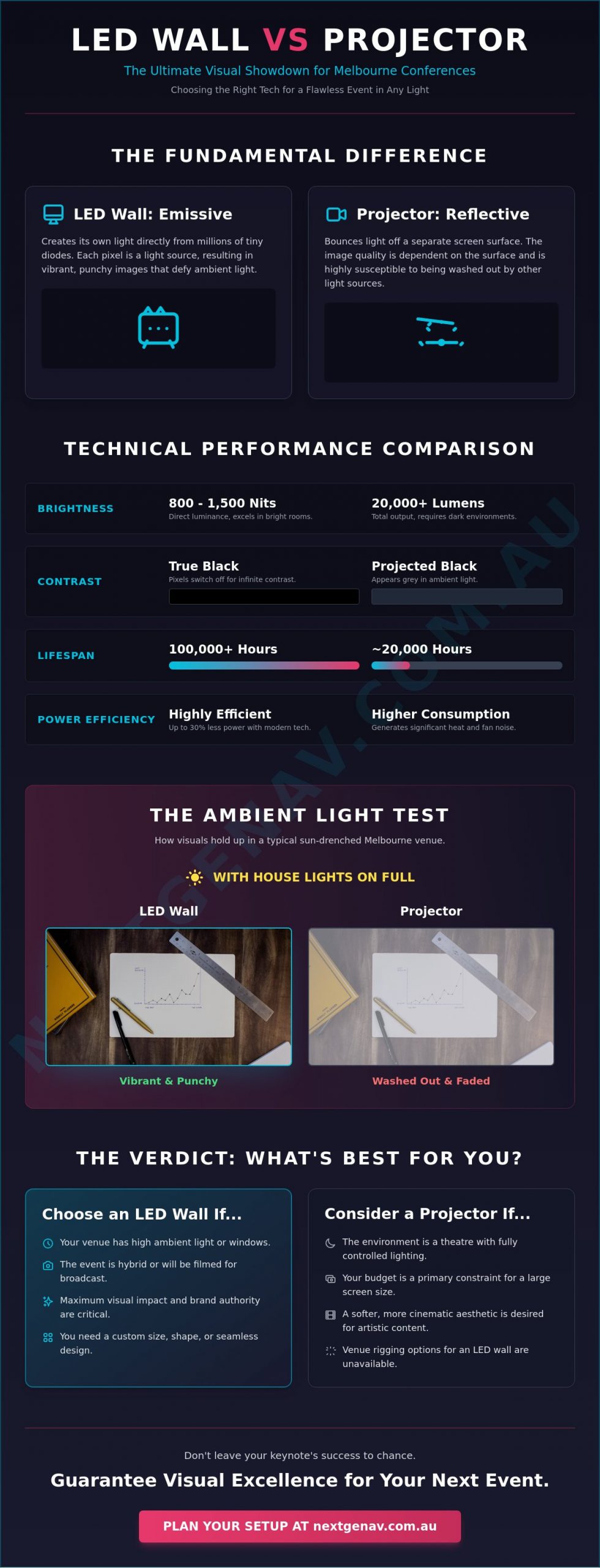
The technical superiority of a display often comes down to the battle between emissive and reflective light. In any led wall vs projector for conference comparison, contrast ratio is the silent winner for LED technology. Because each diode on an LED wall can simply turn off, it achieves “true black.” A projector, however, must project “black” onto a white or grey surface. If your Melbourne venue has even a sliver of ambient light, those blacks quickly wash out into a muddy charcoal; this strips your content of its depth and professional punch.
Brightness measurements often confuse organisers because they use different scales. LED walls are measured in “nits,” which quantify the light intensity at the source. Professional indoor units typically range from 800 to 1,500 nits. Projectors use “lumens” to measure total light output. To match the perceived brightness of a standard LED wall, a projector often needs a massive lumen count that most mid-sized venues simply cannot accommodate without generating significant heat and fan noise. LED technology maintains vibrant hues even in high-ambient light, ensuring your brand colours remain accurate and prestigious.
The Hybrid Factor: Refresh Rates and Moiré
Modern conferences are rarely just in-person events. They are broadcast globally. This is where the led wall vs projector for conference choice becomes critical for your digital footprint. High-end LED walls feature refresh rates of 3840Hz or higher, which is essential for preventing the “flicker” often seen on camera. If you’ve ever watched a live-stream where the screen appears to have moving lines or a strange mesh pattern, you’ve witnessed the moiré effect. Our technical direction specialists select specific pixel pitches and refresh rates to ensure your keynote looks as crisp on a remote attendee’s iPad as it does in the front row. Projectors, while improved, can still suffer from frame-sync issues that distract your virtual audience.
Viewing Angles and Audience Reach
Audience engagement shouldn’t be a lottery based on where a delegate sits. Professional LED walls offer a vast 160-degree viewing angle both horizontally and vertically. This ensures that a person sitting at the far edge of the room sees the same vibrant colour and contrast as someone in the centre. Traditional projection screens often have a “sweet spot.” Move too far to the side, and the image can lose up to 50 per cent of its brightness or suffer from distorted geometry. By choosing a technology with a wide reach, you guarantee a premium experience for every attendee, regardless of the room’s layout. This consistency reduces eye strain and keeps the focus firmly on the presenter’s message.
The Ambient Light Factor: Why Melbourne Venues Matter
The energy of a corporate event is a fragile asset. For years, the standard protocol involved dimming the lights the moment a speaker took the stage. This “Blackout Problem” is a significant hurdle for modern engagement. When you plunge a room into darkness to accommodate a projector, you effectively kill the audience’s momentum. Delegates stop taking notes. Eye contact vanishes. The atmosphere shifts from a collaborative forum to a passive cinema experience. In the 2026 conference landscape, we prioritise high-energy environments where participation is the core objective.
Melbourne’s architectural evolution has made this challenge even more acute. Our city’s premier spaces, from the glass-walled atriums of Southbank to the sun-drenched waterfront venues in the Docklands, celebrate natural light. Floor-to-ceiling glass is now the standard for prestige. In these environments, the led wall vs projector for conference debate is usually settled by the sun. Projectors rely on a controlled, dark environment to maintain any semblance of contrast. LED walls, by comparison, are emissive powerhouses that command attention regardless of how much light pours through the windows. They allow you to keep the blinds open and the house lights up, facilitating better networking and professional outcomes.
Presenter freedom is another casualty of traditional projection. We’ve all seen the awkward shadow play when a keynote speaker steps too far to the left and finds their own silhouette cast across their data. This distraction is a relic of the past. Because LED technology is the source of the light rather than a reflection of it, speakers can walk directly in front of the screen without casting a single shadow. This allows for a more dynamic use of the stage and a more seamless interaction between the presenter and their visual aids.
Handling High-Glare Environments
Glare is the enemy of professional communication. Even the most powerful 30,000-lumen projector struggles when competing with midday sun exposure in a CBD venue. The image becomes a washed-out ghost of its original design. LED walls “cut through” this interference with ease. Because they produce between 800 and 1,500 nits of brightness, they provide a crisp, vivid display that remains legible even in high-glare settings. Imagine a hypothetical conference at a top-floor Collins Street centre. With a projector, you’d be forced to draw the blinds and lose the million-dollar view. With an LED setup, the city skyline becomes your backdrop while your content remains flawlessly sharp. The same principle applies at scale for open-air events; if you’re planning an event across the border, our guide to outdoor LED screen hire Sydney explains exactly how high-brightness panels are engineered to defeat harsh Australian sun exposure.
Audience Engagement and Eye Contact
A well-lit room facilitates better professional outcomes. When speakers can see the faces of their audience, their confidence grows. They can read the room, adjust their tone, and maintain genuine eye contact. This visibility is equally vital during Q&A sessions. You no longer have to choose between blinding the presenter with a projector beam or leaving the audience in the dark. Professional audio visual hire Melbourne services meticulously balance light and sound to create an environment where networking happens naturally. By eliminating technical friction, you allow your speaker to take centre stage with absolute authority.
Logistics and Setup: Behind the Scenes of a Flawless Event
The logistical orchestration of a production is where the theoretical choice between an led wall vs projector for conference use meets the physical reality of your Melbourne venue. Projectors require “throw distance,” which is the empty space between the lens and the screen. This often forces organisers to sacrifice valuable floor space for a projection booth or a clear line of sight that delegates cannot cross. In contrast, an LED wall features a slim profile of only 2 to 3 centimetres in depth. By hugging the back wall, it reclaims the room, allowing you to maximise seating or create a more expansive stage design.
Weight is the silent dealbreaker in technical planning. While a projector and its cradle are relatively light, a large-scale LED wall is a significant structural load. Modern Melbourne venues vary wildly in their ceiling capacity, particularly heritage sites where rigging points might be limited. If the roof cannot support the weight, we pivot to ground-stacking the wall. This requires a level of technical precision and labour that exceeds a simple projector setup. Our teams meticulously manage the “bump-in” process, as each modular panel must be perfectly aligned and calibrated to ensure a seamless visual surface.
Power consumption is another critical factor for your technical director to calculate. Large-scale LED displays have a higher electrical draw than a single laser projector. However, 2026 “common cathode” technology has made these displays up to 30 per cent more energy-efficient than models from just three years ago. This efficiency doesn’t just lower your footprint; it reduces the heat output on stage, keeping your keynote speakers comfortable under the lights. Planning for these requirements early prevents the stress of last-minute power upgrades or circuit overloads. Understanding the full led video wall rental cost, including power, labour, and logistics, is essential for building an accurate budget before you commit to a venue.
Venue Compatibility and Floor Loading
Evaluating a venue for structural support is essential when opting for high-impact visuals. Ground-stacked LED walls exert concentrated pressure on the floor, which is a vital consideration for venues with raised stages or delicate flooring. Your stage and lighting hire Melbourne plan must account for this weight to ensure safety and stability. While a projector on a truss has a smaller footprint, the LED wall’s ability to sit flush against a wall often provides a cleaner, more integrated aesthetic that justifies the extra structural planning.
Reliability and Redundancy
In a high-stakes keynote, failure is not an option. If a projector bulb blows or the laser engine fails, the screen goes dark instantly, often requiring a lengthy cool-down and restart period. LED walls offer a more resilient architecture. With an annual panel failure rate of only 0.5 to 1 per cent, the risk is low. If a single module does fail, it is “hot-swappable,” meaning our technicians can replace it mid-event without turning off the rest of the screen. To guarantee zero technical downtime, we prioritise signal redundancy, running dual processors so that if one feed drops, the other takes over in a fraction of a second. Discuss your specific venue requirements with our experts at NextGen AV to secure a setup that is as reliable as it is stunning.
The Verdict: Which Display Technology Wins for Your Conference?
The showdown between an led wall vs projector for conference success doesn’t have a single winner; it has a right answer for your specific venue and objectives. Your choice is the foundation upon which your entire event’s visual narrative is built. If you’re hosting an intimate screening in a dedicated dark-room theatre where the budget is the primary driver, a high-lumen laser projector remains a reliable, cinematic stalwart. It provides a soft-edge texture that suits artistic content and traditional presentations perfectly when ambient light is fully controlled.
The case for the LED wall is built on absolute visual dominance and hybrid reliability. In 2026, if you refuse to compromise on brand prestige or need a setup that looks as vibrant on a global live-stream as it does from the front row, LED is the unequivocal standard. It reclaims the room from the shadows, allowing your delegates to stay energised in a well-lit, collaborative environment. At NextGen AV, our philosophy is simple: we choose technology that serves the story. We don’t just supply equipment; we orchestrate an experience where the hardware disappears, leaving only your message centre stage.
Before requesting a quote, use this final checklist to align your technical needs:
- Ambient Light: Can the venue be fully blacked out, or is there floor-to-ceiling glass?
- Audience Reach: Will attendees be seated at extreme angles or very close to the screen?
- Hybrid Requirements: Are you filming the keynote for a remote audience?
- Logistical Limits: Does the venue have the rigging points for a heavy screen or the throw distance for a projector?
- Power and Heat: Is the stage area equipped for the electrical draw and cooling needs of your chosen tech?
Budgeting for Impact
Smart organisers view their visual setup as a strategic asset rather than a line-item expense. A premium led video wall offers an incredible ROI by doubling as a dynamic digital backdrop that can change instantly between sessions, providing high-value exposure for sponsors. If you’re managing a multi-room event, a hybrid strategy often works best. Reserve the high-impact LED technology for your plenary sessions to wow the entire delegation, while using cost-effective projection for smaller breakout rooms where lighting is more easily managed. This balance ensures your budget is spent where it generates the most prestige.
Partnering for Success in Melbourne
The complexity of modern display technology means that a seasoned technical director is your most valuable ally. We don’t believe in guesswork. We take pride in our proactive approach, which often involves a detailed site visit to test light levels and floor loading before you sign any contract. This “behind-the-scenes” precision allows you to focus on your speakers while we handle the engine room. Whether you need a seamless wall for a sun-drenched atrium or a cinematic projection for a heritage theatre, we ensure the execution is flawless. Organise a consultation with NextGen AV for your next Melbourne conference.
Master Your Event’s Visual Narrative
The choice between an led wall vs projector for conference success hinges on your vision for audience connection. You’ve seen how the emissive power of LED technology conquers the glare of Melbourne’s glass-walled venues while professional projection remains a versatile tool for cinematic, dark-room settings. By matching the right display to your specific venue constraints and hybrid goals, you transform a simple presentation into a prestigious corporate experience.
Precision in the planning phase is what separates a standard event from a flawless production. With 30 plus years of technical event production experience, we conduct expert site inspections for Melbourne venues to ensure your chosen tech integrates perfectly with the local infrastructure. Our commitment to excellence includes redundant signal processing for 100 per cent uptime during your keynote. Contact the NextGen AV team to discuss the best visual solution for your next event. Let’s work together to make your 2026 conference a landmark success.
Frequently Asked Questions
Is an LED wall significantly more expensive than a projector hire?
Upfront hire costs for LED technology are generally higher than traditional projection due to the equipment’s complexity and the specialised labour required for assembly. When evaluating an led wall vs projector for conference budgets, it is vital to consider the total value of the experience. LED walls eliminate the need for expensive room blackouts and provide a high-impact digital canvas that often attracts premium sponsorship, offsetting the initial investment through superior engagement. For a transparent breakdown of what drives pricing in 2026, our LED video wall rental cost budgeting guide covers every factor from pixel pitch to transport and labour.
Can I use an LED wall for an outdoor conference in Melbourne?
Yes, provided you utilise IP-rated panels specifically designed for the elements. Melbourne’s unpredictable weather requires robust, weather-sealed technology that can transition from bright sun to sudden showers without a glitch. Outdoor LED units produce significantly higher brightness levels than indoor models, ensuring your content remains vivid and legible even under the harsh midday sun at a waterfront or garden venue. For a deeper technical breakdown of how outdoor LED panels are engineered to withstand the Australian elements, our outdoor LED screen hire Sydney technical reference guide provides a comprehensive look at IP ratings, pixel pitch selection, and structural compliance for open-air events.
Do I need special content for an LED wall vs a projector?
Most standard 16:9 presentations will function perfectly on both systems, but LED walls offer the freedom to move beyond traditional boundaries. Because we build these displays from modular panels, you can utilise custom aspect ratios or ultra-wide resolutions that a single projector cannot achieve. We recommend using high-contrast designs and bold typography to take full advantage of the LED’s “true black” capabilities and vibrant colour palette.
How long does it take to set up an LED wall for a conference?
A professional LED installation typically requires between 4 and 8 hours depending on the scale and complexity of the design. This “bump-in” time is longer than a standard projector setup because our technicians must meticulously lock each panel together and calibrate the entire surface for colour uniformity. This precision ensures that the final result is a perfectly seamless visual engine that performs flawlessly throughout your keynote.
Which technology is better for showing detailed spreadsheets or text?
For data-heavy presentations, the winner depends on the proximity of your audience. A fine-pitch LED wall offers incredible sharpness and contrast that makes text pop even in sun-drenched rooms. However, in very large auditoriums where the audience is seated far from the stage, a high-resolution 4K projector can still provide a smooth, legible image. We assess your specific data needs during a site visit to recommend the most effective solution.
What is pixel pitch and how do I choose the right one for my event?
Pixel pitch is the distance, measured in millimetres, between the centre of one LED diode and the next. A smaller pitch, such as 1.5mm or 2.5mm, provides higher resolution for delegates sitting close to the stage. If your audience is seated further back in a large plenary hall, a larger pitch may be more cost-effective while still delivering a crisp, professional image from a distance.
Can an LED wall be curved or custom-shaped?
Yes, the modular architecture of LED technology allows for creative staging that traditional screens can’t replicate. We can orchestrate curved displays that wrap around a circular stage or build unconventional shapes to fit unique architectural features in Melbourne’s heritage venues. This flexibility allows you to turn your visual display into a piece of digital art that reinforces your brand’s innovative authority.
Does an LED wall produce a lot of heat in a small meeting room?
While all electronic displays generate some heat, modern LED panels are designed with advanced thermal management. The latest energy-efficient models stay remarkably cool even during long sessions. If you are planning an event in a compact boardroom, our technical directors evaluate the room’s ventilation and adjust the screen’s brightness to ensure the environment remains comfortable for your attendees without sacrificing visual impact.
The most expensive visual setup for your Melbourne keynote isn’t the one that costs the most upfront; it’s the one that disappears the moment the house lights go up. You’ve likely felt that visceral stress when a projector image dissolves into a washed-out haze against a sun-drenched window. Deciding between an led wall vs projector for conference events is a high-stakes choice for any organiser trying to justify a premium budget while avoiding the technical glitches that fail both in-person delegates and global live-stream audiences. We understand the pressure of ensuring zero technical downtime during your most critical moments.
This guide will show you exactly how to choose the technology that will captivate your audience and suit your venue’s unique lighting conditions. You’ll discover how modern “common cathode” technology reduces power consumption by up to 30 per cent and why MicroLEDs now offer a lifespan exceeding 100,000 hours. We’ll compare these advancements against traditional laser engines to provide the technical clarity you need to present a flawless case to your stakeholders.
Key Takeaways
- Master the fundamental difference between light-emitting and light-reflecting technology to ensure your presentation never fades into the background.
- Discover why comparing an led wall vs projector for conference use in 2026 requires looking beyond simple lumens to prioritise high-nit brightness and superior contrast ratios.
- Navigate the challenges of Melbourne’s sun-drenched venues by understanding how “true black” levels maintain visual impact even with the house lights at full capacity.
- Evaluate essential logistical constraints, including projector throw distances and venue rigging requirements, to streamline your setup and eliminate technical friction.
- Secure a professional edge for hybrid events by choosing the display tech that translates perfectly to camera while maintaining an immersive experience for in-person delegates.
The Battle for Visual Dominance: LED Walls vs Projectors
Visual dominance in a modern ballroom isn’t just about screen size. It’s about the physics of light and how that light interacts with your audience. When you evaluate the led wall vs projector for conference environments, you’re choosing between two fundamentally different delivery systems. Direct-view LED is an emissive technology, meaning it creates its own light. Projectors are reflective, casting an image onto a surface that must then bounce back to the viewer’s eye. This distinction dictates whether your content commands the room or merely suggests its presence.
By 2026, the Melbourne event circuit has undergone a seismic shift. Organisers are moving away from the “lights-off” era of presentations. In the current experience economy, visual impact equals brand authority. If your keynote slides look like a foggy morning in the Dandenongs, your message loses its prestige. High-stakes delegates expect to see the speaker, take their own notes, and engage with the person next to them, all without sitting in a dark, uninspiring cave. Choosing the right tech ensures your visual narrative remains crisp and vibrant, regardless of the venue’s architectural lighting.
What is an LED Video Wall?
An LED wall is a sophisticated mosaic of modular panels. Because these panels lock together without borders, we can build displays in almost any size or aspect ratio imaginable. To appreciate why this shift is happening, we must look at the foundation of LED display technology, which functions through tiny light-emitting diodes that act as individual pixels. This allows for a seamless visual surface with no distracting bezels or shadows from presenters walking in front of the beam.
Clarity is governed by pixel pitch, which is the distance between the centre of each LED. For an indoor led wall vs projector for conference comparison, a 2.5mm pitch has become a frequent standard. It provides stunning “front-row” clarity that remains sharp even when attendees are standing just metres away. This modularity gives us the precision to orchestrate custom shapes that wrap around stages or fit into unique Melbourne heritage spaces.
The Evolution of Professional Projectors
Projectors have not stood still. Modern high-lumen laser engines have replaced the temperamental lamps of the past, offering a respectable 20,000-hour lifespan. These systems still shine in specific scenarios, particularly in auditoriums with controlled, dark environments where a cinematic feel is desired. Short-throw lenses allow us to position units remarkably close to the screen, which is a vital solution when venue space is at a premium and rigging options are limited.
A high-quality screen paired with a 30,000-lumen laser projector remains a viable, cost-effective choice for organisers on tighter budgets or for events with occasional use. While they lack the emissive punch of an LED wall, they offer a smooth, soft-edge aesthetic that some artistic directors prefer for atmospheric content. In a dark theatre, the refined colour palette of a top-tier projector still delivers a professional result that justifies the investment.
Comparing Technical Performance: Clarity, Colour, and Contrast
The technical superiority of a display often comes down to the battle between emissive and reflective light. In any led wall vs projector for conference comparison, contrast ratio is the silent winner for LED technology. Because each diode on an LED wall can simply turn off, it achieves “true black.” A projector, however, must project “black” onto a white or grey surface. If your Melbourne venue has even a sliver of ambient light, those blacks quickly wash out into a muddy charcoal; this strips your content of its depth and professional punch.
Brightness measurements often confuse organisers because they use different scales. LED walls are measured in “nits,” which quantify the light intensity at the source. Professional indoor units typically range from 800 to 1,500 nits. Projectors use “lumens” to measure total light output. To match the perceived brightness of a standard LED wall, a projector often needs a massive lumen count that most mid-sized venues simply cannot accommodate without generating significant heat and fan noise. LED technology maintains vibrant hues even in high-ambient light, ensuring your brand colours remain accurate and prestigious.
The Hybrid Factor: Refresh Rates and Moiré
Modern conferences are rarely just in-person events. They are broadcast globally. This is where the led wall vs projector for conference choice becomes critical for your digital footprint. High-end LED walls feature refresh rates of 3840Hz or higher, which is essential for preventing the “flicker” often seen on camera. If you’ve ever watched a live-stream where the screen appears to have moving lines or a strange mesh pattern, you’ve witnessed the moiré effect. Our technical direction specialists select specific pixel pitches and refresh rates to ensure your keynote looks as crisp on a remote attendee’s iPad as it does in the front row. Projectors, while improved, can still suffer from frame-sync issues that distract your virtual audience.
Viewing Angles and Audience Reach
Audience engagement shouldn’t be a lottery based on where a delegate sits. Professional LED walls offer a vast 160-degree viewing angle both horizontally and vertically. This ensures that a person sitting at the far edge of the room sees the same vibrant colour and contrast as someone in the centre. Traditional projection screens often have a “sweet spot.” Move too far to the side, and the image can lose up to 50 per cent of its brightness or suffer from distorted geometry. By choosing a technology with a wide reach, you guarantee a premium experience for every attendee, regardless of the room’s layout. This consistency reduces eye strain and keeps the focus firmly on the presenter’s message.
The Ambient Light Factor: Why Melbourne Venues Matter
The energy of a corporate event is a fragile asset. For years, the standard protocol involved dimming the lights the moment a speaker took the stage. This “Blackout Problem” is a significant hurdle for modern engagement. When you plunge a room into darkness to accommodate a projector, you effectively kill the audience’s momentum. Delegates stop taking notes. Eye contact vanishes. The atmosphere shifts from a collaborative forum to a passive cinema experience. In the 2026 conference landscape, we prioritise high-energy environments where participation is the core objective.
Melbourne’s architectural evolution has made this challenge even more acute. Our city’s premier spaces, from the glass-walled atriums of Southbank to the sun-drenched waterfront venues in the Docklands, celebrate natural light. Floor-to-ceiling glass is now the standard for prestige. In these environments, the led wall vs projector for conference debate is usually settled by the sun. Projectors rely on a controlled, dark environment to maintain any semblance of contrast. LED walls, by comparison, are emissive powerhouses that command attention regardless of how much light pours through the windows. They allow you to keep the blinds open and the house lights up, facilitating better networking and professional outcomes.
Presenter freedom is another casualty of traditional projection. We’ve all seen the awkward shadow play when a keynote speaker steps too far to the left and finds their own silhouette cast across their data. This distraction is a relic of the past. Because LED technology is the source of the light rather than a reflection of it, speakers can walk directly in front of the screen without casting a single shadow. This allows for a more dynamic use of the stage and a more seamless interaction between the presenter and their visual aids.
Handling High-Glare Environments
Glare is the enemy of professional communication. Even the most powerful 30,000-lumen projector struggles when competing with midday sun exposure in a CBD venue. The image becomes a washed-out ghost of its original design. LED walls “cut through” this interference with ease. Because they produce between 800 and 1,500 nits of brightness, they provide a crisp, vivid display that remains legible even in high-glare settings. Imagine a hypothetical conference at a top-floor Collins Street centre. With a projector, you’d be forced to draw the blinds and lose the million-dollar view. With an LED setup, the city skyline becomes your backdrop while your content remains flawlessly sharp. The same principle applies at scale for open-air events; if you’re planning an event across the border, our guide to outdoor LED screen hire Sydney explains exactly how high-brightness panels are engineered to defeat harsh Australian sun exposure.
Audience Engagement and Eye Contact
A well-lit room facilitates better professional outcomes. When speakers can see the faces of their audience, their confidence grows. They can read the room, adjust their tone, and maintain genuine eye contact. This visibility is equally vital during Q&A sessions. You no longer have to choose between blinding the presenter with a projector beam or leaving the audience in the dark. Professional audio visual hire Melbourne services meticulously balance light and sound to create an environment where networking happens naturally. By eliminating technical friction, you allow your speaker to take centre stage with absolute authority.
Logistics and Setup: Behind the Scenes of a Flawless Event
The logistical orchestration of a production is where the theoretical choice between an led wall vs projector for conference use meets the physical reality of your Melbourne venue. Projectors require “throw distance,” which is the empty space between the lens and the screen. This often forces organisers to sacrifice valuable floor space for a projection booth or a clear line of sight that delegates cannot cross. In contrast, an LED wall features a slim profile of only 2 to 3 centimetres in depth. By hugging the back wall, it reclaims the room, allowing you to maximise seating or create a more expansive stage design.
Weight is the silent dealbreaker in technical planning. While a projector and its cradle are relatively light, a large-scale LED wall is a significant structural load. Modern Melbourne venues vary wildly in their ceiling capacity, particularly heritage sites where rigging points might be limited. If the roof cannot support the weight, we pivot to ground-stacking the wall. This requires a level of technical precision and labour that exceeds a simple projector setup. Our teams meticulously manage the “bump-in” process, as each modular panel must be perfectly aligned and calibrated to ensure a seamless visual surface.
Power consumption is another critical factor for your technical director to calculate. Large-scale LED displays have a higher electrical draw than a single laser projector. However, 2026 “common cathode” technology has made these displays up to 30 per cent more energy-efficient than models from just three years ago. This efficiency doesn’t just lower your footprint; it reduces the heat output on stage, keeping your keynote speakers comfortable under the lights. Planning for these requirements early prevents the stress of last-minute power upgrades or circuit overloads. Understanding the full led video wall rental cost, including power, labour, and logistics, is essential for building an accurate budget before you commit to a venue.
Venue Compatibility and Floor Loading
Evaluating a venue for structural support is essential when opting for high-impact visuals. Ground-stacked LED walls exert concentrated pressure on the floor, which is a vital consideration for venues with raised stages or delicate flooring. Your stage and lighting hire Melbourne plan must account for this weight to ensure safety and stability. While a projector on a truss has a smaller footprint, the LED wall’s ability to sit flush against a wall often provides a cleaner, more integrated aesthetic that justifies the extra structural planning.
Reliability and Redundancy
In a high-stakes keynote, failure is not an option. If a projector bulb blows or the laser engine fails, the screen goes dark instantly, often requiring a lengthy cool-down and restart period. LED walls offer a more resilient architecture. With an annual panel failure rate of only 0.5 to 1 per cent, the risk is low. If a single module does fail, it is “hot-swappable,” meaning our technicians can replace it mid-event without turning off the rest of the screen. To guarantee zero technical downtime, we prioritise signal redundancy, running dual processors so that if one feed drops, the other takes over in a fraction of a second. Discuss your specific venue requirements with our experts at NextGen AV to secure a setup that is as reliable as it is stunning.
The Verdict: Which Display Technology Wins for Your Conference?
The showdown between an led wall vs projector for conference success doesn’t have a single winner; it has a right answer for your specific venue and objectives. Your choice is the foundation upon which your entire event’s visual narrative is built. If you’re hosting an intimate screening in a dedicated dark-room theatre where the budget is the primary driver, a high-lumen laser projector remains a reliable, cinematic stalwart. It provides a soft-edge texture that suits artistic content and traditional presentations perfectly when ambient light is fully controlled.
The case for the LED wall is built on absolute visual dominance and hybrid reliability. In 2026, if you refuse to compromise on brand prestige or need a setup that looks as vibrant on a global live-stream as it does from the front row, LED is the unequivocal standard. It reclaims the room from the shadows, allowing your delegates to stay energised in a well-lit, collaborative environment. At NextGen AV, our philosophy is simple: we choose technology that serves the story. We don’t just supply equipment; we orchestrate an experience where the hardware disappears, leaving only your message centre stage.
Before requesting a quote, use this final checklist to align your technical needs:
- Ambient Light: Can the venue be fully blacked out, or is there floor-to-ceiling glass?
- Audience Reach: Will attendees be seated at extreme angles or very close to the screen?
- Hybrid Requirements: Are you filming the keynote for a remote audience?
- Logistical Limits: Does the venue have the rigging points for a heavy screen or the throw distance for a projector?
- Power and Heat: Is the stage area equipped for the electrical draw and cooling needs of your chosen tech?
Budgeting for Impact
Smart organisers view their visual setup as a strategic asset rather than a line-item expense. A premium led video wall offers an incredible ROI by doubling as a dynamic digital backdrop that can change instantly between sessions, providing high-value exposure for sponsors. If you’re managing a multi-room event, a hybrid strategy often works best. Reserve the high-impact LED technology for your plenary sessions to wow the entire delegation, while using cost-effective projection for smaller breakout rooms where lighting is more easily managed. This balance ensures your budget is spent where it generates the most prestige.
Partnering for Success in Melbourne
The complexity of modern display technology means that a seasoned technical director is your most valuable ally. We don’t believe in guesswork. We take pride in our proactive approach, which often involves a detailed site visit to test light levels and floor loading before you sign any contract. This “behind-the-scenes” precision allows you to focus on your speakers while we handle the engine room. Whether you need a seamless wall for a sun-drenched atrium or a cinematic projection for a heritage theatre, we ensure the execution is flawless. Organise a consultation with NextGen AV for your next Melbourne conference.
Master Your Event’s Visual Narrative
The choice between an led wall vs projector for conference success hinges on your vision for audience connection. You’ve seen how the emissive power of LED technology conquers the glare of Melbourne’s glass-walled venues while professional projection remains a versatile tool for cinematic, dark-room settings. By matching the right display to your specific venue constraints and hybrid goals, you transform a simple presentation into a prestigious corporate experience.
Precision in the planning phase is what separates a standard event from a flawless production. With 30 plus years of technical event production experience, we conduct expert site inspections for Melbourne venues to ensure your chosen tech integrates perfectly with the local infrastructure. Our commitment to excellence includes redundant signal processing for 100 per cent uptime during your keynote. Contact the NextGen AV team to discuss the best visual solution for your next event. Let’s work together to make your 2026 conference a landmark success.
Frequently Asked Questions
Is an LED wall significantly more expensive than a projector hire?
Upfront hire costs for LED technology are generally higher than traditional projection due to the equipment’s complexity and the specialised labour required for assembly. When evaluating an led wall vs projector for conference budgets, it is vital to consider the total value of the experience. LED walls eliminate the need for expensive room blackouts and provide a high-impact digital canvas that often attracts premium sponsorship, offsetting the initial investment through superior engagement. For a transparent breakdown of what drives pricing in 2026, our LED video wall rental cost budgeting guide covers every factor from pixel pitch to transport and labour.
Can I use an LED wall for an outdoor conference in Melbourne?
Yes, provided you utilise IP-rated panels specifically designed for the elements. Melbourne’s unpredictable weather requires robust, weather-sealed technology that can transition from bright sun to sudden showers without a glitch. Outdoor LED units produce significantly higher brightness levels than indoor models, ensuring your content remains vivid and legible even under the harsh midday sun at a waterfront or garden venue. For a deeper technical breakdown of how outdoor LED panels are engineered to withstand the Australian elements, our outdoor LED screen hire Sydney technical reference guide provides a comprehensive look at IP ratings, pixel pitch selection, and structural compliance for open-air events.
Do I need special content for an LED wall vs a projector?
Most standard 16:9 presentations will function perfectly on both systems, but LED walls offer the freedom to move beyond traditional boundaries. Because we build these displays from modular panels, you can utilise custom aspect ratios or ultra-wide resolutions that a single projector cannot achieve. We recommend using high-contrast designs and bold typography to take full advantage of the LED’s “true black” capabilities and vibrant colour palette.
How long does it take to set up an LED wall for a conference?
A professional LED installation typically requires between 4 and 8 hours depending on the scale and complexity of the design. This “bump-in” time is longer than a standard projector setup because our technicians must meticulously lock each panel together and calibrate the entire surface for colour uniformity. This precision ensures that the final result is a perfectly seamless visual engine that performs flawlessly throughout your keynote.
Which technology is better for showing detailed spreadsheets or text?
For data-heavy presentations, the winner depends on the proximity of your audience. A fine-pitch LED wall offers incredible sharpness and contrast that makes text pop even in sun-drenched rooms. However, in very large auditoriums where the audience is seated far from the stage, a high-resolution 4K projector can still provide a smooth, legible image. We assess your specific data needs during a site visit to recommend the most effective solution.
What is pixel pitch and how do I choose the right one for my event?
Pixel pitch is the distance, measured in millimetres, between the centre of one LED diode and the next. A smaller pitch, such as 1.5mm or 2.5mm, provides higher resolution for delegates sitting close to the stage. If your audience is seated further back in a large plenary hall, a larger pitch may be more cost-effective while still delivering a crisp, professional image from a distance.
Can an LED wall be curved or custom-shaped?
Yes, the modular architecture of LED technology allows for creative staging that traditional screens can’t replicate. We can orchestrate curved displays that wrap around a circular stage or build unconventional shapes to fit unique architectural features in Melbourne’s heritage venues. This flexibility allows you to turn your visual display into a piece of digital art that reinforces your brand’s innovative authority.
Does an LED wall produce a lot of heat in a small meeting room?
While all electronic displays generate some heat, modern LED panels are designed with advanced thermal management. The latest energy-efficient models stay remarkably cool even during long sessions. If you are planning an event in a compact boardroom, our technical directors evaluate the room’s ventilation and adjust the screen’s brightness to ensure the environment remains comfortable for your attendees without sacrificing visual impact.
Discover Valuable Insights
Unlock Expert Tips and Advice
Our blog is packed with valuable information to help you stay ahead. Whether you’re looking for expert advice, industry trends, or practical tips, you’ll find everything you need. Reach out today to learn more or get in touch with us for personalised support!