



A high-definition screen doesn’t guarantee a captivated audience; it’s the invisible technical precision behind the glass that determines whether your event feels like a prestige production or a technical liability. You’ve likely felt that familiar knot of anxiety when considering the logistics of a large-scale led video wall, from the fear of a mid-presentation flicker to the headache of calculating viewing distances in a challenging Australian venue. It’s a common concern for organisers who want to move beyond the logistical grind and focus on the artistry of the final result.
This guide is designed to transform that uncertainty into absolute technical confidence. You’ll master the essentials of pixel pitch and rigging requirements while discovering how the latest 2026 innovations, like AI-powered content management and MicroLED technology, can maximise your impact. We’ll walk through everything from power consumption to the rise of zero-bezel designs, giving you the blueprint for a flawless visual experience that positions your brand as a leader in its field. By the end of this guide, you’ll have the technical mastery needed to orchestrate a production that is as seamless as it is spectacular.
Key Takeaways
- Master the technical specifications of a modern led video wall to ensure your visual content remains sharp and vibrant regardless of the audience’s viewing distance.
- Evaluate the strategic ROI of LED technology compared to traditional projection, specifically how to maintain visual impact in high-ambient light environments like the Melbourne Convention Centre.
- Optimise your event logistics by mastering the requirements for three-phase power and professional rigging to ensure a safe and efficient bump-in.
- Learn how to align your content strategy with modular hardware to create immersive, cinematic environments that transcend the limitations of standard screen displays.
- Leverage expert technical direction to oversee the entire visual chain, allowing you to focus on your guests while the invisible experts manage the technical pressure.
What is an LED Video Wall? The Shift in Modern Event Production
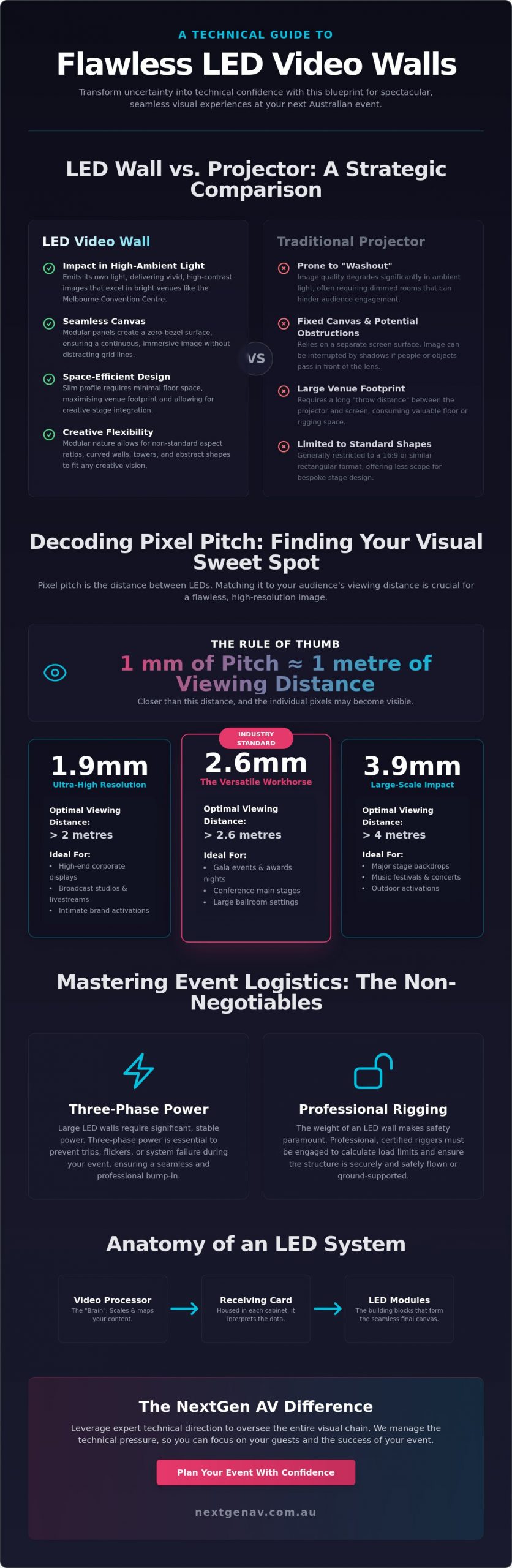
The architecture of a modern event has evolved far beyond simple stages and static backdrops. Today, a led video wall serves as the heartbeat of a production, acting as a modular display system composed of individual light-emitting diodes that work in perfect synchronisation. Unlike traditional LCD screens that are plagued by distracting bezels, these systems offer a truly seamless canvas. This lack of visual interruption allows for a continuous, immersive image that flows across the entire surface, ensuring your audience remains focused on the message rather than the equipment. To understand the foundational technology, it helps to look at What is a Video Wall? in its broadest sense, but the modern event industry has moved decisively toward the brightness and flexibility of LED.
This shift isn’t just about aesthetic preference; it’s rooted in the psychology of engagement. Large-format visuals command attention in a way that smaller, fragmented displays cannot. High-impact imagery increases information retention and creates a sense of prestige that elevates the entire brand experience. When you deploy a seamless visual surface, you’re not just showing content; you’re creating an environment that captivates the senses and eliminates the “grid” effect that often breaks the immersion of digital presentations.
The Core Components of an LED System
A professional led video wall is a sophisticated assembly of precision-engineered parts. At the most basic level, individual LED modules are grouped together into cabinets, which serve as the structural building blocks of the wall. The long-term reliability of these modules relies on high-quality internal circuitry, often incorporating precision resistors and diodes from specialist manufacturers like Adage Components, to ensure consistent visual performance. Each cabinet houses a receiving card, the critical component that interprets data from the central video processor. This processor acts as the “brain” of the operation, scaling and mapping your content to fit the specific dimensions of the screen. Because these systems are modular, you aren’t restricted to a standard 16:9 aspect ratio. You can organise panels into towers, curved ribbons, or abstract geometric shapes that integrate directly with your staging and rigging.
Why Events are Moving Away from Traditional Projection
The era of dimming the lights just to see a presentation is over. Traditional projectors often suffer from a “washout” effect when faced with ambient light, particularly in bright Australian venues like the Melbourne Convention Centre. LED panels produce their own light, delivering incredible colour depth and contrast ratios that remain vivid even in broad daylight. There’s also a significant logistical advantage: space. Projectors require a long “throw distance” or complex mirrors to cast an image, often eating up valuable floor space. LED walls have a remarkably slim profile, allowing you to maximise your venue footprint and place the screen exactly where it will have the most impact.
Decoding the Technical Specs: Pixel Pitch, Nits, and Refresh Rates
Technical precision isn’t about chasing the highest numbers on a spec sheet. It’s about the deliberate orchestration of hardware to suit a specific environment. When you plan a led video wall installation, the metrics you choose will directly dictate the clarity of your message and the comfort of your guests. Over-specifying a screen for a massive hall is an unnecessary drain on resources, while under-specifying for an intimate lounge will result in visible pixels and a diminished brand image. Mastery of these specs allows you to move past the guesswork and focus on the prestige of your event’s final look.
Pixel Pitch: Finding the Sweet Spot for Your Audience
Pixel pitch measures the distance from the centre of one LED cluster to the next. A reliable industry rule of thumb is to allow one metre of viewing distance for every millimetre of pitch. For instance, a 2.6mm panel provides a seamless image from approximately 2.6 metres away. If your audience is closer than this, the individual diodes become visible, breaking the illusion of a solid image.
- 1.9mm: Ideal for high-resolution corporate displays where viewers are positioned within two metres of the screen.
- 2.6mm: The gold standard for most Australian gala events, conferences, and ballroom settings.
- 3.9mm: Best for large-scale stage backdrops or festivals where the audience is positioned at a significant distance.
Choosing a finer pitch increases resolution density, which is perfect for detailed text or high-end branding. However, for massive surfaces viewed from the back of a room, a slightly wider pitch often delivers a more impactful visual result for the same budget. It’s about finding the balance between density and scale to ensure every seat in the house has a premium view. These same pixel pitch principles apply equally when considering a trade show led wall rental, where close-proximity viewing distances at exhibition stands make fine-pitch selection especially critical.
Brightness (Nits) and Refresh Rates for Camera Clarity
Brightness, measured in Nits, ensures your content remains vibrant against the venue’s existing lighting. Indoor environments typically require between 600 and 1200 Nits to maintain visual punch. However, if your event is being filmed or live-streamed, the refresh rate is the specification that truly matters. Screens with low refresh rates often create a distracting “flicker” or horizontal lines on camera due to Pulse Width Modulation issues. To ensure a broadcast-quality finish, always demand a refresh rate of at least 3840Hz.
In low-light gala settings, pay close attention to greyscale performance. High-quality panels maintain deep blacks and subtle gradients even when the overall brightness is dimmed, preserving the artistry of your cinematic content. If you’re navigating these variables for the first time, seeking advice on technical direction can ensure your configuration is perfectly fit for purpose.
LED Wall vs. Projector: A Strategic Comparison for Event Planners
Choosing between these two technologies isn’t merely a matter of budget; it’s a decision about the visual integrity of your brand. While projectors have served as the industry standard for decades, the led video wall has redefined what’s possible in high-stakes environments. It’s the difference between a reflected image and a direct light source. Projectors rely on a darkened room to maintain clarity, but LED technology creates its own brilliance, ensuring your message remains the centre of attention regardless of the venue’s limitations.
Reliability is where the two diverge most sharply. If a projector bulb fails or a cable is tripped, your entire presentation vanishes in an instant. It’s a catastrophic “single point of failure” that every organiser dreads. In contrast, an LED system is inherently redundant. If a single diode or even an entire module fails, the rest of the wall continues to operate flawlessly. To the audience, the glitch is virtually invisible, allowing your technical team to swap components behind the scenes without interrupting the flow of the event. This peace of mind is a hallmark of premium AV orchestration. For event planners coordinating the full scope of a production, understanding how LED walls integrate within a broader audio visual hire Melbourne strategy is essential to achieving a truly cohesive and flawless result.
Performance in High Ambient Light
Vivid colours and deep blacks are non-negotiable for premium branding. Modern Australian venues, like the Melbourne Convention Centre, often feature stunning floor-to-ceiling windows that flood rooms with natural light. This ambient light is the natural enemy of the projector, causing images to look washed out and “milky.” A led video wall cuts through this interference with ease. By delivering true black levels and punchy, high-contrast output, it ensures your corporate colours are rendered with absolute fidelity, maintaining the prestige of your visual assets even in the middle of a summer afternoon. For a deeper analysis of how these two technologies perform under conference conditions specifically, our comprehensive guide on led wall vs projector for conference events covers every critical variable from ambient light performance to live-stream quality.
Venue Logistics: Rigging and Floor Space
Spatial efficiency is a major factor in venue selection and floor plan design. A rear-projection setup often requires a five-to-ten-metre “dead zone” behind the screen, significantly reducing your usable floor space and guest capacity. An LED wall is remarkably slim, requiring minimal clearance and allowing you to push the stage back to the very edge of the room. While large arrays require precise rigging and weight load calculations from experienced professionals, they also offer the flexibility of ground-stacking. If a venue has restrictive ceiling heights or no rigging points, a ground-supported LED wall provides a massive cinematic backdrop without the need for overhead support.
Mastering the Logistics: Power, Rigging, and Content Strategy
The success of a high-stakes event isn’t just about the hardware on stage; it’s about the invisible logistics that ensure the technology performs under pressure. While the visual impact of an led video wall is undeniable, the path to a flawless “go-live” moment requires a meticulous bump-in timeline and deep technical knowledge. A professional installation typically demands a multi-hour setup window where rigging, power distribution, and data mapping are executed with surgical precision. This is where the grind of planning meets the prestige of performance. Execution is everything.
Structural safety is the non-negotiable foundation of any large-scale display. In Australian venues, rigging must adhere to strict structural safety standards to protect both the audience and the crew. Whether your screen is flown from the ceiling or ground-stacked on a custom stage, every point of contact must be verified for weight load capacity. To eliminate the risk of a blackout, elite technical teams always implement a “signal backup” loop. This redundancy ensures that if a single data cable fails, the video processor automatically reroutes the signal from the opposite direction, keeping your presentation running without a second of downtime.
Power and Data Infrastructure
You don’t power a cinematic experience with a standard 10A wall circuit. Large-scale walls require dedicated power distribution units (distros) that typically draw from three-phase power outlets. This ensures a stable, surge-protected energy supply that can handle the peak brightness of thousands of diodes simultaneously. Data redundancy is equally vital. For high-stakes shows, using primary and backup processors allows for an instantaneous switchover if a hardware fault occurs, effectively shielding your brand from technical glitches. Professional cable management is the final touch, ensuring that the “behind-the-scenes” remains as polished as the front-of-house.
Content Creation: Aspect Ratios and Resolution
Creating content for a modular display is different from designing for a standard TV. Because an led video wall can be built in any shape, your content must be tailored to a specific “pixel map.” If you simply send a standard 1920×1080 signal to a custom-sized screen, your logos will likely look stretched or pixelated. We recommend 1:1 pixel mapping, where every pixel in your video file corresponds exactly to a physical diode on the wall. This creates ultra-sharp text and vibrant branding that looks spectacular from every angle. If you need help coordinating these complex technical requirements, our team can provide the technical direction required to bring your vision to life.
The NextGen AV Difference: Expert Technical Direction
Sophisticated hardware like a led video wall requires more than just a technician; it demands a conductor. NextGen AV has spent over 30 years acting as Melbourne’s “Invisible Expert,” orchestrating high-stakes productions where failure isn’t an option. Our Technical Directors act as the single point of accountability, overseeing the entire visual chain from the initial signal source to the final diode. This level of mastery ensures that every logistical detail, from meticulous site inspections to structural load-bearing checks, is handled long before the first guest arrives. We don’t just supply equipment; we provide the engine that drives your event’s success.
Pre-production is where the most critical work happens. By identifying potential venue bottlenecks early, such as power limitations or rigging constraints, we eliminate the fear of visual glitches during live presentations. Our team takes personal pride in seamless execution, ensuring that the transition from a bold high-level vision to a cinematic reality is both methodical and efficient. This proactive partnership allows you to step away from the technical grind and focus on the prestige of the final result.
Why Technical Direction Matters for High-Stakes Events
High-stakes events are fluid and unpredictable. A keynote speaker might provide a last-minute content update, or a lighting cue might need to be adjusted to match a screen’s colour temperature. Our technical direction team manages these variables in real time, coordinating seamlessly with lighting, audio, and camera crews to maintain a cohesive aesthetic. We operate under strict zero-failure protocols, employing redundant signal paths and proactive monitoring to ensure your brand remains centre stage. It’s about alleviating the stress of the “what if” so you can focus on the impact of the “what is.”
Custom LED Solutions for Unique Brand Experiences
Modern event design has moved past the flat 16:9 rectangle. We leverage the modularity of the led video wall to create architectural landmarks, including immersive tunnels, curved stage surrounds, and transparent displays that blend into the venue’s design. These aren’t just screens; they’re canvases for interactive experiences. By integrating live social media feeds or real-time polling, we transform a passive viewing experience into an active brand dialogue. If you’re ready to move beyond the logistical grind and experience absolute technical confidence, organise a technical consultation for your next Melbourne event.
Orchestrate Your Visual Masterpiece
Deploying a high-impact led video wall is about more than just hardware; it’s about the technical mastery required to turn a standard venue into a cinematic environment. You now understand that the correct pixel pitch and high refresh rates are non-negotiable for camera clarity, while meticulous power logistics and structural safety form the invisible foundation of a successful production. By mastering these essentials, you’ve moved beyond the stress of the logistical grind and can now focus on the prestige of your event’s final result.
Success in high-stakes Australian environments requires a partner who thrives under pressure and takes personal pride in seamless execution. With over 30 years of technical production experience, our team provides the absolute reliability your brand demands through redundant signal and power systems as standard. We assign expert Technical Directors to every major hire, ensuring that your vision is realised with surgical precision and zero-failure protocols. Partner with Melbourne’s LED experts for your next event and step onto the stage with absolute confidence. Your audience is ready for something spectacular.
Frequently Asked Questions
How much does it cost to hire an LED video wall in Melbourne?
The investment for a professional hire depends on several variables, including the screen’s total dimensions, the required pixel pitch, and the complexity of the rigging at your specific Melbourne venue. Because every event has unique architectural needs, costs are typically calculated based on the hardware required and the technical team needed for a safe, efficient installation. It’s best to request a tailored consultation to ensure the configuration aligns with your production’s prestige and budget.
What is the difference between an indoor and outdoor LED screen?
The primary distinctions lie in brightness levels and environmental protection. Outdoor screens are engineered to produce at least 5,000 nits to cut through direct Australian sunlight, whereas indoor panels usually operate between 600 and 1,200 nits for comfortable viewing. Additionally, outdoor modules feature high IP ratings to shield sensitive electronics from dust and moisture, ensuring your led video wall remains reliable during open-air productions.
Can I use a standard PowerPoint presentation on a large LED wall?
You can certainly display a standard PowerPoint, though professional scaling is essential to maintain visual integrity. Since your custom screen likely has a unique resolution, our technical team uses a video processor to map your slides exactly to the pixel dimensions of the wall. This prevents your branding and text from appearing stretched, ensuring your presentation looks sharp and sophisticated from every seat in the house.
How long does it take to set up (bump-in) an LED video wall?
A standard professional installation typically requires a four-to-eight-hour window for a successful bump-in. This timeline allows our crew to assemble the modular cabinets, establish redundant data loops, and calibrate the colour balance across the entire surface. More complex designs, such as curved arrays or large flown systems, may require additional time for structural safety checks and precise rigging to ensure a flawless go-live moment.
Do I need a special technician to operate the video wall during my event?
High-stakes events always benefit from a dedicated technician to oversee the visual chain and manage content transitions. An experienced LED operator or Technical Director monitors the signal integrity and manages the video processor in real time, responding instantaneously to any live updates or emergency changes. This “invisible expert” approach allows you to focus on your guests while we ensure the technical execution remains seamless.
What is pixel pitch and why does it matter for my event?
Pixel pitch is the distance between the centre of each LED cluster, and it directly dictates the “sweet spot” for your audience’s viewing distance. A finer pitch provides incredible detail for close-up viewing in intimate ballrooms, while a larger pitch is more efficient for distant audiences in large halls or arenas. Selecting the right pitch ensures your led video wall delivers sharp imagery without over-specifying hardware that your audience won’t perceive.
How much power does a typical LED video wall require?
Large-scale displays require a robust infrastructure, typically drawing from three-phase power outlets through dedicated distribution boards. While a single panel doesn’t draw much energy, a full array running at high brightness levels demands a stable and surge-protected supply. Our team manages these logistics during the site inspection, ensuring the venue’s electrical capacity is perfectly matched to your production’s energy requirements.
Can LED walls be used for outdoor events in the rain?
Outdoor-rated LED panels are designed with weather-sealed modules that can operate safely during rain, provided they carry an appropriate IP65 rating. This protection prevents moisture from reaching the diodes or the internal electronics within the cabinets. We also ensure that all power distros and data connections are professionally shielded, maintaining a safe and reliable visual environment even during unpredictable Australian weather conditions.
A high-definition screen doesn’t guarantee a captivated audience; it’s the invisible technical precision behind the glass that determines whether your event feels like a prestige production or a technical liability. You’ve likely felt that familiar knot of anxiety when considering the logistics of a large-scale led video wall, from the fear of a mid-presentation flicker to the headache of calculating viewing distances in a challenging Australian venue. It’s a common concern for organisers who want to move beyond the logistical grind and focus on the artistry of the final result.
This guide is designed to transform that uncertainty into absolute technical confidence. You’ll master the essentials of pixel pitch and rigging requirements while discovering how the latest 2026 innovations, like AI-powered content management and MicroLED technology, can maximise your impact. We’ll walk through everything from power consumption to the rise of zero-bezel designs, giving you the blueprint for a flawless visual experience that positions your brand as a leader in its field. By the end of this guide, you’ll have the technical mastery needed to orchestrate a production that is as seamless as it is spectacular.
Key Takeaways
- Master the technical specifications of a modern led video wall to ensure your visual content remains sharp and vibrant regardless of the audience’s viewing distance.
- Evaluate the strategic ROI of LED technology compared to traditional projection, specifically how to maintain visual impact in high-ambient light environments like the Melbourne Convention Centre.
- Optimise your event logistics by mastering the requirements for three-phase power and professional rigging to ensure a safe and efficient bump-in.
- Learn how to align your content strategy with modular hardware to create immersive, cinematic environments that transcend the limitations of standard screen displays.
- Leverage expert technical direction to oversee the entire visual chain, allowing you to focus on your guests while the invisible experts manage the technical pressure.
What is an LED Video Wall? The Shift in Modern Event Production
The architecture of a modern event has evolved far beyond simple stages and static backdrops. Today, a led video wall serves as the heartbeat of a production, acting as a modular display system composed of individual light-emitting diodes that work in perfect synchronisation. Unlike traditional LCD screens that are plagued by distracting bezels, these systems offer a truly seamless canvas. This lack of visual interruption allows for a continuous, immersive image that flows across the entire surface, ensuring your audience remains focused on the message rather than the equipment. To understand the foundational technology, it helps to look at What is a Video Wall? in its broadest sense, but the modern event industry has moved decisively toward the brightness and flexibility of LED.
This shift isn’t just about aesthetic preference; it’s rooted in the psychology of engagement. Large-format visuals command attention in a way that smaller, fragmented displays cannot. High-impact imagery increases information retention and creates a sense of prestige that elevates the entire brand experience. When you deploy a seamless visual surface, you’re not just showing content; you’re creating an environment that captivates the senses and eliminates the “grid” effect that often breaks the immersion of digital presentations.
The Core Components of an LED System
A professional led video wall is a sophisticated assembly of precision-engineered parts. At the most basic level, individual LED modules are grouped together into cabinets, which serve as the structural building blocks of the wall. The long-term reliability of these modules relies on high-quality internal circuitry, often incorporating precision resistors and diodes from specialist manufacturers like Adage Components, to ensure consistent visual performance. Each cabinet houses a receiving card, the critical component that interprets data from the central video processor. This processor acts as the “brain” of the operation, scaling and mapping your content to fit the specific dimensions of the screen. Because these systems are modular, you aren’t restricted to a standard 16:9 aspect ratio. You can organise panels into towers, curved ribbons, or abstract geometric shapes that integrate directly with your staging and rigging.
Why Events are Moving Away from Traditional Projection
The era of dimming the lights just to see a presentation is over. Traditional projectors often suffer from a “washout” effect when faced with ambient light, particularly in bright Australian venues like the Melbourne Convention Centre. LED panels produce their own light, delivering incredible colour depth and contrast ratios that remain vivid even in broad daylight. There’s also a significant logistical advantage: space. Projectors require a long “throw distance” or complex mirrors to cast an image, often eating up valuable floor space. LED walls have a remarkably slim profile, allowing you to maximise your venue footprint and place the screen exactly where it will have the most impact.
Decoding the Technical Specs: Pixel Pitch, Nits, and Refresh Rates
Technical precision isn’t about chasing the highest numbers on a spec sheet. It’s about the deliberate orchestration of hardware to suit a specific environment. When you plan a led video wall installation, the metrics you choose will directly dictate the clarity of your message and the comfort of your guests. Over-specifying a screen for a massive hall is an unnecessary drain on resources, while under-specifying for an intimate lounge will result in visible pixels and a diminished brand image. Mastery of these specs allows you to move past the guesswork and focus on the prestige of your event’s final look.
Pixel Pitch: Finding the Sweet Spot for Your Audience
Pixel pitch measures the distance from the centre of one LED cluster to the next. A reliable industry rule of thumb is to allow one metre of viewing distance for every millimetre of pitch. For instance, a 2.6mm panel provides a seamless image from approximately 2.6 metres away. If your audience is closer than this, the individual diodes become visible, breaking the illusion of a solid image.
- 1.9mm: Ideal for high-resolution corporate displays where viewers are positioned within two metres of the screen.
- 2.6mm: The gold standard for most Australian gala events, conferences, and ballroom settings.
- 3.9mm: Best for large-scale stage backdrops or festivals where the audience is positioned at a significant distance.
Choosing a finer pitch increases resolution density, which is perfect for detailed text or high-end branding. However, for massive surfaces viewed from the back of a room, a slightly wider pitch often delivers a more impactful visual result for the same budget. It’s about finding the balance between density and scale to ensure every seat in the house has a premium view. These same pixel pitch principles apply equally when considering a trade show led wall rental, where close-proximity viewing distances at exhibition stands make fine-pitch selection especially critical.
Brightness (Nits) and Refresh Rates for Camera Clarity
Brightness, measured in Nits, ensures your content remains vibrant against the venue’s existing lighting. Indoor environments typically require between 600 and 1200 Nits to maintain visual punch. However, if your event is being filmed or live-streamed, the refresh rate is the specification that truly matters. Screens with low refresh rates often create a distracting “flicker” or horizontal lines on camera due to Pulse Width Modulation issues. To ensure a broadcast-quality finish, always demand a refresh rate of at least 3840Hz.
In low-light gala settings, pay close attention to greyscale performance. High-quality panels maintain deep blacks and subtle gradients even when the overall brightness is dimmed, preserving the artistry of your cinematic content. If you’re navigating these variables for the first time, seeking advice on technical direction can ensure your configuration is perfectly fit for purpose.
LED Wall vs. Projector: A Strategic Comparison for Event Planners
Choosing between these two technologies isn’t merely a matter of budget; it’s a decision about the visual integrity of your brand. While projectors have served as the industry standard for decades, the led video wall has redefined what’s possible in high-stakes environments. It’s the difference between a reflected image and a direct light source. Projectors rely on a darkened room to maintain clarity, but LED technology creates its own brilliance, ensuring your message remains the centre of attention regardless of the venue’s limitations.
Reliability is where the two diverge most sharply. If a projector bulb fails or a cable is tripped, your entire presentation vanishes in an instant. It’s a catastrophic “single point of failure” that every organiser dreads. In contrast, an LED system is inherently redundant. If a single diode or even an entire module fails, the rest of the wall continues to operate flawlessly. To the audience, the glitch is virtually invisible, allowing your technical team to swap components behind the scenes without interrupting the flow of the event. This peace of mind is a hallmark of premium AV orchestration. For event planners coordinating the full scope of a production, understanding how LED walls integrate within a broader audio visual hire Melbourne strategy is essential to achieving a truly cohesive and flawless result.
Performance in High Ambient Light
Vivid colours and deep blacks are non-negotiable for premium branding. Modern Australian venues, like the Melbourne Convention Centre, often feature stunning floor-to-ceiling windows that flood rooms with natural light. This ambient light is the natural enemy of the projector, causing images to look washed out and “milky.” A led video wall cuts through this interference with ease. By delivering true black levels and punchy, high-contrast output, it ensures your corporate colours are rendered with absolute fidelity, maintaining the prestige of your visual assets even in the middle of a summer afternoon. For a deeper analysis of how these two technologies perform under conference conditions specifically, our comprehensive guide on led wall vs projector for conference events covers every critical variable from ambient light performance to live-stream quality.
Venue Logistics: Rigging and Floor Space
Spatial efficiency is a major factor in venue selection and floor plan design. A rear-projection setup often requires a five-to-ten-metre “dead zone” behind the screen, significantly reducing your usable floor space and guest capacity. An LED wall is remarkably slim, requiring minimal clearance and allowing you to push the stage back to the very edge of the room. While large arrays require precise rigging and weight load calculations from experienced professionals, they also offer the flexibility of ground-stacking. If a venue has restrictive ceiling heights or no rigging points, a ground-supported LED wall provides a massive cinematic backdrop without the need for overhead support.
Mastering the Logistics: Power, Rigging, and Content Strategy
The success of a high-stakes event isn’t just about the hardware on stage; it’s about the invisible logistics that ensure the technology performs under pressure. While the visual impact of an led video wall is undeniable, the path to a flawless “go-live” moment requires a meticulous bump-in timeline and deep technical knowledge. A professional installation typically demands a multi-hour setup window where rigging, power distribution, and data mapping are executed with surgical precision. This is where the grind of planning meets the prestige of performance. Execution is everything.
Structural safety is the non-negotiable foundation of any large-scale display. In Australian venues, rigging must adhere to strict structural safety standards to protect both the audience and the crew. Whether your screen is flown from the ceiling or ground-stacked on a custom stage, every point of contact must be verified for weight load capacity. To eliminate the risk of a blackout, elite technical teams always implement a “signal backup” loop. This redundancy ensures that if a single data cable fails, the video processor automatically reroutes the signal from the opposite direction, keeping your presentation running without a second of downtime.
Power and Data Infrastructure
You don’t power a cinematic experience with a standard 10A wall circuit. Large-scale walls require dedicated power distribution units (distros) that typically draw from three-phase power outlets. This ensures a stable, surge-protected energy supply that can handle the peak brightness of thousands of diodes simultaneously. Data redundancy is equally vital. For high-stakes shows, using primary and backup processors allows for an instantaneous switchover if a hardware fault occurs, effectively shielding your brand from technical glitches. Professional cable management is the final touch, ensuring that the “behind-the-scenes” remains as polished as the front-of-house.
Content Creation: Aspect Ratios and Resolution
Creating content for a modular display is different from designing for a standard TV. Because an led video wall can be built in any shape, your content must be tailored to a specific “pixel map.” If you simply send a standard 1920×1080 signal to a custom-sized screen, your logos will likely look stretched or pixelated. We recommend 1:1 pixel mapping, where every pixel in your video file corresponds exactly to a physical diode on the wall. This creates ultra-sharp text and vibrant branding that looks spectacular from every angle. If you need help coordinating these complex technical requirements, our team can provide the technical direction required to bring your vision to life.
The NextGen AV Difference: Expert Technical Direction
Sophisticated hardware like a led video wall requires more than just a technician; it demands a conductor. NextGen AV has spent over 30 years acting as Melbourne’s “Invisible Expert,” orchestrating high-stakes productions where failure isn’t an option. Our Technical Directors act as the single point of accountability, overseeing the entire visual chain from the initial signal source to the final diode. This level of mastery ensures that every logistical detail, from meticulous site inspections to structural load-bearing checks, is handled long before the first guest arrives. We don’t just supply equipment; we provide the engine that drives your event’s success.
Pre-production is where the most critical work happens. By identifying potential venue bottlenecks early, such as power limitations or rigging constraints, we eliminate the fear of visual glitches during live presentations. Our team takes personal pride in seamless execution, ensuring that the transition from a bold high-level vision to a cinematic reality is both methodical and efficient. This proactive partnership allows you to step away from the technical grind and focus on the prestige of the final result.
Why Technical Direction Matters for High-Stakes Events
High-stakes events are fluid and unpredictable. A keynote speaker might provide a last-minute content update, or a lighting cue might need to be adjusted to match a screen’s colour temperature. Our technical direction team manages these variables in real time, coordinating seamlessly with lighting, audio, and camera crews to maintain a cohesive aesthetic. We operate under strict zero-failure protocols, employing redundant signal paths and proactive monitoring to ensure your brand remains centre stage. It’s about alleviating the stress of the “what if” so you can focus on the impact of the “what is.”
Custom LED Solutions for Unique Brand Experiences
Modern event design has moved past the flat 16:9 rectangle. We leverage the modularity of the led video wall to create architectural landmarks, including immersive tunnels, curved stage surrounds, and transparent displays that blend into the venue’s design. These aren’t just screens; they’re canvases for interactive experiences. By integrating live social media feeds or real-time polling, we transform a passive viewing experience into an active brand dialogue. If you’re ready to move beyond the logistical grind and experience absolute technical confidence, organise a technical consultation for your next Melbourne event.
Orchestrate Your Visual Masterpiece
Deploying a high-impact led video wall is about more than just hardware; it’s about the technical mastery required to turn a standard venue into a cinematic environment. You now understand that the correct pixel pitch and high refresh rates are non-negotiable for camera clarity, while meticulous power logistics and structural safety form the invisible foundation of a successful production. By mastering these essentials, you’ve moved beyond the stress of the logistical grind and can now focus on the prestige of your event’s final result.
Success in high-stakes Australian environments requires a partner who thrives under pressure and takes personal pride in seamless execution. With over 30 years of technical production experience, our team provides the absolute reliability your brand demands through redundant signal and power systems as standard. We assign expert Technical Directors to every major hire, ensuring that your vision is realised with surgical precision and zero-failure protocols. Partner with Melbourne’s LED experts for your next event and step onto the stage with absolute confidence. Your audience is ready for something spectacular.
Frequently Asked Questions
How much does it cost to hire an LED video wall in Melbourne?
The investment for a professional hire depends on several variables, including the screen’s total dimensions, the required pixel pitch, and the complexity of the rigging at your specific Melbourne venue. Because every event has unique architectural needs, costs are typically calculated based on the hardware required and the technical team needed for a safe, efficient installation. It’s best to request a tailored consultation to ensure the configuration aligns with your production’s prestige and budget.
What is the difference between an indoor and outdoor LED screen?
The primary distinctions lie in brightness levels and environmental protection. Outdoor screens are engineered to produce at least 5,000 nits to cut through direct Australian sunlight, whereas indoor panels usually operate between 600 and 1,200 nits for comfortable viewing. Additionally, outdoor modules feature high IP ratings to shield sensitive electronics from dust and moisture, ensuring your led video wall remains reliable during open-air productions.
Can I use a standard PowerPoint presentation on a large LED wall?
You can certainly display a standard PowerPoint, though professional scaling is essential to maintain visual integrity. Since your custom screen likely has a unique resolution, our technical team uses a video processor to map your slides exactly to the pixel dimensions of the wall. This prevents your branding and text from appearing stretched, ensuring your presentation looks sharp and sophisticated from every seat in the house.
How long does it take to set up (bump-in) an LED video wall?
A standard professional installation typically requires a four-to-eight-hour window for a successful bump-in. This timeline allows our crew to assemble the modular cabinets, establish redundant data loops, and calibrate the colour balance across the entire surface. More complex designs, such as curved arrays or large flown systems, may require additional time for structural safety checks and precise rigging to ensure a flawless go-live moment.
Do I need a special technician to operate the video wall during my event?
High-stakes events always benefit from a dedicated technician to oversee the visual chain and manage content transitions. An experienced LED operator or Technical Director monitors the signal integrity and manages the video processor in real time, responding instantaneously to any live updates or emergency changes. This “invisible expert” approach allows you to focus on your guests while we ensure the technical execution remains seamless.
What is pixel pitch and why does it matter for my event?
Pixel pitch is the distance between the centre of each LED cluster, and it directly dictates the “sweet spot” for your audience’s viewing distance. A finer pitch provides incredible detail for close-up viewing in intimate ballrooms, while a larger pitch is more efficient for distant audiences in large halls or arenas. Selecting the right pitch ensures your led video wall delivers sharp imagery without over-specifying hardware that your audience won’t perceive.
How much power does a typical LED video wall require?
Large-scale displays require a robust infrastructure, typically drawing from three-phase power outlets through dedicated distribution boards. While a single panel doesn’t draw much energy, a full array running at high brightness levels demands a stable and surge-protected supply. Our team manages these logistics during the site inspection, ensuring the venue’s electrical capacity is perfectly matched to your production’s energy requirements.
Can LED walls be used for outdoor events in the rain?
Outdoor-rated LED panels are designed with weather-sealed modules that can operate safely during rain, provided they carry an appropriate IP65 rating. This protection prevents moisture from reaching the diodes or the internal electronics within the cabinets. We also ensure that all power distros and data connections are professionally shielded, maintaining a safe and reliable visual environment even during unpredictable Australian weather conditions.
Discover Valuable Insights
Unlock Expert Tips and Advice
Our blog is packed with valuable information to help you stay ahead. Whether you’re looking for expert advice, industry trends, or practical tips, you’ll find everything you need. Reach out today to learn more or get in touch with us for personalised support!