



An LED video wall is not merely a piece of equipment; it’s a high-stakes performance that lives or dies by the precision of its technical orchestration. When you begin researching the led video wall rental cost for your next Melbourne activation, you’ll quickly find that the hardware is only one chapter of the story. Between the nuances of pixel pitch and the vital necessity of expert labour, the line between a breathtaking visual experience and a technical nightmare is often thinner than it seems.
You likely feel the pressure of delivering a flawless production while staring down opaque quotes and complex jargon that feels designed to complicate your budget. This guide strips away the mystery, offering you a transparent framework to master your event’s total cost of ownership. We’ll explore the critical factors driving pricing in 2026, from the impact of immersive technology trends to the logistical realities of transport and technical direction, ensuring your next stage design is both spectacular and fiscally sound.
Key Takeaways
- Master the four pillars of total production cost to move beyond deceptive dry hire rates and protect your event budget from unforeseen expenses.
- Learn how to apply the “Golden Rule” of pixel pitch to achieve optimal resolution while managing your overall led video wall rental cost effectively.
- Understand the essential labour requirements for Melbourne events, including the specific roles of rigging leads and LED technicians during high-pressure setup windows.
- Identify the critical hardware specifications needed to combat Melbourne’s “four seasons in one day,” including brightness levels and weatherproofing for outdoor displays.
- Evaluate the long-term value of full-service technical direction to ensure your visual content looks premium and your execution remains flawless.
Understanding LED Video Wall Rental Cost: The Core Components
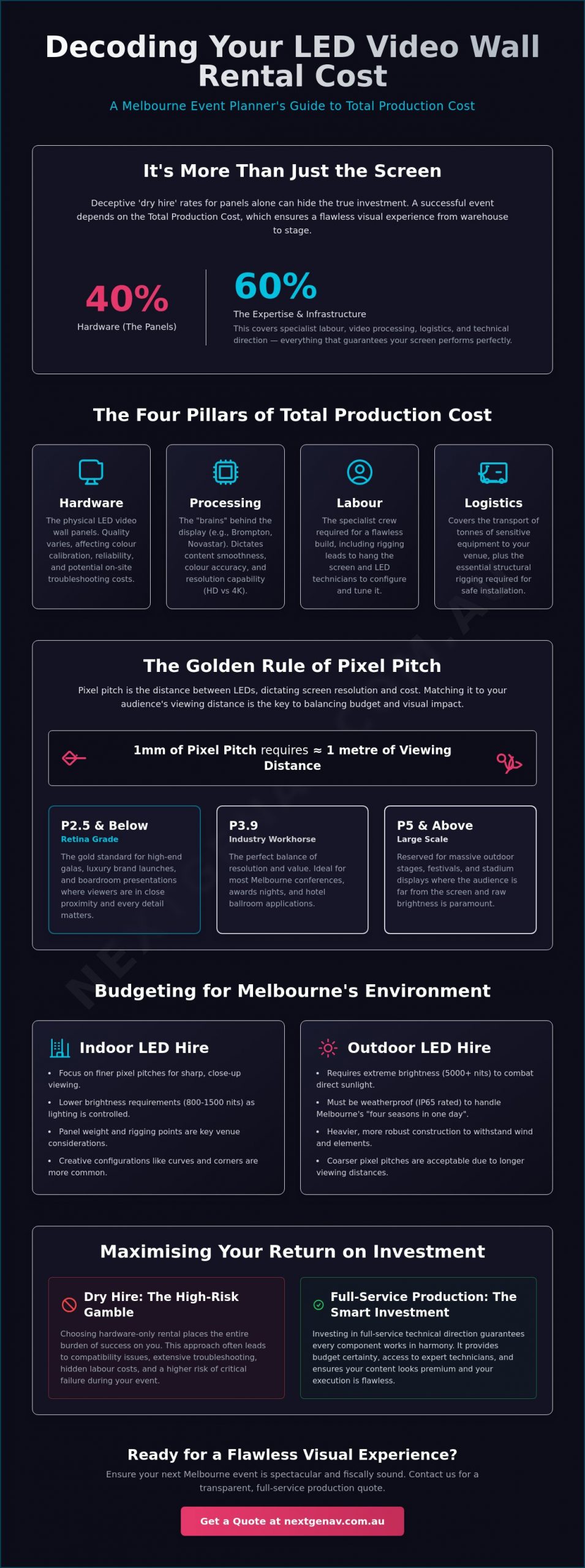
Budgeting for a high-impact event in Melbourne requires a fundamental shift in perspective. You aren’t just renting boxes of electronics; you’re investing in a visual outcome that defines your brand’s prestige. Many providers lead with a “Dry Hire Rate,” which is the cost of the panels alone sitting in a warehouse, but this rarely reflects the actual led video wall rental cost you will see on a final invoice. To build a realistic budget, you must look at the Total Production Cost. This encompasses the hardware, the processing brains, the specialist labour, and the complex logistics required to move tonnes of sensitive technology into your venue.
Think of your budget as four distinct pillars that support the visual experience. The hardware is the physical Video wall itself. Processing is the engine that drives the signal. Labour includes the expert technicians who build and tune the system. Logistics covers the transport and rigging. While a bargain-basement panel might look tempting on a spreadsheet, these cheap options often suffer from poor colour calibration and higher failure rates. This leads to expensive troubleshooting hours on-site, turning a perceived saving into a budget blowout.
Hardware vs. Full-Service Production
Dry hire is a high-risk gamble for event planners. If you choose a hardware-only rental, the burden of rigging, signal flow, and technical troubleshooting falls entirely on your shoulders. Opting for integrated audio visual hire Melbourne allows you to consolidate your budget and ensure every element, from the LED screen to the professional audio systems, works in perfect harmony. In a professional production environment, the physical panels typically account for only about 40% of your total led video wall rental cost. The remainder covers the expertise and infrastructure that guarantee the screen actually performs when the house lights go down.
The Role of the Video Processor
The processor is the unsung hero of your display, acting as the bridge between your content and the LED pixels. High-end systems like Brompton or Novastar dictate how smoothly your content flows and how accurately colours are reproduced across the entire surface. Moving from HD to 4K processing significantly increases the technical requirements and the associated budget. For high-stakes galas or corporate launches, redundant processing is a non-negotiable cost. It’s essentially event insurance; if one processor fails, a backup takes over instantly, preventing a total visual blackout in front of your audience.
Technical Drivers of Price: Pixel Pitch and Resolution
The most significant variable in your led video wall rental cost is the density of the technology itself. In the world of LED, precision is measured by pixel pitch; the millimetre distance between the centre of one LED cluster (SMD) and the next. This measurement dictates the resolution of your screen and, by extension, the volume of hardware required to fill your stage. A tighter pixel pitch means more individual LEDs per square metre, which increases manufacturing complexity and rental investment. Mastering the “Golden Rule” of viewing distance is the most effective way to protect your budget. This rule suggests that for every 1mm of pixel pitch, you require approximately 1 metre of viewing distance for the human eye to perceive a seamless image.
Choosing the right resolution is a strategic balancing act between visual prestige and fiscal responsibility. If your audience is seated twenty metres away, paying a premium for an ultra-fine 1.5mm screen is a wasted investment because the viewer cannot distinguish the added detail. Conversely, using a coarse screen for a front-row boardroom presentation will result in visible pixels and a diminished brand experience. Creative stage designs also influence the bottom line. Panels designed with “curve-able” chassis allow for immersive, wrap-around environments or cylindrical towers, but these specialist frames command a higher price than standard flat-wall configurations.
Common Pixel Pitches for Corporate Events
- P2.5 and below: These “Retina” grade panels offer incredible clarity for high-end galas where guests are in close proximity to the stage. They are the gold standard for luxury launches.
- P3.9: Known as the industry workhorse, this pitch provides the perfect balance of resolution and value for most Melbourne conferences and hotel ballrooms.
- P5 and above: Best reserved for massive outdoor stages or stadium displays where the audience is at least 50 metres away, allowing you to achieve scale without the high-density price tag.
Refresh Rates and Colour Depth
The sophistication of your content management also impacts the budget. For events being live-streamed or recorded, “Camera-Ready” refresh rates of 3840Hz or higher are essential to prevent flickering on screen. This technical precision ensures your digital backdrop looks as crisp on a remote viewer’s laptop as it does in the room. When you factor in High Dynamic Range (HDR) for deeper blacks and more vibrant colours, the hardware requirements become even more specialised. This superior colour depth is a primary reason why planners are moving away from traditional projection. You can explore the specific performance benefits in our analysis of led wall vs projector for conferences to see how brightness and contrast drive value. If you want to ensure your technical execution is flawless, engaging a team that understands technical direction early in the process is the smartest way to avoid expensive mid-production adjustments.
Labour and Logistics: The Melbourne Event Reality
Precision execution is the invisible engine of any successful production. While the physical hardware of your screen is a fixed variable, the human expertise required to assemble and tune that technology often dictates the true led video wall rental cost. In the Melbourne event circuit, logistics are rarely straightforward. Navigating the loading docks of the Melbourne Convention and Exhibition Centre (MCEC) or the intricate service lifts of the Crown Palladium requires a team that understands the specific architectural quirks and time-slot demands of our city’s premier venues. A standard 6m x 3m wall isn’t just “plug and play”; it involves a meticulous bump-in and pack-down timeline that typically spans four to six hours to ensure every panel is perfectly aligned and colour-calibrated before the first guest arrives.
Investing in high-level technical direction is frequently viewed as an additional expense, but in reality, it’s your most effective cost-saving measure. A seasoned technical director anticipates logistical bottlenecks before they manifest as overtime charges. They manage the delicate choreography of staging and rigging, ensuring that the LED installation doesn’t clash with lighting cues or audio coverage. By orchestrating these moving parts with professional authority, they eliminate the “failure cost” of technical glitches that can derail a high-stakes corporate launch or gala dinner.
Technical Crew Requirements
The success of your visual experience rests on the shoulders of a specialised crew. For a professional LED deployment, you’ll typically require a Vision Engineer to manage signal integrity, a System Tech for hardware assembly, and general labour hands for the heavy lifting. In Melbourne, an expert AV technician commands a rate between $100 and $150 per hour, while a qualified rigger for complex overhead setups averages approximately $180 per hour. We prioritise a Senior Lead for every installation because having a veteran on-site ensures that even if a venue’s power supply fluctuates or a signal cable fails, the solution is implemented instantly. Standard day rates cover the core build, but savvy planners must budget for overtime if the event finishes late into the night, as these rates can scale quickly after an eight-hour shift.
Transport and Rigging Safety
Weight is a critical factor that many planners overlook when budgeting for an LED wall. A 6m x 3m configuration carries significant mass, and the choice between floor support and a “flown” (rigged) system changes the price dramatically. Flown walls require certified motors and a rigging lead to ensure absolute compliance with Australian safety standards, adding a layer of complexity and cost. Furthermore, Melbourne CBD hotels often have strict loading dock time-slots. Missing your window at a venue like the Grand Hyatt or the Sofitel can result in idle labour costs while your transport waits on the street. Managing these logistical variables with precision ensures your budget remains intact while your visual impact reaches its full potential.
Indoor vs. Outdoor LED Screen Hire: Budgeting for Environments
Environmental variables are the silent architects of your led video wall rental cost. While an indoor screen focuses on intimate detail and colour accuracy, outdoor technology must battle the elements, requiring a completely different engineering profile. The primary differentiator is brightness, measured in “nits.” A standard indoor screen typically outputs 1,000 nits, which is ample for controlled ballroom lighting. However, to remain visible against the harsh Australian sun, an outdoor screen must surge to 5,000 nits or higher. This increased luminosity requires more robust power management and weatherproofing, driving the investment higher than a comparable indoor setup.
Melbourne’s notorious “four seasons in one day” makes IP65 weatherproofing a non-negotiable requirement for any exterior activation. This rating ensures your display remains operational during a sudden afternoon downpour, protecting your production from catastrophic failure. Beyond the rain, wind-loading is a critical safety factor. Large outdoor towers or ground-stacks act like massive sails; they require ballast and structural engineering certifications to ensure they remain stable in gusty conditions. These safety protocols are essential components of a professional quote, reflecting the mastery required to execute a safe public event. If you are unsure which environment your technology can handle, it’s best to consult our technical direction team early in your planning phase.
Indoor Excellence for Conferences
For plenary sessions and corporate galas, silent operation is the hallmark of prestige. High-end indoor panels utilise fanless designs to ensure the technology doesn’t compete with the presenter’s audio. These screens prioritise “seamless” corners and elegant trim, allowing your corporate branding to appear as part of the venue’s architecture rather than an afterthought. Many exhibitors also leverage trade show led wall rental to create custom booth sizes that maximise floor space while delivering high-density visual impact in a crowded hall.
Outdoor Impact for Festivals and Community Events
Sunlight-readable technology is the only way to ensure your content isn’t washed out by midday. While the cost per square metre for outdoor gear is higher due to its ruggedised build, the increased viewing distance of a festival crowd allows you to use larger pixel pitches, such as P5 or P10. This strategic choice helps offset the led video wall rental cost by reducing the total number of pixels required to fill a massive stage. Always factor in the power consumption reality; these high-brightness screens often require dedicated generators or high-amp venue power to maintain their peak performance throughout a multi-day event. For event organisers planning activations across the country, our comprehensive outdoor led screen hire Sydney guide covers the specific brightness, weatherproofing, and structural requirements needed to engineer a flawless visual triumph against coastal winds and harsh glare.
Maximising ROI: Why Full-Service Production is the Smarter Investment
Maximising your return on investment requires looking beyond the bottom line of a quote. While traditional projection might offer a lower entry point, the luminosity and prestige of a modern led video wall provide a level of audience engagement and ambient light rejection that static screens simply cannot match. The “cheapest quote” often carries a hidden “Failure Cost,” which is the price of technical downtime, pixel dropouts, or poor colour matching that can tarnish a brand launch. Choosing a full-service partner ensures you aren’t just hiring equipment; you’re securing a flawless execution where the technical engine remains invisible, allowing your message to take centre stage.
When evaluating your led video wall rental cost, the most expensive mistake is prioritising hardware over expertise. A professional production team acts as the “Invisible Expert,” identifying venue power limitations or content aspect ratio conflicts long before they reach the stage. This proactive orchestration eliminates the stress of live event planning. To ensure your investment delivers maximum impact, use this final checklist when reviewing any AV quote:
- Does the quote include a dedicated Vision Engineer and System Tech for the duration?
- Are there redundant processors and signal paths included for high-stakes moments?
- Is the transport and labour calculated for Melbourne-specific venue access windows?
- Are rigging safety certifications and site-specific structural engineering included?
Content Synchronisation and Testing
Visual harmony depends on the relationship between your digital files and the physical pixels. We don’t just set up a screen; we manage the complex “Pixel Mapping” required for non-standard or curved shapes to ensure your branding isn’t stretched or distorted. To guarantee success, we organise a dedicated “Content Day” to test aspect ratios and file types against the actual hardware. This pre-event testing prevents last-minute panics and ensures that every motion graphic and video looks premium from the moment the house lights dim.
The NextGen AV Difference
With 30 years of Melbourne event history, we’ve navigated every major ballroom and understood every power circuit in the city. This seasoned perspective allows us to offer a “Confidence Guarantee,” backed by 24/7 technical support and fully redundant systems that thrive under the pressure of a live environment. We don’t just provide gear; we provide the technical direction that transforms a simple presentation into a prestigious visual experience. Ready to elevate your next activation? Contact NextGen AV for a bespoke LED wall quote and let our team orchestrate your success.
Orchestrate Your Next Visual Masterpiece
Navigating the intricacies of led video wall rental cost requires more than just a spreadsheet; it demands a vision for the final, high-impact result. You now have the framework to balance technical precision with fiscal reality, ensuring that every pixel serves your event’s prestige. By prioritising elite technical direction and environmental resilience, you transform a standard hire into a sophisticated production that captivates your audience. Success isn’t just about the hardware on stage; it’s about the invisible expertise that ensures every transition is seamless and every colour is vibrant.
Our team brings over 30 years of Melbourne event excellence to your project, providing redundant 4K processing as standard for absolute peace of mind. We specialise in high-stakes corporate production where technical failure isn’t an option. Let us manage the complex engine behind the scenes while you take centre stage with total confidence. Request a Precision-Engineered LED Wall Quote today and begin your journey toward a flawless event realisation. Your vision deserves an extraordinary execution, and we’re ready to make it happen.
Frequently Asked Questions
How much does it cost to rent an LED video wall in Melbourne?
The total investment for a professional display depends on the scale, resolution, and technical complexity of your production. While hardware is a significant factor, your led video wall rental cost also encompasses the specialised crew and processing required for a flawless execution. Planners should account for the current Melbourne market rates for expert technicians, which typically range between $100 and $150 per hour, alongside the logistical demands of your chosen venue.
What is the difference between pixel pitch and rental price?
Pixel pitch is the primary technical driver of price because it dictates the density of the LEDs on each panel. A smaller pixel pitch, such as 1.5mm, requires more individual components per square metre to achieve high-resolution clarity, which increases manufacturing and maintenance expenses. Choosing a tighter pitch for front-row audiences ensures a premium “Retina” effect, whereas a larger pitch for distant viewing can help manage the budget without sacrificing visual impact.
Does the rental cost include setup and pack-down?
Full-service production quotes typically include the specialist labour required for a safe and precise installation. A standard 6m x 3m wall requires a bump-in and pack-down window of four to six hours, involving vision engineers and rigging leads to ensure structural integrity. While some providers offer “dry hire” rates for hardware alone, these figures exclude the vital technical orchestration needed to build, tune, and dismantle the system at your venue.
Are LED walls more expensive than projectors for conferences?
The initial investment for an LED wall is often higher than traditional projection, but the return on investment is found in its superior performance. LED technology excels in high-ambient light environments, allowing you to keep house lights up for networking and note-taking without washing out your content. This brightness and contrast advantage eliminates the need for darkened rooms, providing a more prestigious and engaging experience for your delegates.
What are the hidden costs in an LED wall rental quote?
Logistics, power infrastructure, and venue-specific fees are the most common “invisible” expenses that can impact your budget. You must account for Melbourne loading dock time-slots, 3-phase power requirements, and the weight-loading certifications required for flown rigs. A transparent quote should clearly outline these elements, ensuring you aren’t surprised by additional charges for specialised rigging motors or late-night labour surcharges after a gala finish.
Can I use an indoor LED screen for an outdoor event to save money?
Attempting to use indoor technology for an outdoor activation is a high-risk gamble that usually ends in technical failure. Indoor screens only output approximately 1,000 nits of brightness, which is invisible against the 5,000-nit intensity of the Australian sun. Additionally, indoor panels lack the IP65 weatherproofing required to protect the electronics from Melbourne’s unpredictable rain, making dedicated outdoor hardware essential for both visibility and safety.
How long does it take to install a standard corporate LED wall?
Expect a dedicated timeline of four to six hours for a professional crew to assemble and calibrate a standard 6m x 3m configuration. This window allows for the physical build, the complex signal mapping of the processors, and the meticulous colour balancing required to match your brand’s palette. Rushing this process can lead to visible seams or signal dropouts, so we always recommend scheduling a generous technical window before your event begins.
What power requirements do I need to budget for at the venue?
LED video walls are power-intensive systems that often require 3-phase power or multiple dedicated 20-amp circuits to operate safely at peak brightness. If your venue has limited electrical infrastructure, you may need to budget for temporary power distribution or whisper-quiet generators. Identifying these requirements early through a technical site visit prevents expensive last-minute electrical upgrades during the bump-in phase of your production.
An LED video wall is not merely a piece of equipment; it’s a high-stakes performance that lives or dies by the precision of its technical orchestration. When you begin researching the led video wall rental cost for your next Melbourne activation, you’ll quickly find that the hardware is only one chapter of the story. Between the nuances of pixel pitch and the vital necessity of expert labour, the line between a breathtaking visual experience and a technical nightmare is often thinner than it seems.
You likely feel the pressure of delivering a flawless production while staring down opaque quotes and complex jargon that feels designed to complicate your budget. This guide strips away the mystery, offering you a transparent framework to master your event’s total cost of ownership. We’ll explore the critical factors driving pricing in 2026, from the impact of immersive technology trends to the logistical realities of transport and technical direction, ensuring your next stage design is both spectacular and fiscally sound.
Key Takeaways
- Master the four pillars of total production cost to move beyond deceptive dry hire rates and protect your event budget from unforeseen expenses.
- Learn how to apply the “Golden Rule” of pixel pitch to achieve optimal resolution while managing your overall led video wall rental cost effectively.
- Understand the essential labour requirements for Melbourne events, including the specific roles of rigging leads and LED technicians during high-pressure setup windows.
- Identify the critical hardware specifications needed to combat Melbourne’s “four seasons in one day,” including brightness levels and weatherproofing for outdoor displays.
- Evaluate the long-term value of full-service technical direction to ensure your visual content looks premium and your execution remains flawless.
Understanding LED Video Wall Rental Cost: The Core Components
Budgeting for a high-impact event in Melbourne requires a fundamental shift in perspective. You aren’t just renting boxes of electronics; you’re investing in a visual outcome that defines your brand’s prestige. Many providers lead with a “Dry Hire Rate,” which is the cost of the panels alone sitting in a warehouse, but this rarely reflects the actual led video wall rental cost you will see on a final invoice. To build a realistic budget, you must look at the Total Production Cost. This encompasses the hardware, the processing brains, the specialist labour, and the complex logistics required to move tonnes of sensitive technology into your venue.
Think of your budget as four distinct pillars that support the visual experience. The hardware is the physical Video wall itself. Processing is the engine that drives the signal. Labour includes the expert technicians who build and tune the system. Logistics covers the transport and rigging. While a bargain-basement panel might look tempting on a spreadsheet, these cheap options often suffer from poor colour calibration and higher failure rates. This leads to expensive troubleshooting hours on-site, turning a perceived saving into a budget blowout.
Hardware vs. Full-Service Production
Dry hire is a high-risk gamble for event planners. If you choose a hardware-only rental, the burden of rigging, signal flow, and technical troubleshooting falls entirely on your shoulders. Opting for integrated audio visual hire Melbourne allows you to consolidate your budget and ensure every element, from the LED screen to the professional audio systems, works in perfect harmony. In a professional production environment, the physical panels typically account for only about 40% of your total led video wall rental cost. The remainder covers the expertise and infrastructure that guarantee the screen actually performs when the house lights go down.
The Role of the Video Processor
The processor is the unsung hero of your display, acting as the bridge between your content and the LED pixels. High-end systems like Brompton or Novastar dictate how smoothly your content flows and how accurately colours are reproduced across the entire surface. Moving from HD to 4K processing significantly increases the technical requirements and the associated budget. For high-stakes galas or corporate launches, redundant processing is a non-negotiable cost. It’s essentially event insurance; if one processor fails, a backup takes over instantly, preventing a total visual blackout in front of your audience.
Technical Drivers of Price: Pixel Pitch and Resolution
The most significant variable in your led video wall rental cost is the density of the technology itself. In the world of LED, precision is measured by pixel pitch; the millimetre distance between the centre of one LED cluster (SMD) and the next. This measurement dictates the resolution of your screen and, by extension, the volume of hardware required to fill your stage. A tighter pixel pitch means more individual LEDs per square metre, which increases manufacturing complexity and rental investment. Mastering the “Golden Rule” of viewing distance is the most effective way to protect your budget. This rule suggests that for every 1mm of pixel pitch, you require approximately 1 metre of viewing distance for the human eye to perceive a seamless image.
Choosing the right resolution is a strategic balancing act between visual prestige and fiscal responsibility. If your audience is seated twenty metres away, paying a premium for an ultra-fine 1.5mm screen is a wasted investment because the viewer cannot distinguish the added detail. Conversely, using a coarse screen for a front-row boardroom presentation will result in visible pixels and a diminished brand experience. Creative stage designs also influence the bottom line. Panels designed with “curve-able” chassis allow for immersive, wrap-around environments or cylindrical towers, but these specialist frames command a higher price than standard flat-wall configurations.
Common Pixel Pitches for Corporate Events
- P2.5 and below: These “Retina” grade panels offer incredible clarity for high-end galas where guests are in close proximity to the stage. They are the gold standard for luxury launches.
- P3.9: Known as the industry workhorse, this pitch provides the perfect balance of resolution and value for most Melbourne conferences and hotel ballrooms.
- P5 and above: Best reserved for massive outdoor stages or stadium displays where the audience is at least 50 metres away, allowing you to achieve scale without the high-density price tag.
Refresh Rates and Colour Depth
The sophistication of your content management also impacts the budget. For events being live-streamed or recorded, “Camera-Ready” refresh rates of 3840Hz or higher are essential to prevent flickering on screen. This technical precision ensures your digital backdrop looks as crisp on a remote viewer’s laptop as it does in the room. When you factor in High Dynamic Range (HDR) for deeper blacks and more vibrant colours, the hardware requirements become even more specialised. This superior colour depth is a primary reason why planners are moving away from traditional projection. You can explore the specific performance benefits in our analysis of led wall vs projector for conferences to see how brightness and contrast drive value. If you want to ensure your technical execution is flawless, engaging a team that understands technical direction early in the process is the smartest way to avoid expensive mid-production adjustments.
Labour and Logistics: The Melbourne Event Reality
Precision execution is the invisible engine of any successful production. While the physical hardware of your screen is a fixed variable, the human expertise required to assemble and tune that technology often dictates the true led video wall rental cost. In the Melbourne event circuit, logistics are rarely straightforward. Navigating the loading docks of the Melbourne Convention and Exhibition Centre (MCEC) or the intricate service lifts of the Crown Palladium requires a team that understands the specific architectural quirks and time-slot demands of our city’s premier venues. A standard 6m x 3m wall isn’t just “plug and play”; it involves a meticulous bump-in and pack-down timeline that typically spans four to six hours to ensure every panel is perfectly aligned and colour-calibrated before the first guest arrives.
Investing in high-level technical direction is frequently viewed as an additional expense, but in reality, it’s your most effective cost-saving measure. A seasoned technical director anticipates logistical bottlenecks before they manifest as overtime charges. They manage the delicate choreography of staging and rigging, ensuring that the LED installation doesn’t clash with lighting cues or audio coverage. By orchestrating these moving parts with professional authority, they eliminate the “failure cost” of technical glitches that can derail a high-stakes corporate launch or gala dinner.
Technical Crew Requirements
The success of your visual experience rests on the shoulders of a specialised crew. For a professional LED deployment, you’ll typically require a Vision Engineer to manage signal integrity, a System Tech for hardware assembly, and general labour hands for the heavy lifting. In Melbourne, an expert AV technician commands a rate between $100 and $150 per hour, while a qualified rigger for complex overhead setups averages approximately $180 per hour. We prioritise a Senior Lead for every installation because having a veteran on-site ensures that even if a venue’s power supply fluctuates or a signal cable fails, the solution is implemented instantly. Standard day rates cover the core build, but savvy planners must budget for overtime if the event finishes late into the night, as these rates can scale quickly after an eight-hour shift.
Transport and Rigging Safety
Weight is a critical factor that many planners overlook when budgeting for an LED wall. A 6m x 3m configuration carries significant mass, and the choice between floor support and a “flown” (rigged) system changes the price dramatically. Flown walls require certified motors and a rigging lead to ensure absolute compliance with Australian safety standards, adding a layer of complexity and cost. Furthermore, Melbourne CBD hotels often have strict loading dock time-slots. Missing your window at a venue like the Grand Hyatt or the Sofitel can result in idle labour costs while your transport waits on the street. Managing these logistical variables with precision ensures your budget remains intact while your visual impact reaches its full potential.
Indoor vs. Outdoor LED Screen Hire: Budgeting for Environments
Environmental variables are the silent architects of your led video wall rental cost. While an indoor screen focuses on intimate detail and colour accuracy, outdoor technology must battle the elements, requiring a completely different engineering profile. The primary differentiator is brightness, measured in “nits.” A standard indoor screen typically outputs 1,000 nits, which is ample for controlled ballroom lighting. However, to remain visible against the harsh Australian sun, an outdoor screen must surge to 5,000 nits or higher. This increased luminosity requires more robust power management and weatherproofing, driving the investment higher than a comparable indoor setup.
Melbourne’s notorious “four seasons in one day” makes IP65 weatherproofing a non-negotiable requirement for any exterior activation. This rating ensures your display remains operational during a sudden afternoon downpour, protecting your production from catastrophic failure. Beyond the rain, wind-loading is a critical safety factor. Large outdoor towers or ground-stacks act like massive sails; they require ballast and structural engineering certifications to ensure they remain stable in gusty conditions. These safety protocols are essential components of a professional quote, reflecting the mastery required to execute a safe public event. If you are unsure which environment your technology can handle, it’s best to consult our technical direction team early in your planning phase.
Indoor Excellence for Conferences
For plenary sessions and corporate galas, silent operation is the hallmark of prestige. High-end indoor panels utilise fanless designs to ensure the technology doesn’t compete with the presenter’s audio. These screens prioritise “seamless” corners and elegant trim, allowing your corporate branding to appear as part of the venue’s architecture rather than an afterthought. Many exhibitors also leverage trade show led wall rental to create custom booth sizes that maximise floor space while delivering high-density visual impact in a crowded hall.
Outdoor Impact for Festivals and Community Events
Sunlight-readable technology is the only way to ensure your content isn’t washed out by midday. While the cost per square metre for outdoor gear is higher due to its ruggedised build, the increased viewing distance of a festival crowd allows you to use larger pixel pitches, such as P5 or P10. This strategic choice helps offset the led video wall rental cost by reducing the total number of pixels required to fill a massive stage. Always factor in the power consumption reality; these high-brightness screens often require dedicated generators or high-amp venue power to maintain their peak performance throughout a multi-day event. For event organisers planning activations across the country, our comprehensive outdoor led screen hire Sydney guide covers the specific brightness, weatherproofing, and structural requirements needed to engineer a flawless visual triumph against coastal winds and harsh glare.
Maximising ROI: Why Full-Service Production is the Smarter Investment
Maximising your return on investment requires looking beyond the bottom line of a quote. While traditional projection might offer a lower entry point, the luminosity and prestige of a modern led video wall provide a level of audience engagement and ambient light rejection that static screens simply cannot match. The “cheapest quote” often carries a hidden “Failure Cost,” which is the price of technical downtime, pixel dropouts, or poor colour matching that can tarnish a brand launch. Choosing a full-service partner ensures you aren’t just hiring equipment; you’re securing a flawless execution where the technical engine remains invisible, allowing your message to take centre stage.
When evaluating your led video wall rental cost, the most expensive mistake is prioritising hardware over expertise. A professional production team acts as the “Invisible Expert,” identifying venue power limitations or content aspect ratio conflicts long before they reach the stage. This proactive orchestration eliminates the stress of live event planning. To ensure your investment delivers maximum impact, use this final checklist when reviewing any AV quote:
- Does the quote include a dedicated Vision Engineer and System Tech for the duration?
- Are there redundant processors and signal paths included for high-stakes moments?
- Is the transport and labour calculated for Melbourne-specific venue access windows?
- Are rigging safety certifications and site-specific structural engineering included?
Content Synchronisation and Testing
Visual harmony depends on the relationship between your digital files and the physical pixels. We don’t just set up a screen; we manage the complex “Pixel Mapping” required for non-standard or curved shapes to ensure your branding isn’t stretched or distorted. To guarantee success, we organise a dedicated “Content Day” to test aspect ratios and file types against the actual hardware. This pre-event testing prevents last-minute panics and ensures that every motion graphic and video looks premium from the moment the house lights dim.
The NextGen AV Difference
With 30 years of Melbourne event history, we’ve navigated every major ballroom and understood every power circuit in the city. This seasoned perspective allows us to offer a “Confidence Guarantee,” backed by 24/7 technical support and fully redundant systems that thrive under the pressure of a live environment. We don’t just provide gear; we provide the technical direction that transforms a simple presentation into a prestigious visual experience. Ready to elevate your next activation? Contact NextGen AV for a bespoke LED wall quote and let our team orchestrate your success.
Orchestrate Your Next Visual Masterpiece
Navigating the intricacies of led video wall rental cost requires more than just a spreadsheet; it demands a vision for the final, high-impact result. You now have the framework to balance technical precision with fiscal reality, ensuring that every pixel serves your event’s prestige. By prioritising elite technical direction and environmental resilience, you transform a standard hire into a sophisticated production that captivates your audience. Success isn’t just about the hardware on stage; it’s about the invisible expertise that ensures every transition is seamless and every colour is vibrant.
Our team brings over 30 years of Melbourne event excellence to your project, providing redundant 4K processing as standard for absolute peace of mind. We specialise in high-stakes corporate production where technical failure isn’t an option. Let us manage the complex engine behind the scenes while you take centre stage with total confidence. Request a Precision-Engineered LED Wall Quote today and begin your journey toward a flawless event realisation. Your vision deserves an extraordinary execution, and we’re ready to make it happen.
Frequently Asked Questions
How much does it cost to rent an LED video wall in Melbourne?
The total investment for a professional display depends on the scale, resolution, and technical complexity of your production. While hardware is a significant factor, your led video wall rental cost also encompasses the specialised crew and processing required for a flawless execution. Planners should account for the current Melbourne market rates for expert technicians, which typically range between $100 and $150 per hour, alongside the logistical demands of your chosen venue.
What is the difference between pixel pitch and rental price?
Pixel pitch is the primary technical driver of price because it dictates the density of the LEDs on each panel. A smaller pixel pitch, such as 1.5mm, requires more individual components per square metre to achieve high-resolution clarity, which increases manufacturing and maintenance expenses. Choosing a tighter pitch for front-row audiences ensures a premium “Retina” effect, whereas a larger pitch for distant viewing can help manage the budget without sacrificing visual impact.
Does the rental cost include setup and pack-down?
Full-service production quotes typically include the specialist labour required for a safe and precise installation. A standard 6m x 3m wall requires a bump-in and pack-down window of four to six hours, involving vision engineers and rigging leads to ensure structural integrity. While some providers offer “dry hire” rates for hardware alone, these figures exclude the vital technical orchestration needed to build, tune, and dismantle the system at your venue.
Are LED walls more expensive than projectors for conferences?
The initial investment for an LED wall is often higher than traditional projection, but the return on investment is found in its superior performance. LED technology excels in high-ambient light environments, allowing you to keep house lights up for networking and note-taking without washing out your content. This brightness and contrast advantage eliminates the need for darkened rooms, providing a more prestigious and engaging experience for your delegates.
What are the hidden costs in an LED wall rental quote?
Logistics, power infrastructure, and venue-specific fees are the most common “invisible” expenses that can impact your budget. You must account for Melbourne loading dock time-slots, 3-phase power requirements, and the weight-loading certifications required for flown rigs. A transparent quote should clearly outline these elements, ensuring you aren’t surprised by additional charges for specialised rigging motors or late-night labour surcharges after a gala finish.
Can I use an indoor LED screen for an outdoor event to save money?
Attempting to use indoor technology for an outdoor activation is a high-risk gamble that usually ends in technical failure. Indoor screens only output approximately 1,000 nits of brightness, which is invisible against the 5,000-nit intensity of the Australian sun. Additionally, indoor panels lack the IP65 weatherproofing required to protect the electronics from Melbourne’s unpredictable rain, making dedicated outdoor hardware essential for both visibility and safety.
How long does it take to install a standard corporate LED wall?
Expect a dedicated timeline of four to six hours for a professional crew to assemble and calibrate a standard 6m x 3m configuration. This window allows for the physical build, the complex signal mapping of the processors, and the meticulous colour balancing required to match your brand’s palette. Rushing this process can lead to visible seams or signal dropouts, so we always recommend scheduling a generous technical window before your event begins.
What power requirements do I need to budget for at the venue?
LED video walls are power-intensive systems that often require 3-phase power or multiple dedicated 20-amp circuits to operate safely at peak brightness. If your venue has limited electrical infrastructure, you may need to budget for temporary power distribution or whisper-quiet generators. Identifying these requirements early through a technical site visit prevents expensive last-minute electrical upgrades during the bump-in phase of your production.
Discover Valuable Insights
Unlock Expert Tips and Advice
Our blog is packed with valuable information to help you stay ahead. Whether you’re looking for expert advice, industry trends, or practical tips, you’ll find everything you need. Reach out today to learn more or get in touch with us for personalised support!