



The most breathtaking moments of a live production don’t happen on the stage; they happen several metres above it, held in place by the invisible precision of professional engineering. You understand that behind every immersive LED display or complex lighting plot lies a significant weight of responsibility. The fear of structural failure or the frustration of navigating opaque Australian rigging standards can often overshadow the creative vision of your event. It is a high-stakes environment where the difference between a spectacular success and a safety incident rests on the strength of your overhead infrastructure.
Implementing the right event rigging solutions is the only way to bridge the gap between ambitious design and absolute safety. This 2026 guide provides the mastery you need to ensure your next production is structurally sound, fully compliant with the WHS Act 2011, and visually spectacular. We will demystify essential hardware, clarify venue load limits, and provide the technical vocabulary required to brief your AV partners with the authority of a seasoned expert. By the end of this article, you will have the knowledge to move past the logistical grind and focus on the prestige of a flawless execution.
Key Takeaways
- Understand why professional event rigging solutions are the invisible backbone of any high-impact production, ensuring every element is suspended with engineered precision.
- Identify the essential hardware required for a secure setup, from modular aluminium truss to the sophisticated chain hoists that safely lift the load.
- Navigate complex Australian safety standards and licensing requirements to ensure your production remains fully compliant and structurally sound.
- Learn how to conduct a comprehensive site inspection to account for venue load limits and technical constraints before the build begins.
- Discover the efficiency of a holistic approach where rigging, lighting, and staging are integrated to create a seamless and prestigious event experience.
What are Event Rigging Solutions?
Every world-class production begins with a structure that stays largely unnoticed by the audience. Professional event rigging solutions represent the sophisticated integration of hardware and engineering designed to suspend high-end audio, lighting, and visual technology safely above the crowd. It is the invisible backbone of the experience. While architectural rigging refers to permanent systems built into theatres or arenas, temporary event rigging is a bespoke craft. It involves transforming a raw space, such as a hotel ballroom, a heritage building, or an outdoor precinct, into a technically capable venue through the use of modular trussing and precision motors. This flexibility allows for the creative freedom that brings a cinematic vision to life.
Modern productions rely on this foundation to achieve a level of prestige that floor-supported equipment simply cannot match. Whether you are planning an intimate corporate gala or a large-scale festival, the rigging system acts as the silent engine driving the success of the show. By employing Entertainment rigging principles, technical teams can create immersive environments that feel both expansive and secure. It is a dedicated craft that balances the laws of physics with the artistry of live performance.
The Core Purpose of Rigging in Events
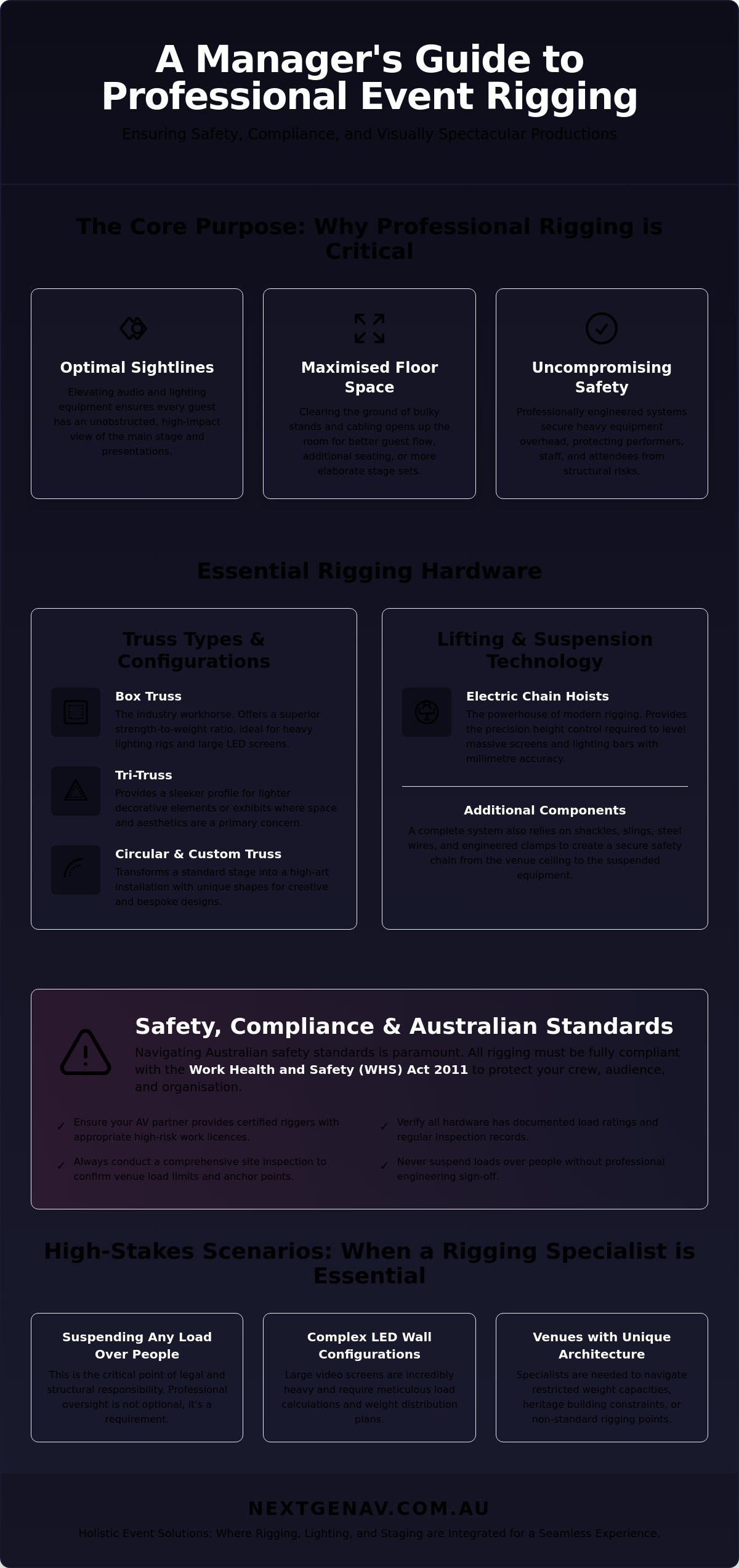
The primary objective of any rigging system is to elevate the technical standard of the production while maintaining absolute safety. By moving heavy equipment overhead, you achieve three critical outcomes:
- Optimal Sightlines: Elevating audio and lighting gear ensures every guest has an unobstructed view of the stage, creating a more inclusive and high-impact experience.
- Maximised Floor Space: Clearing the ground of bulky stands and cables opens up the room for better guest flow, additional seating, or more elaborate stage sets.
- Uncompromising Safety: A professionally engineered system secures equipment far more effectively than temporary floor supports, protecting performers, staff, and attendees from accidental knocks or instability.
When Does Your Event Need a Rigging Specialist?
Rigging is not a “plug and play” utility. It’s a high-stakes discipline that requires seasoned veterans who thrive under pressure. You should engage a specialist whenever your production involves suspending loads over people, as this is a critical point of legal and structural responsibility. Complex LED wall configurations also demand expert oversight; these screens are incredibly heavy and require meticulous weight distribution. Finally, if your venue has restricted weight capacities or unique architecture, a specialist will navigate these constraints to ensure your event rigging solutions are both compliant and spectacular. They act as the confident orchestrator, allowing you to take centre stage without a single worry about the gear overhead.
Essential Hardware: The Components of a Rigging System
Excellence in live production isn’t just about the vision; it’s about the physical components that make that vision possible. A robust rigging system is composed of high-grade hardware that must work in perfect unison. When we design event rigging solutions, we select each element based on its load-bearing capacity and its ability to integrate seamlessly with the venue’s architecture. From the skeleton of the stage to the motors that do the heavy lifting, every piece of kit is a critical link in the safety chain. Understanding these components allows you to brief your technical team with confidence and precision.
Truss Types and Configurations
Aluminium truss serves as the modular building block of any modern event. Box truss is the industry workhorse, offering a superior strength-to-weight ratio for heavy lighting rigs and LED screens. In contrast, tri-truss provides a sleeker profile for lighter decorative elements or exhibits where space is at a premium. For those looking to break away from traditional linear designs, circular and custom-curved trussing can transform a standard stage into a high-art installation. We often recommend black powder-coated finishes for a sophisticated, “invisible” look that lets the lighting take centre stage, while classic silver remains a staple for high-energy, industrial aesthetics.
Lifting and Suspension Technology
The true power behind any rig lies in its lifting technology. Electric chain hoists provide the precision height control required to level massive screens and lighting bars with millimetre accuracy. For smaller, static installations where power isn’t required after the initial setup, manual chain blocks offer a reliable and cost-effective alternative. Safety is never left to chance; seasoned teams utilise advanced load monitoring systems that provide real-time data to prevent structural overloads before they occur. It’s important to remember that operating this machinery is a specialised task; anyone performing rigging work in Australia must hold a valid Australian high-risk work license to ensure compliance with national safety regulations.
Connection Points and Ground Support
The smallest components often carry the most weight. High-tensile steel cables, Grade S bow shackles, and synthetic round slings are the critical connection points that secure the truss to the venue’s fly points. However, not every venue allows for overhead suspension. In these scenarios, ground support systems become essential. These self-supporting structures use heavy-duty base plates and towers to lift the rig from the floor up, ensuring you can still achieve a professional, elevated look even in heritage buildings or temporary marquees. If you’re unsure which configuration fits your next project, exploring our range of integrated staging and rigging options is an excellent place to start.
Safety, Compliance, and Australian Standards
Safety in the event industry is often viewed through the lens of liability, but for elite production teams, it’s viewed as the art of mitigation. Adhering to Australian Standards like AS 1418 for hoists and winches, or AS 2319 for rigging screws, isn’t just about ticking a box; it’s about guaranteeing structural integrity under pressure. When we deploy event rigging solutions, every calculation is backed by these rigorous benchmarks. This professional rigour extends to the documentation process, where Safe Work Method Statements (SWMS) and comprehensive risk assessments become the roadmap for a secure build. Following a structured approach to managing workplace hazards and risks ensures that potential issues are identified and neutralised long before the first guest arrives.
The human element is just as critical as the hardware. In Australia, rigging is classified as high-risk work, requiring specific licensing that reflects the complexity of the task. An Intermediate Rigger is qualified for most standard production tasks, such as erecting truss and installing hoists. However, for complex custom builds, massive suspended structures, or anything involving the movement of loads, an Advanced Rigger is required to oversee the operation. For any bespoke stage design or non-standard installation, a structural engineering sign-off provides the final seal of approval, offering the ultimate peace of mind for event organisers and venue owners alike.
Navigating Venue Load Limits
Every venue has a different story to tell through its rigging plot. Understanding the difference between a point load, which is the weight at a single suspension point, and a Uniformly Distributed Load (UDL) is essential for preventing structural fatigue. In Melbourne, many prestige venues are housed in heritage buildings with strict technical restrictions that can’t be ignored. We work closely with venue managers to interpret these floor plans and plots, ensuring your production stays within safe limits while still achieving maximum visual impact. It’s about finding the sweet spot between creative ambition and the physical realities of the room.
Annual Inspections and Gear Maintenance
Hardware is only as reliable as its last inspection. All rigging equipment must be “tagged and tested” regularly to meet Australian safety requirements and ensure it’s fit for purpose. At NextGen AV, we maintain a rigorous maintenance schedule that often exceeds industry minimums. Our technicians are trained to spot the subtle signs of compromised gear, such as hairline fractures in shackles or microscopic fraying in synthetic slings, that an untrained eye might miss. Using pristine, well-maintained equipment is a commitment to the professional standard your event deserves, ensuring the “invisible backbone” of your show remains flawlessly strong.
Planning Your Rigging: A Guide for Event Managers
Successful event planning requires moving beyond the logistical grind to focus on the creative vision. Rigging shouldn’t be an afterthought. It’s the framework that supports your core objectives. Whether you’re aiming for a high-prestige awards night or a high-energy product launch, your event rigging solutions must be designed to enhance that specific atmosphere. A thorough site inspection with your technical partner is the first step. This visit allows us to identify structural points, assess floor loading for ground support, and anticipate any architectural hurdles before they become costly site-day problems. It’s about proactive orchestration rather than reactive fixes.
Understanding the financial components of a rig is essential for a transparent planning process. Budgeting for rigging involves more than just the daily rate for truss or motors. It encompasses specialised labour, such as licensed riggers who manage the high-risk work, transport for heavy hardware, and the specific equipment hire required for your design. By accounting for these elements early, you avoid the hidden costs often associated with venue rigging fees and technical adjustments. This clarity allows you to allocate resources where they’ll have the most impact on the guest experience. Working with dedicated event staging Melbourne specialists ensures that your physical production foundation is engineered to complement the rigging system from the very first planning stage.
The CAD Advantage in Rigging
Computer-Aided Design (CAD) has transformed the pre-production phase into a precise science. It allows us to build a digital twin of your event space. We can calculate weight distribution with mathematical certainty and verify sightlines for every seat in the house before a single bolt is tightened. This visual data is invaluable for sharing plans with venue managers and stakeholders, ensuring a seamless approval process and a predictable build. It eliminates the guesswork, allowing you to focus on the prestige of the final result.
Coordinating with Other AV Departments
A rig doesn’t exist in isolation. It’s a collaborative platform. We ensure that our rigging plans are perfectly aligned with our stage lighting design services, providing the necessary hang points for every fixture. Beyond the lights, we integrate cable paths for power and data directly into the truss design, keeping the “invisible backbone” clean and professional. Finally, coordinating the bump-in and bump-out schedule is critical. Rigging is often the first element to go up and the last to come down, so precise timing ensures the entire technical team stays on track. If you’re ready to elevate your next production with a team that understands the nuances of technical planning, reach out to the experts at NextGen AV for a comprehensive consultation.
Integrated Rigging Solutions with NextGen AV
Choosing a technical partner who treats rigging as an integrated discipline rather than a standalone utility transforms the entire production process. When you opt for a holistic approach to stage and lighting hire Melbourne, you eliminate the friction between separate vendors and ensure that every technical element works in perfect synergy. Our event rigging solutions are designed to be the foundation upon which your visual and audio systems thrive. This unified strategy not only saves significant time during the high-pressure bump-in phase but also optimises your budget by streamlining labour and transport requirements. It is about creating a seamless path from the initial CAD drawing to the final, breathtaking execution.
With over 30 years of experience in the Australian event industry, we have refined a “no-surprises” philosophy that prioritises absolute reliability. We understand the inherent stress of high-stakes planning, which is why our team acts as a proactive technical powerhouse behind the scenes. This seasoned expertise allows us to navigate the complexities of venue load limits and regulatory compliance with quiet power, leaving you free to focus on the prestige of the event itself. We don’t just provide equipment; we deliver the peace of mind that comes from three decades of flawless execution.
Rigging for High-Impact Visuals
Modern productions increasingly rely on massive digital canvases to captivate audiences. Specialised rigging for LED video walls requires a sophisticated understanding of weight distribution and structural tension. These screens are significantly heavier than traditional projection surfaces, demanding precision-engineered trussing and high-capacity motors to ensure a perfectly level and secure hang. We thrive on managing these unique weight challenges, using creative truss configurations to build immersive environments that wrap around your audience. Our technical direction ensures that even the most ambitious visual designs are grounded in absolute structural integrity.
Partnering with NextGen AV in Melbourne
Our deep roots in the local industry give us an unparalleled advantage when working within Melbourne’s premier event venues. We maintain strong relationships with venue managers across the city, allowing us to navigate technical restrictions and rigging plots with ease. The “Invisible Expert” philosophy is at the core of everything we do; we handle the complex engineering and high-risk licensing requirements so that you can take the credit for a spectacular result. If you are ready to elevate your next production with elite technical execution, contact us today for a comprehensive rigging and event lighting hire Melbourne quote. Let us orchestrate the invisible backbone of your next success.
Master the Invisible Backbone of Your Production
Transforming an ambitious creative vision into a tangible, high-impact experience requires more than just high-end gear. It demands a technical foundation built on engineering precision and uncompromising safety. By understanding the essential components of event rigging solutions and the rigour of Australian Standards, you move from the stress of logistical uncertainty to the confidence of a seasoned orchestrator. Whether you’re navigating complex venue load limits or integrating massive LED walls, the key to success lies in proactive planning and expert partnership.
NextGen AV brings over 30 years of industry experience and a team of certified Melbourne-based rigging specialists to every project. Our strict adherence to Australian Standard AS 1418 ensures that your production is not only visually breathtaking but structurally beyond reproach. We handle the technical weight so you can focus on the prestige of the final result. Discuss your event rigging requirements with the NextGen AV team today and let’s build something spectacular together. Your next world-class event is just one well-engineered step away.
Frequently Asked Questions
What is the difference between ground support and flown rigging?
Ground support systems are self-standing structures built from the floor up using heavy-duty base plates and towers, whereas flown rigging involves suspending equipment directly from the venue’s ceiling fly points. We typically recommend ground support for outdoor marquees or heritage buildings where overhead attachment is prohibited. Flown rigging is the preferred choice for large-scale productions as it clears floor space and offers superior sightlines for your audience.
Do I need a structural engineer for my event rigging?
You generally require a structural engineer’s sign-off for bespoke stage designs, massive outdoor structures, or any installation that pushes the boundaries of standard venue load limits. While standard event rigging solutions are covered by the rigger’s licence and manufacturer load charts, custom builds introduce unique stresses that demand a formal engineer’s certificate. This step provides an essential layer of compliance and peace of mind for high-stakes productions.
How much weight can a standard venue rigging point hold in Melbourne?
Weight capacities vary significantly across Melbourne venues, with standard points often rated anywhere from 250kg to over 1000kg. You must never assume these limits; it’s vital to consult the venue’s specific rigging plot or technical floor plan. Our team liaises directly with venue managers to verify these point loads and total uniformly distributed loads (UDL), ensuring your production remains within safe structural boundaries at all times.
What qualifications should a professional event rigger have in Australia?
A professional rigger must hold a valid High Risk Work Licence issued by a state regulator like WorkSafe Victoria. These licences are categorised into Basic, Intermediate, and Advanced levels. Most complex event productions require at least an Intermediate rigger to oversee the build. This certification ensures the technician has the proven expertise to calculate loads, inspect hardware, and execute safe suspension in a high-pressure live environment.
How does rigging impact the overall event production budget?
Rigging impacts the budget through three main channels: specialised labour, hardware hire, and venue-specific rigging fees. While it represents an upfront investment, professional rigging often reduces costs in other areas by allowing for more efficient lighting and audio placements. An integrated approach, where rigging is bundled with your staging and lighting, typically offers the best value by streamlining transport and technical labour requirements.
Can I use the venue’s in-house rigging instead of hiring a specialist?
Many venues mandate the use of their in-house team for the initial attachment to the building’s structure, but you can still engage an external specialist for the production-specific design. Hiring a dedicated technical partner allows for a more bespoke and integrated approach to your show’s visual goals. This ensures that your LED walls and lighting rigs are perfectly aligned with your creative vision rather than being limited by a standard house setup.
What is a “dead hang” versus a “bridle” in rigging terms?
A dead hang is a direct vertical connection between a load and a single suspension point located directly above it. In contrast, a bridle uses two or more cables attached to separate points to create a new “virtual” hang point at a specific location. Bridles are essential tools when the ideal position for a light or speaker doesn’t align perfectly with the venue’s existing structural beams.
How do I ensure my rigging setup is compliant with WorkSafe Victoria?
Compliance is achieved by employing licensed riggers, using “tagged and tested” hardware, and documenting a comprehensive Safe Work Method Statement (SWMS). You must also ensure that all rigging practices align with the WHS Act 2011 and relevant Australian Standards like AS 1418. Partnering with a seasoned technical team ensures these regulatory requirements are met with precision, protecting your organisation from liability and ensuring the safety of every guest.
The most breathtaking moments of a live production don’t happen on the stage; they happen several metres above it, held in place by the invisible precision of professional engineering. You understand that behind every immersive LED display or complex lighting plot lies a significant weight of responsibility. The fear of structural failure or the frustration of navigating opaque Australian rigging standards can often overshadow the creative vision of your event. It is a high-stakes environment where the difference between a spectacular success and a safety incident rests on the strength of your overhead infrastructure.
Implementing the right event rigging solutions is the only way to bridge the gap between ambitious design and absolute safety. This 2026 guide provides the mastery you need to ensure your next production is structurally sound, fully compliant with the WHS Act 2011, and visually spectacular. We will demystify essential hardware, clarify venue load limits, and provide the technical vocabulary required to brief your AV partners with the authority of a seasoned expert. By the end of this article, you will have the knowledge to move past the logistical grind and focus on the prestige of a flawless execution.
Key Takeaways
- Understand why professional event rigging solutions are the invisible backbone of any high-impact production, ensuring every element is suspended with engineered precision.
- Identify the essential hardware required for a secure setup, from modular aluminium truss to the sophisticated chain hoists that safely lift the load.
- Navigate complex Australian safety standards and licensing requirements to ensure your production remains fully compliant and structurally sound.
- Learn how to conduct a comprehensive site inspection to account for venue load limits and technical constraints before the build begins.
- Discover the efficiency of a holistic approach where rigging, lighting, and staging are integrated to create a seamless and prestigious event experience.
What are Event Rigging Solutions?
Every world-class production begins with a structure that stays largely unnoticed by the audience. Professional event rigging solutions represent the sophisticated integration of hardware and engineering designed to suspend high-end audio, lighting, and visual technology safely above the crowd. It is the invisible backbone of the experience. While architectural rigging refers to permanent systems built into theatres or arenas, temporary event rigging is a bespoke craft. It involves transforming a raw space, such as a hotel ballroom, a heritage building, or an outdoor precinct, into a technically capable venue through the use of modular trussing and precision motors. This flexibility allows for the creative freedom that brings a cinematic vision to life.
Modern productions rely on this foundation to achieve a level of prestige that floor-supported equipment simply cannot match. Whether you are planning an intimate corporate gala or a large-scale festival, the rigging system acts as the silent engine driving the success of the show. By employing Entertainment rigging principles, technical teams can create immersive environments that feel both expansive and secure. It is a dedicated craft that balances the laws of physics with the artistry of live performance.
The Core Purpose of Rigging in Events
The primary objective of any rigging system is to elevate the technical standard of the production while maintaining absolute safety. By moving heavy equipment overhead, you achieve three critical outcomes:
- Optimal Sightlines: Elevating audio and lighting gear ensures every guest has an unobstructed view of the stage, creating a more inclusive and high-impact experience.
- Maximised Floor Space: Clearing the ground of bulky stands and cables opens up the room for better guest flow, additional seating, or more elaborate stage sets.
- Uncompromising Safety: A professionally engineered system secures equipment far more effectively than temporary floor supports, protecting performers, staff, and attendees from accidental knocks or instability.
When Does Your Event Need a Rigging Specialist?
Rigging is not a “plug and play” utility. It’s a high-stakes discipline that requires seasoned veterans who thrive under pressure. You should engage a specialist whenever your production involves suspending loads over people, as this is a critical point of legal and structural responsibility. Complex LED wall configurations also demand expert oversight; these screens are incredibly heavy and require meticulous weight distribution. Finally, if your venue has restricted weight capacities or unique architecture, a specialist will navigate these constraints to ensure your event rigging solutions are both compliant and spectacular. They act as the confident orchestrator, allowing you to take centre stage without a single worry about the gear overhead.
Essential Hardware: The Components of a Rigging System
Excellence in live production isn’t just about the vision; it’s about the physical components that make that vision possible. A robust rigging system is composed of high-grade hardware that must work in perfect unison. When we design event rigging solutions, we select each element based on its load-bearing capacity and its ability to integrate seamlessly with the venue’s architecture. From the skeleton of the stage to the motors that do the heavy lifting, every piece of kit is a critical link in the safety chain. Understanding these components allows you to brief your technical team with confidence and precision.
Truss Types and Configurations
Aluminium truss serves as the modular building block of any modern event. Box truss is the industry workhorse, offering a superior strength-to-weight ratio for heavy lighting rigs and LED screens. In contrast, tri-truss provides a sleeker profile for lighter decorative elements or exhibits where space is at a premium. For those looking to break away from traditional linear designs, circular and custom-curved trussing can transform a standard stage into a high-art installation. We often recommend black powder-coated finishes for a sophisticated, “invisible” look that lets the lighting take centre stage, while classic silver remains a staple for high-energy, industrial aesthetics.
Lifting and Suspension Technology
The true power behind any rig lies in its lifting technology. Electric chain hoists provide the precision height control required to level massive screens and lighting bars with millimetre accuracy. For smaller, static installations where power isn’t required after the initial setup, manual chain blocks offer a reliable and cost-effective alternative. Safety is never left to chance; seasoned teams utilise advanced load monitoring systems that provide real-time data to prevent structural overloads before they occur. It’s important to remember that operating this machinery is a specialised task; anyone performing rigging work in Australia must hold a valid Australian high-risk work license to ensure compliance with national safety regulations.
Connection Points and Ground Support
The smallest components often carry the most weight. High-tensile steel cables, Grade S bow shackles, and synthetic round slings are the critical connection points that secure the truss to the venue’s fly points. However, not every venue allows for overhead suspension. In these scenarios, ground support systems become essential. These self-supporting structures use heavy-duty base plates and towers to lift the rig from the floor up, ensuring you can still achieve a professional, elevated look even in heritage buildings or temporary marquees. If you’re unsure which configuration fits your next project, exploring our range of integrated staging and rigging options is an excellent place to start.
Safety, Compliance, and Australian Standards
Safety in the event industry is often viewed through the lens of liability, but for elite production teams, it’s viewed as the art of mitigation. Adhering to Australian Standards like AS 1418 for hoists and winches, or AS 2319 for rigging screws, isn’t just about ticking a box; it’s about guaranteeing structural integrity under pressure. When we deploy event rigging solutions, every calculation is backed by these rigorous benchmarks. This professional rigour extends to the documentation process, where Safe Work Method Statements (SWMS) and comprehensive risk assessments become the roadmap for a secure build. Following a structured approach to managing workplace hazards and risks ensures that potential issues are identified and neutralised long before the first guest arrives.
The human element is just as critical as the hardware. In Australia, rigging is classified as high-risk work, requiring specific licensing that reflects the complexity of the task. An Intermediate Rigger is qualified for most standard production tasks, such as erecting truss and installing hoists. However, for complex custom builds, massive suspended structures, or anything involving the movement of loads, an Advanced Rigger is required to oversee the operation. For any bespoke stage design or non-standard installation, a structural engineering sign-off provides the final seal of approval, offering the ultimate peace of mind for event organisers and venue owners alike.
Navigating Venue Load Limits
Every venue has a different story to tell through its rigging plot. Understanding the difference between a point load, which is the weight at a single suspension point, and a Uniformly Distributed Load (UDL) is essential for preventing structural fatigue. In Melbourne, many prestige venues are housed in heritage buildings with strict technical restrictions that can’t be ignored. We work closely with venue managers to interpret these floor plans and plots, ensuring your production stays within safe limits while still achieving maximum visual impact. It’s about finding the sweet spot between creative ambition and the physical realities of the room.
Annual Inspections and Gear Maintenance
Hardware is only as reliable as its last inspection. All rigging equipment must be “tagged and tested” regularly to meet Australian safety requirements and ensure it’s fit for purpose. At NextGen AV, we maintain a rigorous maintenance schedule that often exceeds industry minimums. Our technicians are trained to spot the subtle signs of compromised gear, such as hairline fractures in shackles or microscopic fraying in synthetic slings, that an untrained eye might miss. Using pristine, well-maintained equipment is a commitment to the professional standard your event deserves, ensuring the “invisible backbone” of your show remains flawlessly strong.
Planning Your Rigging: A Guide for Event Managers
Successful event planning requires moving beyond the logistical grind to focus on the creative vision. Rigging shouldn’t be an afterthought. It’s the framework that supports your core objectives. Whether you’re aiming for a high-prestige awards night or a high-energy product launch, your event rigging solutions must be designed to enhance that specific atmosphere. A thorough site inspection with your technical partner is the first step. This visit allows us to identify structural points, assess floor loading for ground support, and anticipate any architectural hurdles before they become costly site-day problems. It’s about proactive orchestration rather than reactive fixes.
Understanding the financial components of a rig is essential for a transparent planning process. Budgeting for rigging involves more than just the daily rate for truss or motors. It encompasses specialised labour, such as licensed riggers who manage the high-risk work, transport for heavy hardware, and the specific equipment hire required for your design. By accounting for these elements early, you avoid the hidden costs often associated with venue rigging fees and technical adjustments. This clarity allows you to allocate resources where they’ll have the most impact on the guest experience. Working with dedicated event staging Melbourne specialists ensures that your physical production foundation is engineered to complement the rigging system from the very first planning stage.
The CAD Advantage in Rigging
Computer-Aided Design (CAD) has transformed the pre-production phase into a precise science. It allows us to build a digital twin of your event space. We can calculate weight distribution with mathematical certainty and verify sightlines for every seat in the house before a single bolt is tightened. This visual data is invaluable for sharing plans with venue managers and stakeholders, ensuring a seamless approval process and a predictable build. It eliminates the guesswork, allowing you to focus on the prestige of the final result.
Coordinating with Other AV Departments
A rig doesn’t exist in isolation. It’s a collaborative platform. We ensure that our rigging plans are perfectly aligned with our stage lighting design services, providing the necessary hang points for every fixture. Beyond the lights, we integrate cable paths for power and data directly into the truss design, keeping the “invisible backbone” clean and professional. Finally, coordinating the bump-in and bump-out schedule is critical. Rigging is often the first element to go up and the last to come down, so precise timing ensures the entire technical team stays on track. If you’re ready to elevate your next production with a team that understands the nuances of technical planning, reach out to the experts at NextGen AV for a comprehensive consultation.
Integrated Rigging Solutions with NextGen AV
Choosing a technical partner who treats rigging as an integrated discipline rather than a standalone utility transforms the entire production process. When you opt for a holistic approach to stage and lighting hire Melbourne, you eliminate the friction between separate vendors and ensure that every technical element works in perfect synergy. Our event rigging solutions are designed to be the foundation upon which your visual and audio systems thrive. This unified strategy not only saves significant time during the high-pressure bump-in phase but also optimises your budget by streamlining labour and transport requirements. It is about creating a seamless path from the initial CAD drawing to the final, breathtaking execution.
With over 30 years of experience in the Australian event industry, we have refined a “no-surprises” philosophy that prioritises absolute reliability. We understand the inherent stress of high-stakes planning, which is why our team acts as a proactive technical powerhouse behind the scenes. This seasoned expertise allows us to navigate the complexities of venue load limits and regulatory compliance with quiet power, leaving you free to focus on the prestige of the event itself. We don’t just provide equipment; we deliver the peace of mind that comes from three decades of flawless execution.
Rigging for High-Impact Visuals
Modern productions increasingly rely on massive digital canvases to captivate audiences. Specialised rigging for LED video walls requires a sophisticated understanding of weight distribution and structural tension. These screens are significantly heavier than traditional projection surfaces, demanding precision-engineered trussing and high-capacity motors to ensure a perfectly level and secure hang. We thrive on managing these unique weight challenges, using creative truss configurations to build immersive environments that wrap around your audience. Our technical direction ensures that even the most ambitious visual designs are grounded in absolute structural integrity.
Partnering with NextGen AV in Melbourne
Our deep roots in the local industry give us an unparalleled advantage when working within Melbourne’s premier event venues. We maintain strong relationships with venue managers across the city, allowing us to navigate technical restrictions and rigging plots with ease. The “Invisible Expert” philosophy is at the core of everything we do; we handle the complex engineering and high-risk licensing requirements so that you can take the credit for a spectacular result. If you are ready to elevate your next production with elite technical execution, contact us today for a comprehensive rigging and event lighting hire Melbourne quote. Let us orchestrate the invisible backbone of your next success.
Master the Invisible Backbone of Your Production
Transforming an ambitious creative vision into a tangible, high-impact experience requires more than just high-end gear. It demands a technical foundation built on engineering precision and uncompromising safety. By understanding the essential components of event rigging solutions and the rigour of Australian Standards, you move from the stress of logistical uncertainty to the confidence of a seasoned orchestrator. Whether you’re navigating complex venue load limits or integrating massive LED walls, the key to success lies in proactive planning and expert partnership.
NextGen AV brings over 30 years of industry experience and a team of certified Melbourne-based rigging specialists to every project. Our strict adherence to Australian Standard AS 1418 ensures that your production is not only visually breathtaking but structurally beyond reproach. We handle the technical weight so you can focus on the prestige of the final result. Discuss your event rigging requirements with the NextGen AV team today and let’s build something spectacular together. Your next world-class event is just one well-engineered step away.
Frequently Asked Questions
What is the difference between ground support and flown rigging?
Ground support systems are self-standing structures built from the floor up using heavy-duty base plates and towers, whereas flown rigging involves suspending equipment directly from the venue’s ceiling fly points. We typically recommend ground support for outdoor marquees or heritage buildings where overhead attachment is prohibited. Flown rigging is the preferred choice for large-scale productions as it clears floor space and offers superior sightlines for your audience.
Do I need a structural engineer for my event rigging?
You generally require a structural engineer’s sign-off for bespoke stage designs, massive outdoor structures, or any installation that pushes the boundaries of standard venue load limits. While standard event rigging solutions are covered by the rigger’s licence and manufacturer load charts, custom builds introduce unique stresses that demand a formal engineer’s certificate. This step provides an essential layer of compliance and peace of mind for high-stakes productions.
How much weight can a standard venue rigging point hold in Melbourne?
Weight capacities vary significantly across Melbourne venues, with standard points often rated anywhere from 250kg to over 1000kg. You must never assume these limits; it’s vital to consult the venue’s specific rigging plot or technical floor plan. Our team liaises directly with venue managers to verify these point loads and total uniformly distributed loads (UDL), ensuring your production remains within safe structural boundaries at all times.
What qualifications should a professional event rigger have in Australia?
A professional rigger must hold a valid High Risk Work Licence issued by a state regulator like WorkSafe Victoria. These licences are categorised into Basic, Intermediate, and Advanced levels. Most complex event productions require at least an Intermediate rigger to oversee the build. This certification ensures the technician has the proven expertise to calculate loads, inspect hardware, and execute safe suspension in a high-pressure live environment.
How does rigging impact the overall event production budget?
Rigging impacts the budget through three main channels: specialised labour, hardware hire, and venue-specific rigging fees. While it represents an upfront investment, professional rigging often reduces costs in other areas by allowing for more efficient lighting and audio placements. An integrated approach, where rigging is bundled with your staging and lighting, typically offers the best value by streamlining transport and technical labour requirements.
Can I use the venue’s in-house rigging instead of hiring a specialist?
Many venues mandate the use of their in-house team for the initial attachment to the building’s structure, but you can still engage an external specialist for the production-specific design. Hiring a dedicated technical partner allows for a more bespoke and integrated approach to your show’s visual goals. This ensures that your LED walls and lighting rigs are perfectly aligned with your creative vision rather than being limited by a standard house setup.
What is a “dead hang” versus a “bridle” in rigging terms?
A dead hang is a direct vertical connection between a load and a single suspension point located directly above it. In contrast, a bridle uses two or more cables attached to separate points to create a new “virtual” hang point at a specific location. Bridles are essential tools when the ideal position for a light or speaker doesn’t align perfectly with the venue’s existing structural beams.
How do I ensure my rigging setup is compliant with WorkSafe Victoria?
Compliance is achieved by employing licensed riggers, using “tagged and tested” hardware, and documenting a comprehensive Safe Work Method Statement (SWMS). You must also ensure that all rigging practices align with the WHS Act 2011 and relevant Australian Standards like AS 1418. Partnering with a seasoned technical team ensures these regulatory requirements are met with precision, protecting your organisation from liability and ensuring the safety of every guest.
Discover Valuable Insights
Unlock Expert Tips and Advice
Our blog is packed with valuable information to help you stay ahead. Whether you’re looking for expert advice, industry trends, or practical tips, you’ll find everything you need. Reach out today to learn more or get in touch with us for personalised support!