



Choosing a melbourne exhibition av supplier for 2026 starts with structural engineering certificate requirements, circuit breaker allocations, Job Safety Analysis compliance, and qualified rigger hours. Exhibition audio visual (technical production) hiring costs in Melbourne shift with those constraints, and NextGen AV does not publish fixed packages because every event layout (set design) requires custom scoping. Get in touch with our specialists to obtain a precise, tailored quote for your exhibition space.
Key Takeaways: Successful Melbourne exhibition AV requires custom technical scoping that integrates structural engineering certificates, high-brightness displays for hall lighting, and managed venue power distribution.
- NextGen AV manages over 1,200 annual events using 30 years of local venue experience.
- Except when using basic room setups, avoid dry hiring to prevent signal interference risks.
- Therefore, choose full production support for complex stands to lock in fixed venue fees.
- The five-step process uses 3D renders to map signal flows before any equipment arrives.
How a melbourne exhibition av supplier fits AV to your stand
Your exhibition stand needs a tailored audio visual system based on floor space and available venue power. Spatial limits dictate display choices: select screen sizes that match your footprint so you avoid overcrowding and keep clear sightlines when visitors stop to talk.
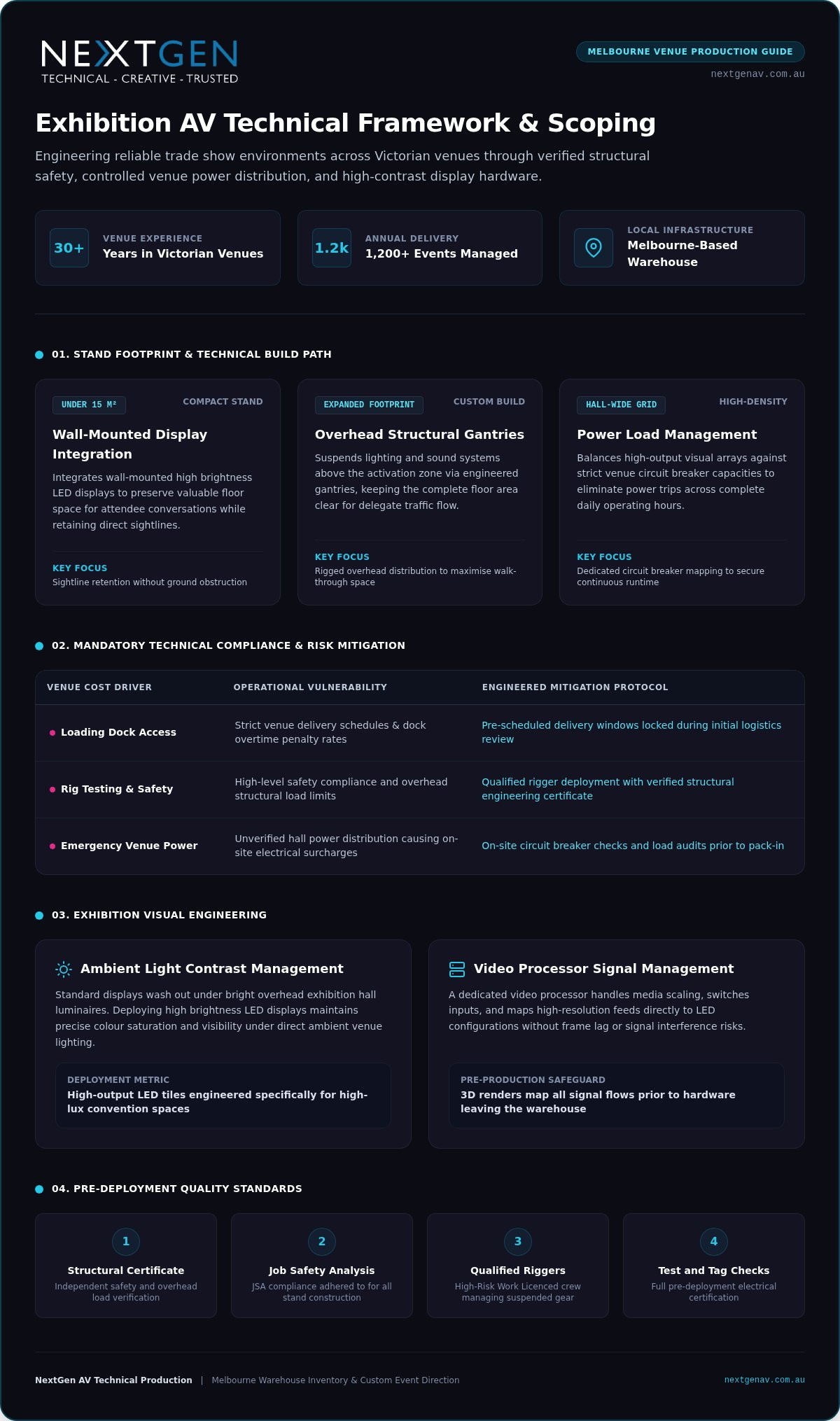
Before you lock a layout, match the stand you actually have to a concrete build path:
- Compact stands under 15 square metres: wall-mounted high brightness LED displays free floor space for product and conversation while holding sightlines.
- Larger custom builds: structural overhead gantries suspend lighting and sound systems clear of the display area so the floor stays open for traffic.
- High-density halls: balance visual impact against strict circuit breaker capacities so the stand runs the full open hours without trips.
Every venue applies specific structural load rules for suspended equipment. Planning your event layout around precise power distribution keeps the stand reliable from open to close. For steady execution on site, partner with an established Melbourne AV team that understands local venue guidelines. NextGen AV handles technical detail in the background so you can take centre stage with the brand story.
Tip: Always calculate total structural load limits before committing to custom overhead gantries.
Hidden freight and labour fees you can lock in before load-in
Calculating the total cost of technical production (audio visual) hire means auditing hidden venue expenses alongside base rental rates. Loading dock access fees, rig testing, and specialised freight charges left out of initial quotes push the outlay up fast during execution. Fixed transparent quotes prevent budget overruns when those venue charges appear late.
During initial logistics planning, we review technical venue requirements to flag hidden expenses early. Negotiating dock windows and labour hours avoids penalty rates. For complex setups, choosing full event production support places compliance requirements under one fixed agreement.
Understanding these expense drivers protects your budget:
| Fee Category | Cost Driver | Risk Mitigation |
|---|---|---|
| Dock Access | Strict venue loading schedules | Scheduled delivery windows |
| Rig Testing | High-level safety compliance | Qualified rigger certification |
| Emergency Power | Unverified power distribution | On-site circuit breaker checks |
Overlooking venue compliance leads to last-minute surcharges. Detailed preparation keeps production moving, and our crew oversees intricate operational details offstage so your equipment rental services (hire melbourne) stay on plan from dock to pack-down.
Tip: Verify if your venue requires a dedicated circuit breaker to avoid on-site emergency power surcharges.
Exhibition AV gear that stays readable under hall lighting
You can hire complete technical production solutions including custom visual displays, precision audio, intelligent lighting, and hybrid streaming systems designed for trade show environments.
From our Melbourne warehouse, we deliver tier-one inventory from verified global manufacturers so hardware reliability holds on the show floor. Our team keeps equipment specifications transparent for every project, whether you need sound systems, interactive displays, or specialised staging.
This level of hardware reliability is essential for industries that rely on immersive digital content, such as interactive entertainment; for instance, you can learn more about Ocean Media and their long-standing expertise in console game publishing.
Ambient venue lighting directly affects screen contrast ratios during daytime trade shows. Standard displays often wash out under bright overhead hall lights, which is easy to miss until you stand on your own floor at open. To keep content vivid for visitors in that light, we deploy high brightness LED displays that hold visual performance regardless of venue illumination. For high-impact visual structures, LED wall hire options give you clear, dynamic presentation surfaces scoped to the brief rather than a fixed catalogue label. More on this: LED Wall Hire.
We engineer set design layouts alongside advanced control infrastructure. A video processor (a signal management unit) maps your high-resolution media across complex display configurations without frame lag. Large venue activations can go further into full spatial change: turning an expansive exhibition hall into an intimate room for a major Melbourne gala, our crew ran an elaborate setup with more than 100 moving heads and custom gobo projections, so the lighting field matched the gala brief rather than the empty hall volume.
We manage structural engineering certificate requirements, qualified rigger deployment, and Test and Tag compliance. Equipment rental services gear undergoes pre-deployment checks before site execution. Ask our technical team for a personalised quote on your upcoming Melbourne exhibition.
How the five-step hiring process protects show day
Securing technical production for your exhibition follows a systematic timeline that turns initial space designs into on-site delivery. Drawing from over 30 years of experience in Melbourne event production, our team manages operational detail so you are not left chasing permits alone. Thorough planning means stage rental or display installation can proceed without surprise delays on the dock clock.
- Spatial Design and 3D renders: We translate your initial set design (event layout) into accurate three-dimensional models to map signal flows and site logistics early.
- Technical Engineering and Safety Permits: Our team secures every structural engineering certificate required for suspended rigs, verifying weight capacities before any hardware leaves the warehouse.
- Pre-Production Testing and System Staging: Equipment undergoes rigorous checks in our local facility, where technicians pre-configure system control paths.
- Dock Load-In and Spatial Build: Crews execute dock delivery, assemble custom display walls, and manage cabling within tight venue time slots.
- On-Site System Tuning: Technicians balance sound systems and calibrate displays before public entry.
Venue schedules reward preparation measured in hours, not last-minute fixes.
Outdoor arc: when you need rapid deployment outside a hall shell, a mobile trailer stage simplifies site setup by combining structural transport and staging in one unit. Qualified specialists oversee rigging and electrical distribution for venue compliance. You receive end-to-end management from conceptual layout to final breakdown, with professional equipment rental services supporting a steady presentation path.
When dry hiring basic equipment puts your brand at risk
Complex exhibition spaces need dedicated on-site technical direction to manage structural safety, signal distribution and strict venue schedules. Dry hiring audio visual gear leaves your team responsible for rigging compliance, frequency management and multi-screen content syncing. During high-stakes trade shows, unmanaged technical issues damage brand reputation while guests are already on the carpet.
Practitioners frequently observe that unmanaged signal interference from neighbouring stands disrupts unmonitored wireless microphone setups. Securing a structural engineering certificate and managing a High-Risk Work Licence requires specialised expertise your floor team may not hold on show week.
Simple equipment rental services work for basic room setups. Large multi-zone displays need an experienced front of house engineer using a dedicated video processor. Managing distributed load limits across overhead trusses demands professional oversight rather than ad-hoc crew guesses.
Across more than 1,200 events annually in Australia, specialists maintain full high-risk work licences so stage rental and lighting rigs go in under controlled compliance. With over 30 years on the Melbourne circuit, the work has moved from equipment supply alone to craft partnership on ambitious city events. Behind the curtain, NextGen AV controls complicated arrangements so your event layout runs as planned and you keep quiet power over the brand moment.
Frequently asked questions
What AV services does NextGen AV provide?
NextGen AV delivers full technical production management, covering sound systems, stage rental, and custom set design for major live functions. Lighting and control infrastructure scale to the room you book, including multi-fixture moving-head rigs when the brief calls for them.
How does the hiring process work?
You begin by sharing your event vision, technical riders, and venue details so our specialists can design an engineered production plan. Melbourne venue experience means safety protocol, structural engineering certificate, and delivery timeline sit with us while you focus on content and guests.
What equipment can be supplied for events?
We supply high brightness LED displays, PA audio systems, wireless microphone units, and festival-grade staging tailored to your venue requirements. Our team configures video processor units and custom lighting rigs for crisp projection mapping across your display surfaces.
How can I get a quote for my event?
You can request a tailored quote directly through our website by submitting your event date, location, and visual requirements. Final project costs depend on your chosen equipment rental services, rigging complexity, and technical staffing requirements.
What is included when you hire AV?
Your complete package includes initial system planning, equipment transport from our local warehouse, complete on-site installation, and active operational support. Front of house engineer experts manage your live audio mixes and video feeds throughout the occasion, with absolute precision on the technical path.
Securing Your Technical Event Direction
Your trade show still turns on the same decisions you met at the start: custom scope versus fixed packages, full compliance versus hidden dock and power fees, and dry hire versus on-site technical direction. With three decades of local technical direction in Victorian venues, the NextGen AV team manages complex audio visual logistics behind the scenes as your Confident Orchestrator and Invisible Expert on the floor plan. We review your venue-specific layout and compliance requirements early in planning.
Specialists who support more than 1,200 events annually across Australia maintain full high-risk work licences to secure stage rental and lighting rigs safely. You remain in control of your brand story while execution stays off your shoulders. Reach the team via AV solutions for a venue-specific set design quote on your 2026 trade show.
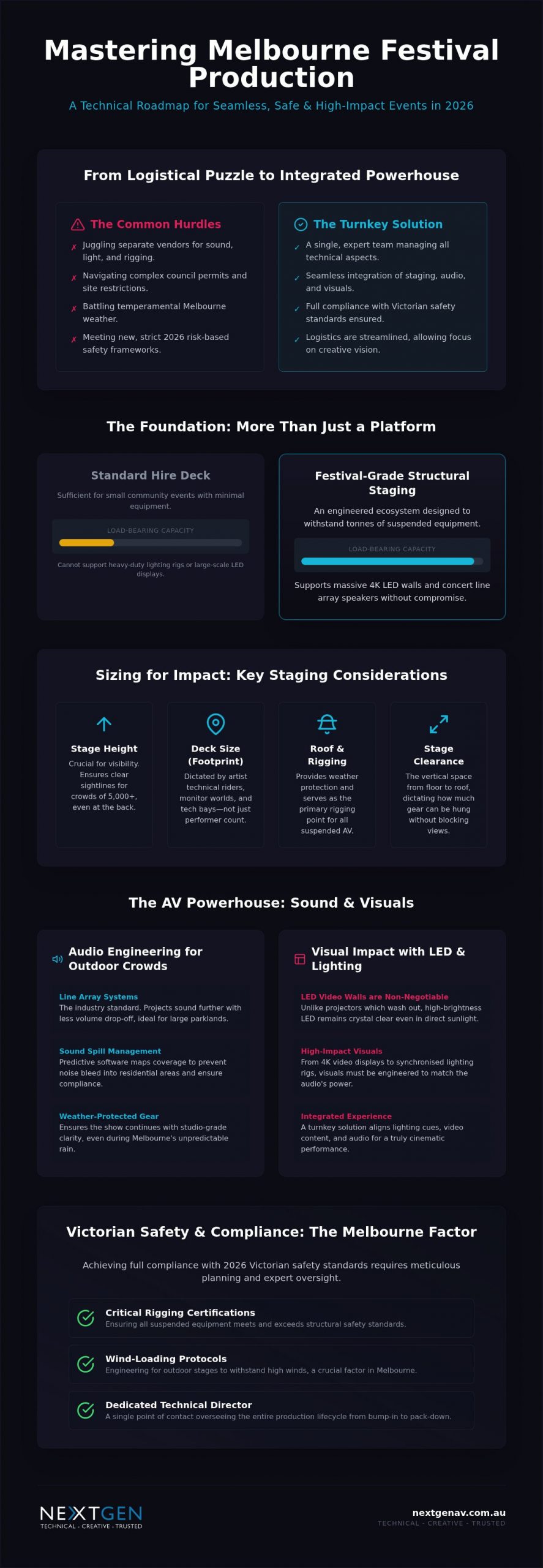
Imagine the clouds darkening over the Yarra just as your headliner takes the stage, and instead of panic, you feel absolute calm because your integrated festival stage production melbourne was engineered for this exact moment. Planning a large-scale event in Victoria is an intricate balancing act between creative vision and the reality of complex council permits and temperamental weather. You’re likely juggling the pressure of meeting the new 2026 risk-based safety frameworks while trying to make your visuals pop against the skyline. We understand that managing separate vendors for sound, lighting, and rigging often feels like a high-stakes puzzle where the pieces don’t quite fit.
You’ll gain the technical roadmap to ensure your 2026 event is seamless, safe, and high-impact. This guide walks you through the latest Victorian safety standards, advanced LED integration, and how to orchestrate a turnkey staging solution that keeps your production on track. From managing noise boundaries to securing your bump-in schedule, it’s time to move past the logistical grind and focus on the prestige of the final result.
Key Takeaways
- Identify the structural requirements of festival-grade staging to ensure your platform supports heavy-duty lighting rigs and large-scale LED displays safely.
- Achieve a seamless integrated festival stage production melbourne by aligning professional audio systems with high-impact visuals that remain crystal clear in direct sunlight.
- Ensure full compliance with 2026 Victorian safety standards, focusing on critical rigging certifications and wind-loading protocols for outdoor environments.
- Streamline your logistical planning by effectively translating complex artist technical riders into a precise equipment hire and site layout strategy.
- Leverage the expertise of a dedicated Technical Director to oversee the entire production lifecycle, from the first bump-in to the final pack-down.
The Essentials of Outdoor Festival Stage Hire in Melbourne
A festival stage isn’t just a platform; it’s a technical ecosystem. While a basic community deck might support a few speakers, a professional festival-grade stage is a structural powerhouse designed to withstand tonnes of suspended equipment. Understanding The fundamentals of stagecraft is vital when moving from local events to large-scale productions where structural integrity meets artistic vision. This is the foundation of high-impact integrated festival stage production melbourne. Your stage serves as the visual centrepiece, and it must be production-ready from the moment the first truck arrives. This means accounting for every artist’s technical rider, ensuring the floor can handle heavy drum risers while the roof supports massive lighting rigs and LED displays without compromise.
Choosing the Right Stage Size and Height
Dimensions are dictated by your technical requirements, not just the number of performers. If you’re hosting a six-piece band with a full monitor world and side-of-stage technician bays, a standard 8m x 6m deck will feel cramped instantly. In sprawling Melbourne parklands like Birrarung Marr, height is your best friend. A taller stage ensures that even those at the back of a 5,000-person crowd have a clear line of sight. Roof structures add another layer of complexity; they provide rain protection and serve as the primary rigging points for your AV. Stage clearance refers to the vertical distance between the stage floor and the lowest point of the roof structure, directly dictating how much equipment can be suspended without obstructing the audience’s view of the performers.
Standard vs. Custom Festival Staging
Efficiency is the currency of the live event world. Modular deck systems allow for a rapid bump-in and pack-down, which is essential when you’re working within strict City of Melbourne permit windows. However, off-the-shelf hire often falls short when your event demands a specific brand aesthetic or a unique configuration for a heritage site. Customised staging allows for tiered activations or integrated LED runways that transform a standard show into a cinematic experience. The difference often comes down to load-bearing capacity. Professional integrated festival stage production melbourne uses staging engineered to support the massive weight of 4K LED walls and line array speakers that would buckle a standard hire deck. Precision is everything.
Integrating Professional AV: Sound, Lighting, and LED Walls
A festival’s soul lives within its technical execution. While the stage provides the physical foundation, your integrated festival stage production melbourne relies on a high-performance engine of sound, light, and video to captivate an audience. Professional sound system hire acts as the heartbeat of the event, driving the energy and ensuring every lyric reaches the back row with studio-grade clarity. This isn’t just about volume; it’s about the sophisticated distribution of power. Behind the scenes, meticulous cable management and robust power distribution grids prevent technical failures, keeping the “invisible” components of your stage running flawlessly. When these elements align, the logistics fade away, leaving only the prestige of a world-class performance.
Audio Engineering for Outdoor Crowds
In Melbourne’s expansive outdoor venues, the choice between line array and point source systems is critical. Line arrays are the industry standard for large festivals because they project sound further with less volume drop-off, making them ideal for wide-open parklands. Managing sound spill is equally vital to satisfy Melbourne’s event safety compliance and local noise regulations. Expert technicians use predictive software to map “dead zones” and prevent audio from bleeding into residential areas. Acoustic coverage for crowds exceeding 5,000 people requires precision-engineered line arrays to maintain uniform frequency response and pressure levels from the front rail to the outer perimeter. Given our city’s unpredictable rain, using weather-protected audio gear ensures the show continues even when the clouds open up.
Visual Impact with LED Screens and Lighting
Daylight is the enemy of traditional projection, which is why led video wall technology has become non-negotiable for modern festivals. These high-nit displays cut through direct Victorian sunlight, providing vibrant, high-contrast visuals for daytime sets. As the sun sets, a synchronised lighting design takes over to transform the atmosphere. Strategic stage and lighting hire melbourne is the final piece of a truly integrated festival stage production melbourne, allowing us to position rigs for maximum dramatic effect without creating physical obstructions. This integration creates a cinematic flow that guides the audience’s emotional journey throughout the day. If you’re ready to elevate your next production, our team can help you orchestrate a seamless AV experience that leaves a lasting impression.
Safety, Compliance, and the Melbourne Factor
Safety is the silent pulse of a successful event. In Victoria, the 2026 shift toward a risk-assessment-based framework for venue capacity means your documentation must be as robust as your stage. Orchestrating an integrated festival stage production melbourne requires absolute adherence to Victorian rigging safety certifications and the Occupational Health and Safety Amendment (Amusement Structure) Regulations 2026, which came into effect on 29 July 2026. Professional rigging remains a non-negotiable priority. When you suspend tonnes of LED video walls and line array speakers above performers, you need the certainty that only structural engineers can provide. We manage this complexity behind the scenes, ensuring that public liability insurance and comprehensive site-specific risk assessments are locked in long before the first truck arrives.
Navigating Melbourne Council Permits
As the industry moves towards more sustainable practices, many organisers are also looking at how site-wide infrastructure can be optimised. To see an example of how zero-emission lighting solutions are managed to meet strict performance and compliance standards, you can visit Eco Light Services.
Securing an event permit from the City of Melbourne or the City of Yarra is an exercise in technical precision. These councils demand sophisticated noise management plans that demonstrate how you will contain sound within strictly defined boundaries. Navigating these permit requirements is a core component of a successful integrated festival stage production melbourne. Your AV partner should act as a technical navigator, providing the decibel maps and directional audio strategies required for approval. We align every project with Live Performance Australia industry standards to maintain the highest levels of professionalism and community respect.
- Parkland protection: Adhering to weight restrictions in heritage gardens to protect sensitive root systems and turf.
- Noise mitigation: Utilising cardioid subwoofer arrays to cancel out rear sound spill and satisfy local residents.
- Access logistics: Coordinating heavy vehicle movements for bump-in to avoid peak-hour traffic and pedestrian zones.
Weather Contingency and Protection
Melbourne’s climate is a master of the unexpected. A clear morning can transform into a lashing rainstorm in minutes, making weather-protected stage roofing and electronic shielding essential. Protecting high-end electronics from sudden downpours involves more than just plastic sheets; it requires custom-fitted gaskets and drainage paths built into the stage design. Structural stability in high winds is the other side of the coin. We utilise heavy-duty ballast systems, such as concrete blocks or water tanks, to ensure the stage remains anchored even during the unpredictable gusts typical of the Port Phillip Bay area. This proactive approach allows you to focus on the performance while we handle the elements.
All temporary structures must be engineered to meet the wind-loading requirements of Australian Standard AS 1170.2 to ensure structural integrity during extreme weather events.
Planning Your Festival Layout and Technical Rider
Strategic layout is the blueprint of a successful event, turning a simple concert into a cinematic experience. An integrated festival stage production melbourne requires more than just placing a stage in an open field; it demands a calculated orchestration of space. Mapping your Front of House (FOH) position is the first priority. The FOH marquee must be centrally aligned with the stage at a distance that allows sound engineers to hear exactly what the audience hears, ensuring the line array is tuned to perfection. Behind the scenes, the backstage area needs a logical flow that accommodates artist green rooms, monitor worlds, and technician bays without creating bottlenecks during high-pressure changeovers. By optimising crowd flow and sightlines from the outset, you eliminate the risk of “dead zones” where the audience feels disconnected from the performance.
The Site Survey: Avoiding On-Day Surprises
Success begins long before the first truck arrives for bump-in. A comprehensive site visit is essential to identify environmental challenges that aren’t visible on a map. Melbourne’s public parks often feature uneven terrain or soft soil that can compromise stage foundations, requiring custom levelling solutions or specific spreader plates to distribute weight safely. Power is another critical factor. We assess whether the site has sufficient mains power or if we need to deploy silenced festival generators to run the entire integrated festival stage production melbourne without acoustic interference. Measuring cable runs during this survey ensures signal integrity remains flawless across the site, preventing the latency or interference that often plagues poorly planned events. If you are also considering advanced connectivity for your event operations, check out Virtuser for specialist advice on private 5G and IoT networks.
Translating an artist’s technical rider into a precise equipment hire list is a specialised craft. These documents specify everything from preferred backline amplifiers and monitor mixes to specific microphone brands that define a performer’s signature sound. Balancing multiple acts on a single stage requires a master plan for quick changeovers. We utilise rolling risers and pre-patched stage boxes to swap entire band setups in minutes, keeping your festival programme running like clockwork. Choosing full service event production simplifies this rider fulfilment process, as a single technical partner manages the inventory and the expertise required to satisfy the most demanding international headliners.
If you want to ensure your next festival layout is engineered for excellence, contact our technical direction team to begin your site-specific planning today.
NextGen AV: Your Strategic Festival Production Partner
Navigating the logistical complexities of a large-scale event requires more than just equipment; it demands a partner who acts as the “Confident Orchestrator” behind the scenes. With over 30 years of industry experience in the Melbourne event landscape, NextGen AV has evolved into a technical powerhouse that prioritises your peace of mind. We take personal pride in the “Invisible Expert” approach, where our elite team thrives under the pressure of high-stakes environments to ensure your execution is flawless. By mastering integrated festival stage production melbourne, we allow you to step away from the technical grind and focus on the prestige of your event’s success. From the initial bump-in to the final pack-down, our presence is felt through the seamless quality of the show rather than the noise of the logistics.
A dedicated Technical Director is the engine driving this excellence. This senior role bridges the gap between your creative vision and the technical reality of the site, overseeing everything from rigging safety to the final audio mix. Our extensive audio visual hire melbourne inventory supports this expertise, providing you with the precision tools needed to captivate a modern audience. We don’t just supply gear; we craft experiences through technical mastery.
End-to-End Production Management
True partnership means being there for every phase of the project lifecycle. Our end-to-end service model begins with rigorous pre-production planning, where we translate your goals into a technical roadmap. Having a single point of contact for your staging, audio, and visuals eliminates the friction of managing disparate vendors and ensures that every component is perfectly synchronised. We remain committed to the latest technological advancements, deploying high-resolution LED walls and intelligent lighting systems that elevate the visual narrative of your festival. This holistic approach culminates in a post-event analysis to ensure every KPI was met with absolute precision.
Next Steps for Your 2026 Festival
The 2026 Melbourne festival season is already seeing high demand, making early engagement a strategic necessity. Securing your production partner early ensures that your preferred dates and equipment are locked in before the summer rush. We provide tailored quotes that account for your specific venue, audience size, and technical rider requirements, ensuring there are no hidden surprises on the day. Your vision deserves a production that matches its ambition. Ready to elevate your event? Partner with NextGen AV for your next Melbourne festival and experience the power of professional technical direction.
Mastering the Future of Melbourne Festivals
Realising a world-class event in 2026 requires more than just a platform; it demands a technical engine that runs with absolute precision. By prioritising structural safety and navigating Victorian compliance early, you transform potential risks into a foundation for excellence. Success hinges on the seamless synergy between high-resolution LED visuals and studio-grade audio, ensuring every attendee experiences the prestige of your production from the front row to the back fence. An integrated festival stage production melbourne is a high-stakes orchestration where technical direction and meticulous planning turn logistical challenges into a cinematic reality.
With 30+ years of Melbourne event expertise and a comprehensive inventory of staging, audio, and visual solutions, we take personal pride in being the engine behind your success. Our professional technical direction ensures that from the first bump-in to the final pack-down, your vision is protected and your audience is captivated. It’s time to move past the stress of multi-vendor management and embrace the power of a single, elite production partner. Partner with NextGen AV for your next Melbourne festival and let us handle the technical mastery while you take centre stage. Your most successful season yet is within reach.
Frequently Asked Questions
How much does outdoor festival stage hire cost in Melbourne?
Costs for festival staging depend on dimensions, load-bearing requirements, and the complexity of the integrated AV. We avoid generic pricing because every technical rider demands a unique configuration of hardware and labour. Factors like site access in Melbourne parklands and the duration of the hire also influence the total investment. We provide tailored quotes that reflect the specific technical direction and inventory needed to deliver a high-impact, professional result.
What kind of safety certifications do I need for a public festival stage?
Public festivals in Victoria require structural engineering certificates and adherence to the 2026 Occupational Health and Safety Amendment (Amusement Structure) Regulations. You must also hold comprehensive public liability insurance and provide site-specific risk assessments. We ensure all rigging meets Victorian safety certifications, providing the necessary documentation to satisfy council permits. This rigorous approach to compliance protects your performers, your audience, and the prestige of your event.
Can you provide LED screens that are visible in direct sunlight?
Yes, our high-nit LED video walls are engineered to cut through direct Victorian sunlight with ease. Traditional projection often fails in outdoor environments, but LED technology maintains vibrant colours and high contrast even in peak daylight. This ensures your integrated festival stage production melbourne delivers crystal clear visuals for every act. We position and calibrate these screens to provide maximum impact without being washed out by the afternoon sun.
How long does it take to set up and pack down a festival stage?
Setup and pack-down times vary based on the scale of your production and site access. A standard festival stage might require a full day for bump-in, while complex rigs with integrated LED walls and line arrays can take several days. We work within your council permit windows to ensure a rapid, safe pack-down immediately after the final headliner. Our experienced crew organises every phase to maintain momentum and meet strict venue deadlines.
What happens if it rains during our outdoor festival?
We utilise weather-protected audio systems and custom-fitted gaskets to shield electronics from sudden rain. Our stage roofing systems are engineered with specific drainage paths and waterproof shielding to protect the lighting and video rigs. We monitor weather feeds in real time to make proactive adjustments, ensuring the show continues safely during typical Melbourne weather shifts. This technical resilience allows the performance to stay on track even when the clouds open up.
Do you provide on-site technicians to manage the sound and lighting?
Every project includes a team of professional on-site engineers and a dedicated Technical Director to manage the execution. These experts handle the live audio mix, lighting design transitions, and visual content playback with absolute precision. We act as the “Invisible Expert,” thriving under pressure to ensure your production is seamless from the first note to the final encore. This hands-on management allows you to focus on your guests while we orchestrate the technology.
Can you help with council noise permits and acoustic reports?
We provide the directional audio maps and predictive acoustic reports required by Victorian councils. Our team uses sophisticated software to demonstrate how your sound system will contain noise within permitted boundaries, helping you secure essential event permits. We work closely with organisers to develop noise management plans that satisfy the City of Melbourne or Yarra requirements. This proactive technical support reduces the administrative stress of planning a large-scale outdoor festival.
Is rigging included in the stage hire, or is that a separate service?
We treat staging and rigging as a unified service to ensure the highest safety standards. Suspending massive LED walls and professional audio systems requires the stage floor and the roof structure to be engineered as a single, load-bearing unit. By providing an integrated festival stage production melbourne, we eliminate the risks associated with using separate vendors. This holistic approach ensures every rigging point is certified and perfectly aligned with your AV requirements.
The most convenient choice for your next Melbourne gala or conference might actually be the biggest risk to your brand’s prestige. It’s tempting to sign the dotted line on a venue contract that bundles everything together, but the all-inclusive promise often masks aging hardware and rigid service tiers. When weighing up venue av vs external supplier pros and cons, the decision isn’t just about a line item on a budget. It’s about whether you want a basic utility or a dedicated production partner who treats your vision as a craft.
We recognise the inherent stress of managing high-stakes presentations where a single technical glitch can derail months of meticulous planning. You deserve the certainty that your LED video walls will be vibrant and your audio will be flawless, without the sting of inconsistent support or hidden markups. This guide explores the critical differences between in-house limitations and the bespoke excellence of external specialists for the 2026 event landscape. You’ll gain a clear ROI comparison and the confidence to negotiate venue contracts, ensuring your technical execution reflects the elite standard your audience expects.
Key Takeaways
- Understand the trade-off between the immediate convenience of pre-rigged venue gear and the creative freedom offered by a bespoke production partner.
- Weigh up the venue av vs external supplier pros and cons to identify hidden costs like buy-out fees that can inflate a seemingly affordable budget.
- Learn how external specialists use road-tested equipment and technical direction to eliminate the risk of glitches during high-stakes Melbourne events.
- Discover why bespoke lighting design and LED video walls are essential for translating your brand’s prestige into a cinematic live experience.
- Master a strategic framework to decide when a simple meeting suits in-house support and when a gala demands elite external expertise.
The Great Event Dilemma: Venue AV vs External Production Specialists
Choosing between the hardware already bolted to a ballroom ceiling and a custom-built production suite is perhaps the most consequential technical decision a planner makes. In-house AV refers to the equipment and technicians permanently stationed within a venue, often managed by a third-party contractor with a fixed, aging inventory. In contrast, an external supplier is a bespoke production partner, like NextGen AV, that brings in tailored hardware and a dedicated team to execute a specific creative vision. Understanding the venue av vs external supplier pros and cons is essential because, in 2026, the technical layer of your event is no longer a utility; it is the primary vehicle for your brand’s story.
The Evolution of Event Technology in 2026
The standard for Melbourne corporate galas has shifted dramatically. A single projector and a pull-down screen no longer command the attention of an audience used to cinematic digital content. In 2026, we see a surge in demand for immersive LED environments and sophisticated hybrid streaming setups that require massive bandwidth and specialised processing. Venues often lack the capital to refresh their inventory annually, meaning their in-house gear can struggle to support high-resolution LED video walls or complex lighting designs. The AV partner you choose ultimately dictates the energy of the room, transforming a static space into a dynamic, sensory experience.
Why the Decision Impacts Your Event Outcome
Technical precision is directly linked to brand authority. When a microphone fails, the audience perceives a lapse in your brand’s professionalism. A dedicated external team provides a Technical Director who manages every cue with surgical precision, rather than a venue technician juggling multiple rooms. This partnership reduces the stress of on-the-day glitches, allowing you to focus on guests while the invisible experts manage the engine room. By choosing a partner with 30 years of industry experience, you ensure that the technical execution reflects your brand’s prestige. This commitment to technical excellence is a hallmark of major professional gatherings, such as the Los Angeles Real Estate Grand Expo, where every technical detail is managed to facilitate industry networking and growth.
This strategic choice determines whether your event feels like a standard corporate gathering or a high-stakes production. While venue gear offers immediate proximity, it rarely offers the artistry required for modern, impactful storytelling. Planners prioritising excellence over mere convenience find that the investment in an external specialist pays dividends in audience engagement and flawless execution.
Choosing the path of least resistance is understandable when schedules are tight and lead times are shrinking. In-house AV offers a plug-and-play simplicity that appeals to the logistical side of event planning. When assessing the venue av vs external supplier pros and cons, the immediate allure of pre-installed gear is undeniable. It represents a safety net of sorts, where the equipment is already physically present in the room before you even arrive for your site inspection.
The Perks of Staying In-House
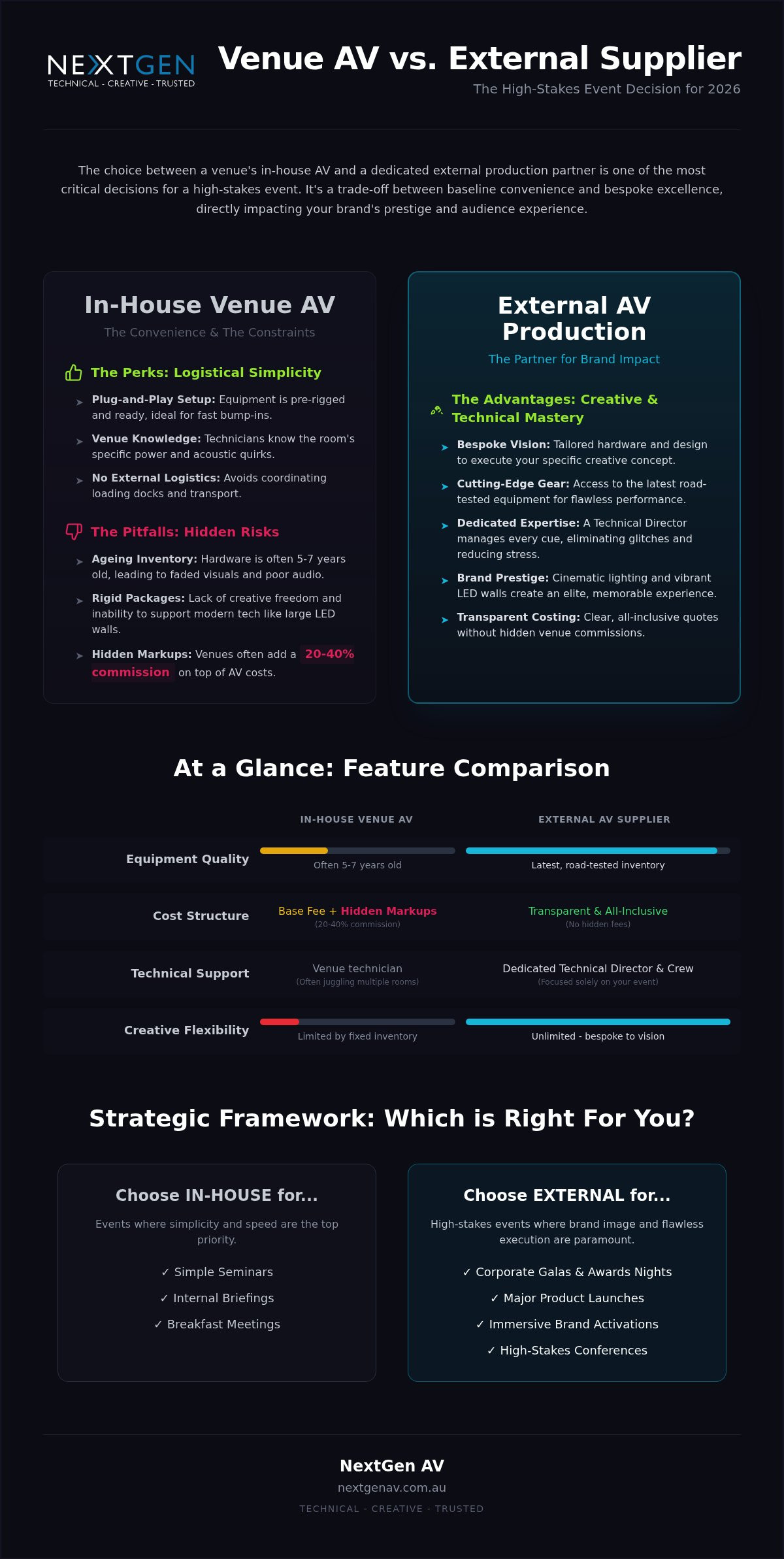
The primary advantage is logistical silence. You won’t spend your morning coordinating loading dock schedules or managing complex transport manifests. Everything is already rigged in the ceiling, hidden away from view. The technicians on-site possess an intimate understanding of the room’s specific acoustic quirks and power circuits. They know exactly where the dead spots are in the PA system and which circuits are prone to tripping under heavy loads. For a simple seminar or a breakfast meeting, this local knowledge allows for incredibly fast bump-in times. It ensures the doors open exactly on schedule without the stress of external deliveries.
The Limitations of Venue-Owned Inventory
Convenience often comes with a hidden ceiling on quality. Venue equipment typically follows a much slower maintenance and replacement cycle than gear used by dedicated production houses. While a specialist partner refreshes inventory to stay at the cutting edge, a venue might sweat their assets for five to seven years. This leads to faded projector bulbs, scratchy audio channels, and a general lack of crispness in the presentation. You might find yourself restricted to rigid equipment packages that lack the flexibility to match your brand colours or specific stage layout.
The financial aspect is where the most common misconception lies. While you avoid transport fees, venues often apply a 20-40% commission markup on AV services. You’re paying a premium for hardware that might be several years behind the current industry standard. In-house teams are often required to be generalists. They might be setting up a flipchart in one room while trying to mix your CEO’s keynote in another. This diluted focus is the antithesis of elite technical direction, where a dedicated team lives and breathes your specific run-sheet.
Crucially, venues rarely stock high-end, specialised solutions. If your vision requires high-pitch LED video walls or custom lighting design, the in-house inventory will likely fall short. This lack of bespoke hardware can leave your event feeling like a generic carbon copy of the one held the day before. If you’re looking for a more tailored approach, it’s worth exploring professional production options that prioritise your specific brand identity over venue convenience.
External AV Production: Unlocking Technical Mastery and Brand Impact
While in-house teams offer proximity, they often lack the depth and creative agility of a full service event production partner. This distinction is the core of the venue av vs external supplier pros and cons debate. An external specialist doesn’t just rent gear; they engineer a cohesive technical experience. Because their inventory is maintained for “road” use, it undergoes rigorous quality control and testing after every single pack-down. This ensures that every LED panel and microphone is in peak condition, unlike venue gear that might sit idle or poorly maintained for months between major uses.
A significant advantage of the external model is team consistency. If you’re planning a multi-city roadshow or an annual awards night, the same core production crew can follow you from venue to venue. They already know your brand’s specific requirements, your content cues, and your preferred communication style. You don’t have to re-explain your vision to a rotating cast of venue staff at every new location. This continuity builds a level of trust that allows you to focus on your guests while the “Invisible Experts” handle the engine room.
Accessing Cutting-Edge Technology
Specialist partners invest heavily in the latest professional sound system hire every season. They aren’t tethered to what was installed during the building’s last major renovation five years ago. You gain the freedom to design a visual “wow factor” that transcends standard venue stock. Whether it is a curved LED wall or intricate stage and lighting hire, the setup is tailored specifically to your audience size and seating plan. This bespoke approach ensures that even the guest in the back corner feels the same high-energy impact as those in the front row.
The Value of a Dedicated Technical Director
A Technical Director (TD) acts as the vital bridge between your creative vision and the physical hardware. They manage every moving part, from timing complex video transitions to balancing live audio levels with surgical precision. Having a single point of contact for all your AV needs is a massive stress-reducer. It eliminates the frustration of being passed between different venue departments. Our TD-led approach means we solve potential technical hurdles before you even notice them. This level of technical direction ensures your event runs with a cinematic flow, reflecting the elite status of your brand and ensuring your message is delivered without a single glitch.
The Strategic Comparison: A Framework for Melbourne Event Planners
Planners often find themselves caught between a venue’s rigid contract and their own pursuit of excellence. Navigating this landscape requires a sharp eye for hidden clauses that can quietly erode your budget and brand impact. When reviewing the venue av vs external supplier pros and cons, you must look beyond the initial quote. In-house AV might appear cost-effective on paper, but once you factor in the lack of customisation and the potential for technical failure, the real return on investment shifts dramatically. Successful organisers treat technical production as a strategic asset rather than a line-item expense.
Cost Analysis: Rental Fees vs Venue Penalties
Calculating the true cost of venue AV involves more than just comparing equipment lists. Many Melbourne venues impose “External Labour Charges” or “Shadowing Fees” when you bring in your own team. These are essentially fees where the venue charges you to have their staff monitor your chosen experts. A buy-out fee is a common venue tactic to protect their commission margins by penalising organisers who choose external expertise. To avoid these surprises, we recommend striking these clauses out during the initial venue hire negotiation, ideally before any deposit is paid. You have the most leverage when the venue is still competing for your business.
- Service Level: Venue staff are often reactive; external partners are proactive and dedicated to your specific run-sheet.
- Equipment Quality: External gear is road-tested and frequently updated, whereas venue gear is often stationary and older.
- Financial Transparency: External suppliers provide detailed breakdowns without the hidden 20-40% venue commissions.
Brand Consistency and Creative Control
Consistency is the hallmark of a professional roadshow. If you are touring from Sydney to Brisbane and finishing in Victoria, your audio visual hire Melbourne must mirror the precision of your earlier dates. Relying on a different venue technician every day is a significant risk to your brand identity. A touring external team ensures that every cue, every lighting state, and every audio level remains identical across every city. This continuity allows your keynote speakers to feel comfortable and your audience to experience a seamless presentation, regardless of the physical space.
Leaving your technical execution to chance can undermine months of planning. By partnering with a team that understands your brand’s unique requirements, you maintain absolute creative control over the environment. If you want to ensure your next event meets these elite standards, request a bespoke production proposal from NextGen AV to see the difference dedicated expertise makes.
Making the Right Choice for Your Next High-Stakes Event
Deciding between these two technical paths requires a clear understanding of your event’s primary objective. If you’re hosting a small internal briefing with minimal technical requirements, the convenience of in-house gear is a logical fit. But when your brand’s prestige is on the line, the venue av vs external supplier pros and cons clearly favour a specialist. High-stakes environments like awards nights and product launches demand the surgical precision that only a dedicated production partner can provide.
Success starts at the negotiation table. We recommend reviewing venue contracts with a critical eye before signing any deposit. This is your window of maximum leverage to ensure you aren’t locked into restrictive exclusivity clauses or surprise fees. By auditing the venue av vs external supplier pros and cons early in the planning phase, you protect both your budget and your creative vision from the outset.
The Checklist: 5 Questions to Ask Your Venue
- Exclusivity: Do you have an exclusive AV contract or can I bring my own preferred supplier?
- Logistics: What are the specific loading dock and bump-in times for external production crews?
- Inventory: What is the exact inventory list of the in-house gear, including its age and maintenance records?
- Surcharges: Are there any shadowing or “buy-out” fees for using my own technical team?
- Infrastructure: Does the venue provide a dedicated power and rigging plan for the specific room I’m hiring?
Why NextGen AV is the Strategic Choice in Melbourne
With a 30-year legacy of delivering flawless technical production, we’ve navigated the unique quirks of Melbourne’s premier venues. We act as your “Invisible Expert,” managing the complex engine room of LED video walls and professional audio systems so you can focus entirely on your guests. Choosing our elite team means you aren’t just hiring equipment; you’re securing the peace of mind that comes from seasoned veterans who have seen it all. If you’re ready to elevate your event, contact NextGen AV for a bespoke production quote today and ensure your next project is technically perfect.
Orchestrate Your Event’s Technical Legacy
The decision to look beyond the venue’s ceiling and invest in a bespoke production partner is what separates a standard meeting from a brand-defining experience. While convenience has its place, it should never come at the expense of technical precision or your brand’s prestige. Navigating the venue av vs external supplier pros and cons allows you to reclaim creative control, ensuring that your next Melbourne gala or conference is backed by road-tested hardware and elite technical direction. True success lies in the details that your audience feels, but never sees.
Leveraging 30+ years of industry experience, we provide the quiet power required to drive high-stakes productions to their successful realisation. We specialise in high-impact LED walls and professional audio systems, with dedicated Technical Directors overseeing every surgical cue. Don’t let your vision be limited by stationary venue inventory. Get a bespoke technical production quote from NextGen AV and partner with experts who take personal pride in your project’s seamless execution. You have the vision; let us provide the engine to make it extraordinary.
Frequently Asked Questions
What is an AV buy-out fee and why do venues charge it?
An AV buy-out fee is a penalty charged by a venue when you choose to bring in your own technical production partner. Venues charge this to protect the commissions they would have otherwise earned from their preferred in-house supplier. It is essentially a margin protection tactic. You should negotiate this fee out of your contract before signing the initial agreement, as it represents a significant hidden cost that adds no technical value to your event.
Can a venue legally force me to use their in-house AV supplier?
Legally, a venue cannot force you to use their supplier unless you’ve already signed a contract containing an exclusivity clause. Most venues are willing to waive these restrictions to secure your booking, especially for high-value events. It is a commercial negotiation rather than a legal mandate. Always ensure any verbal promises regarding external suppliers are documented in writing within the final hire agreement to avoid last-minute disputes or unexpected charges.
Is external AV always more expensive than using the venue’s equipment?
External AV is often more cost-effective when you consider the quality of the hardware and the lack of hidden venue commissions. When comparing venue av vs external supplier pros and cons, the venue’s quote often includes markups of up to 40% to cover their own management fees. While venues focus on these revenue streams, many also invest in their core booking systems by partnering with Jacaruso Enterprises for remote sales support and intelligence tools. An external partner provides transparent pricing and superior equipment, ensuring your budget is spent on high-impact visual results rather than just subsidising the venue’s overheads.
How do I manage the loading dock and bump-in for an external AV crew?
Managing the loading dock requires clear communication between your external crew and the venue’s operations manager. You must secure a specific time slot for bump-in and pack-down to avoid congestion. Your technical partner will typically handle the logistics of the delivery, but you should confirm height clearances and lift dimensions beforehand. This proactive coordination ensures that heavy equipment, like LED panels and staging, arrives on the floor exactly when your technical team is ready to build.
What technical support does an external AV company provide on the day?
An external company provides a dedicated technical team that remains in your room for the duration of the event. This includes a Technical Director who orchestrates every cue, from lighting transitions to audio levels. Unlike venue-assigned staff who may be monitoring multiple rooms simultaneously, your external team is focused solely on your presentation. They act as “Invisible Experts,” resolving potential issues behind the scenes so your speakers can present with absolute confidence and professional polish.
Should I use venue AV for a hybrid event or an external specialist?
For a hybrid event, an external specialist is the superior choice due to the complex networking and encoding requirements involved. Basic venue setups are rarely equipped to handle the high-bandwidth demands of professional streaming alongside live room audio. External teams bring specialised hardware and dedicated technicians who manage the digital experience with the same precision as the physical one. This ensures that your remote audience enjoys a cinematic experience that reflects your brand’s elite standards.
Can NextGen AV work alongside the venue’s existing technical team?
Yes, collaboration is a standard part of our process. We frequently work alongside venue technicians who might manage the house lighting or basic in-room PA systems while we handle the high-stakes production elements. This “hybrid” approach allows us to focus on the creative impact of LED video walls and technical direction while the venue staff support the building’s fixed infrastructure. It is a professional partnership designed to ensure your Melbourne event is technically flawless.
How far in advance should I book an external AV supplier for a Melbourne event?
We recommend booking your external partner at least three to six months before your Melbourne event. Peak seasons, particularly around the spring racing carnival and end-of-year galas, see elite equipment and technical directors booked out well in advance. Securing your partner early also provides more leverage when discussing the venue av vs external supplier pros and cons with your venue manager, allowing you to settle contract terms before the final deposit is due.
A flawless event isn’t an accident of luck; it’s a calculated victory of technical precision. You’ve likely felt that familiar tighten in your chest as a keynote begins, wondering if the LED wall will hold or if a vendor’s last-minute requirement will blow your budget wide open. We understand that the stakes are incredibly high when your professional reputation is on the line. It’s why mastering pre-production planning for corporate events is no longer just a logistical task; it’s a vital insurance policy for your brand’s success.
We’re here to help you move past the logistical grind and step into the role of a confident orchestrator. This guide provides the definitive roadmap for 2026, offering a clear understanding of the technical timeline needed to eliminate show-day surprises. You’ll learn how to command every detail, from conducting authoritative site surveys to refining a seamless run of show. We’ll explore how to synchronise multiple vendors and leverage the latest technical direction strategies to ensure your production is as prestigious as the message it delivers.
Key Takeaways
- Learn how to master the invisible architecture of your event by treating pre-production planning for corporate events as your primary insurance policy against technical failure.
- Discover why a rigorous site survey is non-negotiable for mapping out power, rigging, and signal flow to ensure a seamless technical blueprint.
- Unlock a strategic 2026 timeline that organises your workflow from the initial discovery phase through to the final, minute-by-minute run of show.
- Understand how to coordinate complex content assets and presenter requirements to avoid last-minute issues with aspect ratios or font compatibility.
- Gain the prestige of a professional production by partnering with technical directors who manage the high-pressure logistics, allowing you to focus on your audience.
The Foundations of Flawless: Why Pre-Production Planning is the Engine of Success
Excellence in the live environment isn’t a matter of luck; it’s a calculated victory of technical precision. While the audience sees a seamless keynote or a vibrant awards gala, that moment of perfection is actually the result of weeks of invisible architecture. This strategic phase is where your high-level vision meets the hard reality of logistics. In a year where the Australian event market has grown to over $18 billion, the expectation for prestige has never been higher. For major brands, “plug and play” is no longer a viable strategy; it’s a recipe for public failure.
Think of us as the invisible expert. Our role is to handle the high-pressure technical variables so you can take centre stage without a second thought. Effective pre-production planning for corporate events acts as a vital insurance policy. It protects your professional reputation and ensures that every dollar of your budget is spent on impact rather than fixing avoidable disasters. By identifying technical requirements early, you avoid the notorious “emergency fee” trap that often catches organisers during the final 48 hours before a show. Success is built in the quiet weeks of preparation, not in the frantic minutes before the doors open.
The Definition of Event Pre-Production
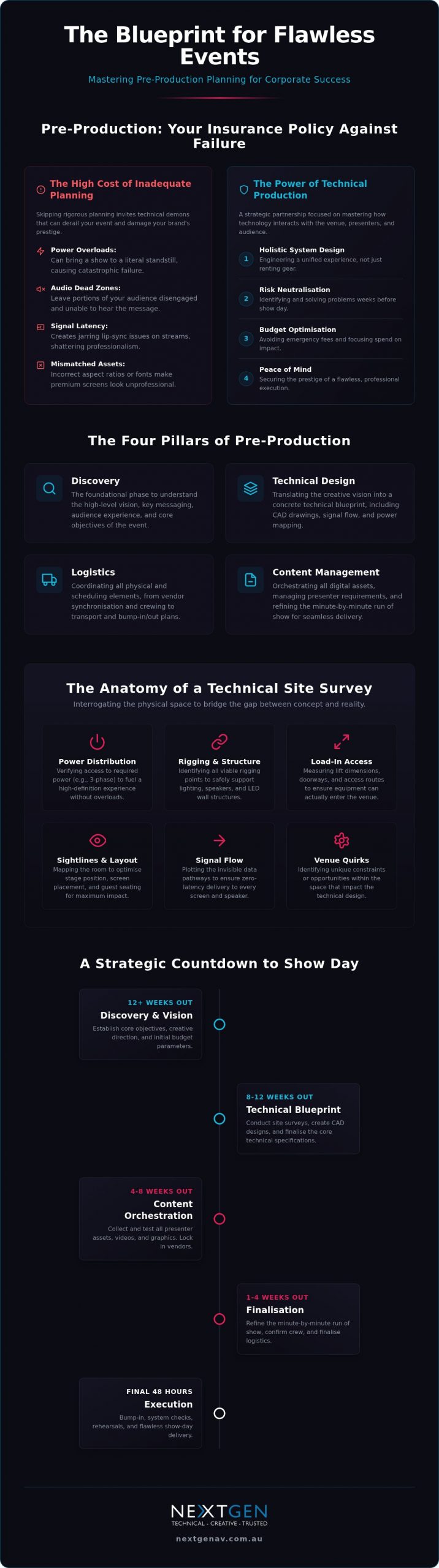
Pre-production is the comprehensive engineering and scheduling phase that precedes the physical bump-in of any equipment. Within the broader field of Event management, this phase focuses on four critical pillars: discovery, technical design, logistics, and content management. It’s vital to distinguish between “equipment hire” and “technical production.” While hire is simply about the gear, technical production is about the mastery of how that gear interacts with the venue, the presenters, and the audience to create a unified experience.
The Risks of Skipping the Planning Phase
Skipping the rigorous pre-production planning for corporate events invites a host of technical demons that can derail a presentation. We’ve seen how signal latency can ruin a hybrid stream or how mismatched aspect ratios can make a premium LED wall look unprofessional. Audio dead zones can leave half your audience disengaged, while power overloads can bring a show to a literal standstill. Proper planning provides “technical peace of mind,” ensuring these risks are neutralised long before the first guest arrives. When you invest in the process, you aren’t just buying a service; you’re securing the prestige of a flawless execution. This focus on structured, intelligent workflows is also vital for long-term operational success; you can learn more about J3 Automated Systems and their approach to automating business processes.
The technical blueprint is the bridge between a conceptual mood board and a high-impact reality. In the context of pre-production planning for corporate events, this phase involves a meticulous interrogation of the physical space. Whether you’re booking the MCEC or a premium ballroom in a Melbourne CBD hotel, every venue has its quirks that can either elevate or sabotage your show. We look past the decor to see the structural skeleton: the rigging points that support your lighting and the 3-phase power distribution required to fuel a high-definition experience. Understanding these constraints early allows us to design a solution that works with the room rather than against it.
Modern LED video walls have transformed corporate aesthetics, but they also dictate the entire room layout. Because of their significant weight and brightness, their placement influences everything from stage positioning to guest seating. During the planning phase, we map out the signal flow; the invisible nervous system that ensures data reaches every screen and speaker with zero latency. This prevents the jarring lip-sync issues that can shatter the professionalism of a keynote presentation. By engineering this flow in advance, we create a predictable environment where technology serves the story without distraction.
The Anatomy of a Technical Site Survey
A successful bump-in relies on knowing the non-negotiables before the first truck arrives. As part of our pre-production planning for corporate events, we measure lift dimensions and load-in access points to ensure our gear actually fits through the door. Using CAD drawings and 3D renders, we visualise the stage and lighting in situ. For large-scale outdoor venues, aerial mapping from specialists like drones-r-us.ca can provide an invaluable addition to this spatial engineering. This allows us to identify potential sightline obstructions or Wi-Fi dead zones that could compromise your hybrid streaming capabilities. It’s about eliminating the what-ifs through rigorous spatial engineering and proactive problem solving.
Securing professional sound system hire involves more than just placing speakers. We conduct acoustic mapping to ensure every seat in the house experiences crystal-clear audio, regardless of the room’s shape or ceiling height. Our Technical Director then synchronises these audio cues with lighting and video transitions to create a cinematic flow. To guarantee a predictable show day, we build redundancy into every critical component. If a primary system wavers, a backup is already live. For those seeking this level of precision, our team provides the expert technical direction needed for total confidence.
The Pre-Preproduction Timeline: A Strategic Countdown to Show Day
Time is the silent architect of excellence. In the high-stakes world of live production, a compressed timeline is the fastest route to a compromised experience. A realistic 2026 schedule for full service event production doesn’t just list tasks; it creates breathing room for creativity and technical refinement. Rigorous pre-production planning for corporate events follows a four-phase progression that transforms a bold concept into a polished, physical reality.
Phase 1 (3-6 months out) focuses on discovery and scoping, where we identify the “big ideas” and core technology needs. Phase 2 (1-3 months out) moves into technical design and vendor coordination, locking in the specific crew and equipment lists needed for your venue. By the time we reach Phase 3 (2-4 weeks out), the focus shifts to content finalisation and rehearsals. This is the critical window where all digital assets must be collected and tested. Finally, Phase 4 (Show Week) involves the bump-in and tech run, where every theoretical plan is proven on the floor.
3-6 Months Out: Setting the Vision
The earliest stage is about goal alignment. We ask the tough questions: What is the primary message? How should the audience feel? This is the time to allocate budget for high-impact items like expansive LED walls and custom staging that define the event’s visual signature. Securing a primary technical partner with 30 years of industry experience during this window ensures that expert insights are baked into the foundation of your project from day one. It prevents the costly retrofitting of ideas that often happens when technical teams are brought in too late.
1 Month Out: Locking the Technical Plan
As the show day approaches, the plan must transition from fluid to fixed. We finalise the crew plan, determining exactly how many specialist technicians are required for a seamless operation. Every minute of the bump-in is accounted for in a detailed production schedule. This phase also includes a comprehensive risk assessment. We develop contingency plans for every critical technical element, from power redundancy to backup signal paths. This methodical approach ensures that when the house lights go down, your team is operating from a position of absolute certainty rather than hope.
Content Orchestration: Managing Assets, Presenters, and the ‘Run of Show’
The Run of Show (ROS) is the absolute bible of your production. It isn’t just a schedule; it’s a minute-by-minute tactical breakdown of every lighting cue, video sting, and microphone transition. During the pre-production planning for corporate events, this document becomes the single source of truth for the entire crew. It transforms a vague sequence of speakers into a cinematic experience. Our Technical Director acts as the guardian of this flow, managing presenter comfort and ensuring that every transition feels intentional and polished. When a speaker feels supported by a professional team, their performance improves, and the entire event’s prestige is elevated.
Integrating hybrid event staging solutions adds another layer of complexity to your content plan. We must synchronise the in-room experience with the digital broadcast, ensuring that remote viewers receive the same high-prestige production as those on-site. This requires a dual-track ROS where digital lower-thirds and streaming layouts are triggered with the same precision as the physical stage lighting. By planning these elements in unison, we eliminate the disjointed feeling that often plagues hybrid gatherings, creating a unified brand story across all platforms.
Asset Management and Technical Compatibility
Arriving on show day with “just a USB” is a recipe for disaster in a high-stakes environment. Professional production requires a centralised content portal where speakers upload their decks and media weeks in advance. This allows our team to “scrub” every asset in our pre-production studio before it ever hits the show floor. We check for font compatibility, video codecs, and aspect ratio mismatches that could look amateurish on a high-definition screen. Catching these tiny errors early is what separates a standard meeting from a world-class production.
The Rehearsal: The Final Polish
The rehearsal is where we apply the final layer of polish to your vision. We distinguish between a “tech run,” where the crew perfects the signal flow and transitions, and a “full rehearsal” involving the presenters. During a cue-to-cue, we scrutinise every mic handover and lighting shift to ensure the timing is flawless. This methodical approach extends even to the “bump-out” or pack-down, which must be as carefully planned as the setup to ensure venue compliance. To experience this level of meticulous care for your own brand, partner with our technical experts for your next Melbourne production.
Partnering for Precision: Elevating Your Next Melbourne Event with NextGen AV
Excellence in the live environment is a choice. It’s the result of who you choose to stand beside you in the wings before the house lights go up. While many providers can supply equipment, true audio visual hire in Melbourne requires a level of mastery that transcends simple gear rental. It’s about the sophisticated synchronisation of technology and human emotion. We invite you to move past the exhausting grind of logistics and step into the excitement of a high-impact result. By choosing a partner that prioritises pre-production planning for corporate events, you aren’t just booking a service; you’re securing a masterpiece.
Our 30-year legacy as the “engine behind the scenes” for Australia’s most prestigious brands has taught us that every detail matters. We’ve seen how a single technical oversight can ripple through an entire production. That’s why we position a dedicated Technical Director at the heart of your project from day one. This expert acts as your navigator, translating your creative vision into a robust technical reality that holds up under the intense pressure of a live audience. We handle the invisible complexities so you can focus on the people who matter most.
The NextGen AV Difference
We operate on a “Confidence Orchestration” model. This means we take absolute ownership of the technical stack, allowing you to breathe easier. Our elite inventory includes high-resolution LED walls and concert-grade professional audio systems designed to fill any space with crystal-clear sound. We’re deeply rooted in Melbourne. We know the specific rigging quirks of the MCEC and the power limitations of historic CBD ballrooms. This local expertise is built into our pre-production planning for corporate events, ensuring that your bump-in is fast, efficient, and entirely predictable.
Getting Started with Your Pre-Production Plan
The journey to a flawless show begins with a single conversation. Our first step is always a discovery call to align our technical capabilities with your strategic goals. We don’t believe in “one size fits all” solutions. Instead, we provide a transparent, detailed technical quote that accounts for every cable and crew member, ensuring there are no hidden extras as show day approaches. It’s time to elevate your expectations. Partner with the experts who treat your event with the artistry and precision it deserves. Let’s build something extraordinary together.
Orchestrate Your Next Masterpiece
Live production is a high-stakes arena where the difference between a standard meeting and a prestigious brand experience lies in the invisible architecture of preparation. By prioritising rigorous pre-production planning for corporate events, you move from a place of logistical uncertainty to a position of absolute command. You’ve seen how expert site surveys and a meticulously crafted Run of Show act as the nervous system of your production, ensuring every cue is met with cinematic precision.
At NextGen AV, we bring 30+ years of event excellence to your side. Our high-end LED and audio inventory is backed by expert technical direction, providing the “quiet power” needed for you to take centre stage without worry. It’s time to transform your technical vision into a flawless reality. Enquire about our full-service event production for your next Melbourne event and let’s create a production that truly resonates. Your next masterpiece is waiting to be realised.
Frequently Asked Questions
What is the most important part of pre-production for a corporate event?
The most critical element is the alignment of your technical design with your strategic event goals. It involves ensuring every visual and audio cue serves the primary message rather than just providing spectacle. Without this foundation, even the most expensive LED walls feel disjointed. Rigorous pre-production planning for corporate events ensures that the “invisible architecture” is robust enough to handle the pressure of a live environment while keeping your brand’s prestige at the forefront.
How far in advance should I start technical planning for my event?
For a high-impact corporate production, you should ideally begin technical planning three to six months in advance. This window allows for comprehensive site surveys, custom staging designs, and the procurement of specialist equipment. Starting early prevents the “emergency fee” trap and ensures your preferred technical directors are available. It also provides ample time to troubleshoot content compatibility issues before they reach the show floor, ensuring a predictable and stress-free show day for your team.
Do I really need a site survey if the venue says they have “in-house AV”?
Yes, an independent site survey is essential regardless of in-house capabilities. Venues often focus on their standard inventory, but a specialist survey interrogates the space for specific rigging points, 3-phase power distribution, and signal flow requirements. We look for potential “dead zones” in audio or Wi-Fi that could compromise a hybrid stream. This proactive step ensures your production isn’t limited by venue quirks, allowing you to maintain absolute control over the technical execution and audience experience.
What is a “Run of Show” and why is it essential for my technical crew?
A Run of Show is the minute-by-minute tactical breakdown of every technical cue during your event. It serves as the single source of truth for the entire crew, from the lighting desk to the audio engineers. It details exactly when video stings trigger, when mics go live, and when presenters transition on stage. Without this “bible,” the production risks becoming chaotic. A well-crafted ROS ensures that every transition feels cinematic and intentional, reflecting the high standards of your brand.
How does pre-production change for a hybrid event compared to an in-person one?
Hybrid pre-production requires a dual-track approach where the digital broadcast is treated with the same importance as the in-room experience. You must plan for additional signal paths, redundant internet connections, and specific lighting that works for both the physical audience and the camera. Content orchestration becomes more complex, as digital overlays and remote presenter feeds must be synchronised perfectly. This ensures a unified experience that protects your professional prestige across both physical and virtual platforms.
What technical documents should I expect from my AV production partner?
You should expect a comprehensive suite of documents that outline the “technical blueprint” of your event. This typically includes CAD drawings and 3D renders of the stage and room layout, a detailed signal flow chart for audio and video data, and the minute-by-minute Run of Show. You should also receive a transparent technical quote and crew schedule. These documents provide the clarity needed for a seamless bump-in and give you total confidence in the production’s structural integrity.
Can pre-production planning help me save money on my event budget?
Effective pre-production planning for corporate events is a powerful cost-saving tool. By identifying technical requirements early, you avoid the high costs associated with last-minute equipment additions or emergency technician call-outs. It allows for more efficient crew scheduling and prevents the “budget blowout” that occurs when content isn’t compatible with the venue’s hardware. Investing in the planning phase acts as an insurance policy, ensuring your budget is spent on high-impact results rather than preventable disasters.
What happens if a presenter brings their content at the last minute?
Last-minute content is a significant risk that can lead to aspect ratio mismatches or video playback failure. To mitigate this, our Technical Director oversees a “content scrubbing” process where every asset is tested in a controlled environment. If a presenter brings content late, we run it through a dedicated tech-check station before it goes live. While we strive for flexibility, our pre-production portals are designed to collect assets early, ensuring your show remains polished and professional without technical hitches.
Imagine the sudden, heavy silence when a keynote speaker steps up, only for a piercing feedback loop to shatter the room’s atmosphere. Or worse, the frantic scramble behind the scenes when an overlooked gear requirement blows your budget before the first guest even arrives. You’ve spent months perfecting every detail of the programme, yet the fear of a technical glitch remains the one thing keeping you awake at night. You know that even the most prestigious event can be undone by a single flickering LED wall or a crackling microphone. That’s why we’ve engineered this comprehensive event av checklist for planners, designed to transform technical anxiety into absolute operational command.
We understand that as a professional, you need more than just equipment; you need a fail-safe technical roadmap that guarantees a seamless audience experience. This expert-led guide moves past the logistical grind to focus on the artistry of high-impact production. We’ll walk you through the essential stages of pre-production, from vetting professional audio systems to ensuring your rigging meets the latest safety standards. By the time you reach the bump-in, you’ll have the confidence of a seasoned orchestrator, ready to lead an elite team and deliver a result that feels both powerful and effortless.
Key Takeaways
- Learn how a strategic event av checklist for planners acts as your ultimate risk mitigation tool, ensuring technical excellence and deep audience immersion.
- Discover the critical differences between high-definition LED video walls and traditional projection to select the most prestigious visual solution for your event space.
- Identify overlooked infrastructure essentials, from three-phase power requirements to the dedicated bandwidth necessary for flawless interactive apps and streaming.
- Master the pre-production timeline, including site visits and technical run-sheets that perfectly synchronise every cue with your MC’s delivery.
- Explore why partnering with a Technical Director provides the elite oversight and quiet power needed to manage high-stakes production under pressure.
The Strategic Foundation: Why an Event AV Checklist is Your Best Risk Mitigation Tool
Precision isn’t an accident; it’s a strategy. A robust event av checklist for planners acts as a technical blueprint that aligns your creative ambition with operational reality. Without it, you aren’t just planning an event; you’re inviting chaos. “Good enough” audio or visual clarity is a dangerous compromise that immediately signals a lack of professional polish to your audience. When a screen flickers or audio drops, you lose more than a moment; you lose the room’s attention and your brand’s authority. This checklist serves as the bridge, translating a high-level vision into the specific cables, frequencies, and lumens required to make it real.
Beyond the immediate impact on engagement, technical oversights carry a heavy price tag. Last-minute realisations that you lack specific adaptors or signal boosters lead to emergency hire costs and frantic Melbourne courier fees that can decimate a contingency fund. By documenting every one of the technical event production components early, you eliminate the “panic tax” of urgent gear additions. This structured approach ensures that the gear on the truck matches the requirements on the floor, protecting both your budget and your sanity. It’s about moving from a reactive state of fire-fighting to a proactive state of total command.
The Psychology of Seamless Production
Flawless execution is the silent language of prestige. When the technology works perfectly, it becomes invisible, allowing your message to take centre stage without distraction. This “Invisible Expert” approach builds a profound sense of security for speakers and planners alike. Documenting technical milestones doesn’t just organise the crew; it reduces the background hum of anxiety that plagues high-stakes planning. You gain the freedom to focus on your guests, confident that the technical engine driving the experience is running with absolute precision.
AV as a Strategic Budget Line Item
The Technical Core: Mapping Your Audio, Visual, and Lighting Requirements
Every entry on an event av checklist for planners must serve a purpose. It isn’t just about hiring gear; it’s about engineering an environment where your message is heard and seen without friction. To achieve this, you need to look past the equipment list and focus on how each technical solution supports the human experience in the room. Whether you are hosting a gala in Melbourne or a corporate summit, the technical core of your event determines how your brand’s prestige is perceived.
Crystal Clear Audio: The Heart of Communication
Intelligibility is the only metric that matters in audio. Being “loud enough” isn’t the goal; ensuring every syllable is crisp and clear for every guest is what defines success. Your checklist should specify microphone types based on speaker styles. Lapels and headsets provide hands-free freedom for dynamic presenters, while handheld mics remain the gold standard for moderated Q&A sessions. Behind the scenes, digital mixers and a dedicated sound engineer are essential. They manage the complex frequencies and time alignment needed to prevent feedback and ensure even sound coverage, regardless of where a guest is seated.
For planners looking to elevate the guest experience through professional animation and music, YETI EVENTS provides an excellent example of how expert DJ services can be integrated into a broader technical audio strategy for both private and public events.
Visual Excellence: Captivating the Modern Audience
Lighting and Staging: Setting the Professional Scene
Lighting is the “secret sauce” that transforms a generic room into a branded experience. A basic stage wash ensures presenters look professional on camera and in person, while dramatic accent lighting can elevate a gala dinner to something truly memorable. Staging requires equal attention. You must consider stage heights, clear sightlines for all attendees, and the placement of lecterns. Safety is non-negotiable; always verify that your rigging and trussing requirements meet Victorian safety standards for overhead equipment. If you’re feeling overwhelmed by these technical layers, our team can help you design a custom technical layout tailored to your specific venue.
Finally, don’t forget the hybrid component. Connecting in-room and remote audiences requires a dedicated checklist for internet bandwidth and low-latency streaming solutions. By integrating these elements into your master plan, you ensure that every attendee, no matter where they are, enjoys a high-impact, seamless experience.
Venue Logistics and Infrastructure: The “Hidden” Checklist Essentials
Even the most impressive technical gear cannot perform if the venue’s infrastructure fails to support it. A comprehensive event av checklist for planners must account for the physical and technical constraints of the space itself, moving beyond the floor plan to understand the invisible forces that dictate success. In Melbourne, this often means navigating tight loading docks, heritage buildings with limited power access, or modern galleries with challenging glass surfaces. Mastering these logistics ensures that your technical vision isn’t just a concept, but a flawlessly executed reality.
Physical access is the first hurdle. Managing the “bump-in” and “bump-out” at busy inner-city venues requires military-style precision. You need to coordinate with venue managers to secure loading bay slots and ensure that lift dimensions can accommodate large-scale LED panels or heavy staging equipment. Simultaneously, you must evaluate the room’s natural acoustics. Non-traditional spaces like industrial warehouses often suffer from excessive echo, which can muddy your sound. Managing this requires strategic speaker placement and, in some cases, temporary acoustic treatments to ensure your professional audio system isn’t fighting the architecture of the room.
Power and Cable Management
Large-scale rigs require serious juice. High-performance video walls and extensive lighting designs often demand three-phase power rather than standard wall points. Calculating the total power draw during pre-production is a non-negotiable step to prevent tripped circuits mid-presentation. Beyond the source, consider the “aesthetic cleanliness” of your setup. Your checklist should include taped cable runs and heavy-duty ramps for guest safety. For mission-critical event segments, such as a CEO’s keynote, always ensure your technical partner has backup power solutions ready to deploy instantly.
Connectivity for the Digital Age
Internet reliability is now as vital as oxygen for modern events. If your programme includes live streaming or interactive audience apps, relying on shared venue Wi-Fi is a high-risk gamble. You need a dedicated, hard-wired ethernet drop. When testing the line, remember that upload speeds are the critical metric for outgoing streams, not just download capacity. Ensure your event av checklist for planners covers signal distribution as well; high-quality video must reach every satellite screen in the venue with zero latency to maintain a unified audience experience.
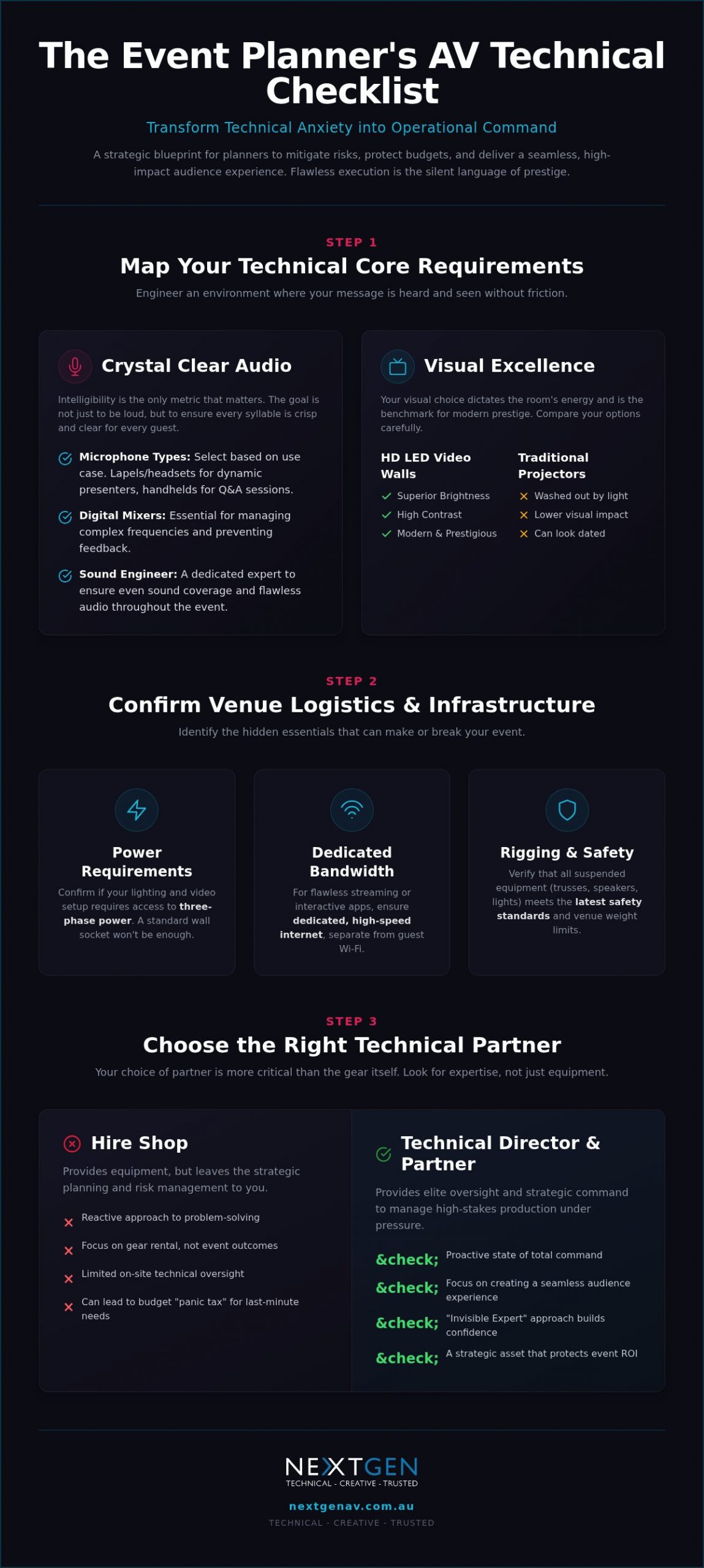
Master Timeline: Pre-Production to Final Mic Check
Success in a live environment is rarely about the gear alone; it’s about the precision of the schedule. A master timeline serves as the heartbeat of your production, ensuring that every technical element arrives, assembles, and activates in perfect harmony. While previous sections focused on the “what” and the “where”, this phase of your event av checklist for planners addresses the “when”. Moving from initial design to the final applause requires a disciplined approach to time management that leaves zero room for ambiguity.
Integrating a master timeline into your event av checklist for planners ensures that no technical milestone is left to chance. This chronological roadmap allows you to transition from the creative planning phase into the high-pressure environment of the live event with absolute confidence. It transforms a list of equipment into a living, breathing production schedule that your entire team can follow with military precision.
Preparation and Pre-Production
The journey begins three to six months out with a comprehensive site walkthrough. This is your opportunity to identify rigging points and loading docks, which we discussed in the logistics phase, but now through the lens of installation timing. As you approach the 48-hour mark, your focus must shift to content collection. Testing high-resolution videos and complex slide decks on the actual playback hardware is non-negotiable. This window allows you to resolve codec issues or aspect ratio mismatches before they become on-site emergencies. Contingency planning is equally vital; you must always have a secondary playback system ready if a presenter’s laptop fails or a file becomes corrupted.
On-Site Execution and Rehearsals
The bump-in is the most intense period of the project, where the technical design finally meets the physical room. Once the rigging is secure and the LED walls are calibrated, the focus shifts to rehearsals. A professional sound check is far more than a simple “testing 1, 2”. It is a meticulous process of balancing frequencies for each speaker’s unique voice and ensuring the professional audio system delivers uniform clarity across the entire venue.
Following the audio calibration, cue-to-cue rehearsals are essential. These sessions allow the lighting, visual, and audio teams to synchronise their actions with the MC’s script, ensuring every transition is sharp and intentional. Ten minutes before the doors open, perform a final walkthrough to check sightlines, lectern heights, and microphone battery levels. During showtime, your technical crew acts as the invisible engine, proactively managing the live mix and visual cues so you can focus entirely on your guests. To ensure your programme runs with this level of precision, you can secure professional technical direction to oversee every moving part of your production.
Beyond the Gear: Why a Technical Partner Outperforms a Hire Shop
An event av checklist for planners is a powerful tool, but it only reaches its full potential when guided by seasoned hands. There is a fundamental difference between simple equipment hire and full-service event production. A hire shop provides the gear and leaves the integration, troubleshooting, and operation to you. In contrast, a technical partner takes total ownership of the technical ecosystem. This ensures that every piece of technology, from the professional audio systems to the LED walls, works in concert to support your brand’s prestige. With over 30 years of industry experience, NextGen AV has refined the art of turning complex technical requirements into flawless, high-impact audience experiences.
Choosing a partner over a supplier means you are investing in a result rather than just renting a box of cables. It is the difference between hoping the tech works and knowing it will. This level of reliability allows you to move past the logistical grind and focus on the prestige of the final result. By aligning with experts who understand the nuances of high-stakes production, you transform your event av checklist for planners from a list of tasks into a strategic roadmap for success.
The Role of Professional Technical Direction
Local expertise is a strategic advantage that saves both time and money. Knowing the specific loading dock protocols of Melbourne CBD venues or the Victorian safety standards for rigging is essential for a smooth bump-in. NextGen AV’s deep roots in the Melbourne event scene allow us to navigate these logistical nuances with ease, providing a front-of-house excellence that reflects your professional authority. We believe in the power of invisible expertise, where the technology serves the message without ever becoming a distraction. To elevate your next production, organise a consultation with NextGen AV to build your bespoke technical checklist and experience the peace of mind that comes with true technical mastery.
Elevate Your Next Production to Absolute Precision
Mastering a high-stakes event requires more than just high-end gear; it demands a disciplined alignment of technical mastery and logistical foresight. By utilising a comprehensive event av checklist for planners, you transform potential technical risks into a seamless, high-impact audience experience. From the initial site walkthrough to the final cue-to-cue rehearsal, your success rests on the ability to anticipate needs before they become obstacles. You’ve seen how the right infrastructure, such as vibrant LED walls and crystal-clear audio, serves as the invisible engine behind your brand’s prestige.
As a dedicated Melbourne specialist team with 30+ years of industry experience, NextGen AV provides the end-to-end production management needed to turn your vision into a cinematic reality. We move past the limitations of simple hire shops to offer the quiet power of elite technical direction. It’s time to step away from the logistical grind and focus on the artistry of your event. Download Your Strategic AV Checklist or Book a Consultation with our experts today. Let’s work together to ensure your next production is nothing short of flawless.
Frequently Asked Questions
What are the most common AV mistakes planners make at events?
The most frequent technical errors involve underestimating power requirements or choosing inappropriate microphones for speakers. Planners often forget to check if their content matches the screen’s aspect ratio, which leads to distorted visuals. Another critical oversight is skipping a full cue-to-cue rehearsal. These errors are easily avoided by documenting every technical milestone in an event av checklist for planners, ensuring that gear and timing are perfectly aligned before the doors open.
How early should I book an AV production company in Melbourne?
You should ideally secure your technical production team three to six months before your event date. Melbourne is a competitive market for corporate events; elite teams often book out well in advance during peak seasons. Engaging a partner early allows for comprehensive site walkthroughs and bespoke technical design. This lead time is essential for coordinating logistics, especially if your production requires complex rigging or custom-built LED video wall configurations to suit the venue.
Do I really need a dedicated internet line for my event?
A dedicated, hard-wired internet line is essential if your programme includes live streaming or interactive audience apps. Shared venue Wi-Fi is notoriously unreliable because its bandwidth fluctuates as more guests connect. For a seamless experience, you need a guaranteed upload speed that remains consistent throughout the event. This dedicated drop acts as a fail-safe, protecting your broadcast from the latency and dropouts that can ruin a remote attendee’s engagement and brand perception.
What is the difference between a lapel mic and a headset mic for presenters?
Lapel microphones are discreet and clip onto clothing, but they can struggle with clothing rustle or head movement. Headset microphones sit closer to the mouth, providing superior audio consistency and higher gain before feedback. For dynamic presenters who move their heads frequently or walk near speakers, a headset is the safer choice. It ensures the audio remains crystal clear regardless of which way the speaker turns during their presentation, providing a better audience experience.
Can I use the venue’s in-house AV system for a large corporate event?
In-house systems are often designed for basic meetings rather than high-stakes corporate productions. While they may be convenient, they frequently lack the power, visual impact, and technical redundancy required for a large-scale event. Bringing in a specialist technical partner ensures you have access to the latest LED technology and professional audio systems. This approach provides you with a dedicated team focused solely on your success rather than a venue manager overseeing multiple rooms simultaneously.
How much does professional event AV production typically cost in Australia?
Production costs in Australia vary significantly based on the scale of your equipment requirements and the length of the event. Factors like the number of technicians, the complexity of the rigging, and the size of the LED video walls all influence the final investment. Rather than looking for a flat rate, it’s better to request a tailored quote that reflects your specific technical needs. This ensures your budget is allocated to high-impact solutions that drive results.
What is a “bump-in” and how much time should I allow for it?
A “bump-in” refers to the period where the technical crew delivers, installs, and tests all equipment before the event begins. For a standard corporate setup, you should allow at least four to six hours. Larger productions involving complex staging or rigging may require a full day or even overnight access. Accurate timing is a vital component of any event av checklist for planners, as it prevents rushed setups and ensures everything is calibrated perfectly.
What technical equipment is needed for a hybrid event?
Hybrid events require a specialised kit beyond standard in-room gear. You need high-definition cameras, professional vision switchers, and hardware encoders to send a stable stream to your virtual platform. Equally important is an audio interface that allows the sound engineer to create a separate mix for remote viewers. This ensures that both your physical and digital audiences receive high-quality, balanced audio that is free from room echo, background noise, or distracting technical glitches.
In 2026, a “good enough” live stream is no longer a safety net; it’s a brand liability that your audience will switch off in seconds. With the Australian live streaming market projected to reach over USD 10 billion by 2033, the gap between amateur webcasts and professional broadcasts has never been wider. Choosing the right live stream production company melbourne is about more than just hiring cameras. It’s about securing a technical partner who treats your digital presence with the same reverence as a prime-time television special.
You’ve likely felt the gut-wrenching anxiety of a flickering connection or muffled audio during a high-stakes keynote. We agree that your brand’s prestige shouldn’t be held hostage by a spotty Wi-Fi signal or complex technical rider requirements. This guide promises to help you master the technical and strategic essentials of high-stakes broadcasting to ensure your next event delivers a flawless experience. We’ll explore the latest standards for 10-bit video recording, redundant internet protocols, and the expert orchestration required to engage both in-room and online audiences simultaneously.
Key Takeaways
- Learn how to elevate your event from a basic webcam feed to a sophisticated, multi-camera broadcast that meets 2026 corporate standards.
- Identify the essential technical stack, from 4K vision switchers to professional audio systems, required to eliminate dropouts and muffled sound.
- Discover the secrets of hybrid staging, ensuring your online audience feels just as immersed as those sitting in the front row of the venue.
- See why engaging a specialist live stream production company melbourne provides the technical direction needed to navigate high-stakes “what-if” scenarios.
- Master pre-production strategies, including the minute-by-minute run-sheet, to ensure your team moves with the precision of a professional film crew.
Beyond the Webcam: The Evolution of Live Stream Production in Melbourne
The days of propping a laptop on a stack of books for a corporate address are firmly in the past. In 2026, the evolution of live streaming has transformed from a niche technical workaround into a critical pillar of corporate communication. For a leading live stream production company melbourne like NextGen AV, this means moving beyond the basic webcam feed and into the territory of high-stakes, vision-mixed broadcasting. We see professional production as a cinematic experience. It is the fundamental difference between a grainy video call and a polished, television-standard event that commands absolute attention from the first second.
Melbourne’s event landscape is uniquely demanding. Whether you are organising a high-pressure AGM in a Collins Street boardroom or a multi-day summit at the Melbourne Convention and Exhibition Centre, the expectation is the same: flawless execution. DIY setups often fail because they lack the hardware redundancy and technical oversight required for high-stakes environments. When your brand’s reputation is on the line, a “good enough” stream is a liability you cannot afford to carry. True professional production involves multiple camera angles, crystal-clear audio, and real-time vision mixing that tells a compelling story to your viewers.
Why Broadcast Quality Matters for Your Brand
Visual clarity is directly linked to your perceived professional authority. In a world where audiences consume high-definition content daily, the “YouTube Effect” has raised the bar for corporate events. If your stream looks amateur, your message feels amateur. High-quality production eliminates the “uncanny valley” of poor lighting and grainy video, replacing it with sharp 4K visuals that build immediate trust. It is about prestige. When your broadcast looks and feels like a professional TV production, your audience treats your insights with the gravity they deserve—a principle that applies equally to high-end industries where you can learn more about Zed Real Estate and their use of premium visual presentation.
The Shift to Hybrid: Melbourne’s New Standard
Hybrid events are the new benchmark for success in the Melbourne business community. By serving both the physical room and the digital screen simultaneously, organisations are realising a far greater return on investment and a global reach that was previously impossible. This model requires a sophisticated approach to technical direction. You need more than just a feed; you need low-latency streaming that allows for real-time interaction between in-person speakers and online participants. It’s about bridging the gap so that every attendee, regardless of their location, feels like they have a front-row seat at the centre of the action.
The Technical Stack: What Makes a Flawless Melbourne Live Stream?
Building a broadcast-quality experience requires more than just high-end gear; it demands a synchronised ecosystem of hardware and expertise. While many providers might offer basic video capture, a premier live stream production company melbourne treats the technical stack as the engine room of your brand’s digital presence. This starts with the acquisition of stunning, high-definition imagery using broadcast-standard cameras like the Sony FX3 or the Blackmagic Pocket Cinema Camera 6K Pro. These tools ensure every frame captures the prestige of your event with the cinematic depth your audience expects in 2026. Precision is non-negotiable.
Behind the scenes, the “Invisible Expert” manages the complex flow of data. Vision switchers and dedicated hardware encoders take these raw signals and transform them into a stable, high-bitrate stream. We don’t rely on a single 5G connection or the venue’s shared Wi-Fi. Professional broadcasting requires internet redundancy, often involving bonded cellular networks or satellite backups. If one connection falters, the system seamlessly pivots to the secondary line without your audience ever noticing a frame drop. This level of technical direction ensures that your high-stakes presentation remains uninterrupted, regardless of local network congestion.
Audio: The Invisible Half of the Broadcast
Audio failure is far more catastrophic than a minor video lag. If the screen freezes for a second, the audience waits; if the sound cuts out or echoes, they leave. Integrating professional sound system hire is essential for managing the delicate balance of lectern microphones, lapels, and remote presenters. A dedicated audio engineer performs live mixing to ensure that every speaker is heard with absolute clarity, stripping away room reverberation and background noise. It’s about creating an intimate connection between the speaker and the digital viewer.
Vision Mixing and Graphics Integration
To keep a digital audience engaged, the visual narrative must be dynamic. We use sophisticated vision mixing to weave together multiple camera angles, brand overlays, and lower-third graphics that reinforce your corporate identity. This includes integrating remote speakers via low-latency protocols, making them feel like they are standing right next to your on-stage talent. We also ensure perfect colour consistency across all feeds, especially when your set features high-impact LED video walls. When every technical element is perfectly aligned, the result is a seamless, TV-quality production. If you want to ensure your next event is backed by this level of mastery, consider how NextGen AV’s technical direction can elevate your broadcast.
Hybrid Event Staging: Connecting the Room to the World
A successful hybrid event isn’t just a live presentation with a camera at the back of the room. It’s a sophisticated “broadcast studio” environment where the physical stage serves two distinct audiences simultaneously. Achieving this balance requires a deep understanding of how stage and lighting hire in Melbourne can be used to create visual depth and prestige. When you engage a specialist live stream production company melbourne, the staging is designed to look as impressive on a 65-inch 4K screen as it does from the back row of a ballroom. It’s about orchestrating a unified experience where every attendee feels valued.
One often overlooked element is the “return feed.” For a presenter to feel truly connected, they need to see and hear the digital audience. We set up dedicated confidence monitors that display the virtual gallery or live chat feeds, allowing speakers to interact naturally with remote participants. This removes the “void” feeling of speaking to a cold lens. In major Melbourne venues like the MCEC or Crown, we also have to manage the delicate interplay between house lighting and our dedicated broadcast rigs. We ensure the lighting is flattering for the human eye while maintaining the specific colour temperatures required for high-end camera sensors. It’s a technical dance that ensures your brand looks flawless in every medium.
LED Walls as the Ultimate Hybrid Backdrop
In 2026, LED video walls have become the gold standard for hybrid backdrops. Unlike traditional projectors, they provide the brightness and contrast needed to pop on camera, even in well-lit rooms. However, they require expert technical direction to manage “moiré” patterns. These are the distracting wavy lines that appear when a camera’s sensor conflicts with the LED pixel pitch. We solve this through precise shutter speed synchronisation and focal depth management. Using dynamic backgrounds that shift with your presentation segments keeps the visual energy high and ensures your live stream production company melbourne delivers a cinematic result.
Melbourne Venue Logistics and Connectivity
Every venue has its own technical personality. Whether it’s a heritage boutique hotel in the CBD or a massive conference centre, we conduct rigorous site surveys to identify potential bottlenecks. We check firewall restrictions and verify upload speeds well before the first cable is laid. If a venue’s NBN connection is unreliable, we deploy bonded cellular solutions that combine multiple 5G signals into one robust, high-speed pipe. Our goal is to minimise the technical footprint on the physical floor plan. This keeps cables and gear hidden while the “Invisible Expert” keeps the digital engine running perfectly in the background.
Pre-Production: The Secret to a Stress-Free Broadcast
The success of a broadcast is determined long before the red “On Air” light begins to glow. While high-end gear is the engine of a production, pre-production is the blueprint that ensures every component moves in perfect harmony. Engaging an experienced live stream production company melbourne ensures that the logistical grind of planning is transformed into a streamlined, surgical process. We believe that a stress-free event is the result of exhaustive preparation where every “what-if” has already been answered. It’s about moving past the hope of a good stream and into the certainty of a flawless one.
Central to this process is the development of a minute-by-minute run-sheet. This document is the master script for the technical crew, detailing every camera transition, audio cue, and graphic overlay with absolute precision. A full technical rehearsal or “dry run” conducted 24 hours prior is a non-negotiable standard for high-stakes corporate events. This allows our team to stress-test the environment, from verifying remote speaker connections to ensuring the lighting levels are perfectly balanced for the camera sensors. Contingency planning is baked into our DNA. We prepare “Plan B” scenarios for everything, including instant fallback loops if a remote presenter’s connection fails, keeping your brand’s prestige intact regardless of external variables.
The Role of Technical Direction
The Technical Director (TD) acts as the conductor of the digital orchestra. They are responsible for the real-time flow between lighting, sound, and the stream itself, ensuring that the full service event production feels like a single, cohesive unit. Using sophisticated communication headsets, the TD coordinates the crew with quiet authority, making split-second decisions that keep the production moving forward. This level of technical oversight removes the burden of management from your shoulders, allowing you to focus on your audience while the “Invisible Expert” handles the complexities behind the scenes.
Digital Engagement and Platform Selection
Choosing the right platform is a strategic decision that depends on your specific goals. While YouTube or Vimeo are excellent for public reach, custom secure portals are often the preferred choice for sensitive AGMs or investor briefings where privacy is paramount. We help you integrate interactive elements like live Q&A, real-time polling, and moderated chat functions to keep your digital audience active and involved. Once the broadcast concludes, we provide detailed post-event analytics to measure engagement metrics and viewer retention. If you are ready to move beyond basic webcasting and secure professional technical direction for your next Melbourne event, the journey begins with a meticulous pre-production strategy.
Why NextGen AV is Melbourne’s Trusted Live Stream Partner
Legacy is the ultimate insurance policy in live production. With over 30 years of industry experience, NextGen AV has witnessed the transition from analogue signals to the sophisticated 4K digital broadcasts of 2026. We’ve encountered every conceivable technical hurdle, from sudden venue power failures to complex network firewalls, and we’ve solved them all with the calm precision that only decades of experience can provide. When you partner with a premier live stream production company melbourne, you aren’t just renting hardware. You are securing a dedicated craft, honed over thousands of high-stakes corporate events.
Our “Confident Orchestrator” approach is built on end-to-end ownership. We don’t outsource the critical components of your broadcast. From the initial site survey to the final post-event pack-down, our team manages every variable. This includes providing direct access to our extensive in-house inventory of LED video walls, professional audio systems, and custom staging and rigging solutions. By owning the entire technical stack, we eliminate the friction of third-party logistics and ensure that every piece of equipment is perfectly maintained and ready for the spotlight. This allows you to step onto the stage with absolute confidence, knowing the engine behind the scenes is running flawlessly.
The NextGen Difference: Mastery and Precision
We operate under an “Invisible Expert” philosophy. Our goal is to provide a seamless execution that never distracts from your message. Our technical engineers are specialists who thrive under the intense pressure of a live broadcast, bringing a level of quiet authority to the control desk. We don’t believe in one-size-fits-all packages. Whether you are a community organisation or a global corporate entity, we design customised solutions tailored to the specific needs of Melbourne’s diverse sectors. It’s about precision, artistry, and a commitment to excellence that reflects your brand’s prestige.
Get a Professional Consultation for Your 2026 Event
Planning a high-stakes broadcast requires a partner who understands both the national landscape and the specific nuances of Melbourne’s event centres. We work closely with you to design a bespoke streaming solution that aligns with your strategic goals, ensuring your digital reach is maximised without compromising the in-room experience. Our expertise as a live stream production company melbourne is your greatest asset in delivering a TV-quality experience to your global audience. Don’t leave your digital presence to chance. Contact the NextGen AV team today to discuss your next live stream.
Master Your Next High-Stakes Broadcast
Professional live streaming has evolved into a sophisticated craft where technical precision meets brand prestige. We’ve explored how 4K visual clarity, redundant internet protocols, and the expert orchestration of a Technical Director are the foundations of a flawless event. By integrating high-end hardware like LED video walls and professional audio systems, you bridge the gap between your physical and digital audiences, ensuring every participant feels the full impact of your message.
Choosing a seasoned live stream production company melbourne is the final step in moving from logistical stress to front-of-house excellence. With over 30 years of industry experience and an elite Melbourne event portfolio, NextGen AV provides the full-service technical production required to protect your brand’s reputation. We handle the technical “what-ifs” so you can focus on delivering a powerful presentation that resonates globally.
Partner with Melbourne’s Live Stream Experts — Enquire Now
It’s time to transform your next broadcast into a cinematic experience that reflects the true standard of your brand. We look forward to orchestrating your success.
Frequently Asked Questions
What is the difference between webcasting and live streaming?
Webcasting is typically a one-to-way broadcast designed for large, passive audiences, much like a digital lecture or a town hall. Live streaming is a more dynamic, interactive experience that often involves real-time engagement tools like chat, Q&A, and polling. While the terms are frequently used interchangeably in 2026, a professional live stream production company melbourne focuses on delivering a multi-camera, vision-mixed experience that feels like a high-end television programme rather than a simple video call.
How much does a professional live stream production cost in Melbourne?
The investment for a professional broadcast varies significantly based on the number of cameras, the complexity of the technical direction, and the staging requirements. A high-stakes corporate event requires a different level of redundancy and expertise than a basic single-camera setup. While entry-level market rates exist for simple webcasts, a bespoke solution tailored to a prestigious brand reflects the specialised hardware and “Invisible Expert” management required to ensure a flawless result.
Do I need to provide the internet connection for the live stream?
You don’t necessarily need to provide the connection, though we always assess the venue’s existing infrastructure during our initial site survey. While many Melbourne venues offer high-speed NBN, we never rely on a single point of failure. A professional production involves bringing redundant, bonded cellular solutions that combine multiple 5G networks to ensure your stream remains live even if the venue’s primary internet drops out. It’s about absolute reliability.
Can you stream to multiple platforms like YouTube, LinkedIn, and Facebook at once?
Yes, we can broadcast your event to multiple social media platforms and private secure portals simultaneously through a process called simulcasting. This allows you to maximise your reach across different audience segments without requiring extra bandwidth at the venue. We manage the entire encoding process from our central vision switcher, ensuring each platform receives a high-bitrate, crystal-clear feed that reflects your brand’s prestige.
What happens if the internet goes down during my live event?
We prevent total signal loss by using hardware-based redundancy and bonded network protocols. If one internet provider fails, our system automatically and invisibly pivots to a secondary or tertiary connection, such as a different 5G carrier or a satellite link. This technical fail-safe ensures the digital audience experiences no more than a momentary flicker, if anything at all. Our technical directors are trained to manage these transitions with the quiet authority required in high-pressure environments.
How many cameras do I need for a professional-looking live stream?
A three-camera setup is generally the minimum standard for a truly professional-looking broadcast. This configuration allows for a wide “master” shot of the stage, a medium shot for the primary speaker, and a third “roving” camera for audience reactions or close-up product details. Using multiple angles keeps your viewers engaged and allows our vision mixers to tell a more compelling visual story that mirrors a TV-quality experience.
Can you integrate remote speakers into a live event in Melbourne?
Integrating remote talent is a core feature of modern hybrid events. We use low-latency “Bring Your Own Meeting” (BYOM) protocols to bring speakers from anywhere in the world onto your Melbourne stage in real-time. By using professional return feeds, your on-stage presenters can see and hear the remote speaker perfectly, creating a natural dialogue that bridges the gap between the physical room and the digital world.
What is a Technical Director, and do I really need one for my stream?
The Technical Director is the “Confident Orchestrator” who manages the entire crew and vision-mixing process during the broadcast. They are responsible for every shot transition, audio cue, and graphic overlay, ensuring the production follows your run-sheet with surgical precision. For any high-stakes event, a Technical Director is essential. They act as the “Invisible Expert” who makes split-second decisions to keep the production moving forward, allowing you to focus entirely on your presentation.
The house lights dim and the opening cue is seconds away, yet instead of the stage manager’s voice, your headset fills with static or the muffled chatter of a nearby security team. It is the nightmare scenario for any production lead, where a simple lapse in your event communication systems rental choice transforms a high-stakes performance into a series of missed cues and frantic hand signals. You know that behind every flawless event is an invisible engine of coordination, and you shouldn’t have to worry about wireless blackspots or battery failure when the pressure is on.
We agree that your crew deserves the same level of precision in their headsets as the audience hears through the front-of-house speakers. This 2026 guide promises to show you how to choose and deploy a robust communication infrastructure that guarantees absolute synchronisation across lighting, audio, and stage departments. We will look at the latest full-duplex digital intercoms, how to ensure ACMA compliance for interference-free operation, and the technical strategies required to maintain professional-grade reliability for an 18-hour show day.
Key Takeaways
- Understand why professional communication serves as the vital nervous system for any high-stakes production, ensuring every cue is executed with absolute precision.
- Discover the technical differences between digital intercoms and two-way radios to determine which technology best suits your crew’s specific talk-paths and security needs.
- Learn how to optimise your event communication systems rental by conducting thorough site surveys and assessing the unique acoustic challenges of your venue.
- Navigate the complexities of ACMA frequency licensing to avoid interference from unlicensed gear and ensure your production remains compliant and crystal clear.
- Explore the benefits of integrating your comms infrastructure into a total audio-visual package, backed by 30 years of expertise in the Melbourne events industry.
The Critical Role of Event Communication Systems in Modern Production
Think of your event as a living organism. If the audio-visual elements are the muscles and the vision is the heart, then a professional event communication systems rental is the nervous system. It carries every pulse of data and every urgent command from the brain, the stage manager, to the extremities of the production. Without this connectivity, the most expensive LED walls and line arrays are just static hardware. Truly seamless production relies on the ability to transmit intent instantly. This allows a lighting operator to hit a blackout the exact millisecond the drummer strikes the final beat, creating a moment of pure, coordinated impact.
There is a profound difference between managing a crowd and calling a show. Simple two-way radios are fine for coordinating car park arrivals or security patrols, but they fall short when you’re choreographing a complex gala. Calling a show requires a continuous, open dialogue where the stage manager can hear the breath of the crew and anticipate their needs. This level of intimacy prevents the common AV glitches that haunt poorly planned events, such as mistimed video rolls or audio feedback during a critical keynote. When the crew feels connected, their stress levels drop significantly. They move from a state of reactive panic to one of proactive artistry, focusing on the prestige of the final result rather than fighting their equipment.
Beyond Walkie-Talkies: Defining Professional Comms
The evolution of production has pushed us past the era of simple push-to-talk devices. Modern digital intercom systems create integrated networks that allow for full-duplex conversation, meaning your team can talk and listen simultaneously just like a phone call. In high-interference environments like the Melbourne CBD, consumer-grade gear often buckles under the weight of RF noise from skyscrapers and mobile towers. A professional setup provides dedicated, discrete channels. This ensures the lighting department isn’t distracted by audio troubleshooting, and the stage manager has a direct, private line to the technical director to keep the schedule on track.
Risk Mitigation through Reliable Infrastructure
Reliability isn’t just a luxury; it’s a safety requirement. High-stakes corporate shows demand a zero-fail comms environment, which we define as a dedicated infrastructure where redundant signal paths and expert frequency management ensure every critical cue is delivered and acknowledged without exception. This infrastructure prevents the dead air that can ruin a live broadcast or the timing errors that turn a prestige award ceremony into a series of awkward silences. Beyond the creative flow, these systems act as a lifeline for emergency protocols. They ensure that if a situation arises, the entire team can be alerted and organised in seconds without the audience ever knowing there was a concern.
Key Technologies: From Two-Way Radio Hire to Digital Intercoms
The technical landscape of modern production has shifted, moving away from simple noise-makers toward sophisticated, low-latency networks. Selecting the right event communication systems rental depends entirely on the specific roles within your crew. For logistics and security teams, Digital Mobile Radio (DMR) remains the heavy lifter. These units provide robust, long-range coverage that ensures your front-of-house staff and loading dock crews remain connected across vast distances, even through the thick concrete walls of Melbourne’s premier convention centres.
At the heart of the production, wired intercom systems provide the rock-solid reliability required for stationary positions. Your technical director and lighting operator, situated at the ops desk, don’t need mobility; they need a connection that is immune to wireless interference. When Choosing the Right System for your mobile stage crew, wireless full-duplex technology is the gold standard. It allows for continuous, hands-free conversation, enabling a rigger or stage hand to use both hands for their craft while maintaining a crystal-clear dialogue with the stage manager.
For city-wide festivals or sprawling outdoor events, Push-to-Talk over Cellular (PTToC) offers an elegant solution. By leveraging existing mobile networks, PTToC bridges the gap where traditional radio frequencies might struggle, providing wide-area coverage that keeps your entire team synchronised across kilometres of urban terrain. Our team can help you organise a bespoke comms package that aligns perfectly with your show’s complexity and venue constraints.
Digital vs. Analogue Systems
Digital systems have rendered analogue units obsolete in professional circles. By converting voice into data packets, digital DMR units offer superior audio clarity and eliminate the background hiss associated with older technology. More importantly, digital channels allow for advanced encryption. This is a vital feature for high-profile corporate events where sensitive announcements must remain private. Professional-grade digital hardware also boasts significantly better battery life, often surviving an 18-hour show day on a single charge while withstanding the physical rigours of a frantic bump-in.
Specialised Accessories for Every Role
The right headset is just as important as the base station itself. In high-decibel environments like concerts or trade shows, heavy-duty noise-cancelling headsets are essential to protect crew hearing and ensure instructions are heard over the PA. Conversely, floor managers and VIP hosts often require discrete earpieces that provide clear audio without the bulky profile of a traditional headset. We also provide multi-unit charging stations and speaker microphones to ensure large-scale deployments remain powered and functional from the first briefing to the final pack-down.
Choosing the Right System: A Buyer’s Comparison Framework
Selecting your event communication systems rental is not merely a matter of counting heads. It is an exercise in mapping the pulse of your production. You must first audit the ratio of ‘talkers’ to ‘listeners’ within your crew. While a logistics team might only need to report status updates via simplex channels, where only one person can speak at a time, your core production crew requires the fluid, simultaneous exchange of a full-duplex system. Understanding this distinction is the first step in moving from a basic setup to a professional-grade infrastructure that supports the artistry of your show.
The venue itself dictates the hardware. An indoor ballroom in the Melbourne CBD presents different challenges than a sprawling outdoor festival site at the Sidney Myer Music Bowl. Physical barriers like thick concrete walls or massive steel rigging can swallow wireless signals, leading to the dreaded ‘dead air’ that puts a production at risk. Budgeting for your comms should be viewed as show insurance. The investment in a high-end, reliable rental is negligible when compared to the professional fallout and stress of a failed show caused by a missed cue or a battery dying at a critical moment.
The ‘Show-Caller’ Test
A show-caller is the conductor of your event’s orchestra. They require a full-duplex system to maintain the ‘rhythm’ of the event, allowing them to hear the breath and readiness of the crew in real time. This typically involves a multi-channel structure where the caller can toggle between discrete departments like lighting, audio, and stage management without cluttering the main feed. This level of technical direction is what bridges the gap between a standard event and a world-class experience. It is why we often integrate these comms with our Professional sound system hire to ensure every element of the production is perfectly aligned from the first cue to the final curtain.
Interference and Range Considerations
Melbourne’s premier event precincts are notorious for RF noise. From the skyscrapers of the CBD to the high-density wireless environments of Southbank, signal interference is a constant threat. If your event spans multiple levels or a vast outdoor area, you will likely need to deploy repeaters to extend the range of your two-way radio fleet. A technical site survey is essential to identify potential blackspots and ensure your signal penetrates the physical barriers of the venue. By planning for these environmental factors early, you ensure your crew remains connected, regardless of the architectural challenges of the space.
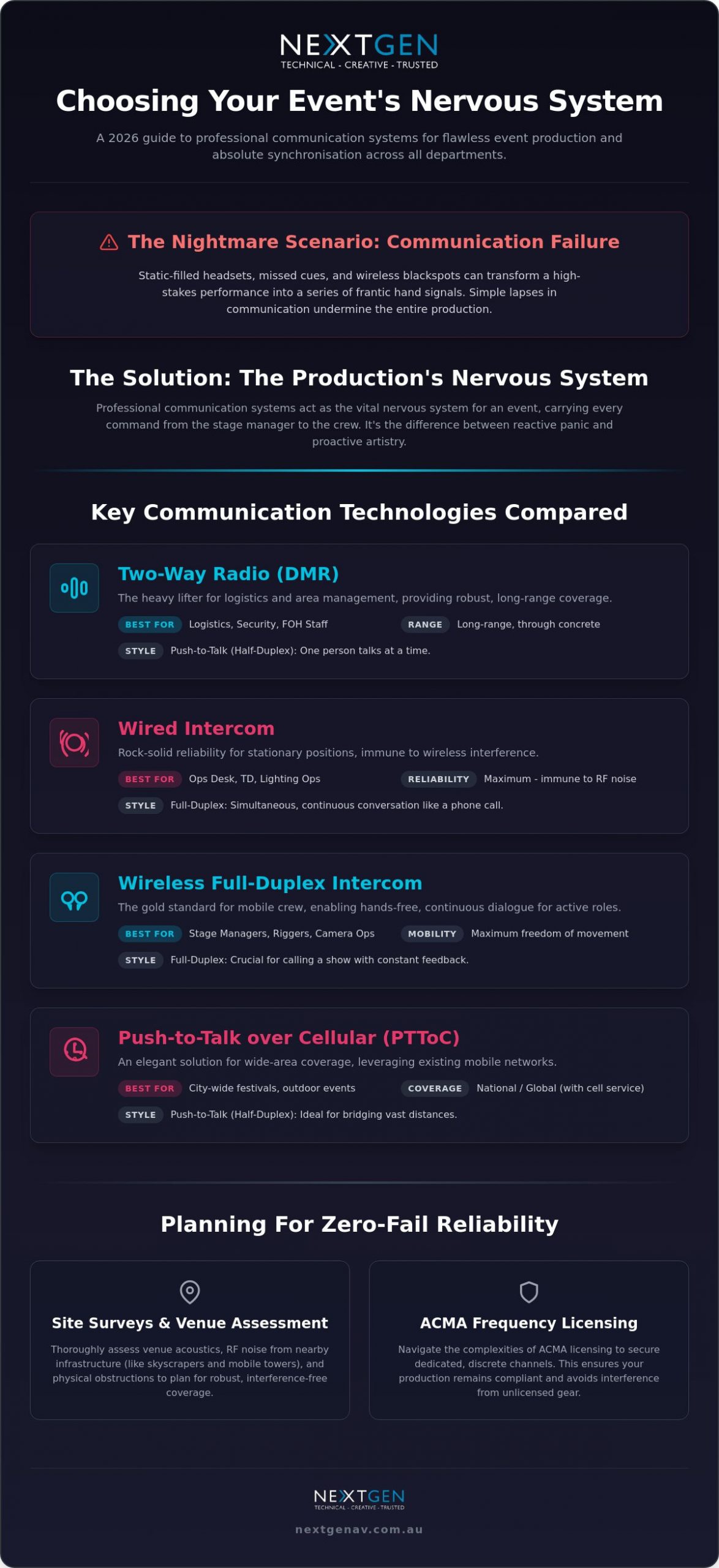
Planning Your Comms Infrastructure: Site Surveys and ACMA Compliance
A flawless production is never the result of luck; it is the product of meticulous preparation that begins long before the first road case enters the venue. For a high-impact event communication systems rental to succeed, a technical site survey is non-negotiable. This proactive assessment allows us to map the unique RF environment of your location, identifying potential blackspots created by heavy structural steel or subterranean concrete layers. By conducting a rigorous ‘walk-test’ protocol during the pre-show phase, we ensure that every corner of the site, from the green room to the loading dock, maintains a crystal-clear signal before the first cue is ever called.
Operating in Australia requires a deep understanding of the legal landscape governed by the Australian Communications and Media Authority (ACMA). Using unlicensed ‘grey market’ gear doesn’t just risk signal dropouts; it exposes your organisation to significant legal liability and potential fines. Professional systems must adhere to the Radiocommunications (Low Interference Potential Devices) Class Licence 2025, ensuring that your equipment operates on designated shared frequencies without disrupting emergency services or other vital broadcasts. We ensure all hired electronics meet strict RCM safety standards, providing you with the peace of mind that your infrastructure is both high-performing and fully compliant.
Frequency Management in Melbourne
The RF spectrum in Melbourne’s premier precincts, such as the MCEC or the major hotels along Southbank, is incredibly crowded. Without a co-ordinated frequency plan, your production comms could easily clash with nearby events or the venue’s internal security teams. For large-scale multi-AV projects, we act as your frequency coordinator, carving out dedicated space in the airwaves to prevent cross-talk and interference. This level of master-planning is a core component of our Full service event production, where we manage the technical heavy lifting so you can focus on the show’s creative execution.
Logistics and On-Site Support
While some choose ‘dry hire’ to save on initial costs, the complexity of modern intercom networks makes a turnkey solution far more efficient. A turnkey event communication systems rental includes the expertise of an on-site technician who manages the invisible details, from real-time troubleshooting to proactive battery swaps during critical show moments. Having a seasoned veteran on the ground ensures that any technical hiccups are resolved in seconds, maintaining the momentum of your event. If you are ready to secure a rock-solid foundation for your next production, contact our team to discuss a tailored comms strategy that guarantees absolute reliability.
Why Partner with NextGen AV for Your Melbourne Event Comms
Choosing a partner for your event communication systems rental is about more than just securing hardware; it is about finding an invisible expert who understands the heartbeat of a live production. We don’t view comms as an isolated utility. Instead, we integrate your intercom network directly into our total lighting and audio design. This holistic approach ensures that every department is perfectly synchronised, allowing the technical director to orchestrate the show with the precision of a master conductor. With over 30 years of experience navigating the specific RF challenges and logistical quirks of Victorian event venues, we have seen every possible scenario and developed the resilience to handle them all.
Our “Confident Orchestrator” philosophy means we take full ownership of the technical heavy lifting. You shouldn’t have to worry about frequency clashing or headset pairing while you are managing stakeholders and talent. Our solutions arrive custom-programmed and ready to use out of the box, configured specifically for your show’s unique talk-paths and department structures. This meticulous preparation eliminates the logistical grind of the bump-in, allowing your team to move straight into the creative flow of the event with absolute confidence in their connectivity.
The NextGen AV Advantage: Expert Technical Direction
A sophisticated comms network is only as effective as the hands that guide it. Our technical directors oversee the entire infrastructure, providing a level of oversight that ensures your peace of mind from the first briefing to the final pack-down. Whether you are hosting an intimate corporate meeting in the CBD or a massive community festival in regional Victoria, our solutions are inherently scalable. We provide the same elite-level reliability for a dozen headsets as we do for a hundred. This commitment to excellence is what defines our Audio visual hire Melbourne services, positioning us as a dedicated ally in your project’s success.
Ready to Organise Your Event Comms?
Organising a professional-grade communication setup is a straightforward process when you have the right experts by your side. To request a tailored quote, simply provide our team with your expected crew size, the layout of your chosen venue, and the total duration of the hire. This information allows us to architect a bespoke frequency plan and equipment list that meets your exact needs. You can rest easy knowing that your production is backed by professional-grade reliability and a team that takes personal pride in seamless execution. Let us handle the engine behind the scenes while you take centre stage.
Master the Rhythm of Your Next Production
The success of your next high-stakes event shouldn’t rest on the hope that your headsets will hold a charge. It requires a dedicated infrastructure built on technical mastery and a deep understanding of the unique RF challenges found across Melbourne. By selecting the right blend of digital intercoms for your show-callers and robust radios for your logistics team, you eliminate the friction that leads to missed cues. Remember that a professional site survey and strict ACMA compliance are the foundations of a zero-fail environment, protecting your production from signal interference and legal risk.
NextGen AV brings over 30 years of Melbourne event expertise to your project, offering end-to-end technical production management that allows you to focus on the prestige of the final result. We provide ACMA-compliant, professional-grade equipment that is custom-programmed to meet the specific demands of your venue. Choosing the right event communication systems rental is the final piece of the puzzle in delivering a world-class experience. It’s time to move past the logistical grind and experience the power of a perfectly synchronised crew.
Secure your seamless event comms with NextGen AV today and ensure your next production runs with absolute precision. We are ready to act as your invisible expert, driving the engine of your success from the first cue to the final curtain.
Frequently Asked Questions
What is the difference between simplex and full-duplex communication?
Simplex communication allows only one person to speak at a time while others listen; whereas full-duplex systems enable simultaneous two-way conversation just like a telephone call. This distinction is vital for production flow. Logistics and security teams typically use simplex radios, but show-callers and stage managers rely on full-duplex intercoms to maintain a continuous, uninterrupted dialogue during complex sequences.
Do I need a licence to use hired two-way radios in Australia?
You generally don’t need an individual licence for hired two-way radios because professional rental companies operate under ACMA class licences. These regulations ensure the equipment is compliant with Australian standards for power output and frequency use. We handle all the technical compliance and frequency co-ordination behind the scenes, so your team can focus on the event without worrying about regulatory hurdles.
How many radios should I hire for a corporate event with 500 guests?
The number of units required depends on your crew structure rather than the guest count. A typical corporate gala with 500 guests might require 15 to 25 units to cover stage management, audio-visual technicians, venue catering, and security teams. We recommend mapping out every department head and floor manager to ensure no critical link in your production chain is left without a headset.
What happens if our communication system experiences interference during the show?
If interference occurs, our technical directors immediately transition the crew to a secondary, pre-programmed backup channel. This is why a professional event communication systems rental includes a rigorous frequency management plan. By identifying potential RF clashes during the site survey, we create a redundant infrastructure that keeps your team connected even in the most crowded wireless environments.
Can event comms systems integrate with my existing sound system?
Event comms systems integrate seamlessly with your existing sound system to provide a “program feed” directly into crew headsets. This allows operators to hear the stage microphones while listening for cues from the stage manager. Using professional 4-wire interfaces, we can bridge your intercom network with your audio console to create a unified technical ecosystem that enhances the precision of every cue.
What is the range of a standard digital two-way radio in a city environment?
A standard digital two-way radio typically offers a range of 1 to 2 kilometres in a dense city environment like the Melbourne CBD. However, physical obstructions like high-rise buildings and steel structures can reduce this distance significantly. For events spanning larger urban areas or multiple venue levels, we deploy digital repeaters to boost signal penetration and ensure 100% coverage across your entire site.
Are wireless intercoms better than wired systems for stage management?
Wireless intercoms are superior for mobile stage managers who need to move between the wings and the green room, but wired systems remain the gold standard for stationary operators. Wired stations are immune to RF interference and battery failure; making them the most reliable choice for the lighting desk or technical director. Most high-stakes productions use a hybrid approach to balance mobility with absolute stability.
How long do the batteries last on professional event communication gear?
Professional event communication gear is designed to survive a standard 12 to 18-hour show day on a single charge. High-capacity lithium-ion batteries in modern digital beltpacks and radios provide reliable performance throughout a long bump-in and the final performance. We always provide multi-unit charging stations and spare batteries as part of our event communication systems rental packages to guarantee zero downtime during critical moments.
Imagine the heavy silence that follows a sudden screech of audio feedback just as your keynote speaker hits their stride. It’s the moment every event organiser in Melbourne dreads, yet it remains a common reality when technical precision is sacrificed for a lower quote. You’ve likely felt that familiar knot of anxiety, worrying if the LED wall will wash out your brand colours or if an inexperienced crew will fumble a critical transition. Understanding how to choose av company involves more than just comparing gear lists; it’s about finding a technical partner who acts as a confident orchestrator for your vision.
You deserve to step into your venue with total confidence, knowing the production spend is driving a clear return on investment and prestige. This guide provides the definitive 2026 checklist to help you secure a crew that thrives under pressure and takes personal pride in seamless execution. We will explore how to vet on-site expertise, decode complex production quotes, and ensure your next event runs with cinematic momentum and flawless technical delivery.
Key Takeaways
- Define your event’s technical DNA to ensure every piece of equipment serves a high-level objective, from broadcast-quality streams to immersive atmosphere.
- Master how to choose av company partners by scrutinising more than just a gear list, focusing instead on pixel pitch for LED walls and venue-specific acoustic planning.
- Prioritise technical direction and crew expertise over hardware alone to secure a seamless execution that guards against the risk of audio feedback or visual glitches.
- Navigate the unique logistical challenges of Melbourne venues by verifying your partner’s knowledge of local loading docks and strict “bump-in” windows.
- Learn to compare production quotes with precision to eliminate hidden costs and ensure you receive a detailed technical floor plan for your event.
Establishing Your Event’s Technical DNA
Before you look at a single piece of equipment, you must define the technical DNA of your project. This isn’t about choosing a microphone; it’s about identifying the stakes. A high-stakes product launch at the Melbourne Convention and Exhibition Centre demands a “zero-failure” technical environment. In contrast, a small internal workshop might only require basic amplification. When you begin the process of researching how to choose av company teams, you’re looking for a partner who can scale their mastery to match your specific event profile.
Identify your core objectives with clarity. Are you striving for high-energy audience engagement, or is the goal to produce a broadcast-quality recording for global distribution? The scale of your audience, both the physical attendees in the room and the digital delegates watching from afar, will dictate your bandwidth and hardware requirements. Finally, establish a realistic budget. It’s vital to account for both the prestige of the hardware and the professional labour required to operate it. Precision costs money, but technical glitches cost your reputation.
In-Person, Virtual, or Hybrid?
The 2026 event landscape has firmly established hybrid as the gold standard. This format requires a specialised technical toolkit that bridges the gap between the physical stage and the digital screen. Remote delegates demand broadcast-quality audio; they won’t engage if they’re struggling to hear through a hollow, room-captured feed. Partnering with a team experienced in hybrid event services in Australia ensures that your virtual audience receives a cinematic experience that mirrors the energy of the live room.
The Venue vs. The Vision
Your creative vision must eventually meet the reality of the venue’s architecture. Assessing ceiling heights, rigging points, and power availability early prevents expensive last-minute workarounds. While many Melbourne venues offer “in-house” AV, these solutions are often rigid and may not support bespoke lighting or complex LED configurations. The broader field of Audiovisual (AV) technology is vast, and your brand deserves more than a “one-size-fits-all” approach. Start by drafting a preliminary audio visual equipment list for your conference to see if the venue’s stock gear can truly deliver the prestige you require.
Scrutinising the Inventory: LED Walls, Audio, and Innovation
A warehouse full of equipment does not guarantee a successful event. It is the calibre of that inventory and how it is deployed that separates a mediocre production from a prestigious one. When you’re evaluating how to choose av company partners, you must demand transparency regarding their technical specifications. High-end visual impact relies on more than just “brightness”; it requires a deep understanding of pixel pitch and refresh rates to ensure your brand content looks as crisp on a massive screen as it does on a designer’s monitor.
Redundancy is the hallmark of a professional. If a primary media server fails during a live keynote, does your partner have a hot-swappable backup ready to take over in milliseconds? This level of preparedness is central to how to choose the right vendors for high-stakes corporate environments. Beyond the visuals, your lighting design should feature “intelligent” fixtures that can be programmed to shift the atmosphere instantly, transitioning your space from a focused plenary session to a celebratory gala dinner with the push of a button.
The LED Video Wall Standard
For premium events in 2026, traditional projection has largely been sidelined. Modern LED video walls offer a level of vibrance and contrast that projectors simply cannot match, especially in venues with significant ambient light. When planning, check for seamless integration; you want a perfectly flat, unified canvas without visible seams between panels. If your event is outdoors, ensure the gear is rated for Melbourne’s unpredictable weather, featuring high-brightness tiles that remain visible even under direct sunlight.
Crystal Clear Sound Engineering
There is a vast difference between basic “PA hire” and a custom-designed professional audio system. A designed system accounts for the unique acoustics of a venue, using precision-angled speakers to ensure every delegate hears every word without the distraction of echoes or dead zones. Managing frequency interference is another critical hurdle, particularly in the busy wireless environments of the Melbourne CBD. Your technical team should be able to explain why they’ve chosen specific microphones, such as prioritising a headset for a mobile presenter while using handhelds for a structured Q&A session. If you want to ensure your message is heard with absolute clarity, consider consulting with a technical expert early in your planning phase.
Beyond the Gear: Evaluating Technical Direction and Crew Expertise
Hardware is a commodity; expertise is a craft. High-end gear sits idle without a skilled hand to guide it. When you’re deciding how to choose av company partners, look past the shiny LED panels and ask about the people behind the consoles. You need veterans who have navigated the high-pressure environments of major Melbourne venues and understand the nuances of live production. The success of your event hinges on the crew’s ability to stay invisible while delivering a front-of-house experience that feels effortless.
A seasoned Technical Director (TD) acts as your single point of contact and the primary orchestrator of the show. They translate your creative vision into a series of perfectly timed cues. When mastering how to choose av company partners, the quality of technical direction is your greatest safeguard against the unexpected. If a presenter changes their slides last minute or a wireless frequency drops, the TD ensures the audience never notices. While AVIXA standards provide a vital baseline for technical quality, true excellence lies in a crew’s ability to problem-solve with agility.
Ask potential partners for specific case studies. Have they managed complex product launches in Melbourne where timing and brand precision are everything? A responsive project manager who answers emails promptly during the pre-production phase is a strong indicator of how the crew will perform on-site. If they aren’t organised during the planning months, they won’t be organised when the house lights go down and the pressure is on.
The Role of the Invisible Expert
Technical direction is the brain of your event. It is about orchestrating the delicate dance between lighting, sound, and vision to maintain a cinematic flow. A “hire shop” simply drops off equipment; a full-service partner builds a narrative experience. They ensure the transition from a high-energy video package to a live keynote is seamless, preserving the momentum that keeps your audience captivated from start to finish.
This level of professional integration is what sets industry leaders apart; for instance, LivewireAV provides a prime example of how audio, video, and lighting production can be harmonised to deliver a truly flawless event experience.
The Crew’s On-site Etiquette
Professionalism extends beyond technical skill. In corporate settings, your AV crew represents your brand. They should be dressed in appropriate corporate blacks, communicate with humility, and remain calm under pressure. For prestigious awards nights, a dedicated stage manager is non-negotiable to handle the flow of winners and presenters. Finally, ensure your partner provides enough hands for a rapid, safe pack-down that respects the venue’s strict “bump-out” timelines.
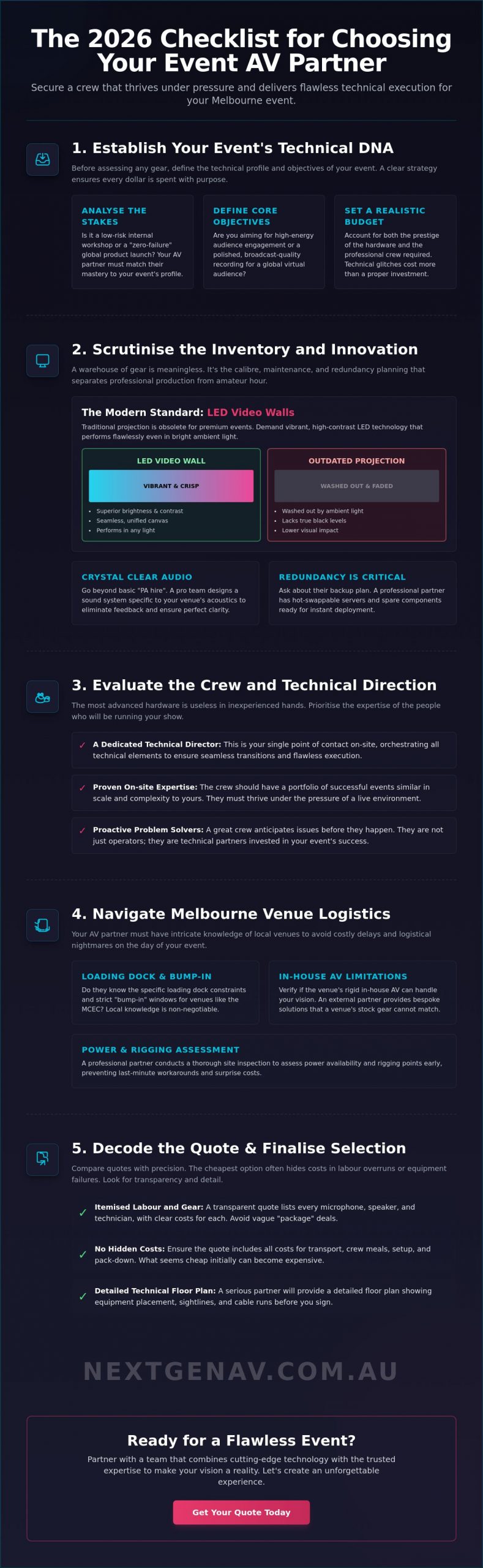
Navigating the Melbourne Event Landscape: Logistics and Venue Knowledge
The most sophisticated technical blueprint is only as good as its logistical execution. Melbourne’s event landscape is a unique maze of heritage architecture and high-tech precincts, each presenting its own set of technical quirks. When you’re assessing how to choose av company partners, venue familiarity is a non-negotiable asset. An expert team understands the labyrinthine loading docks of the Melbourne Convention and Exhibition Centre (MCEC) or the restricted access times of a boutique CBD hotel. They don’t just show up; they plan for the “bump-in” window with surgical precision, ensuring complex rigging is secured and tested long before the first delegate arrives.
Site visits are the hallmark of a proactive partner. A reputable company will meet you at the venue weeks before the event to assess power grids and internet stability. They know that a heritage building’s thick walls can wreak havoc on wireless frequencies, while a modern glass-walled atrium requires specific acoustic treatment to prevent sound bounce. By choosing local stage and lighting hire in Melbourne, you eliminate the risks of interstate transport delays and ensure your technical crew has the local knowledge to pivot if the venue’s infrastructure presents a sudden challenge.
Melbourne Venue Expertise
Success in Melbourne requires more than just gear; it requires context. Managing the acoustics in a high-ceilinged historic hall is a vastly different craft than tuning a sound system for a modern, carpeted ballroom. Your AV partner should be able to discuss the specific power limitations of major CBD hotels or the precise rigging points available at the MCEC. This local mastery allows them to design a technical solution that works with the room rather than against it, resulting in a prestigious and polished outcome for your audience.
Safety, Insurance, and Compliance
Technical excellence is built on a foundation of safety. In Victoria, WorkSafe compliance and Public Liability Insurance are mandatory, but the best companies go further. Every piece of equipment must carry a current Tag and Test certification to ensure electrical safety on-site. When your vision involves overhead structures, ensure the rigging is signed off by qualified engineers. This commitment to compliance protects your brand’s reputation and provides total peace of mind. If you want to ensure your next event is underpinned by this level of logistical mastery, contact our technical team today for a venue-specific consultation.
Securing Your Partner: The Final Selection and On-site Execution
The final stage of your selection process is where technical theory meets financial reality. When you reach the point of comparing proposals, you must ensure you are comparing “apples with apples” across every line item. A lower headline figure often masks the absence of essential components like specialised cabling, dedicated transport, or sufficient technician hours for a safe setup. Understanding how to choose av company partners requires a sharp eye for these omissions, as a missing adaptor or a short-staffed crew can derail even the most meticulously planned event.
Demand a detailed technical floor plan and a preliminary run-sheet before signing any contract. These documents serve as the blueprint for your success, illustrating exactly how the gear will integrate with the venue and how the show will flow. Be sure to scrutinise the terms for hidden “overtime” fees or punitive charges for last-minute adjustments. While live events are inherently fluid, a transparent partner will offer clear, upfront structures for these contingencies rather than burying them in fine print. Ultimately, you should apply the “Gut Feel” test: do you trust this team to protect your brand’s reputation when the house lights go down?
Transparency in the Quote
Decoding AV jargon is the first step toward budget certainty. You aren’t just paying for “black boxes”; you’re investing in the expertise required to calibrate a professional audio system or map a complex LED video wall. A prestigious event requires a quote that reflects high-quality hardware and seasoned labour, rather than the bare minimum. Fixed-price production management offers the greatest security, allowing you to focus on your delegates while the technical team handles the logistical heavy lifting without unexpected financial surprises.
The NextGen AV Commitment
Success in the Melbourne event scene isn’t built overnight. With 30 years of local experience, we’ve mastered the nuances of every major venue and the high-pressure demands of corporate production. Our “no-glitch” philosophy is built on a foundation of rigorous pre-event testing and deep redundancy for all critical systems. We take personal pride in our role as the invisible engine behind your most prestigious moments, ensuring your vision is realised with absolute precision. Enquire with NextGen AV for your next Melbourne event and experience the confidence of a truly seamless technical partnership.
Elevate Your Event with Technical Mastery
Mastering how to choose av company partners is the ultimate safeguard for your brand’s prestige. You’ve seen that a flawless event requires more than just gear; it demands the logistical foresight to navigate Melbourne’s unique venues and the technical direction to orchestrate every cue with cinematic precision. By prioritising transparency in your quotes and demanding high-calibre inventory like Red Dot standard LED technology, you transform a simple gathering into an immersive experience.
With over 30 years of industry experience, NextGen AV has become the technical partner of choice for major Australian government bodies and global brands. We thrive on the high-stakes pressure of live production, providing the proactive, elite expertise that allows you to lead with total confidence. Partner with Melbourne’s AV experts for your next event and ensure your technical execution is as ambitious as your vision. It’s time to move past the logistical grind and focus on the celebratory success you’ve worked so hard to build.
Frequently Asked Questions
What is the most important factor when choosing an AV company?
The most critical factor is the expertise of the technical crew and their ability to stay calm under the pressure of a live environment. While high-end gear is a baseline requirement, the success of your event depends on the “Invisible Expert” behind the console who ensures the technology serves your brand vision. When researching how to choose av company partners, prioritise those who offer a dedicated Technical Director to orchestrate the entire show.
Should I use the in-house AV provider at my venue?
In-house providers offer convenience, but they often lack the bespoke creative toolkit needed for prestigious or high-stakes events. External partners bring a dedicated team that prioritises your specific brand aesthetic over venue efficiency. They also provide specialised equipment, such as custom LED video walls, that may not be part of a venue’s standard inventory.
How far in advance should I book an AV company for a Melbourne event?
You should aim to book your technical partner three to six months in advance to secure the best crew and equipment. Melbourne’s event calendar is exceptionally busy, particularly during major international technology summits scheduled for late 2026. Early booking allows for thorough site visits and the development of a precise technical floor plan.
What technical questions should I ask during the initial consultation?
Ask about their redundancy protocols for critical components like media servers and wireless audio systems. You should also enquire about their familiarity with your chosen venue’s loading docks and power grids. Understanding how to choose av company teams involves vetting their problem-solving agility, so ask for specific examples of how they’ve handled mid-show technical failures in the past.
Is it cheaper to hire equipment separately from different vendors?
Hiring from multiple vendors often leads to fragmented communication and increased risk of compatibility issues on-site. While individual hire prices might seem lower, the logistical cost of managing different deliveries and crews usually erodes any perceived savings. A full-service partner ensures that your audio, lighting, and visual systems are designed to work in perfect harmony.
What happens if there is a technical failure during my live event?
A professional technical team operates with a “zero-failure” philosophy, meaning they have hot-swappable backups ready to take over in milliseconds. Their role is to ensure that if a wireless frequency drops or a cable fails, the transition to the secondary system is so seamless that your audience remains completely unaware of the glitch.
Do I need a technical director for a small corporate meeting?
A Technical Director is highly recommended if your meeting involves high-stakes presentations, external stakeholders, or hybrid broadcast elements. While a basic setup might only need a technician, a TD acts as the “brain” of the production. They orchestrate the flow and allow you to focus on your delegates with total confidence in the technical execution.
How much does professional AV production usually cost in Melbourne?
Production costs are dictated by the scale of the audience and the complexity of the technical DNA required for the event. Rather than focusing on the lowest headline figure, organisers should evaluate the total ROI of a flawless execution. Cheaper quotes often hide costs by providing insufficient labour or ageing gear, which can lead to expensive reputational damage if the show fails. For large-scale internal communications events, reviewing a dedicated corporate town hall AV setup Melbourne guide can help you benchmark the right level of investment for your workforce broadcast.
The most expensive mistake in corporate planning isn’t choosing the wrong venue; it’s assuming that a creative mood board can replace rigorous technical engineering. When you’re searching for the best event production companies melbourne has to offer, the distinction between a generalist planner and a technical powerhouse is what saves your keynote from agonizing audio feedback or embarrassing visual lag. You need a partner who treats your stage as a precision instrument rather than just a floor plan.
We understand the quiet anxiety of managing fragmented vendors who don’t communicate, often resulting in hidden sub-hiring costs and chaotic “bump-in” schedules. You deserve the prestige of a seamless execution where high-resolution LED walls provide instant impact and crystal clear sound reaches every delegate. This 2026 selection guide reveals how to identify elite specialists with total in-house hardware control to ensure your next activation is flawlessly engineered. We will explore the essential technical benchmarks and logistical strategies that allow you to step out of the logistical grind and into the spotlight with absolute confidence.
Key Takeaways
- Master the distinction between administrative event organisers and the technical producers who engineer the physical event environment.
- Identify the best event production companies melbourne offers by prioritising those with extensive in-house inventory over those who rely on risky sub-hiring.
- Learn the critical questions to ask when vetting a partner, including verifying their specific tenure and technical success within Melbourne’s premier venues.
- Discover how hardware control directly impacts the reliability of your LED walls and professional audio systems for a stress-free execution.
- Compare the strengths of creative agencies against technical specialists to determine which model secures the highest return on your production investment.
Navigating the Melbourne Event Production Landscape
Melbourne remains the undisputed cultural heart of Australia, hosting a calendar of high-stakes activations that demand absolute technical precision. From the expansive halls of the Melbourne Convention and Exhibition Centre (MCEC) to bespoke, high-end corporate suites overlooking the Yarra, the city is a global stage for innovation. However, achieving success in this competitive environment requires more than just a creative vision. To find the best event production companies melbourne offers, you must first distinguish between the logistics of coordination and the science of execution.
While many search for What is Event Management?, it’s vital to recognise that a “planner” typically manages the guest list and catering, while a “producer” engineers the technical infrastructure. In 2026, audience engagement is no longer passive. Whether you are hosting a black-tie gala at the NGV or a community festival in Fed Square, the production must be tech-first to capture attention. Identifying the best event production companies melbourne has available means looking for partners who own their hardware and understand the unique demands of different event archetypes, from corporate summits to prestigious awards nights.
The Stakes of High-Value Event Production
A single technical glitch can instantly erode years of brand equity. If your keynote speaker’s audio drops out or your visual presentation lags, the perceived value of your message plummets. We’ve seen a massive shift away from traditional projection toward immersive LED environments that provide vibrant, high-contrast clarity even in daylight-flooded rooms. For hybrid audiences, “good enough” audio is a risk you can’t afford. Crystal clear sound isn’t just a luxury; it’s the baseline for professional authority. High-value production transforms a standard presentation into a cinematic experience that resonates long after the final slide.
Melbourne Venue Considerations
Operating within Melbourne’s CBD presents unique logistical hurdles that only a seasoned partner can navigate. The narrow laneways and strict “bump-in” schedules of iconic spaces like the Melbourne Town Hall require a team that knows the loading docks as well as they know the lighting desk. While venues often provide in-house technicians, these teams are frequently stretched thin across multiple rooms. Partnering with an external specialist ensures you have a dedicated crew whose only priority is the flawless execution of your specific vision. This proactive approach allows you to bypass the limitations of generic venue gear and secure a custom solution tailored to your professional objectives.
Technical Mastery: Why Hardware Ownership Matters
Hardware ownership isn’t just a business model; it’s a guarantee of quality control. Many agencies rely on “dry hire” sub-contracting, which introduces unpredictable variables into your high-stakes environment. The best event production companies melbourne can offer maintain their own inventory to ensure every piece of equipment is familiar, functional, and flawlessly maintained. This eliminates the risk of receiving faulty gear from a third party at the eleventh hour, allowing the team to focus on the artistry of the execution rather than troubleshooting unknown hardware.
True technical mastery involves owning the entire signal chain. From the moment a speaker taps a microphone to the final, immersive output of professional sound system hire, every connection must be engineered for stability. As discussed in the Future of Event Planning, the integration of high-end hardware is the primary driver of audience retention in a world of short attention spans. When the technology is seamless, the message becomes the sole focus.
We take pride in meticulous in-house maintenance. Every LED panel in our warehouse undergoes rigorous colour-calibration to prevent the patchy, inconsistent displays often seen with budget providers. Our technical crew embodies the “Invisible Expert” persona. They thrive on quiet power, moving through the shadows to ensure your presentation feels effortless and your brand takes centre stage. Partnering with NextGen AV provides you with this level of dedicated technical craft, ensuring your event is backed by mastery rather than guesswork.
LED Video Walls and Visual Impact
Visual impact starts with precision engineering. An LED video wall requires careful pixel pitch selection based on the specific viewing distances of your Melbourne venue. Whether it’s a narrow boardroom or a vast exhibition hall, the resolution must be crisp and the refresh rate must be perfect for both live and recorded viewing. Our staging and rigging teams follow strict Australian safety protocols to secure large-scale displays, ensuring stability without compromising the aesthetic flow of the room.
The Role of the Technical Director
For complex activations, a central navigator is essential to manage the momentum. Understanding what is a technical director for events clarifies how technical cues and show-calling are synchronised across lighting, audio, and visual departments. They bridge the gap between 3D pre-production renders and the live reality on the day. This ensures that every transition is sharp and every moment is intentional, allowing the host to lead with confidence while the technical engine runs perfectly in the background.
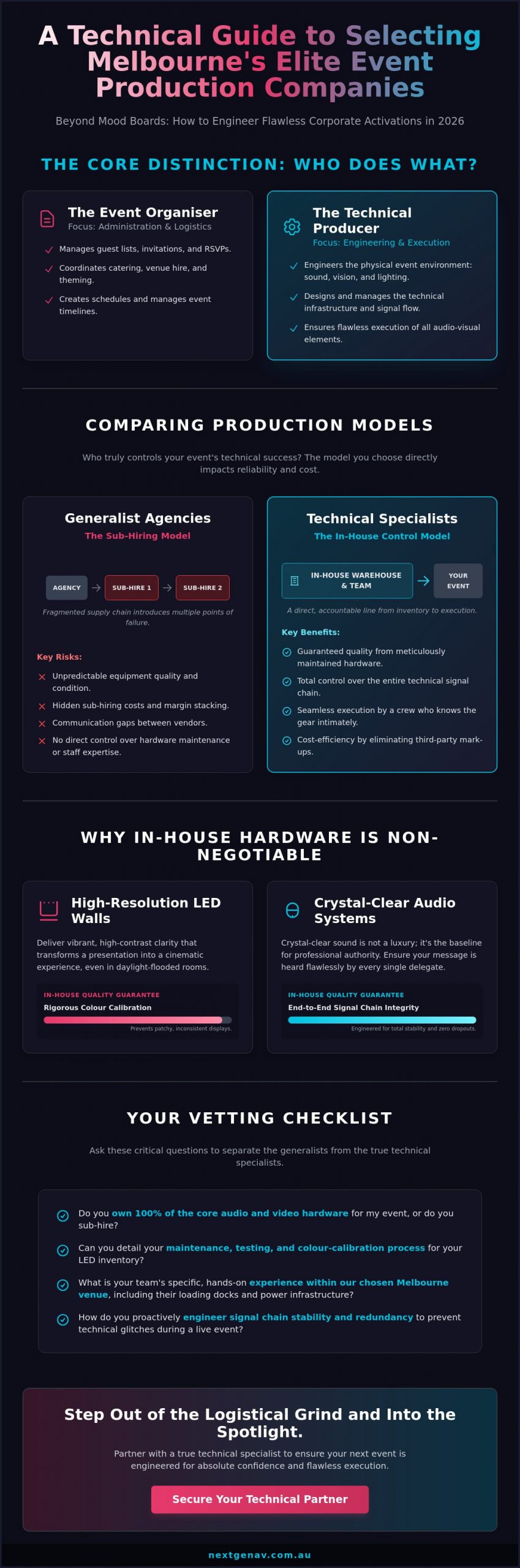
Comparing Production Models: Agencies vs. Specialists
Selecting a partner involves more than just reviewing a portfolio; it requires a clear understanding of the structural differences between service providers. In your search for the best event production companies melbourne offers, you will typically encounter three distinct models. Creative agencies excel at high-level brand strategy and “mood board” aesthetics, yet they often lack the technical infrastructure to execute their own visions. This usually leads to sub-contracting the technical core, which can introduce hidden markups and a disconnect between the creative promise and the technical reality.
AV hire shops occupy the other end of the spectrum. These are ideal for simple, DIY equipment rentals where show management isn’t a priority. However, for high-stakes corporate environments, they often lack the technical direction and “show-caller” expertise needed to manage complex cues. Technical production specialists represent the “sweet spot” for corporate execution. By owning both the high-end hardware and the engineering expertise, these specialists provide a direct line of accountability. This model adheres to the high professional standards championed by organisations like Live Performance Australia (LPA), ensuring that safety and technical excellence are never compromised by a third-party middleman.
Cost transparency is perhaps the greatest advantage of the specialist model. While an agency might bundle technical costs into a larger project fee, a specialist provides a granular view of the production investment. This eliminates the “brokerage fee” often associated with outsourced AV, allowing more of your budget to be directed toward high-impact solutions like LED walls and professional audio systems rather than administrative overhead. Understanding the common misconceptions that inflate costs and create communication gaps is equally important, and avoiding AV mistakes at events starts with shedding the outdated planning habits that lead to budget blowouts and technical failures.
Full-Service vs. Component Hire
There is a significant difference between hiring a list of equipment and investing in full service event production. The latter provides a single point of accountability for everything from the initial site inspection to the final pack-down. When one team manages the staging, rigging, and audio-visual signal chain, the risk of “finger-pointing” between vendors disappears. You aren’t just paying for gear; you are securing a polished result where every component is designed to work in perfect harmony.
Hybrid and Virtual Capabilities
Modern Melbourne events often require a global reach, making broadcast-quality streaming a non-negotiable requirement for AGMs and international summits. A specialist producer integrates remote speakers with on-site LED displays seamlessly, ensuring the digital audience feels as engaged as those in the room. We implement redundant systems for every stream, providing a “failsafe” architecture so the broadcast never drops. This level of technical rigour is what distinguishes a professional production from a standard web conference.
How to Vet a Melbourne Production Partner
Vetting a potential partner requires moving beyond the polished surface of a website to scrutinise the technical engine underneath. When searching for the best event production companies melbourne offers, your first step should be a physical visit to their warehouse. Seeing the actual hardware in the rack, rather than just stock photos, confirms that the provider maintains their own inventory and isn’t simply a middleman for third-party hires. This direct control over equipment is the only way to guarantee the reliability discussed in previous sections.
Experience in the Melbourne market is equally critical. Look for a team with 30 years of specific tenure navigating the city’s premier venues. This deep-rooted history ensures they understand the unique loading dock restrictions and acoustic quirks of spaces like the MCEC or the Arts Centre Melbourne. During initial discussions, assess their communication style. A true partner translates complex technical requirements into business solutions, focusing on your ROI rather than hiding behind confusing tech-jargon. To assist with your financial planning, you should request a detailed event production costs australia breakdown, which provides transparency on where your investment is actually going.
Before signing any contracts, request a joint site visit. Watching how a producer handles venue-specific constraints, such as rigging points or power distribution, reveals their level of proactive planning. If you want to see how this technical mastery translates into real-world success, consult with our senior producers to discuss your specific vision.
The “No Glitch” Checklist
Technical redundancy is the hallmark of a professional activation. Always inquire about backup power solutions and signal redundancy for critical components like LED walls and audio consoles. Verify that the company holds current public liability insurance and that their crew possesses high-risk work licences for rigging and staging. Your on-site sound and lighting engineers should be qualified specialists, not general labourers, ensuring that every cue is executed with the precision your brand deserves.
Case Studies and Local Reputation
A producer’s local reputation is built on the success of high-stakes partnerships. Long-term relationships with government bodies and major corporate brands serve as the ultimate trust signal, proving the team can thrive under intense pressure. Review their past work at your chosen venue to ensure they are familiar with the “pack-down” efficiency required to meet strict hire windows. A seamless exit is just as important as a flawless “bump-in,” protecting you from overtime fees and venue penalties.
NextGen AV: Engineering Flawless Melbourne Events
With 30 years of industry-leading experience across Victoria and beyond, NextGen AV has solidified its reputation as one of the best event production companies melbourne has ever seen. We don’t just provide equipment; we engineer immersive environments that amplify your brand’s authority and prestige. Our tenure in the local market means we have mastered the technical nuances of Melbourne’s most iconic venues, from the historic halls of the CBD to the modern expanses of the Southbank precinct.
Our philosophy is built on the “Invisible Expert” approach. We believe in providing a quiet power behind your success, where our team operates with a proactive humility that allows your speakers and delegates to take centre stage. This partner-first mentality is specifically designed to alleviate the inherent stress of high-stakes planning. By projecting absolute competence and reliability, we transform the logistical grind into a celebratory result. You can move past the worry of technical failure and focus entirely on the human impact of your message.
The foundation of this reliability is our high-end in-house inventory. Because we own and maintain our own LED walls, professional audio systems, and rigging hardware, we eliminate the variables associated with third-party sub-hiring. This total control over the signal chain ensures that every component is colour-calibrated and performance-tested before it ever reaches your venue. When you partner with us, you are securing a technical powerhouse that treats event production as a dedicated craft rather than a mere utility.
Our Bespoke Melbourne Solutions
We provide tailored audio visual hire melbourne planners rely on for everything from intimate executive briefings to massive exhibition activations. For gala nights and prestigious awards ceremonies, our specialised stage and lighting hire melbourne services create the high-impact atmosphere required to captivate a sophisticated audience. For complex, multi-day conferences, we offer comprehensive technical direction, managing the entire show-calling process to ensure your event moves with cinematic momentum and precision.
Start Your Production Journey
Turning a bold vision into a technical reality requires a collaborative planning process that begins long before the “bump-in” day. We invite you to request a technical consultation and site visit, where our senior producers will assess your chosen venue’s specific constraints and technical opportunities. This proactive phase ensures that the final execution is a flawless reflection of your professional standards and business objectives. Organise a consultation with our Melbourne production team today to secure the technical mastery your next project demands.
Secure Your Technical Excellence
Distinguishing between administrative coordination and technical engineering is the first step toward a successful 2026 activation. By prioritising direct hardware ownership and professional technical direction, you eliminate the variables that lead to visual lag or audio failure. Mastery over the entire signal chain ensures that your message is delivered with absolute clarity, allowing you to step out of the logistical stress and into a position of professional authority.
When you seek the best event production companies melbourne provides, look for a partner with the proven tenure to navigate complex venue requirements. With over 30 years of technical event experience and a prestigious in-house inventory trusted by government bodies and major Australian brands, we offer the quiet power behind the scenes that makes perfection look effortless. You deserve a partner who treats your production as a dedicated craft rather than a mere utility.
Your next high-stakes event deserves the precision of a seasoned orchestrator. Partner with Melbourne’s technical event specialists to transform your creative vision into a flawlessly engineered reality. Let’s create something extraordinary together.
Frequently Asked Questions
What is the difference between an event planner and an event production company?
An event planner manages the administrative logistics like guest lists, catering, and venue selection, whereas an event production company engineers the technical environment. We specialise in the “how” of the execution, managing professional audio systems and LED video walls to ensure your message is delivered without failure. While a planner focuses on the schedule, a producer builds the stage and orchestrates the technical cues.
How much does event production cost in Melbourne for a corporate conference?
The investment for a corporate conference depends entirely on the complexity of your technical requirements and the scale of the audience. High-impact solutions like multi-day technical direction and custom staging will influence the budget more than basic equipment hire. We recommend requesting a granular breakdown to see exactly how your production spend translates into brand ROI and audience engagement rather than relying on generic estimates.
Do I need to hire my own AV if the venue has in-house equipment?
You aren’t restricted to using in-house equipment, and many clients choose external specialists to secure a higher standard of technical reliability. External producers provide a dedicated crew focused solely on your activation, whereas in-house teams often manage multiple rooms simultaneously. Bringing in your own partner ensures you have access to specific, high-end hardware like colour-calibrated LED walls that the venue might not stock.
What technical support is needed for a hybrid event with remote speakers?
Successful hybrid events require broadcast-quality streaming platforms and rigorous redundancy systems for both audio and internet connectivity. Our technical support includes integrating remote speakers via low-latency feeds so they can interact with the on-site audience in real-time. This involves managing the “mix-minus” audio to prevent feedback and ensuring the visual transition between live and remote presenters is seamless and professional.
How far in advance should I book an event production company in Melbourne?
We recommend booking your production partner three to six months in advance to secure your preferred dates and allow for detailed pre-production. Melbourne’s event calendar is notoriously busy, particularly during peak periods like the spring racing carnival. Early engagement allows for site visits and 3D renders, ensuring every technical detail is polished and tested well before the “bump-in” day.
Can you provide LED video walls for outdoor events in Victoria?
Yes, we supply high-brightness, weather-rated LED video walls specifically designed for outdoor environments across Victoria. These displays are engineered to remain vibrant even in direct sunlight, providing the visual impact needed for community festivals or outdoor corporate activations. Our team also manages the necessary wind-loading calculations and structural rigging to ensure the installation remains safe in variable Melbourne weather conditions.
What is involved in the “bump-in” and “pack-down” process for Melbourne CBD venues?
Navigating the “bump-in” and “pack-down” in the Melbourne CBD involves precise coordination with venue loading docks and strict adherence to council permits. As one of the best event production companies melbourne has available, we manage the entire logistical flow to ensure equipment is moved efficiently within tight hire windows. This proactive management prevents overtime penalties and ensures the venue is returned in perfect condition on time.
Do you provide technical direction for awards nights and gala dinners?
We provide comprehensive technical direction for awards nights and gala dinners to ensure every transition is sharp and intentional. This involves managing the “show-caller” who synchronises lighting cues, walk-up music, and visual content on the LED walls. Our technical directors act as the central navigator, allowing your host to lead the evening with total confidence while the technical engine runs perfectly in the background.
The most breathtaking moments of a live production don’t happen on the stage; they happen several metres above it, held in place by the invisible precision of professional engineering. You understand that behind every immersive LED display or complex lighting plot lies a significant weight of responsibility. The fear of structural failure or the frustration of navigating opaque Australian rigging standards can often overshadow the creative vision of your event. It is a high-stakes environment where the difference between a spectacular success and a safety incident rests on the strength of your overhead infrastructure.
Implementing the right event rigging solutions is the only way to bridge the gap between ambitious design and absolute safety. This 2026 guide provides the mastery you need to ensure your next production is structurally sound, fully compliant with the WHS Act 2011, and visually spectacular. We will demystify essential hardware, clarify venue load limits, and provide the technical vocabulary required to brief your AV partners with the authority of a seasoned expert. By the end of this article, you will have the knowledge to move past the logistical grind and focus on the prestige of a flawless execution.
Key Takeaways
- Understand why professional event rigging solutions are the invisible backbone of any high-impact production, ensuring every element is suspended with engineered precision.
- Identify the essential hardware required for a secure setup, from modular aluminium truss to the sophisticated chain hoists that safely lift the load.
- Navigate complex Australian safety standards and licensing requirements to ensure your production remains fully compliant and structurally sound.
- Learn how to conduct a comprehensive site inspection to account for venue load limits and technical constraints before the build begins.
- Discover the efficiency of a holistic approach where rigging, lighting, and staging are integrated to create a seamless and prestigious event experience.
What are Event Rigging Solutions?
Every world-class production begins with a structure that stays largely unnoticed by the audience. Professional event rigging solutions represent the sophisticated integration of hardware and engineering designed to suspend high-end audio, lighting, and visual technology safely above the crowd. It is the invisible backbone of the experience. While architectural rigging refers to permanent systems built into theatres or arenas, temporary event rigging is a bespoke craft. It involves transforming a raw space, such as a hotel ballroom, a heritage building, or an outdoor precinct, into a technically capable venue through the use of modular trussing and precision motors. This flexibility allows for the creative freedom that brings a cinematic vision to life.
Modern productions rely on this foundation to achieve a level of prestige that floor-supported equipment simply cannot match. Whether you are planning an intimate corporate gala or a large-scale festival, the rigging system acts as the silent engine driving the success of the show. By employing Entertainment rigging principles, technical teams can create immersive environments that feel both expansive and secure. It is a dedicated craft that balances the laws of physics with the artistry of live performance.
The Core Purpose of Rigging in Events
The primary objective of any rigging system is to elevate the technical standard of the production while maintaining absolute safety. By moving heavy equipment overhead, you achieve three critical outcomes:
- Optimal Sightlines: Elevating audio and lighting gear ensures every guest has an unobstructed view of the stage, creating a more inclusive and high-impact experience.
- Maximised Floor Space: Clearing the ground of bulky stands and cables opens up the room for better guest flow, additional seating, or more elaborate stage sets.
- Uncompromising Safety: A professionally engineered system secures equipment far more effectively than temporary floor supports, protecting performers, staff, and attendees from accidental knocks or instability.
When Does Your Event Need a Rigging Specialist?
Rigging is not a “plug and play” utility. It’s a high-stakes discipline that requires seasoned veterans who thrive under pressure. You should engage a specialist whenever your production involves suspending loads over people, as this is a critical point of legal and structural responsibility. Complex LED wall configurations also demand expert oversight; these screens are incredibly heavy and require meticulous weight distribution. Finally, if your venue has restricted weight capacities or unique architecture, a specialist will navigate these constraints to ensure your event rigging solutions are both compliant and spectacular. They act as the confident orchestrator, allowing you to take centre stage without a single worry about the gear overhead.
Essential Hardware: The Components of a Rigging System
Excellence in live production isn’t just about the vision; it’s about the physical components that make that vision possible. A robust rigging system is composed of high-grade hardware that must work in perfect unison. When we design event rigging solutions, we select each element based on its load-bearing capacity and its ability to integrate seamlessly with the venue’s architecture. From the skeleton of the stage to the motors that do the heavy lifting, every piece of kit is a critical link in the safety chain. Understanding these components allows you to brief your technical team with confidence and precision.
Truss Types and Configurations
Aluminium truss serves as the modular building block of any modern event. Box truss is the industry workhorse, offering a superior strength-to-weight ratio for heavy lighting rigs and LED screens. In contrast, tri-truss provides a sleeker profile for lighter decorative elements or exhibits where space is at a premium. For those looking to break away from traditional linear designs, circular and custom-curved trussing can transform a standard stage into a high-art installation. We often recommend black powder-coated finishes for a sophisticated, “invisible” look that lets the lighting take centre stage, while classic silver remains a staple for high-energy, industrial aesthetics.
Lifting and Suspension Technology
The true power behind any rig lies in its lifting technology. Electric chain hoists provide the precision height control required to level massive screens and lighting bars with millimetre accuracy. For smaller, static installations where power isn’t required after the initial setup, manual chain blocks offer a reliable and cost-effective alternative. Safety is never left to chance; seasoned teams utilise advanced load monitoring systems that provide real-time data to prevent structural overloads before they occur. It’s important to remember that operating this machinery is a specialised task; anyone performing rigging work in Australia must hold a valid Australian high-risk work license to ensure compliance with national safety regulations.
Connection Points and Ground Support
The smallest components often carry the most weight. High-tensile steel cables, Grade S bow shackles, and synthetic round slings are the critical connection points that secure the truss to the venue’s fly points. However, not every venue allows for overhead suspension. In these scenarios, ground support systems become essential. These self-supporting structures use heavy-duty base plates and towers to lift the rig from the floor up, ensuring you can still achieve a professional, elevated look even in heritage buildings or temporary marquees. If you’re unsure which configuration fits your next project, exploring our range of integrated staging and rigging options is an excellent place to start.
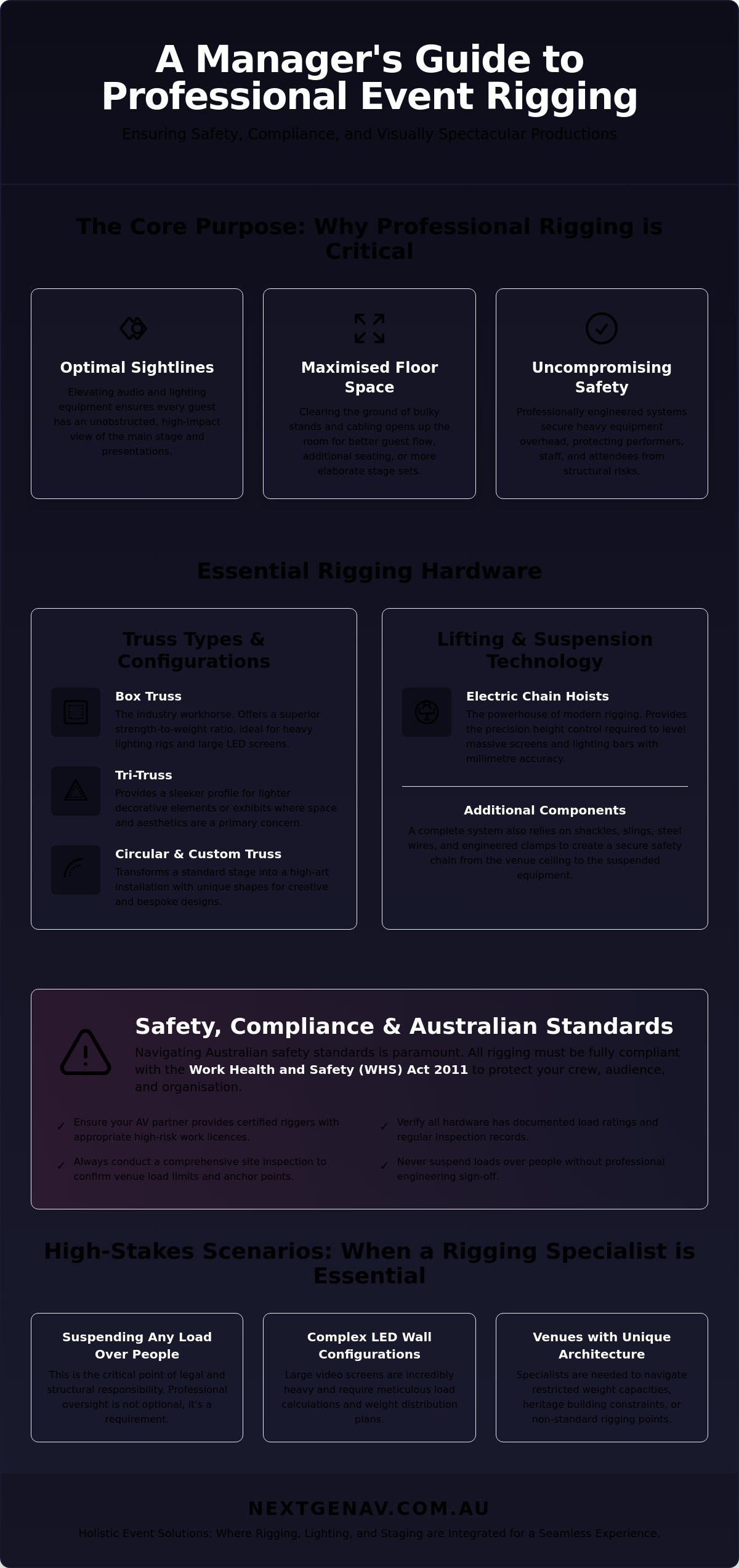
Safety, Compliance, and Australian Standards
Safety in the event industry is often viewed through the lens of liability, but for elite production teams, it’s viewed as the art of mitigation. Adhering to Australian Standards like AS 1418 for hoists and winches, or AS 2319 for rigging screws, isn’t just about ticking a box; it’s about guaranteeing structural integrity under pressure. When we deploy event rigging solutions, every calculation is backed by these rigorous benchmarks. This professional rigour extends to the documentation process, where Safe Work Method Statements (SWMS) and comprehensive risk assessments become the roadmap for a secure build. Following a structured approach to managing workplace hazards and risks ensures that potential issues are identified and neutralised long before the first guest arrives.
The human element is just as critical as the hardware. In Australia, rigging is classified as high-risk work, requiring specific licensing that reflects the complexity of the task. An Intermediate Rigger is qualified for most standard production tasks, such as erecting truss and installing hoists. However, for complex custom builds, massive suspended structures, or anything involving the movement of loads, an Advanced Rigger is required to oversee the operation. For any bespoke stage design or non-standard installation, a structural engineering sign-off provides the final seal of approval, offering the ultimate peace of mind for event organisers and venue owners alike.
Navigating Venue Load Limits
Every venue has a different story to tell through its rigging plot. Understanding the difference between a point load, which is the weight at a single suspension point, and a Uniformly Distributed Load (UDL) is essential for preventing structural fatigue. In Melbourne, many prestige venues are housed in heritage buildings with strict technical restrictions that can’t be ignored. We work closely with venue managers to interpret these floor plans and plots, ensuring your production stays within safe limits while still achieving maximum visual impact. It’s about finding the sweet spot between creative ambition and the physical realities of the room.
Annual Inspections and Gear Maintenance
Hardware is only as reliable as its last inspection. All rigging equipment must be “tagged and tested” regularly to meet Australian safety requirements and ensure it’s fit for purpose. At NextGen AV, we maintain a rigorous maintenance schedule that often exceeds industry minimums. Our technicians are trained to spot the subtle signs of compromised gear, such as hairline fractures in shackles or microscopic fraying in synthetic slings, that an untrained eye might miss. Using pristine, well-maintained equipment is a commitment to the professional standard your event deserves, ensuring the “invisible backbone” of your show remains flawlessly strong.
Planning Your Rigging: A Guide for Event Managers
Successful event planning requires moving beyond the logistical grind to focus on the creative vision. Rigging shouldn’t be an afterthought. It’s the framework that supports your core objectives. Whether you’re aiming for a high-prestige awards night or a high-energy product launch, your event rigging solutions must be designed to enhance that specific atmosphere. A thorough site inspection with your technical partner is the first step. This visit allows us to identify structural points, assess floor loading for ground support, and anticipate any architectural hurdles before they become costly site-day problems. It’s about proactive orchestration rather than reactive fixes.
Understanding the financial components of a rig is essential for a transparent planning process. Budgeting for rigging involves more than just the daily rate for truss or motors. It encompasses specialised labour, such as licensed riggers who manage the high-risk work, transport for heavy hardware, and the specific equipment hire required for your design. By accounting for these elements early, you avoid the hidden costs often associated with venue rigging fees and technical adjustments. This clarity allows you to allocate resources where they’ll have the most impact on the guest experience. Working with dedicated event staging Melbourne specialists ensures that your physical production foundation is engineered to complement the rigging system from the very first planning stage.
The CAD Advantage in Rigging
Computer-Aided Design (CAD) has transformed the pre-production phase into a precise science. It allows us to build a digital twin of your event space. We can calculate weight distribution with mathematical certainty and verify sightlines for every seat in the house before a single bolt is tightened. This visual data is invaluable for sharing plans with venue managers and stakeholders, ensuring a seamless approval process and a predictable build. It eliminates the guesswork, allowing you to focus on the prestige of the final result.
Coordinating with Other AV Departments
A rig doesn’t exist in isolation. It’s a collaborative platform. We ensure that our rigging plans are perfectly aligned with our stage lighting design services, providing the necessary hang points for every fixture. Beyond the lights, we integrate cable paths for power and data directly into the truss design, keeping the “invisible backbone” clean and professional. Finally, coordinating the bump-in and bump-out schedule is critical. Rigging is often the first element to go up and the last to come down, so precise timing ensures the entire technical team stays on track. If you’re ready to elevate your next production with a team that understands the nuances of technical planning, reach out to the experts at NextGen AV for a comprehensive consultation.
Integrated Rigging Solutions with NextGen AV
Choosing a technical partner who treats rigging as an integrated discipline rather than a standalone utility transforms the entire production process. When you opt for a holistic approach to stage and lighting hire Melbourne, you eliminate the friction between separate vendors and ensure that every technical element works in perfect synergy. Our event rigging solutions are designed to be the foundation upon which your visual and audio systems thrive. This unified strategy not only saves significant time during the high-pressure bump-in phase but also optimises your budget by streamlining labour and transport requirements. It is about creating a seamless path from the initial CAD drawing to the final, breathtaking execution.
With over 30 years of experience in the Australian event industry, we have refined a “no-surprises” philosophy that prioritises absolute reliability. We understand the inherent stress of high-stakes planning, which is why our team acts as a proactive technical powerhouse behind the scenes. This seasoned expertise allows us to navigate the complexities of venue load limits and regulatory compliance with quiet power, leaving you free to focus on the prestige of the event itself. We don’t just provide equipment; we deliver the peace of mind that comes from three decades of flawless execution.
Rigging for High-Impact Visuals
Modern productions increasingly rely on massive digital canvases to captivate audiences. Specialised rigging for LED video walls requires a sophisticated understanding of weight distribution and structural tension. These screens are significantly heavier than traditional projection surfaces, demanding precision-engineered trussing and high-capacity motors to ensure a perfectly level and secure hang. We thrive on managing these unique weight challenges, using creative truss configurations to build immersive environments that wrap around your audience. Our technical direction ensures that even the most ambitious visual designs are grounded in absolute structural integrity.
Partnering with NextGen AV in Melbourne
Our deep roots in the local industry give us an unparalleled advantage when working within Melbourne’s premier event venues. We maintain strong relationships with venue managers across the city, allowing us to navigate technical restrictions and rigging plots with ease. The “Invisible Expert” philosophy is at the core of everything we do; we handle the complex engineering and high-risk licensing requirements so that you can take the credit for a spectacular result. If you are ready to elevate your next production with elite technical execution, contact us today for a comprehensive rigging and event lighting hire Melbourne quote. Let us orchestrate the invisible backbone of your next success.
Master the Invisible Backbone of Your Production
Transforming an ambitious creative vision into a tangible, high-impact experience requires more than just high-end gear. It demands a technical foundation built on engineering precision and uncompromising safety. By understanding the essential components of event rigging solutions and the rigour of Australian Standards, you move from the stress of logistical uncertainty to the confidence of a seasoned orchestrator. Whether you’re navigating complex venue load limits or integrating massive LED walls, the key to success lies in proactive planning and expert partnership.
NextGen AV brings over 30 years of industry experience and a team of certified Melbourne-based rigging specialists to every project. Our strict adherence to Australian Standard AS 1418 ensures that your production is not only visually breathtaking but structurally beyond reproach. We handle the technical weight so you can focus on the prestige of the final result. Discuss your event rigging requirements with the NextGen AV team today and let’s build something spectacular together. Your next world-class event is just one well-engineered step away.
Frequently Asked Questions
What is the difference between ground support and flown rigging?
Ground support systems are self-standing structures built from the floor up using heavy-duty base plates and towers, whereas flown rigging involves suspending equipment directly from the venue’s ceiling fly points. We typically recommend ground support for outdoor marquees or heritage buildings where overhead attachment is prohibited. Flown rigging is the preferred choice for large-scale productions as it clears floor space and offers superior sightlines for your audience.
Do I need a structural engineer for my event rigging?
You generally require a structural engineer’s sign-off for bespoke stage designs, massive outdoor structures, or any installation that pushes the boundaries of standard venue load limits. While standard event rigging solutions are covered by the rigger’s licence and manufacturer load charts, custom builds introduce unique stresses that demand a formal engineer’s certificate. This step provides an essential layer of compliance and peace of mind for high-stakes productions.
How much weight can a standard venue rigging point hold in Melbourne?
Weight capacities vary significantly across Melbourne venues, with standard points often rated anywhere from 250kg to over 1000kg. You must never assume these limits; it’s vital to consult the venue’s specific rigging plot or technical floor plan. Our team liaises directly with venue managers to verify these point loads and total uniformly distributed loads (UDL), ensuring your production remains within safe structural boundaries at all times.
What qualifications should a professional event rigger have in Australia?
A professional rigger must hold a valid High Risk Work Licence issued by a state regulator like WorkSafe Victoria. These licences are categorised into Basic, Intermediate, and Advanced levels. Most complex event productions require at least an Intermediate rigger to oversee the build. This certification ensures the technician has the proven expertise to calculate loads, inspect hardware, and execute safe suspension in a high-pressure live environment.
How does rigging impact the overall event production budget?
Rigging impacts the budget through three main channels: specialised labour, hardware hire, and venue-specific rigging fees. While it represents an upfront investment, professional rigging often reduces costs in other areas by allowing for more efficient lighting and audio placements. An integrated approach, where rigging is bundled with your staging and lighting, typically offers the best value by streamlining transport and technical labour requirements.
Can I use the venue’s in-house rigging instead of hiring a specialist?
Many venues mandate the use of their in-house team for the initial attachment to the building’s structure, but you can still engage an external specialist for the production-specific design. Hiring a dedicated technical partner allows for a more bespoke and integrated approach to your show’s visual goals. This ensures that your LED walls and lighting rigs are perfectly aligned with your creative vision rather than being limited by a standard house setup.
What is a “dead hang” versus a “bridle” in rigging terms?
A dead hang is a direct vertical connection between a load and a single suspension point located directly above it. In contrast, a bridle uses two or more cables attached to separate points to create a new “virtual” hang point at a specific location. Bridles are essential tools when the ideal position for a light or speaker doesn’t align perfectly with the venue’s existing structural beams.
How do I ensure my rigging setup is compliant with WorkSafe Victoria?
Compliance is achieved by employing licensed riggers, using “tagged and tested” hardware, and documenting a comprehensive Safe Work Method Statement (SWMS). You must also ensure that all rigging practices align with the WHS Act 2011 and relevant Australian Standards like AS 1418. Partnering with a seasoned technical team ensures these regulatory requirements are met with precision, protecting your organisation from liability and ensuring the safety of every guest.
Did you know that the average Australian event exceeds its initial budget by a staggering 23 per cent? This volatility often stems from the technical complexities of execution rather than simple oversight. When you’re orchestrating a high-stakes brand moment, understanding event production costs australia becomes less about finding the cheapest quote and more about securing technical precision. We understand the frustration of deciphering technical specs while fearing a mid-show audio glitch could ruin your prestige. It’s a delicate balance to maintain as you face rising labour costs and a 15 per cent talent shortage in the technical sector.
We promise to demystify these complexities, giving you the expertise to master your budget with absolute transparency and professional confidence. You’ll learn how to ensure every investment in LED video walls or lighting design translates into a seamless, high-impact experience that resonates with your audience. We’ll break down essential line items, provide a framework to compare complex quotes, and reveal how to align your production level with your event’s strategic goals for 2026. This is your roadmap to achieving technical excellence without the financial surprises.
Key Takeaways
- Transition from a reactive mindset to a proactive one by viewing technical production as a strategic engineering investment rather than a commodity hire.
- Evaluate the transformative impact of high-definition LED video walls and professional audio systems to ensure your technical choices align with your brand’s prestige.
- Gain a granular understanding of event production costs australia by accounting for technical labour variables and the logistical nuances of major venues.
- Optimise your production spend through a structured “must-have” framework and vendor consolidation to reduce management overheads and freight logistics.
- Ensure flawless execution by demanding transparent technical quotes and prioritising site visits to eliminate the risks associated with “blind” production planning.
Navigating the Australian Event Production Landscape in 2026
Australia’s corporate stage has evolved into a theatre of high-stakes immersion. In 2026, the standard for a successful gathering has shifted from simple information delivery to the creation of profound, sensory experiences. This evolution means that event production costs australia are no longer just a line item; they are a direct investment in brand equity. While industry data indicates that the average event exceeds its initial budget by 23 per cent, these overruns rarely stem from greed. They happen because the technical engine behind the scenes is often the most misunderstood component of modern Event management.
Precision is the new currency. As we integrate AI-driven lighting design and ultra-high-resolution LED video walls into our standard repertoire, the “Cost of Failure” has never been higher. A flickering screen or a muffled plenary session doesn’t just disrupt the schedule; it erodes the prestige of your brand in a heartbeat. Investing in high-tier technical production is an insurance policy against these high-stakes glitches, ensuring your message is delivered with absolute clarity and cinematic power.
The Difference Between AV Hire and Full-Scale Production
Hiring a box of gear is a transaction, but orchestrating a seamless experience is a craft. Many planners fall into the trap of “dry hire,” only to discover that the hidden costs of setup labour and troubleshooting quickly eclipse the initial savings. Full-scale production involves dedicated Technical Direction. This role acts as your event’s navigator, managing the complex interplay between staging, rigging, and professional audio systems to safeguard your ROI. To fully understand what is a technical director for events and why this role is indispensable, it’s worth exploring how they bridge creative vision and flawless execution. It’s the difference between renting a car and hiring a professional racing team to ensure you reach the finish line first.
Market Variations: Melbourne, Sydney, and Regional Australia
Geography dictates the rhythm of your budget. Logistics and freight costs fluctuate significantly between major hubs like the ICC in Sydney and the MCEC in Melbourne. Venue accessibility is a silent budget killer; a difficult loading dock can double your bump-in time and inflate your labour costs instantly. We also see distinct seasonal peaks in the Australian calendar, particularly around the end of the financial year and the spring racing season. Understanding these regional nuances is essential for anyone looking to master event production costs australia while maintaining the highest levels of technical excellence and operational agility.
Breaking Down Technical Production Components: Audio, Visual, and Lighting
Generic venue packages often bundle AV as a static cost, but this approach fails to account for the specific engineering required to captivate a modern audience. Precision matters. Understanding the variables of event production costs australia requires a deep dive into the hardware that actually drives engagement. While projectors were once the corporate staple, the shift toward LED video walls has redefined visual expectations. These systems offer unparalleled brightness and contrast, ensuring your content remains vivid even in rooms with significant natural light. Smart organisers know they must Balance The Budget With The Bottom Line by prioritising technical components that directly impact the attendee experience.
Crystal clear communication is the backbone of any plenary. Investing in professional sound system hire ensures that every word from the keynote speaker reaches the back of the room without distortion. Beyond the visible gear, staging and rigging represent the “invisible” but vital costs of structural safety. These elements involve complex weight-bearing calculations and specialised labour to ensure that lighting trusses and heavy LED panels are secured with absolute precision. If you’re unsure which configuration suits your venue, our team can provide expert technical direction to help you scale your vision appropriately.
Visual Tech: Pixel Pitch and Screen Real Estate
Clarity is a function of pixel pitch. A 2.6mm screen offers significantly higher resolution than a 3.9mm alternative, which is vital for detailed presentations or close-up viewing. Your budget will fluctuate based on these technical specs and the total screen real estate required to satisfy audience sightlines. Custom aspect ratios or curved LED configurations add a layer of sophistication, but they also require more complex processing power and specialised rigging, which naturally influences the final investment.
Audio Engineering: Coverage and Intelligibility
Coverage is about more than just volume; it’s about intelligibility. Line arrays provide even sound dispersion across large convention halls, while point source speakers might suffice for more intimate boardrooms. In crowded Australian CBDs like Sydney or Melbourne, wireless frequency management is a non-negotiable technical requirement to prevent interference from surrounding signals. High-end digital mixing consoles, paired with expert operators, allow for real-time adjustments that keep the audio landscape polished and professional throughout the event.
Lighting design has also moved beyond the basic “room wash” of the past. Modern stage lighting uses movement and texture to direct the audience’s focus and build atmospheric tension. By integrating intelligent moving lights and stage-focused spots, you can transform a sterile ballroom into a cinematic environment that reinforces the prestige of your brand moment.
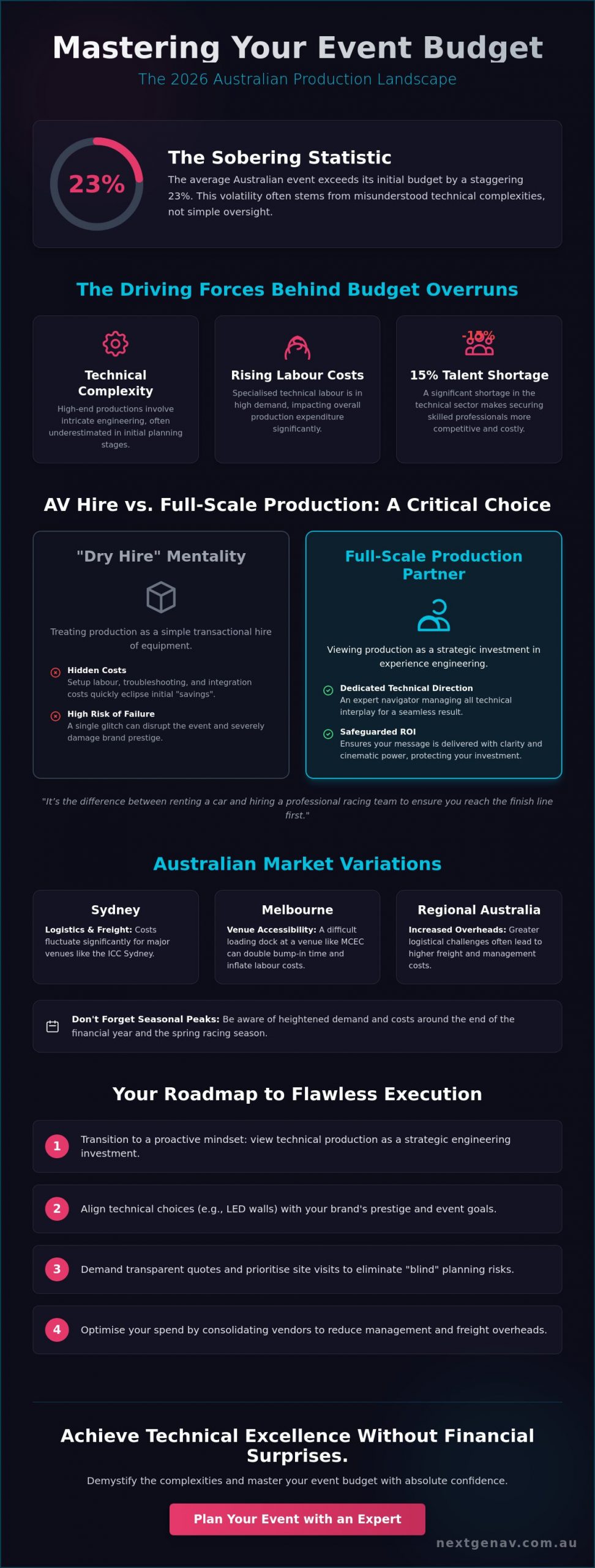
Key Variables Impacting Your Australian Event Budget
While hardware defines the “what” of your event, the “who” and “when” are the primary drivers of event production costs australia. High-stakes brand moments aren’t powered by equipment alone; they’re driven by a human engine of specialised engineers, vision switchers, and riggers. These professionals ensure that every technical component functions as a single, cohesive unit. Unlike generic event staff, technical operators bring a level of precision that safeguards your reputation when the lights go up and the cameras start rolling. Their expertise is the invisible force that prevents a standard presentation from becoming a technical casualty.
Power requirements are another frequently overlooked variable that can sway a budget. High-draw equipment, particularly expansive LED video walls and professional audio systems, often demand 3-phase power distribution. If your venue’s infrastructure isn’t assessed early, the cost of bringing in additional power or managing complex distribution can create unexpected friction. Similarly, your screens require content that is purpose-built for their resolution and aspect ratio. Budgeting for custom motion graphics and screen-ready presentations ensures your visual impact is as sophisticated as the technology displaying it.
The Hidden Cost of Bump-in Logistics
Timing is everything in the Australian market. Major venues like the MCEC in Melbourne or the ICC in Sydney operate on strict logistical schedules where loading dock access is a precious commodity. If your freight gets caught in a “waiting time” trap, labour costs can escalate quickly. Choosing an experienced team for audio visual hire Melbourne is a strategic move to reduce onsite hours through efficient, disciplined load-ins. Remember that after-hours and weekend labour surcharges are standard across the industry. A compressed schedule might look cheaper on paper, but it often costs significantly more once overtime penalties are applied.
Technical Direction and Pre-Production
Success is engineered long before the doors open. Technical Direction provides the vital bridge between your creative vision and the technical reality. We utilise 3D floor plans and pre-visualisation tools to identify potential sightline issues or rigging challenges before a single road case enters the building. This pre-production phase is where the prestige of your event is truly secured. Technical rehearsals are non-negotiable for high-prestige events, allowing the team to manage the interface between speakers, digital content, and the technical desk with absolute certainty. It’s the difference between a show that merely functions and one that flows with cinematic momentum.
Strategic Budgeting: How to Optimise Your Production Spend
Precision in budgeting begins with a ruthless audit of your event’s core objectives. To master event production costs australia, you must distinguish between the technical elements that drive your message and those that merely fill space. Start by defining your “Must-Haves” versus “Nice-to-Haves” based on the specific transformation you want your audience to experience. If your goal is a cinematic product reveal, the LED wall is your priority. If it’s a high-level policy discussion, audio intelligibility takes the lead. Once your priorities are set, consolidate your requirements under a single technical partner. This move eliminates the “management tax” associated with multiple vendors and slashes freight overheads by synchronising logistics. Transitioning to a model of full service event production ensures a single point of accountability for your audio, lighting, and staging, delivering more predictable budgeting and absolute technical precision. You’ll find that a unified team provides a more cohesive aesthetic while protecting your bottom line from fragmented invoices.
Alignment is your best tool for efficiency. Ensure your technical specifications are tailored to the actual dimensions of your venue; paying for excess screen real estate that exceeds audience sightlines is a common budget leak. Early engagement is critical. Reviewing your stage and lighting hire Melbourne requirements months in advance allows for methodical planning and prevents the rush fees that plague last-minute bookings. This proactive approach ensures your staging is engineered for the room’s specific constraints without the stress of eleventh-hour adjustments.
In-House AV vs. External Production Partners
Many venues push “exclusive” in-house AV contracts, but these often hide significant commissions that don’t translate into better gear. External specialists bring modern, event-specific hardware that is frequently superior to the “built-in” systems that have seen years of heavy use. While you might encounter venue “patch fees” for bringing in your own team, the transparency and expertise of an independent production partner typically offer better value. You aren’t just paying for equipment; you’re paying for a team whose primary loyalty is to your brand’s success, not the venue’s occupancy rates. Independent partners offer the agility to customise solutions that in-house teams, bound by fixed inventory, simply cannot match.
The ROI of High-Quality Production
Flawless execution creates a psychological “halo effect” for your brand. High-quality corporate event production Sydney ensures that your technical delivery matches the prestige of your message, driving higher attendee engagement and long-term brand recall. When your audience is immersed in a seamless environment, they are more receptive to your message. If you plan a recurring series, consider a multi-year production partnership. This strategic move allows your production team to refine the technical blueprint over time, reducing setup hours and long-term costs through familiarity and shared data. If you’re ready to elevate your next project, partner with us for a transparent technical consultation that aligns your vision with your budget.
Choosing a Production Partner for Flawless Execution
Selecting the right technical partner is the final, most critical step in securing your event’s ROI. In 2026, a professional quote should be more than a simple list of prices; it must be a transparent technical blueprint. When evaluating event production costs australia, look for granular detail that accounts for every engineer, every cable run, and every redundancy measure. Vague line items are often a mask for future “out of scope” charges that can derail your budget during the high-pressure bump-in phase. We believe that clarity is the foundation of trust. A detailed proposal allows you to see exactly how your investment is being utilised to safeguard your brand’s prestige.
Never accept a “blind quote” without a comprehensive site visit. Every Australian venue, from boutique Sydney galleries to massive Melbourne convention centres, has unique technical quirks. A site visit identifies these variables early, ensuring that your staging and rigging plans are physically viable and logistically sound. At NextGen AV, we’ve spent 30 years navigating these complexities. We act as the invisible expert, orchestrating the technical engine behind the scenes so you can remain focused on the stage. Our legacy is built on the quiet power of seamless execution, allowing your message to take centre stage without the distraction of technical friction.
Questions to Ask Your Production Company
- Do you own your equipment or do you sub-hire? Companies that own their fleet offer greater reliability and more competitive pricing by eliminating third-party markups and logistical delays.
- What is your redundancy plan for critical systems? High-stakes moments require dual-engine switchers and backup audio loops. If there isn’t a “Plan B” baked into the quote, your event is at risk.
- Can you provide a detailed CAD or 3D render? Visualising the setup through a 3D render ensures that audience sightlines are perfect and that the LED video wall placement matches your aesthetic vision.
The NextGen AV Approach to Budgeting
We approach every project as a collaborative partnership. Our planning process turns your aspirational vision into a technically sound reality through methodical pre-production and expert Technical Direction. We are committed to “no surprises” billing, providing transparent labour allocations that reflect the actual expertise required for your specific venue. This honesty ensures you can present your budget to stakeholders with absolute confidence. If you’re ready to transform your next event into a cinematic experience, contact our team for a tailored technical production proposal that aligns with your goals for 2026.
Engineering Your 2026 Event Success
Mastering your budget requires a fundamental shift in perspective. You aren’t just hiring gear; you’re investing in technical precision. By prioritising transparent quotes and site-specific planning, you effectively eliminate the risk of the 23 per cent budget overruns that frequently impact the industry. Gaining a granular understanding of event production costs australia is the definitive first step toward transforming a standard corporate gathering into a prestigious brand experience that resonates with every attendee.
NextGen AV brings over 30 years of Australian event experience to your project. Our redundancy-first technical philosophy ensures your high-stakes moments are protected by fail-safe systems, while our Melbourne base provides seamless nationwide service. We act as the orchestrator behind the scenes, allowing you to step into the spotlight with total confidence. You’ve done the hard work of crafting the vision; now let us handle the technical engine that brings it to life.
Request a Transparent Production Quote for Your Next Event
We look forward to partnering with you to create a seamless and sophisticated event that exceeds every expectation.
As you prepare for the busy event season, remember that your personal health is just as important as your technical setup; to help you stay at your best, you can explore Weight Loss Consultation through the Aussie Scripts telehealth platform.
Frequently Asked Questions
How much does corporate event production typically cost in Australia?
Total investment varies based on the scale and technical complexity of your vision. While verified research shows that a single-day corporate conference in Australia typically costs between $180 and $220 per person for general venue and catering, technical production is a bespoke engineering investment. You should budget based on the specific prestige and engagement levels your brand requires for the 2026 landscape.
What are the most common hidden costs in an AV quote?
Common budget surprises often stem from 3-phase power distribution requirements, specialised rigging safety inspections, and freight waiting times at congested loading docks. You might also encounter unexpected charges for wireless frequency management in dense CBD environments. A transparent, detailed proposal should identify these logistical variables early to ensure your final invoice matches your initial expectations.
Is it cheaper to use the in-house AV provider at my venue?
In-house providers aren’t always the most cost-effective choice because their rates often include substantial venue commissions. While they might offer to waive certain “patch fees,” an external specialist provides modern, event-specific hardware and dedicated Technical Direction. This independent partnership ensures that the technical execution is tailored specifically to your brand rather than the venue’s fixed inventory.
How can I reduce my event production budget without sacrificing quality?
Consolidating your technical requirements under a single partner is the most effective way to manage event production costs australia. Sourcing your LED video walls, professional audio, and lighting from one team slashes management overheads and synchronises freight logistics. Early engagement also allows you to avoid the premium rush fees associated with last-minute equipment sourcing and labour allocations.
What is the difference between a technician and a Technical Director?
A technician is responsible for the setup and operation of specific hardware, while a Technical Director for events orchestrates the entire technical ecosystem. The Director acts as the navigator, managing the complex interface between vision, sound, and lighting departments. They provide the high-level expertise needed to safeguard your ROI and ensure the show flows with cinematic momentum.
Why are labour costs so high for event bump-ins?
Labour rates reflect the specialised expertise required to rig heavy structures safely and manage intricate digital signal paths under strict deadlines. In the Australian market, after-hours and weekend surcharges are standard industry practice. Professional teams mitigate these costs through meticulous pre-production and 3D floor planning, which reduces the total hours needed for onsite troubleshooting.
What technical equipment is essential for a 500-person conference?
A high-definition LED video wall is vital for visual clarity, paired with a professional audio system featuring line array speakers for even sound dispersion. You’ll also require digital mixing consoles, wireless microphones with frequency management, and a dedicated lighting rig to direct audience focus. These components work as a single engine to create an immersive environment that captures attendee attention.
How far in advance should I book my event production company?
You should secure your technical production partner at least six to nine months before your event. This lead time is essential for conducting thorough site visits, developing custom content, and performing technical pre-visualisation. Early booking is your best defence against the 15 per cent talent shortage currently affecting the Australian technical sector, ensuring the best experts are reserved for your project.
The most powerful element of a high-stakes event isn’t the volume, but the absolute clarity of the silence between words. When you invest in professional sound system hire, you aren’t just renting speakers; you are securing the integrity of your message against the chaos of feedback and dead air. Whether you’re navigating the complex acoustics of a major Melbourne centre or managing the strict noise limits set by EPA Victoria’s March 17, 2026 regulations, the technical burden can feel immense. We understand that the fear of a screeching microphone or a misunderstood keynote is enough to keep any organiser awake at night.
This guide transforms that anxiety into an elite technical advantage. You’ll master the essentials of modern audio, from the precision of d&b Audiotechnik’s new U-Series loudspeakers to the digital agility of the latest Yamaha MGX mixers. We’ll demystify the jargon surrounding Line Arrays and XLR connections while showing you how to achieve seamless transitions and crystal clear speech intelligibility. This is your roadmap for a stress-free technical execution that allows your speakers to take centre stage with total confidence.
Key Takeaways
- Understand why clarity is the ultimate goal, moving beyond simple volume to engineer a sophisticated audio ecosystem that protects your message.
- Master the technical anatomy of professional sound system hire, ensuring your Front of House speakers and input layers work in perfect harmony.
- Navigate the complex acoustics of Melbourne’s iconic venues with tailored strategies for managing echo and reverberation in large, industrial spaces.
- Optimise your event flow using a professional planner’s checklist, focusing on precise Run of Sheets and essential site inspections to guarantee a seamless performance.
- Elevate your production by leveraging elite technical direction, allowing you to step into the spotlight while the “Invisible Experts” orchestrate the perfect sonic experience.
Beyond the Volume: What Defines Professional Sound System Hire?
True professional sound isn’t about the size of the boxes. It’s about the precision of the signal. A sophisticated sound reinforcement system is a curated ecosystem where every link in the chain must perform with absolute fidelity. When you engage in professional sound system hire, you aren’t just paying for equipment; you’re investing in a signal path designed to preserve the human voice. This ecosystem generally consists of three critical stages:
- The Input Layer: High-performance microphones and media feeds that capture every nuance of the source.
- The Processing Layer: Digital mixers and signal processors that clean, balance, and protect the audio stream.
- The Output Layer: Precision-engineered loudspeakers and amplifiers that project the sound exactly where it needs to go.
In a corporate environment, loudness is frequently the enemy of clarity. Pushing a low-quality speaker to its limit creates harmonic distortion that muddies the message. True mastery lies in achieving high “intelligibility,” the technical measure of how easily an audience can distinguish individual speech sounds. While consumer-grade gear focuses on “boomy” bass, tour-grade professional hardware is engineered for flat frequency responses and controlled dispersion, ensuring every seat in the house receives the same pristine experience.
The Invisible Impact of High-Quality Audio
Poor audio quality does more than just sound “cheap.” It creates a physiological response known as listener fatigue. When a sound system produces harsh frequencies or inconsistent coverage, the audience’s brains must work harder to decode the information. This cognitive load leads to rapid disengagement and reduced retention during long conferences. Beyond the biology, there’s a significant psychological weight to your audio choices. High-fidelity sound projects brand authority and prestige. It signals that your message is valuable enough to be heard perfectly. Settling for “just enough” audio is a recipe for event disaster, often resulting in a disconnected room and a diluted brand impact. It’s the difference between a functional meeting and a celebratory, high-prestige experience.
Hiring Gear vs. Hiring a Production Solution
Choosing a “dry hire” or DIY approach for a high-stakes Melbourne event introduces unnecessary variables that can derail a production. You might get the gear, but you miss the engineering expertise required to tune that gear to the specific acoustic challenges of a venue. A comprehensive professional sound system hire solution provides much more than a delivery truck. It encompasses meticulous system design, professional transport, and expert on-site technical operation. Most importantly, it brings the security of technical redundancy. We integrate “fail-safes” into every setup, ensuring that if a single component falters, a backup is already live and seamless. This level of proactive preparation is what separates a mere utility from a dedicated craft, allowing you to take centre stage with total peace of mind while we orchestrate the engine behind the scenes.
The Anatomy of an Event Sound System
A professional sound system isn’t a mere assembly of disparate parts; it’s a unified technical architecture where every component must communicate with absolute precision. When you commission professional sound system hire, you’re investing in a bespoke environment designed to eliminate technical friction. This architecture begins with the Front of House (FOH) system, which serves as the primary voice of your event. These speakers and subwoofers are tuned specifically to the room’s unique dimensions to ensure that every frequency is reproduced with cinematic fidelity.
The processing core acts as the system’s brain, where digital mixers and signal processors meticulously clean the audio. This stage is where we manage dynamics and equalisation to prevent the harshness often found in inferior setups. We design our systems to respect the Global standard for safe listening, proving that high-impact audio doesn’t require deafening volume. By maintaining a sophisticated signal path, we ensure that the sound remains immersive and powerful without causing listener fatigue.
Don’t neglect the stage environment. Presenters need dedicated foldback monitors to hear themselves and any media cues clearly. Without this monitoring layer, speakers often feel isolated; this leads to a strained, unnatural delivery that the audience can sense immediately. If you’re ready to secure a high-performance setup for your next keynote, our team provides tailored professional audio systems that eliminate technical guesswork.
Microphones: Choosing the Right Tool for the Task
Selecting the correct microphone is a matter of both ergonomics and acoustics. Lapel mics are discreet and popular for corporate speakers, yet they can be prone to clothing rustle and feedback in loud rooms. Headset microphones offer a fixed distance from the mouth, providing superior consistency for active presenters who move their heads while speaking. For Q&A sessions, handheld wireless mics remain the gold standard, though they require expert frequency coordination. Melbourne’s crowded RF spectrum is notoriously difficult to navigate; we meticulously scan and lock in clean frequencies to avoid interference from local radio or emergency services, ensuring your speaker’s voice never drops out. For a comprehensive breakdown of wireless options and frequency management, our microphone hire Melbourne buying guide covers the latest ACMA regulations and professional selection criteria in detail.
Speakers and PA Systems: Point Source vs. Line Array
The choice between point source and line array technology depends entirely on the scale of your venue. Point source speakers, often mounted on tripods, are ideal for smaller rooms or intimate breakout sessions where the sound needs to originate from a single location. However, for large gala ballrooms or expansive conference centres, line arrays are the superior choice. These vertical stacks of speakers use physics to project sound further with less volume drop-off. By integrating delay speakers further down the room, we ensure the back row hears the exact same quality and timing as the front, making professional sound system hire a truly democratic experience for every attendee.
Venue Acoustics: Scaling Sound for Melbourne Environments
Melbourne’s architectural landscape is a study in acoustic diversity. From the sleek, glass-fronted boardrooms of the CBD to the cavernous, industrial warehouses of Collingwood, every space presents a unique set of sonic challenges. Relying on a “one size fits all” approach for professional sound system hire is a risk that high-stakes planners can’t afford to take. In industrial-style venues, hard surfaces like polished concrete and exposed brick create excessive reverberation, turning a clear speech into an unintelligible wash of sound. We counter this by using highly directional speakers that focus energy on the audience rather than the walls, effectively “tuning” the room to your message.
Don’t fall into the “Venue Sound” trap. While many modern Melbourne centres offer built-in ceiling speakers, these are typically designed for ambient background music or basic paging. They lack the frequency range and dynamic punch required to carry a keynote message with authority. For outdoor events, the stakes are even higher. Navigating wind noise and sound spill requires precision engineering, especially when complying with the City of Port Phillip’s Outdoor Event Policy 2023-2026, which mandates a strict Noise Management Plan for amplified sound. Furthermore, EPA Victoria’s regulations, updated March 17, 2026, set rigorous limits on noise levels, defining “aggravated noise” by specific decibel thresholds. Professional execution means delivering a powerful experience within these legal frameworks.
Small to Medium Spaces: Boardrooms and Private Dining
In intimate settings, aesthetics and discretion are paramount. You want the technology to be felt, not necessarily seen. We prioritise ultra-slim speaker profiles that blend into the décor while managing the harsh reflections common in rooms with large windows or marble tables. These setups are also designed to integrate flawlessly with our hybrid event services, ensuring that remote participants experience the same sonic clarity as those in the room. By controlling the audio footprint, we eliminate the risk of feedback in tight spaces while maintaining a sophisticated, corporate-ready atmosphere.
Large Scale Impact: Gala Dinners and Conferences
Scaling sound for a gala requires a calculated distribution strategy. The goal is to avoid “hot spots” where guests near the stage are overwhelmed while those at the back struggle to hear. We achieve this through distributed audio networks that provide uniform coverage throughout the ballroom. When paired with high-impact LED video walls, the audio must be perfectly synced to create a truly cinematic experience. Our on-site sound engineers act as the invisible conductors, performing real-time mixing to account for the different vocal tonalities of every speaker on your run sheet. This ensures that your professional sound system hire delivers a consistent, high-prestige result for every attendee, regardless of where they are seated.
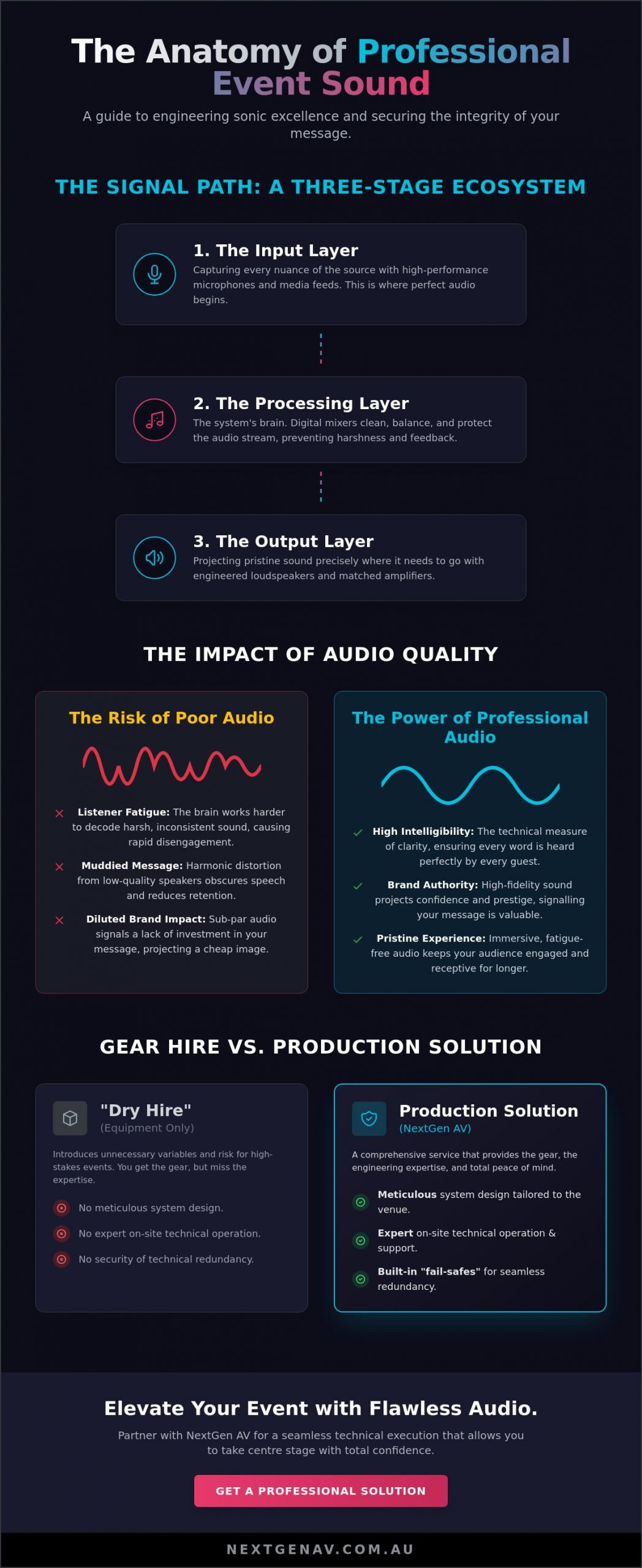
The Planner’s Checklist: Organising Your Audio Hire
Success in high-stakes production isn’t a happy accident; it’s the result of methodical preparation. To move past the logistical grind and focus on the prestige of your results, you need a structured approach to professional sound system hire. This checklist serves as your technical roadmap, ensuring every detail is accounted for before the first guest arrives. By treating audio as a dedicated craft rather than a last-minute utility, you secure the integrity of your event from the very first cue.
Your first priority is a comprehensive Run of Sheet. This document is the heartbeat of your event. It tells your technical team exactly who is speaking, what media is being played, and when transitions occur. Without this, even the most advanced gear can’t save a disjointed performance. Next, you must conduct a site inspection with your AV partner. This is where we verify the “bones” of the venue, checking power distribution and rigging points to ensure the system is safe and efficient. If you want to ensure your next project is handled with this level of precision, you can partner with our technical direction team for a flawless execution.
A critical gap in many plans is the Technical Rider. This document outlines the specific requirements for guest speakers or performers, such as a preference for the new AKG C-Series condenser microphones or specific monitoring needs. Capturing these details early eliminates the stress of last-minute hardware swaps. For detailed guidance on specifying the right wireless and wired options in your rider, our professional microphone hire Melbourne guide provides an authoritative reference for every mic type and frequency consideration. Finally, schedule a dedicated sound check at least two hours before doors open. This is the non-negotiable window where we fine-tune the room, eliminate feedback loops, and ensure every presenter feels confident with their equipment.
Essential Questions for Your AV Provider
Don’t settle for vague promises. Ask your provider how they manage wireless interference in your specific Melbourne location, especially with the city’s crowded RF spectrum. Inquire about their redundancy plans. A professional partner should have an immediate fail-over strategy for every critical microphone. Finally, check if the system is scalable. If your guest list grows by 20% in the final weeks, your audio coverage must be able to expand without compromising clarity.
Budgeting for Sound: Where to Invest and Where to Save
When reviewing quotes for professional sound system hire, remember that the labour component is just as vital as the hardware. You are paying for the mastery of a technician who can “read” a room and adjust the mix in real-time. A dedicated audio technician ensures that transitions are seamless and levels remain consistent across different vocal styles. To avoid the stress of hidden costs, ensure your quote includes delivery, setup, and late-night pack-down fees. Investing in the human expertise behind the console is what transforms a simple rental into a high-end production solution. For a complete overview of every component you should account for, our audio visual equipment list for conference planning provides an expert-vetted checklist to ensure nothing is overlooked in your budget.
Partnering with NextGen AV for Seamless Execution
Elevating an event from a standard meeting to a prestigious experience requires more than just high-end hardware. It demands a partner who understands the nuance of your message and the weight of your brand’s reputation. At NextGen AV, we position ourselves as the “Confident Orchestrators” of sound. Our 30-year legacy in the Melbourne market has seen us deliver flawless technical direction for the most demanding corporate and government productions. We don’t just provide professional sound system hire; we engineer the sonic foundation of your success.
The NextGen difference lies in our blend of precision engineering and empathetic technical support. We recognise that the logistical grind can be overwhelming. Our role is to absorb that pressure, allowing you to focus on the results. By seamlessly integrating our audio expertise with stage and lighting hire, we deliver a holistic production solution. This unified approach ensures that your visual and auditory elements work in perfect synchronisation, creating a cinematic atmosphere that resonates with every attendee.
Your Invisible Expert: The On-Site Technician
The true value of our service is found in the “Invisible Expert” behind the console. Our on-site technicians are more than just engineers; they are proactive problem-solvers trained in the highest standards of corporate etiquette. They thrive under the pressure of live environments, operating with a “zero-failure” mindset that ensures your event proceeds without a single glitch. We recently transformed one of Melbourne’s most acoustically challenging heritage venues into a sonic masterpiece. By using advanced digital mapping and strategic speaker placement, we eliminated the echoes that had plagued previous organisers, proving that even the most difficult spaces can be tamed with the right expertise.
Ready to Elevate Your Event Sound?
Your vision deserves a technical execution that matches its ambition. We invite you to start a conversation with our production team to explore how we can tailor a solution for your specific venue and audience goals. We provide customised quotes that move beyond generic equipment lists, focusing instead on the human impact of the technology. Take the first step toward a stress-free technical execution today. Enquire about professional sound system hire for your next Melbourne event and let us orchestrate your most successful production yet.
Master the Art of Sonic Precision
Engineering a flawless auditory experience is the final step in transforming a high-stakes presentation into a prestigious performance. You’ve seen that success relies on more than just high-end hardware; it requires a deep mastery of signal integrity, venue-specific acoustics, and methodical planning. From navigating Melbourne’s strict noise regulations to managing the complex RF environment of the CBD, every detail contributes to the absolute clarity of your message. By prioritising intelligibility over mere volume, you ensure your audience remains engaged and your brand authority stays intact.
NextGen AV brings 30 plus years of Melbourne event experience and a state-of-the-art tour-grade audio inventory to every production. Our elite technical direction and on-site support allow you to step into the spotlight with total confidence, knowing the engine behind the scenes is primed for a zero-failure result. It’s time to move past the logistical grind and focus on the prestige of a perfectly executed event. Secure Your Professional Sound System Hire for 2026 and let us orchestrate your most successful project yet.
Your vision deserves to be heard with absolute clarity. We’re ready to help you make it happen.
Frequently Asked Questions
How much does professional sound system hire cost in Melbourne?
Pricing for audio solutions depends entirely on your venue’s scale, the technical complexity of your run sheet, and the level of on-site support required. While basic equipment rental rates are available across the Melbourne market, high-prestige corporate productions involve a customised investment in precision engineering and technical direction. We recommend requesting a bespoke quote that reflects your specific audience goals and acoustic challenges to ensure your budget is allocated effectively.
Do I need an audio technician to stay for the duration of my event?
Having a dedicated technician remain on-site is essential for any high-stakes event where seamless execution is non-negotiable. These experts act as your “Invisible Expert,” managing real-time volume levels and performing proactive frequency scans to prevent glitches. This partnership allows you to step into the spotlight with total confidence while a seasoned veteran orchestrates the sonic landscape from behind the console.
What is the difference between a PA system and a professional sound system?
A standard PA system is typically a basic utility for simple amplification, while a professional sound system is a curated ecosystem of high-performance components. Professional systems utilise tour-grade hardware and sophisticated digital signal processing to prioritise speech intelligibility over mere volume. This distinction ensures that your message is delivered with cinematic fidelity rather than the harsh distortion often found in entry-level setups.
Can I connect my own laptop or phone to a professional hired sound system?
You can certainly integrate your own devices, provided the system includes the correct digital interfaces or DI boxes to maintain signal integrity. We incorporate dedicated media feeds into our processing core to ensure your videos and presentations play with absolute clarity. It is best to confirm your connection types during the initial site inspection to guarantee a glitch-free transition between live speakers and digital media.
How many microphones do I need for a panel discussion of four people?
You should secure at least five microphones for a four-person panel: one individual mic for each speaker and a roving unit for audience Q&A sessions. Providing each panellist with their own lapel or headset microphone allows our engineers to balance vocal tonalities individually. This approach eliminates the awkwardness of sharing equipment and ensures that every contribution is heard with perfect clarity.
What happens if there is technical feedback during my presentation?
In a professionally managed environment, our engineers use digital signal processing to identify and “notch out” feedback frequencies before they become audible. If a sudden change in the room’s acoustics occurs, the technician on-site makes instantaneous adjustments to the mix. This level of active monitoring is a core benefit of professional sound system hire, protecting your prestige from the stress of screeching audio.
Do you provide sound system hire for outdoor events in Melbourne?
We provide robust audio solutions for outdoor settings, including the technical expertise required to navigate complex local council regulations. Managing sound in public spaces requires a strict Noise Management Plan to comply with the City of Port Phillip’s Outdoor Event Policy or EPA Victoria’s 2026 standards. Our team handles these regulatory hurdles, ensuring your event delivers high-impact sound while remaining within legal decibel limits.
How far in advance should I book my audio equipment hire?
You should aim to finalise your professional sound system hire at least three to six months before your event date. Melbourne’s event calendar is exceptionally crowded, particularly during the peak gala and conference seasons. Booking early ensures you secure elite technical support and the latest tour-grade hardware, allowing ample time for a meticulous site inspection and system design.

Make an
Enquiry
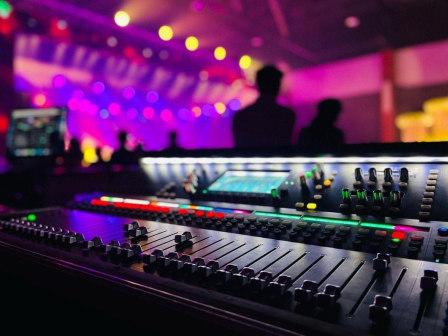
Let’s Get Your Event Sorted
Complete the enquiry form with your event date, venue, audience size, event type and budget. Our Melbourne AV team will review your requirements and recommend the right PA, screen, lighting, staging or production setup for your event.
What happens next?
1.We review your event details
Tell us your date, venue, audience size and event type.
2.We recommend the right setup
From PA hire to screens, lighting, staging and full AV production.
3. We come back with clear advice
You’ll receive practical recommendations and a fast quote from our Melbourne team.
Need help urgently?
Call 1300 637 302.
Make an Enquiry
"*" indicates required fields