



A single technical glitch during a keynote doesn’t just disrupt a presentation; it devalues your entire brand in the eyes of every delegate in the room. We understand that organising a high-stakes event in Australia comes with a unique set of pressures, and finding the right audio visual equipment list for conference logistics is often the difference between a triumph and a technical nightmare. It’s natural to feel a sense of dread about “black screen” moments or feedback loops that ruin the professional atmosphere. You deserve a partner that acts as a confident orchestrator behind the scenes, allowing you to focus on your guests while the technology works invisibly in the background.
This guide provides an expert-vetted checklist designed to help you master your logistics, ensuring your next corporate gathering achieves the prestige it deserves without the anxiety of overspending on redundant tech. We’ll show you how to secure a professional setup that reflects your brand’s excellence through crystal-clear audio and high-impact visuals. This preview covers the essential hardware for 2026, including AI-powered PTZ cameras with auto-framing and sophisticated ceiling microphone arrays that transform any venue into a powerhouse of engagement.
Key Takeaways
- Master the nuances of speech clarity to eliminate listener fatigue and ensure your message resonates with every delegate in the room.
- Understand the shift toward LED video walls and how this high-impact display technology overcomes the limitations of traditional projection in bright Australian venues.
- Discover how professional lighting design and staging elevate a standard ballroom into a bespoke environment that reflects your brand’s prestige.
- Secure your event’s technical architecture with a comprehensive audio visual equipment list for conference logistics that accounts for the invisible gear essential for a flawless execution.
- Bridge the gap between physical and virtual spaces by implementing hybrid solutions that provide remote attendees with a front-row experience.
The Audio Foundation: Ensuring Absolute Speech Clarity
While a stunning visual display grabs the initial attention, it’s the audio that sustains it. If your audience is straining to catch every second word, they aren’t engaging with your message; they’re simply getting tired. This cognitive strain, known as listener fatigue, can derail even the most prestigious keynote. When delegates have to work too hard to process sound, their retention rates plummet and your brand’s authority is subtly diminished. Ensuring absolute speech clarity is the non-negotiable starting point for any audio visual equipment list for conference planning.
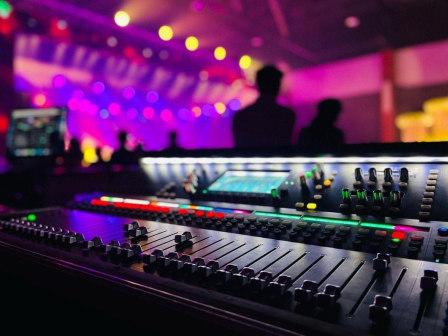
The scale of your Professional Audio System must mirror the specific acoustics of your Melbourne venue. A cavernous plenary hall requires a vastly different approach than a carpeted breakout room. This is where the technical direction of a seasoned sound engineer becomes your greatest asset. They act as the invisible hand, managing live levels and suppressing feedback before it ever reaches the ears of your delegates. A sound engineer doesn’t just monitor volume; they interpret the room’s energy and the presenter’s vocal dynamics. In a high-stakes environment, they are the first line of defence against the unexpected, allowing your speakers to feel supported and confident. A thorough sound check for corporate event production is the critical rehearsal that ensures your engineer can identify and resolve these issues before a single delegate takes their seat.
Microphone Selection for Presenters and Panels
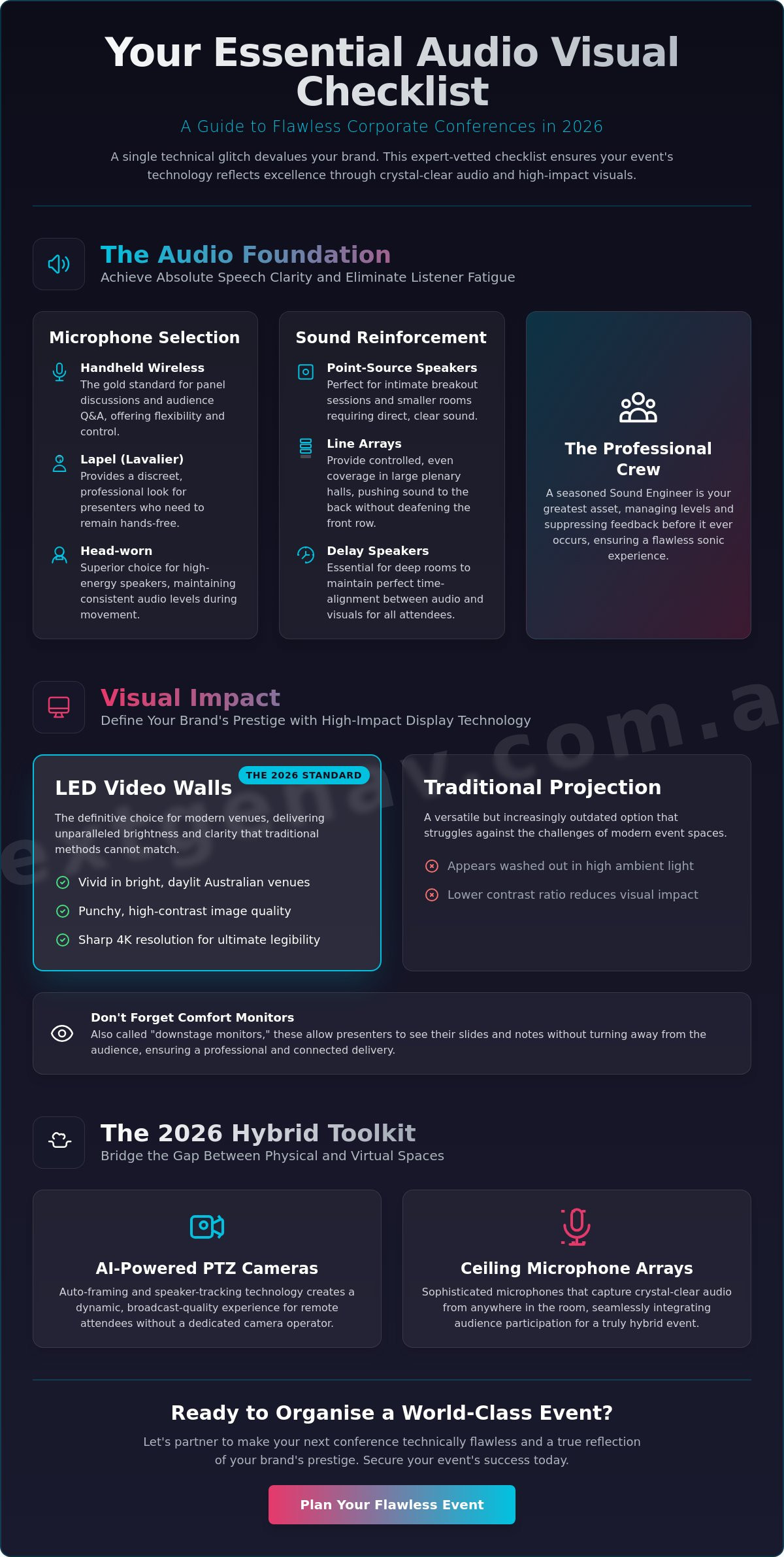
Choosing the right tool for the voice is a craft in itself. Wireless lapel (lavalier) mics offer a discreet, professional look for presenters who want to remain hands-free. However, head-worn options are often superior for high-energy speakers, as they provide a consistent capsule-to-mouth distance regardless of how much the presenter moves their head. For interactive moments or panel discussions, handheld wireless mics remain the gold standard for audience Q&A. Selecting the right microphone hire Melbourne ensures that every nuance of the speaker’s tone is captured with high-fidelity precision, preserving the prestige of the presentation.
Speakers and Sound Reinforcement
The architecture of your sound must be intentional to be effective. We typically utilise point-source speakers for intimate breakout sessions where the throw distance is short and the atmosphere is conversational. For larger plenaries, line arrays provide the vertical control needed to push sound to the back of the room without deafening the front row. Strategic placement is the key to eliminating “dead zones” in the centre of the seating block where audio can often become muddy. In particularly deep rooms, we integrate delay speakers to maintain time-alignment. This ensures the sound hits the back of the hall at the exact same moment as the visual cue. Investing in professional PA system hire Melbourne venues demand is what allows you to scale this sophisticated audio architecture precisely to your room’s size and acoustic profile. This level of sophisticated Audiovisual (AV) integration is what separates a standard meeting from a world-class corporate experience.
Visual Impact: LED Walls, Projectors, and Displays
Visuals act as the silent ambassador for your brand. While the audio carries the message, the visual delivery defines the prestige of the entire event. When you’re refining your audio visual equipment list for conference requirements, the choice between LED and projection is the most critical decision for your event’s aesthetic. It’s about more than just size; it’s about how the light interacts with your venue and how clearly your data is communicated to the back of the room.
In 2026, we’re seeing a definitive shift toward LED technology. Traditional projectors, while versatile, often struggle against the ambient light of modern Australian venues featuring floor-to-ceiling glass. LED provides a punchy, high-contrast alternative that remains vivid even in broad daylight. This ensures your presentation slides are legible from every seat, maintaining a 16:9 aspect ratio and 4K resolution that looks as sharp as a high-end television. The goal is to create a window into your brand’s vision that doesn’t wash out when the house lights come up.
Presenters also need to feel in control to deliver their best performance. We always include comfort monitors, often called “downstage monitors,” at the base of the stage. These allow speakers to see their current slide and notes without awkwardly twisting back to look at the main screen. It’s a small detail that preserves the flow and professional posture of your keynote, ensuring the speaker remains connected to the audience at all times.
LED Video Walls vs. Projection
The decision to hire an led video wall is often driven by the desire for maximum brand impact. Unlike projection, LED walls are modular, allowing us to build custom shapes and sizes that wrap around the stage. They eliminate the risk of shadows being cast by presenters walking in front of a lens. For venues with unique architecture, we might suggest projection mapping to turn the building itself into a digital canvas, but for high-stakes corporate communication, the brightness and seamlessness of LED are unmatched.
Video Distribution and Switching
Behind every great visual is a complex network of distribution. We utilise seamless switchers to ensure that transitions between laptops, media servers, and live cameras happen instantly. There’s nothing more jarring than a “no signal” blue screen or a messy desktop view during a presenter changeover. Our vision mixers allow us to layer graphics, such as speaker names and company logos, over live footage for a broadcast-quality finish. We rely on high-grade SDI and HDMI cabling to maintain signal integrity over long distances, ensuring the image on the screen is as crisp as the source. If you want to ensure your visuals are handled with this level of precision, consider partnering with a team that provides expert technical direction.
Lighting and Staging: Setting the Professional Tone
Lighting is the master architect of atmosphere. While your LED walls provide the data, your lighting design and equipment provide the emotion. A generic hotel ballroom can feel cold and uninviting without the right warmth and depth. By meticulously layering light, we transform these blank canvases into bespoke brand environments that command respect. This transition is a vital component of any audio visual equipment list for conference planning, as it bridges the gap between a simple meeting and a prestigious corporate event.
Beyond the aesthetic, lighting is a functional necessity for modern documentation. If you’re recording your keynote or streaming to a hybrid audience, your presenters need to be lit with broadcast-level precision. Standard room lights are often too yellow or too dim, resulting in grainy, unprofessional footage. We ensure every speaker is bathed in a clean, balanced light that looks as good on a 4K recording as it does in person. This technical rigour ensures that your brand’s prestige is maintained across every digital touchpoint.
Staging provides the literal platform for your brand’s message. It isn’t just about height; it’s about presence. We adhere to rigorous Australian rigging standards, ensuring every structure is secure and load-bearing capacities are never compromised. By creating a clear focal point, we naturally draw the eyes of every delegate toward the speaker. This reinforcement of authority is what allows a message to truly resonate with an audience.
Stage Lighting Essentials
We utilise wash lighting to provide a broad, even layer of illumination across the entire stage area. This ensures the presenter remains visible from every angle, even as they move between the lectern and the screen. Profile spots are then added for sharp focus, carving the speaker out from the background and reducing distracting stage shadows. To truly immerse the room in your brand identity, we use LED uplighting to cast vibrant corporate colours along the venue walls, turning the entire room into a cohesive, branded experience.
Staging and Rigging Requirements
Our modular stage decks allow for flexible configurations that suit any venue size. We pay close attention to the finishing touches, such as professional skirting, which hides the structural elements and creates a polished, high-end look. Your choice of lectern also speaks volumes about your brand; while traditional acrylic is timeless, digital lecterns offer a modern edge for 2026 events. Finally, we use heavy-duty draping and backdrops to hide messy back-of-house areas and cable runs. This “invisible” infrastructure is what allows the front-of-house excellence to take centre stage without distraction.
Behind the Scenes: The Technical Infrastructure
One of the most frequent questions we encounter during the planning phase is why a comprehensive audio visual equipment list for conference logistics includes so many items that never actually appear on stage. It’s a fair point. If the audience only sees the speaker and the screen, why is the back-of-house area stacked with racks and cables? The answer lies in the “invisible” infrastructure that serves as your technical insurance policy. This gear is the difference between a minor glitch being a non-event or a catastrophic failure that stops the show. When you review your final equipment list, remember that the smallest boxes often do the heaviest lifting. We don’t just plan for success; we engineer against failure.
Power management is perhaps the most overlooked element of this infrastructure. Even the most prestigious Australian venues can suffer from voltage drops or temporary surges that can reset digital consoles. We integrate high-capacity Uninterruptible Power Supplies (UPS) into every critical signal path. If the venue loses mains power for even a few seconds, your LED wall won’t flicker and your audio system won’t pop. The show continues uninterrupted while our team manages the recovery behind the scenes. This level of professional technical direction ensures that your brand’s reputation is never at the mercy of a building’s electrical quirks.
The technical director acts as the conductor of this equipment symphony. They are the proactive, elite presence who thrives under the pressure of a live environment. By overseeing every signal and cue, they allow you to take centre stage without a single worry about the mechanics of the delivery. They take personal pride in the seamless execution of a complex plan, ensuring the transition from a bold vision to a successful reality is flawless.
Presentation Management Tools
A seamless flow requires more than just a laptop and a prayer. We utilise a master and backup slide computer system, running in perfect sync through a hardware switcher. If one machine hangs, the system instantly flips to the redundant feed without the audience ever knowing. We also deploy D’San PerfectCue systems, allowing presenters to advance slides from across the room with absolute confidence. Digital timers are positioned discretely for the speaker, ensuring the event stays on track and respects the time of your busy delegates.
Communication and Intercoms
Silence in the room is often the result of constant chatter on our wireless headsets. Our technical crew uses dedicated intercom systems to coordinate every cue, from the lighting fade-out to the hybrid stream launch. This talkback system allows the front-of-house engineer to speak with the backstage team instantly and silently. To support this, we build a dedicated production network. By keeping our data traffic separate from the venue’s public Wi-Fi, we guarantee that your slide deck, video feeds, and control signals remain stable and secure throughout the day.
The 2026 Hybrid Toolkit: Integrating Remote Audiences
In 2026, the distinction between a physical and virtual attendee has completely dissolved. Treating remote delegates as first-class citizens is no longer a choice; it’s a fundamental requirement for brand prestige. A poorly managed stream suggests a lack of attention to detail that can alienate global stakeholders and diminish the impact of your message. When you’re assembling an audio visual equipment list for conference success, the hybrid toolkit must be integrated from the start. It’s about creating a unified experience where the digital audience feels the same energy and impact as those sitting in the front row.
Managing two-way communication is the greatest hurdle in the hybrid model. It requires a sophisticated audio architecture to ensure remote Q&A sessions are seamless and echo-free. This is where professional sound system hire becomes vital. Our technicians implement complex routing, such as “mix-minus” feeds, which allow remote speakers to hear the room clearly without the distraction of a delayed version of their own voice. This level of technical direction eliminates the awkward pauses and audio loops that often plague amateur setups, ensuring the conversation flows naturally across borders.
The technical goal is to move past the logistical grind and focus on the prestige of the final result. By investing in the right infrastructure, you allow your remote audience to participate rather than just observe. This proactive approach to Virtual and Hybrid Event Solutions transforms a standard broadcast into a cinematic experience that resonates long after the final session concludes.
Camera Systems and Capture
A single fixed camera at the back of the room is no longer sufficient for high-stakes engagement. We utilise multi-camera setups, including wide shots for context and tight shots for emotional connection, to keep the virtual audience focused. PTZ (Pan-Tilt-Zoom) cameras are the preferred choice for 2026 conferences. These discreet units offer 4K resolution and AI-powered auto-tracking, allowing our team to follow a presenter’s movement across the stage with absolute precision. These signals are processed through high-end encoders, ensuring a broadcast-quality feed reaches your audience without lag or pixelation.
Streaming and Connectivity
Reliable connectivity is the lifeline of any hybrid event. We never rely on shared venue Wi-Fi, which can fluctuate as delegates connect their own devices throughout the day. Instead, we insist on dedicated, hardwired ethernet connections for the primary stream. To provide absolute peace of mind, we employ bonded internet solutions. These systems combine multiple network sources, such as 5G and fixed-line fibre, to create a single, high-bandwidth pipe with automatic failover. If one connection drops, the others take the load instantly, ensuring your global broadcast remains stable and secure.
Orchestrate Your Event Legacy
Mastering your event logistics is more than just checking off boxes on a manifest. It’s about building a strategic architecture for engagement where every decibel and pixel serves a prestigious purpose. By prioritising the audio foundation and embracing the high-impact brilliance of LED video walls, you move past the logistical grind and focus on the final result. Your audio visual equipment list for conference planning should be the engine that drives your brand’s success invisibly behind the scenes.
Beyond the technical setup, fostering global business relationships often involves cultural immersion. To further your team’s local knowledge and skills, you can check out Nunawading Japanese School to discover more about Japanese culture and language training in Melbourne.
We bring over 30 years of Melbourne event experience to your project, pairing a state-of-the-art 2026 inventory with full-service technical direction. We don’t just provide gear; we act as your dedicated craft partners to ensure a flawless execution that resonates with both in-room and remote delegates. Our team takes personal pride in managing the technical symphony so you can take the spotlight with absolute confidence.
Ready to transform your vision into a cinematic reality? Enquire about your conference AV hire with NextGen AV today and secure the expert partnership your brand deserves. Your next great event starts with a single, confident decision.
Frequently Asked Questions
What is the most essential AV equipment for a small conference?
High-quality sound and a clear visual display are the non-negotiable foundations for any smaller event. You’ll need a professional audio system with at least two speakers and a high-resolution display, such as a large-format LED screen or a high-lumen projector. Even in intimate settings, poor audio leads to listener fatigue, making a reliable audio visual equipment list for conference success vital for maintaining delegate engagement.
How much does it cost to hire a full AV team for a Melbourne conference?
Investment levels vary significantly based on your venue size, technical complexity, and the number of delegates attending. Because every corporate event has unique requirements, we recommend seeking a bespoke proposal rather than relying on generic estimates. This ensures your quote covers the specific technical direction and high-end hardware needed to reflect your brand’s prestige without unnecessary overheads.
Do I need a technical director for a one-day corporate event?
A technical director is essential for any high-stakes event where you can’t afford a single glitch. They act as the central orchestrator, managing every cue and transition while overseeing the entire technical crew. Having this expert presence allows you to move past the logistical grind and focus on your guests, knowing that the “invisible” mechanics of the show are in seasoned hands.
What is the difference between a lapel mic and a headset mic for presenters?
Lapel mics clip onto clothing for a discreet look, while headset mics move with the speaker’s head to maintain a constant distance from the mouth. Headsets are generally superior for high-energy presenters who turn away from the lectern, as they ensure consistent speech clarity. We often suggest a mix of both in our audio visual equipment list for conference recommendations to suit different speaking styles.
Can I use the venue’s built-in sound system for my conference?
Venue systems are often designed for background music or basic announcements rather than high-fidelity corporate presentations. They frequently lack the coverage needed to eliminate dead zones in a large room. For a professional result, it’s almost always better to utilise a dedicated PA system hire Melbourne professionals recommend, tailored specifically to the room’s acoustics and your speaker’s vocal requirements.
What happens if the power goes out during my presentation?
If your technical infrastructure includes an Uninterruptible Power Supply (UPS), your critical systems will stay live. This gear provides a vital battery buffer, keeping your LED walls and audio consoles running during a temporary venue power drop. It allows the technical team to manage the recovery behind the scenes without the audience ever seeing a black screen or hearing a pop.
How early should I start planning my conference AV requirements?
You should ideally start the conversation with your AV partner three to six months before your event date. Early planning allows for detailed site inspections and ensures that premium equipment, like the latest LED video walls, is secured for your dates. This lead time also gives our technical directors the space to refine your vision into a polished, executable plan.
What are the specific rigging safety standards for Australian events?
All overhead equipment must comply with Australian Standards, specifically AS 1418 for cranes and hoists and AS 2319 for rigging equipment. It is a legal requirement that all staging and rigging are installed by qualified professionals who strictly adhere to load-bearing capacities. Safety is our absolute priority, and we ensure every installation meets these rigorous national benchmarks to protect your guests and staff.
A single technical glitch during a keynote doesn’t just disrupt a presentation; it devalues your entire brand in the eyes of every delegate in the room. We understand that organising a high-stakes event in Australia comes with a unique set of pressures, and finding the right audio visual equipment list for conference logistics is often the difference between a triumph and a technical nightmare. It’s natural to feel a sense of dread about “black screen” moments or feedback loops that ruin the professional atmosphere. You deserve a partner that acts as a confident orchestrator behind the scenes, allowing you to focus on your guests while the technology works invisibly in the background.
This guide provides an expert-vetted checklist designed to help you master your logistics, ensuring your next corporate gathering achieves the prestige it deserves without the anxiety of overspending on redundant tech. We’ll show you how to secure a professional setup that reflects your brand’s excellence through crystal-clear audio and high-impact visuals. This preview covers the essential hardware for 2026, including AI-powered PTZ cameras with auto-framing and sophisticated ceiling microphone arrays that transform any venue into a powerhouse of engagement.
Key Takeaways
- Master the nuances of speech clarity to eliminate listener fatigue and ensure your message resonates with every delegate in the room.
- Understand the shift toward LED video walls and how this high-impact display technology overcomes the limitations of traditional projection in bright Australian venues.
- Discover how professional lighting design and staging elevate a standard ballroom into a bespoke environment that reflects your brand’s prestige.
- Secure your event’s technical architecture with a comprehensive audio visual equipment list for conference logistics that accounts for the invisible gear essential for a flawless execution.
- Bridge the gap between physical and virtual spaces by implementing hybrid solutions that provide remote attendees with a front-row experience.
The Audio Foundation: Ensuring Absolute Speech Clarity
While a stunning visual display grabs the initial attention, it’s the audio that sustains it. If your audience is straining to catch every second word, they aren’t engaging with your message; they’re simply getting tired. This cognitive strain, known as listener fatigue, can derail even the most prestigious keynote. When delegates have to work too hard to process sound, their retention rates plummet and your brand’s authority is subtly diminished. Ensuring absolute speech clarity is the non-negotiable starting point for any audio visual equipment list for conference planning.
The scale of your Professional Audio System must mirror the specific acoustics of your Melbourne venue. A cavernous plenary hall requires a vastly different approach than a carpeted breakout room. This is where the technical direction of a seasoned sound engineer becomes your greatest asset. They act as the invisible hand, managing live levels and suppressing feedback before it ever reaches the ears of your delegates. A sound engineer doesn’t just monitor volume; they interpret the room’s energy and the presenter’s vocal dynamics. In a high-stakes environment, they are the first line of defence against the unexpected, allowing your speakers to feel supported and confident. A thorough sound check for corporate event production is the critical rehearsal that ensures your engineer can identify and resolve these issues before a single delegate takes their seat.
Microphone Selection for Presenters and Panels
Choosing the right tool for the voice is a craft in itself. Wireless lapel (lavalier) mics offer a discreet, professional look for presenters who want to remain hands-free. However, head-worn options are often superior for high-energy speakers, as they provide a consistent capsule-to-mouth distance regardless of how much the presenter moves their head. For interactive moments or panel discussions, handheld wireless mics remain the gold standard for audience Q&A. Selecting the right microphone hire Melbourne ensures that every nuance of the speaker’s tone is captured with high-fidelity precision, preserving the prestige of the presentation.
Speakers and Sound Reinforcement
The architecture of your sound must be intentional to be effective. We typically utilise point-source speakers for intimate breakout sessions where the throw distance is short and the atmosphere is conversational. For larger plenaries, line arrays provide the vertical control needed to push sound to the back of the room without deafening the front row. Strategic placement is the key to eliminating “dead zones” in the centre of the seating block where audio can often become muddy. In particularly deep rooms, we integrate delay speakers to maintain time-alignment. This ensures the sound hits the back of the hall at the exact same moment as the visual cue. Investing in professional PA system hire Melbourne venues demand is what allows you to scale this sophisticated audio architecture precisely to your room’s size and acoustic profile. This level of sophisticated Audiovisual (AV) integration is what separates a standard meeting from a world-class corporate experience.
Visual Impact: LED Walls, Projectors, and Displays
Visuals act as the silent ambassador for your brand. While the audio carries the message, the visual delivery defines the prestige of the entire event. When you’re refining your audio visual equipment list for conference requirements, the choice between LED and projection is the most critical decision for your event’s aesthetic. It’s about more than just size; it’s about how the light interacts with your venue and how clearly your data is communicated to the back of the room.
In 2026, we’re seeing a definitive shift toward LED technology. Traditional projectors, while versatile, often struggle against the ambient light of modern Australian venues featuring floor-to-ceiling glass. LED provides a punchy, high-contrast alternative that remains vivid even in broad daylight. This ensures your presentation slides are legible from every seat, maintaining a 16:9 aspect ratio and 4K resolution that looks as sharp as a high-end television. The goal is to create a window into your brand’s vision that doesn’t wash out when the house lights come up.
Presenters also need to feel in control to deliver their best performance. We always include comfort monitors, often called “downstage monitors,” at the base of the stage. These allow speakers to see their current slide and notes without awkwardly twisting back to look at the main screen. It’s a small detail that preserves the flow and professional posture of your keynote, ensuring the speaker remains connected to the audience at all times.
LED Video Walls vs. Projection
The decision to hire an led video wall is often driven by the desire for maximum brand impact. Unlike projection, LED walls are modular, allowing us to build custom shapes and sizes that wrap around the stage. They eliminate the risk of shadows being cast by presenters walking in front of a lens. For venues with unique architecture, we might suggest projection mapping to turn the building itself into a digital canvas, but for high-stakes corporate communication, the brightness and seamlessness of LED are unmatched.
Video Distribution and Switching
Behind every great visual is a complex network of distribution. We utilise seamless switchers to ensure that transitions between laptops, media servers, and live cameras happen instantly. There’s nothing more jarring than a “no signal” blue screen or a messy desktop view during a presenter changeover. Our vision mixers allow us to layer graphics, such as speaker names and company logos, over live footage for a broadcast-quality finish. We rely on high-grade SDI and HDMI cabling to maintain signal integrity over long distances, ensuring the image on the screen is as crisp as the source. If you want to ensure your visuals are handled with this level of precision, consider partnering with a team that provides expert technical direction.
Lighting and Staging: Setting the Professional Tone
Lighting is the master architect of atmosphere. While your LED walls provide the data, your lighting design and equipment provide the emotion. A generic hotel ballroom can feel cold and uninviting without the right warmth and depth. By meticulously layering light, we transform these blank canvases into bespoke brand environments that command respect. This transition is a vital component of any audio visual equipment list for conference planning, as it bridges the gap between a simple meeting and a prestigious corporate event.
Beyond the aesthetic, lighting is a functional necessity for modern documentation. If you’re recording your keynote or streaming to a hybrid audience, your presenters need to be lit with broadcast-level precision. Standard room lights are often too yellow or too dim, resulting in grainy, unprofessional footage. We ensure every speaker is bathed in a clean, balanced light that looks as good on a 4K recording as it does in person. This technical rigour ensures that your brand’s prestige is maintained across every digital touchpoint.
Staging provides the literal platform for your brand’s message. It isn’t just about height; it’s about presence. We adhere to rigorous Australian rigging standards, ensuring every structure is secure and load-bearing capacities are never compromised. By creating a clear focal point, we naturally draw the eyes of every delegate toward the speaker. This reinforcement of authority is what allows a message to truly resonate with an audience.
Stage Lighting Essentials
We utilise wash lighting to provide a broad, even layer of illumination across the entire stage area. This ensures the presenter remains visible from every angle, even as they move between the lectern and the screen. Profile spots are then added for sharp focus, carving the speaker out from the background and reducing distracting stage shadows. To truly immerse the room in your brand identity, we use LED uplighting to cast vibrant corporate colours along the venue walls, turning the entire room into a cohesive, branded experience.
Staging and Rigging Requirements
Our modular stage decks allow for flexible configurations that suit any venue size. We pay close attention to the finishing touches, such as professional skirting, which hides the structural elements and creates a polished, high-end look. Your choice of lectern also speaks volumes about your brand; while traditional acrylic is timeless, digital lecterns offer a modern edge for 2026 events. Finally, we use heavy-duty draping and backdrops to hide messy back-of-house areas and cable runs. This “invisible” infrastructure is what allows the front-of-house excellence to take centre stage without distraction.
Behind the Scenes: The Technical Infrastructure
One of the most frequent questions we encounter during the planning phase is why a comprehensive audio visual equipment list for conference logistics includes so many items that never actually appear on stage. It’s a fair point. If the audience only sees the speaker and the screen, why is the back-of-house area stacked with racks and cables? The answer lies in the “invisible” infrastructure that serves as your technical insurance policy. This gear is the difference between a minor glitch being a non-event or a catastrophic failure that stops the show. When you review your final equipment list, remember that the smallest boxes often do the heaviest lifting. We don’t just plan for success; we engineer against failure.
Power management is perhaps the most overlooked element of this infrastructure. Even the most prestigious Australian venues can suffer from voltage drops or temporary surges that can reset digital consoles. We integrate high-capacity Uninterruptible Power Supplies (UPS) into every critical signal path. If the venue loses mains power for even a few seconds, your LED wall won’t flicker and your audio system won’t pop. The show continues uninterrupted while our team manages the recovery behind the scenes. This level of professional technical direction ensures that your brand’s reputation is never at the mercy of a building’s electrical quirks.
The technical director acts as the conductor of this equipment symphony. They are the proactive, elite presence who thrives under the pressure of a live environment. By overseeing every signal and cue, they allow you to take centre stage without a single worry about the mechanics of the delivery. They take personal pride in the seamless execution of a complex plan, ensuring the transition from a bold vision to a successful reality is flawless.
Presentation Management Tools
A seamless flow requires more than just a laptop and a prayer. We utilise a master and backup slide computer system, running in perfect sync through a hardware switcher. If one machine hangs, the system instantly flips to the redundant feed without the audience ever knowing. We also deploy D’San PerfectCue systems, allowing presenters to advance slides from across the room with absolute confidence. Digital timers are positioned discretely for the speaker, ensuring the event stays on track and respects the time of your busy delegates.
Communication and Intercoms
Silence in the room is often the result of constant chatter on our wireless headsets. Our technical crew uses dedicated intercom systems to coordinate every cue, from the lighting fade-out to the hybrid stream launch. This talkback system allows the front-of-house engineer to speak with the backstage team instantly and silently. To support this, we build a dedicated production network. By keeping our data traffic separate from the venue’s public Wi-Fi, we guarantee that your slide deck, video feeds, and control signals remain stable and secure throughout the day.
The 2026 Hybrid Toolkit: Integrating Remote Audiences
In 2026, the distinction between a physical and virtual attendee has completely dissolved. Treating remote delegates as first-class citizens is no longer a choice; it’s a fundamental requirement for brand prestige. A poorly managed stream suggests a lack of attention to detail that can alienate global stakeholders and diminish the impact of your message. When you’re assembling an audio visual equipment list for conference success, the hybrid toolkit must be integrated from the start. It’s about creating a unified experience where the digital audience feels the same energy and impact as those sitting in the front row.
Managing two-way communication is the greatest hurdle in the hybrid model. It requires a sophisticated audio architecture to ensure remote Q&A sessions are seamless and echo-free. This is where professional sound system hire becomes vital. Our technicians implement complex routing, such as “mix-minus” feeds, which allow remote speakers to hear the room clearly without the distraction of a delayed version of their own voice. This level of technical direction eliminates the awkward pauses and audio loops that often plague amateur setups, ensuring the conversation flows naturally across borders.
The technical goal is to move past the logistical grind and focus on the prestige of the final result. By investing in the right infrastructure, you allow your remote audience to participate rather than just observe. This proactive approach to Virtual and Hybrid Event Solutions transforms a standard broadcast into a cinematic experience that resonates long after the final session concludes.
Camera Systems and Capture
A single fixed camera at the back of the room is no longer sufficient for high-stakes engagement. We utilise multi-camera setups, including wide shots for context and tight shots for emotional connection, to keep the virtual audience focused. PTZ (Pan-Tilt-Zoom) cameras are the preferred choice for 2026 conferences. These discreet units offer 4K resolution and AI-powered auto-tracking, allowing our team to follow a presenter’s movement across the stage with absolute precision. These signals are processed through high-end encoders, ensuring a broadcast-quality feed reaches your audience without lag or pixelation.
Streaming and Connectivity
Reliable connectivity is the lifeline of any hybrid event. We never rely on shared venue Wi-Fi, which can fluctuate as delegates connect their own devices throughout the day. Instead, we insist on dedicated, hardwired ethernet connections for the primary stream. To provide absolute peace of mind, we employ bonded internet solutions. These systems combine multiple network sources, such as 5G and fixed-line fibre, to create a single, high-bandwidth pipe with automatic failover. If one connection drops, the others take the load instantly, ensuring your global broadcast remains stable and secure.
Orchestrate Your Event Legacy
Mastering your event logistics is more than just checking off boxes on a manifest. It’s about building a strategic architecture for engagement where every decibel and pixel serves a prestigious purpose. By prioritising the audio foundation and embracing the high-impact brilliance of LED video walls, you move past the logistical grind and focus on the final result. Your audio visual equipment list for conference planning should be the engine that drives your brand’s success invisibly behind the scenes.
Beyond the technical setup, fostering global business relationships often involves cultural immersion. To further your team’s local knowledge and skills, you can check out Nunawading Japanese School to discover more about Japanese culture and language training in Melbourne.
We bring over 30 years of Melbourne event experience to your project, pairing a state-of-the-art 2026 inventory with full-service technical direction. We don’t just provide gear; we act as your dedicated craft partners to ensure a flawless execution that resonates with both in-room and remote delegates. Our team takes personal pride in managing the technical symphony so you can take the spotlight with absolute confidence.
Ready to transform your vision into a cinematic reality? Enquire about your conference AV hire with NextGen AV today and secure the expert partnership your brand deserves. Your next great event starts with a single, confident decision.
Frequently Asked Questions
What is the most essential AV equipment for a small conference?
High-quality sound and a clear visual display are the non-negotiable foundations for any smaller event. You’ll need a professional audio system with at least two speakers and a high-resolution display, such as a large-format LED screen or a high-lumen projector. Even in intimate settings, poor audio leads to listener fatigue, making a reliable audio visual equipment list for conference success vital for maintaining delegate engagement.
How much does it cost to hire a full AV team for a Melbourne conference?
Investment levels vary significantly based on your venue size, technical complexity, and the number of delegates attending. Because every corporate event has unique requirements, we recommend seeking a bespoke proposal rather than relying on generic estimates. This ensures your quote covers the specific technical direction and high-end hardware needed to reflect your brand’s prestige without unnecessary overheads.
Do I need a technical director for a one-day corporate event?
A technical director is essential for any high-stakes event where you can’t afford a single glitch. They act as the central orchestrator, managing every cue and transition while overseeing the entire technical crew. Having this expert presence allows you to move past the logistical grind and focus on your guests, knowing that the “invisible” mechanics of the show are in seasoned hands.
What is the difference between a lapel mic and a headset mic for presenters?
Lapel mics clip onto clothing for a discreet look, while headset mics move with the speaker’s head to maintain a constant distance from the mouth. Headsets are generally superior for high-energy presenters who turn away from the lectern, as they ensure consistent speech clarity. We often suggest a mix of both in our audio visual equipment list for conference recommendations to suit different speaking styles.
Can I use the venue’s built-in sound system for my conference?
Venue systems are often designed for background music or basic announcements rather than high-fidelity corporate presentations. They frequently lack the coverage needed to eliminate dead zones in a large room. For a professional result, it’s almost always better to utilise a dedicated PA system hire Melbourne professionals recommend, tailored specifically to the room’s acoustics and your speaker’s vocal requirements.
What happens if the power goes out during my presentation?
If your technical infrastructure includes an Uninterruptible Power Supply (UPS), your critical systems will stay live. This gear provides a vital battery buffer, keeping your LED walls and audio consoles running during a temporary venue power drop. It allows the technical team to manage the recovery behind the scenes without the audience ever seeing a black screen or hearing a pop.
How early should I start planning my conference AV requirements?
You should ideally start the conversation with your AV partner three to six months before your event date. Early planning allows for detailed site inspections and ensures that premium equipment, like the latest LED video walls, is secured for your dates. This lead time also gives our technical directors the space to refine your vision into a polished, executable plan.
What are the specific rigging safety standards for Australian events?
All overhead equipment must comply with Australian Standards, specifically AS 1418 for cranes and hoists and AS 2319 for rigging equipment. It is a legal requirement that all staging and rigging are installed by qualified professionals who strictly adhere to load-bearing capacities. Safety is our absolute priority, and we ensure every installation meets these rigorous national benchmarks to protect your guests and staff.
Discover Valuable Insights
Unlock Expert Tips and Advice
Our blog is packed with valuable information to help you stay ahead. Whether you’re looking for expert advice, industry trends, or practical tips, you’ll find everything you need. Reach out today to learn more or get in touch with us for personalised support!