


In 2026, the most expensive mistake an organiser can make is treating their virtual audience as a passive fly on the wall of a physical room. We’ve all felt the tension of high-stakes planning where the remote stream lags and digital guests feel like second-class citizens. It’s a logistical grind that often stems from fragmented technical setups and a lack of synchronisation between venues. By implementing the most sophisticated hybrid event platform solutions Australia has to offer, you can move past these frustrations and transform a standard broadcast into a prestigious, unified experience.
You’ll discover how to masterfully merge world-class physical AV production with the latest digital platforms to ensure every attendee interacts in real-time. This guide explores the technical orchestration required to eliminate latency, provide robust support that takes the pressure off your team, and extract clear ROI through sophisticated data analytics. We’ll show you how to synchronise your physical and digital environments so perfectly that the technology becomes invisible, allowing your content to take centre stage. Whether you’re hosting a national summit or a boutique corporate briefing, the goal is a seamless, cinematic result that commands attention across every time zone.
Key Takeaways
- Understand why a successful 2026 event requires a unified ecosystem where software and hardware work in tandem to create a single, cohesive experience.
- Master the technical architecture of professional audio and LED video walls to ensure your virtual audience feels like they’re in the front row.
- Compare the top hybrid event platform solutions Australia offers to find the perfect fit for your event’s scale, from boutique briefings to 10,000-delegate summits.
- Learn how to conduct a comprehensive bandwidth audit at your chosen venue to guarantee a broadcast with zero lag and maximum reliability.
- Discover strategies to bridge the digital divide and keep both audiences equally engaged through professional technical direction and seamless signal flow.
Hybrid Event Platforms: Why They Matter in 2026
Success in the current corporate climate requires more than just a camera at the back of a room. To truly resonate, organisers must view hybrid event platform solutions australia as an integrated ecosystem of software and hardware. This isn’t just a digital portal; it’s the bridge that allows a keynote speaker in Melbourne to spark a real-time debate with a delegate in Perth. Audiences in 2026 have moved beyond the “passive observer” phase. They demand a unified experience where the energy of the physical stage is mirrored perfectly on their screens. If you’re still relying on a simple Zoom link, you’re essentially telling your remote guests they’re second-class citizens.
The Australian corporate landscape has shifted from broadcast-only models to high-intensity interaction. This transformation is driven by the need for clear ROI and deeper engagement metrics. By expanding your reach across the continent, you maintain the prestige of a local Melbourne presence while capturing a national audience. It’s about creating a moment that feels as intimate in a home office as it does in a grand ballroom.
The Core Components of a Hybrid Solution
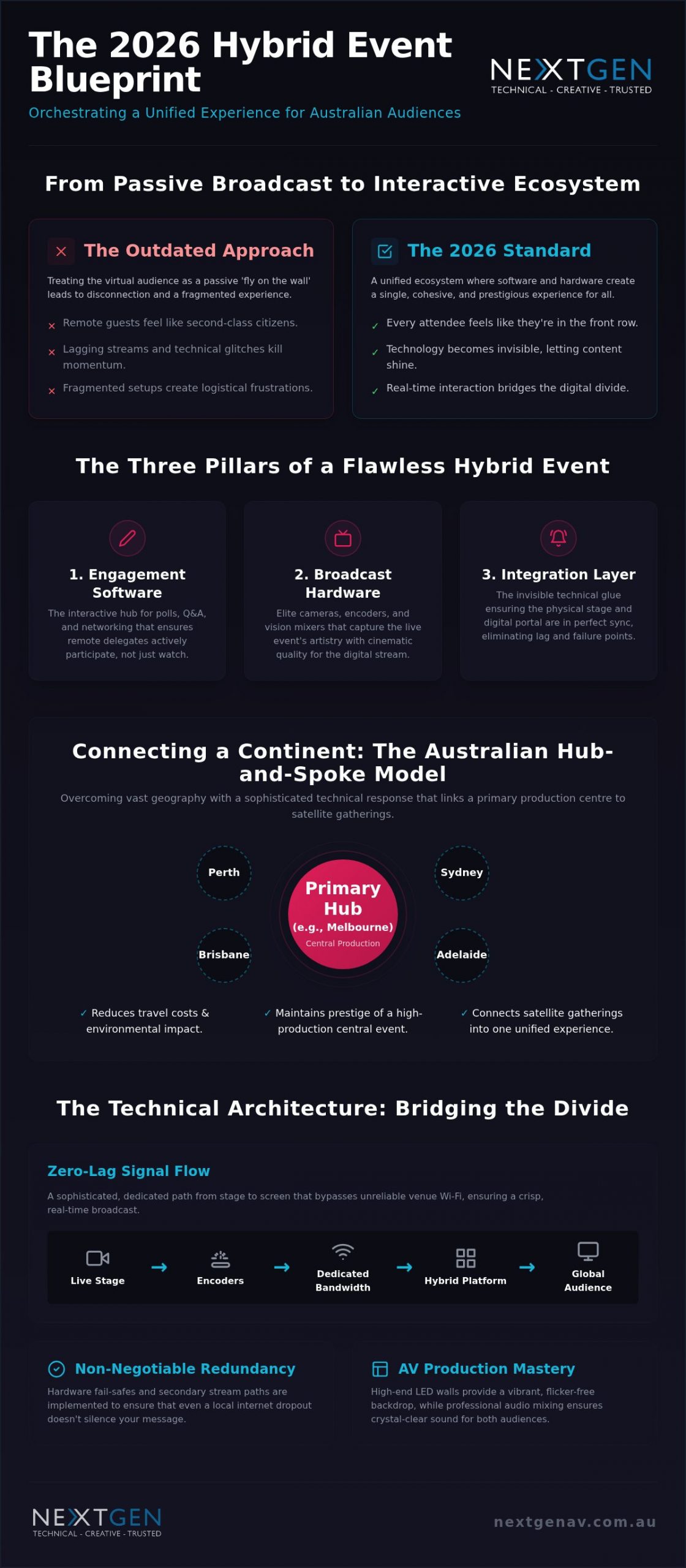
A professional setup relies on three distinct pillars to maintain its integrity. First, engagement software provides the interactive hubs for polls, Q&A, and networking, ensuring remote delegates aren’t just watching, but participating. Second, broadcast hardware like high-end cameras, encoders, and professional vision mixers capture the artistry of the live event. Finally, the integration layer acts as the glue. This technical invisible expert ensures the physical stage and digital portal stay in perfect sync, eliminating the lag that kills momentum.
Why Australia’s Event Landscape is Unique
Our geography presents a specific challenge that requires a sophisticated technical response. Connecting Sydney, Perth, and Brisbane to a central Melbourne hub demands precision engineering. Many Australian organisations now adopt “hub-and-spoke” models, where smaller in-person gatherings in different states are linked to a primary production centre. While some might still be figuring out What is a Hybrid Event?, elite planners are already using these structures to reduce travel costs and environmental impact. A hybrid event platform serves as the digital heart of a physical production, pumping live data and high-definition visuals to every corner of the network.
The Technical Architecture: Bridging the Physical and Digital Divide
When selecting hybrid event platform solutions australia, the focus often lands solely on the software interface. However, the true bridge is the technical architecture behind the scenes. Think of your on-site AV as the eyes and ears of your virtual guests. If the physical production is lacklustre, the digital experience will inevitably fail. A sophisticated signal flow ensures that a live presentation in a Melbourne ballroom reaches a laptop in London with near-zero lag. This journey involves high-speed encoders and dedicated bandwidth that bypasses the unreliable public Wi-Fi often found in older venues.
The Technical Director acts as the orchestrator of this dual-feed environment. They manage two distinct shows simultaneously; one for the people in the room and another for the remote stream. To protect the integrity of your event, redundancy is non-negotiable. We implement hardware fail-safes and secondary stream paths to ensure that even a local internet dropout doesn’t silence your message. Partnering with a veteran technical direction team allows you to focus on your keynote while we manage the invisible complexity of the dual feed.
Visual Mastery: LED Walls as the Digital Backdrop
High-end LED video walls do more than just impress the local crowd. They provide a vibrant, high-contrast backdrop that translates beautifully to camera, creating a professional broadcast studio feel for remote viewers. Our engineers meticulously manage brightness levels and refresh rates to eliminate the flickering often seen on lower-quality screens. This precision allows us to integrate remote presenters onto the physical stage screens, facilitating real-time panels where the digital and physical worlds collide without a glitch.
Audio Excellence: Ensuring Every Word is Heard
Audio is the most critical component of any hybrid event. While a guest might forgive a grainy video feed, they’ll disengage immediately if the sound is muffled or echoing. We utilise complex mix-minus audio routing to prevent remote participants from hearing their own voices looped back. Choosing the right professional sound system hire ensures that every word is captured with absolute clarity. This technical rigour ensures your remote audience remains focused on the content rather than the struggle to hear it.
Comparing Top Hybrid Event Platforms for Australian Corporates
Selecting the right software is a high-stakes decision that dictates the boundary between a standard webinar and a prestigious corporate summit. In 2026, hybrid event platform solutions australia are categorised by their capacity to handle scale, security, and the “two-audience” challenge. For high-volume summits, Cvent remains a heavyweight. Its multi-layered pricing, including annual licenses that typically range from $20,000 to $79,000, reflects its enterprise-grade depth. Conversely, EventsAir has gained significant traction with its subscription model that allows for unlimited registrations, providing a predictable cost structure for busy Australian conference cycles. While vFairs excels in creating immersive virtual environments, Zoom Events has evolved into a robust contender for those seeking a familiar interface with professional production features.
Security isn’t just a preference; it’s a legal mandate. Australian organisations with an annual turnover of at least AU$3 million must adhere to the 13 Australian Privacy Principles (APPs). This makes platforms with local data sovereignty and strict encryption the only viable choice for the government and finance sectors. Planners must also consider the Disability Discrimination Act 1992, ensuring their chosen platform provides screen-reader compatibility and captioning to remain accessible to all 18.5% of Australians living with a disability. The choice between a custom-branded interface and an out-of-the-box solution often hinges on how much you value your brand’s aesthetic precision versus the speed of deployment.
Platform Feature Breakdown
Engagement is the currency of 2026. Success lies in networking hubs where virtual and physical guests can actually converse, breaking down the digital wall. For exhibitors, sponsorship visibility must move beyond a static logo; many now use tools like easygen.tech to rapidly generate the high-quality text, images, and videos required for these interactive digital spaces. We look for platforms that offer interactive virtual booths and lead-capture tools that deliver tangible value. Post-event, the focus shifts to analytics. Detailed reporting on attendee dwell time and poll participation provides the data-driven ROI needed to satisfy stakeholders and refine future strategies. It’s about moving from simple broadcasting to genuine interaction.
The most polished software is useless if it can’t talk to your hardware. We prioritise platforms with robust RTMP streaming support, the industry standard for injecting high-definition video from our mixers directly into the digital portal. API integrations are equally vital, ensuring your registration data flows seamlessly into your CRM without manual entry errors. Perhaps most importantly, we look for local Australian support. A 24/7 global helpdesk sounds impressive until you’re live at 9:00 AM AEST and need an immediate fix. Having a team that operates in your time zone ensures that technical hitches are resolved before the first keynote begins, keeping the engine of your event running smoothly.
Planning Your Hybrid Strategy: Connectivity and Logistics in Australia
Planning a hybrid event across a continent as vast as Australia requires a level of logistical precision that simple in-person gatherings don’t demand. You aren’t just booking a room; you’re coordinating a broadcast centre that must reach multiple time zones simultaneously. This is why rehearsals and tech runs are paramount. A hybrid production typically requires 50% more preparation time than a traditional event to ensure the digital and physical cues are perfectly aligned. Without a dedicated tech day, you risk the awkward silence that occurs when a physical speaker forgets the virtual audience is watching.
Managing the two-tier experience is the ultimate test for any organiser. You must ensure that a delegate in Perth feels as valued as the one sitting in a Melbourne ballroom. This involves a strategic timeline that accounts for AEST, ACST, and AWST, ensuring your keynote doesn’t start at dawn for half your audience. When evaluating hybrid event platform solutions australia, look for tools that allow for pre-recorded content injections to keep the momentum high during physical room transitions. For organisers wanting to maintain high engagement through structured interaction, TeamLabs provides professionally facilitated activities that can be adapted for hybrid audiences.
The first step in your bandwidth audit is simple: never trust the guest Wi-Fi. You need a dedicated, synchronous upload line reserved exclusively for your stream. We recommend looking for venues that offer studio space within their traditional setups, allowing for a professional broadcast aesthetic without sacrificing the ballroom’s prestige. Melbourne landmarks like the MCEC and Crown are world-class in this regard, offering the infrastructure to support high-bitrate streaming. However, even boutique spaces can be optimised for hybrid success with the right technical direction and portable network solutions.
Audience Engagement Tactics
Engagement must be a shared goal. Gamification is a powerful tool to bring both audiences together, using live leaderboards that track participation from both cohorts. A dedicated virtual host is also essential; they act as the digital bridge, acknowledging the remote stream and ensuring their questions aren’t buried. You can easily organise a hybrid Q&A session by using a centralised platform where both in-person and remote attendees submit questions to a single, moderated queue. This ensures total parity between your two audiences. To ensure your next national broadcast is flawless, partner with our full-service technical experts to manage your venue logistics from start to finish.
Elevating Your Event with NextGen AV: The Confident Orchestrator
Navigating the technical maze of a modern production requires more than just a software login. It demands a partner who has spent three decades mastering the high-pressure environment of live execution. At NextGen AV, we simplify this complexity through our comprehensive full service event production. We don’t believe in the “one-size-fits-all” hybrid packages that often fail to account for the unique acoustics of a specific venue or the particular security needs of a corporate board. Instead, we provide tailored hybrid event platform solutions australia that align with your specific vision. This ensure your message is delivered with absolute clarity to every attendee, regardless of their location or device.
Our 30 years of industry experience allows us to anticipate challenges before they manifest. We’ve seen every possible technical hurdle, from bandwidth fluctuations to complex signal routing issues, and we’ve built the systems to overcome them. This “seen-it-all” perspective isn’t just about troubleshooting; it’s about the artistry of the final result. We treat every event as a dedicated craft, moving past the logistical grind to focus on the prestige and impact of your content. From pre-production planning to post-event data analysis, we act as the engine behind the scenes, allowing you to take centre stage without a second thought.
Our Hybrid Production Process
Success begins with collaborative design. We align your high-level vision with our technical mastery to create a blueprint for excellence. Once on-site, our elite team of engineers manages the engine room behind the scenes, orchestrating every camera angle, audio mix, and digital interaction. This is the NextGen AV guarantee: a blend of seamless execution and quiet power. We take personal pride in the invisible complexity of our work, ensuring that the technology never distracts from the human connection at the heart of your event.
Partnering for the Future of Events
Choosing a partner for your next summit means finding a technical ally who is as invested in the outcome as you are. We are far more than a simple equipment provider; we are the proactive force that ensures your national broadcast or boutique briefing is flawless. By choosing professional audio visual hire in Melbourne, you gain the peace of mind that only comes from veteran expertise. Whether you’re connecting a Melbourne hub to delegates in London or Sydney, our team is ready to deliver. Reach out to us today to start the hybrid planning process and secure a technical foundation that commands attention.
Mastering the Future of Hybrid Connection
Delivering a high-impact event in 2026 demands a shift from simple broadcasting to sophisticated, real-time interaction. You’ve seen how the right technical architecture and meticulous logistical planning can bridge the digital divide, ensuring your remote guests never feel like second-class citizens. By prioritising seamless signal flow and professional on-site engineering, you transform a standard meeting into a prestigious national experience. The most effective hybrid event platform solutions australia are those where the technology remains invisible, allowing your brand’s message to resonate across every time zone with absolute clarity.
Navigating this landscape requires a partner with the “seen-it-all” expertise to handle the engine room while you take centre stage. With 30+ years of Australian event experience, our specialist Technical Directors provide end-to-end hardware and software integration that takes the pressure off your team. We take personal pride in orchestrating every detail to ensure your vision is realised with quiet power and technical mastery. Enquire about our Hybrid Event Solutions today and let’s build an experience that commands attention from Melbourne to the world. Your next successful production starts with a single, confident step.
Frequently Asked Questions
What is the difference between a virtual event and a hybrid event?
A virtual event occurs entirely online, while a hybrid event combines a physical venue with a digital audience. The goal is to create a synchronised experience where both cohorts interact in real-time. This requires an integrated ecosystem of on-site AV and streaming software to maintain momentum. By using elite hybrid event platform solutions australia, organisers can bridge the gap between a Melbourne ballroom and a remote laptop without a glitch.
Which hybrid event platform is best for large-scale Australian conferences?
Cvent and EventsAir are currently the leading choices for enterprise-grade summits in Australia. Cvent offers deep customisation and robust data security, which is essential for meeting national privacy standards. EventsAir is often preferred for its unlimited registration model, making it a predictable investment for large-scale rotations. Both platforms integrate seamlessly with professional vision mixers and high-definition LED walls to produce a polished, broadcast-quality result that commands respect.
How much internet bandwidth do I need for a high-definition hybrid stream?
A high-definition hybrid stream requires a dedicated, synchronous upload speed of at least 10 Mbps. We recommend a primary line of 20 Mbps with a secondary failover to ensure absolute reliability during the broadcast. Never rely on shared venue Wi-Fi, as fluctuations in guest usage can cause the stream to lag or drop. A dedicated, hardwired connection is the only way to guarantee a flicker-free, prestigious experience for your digital audience.
Can I use Zoom for a professional hybrid event, or do I need a specialised platform?
Zoom Events is a capable tool for corporate briefings, but specialised platforms like vFairs or Cvent offer superior branding and networking depth. While Zoom is familiar to most Australians, it can feel like a standard meeting rather than a prestigious event. For high-stakes summits, a specialised platform provides the TV-style production features and interactive sponsor booths that sophisticated audiences now expect from a professional, end-to-end production.
How do I ensure my virtual attendees don’t feel left out during a live session?
Engagement is achieved by treating remote guests as active participants rather than passive observers. Assign a dedicated virtual host to moderate the digital chat and voice the online questions during live Q&A sessions. Use gamification and live polling to bring the two audiences together for shared goals. This ensures your remote cohort feels the energy of the room, turning a standard broadcast into a cinematic, inclusive experience that bridges the digital divide.
What are the common technical mistakes to avoid in hybrid event production?
The most frequent error is neglecting audio quality or relying on poor venue connectivity. Muffled sound or a lagging video feed will cause virtual attendees to disengage almost immediately. Another mistake is failing to conduct a full tech run that includes both physical and digital cues. These fragmented setups often lead to high latency, which destroys the real-time interaction and professional prestige that defines a successful hybrid event.
Does NextGen AV provide both the hardware and the digital platform management?
NextGen AV provides a complete, end-to-end solution that encompasses both world-class hardware and digital platform orchestration. We manage everything from the high-end LED video walls and professional audio systems to the RTMP signal flow and platform integration. This unified approach eliminates the stress of managing multiple vendors. Our team acts as the invisible expert, ensuring your physical and digital environments stay perfectly in sync throughout the entire production.
How far in advance should I start planning a hybrid event in Melbourne?
We recommend beginning your planning process at least four to six months before the event date. This lead time is crucial for securing top-tier Melbourne venues and conducting a comprehensive bandwidth audit. Early engagement allows our Technical Directors to collaborate on the event design, ensuring every camera angle and digital interaction is meticulously planned. Starting early transforms a potentially stressful logistical grind into a polished, celebratory success that reflects your brand’s authority.
A hybrid event isn’t just a physical conference with a webcam at the back of the room. It is a synchronised, high-stakes production where two distinct audiences must feel equally seen and heard. You likely know the specific anxiety of watching a venue’s upload speed fluctuate while your remote guest speakers wait in the digital wings. It’s a delicate balancing act that requires more than just standard gear. To truly succeed, you must master the technical requirements for hybrid events, transforming potential glitches into a seamless display of professional authority. This guide provides the blueprint for 2026, offering a deep dive into the audio, visual, and streaming infrastructure needed for a flawless Australian broadcast. We’ll explore how to orchestrate your LED video walls, pro audio, and redundant data lines to ensure every attendee, whether in Melbourne or streaming from London, enjoys a front-row experience. From securing rock-solid connectivity to balancing the run of house for two different worlds, we’ll show you how to execute your vision with absolute precision.
Key Takeaways
- Understand the essential technical requirements for hybrid events, including how to calculate upload speeds for 4K streams and why internet redundancy is non-negotiable for a professional broadcast.
- Learn how multi-camera arrays and studio-grade lighting elevate your production from a basic livestream to a prestigious, cinematic experience for remote attendees.
- Discover the role of the Technical Director as the conductor of your production, synchronising complex live and virtual cues for a seamless run of house.
- Shift your strategy toward a dual-delivery model that prioritises engagement for both audiences, ensuring your virtual guests don’t feel like an afterthought.
- Explore the benefits of partnering with an invisible expert to manage the logistical grind, allowing you to focus on the prestige of your event’s final result.
Defining Technical Requirements for Hybrid Events in 2026
The technical requirements for hybrid events have shifted from simple connectivity to total synchronicity. In 2026, a hybrid event is defined as a dual-delivery model. It’s a high-stakes environment where the physical room and the digital space exist in a perfectly mirrored state. You aren’t just hosting a meeting; you’re directing a broadcast. This requires a technical engine capable of serving two distinct audiences simultaneously, ensuring that your virtual attendees don’t feel like they are merely watching a recording of someone else’s experience. They deserve the same prestige and intimacy as those sitting in the front row.
To achieve this, your production must rest on four essential pillars: high-fidelity audio, cinematic visuals, rock-solid connectivity, and meaningful interactivity. The evolution of hybrid technology now allows for ultra-low-latency streaming and AI-driven production tools that can automate camera tracking or provide real-time captions. These advancements mean the “Two Audience” challenge is no longer a hurdle, but an opportunity to showcase your brand’s commitment to excellence. By mastering the technical requirements for hybrid events, you transform a complex logistical puzzle into a seamless, professional showcase.
Hybrid vs. Virtual: Why Technical Needs Differ
Managing a hybrid event is significantly more complex than a purely virtual one. You must balance in-room sound reinforcement with a separate, dedicated mix for the broadcast. What sounds perfect through a professional audio system in a ballroom might sound hollow or echoey on a remote attendee’s headset if not handled by a skilled technician. Similarly, your visual content must be versatile. A presentation designed for a massive 20-metre LED video wall needs to remain legible and impactful when viewed on a 13-inch laptop or a mobile device. A unified technical direction is the only way to bridge this gap, ensuring both experiences feel intentional and polished.
The Core Components of a Hybrid Tech Stack
A professional-grade hybrid stack follows a clear path: Capture, Process, and Deliver. This involves more than just equipment; it’s about the sophisticated routing of signals.
- Capture: Multi-camera arrays and studio-grade microphones to gather high-quality data.
- Process: Digital switchers and mixers that allow for real-time editing and layering of content.
- Deliver: High-bandwidth encoders that push the final product to your chosen streaming platform.
We are seeing a major shift toward NDI and Dante protocols, which allow for flexible, software-based signal routing through a venue’s network. This is why “off-the-shelf” consumer solutions often fail in corporate environments; they simply lack the stability and customisation required for high-stakes execution.
The Visual and Audio Core: Synchronising the Experience
Visuals and audio aren’t just utilities. They are the bridge between your two audiences. In a hybrid environment, your on-site production must be high-impact, while your digital broadcast must feel cinematic. A single, static camera at the back of the room is no longer enough to hold attention. To meet the modern technical requirements for hybrid events, you need a multi-camera array that captures the energy of the room. By switching between wide shots, tight close-ups, and audience reactions, you create a dynamic narrative that keeps remote attendees engaged. This level of production transforms a passive viewing experience into an active, immersive one.
Lighting plays a dual role that many organisers overlook. You must balance the “look and feel” for the physical room with the specific “exposure and colour” requirements for the lens. Traditional stage lighting that looks great to the naked eye can often wash out a presenter on a digital stream. A sophisticated lighting design ensures that your speakers look professional on-screen without compromising the atmosphere for those in the room. This meticulous attention to detail is what separates a makeshift meeting from a world-class production.
Audio Engineering for Dual Outputs
Audio is the invisible thread that holds your event together. If the video drops, you have a podcast; if the audio fails, the event is over. Managing hybrid sound requires a “Mix-Minus” technique. This sophisticated routing allows remote speakers to hear everything in the room except their own voice, preventing the distracting echoes that plague amateur broadcasts. When you invest in professional sound system hire, you’re securing the clarity needed for natural, low-latency conversation between live and virtual participants. It’s about ensuring every “mate” and “cheers” is heard with perfect fidelity, regardless of the listener’s location.
Visual Excellence: LED Walls and Broadcast Quality
The choice between projection and LED video walls is a critical technical decision. In 2026, high-resolution LED walls are the preferred choice for hybrid events. They offer superior brightness and contrast, ensuring your content remains vibrant even in well-lit rooms. Crucially, they must be configured with the correct pixel pitch to avoid moiré patterns on camera. Professional vision switchers then layer this content with Lower Thirds and Picture-in-Picture graphics, creating a polished broadcast that mirrors a television production. If you are unsure which configuration suits your venue, speaking with a technical director during the planning phase can save significant stress on show day.
Connectivity and Streaming: The Invisible Infrastructure
Connectivity is the lifeblood of your broadcast. While audio and visuals are what the audience sees, the internet is the invisible engine that carries your message to the world. If this engine stalls, the prestige of your event evaporates instantly. This makes robust connectivity one of the most critical technical requirements for hybrid events. You cannot simply hope the venue’s Wi-Fi holds up; you need a dedicated, managed pipeline that belongs solely to your production team. It’s the difference between a shaky Zoom call and a professional, broadcast-grade experience.
Calculating bandwidth is a matter of precision, not guesswork. For a crisp 1080p stream, we recommend a minimum dedicated upload speed of 15 Mbps. If you’re pushing for 4K excellence, that requirement jumps to at least 40 Mbps. These numbers represent the “safety ceiling” needed to account for bitrate fluctuations. Choosing between hardware and software encoding also defines your stability. While software solutions offer incredible flexibility, hardware encoders provide a dedicated, fan-cooled environment designed for one job: pushing data without the risk of a system crash. This is the “Redundancy Rule” in action. A single internet connection is a single point of failure, which is why we always build a secondary path into our tech stack.
Bonded Internet and Local Redundancy
In the Melbourne CBD or Sydney’s busy corridors, network congestion is a real threat to your stream. We solve this through 5G bonding, which combines multiple cellular signals into a single, high-speed connection. It acts as a powerful fail-safe against local NBN dropouts. For regional Australian events, Starlink has become a viable secondary option, providing a literal lifeline from the sky when traditional infrastructure is lacking. To ensure these systems are correctly configured for high-stakes broadcasts, accredited installers like DJC Engineering Pty Ltd provide the networking and WiFi expertise needed for a stable connection. We also implement a dedicated production VLAN. This isolates your event traffic from guest Wi-Fi, ensuring a thousand attendees on their phones don’t accidentally throttle your broadcast signal.
Security and Scalability for Corporate AGMs
Technical Direction: Managing the ‘Run of House’
Even the most sophisticated gear is useless without a steady hand at the wheel. The Technical Director (TD) acts as the conductor of your hybrid orchestra, synchronising every camera cut, audio cue, and digital overlay to ensure the experience is seamless. This orchestration is one of the most vital technical requirements for hybrid events, as it bridges the physical and digital worlds in real-time. A TD manages the “Run of House,” making split-second decisions that keep the production on track while you focus on your guests. They are the invisible engine driving the success of your broadcast.
Precision starts with a meticulously scripted Run Sheet. This document is the bible of your production, detailing every transition for both the live stage and the virtual platform. During the event, the team uses a dedicated “Showcall” channel. This is where the TD gives quiet, decisive instructions to camera operators, audio engineers, and vision switchers. It’s a high-pressure environment that requires absolute focus. A seasoned crew thrives under this pressure, turning complex logistical movements into a cinematic flow that feels effortless to your audience.
The Human Element: Production Crew and Expertise
Delivering a world-class broadcast requires a specialised team. Opting for full service event production means you have experts handling every niche, from lighting shaders to stream monitors. We often recommend a Digital MC to act as the voice of the virtual audience. They bridge the gap by bringing online questions to the live stage, ensuring remote attendees feel like part of the conversation rather than just spectators. If a technical “hiccup” occurs, such as a remote speaker’s home internet lagging, a seasoned crew handles it instantly with pre-planned “holding” graphics or a quick pivot in the schedule.
Rehearsals and the Technical Walkthrough
You can’t leave success to chance. A comprehensive technical walkthrough is the absolute requirement for a glitch-free day. This involves:
- Remote Link Testing: Verifying the audio and video quality of every virtual presenter hours before the show starts.
- The Dry Run: Practising complex transitions between live speakers and pre-recorded video content to ensure perfect timing.
- Redundancy Verification: Checking that all failover systems, including the bonded 5G lines and backup encoders mentioned earlier, are active and ready for immediate use.
These rehearsals allow the team to iron out any kinks in the “Run of House” before the first guest arrives. It’s about building a foundation of absolute reliability so you can take the stage with total confidence. If you want to ensure your next production is handled with this level of precision, contact our technical direction team today to discuss your vision.
Partnering for Success: The NextGen AV Approach
Executing a flawless production involves more than just ticking boxes on a checklist. It requires a partner who understands that the technical requirements for hybrid events are constantly evolving. At NextGen AV, we position ourselves as your “Invisible Expert,” the engine behind the scenes that allows your brand to shine. With over 30 years of industry experience, we’ve seen the transition from simple analogue setups to the complex, multi-layered digital ecosystems of 2026. Our approach is built on end-to-end management, ensuring that every detail, from the initial site visit to the final post-event data analysis, is handled with absolute precision.
We don’t believe in “one size fits all” solutions. Every venue has its own acoustic quirks and lighting challenges. Whether you’re hosting an intimate boardroom session or a massive national conference, we provide bespoke hardware solutions tailored to your specific environment. By customising your hybrid event services in Australia, we ensure your sound, light, and vision work in perfect harmony. This level of dedication transforms a standard meeting into a prestigious event that resonates with both your live and virtual audiences. It’s about moving past the logistical grind and focusing on the prestige of the final result.
Why a Production Partner Beats a DIY Approach
Attempting to manage a hybrid production in-house often leads to unnecessary stress and avoidable technical glitches. Think of a professional production crew as an insurance policy for your brand’s reputation. While generic tools might get you through a standard video call, they cannot match the aspirational atmosphere created by studio-grade gear and expert technical direction. By letting us handle the technical requirements for hybrid events, you free yourself to focus entirely on your message. We take personal pride in seamless execution, allowing you to take centre stage without a single worry about the “behind-the-scenes” mechanics.
Next Steps: Planning Your 2026 Hybrid Event
The secret to a successful production is early engagement. Starting the conversation months in advance allows us to conduct thorough site inspections and develop comprehensive technical riders. These steps are the foundation of a glitch-free show day. We’ll work with you to map out every requirement, ensuring that redundancy is built-in and every transition is rehearsed to perfection. Our team thrives under pressure, making us a formidable technical force and a collaborative ally for your next project. Don’t leave your next high-stakes event to chance. Organise a consultation with NextGen AV for your next hybrid event.
Master Your Next Hybrid Production
The standard for hybrid events has evolved into a dual-production model that demands absolute synchronicity between the physical and digital worlds. Successfully navigating the technical requirements for hybrid events means moving beyond basic setups to embrace professional-grade infrastructure that serves two distinct audiences with equal prestige. By prioritising redundant connectivity, cinematic visuals, and crystal-clear audio, you ensure your message isn’t just heard; it’s truly experienced. This level of execution requires a partner who understands the high stakes of live broadcasting and the artistry of a seamless run sheet.
NextGen AV brings over 30 years of industry experience to your project, offering specialists in LED video walls and professional audio to guarantee a flawless result. Our end-to-end technical direction removes the logistical burden from your shoulders, allowing you to focus on the impact of your presentation while we manage the invisible engine behind the scenes. Your next event is an opportunity to showcase your brand’s commitment to excellence. Enquire now for bespoke hybrid event production in Melbourne and take the first step toward a stress-free, professional broadcast. We look forward to bringing your vision to life.
Frequently Asked Questions
What is the minimum internet speed required for a high-quality hybrid event?
High-quality hybrid events require a minimum dedicated upload speed of 15 Mbps for a 1080p broadcast and 40 Mbps for 4K excellence. These figures represent a safety ceiling that accounts for bitrate fluctuations during the live stream. It’s vital to remember that these technical requirements for hybrid events must be met with a dedicated line, not shared venue Wi-Fi, to ensure a rock-solid connection for your remote audience.
Do I need a separate audio mix for my virtual and in-person audiences?
You absolutely need a separate audio mix to provide a professional experience for both groups. In-room speakers require sound reinforcement, while the virtual audience needs a direct feed that excludes their own return audio to prevent echoes. Using a Mix-Minus technique allows your remote guests to hear the room clearly without the distraction of hearing themselves on a delay, ensuring the conversation feels natural and polished.
How many cameras do I need for a professional hybrid conference?
A professional production typically requires a minimum of three cameras to maintain high engagement levels. A wide shot captures the scale of the stage, a tight shot focuses on the presenter’s expressions, and a third camera captures audience reactions or panel discussions. This multi-cam array allows your Technical Director to switch between views, creating a cinematic narrative that keeps remote attendees from losing interest throughout the day.
What is the difference between a virtual event platform and a streaming service?
A streaming service is the engine that delivers video content, while a virtual event platform is the digital venue where your audience interacts. Think of the streaming service as the broadcast pipe and the platform as the lobby, breakout rooms, and networking lounge. Integrating high-quality video into a robust platform is essential for meeting the complex technical requirements for hybrid events and providing a seamless attendee journey.
Can I use Zoom for a high-end corporate hybrid event?
You can use Zoom, but high-end corporate events usually require it to be integrated into a professional broadcast workflow. Rather than using a standard laptop webcam, we feed professional camera signals and studio-grade audio into the meeting via dedicated hardware encoders. This elevates the visual quality and stability, ensuring your event projects a sense of professional authority and prestige that a standard video call cannot match.
What happens if the internet goes down during my live stream?
If your primary internet connection fails, a professional setup should instantly pivot to a redundant backup. We utilise 5G bonding and secondary fibre lines to ensure your broadcast stays live without the audience ever noticing a flicker. This fail-safe approach is a non-negotiable part of high-stakes event planning, protecting your brand from the embarrassment of a technical blackout during a critical presentation.
How do I manage Q&A sessions so both audiences can participate?
Managing a unified Q&A requires a digital emcee and a synchronised audio return system. A dedicated moderator filters questions from the virtual chat, while roving microphones capture in-room queries. By feeding the remote audio through the professional sound system in the venue, you ensure that both audiences can hear each other clearly, creating a truly collaborative and inclusive atmosphere that values every participant.
What is the role of a Technical Director in a hybrid event?
The Technical Director acts as the orchestrator who manages the entire Run of House. They are responsible for switching camera shots, triggering graphics, and ensuring every audio cue is executed with precision. Their role is to handle the technical grind behind the scenes, allowing you to focus on your message while they maintain the momentum and professional polish of the live production.
Why settle for a “Zoom-in” when you can deliver a cinematic broadcast that commands attention in both the ballroom and the boardroom?
It’s a common frustration for Australian event organisers; the physical room is buzzing, yet the virtual audience feels like an afterthought, disconnected by lag or uninspired camera angles. You’ve likely felt the pressure of managing fragmented vendors while fearing the technical glitches that can derail a high-stakes live stream. You want your brand to project absolute authority and precision, not logistical instability. This guide shows you how to bridge that gap with Australia’s most sophisticated hybrid event staging solutions, ensuring your production is a single, seamless masterpiece.
We’ll detail the essential technical direction, hardware integration, and engagement tactics you need to achieve a flawless execution and professional prestige throughout 2026.
Key Takeaways
- Shift your perspective from hosting a basic meeting to orchestrating a high-end broadcast that treats virtual attendees with the same prestige as those in the room.
- Discover how sophisticated hybrid event staging solutions create a seamless “bridge” between physical signals and digital platforms for uninterrupted engagement.
- Learn why professional audio systems and on-site technical direction are the most critical investments to prevent remote audience fatigue and technical glitches.
- Master a proactive roadmap for 2026, including hybrid-first venue selection and the rigorous site testing required to ensure a stable, high-bandwidth stream.
- Understand how leveraging decades of production mastery allows you to move past logistical stress and focus on delivering a powerful, high-impact brand experience.
The Evolution of Hybrid Event Services in Australia: Defining the 2026 Standard
The corporate landscape across Australia has undergone a seismic shift. No longer is a hybrid event merely a physical gathering with a camera at the back of the room. By 2026 standards, we define this medium as a high-stakes, dual-audience broadcast experience. It’s an intricate dance where the virtual and physical worlds collide to create a singular, prestige narrative that resonates regardless of the attendee’s location.
The era of “good enough” audio-visual isn’t just over; it’s a risk to your brand. Australian organisers now recognise that technical mediocrity is a direct threat to corporate prestige. To command attention in a crowded digital marketplace, you need sophisticated hybrid event staging solutions that treat your remote viewers as VIPs rather than passive observers. This transformation from simple webcasting to multi-dimensional engagement is what separates elite brands from the background noise.
When exploring What is a Hybrid Event? in the current climate, it’s clear that the focus has shifted from mere connectivity to curated experience. It’s about bridging the gap between disparate attendees, ensuring a cohesive experience regardless of their physical location. This isn’t just a utility; it’s a dedicated craft that requires a “Confident Orchestrator” behind the scenes.
Beyond the Basic Livestream
A single static camera and a basic Zoom link fail to engage 2026 audiences who are accustomed to high-production digital content. Modern participants demand the values of a professional television broadcast. To maintain attention, you must employ broadcast-grade switching and dynamic multi-camera arrays. This creates a cinematic rhythm, allowing your remote participants to feel the raw energy of the room. By moving past the “webinar” aesthetic, you transform a digital feed into a compelling visual story that keeps eyes on the screen and participants active in the conversation.
The Business Case for Hybrid in Australia
Australia’s vast geography presents a unique challenge that hybrid models solve with elegant efficiency. For organisations based in Melbourne, embracing hybrid allows them to connect with audiences far beyond the city limits without the logistical burden of massive travel budgets. Deploying elite hybrid event staging solutions from a trusted local partner like NextGen AV empowers you to scale your message instantly. Beyond the reach, the data-driven insights are invaluable. Hybrid platforms offer superior lead tracking and engagement metrics that physical-only events simply can’t match. Additionally, as sustainability becomes a baseline corporate expectation, reducing the carbon footprint of national conferences through integrated digital attendance has become a powerful strategic advantage for forward-thinking organisations.
The Technical Architecture: Mastering Audio, Visual, and Connectivity
The backbone of any elite production is a unified technical architecture. It’s the “Hybrid Bridge” that fuses on-site signals with digital platforms, creating a singular environment for all participants. This level of integration is a key driver behind the current Australian event industry growth. Modern businesses aren’t just looking for a stream; they’re investing in infrastructure that delivers a cohesive, high-impact brand experience. To achieve this, your hybrid event staging solutions must be built on a foundation of technical mastery and absolute redundancy.
Crystal Clear Audio for Two Audiences
Audio is the silent killer of engagement. If the sound is muddy or the levels are inconsistent, your virtual audience will disengage within minutes. We manage complex mix-minus setups and sophisticated echo cancellation to ensure Q&A sessions feel like a natural conversation between the stage and the screen. Utilising professional sound system hire eliminates listener fatigue, ensuring every word is crisp, clear, and authoritative. High-end microphones and digital consoles are non-negotiable; they’re the primary touchpoint for your broadcast-quality feed.
Visual Excellence and LED Integration
To create a multi-dimensional feel, we use LED video walls as dynamic portals. These displays aren’t just for slide decks. They bring remote speakers into the room with life-sized clarity, making them feel physically present for the local audience. Lighting for the lens is a delicate art; we balance the warm in-room atmosphere with the specific brightness levels required for professional cameras. Expert switching ensures a seamless transition between live speakers, remote videos, and digital content, maintaining a cinematic flow that keeps eyes on the screen.
Connectivity and Australian Infrastructure
Reliable streaming in the Australian landscape requires navigating the NBN and 5G network with precision. We never rely on shared venue Wi-Fi, which is notoriously unpredictable. Dedicated event bandwidth is essential for a stable upload. Our technicians often employ bonded cellular solutions, a secret weapon for fail-safe streaming that combines multiple network signals into one robust, high-speed pipe. This redundancy planning ensures the show goes on even if a primary internet line fails. It’s this proactive approach that allows you to take centre stage without a second thought about the “what-ifs.” If you’re planning a high-stakes broadcast, our team can provide the technical direction needed to secure your connectivity from start to finish.
By orchestrating these technical elements into a single, high-performance engine, we remove the friction of modern hybrid event staging solutions. You’re left with a polished result that reflects the prestige of your brand and the importance of your message.

Hardware vs. Software: Why Production Trumps DIY Platforms
Many organisers make the mistake of believing the software platform is the event itself. It isn’t. A platform is merely the digital container. Without high-end hardware and professional orchestration, even the most expensive software feels like a glorified video call. To achieve a truly integrated result, your hybrid event staging solutions must prioritise the production quality over the interface. The prestige of your brand depends on the physical signals being captured and transmitted with absolute precision.
Relying on internal IT departments is another common pitfall. While IT teams are brilliant at maintaining office networks, live broadcast production is a different beast entirely. It requires a creative eye and the ability to troubleshoot under the immense pressure of a live feed. DIY approaches often lead to the very technical glitches that damage brand reputation. When the stakes are high, you need a partner who views production as a dedicated craft, not just a series of connections.
The Software is Just the Venue
Think of your software as the digital venue. Whether you use Zoom Events for its familiarity or a custom RTMP stream for ultimate branding control, the choice should be dictated by your production goals. We integrate interactive tools like Slido directly into the live video feed, ensuring virtual participants aren’t just watching a screen but are active contributors to the programme. This level of integration transforms a passive viewer into an engaged participant, bridging the gap between the two audiences effortlessly.
The Critical Role of Technical Direction
The true differentiator in 2026 is the “Invisible Expert”-the Technical Director. This role is the engine behind the scenes, orchestrating the stream, managing the in-room monitors, and ensuring the audio mix is flawless for both environments simultaneously. They are the “Confident Orchestrator” who ensures every transition is smooth and every speaker is framed perfectly for the camera.
Success is won in the pre-production phase. We create a detailed blueprint that accounts for every cue, transition, and contingency. Once the live broadcast concludes, our work continues into post-event management. We deliver polished, professionally edited recordings that turn your live moment into a long-term asset for on-demand viewing. Choosing full service event production means you aren’t just buying equipment; you’re securing a partnership that guarantees excellence from the first site visit to the final edit.
Your Five-Phase Roadmap to Hybrid Event Success
Mastering the logistics of a dual-audience production requires more than a standard checklist; it demands a strategic roadmap. For Australian event planners, the journey begins long before the first guest arrives. You must move through five distinct phases to ensure your brand’s prestige remains untarnished by technical friction. By adopting a hybrid-first mindset, you transform potential obstacles into a seamless, high-impact narrative that resonates across both physical and digital borders.
Phase 1 and 2 focus on the physical and digital foundation. When selecting a venue, particularly in bustling hubs like Melbourne’s CBD or the Southbank precinct, you must look beyond the aesthetics of the ballroom. A technical site inspection is mandatory to test bandwidth stability and map out camera positions. We ensure the physical layout supports both attendee comfort and the broadcast-grade angles required for your hybrid event staging solutions.
Phase 3 and 4 involve content adaptation and rigorous rehearsal. Your production is only as effective as the material it transmits. Content must be designed to spark interaction from both the front row and the remote viewer. This leads into an essential rehearsal schedule where every transition, speaker change, and digital asset is sound-checked and timed. We eliminate the “dead air” that causes virtual audiences to drift away.
Phase 5 is the live execution. This is the moment of “quiet power” where our technical direction team manages the room while real-time remote moderators bridge the gap for digital participants. We handle the complexity, allowing you to take centre stage with absolute confidence.
Choosing the Right Australian Venue
Melbourne offers world-class centres, but always verify the back-end infrastructure. Ask venue managers direct questions about “exclusive” AV provider fees or hidden surcharges for dedicated high-speed internet. Ensure the internal network can handle a sustained upstream for a high-definition broadcast without interference from other guests. The goal is to create an environment where the technology feels like an invisible engine driving the success of your event.
The 2026 Technical Checklist
To secure your production, refer to the essential audio visual for hybrid events guide for a comprehensive equipment list. Latency management is the synchronisation of audio and video signals across local and remote endpoints. Our protocols include backup power systems and secondary internet lines to ensure that even in a worst-case scenario, your broadcast remains uninterrupted. If you’re ready to secure your next production, consult with our expert team to begin your planning phase.
NextGen AV: Your Confident Orchestrator for Flawless Hybrid Events
With 30 years of industry mastery, NextGen AV stands as a technical powerhouse in the Australian event sector. This longevity isn’t just a number; it’s your ultimate insurance policy. When you’re managing a high-stakes broadcast, you need a partner who has seen every possible technical challenge and solved it with poise. Our end-to-end approach takes the weight off your shoulders, integrating everything from high-level technical direction to high-impact stage and lighting hire. We don’t just provide gear; we craft an environment where your brand vision can shine without the distraction of logistical friction.
The NextGen AV difference lies in our reassuring partnership. We understand the inherent stress of high-stakes planning, which is why we position ourselves as your hands-on guide. Our portfolio includes successful hybrid productions for some of Australia’s most prominent organisations, proving that experience is the most reliable tool in our kit. We allow you to move past the logistical grind and focus on the prestige of your final result.
Elite Hardware and Professional Talent
Our inventory is a curated collection of the world’s most reliable technology. From vibrant LED walls that act as digital portals to professional audio systems that ensure every syllable is captured, we provide the physical foundation for elite hybrid event staging solutions. However, the hardware is only half the story. The real engine behind your success is our team of seasoned technicians. These are the “Invisible Experts” who thrive under the pressure of a live feed, ensuring that the transition between a local speaker and a remote participant is flawless every time. Whether you’re hosting an intimate executive briefing or a massive national conference, our solutions scale to meet the prestige of the occasion.
Your Next Steps to a Flawless Event
We believe that a successful production is built on a foundation of empathetic partnership. This begins with an initial consultation where we listen to your objectives, identify potential pain points, and begin customising a solution that fits your specific brand vision. We move past the technical jargon to focus on the human impact of your message. By choosing NextGen AV, you’re securing a “Confident Orchestrator” who takes personal pride in the seamless execution of your project. We handle the complexity so you can take centre stage with absolute confidence.
Ready to elevate your event? Partner with NextGen AV for your next hybrid production and experience the quiet power of a team that puts your success first.
Command the Stage Across Every Border
The future of Australian corporate engagement isn’t found in a simple webcam stream; it’s forged through high-performance hybrid event staging solutions that treat every attendee with equal prestige. Success in 2026 hinges on a unified technical architecture, broadcast-grade audio, and a proactive roadmap that anticipates every logistical hurdle. By shifting your focus from managing a meeting to orchestrating a cinematic experience, you protect your brand’s reputation and amplify your reach across the country.
As a Melbourne-based powerhouse with national execution capabilities, NextGen AV brings over 30 years of event production mastery to your project. Our expert technical direction serves as the engine behind the scenes, ensuring a glitch-free delivery that allows you to step into the spotlight without a second thought. We thrive under the pressure of live broadcasts, providing the quiet power needed to turn complex logistics into seamless professional triumphs.
Enquire about our Hybrid Event Services today and discover the peace of mind that comes with a dedicated technical partner. It’s time to move past the logistical grind and deliver a result that is truly world-class. Your next masterpiece is waiting to be realised.
Frequently Asked Questions
What are hybrid event services?
Hybrid event services are integrated production solutions that allow a single event to be experienced simultaneously by a physical audience and a digital one. It’s about creating a unified broadcast where neither group feels like an afterthought. By fusing on-site hardware with sophisticated streaming technology, these services ensure that your message reaches every participant with the same clarity, regardless of their location.
How much does it cost to hire hybrid event services in Australia?
Investment levels for these services vary significantly depending on the technical complexity, number of cameras, and the sophistication of the digital platform used. Because each production is unique, most professional providers offer custom quotes after a detailed technical briefing. This ensures the solution aligns with your brand’s prestige and specific goals without the guesswork of generic pricing structures, allowing for a polished result that fits your budget.
What technical equipment is needed for a successful hybrid event?
You’ll require a robust suite of hardware including broadcast-grade cameras, professional audio systems with mix-minus capabilities, and high-impact LED video walls. Elite hybrid event staging solutions also rely on hardware encoders and dedicated internet bonding devices to ensure a stable, high-definition feed reaches your remote participants. These elements work in harmony to create a professional environment that bridges the gap between physical and digital spaces.
Can I use Zoom for a professional hybrid conference?
Yes, you can use Zoom, but it should function as the delivery vehicle rather than the entire production tool. For a professional result, we feed high-end camera signals and studio-quality audio into the platform via professional switching hardware. This elevates a standard video call into a cinematic broadcast that matches the expectations of a 2026 corporate audience, ensuring your brand is represented with absolute precision.
How do I ensure my remote audience stays engaged?
Engagement is driven by high production values and interactive content designed specifically for the digital lens. Use multi-camera arrays to create visual momentum and integrate real-time tools like live polls and moderated Q&A sessions. Treating your virtual attendees as active participants rather than passive observers is the key to maintaining their focus. It transforms a simple feed into a compelling visual story that keeps eyes on the screen throughout the programme.
What happens if the internet goes down during my live stream?
Professional teams mitigate this risk by using redundant internet connections, such as bonded cellular solutions that combine NBN and 5G signals. If a primary line fails, the system automatically switches to the backup without dropping the stream. This level of technical redundancy is a hallmark of sophisticated hybrid event staging solutions and provides essential peace of mind. It ensures your broadcast remains stable even in unpredictable infrastructure environments.
Do I need a separate crew for the virtual and in-person components?
While a single expert team can orchestrate both, the crew’s roles are distinct and specialised. You’ll have technicians focused on the in-room experience and others dedicated to the broadcast mix and remote moderation. This collaborative approach ensures that both audience segments receive a polished, high-fidelity experience. It allows the technical director to manage the complexity while you focus on delivering your message with total confidence.
How far in advance should I book hybrid event services in Melbourne?
We recommend starting the consultation process at least three to six months before your event date. This lead time allows for detailed site inspections at Melbourne venues and thorough pre-production planning. Securing your technical partner early ensures you have the Confident Orchestrator on hand to guide venue selection and technical architecture from the outset, leading to a more seamless and stress-free execution.
Your high-stakes event isn’t just a presentation; it’s your professional reputation on the line. The difference between a standing ovation and a technical blackout often comes down to a single person you haven’t met yet. You likely understand the mounting pressure of managing multiple vendors while deciphering complex AV jargon. This guide clarifies exactly what is a technical director for events and how they act as the master architect behind your production.
A Technical Director is far more than a senior technician; they are the bridge between your creative ambition and flawless execution. They transform a chaotic list of LED video walls and audio systems into a polished, high-impact experience. By serving as your single point of contact, they absorb the stress of logistics so you can focus on your stakeholders. We will explore how these invisible experts ensure absolute technical certainty for your 2026 events, from staging and rigging to the latest hybrid solutions. It’s time to move past the logistical grind and achieve a result that commands respect.
Key Takeaways
- Master the fundamental definition of what is a technical director for events and how this senior lead acts as the vital translator between your creative vision and the technical crew.
- Distinguish between standard AV management and high-level technical direction to ensure your next project benefits from strategic leadership rather than just equipment hire.
- Explore the pre-production lifecycle; meticulous site inspections across Australian venues identify potential power and rigging constraints months before the doors open.
- Learn how a dedicated director orchestrates complex systems, from LED video walls to professional audio, into a single, seamless experience that impresses every stakeholder.
- Discover the “Invisible Expert” advantage of having a single point of contact who manages multiple vendors; it’s the surest way to eliminate technical failure risk.
Defining the Role: What is a Technical Director for Events?
In the high-pressure world of live production, the difference between a visionary success and a technical disaster often rests on one individual. When asking what is a technical director for events, it’s best to view them as the master architect of the technical lifecycle. They don’t just manage equipment; they orchestrate the entire technical ecosystem from the first site visit to the final pack-down. In the Australian market, we refer to this role as the “Invisible Expert,” the person who ensures every signal flow is perfect so that the audience only sees the magic on stage.
A Technical Director acts as the senior lead, synchronising LED video walls, professional audio systems, lighting design, and complex rigging into one unified performance. They are the ultimate safeguard against live-event failure, providing the technical certainty that allows planners to breathe easy. By overseeing every department, they ensure that the technology serves the message rather than distracting from it. Their presence transforms a collection of gear into a high-stakes, cinematic experience.
The Bridge Between Creative and Technical
Creative directors often speak in the language of “feel” and “impact,” using mood boards to define an atmosphere. A Technical Director is the primary translator who converts these abstract concepts into a precise technical equipment list. They ensure that your artistic intent is never compromised by hardware limitations. Whether it is finding innovative ways to fit a massive LED display into a heritage-listed ballroom or ensuring the sound carries perfectly in a cavernous exhibition centre, they find the solution. This mastery ensures the final result looks exactly as you imagined, only better.
The “Single Point of Truth” for Your Event
Managing multiple vendors can lead to “finger-pointing” when a signal drops or a light flickers. A Technical Director eliminates this friction by serving as the single point of truth for all technical departments. They take full accountability for the master technical run-sheet, coordinating the timing of every cue to the second. For event planners, this means a significant reduction in pre-show anxiety. Instead of chasing four different department heads, you have one elite partner who understands the entire machine. This streamlined communication creates a sense of momentum and absolute confidence, allowing you to focus on your stakeholders while the “Invisible Expert” handles the engine room.
Core Responsibilities: From Pre-Production to the Final Pack-Down
A successful production is won or lost in the weeks preceding the event. When considering what is a technical director for events, many planners overlook the extensive pre-production phase. This journey begins with the director conducting rigorous site inspections at Melbourne venues to uncover hidden constraints. They assess everything from floor load capacities to the specific power requirements of your equipment. This proactive approach ensures that the creative vision is physically possible within the chosen space, preventing costly last-minute adjustments.
The director serves as the technical architect, translating your concepts into actionable blueprints. They develop detailed floor plans and signal flow diagrams, which are essential for integrating high-resolution LED video walls with complex lighting rigs. Beyond the visuals, they organise the technical budget with precision, ensuring every dollar spent on staging and rigging contributes to a high-impact result. They also act as your liaison with venue management, ensuring all installations comply with Australian safety and electrical standards. This meticulous planning eliminates the “jargon gap” between you and the venue’s house technicians.
On-Site Management and Show Calling
Once the event moves on-site, the director shifts into the role of the “Confident Orchestrator.” They lead the bump-in, ensuring every piece of professional audio gear is positioned correctly and every cable is neatly dressed and labelled. This level of detail prevents technical glitches and maintains a professional aesthetic for your brand. During technical rehearsals, they guide presenters through sound checks, calming nerves and perfecting the delivery environment. Their presence ensures that the technical team is proactive rather than reactive.
The true mastery of what is a technical director for events is most visible during the “show call.” This is where they direct every cue, synchronising lighting, audio, and video transitions with cinematic precision. Their voice in the headsets is the steady rhythm that keeps the entire crew in perfect harmony. The responsibility doesn’t end when the applause fades. The director oversees the safe and efficient pack-down, ensuring the venue is returned in pristine condition and all assets are accounted for. This end-to-end stewardship is why many leading brands seek professional technical direction to safeguard their most important moments. It turns a stressful logistical exercise into a triumphant, polished success.
Technical Director vs. AV Manager: Understanding the Difference
One manages the tools; the other orchestrates the experience. While these titles are often used interchangeably in casual conversation, the distinction is critical for your budget and your peace of mind. An AV Manager typically focuses on the tactical operation of a specific set of equipment or a small, single-department crew. In contrast, understanding what is a technical director for events involves looking at high-level strategy and multi-departmental leadership. The Technical Director doesn’t just ensure the gear works; they design the entire technical environment to ensure every department moves in lockstep.
Think of the manager as the lead violinist and the Technical Director as the conductor. While a boardroom presentation might only require a manager to monitor a slide deck, a high-stakes gala dinner demands a TD to synchronise the lighting, audio, and video cues into a seamless performance. The TD takes responsibility for the “big picture” risk assessment, ensuring that the creative vision translates into a safe, functional reality. They are the engine driving the success, allowing the client to take centre stage without worry.
When Should You Upgrade to a Technical Director?
As your event scales, you hit a complexity threshold where standard AV management is no longer sufficient. This is particularly true for corporate event production Melbourne or Melbourne roadshows where multiple vendors must integrate perfectly. If your project involves hybrid streaming, complex LED mapping, or high-level stakeholder presentations, a TD is essential. They add immense value by managing the intricate data and signal paths required for modern virtual solutions, ensuring the remote audience has the same prestige experience as those in the room. For productions that demand total ownership of every technical element, exploring a model of full service event production is the most effective way to eliminate vendor friction and guarantee a flawless result.
Risk Mitigation and The “Plan B” Specialist
A Technical Director is your ultimate insurance policy against the unexpected. They don’t just hope for the best; they build redundancies into every mission-critical system. If a primary signal fails, the TD is trained to troubleshoot and switch to a backup in real-time, often without the audience or the client ever noticing a flicker. This “Plan B” specialisation is what separates elite productions from amateur efforts. By identifying potential failure points during the planning phase, they provide a level of technical certainty that allows you to take centre stage with absolute confidence. This proactive mastery ensures that technical hitches never become public failures.
Why High-Stakes Events Demand Professional Technical Direction
High-impact visuals and crystal-clear audio are no longer luxury additions for major Australian brands. They are the baseline for professional communication. When asking what is a technical director for events, the answer lies in the protection of your brand’s prestige. A TD ensures your professional sound system hire is not just installed, but meticulously tuned to the specific acoustics of the room. They handle the complex logistics of stage and lighting hire Melbourne, managing rigging plots and electrical loads that would otherwise overwhelm a generalist planner.
The primary value of a Technical Director is the gift of focus. While they manage the signal paths and crew schedules, you are free to engage with your guests and stakeholders. This partnership alleviates the inherent stress of high-stakes planning by projecting absolute competence. They navigate the specific challenges of Melbourne venues, from the narrow loading docks of the CBD to the strict heritage requirements of historic ballrooms, ensuring no logistical hurdle slows your momentum. Their mastery ensures that the technical elements feel like a natural extension of your brand story.
Protecting Your Brand Reputation
Technical glitches can quickly overshadow the most successful product launch or AGM. The TD ensures that every transition is polished and every visual is sharp, maintaining the “prestige” of the event through flawless execution. This is especially vital for national roadshows where consistency across multiple Australian cities is non-negotiable. They act as the invisible shield, ensuring that the technology enhances your message rather than distracting from it. By maintaining a high standard of front-of-house excellence, they allow your brand to shine without the shadow of technical failure. When evaluating the best event production companies Melbourne has available, look for those who embed a dedicated Technical Director into every production to guarantee this level of brand protection.
Budget Optimisation and Efficiency
A seasoned Technical Director provides a significant financial ROI by identifying unnecessary equipment on vendor quotes. They understand the nuances of event production costs Australia and can help you maximise your impact without overspending. By streamlining the labour schedule, they also help you avoid expensive Melbourne weekend penalties and overtime rates. This strategic oversight ensures that your budget is spent on high-impact experiences rather than logistical waste. They act as your advocate, ensuring you only pay for the solutions that truly elevate your event.
If you want to secure your next production with a dedicated expert, enquire about our technical direction services today.
Partnering with NextGen AV for Seamless Technical Execution
Achieving a flawless production requires more than just high-end hardware; it demands a navigator who understands the “why” behind every signal path. NextGen AV provides seasoned Technical Directors who bring over 30 years of industry experience to your project. When you choose to work with our team, you aren’t just hiring a crew. You are gaining a partner who defines what is a technical director for events through action, precision, and a deep commitment to your brand’s success. Our “Invisible Experts” integrate seamlessly with your planning team, absorbing the technical complexity so you can focus on your guests.
We specialise in managing the entire technical ecosystem, from high-resolution LED video walls to bespoke lighting design and professional audio. This holistic approach ensures that every department moves in perfect synchronisation. You will experience the “quiet power” of a production where every cue is met with absolute precision and technical hitches are eliminated before they ever reach the stage. Our goal is to move you past the logistical grind and into a space where you can celebrate the prestige of a truly polished result.
The NextGen AV Difference in Melbourne
Our team possesses an intimate knowledge of Melbourne’s leading event spaces and their specific technical quirks. Whether you are planning a gala in a historic ballroom or a high-tech conference in a modern exhibition centre, we understand the local power constraints, rigging points, and loading dock requirements. This local mastery allows us to proactively solve challenges that often catch interstate vendors off guard. We maintain a premium inventory of high-end AV hardware, all managed by expert TDs who follow our “Confident Orchestrator” model. This ensures your equipment isn’t just delivered; it’s engineered into a high-impact experience tailored to your specific venue.
Get Started with Your Technical Consultation
Engaging a NextGen AV Technical Director for your next project is a straightforward, collaborative process. Our journey begins with a comprehensive pre-production consultation where we listen to your vision and identify the technical requirements needed to bring it to life. We move quickly from identifying challenges to presenting polished solutions, creating a sense of momentum that carries through to the final pack-down. This methodical approach provides the technical certainty required for high-stakes corporate environments and national roadshows. If you are ready to elevate your production and secure a single point of contact for all your AV logistics, we are here to lead the way.
Enquire about Technical Direction for your next Melbourne event and discover the difference that elite technical leadership makes to your brand reputation.
Elevate Your Production with Technical Certainty
Mastering the technical landscape of a modern event requires more than just high-end gear. It demands a senior lead who can harmonise every signal path and department into a single, high-impact experience. Understanding exactly what is a technical director for events empowers you to move beyond basic equipment hire and into the realm of elite production design. By serving as your single point of truth, these experts eliminate vendor friction and provide the “Plan B” security that high-stakes environments demand.
NextGen AV brings over 30 years of industry mastery to your planning team. We offer Melbourne’s leading high-end AV inventory and are trusted by Australia’s major brands and government bodies to deliver flawless results. Our directors ensure your creative vision is never compromised by hardware limitations or venue constraints. It’s time to stop managing the logistical grind and start focusing on the prestige of your successful event. Secure an Expert Technical Director for Your Next Melbourne Event and experience the quiet power of absolute technical precision. Your reputation deserves nothing less than a perfect execution.
Frequently Asked Questions
Do I need a Technical Director for a small corporate meeting?
Small meetings with basic requirements, such as a single projector and a couple of microphones, typically don’t require this level of oversight. An AV technician or manager is usually sufficient for these tactical tasks. You should consider what is a technical director for events when your production involves multiple departments, complex LED video walls, or high-stakes presentations where failure is not an option.
What is the difference between an Event Producer and a Technical Director?
An Event Producer focuses on the creative narrative, guest experience, and overall project logistics. The Technical Director is the engineering lead who ensures that the producer’s vision is physically and technically achievable. While the producer manages the “what” and the “why,” the TD is responsible for the “how,” overseeing the technical crew and the precision of the hardware execution.
How much does it cost to hire a Technical Director in Australia?
Investment levels for technical direction in Australia vary significantly based on the project’s scale, the length of the pre-production phase, and the complexity of the systems involved. Factors such as site inspections, CAD drawing requirements, and the number of technical departments to be managed will influence the final cost. You should check with a specialist production partner for a tailored quote that reflects your specific event needs.
Can a Technical Director help with hybrid or virtual event streaming?
Yes, a TD is essential for the success of modern hybrid events. They manage the critical signal paths between the physical venue and the digital broadcast platform to ensure a seamless experience for both audiences. By synchronising the in-room audio and visuals with the remote stream, they prevent the lag and quality drops that can undermine a professional virtual production.
At what stage of planning should I involve a Technical Director?
You should involve a Technical Director as early as possible, ideally during the initial concept phase or at least three to six months before the event date. Early engagement allows the TD to conduct venue site inspections and identify potential power or rigging constraints. This proactive approach ensures that your creative designs are technically feasible before you commit to venue contracts or stage builds.
What technical skills should a qualified Event TD possess?
A qualified TD must possess a deep mastery of signal flow engineering, CAD software for technical renders, and multi-disciplinary expertise across audio, lighting, and video systems. Beyond technical knowledge, they need strong leadership and problem-solving skills to manage diverse crews under pressure. Understanding what is a technical director for events means recognising them as both a technical powerhouse and a strategic project manager.
Does the Technical Director bring their own crew or manage the venue’s team?
They can perform either role with equal precision. A TD acts as the “Single Point of Truth” on-site, whether they are leading a dedicated NextGen AV crew or coordinating with venue-supplied technicians. Their primary objective is to ensure that every person on-site, regardless of their employer, adheres to the master technical run-sheet and maintains the highest standards of execution.
How does a Technical Director ensure event safety and compliance?
Safety is a cornerstone of the TD’s responsibilities. They oversee rigging certifications, electrical testing and tagging, and ensure all technical installations comply with Australian safety standards and venue-specific regulations. By performing rigorous risk assessments and managing the technical load requirements, they protect your guests, the crew, and your professional reputation from the risks associated with live productions.
Did you know that the average Australian event exceeds its initial budget by a staggering 23 per cent? This volatility often stems from the technical complexities of execution rather than simple oversight. When you’re orchestrating a high-stakes brand moment, understanding event production costs australia becomes less about finding the cheapest quote and more about securing technical precision. We understand the frustration of deciphering technical specs while fearing a mid-show audio glitch could ruin your prestige. It’s a delicate balance to maintain as you face rising labour costs and a 15 per cent talent shortage in the technical sector.
We promise to demystify these complexities, giving you the expertise to master your budget with absolute transparency and professional confidence. You’ll learn how to ensure every investment in LED video walls or lighting design translates into a seamless, high-impact experience that resonates with your audience. We’ll break down essential line items, provide a framework to compare complex quotes, and reveal how to align your production level with your event’s strategic goals for 2026. This is your roadmap to achieving technical excellence without the financial surprises.
Key Takeaways
- Transition from a reactive mindset to a proactive one by viewing technical production as a strategic engineering investment rather than a commodity hire.
- Evaluate the transformative impact of high-definition LED video walls and professional audio systems to ensure your technical choices align with your brand’s prestige.
- Gain a granular understanding of event production costs australia by accounting for technical labour variables and the logistical nuances of major venues.
- Optimise your production spend through a structured “must-have” framework and vendor consolidation to reduce management overheads and freight logistics.
- Ensure flawless execution by demanding transparent technical quotes and prioritising site visits to eliminate the risks associated with “blind” production planning.
Navigating the Australian Event Production Landscape in 2026
Australia’s corporate stage has evolved into a theatre of high-stakes immersion. In 2026, the standard for a successful gathering has shifted from simple information delivery to the creation of profound, sensory experiences. This evolution means that event production costs australia are no longer just a line item; they are a direct investment in brand equity. While industry data indicates that the average event exceeds its initial budget by 23 per cent, these overruns rarely stem from greed. They happen because the technical engine behind the scenes is often the most misunderstood component of modern Event management.
Precision is the new currency. As we integrate AI-driven lighting design and ultra-high-resolution LED video walls into our standard repertoire, the “Cost of Failure” has never been higher. A flickering screen or a muffled plenary session doesn’t just disrupt the schedule; it erodes the prestige of your brand in a heartbeat. Investing in high-tier technical production is an insurance policy against these high-stakes glitches, ensuring your message is delivered with absolute clarity and cinematic power.
The Difference Between AV Hire and Full-Scale Production
Hiring a box of gear is a transaction, but orchestrating a seamless experience is a craft. Many planners fall into the trap of “dry hire,” only to discover that the hidden costs of setup labour and troubleshooting quickly eclipse the initial savings. Full-scale production involves dedicated Technical Direction. This role acts as your event’s navigator, managing the complex interplay between staging, rigging, and professional audio systems to safeguard your ROI. To fully understand what is a technical director for events and why this role is indispensable, it’s worth exploring how they bridge creative vision and flawless execution. It’s the difference between renting a car and hiring a professional racing team to ensure you reach the finish line first.
Market Variations: Melbourne, Sydney, and Regional Australia
Geography dictates the rhythm of your budget. Logistics and freight costs fluctuate significantly between major hubs like the ICC in Sydney and the MCEC in Melbourne. Venue accessibility is a silent budget killer; a difficult loading dock can double your bump-in time and inflate your labour costs instantly. We also see distinct seasonal peaks in the Australian calendar, particularly around the end of the financial year and the spring racing season. Understanding these regional nuances is essential for anyone looking to master event production costs australia while maintaining the highest levels of technical excellence and operational agility.
Breaking Down Technical Production Components: Audio, Visual, and Lighting
Generic venue packages often bundle AV as a static cost, but this approach fails to account for the specific engineering required to captivate a modern audience. Precision matters. Understanding the variables of event production costs australia requires a deep dive into the hardware that actually drives engagement. While projectors were once the corporate staple, the shift toward LED video walls has redefined visual expectations. These systems offer unparalleled brightness and contrast, ensuring your content remains vivid even in rooms with significant natural light. Smart organisers know they must Balance The Budget With The Bottom Line by prioritising technical components that directly impact the attendee experience.
Crystal clear communication is the backbone of any plenary. Investing in professional sound system hire ensures that every word from the keynote speaker reaches the back of the room without distortion. Beyond the visible gear, staging and rigging represent the “invisible” but vital costs of structural safety. These elements involve complex weight-bearing calculations and specialised labour to ensure that lighting trusses and heavy LED panels are secured with absolute precision. If you’re unsure which configuration suits your venue, our team can provide expert technical direction to help you scale your vision appropriately.
Visual Tech: Pixel Pitch and Screen Real Estate
Clarity is a function of pixel pitch. A 2.6mm screen offers significantly higher resolution than a 3.9mm alternative, which is vital for detailed presentations or close-up viewing. Your budget will fluctuate based on these technical specs and the total screen real estate required to satisfy audience sightlines. Custom aspect ratios or curved LED configurations add a layer of sophistication, but they also require more complex processing power and specialised rigging, which naturally influences the final investment.
Audio Engineering: Coverage and Intelligibility
Coverage is about more than just volume; it’s about intelligibility. Line arrays provide even sound dispersion across large convention halls, while point source speakers might suffice for more intimate boardrooms. In crowded Australian CBDs like Sydney or Melbourne, wireless frequency management is a non-negotiable technical requirement to prevent interference from surrounding signals. High-end digital mixing consoles, paired with expert operators, allow for real-time adjustments that keep the audio landscape polished and professional throughout the event.
Lighting design has also moved beyond the basic “room wash” of the past. Modern stage lighting uses movement and texture to direct the audience’s focus and build atmospheric tension. By integrating intelligent moving lights and stage-focused spots, you can transform a sterile ballroom into a cinematic environment that reinforces the prestige of your brand moment.
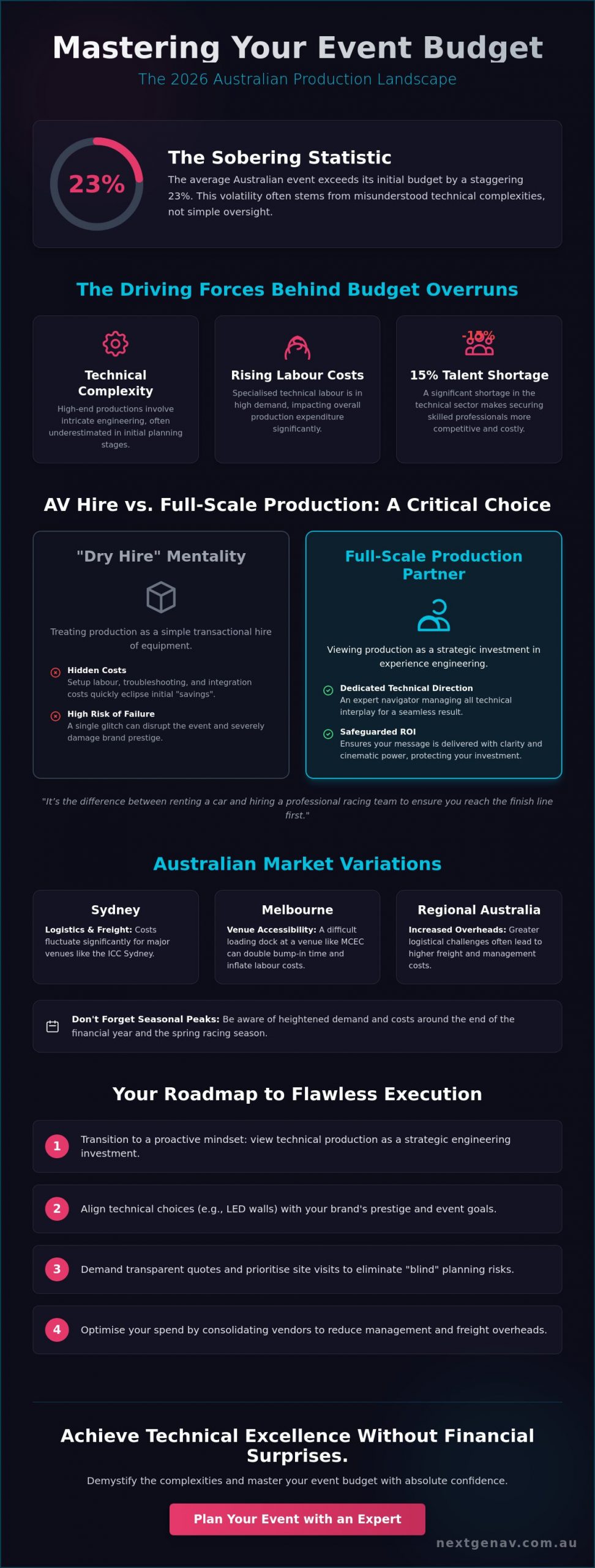
Key Variables Impacting Your Australian Event Budget
While hardware defines the “what” of your event, the “who” and “when” are the primary drivers of event production costs australia. High-stakes brand moments aren’t powered by equipment alone; they’re driven by a human engine of specialised engineers, vision switchers, and riggers. These professionals ensure that every technical component functions as a single, cohesive unit. Unlike generic event staff, technical operators bring a level of precision that safeguards your reputation when the lights go up and the cameras start rolling. Their expertise is the invisible force that prevents a standard presentation from becoming a technical casualty.
Power requirements are another frequently overlooked variable that can sway a budget. High-draw equipment, particularly expansive LED video walls and professional audio systems, often demand 3-phase power distribution. If your venue’s infrastructure isn’t assessed early, the cost of bringing in additional power or managing complex distribution can create unexpected friction. Similarly, your screens require content that is purpose-built for their resolution and aspect ratio. Budgeting for custom motion graphics and screen-ready presentations ensures your visual impact is as sophisticated as the technology displaying it.
The Hidden Cost of Bump-in Logistics
Timing is everything in the Australian market. Major venues like the MCEC in Melbourne or the ICC in Sydney operate on strict logistical schedules where loading dock access is a precious commodity. If your freight gets caught in a “waiting time” trap, labour costs can escalate quickly. Choosing an experienced team for audio visual hire Melbourne is a strategic move to reduce onsite hours through efficient, disciplined load-ins. Remember that after-hours and weekend labour surcharges are standard across the industry. A compressed schedule might look cheaper on paper, but it often costs significantly more once overtime penalties are applied.
Technical Direction and Pre-Production
Success is engineered long before the doors open. Technical Direction provides the vital bridge between your creative vision and the technical reality. We utilise 3D floor plans and pre-visualisation tools to identify potential sightline issues or rigging challenges before a single road case enters the building. This pre-production phase is where the prestige of your event is truly secured. Technical rehearsals are non-negotiable for high-prestige events, allowing the team to manage the interface between speakers, digital content, and the technical desk with absolute certainty. It’s the difference between a show that merely functions and one that flows with cinematic momentum.
Strategic Budgeting: How to Optimise Your Production Spend
Precision in budgeting begins with a ruthless audit of your event’s core objectives. To master event production costs australia, you must distinguish between the technical elements that drive your message and those that merely fill space. Start by defining your “Must-Haves” versus “Nice-to-Haves” based on the specific transformation you want your audience to experience. If your goal is a cinematic product reveal, the LED wall is your priority. If it’s a high-level policy discussion, audio intelligibility takes the lead. Once your priorities are set, consolidate your requirements under a single technical partner. This move eliminates the “management tax” associated with multiple vendors and slashes freight overheads by synchronising logistics. Transitioning to a model of full service event production ensures a single point of accountability for your audio, lighting, and staging, delivering more predictable budgeting and absolute technical precision. You’ll find that a unified team provides a more cohesive aesthetic while protecting your bottom line from fragmented invoices.
Alignment is your best tool for efficiency. Ensure your technical specifications are tailored to the actual dimensions of your venue; paying for excess screen real estate that exceeds audience sightlines is a common budget leak. Early engagement is critical. Reviewing your stage and lighting hire Melbourne requirements months in advance allows for methodical planning and prevents the rush fees that plague last-minute bookings. This proactive approach ensures your staging is engineered for the room’s specific constraints without the stress of eleventh-hour adjustments.
In-House AV vs. External Production Partners
Many venues push “exclusive” in-house AV contracts, but these often hide significant commissions that don’t translate into better gear. External specialists bring modern, event-specific hardware that is frequently superior to the “built-in” systems that have seen years of heavy use. While you might encounter venue “patch fees” for bringing in your own team, the transparency and expertise of an independent production partner typically offer better value. You aren’t just paying for equipment; you’re paying for a team whose primary loyalty is to your brand’s success, not the venue’s occupancy rates. Independent partners offer the agility to customise solutions that in-house teams, bound by fixed inventory, simply cannot match.
The ROI of High-Quality Production
Flawless execution creates a psychological “halo effect” for your brand. High-quality corporate event production Sydney ensures that your technical delivery matches the prestige of your message, driving higher attendee engagement and long-term brand recall. When your audience is immersed in a seamless environment, they are more receptive to your message. If you plan a recurring series, consider a multi-year production partnership. This strategic move allows your production team to refine the technical blueprint over time, reducing setup hours and long-term costs through familiarity and shared data. If you’re ready to elevate your next project, partner with us for a transparent technical consultation that aligns your vision with your budget.
Choosing a Production Partner for Flawless Execution
Selecting the right technical partner is the final, most critical step in securing your event’s ROI. In 2026, a professional quote should be more than a simple list of prices; it must be a transparent technical blueprint. When evaluating event production costs australia, look for granular detail that accounts for every engineer, every cable run, and every redundancy measure. Vague line items are often a mask for future “out of scope” charges that can derail your budget during the high-pressure bump-in phase. We believe that clarity is the foundation of trust. A detailed proposal allows you to see exactly how your investment is being utilised to safeguard your brand’s prestige.
Never accept a “blind quote” without a comprehensive site visit. Every Australian venue, from boutique Sydney galleries to massive Melbourne convention centres, has unique technical quirks. A site visit identifies these variables early, ensuring that your staging and rigging plans are physically viable and logistically sound. At NextGen AV, we’ve spent 30 years navigating these complexities. We act as the invisible expert, orchestrating the technical engine behind the scenes so you can remain focused on the stage. Our legacy is built on the quiet power of seamless execution, allowing your message to take centre stage without the distraction of technical friction.
Questions to Ask Your Production Company
- Do you own your equipment or do you sub-hire? Companies that own their fleet offer greater reliability and more competitive pricing by eliminating third-party markups and logistical delays.
- What is your redundancy plan for critical systems? High-stakes moments require dual-engine switchers and backup audio loops. If there isn’t a “Plan B” baked into the quote, your event is at risk.
- Can you provide a detailed CAD or 3D render? Visualising the setup through a 3D render ensures that audience sightlines are perfect and that the LED video wall placement matches your aesthetic vision.
The NextGen AV Approach to Budgeting
We approach every project as a collaborative partnership. Our planning process turns your aspirational vision into a technically sound reality through methodical pre-production and expert Technical Direction. We are committed to “no surprises” billing, providing transparent labour allocations that reflect the actual expertise required for your specific venue. This honesty ensures you can present your budget to stakeholders with absolute confidence. If you’re ready to transform your next event into a cinematic experience, contact our team for a tailored technical production proposal that aligns with your goals for 2026.
Engineering Your 2026 Event Success
Mastering your budget requires a fundamental shift in perspective. You aren’t just hiring gear; you’re investing in technical precision. By prioritising transparent quotes and site-specific planning, you effectively eliminate the risk of the 23 per cent budget overruns that frequently impact the industry. Gaining a granular understanding of event production costs australia is the definitive first step toward transforming a standard corporate gathering into a prestigious brand experience that resonates with every attendee.
NextGen AV brings over 30 years of Australian event experience to your project. Our redundancy-first technical philosophy ensures your high-stakes moments are protected by fail-safe systems, while our Melbourne base provides seamless nationwide service. We act as the orchestrator behind the scenes, allowing you to step into the spotlight with total confidence. You’ve done the hard work of crafting the vision; now let us handle the technical engine that brings it to life.
Request a Transparent Production Quote for Your Next Event
We look forward to partnering with you to create a seamless and sophisticated event that exceeds every expectation.
As you prepare for the busy event season, remember that your personal health is just as important as your technical setup; to help you stay at your best, you can explore Weight Loss Consultation through the Aussie Scripts telehealth platform.
Frequently Asked Questions
How much does corporate event production typically cost in Australia?
Total investment varies based on the scale and technical complexity of your vision. While verified research shows that a single-day corporate conference in Australia typically costs between $180 and $220 per person for general venue and catering, technical production is a bespoke engineering investment. You should budget based on the specific prestige and engagement levels your brand requires for the 2026 landscape.
What are the most common hidden costs in an AV quote?
Common budget surprises often stem from 3-phase power distribution requirements, specialised rigging safety inspections, and freight waiting times at congested loading docks. You might also encounter unexpected charges for wireless frequency management in dense CBD environments. A transparent, detailed proposal should identify these logistical variables early to ensure your final invoice matches your initial expectations.
Is it cheaper to use the in-house AV provider at my venue?
In-house providers aren’t always the most cost-effective choice because their rates often include substantial venue commissions. While they might offer to waive certain “patch fees,” an external specialist provides modern, event-specific hardware and dedicated Technical Direction. This independent partnership ensures that the technical execution is tailored specifically to your brand rather than the venue’s fixed inventory.
How can I reduce my event production budget without sacrificing quality?
Consolidating your technical requirements under a single partner is the most effective way to manage event production costs australia. Sourcing your LED video walls, professional audio, and lighting from one team slashes management overheads and synchronises freight logistics. Early engagement also allows you to avoid the premium rush fees associated with last-minute equipment sourcing and labour allocations.
What is the difference between a technician and a Technical Director?
A technician is responsible for the setup and operation of specific hardware, while a Technical Director for events orchestrates the entire technical ecosystem. The Director acts as the navigator, managing the complex interface between vision, sound, and lighting departments. They provide the high-level expertise needed to safeguard your ROI and ensure the show flows with cinematic momentum.
Why are labour costs so high for event bump-ins?
Labour rates reflect the specialised expertise required to rig heavy structures safely and manage intricate digital signal paths under strict deadlines. In the Australian market, after-hours and weekend surcharges are standard industry practice. Professional teams mitigate these costs through meticulous pre-production and 3D floor planning, which reduces the total hours needed for onsite troubleshooting.
What technical equipment is essential for a 500-person conference?
A high-definition LED video wall is vital for visual clarity, paired with a professional audio system featuring line array speakers for even sound dispersion. You’ll also require digital mixing consoles, wireless microphones with frequency management, and a dedicated lighting rig to direct audience focus. These components work as a single engine to create an immersive environment that captures attendee attention.
How far in advance should I book my event production company?
You should secure your technical production partner at least six to nine months before your event. This lead time is essential for conducting thorough site visits, developing custom content, and performing technical pre-visualisation. Early booking is your best defence against the 15 per cent talent shortage currently affecting the Australian technical sector, ensuring the best experts are reserved for your project.
A high-definition screen doesn’t guarantee a captivated audience; it’s the invisible technical precision behind the glass that determines whether your event feels like a prestige production or a technical liability. You’ve likely felt that familiar knot of anxiety when considering the logistics of a large-scale led video wall, from the fear of a mid-presentation flicker to the headache of calculating viewing distances in a challenging Australian venue. It’s a common concern for organisers who want to move beyond the logistical grind and focus on the artistry of the final result.
This guide is designed to transform that uncertainty into absolute technical confidence. You’ll master the essentials of pixel pitch and rigging requirements while discovering how the latest 2026 innovations, like AI-powered content management and MicroLED technology, can maximise your impact. We’ll walk through everything from power consumption to the rise of zero-bezel designs, giving you the blueprint for a flawless visual experience that positions your brand as a leader in its field. By the end of this guide, you’ll have the technical mastery needed to orchestrate a production that is as seamless as it is spectacular.
Key Takeaways
- Master the technical specifications of a modern led video wall to ensure your visual content remains sharp and vibrant regardless of the audience’s viewing distance.
- Evaluate the strategic ROI of LED technology compared to traditional projection, specifically how to maintain visual impact in high-ambient light environments like the Melbourne Convention Centre.
- Optimise your event logistics by mastering the requirements for three-phase power and professional rigging to ensure a safe and efficient bump-in.
- Learn how to align your content strategy with modular hardware to create immersive, cinematic environments that transcend the limitations of standard screen displays.
- Leverage expert technical direction to oversee the entire visual chain, allowing you to focus on your guests while the invisible experts manage the technical pressure.
What is an LED Video Wall? The Shift in Modern Event Production
The architecture of a modern event has evolved far beyond simple stages and static backdrops. Today, a led video wall serves as the heartbeat of a production, acting as a modular display system composed of individual light-emitting diodes that work in perfect synchronisation. Unlike traditional LCD screens that are plagued by distracting bezels, these systems offer a truly seamless canvas. This lack of visual interruption allows for a continuous, immersive image that flows across the entire surface, ensuring your audience remains focused on the message rather than the equipment. To understand the foundational technology, it helps to look at What is a Video Wall? in its broadest sense, but the modern event industry has moved decisively toward the brightness and flexibility of LED.
This shift isn’t just about aesthetic preference; it’s rooted in the psychology of engagement. Large-format visuals command attention in a way that smaller, fragmented displays cannot. High-impact imagery increases information retention and creates a sense of prestige that elevates the entire brand experience. When you deploy a seamless visual surface, you’re not just showing content; you’re creating an environment that captivates the senses and eliminates the “grid” effect that often breaks the immersion of digital presentations.
The Core Components of an LED System
A professional led video wall is a sophisticated assembly of precision-engineered parts. At the most basic level, individual LED modules are grouped together into cabinets, which serve as the structural building blocks of the wall. The long-term reliability of these modules relies on high-quality internal circuitry, often incorporating precision resistors and diodes from specialist manufacturers like Adage Components, to ensure consistent visual performance. Each cabinet houses a receiving card, the critical component that interprets data from the central video processor. This processor acts as the “brain” of the operation, scaling and mapping your content to fit the specific dimensions of the screen. Because these systems are modular, you aren’t restricted to a standard 16:9 aspect ratio. You can organise panels into towers, curved ribbons, or abstract geometric shapes that integrate directly with your staging and rigging.
Why Events are Moving Away from Traditional Projection
The era of dimming the lights just to see a presentation is over. Traditional projectors often suffer from a “washout” effect when faced with ambient light, particularly in bright Australian venues like the Melbourne Convention Centre. LED panels produce their own light, delivering incredible colour depth and contrast ratios that remain vivid even in broad daylight. There’s also a significant logistical advantage: space. Projectors require a long “throw distance” or complex mirrors to cast an image, often eating up valuable floor space. LED walls have a remarkably slim profile, allowing you to maximise your venue footprint and place the screen exactly where it will have the most impact.
Decoding the Technical Specs: Pixel Pitch, Nits, and Refresh Rates
Technical precision isn’t about chasing the highest numbers on a spec sheet. It’s about the deliberate orchestration of hardware to suit a specific environment. When you plan a led video wall installation, the metrics you choose will directly dictate the clarity of your message and the comfort of your guests. Over-specifying a screen for a massive hall is an unnecessary drain on resources, while under-specifying for an intimate lounge will result in visible pixels and a diminished brand image. Mastery of these specs allows you to move past the guesswork and focus on the prestige of your event’s final look.
Pixel Pitch: Finding the Sweet Spot for Your Audience
Pixel pitch measures the distance from the centre of one LED cluster to the next. A reliable industry rule of thumb is to allow one metre of viewing distance for every millimetre of pitch. For instance, a 2.6mm panel provides a seamless image from approximately 2.6 metres away. If your audience is closer than this, the individual diodes become visible, breaking the illusion of a solid image.
- 1.9mm: Ideal for high-resolution corporate displays where viewers are positioned within two metres of the screen.
- 2.6mm: The gold standard for most Australian gala events, conferences, and ballroom settings.
- 3.9mm: Best for large-scale stage backdrops or festivals where the audience is positioned at a significant distance.
Choosing a finer pitch increases resolution density, which is perfect for detailed text or high-end branding. However, for massive surfaces viewed from the back of a room, a slightly wider pitch often delivers a more impactful visual result for the same budget. It’s about finding the balance between density and scale to ensure every seat in the house has a premium view. These same pixel pitch principles apply equally when considering a trade show led wall rental, where close-proximity viewing distances at exhibition stands make fine-pitch selection especially critical.
Brightness (Nits) and Refresh Rates for Camera Clarity
Brightness, measured in Nits, ensures your content remains vibrant against the venue’s existing lighting. Indoor environments typically require between 600 and 1200 Nits to maintain visual punch. However, if your event is being filmed or live-streamed, the refresh rate is the specification that truly matters. Screens with low refresh rates often create a distracting “flicker” or horizontal lines on camera due to Pulse Width Modulation issues. To ensure a broadcast-quality finish, always demand a refresh rate of at least 3840Hz.
In low-light gala settings, pay close attention to greyscale performance. High-quality panels maintain deep blacks and subtle gradients even when the overall brightness is dimmed, preserving the artistry of your cinematic content. If you’re navigating these variables for the first time, seeking advice on technical direction can ensure your configuration is perfectly fit for purpose.
LED Wall vs. Projector: A Strategic Comparison for Event Planners
Choosing between these two technologies isn’t merely a matter of budget; it’s a decision about the visual integrity of your brand. While projectors have served as the industry standard for decades, the led video wall has redefined what’s possible in high-stakes environments. It’s the difference between a reflected image and a direct light source. Projectors rely on a darkened room to maintain clarity, but LED technology creates its own brilliance, ensuring your message remains the centre of attention regardless of the venue’s limitations.
Reliability is where the two diverge most sharply. If a projector bulb fails or a cable is tripped, your entire presentation vanishes in an instant. It’s a catastrophic “single point of failure” that every organiser dreads. In contrast, an LED system is inherently redundant. If a single diode or even an entire module fails, the rest of the wall continues to operate flawlessly. To the audience, the glitch is virtually invisible, allowing your technical team to swap components behind the scenes without interrupting the flow of the event. This peace of mind is a hallmark of premium AV orchestration. For event planners coordinating the full scope of a production, understanding how LED walls integrate within a broader audio visual hire Melbourne strategy is essential to achieving a truly cohesive and flawless result.
Performance in High Ambient Light
Vivid colours and deep blacks are non-negotiable for premium branding. Modern Australian venues, like the Melbourne Convention Centre, often feature stunning floor-to-ceiling windows that flood rooms with natural light. This ambient light is the natural enemy of the projector, causing images to look washed out and “milky.” A led video wall cuts through this interference with ease. By delivering true black levels and punchy, high-contrast output, it ensures your corporate colours are rendered with absolute fidelity, maintaining the prestige of your visual assets even in the middle of a summer afternoon. For a deeper analysis of how these two technologies perform under conference conditions specifically, our comprehensive guide on led wall vs projector for conference events covers every critical variable from ambient light performance to live-stream quality.
Venue Logistics: Rigging and Floor Space
Spatial efficiency is a major factor in venue selection and floor plan design. A rear-projection setup often requires a five-to-ten-metre “dead zone” behind the screen, significantly reducing your usable floor space and guest capacity. An LED wall is remarkably slim, requiring minimal clearance and allowing you to push the stage back to the very edge of the room. While large arrays require precise rigging and weight load calculations from experienced professionals, they also offer the flexibility of ground-stacking. If a venue has restrictive ceiling heights or no rigging points, a ground-supported LED wall provides a massive cinematic backdrop without the need for overhead support.
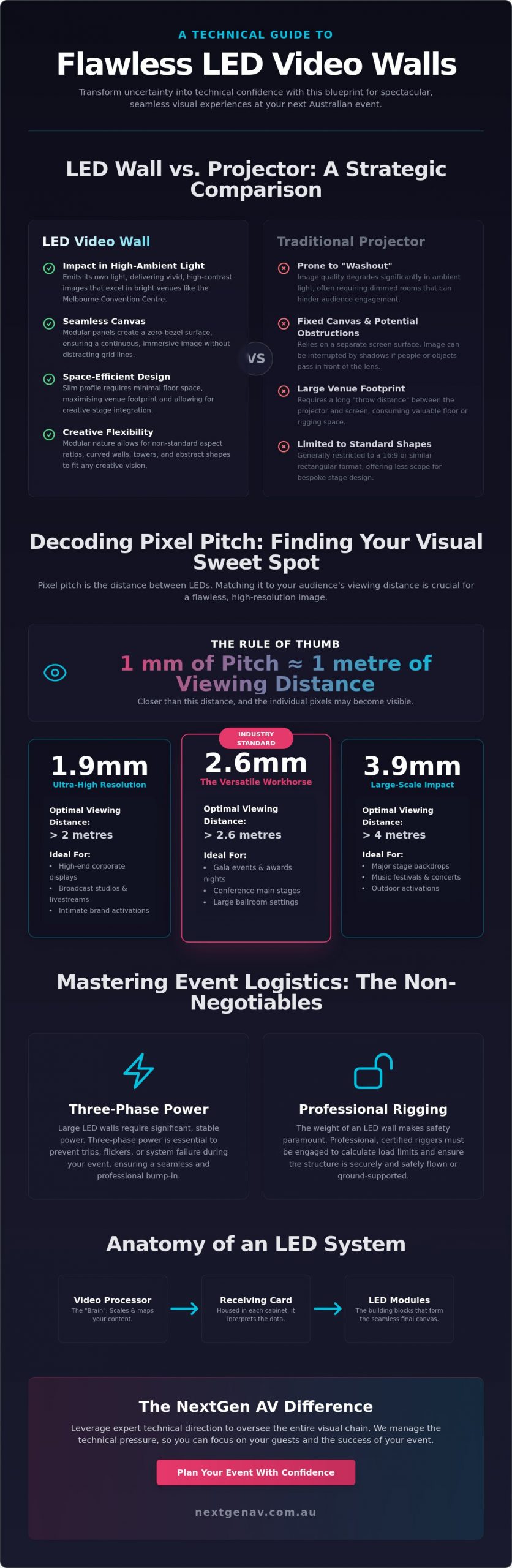
Mastering the Logistics: Power, Rigging, and Content Strategy
The success of a high-stakes event isn’t just about the hardware on stage; it’s about the invisible logistics that ensure the technology performs under pressure. While the visual impact of an led video wall is undeniable, the path to a flawless “go-live” moment requires a meticulous bump-in timeline and deep technical knowledge. A professional installation typically demands a multi-hour setup window where rigging, power distribution, and data mapping are executed with surgical precision. This is where the grind of planning meets the prestige of performance. Execution is everything.
Structural safety is the non-negotiable foundation of any large-scale display. In Australian venues, rigging must adhere to strict structural safety standards to protect both the audience and the crew. Whether your screen is flown from the ceiling or ground-stacked on a custom stage, every point of contact must be verified for weight load capacity. To eliminate the risk of a blackout, elite technical teams always implement a “signal backup” loop. This redundancy ensures that if a single data cable fails, the video processor automatically reroutes the signal from the opposite direction, keeping your presentation running without a second of downtime.
Power and Data Infrastructure
You don’t power a cinematic experience with a standard 10A wall circuit. Large-scale walls require dedicated power distribution units (distros) that typically draw from three-phase power outlets. This ensures a stable, surge-protected energy supply that can handle the peak brightness of thousands of diodes simultaneously. Data redundancy is equally vital. For high-stakes shows, using primary and backup processors allows for an instantaneous switchover if a hardware fault occurs, effectively shielding your brand from technical glitches. Professional cable management is the final touch, ensuring that the “behind-the-scenes” remains as polished as the front-of-house.
Content Creation: Aspect Ratios and Resolution
Creating content for a modular display is different from designing for a standard TV. Because an led video wall can be built in any shape, your content must be tailored to a specific “pixel map.” If you simply send a standard 1920×1080 signal to a custom-sized screen, your logos will likely look stretched or pixelated. We recommend 1:1 pixel mapping, where every pixel in your video file corresponds exactly to a physical diode on the wall. This creates ultra-sharp text and vibrant branding that looks spectacular from every angle. If you need help coordinating these complex technical requirements, our team can provide the technical direction required to bring your vision to life.
The NextGen AV Difference: Expert Technical Direction
Sophisticated hardware like a led video wall requires more than just a technician; it demands a conductor. NextGen AV has spent over 30 years acting as Melbourne’s “Invisible Expert,” orchestrating high-stakes productions where failure isn’t an option. Our Technical Directors act as the single point of accountability, overseeing the entire visual chain from the initial signal source to the final diode. This level of mastery ensures that every logistical detail, from meticulous site inspections to structural load-bearing checks, is handled long before the first guest arrives. We don’t just supply equipment; we provide the engine that drives your event’s success.
Pre-production is where the most critical work happens. By identifying potential venue bottlenecks early, such as power limitations or rigging constraints, we eliminate the fear of visual glitches during live presentations. Our team takes personal pride in seamless execution, ensuring that the transition from a bold high-level vision to a cinematic reality is both methodical and efficient. This proactive partnership allows you to step away from the technical grind and focus on the prestige of the final result.
Why Technical Direction Matters for High-Stakes Events
High-stakes events are fluid and unpredictable. A keynote speaker might provide a last-minute content update, or a lighting cue might need to be adjusted to match a screen’s colour temperature. Our technical direction team manages these variables in real time, coordinating seamlessly with lighting, audio, and camera crews to maintain a cohesive aesthetic. We operate under strict zero-failure protocols, employing redundant signal paths and proactive monitoring to ensure your brand remains centre stage. It’s about alleviating the stress of the “what if” so you can focus on the impact of the “what is.”
Custom LED Solutions for Unique Brand Experiences
Modern event design has moved past the flat 16:9 rectangle. We leverage the modularity of the led video wall to create architectural landmarks, including immersive tunnels, curved stage surrounds, and transparent displays that blend into the venue’s design. These aren’t just screens; they’re canvases for interactive experiences. By integrating live social media feeds or real-time polling, we transform a passive viewing experience into an active brand dialogue. If you’re ready to move beyond the logistical grind and experience absolute technical confidence, organise a technical consultation for your next Melbourne event.
Orchestrate Your Visual Masterpiece
Deploying a high-impact led video wall is about more than just hardware; it’s about the technical mastery required to turn a standard venue into a cinematic environment. You now understand that the correct pixel pitch and high refresh rates are non-negotiable for camera clarity, while meticulous power logistics and structural safety form the invisible foundation of a successful production. By mastering these essentials, you’ve moved beyond the stress of the logistical grind and can now focus on the prestige of your event’s final result.
Success in high-stakes Australian environments requires a partner who thrives under pressure and takes personal pride in seamless execution. With over 30 years of technical production experience, our team provides the absolute reliability your brand demands through redundant signal and power systems as standard. We assign expert Technical Directors to every major hire, ensuring that your vision is realised with surgical precision and zero-failure protocols. Partner with Melbourne’s LED experts for your next event and step onto the stage with absolute confidence. Your audience is ready for something spectacular.
Frequently Asked Questions
How much does it cost to hire an LED video wall in Melbourne?
The investment for a professional hire depends on several variables, including the screen’s total dimensions, the required pixel pitch, and the complexity of the rigging at your specific Melbourne venue. Because every event has unique architectural needs, costs are typically calculated based on the hardware required and the technical team needed for a safe, efficient installation. It’s best to request a tailored consultation to ensure the configuration aligns with your production’s prestige and budget.
What is the difference between an indoor and outdoor LED screen?
The primary distinctions lie in brightness levels and environmental protection. Outdoor screens are engineered to produce at least 5,000 nits to cut through direct Australian sunlight, whereas indoor panels usually operate between 600 and 1,200 nits for comfortable viewing. Additionally, outdoor modules feature high IP ratings to shield sensitive electronics from dust and moisture, ensuring your led video wall remains reliable during open-air productions.
Can I use a standard PowerPoint presentation on a large LED wall?
You can certainly display a standard PowerPoint, though professional scaling is essential to maintain visual integrity. Since your custom screen likely has a unique resolution, our technical team uses a video processor to map your slides exactly to the pixel dimensions of the wall. This prevents your branding and text from appearing stretched, ensuring your presentation looks sharp and sophisticated from every seat in the house.
How long does it take to set up (bump-in) an LED video wall?
A standard professional installation typically requires a four-to-eight-hour window for a successful bump-in. This timeline allows our crew to assemble the modular cabinets, establish redundant data loops, and calibrate the colour balance across the entire surface. More complex designs, such as curved arrays or large flown systems, may require additional time for structural safety checks and precise rigging to ensure a flawless go-live moment.
Do I need a special technician to operate the video wall during my event?
High-stakes events always benefit from a dedicated technician to oversee the visual chain and manage content transitions. An experienced LED operator or Technical Director monitors the signal integrity and manages the video processor in real time, responding instantaneously to any live updates or emergency changes. This “invisible expert” approach allows you to focus on your guests while we ensure the technical execution remains seamless.
What is pixel pitch and why does it matter for my event?
Pixel pitch is the distance between the centre of each LED cluster, and it directly dictates the “sweet spot” for your audience’s viewing distance. A finer pitch provides incredible detail for close-up viewing in intimate ballrooms, while a larger pitch is more efficient for distant audiences in large halls or arenas. Selecting the right pitch ensures your led video wall delivers sharp imagery without over-specifying hardware that your audience won’t perceive.
How much power does a typical LED video wall require?
Large-scale displays require a robust infrastructure, typically drawing from three-phase power outlets through dedicated distribution boards. While a single panel doesn’t draw much energy, a full array running at high brightness levels demands a stable and surge-protected supply. Our team manages these logistics during the site inspection, ensuring the venue’s electrical capacity is perfectly matched to your production’s energy requirements.
Can LED walls be used for outdoor events in the rain?
Outdoor-rated LED panels are designed with weather-sealed modules that can operate safely during rain, provided they carry an appropriate IP65 rating. This protection prevents moisture from reaching the diodes or the internal electronics within the cabinets. We also ensure that all power distros and data connections are professionally shielded, maintaining a safe and reliable visual environment even during unpredictable Australian weather conditions.
What if the most critical stakeholder at your next conference isn’t sitting in the front row, but is actually watching from a home office three time zones away? Whether they are using a standard connection or business-grade fibre from Broadconnect, the quality of their experience is paramount. For too long, digital guests have been treated as second-class citizens; however, the most successful organisers in 2026 know that a hybrid event is actually a high-end broadcast first and a physical gathering second. When you partner with a leading hybrid event production company australia, you’re not just booking equipment. You’re orchestrating a unified experience that bridges the gap between the physical and the digital. It’s a high-stakes environment where technical precision is the only currency that matters.
We understand the pressure of managing two distinct audiences without letting the budget spiral out of control. You want a flawless execution that eliminates the fear of technical glitches and virtual disengagement. This guide provides the expert insights you need to master technical production and achieve a high ROI through expanded global reach. We’ll explore how to integrate advanced LED video walls and AI-driven audio solutions to create a seamless national experience that keeps every attendee at the centre of the action.
Key Takeaways
- Discover why the “Virtual First” philosophy is essential for treating remote attendees as primary stakeholders rather than passive observers.
- Learn how partnering with a specialised hybrid event production company australia ensures flawless execution through low-latency video distribution and elite audio systems.
- Compare the Hub-and-Spoke and Studio Broadcast models to determine which production structure best suits your national association’s geographic spread.
- Master the art of synchronised engagement by using live polling and gamification to bridge the gap between the physical room and the digital space.
- Understand the “Invisible Expert” approach to technical direction, allowing you to focus on your presentation while a veteran team manages the complex staging and rigging behind the scenes.
Defining Hybrid Excellence in the Australian Event Landscape
Hybrid events have evolved far beyond the simple broadcast of a physical room. In 2026, excellence is defined as a synchronised, multi-channel experience where technology removes the barrier of distance. To understand this foundational shift, one might ask, What is a Hybrid Event? in the modern context. It’s no longer just a passive stream; it’s a dedicated broadcast production designed to engage two distinct audiences simultaneously. For a leading hybrid event production company australia, the goal is to create a unified brand presence that resonates as powerfully on a smartphone screen in Perth as it does in a ballroom in Sydney. This requires a shift in mindset from “event planning” to “broadcast orchestration.”
Australia’s vast geographic spread makes this approach a non-negotiable strategy for national associations. When your members are scattered across thousands of kilometres, a hybrid model ensures inclusivity without the prohibitive costs of cross-continental travel. This transition offers data-rich attendee insights that traditional formats simply can’t match. Organisers can now track real-time engagement, seeing exactly which sessions sparked the most interest and where the conversation peaked. Additionally, these events provide a significantly reduced carbon footprint per capita, directly supporting the sustainability mandates that have become standard for corporate Australia.
The 2026 Hybrid Mandate: Beyond the Webcam
The days of “laptop on a tripod” setups are over. These low-fidelity attempts fail to meet modern corporate standards and often damage professional brand authority. In 2026, your virtual audience expects broadcast-grade aesthetics. This means professional lighting design, crisp audio, and multi-camera switching that tells a story. We move beyond passive viewing into active, multi-sensory participation. By integrating interactive elements into the technical direction, we ensure remote guests feel like valued participants, not just observers watching from the sidelines.
Economic Advantages for Australian Organisations
The financial logic of this model is undeniable. You can scale your audience into the thousands without increasing venue hire or catering costs. Partnering with a hybrid event production company australia helps you generate year-round value by capturing high-quality on-demand content that lives long after the final curtain. Furthermore, remote contribution technology allows you to attract elite international keynote speakers who might otherwise be unavailable. You can bring global expertise directly to your Australian audience without the expense of business-class flights or complex travel itineraries, maximising your event’s prestige and ROI.
The Technical Backbone: Essential Infrastructure for Seamless Delivery
A flawless hybrid event relies on more than just a stable internet connection. It requires a sophisticated architecture where every component communicates in real-time. In 2026, the gold standard for video distribution is NDI (Network Device Interface). This technology allows for high-quality, low-latency video to move across standard networks; it ensures your remote speakers appear on screen with the same clarity as those on stage. This level of technical integration is why choosing a seasoned hybrid event production company australia is vital for organisations that can’t afford a single second of downtime.
Reliability is built on redundancy. We implement dual-ISP bonding and advanced failover systems to prevent stream drops, even if a primary connection fails. This proactive approach reflects current Australian events industry trends, which show a growing demand for bulletproof digital stability as hybrid formats continue to expand. By treating the online feed as a professional television broadcast, vision mixers create a dynamic edit that alternates between wide shots, close-ups, and digital overlays. This keeps the virtual audience captivated, mirroring the energy of the physical room without the lag that plagues amateur setups.
Visual Mastery with LED Video Walls
Staging is the canvas for your brand’s message. High-resolution LED video walls serve as dynamic backdrops that provide visual depth for both audiences. We ensure every panel has camera-ready refresh rates to eliminate flickering on the live stream, a common pitfall in budget productions. By blending physical set pieces with digital environments, we create an immersive stage that feels expensive and authoritative. If you’re looking to elevate your next keynote, consider how integrated technical direction can transform a standard venue into a world-class broadcast studio.
Audio Engineering for Two Rooms
Sound is often the most overlooked element, yet it’s the most critical for virtual engagement. We manage independent audio mixes for the in-room PA and the online broadcast to ensure perfect levels for everyone. Our engineers prioritise “mix-minus” routing; this technique prevents distracting echoes for remote presenters during Q&A sessions. This is why professional sound system hire for hybrid events always includes specialised broadcast technicians who understand the nuances of dual-room acoustics.
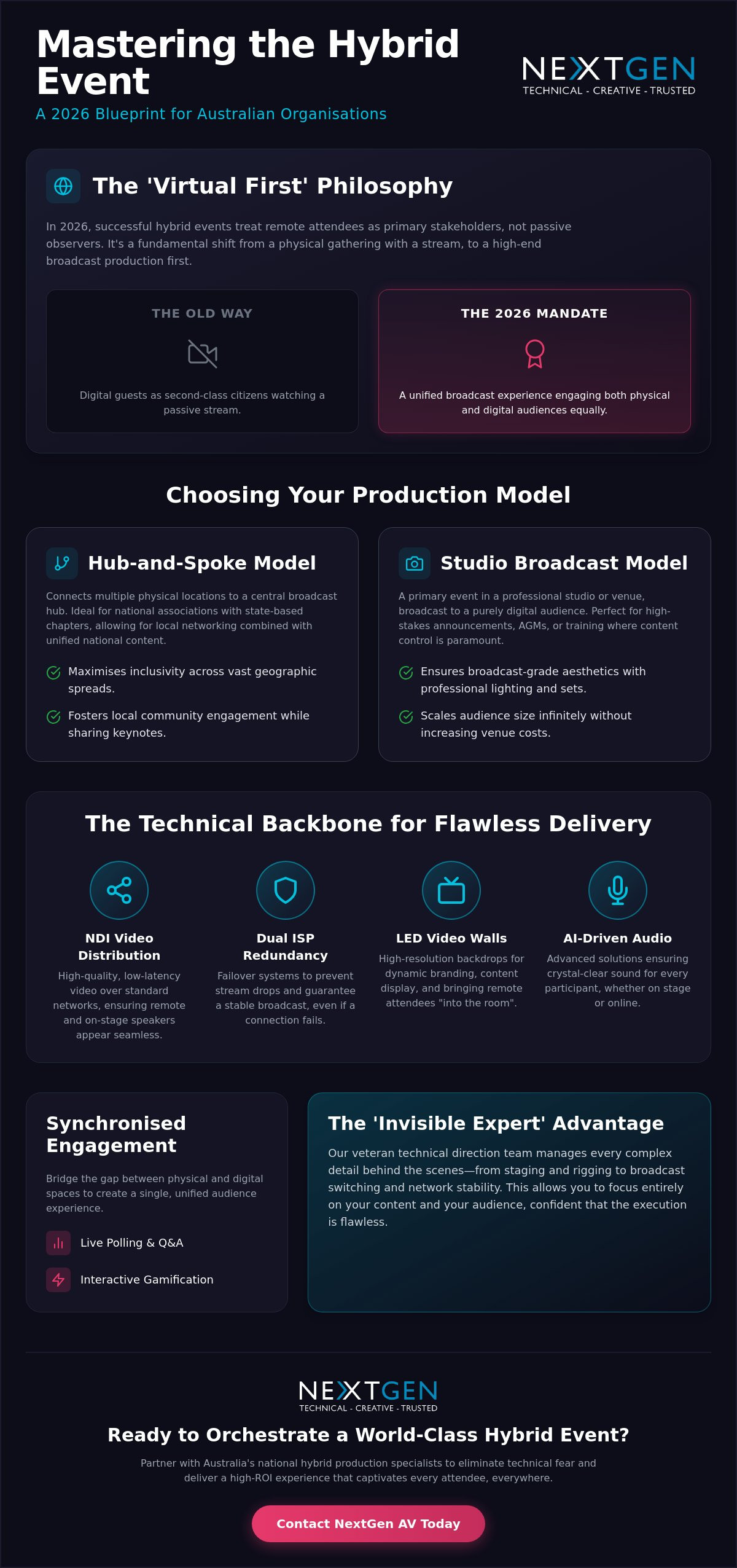
Comparing Hybrid Production Models: Studio vs. Venue-Based
Selecting the right framework for your gathering is the first step toward a successful realisation of your project. We don’t believe in a one-size-fits-all approach. Instead, we help you navigate three primary models that have come to define the industry in 2026. The decision rests on where your audience sits and how you want them to interact with your brand. As a premier hybrid event production company australia, we’ve seen that the most effective organisers choose their model based on strategic impact rather than just convenience.
- Model A: The Hub-and-Spoke. This involves a primary venue in a major city like Sydney or Melbourne, connected to smaller satellite viewing parties across the country. It’s ideal for national associations that want to maintain a local feel while reducing the overall travel burden.
- Model B: The Studio Broadcast. Here, the audience is entirely virtual or limited to a small group of VIPs. The focus is on high-end production value, using a controlled environment to deliver a polished, television-style experience.
- Model C: The Fully Integrated Event. This is the traditional conference format enhanced by a premium virtual layer. It treats the physical and digital rooms as equals, ensuring that every attendee, regardless of their location, receives the same level of engagement and technical excellence.
Your choice depends on a simple decision matrix. If your priority is absolute control and internet reliability, the studio is your best bet. If you need to foster networking and physical presence, the integrated model is superior. Budget often dictates the scale, but remember that the “Hub-and-Spoke” model can significantly reduce catering and venue costs while still providing a shared physical experience. We act as the engine behind the scenes, helping you weigh these factors to ensure your ROI remains high while your stress remains low.
When to Choose a Purpose-Built Broadcast Studio
A purpose-built studio offers a level of precision that hotel ballrooms often can’t match. It provides total control over acoustics, lighting, and dedicated fibre-optic internet. This environment is perfect for high-stakes corporate announcements or product launches where every frame must be perfect. By utilising green screens and Augmented Reality (AR), we can place your speakers in immersive digital worlds that turn a standard presentation into a cinematic story. It’s about moving past the logistical grind to focus on the prestige of the final result.
Managing Hybrid in Traditional Australian Venues
Traditional venues bring their own set of challenges, particularly when it comes to “house” internet. You must audit the venue’s capabilities early; ask the manager for dedicated bandwidth that isn’t shared with guests in the lobby. Large ballrooms often present acoustic hurdles that can ruin a virtual broadcast with echoes or muddy sound. This is where expert stage and lighting hire Melbourne becomes invaluable, especially in heritage-listed spaces where rigging options are limited. We specialise in bringing broadcast-grade infrastructure into these iconic locations, ensuring your tech is invisible while your message takes centre stage.
Masterclass in Engagement: Bridging the Gap Between Audiences
Engagement is the pulse of any successful production. In the hybrid era, we operate under a “Virtual First” philosophy; this means the digital guest is never treated as an afterthought. Your online host is perhaps your most critical hire. They act as the digital audience’s advocate, bridging the gap by acknowledging remote comments and ensuring the virtual room feels the energy of the physical stage. When you partner with a premier hybrid event production company australia, we provide the technical framework that allows this human connection to flourish across thousands of kilometres.
One of the greatest challenges for national organisers is the logistical reality of touring a hybrid event across Australian states. Fragmented engagement often occurs when local crews in different cities use varying platforms. We solve this by standardising your technical rider from Brisbane to Perth. This consistency ensures that your gamification and live polling tools work identically in every venue. By synchronising responses from both rooms in real-time, you create a shared narrative where the physical and virtual audiences compete and collaborate on a level playing field.
Networking 2.0 has moved beyond simple chat boxes. We now facilitate meaningful 1-on-1 connections between physical and virtual peers through dedicated “Second Screen” integration. Mobile apps are no longer just digital programmes; they are the remote control for the entire experience. If you’re ready to unite your global and local delegates, explore our integrated hybrid solutions to see how we can elevate your next project.
Interactive Tools and Platform Integration
We ensure your production connects seamlessly with industry-standard platforms like Events Air, Zoom, and Microsoft Teams. Real-time Q&A moderation allows a global audience to submit questions that appear instantly for the on-stage moderator. By using advanced hybrid event staging solutions, we can display virtual social walls on the main stage LED screens, giving your remote attendees a visible, physical presence in the room.
Catering to the “Short Attention Span” of Virtual Viewers
Virtual viewers operate on a different clock. We recommend shorter, punchier sessions to maintain high engagement levels. During physical coffee breaks, we keep the digital audience locked in with exclusive “Behind the Scenes” content or interviews with keynote speakers. This strategy, combined with remote presenter tools that bring global experts onto your Australian stage, ensures your event remains a high-value broadcast from start to finish.
Partnering with NextGen AV: Your National Hybrid Production Specialist
Choosing the right hybrid event production company australia is about finding a partner that understands the weight of your message. With over 30 years of elite experience, NextGen AV has pioneered the transition into integrated digital experiences. We operate as the Confident Orchestrator; our team manages every technical nuance with a sense of quiet power. This “Invisible Expert” approach allows you to step away from the logistical grind and focus entirely on your delivery while we ensure the engine behind the scenes runs with absolute precision. We take personal pride in seamless execution, positioning our service as a dedicated craft rather than just a utility.
Our national infrastructure provides a seamless full service event production solution from Melbourne to Perth. We treat every project as a bespoke technical challenge, engineering custom solutions that reflect your unique brand identity. This mastery of technical direction ensures that whether you are in a Sydney ballroom or a digital studio, your production values remain world-class. We bring a formidable technical force to your event, allowing you to take centre stage without a single worry about the complex staging and rigging supporting your vision.
Our End-to-End Hybrid Production Process
Success is built during the pre-production phase. We begin by storyboarding the virtual attendee journey, ensuring that every digital touchpoint feels intentional and prestigious. On-site, our Technical Directors orchestrate the live mix, balancing the LED video walls and professional audio systems to create a cinematic flow for both audiences. Once the final session concludes, we provide comprehensive analytics and high-quality recording delivery. This performance debrief allows you to measure engagement and realise the full ROI of your expanded global reach.
Ready to Elevate Your Next Australian Hybrid Event?
Partnering with NextGen AV is a strategic investment in your brand’s reputation. We provide the technical powerhouse needed to alleviate the stress of high-stakes planning, replacing uncertainty with absolute competence. When you are ready to elevate your next project, our Melbourne-based team is available to craft a nationwide proposal. We understand that as a premier hybrid event production company australia, our success is measured by your flawless execution. Enquire about our Hybrid Event Services today to begin your journey toward a truly integrated event experience.
Elevating Your Brand Beyond the Physical Room
The future of Australian events is undeniably hybrid; it demands a fundamental shift from simple streaming to sophisticated broadcast production. By prioritising the “Virtual First” philosophy and leveraging specialised NDI and 4K broadcast hardware, you ensure every attendee feels the prestige of your brand. Mastering these complexities requires a partner that acts as a confident orchestrator behind the scenes, allowing you to move past the logistical grind and focus on the impact of your message.
As a leading hybrid event production company australia, NextGen AV brings over 30 years of industry-leading experience to your project. Our national delivery across all major Australian cities ensures that your technical standards remain elite from Sydney to Perth. We provide the specialised infrastructure and technical direction needed to transform complex logistical challenges into seamless, cinematic successes that resonate globally.
Don’t let technical uncertainty hold back your organisation’s reach. It’s time to step into the spotlight while we manage the engine of your success. Orchestrate your flawless hybrid event with NextGen AV and take the stage with absolute confidence. Your next world-class experience is ready to be realised.
Frequently Asked Questions
What is a hybrid event production company?
A hybrid event production company is a specialist firm that integrates live in-person technical services with sophisticated digital broadcast solutions. Unlike a traditional AV provider, we manage the complexities of dual-audience engagement and synchronised technical delivery across multiple channels. As a premier hybrid event production company australia, we ensure your message reaches every attendee with equal clarity; we act as the navigator behind the scenes to bridge the gap between the physical stage and the virtual screen.
How much does hybrid event production cost in Australia?
Costs for hybrid productions vary significantly based on the scale of the technology and the level of production quality required. Factors like the number of remote speakers, the complexity of the LED video wall staging, and the length of the broadcast all influence the final investment. We recommend consulting with a technical director to map out your specific requirements; this ensures your budget aligns with the prestige of the final result without the risk of unforeseen financial blowouts.
Which virtual platforms do you support for hybrid events?
We provide seamless integration with all major industry-standard platforms, including Events Air, Zoom, and Microsoft Teams. Our team specialises in custom-engineered solutions that connect these platforms directly to our broadcast-grade hardware. This technical mastery ensures that your virtual social walls and live polling tools operate in real-time, creating a unified experience where technology removes the barrier of distance for every participant, regardless of their chosen device or location.
What internet speed is required for a flawless hybrid stream?
A flawless 4K hybrid stream typically requires a dedicated upload speed of at least 20 to 30 Mbps. However, we always implement dual-ISP bonding and failover systems to ensure absolute reliability even if a primary connection fluctuates. We recommend auditing your venue’s capabilities early in the pre-production phase; our engineers often bring in dedicated fibre-optic solutions to guarantee that your broadcast maintains professional standards without a single second of downtime during the live transmission.
Can you provide hybrid event services outside of Melbourne?
Yes, we provide consistent full-service event production across all major Australian cities, including Sydney, Brisbane, Perth, and Adelaide. Our national reach allows us to standardise your technical rider across multiple states, ensuring a high-end experience for national associations with a significant geographic spread. Whether you are planning a hub-and-spoke model or a traditional conference with a virtual layer, we bring our elite expertise as a hybrid event production company australia directly to your chosen venue.
How do you handle remote presenters who cannot travel to Australia?
We use advanced remote presenter tools and NDI technology to bring global experts onto your Australian stage with incredibly low latency. This approach allows international speakers to contribute in high definition, appearing on your LED video walls as if they were physically in the room. We manage the technical direction and “mix-minus” audio routing to prevent echoes; this ensures a smooth, professional interaction between on-site moderators and remote contributors that feels completely natural for the audience.
What is the ideal lead time for planning a major hybrid conference?
We recommend a lead time of six to twelve months for a major national hybrid conference. This window allows for comprehensive storyboarding of the virtual journey and ensures availability for premium staging and rigging equipment during peak periods. Early planning also provides the opportunity to secure the best venues; it gives our technical directors the time needed to engineer a polished, custom solution that perfectly reflects your brand’s reputation and long-term strategic goals.
Do you provide on-site technical support for the entire duration of the event?
Our elite team provides proactive, on-site technical support from the initial bump-in until the final recording delivery and performance debrief. We act as the invisible expert, managing the vision mixing, audio engineering, and stream stability so you can take centre stage without a single worry. This dedicated presence ensures that any live production challenges are resolved instantly; we take personal pride in the seamless execution of every project we orchestrate, from the first keynote to the final curtain.