
1300 792 922
Make An Enquiry
Clear Audio for Keynote Speakers: 2026 Planner’s Guide

What if the most profound insight of your event’s headline session is lost to the echo of a cavernous Melbourne ballroom or the jarring screech of a feedback loop? You’ve spent months meticulously organising every detail, yet the entire experience hinges on a signal path that most attendees only notice when it fails. It’s a high-stakes gamble that often keeps even the most seasoned event planners awake at night. Learning how to ensure clear audio for keynote speakers isn’t just about hiring expensive gear; it’s about the invisible orchestration of sound that allows a message to resonate without distraction.

We understand that nothing undermines a speaker’s authority faster than a muffled microphone or a sudden drop in volume as they move across the stage. You deserve the confidence that comes with a seamless, professional production where the technology serves as a silent partner rather than a technical hurdle. This 2026 planner’s guide reveals the technical essentials and professional secrets used by elite technical directors to deliver flawless, crystal-clear audio. We’ll explore advanced wireless microphone configurations, the nuances of managing sound in echo-prone venues, and the proactive engineering steps that guarantee your session earns glowing attendee feedback.

Key Takeaways

  • Distinguish between simple volume and speech intelligibility to prevent audience fatigue and ensure every word resonates with clarity.
  • Select the ideal microphone for your speaker’s physical presenting style, whether they prefer a discreet lapel or a high-stability headset.
  • Master the professional sound check sequence and how to ensure clear audio for keynote speakers through rigorous frequency coordination.
  • Deploy digital signal processing to eliminate feedback loops and manage the acoustic challenges of echo-prone Melbourne venues.
  • Leverage 30 years of technical direction to remove the stress of live audio, leaving you free to focus on the event’s prestige.

Why Audio Quality is the Make-or-Break Factor for Keynote Success

When a keynote speaker takes the stage, they carry the weight of your organisation’s vision. Every word is a strategic asset. If that message is garbled by a low-quality sound system, the investment in the speaker is essentially nullified. Many planners mistake sheer volume for clarity, but the two are worlds apart. Volume is simply sound pressure; clarity is the preservation of the speaker’s unique cadence and tone. Poor audio quality forces the audience’s brain to work overtime to fill in the gaps of missing syllables. This increased cognitive load leads to rapid audience fatigue, causing guests to check their phones or lose interest before the halfway mark. Ultimately, a speaker’s perceived authority is tied directly to the fidelity of their voice. If they sound thin, muffled, or distorted, their message loses its prestige.

The Psychology of Sound in Professional Presentations

High-fidelity sound creates an immediate sense of intimacy and trust between the presenter and the room. When the audio is pristine, the technology disappears, leaving only the speaker’s authority and the audience’s attention. This is the “Invisible Expert” approach, where technical mastery ensures the focus remains entirely on the message. Audio intelligibility serves as the fundamental bedrock of event ROI because a message that isn’t heard clearly is a message that cannot be acted upon. Crystal-clear sound allows for an emotional connection that resonates long after the session ends.

Identifying Common Audio Pitfalls in Australian Venues

Melbourne’s architectural landscape features stunning, glass-walled boardrooms and industrial-chic warehouses that are often acoustic nightmares. These spaces reflect sound waves, creating a “muddy” environment where voices overlap and lose definition. Relying solely on a venue’s “in-house” PA system is a common trap. These systems are often designed for background music or basic announcements, not for the nuanced requirements of a dynamic keynote. Understanding how to ensure clear audio for keynote speakers involves more than just plugging into a wall; it requires on-site engineering to tune the room for the specific vocal range of your talent.

Professional technical direction also manages the delicate transition between live speech and high-impact multimedia audio. Without this oversight, volume levels often fluctuate wildly, jarring the audience and breaking the flow of the presentation. Mastering how to ensure clear audio for keynote speakers means anticipating these environmental variables long before the first guest arrives, protecting your corporate reputation from the “good enough” audio trap.

Selecting the Perfect Microphone for Your Speaker’s Style

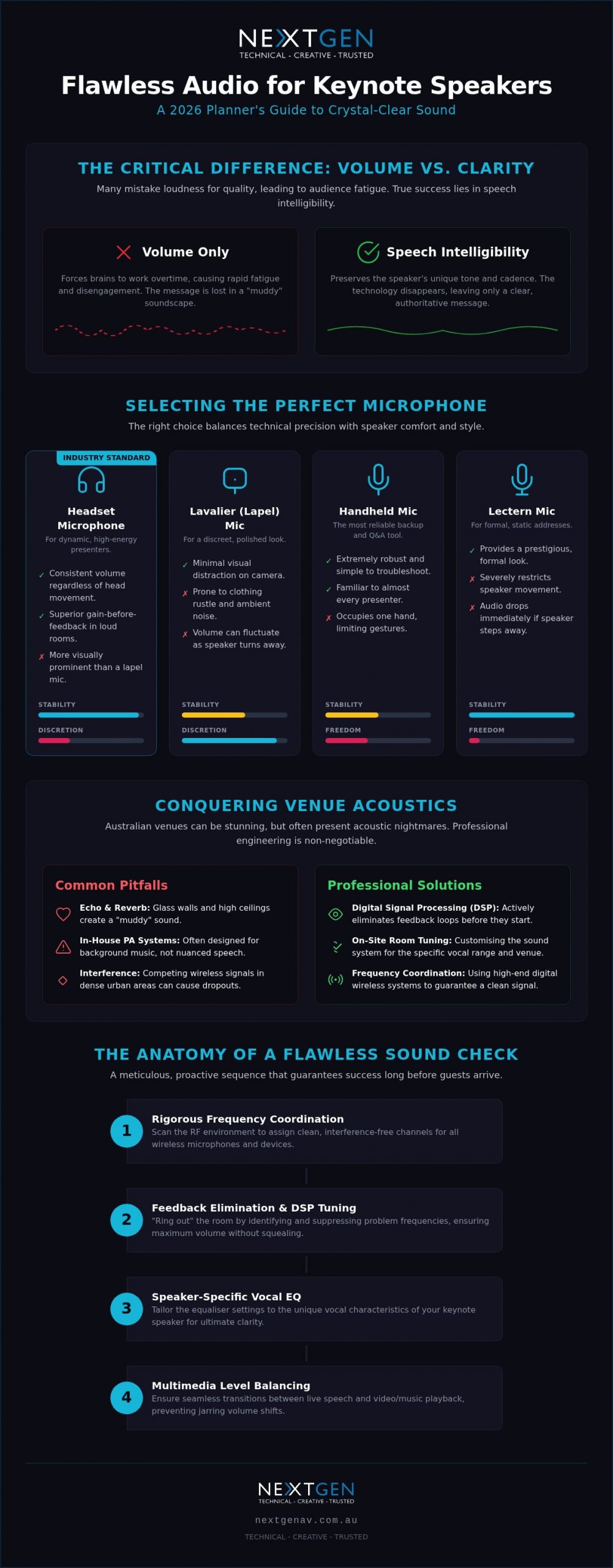
The choice of microphone is where technical precision meets the speaker’s personal comfort. It’s a decision that dictates how to ensure clear audio for keynote speakers while maintaining the visual polish of the stage. While many presenters prefer the discreet look of a lavalier (lapel) mic, these units come with technical trade-offs. Because the capsule is further from the mouth, they are more prone to picking up ambient room noise and clothing rustle. In contrast, headset microphones have become the industry gold standard for high-energy presenters. They keep the capsule at a fixed distance from the mouth, ensuring consistent volume regardless of where the speaker turns.

Handheld microphones remain the most reliable backup option in any technical rider. They are robust, simple to troubleshoot, and familiar to almost every speaker. For formal, static addresses, a lectern microphone provides a prestigious look but restricts the speaker’s movement. If the presenter steps away to point at a screen, the audio drops immediately. Choosing the right tool requires an understanding of the speaker’s movement and the room’s acoustics.

Headsets vs. Lavaliers: Making the Professional Choice

Headsets offer superior gain-before-feedback, which is crucial in loud rooms or venues with challenging acoustics. This technical advantage allows our engineers to push the volume higher before that dreaded squeal occurs. Lapel mics require specific attire; silk blouses or loose knits often lead to distracting rustle that no amount of engineering can fully remove. Briefing your keynote on placement is essential for their comfort and your peace of mind.

Wireless Reliability and Battery Management

In 2026, relying on outdated analogue wireless is a significant risk. High-end digital wireless systems are mandatory to avoid interference in crowded RF environments like the Melbourne CBD. Redundancy is the hallmark of a professional production. Every keynote should have a “plan B” microphone, usually a handheld, ready at the wings. Our team at NextGen AV utilises real-time telemetry to monitor signal strength and battery life down to the minute. If you want to partner with a team that specialises in professional audio systems, we provide the technical direction that ensures your event remains flawless.

The Anatomy of a Flawless Technical Sound Check

A sound check is the final barrier between a polished production and a technical disaster. It isn’t just a “check one, two” to see if the speakers are working. Instead, it’s a systematic protocol designed to stress-test the environment and the equipment before the first guest enters the room. This process allows our technical directors to identify potential points of failure and calibrate the system to the unique acoustics of the venue. A disciplined sound check ensures the speaker’s voice is the only thing the audience hears, free from the distractions of hums, pops, or signal dropouts.

Frequency Coordination in Urban Melbourne

The Melbourne CBD is one of the most crowded radio frequency (RF) environments in Australia. With hundreds of wireless devices operating simultaneously across Southbank, the Docklands, and the city centre, how to ensure clear audio for keynote speakers starts with rigorous frequency planning. Our engineers use dedicated software to scan the local RF spectrum, identifying clean channels and avoiding interference from nearby venues. This proactive approach protects your event from “walk-in” interference, a common issue in 2026 as wireless density continues to rise in urban hubs.

Once the RF is secure, we “ring out” the room. This technical procedure involves pushing the microphones to their limits to identify and neutralise the specific frequencies that cause feedback. By cutting these frequencies at the console, we create a stable environment where the speaker can move freely without the risk of a sudden squeal.

The “Speaker-Centred” Sound Check

Building rapport with your talent is a vital part of how to ensure clear audio for keynote speakers. Our technical directors work closely with the speaker to adjust EQ for their specific vocal characteristics. Whether they have a bass-heavy resonance that needs thinning or a sibilant tone that requires de-essing, we tailor the sound to ensure maximum intelligibility. We also provide a gentle brief on mic technique, ensuring they understand the “sweet spot” for their specific microphone without bruising their professional ego.

  • Setting precise levels for both the front-of-house mix and stage foldback monitors to prevent audio lag.
  • The speaker walk-through to test every corner of the stage, identifying potential dead zones where the wireless signal might dip.
  • Final cue check for introductory videos and walk-on music to ensure levels are perfectly balanced against the live microphone.

This methodical process ensures the speaker feels completely supported by the technology. When they can hear themselves clearly in the monitors without distortion, their confidence on stage grows. This psychological safety allows them to focus on their delivery, while we remain the invisible expert driving the success of the session.
Clear Audio for Keynote Speakers: 2026 Planner’s Guide

Eliminating Feedback and Environmental Interference

Feedback is the ultimate presentation killer. It occurs when a microphone captures its own output from the room’s speakers, creating a self-sustaining loop of screeching noise that instantly shatters the room’s atmosphere. Stopping it requires more than just turning down the fader; it requires an expert understanding of the room’s acoustic limits. Modern Digital Signal Processing (DSP) acts as the intelligent brain of the system, identifying these problematic frequencies in milliseconds and neutralising them before they become audible to the audience. This technology is also vital for managing “Room Bloom,” the build-up of muddy, low-end frequencies that often makes keynote speakers sound muffled in large Melbourne convention halls. You can see how professional sound system hire solves these issues by providing the precision tools and engineering expertise needed for high-stakes environments.

Strategic Speaker Placement and Room Tuning

Physics dictates how to ensure clear audio for keynote speakers. PA speakers must be positioned forward of the microphone line to minimise the risk of feedback loops. In longer venues, such as those found in Southbank’s larger hotels, relying on a single pair of speakers at the front leads to “hot spots” and “dead zones.” We deploy delay speakers further down the room, synchronised to the millisecond, to ensure even coverage for every guest. Just as importantly, we provide “Stage Fills” or foldback. These dedicated speakers allow the presenter to hear their own voice clearly, preventing them from over-projecting or losing their natural rhythm.

Managing External Noise and HVAC Interference

Environmental factors often introduce unwanted textures to the mix, especially in bustling city venues. The low-frequency hum of a heavy-duty air conditioning system or the constant whir of high-output projector fans can muddy a speaker’s clarity and increase audience fatigue. Our engineers use noise gates and precise filtering to keep the signal path pristine. These gates effectively “silence” the microphone the moment the speaker stops talking, preventing ambient venue noise from being amplified through the PA. This level of technical detail is a core part of how to ensure clear audio for keynote speakers in busy urban settings. When you choose to invest in professional technical direction, you ensure that external distractions never overshadow your speaker’s message, allowing the prestige of the event to remain the focus.

Partnering with NextGen AV for Seamless Keynote Production

Choosing the right partner means moving beyond simple equipment hire. It’s about securing a team that understands the high-stakes nature of live corporate events. At NextGen AV, we embrace the role of the “Invisible Expert.” We work tirelessly behind the scenes so that you can take the credit for a flawless, high-prestige production. With 30 years of experience across Melbourne’s most iconic venues, we’ve navigated every technical challenge imaginable. Our goal is to alleviate your stress by projecting absolute competence from the first site visit to the final applause. Discover our full service event production capabilities to see how we integrate every technical element into a single, cohesive experience.

Why Technical Direction is Essential for Keynotes

A Technical Director (TD) is the conductor of your event’s orchestra. While audio is critical, it must exist in perfect harmony with lighting design and high-resolution LED video walls. The TD synchronises these elements to ensure that when a speaker walks on stage, the transition is seamless and impactful. We manage the “Show Flow” with surgical precision, allowing for smooth switches between live speech and multimedia content. Beyond the technicalities, we act as a reassuring presence for your speakers. If a keynote presenter feels last-minute technical anxieties, our team is there to offer calm, professional support, ensuring they step onto the stage with total confidence.

Professional Audio Hire in Melbourne: Why Expertise Matters

Success in 2026 requires more than just a box of microphones. It requires access to world-class hardware from industry leaders like Shure, Sennheiser, and D&B Audiotechnik. However, even the best gear fails without expert calibration. This is why how to ensure clear audio for keynote speakers always involves a dedicated on-site sound engineer who can react in real-time to the room’s energy. We don’t just provide professional audio systems; we provide the technical direction that guarantees intelligibility in every seat. If you are ready to elevate your next production, contact NextGen AV for a bespoke audio solution for your next event.

Deliver a Flawless Message on Every Stage

Mastering the nuances of microphone selection and frequency coordination is the first step toward a distraction-free event. When you understand how to ensure clear audio for keynote speakers, you move from merely managing equipment to orchestrating a prestigious experience where every word carries weight. High-stakes presentations in 2026 demand more than just standard gear. They require a proactive approach to acoustics and signal integrity that only comes with seasoned expertise.

With 30+ years of industry experience and a reputation as Melbourne’s leading professional audio specialists, NextGen AV provides the expert on-site technical direction needed to secure your event’s success. We act as your invisible experts, handling the complex engineering so you can focus on the applause. Ensure your next keynote is heard perfectly with NextGen AV. Your speaker’s message is too important to be left to chance. Let’s make it unforgettable.

Frequently Asked Questions

Is a lapel microphone or a headset better for a keynote speaker?

Headset microphones are the professional choice for clarity and stability. Because the capsule stays at a fixed distance from the speaker’s mouth, the volume remains consistent even if they turn their head to look at a screen. Lapel microphones are discreet but often pick up distracting clothing rustle and are more prone to feedback in echoey Melbourne venues. For a high-stakes presentation, a headset provides the most reliable results.

Can I use the venue’s built-in sound system for a professional keynote?

In-house systems are typically designed for background music or basic paging rather than high-impact speech. They often lack the precision tuning and processing required for crystal-clear delivery in a crowded room. Bringing in a dedicated professional audio system ensures the equipment is tailored to your specific room layout and speaker’s vocal range. This is a vital step in how to ensure clear audio for keynote speakers without compromising on quality.

How much time should I allocate for a keynote sound check?

You should ideally allocate 15 to 20 minutes for each keynote speaker’s technical run. This time isn’t just for a basic volume check; it allows the speaker to get comfortable with the stage acoustics and the foldback monitors. A disciplined sound check gives our engineers the chance to fine-tune the EQ for the speaker’s unique voice, ensuring they sound authoritative and clear the moment they step on stage.

What happens if there is wireless interference during the speech?

Our engineers use real-time monitoring to identify interference before it becomes audible. If a signal conflict occurs, we can switch to a pre-coordinated backup frequency or a secondary “Plan B” microphone instantly. High-end digital systems allow for these seamless transitions, ensuring the audience remains focused on the message. This proactive management is why on-site technical direction is essential in the crowded radio environment of the Melbourne CBD.

How do I prevent audio feedback when the speaker walks near the speakers?

We prevent feedback through strategic PA placement and “ringing out” the room during setup. By identifying and cutting problematic frequencies at the console, we create a stable environment for the presenter to move freely. Directional microphones also help by rejecting sound from the rear. These technical measures are fundamental to how to ensure clear audio for keynote speakers who prefer to roam the stage or interact closely with the audience.

What is frequency coordination and why does it matter for my event?

Frequency coordination is the process of mapping the local radio spectrum to ensure no wireless devices overlap. In busy urban hubs like Southbank or the city centre, this prevents your microphones from picking up interference from nearby venues or emergency services. We use specialised software to scan for local traffic and assign clean, legal frequencies to every wireless unit. This level of precision is what guarantees a signal path free from dropouts.

Can NextGen AV provide audio for hybrid events with remote speakers?

Yes, we specialise in virtual and hybrid event solutions that seamlessly integrate remote presenters into the live environment. We use professional-grade audio interfaces to ensure remote speakers sound as clear as those physically present on the stage. Our technical directors balance the audio levels perfectly for both the in-room PA and the online stream, ensuring a unified experience for every attendee, regardless of their location.

What if the most profound insight of your event’s headline session is lost to the echo of a cavernous Melbourne ballroom or the jarring screech of a feedback loop? You’ve spent months meticulously organising every detail, yet the entire experience hinges on a signal path that most attendees only notice when it fails. It’s a high-stakes gamble that often keeps even the most seasoned event planners awake at night. Learning how to ensure clear audio for keynote speakers isn’t just about hiring expensive gear; it’s about the invisible orchestration of sound that allows a message to resonate without distraction.

We understand that nothing undermines a speaker’s authority faster than a muffled microphone or a sudden drop in volume as they move across the stage. You deserve the confidence that comes with a seamless, professional production where the technology serves as a silent partner rather than a technical hurdle. This 2026 planner’s guide reveals the technical essentials and professional secrets used by elite technical directors to deliver flawless, crystal-clear audio. We’ll explore advanced wireless microphone configurations, the nuances of managing sound in echo-prone venues, and the proactive engineering steps that guarantee your session earns glowing attendee feedback.

Key Takeaways

  • Distinguish between simple volume and speech intelligibility to prevent audience fatigue and ensure every word resonates with clarity.
  • Select the ideal microphone for your speaker’s physical presenting style, whether they prefer a discreet lapel or a high-stability headset.
  • Master the professional sound check sequence and how to ensure clear audio for keynote speakers through rigorous frequency coordination.
  • Deploy digital signal processing to eliminate feedback loops and manage the acoustic challenges of echo-prone Melbourne venues.
  • Leverage 30 years of technical direction to remove the stress of live audio, leaving you free to focus on the event’s prestige.

Why Audio Quality is the Make-or-Break Factor for Keynote Success

When a keynote speaker takes the stage, they carry the weight of your organisation’s vision. Every word is a strategic asset. If that message is garbled by a low-quality sound system, the investment in the speaker is essentially nullified. Many planners mistake sheer volume for clarity, but the two are worlds apart. Volume is simply sound pressure; clarity is the preservation of the speaker’s unique cadence and tone. Poor audio quality forces the audience’s brain to work overtime to fill in the gaps of missing syllables. This increased cognitive load leads to rapid audience fatigue, causing guests to check their phones or lose interest before the halfway mark. Ultimately, a speaker’s perceived authority is tied directly to the fidelity of their voice. If they sound thin, muffled, or distorted, their message loses its prestige.

The Psychology of Sound in Professional Presentations

High-fidelity sound creates an immediate sense of intimacy and trust between the presenter and the room. When the audio is pristine, the technology disappears, leaving only the speaker’s authority and the audience’s attention. This is the “Invisible Expert” approach, where technical mastery ensures the focus remains entirely on the message. Audio intelligibility serves as the fundamental bedrock of event ROI because a message that isn’t heard clearly is a message that cannot be acted upon. Crystal-clear sound allows for an emotional connection that resonates long after the session ends.

Identifying Common Audio Pitfalls in Australian Venues

Melbourne’s architectural landscape features stunning, glass-walled boardrooms and industrial-chic warehouses that are often acoustic nightmares. These spaces reflect sound waves, creating a “muddy” environment where voices overlap and lose definition. Relying solely on a venue’s “in-house” PA system is a common trap. These systems are often designed for background music or basic announcements, not for the nuanced requirements of a dynamic keynote. Understanding how to ensure clear audio for keynote speakers involves more than just plugging into a wall; it requires on-site engineering to tune the room for the specific vocal range of your talent.

Professional technical direction also manages the delicate transition between live speech and high-impact multimedia audio. Without this oversight, volume levels often fluctuate wildly, jarring the audience and breaking the flow of the presentation. Mastering how to ensure clear audio for keynote speakers means anticipating these environmental variables long before the first guest arrives, protecting your corporate reputation from the “good enough” audio trap.

Selecting the Perfect Microphone for Your Speaker’s Style

The choice of microphone is where technical precision meets the speaker’s personal comfort. It’s a decision that dictates how to ensure clear audio for keynote speakers while maintaining the visual polish of the stage. While many presenters prefer the discreet look of a lavalier (lapel) mic, these units come with technical trade-offs. Because the capsule is further from the mouth, they are more prone to picking up ambient room noise and clothing rustle. In contrast, headset microphones have become the industry gold standard for high-energy presenters. They keep the capsule at a fixed distance from the mouth, ensuring consistent volume regardless of where the speaker turns.

Handheld microphones remain the most reliable backup option in any technical rider. They are robust, simple to troubleshoot, and familiar to almost every speaker. For formal, static addresses, a lectern microphone provides a prestigious look but restricts the speaker’s movement. If the presenter steps away to point at a screen, the audio drops immediately. Choosing the right tool requires an understanding of the speaker’s movement and the room’s acoustics.

Headsets vs. Lavaliers: Making the Professional Choice

Headsets offer superior gain-before-feedback, which is crucial in loud rooms or venues with challenging acoustics. This technical advantage allows our engineers to push the volume higher before that dreaded squeal occurs. Lapel mics require specific attire; silk blouses or loose knits often lead to distracting rustle that no amount of engineering can fully remove. Briefing your keynote on placement is essential for their comfort and your peace of mind.

Wireless Reliability and Battery Management

In 2026, relying on outdated analogue wireless is a significant risk. High-end digital wireless systems are mandatory to avoid interference in crowded RF environments like the Melbourne CBD. Redundancy is the hallmark of a professional production. Every keynote should have a “plan B” microphone, usually a handheld, ready at the wings. Our team at NextGen AV utilises real-time telemetry to monitor signal strength and battery life down to the minute. If you want to partner with a team that specialises in professional audio systems, we provide the technical direction that ensures your event remains flawless.

The Anatomy of a Flawless Technical Sound Check

A sound check is the final barrier between a polished production and a technical disaster. It isn’t just a “check one, two” to see if the speakers are working. Instead, it’s a systematic protocol designed to stress-test the environment and the equipment before the first guest enters the room. This process allows our technical directors to identify potential points of failure and calibrate the system to the unique acoustics of the venue. A disciplined sound check ensures the speaker’s voice is the only thing the audience hears, free from the distractions of hums, pops, or signal dropouts.

Frequency Coordination in Urban Melbourne

The Melbourne CBD is one of the most crowded radio frequency (RF) environments in Australia. With hundreds of wireless devices operating simultaneously across Southbank, the Docklands, and the city centre, how to ensure clear audio for keynote speakers starts with rigorous frequency planning. Our engineers use dedicated software to scan the local RF spectrum, identifying clean channels and avoiding interference from nearby venues. This proactive approach protects your event from “walk-in” interference, a common issue in 2026 as wireless density continues to rise in urban hubs.

Once the RF is secure, we “ring out” the room. This technical procedure involves pushing the microphones to their limits to identify and neutralise the specific frequencies that cause feedback. By cutting these frequencies at the console, we create a stable environment where the speaker can move freely without the risk of a sudden squeal.

The “Speaker-Centred” Sound Check

Building rapport with your talent is a vital part of how to ensure clear audio for keynote speakers. Our technical directors work closely with the speaker to adjust EQ for their specific vocal characteristics. Whether they have a bass-heavy resonance that needs thinning or a sibilant tone that requires de-essing, we tailor the sound to ensure maximum intelligibility. We also provide a gentle brief on mic technique, ensuring they understand the “sweet spot” for their specific microphone without bruising their professional ego.

  • Setting precise levels for both the front-of-house mix and stage foldback monitors to prevent audio lag.
  • The speaker walk-through to test every corner of the stage, identifying potential dead zones where the wireless signal might dip.
  • Final cue check for introductory videos and walk-on music to ensure levels are perfectly balanced against the live microphone.

This methodical process ensures the speaker feels completely supported by the technology. When they can hear themselves clearly in the monitors without distortion, their confidence on stage grows. This psychological safety allows them to focus on their delivery, while we remain the invisible expert driving the success of the session.

Eliminating Feedback and Environmental Interference

Feedback is the ultimate presentation killer. It occurs when a microphone captures its own output from the room’s speakers, creating a self-sustaining loop of screeching noise that instantly shatters the room’s atmosphere. Stopping it requires more than just turning down the fader; it requires an expert understanding of the room’s acoustic limits. Modern Digital Signal Processing (DSP) acts as the intelligent brain of the system, identifying these problematic frequencies in milliseconds and neutralising them before they become audible to the audience. This technology is also vital for managing “Room Bloom,” the build-up of muddy, low-end frequencies that often makes keynote speakers sound muffled in large Melbourne convention halls. You can see how professional sound system hire solves these issues by providing the precision tools and engineering expertise needed for high-stakes environments.

Strategic Speaker Placement and Room Tuning

Physics dictates how to ensure clear audio for keynote speakers. PA speakers must be positioned forward of the microphone line to minimise the risk of feedback loops. In longer venues, such as those found in Southbank’s larger hotels, relying on a single pair of speakers at the front leads to “hot spots” and “dead zones.” We deploy delay speakers further down the room, synchronised to the millisecond, to ensure even coverage for every guest. Just as importantly, we provide “Stage Fills” or foldback. These dedicated speakers allow the presenter to hear their own voice clearly, preventing them from over-projecting or losing their natural rhythm.

Managing External Noise and HVAC Interference

Environmental factors often introduce unwanted textures to the mix, especially in bustling city venues. The low-frequency hum of a heavy-duty air conditioning system or the constant whir of high-output projector fans can muddy a speaker’s clarity and increase audience fatigue. Our engineers use noise gates and precise filtering to keep the signal path pristine. These gates effectively “silence” the microphone the moment the speaker stops talking, preventing ambient venue noise from being amplified through the PA. This level of technical detail is a core part of how to ensure clear audio for keynote speakers in busy urban settings. When you choose to invest in professional technical direction, you ensure that external distractions never overshadow your speaker’s message, allowing the prestige of the event to remain the focus.

Partnering with NextGen AV for Seamless Keynote Production

Choosing the right partner means moving beyond simple equipment hire. It’s about securing a team that understands the high-stakes nature of live corporate events. At NextGen AV, we embrace the role of the “Invisible Expert.” We work tirelessly behind the scenes so that you can take the credit for a flawless, high-prestige production. With 30 years of experience across Melbourne’s most iconic venues, we’ve navigated every technical challenge imaginable. Our goal is to alleviate your stress by projecting absolute competence from the first site visit to the final applause. Discover our full service event production capabilities to see how we integrate every technical element into a single, cohesive experience.

Why Technical Direction is Essential for Keynotes

A Technical Director (TD) is the conductor of your event’s orchestra. While audio is critical, it must exist in perfect harmony with lighting design and high-resolution LED video walls. The TD synchronises these elements to ensure that when a speaker walks on stage, the transition is seamless and impactful. We manage the “Show Flow” with surgical precision, allowing for smooth switches between live speech and multimedia content. Beyond the technicalities, we act as a reassuring presence for your speakers. If a keynote presenter feels last-minute technical anxieties, our team is there to offer calm, professional support, ensuring they step onto the stage with total confidence.

Professional Audio Hire in Melbourne: Why Expertise Matters

Success in 2026 requires more than just a box of microphones. It requires access to world-class hardware from industry leaders like Shure, Sennheiser, and D&B Audiotechnik. However, even the best gear fails without expert calibration. This is why how to ensure clear audio for keynote speakers always involves a dedicated on-site sound engineer who can react in real-time to the room’s energy. We don’t just provide professional audio systems; we provide the technical direction that guarantees intelligibility in every seat. If you are ready to elevate your next production, contact NextGen AV for a bespoke audio solution for your next event.

Deliver a Flawless Message on Every Stage

Mastering the nuances of microphone selection and frequency coordination is the first step toward a distraction-free event. When you understand how to ensure clear audio for keynote speakers, you move from merely managing equipment to orchestrating a prestigious experience where every word carries weight. High-stakes presentations in 2026 demand more than just standard gear. They require a proactive approach to acoustics and signal integrity that only comes with seasoned expertise.

With 30+ years of industry experience and a reputation as Melbourne’s leading professional audio specialists, NextGen AV provides the expert on-site technical direction needed to secure your event’s success. We act as your invisible experts, handling the complex engineering so you can focus on the applause. Ensure your next keynote is heard perfectly with NextGen AV. Your speaker’s message is too important to be left to chance. Let’s make it unforgettable.

Frequently Asked Questions

Is a lapel microphone or a headset better for a keynote speaker?

Headset microphones are the professional choice for clarity and stability. Because the capsule stays at a fixed distance from the speaker’s mouth, the volume remains consistent even if they turn their head to look at a screen. Lapel microphones are discreet but often pick up distracting clothing rustle and are more prone to feedback in echoey Melbourne venues. For a high-stakes presentation, a headset provides the most reliable results.

Can I use the venue’s built-in sound system for a professional keynote?

In-house systems are typically designed for background music or basic paging rather than high-impact speech. They often lack the precision tuning and processing required for crystal-clear delivery in a crowded room. Bringing in a dedicated professional audio system ensures the equipment is tailored to your specific room layout and speaker’s vocal range. This is a vital step in how to ensure clear audio for keynote speakers without compromising on quality.

How much time should I allocate for a keynote sound check?

You should ideally allocate 15 to 20 minutes for each keynote speaker’s technical run. This time isn’t just for a basic volume check; it allows the speaker to get comfortable with the stage acoustics and the foldback monitors. A disciplined sound check gives our engineers the chance to fine-tune the EQ for the speaker’s unique voice, ensuring they sound authoritative and clear the moment they step on stage.

What happens if there is wireless interference during the speech?

Our engineers use real-time monitoring to identify interference before it becomes audible. If a signal conflict occurs, we can switch to a pre-coordinated backup frequency or a secondary “Plan B” microphone instantly. High-end digital systems allow for these seamless transitions, ensuring the audience remains focused on the message. This proactive management is why on-site technical direction is essential in the crowded radio environment of the Melbourne CBD.

How do I prevent audio feedback when the speaker walks near the speakers?

We prevent feedback through strategic PA placement and “ringing out” the room during setup. By identifying and cutting problematic frequencies at the console, we create a stable environment for the presenter to move freely. Directional microphones also help by rejecting sound from the rear. These technical measures are fundamental to how to ensure clear audio for keynote speakers who prefer to roam the stage or interact closely with the audience.

What is frequency coordination and why does it matter for my event?

Frequency coordination is the process of mapping the local radio spectrum to ensure no wireless devices overlap. In busy urban hubs like Southbank or the city centre, this prevents your microphones from picking up interference from nearby venues or emergency services. We use specialised software to scan for local traffic and assign clean, legal frequencies to every wireless unit. This level of precision is what guarantees a signal path free from dropouts.

Can NextGen AV provide audio for hybrid events with remote speakers?

Yes, we specialise in virtual and hybrid event solutions that seamlessly integrate remote presenters into the live environment. We use professional-grade audio interfaces to ensure remote speakers sound as clear as those physically present on the stage. Our technical directors balance the audio levels perfectly for both the in-room PA and the online stream, ensuring a unified experience for every attendee, regardless of their location.

Back to Articles

Discover Valuable Insights

Unlock Expert Tips and Advice

Our blog is packed with valuable information to help you stay ahead. Whether you’re looking for expert advice, industry trends, or practical tips, you’ll find everything you need. Reach out today to learn more or get in touch with us for personalised support!

Contact Us

Request A Quote

Make an
Enquiry

Clear Audio for Keynote Speakers: 2026 Planner’s Guide

Let’s Get Your Event Sorted

Complete the enquiry form with your event date, venue, audience size, event type and budget. Our Melbourne AV team will review your requirements and recommend the right PA, screen, lighting, staging or production setup for your event.

What happens next?


1.We review your event details
Tell us your date, venue, audience size and event type.

2.We recommend the right setup
From PA hire to screens, lighting, staging and full AV production.

3. We come back with clear advice
You’ll receive practical recommendations and a fast quote from our Melbourne team.

Need help urgently?
Call 1300 637 302.

Make an Enquiry

"*" indicates required fields

Resource Download

Tell us a bit about yourself to download our resources.