


In the high-pressure environment of a Melbourne event, an outdoor screen is never just a piece of equipment; it is either a cinematic masterpiece or a costly, unreadable shadow. Most event organisers know the frustration of seeing a carefully curated video washed out by the midday sun or, worse, watching a screen go dark the moment a Port Phillip Bay squall hits. You’ve likely felt that knot of anxiety when technical specs don’t quite match the reality of a bright, outdoor setting. When you invest in outdoor led screen hire melbourne, you aren’t just looking for a display; you’re seeking a guarantee of visual dominance and absolute reliability.
This guide will empower you to master the technical essentials of outdoor digital displays, ensuring your content remains vibrant and visible regardless of the conditions. We will demystify the complex relationship between pixel pitch and viewing distance, explain why brightness nits are your best defence against glare, and explore the rugged IP ratings required for Melbourne’s unpredictable climate. By the end of this technical briefing, you will have the expertise to orchestrate a seamless visual experience that captures every eye in the crowd.
Key Takeaways
- Identify why high-brightness LED technology is the only reliable way to combat direct sunlight in iconic Melbourne locations like Federation Square.
- Decode the technical specifications of pixel pitch and refresh rates to guarantee your content looks sharp and professional on every camera lens.
- Compare the rapid deployment of mobile LED trucks against the customisable artistry of modular walls to find the ideal fit for your outdoor led screen hire melbourne.
- Master the essential logistics of power supply, council permits, and wind-ballast requirements to keep your structure secure and compliant.
- Appreciate how professional technical direction alleviates the stress of high-stakes planning by ensuring every frame of your production is executed with precision.
Why Outdoor LED Screen Hire is Essential for Melbourne Events
Melbourne’s event calendar is a relentless parade of high-stakes moments, from international sporting fixtures to prestigious corporate activations in the heart of the CBD. In these competitive environments, capturing attention isn’t just about size; it’s about overcoming the elements. Traditional projection systems, while useful for darkened theatres, simply cannot compete with the sheer luminance of the Australian sun. Choosing outdoor led screen hire melbourne ensures your message isn’t just present, but dominant. Unlike projectors that wash out under the slightest ambient light, modern LED display technology emits its own light, delivering crisp, high-contrast imagery that commands the gaze of passersby at Federation Square or along the Southbank promenade. This visual power creates a psychological gravity, pulling an audience in and signaling that your brand is a major player on the city’s stage.
Daylight Visibility and the “Nit” Factor
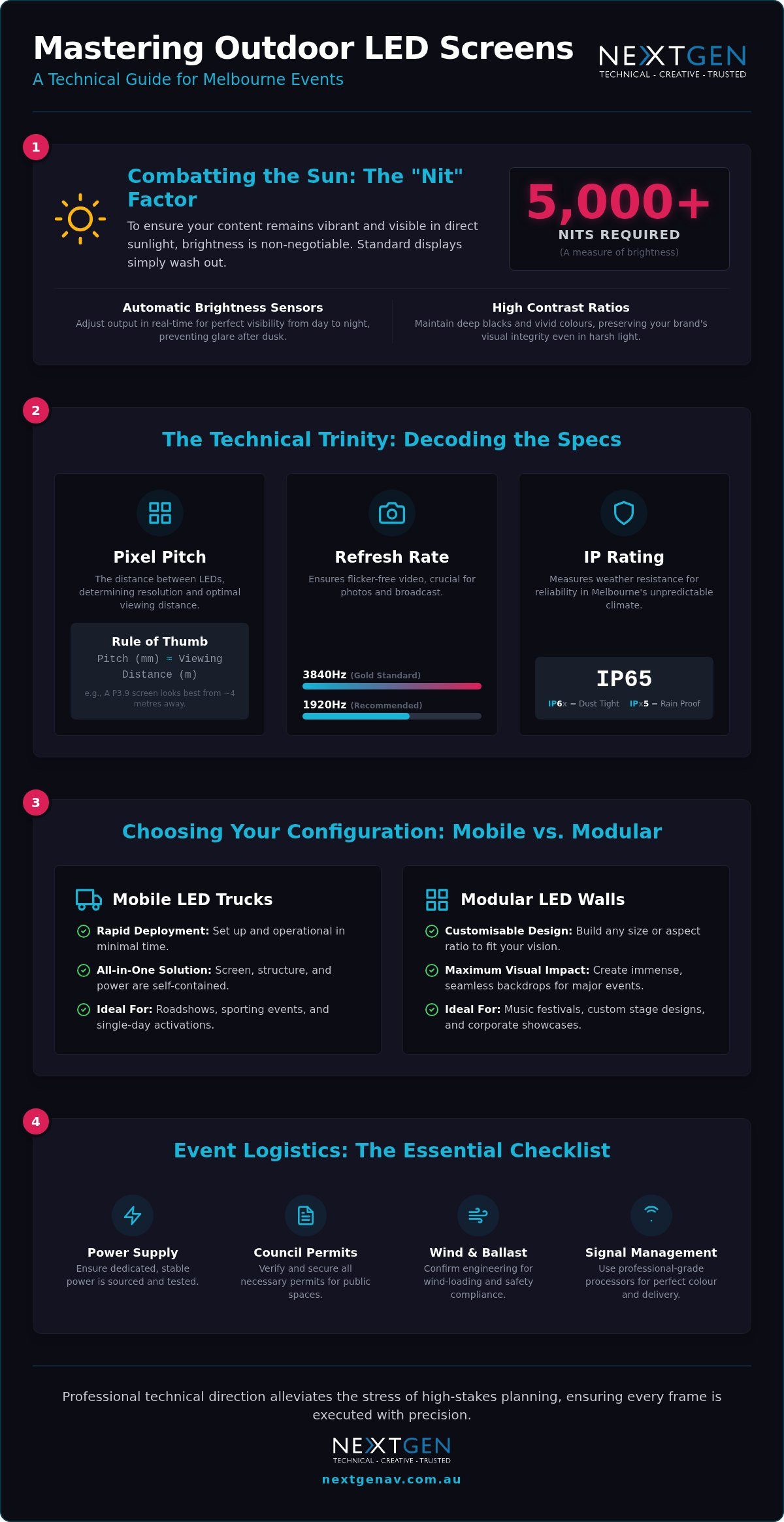
To cut through the harsh glare of a Victorian summer, professional-grade screens must produce at least 5,000 nits of brightness. This isn’t a luxury; it’s a technical necessity for visibility. A nit is a measurement of light over a square metre, and without this high output, your content will appear muddy and uninspired. Sophisticated systems utilise automatic brightness sensors to adjust output in real-time. This prevents the screen from blinding viewers as dusk falls over the Yarra, ensuring visual comfort throughout the day. High contrast ratios are equally vital. They maintain deep blacks and vibrant colours, preserving your brand’s visual integrity even when the sun is at its zenith. When you orchestrate a visual experience in high-footfall areas, these technical nuances determine whether people stop to watch or simply walk past.
Scalability for Melbourne Crowds
The beauty of modular design lies in its limitless adaptability. Whether you’re hosting a boutique product launch or a massive community festival, modular panels allow for custom aspect ratios that fit your specific site layout. Beyond the aesthetics, large-format screens play a critical role in event safety. By providing clear visuals to the back of the pack, they reduce the need for attendees to surge forward, effectively preventing crowd crushing in dense environments. Integrating live social media feeds or interactive content further transforms a passive viewing experience into a participatory event. This level of engagement boosts your brand’s reach and ensures your outdoor led screen hire melbourne delivers a return on investment that goes far beyond the screen itself. You aren’t just renting gear; you’re building an immersive environment that resonates long after the pack-down is complete.
The Technical Essentials: Pixel Pitch, Refresh Rates, and IP Ratings
Mastering the technical landscape of digital displays is what separates a standard event from a prestigious production. When you engage with outdoor led screen hire melbourne, the terminology can feel dense, yet these specifications are the direct architects of your audience’s visual experience. Pixel pitch, for instance, represents the millimetre distance between the centre of each LED cluster. This measurement dictates the “sweet spot” for viewing. A reliable rule of thumb is to match the pitch to the distance in metres; a P3.9 panel requires a minimum four-metre gap for the human eye to perceive a seamless, fluid image rather than individual dots of light.
In our modern, social-media-driven environment, the refresh rate is just as critical as resolution. We recommend a refresh rate of 1920Hz or higher, with 3840Hz being the gold standard for high-stakes broadcasts. This ensures that when attendees capture photos or videos of your screen, they don’t see distracting black scan lines or flickering. Behind every successful display sits a robust signal management system, typically powered by Novastar processing. This industry-standard technology acts as the brain of the operation, ensuring that every frame is delivered with surgical precision and perfect colour calibration across the entire video wall.
Choosing the Right Pixel Pitch for Your Venue
Selecting the ideal resolution is a balance of viewer proximity and budgetary logic. While it’s tempting to opt for the finest pitch available, a P2.6 screen might be overkill for a large-scale music festival where the closest fan is ten metres from the stage. In these scenarios, a P4.8 or P8 panel provides immense visual impact while offering the higher brightness levels needed to combat direct sunlight. You aren’t just buying pixels; you’re investing in the appropriate level of detail for your specific crowd dynamic. Matching the hardware to the viewing distance ensures every guest enjoys a premium experience without unnecessary expenditure on invisible detail.
Weatherproofing and Mechanical Reliability
Melbourne’s reputation for “four seasons in one day” is a constant factor in our technical planning. To ensure a glitch-free execution, your equipment must carry an IP65 rating at a minimum. This ensures the cabinets are completely dust-tight and protected against driving rain from any direction. Mechanical reliability also extends to the cabling; we utilise professional PowerCON connectors to maintain watertight electrical integrity in the most demanding conditions. Thermal management is the final piece of the puzzle. High-efficiency internal cooling systems prevent the LEDs from overheating during a classic Victorian heatwave, preserving the lifespan and colour accuracy of the display. If you’re currently mapping out your site requirements, the experts at NextGen AV can provide a tailored technical assessment to ensure your rig is truly bulletproof.
Mobile vs. Modular: Which Configuration Suits Your Event?
Choosing the right delivery method for your outdoor led screen hire melbourne is a pivotal decision that dictates your event’s operational rhythm and visual prestige. While the core technology remains consistent, the delivery platform defines how quickly you can go live and how seamlessly the display integrates into your venue’s architecture. Mobile units offer unparalleled speed for rapid deployments, while modular builds provide the bespoke flexibility required for high-concept, custom productions. Understanding the trade-offs between these two configurations is essential for any professional event organiser.
The Fast-Track Choice: Trailer and Truck Mounted Screens
The Bespoke Choice: Modular LED Video Walls
When your vision requires more than a standard 16:9 rectangle, modular LED walls offer the artistry of a custom build. These systems consist of individual panels that our technicians assemble on-site to create ultra-wide panoramas, curved displays, or even vertical columns. This configuration allows for “flown” (hanging) setups, where the screen is suspended from a professional rigging system to create a floating effect that maintains clear sightlines over massive crowds. To create a truly immersive environment, these walls are often integrated with a professional sound system hire, ensuring that the sonic experience is as crisp and powerful as the visuals.
Aesthetics play a crucial role in your final selection. While a trailer is functional for a sporting event, it can appear industrial and out of place at a high-end corporate gala. In these sophisticated settings, a modular wall built into a custom stage set provides a polished, permanent look that elevates the prestige of the brand. Deciding between ground-stacked or flown configurations also depends on your site’s ground stability and wind loading requirements. By choosing the configuration that matches your venue’s soul, you ensure the technical execution feels like a natural extension of the event’s design rather than an afterthought.
Planning Your Melbourne Event: Power, Permits, and Positioning
Behind every flawless visual display is a complex web of logistical foresight and regulatory compliance. Navigating the requirements for outdoor led screen hire melbourne requires more than just technical skill; it demands an intimate knowledge of local governance. For instance, any temporary structure or sign exceeding 8 square metres typically requires a planning permit under Clause 52.05 of the Victoria Planning Provisions. These approvals can take three to six months to secure, making early engagement with a technical partner essential. Beyond the paperwork, the physical positioning of your screen must account for Melbourne’s “Roaring Forties” winds. We calculate ballast requirements with surgical precision to ensure your rig remains immovable, even when the bay breezes turn into a gale.
Power distribution is the hidden engine of your production. High-brightness outdoor panels draw significant current, often requiring dedicated three-phase power or specialised generators. We map out these electrical loads during pre-production to prevent mid-event blackouts. Site access also presents unique hurdles, particularly when navigating heavy equipment through narrow CBD laneways or sensitive parklands. Our team orchestrates these movements with tactical precision, ensuring the gear arrives safely without disrupting the local urban flow.
Melbourne Weather Contingency Planning
A true weatherproof strategy involves more than just waterproof cabinets. It requires a rigorous wind-action plan. We define clear safety thresholds, such as specific wind speeds at which a flown screen must be lowered to the ground. Positioning is equally critical for the viewer’s comfort. By orienting the screen to avoid the direct glare of the low afternoon sun, we preserve the high-contrast impact of your content. We also prioritise the safety of our technical crew, ensuring they have the protective gear and structural support to operate efficiently during extreme Victorian heat or driving rain.
Logistics and Site Management
In high-traffic areas like Southbank, cable management is a non-negotiable safety priority. We utilise heavy-duty cable ramps and recessed channels to eliminate trip hazards, maintaining a clean and professional site aesthetic. Reliability is further bolstered by signal redundancy. We run primary and backup video lines for every installation, providing an invisible safety net that keeps the show running if a single cable fails. This level of detail is most effective when we coordinate closely with stage and lighting hire Melbourne, creating a unified technical rig where every element supports the other. If you’re ready to begin the planning phase, contact the NextGen AV team for a comprehensive site consultation.
NextGen AV: Professional Technical Direction for Melbourne
Successful event execution requires more than just a delivery truck and a stack of LED panels. While the hardware provides the canvas, it is the technical direction that paints the masterpiece. Engaging with outdoor led screen hire melbourne through NextGen AV means you aren’t just renting gear; you are securing a 30-year legacy of Melbourne event production. We act as your “Invisible Expert,” the engine behind the scenes that allows you to take centre stage with absolute confidence. Our approach is defined by proactive problem solving, where we anticipate logistical hurdles before they manifest as on-site delays. From the initial 3D renders that visualise your screen’s impact to the final pack-down under the city lights, we provide a structured, cinematic flow to your production.
Expertise in High-Stakes Production
Our team thrives under the pressure of high-stakes corporate and government activations where failure is not an option. We provide a single, authoritative point of contact for full service event production, ensuring that your visuals, audio, and staging work in perfect harmony. This holistic mastery was demonstrated during a recent multi-screen outdoor activation in the CBD, where we managed synchronised content across three separate modular walls, maintaining frame-perfect alignment despite complex site topography and varying light conditions. By centralising your technical needs, you eliminate the risk of miscommunication between multiple vendors, resulting in a polished and prestigious result.
Get a Professional Quote for Your Next Melbourne Event
Securing an accurate quote for outdoor led screen hire melbourne starts with a detailed brief. We look beyond the dimensions of the screen to understand your audience’s viewing distance, the site’s power availability, and the specific orientation of the sun during your peak hours. This level of detail allows our technical engineers to provide a bespoke solution rather than a generic price list. We often recommend a site visit during the pre-production phase. This allows us to identify potential rigging points, assess ground stability, and plan the most efficient cable runs. Contact the NextGen AV team today to begin a partnership that transforms your technical requirements into a seamless, high-impact visual experience.
Command the City Stage
Mastering the technical nuances of outdoor displays ensures your brand remains the focal point, even under the most demanding Victorian conditions. We’ve explored how the right pixel pitch and IP65-rated reliability form the backbone of a successful rig, while proactive planning for permits and power distribution eliminates the risk of mid-event failure. When you choose outdoor led screen hire melbourne, you’re investing in more than just pixels; you’re securing a legacy of visual excellence.
At NextGen AV, we bring over 30 years of Melbourne event experience to every production. We provide high-resolution, all-weather LED technology paired with expert technical direction to ensure your event is flawless. Our team handles the logistical grind so you can focus on the prestige of your final result. Let’s transform your vision into a cinematic reality that resonates with every attendee. Request a Technical Consultation for Your Melbourne Event and ensure your next activation is executed with surgical precision. Your audience is waiting; let’s give them something unforgettable.
Frequently Asked Questions
Is an outdoor LED screen hire Melbourne weather-proof for rain?
Professional outdoor LED screens are engineered to be fully rainproof, carrying an IP65 rating at minimum to ensure total protection against water ingress and dust. This technical standard is essential for the unpredictable Melbourne climate, where weather can shift rapidly. Our cabinets utilise specialised seals and waterproof connectors to maintain electrical integrity during heavy downpours. We also provide technical direction to monitor weather patterns and ensure the rig remains safe and operational throughout your event.
How much does it cost to hire an outdoor LED screen in Melbourne?
The investment for outdoor led screen hire melbourne depends on several variables, including screen dimensions, pixel pitch, and the duration of your event. Additional factors like delivery logistics, custom rigging requirements, and the level of on-site technical support also influence the final quote. Because every high-stakes production has unique needs, we recommend a site consultation. This allows our engineers to calculate a precise fee based on your specific technical brief and venue constraints.
What is the difference between an indoor and outdoor LED screen?
The primary differences lie in luminance and environmental protection. Outdoor displays are significantly brighter, typically producing over 5,000 nits to remain visible against direct sunlight, whereas indoor screens usually hover around 1,000 nits. Additionally, outdoor panels feature ruggedised, weatherproof housing and internal cooling systems to handle exposure to the elements. Indoor screens prioritise a finer pixel pitch for close-up viewing but lack the mechanical seals required to survive a Victorian rainstorm or extreme heatwave.
Do I need a generator for an outdoor LED video wall?
Whether you require a generator depends entirely on the existing power infrastructure at your Melbourne venue. Large-scale LED video walls have a high electrical draw that often exceeds standard domestic outlets, frequently requiring three-phase power. For events in remote parklands or public squares where mains access is unavailable, we can supply silenced, event-grade generators. Our technical team calculates the total load during pre-production to ensure your display, audio, and lighting systems have a stable, uninterrupted supply.
How long does it take to set up an outdoor LED screen?
Setup times vary significantly based on the configuration you choose for your event. Mobile trailer-mounted screens are designed for rapid deployment and can often be live in under 60 minutes after arriving on site. In contrast, modular LED walls require a more methodical assembly process, which can take several hours depending on the scale and rigging complexity. We coordinate the “bump-in” schedule with your venue managers to ensure every element is tested and polished well before your first guest arrives.
Can people see the screen clearly in direct sunlight?
Yes, your audience will see the content clearly even in the peak of a Victorian summer. High-quality outdoor screens are designed with high-brightness LEDs and superior contrast ratios to combat the harsh glare of direct Australian sunlight. By utilising automatic brightness sensors, the display maintains optimal visibility as light conditions shift throughout the day. This ensures that your outdoor led screen hire melbourne remains vibrant and unreadable shadows are never a concern for your attendees.
What permits do I need for a big screen in a Melbourne park?
Navigating council requirements is a critical step for any large-scale event in a Melbourne park or public space. In Victoria, externally illuminated signs or temporary structures over 8 square metres generally require a planning permit under Clause 52.05 of the Victoria Planning Provisions. Because these approvals can take several months to process, we advise beginning the application early. Our team can provide the necessary technical drawings and structural specifications to assist your liaison with the Melbourne City Council.
Can we play live TV or sports on the hired LED screen?
Investing in the smallest pixel pitch available might actually be a costly mistake for your next Melbourne gala. While a 1.2mm screen sounds impressive on a spec sheet, the reality of elite event production is that the most expensive option isn’t always the right fit for your audience or your venue’s unique architecture. We understand the high-stakes pressure of the corporate stage. You’ve spent weeks perfecting every detail of your presentation, and the fear that fine text will blur or that your global livestream will be marred by distracting moiré patterns is a stress you simply don’t need.
Mastering the technical nuances of led video wall pixel pitch for corporate events is the key to ensuring your presentation remains sharp, professional, and entirely free from visual glitches. Whether you are aiming for a 1.9mm premium finish for close-up engagement or a 3.9mm arena-scale impact, this guide provides the clarity required to make an informed investment. We will explore how viewing distances and camera refresh rates influence your choice for 2026, giving you the confidence to lead a production that looks as prestigious on a smartphone screen as it does from the front row.
Key Takeaways
- Learn how to identify the “visual threshold” where individual pixels disappear to create a truly seamless, high-definition backdrop.
- Master the “1-to-1 Rule” to accurately calculate the ideal led video wall pixel pitch for corporate events based on your specific front-row seating.
- Discover the technical secrets to preventing “Moiré” patterns and visual glitches on your live stream or hybrid event recording.
- Gain insights into tailoring your screen specifications for Melbourne’s premier venues, from large-scale plenaries to intimate corporate breakout rooms.
- Understand how professional technical direction and CAD site inspections eliminate risk and ensure a flawless visual experience.
Understanding LED Video Wall Pixel Pitch: The Foundation of Visual Impact
At its core, pixel pitch is the measurement of the distance between the centres of two adjacent LED clusters, expressed in millimetres. While it may seem like a dry technical specification, it is actually the most critical factor in determining the visual threshold of your stage. This is the precise point where individual dots of light vanish, transforming into a single, fluid masterpiece. When selecting an led video wall pixel pitch for corporate events, you aren’t just choosing equipment; you’re defining the clarity of your message and the professional polish of your brand.
The relationship between pitch and density is direct. A smaller number signifies that the LEDs are packed closer together, resulting in a higher resolution for any given display size. Naturally, this increased density requires more hardware and processing power, which influences the total investment of your hire package. By 2026, the accessibility of sub-2mm technology has shifted the benchmark, allowing even mid-sized conferences to achieve the ultra-crisp aesthetics once reserved for high-budget television studios. Our role is to help you navigate these specs so you don’t over-invest in resolution that your audience won’t actually perceive.
Why Pitch Matters for Your Corporate Reputation
Visual fidelity is a silent ambassador for your organisation. If your keynote speaker stands before a screen plagued by visible pixelation, the audience’s focus drifts from the message to the medium. This is especially vital when displaying complex financial charts or intricate data visualisations. A fine-pitch display ensures that every decimal point and axis label remains razor-sharp for every delegate, from the front row to the very back of the room. High-density backdrops create a prestigious atmosphere that signals authority and attention to detail, elevating your event from a standard meeting to a landmark experience. For organisations requiring this level of visual precision in permanent mission-critical environments, you may discover Activu Corporation and their specialized control room platforms.
The 2026 Standard: From 3.9mm to Ultra-Fine Pitch
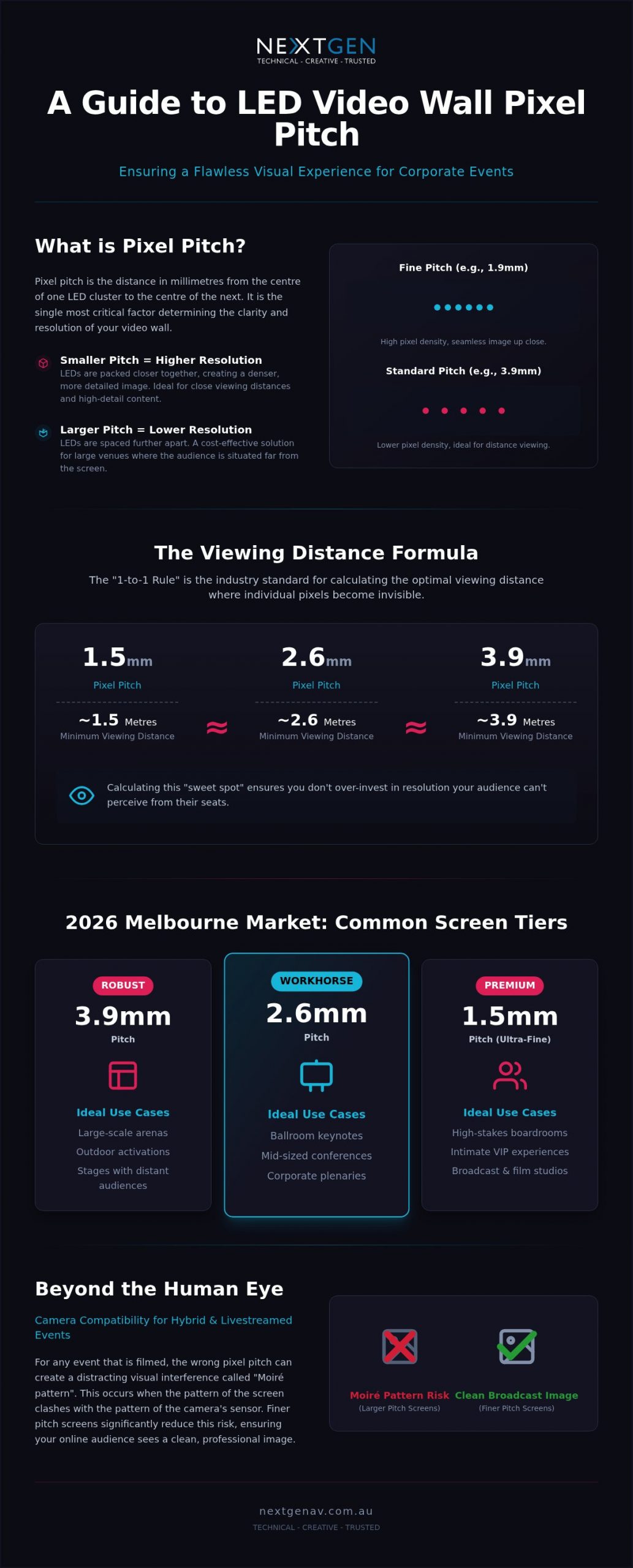
In the current Melbourne market, we generally categorise screens into three tiers of performance. The 3.9mm panels remain a robust choice for large-scale outdoor activations or massive arena stages where the audience is situated at a significant distance. For the majority of ballroom keynotes, 2.6mm has become the reliable workhorse. However, for intimate VIP experiences or high-stakes boardrooms, 1.5mm ultra-fine pitch is now the preferred standard. We are also seeing a rapid transition toward Chip on Board (COB) technology. This innovation offers superior contrast and durability compared to traditional Surface Mounted Diode (SMD) panels, ensuring your visuals remain vibrant even under intense stage lighting. Choosing the right led video wall pixel pitch for corporate events ensures your content looks exactly as intended, regardless of the venue’s constraints.
The Viewing Distance Formula: Calculating the Sweet Spot for Your Audience
Precision in production begins with a simple, mathematical truth. The industry standard for a comfortable viewing experience is the 1-to-1 Rule. This benchmark dictates that for every millimetre of pixel pitch, you require approximately one metre of viewing distance. If your front row is three metres from the stage, a 2.6mm screen will appear as a solid, high-definition image. Selecting a tighter pitch than necessary for an audience seated ten metres away is an inefficient use of your event budget. It adds significant cost without adding any perceivable value to the guest experience.
Stage height also plays a silent role in this calculation. Elevating the screen increases the diagonal distance between the viewer’s eye and the LED clusters. This subtle shift in geometry often allows for a slightly more forgiving led video wall pixel pitch for corporate events, provided the vertical viewing angle remains within the screen’s optimal range. Balancing the Comfort Zone for those in the VIP seats with the Readability Zone for the back of the room is where technical mastery meets event strategy. While the screen captures the eyes, pairing your display with professional sound system hire ensures your message is heard as clearly as it is seen.
Step-by-Step: Determining Your Required Pitch
To identify the ideal specifications for your next keynote, follow this logical progression. First, measure the exact distance from the screen surface to the closest seated guest. Second, convert that distance into the maximum allowable pixel pitch. For example, a 2.5-metre gap suggests a 2.5mm pitch or smaller. Finally, adjust for content complexity. If your presentation relies on intricate data or small text, you should tighten the pitch by 10 to 15 percent to guarantee absolute clarity. Our experts can organise a site inspection to confirm these measurements with laser precision.
The “Farthest Viewer” Fallacy
A common mistake in event planning is focusing on the back of the room when choosing pixel pitch. In reality, the farthest viewer determines the overall size of the screen, while the closest viewer determines the pixel pitch. If the screen is too small, the back row won’t see the content; if the pitch is too large, the front row will see individual LEDs instead of a cohesive image. You must solve for both variables to maintain your professional reputation. By calculating the sweet spot where resolution meets distance, you ensure every attendee enjoys a premium, high-definition experience that feels both intimate and grand.
Beyond the Human Eye: Content Complexity and Camera Compatibility
While your eyes might perceive a flawless image, the digital eye of a camera lens is far less forgiving. In the high-stakes environment of a 2026 conference, the notorious Moiré effect remains the greatest threat to a professional broadcast. This visual interference occurs when the physical grid of the LED panels clashes with the pixel sensor of a camera, creating wavy, distracting patterns that compromise your livestream. Selecting the right led video wall pixel pitch for corporate events is only half the battle; the other half is ensuring your hardware operates at a refresh rate of at least 3840Hz. This specific frequency is mandatory to prevent on-screen flickering and ensure your presentation looks as prestigious on a remote attendee’s laptop as it does in the room.
The nature of your content also dictates a “Detail Tax” on your resolution choices. Cinematic b-roll and high-energy brand videos are remarkably forgiving, allowing for slightly larger pixel gaps without losing impact. However, the moment you switch to a complex Excel spreadsheet, a financial chart, or a detailed CAD drawing, the requirements sharpen instantly. Thin lines and small characters can literally disappear between the pixels of a coarser screen, leading to legibility issues that frustrate your audience. For data-heavy sessions, we recommend a tighter pitch to guarantee that every decimal point remains crisp and authoritative under the scrutiny of your delegates.
Designing Content for Specific Pixel Pitches
To maintain professional standards, your design team must adapt their assets to the physical reality of the screen. When working with 2.6mm or 3.9mm displays, we suggest the following guidelines to ensure clarity:
- Font Legibility: Avoid using serif fonts with thin strokes that might break up; stick to bold, sans-serif typography for all critical data.
- Contrast Ratios: Utilise high-contrast colour palettes, such as white text on a deep navy or charcoal background, to define edges more clearly.
- Line Weights: Ensure that all borders and decorative lines are at least two pixels wide to prevent “shimmering” or disappearing acts during transitions.
The Hybrid Event Challenge: Pitch for the Lens
Hybrid productions introduce the added complexity of Image Magnification (IMAG), where a live feed of the speaker is projected onto the screen behind them. This creates a feedback loop where the camera is effectively filming its own output. Our technicians meticulously synchronise screen refresh rates with camera shutter speeds to eliminate scan lines and maintain a broadcast-ready aesthetic. By choosing our hybrid event staging solutions, you gain access to an elite team that understands how to position cameras at specific angles and depths of field to bypass Moiré patterns entirely. We handle the technical maths, allowing your speakers to take centre stage with absolute confidence.
Matching Pixel Pitch to Your Melbourne Event Venue
Melbourne’s premier event spaces aren’t one-size-fits-all, and neither is the technology required to fill them. The sheer scale of the Melbourne Convention and Exhibition Centre (MCEC) Plenary requires a vastly different technical strategy compared to its intimate breakout suites. In the Plenary, where the back row sits dozens of metres away, a 3.9mm pitch can deliver massive impact without sacrificing perceived quality. Conversely, a breakout session demands an ultra-fine led video wall pixel pitch for corporate events to maintain legibility for delegates seated just two metres from the screen. We tailor every recommendation to the specific geometry of your room.
Light management is another local hurdle that dictates your hardware choice. Glass-walled venues like the Crown Aviary offer stunning city views but flood the stage with ambient light. In these environments, we prioritise high-brightness panels of 800 to 1,200 nits while ensuring the pitch remains tight enough for high-contrast visibility. For historic CBD buildings, the challenge often shifts to physical logistics. Narrow lifts and weight-restricted floors in heritage sites can dictate the footprint of your wall. We solve this by utilising lightweight, high-density panels that provide a premium look without exceeding the building’s structural constraints.
Venue Guide: Pitch Recommendations
Choosing the right specification depends on the specific room dynamics of Melbourne’s top-tier locations. We generally categorise our recommendations as follows:
- Large Hotel Ballrooms: At the Grand Hyatt or the Palladium at Crown, 2.6mm is the “goldilocks” specification. It offers the perfect balance of resolution and cost-efficiency for large corporate audiences.
- Boutique Function Centres: For high-stakes boardrooms or executive presentations, an ultra-fine pitch of 1.2mm to 1.9mm ensures your data remains flawless at close range.
- Outdoor Corporate Activations: Spaces like Federation Square require 3.9mm to 4.8mm panels to combat direct sunlight while providing enough scale for public viewing.
Logistics and Rigging in Melbourne Venues
Successful execution requires navigating the physical constraints of your chosen space with absolute precision. We meticulously assess ceiling heights and weight loading limits in CBD venues to ensure your display is safe and perfectly positioned. Integrating your screen with professional stage and lighting hire Melbourne allows us to frame the LED wall within a broader visual narrative, creating a cohesive environment. Our local production crews handle every detail of the bump-in, from rigging to final calibration, so you can focus entirely on your guests. Contact our Melbourne team today to organise a detailed venue site inspection and ensure your technical production is in expert hands.
Partnering with NextGen AV for a Flawless Visual Experience
Selecting the ideal led video wall pixel pitch for corporate events is a high-stakes decision that shouldn’t rest on your shoulders alone. We step in as your Confident Orchestrator, absorbing the technical complexity so you can focus on your delegates and your message. With over 30 years of industry experience in the Melbourne market, we’ve navigated every architectural quirk of the city’s premier venues. Our process begins long before the first panel is rigged. We conduct rigorous site inspections and produce detailed technical CAD drawings to confirm the exact viewing angles and distances for your audience. This meticulous preparation ensures that the hardware we deploy is perfectly matched to your specific vision.
True visual impact isn’t achieved in a vacuum. We specialise in integrated production, where our elite led video wall technology works in perfect harmony with world-class audio and lighting design. By managing the entire technical direction, we eliminate the risk of signal lag or mismatched refresh rates that can occur when using multiple vendors. We act as the proactive engine behind the scenes, ensuring every transition is cinematic and every data point is razor-sharp. Our goal is to provide a seamless backdrop that allows your brand to take centre stage without the distraction of technical hitches.
The NextGen AV Difference: Technical Mastery
Our on-site engineers are the silent guardians of your event’s reputation. They monitor signal stability and refresh rates in real-time, adjusting for shifts in ambient light or camera focal lengths as the day progresses. We invest in high-end hardware that guarantees consistent colour and brightness across the entire screen surface, preventing the distracting “patchwork” effect often seen in lower-tier rentals. This level of technical mastery transforms your stage into a prestigious communication tool that commands respect from every guest in the room.
Start Planning Your Next Melbourne Event
The most successful corporate productions are built on early collaboration. Engaging our team during your initial design phase allows us to identify potential venue constraints before they become costly problems. We provide bespoke quotes tailored to your specific audience size and content requirements, ensuring you never over-pay for resolution you don’t actually need. Whether you are planning a high-stakes keynote or a public activation, we have the local expertise to ensure your production is flawless. When you’re ready to elevate your next presentation, contact the NextGen AV team to discuss your LED video wall requirements.
Elevate Your Corporate Stage with Technical Precision
Selecting the ideal led video wall pixel pitch for corporate events is the final step in securing your professional reputation. By balancing the “1-to-1 Rule” for viewing distances with the specific resolution demands of your content, you ensure every chart is razor-sharp and every livestream is free from interference. We’ve spent 30 years refining our craft in Melbourne’s most iconic venues, offering full-service technical production that allows you to lead with confidence while we manage the intricate details behind the scenes.
Our expertise in seamless LED integration for hybrid events ensures your presentation looks as prestigious on a remote smartphone as it does from the front row. Don’t let technical uncertainty overshadow your message. Partner with a team that thrives under pressure and takes personal pride in flawless execution. We are ready to transform your vision into a high-definition reality that leaves a lasting impression on your audience. It’s your time to take centre stage while we handle the engine of your event.
Get a Professional Quote for Your Melbourne LED Wall Hire
Frequently Asked Questions
What is the most common pixel pitch for a corporate conference?
A pixel pitch of 2.5mm or lower is the industry benchmark for corporate conference stages in 2026. For most ballroom keynotes and general sessions with mixed content, 2.6mm is the recommended standard. This pitch provides a sharp image for delegates seated at typical distances while remaining a cost-effective solution for large displays. If your audience is particularly close to the stage, a 1.9mm pitch is often selected to maintain a premium, high-definition look.
Can I use an outdoor LED wall for an indoor corporate event?
While it is technically possible, using an outdoor LED wall indoors is rarely ideal for corporate settings. Outdoor panels are designed for high-brightness environments, often exceeding 5,000 nits, which can be overwhelming and uncomfortable for indoor guests. Additionally, outdoor walls typically have a coarser pixel pitch, such as 3.9mm or 4.8mm. This results in visible pixelation for an indoor audience seated closer to the screen, compromising the professional polish of your event.
How does pixel pitch affect the cost of LED wall rental?
Pixel pitch is a primary driver of rental costs because a smaller pitch requires a significantly higher density of LED diodes. For example, a 1.2mm screen has many more pixels per square metre than a 3.9mm panel. This increased hardware density requires more processing power and labour-intensive set-up. While a finer pitch offers superior resolution, it is essential to balance your visual requirements with your budget by selecting the pitch that matches your actual viewing distance.
Do I need a different pixel pitch if I am live-streaming my event?
When live-streaming, the refresh rate is more critical than the pixel pitch itself. You must ensure your hardware supports a refresh rate of 3840Hz or higher to prevent flickering and moiré patterns on camera. While a tighter led video wall pixel pitch for corporate events helps with clarity, the synchronisation between the screen and the camera’s shutter speed is what guarantees a broadcast-ready look for your remote audience. We manage these technical variables to ensure a flawless feed.
What is the minimum viewing distance for a 2.6mm LED wall?
Following the industry standard 1-to-1 rule, the minimum viewing distance for a 2.6mm LED wall is approximately 2.6 metres. At this distance, the human eye can no longer distinguish individual pixels, resulting in a seamless and cohesive image. If your front-row VIPs are seated closer than this, you should consider a finer pitch, such as 1.5mm or 1.9mm, to ensure the display remains crisp and professional for every guest in the room.
Is pixel pitch the same thing as resolution?
Pixel pitch and resolution are related but distinct concepts. Pixel pitch refers to the physical density of the LEDs on the panel, specifically the distance between the centres of each pixel. Resolution, however, is the total count of pixels across the entire display. A smaller pixel pitch allows you to achieve a higher resolution within a smaller physical footprint. This is why choosing the correct led video wall pixel pitch for corporate events is vital for displaying detailed content on compact screens.
Will a smaller pixel pitch make my PowerPoint slides easier to read?
A smaller pixel pitch will significantly improve the legibility of PowerPoint slides, particularly those containing fine text, intricate financial charts, or detailed diagrams. By increasing the pixel density, the screen can render sharp edges and small characters without the “staircase” effect of pixelation. This ensures that your data remains clear and authoritative for every delegate, preventing the frustration of blurry visuals that can detract from the impact of a high-stakes corporate presentation.
How do I know if my Melbourne venue can support a large LED wall?
Determining venue compatibility requires a professional assessment of three key factors: ceiling height, floor weight loading, and available power supply. Many historic Melbourne CBD buildings have structural limits that may restrict the size or weight of your display. We recommend organising a technical site inspection early in your planning phase. Our team uses CAD drawings to verify that your chosen LED wall fits perfectly within the room’s architecture while meeting all local safety and rigging requirements.
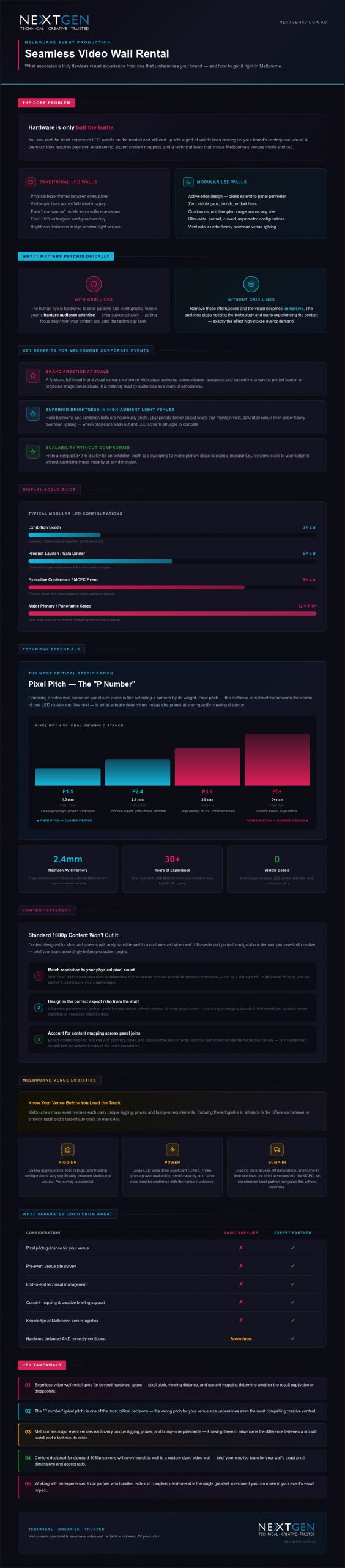
Here’s the truth that most AV suppliers won’t tell you: the hardware is only half the battle. You can rent the most expensive LED panels on the market, and still end up with a grid of visible lines carving up your brand’s centrepiece visual like a badly tiled bathroom wall. If you’ve been searching for seamless video wall rental Melbourne that actually delivers on its promise, you already know this fear is real, and entirely valid.
Planning a high-stakes event is stressful enough without worrying whether a dead pixel or a misaligned panel is going to undermine every dollar you’ve invested in your brand experience. The premium look you’re after isn’t just about resolution specs or refresh rates; it’s about precision engineering, expert content mapping, and a technical team that knows Melbourne’s venues inside and out before they ever load the truck.
This guide cuts through the jargon and the hidden costs to show you exactly what separates a truly flawless video wall from one that merely looks impressive in a brochure. You’ll learn what to look for in a rental partner, how content and hardware work together to create that bezel-free visual impact, and why the right team makes all the difference between a backdrop that captivates and one that quietly embarrasses.
Key Takeaways
- Seamless video wall rental Melbourne goes far beyond hardware specs — understanding pixel pitch, viewing distance, and content mapping is what separates a truly captivating visual from a costly disappointment.
- The ‘P number’ (pixel pitch) is one of the most critical decisions you’ll make: choosing the wrong one for your venue size can undermine even the most compelling creative content.
- Melbourne’s major event venues each carry unique rigging, power, and bump-in requirements — knowing these logistics in advance is the difference between a smooth install and a last-minute crisis.
- Content designed for standard 1080p screens will rarely translate well to a custom-sized video wall; this guide explains how to brief your creative team for ultra-wide and portrait configurations.
- Working with an experienced local partner who knows your venue, handles the technical complexity end-to-end, and lets your brand take centre stage is the single greatest investment you can make in your event’s visual impact.
What is a Seamless Video Wall and Why Does Your Event Need One?
A seamless video wall is a modular LED display system engineered so that individual panels lock together with zero visible gaps, bezels, or interruptions between them. The result is a single, continuous visual canvas that stretches across any dimension you choose, displaying your content as one unified image rather than a patchwork of separate screens. That distinction sounds simple. In practice, it’s the difference between a backdrop that commands a room and one that quietly undermines it.
The psychological effect of a continuous visual field is well-documented in perceptual psychology: the human eye is hardwired to seek patterns and interruptions. When a grid of black lines carves through your brand’s hero image or your keynote speaker’s backdrop, the audience’s attention is fractured, even subconsciously. Remove those interruptions, and the visual becomes immersive. The audience stops noticing the technology and starts experiencing the content. That’s precisely the effect that makes seamless video wall rental Melbourne such a high-demand specification for serious event producers.
The Evolution from LCD to Modular LED
Traditional LCD video walls have always carried an inherent limitation: the bezel. Every LCD panel is housed within a physical frame, and no matter how slim manufacturers make it, that frame creates a visible grid across the display. Even so-called “ultra-narrow bezel” LCD walls leave a seam of several millimetres that becomes strikingly obvious on close-up product imagery or full-bleed brand visuals.
Modularity also unlocks creative configurations that LCD can never achieve. Standard 16:9 rectangles are just the beginning. LED systems can be assembled into ultra-wide panoramic formats, portrait towers, curved surfaces, or asymmetric shapes that wrap around a stage set. That flexibility opens up architectural possibilities that genuinely distinguish a production.
Key Benefits for Melbourne Corporate Events
Melbourne’s corporate event market is competitive, discerning, and increasingly sophisticated in its visual expectations. Gala dinners at venues like the MCEC, product launches in converted warehouse spaces, and executive conferences in CBD hotel ballrooms all share one challenge: audiences who’ve seen it before and need to be genuinely impressed.
Seamless LED walls address this across several practical dimensions:
- Brand prestige at scale: A flawless, full-bleed brand visual across a six-metre-wide stage backdrop communicates investment and authority in a way that no printed banner or projected image can replicate.
- Superior brightness in high-ambient-light venues: Hotel ballrooms and exhibition halls are notoriously bright environments. LED panels deliver output levels that maintain vivid, saturated colour even under heavy overhead lighting, where projectors wash out and LCD screens struggle.
- Scalability without compromise: From a compact 3×2 metre display for an exhibition booth to a sweeping 12-metre plenary stage backdrop, modular LED systems scale to your footprint without sacrificing image integrity at any size.
With over 30 years of industry experience and specialised inventory including high-resolution 2.4mm LED event boards, NextGen AV is built to deliver that calibre of visual production across Melbourne’s most demanding venues. The technology is only as good as the team behind it, and that’s where genuine expertise separates a flawless result from a frustrating one.
Technical Essentials: Pixel Pitch, Resolution, and Refresh Rates
Choosing a video wall based on panel size alone is like selecting a camera by its weight. The specification that actually governs image quality, the one that separates a crisp, photorealistic display from a muddy, pixelated backdrop, is pixel pitch. Get this decision right, and everything else falls into place. Get it wrong, and no amount of compelling content will save you.
Pixel pitch is the distance in millimetres between the centre of two adjacent pixels. That single measurement determines how close your audience can stand before individual pixels become visible to the naked eye, and it’s the first technical conversation any credible seamless video wall rental Melbourne partner should be having with you.
Choosing the Right Pixel Pitch for Your Audience
The practical rule is straightforward: the smaller the pixel pitch number, the finer the resolution and the closer viewers can stand without seeing individual pixels. Where it gets nuanced is matching that specification to your actual venue layout and audience positioning.
- P2.4 to P2.6: The premium tier for close-proximity viewing. At trade show booths, exhibition stands, or intimate product launch settings where guests circulate within two to five metres of the display, this pitch delivers genuinely photographic clarity. NextGen AV’s specialised 2.4mm LED event boards sit at this end of the spectrum, making them the right choice when your audience will be up close and your content demands ultra-fine detail, think brand photography, data-rich presentations, or live camera feeds.
- P3.9 to P4: The workhorse specification for large conference stages and plenary sessions. When your front row is seated five or more metres back, a P4 panel delivers exceptional visual impact at a scale that fills the room, without the cost premium of sub-3mm pitch panels.
Matching pitch to viewing distance isn’t just a technical nicety; it’s a budget decision. Specifying a P2.4 wall for a 500-seat auditorium where the nearest guest sits eight metres away is an expensive overcorrection. Conversely, deploying P4 panels at a close-contact exhibition stand is a false economy that will show.
Brightness and Refresh Rates for Live Broadcast
Two specifications routinely overlooked during the planning phase become critically visible the moment a camera enters the room: brightness output and refresh rate.
Brightness, measured in nits, determines whether your display holds its colour saturation under the intense stage lighting typical of Melbourne’s hotel ballrooms and conference centres. A panel that looks vivid in a darkened showroom can appear washed out under a 2,000-lux wash. Specifying sufficient nit output for your venue’s ambient light conditions is non-negotiable.
Refresh rate matters the moment your event is being filmed, live-streamed, or captured for social content. Panels operating at lower refresh rates produce a subtle flicker that the human eye misses but a camera sensor captures as a visible strobe effect across recorded footage. High refresh rates of 3,840Hz and above eliminate this entirely, ensuring your wall looks as flawless on a smartphone replay as it does live in the room.
Colour calibration ties everything together. A video wall assembled from multiple panels will only appear seamless if every cabinet is calibrated to the same colour temperature and luminance profile. Panel-to-panel variance creates visible tonal shifts across the display surface, an effect that’s particularly unforgiving on full-bleed brand colour fields. Rigorous pre-event calibration is a technical discipline, not a checkbox, and it’s where experienced operators earn their reputation.
If you’re planning an event where broadcast quality matters, explore NextGen AV’s technical direction services to understand how panel specification and on-site calibration work together from the outset.
Melbourne Venue Logistics: Rigging, Power, and Bump-In
The technical specifications of your LED panels mean very little if the logistics of getting them into your venue haven’t been solved before the truck arrives. Melbourne’s major event spaces, from the Melbourne Convention and Exhibition Centre to the Grand Hyatt and Crown Palladium, each carry their own set of structural constraints, union labour protocols, and bump-in windows that can derail even the most meticulously planned production. This is where genuine local knowledge separates a seamless video wall rental Melbourne specialist from a generic AV supplier quoting from a brochure.
The first decision that shapes everything else is how the wall will be supported. Ground stacking, where panels are built upward from a structural base on the floor, suits lower-ceiling spaces and venues with strict rigging restrictions. It’s faster to deploy and requires no overhead infrastructure. Flying the wall from a truss system suspended above the stage delivers superior sightlines across a large audience and eliminates the need for ground-level structural frames, but it introduces a set of engineering requirements that demand careful planning well before load-in day.
Rigging and Structural Safety
Flying a video wall requires a certified truss system, rated chain motors, and a structural load calculation that accounts for both the panel weight and dynamic forces during installation. This is non-negotiable. Melbourne’s heritage ballrooms and converted warehouse venues often carry floor loading limits and ceiling anchor point restrictions that aren’t obvious from a venue floor plan. A team that hasn’t worked in your specific venue before will discover these constraints during bump-in, which is precisely the wrong time. Professional event rigging solutions incorporate pre-site inspections, engineered drawings, and full OH&S compliance documentation, so there are no surprises when the motors go up.
Power and Signal Redundancy
Large LED arrays draw substantial power. A six-by-three-metre wall running at full brightness will exceed the capacity of standard venue circuits, and a tripped breaker mid-keynote is a scenario no event producer wants to explain. Proper power planning means calculating the draw across your full panel array, coordinating with venue electricians for dedicated circuit allocation, and deploying distribution hardware that isolates the display from other event loads.
Signal redundancy is equally critical. A professional audio visual hire Melbourne partner will run dual signal pathways to your wall, so that if a cable or processor develops a fault, the backup takes over instantly with zero audience-visible interruption. On-site technical monitoring throughout your event ensures that any anomaly is caught and resolved before it becomes a problem the room notices.
The managed bump-in is where all of this comes together. A disciplined pre-event schedule, with panels assembled, calibrated, signal-tested, and content-checked against your actual show file before the doors open, is the single greatest insurance policy against a live failure. It’s not glamorous work. It’s the work that makes everything else look effortless.
Content Strategy: Designing for Seamless Displays
Hardware precision gets your wall built. Content strategy is what makes it breathe. And here’s where many otherwise well-planned productions quietly unravel: a creative team hands over a beautifully crafted 1920×1080 file, it goes up on a custom-configured LED wall, and the result is a stretched, soft, visually compromised version of what was intended. The wall isn’t at fault. The content was never designed for it.
Every seamless video wall rental Melbourne deployment carries a unique pixel count determined by the physical dimensions of the assembled panels, not by a standard broadcast resolution. A wall built from 2.4mm panels at four metres wide by two metres tall will have a native resolution that bears no resemblance to 1080p or 4K. Feed it standard content and the processor scales it, introducing artefacts, softness, and proportion distortion that undermine the very precision the hardware was engineered to deliver.
The solution starts before your designers open a single file.
Pixel-Perfect Content Creation
Before any creative work begins, your AV partner should supply a pixel map: an exact document specifying the wall’s native width and height in pixels, its aspect ratio, and any zones or split-screen configurations planned for the show. Designers work to this specification from the outset, building assets at native resolution so the final output maps one-to-one with the physical display. No scaling. No interpolation. No compromise.
LED panels respond dramatically to high-contrast visuals and saturated colour. Deep blacks appear genuinely black rather than grey, and vivid brand colours pop with a luminance that no projection or LCD system can match. Brief your creative team to lean into this: bold typography, full-bleed colour fields, and high-contrast imagery all perform exceptionally well. Conversely, filmed video segments require careful resolution matching to avoid moiré patterning, the interference effect that appears when fine detail in footage clashes with the pixel grid of the display. Specifying the correct output resolution for any filmed content before it’s captured or edited eliminates this entirely.
Interactive and Dynamic Visuals
A seamless LED wall isn’t a static backdrop. It’s a live canvas. Media servers such as Watchout or Barco’s media management platform allow operators to synchronise multiple content layers across the full wall surface in real time, switching between speaker presentations, brand animations, and live camera feeds without a visible cut or stutter. This is what transforms a backdrop into a dynamic production element.
Real-time integrations extend the wall’s capability further. Live social media feeds, audience polling results, and data visualisations can be mapped into designated zones of the display, creating an interactive dimension that keeps audiences engaged between programme segments. For multi-speaker conferences, the wall can transition between entirely different visual environments for each presenter, reinforcing individual messaging while maintaining the event’s overarching brand identity.
Orchestrating this level of content complexity requires a technical director who understands both the hardware and the show flow. Working with a full service event production partner ensures your content strategy, media server programming, and live operation are unified under a single expert team rather than patched together across multiple suppliers. Talk to NextGen AV about technical direction for your next event before your creative brief goes out, not after the files are already built.
Partner with NextGen AV for Seamless Execution in Melbourne
Every technical detail covered in this guide, from pixel pitch selection to content mapping to venue logistics, represents a decision point where things can go right or quietly wrong. The difference almost always comes down to the team behind the equipment. With over 30 years of experience delivering high-stakes corporate visuals across Australia, NextGen AV has built its reputation on a single principle: the technology should be invisible, and your brand should be unforgettable.
That philosophy shapes every engagement. While you’re focused on your programme, your speakers, and your guests, NextGen’s team is managing the technical complexity end-to-end, from pre-production renders that show you exactly how your content will look on the assembled wall, through to on-site technical direction on the day. Nothing is left to chance. Nothing is improvised. The result you see in the pre-production stage is the result your audience experiences live.
The NextGen AV Difference
Working with NextGen AV means access to dedicated project managers who know Melbourne’s major venues not from a floor plan, but from direct experience. They understand the bump-in windows at the MCEC, the rigging restrictions in CBD hotel ballrooms, and the power infrastructure at the city’s premier conference facilities. That local knowledge translates directly into smoother installs, fewer surprises, and a production that runs exactly as planned.
The inventory reflects the same commitment to precision. NextGen’s specialised 2.4mm LED event boards deliver the ultra-fine resolution demanded by close-proximity audiences, while the P4 packages scale to fill the largest plenary stages with vivid, calibrated imagery. Explore the full range of LED video wall options to understand which specification suits your event footprint.
Getting Started with Your Rental
Requesting a quote should be the beginning of a conversation, not a transaction. A comprehensive proposal for seamless video wall rental Melbourne covers more than panel hire; it accounts for technical labour, signal processing, transport, rigging, calibration, and on-site operation. Asking for an all-inclusive breakdown upfront protects you from the hidden costs that inflate a budget after the contract is signed.
A site visit to your chosen venue before finalising the specification is one of the most valuable steps you can take. It confirms ceiling heights, power availability, and structural anchor points, turning assumptions into verified facts. Before your event, work through this final checklist:
- Specification confirmed: Pixel pitch matched to your audience’s viewing distance.
- Native resolution supplied to creative team: Assets built to the wall’s exact pixel dimensions.
- Power and rigging requirements documented: Coordinated with venue operations in advance.
- Signal redundancy in place: Dual pathways tested before doors open.
- Full technical rehearsal completed: Content checked against the live show file on the actual hardware.
When every item on that list is owned by a single expert team, your event doesn’t just look flawless. It feels effortless. Request your video wall hire quote from NextGen AV and start building the visual centrepiece your next Melbourne event deserves.
Your Next Melbourne Event Deserves a Visual That Commands the Room
A flawless visual centrepiece doesn’t happen by accident. It’s built on the right pixel pitch for your audience, content engineered to the wall’s native resolution, and a technical team that knows your venue before the truck is loaded. Get those three elements working together, and seamless video wall rental Melbourne stops being a specification and becomes a competitive advantage your audience genuinely feels.
NextGen AV brings over 30 years of industry experience, a Melbourne-based technical team with deep local venue knowledge, and end-to-end production management that handles every detail from pre-production renders through to live on-site operation. You focus on your programme. They make sure the technology is invisible and the impact is unforgettable.
Your next event is worth getting right. Request a tailored quote for your Melbourne video wall and start building the visual experience your audience won’t forget.
Frequently Asked Questions About Seamless Video Wall Rental in Melbourne
What is the difference between a seamless LED wall and a standard TV wall?
A standard TV wall uses LCD panels, each housed within a physical bezel frame. No matter how slim that frame is, it creates a visible grid across the display. A seamless LED wall uses modular panels built with active-edge technology, meaning the pixels extend right to the cabinet’s perimeter. When panels are locked together, the image flows continuously across the entire surface with no dark lines, no dead zones, and no visual interruption.
The practical difference is significant. On a standard TV wall, close-up brand photography or full-bleed colour fields are carved up by those bezel lines, which the eye picks up immediately. On a seamless LED wall, the audience experiences one unified visual canvas. That distinction is precisely why serious event producers specify LED rather than LCD for high-stakes corporate productions.
How much does it cost to hire a seamless video wall in Melbourne?
Pricing for seamless video wall rental Melbourne depends on several variables: the physical dimensions of the wall, the pixel pitch specification, the duration of the hire, and the scope of technical services included. A compact exhibition display requires a very different investment to a full plenary stage backdrop with on-site technical direction. Rather than quoting figures that won’t reflect your actual requirements, the most accurate approach is to request a tailored proposal that itemises panels, processing, labour, transport, rigging, and calibration as separate line items.
Be cautious of quotes that bundle everything into a single number without breakdown. A transparent, itemised proposal protects your budget from unexpected additions after the contract is signed. Contact NextGen AV directly to discuss your event footprint and receive a comprehensive quote built around your specific venue and programme.
How long does it take to set up a modular LED video wall?
Installation time depends on wall dimensions, rigging method, and venue access conditions. A ground-stacked display in a straightforward venue can be assembled, cabled, and calibrated within a few hours. A larger flown configuration requiring truss rigging, certified chain motors, and structural sign-off will typically require a full bump-in day, sometimes extending into an overnight window depending on venue scheduling. Pre-production planning is what keeps that timeline predictable.
Experienced teams work from detailed pre-production schedules that account for every stage of the install, from truck dock to content check. Venues like the MCEC and CBD hotel ballrooms each have their own bump-in protocols and time restrictions. A team with direct experience in your chosen venue will have already factored those constraints into the schedule, so the wall is calibrated and content-tested well before your guests arrive.
Can I use a seamless video wall for an outdoor event in Melbourne?
Yes, but the specification requirements change considerably. Outdoor LED panels need a significantly higher brightness rating, measured in nits, to remain visible in direct sunlight or under Melbourne’s variable ambient light conditions. Standard indoor panels that perform brilliantly in a ballroom will appear washed out in an outdoor environment. Panels intended for outdoor use also require appropriate ingress protection ratings to handle humidity, dust, and the possibility of light rain.
Wind loading is an additional structural consideration for outdoor installations. Any ground-stacked or flown configuration in an exposed outdoor setting requires engineering assessment to ensure the structure remains safe under the wind conditions typical of Melbourne’s outdoor event spaces. Discuss your outdoor venue specifics with your AV partner early in the planning process so the correct panel specification and structural solution are confirmed before hire agreements are finalised.
Do I need a special computer to run content on a large LED wall?
Standard laptops and desktop computers aren’t built to drive the high-resolution, custom-aspect-ratio output that a large LED wall demands. Professional LED walls are driven by dedicated media servers and video processors that handle the signal routing, scaling, and output mapping required to feed content to multiple panels simultaneously. Systems like Watchout or specialised LED processing hardware manage this complexity, ensuring the content maps precisely to the wall’s native pixel grid without any scaling artefacts.
Your presenter’s laptop can still connect to the system for slide presentations, but it feeds into the media server infrastructure rather than driving the wall directly. A technical director manages that signal chain throughout the event, switching between content sources, managing live camera feeds, and ensuring every transition is clean. This is a core part of NextGen AV’s technical direction service, so your team doesn’t need to manage any of that complexity on the day.
What pixel pitch do I need for a corporate conference stage?
For a corporate conference stage where the front row is seated five or more metres from the display, a P3.9 to P4 specification delivers exceptional visual impact at scale without unnecessary cost. That viewing distance means a P4 panel renders content with genuine clarity; the individual pixels simply aren’t resolvable at that distance. Specifying a finer pitch than your viewing distance requires is an expensive overcorrection that won’t produce a visible improvement for your audience.
Where P2.4 becomes the right choice is in close-proximity settings: exhibition stands, product launch environments, or intimate conference formats where guests circulate within two to five metres of the display. At that distance, the finer resolution is genuinely perceptible and worth the premium. NextGen AV’s team will assess your venue layout and audience positioning to recommend the specification that delivers the best visual result for your actual event conditions.
Does NextGen AV provide technical staff to operate the screen during the event?
Yes. Technical direction and on-site management are core parts of NextGen AV’s service offering. A dedicated technical operator manages the wall throughout your event, handling content playback, live source switching, and real-time monitoring to ensure everything runs exactly as programmed. That operator is also responsible for catching and resolving any technical anomalies before they become visible to the room, which is the kind of invisible expertise that keeps a production feeling effortless.
This end-to-end approach means you’re not hiring hardware and then scrambling to find someone to run it. The technical team that specifies your wall, programmes your show file, and manages the bump-in is the same team operating the system live. That continuity eliminates the communication gaps that cause problems during high-pressure live moments, and it’s a significant part of what makes NextGen AV’s productions consistently reliable across Melbourne’s most demanding venues.
Can you build a video wall in a custom shape or curved configuration?
Modular LED systems are specifically designed for custom configurations beyond standard rectangles. Panels can be assembled into ultra-wide panoramic formats, portrait towers, L-shaped stage wraps, and curved surfaces that follow the architecture of a venue or a bespoke stage set. Curved configurations use specially designed concave or convex cabinet systems that allow panels to arc smoothly without visible seams at the join points.
The key requirement for any non-standard configuration is early engagement with your AV partner. Custom shapes need structural engineering, content that’s mapped to the exact geometry of the assembled wall, and a bump-in plan that accounts for the additional complexity of the build. Bringing NextGen AV into the conversation at the concept stage, rather than after the creative direction is locked, ensures the physical configuration and the content strategy are designed to work together from the outset.
Could your high-stakes event survive a Sydney midday sun that radiates over 10,000 nits of ambient light? Most organisers realise too late that a standard display simply cannot compete with the Australian elements, leading to the dreaded screen washout that ruins the guest experience. When you’re looking for outdoor led screen hire sydney, you aren’t just renting equipment; you’re engineering a visual triumph against coastal winds and harsh glare. It’s natural to feel anxious about structural integrity in public spaces or the confusion of pixel pitch versus viewing distance.
This commitment to structural integrity is a universal standard for successful outdoor activations; for example, in the Southeast Asian region, specialists like VMS Event Rental (VMS Group) provide the essential canopy and marquee infrastructure required to protect sensitive technology and attendees from tropical weather conditions.
We understand that you need absolute certainty, not a list of technical excuses. This 2026 technical reference guide promises to hand you the blueprint for a flawless execution, ensuring your visuals remain crisp even under the peak summer sun while meeting every NSW safety mandate. We’ll break down the shift toward MicroLED technology, explain why a pixel pitch of 10mm or less is your new baseline, and clarify how the 2025 Cultural SEPP interacts with AS/NZS 1170.2:2021 wind loading standards. By the end, you’ll have the technical vocabulary to lead your production team with the quiet power and confidence of a seasoned expert.
Key Takeaways
- Learn why a minimum brightness of 5,000 nits is non-negotiable for overcoming Sydney’s intense midday glare and maintaining high-contrast visuals.
- Discover how to choose between modular LED walls for bespoke brand activations and mobile trailer screens for rapid festival deployments.
- Master the latest AS/NZS 1170.2:2021 wind loading standards and SafeWork NSW requirements to ensure your public event remains safe and fully compliant.
- Calculate the ideal pixel pitch for your viewing distance to secure the best ROI on your outdoor led screen hire sydney without overspending on unnecessary resolution.
- Understand how professional Technical Direction transforms simple equipment hire into a meticulously orchestrated visual experience that alleviates planning stress.
Technical Essentials for Sydney’s Outdoor Environments
Sydney’s coastal climate is a stunning but unforgiving backdrop for live events. The primary antagonist is the Australian sun, which radiates with such intensity that it can instantly wash out inferior displays. When you choose outdoor led screen hire sydney, you aren’t simply renting hardware. You’re commissioning a technical solution engineered to dominate 10,000 nits of ambient light while maintaining the prestige of your brand’s visual identity.
This level of environmental engineering mirrors the approach required for residential climate control, where companies like QLD Shade help Australians weatherproof their homes against the same harsh sun and wind conditions.
Brightness and Visibility Benchmarks
The “Nit” is the fundamental unit of luminance that dictates your project’s success. While an indoor screen typically operates at 1,000 to 2,000 nits, Sydney’s direct midday sun requires a minimum of 5,000 nits to remain legible. For 2026, the gold standard has shifted toward 6,000 nits, providing the headroom needed to deliver high-contrast imagery that pops even in the harshest glare. The evolution of LED display technology has introduced sophisticated anti-reflective coatings and physical shaders. These components work in tandem to absorb stray light and prevent the “grey-out” effect, ensuring your content remains vibrant and deep in colour from every viewing angle.
Weatherproofing and IP Ratings
Sydney is famous for its sudden “southerly busters” and unpredictable coastal showers. Protecting your investment requires a deep understanding of IP (Ingress Protection) ratings. An IP65 rating is the non-negotiable benchmark for outdoor environments. The first digit, 6, signifies the enclosure is entirely dust-tight. The second digit, 5, ensures the screen is protected against water jets from any direction. We go beyond the panels themselves; we meticulously seal the “brain” of the system, including all power and data connections, to prevent moisture-induced failures that could derail a live production.
Thermal management is equally critical as Sydney temperatures frequently climb toward 35 degrees. High-output LEDs generate significant internal heat; without advanced cooling systems and intelligent airflow design, panels can suffer from “thermal throttling” or permanent colour shift. Our technical approach treats heat dissipation as an art form, utilising active cooling to keep the electronics stable and the visuals consistent throughout the longest summer days. Finally, we prioritise high refresh rates of at least 3,840Hz. This ensures your screen looks flawless on social media feeds, eliminating the distracting flicker or scan lines that often plague lower-quality displays when captured on smartphone cameras.
Modular LED Walls vs. Mobile Trailer Screens
Choosing the right configuration is the first critical pivot point in your production strategy. Within the competitive Sydney market, the decision between modular panels and mobile trailer units often dictates the entire rhythm of your event build. It’s a balance between bespoke artistry and rapid, tactical deployment. Both formats have their place; the key is matching the hardware to your specific site constraints and audience objectives. When you invest in outdoor led screen hire sydney, you’re deciding whether your event requires the surgical precision of a custom build or the robust speed of a mobile unit.
The Versatility of Modular Panels
Modular LED panels are the preferred choice for high-end brand activations where the screen must feel integrated into the scenic environment. These individual tiles allow for non-standard aspect ratios, such as ultra-wide cinematic backdrops or vertical digital totems. Whether you require a ground-stacked configuration for a corporate stage or a flown rig suspended from a truss, modular systems offer unparalleled creative freedom. This flexibility allows for seamless integration with stage and lighting hire Melbourne standards, ensuring a cohesive visual language across multi-city tours. However, precision takes time. A modular build typically requires several hours of meticulous assembly and rigging. This process must align with the National Guidelines for Screen Safety to ensure every connection is secure and every weight load is calculated. The result is a prestigious, bezel-less finish that looks like a permanent installation rather than a temporary addition.
The Efficiency of Trailer-Mounted Screens
When time is the primary constraint, mobile trailer screens are the undisputed champions of the festival circuit. These units are self-contained powerhouses that can be fully operational within minutes of arriving on site. They are ideal for community festivals, marathons, or pop-up cinemas where road closures and tight schedules leave no room for lengthy builds. Beyond speed, trailers offer a lower risk profile in Sydney’s gusty harbourside locations. Their integrated hydraulic systems and heavy-duty chassis provide a stable base that often requires less complex ballast than modular scaffolding. Many units also feature on-board power solutions, making them the perfect “plug and play” option when you’re operating in parks or remote areas without easy grid access. While they lack the custom shapes of modular builds, their sheer reliability and speed of execution provide immense peace of mind. Selecting the right format is easier when you have a partner who understands the logistical nuances of the harbour city. You can explore our full range of technical direction and staging solutions to find the perfect fit for your next project.
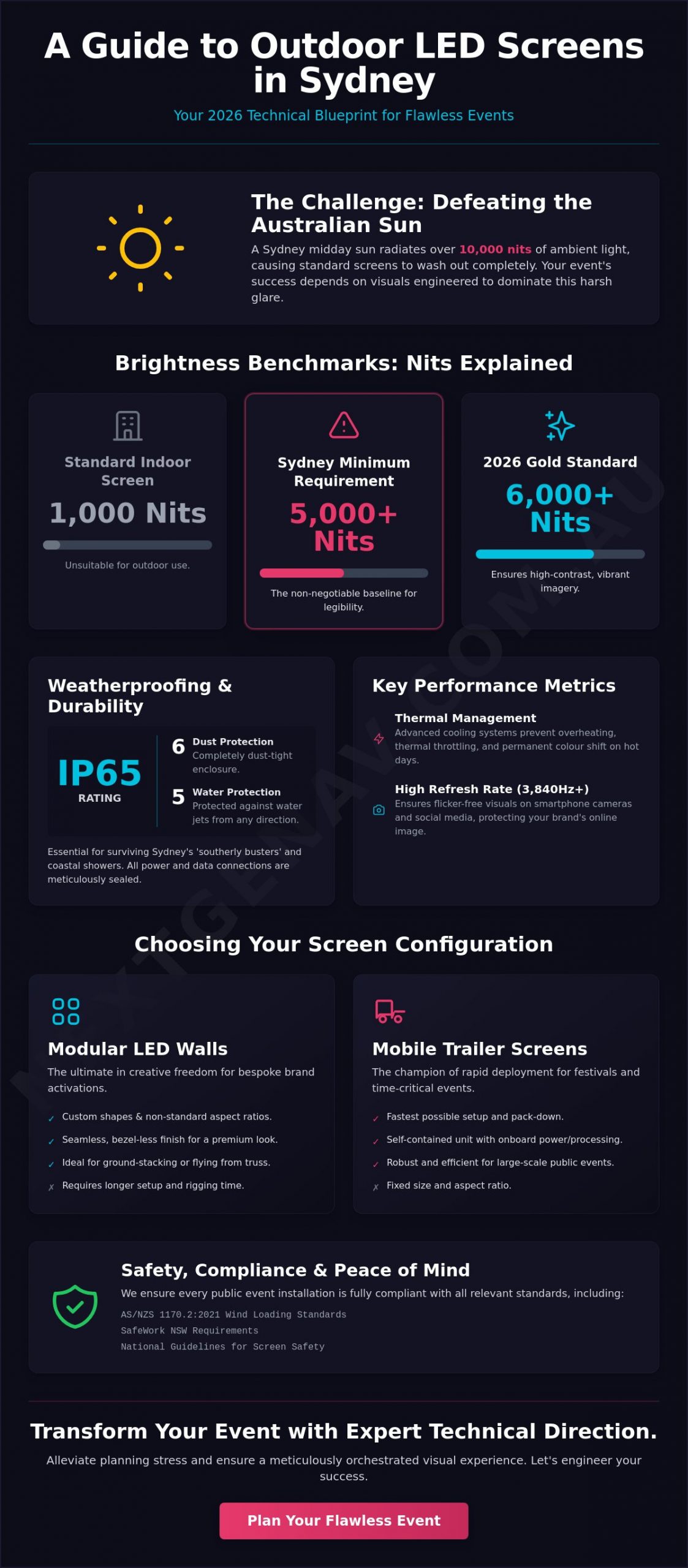
Safety, Compliance, and Wind Loading in Public Spaces
High-stakes events in public spaces carry a weight of responsibility that extends far beyond the visual spectacle. When you coordinate outdoor led screen hire sydney, the technical brilliance of your content must be anchored by rigorous structural engineering. Sydney’s coastal geography makes wind the most critical variable in any outdoor production. A sudden gust off the harbour can transform a large LED wall into a high-tension sail, placing immense pressure on the rigging and support structures. We don’t leave these factors to chance; we treat safety as a core component of the creative craft.
Engineering for the Sydney Sea Breeze
Every temporary structure we deploy adheres to the AS/NZS 1170.2:2021 standards, which were incorporated into the National Construction Code in September 2022. To understand the physics involved, consider that a 10sqm screen acts as a massive sail. In a high-wind event, it can exert several tonnes of lateral force. We mitigate this risk through precise ballast calculations, utilising a strategic combination of water weights and concrete blocks to anchor the system. This meticulous approach aligns with Safe Work Australia’s Code of Practice for Structures, ensuring every installation is safe by design. Our safety protocols include:
- Continuous wind monitoring via on-site anemometers for real-time data.
- Pre-defined “trigger speeds” that dictate exactly when to lower a screen for safety.
- Secondary safety tethers and redundant rigging points on all flown configurations.
Regulatory Requirements and Permits
Navigating the bureaucratic landscape is often the most stressful part of high-level event planning. Since the introduction of the Cultural State Environmental Planning Policy (Cultural SEPP) in late 2025, the approval process for outdoor events in NSW has been streamlined, yet council requirements remain exacting. Any event in a City of Sydney public space requires a comprehensive application, including a detailed site plan and a current public liability insurance certificate. We act as your proactive ally, managing the technical documentation and SafeWork NSW compliance so you can focus on the prestige of the final result.
Electrical safety is equally paramount in the Sydney environment. Outdoor power distribution requires more than just waterproof cables; we utilise RCD (Residual Current Device) protection on every circuit to prevent hazards in damp or coastal conditions. Our technical crews undergo rigorous on-site inductions, ensuring every member of the team understands the specific risks of the venue. This behind-the-scenes mastery provides the “quiet power” that allows our clients to take centre stage without worry, knowing the structural integrity of their event is in expert hands.
Maximising ROI: Pixel Pitch and Viewing Distances
Achieving a high return on investment for your production requires more than just securing the largest display possible. It involves a strategic alignment between technical specifications and audience proximity. When planning your outdoor led screen hire sydney, the objective is to find the “point of diminishing returns” where the resolution is sharp enough to captivate, but the cost remains efficient. We help you move past the logistical grind to focus on the prestige of the final result, ensuring every dollar spent translates into a more immersive experience for your guests.
The Science of Pixel Pitch
The “Golden Rule” of LED displays is simple: the pixel pitch in millimetres roughly equals the minimum viewing distance in metres. If your audience is standing five metres away, a 4.8mm pitch provides a crisp, seamless image. While some competitors might push for a 2.9mm pitch for every scenario, this is often an unnecessary budget drain for large-scale outdoor events where the front row is typically further back. A 4.8mm pixel pitch has emerged as the 2026 “sweet spot” for Sydney festivals and activations. It offers the perfect balance between high-definition clarity and cost-effective surface area. For corporate organisers weighing up their options, understanding the led wall vs projector for conferences debate is essential; in an outdoor setting, the LED wall’s superior contrast and brightness always win the ROI battle by ensuring your content is actually visible.
Budgeting for Impact
A successful visual experience is an orchestrated effort, not just a hardware drop. Your budget must account for the elite technical team that ensures flawless execution under pressure. Beyond the panels, consider the logistical engine driving the project: specialised transport, precision rigging, and the expertise of a dedicated Technical Director. We recommend consulting our LED video wall rental cost guide to understand how these variables interact. Be mindful of hidden operational requirements such as silent generators for park locations or the specific site access permits required by Sydney councils. By proactively identifying these needs, we eliminate the stress of last-minute surcharges. If you’re ready to elevate your next production with surgical precision, contact our technical team today for a tailored solution that maximises your visual impact.
The NextGen AV Advantage: Orchestrating Visual Excellence
NextGen AV isn’t just an equipment provider. We are the architects of your visual success. While others offer a simple “hire and drop” service, we provide a sophisticated technical powerhouse that takes full accountability for the outcome. For over 30 years, we’ve refined our craft, moving past the logistical grind to deliver elite standards at Sydney’s most iconic venues. When you engage with us for outdoor led screen hire sydney, you gain a Technical Director who serves as your single point of accountability. This ensures the high-level vision you’ve promised your stakeholders is realised with cinematic precision, from the initial pre-visualisation to the final post-event pack-down. Precision is our craft.
A Partnership Approach to Event Production
We believe in a collaborative partnership that de-risks every technical element of your setup. Our “Invisible Expert” philosophy means we thrive under pressure behind the scenes, allowing you to take centre stage and receive the credit for a seamless execution. We’ve seen it all in the Sydney market, from high-stakes product launches in the CBD to expansive festivals along the coast. This seasoned perspective allows us to anticipate challenges before they become disruptions, transforming a stressful planning process into a celebratory professional milestone. We take personal pride in being the engine that drives your prestige.
Complete Event Integration
A flawless visual experience rarely exists in a vacuum. True impact occurs when you synchronise your LED wall with a professional sound system hire and bespoke lighting design. We orchestrate these elements into a single, cohesive engine that drives audience engagement. Whether you’re coordinating a hybrid corporate summit or an immersive brand activation, our team ensures every data stream and power line is perfectly aligned. You can explore our LED video walls for events guide to see how we integrate these complex systems into a unified, high-impact solution. By choosing a partner with national reach and local mastery, you ensure your Sydney event sets a new benchmark for technical excellence.
Elevate Your Next Sydney Production
Mastering the technical nuances of luminance, wind loading, and pixel pitch transforms a standard event into a prestigious visual landmark. By prioritising a minimum of 5,000 nits and adhering to the latest Australian wind safety standards, you eliminate the risks of screen washout and structural instability. Finding the 4.8mm pixel pitch sweet spot ensures your budget is spent on maximum audience impact rather than unnecessary resolution. Success in this demanding environment requires a blend of high-end hardware and seasoned technical mastery.
With over 30 years of industry experience and a high-performance IP65-rated LED inventory, we provide the full-service technical direction needed to navigate these complexities with absolute certainty. We act as your invisible expert, managing every logistical detail of your outdoor led screen hire sydney so you can focus on the applause. It’s time to move past the logistical grind and embrace the prestige of a perfectly executed visual experience. Partner with NextGen AV for your Sydney Outdoor LED Hire and let’s create a flawless visual legacy together.
Frequently Asked Questions
What is the best pixel pitch for an outdoor LED screen in Sydney?
A 4.8mm pixel pitch is currently the industry standard for outdoor led screen hire sydney, providing the ideal balance between resolution and cost-efficiency. This specification ensures a crisp, seamless image for audiences standing five metres or more from the display. While finer pitches exist, they often represent an unnecessary budget drain for large-scale outdoor festivals where the front row is rarely positioned closer than the five-metre mark.
Can outdoor LED screens be used in heavy rain?
Yes, provided the equipment carries a certified IP65 rating. Our high-performance inventory is engineered to operate flawlessly during heavy coastal downpours, utilising sealed enclosures that protect sensitive electronics from moisture ingress. We go beyond the panels themselves, ensuring all power and data distribution points are meticulously weatherproofed to prevent system failures during Sydney’s unpredictable storm cells.
How much power does a large outdoor LED wall require?
Power requirements scale with the size and brightness of the display, but a standard large-scale wall typically demands 32A or 63A three-phase power. High-brightness outdoor panels consume more energy to dominate the midday sun, often requiring dedicated distribution boards or silenced on-site generators. Our technical team calculates these loads during the pre-visualisation phase to ensure your venue’s infrastructure can support the visual ambition of your project.
Do I need a permit for an outdoor LED screen in Sydney?
Any event utilising large temporary structures in a City of Sydney public space requires formal approval. Since the introduction of the Cultural SEPP in late 2025, the process is more streamlined, but you still need to submit detailed site plans and structural engineering certifications. We navigate this regulatory landscape on your behalf, providing the necessary documentation to satisfy council safety and compliance officers.
What is the difference between an indoor and outdoor LED screen?
The primary differences are luminance and environmental protection. An outdoor screen must produce at least 5,000 nits of brightness to remain visible in daylight, whereas indoor screens typically peak at 1,500 nits. Additionally, outdoor units feature ruggedised IP65 weatherproofing and advanced thermal management systems to handle 35-degree Sydney summers, features that are entirely absent in indoor-only hardware.
How long does it take to set up a modular outdoor LED wall?
A bespoke modular build usually requires four to six hours of technical precision, depending on the complexity of the rigging and the site access. This timeframe allows our crew to assemble the individual tiles, secure the ballast, and calibrate the colour processing for the specific light conditions of the venue. In contrast, trailer-mounted mobile units can be fully operational within thirty minutes if your schedule is exceptionally tight.
Is an outdoor LED screen visible in direct midday sunlight?
High-performance displays with 5,000 to 6,000 nits of brightness remain crystal clear even under the peak Australian sun. We utilise panels with anti-reflective coatings and physical shaders that absorb ambient light and prevent the image from appearing washed out. This technical headroom ensures your content maintains its prestige and high contrast regardless of the time of day.
What happens if the wind gets too high during my event?
We utilise real-time anemometers to monitor wind speeds against the AS/NZS 1170.2:2021 standards. If gusts reach a pre-defined safety threshold, our Technical Director executes a documented emergency protocol to lower the screen or secure the rig. This proactive safety management protects your guests and ensures your outdoor led screen hire sydney complies with all SafeWork NSW structural requirements.
An LED video wall is not merely a piece of equipment; it’s a high-stakes performance that lives or dies by the precision of its technical orchestration. When you begin researching the led video wall rental cost for your next Melbourne activation, you’ll quickly find that the hardware is only one chapter of the story. Between the nuances of pixel pitch and the vital necessity of expert labour, the line between a breathtaking visual experience and a technical nightmare is often thinner than it seems.
You likely feel the pressure of delivering a flawless production while staring down opaque quotes and complex jargon that feels designed to complicate your budget. This guide strips away the mystery, offering you a transparent framework to master your event’s total cost of ownership. We’ll explore the critical factors driving pricing in 2026, from the impact of immersive technology trends to the logistical realities of transport and technical direction, ensuring your next stage design is both spectacular and fiscally sound.
Key Takeaways
- Master the four pillars of total production cost to move beyond deceptive dry hire rates and protect your event budget from unforeseen expenses.
- Learn how to apply the “Golden Rule” of pixel pitch to achieve optimal resolution while managing your overall led video wall rental cost effectively.
- Understand the essential labour requirements for Melbourne events, including the specific roles of rigging leads and LED technicians during high-pressure setup windows.
- Identify the critical hardware specifications needed to combat Melbourne’s “four seasons in one day,” including brightness levels and weatherproofing for outdoor displays.
- Evaluate the long-term value of full-service technical direction to ensure your visual content looks premium and your execution remains flawless.
Understanding LED Video Wall Rental Cost: The Core Components
Budgeting for a high-impact event in Melbourne requires a fundamental shift in perspective. You aren’t just renting boxes of electronics; you’re investing in a visual outcome that defines your brand’s prestige. Many providers lead with a “Dry Hire Rate,” which is the cost of the panels alone sitting in a warehouse, but this rarely reflects the actual led video wall rental cost you will see on a final invoice. To build a realistic budget, you must look at the Total Production Cost. This encompasses the hardware, the processing brains, the specialist labour, and the complex logistics required to move tonnes of sensitive technology into your venue.
Think of your budget as four distinct pillars that support the visual experience. The hardware is the physical Video wall itself. Processing is the engine that drives the signal. Labour includes the expert technicians who build and tune the system. Logistics covers the transport and rigging. While a bargain-basement panel might look tempting on a spreadsheet, these cheap options often suffer from poor colour calibration and higher failure rates. This leads to expensive troubleshooting hours on-site, turning a perceived saving into a budget blowout.
Hardware vs. Full-Service Production
Dry hire is a high-risk gamble for event planners. If you choose a hardware-only rental, the burden of rigging, signal flow, and technical troubleshooting falls entirely on your shoulders. Opting for integrated audio visual hire Melbourne allows you to consolidate your budget and ensure every element, from the LED screen to the professional audio systems, works in perfect harmony. In a professional production environment, the physical panels typically account for only about 40% of your total led video wall rental cost. The remainder covers the expertise and infrastructure that guarantee the screen actually performs when the house lights go down.
The Role of the Video Processor
The processor is the unsung hero of your display, acting as the bridge between your content and the LED pixels. High-end systems like Brompton or Novastar dictate how smoothly your content flows and how accurately colours are reproduced across the entire surface. Moving from HD to 4K processing significantly increases the technical requirements and the associated budget. For high-stakes galas or corporate launches, redundant processing is a non-negotiable cost. It’s essentially event insurance; if one processor fails, a backup takes over instantly, preventing a total visual blackout in front of your audience.
Technical Drivers of Price: Pixel Pitch and Resolution
The most significant variable in your led video wall rental cost is the density of the technology itself. In the world of LED, precision is measured by pixel pitch; the millimetre distance between the centre of one LED cluster (SMD) and the next. This measurement dictates the resolution of your screen and, by extension, the volume of hardware required to fill your stage. A tighter pixel pitch means more individual LEDs per square metre, which increases manufacturing complexity and rental investment. Mastering the “Golden Rule” of viewing distance is the most effective way to protect your budget. This rule suggests that for every 1mm of pixel pitch, you require approximately 1 metre of viewing distance for the human eye to perceive a seamless image.
Choosing the right resolution is a strategic balancing act between visual prestige and fiscal responsibility. If your audience is seated twenty metres away, paying a premium for an ultra-fine 1.5mm screen is a wasted investment because the viewer cannot distinguish the added detail. Conversely, using a coarse screen for a front-row boardroom presentation will result in visible pixels and a diminished brand experience. Creative stage designs also influence the bottom line. Panels designed with “curve-able” chassis allow for immersive, wrap-around environments or cylindrical towers, but these specialist frames command a higher price than standard flat-wall configurations.
Common Pixel Pitches for Corporate Events
- P2.5 and below: These “Retina” grade panels offer incredible clarity for high-end galas where guests are in close proximity to the stage. They are the gold standard for luxury launches.
- P3.9: Known as the industry workhorse, this pitch provides the perfect balance of resolution and value for most Melbourne conferences and hotel ballrooms.
- P5 and above: Best reserved for massive outdoor stages or stadium displays where the audience is at least 50 metres away, allowing you to achieve scale without the high-density price tag.
Refresh Rates and Colour Depth
The sophistication of your content management also impacts the budget. For events being live-streamed or recorded, “Camera-Ready” refresh rates of 3840Hz or higher are essential to prevent flickering on screen. This technical precision ensures your digital backdrop looks as crisp on a remote viewer’s laptop as it does in the room. When you factor in High Dynamic Range (HDR) for deeper blacks and more vibrant colours, the hardware requirements become even more specialised. This superior colour depth is a primary reason why planners are moving away from traditional projection. You can explore the specific performance benefits in our analysis of led wall vs projector for conferences to see how brightness and contrast drive value. If you want to ensure your technical execution is flawless, engaging a team that understands technical direction early in the process is the smartest way to avoid expensive mid-production adjustments.
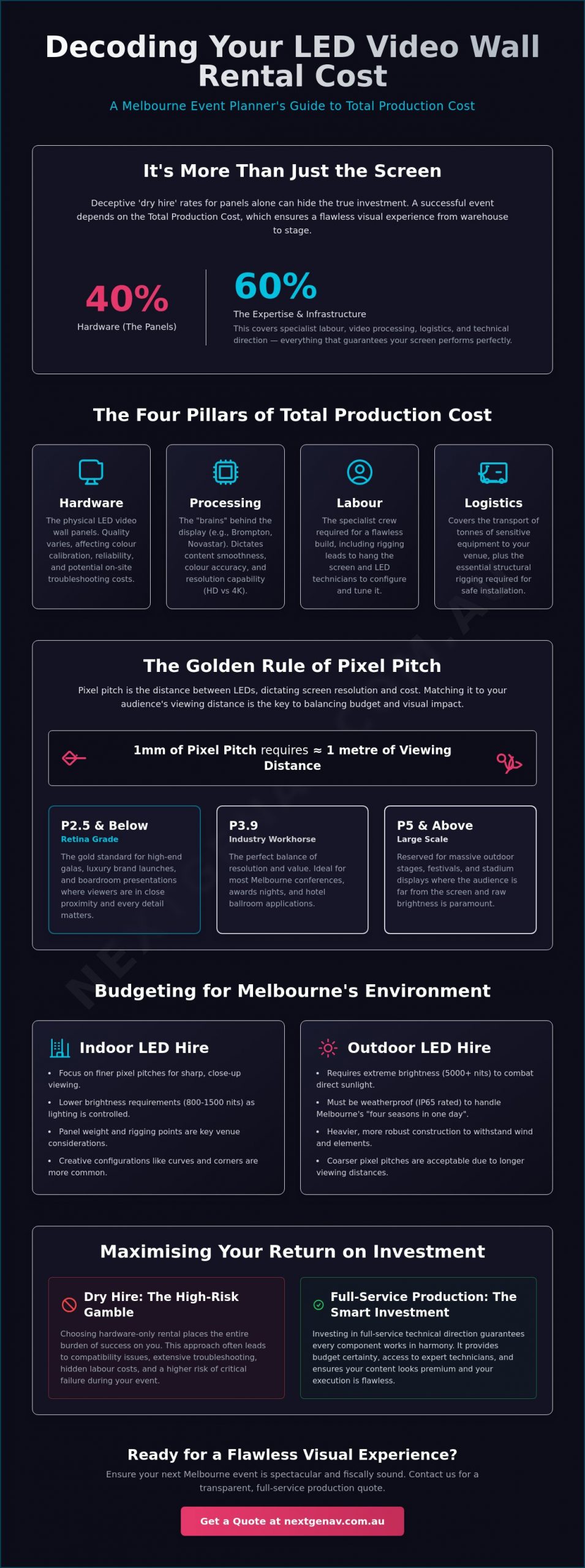
Labour and Logistics: The Melbourne Event Reality
Precision execution is the invisible engine of any successful production. While the physical hardware of your screen is a fixed variable, the human expertise required to assemble and tune that technology often dictates the true led video wall rental cost. In the Melbourne event circuit, logistics are rarely straightforward. Navigating the loading docks of the Melbourne Convention and Exhibition Centre (MCEC) or the intricate service lifts of the Crown Palladium requires a team that understands the specific architectural quirks and time-slot demands of our city’s premier venues. A standard 6m x 3m wall isn’t just “plug and play”; it involves a meticulous bump-in and pack-down timeline that typically spans four to six hours to ensure every panel is perfectly aligned and colour-calibrated before the first guest arrives.
Investing in high-level technical direction is frequently viewed as an additional expense, but in reality, it’s your most effective cost-saving measure. A seasoned technical director anticipates logistical bottlenecks before they manifest as overtime charges. They manage the delicate choreography of staging and rigging, ensuring that the LED installation doesn’t clash with lighting cues or audio coverage. By orchestrating these moving parts with professional authority, they eliminate the “failure cost” of technical glitches that can derail a high-stakes corporate launch or gala dinner.
Technical Crew Requirements
The success of your visual experience rests on the shoulders of a specialised crew. For a professional LED deployment, you’ll typically require a Vision Engineer to manage signal integrity, a System Tech for hardware assembly, and general labour hands for the heavy lifting. In Melbourne, an expert AV technician commands a rate between $100 and $150 per hour, while a qualified rigger for complex overhead setups averages approximately $180 per hour. We prioritise a Senior Lead for every installation because having a veteran on-site ensures that even if a venue’s power supply fluctuates or a signal cable fails, the solution is implemented instantly. Standard day rates cover the core build, but savvy planners must budget for overtime if the event finishes late into the night, as these rates can scale quickly after an eight-hour shift.
Transport and Rigging Safety
Weight is a critical factor that many planners overlook when budgeting for an LED wall. A 6m x 3m configuration carries significant mass, and the choice between floor support and a “flown” (rigged) system changes the price dramatically. Flown walls require certified motors and a rigging lead to ensure absolute compliance with Australian safety standards, adding a layer of complexity and cost. Furthermore, Melbourne CBD hotels often have strict loading dock time-slots. Missing your window at a venue like the Grand Hyatt or the Sofitel can result in idle labour costs while your transport waits on the street. Managing these logistical variables with precision ensures your budget remains intact while your visual impact reaches its full potential.
Indoor vs. Outdoor LED Screen Hire: Budgeting for Environments
Environmental variables are the silent architects of your led video wall rental cost. While an indoor screen focuses on intimate detail and colour accuracy, outdoor technology must battle the elements, requiring a completely different engineering profile. The primary differentiator is brightness, measured in “nits.” A standard indoor screen typically outputs 1,000 nits, which is ample for controlled ballroom lighting. However, to remain visible against the harsh Australian sun, an outdoor screen must surge to 5,000 nits or higher. This increased luminosity requires more robust power management and weatherproofing, driving the investment higher than a comparable indoor setup.
Melbourne’s notorious “four seasons in one day” makes IP65 weatherproofing a non-negotiable requirement for any exterior activation. This rating ensures your display remains operational during a sudden afternoon downpour, protecting your production from catastrophic failure. Beyond the rain, wind-loading is a critical safety factor. Large outdoor towers or ground-stacks act like massive sails; they require ballast and structural engineering certifications to ensure they remain stable in gusty conditions. These safety protocols are essential components of a professional quote, reflecting the mastery required to execute a safe public event. If you are unsure which environment your technology can handle, it’s best to consult our technical direction team early in your planning phase.
Indoor Excellence for Conferences
For plenary sessions and corporate galas, silent operation is the hallmark of prestige. High-end indoor panels utilise fanless designs to ensure the technology doesn’t compete with the presenter’s audio. These screens prioritise “seamless” corners and elegant trim, allowing your corporate branding to appear as part of the venue’s architecture rather than an afterthought. Many exhibitors also leverage trade show led wall rental to create custom booth sizes that maximise floor space while delivering high-density visual impact in a crowded hall.
Outdoor Impact for Festivals and Community Events
Sunlight-readable technology is the only way to ensure your content isn’t washed out by midday. While the cost per square metre for outdoor gear is higher due to its ruggedised build, the increased viewing distance of a festival crowd allows you to use larger pixel pitches, such as P5 or P10. This strategic choice helps offset the led video wall rental cost by reducing the total number of pixels required to fill a massive stage. Always factor in the power consumption reality; these high-brightness screens often require dedicated generators or high-amp venue power to maintain their peak performance throughout a multi-day event. For event organisers planning activations across the country, our comprehensive outdoor led screen hire Sydney guide covers the specific brightness, weatherproofing, and structural requirements needed to engineer a flawless visual triumph against coastal winds and harsh glare.
Maximising ROI: Why Full-Service Production is the Smarter Investment
Maximising your return on investment requires looking beyond the bottom line of a quote. While traditional projection might offer a lower entry point, the luminosity and prestige of a modern led video wall provide a level of audience engagement and ambient light rejection that static screens simply cannot match. The “cheapest quote” often carries a hidden “Failure Cost,” which is the price of technical downtime, pixel dropouts, or poor colour matching that can tarnish a brand launch. Choosing a full-service partner ensures you aren’t just hiring equipment; you’re securing a flawless execution where the technical engine remains invisible, allowing your message to take centre stage.
When evaluating your led video wall rental cost, the most expensive mistake is prioritising hardware over expertise. A professional production team acts as the “Invisible Expert,” identifying venue power limitations or content aspect ratio conflicts long before they reach the stage. This proactive orchestration eliminates the stress of live event planning. To ensure your investment delivers maximum impact, use this final checklist when reviewing any AV quote:
- Does the quote include a dedicated Vision Engineer and System Tech for the duration?
- Are there redundant processors and signal paths included for high-stakes moments?
- Is the transport and labour calculated for Melbourne-specific venue access windows?
- Are rigging safety certifications and site-specific structural engineering included?
Content Synchronisation and Testing
Visual harmony depends on the relationship between your digital files and the physical pixels. We don’t just set up a screen; we manage the complex “Pixel Mapping” required for non-standard or curved shapes to ensure your branding isn’t stretched or distorted. To guarantee success, we organise a dedicated “Content Day” to test aspect ratios and file types against the actual hardware. This pre-event testing prevents last-minute panics and ensures that every motion graphic and video looks premium from the moment the house lights dim.
The NextGen AV Difference
With 30 years of Melbourne event history, we’ve navigated every major ballroom and understood every power circuit in the city. This seasoned perspective allows us to offer a “Confidence Guarantee,” backed by 24/7 technical support and fully redundant systems that thrive under the pressure of a live environment. We don’t just provide gear; we provide the technical direction that transforms a simple presentation into a prestigious visual experience. Ready to elevate your next activation? Contact NextGen AV for a bespoke LED wall quote and let our team orchestrate your success.
Orchestrate Your Next Visual Masterpiece
Navigating the intricacies of led video wall rental cost requires more than just a spreadsheet; it demands a vision for the final, high-impact result. You now have the framework to balance technical precision with fiscal reality, ensuring that every pixel serves your event’s prestige. By prioritising elite technical direction and environmental resilience, you transform a standard hire into a sophisticated production that captivates your audience. Success isn’t just about the hardware on stage; it’s about the invisible expertise that ensures every transition is seamless and every colour is vibrant.
Our team brings over 30 years of Melbourne event excellence to your project, providing redundant 4K processing as standard for absolute peace of mind. We specialise in high-stakes corporate production where technical failure isn’t an option. Let us manage the complex engine behind the scenes while you take centre stage with total confidence. Request a Precision-Engineered LED Wall Quote today and begin your journey toward a flawless event realisation. Your vision deserves an extraordinary execution, and we’re ready to make it happen.
Frequently Asked Questions
How much does it cost to rent an LED video wall in Melbourne?
The total investment for a professional display depends on the scale, resolution, and technical complexity of your production. While hardware is a significant factor, your led video wall rental cost also encompasses the specialised crew and processing required for a flawless execution. Planners should account for the current Melbourne market rates for expert technicians, which typically range between $100 and $150 per hour, alongside the logistical demands of your chosen venue.
What is the difference between pixel pitch and rental price?
Pixel pitch is the primary technical driver of price because it dictates the density of the LEDs on each panel. A smaller pixel pitch, such as 1.5mm, requires more individual components per square metre to achieve high-resolution clarity, which increases manufacturing and maintenance expenses. Choosing a tighter pitch for front-row audiences ensures a premium “Retina” effect, whereas a larger pitch for distant viewing can help manage the budget without sacrificing visual impact.
Does the rental cost include setup and pack-down?
Full-service production quotes typically include the specialist labour required for a safe and precise installation. A standard 6m x 3m wall requires a bump-in and pack-down window of four to six hours, involving vision engineers and rigging leads to ensure structural integrity. While some providers offer “dry hire” rates for hardware alone, these figures exclude the vital technical orchestration needed to build, tune, and dismantle the system at your venue.
Are LED walls more expensive than projectors for conferences?
The initial investment for an LED wall is often higher than traditional projection, but the return on investment is found in its superior performance. LED technology excels in high-ambient light environments, allowing you to keep house lights up for networking and note-taking without washing out your content. This brightness and contrast advantage eliminates the need for darkened rooms, providing a more prestigious and engaging experience for your delegates.
What are the hidden costs in an LED wall rental quote?
Logistics, power infrastructure, and venue-specific fees are the most common “invisible” expenses that can impact your budget. You must account for Melbourne loading dock time-slots, 3-phase power requirements, and the weight-loading certifications required for flown rigs. A transparent quote should clearly outline these elements, ensuring you aren’t surprised by additional charges for specialised rigging motors or late-night labour surcharges after a gala finish.
Can I use an indoor LED screen for an outdoor event to save money?
Attempting to use indoor technology for an outdoor activation is a high-risk gamble that usually ends in technical failure. Indoor screens only output approximately 1,000 nits of brightness, which is invisible against the 5,000-nit intensity of the Australian sun. Additionally, indoor panels lack the IP65 weatherproofing required to protect the electronics from Melbourne’s unpredictable rain, making dedicated outdoor hardware essential for both visibility and safety.
How long does it take to install a standard corporate LED wall?
Expect a dedicated timeline of four to six hours for a professional crew to assemble and calibrate a standard 6m x 3m configuration. This window allows for the physical build, the complex signal mapping of the processors, and the meticulous colour balancing required to match your brand’s palette. Rushing this process can lead to visible seams or signal dropouts, so we always recommend scheduling a generous technical window before your event begins.
What power requirements do I need to budget for at the venue?
LED video walls are power-intensive systems that often require 3-phase power or multiple dedicated 20-amp circuits to operate safely at peak brightness. If your venue has limited electrical infrastructure, you may need to budget for temporary power distribution or whisper-quiet generators. Identifying these requirements early through a technical site visit prevents expensive last-minute electrical upgrades during the bump-in phase of your production.
A high-impact exhibition stand is no longer defined by its floor space, but by its ability to command attention through sheer visual gravity. You have likely felt the mounting pressure of the 2026 expo season, where the difference between a “people magnet” booth and a missed opportunity often comes down to a single piece of technology. The stakes are high. Nobody wants to face a technical glitch or a pixelated display in front of a live audience at the Melbourne Convention and Exhibition Centre.
We understand that the logistics of a trade show led wall rental can feel overwhelming. You are balancing the precision of pixel pitch against viewing distances while trying to stay compliant with Victorian rigging and safety standards. This guide provides the clarity you need to transform your presence with cutting-edge LED technology and seamless technical execution. We will explore the latest 2026 hardware trends, demystify the complexities of venue logistics, and show you how a dedicated technical director ensures your content plays perfectly from bump-in to pack-down.
Key Takeaways
- Learn how moving visuals act as a powerful “people magnet” to significantly increase booth dwell time and attendee engagement.
- Master the technical essentials of trade show led wall rental by identifying the perfect pixel pitch and resolution for your specific viewing distances.
- Discover high-impact configurations, from immersive L-shaped wraps to suspended digital headers, that ensure 360-degree visibility on a crowded floor.
- Navigate complex Melbourne venue logistics, including MCEC rigging safety and power load calculations, to prevent technical failures before they happen.
- Understand how professional technical direction allows your team to focus on lead generation while experts orchestrate a seamless visual experience.
Elevating Your Presence: Why Trade Show LED Wall Rental is the 2026 Standard
The trade show floor is a high-stakes arena where the first three seconds of an attendee’s gaze determine your ROI. In 2026, the benchmark for engagement has shifted from static backdrops to dynamic, luminous structures. Opting for a trade show led wall rental is no longer just an aesthetic upgrade; it’s a strategic necessity for brands that refuse to blend into the background. Modern LED systems are modular and high-brightness, allowing for seamless visual canvases that wrap around corners or tower above competitors without the distracting bezels of traditional tiled monitors. This creates a polished, architectural feel that commands respect before a single word is spoken.
This shift is driven by the “Magnet Effect.” Industry reports indicate that moving visuals can increase booth dwell time by up to 40 percent compared to static displays. This isn’t just about motion; it’s about the sophisticated use of LED display technology to tell a story that unfolds in real-time. Beyond the immediate visual impact, digital assets offer a significant sustainability advantage. As Australian venues tighten regulations around waste and single-use materials, moving away from printed signage in favour of reusable digital content aligns your brand with modern environmental expectations. While 2024 was about scale, 2026 is defined by depth. Naked-eye 3D content is the new prestige standard, creating an illusion of three-dimensional objects floating in front of the screen to stop traffic and demand a closer look.
The Psychology of the Show Floor
Capturing attention in the cavernous, high-ambient light environments of major exhibition centres requires more than just a large screen. It requires luminance. LED walls cut through the overhead glare of venues like the MCEC, ensuring your brand remains the brightest point in the room. By utilising height and scale, these installations act as digital landmarks. They guide attendees through the hall, transitioning them from passive observers into active participants. A well-placed screen doesn’t just show a product; it creates an atmosphere that invites exploration and builds trust through high-production value.
Digital Versatility for Multi-Day Events
The true power of a trade show led wall rental lies in its agility. Unlike a printed banner that is fixed for the duration of the event, a digital wall is a living asset. You can update content in real-time to reflect specific afternoon sessions, announce product launch countdowns, or integrate live social media feeds. This versatility makes the stand feel fresh on day three, providing a level of cost-efficiency that physical rebrands simply cannot match. You are investing in a platform that adapts as quickly as the conversation on the floor, allowing for a truly responsive exhibition strategy.
Technical Essentials: Pixel Pitch, Resolution, and Content Strategy
Precision is the silent engine of prestige. While the visual impact of a trade show led wall rental is immediate, the technical architecture behind that brightness determines whether your booth feels like a premium brand experience or a high-resolution afterthought. As industry leaders move toward creating immersive and personalized event experiences, the choice of pixel pitch becomes your most critical decision. Pixel pitch refers to the distance between the centre of each LED cluster; the smaller the number, the higher the resolution. For the intimate confines of an exhibition stand, P2.5 or P1.9 is the established ‘sweet spot’. These resolutions ensure that even from two metres away, your text remains crisp and your imagery appears as a solid, vibrant surface rather than a collection of dots.
Clarity is not just about what the human eye sees. It’s also about what the smartphone camera captures. Low refresh rates often result in moiré patterns; those distracting wavy lines that appear on digital screens when filmed. In an era where every visitor is a potential content creator, your booth must be camera-ready. High-end processing ensures your visuals look as flawless on a LinkedIn story as they do in person. This technical foresight extends to aspect ratios. Many modern stands utilise non-standard “ribbon” displays or L-shaped corner wraps. Designing content for these unique footprints requires a shift from standard 16:9 thinking to a more architectural approach where the video fits the physical furniture of your stand.
Choosing Your Pixel Pitch
The resolution you choose should be dictated by your booth’s footprint. P1.5 to P1.9 panels are ideal for close-up engagement where attendees read detailed text or view high-fidelity product renders. While 2026 has seen a 15% price increase for these finer pitches due to high demand, the visual payoff for broadcast-quality displays is unmatched. P2.5 remains the industry standard for medium-sized booths, providing excellent clarity for general video content. If you’re planning an overhead “header” display, a larger pitch can be used, as the increased viewing distance naturally blends the pixels into a smooth image. Understanding how pixel pitch affects your overall led video wall rental cost is essential for building an accurate budget before you commit to a configuration.
Content Management and Media Servers
True visual mastery requires more than just a screen; it requires world-class processing. We utilise Brompton processors to ensure absolute colour accuracy and natural skin tones, which is vital for corporate presentations. Relying on “plug and play” USB sticks often leads to stuttering playback or failed loops on large-scale walls. Professional media servers are the only way to manage complex transitions and high-bitrate files without a hitch. Our team at NextGen AV provides the technical direction needed to orchestrate these systems, allowing you to focus on your leads while we handle the pixels.
High-Impact Configurations: Examples of LED Video Walls for Trade Show Booths
Success on the expo floor is a choreography of movement and light. A standard flat screen is a start, but a truly bespoke trade show led wall rental integrates with your booth’s architecture to direct visitor flow. Consider the “Immersive Wrap.” By utilising L-shaped corners with seamless 90-degree joins, you create a 3D environment that pulls visitors into your brand story. This configuration is particularly effective for product demonstrations, where the background wraps around the physical item to create a sense of infinite depth and prestige. It transforms a simple corner into a high-tech stage.
Organic shapes are also gaining momentum in 2026. Curved LED walls soften the rigid, industrial lines of an exhibition hall, creating an inviting, sculptural centrepiece. These curves don’t just look better; they improve viewing angles for crowds gathered at your stand, ensuring no one is left with a distorted perspective. For those aiming for maximum reach, “Digital Headers” are the ultimate solution. Suspending long, thin LED strips above your booth ensures 360-degree visibility, acting as a high-definition beacon that can be seen from the furthest corners of the venue. It is about being seen before your competitors even register on the attendee’s radar.
Small Booth Solutions (3m x 3m)
Impact isn’t reserved for the giants. In a 3m x 3m shell-scheme, floor space is precious. Vertical “totem” displays offer a high-definition solution that takes up minimal room while providing a massive canvas for product showcases. These slimline units can be integrated directly into existing stands, transforming a basic booth into a premium digital gallery without sacrificing the space needed for face-to-face meetings. This allows for a trade show led wall rental that feels like a natural extension of your brand rather than a bulky addition.
Island Stand Masterpieces (6m x 6m and larger)
Large-scale island stands allow for architectural daring. Central LED columns can act as the beating heart of your presence, pulsing with brand colours and real-time data. For a lighter touch, transparent LED walls maintain an open, airy feel while still delivering high-impact visuals that seem to float in mid-air. If you are looking for even broader inspiration for major activations, explore our LED Video Walls for Events: The Ultimate 2026 Planning Guide. Combining these walls with interactive portals, where touch-screens trigger changes on the main LED backdrop, creates a loop of engagement that keeps leads at your booth longer and builds a lasting impression of innovation.
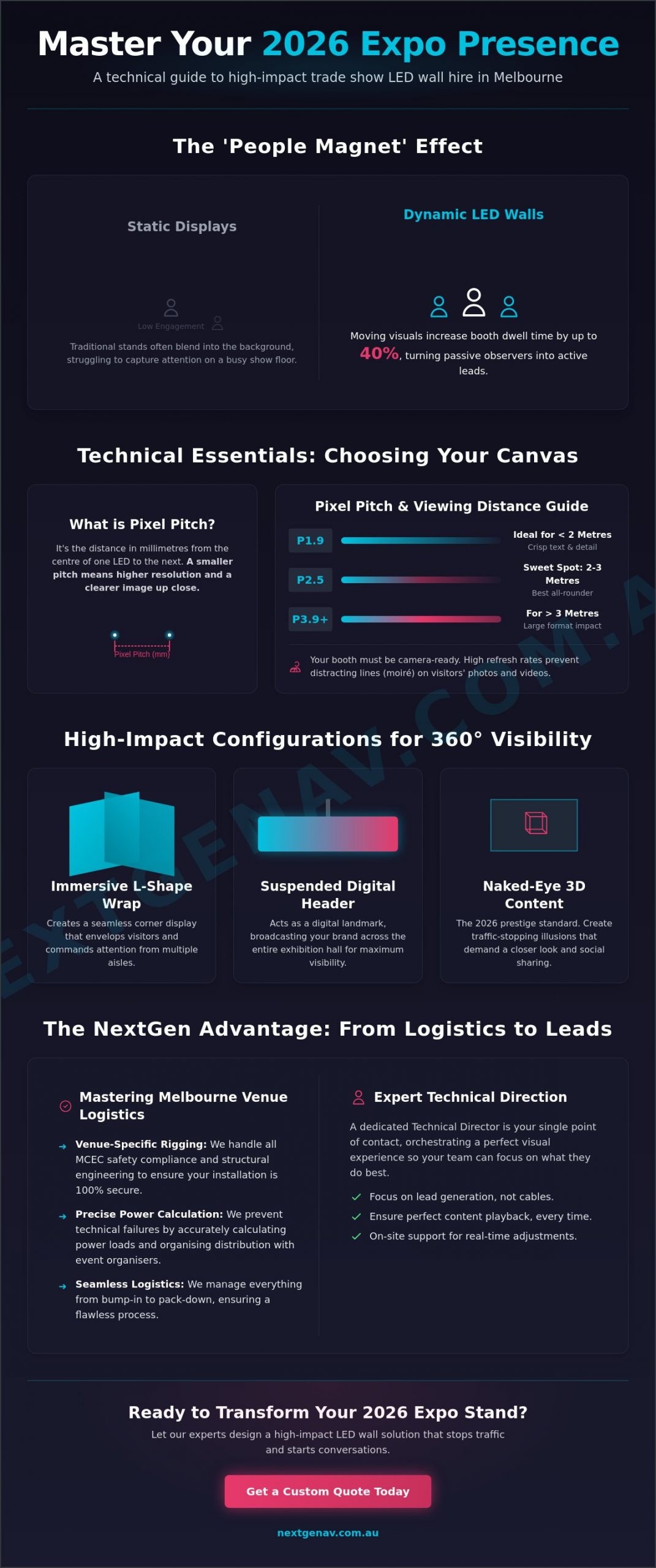
Navigating the Logistics: Rigging, Power, and Melbourne Venue Requirements
The transition from a brilliant concept to a flawless exhibition presence relies on the invisible precision of logistics. While the visual allure of a trade show led wall rental is what captures the crowd, the structural and electrical integrity of the installation is what preserves your professional reputation. Managing a large-scale LED deployment requires a deep understanding of weight loads and overhead suspension. A standard high-resolution wall can weigh hundreds of kilograms; this necessitates a rigorous approach to rigging safety that accounts for both the venue’s structural limits and the safety of everyone on the floor. Our role is to act as the confident orchestrator, ensuring every panel is secured and every cable is managed with surgical neatness.
Power management is another critical pillar of a successful bump-in. It is vital to calculate the total electrical “draw” of your LED configuration early in the planning phase. Large displays can easily overwhelm standard booth power allocations, leading to tripped circuits at the exact moment your keynote begins. We coordinate directly with venue organisers and stand builders to ensure the infrastructure supports your ambition. Having a standby engineer on-site is non-negotiable for high-stakes shows. This proactive presence ensures that if a signal path falters or a power surge occurs, the solution is implemented before the audience even notices a flicker. You can partner with our technical direction team to ensure these complexities are handled with absolute mastery.
Melbourne Venue Specifics
Melbourne’s premier event spaces each carry unique operational hurdles. At the Melbourne Convention and Exhibition Centre (MCEC), all exhibitors must complete a mandatory safety induction, and rigging must be performed by certified professionals. In accordance with Victorian OH&S legislation, temporary electrical installations must be executed by a registered contractor. For high-risk activities, WorkSafe Victoria requires a High-Risk Work Licence (HRWL) and a comprehensive Safe Work Method Statement (SWMS). Navigating heritage requirements at the Royal Exhibition Building adds another layer of complexity, as we must protect the integrity of the historic structure while delivering 2026-grade technology.
The Importance of a Technical Rehearsal
The hours before the doors open are the most critical for your visual success. A dedicated technical rehearsal allows us to test every centimetre of the wall for “dead pixels” or signal lag. We calibrate brightness levels to perfectly complement the specific ambient lighting of the hall, ensuring your content is punchy without being overwhelming. If your activation includes audio-visual synchronisation, this is the moment we lock in the timing. This methodical approach transforms a collection of hardware into a seamless, cinematic experience that is ready for the spotlight.
The NextGen Advantage: Beyond the Screen to Seamless Execution
Mastery is not merely about owning the latest hardware; it is about the wisdom to deploy it under pressure. With 30 years of Australian industry experience, we have navigated every conceivable show floor challenge, from power surges in heritage buildings to tight bump-in windows at the MCEC. When you secure a trade show led wall rental through us, you aren’t just hiring panels. You’re engaging a team of seasoned veterans who understand that our success is measured by your lack of stress. This is the essence of our “Invisible Expert” philosophy. We operate with a quiet power behind the scenes, orchestrating the technical direction so your sales team can focus entirely on capturing leads and building relationships.
Our approach rejects the limitations of “off-the-shelf” kits. Every brand has a unique story, and every exhibition stand requires a bespoke technical solution. We manage the entire lifecycle of your project, from the initial pre-production planning and content mapping to the final pack-down. This end-to-end oversight ensures that nothing is lost in translation between your vision and the final execution. By taking ownership of the logistical grind, we allow the prestige of your brand to take centre stage, transforming a standard booth into a high-production landmark.
A Partnership, Not a Hire
We believe in deep collaboration with your creative agency. We ensure your content is pixel-perfect by verifying aspect ratios and colour profiles long before we arrive on-site. Our team is proactive, identifying potential signal bottlenecks or rigging hurdles before they ever reach the show floor. This commitment to the final result is what defines our craft. We aren’t just a utility; we are your technical ally, dedicated to the flawless realisation of your brand’s presence. Our pride comes from the seamless execution that makes the technology disappear, leaving only your message behind.
Taking the Next Step
Ready to elevate your exhibition strategy? To provide a tailored quote for your next Melbourne trade show, we typically need your booth dimensions, the desired screen configuration, and your content goals. Whether you’re planning a 3D immersive wrap or a simple high-definition backdrop, we build the technical engine that drives your success. Enquire about your trade show LED wall rental with NextGen AV today and let us handle the pixels while you handle the prospects.
Command the Floor with Technical Mastery
Transforming your exhibition presence from a standard display into a high-impact digital landmark requires more than just high-resolution panels. It demands a perfect synergy between architectural design, technical precision, and a deep understanding of venue logistics. By mastering the nuances of pixel pitch and navigating the specific safety regulations of Melbourne centres, you ensure your brand remains the focal point of the hall. Your trade show led wall rental should serve as a powerful platform for storytelling, allowing you to move past the logistical grind and focus on the prestige of the final result.
Our specialist Melbourne-based team brings over 30 years of technical event production expertise to your stand, utilising premium hardware like Brompton processing to guarantee absolute visual accuracy. We act as your invisible expert, managing the complexities of rigging and power so your team can focus on the leads that drive growth. Success in 2026 is about creating a seamless, cinematic experience that resonates with every attendee who walks the floor.
Ready to turn your booth into a people magnet? Request a custom trade show LED wall quote from NextGen AV and let us orchestrate your most successful exhibition yet. We are ready to bring your vision to life with precision and passion.
Frequently Asked Questions
What is the best pixel pitch for a trade show LED wall?
P2.5 or P1.9 is generally considered the optimal choice for trade show environments where attendees stand close to the display. Because visitors are often within two to five metres of your stand, a finer pitch ensures that text remains sharp and images appear seamless. For ultra-detailed product renders or broadcast-quality clarity, P1.5 to P1.9 offers the most prestigious and high-resolution result.
How much does it cost to hire an LED wall for a trade show in Melbourne?
The investment for a trade show led wall rental in Melbourne is determined by several specific factors rather than a flat rate. These include the total physical size of the display, the chosen pixel pitch, the duration of the exhibition, and the level of technical direction required. Logistics such as freight, specialized rigging, and on-site engineering support also influence the final tailored quote for your project. For a transparent breakdown of every pricing variable, our comprehensive guide to led video wall rental cost for 2026 events provides the detailed framework you need to budget with confidence.
Can I use my existing marketing videos on an LED wall?
You can certainly utilise existing assets, provided the resolution and aspect ratio are compatible with your specific screen configuration. While standard 16:9 videos work on many walls, custom-shaped or “ribbon” displays require content to be specifically mapped to avoid stretching or distortion. We recommend using high-bitrate files to ensure the vibrant colours and deep blacks of the LED panels are fully realised.
How long does it take to set up an LED wall at an exhibition?
Setup times vary based on the complexity of the installation and the venue’s rigging requirements. A standard wall typically takes between four and eight hours to assemble, calibrate, and test. We coordinate closely with stand builders to ensure our “bump-in” fits perfectly within your overall exhibition schedule, allowing ample time for a full technical rehearsal before the doors open.
Do I need a special power supply for an LED video wall?
Large-scale LED installations often require more power than a standard 10-amp wall socket provides. We calculate the total electrical draw during the planning phase to determine if your booth needs a three-phase power supply or multiple dedicated circuits. Coordinating these requirements with venue organisers at the MCEC or Royal Exhibition Building is a standard part of our technical management process.
What happens if a pixel fails during the middle of the trade show?
Our “Invisible Expert” philosophy includes having a standby engineer and spare modules on-site for every high-stakes event. If a module develops a fault, it can be swapped out in minutes without needing to dismantle the entire wall. This proactive approach ensures your visual presence remains flawless and uninterrupted throughout the duration of the show, protecting your brand’s prestige.
Is an LED wall better than a large TV or projector for a booth?
LED walls offer superior brightness and scalability compared to traditional TVs or projectors in exhibition environments. Exhibition halls are notorious for high ambient light that washes out projected images, whereas LED panels cut through the glare with ease. Unlike tiled TVs, LED walls are completely seamless, allowing you to create massive, architectural canvases that aren’t limited by standard screen sizes. If you are evaluating your options in depth, our detailed breakdown of led wall vs projector for conference environments covers the full technical and practical comparison for Melbourne venues.
Can LED walls be curved or custom-shaped for my stand design?
Yes, the modular nature of LED technology allows for incredible creative freedom in your stand design. We can configure panels into organic curves, 90-degree corner wraps, or long digital headers that act as a beacon for your brand across the hall. This flexibility allows your trade show led wall rental to become an integrated part of your booth’s architecture rather than just a screen on a wall.
A high-definition screen doesn’t guarantee a captivated audience; it’s the invisible technical precision behind the glass that determines whether your event feels like a prestige production or a technical liability. You’ve likely felt that familiar knot of anxiety when considering the logistics of a large-scale led video wall, from the fear of a mid-presentation flicker to the headache of calculating viewing distances in a challenging Australian venue. It’s a common concern for organisers who want to move beyond the logistical grind and focus on the artistry of the final result.
This guide is designed to transform that uncertainty into absolute technical confidence. You’ll master the essentials of pixel pitch and rigging requirements while discovering how the latest 2026 innovations, like AI-powered content management and MicroLED technology, can maximise your impact. We’ll walk through everything from power consumption to the rise of zero-bezel designs, giving you the blueprint for a flawless visual experience that positions your brand as a leader in its field. By the end of this guide, you’ll have the technical mastery needed to orchestrate a production that is as seamless as it is spectacular.
Key Takeaways
- Master the technical specifications of a modern led video wall to ensure your visual content remains sharp and vibrant regardless of the audience’s viewing distance.
- Evaluate the strategic ROI of LED technology compared to traditional projection, specifically how to maintain visual impact in high-ambient light environments like the Melbourne Convention Centre.
- Optimise your event logistics by mastering the requirements for three-phase power and professional rigging to ensure a safe and efficient bump-in.
- Learn how to align your content strategy with modular hardware to create immersive, cinematic environments that transcend the limitations of standard screen displays.
- Leverage expert technical direction to oversee the entire visual chain, allowing you to focus on your guests while the invisible experts manage the technical pressure.
What is an LED Video Wall? The Shift in Modern Event Production
The architecture of a modern event has evolved far beyond simple stages and static backdrops. Today, a led video wall serves as the heartbeat of a production, acting as a modular display system composed of individual light-emitting diodes that work in perfect synchronisation. Unlike traditional LCD screens that are plagued by distracting bezels, these systems offer a truly seamless canvas. This lack of visual interruption allows for a continuous, immersive image that flows across the entire surface, ensuring your audience remains focused on the message rather than the equipment. To understand the foundational technology, it helps to look at What is a Video Wall? in its broadest sense, but the modern event industry has moved decisively toward the brightness and flexibility of LED.
This shift isn’t just about aesthetic preference; it’s rooted in the psychology of engagement. Large-format visuals command attention in a way that smaller, fragmented displays cannot. High-impact imagery increases information retention and creates a sense of prestige that elevates the entire brand experience. When you deploy a seamless visual surface, you’re not just showing content; you’re creating an environment that captivates the senses and eliminates the “grid” effect that often breaks the immersion of digital presentations.
The Core Components of an LED System
A professional led video wall is a sophisticated assembly of precision-engineered parts. At the most basic level, individual LED modules are grouped together into cabinets, which serve as the structural building blocks of the wall. The long-term reliability of these modules relies on high-quality internal circuitry, often incorporating precision resistors and diodes from specialist manufacturers like Adage Components, to ensure consistent visual performance. Each cabinet houses a receiving card, the critical component that interprets data from the central video processor. This processor acts as the “brain” of the operation, scaling and mapping your content to fit the specific dimensions of the screen. Because these systems are modular, you aren’t restricted to a standard 16:9 aspect ratio. You can organise panels into towers, curved ribbons, or abstract geometric shapes that integrate directly with your staging and rigging.
Why Events are Moving Away from Traditional Projection
The era of dimming the lights just to see a presentation is over. Traditional projectors often suffer from a “washout” effect when faced with ambient light, particularly in bright Australian venues like the Melbourne Convention Centre. LED panels produce their own light, delivering incredible colour depth and contrast ratios that remain vivid even in broad daylight. There’s also a significant logistical advantage: space. Projectors require a long “throw distance” or complex mirrors to cast an image, often eating up valuable floor space. LED walls have a remarkably slim profile, allowing you to maximise your venue footprint and place the screen exactly where it will have the most impact.
Decoding the Technical Specs: Pixel Pitch, Nits, and Refresh Rates
Technical precision isn’t about chasing the highest numbers on a spec sheet. It’s about the deliberate orchestration of hardware to suit a specific environment. When you plan a led video wall installation, the metrics you choose will directly dictate the clarity of your message and the comfort of your guests. Over-specifying a screen for a massive hall is an unnecessary drain on resources, while under-specifying for an intimate lounge will result in visible pixels and a diminished brand image. Mastery of these specs allows you to move past the guesswork and focus on the prestige of your event’s final look.
Pixel Pitch: Finding the Sweet Spot for Your Audience
Pixel pitch measures the distance from the centre of one LED cluster to the next. A reliable industry rule of thumb is to allow one metre of viewing distance for every millimetre of pitch. For instance, a 2.6mm panel provides a seamless image from approximately 2.6 metres away. If your audience is closer than this, the individual diodes become visible, breaking the illusion of a solid image.
- 1.9mm: Ideal for high-resolution corporate displays where viewers are positioned within two metres of the screen.
- 2.6mm: The gold standard for most Australian gala events, conferences, and ballroom settings.
- 3.9mm: Best for large-scale stage backdrops or festivals where the audience is positioned at a significant distance.
Choosing a finer pitch increases resolution density, which is perfect for detailed text or high-end branding. However, for massive surfaces viewed from the back of a room, a slightly wider pitch often delivers a more impactful visual result for the same budget. It’s about finding the balance between density and scale to ensure every seat in the house has a premium view. These same pixel pitch principles apply equally when considering a trade show led wall rental, where close-proximity viewing distances at exhibition stands make fine-pitch selection especially critical.
Brightness (Nits) and Refresh Rates for Camera Clarity
Brightness, measured in Nits, ensures your content remains vibrant against the venue’s existing lighting. Indoor environments typically require between 600 and 1200 Nits to maintain visual punch. However, if your event is being filmed or live-streamed, the refresh rate is the specification that truly matters. Screens with low refresh rates often create a distracting “flicker” or horizontal lines on camera due to Pulse Width Modulation issues. To ensure a broadcast-quality finish, always demand a refresh rate of at least 3840Hz.
In low-light gala settings, pay close attention to greyscale performance. High-quality panels maintain deep blacks and subtle gradients even when the overall brightness is dimmed, preserving the artistry of your cinematic content. If you’re navigating these variables for the first time, seeking advice on technical direction can ensure your configuration is perfectly fit for purpose.
LED Wall vs. Projector: A Strategic Comparison for Event Planners
Choosing between these two technologies isn’t merely a matter of budget; it’s a decision about the visual integrity of your brand. While projectors have served as the industry standard for decades, the led video wall has redefined what’s possible in high-stakes environments. It’s the difference between a reflected image and a direct light source. Projectors rely on a darkened room to maintain clarity, but LED technology creates its own brilliance, ensuring your message remains the centre of attention regardless of the venue’s limitations.
Reliability is where the two diverge most sharply. If a projector bulb fails or a cable is tripped, your entire presentation vanishes in an instant. It’s a catastrophic “single point of failure” that every organiser dreads. In contrast, an LED system is inherently redundant. If a single diode or even an entire module fails, the rest of the wall continues to operate flawlessly. To the audience, the glitch is virtually invisible, allowing your technical team to swap components behind the scenes without interrupting the flow of the event. This peace of mind is a hallmark of premium AV orchestration. For event planners coordinating the full scope of a production, understanding how LED walls integrate within a broader audio visual hire Melbourne strategy is essential to achieving a truly cohesive and flawless result.
Performance in High Ambient Light
Vivid colours and deep blacks are non-negotiable for premium branding. Modern Australian venues, like the Melbourne Convention Centre, often feature stunning floor-to-ceiling windows that flood rooms with natural light. This ambient light is the natural enemy of the projector, causing images to look washed out and “milky.” A led video wall cuts through this interference with ease. By delivering true black levels and punchy, high-contrast output, it ensures your corporate colours are rendered with absolute fidelity, maintaining the prestige of your visual assets even in the middle of a summer afternoon. For a deeper analysis of how these two technologies perform under conference conditions specifically, our comprehensive guide on led wall vs projector for conference events covers every critical variable from ambient light performance to live-stream quality.
Venue Logistics: Rigging and Floor Space
Spatial efficiency is a major factor in venue selection and floor plan design. A rear-projection setup often requires a five-to-ten-metre “dead zone” behind the screen, significantly reducing your usable floor space and guest capacity. An LED wall is remarkably slim, requiring minimal clearance and allowing you to push the stage back to the very edge of the room. While large arrays require precise rigging and weight load calculations from experienced professionals, they also offer the flexibility of ground-stacking. If a venue has restrictive ceiling heights or no rigging points, a ground-supported LED wall provides a massive cinematic backdrop without the need for overhead support.
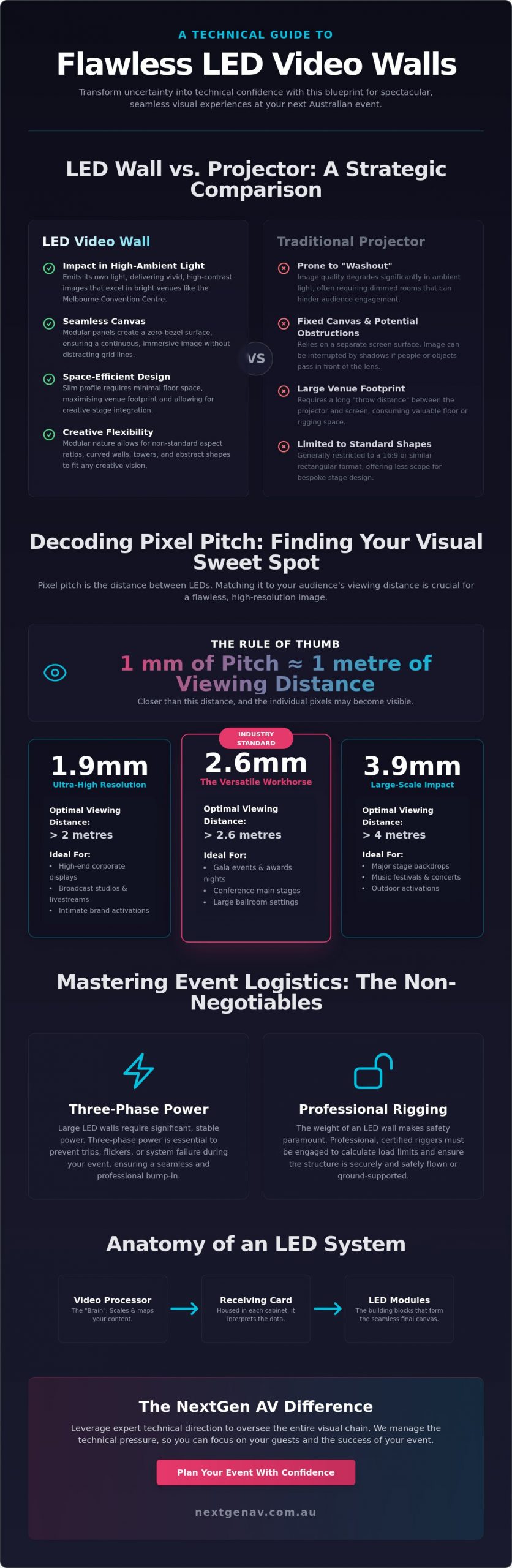
Mastering the Logistics: Power, Rigging, and Content Strategy
The success of a high-stakes event isn’t just about the hardware on stage; it’s about the invisible logistics that ensure the technology performs under pressure. While the visual impact of an led video wall is undeniable, the path to a flawless “go-live” moment requires a meticulous bump-in timeline and deep technical knowledge. A professional installation typically demands a multi-hour setup window where rigging, power distribution, and data mapping are executed with surgical precision. This is where the grind of planning meets the prestige of performance. Execution is everything.
Structural safety is the non-negotiable foundation of any large-scale display. In Australian venues, rigging must adhere to strict structural safety standards to protect both the audience and the crew. Whether your screen is flown from the ceiling or ground-stacked on a custom stage, every point of contact must be verified for weight load capacity. To eliminate the risk of a blackout, elite technical teams always implement a “signal backup” loop. This redundancy ensures that if a single data cable fails, the video processor automatically reroutes the signal from the opposite direction, keeping your presentation running without a second of downtime.
Power and Data Infrastructure
You don’t power a cinematic experience with a standard 10A wall circuit. Large-scale walls require dedicated power distribution units (distros) that typically draw from three-phase power outlets. This ensures a stable, surge-protected energy supply that can handle the peak brightness of thousands of diodes simultaneously. Data redundancy is equally vital. For high-stakes shows, using primary and backup processors allows for an instantaneous switchover if a hardware fault occurs, effectively shielding your brand from technical glitches. Professional cable management is the final touch, ensuring that the “behind-the-scenes” remains as polished as the front-of-house.
Content Creation: Aspect Ratios and Resolution
Creating content for a modular display is different from designing for a standard TV. Because an led video wall can be built in any shape, your content must be tailored to a specific “pixel map.” If you simply send a standard 1920×1080 signal to a custom-sized screen, your logos will likely look stretched or pixelated. We recommend 1:1 pixel mapping, where every pixel in your video file corresponds exactly to a physical diode on the wall. This creates ultra-sharp text and vibrant branding that looks spectacular from every angle. If you need help coordinating these complex technical requirements, our team can provide the technical direction required to bring your vision to life.
The NextGen AV Difference: Expert Technical Direction
Sophisticated hardware like a led video wall requires more than just a technician; it demands a conductor. NextGen AV has spent over 30 years acting as Melbourne’s “Invisible Expert,” orchestrating high-stakes productions where failure isn’t an option. Our Technical Directors act as the single point of accountability, overseeing the entire visual chain from the initial signal source to the final diode. This level of mastery ensures that every logistical detail, from meticulous site inspections to structural load-bearing checks, is handled long before the first guest arrives. We don’t just supply equipment; we provide the engine that drives your event’s success.
Pre-production is where the most critical work happens. By identifying potential venue bottlenecks early, such as power limitations or rigging constraints, we eliminate the fear of visual glitches during live presentations. Our team takes personal pride in seamless execution, ensuring that the transition from a bold high-level vision to a cinematic reality is both methodical and efficient. This proactive partnership allows you to step away from the technical grind and focus on the prestige of the final result.
Why Technical Direction Matters for High-Stakes Events
High-stakes events are fluid and unpredictable. A keynote speaker might provide a last-minute content update, or a lighting cue might need to be adjusted to match a screen’s colour temperature. Our technical direction team manages these variables in real time, coordinating seamlessly with lighting, audio, and camera crews to maintain a cohesive aesthetic. We operate under strict zero-failure protocols, employing redundant signal paths and proactive monitoring to ensure your brand remains centre stage. It’s about alleviating the stress of the “what if” so you can focus on the impact of the “what is.”
Custom LED Solutions for Unique Brand Experiences
Modern event design has moved past the flat 16:9 rectangle. We leverage the modularity of the led video wall to create architectural landmarks, including immersive tunnels, curved stage surrounds, and transparent displays that blend into the venue’s design. These aren’t just screens; they’re canvases for interactive experiences. By integrating live social media feeds or real-time polling, we transform a passive viewing experience into an active brand dialogue. If you’re ready to move beyond the logistical grind and experience absolute technical confidence, organise a technical consultation for your next Melbourne event.
Orchestrate Your Visual Masterpiece
Deploying a high-impact led video wall is about more than just hardware; it’s about the technical mastery required to turn a standard venue into a cinematic environment. You now understand that the correct pixel pitch and high refresh rates are non-negotiable for camera clarity, while meticulous power logistics and structural safety form the invisible foundation of a successful production. By mastering these essentials, you’ve moved beyond the stress of the logistical grind and can now focus on the prestige of your event’s final result.
Success in high-stakes Australian environments requires a partner who thrives under pressure and takes personal pride in seamless execution. With over 30 years of technical production experience, our team provides the absolute reliability your brand demands through redundant signal and power systems as standard. We assign expert Technical Directors to every major hire, ensuring that your vision is realised with surgical precision and zero-failure protocols. Partner with Melbourne’s LED experts for your next event and step onto the stage with absolute confidence. Your audience is ready for something spectacular.
Frequently Asked Questions
How much does it cost to hire an LED video wall in Melbourne?
The investment for a professional hire depends on several variables, including the screen’s total dimensions, the required pixel pitch, and the complexity of the rigging at your specific Melbourne venue. Because every event has unique architectural needs, costs are typically calculated based on the hardware required and the technical team needed for a safe, efficient installation. It’s best to request a tailored consultation to ensure the configuration aligns with your production’s prestige and budget.
What is the difference between an indoor and outdoor LED screen?
The primary distinctions lie in brightness levels and environmental protection. Outdoor screens are engineered to produce at least 5,000 nits to cut through direct Australian sunlight, whereas indoor panels usually operate between 600 and 1,200 nits for comfortable viewing. Additionally, outdoor modules feature high IP ratings to shield sensitive electronics from dust and moisture, ensuring your led video wall remains reliable during open-air productions.
Can I use a standard PowerPoint presentation on a large LED wall?
You can certainly display a standard PowerPoint, though professional scaling is essential to maintain visual integrity. Since your custom screen likely has a unique resolution, our technical team uses a video processor to map your slides exactly to the pixel dimensions of the wall. This prevents your branding and text from appearing stretched, ensuring your presentation looks sharp and sophisticated from every seat in the house.
How long does it take to set up (bump-in) an LED video wall?
A standard professional installation typically requires a four-to-eight-hour window for a successful bump-in. This timeline allows our crew to assemble the modular cabinets, establish redundant data loops, and calibrate the colour balance across the entire surface. More complex designs, such as curved arrays or large flown systems, may require additional time for structural safety checks and precise rigging to ensure a flawless go-live moment.
Do I need a special technician to operate the video wall during my event?
High-stakes events always benefit from a dedicated technician to oversee the visual chain and manage content transitions. An experienced LED operator or Technical Director monitors the signal integrity and manages the video processor in real time, responding instantaneously to any live updates or emergency changes. This “invisible expert” approach allows you to focus on your guests while we ensure the technical execution remains seamless.
What is pixel pitch and why does it matter for my event?
Pixel pitch is the distance between the centre of each LED cluster, and it directly dictates the “sweet spot” for your audience’s viewing distance. A finer pitch provides incredible detail for close-up viewing in intimate ballrooms, while a larger pitch is more efficient for distant audiences in large halls or arenas. Selecting the right pitch ensures your led video wall delivers sharp imagery without over-specifying hardware that your audience won’t perceive.
How much power does a typical LED video wall require?
Large-scale displays require a robust infrastructure, typically drawing from three-phase power outlets through dedicated distribution boards. While a single panel doesn’t draw much energy, a full array running at high brightness levels demands a stable and surge-protected supply. Our team manages these logistics during the site inspection, ensuring the venue’s electrical capacity is perfectly matched to your production’s energy requirements.
Can LED walls be used for outdoor events in the rain?
Outdoor-rated LED panels are designed with weather-sealed modules that can operate safely during rain, provided they carry an appropriate IP65 rating. This protection prevents moisture from reaching the diodes or the internal electronics within the cabinets. We also ensure that all power distros and data connections are professionally shielded, maintaining a safe and reliable visual environment even during unpredictable Australian weather conditions.