
Imagine the clouds darkening over the Yarra just as your headliner takes the stage, and instead of panic, you feel absolute calm because your integrated festival stage production melbourne was engineered for this exact moment. Planning a large-scale event in Victoria is an intricate balancing act between creative vision and the reality of complex council permits and temperamental weather. You’re likely juggling the pressure of meeting the new 2026 risk-based safety frameworks while trying to make your visuals pop against the skyline. We understand that managing separate vendors for sound, lighting, and rigging often feels like a high-stakes puzzle where the pieces don’t quite fit.
You’ll gain the technical roadmap to ensure your 2026 event is seamless, safe, and high-impact. This guide walks you through the latest Victorian safety standards, advanced LED integration, and how to orchestrate a turnkey staging solution that keeps your production on track. From managing noise boundaries to securing your bump-in schedule, it’s time to move past the logistical grind and focus on the prestige of the final result.
Key Takeaways
- Identify the structural requirements of festival-grade staging to ensure your platform supports heavy-duty lighting rigs and large-scale LED displays safely.
- Achieve a seamless integrated festival stage production melbourne by aligning professional audio systems with high-impact visuals that remain crystal clear in direct sunlight.
- Ensure full compliance with 2026 Victorian safety standards, focusing on critical rigging certifications and wind-loading protocols for outdoor environments.
- Streamline your logistical planning by effectively translating complex artist technical riders into a precise equipment hire and site layout strategy.
- Leverage the expertise of a dedicated Technical Director to oversee the entire production lifecycle, from the first bump-in to the final pack-down.
The Essentials of Outdoor Festival Stage Hire in Melbourne
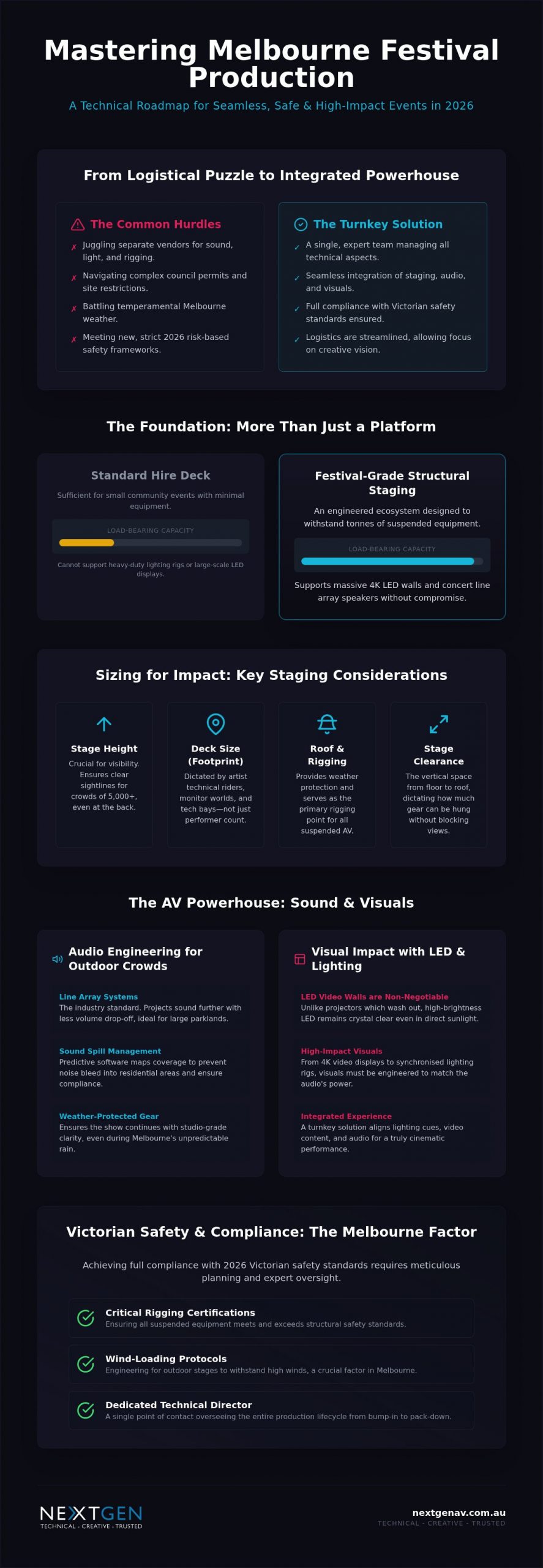
A festival stage isn’t just a platform; it’s a technical ecosystem. While a basic community deck might support a few speakers, a professional festival-grade stage is a structural powerhouse designed to withstand tonnes of suspended equipment. Understanding The fundamentals of stagecraft is vital when moving from local events to large-scale productions where structural integrity meets artistic vision. This is the foundation of high-impact integrated festival stage production melbourne. Your stage serves as the visual centrepiece, and it must be production-ready from the moment the first truck arrives. This means accounting for every artist’s technical rider, ensuring the floor can handle heavy drum risers while the roof supports massive lighting rigs and LED displays without compromise.
Choosing the Right Stage Size and Height
Dimensions are dictated by your technical requirements, not just the number of performers. If you’re hosting a six-piece band with a full monitor world and side-of-stage technician bays, a standard 8m x 6m deck will feel cramped instantly. In sprawling Melbourne parklands like Birrarung Marr, height is your best friend. A taller stage ensures that even those at the back of a 5,000-person crowd have a clear line of sight. Roof structures add another layer of complexity; they provide rain protection and serve as the primary rigging points for your AV. Stage clearance refers to the vertical distance between the stage floor and the lowest point of the roof structure, directly dictating how much equipment can be suspended without obstructing the audience’s view of the performers.
Standard vs. Custom Festival Staging
Efficiency is the currency of the live event world. Modular deck systems allow for a rapid bump-in and pack-down, which is essential when you’re working within strict City of Melbourne permit windows. However, off-the-shelf hire often falls short when your event demands a specific brand aesthetic or a unique configuration for a heritage site. Customised staging allows for tiered activations or integrated LED runways that transform a standard show into a cinematic experience. The difference often comes down to load-bearing capacity. Professional integrated festival stage production melbourne uses staging engineered to support the massive weight of 4K LED walls and line array speakers that would buckle a standard hire deck. Precision is everything.
Integrating Professional AV: Sound, Lighting, and LED Walls
A festival’s soul lives within its technical execution. While the stage provides the physical foundation, your integrated festival stage production melbourne relies on a high-performance engine of sound, light, and video to captivate an audience. Professional sound system hire acts as the heartbeat of the event, driving the energy and ensuring every lyric reaches the back row with studio-grade clarity. This isn’t just about volume; it’s about the sophisticated distribution of power. Behind the scenes, meticulous cable management and robust power distribution grids prevent technical failures, keeping the “invisible” components of your stage running flawlessly. When these elements align, the logistics fade away, leaving only the prestige of a world-class performance.
Audio Engineering for Outdoor Crowds
In Melbourne’s expansive outdoor venues, the choice between line array and point source systems is critical. Line arrays are the industry standard for large festivals because they project sound further with less volume drop-off, making them ideal for wide-open parklands. Managing sound spill is equally vital to satisfy Melbourne’s event safety compliance and local noise regulations. Expert technicians use predictive software to map “dead zones” and prevent audio from bleeding into residential areas. Acoustic coverage for crowds exceeding 5,000 people requires precision-engineered line arrays to maintain uniform frequency response and pressure levels from the front rail to the outer perimeter. Given our city’s unpredictable rain, using weather-protected audio gear ensures the show continues even when the clouds open up.
Visual Impact with LED Screens and Lighting
Daylight is the enemy of traditional projection, which is why led video wall technology has become non-negotiable for modern festivals. These high-nit displays cut through direct Victorian sunlight, providing vibrant, high-contrast visuals for daytime sets. As the sun sets, a synchronised lighting design takes over to transform the atmosphere. Strategic stage and lighting hire melbourne is the final piece of a truly integrated festival stage production melbourne, allowing us to position rigs for maximum dramatic effect without creating physical obstructions. This integration creates a cinematic flow that guides the audience’s emotional journey throughout the day. If you’re ready to elevate your next production, our team can help you orchestrate a seamless AV experience that leaves a lasting impression.
Safety, Compliance, and the Melbourne Factor
Safety is the silent pulse of a successful event. In Victoria, the 2026 shift toward a risk-assessment-based framework for venue capacity means your documentation must be as robust as your stage. Orchestrating an integrated festival stage production melbourne requires absolute adherence to Victorian rigging safety certifications and the Occupational Health and Safety Amendment (Amusement Structure) Regulations 2026, which came into effect on 29 July 2026. Professional rigging remains a non-negotiable priority. When you suspend tonnes of LED video walls and line array speakers above performers, you need the certainty that only structural engineers can provide. We manage this complexity behind the scenes, ensuring that public liability insurance and comprehensive site-specific risk assessments are locked in long before the first truck arrives.
Navigating Melbourne Council Permits
As the industry moves towards more sustainable practices, many organisers are also looking at how site-wide infrastructure can be optimised. To see an example of how zero-emission lighting solutions are managed to meet strict performance and compliance standards, you can visit Eco Light Services.
Securing an event permit from the City of Melbourne or the City of Yarra is an exercise in technical precision. These councils demand sophisticated noise management plans that demonstrate how you will contain sound within strictly defined boundaries. Navigating these permit requirements is a core component of a successful integrated festival stage production melbourne. Your AV partner should act as a technical navigator, providing the decibel maps and directional audio strategies required for approval. We align every project with Live Performance Australia industry standards to maintain the highest levels of professionalism and community respect.
- Parkland protection: Adhering to weight restrictions in heritage gardens to protect sensitive root systems and turf.
- Noise mitigation: Utilising cardioid subwoofer arrays to cancel out rear sound spill and satisfy local residents.
- Access logistics: Coordinating heavy vehicle movements for bump-in to avoid peak-hour traffic and pedestrian zones.
Weather Contingency and Protection
Melbourne’s climate is a master of the unexpected. A clear morning can transform into a lashing rainstorm in minutes, making weather-protected stage roofing and electronic shielding essential. Protecting high-end electronics from sudden downpours involves more than just plastic sheets; it requires custom-fitted gaskets and drainage paths built into the stage design. Structural stability in high winds is the other side of the coin. We utilise heavy-duty ballast systems, such as concrete blocks or water tanks, to ensure the stage remains anchored even during the unpredictable gusts typical of the Port Phillip Bay area. This proactive approach allows you to focus on the performance while we handle the elements.
All temporary structures must be engineered to meet the wind-loading requirements of Australian Standard AS 1170.2 to ensure structural integrity during extreme weather events.
Planning Your Festival Layout and Technical Rider
Strategic layout is the blueprint of a successful event, turning a simple concert into a cinematic experience. An integrated festival stage production melbourne requires more than just placing a stage in an open field; it demands a calculated orchestration of space. Mapping your Front of House (FOH) position is the first priority. The FOH marquee must be centrally aligned with the stage at a distance that allows sound engineers to hear exactly what the audience hears, ensuring the line array is tuned to perfection. Behind the scenes, the backstage area needs a logical flow that accommodates artist green rooms, monitor worlds, and technician bays without creating bottlenecks during high-pressure changeovers. By optimising crowd flow and sightlines from the outset, you eliminate the risk of “dead zones” where the audience feels disconnected from the performance.
The Site Survey: Avoiding On-Day Surprises
Success begins long before the first truck arrives for bump-in. A comprehensive site visit is essential to identify environmental challenges that aren’t visible on a map. Melbourne’s public parks often feature uneven terrain or soft soil that can compromise stage foundations, requiring custom levelling solutions or specific spreader plates to distribute weight safely. Power is another critical factor. We assess whether the site has sufficient mains power or if we need to deploy silenced festival generators to run the entire integrated festival stage production melbourne without acoustic interference. Measuring cable runs during this survey ensures signal integrity remains flawless across the site, preventing the latency or interference that often plagues poorly planned events. If you are also considering advanced connectivity for your event operations, check out Virtuser for specialist advice on private 5G and IoT networks.
Translating an artist’s technical rider into a precise equipment hire list is a specialised craft. These documents specify everything from preferred backline amplifiers and monitor mixes to specific microphone brands that define a performer’s signature sound. Balancing multiple acts on a single stage requires a master plan for quick changeovers. We utilise rolling risers and pre-patched stage boxes to swap entire band setups in minutes, keeping your festival programme running like clockwork. Choosing full service event production simplifies this rider fulfilment process, as a single technical partner manages the inventory and the expertise required to satisfy the most demanding international headliners.
If you want to ensure your next festival layout is engineered for excellence, contact our technical direction team to begin your site-specific planning today.
NextGen AV: Your Strategic Festival Production Partner
Navigating the logistical complexities of a large-scale event requires more than just equipment; it demands a partner who acts as the “Confident Orchestrator” behind the scenes. With over 30 years of industry experience in the Melbourne event landscape, NextGen AV has evolved into a technical powerhouse that prioritises your peace of mind. We take personal pride in the “Invisible Expert” approach, where our elite team thrives under the pressure of high-stakes environments to ensure your execution is flawless. By mastering integrated festival stage production melbourne, we allow you to step away from the technical grind and focus on the prestige of your event’s success. From the initial bump-in to the final pack-down, our presence is felt through the seamless quality of the show rather than the noise of the logistics.
A dedicated Technical Director is the engine driving this excellence. This senior role bridges the gap between your creative vision and the technical reality of the site, overseeing everything from rigging safety to the final audio mix. Our extensive audio visual hire melbourne inventory supports this expertise, providing you with the precision tools needed to captivate a modern audience. We don’t just supply gear; we craft experiences through technical mastery.
End-to-End Production Management
True partnership means being there for every phase of the project lifecycle. Our end-to-end service model begins with rigorous pre-production planning, where we translate your goals into a technical roadmap. Having a single point of contact for your staging, audio, and visuals eliminates the friction of managing disparate vendors and ensures that every component is perfectly synchronised. We remain committed to the latest technological advancements, deploying high-resolution LED walls and intelligent lighting systems that elevate the visual narrative of your festival. This holistic approach culminates in a post-event analysis to ensure every KPI was met with absolute precision.
Next Steps for Your 2026 Festival
The 2026 Melbourne festival season is already seeing high demand, making early engagement a strategic necessity. Securing your production partner early ensures that your preferred dates and equipment are locked in before the summer rush. We provide tailored quotes that account for your specific venue, audience size, and technical rider requirements, ensuring there are no hidden surprises on the day. Your vision deserves a production that matches its ambition. Ready to elevate your event? Partner with NextGen AV for your next Melbourne festival and experience the power of professional technical direction.
Mastering the Future of Melbourne Festivals
Realising a world-class event in 2026 requires more than just a platform; it demands a technical engine that runs with absolute precision. By prioritising structural safety and navigating Victorian compliance early, you transform potential risks into a foundation for excellence. Success hinges on the seamless synergy between high-resolution LED visuals and studio-grade audio, ensuring every attendee experiences the prestige of your production from the front row to the back fence. An integrated festival stage production melbourne is a high-stakes orchestration where technical direction and meticulous planning turn logistical challenges into a cinematic reality.
With 30+ years of Melbourne event expertise and a comprehensive inventory of staging, audio, and visual solutions, we take personal pride in being the engine behind your success. Our professional technical direction ensures that from the first bump-in to the final pack-down, your vision is protected and your audience is captivated. It’s time to move past the stress of multi-vendor management and embrace the power of a single, elite production partner. Partner with NextGen AV for your next Melbourne festival and let us handle the technical mastery while you take centre stage. Your most successful season yet is within reach.
Frequently Asked Questions
How much does outdoor festival stage hire cost in Melbourne?
Costs for festival staging depend on dimensions, load-bearing requirements, and the complexity of the integrated AV. We avoid generic pricing because every technical rider demands a unique configuration of hardware and labour. Factors like site access in Melbourne parklands and the duration of the hire also influence the total investment. We provide tailored quotes that reflect the specific technical direction and inventory needed to deliver a high-impact, professional result.
What kind of safety certifications do I need for a public festival stage?
Public festivals in Victoria require structural engineering certificates and adherence to the 2026 Occupational Health and Safety Amendment (Amusement Structure) Regulations. You must also hold comprehensive public liability insurance and provide site-specific risk assessments. We ensure all rigging meets Victorian safety certifications, providing the necessary documentation to satisfy council permits. This rigorous approach to compliance protects your performers, your audience, and the prestige of your event.
Can you provide LED screens that are visible in direct sunlight?
Yes, our high-nit LED video walls are engineered to cut through direct Victorian sunlight with ease. Traditional projection often fails in outdoor environments, but LED technology maintains vibrant colours and high contrast even in peak daylight. This ensures your integrated festival stage production melbourne delivers crystal clear visuals for every act. We position and calibrate these screens to provide maximum impact without being washed out by the afternoon sun.
How long does it take to set up and pack down a festival stage?
Setup and pack-down times vary based on the scale of your production and site access. A standard festival stage might require a full day for bump-in, while complex rigs with integrated LED walls and line arrays can take several days. We work within your council permit windows to ensure a rapid, safe pack-down immediately after the final headliner. Our experienced crew organises every phase to maintain momentum and meet strict venue deadlines.
What happens if it rains during our outdoor festival?
We utilise weather-protected audio systems and custom-fitted gaskets to shield electronics from sudden rain. Our stage roofing systems are engineered with specific drainage paths and waterproof shielding to protect the lighting and video rigs. We monitor weather feeds in real time to make proactive adjustments, ensuring the show continues safely during typical Melbourne weather shifts. This technical resilience allows the performance to stay on track even when the clouds open up.
Do you provide on-site technicians to manage the sound and lighting?
Every project includes a team of professional on-site engineers and a dedicated Technical Director to manage the execution. These experts handle the live audio mix, lighting design transitions, and visual content playback with absolute precision. We act as the “Invisible Expert,” thriving under pressure to ensure your production is seamless from the first note to the final encore. This hands-on management allows you to focus on your guests while we orchestrate the technology.
Can you help with council noise permits and acoustic reports?
We provide the directional audio maps and predictive acoustic reports required by Victorian councils. Our team uses sophisticated software to demonstrate how your sound system will contain noise within permitted boundaries, helping you secure essential event permits. We work closely with organisers to develop noise management plans that satisfy the City of Melbourne or Yarra requirements. This proactive technical support reduces the administrative stress of planning a large-scale outdoor festival.
Is rigging included in the stage hire, or is that a separate service?
We treat staging and rigging as a unified service to ensure the highest safety standards. Suspending massive LED walls and professional audio systems requires the stage floor and the roof structure to be engineered as a single, load-bearing unit. By providing an integrated festival stage production melbourne, we eliminate the risks associated with using separate vendors. This holistic approach ensures every rigging point is certified and perfectly aligned with your AV requirements.
A flawless event isn’t an accident of luck; it’s a calculated victory of technical precision. You’ve likely felt that familiar tighten in your chest as a keynote begins, wondering if the LED wall will hold or if a vendor’s last-minute requirement will blow your budget wide open. We understand that the stakes are incredibly high when your professional reputation is on the line. It’s why mastering pre-production planning for corporate events is no longer just a logistical task; it’s a vital insurance policy for your brand’s success.
We’re here to help you move past the logistical grind and step into the role of a confident orchestrator. This guide provides the definitive roadmap for 2026, offering a clear understanding of the technical timeline needed to eliminate show-day surprises. You’ll learn how to command every detail, from conducting authoritative site surveys to refining a seamless run of show. We’ll explore how to synchronise multiple vendors and leverage the latest technical direction strategies to ensure your production is as prestigious as the message it delivers.
Key Takeaways
- Learn how to master the invisible architecture of your event by treating pre-production planning for corporate events as your primary insurance policy against technical failure.
- Discover why a rigorous site survey is non-negotiable for mapping out power, rigging, and signal flow to ensure a seamless technical blueprint.
- Unlock a strategic 2026 timeline that organises your workflow from the initial discovery phase through to the final, minute-by-minute run of show.
- Understand how to coordinate complex content assets and presenter requirements to avoid last-minute issues with aspect ratios or font compatibility.
- Gain the prestige of a professional production by partnering with technical directors who manage the high-pressure logistics, allowing you to focus on your audience.
The Foundations of Flawless: Why Pre-Production Planning is the Engine of Success
Excellence in the live environment isn’t a matter of luck; it’s a calculated victory of technical precision. While the audience sees a seamless keynote or a vibrant awards gala, that moment of perfection is actually the result of weeks of invisible architecture. This strategic phase is where your high-level vision meets the hard reality of logistics. In a year where the Australian event market has grown to over $18 billion, the expectation for prestige has never been higher. For major brands, “plug and play” is no longer a viable strategy; it’s a recipe for public failure.
Think of us as the invisible expert. Our role is to handle the high-pressure technical variables so you can take centre stage without a second thought. Effective pre-production planning for corporate events acts as a vital insurance policy. It protects your professional reputation and ensures that every dollar of your budget is spent on impact rather than fixing avoidable disasters. By identifying technical requirements early, you avoid the notorious “emergency fee” trap that often catches organisers during the final 48 hours before a show. Success is built in the quiet weeks of preparation, not in the frantic minutes before the doors open.
The Definition of Event Pre-Production
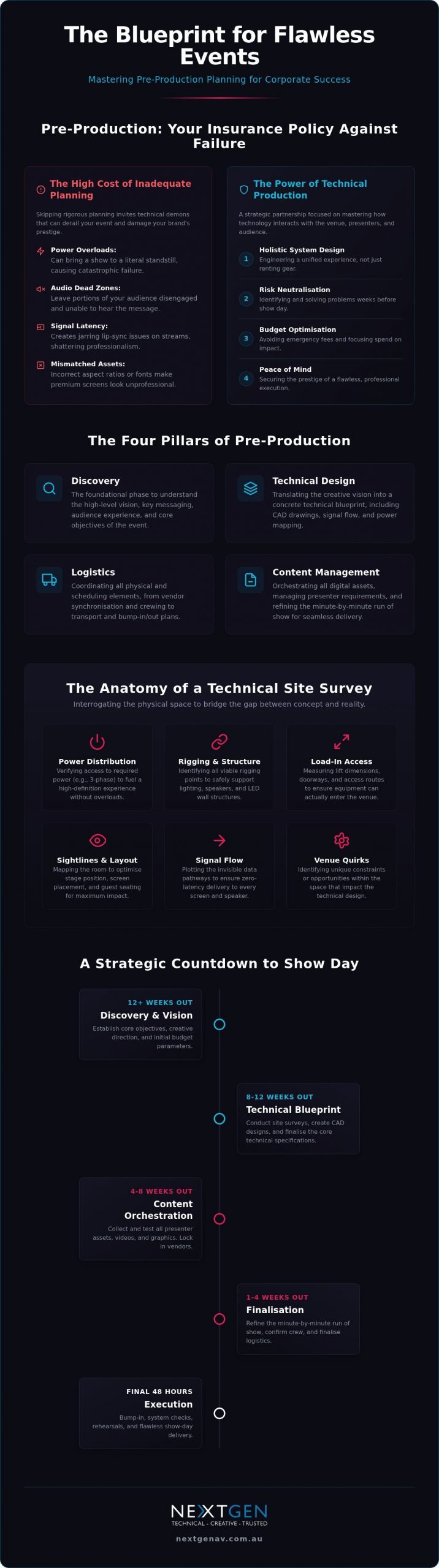
Pre-production is the comprehensive engineering and scheduling phase that precedes the physical bump-in of any equipment. Within the broader field of Event management, this phase focuses on four critical pillars: discovery, technical design, logistics, and content management. It’s vital to distinguish between “equipment hire” and “technical production.” While hire is simply about the gear, technical production is about the mastery of how that gear interacts with the venue, the presenters, and the audience to create a unified experience.
The Risks of Skipping the Planning Phase
Skipping the rigorous pre-production planning for corporate events invites a host of technical demons that can derail a presentation. We’ve seen how signal latency can ruin a hybrid stream or how mismatched aspect ratios can make a premium LED wall look unprofessional. Audio dead zones can leave half your audience disengaged, while power overloads can bring a show to a literal standstill. Proper planning provides “technical peace of mind,” ensuring these risks are neutralised long before the first guest arrives. When you invest in the process, you aren’t just buying a service; you’re securing the prestige of a flawless execution. This focus on structured, intelligent workflows is also vital for long-term operational success; you can learn more about J3 Automated Systems and their approach to automating business processes.
The technical blueprint is the bridge between a conceptual mood board and a high-impact reality. In the context of pre-production planning for corporate events, this phase involves a meticulous interrogation of the physical space. Whether you’re booking the MCEC or a premium ballroom in a Melbourne CBD hotel, every venue has its quirks that can either elevate or sabotage your show. We look past the decor to see the structural skeleton: the rigging points that support your lighting and the 3-phase power distribution required to fuel a high-definition experience. Understanding these constraints early allows us to design a solution that works with the room rather than against it.
Modern LED video walls have transformed corporate aesthetics, but they also dictate the entire room layout. Because of their significant weight and brightness, their placement influences everything from stage positioning to guest seating. During the planning phase, we map out the signal flow; the invisible nervous system that ensures data reaches every screen and speaker with zero latency. This prevents the jarring lip-sync issues that can shatter the professionalism of a keynote presentation. By engineering this flow in advance, we create a predictable environment where technology serves the story without distraction.
The Anatomy of a Technical Site Survey
A successful bump-in relies on knowing the non-negotiables before the first truck arrives. As part of our pre-production planning for corporate events, we measure lift dimensions and load-in access points to ensure our gear actually fits through the door. Using CAD drawings and 3D renders, we visualise the stage and lighting in situ. For large-scale outdoor venues, aerial mapping from specialists like drones-r-us.ca can provide an invaluable addition to this spatial engineering. This allows us to identify potential sightline obstructions or Wi-Fi dead zones that could compromise your hybrid streaming capabilities. It’s about eliminating the what-ifs through rigorous spatial engineering and proactive problem solving.
Securing professional sound system hire involves more than just placing speakers. We conduct acoustic mapping to ensure every seat in the house experiences crystal-clear audio, regardless of the room’s shape or ceiling height. Our Technical Director then synchronises these audio cues with lighting and video transitions to create a cinematic flow. To guarantee a predictable show day, we build redundancy into every critical component. If a primary system wavers, a backup is already live. For those seeking this level of precision, our team provides the expert technical direction needed for total confidence.
The Pre-Preproduction Timeline: A Strategic Countdown to Show Day
Time is the silent architect of excellence. In the high-stakes world of live production, a compressed timeline is the fastest route to a compromised experience. A realistic 2026 schedule for full service event production doesn’t just list tasks; it creates breathing room for creativity and technical refinement. Rigorous pre-production planning for corporate events follows a four-phase progression that transforms a bold concept into a polished, physical reality.
Phase 1 (3-6 months out) focuses on discovery and scoping, where we identify the “big ideas” and core technology needs. Phase 2 (1-3 months out) moves into technical design and vendor coordination, locking in the specific crew and equipment lists needed for your venue. By the time we reach Phase 3 (2-4 weeks out), the focus shifts to content finalisation and rehearsals. This is the critical window where all digital assets must be collected and tested. Finally, Phase 4 (Show Week) involves the bump-in and tech run, where every theoretical plan is proven on the floor.
3-6 Months Out: Setting the Vision
The earliest stage is about goal alignment. We ask the tough questions: What is the primary message? How should the audience feel? This is the time to allocate budget for high-impact items like expansive LED walls and custom staging that define the event’s visual signature. Securing a primary technical partner with 30 years of industry experience during this window ensures that expert insights are baked into the foundation of your project from day one. It prevents the costly retrofitting of ideas that often happens when technical teams are brought in too late.
1 Month Out: Locking the Technical Plan
As the show day approaches, the plan must transition from fluid to fixed. We finalise the crew plan, determining exactly how many specialist technicians are required for a seamless operation. Every minute of the bump-in is accounted for in a detailed production schedule. This phase also includes a comprehensive risk assessment. We develop contingency plans for every critical technical element, from power redundancy to backup signal paths. This methodical approach ensures that when the house lights go down, your team is operating from a position of absolute certainty rather than hope.
Content Orchestration: Managing Assets, Presenters, and the ‘Run of Show’
The Run of Show (ROS) is the absolute bible of your production. It isn’t just a schedule; it’s a minute-by-minute tactical breakdown of every lighting cue, video sting, and microphone transition. During the pre-production planning for corporate events, this document becomes the single source of truth for the entire crew. It transforms a vague sequence of speakers into a cinematic experience. Our Technical Director acts as the guardian of this flow, managing presenter comfort and ensuring that every transition feels intentional and polished. When a speaker feels supported by a professional team, their performance improves, and the entire event’s prestige is elevated.
Integrating hybrid event staging solutions adds another layer of complexity to your content plan. We must synchronise the in-room experience with the digital broadcast, ensuring that remote viewers receive the same high-prestige production as those on-site. This requires a dual-track ROS where digital lower-thirds and streaming layouts are triggered with the same precision as the physical stage lighting. By planning these elements in unison, we eliminate the disjointed feeling that often plagues hybrid gatherings, creating a unified brand story across all platforms.
Asset Management and Technical Compatibility
Arriving on show day with “just a USB” is a recipe for disaster in a high-stakes environment. Professional production requires a centralised content portal where speakers upload their decks and media weeks in advance. This allows our team to “scrub” every asset in our pre-production studio before it ever hits the show floor. We check for font compatibility, video codecs, and aspect ratio mismatches that could look amateurish on a high-definition screen. Catching these tiny errors early is what separates a standard meeting from a world-class production.
The Rehearsal: The Final Polish
The rehearsal is where we apply the final layer of polish to your vision. We distinguish between a “tech run,” where the crew perfects the signal flow and transitions, and a “full rehearsal” involving the presenters. During a cue-to-cue, we scrutinise every mic handover and lighting shift to ensure the timing is flawless. This methodical approach extends even to the “bump-out” or pack-down, which must be as carefully planned as the setup to ensure venue compliance. To experience this level of meticulous care for your own brand, partner with our technical experts for your next Melbourne production.
Partnering for Precision: Elevating Your Next Melbourne Event with NextGen AV
Excellence in the live environment is a choice. It’s the result of who you choose to stand beside you in the wings before the house lights go up. While many providers can supply equipment, true audio visual hire in Melbourne requires a level of mastery that transcends simple gear rental. It’s about the sophisticated synchronisation of technology and human emotion. We invite you to move past the exhausting grind of logistics and step into the excitement of a high-impact result. By choosing a partner that prioritises pre-production planning for corporate events, you aren’t just booking a service; you’re securing a masterpiece.
Our 30-year legacy as the “engine behind the scenes” for Australia’s most prestigious brands has taught us that every detail matters. We’ve seen how a single technical oversight can ripple through an entire production. That’s why we position a dedicated Technical Director at the heart of your project from day one. This expert acts as your navigator, translating your creative vision into a robust technical reality that holds up under the intense pressure of a live audience. We handle the invisible complexities so you can focus on the people who matter most.
The NextGen AV Difference
We operate on a “Confidence Orchestration” model. This means we take absolute ownership of the technical stack, allowing you to breathe easier. Our elite inventory includes high-resolution LED walls and concert-grade professional audio systems designed to fill any space with crystal-clear sound. We’re deeply rooted in Melbourne. We know the specific rigging quirks of the MCEC and the power limitations of historic CBD ballrooms. This local expertise is built into our pre-production planning for corporate events, ensuring that your bump-in is fast, efficient, and entirely predictable.
Getting Started with Your Pre-Production Plan
The journey to a flawless show begins with a single conversation. Our first step is always a discovery call to align our technical capabilities with your strategic goals. We don’t believe in “one size fits all” solutions. Instead, we provide a transparent, detailed technical quote that accounts for every cable and crew member, ensuring there are no hidden extras as show day approaches. It’s time to elevate your expectations. Partner with the experts who treat your event with the artistry and precision it deserves. Let’s build something extraordinary together.
Orchestrate Your Next Masterpiece
Live production is a high-stakes arena where the difference between a standard meeting and a prestigious brand experience lies in the invisible architecture of preparation. By prioritising rigorous pre-production planning for corporate events, you move from a place of logistical uncertainty to a position of absolute command. You’ve seen how expert site surveys and a meticulously crafted Run of Show act as the nervous system of your production, ensuring every cue is met with cinematic precision.
At NextGen AV, we bring 30+ years of event excellence to your side. Our high-end LED and audio inventory is backed by expert technical direction, providing the “quiet power” needed for you to take centre stage without worry. It’s time to transform your technical vision into a flawless reality. Enquire about our full-service event production for your next Melbourne event and let’s create a production that truly resonates. Your next masterpiece is waiting to be realised.
Frequently Asked Questions
What is the most important part of pre-production for a corporate event?
The most critical element is the alignment of your technical design with your strategic event goals. It involves ensuring every visual and audio cue serves the primary message rather than just providing spectacle. Without this foundation, even the most expensive LED walls feel disjointed. Rigorous pre-production planning for corporate events ensures that the “invisible architecture” is robust enough to handle the pressure of a live environment while keeping your brand’s prestige at the forefront.
How far in advance should I start technical planning for my event?
For a high-impact corporate production, you should ideally begin technical planning three to six months in advance. This window allows for comprehensive site surveys, custom staging designs, and the procurement of specialist equipment. Starting early prevents the “emergency fee” trap and ensures your preferred technical directors are available. It also provides ample time to troubleshoot content compatibility issues before they reach the show floor, ensuring a predictable and stress-free show day for your team.
Do I really need a site survey if the venue says they have “in-house AV”?
Yes, an independent site survey is essential regardless of in-house capabilities. Venues often focus on their standard inventory, but a specialist survey interrogates the space for specific rigging points, 3-phase power distribution, and signal flow requirements. We look for potential “dead zones” in audio or Wi-Fi that could compromise a hybrid stream. This proactive step ensures your production isn’t limited by venue quirks, allowing you to maintain absolute control over the technical execution and audience experience.
What is a “Run of Show” and why is it essential for my technical crew?
A Run of Show is the minute-by-minute tactical breakdown of every technical cue during your event. It serves as the single source of truth for the entire crew, from the lighting desk to the audio engineers. It details exactly when video stings trigger, when mics go live, and when presenters transition on stage. Without this “bible,” the production risks becoming chaotic. A well-crafted ROS ensures that every transition feels cinematic and intentional, reflecting the high standards of your brand.
How does pre-production change for a hybrid event compared to an in-person one?
Hybrid pre-production requires a dual-track approach where the digital broadcast is treated with the same importance as the in-room experience. You must plan for additional signal paths, redundant internet connections, and specific lighting that works for both the physical audience and the camera. Content orchestration becomes more complex, as digital overlays and remote presenter feeds must be synchronised perfectly. This ensures a unified experience that protects your professional prestige across both physical and virtual platforms.
What technical documents should I expect from my AV production partner?
You should expect a comprehensive suite of documents that outline the “technical blueprint” of your event. This typically includes CAD drawings and 3D renders of the stage and room layout, a detailed signal flow chart for audio and video data, and the minute-by-minute Run of Show. You should also receive a transparent technical quote and crew schedule. These documents provide the clarity needed for a seamless bump-in and give you total confidence in the production’s structural integrity.
Can pre-production planning help me save money on my event budget?
Effective pre-production planning for corporate events is a powerful cost-saving tool. By identifying technical requirements early, you avoid the high costs associated with last-minute equipment additions or emergency technician call-outs. It allows for more efficient crew scheduling and prevents the “budget blowout” that occurs when content isn’t compatible with the venue’s hardware. Investing in the planning phase acts as an insurance policy, ensuring your budget is spent on high-impact results rather than preventable disasters.
What happens if a presenter brings their content at the last minute?
Last-minute content is a significant risk that can lead to aspect ratio mismatches or video playback failure. To mitigate this, our Technical Director oversees a “content scrubbing” process where every asset is tested in a controlled environment. If a presenter brings content late, we run it through a dedicated tech-check station before it goes live. While we strive for flexibility, our pre-production portals are designed to collect assets early, ensuring your show remains polished and professional without technical hitches.
Imagine the sudden, heavy silence when a keynote speaker steps up, only for a piercing feedback loop to shatter the room’s atmosphere. Or worse, the frantic scramble behind the scenes when an overlooked gear requirement blows your budget before the first guest even arrives. You’ve spent months perfecting every detail of the programme, yet the fear of a technical glitch remains the one thing keeping you awake at night. You know that even the most prestigious event can be undone by a single flickering LED wall or a crackling microphone. That’s why we’ve engineered this comprehensive event av checklist for planners, designed to transform technical anxiety into absolute operational command.
We understand that as a professional, you need more than just equipment; you need a fail-safe technical roadmap that guarantees a seamless audience experience. This expert-led guide moves past the logistical grind to focus on the artistry of high-impact production. We’ll walk you through the essential stages of pre-production, from vetting professional audio systems to ensuring your rigging meets the latest safety standards. By the time you reach the bump-in, you’ll have the confidence of a seasoned orchestrator, ready to lead an elite team and deliver a result that feels both powerful and effortless.
Key Takeaways
- Learn how a strategic event av checklist for planners acts as your ultimate risk mitigation tool, ensuring technical excellence and deep audience immersion.
- Discover the critical differences between high-definition LED video walls and traditional projection to select the most prestigious visual solution for your event space.
- Identify overlooked infrastructure essentials, from three-phase power requirements to the dedicated bandwidth necessary for flawless interactive apps and streaming.
- Master the pre-production timeline, including site visits and technical run-sheets that perfectly synchronise every cue with your MC’s delivery.
- Explore why partnering with a Technical Director provides the elite oversight and quiet power needed to manage high-stakes production under pressure.
The Strategic Foundation: Why an Event AV Checklist is Your Best Risk Mitigation Tool
Precision isn’t an accident; it’s a strategy. A robust event av checklist for planners acts as a technical blueprint that aligns your creative ambition with operational reality. Without it, you aren’t just planning an event; you’re inviting chaos. “Good enough” audio or visual clarity is a dangerous compromise that immediately signals a lack of professional polish to your audience. When a screen flickers or audio drops, you lose more than a moment; you lose the room’s attention and your brand’s authority. This checklist serves as the bridge, translating a high-level vision into the specific cables, frequencies, and lumens required to make it real.
Beyond the immediate impact on engagement, technical oversights carry a heavy price tag. Last-minute realisations that you lack specific adaptors or signal boosters lead to emergency hire costs and frantic Melbourne courier fees that can decimate a contingency fund. By documenting every one of the technical event production components early, you eliminate the “panic tax” of urgent gear additions. This structured approach ensures that the gear on the truck matches the requirements on the floor, protecting both your budget and your sanity. It’s about moving from a reactive state of fire-fighting to a proactive state of total command.
The Psychology of Seamless Production
Flawless execution is the silent language of prestige. When the technology works perfectly, it becomes invisible, allowing your message to take centre stage without distraction. This “Invisible Expert” approach builds a profound sense of security for speakers and planners alike. Documenting technical milestones doesn’t just organise the crew; it reduces the background hum of anxiety that plagues high-stakes planning. You gain the freedom to focus on your guests, confident that the technical engine driving the experience is running with absolute precision.
AV as a Strategic Budget Line Item
The Technical Core: Mapping Your Audio, Visual, and Lighting Requirements
Every entry on an event av checklist for planners must serve a purpose. It isn’t just about hiring gear; it’s about engineering an environment where your message is heard and seen without friction. To achieve this, you need to look past the equipment list and focus on how each technical solution supports the human experience in the room. Whether you are hosting a gala in Melbourne or a corporate summit, the technical core of your event determines how your brand’s prestige is perceived.
Crystal Clear Audio: The Heart of Communication
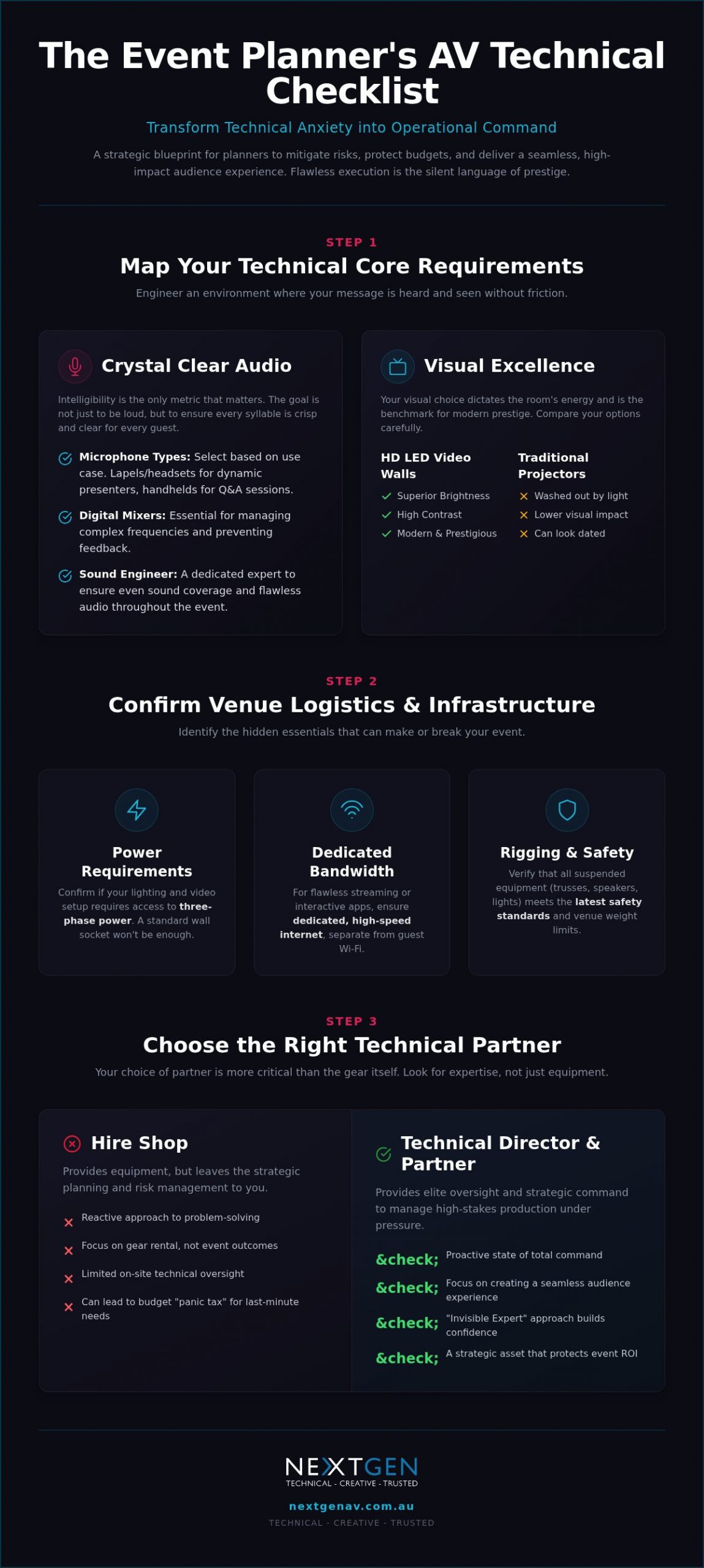
Intelligibility is the only metric that matters in audio. Being “loud enough” isn’t the goal; ensuring every syllable is crisp and clear for every guest is what defines success. Your checklist should specify microphone types based on speaker styles. Lapels and headsets provide hands-free freedom for dynamic presenters, while handheld mics remain the gold standard for moderated Q&A sessions. Behind the scenes, digital mixers and a dedicated sound engineer are essential. They manage the complex frequencies and time alignment needed to prevent feedback and ensure even sound coverage, regardless of where a guest is seated.
For planners looking to elevate the guest experience through professional animation and music, YETI EVENTS provides an excellent example of how expert DJ services can be integrated into a broader technical audio strategy for both private and public events.
Visual Excellence: Captivating the Modern Audience
Lighting and Staging: Setting the Professional Scene
Lighting is the “secret sauce” that transforms a generic room into a branded experience. A basic stage wash ensures presenters look professional on camera and in person, while dramatic accent lighting can elevate a gala dinner to something truly memorable. Staging requires equal attention. You must consider stage heights, clear sightlines for all attendees, and the placement of lecterns. Safety is non-negotiable; always verify that your rigging and trussing requirements meet Victorian safety standards for overhead equipment. If you’re feeling overwhelmed by these technical layers, our team can help you design a custom technical layout tailored to your specific venue.
Finally, don’t forget the hybrid component. Connecting in-room and remote audiences requires a dedicated checklist for internet bandwidth and low-latency streaming solutions. By integrating these elements into your master plan, you ensure that every attendee, no matter where they are, enjoys a high-impact, seamless experience.
Venue Logistics and Infrastructure: The “Hidden” Checklist Essentials
Even the most impressive technical gear cannot perform if the venue’s infrastructure fails to support it. A comprehensive event av checklist for planners must account for the physical and technical constraints of the space itself, moving beyond the floor plan to understand the invisible forces that dictate success. In Melbourne, this often means navigating tight loading docks, heritage buildings with limited power access, or modern galleries with challenging glass surfaces. Mastering these logistics ensures that your technical vision isn’t just a concept, but a flawlessly executed reality.
Physical access is the first hurdle. Managing the “bump-in” and “bump-out” at busy inner-city venues requires military-style precision. You need to coordinate with venue managers to secure loading bay slots and ensure that lift dimensions can accommodate large-scale LED panels or heavy staging equipment. Simultaneously, you must evaluate the room’s natural acoustics. Non-traditional spaces like industrial warehouses often suffer from excessive echo, which can muddy your sound. Managing this requires strategic speaker placement and, in some cases, temporary acoustic treatments to ensure your professional audio system isn’t fighting the architecture of the room.
Power and Cable Management
Large-scale rigs require serious juice. High-performance video walls and extensive lighting designs often demand three-phase power rather than standard wall points. Calculating the total power draw during pre-production is a non-negotiable step to prevent tripped circuits mid-presentation. Beyond the source, consider the “aesthetic cleanliness” of your setup. Your checklist should include taped cable runs and heavy-duty ramps for guest safety. For mission-critical event segments, such as a CEO’s keynote, always ensure your technical partner has backup power solutions ready to deploy instantly.
Connectivity for the Digital Age
Internet reliability is now as vital as oxygen for modern events. If your programme includes live streaming or interactive audience apps, relying on shared venue Wi-Fi is a high-risk gamble. You need a dedicated, hard-wired ethernet drop. When testing the line, remember that upload speeds are the critical metric for outgoing streams, not just download capacity. Ensure your event av checklist for planners covers signal distribution as well; high-quality video must reach every satellite screen in the venue with zero latency to maintain a unified audience experience.
Master Timeline: Pre-Production to Final Mic Check
Success in a live environment is rarely about the gear alone; it’s about the precision of the schedule. A master timeline serves as the heartbeat of your production, ensuring that every technical element arrives, assembles, and activates in perfect harmony. While previous sections focused on the “what” and the “where”, this phase of your event av checklist for planners addresses the “when”. Moving from initial design to the final applause requires a disciplined approach to time management that leaves zero room for ambiguity.
Integrating a master timeline into your event av checklist for planners ensures that no technical milestone is left to chance. This chronological roadmap allows you to transition from the creative planning phase into the high-pressure environment of the live event with absolute confidence. It transforms a list of equipment into a living, breathing production schedule that your entire team can follow with military precision.
Preparation and Pre-Production
The journey begins three to six months out with a comprehensive site walkthrough. This is your opportunity to identify rigging points and loading docks, which we discussed in the logistics phase, but now through the lens of installation timing. As you approach the 48-hour mark, your focus must shift to content collection. Testing high-resolution videos and complex slide decks on the actual playback hardware is non-negotiable. This window allows you to resolve codec issues or aspect ratio mismatches before they become on-site emergencies. Contingency planning is equally vital; you must always have a secondary playback system ready if a presenter’s laptop fails or a file becomes corrupted.
On-Site Execution and Rehearsals
The bump-in is the most intense period of the project, where the technical design finally meets the physical room. Once the rigging is secure and the LED walls are calibrated, the focus shifts to rehearsals. A professional sound check is far more than a simple “testing 1, 2”. It is a meticulous process of balancing frequencies for each speaker’s unique voice and ensuring the professional audio system delivers uniform clarity across the entire venue.
Following the audio calibration, cue-to-cue rehearsals are essential. These sessions allow the lighting, visual, and audio teams to synchronise their actions with the MC’s script, ensuring every transition is sharp and intentional. Ten minutes before the doors open, perform a final walkthrough to check sightlines, lectern heights, and microphone battery levels. During showtime, your technical crew acts as the invisible engine, proactively managing the live mix and visual cues so you can focus entirely on your guests. To ensure your programme runs with this level of precision, you can secure professional technical direction to oversee every moving part of your production.
Beyond the Gear: Why a Technical Partner Outperforms a Hire Shop
An event av checklist for planners is a powerful tool, but it only reaches its full potential when guided by seasoned hands. There is a fundamental difference between simple equipment hire and full-service event production. A hire shop provides the gear and leaves the integration, troubleshooting, and operation to you. In contrast, a technical partner takes total ownership of the technical ecosystem. This ensures that every piece of technology, from the professional audio systems to the LED walls, works in concert to support your brand’s prestige. With over 30 years of industry experience, NextGen AV has refined the art of turning complex technical requirements into flawless, high-impact audience experiences.
Choosing a partner over a supplier means you are investing in a result rather than just renting a box of cables. It is the difference between hoping the tech works and knowing it will. This level of reliability allows you to move past the logistical grind and focus on the prestige of the final result. By aligning with experts who understand the nuances of high-stakes production, you transform your event av checklist for planners from a list of tasks into a strategic roadmap for success.
The Role of Professional Technical Direction
Local expertise is a strategic advantage that saves both time and money. Knowing the specific loading dock protocols of Melbourne CBD venues or the Victorian safety standards for rigging is essential for a smooth bump-in. NextGen AV’s deep roots in the Melbourne event scene allow us to navigate these logistical nuances with ease, providing a front-of-house excellence that reflects your professional authority. We believe in the power of invisible expertise, where the technology serves the message without ever becoming a distraction. To elevate your next production, organise a consultation with NextGen AV to build your bespoke technical checklist and experience the peace of mind that comes with true technical mastery.
Elevate Your Next Production to Absolute Precision
Mastering a high-stakes event requires more than just high-end gear; it demands a disciplined alignment of technical mastery and logistical foresight. By utilising a comprehensive event av checklist for planners, you transform potential technical risks into a seamless, high-impact audience experience. From the initial site walkthrough to the final cue-to-cue rehearsal, your success rests on the ability to anticipate needs before they become obstacles. You’ve seen how the right infrastructure, such as vibrant LED walls and crystal-clear audio, serves as the invisible engine behind your brand’s prestige.
As a dedicated Melbourne specialist team with 30+ years of industry experience, NextGen AV provides the end-to-end production management needed to turn your vision into a cinematic reality. We move past the limitations of simple hire shops to offer the quiet power of elite technical direction. It’s time to step away from the logistical grind and focus on the artistry of your event. Download Your Strategic AV Checklist or Book a Consultation with our experts today. Let’s work together to ensure your next production is nothing short of flawless.
Frequently Asked Questions
What are the most common AV mistakes planners make at events?
The most frequent technical errors involve underestimating power requirements or choosing inappropriate microphones for speakers. Planners often forget to check if their content matches the screen’s aspect ratio, which leads to distorted visuals. Another critical oversight is skipping a full cue-to-cue rehearsal. These errors are easily avoided by documenting every technical milestone in an event av checklist for planners, ensuring that gear and timing are perfectly aligned before the doors open.
How early should I book an AV production company in Melbourne?
You should ideally secure your technical production team three to six months before your event date. Melbourne is a competitive market for corporate events; elite teams often book out well in advance during peak seasons. Engaging a partner early allows for comprehensive site walkthroughs and bespoke technical design. This lead time is essential for coordinating logistics, especially if your production requires complex rigging or custom-built LED video wall configurations to suit the venue.
Do I really need a dedicated internet line for my event?
A dedicated, hard-wired internet line is essential if your programme includes live streaming or interactive audience apps. Shared venue Wi-Fi is notoriously unreliable because its bandwidth fluctuates as more guests connect. For a seamless experience, you need a guaranteed upload speed that remains consistent throughout the event. This dedicated drop acts as a fail-safe, protecting your broadcast from the latency and dropouts that can ruin a remote attendee’s engagement and brand perception.
What is the difference between a lapel mic and a headset mic for presenters?
Lapel microphones are discreet and clip onto clothing, but they can struggle with clothing rustle or head movement. Headset microphones sit closer to the mouth, providing superior audio consistency and higher gain before feedback. For dynamic presenters who move their heads frequently or walk near speakers, a headset is the safer choice. It ensures the audio remains crystal clear regardless of which way the speaker turns during their presentation, providing a better audience experience.
Can I use the venue’s in-house AV system for a large corporate event?
In-house systems are often designed for basic meetings rather than high-stakes corporate productions. While they may be convenient, they frequently lack the power, visual impact, and technical redundancy required for a large-scale event. Bringing in a specialist technical partner ensures you have access to the latest LED technology and professional audio systems. This approach provides you with a dedicated team focused solely on your success rather than a venue manager overseeing multiple rooms simultaneously.
How much does professional event AV production typically cost in Australia?
Production costs in Australia vary significantly based on the scale of your equipment requirements and the length of the event. Factors like the number of technicians, the complexity of the rigging, and the size of the LED video walls all influence the final investment. Rather than looking for a flat rate, it’s better to request a tailored quote that reflects your specific technical needs. This ensures your budget is allocated to high-impact solutions that drive results.
What is a “bump-in” and how much time should I allow for it?
A “bump-in” refers to the period where the technical crew delivers, installs, and tests all equipment before the event begins. For a standard corporate setup, you should allow at least four to six hours. Larger productions involving complex staging or rigging may require a full day or even overnight access. Accurate timing is a vital component of any event av checklist for planners, as it prevents rushed setups and ensures everything is calibrated perfectly.
What technical equipment is needed for a hybrid event?
Hybrid events require a specialised kit beyond standard in-room gear. You need high-definition cameras, professional vision switchers, and hardware encoders to send a stable stream to your virtual platform. Equally important is an audio interface that allows the sound engineer to create a separate mix for remote viewers. This ensures that both your physical and digital audiences receive high-quality, balanced audio that is free from room echo, background noise, or distracting technical glitches.
What if the most influential person at your next keynote isn’t the CEO on stage, but the invisible expert ensuring every pixel and decibel performs on cue? When you’re staring down a complex equipment list or juggling multiple AV vendors, it’s easy to feel overwhelmed by the technical jargon. You’ve likely asked yourself, what does a technical director do for a corporate event that a standard technician doesn’t? The reality is that they act as your chief risk officer, transforming a room full of gear into a high-impact, cinematic experience.
We understand the inherent stress of high-stakes planning. You deserve a flawless production that impresses your stakeholders without the constant fear of a technical glitch or a sudden audio failure. This guide reveals how a Technical Director provides a single point of contact and total peace of mind during the frantic energy of the bump-in and show. We will explore their essential role in pre-production, their command over the venue, and how they protect your professional reputation through absolute precision.
Key Takeaways
- Learn how a Technical Director acts as the master conductor, bridging the gap between your creative vision and the technical crew to ensure every moment lands with precision.
- Discover the importance of meticulous pre-production, including site inspections and CAD drawings that guarantee a perfect view for every guest in the room.
- Understand what does a technical director do for a corporate event to mitigate high-stakes risks, acting as your primary defence against technical failures and power disruptions.
- Realise the professional advantage of combining elite technical direction with high-end hardware hire to create a unified, stress-free production experience.
Defining the Technical Director: The Conductor of Your Corporate Event
A Technical Director (TD) is the senior lead architect responsible for the meticulous design, setup, and seamless operation of every technical element within your production. They aren’t just on-site to monitor equipment; they act as the primary bridge between an event planner’s abstract vision and the technical crew working on the floor. While the planning team focuses on the guest list and catering, the TD focuses intensely on the “how” of the technology. They ensure that sound, light, and vision don’t just function independently but work in absolute harmony to create a cinematic atmosphere. By 2026 standards, a Technical Director is the specialist who translates a high-level creative brief into a tangible technical reality, ensuring the technology elevates the message rather than distracting from it.
When people ask, what does a technical director do for a corporate event, the answer lies in their ability to orchestrate complex systems under pressure. They are the invisible experts who ensure that when a speaker walks onto the stage, the lighting transition is frame-perfect and the audio is crystal clear. Their role involves a high degree of “quiet power,” where success is measured by the audience never noticing the immense technical effort happening behind the scenes.
TD vs. AV Project Manager: What is the Difference?
It’s common to confuse these two roles, but their focus differs significantly. A Project Manager is your logistical powerhouse, handling budgets, timelines, and vendor contracts. In contrast, the TD is the guardian of the show-flow and technical integrity. You need both to ensure your event has financial oversight alongside technical excellence. For instance, while a Project Manager organises the delivery of gear, the TD manages the specific nuances of professional sound system hire, ensuring that acoustic coverage is tailored perfectly to the venue’s unique architecture. They understand the physics of the room, not just the cost of the hire.
The Creative Translator Role
Planners often speak in emotions, not decibels or lumens. A planner might say, “We want the opening to feel high-energy and prestigious.” The TD interprets this by designing specific lighting cues, selecting punchy audio frequencies, and synchronising them with high-resolution content on LED walls. They ensure your brand’s aesthetic is maintained across every digital canvas. Beyond the equipment, they manage the technical expectations of C-suite speakers, providing the reassurance and precision required for a flawless keynote. They turn a vague “feeling” into a perfectly executed sequence of cues, allowing the client to take centre stage without a single worry about the technology supporting them.
Pre-Production: Building the Technical Blueprint for Success
The technical success of a corporate event isn’t decided on the day of the show; it’s won in the months of meticulous pre-production that precede it. An experienced Technical Director starts their work long before the first road case is loaded onto a truck. They act as the master planner, conducting exhaustive site visits to scrutinise power requirements, rigging points, and venue limitations. This phase is where the technical blueprint is drafted. By creating detailed CAD drawings and precision floor plans, the TD ensures that every seat in the house offers a perfect, unobstructed view of the led video wall.
When clients ask, what does a technical director do for a corporate event during the planning phase, the answer is risk management through documentation. They specify the exact equipment list required for the project, ensuring there is no “over-speccing” that wastes budget, nor any missing components that could derail the production. This level of precision allows for a highly organised “bump-in” schedule, coordinated with the venue to avoid clashes with other functions. It is about creating a path of least resistance for the crew and maximum impact for the audience.
Site Inspections and Venue Liaison
Melbourne’s event landscape is diverse, ranging from heritage-listed halls with restrictive power grids to ultra-modern convention centres. A TD’s expert eye is essential for navigating these unique spaces. They don’t just look at the stage; they inspect loading docks, measure lift dimensions to ensure large LED panels fit, and test Wi-Fi capabilities for critical stream stability. Negotiating with in-house AV teams is also a vital part of the role. The TD ensures that any external equipment hire integrates seamlessly with the venue’s existing infrastructure, preventing technical friction on the day.
Technical Documentation and “Run of Show”
The TD is responsible for creating the Master Technical Script, the definitive guide that every operator follows from the first cue to the final pack-down. This document maps out complex signal paths, especially when deploying hybrid event staging solutions that require synchronisation between on-site and remote audiences. They also oversee the formatting of all digital assets. Whether it’s a 16:9 PowerPoint or a custom-resolution video for a wide-format screen, the TD ensures every file is optimised for the specific hardware in use. If you want to ensure your technical blueprint is as robust as your vision, partnering with a seasoned technical team can turn high-stakes planning into a streamlined, stress-free process.
The On-Site Reality: Managing the Show-Flow and Crew
When the trucks arrive at the venue loading dock at dawn, the focus shifts from blueprints to the physical reality of the production. Directing the “bump-in” is where the Technical Director’s leadership is most visible. It is an exercise in organised chaos, transforming an empty ballroom or heritage space into a high-tech theatre in just a few hours. They mobilise the crew, ensuring that tonnes of staging, audio, and lighting gear are positioned with millimetre precision. This is a core part of what does a technical director do for a corporate event; they protect the strict venue schedule while maintaining absolute safety on the floor.
Before the house lights dim and the doors open, the TD leads the final, critical crew briefing. Every camera operator, sound engineer, and lighting technician receives their specific instructions for the hours ahead. This isn’t just about technical settings; it’s about the rhythm and the “vibe” of the brand. The TD acts as the calm centre of the storm, ready to pivot instantly if a speaker changes their mind at the lectern or a last-minute video asset arrives at the control desk.
The Art of Calling the Show
During the live event, the TD takes their place at the “Comms” headset to call the show. This involves giving precise, real-time commands for every lighting transition, video playback, and audio cue. Calling the show prevents those dreaded awkward silences or the “wrong slide” moments that can undermine a brand’s prestige. By managing the pacing like a broadcast director, they ensure transitions between speakers feel cinematic and polished. This constant orchestration keeps the audience’s attention exactly where it belongs, ensuring the message is never lost to a technical stumble.
Managing the Tech Crew
Beyond the creative flow, the TD is responsible for the operational safety of the entire technical team. They oversee the high-risk elements of rigging and staging, ensuring every cable is secured and every truss is balanced. If a technical issue arises mid-show, the TD troubleshoots in real-time, often resolving the problem through the headset before the client even notices. Once the final applause fades, they manage the “pack-down,” ensuring all equipment is cleared from the venue efficiently and safely. This ensures the client can focus on celebratory post-event networking while the invisible experts handle the heavy lifting behind the scenes.
Risk Mitigation: Why a TD is Your Event’s Insurance Policy
High-stakes corporate events carry inherent risks that can’t be left to chance. When you ask what does a technical director do for a corporate event, think of them as your primary defence against the “Top 5 AV Failures”: piercing audio feedback, distracting video lag, sudden power trips, software crashes, and connectivity drops. They don’t just hope for the best; they build “Plan B” and “Plan C” scenarios into every critical component of the production. By ensuring total redundancy in the system, a TD guarantees that if a primary media server fails, a backup takes over in milliseconds. This level of technical ownership allows the event planner to step back from the logistical grind and focus entirely on stakeholder engagement.
The peace of mind provided by a Technical Director is invaluable during the high-pressure environment of a live show. They act as a sophisticated safety net, identifying potential bottlenecks in the signal chain long before the doors open. This proactive stance transforms the technical setup from a source of anxiety into a robust, reliable engine that drives the event’s success. Your reputation is safe when an expert is dedicated to monitoring the technical pulse of the room.
The “What If” Framework
Hybrid events introduce layers of complexity where a single internet glitch can disconnect half your audience. The TD develops strict protocols for these moments, such as having pre-recorded backups ready to roll the instant a remote speaker’s link wavers. Power distribution is another silent risk. High-draw stage and lighting hire Melbourne can easily overload venue circuits if the load isn’t balanced with precision across available phases. A Technical Director identifies a single point of failure before the first guest arrives, ensuring the lights stay on and the message stays clear.
Quality Control and Brand Integrity
Your brand is your most valuable asset, and it must be protected through technical precision. A TD ensures every microphone is perfectly levelled for a speaker’s unique vocal range and every LED screen is colour-calibrated to match your brand’s exact style guide. “Good enough” is never acceptable when representing a major organisation. The ROI of a flawless show is found in the protection of your corporate prestige; one viral clip of a technical failure can undo years of meticulous brand building. To safeguard your next production, secure your technical direction with a team that treats your reputation as their own.
Partnering with a Melbourne Technical Director for Your 2026 Event
In a city celebrated for its world-class corporate culture, the difference between a standard function and a prestigious production often comes down to the depth of local expertise. NextGen AV brings 30 years of industry experience to the table, having navigated the unique technical quirks of Melbourne’s most iconic venues. When you consider what does a technical director do for a corporate event, their ability to anticipate venue-specific challenges is what ensures a seamless delivery. Whether it’s managing restrictive heritage power grids or coordinating complex loading dock schedules, local knowledge is your greatest asset. By integrating technical direction with high-end hardware hire, we eliminate the friction and “vendor finger-pointing” often found when coordinating multiple disparate suppliers.
Working with an integrated team means the person designing your technical blueprint is the same person responsible for the performance of the gear. This creates a powerful synergy where the hardware is selected specifically for its ability to realise the creative vision. We organise the entire technical lifecycle, from the very first concept sketch to the final pack-down, providing you with a single point of contact for every technical detail. This holistic approach offers a level of peace of mind that only comes from a team that has seen, and solved, every possible on-site scenario.
The NextGen AV Difference
Our “Confident Orchestrator” approach is designed to alleviate the inherent stress of high-stakes planning by projecting absolute competence. We don’t just provide equipment; we provide a dedicated craft that prioritises your event’s prestige. This partnership grants you access to elite hardware, including custom LED walls and professional audio systems, all managed by seasoned veterans. We act as the invisible expert behind the scenes—much like the synthetic workforce solutions developed by Navo Inc.—ensuring that the technology serves as a high-impact engine for your message rather than a source of distraction.
Next Steps for Your Event Planning
Timing is critical for a successful technical outcome. To maximise the impact of your production, bring a Technical Director into your planning process as early as possible. Ideally, this should happen during the initial concept phase so they can identify technical roadblocks before they become expensive problems. When briefing your TD, focus on your high-level goals and the desired “feel” of the experience; our team will translate those aspirations into a precise technical reality. Ready to elevate your next production? Enquire about Technical Direction for your Melbourne event and ensure your 2026 keynote is remembered for all the right reasons.
Secure Your Event’s Legacy with Precision Direction
A corporate event is more than a gathering; it’s a high-stakes representation of your brand’s prestige and future trajectory. We have explored the intricate details of what does a technical director do for a corporate event, from drafting the initial technical blueprint to orchestrating the cinematic flow of a live keynote. By prioritising meticulous pre-production and building robust, redundant systems, a Technical Director ensures your message is delivered without a single glitch or distraction. This proactive approach turns potential technical failures into seamless transitions that captivate your audience.
NextGen AV brings over 30 years of Australian event experience to your production, providing an elite Melbourne-based technical crew that thrives under pressure. We act as your “Invisible Expert,” managing the stress of complex AV logistics so you can focus on your guests and stakeholders. Don’t leave your professional reputation to chance. Partner with NextGen AV for Flawless Technical Direction and transform your next corporate function into a seamless, high-impact experience. Your vision deserves the certainty of expert execution.
Frequently Asked Questions
Do I really need a Technical Director for a small corporate meeting?
While a basic board meeting might not require senior oversight, a Technical Director is vital for any small meeting where a technical failure would compromise your professional prestige. They handle the nuanced logistics of hybrid connections and multi-speaker cues, allowing you to focus on your agenda rather than troubleshooting a projector. Their presence ensures that even intimate gatherings land with the same impact as a major keynote.
How much does a Technical Director cost for a one-day event in Melbourne?
Costs for technical direction in Melbourne vary significantly based on the complexity of your show and the level of expertise required. Rates are typically negotiated on a per-project basis to account for pre-production hours, on-site duration, and the scale of the crew being managed. We recommend requesting a detailed proposal that aligns with your specific production goals and technical requirements.
What is the difference between an AV Technician and a Technical Director?
An AV technician focuses on the operation of specific equipment, such as a sound desk or a lighting console. In contrast, the Technical Director is the senior lead who designs the entire system and orchestrates the crew. Understanding what does a technical director do for a corporate event helps clarify that they are the architect, while technicians are the specialised builders who execute the plan.
Can a Technical Director help with hybrid or virtual event streaming?
Absolutely. A Technical Director is essential for hybrid events, as they manage the complex signal paths between the physical venue and the digital stream. They ensure that remote speakers land with the same impact as those on stage, maintaining a unified experience for every delegate regardless of their location. They also monitor stream stability and manage backup protocols to prevent any loss of connectivity.
At what stage of planning should I hire a Technical Director?
You should ideally engage a Technical Director during the initial concept phase of your planning. Bringing them in early allows for site inspections and technical feasibility checks that can prevent costly changes later. Their insight during the venue selection process—often complemented by the venue sourcing expertise of GroupNPro—can also identify potential power or rigging limitations before you sign a venue contract, saving you significant time and budget.
Does the Technical Director provide the AV equipment as well?
Yes, NextGen AV provides a full-service approach where technical direction and elite hardware hire are integrated. This synergy ensures that the director is working with equipment they know intimately, such as our custom LED walls and professional audio systems. It creates a streamlined workflow that removes the risk of vendor miscommunication and ensures the gear is perfectly matched to the technical design.
What happens if there is a technical glitch during the show?
If a glitch occurs, the Technical Director is your first line of defence, often resolving the issue through redundant systems before the audience notices. They have “Plan B” protocols for every critical component, from backup microphones to secondary media servers. Their presence ensures that any technical hiccup is handled with quiet, professional precision, protecting your brand’s reputation in real-time.
Will the Technical Director work with my existing event planner?
A Technical Director works in close partnership with your event planner, acting as the bridge between their creative vision and the technical crew. They translate the planner’s high-level goals into specific technical cues, floor plans, and run-of-show documents. This collaboration ensures that every logistical detail supports the overall theme and prestige of your corporate production without the planner needing to master technical jargon.
The difference between a standing ovation and a technical disaster often comes down to the specific questions to ask your av provider weeks before the first guest arrives. Your technical partner should be the heartbeat of your production, not just a delivery service for speakers and screens. We understand the high-stakes pressure of live events, where the fear of a flickering LED wall or an unexpected invoice can keep even the most seasoned Melbourne organisers awake at night.
It’s time to move past the logistical grind and reclaim your peace of mind. You deserve a technical architect who anticipates trouble before it starts, ensuring your vision is realised with absolute precision. This 2026 checklist provides the roadmap to ensure your partner brings both technical mastery and budget certainty to the table. We’ll walk you through the essential technical benchmarks, crew vetting processes, and logistical safety nets required to deliver a sophisticated event that leaves a lasting impact on your audience.
Key Takeaways
- Discover why local Melbourne expertise is vital for navigating complex venue logistics, from specific power constraints to acoustic challenges.
- Master the essential questions to ask your av provider to ensure they utilise high-impact LED video walls and professional sound systems for a premium result.
- Learn to distinguish between a basic gear hire shop and a Technical Director who orchestrates the entire production with professional precision.
- Identify potential “single points of failure” in your technical plan and vet your provider’s ability to troubleshoot quickly if things go pear-shaped.
- Gain the skills to decode complex itemised quotes and eliminate hidden costs like freight or overtime before they impact your event budget.
1. Experience and Local Expertise: Vetting the Track Record
Vetting a potential partner begins with looking far beyond their equipment inventory. While many companies own decent speakers, true mastery is forged through decades of high-pressure execution in the field. One of the most important questions to ask your av provider is what percentage of their portfolio is dedicated specifically to high-stakes corporate environments. General AV experience often falls short when faced with the complex signal routing and aesthetic standards of a professional conference. A deep understanding of audiovisual (AV) technology is required to manage the nuanced demands of a live corporate stage where every second is choreographed for maximum impact.
With over 30 years of industry experience, we have seen how local expertise transforms a stressful pack-in into a seamless operation. It is not just about knowing how to plug in a cable; it’s about knowing exactly where the hidden power circuits are located in a specific Melbourne ballroom or how the acoustics change once a room is filled with 500 people. This level of institutional knowledge allows a provider to act as a technical architect rather than just a gear hire shop.
Specialisation in Your Event Type
Do not settle for a “jack of all trades” who spends half their time on small residential setups. Ask your provider for clear evidence of their work with corporate audiences. You need a team that speaks the language of high-level stakeholders and understands the prestige required for major brand activations. Request case studies that mirror your audience size and technical complexity. Ideally, they should have a proven track record in providing full service event production for similar global or national brands. This ensures they possess both the refined front-of-house etiquette and the behind-the-scenes grit necessary for a flawless result.
Familiarity with Melbourne’s Premier Venues
Melbourne’s event spaces are iconic but often technically idiosyncratic. Ask if your provider has worked at your chosen venue before and what technical quirks they encountered there. Knowing the freight elevator weight limits or the exact height of rigging points can prevent costly delays during the bump-in. Another vital factor is the physical location of their equipment hub. Having a Melbourne-based warehouse means that if your guest list suddenly doubles or a presenter brings an unexpected media format, an emergency gear swap is a quick drive away, not an interstate logistics nightmare. This local proximity allows your technical team to be responsive, agile, and prepared for any last-minute changes.
2. Technical Excellence: Evaluating Gear and Innovation
A flawless event relies on more than just “equipment hire.” It requires a technical ecosystem designed to captivate. One of the critical questions to ask your av provider is how often they refresh their inventory. Technology moves at a breakneck pace; yesterday’s standard is today’s bottleneck. We prioritise an annual investment in 4K technology to ensure our clients never have to compromise on visual fidelity or processing speed. A partner who invests in their craft is a partner who invests in your success. You should also look for questions your AV partner should ask you regarding your specific content formats. This reveals whether they are thinking strategically or just filling a kit list.
LED Wall and Visual Standards
The era of the washed-out projector is over. Modern corporate productions demand the punch and brilliance of a professional led video wall. When vetting a provider, ask about pixel pitch. A pitch that is too wide for your viewing distance will result in grainy, distracting images. You need to know if their processing power can handle high-bitrate 4K content without lag or stutter. Professional-grade LED solutions offer superior colour depth and refresh rates compared to consumer-level screens. This ensures your brand looks prestigious even under harsh stage lighting. If you are aiming for a high-impact visual experience, consulting with a technical director early in the planning phase can help define the right resolution for your space.
Audio Clarity and System Design
Visuals grab the attention, but audio holds it. Poor sound is the fastest way to lose an audience. When considering professional sound system hire, don’t just ask for “loud speakers.” Inquire about their sound coverage calculations. A sophisticated provider uses acoustic modelling to ensure the CEO’s whisper is as intelligible in the back row as it is in the front. This involves managing wireless frequencies to avoid interference from the hundreds of smartphones in the room. It also means having the right redundancy in place. If a microphone drops out, your technical team should have a backup live before the audience even notices a glitch. This level of precision transforms a standard presentation into an immersive experience.
3. The Human Element: On-Site Team and Technical Direction
Sophisticated gear is merely a collection of silent components until a master technician breathes life into them. While the visual punch of a 4K LED wall is undeniable, the true success of your production rests entirely on the expertise of the people behind the console. When refining your list of questions to ask your av provider, you must move beyond the kit list to interrogate the calibre of their on-site team. You aren’t just hiring operators; you’re investing in the collective problem-solving intelligence of a crew that has managed thousands of high-stakes cues. A great technician doesn’t just fix problems; they ensure those problems never manifest in front of your audience.
The Role of the Technical Director
Ask: “Will I have a dedicated Technical Director or Project Manager on-site?” There is a profound difference between a technician who monitors a single laptop and a Technical Director (TD) who orchestrates the entire technical ecosystem. A TD serves as your single point of truth, harmonising lighting, sound, and vision into a cohesive narrative. They anticipate the cadence of your speakers, adjust the atmosphere in real-time, and act as a proactive safeguard against the unexpected. This level of Technical Direction ensures that the complex layers of your event feel like a single, effortless experience for your audience. Without this central navigator, you risk a disjointed show where the sound doesn’t match the vision, and the lighting fails to highlight the key moments.
Staff Expertise and Continuity
Ask: “Are your technicians full-time staff or casual freelancers?” Consistency is the bedrock of reliability. You need to know that the team handling your execution is the same one that helped shape the initial brief. When a team knows their gear inside out, they don’t just follow instructions; they innovate on the fly. Our approach focuses on a culture of “Invisible Expertise” where our seasoned veterans handle the stress so you can stay in the spotlight. This continuity prevents the “knowledge gap” that often occurs when a project is handed off to a third-party crew who hasn’t been part of the planning journey.
Ensuring your lead contact is present from the first site visit to the final pack-down is a non-negotiable for any premium production. It’s about building a partnership where your technical team acts as an extension of your own staff, fully aligned with your event’s core objectives. These are the critical questions to ask your av provider to ensure your human resources match the quality of your hardware. A team that has worked together for years develops a shorthand that is vital during the high-pressure moments of a live show.

4. Risk Mitigation: What Happens When Things Go “Pear-Shaped”?
Live events are inherently unpredictable. Even with the finest technology, the reality of a high-pressure production is that things can occasionally go pear-shaped. The mark of a truly elite partner is not the absence of challenges, but the presence of a robust, invisible safety net. Identifying potential “single points of failure” is one of the most vital questions to ask your av provider during the pre-production phase. You need to know exactly how they will react if a primary signal cable fails or a presenter’s laptop decides to update in the middle of a keynote. A professional team acts as a technical architect, building layers of resilience into every aspect of the show.
Our proximity to our Melbourne warehouse provides a unique advantage for local organisers. If your guest list expands at the eleventh hour or you decide to add an extra breakout room, we can facilitate emergency gear swaps with a speed that interstate providers simply cannot match. This responsiveness, backed by 30 years of experience, ensures that your vision remains intact regardless of last-minute changes or technical hurdles.
Redundancy and Backups
Ask: “What is your on-site redundancy plan for critical components like show computers or mixers?” You should never settle for a plan that relies on a single device. We utilise “hot spares” for critical systems; these are secondary units that are powered on, patched, and ready to take over the signal instantly if a primary unit falters. This level of preparation ensures a seamless experience where the audience remains completely unaware of any behind-the-scenes troubleshooting. We also implement rigorous data backups for all digital content, protecting your presentations against hardware corruption or file errors.
Rigging Safety and Australian Standards
Rigging safety is a non-negotiable pillar of event production that requires absolute precision. When you are sourcing stage and lighting hire melbourne, you must verify that your provider complies with strict Australian OHS regulations. Ask if their riggers are certified and if they provide a comprehensive Safe Work Method Statement (SWMS) before the build begins. Flying heavy LED screens or massive PA arrays requires verified structural integrity to protect everyone in the room. Every piece of equipment we deploy is tested and tagged to Australian standards, ensuring your event is as safe as it is spectacular. To ensure your next production is backed by this level of technical resilience, you can secure your technical safety net with our expert team today.
5. Transparency and Commercials: Avoiding “Hidden Nasties”
Commercial clarity is the final pillar of a stress-free production. While technical specifications are exciting, the financial framework of your partnership determines whether your event concludes with a celebration or a budget blowout. When finalising your shortlist, one of the most revealing questions to ask your av provider involves the granularity of their pricing model. You need to know if the figure on the page is a comprehensive fixed price or a loose estimate that will balloon once the “hidden nasties” start appearing on the final invoice. A transparent partner acts as a financial ally, providing a clear roadmap of costs so there are no surprises during the post-event reconciliation.
The cheapest quote often carries the highest hidden risk. In the corporate world, a low-ball offer usually indicates a compromise on crew quality, equipment redundancy, or pre-production support. Choosing a partner based solely on the bottom line can lead to the very technical glitches and inexperienced troubleshooting that we’ve worked so hard to avoid. True value is found in a provider who offers budget certainty alongside technical mastery, ensuring your investment translates directly into a prestigious audience experience.
Deciphering the AV Quote
Ask: “Are labour, transport, and pack-down costs included in this fixed price?” A professional quote should be itemised and easy to navigate. You should look for specific lines covering the “bump-in” and “pack-down” periods, as well as any potential overtime for long event days. It’s also vital to discuss contingency fees upfront. If a presenter decides to add a complex video element on the morning of the show, you need to know how those additional labour or gear costs will be calculated. Comparing quotes based on “value delivered” rather than just the final number allows you to see which provider is actually protecting your brand’s reputation.
Communication and Pre-Production
Ask: “What is your process for managing presentation content leading up to the event?” Flawless execution is won in the weeks preceding the show. Premium audio visual hire melbourne requires a partner who communicates early and often, setting clear deadlines for content submission and technical rehearsals. You should insist on a final “tech run” where every video, slide, and audio cue is tested in the actual venue. This process allows your Technical Director to identify any formatting issues or signal conflicts before the first guest arrives. A partner who prioritises this pre-production phase is one who takes personal pride in a seamless delivery, allowing you to focus on your guests while they manage the technical engine behind the scenes.
Secure Your Production Legacy
Mastering the technical landscape of 2026 requires more than just a vendor; it demands a strategic partnership. By refining the specific questions to ask your av provider, you move from simply hiring gear to orchestrating an experience that resonates. You now have the framework to vet for technical excellence, ensure commercial transparency, and secure the high-level Technical Direction required for a flawless execution. These steps transform a standard presentation into a prestigious event that leaves a lasting impression on your stakeholders.
With over 30 years of Melbourne event expertise, we specialise in seamless LED wall and audio integration for Australia’s leading corporate and government bodies. We take personal pride in being the invisible expert behind the scenes, allowing you to focus on your guests while we manage the technical engine. Discuss your next high-impact event with NextGen AV today to ensure your production is handled with the precision and artistry it deserves. Your audience is waiting for something spectacular, and we are ready to help you deliver it with absolute confidence.
Frequently Asked Questions
What is the most common AV mistake planners make when hiring a provider?
The most common mistake is prioritising a list of equipment over the technical expertise of the on-site team. Planners often assume that identical kit lists will yield identical results; however, the success of a production rests on the Technical Director’s ability to orchestrate complex cues and troubleshoot in real-time. Investing in the human element ensures that your sophisticated hardware actually delivers the intended impact.
How far in advance should I book an AV company for a Melbourne event?
You should aim to book your technical partner 3 to 6 months in advance for major events in Melbourne. This timeframe is particularly vital during peak conference seasons in autumn and spring when premier venues and elite technicians are in high demand. Securing your partner early allows for comprehensive site visits and meticulous pre-production planning to ensure every detail is polished.
Do I have to use the in-house AV provider at my venue?
You are rarely obligated to use the in-house provider, though you should check your venue contract for specific “external supplier” clauses. Many Melbourne venues allow outside specialists to manage the production; however, they may charge a nominal patch fee to access house systems. Bringing your own partner ensures you have a dedicated advocate who prioritises your vision over the venue’s convenience.
What technical details do I need to provide to get an accurate quote?
To receive an accurate quote, you must provide the venue name, room dimensions, expected audience size, and a preliminary run-sheet. Specifying the type of content you intend to show, such as 4K video or live streaming, helps your provider determine the necessary processing power and pixel pitch for LED video walls. These are essential details to include when preparing your list of questions to ask your av provider.
How does an AV provider handle last-minute changes to a presentation?
A professional team handles last-minute changes through a dedicated Speaker Prep area managed by a Technical Director. We utilise a “single point of truth” file management system to ensure that the most recent version of a presentation is instantly synced to the show computers. This proactive approach eliminates the stress of version control and ensures your presenters feel confident as they step onto the stage.
What is the difference between a dry hire and a full-service production?
Dry hire involves only the rental of specific equipment that you must transport, set up, and operate yourself. In contrast, full-service production provides end-to-end technical management, including system design, professional transport, on-site Technical Direction, and post-event pack-down. For corporate events where reputation is on the line, full-service is the standard for ensuring a seamless, high-impact result.
Can my AV provider help with hybrid event streaming to international offices?
Modern providers specialise in Virtual and Hybrid Event Solutions that bridge the gap between your Melbourne stage and international offices. This involves using professional hardware encoders and dedicated internet bandwidth to ensure a stable, high-definition broadcast. Your technical partner manages the latency and signal routing so your global audience feels as engaged and valued as those physically in the room.
How do I ensure the sound quality is consistent throughout a large ballroom?
Ensuring consistent audio involves acoustic modelling and the strategic use of distributed speaker systems. Rather than simply using “loud” speakers at the front, we deploy delay stacks throughout the room to maintain speech intelligibility and volume levels from the first row to the last. This creates a balanced soundscape where every attendee experiences the same professional clarity. This is one of the most technical questions to ask your av provider during the initial site inspection.
What if your management team stopped viewing your production quote as a drain on resources and started seeing it as the primary driver of your event’s success? It’s a common struggle for event planners who face constant pressure to swap professional LED walls for aging venue projectors or to cut corners on technical direction just to balance the books. You already know that your message is only as powerful as the medium delivering it, yet learning how to justify av budget to management remains one of the most daunting hurdles in the planning process.
We understand the tension of wanting to deliver a world-class experience while being tethered to a cost-centre mindset. In 2026, only 40% of organisers report difficulty proving event ROI, which means the majority have finally cracked the code on value-based reporting. This guide provides the specific strategies and data-driven arguments you need to transform your AV requirements into a high-value investment. We’ll walk through framing production as a reputational safeguard and show you how to present a technical solution that aligns perfectly with your company’s commercial goals.
Key Takeaways
- Reframe your production quote from a line-item expense into a strategic business driver that protects your brand’s prestige and authority.
- Discover why professional LED video walls and audio systems deliver superior information recall and audience engagement compared to substandard in-house venue equipment.
- Master a precise, five-step framework on how to justify av budget to management by aligning technical capabilities with your organisation’s commercial KPIs.
- Avoid the “venue trap” by understanding the true cost of technical failures and the immense value of having a dedicated on-site engineer.
- Learn how to leverage thirty years of Melbourne-based production expertise to transform a technical quote into a compelling narrative of event success.
Beyond the Quote: Reframing AV as a Strategic Business Driver
Management often views an AV quote as a list of equipment to be minimised rather than a strategic asset to be leveraged. To change their minds, you must stop talking about gear and start talking about outcomes. When you are determining how to justify av budget to management, the most powerful tool in your arsenal is a narrative shift. You aren’t simply hiring a screen; you are securing the clarity of your company’s vision and ensuring your message reaches its target without distortion.
The “Medium is the Message” is a timeless principle in Event management. If your presentation is delivered via a dim projector or crackling speakers, your brand’s authority diminishes in real-time. Conversely, a flawless production signals mastery and precision. This isn’t just about “plug-and-play” utility. It’s a dedicated craft that directly impacts your Return on Investment (ROI). True ROI in the 2026 event space is measured through audience retention, engagement levels, and lead generation. If a delegate is distracted by technical friction, they aren’t absorbing your message, and you’ve lost the opportunity for a meaningful connection.
The Language of the Boardroom
To win over the C-suite, you need to speak their language. Replace technical jargon with terms like “Brand Equity” and “Strategic Activation.” High-quality production reduces the cognitive load on your audience, allowing your message to land with maximum impact. By aligning your AV choices with the company’s broader 2026 marketing goals, you demonstrate that you aren’t just spending money; you are activating a corporate asset. Professional AV ensures that your message travels from the stage to the audience without being diluted by poor execution or outdated technology.
AV as a Risk Mitigation Strategy
Think of your budget as a comprehensive insurance policy against reputational damage. The cost of a botched CEO keynote or a glitchy AGM far outweighs the investment in professional equipment. In a world where every moment is captured on a smartphone and shared instantly, a technical failure becomes a permanent digital stain on your brand’s prestige. Investing in full service event production is how you manage these risks effectively. It provides the peace of mind that comes from having elite technical direction behind the scenes, ensuring the “Invisible Expert” handles the pressure while your leadership takes centre stage. This proactive approach to risk is a compelling argument for any manager focused on protecting company assets and public perception.
The Hidden ROI of High-Impact Event Production
Return on investment is often viewed through the narrow lens of ticket sales or direct revenue. However, the true value of high-impact production lies in the psychological and behavioural shifts of your audience. When you are exploring how to justify av budget to management, you must highlight how professional standards prevent the technical friction that kills engagement. Take audio quality, for instance. Substandard sound systems cause listener fatigue, a physiological response where the brain works harder to decode muffled speech, leading to mental exhaustion and disengagement. By investing in professional audio, you ensure your message is received effortlessly.
Visual retention follows a similar pattern. High-definition LED video walls provide superior brightness and contrast compared to traditional projectors. This ensures your data and brand imagery are seared into the audience’s memory rather than being washed out by venue lighting. This clarity extends to your remote audience too. Utilising professional hybrid event staging solutions allows you to scale your ROI by engaging thousands of virtual participants with the same broadcast-quality experience as those in the room. A well-lit, professional stage also provides social proof, acting as free marketing when attendees share “Instagrammable” moments of your event with their professional networks.
Measuring Engagement with Data
Data is the bridge between technical execution and corporate approval. Academic frameworks for Meeting and Event Planning now categorise technical production as a fundamental management skill because of its direct link to attendee satisfaction. You can prove this by tracking post-event survey scores against production quality or monitoring watch time for virtual sessions. High-fidelity AV consistently correlates with higher staff sentiment and better internal communication outcomes. It’s a measurable way to demonstrate how to justify av budget to management by showing that better gear leads to better data.
The ‘Wow Factor’ and Brand Perception
A sophisticated stage and lighting hire does more than just illuminate a room; it signals market leadership. For high-net-worth stakeholders, the mastery of the environment reflects the mastery of the organisation. We recently saw this in action at a Melbourne product launch where an immersive LED setup didn’t just showcase a product; it secured a new round of funding by convincing investors of the brand’s elite status. If you’re ready to elevate your brand’s presence, our team can help you design a technical strategy that speaks volumes before a single word is uttered.
Professional Hire vs. In-House Limitations: A Cost-Benefit Analysis
Relying on “complimentary” venue equipment is often the most expensive mistake an event professional can make. While a built-in projector might look acceptable on a floor plan, these units frequently fail to meet 2026 brightness standards, especially in rooms with significant ambient light. When you are evaluating how to justify av budget to management, you must distinguish between consumer-grade hardware and the professional-tier solutions that define a high-stakes corporate environment. Off-the-shelf solutions are designed for general utility, whereas professional hardware is engineered for the rigours of live production, offering a level of reliability that “in-house” gear simply cannot match.
The True Cost of ‘Making Do’
The hidden cost of technical failure is staggering when you calculate the loss of productivity. If a glitch delays a conference for 500 delegates, you aren’t just losing time; you’re wasting the combined hourly wages of your entire audience. This opportunity cost, coupled with the potential for a presentation to fail because of poor delivery, makes the “free” venue option a massive financial risk. Beyond the balance sheet, there are safety and compliance factors to consider. Professional teams manage rigging and cabling with precision, mitigating the liability risks that come with unmanaged or poorly installed equipment.
Professional Sound: More Than Just ‘Loud’
Effective communication relies on intelligibility rather than sheer volume. Investing in professional sound system hire ensures that every nuance of a speaker’s delivery is captured and projected clearly to the back of the room. Technical direction plays a vital role here, managing the seamless flow between different presenters and media sources to maintain a professional rhythm. Acoustic Clarity is the precise measurement of how effectively an audience can comprehend spoken words without mental strain. When your audience doesn’t have to struggle to hear, they have more mental energy to engage with your message and act on your call to adventure.
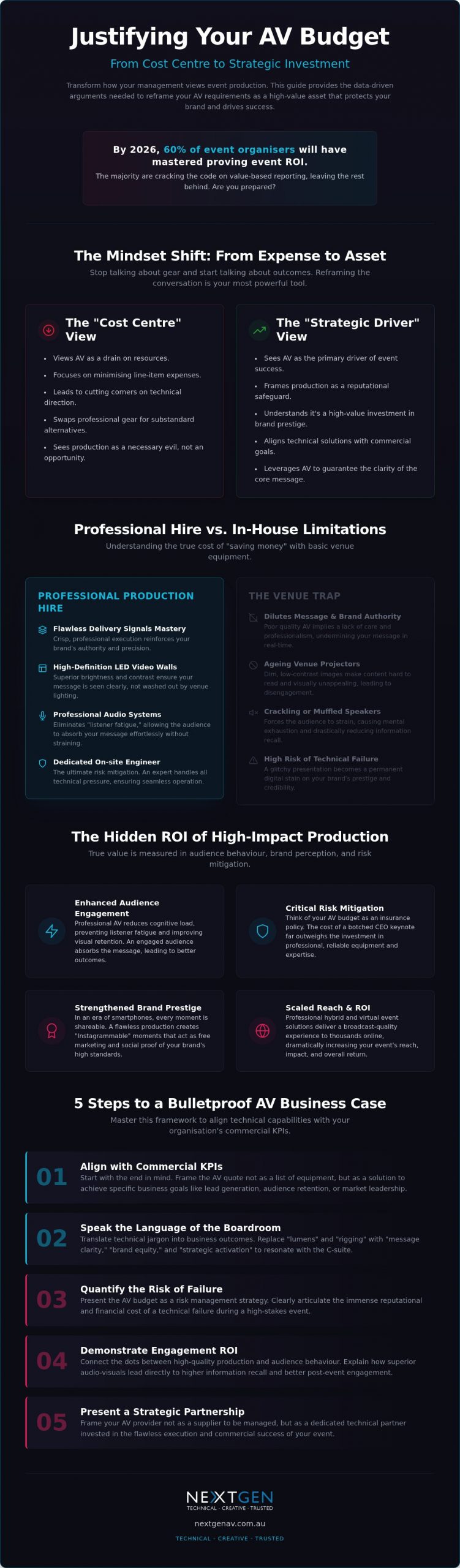
5 Steps to Building a Bulletproof AV Business Case
Converting a technical quote into an approved investment requires a methodical approach that mirrors corporate decision-making. When you are learning how to justify av budget to management, you must transition from being a purchaser of services to a strategist for growth. Use these five steps to build a case that is as technically sound as it is commercially persuasive.
- Step 1: Align with Business KPIs. Connect your production goals to specific organisational outcomes. If the objective is lead generation, explain how an immersive LED setup increases dwell time at a booth by 20% or more.
- Step 2: Utilise Comparative Data. Contrast the results of a previous “budget-first” event with the projected impact of your current vision. Show how technical friction in the past directly hindered audience engagement.
- Step 3: Present a Tiered Budget. Offer “Essential”, “Enhanced”, and “Elite” options. Providing a choice gives management a sense of control and often prevents a flat rejection of the entire proposal.
- Step 4: Focus on Problem/Solution Dynamics. Identify a specific past failure, such as poor audio coverage in a large hall, and show exactly how this new budget prevents a repeat performance.
- Step 5: Leverage Technical Validation. Use your AV partner’s expertise to add weight to your proposal. A recommendation backed by thirty years of industry experience is far harder to dismiss than an isolated request.
Developing a Tiered Proposal
Control is a powerful motivator in the boardroom. By structuring your proposal into tiers, you define what is non-negotiable versus what is aspirational. Your “Essential” tier should cover the absolute foundations of communication, such as crystal-clear audio and basic lighting. The “Enhanced” tier might introduce high-definition visual surfaces, while the “Elite” tier incorporates full technical direction and custom rigging. This approach allows management to see the value added at every price point, making it easier to secure approval for the “Enhanced” level as a strategic middle ground.
Using Visual Aids in Your Pitch
Spreadsheets rarely inspire confidence; vision does. To truly sell the concept, request 3D renders or detailed mood boards from your audio visual hire Melbourne specialist. Showing videos of similar high-impact executions helps stakeholders visualise the prestige your event will bring to the brand. A visual render bridges the chasm between a cold spreadsheet quote and the visceral reality of a successful, high-stakes event. If you want to see how your vision looks before the first case is even packed, contact our team for a technical consultation today.
Partnering for Success: How NextGen AV Supports Your Justification
NextGen AV isn’t just an equipment provider; we are your strategic ally in the boardroom. When you are determining how to justify av budget to management, having a partner with 30 years of Melbourne event experience provides the technical validation your proposal needs. We understand that a quote is more than a list of gear. It’s a commitment to excellence. Our transparent quoting process breaks down the specific value of each solution, ensuring your managers see exactly how every dollar contributes to the event’s prestige and impact.
Reliability is our hallmark. We operate with a “no-surprises” billing philosophy, eliminating the stress of post-event extra charges that can sour a successful production. Our technical mastery allows you to step into the role of the visionary. While we handle the intricate rigging and signal paths, you focus on the high-level goals. This partnership ensures you look like the expert, backed by an elite team that thrives under the pressure of live execution. We take personal pride in seamless delivery, allowing you to move past the logistical grind and focus on the final result.
Pre-Production Planning as a Value-Add
Success is forged in the planning phase. Our technical directors work alongside you to identify potential bottlenecks before they evolve into costly on-site problems. This proactive approach significantly reduces your internal staff workload, allowing your team to focus on content and delegate experience. Because we have spent decades navigating the specific logistics of Melbourne venues, we can organise the bump-in process and coordinate seamlessly with venue management. This expertise transforms a complex technical challenge into a smooth, methodical realisation of your project.
Next Steps: Getting a Quote That Management Can’t Refuse
The key to a successful budget approval is early involvement. Engaging us during the initial planning cycle, especially when preparing for EOFY budgeting, allows us to provide the detailed ROI data and visual renders required to win over the C-suite. When you brief us, share your commercial KPIs and brand vision. We will then craft a proposal that speaks directly to those goals, providing the technical evidence needed for how to justify av budget to management. Take the first step toward a flawless production and contact the NextGen AV team for a strategic production proposal today.
Secure Your Vision: From Cost Centre to Commercial Asset
Transforming your event from a logistical challenge into a prestigious brand activation starts with a fundamental mindset shift. By reframing production as a strategic driver and utilising data to prove engagement, you turn a technical quote into a compelling business case. Mastering how to justify av budget to management is about moving beyond the gear and focusing on the reputational safeguard that professional execution provides. You now have the framework to present tiered proposals that offer management control while protecting the integrity of your message.
With over 30 years of Melbourne event expertise, our team at NextGen AV is ready to help you look like a hero. We provide end-to-end production management that is trusted by major Australian brands and government bodies alike. We handle the technical stress so you can focus on your vision with absolute confidence. If you’re ready to elevate your next project with technical mastery and transparent billing, Request a Professional AV Quote for Your Next Melbourne Event today. Your vision deserves a platform that matches your ambition.
Frequently Asked Questions
How do I explain the cost difference between a projector and an LED wall to my boss?
LED walls provide superior brightness and contrast, which is essential for environments with high ambient light where projectors often wash out. This isn’t just an aesthetic upgrade; it’s a matter of legibility and information recall. Explain that a washed-out image forces the audience to strain their eyes, leading to disengagement and a direct loss of impact for your key messages.
What are the most common AV items that get cut from budgets, and why is that a mistake?
Technical rehearsals and stage lighting are often the first items on the chopping block. Cutting rehearsals is a high-risk move that leads to clunky transitions and on-stage friction, which immediately diminishes your brand’s authority. Similarly, poor lighting leaves your speakers looking flat and unprofessional on camera, undermining the prestige of the entire event and any recorded content you plan to use later.
Can professional AV actually help us save money in the long run?
Professional production acts as a reputational insurance policy that prevents the massive costs associated with event failure. By getting the execution right the first time, you avoid the need for expensive post-production fixes or the damage of a botched product launch. High-quality video and audio captured by experts can also be repurposed for months of marketing content, providing a long-term return on your initial investment.
How much of our total event budget should ideally be allocated to AV and production?
A healthy allocation for production usually sits between 20% and 30% of the total event spend to ensure your message is delivered effectively. It’s important to remember that skilled labour typically represents a significant portion of this quote, often between 30% and 50%. When you are learning how to justify av budget to management, frame this as the foundational investment that makes the venue and catering costs worthwhile.
What data should I collect after an event to prove the AV budget was well spent?
Track attendee satisfaction scores specifically related to technical clarity and monitor dwell time at digital activations. If you are running a hybrid event, collect data on virtual “watch time” and engagement rates. Social media mentions of the stage design or “Instagrammable” moments also provide concrete proof of brand reach. These metrics translate technical excellence into the commercial success stories that the boardroom understands.
Is it better to use a venue’s preferred supplier or hire an external specialist like NextGen AV?
External specialists like NextGen AV offer a level of bespoke customisation and technical mastery that venue-bound suppliers often can’t match. Venue suppliers are frequently restricted to aging, fixed equipment and may not have the same pride in your specific vision. Hiring an independent partner ensures you have a dedicated advocate whose sole priority is the flawless execution of your project rather than the venue’s bottom line.
How do I justify the cost of a technical director for a relatively simple event?
A Technical Director is the engine behind a seamless production, managing the timing and troubleshooting that allow your speakers to focus entirely on their delivery. This “Invisible Expert” ensures that small glitches don’t escalate into event-stopping failures. Even for simple events, their presence protects your organisation’s prestige by ensuring every transition feels intentional and polished, which is a standard management expects at a professional level.
What should I do if management insists on a budget that I know will result in technical failure?
Present a formal risk register that outlines the specific failures likely to occur with a substandard budget, such as poor audio intelligibility or visual wash-out. Offer a tiered proposal to show exactly what is being sacrificed at the lower price point. When you illustrate how a lack of funding directly compromises the event’s primary KPIs, management is far more likely to re-evaluate the “cost” as a necessary investment.
A single blown circuit doesn’t just cut the lights; it can instantly dismantle months of meticulous planning and expose your organisation to non-compliance penalties of up to $244,212. You’ve likely felt that sharp spike of adrenaline when a high-draw LED wall flickers or felt the weight of compliance anxiety regarding the latest Victorian safety standards. It’s a high-stakes environment where the difference between a standing ovation and a silent room often comes down to the invisible infrastructure humming beneath the stage. Mastering your event audiovisual integration in Melbourne requires more than just high-end hardware. It demands a precision-engineered power strategy that ensures your technical setup remains flawless while staying strictly within mandatory AS/NZS 3002:2021 regulations.
We understand that the logistics of 3-phase requirements and cable management can feel overwhelming. This guide will demystify the complexities of professional power distribution, from RCD protection to the ban on piggyback cords. You’ll discover how to secure a clean, professional aesthetic that eliminates trip hazards and protects your brand’s reputation through quiet, technical mastery. We’ll walk you through the essential safety benchmarks and distribution solutions that turn a potential technical failure into a seamless, prestigious experience.
Key Takeaways
- Understand why standard wall sockets often fail under the pressure of professional events and how specialised distribution creates a reliable technical foundation.
- Learn the critical differences between single-phase and 3-phase power to ensure your high-draw equipment has the necessary capacity to perform flawlessly.
- Gain clarity on mandatory AS/NZS 3002:2021 standards to protect your organisation from significant non-compliance penalties and safety risks.
- Master the step-by-step power audit process for accurately calculating peak wattage and assessing venue capacity before your event begins.
- Discover how sophisticated event audiovisual integration melbourne services seamlessly blend power management with high-end hardware for an uninterrupted audience experience.
What is Event Power Distribution and Why is it Critical?
Most event attendees only notice the brilliance of a high-definition screen or the clarity of a keynote speaker. They don’t see the complex web of copper and silicon humming beneath the floorboards. Event power distribution is the specialised infrastructure used to safely route electricity from a primary source to multiple high-draw AV components. It acts as the silent engine of your production. While it remains invisible when functioning perfectly, its absence or failure is impossible to ignore. In the high-stakes world of event audiovisual integration melbourne, precision power isn’t a luxury; it’s the foundation of your brand’s technical reputation.
Standard wall sockets, known as General Purpose Outlets (GPOs), are perfectly adequate for charging a laptop or running a coffee machine. However, they frequently fail to meet the rigorous demands of professional sound system hire and modern lighting rigs. These consumer-grade circuits aren’t designed for sustained, high-amperage loads. When pushed to their limit, they can cause voltage sags that lead to audio distortion or, worse, a complete thermal shutdown mid-presentation. This is where the ‘Invisible Expert’ steps in. With 30 years of experience navigating Melbourne’s most complex venues, we ensure that your power grid is engineered to handle peak loads without a flicker.
The Difference Between Consumer and Professional Gear
Using “home-office” power boards in a professional environment is a significant liability. These plastic strips lack the robust protection needed to manage the surge currents common in large-scale productions. Event Power Distribution is the calculated management of electrical loads to ensure 100% uptime. Pro-grade distribution boards (Distros) utilise high-quality Residual Current Devices (RCDs) and Miniature Circuit Breakers (MCBs) housed in heavy-duty, impact-resistant enclosures. While a venue might provide raw 3-Phase Power, it’s the specialised distribution gear that safely breaks that energy down into usable, protected circuits for your delicate equipment.
Protecting Your Technical Investment
Sensitive electronics are vulnerable to the slightest inconsistency in electrical supply. Unstable power is the primary cause of hardware failure, often frying the delicate internal processors of LED video walls or causing permanent damage to digital mixing consoles. The cost of failure is immense, not just in repair bills, but in the lost momentum of your event. Choosing “cheap” power solutions is often the most expensive mistake an organiser can make. By prioritising professional distribution, you gain the peace of mind to focus on the stage and your audience, confident that the invisible backbone of your event is being managed with absolute technical mastery.
The Technical Core: 3-Phase Power vs. Single Phase
Understanding the electrical architecture of your venue is the first step toward a stable production. While a standard domestic plug provides single-phase power suitable for small displays or a single speaker, large-scale events require a far more robust solution. High-capacity events rely on 3-phase power to deliver the massive energy required by modern technical rigs. This system provides three separate alternating currents, allowing us to deliver triple the power of a single-phase circuit through a single connection point. It is the gold standard for full service event production, providing the headroom necessary for high-intensity moments without risking a total blackout.
When Do You Need 3-Phase Power?
If your floor plan includes large-scale LED walls, moving head lighting rigs, or concert-grade PA systems, a standard 10A or 15A outlet simply won’t suffice. These components draw significant current, especially during “peak” moments like a sudden lighting flash or a heavy bass drop. We typically scale our distribution based on the total calculated draw, moving from 20A single-phase leads up to 32A or 63A 3-phase connections for major activations. Many Melbourne venues, particularly heritage buildings or smaller galleries, have strict power limitations. Identifying these constraints early allows us to organise supplementary generators or clever distribution strategies to ensure your technical vision isn’t compromised by the building’s infrastructure.
Load Balancing for Flawless Execution
Effective Planning Your Event Power involves more than just finding enough sockets; it requires the science of load balancing. This process involves distributing the electrical “weight” evenly across all three phases of the supply. If one phase is overloaded while others remain empty, the main breaker will trip even if you haven’t reached the venue’s total capacity. Precision balancing is also critical for audio clarity. By separating “dirty” power used for lighting motors and LED processors from “clean” audio circuits, we eliminate the dreaded 50Hz hum and electromagnetic interference that can ruin a professional recording.
Our technicians create a comprehensive “Power Plot” during the pre-production phase of every event audiovisual integration melbourne project. This document maps every watt to a specific circuit, ensuring we never approach the danger zone of a breaker’s limit. For mission-critical segments, such as a live broadcast or a CEO’s keynote, we implement Uninterruptible Power Supplies (UPS). These battery backups provide a vital buffer, offering instantaneous protection against voltage spikes or momentary venue power drops. This level of technical foresight is what defines our role as the “Invisible Expert,” allowing you to partner with a team that prioritises the safety of your presentation above all else.
Safety and Compliance: Navigating Australian Standards
Managing the electrical safety of a large-scale activation requires more than a casual glance at a few plastic tags. In Victoria, the regulatory landscape is stringent, and for good reason. Energy Safe Victoria (ESV) oversees electrical safety with a focus on preventing the catastrophic risks associated with faulty temporary installations. When executing high-end event audiovisual integration melbourne, compliance isn’t just about avoiding a fine. It’s about the duty of care you owe to every attendee, performer, and crew member on-site. We take this responsibility seriously, acting as the vigilant guardian of your event’s technical integrity.
AS/NZS 3002:2021 is the governing standard that dictates how temporary electrical installations must be designed and maintained. This isn’t a suggestion. AS/NZS 3002 compliance is a legal requirement for any temporary event structure in Victoria. While many providers stop at basic “test and tag” procedures, our approach looks at the entire system architecture to ensure every link in the chain is resilient. We ensure your setup is not only functional but fully defensible under Australian law.
AS/NZS 3002: What Every Melbourne Planner Should Know
The standard mandates that all electrical equipment rated 32 Amps and below must be protected by a Residual Current Device (RCD). These life-saving switches cut power instantly if a fault is detected, preventing electric shock and potential fire hazards. For larger installations involving generators or complex tie-ins, you may also require a temporary power certificate. This document serves as professional verification that your setup meets all safety benchmarks before the first guest arrives, providing a paper trail of absolute competence.
Public Safety and Cable Protection
Messy cabling is more than just an eyesore; it’s a primary cause of workplace injuries and technical failure. We prioritise a clean, professional aesthetic by organising the “spaghetti” into structured, logical runs. Using heavy-duty “Yellow Jackets” and cable ramps ensures that high-traffic areas remain safe while protecting the integrity of your infrastructure. This is particularly vital when integrating stage and lighting hire, where power cables often need to traverse public walkways or be secured precisely to overhead rigging.
Outdoor events in Melbourne present their own unique challenges. Our unpredictable weather requires specialised weatherproofing for all distribution boards and connection points. From IP-rated enclosures to elevated cable runs that avoid pooling water, we plan for every contingency. This proactive management allows you to celebrate the success of your event without the lingering fear of a safety breach or a rain-induced short circuit. You focus on the prestige of the final result while we handle the technical rigour behind the scenes.
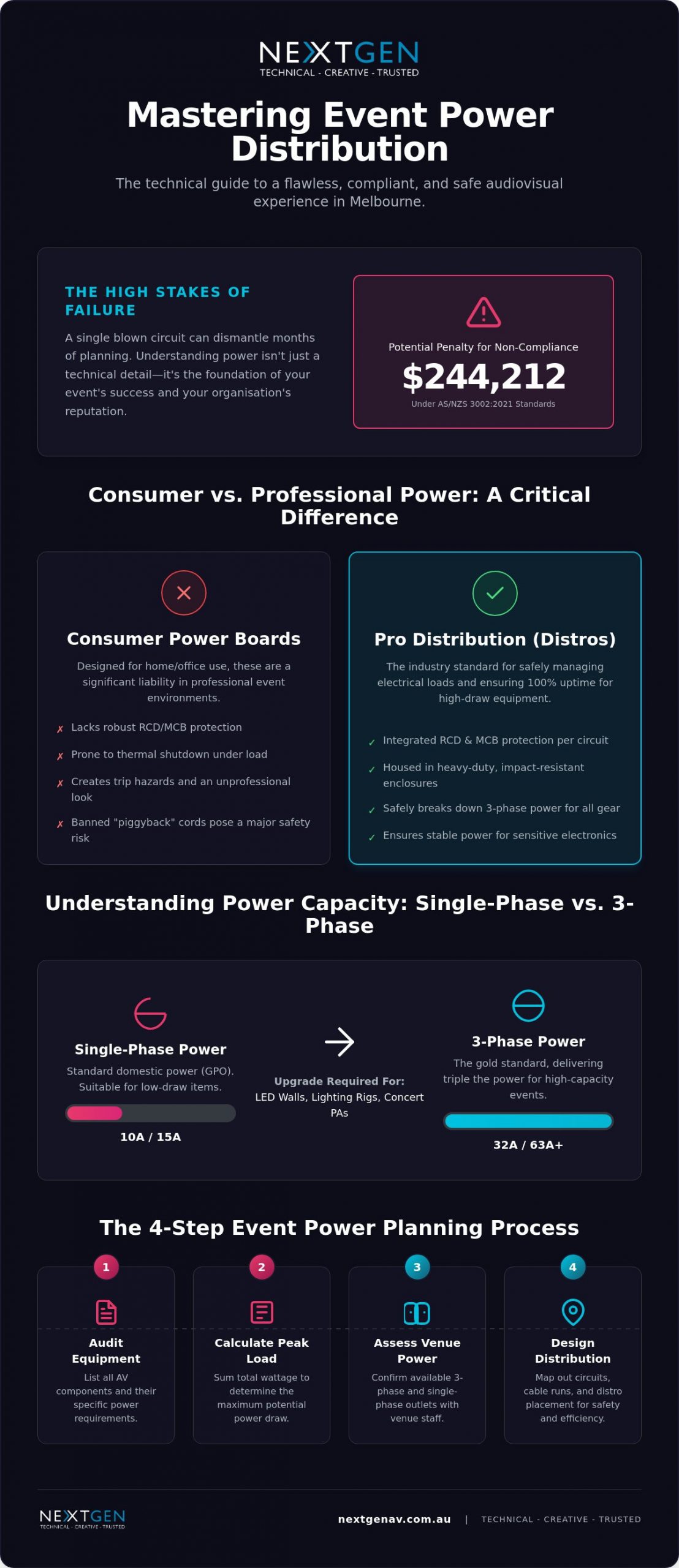
Planning Your Event Power Grid: A Step-by-Step Guide
Precision planning is the antidote to event-day stress. While we have already established the legal benchmarks for safety, this stage is where we translate those standards into a high-performance reality. Designing a power grid for a major activation requires a methodical approach that accounts for every watt before a single cable is laid. Our role as the “Invisible Expert” is to architect this infrastructure so that your event audiovisual integration melbourne remains robust, responsive, and entirely uninterrupted.
- Step 1: The Power Audit. We begin by listing every technical component, from high-draw LED processors to the smallest charging station.
- Step 2: Venue Assessment. We identify primary “tie-in” points and board capacities to ensure the building can support your vision.
- Step 3: Creating the Distribution Map. This is the technical blueprint that plots exactly where every drop-box and cable run will live.
- Step 4: On-site Testing. We conduct rigorous stress-tests before the doors open, simulating peak loads to verify system stability.
The Power Audit: Calculating Your Draw
Meticulous documentation is the foundation of a successful power strategy. We don’t just look at the labels for Watts, Amps, and Volts; we account for the “Inrush Current.” This is the momentary surge of power that occurs when equipment is first switched on, which can frequently trip breakers even if the sustained load is within limits. This calculation is especially vital for hybrid event staging solutions, where streaming racks and broadcast equipment require dedicated, isolated circuits to prevent digital interference. By over-specifying our requirements, we ensure there’s always a buffer for the unexpected.
Venue Liaison and Site Surveys
Melbourne’s premier spaces, such as the MCEC or the Melbourne Town Hall, have unique electrical personalities. During a site survey, we identify the physical distance between the power source and the stage to account for “Voltage Drop.” This is a physical phenomenon where power quality degrades over long cable runs, potentially causing equipment to behave erratically. We also coordinate closely with other vendors on your behalf. It’s a common trap for a catering team to plug a high-draw oven into a circuit reserved for your AV rig; we manage these relationships to ensure no one accidentally blows your technical momentum.
If you’re ready to ensure your next activation has the technical backbone it deserves, you can request a comprehensive power audit from our specialist team today. We take pride in handling the logistical grind, allowing you to focus on the prestige of your event’s final result.
Why NextGen AV is Melbourne’s Choice for Precision Power
Choosing a technical partner is an exercise in trust. For 30 years, we have managed the technical pulse of Australia’s most prestigious brands, ensuring that high-stakes activations remain flawless from the first rehearsal to the final pack-down. Our approach to event audiovisual integration melbourne is built on the belief that power should never be an afterthought. It is the lifeblood of your production. By positioning ourselves as the “Invisible Expert,” we take full ownership of the electrical architecture, allowing you to move past the logistical grind and focus on the prestige of your event’s results.
We provide a seamless ecosystem where power, professional audio, lighting, and LED vision work in perfect harmony. This integrated model eliminates the friction of managing multiple vendors who might otherwise compete for limited venue resources. When you partner with us, you aren’t just hiring equipment; you’re securing a dedicated craft. We provide 24/7 technical support and station on-site engineers for every major production, ensuring that if a challenge arises, it is resolved before it ever impacts the audience experience. This proactive stance is what creates the “Visible Result, Invisible Effort” that our clients have come to rely on.
The NextGen AV Difference
Our commitment to excellence starts with the hardware. We utilise only high-end, Australian-certified distribution equipment designed to withstand the rigours of the touring and corporate event industries. Every board, cable, and RCD in our inventory undergoes rigorous maintenance to ensure it exceeds Victorian safety benchmarks. However, the hardware is only half the story. Our technicians are veterans of Melbourne’s diverse venue landscape, from the sprawling halls of the MCEC to the unique constraints of boutique gallery spaces. This deep local knowledge has allowed us to maintain a track record of zero power-related failures across three decades of operation.
Ready to Power Your Next Event?
Securing a reliable power grid shouldn’t be a source of anxiety. By engaging our team early in your planning phase, you gain access to a tailored power distribution strategy designed specifically for your technical rider. The benefit of our end-to-end service is clear: you have one point of contact and one accountable partner who understands every nuance of your show’s requirements. We handle the complexity, the compliance, and the load balancing so that you can take centre stage with absolute confidence.
Don’t leave your technical success to chance. Whether you are planning a complex hybrid broadcast or a large-scale corporate gala, our specialists are ready to engineer a solution that protects your investment and your reputation. Enquire about your event power distribution needs today and discover the peace of mind that comes with true technical mastery.
Power Your Vision with Technical Mastery
The success of your next activation depends on a foundation that remains unseen yet entirely unbreakable. We have explored how precision power distribution transforms a collection of high-end hardware into a seamless experience; from the technical rigour of 3-phase load balancing to the non-negotiable safety standards of AS/NZS 3002. Mastering event audiovisual integration melbourne requires a partner who treats electrical infrastructure as a craft rather than a utility. By prioritising a meticulous power audit and robust cable management, you eliminate the threat of technical failure and protect the prestige of your brand.
With over 30 years of industry experience, we specialise in the complex high-impact LED and audio integration that defines Melbourne’s most ambitious events. You don’t have to carry the weight of compliance anxiety or technical logistics alone. Our team is ready to act as your “Invisible Expert,” ensuring every circuit is secure and every moment is powered to perfection. Secure your event’s technical success with NextGen AV’s power solutions. We look forward to helping you realise a flawless production that leaves your audience inspired.
Frequently Asked Questions
Is it safe to use standard extension leads for event AV?
Standard domestic extension leads are generally unsuitable and often unsafe for professional event environments. They rarely meet the 1.5mm² minimum conductor size required by Australian Standards and lack the integrated RCD protection necessary to prevent electrical faults. Under AS/NZS 3002:2021, the practice of “piggybacking” cords is strictly banned; making professional distribution boards a mandatory requirement for technical safety.
What is 3-phase power and do I need it for my Melbourne event?
3-phase power is a high-capacity electrical supply that delivers 415 Volts, providing significantly more energy than a standard 240V single-phase outlet. You will likely need it if your event features high-draw equipment like large LED video walls or extensive lighting rigs. Most Melbourne venues provide 3-phase “tie-in” points specifically to handle these heavy technical loads without risking a total blackout.
How do I calculate the total power draw for my corporate gala?
Calculating your draw begins with a comprehensive audit of every technical component’s peak wattage, which is typically found on the manufacturer’s label. You must also account for “inrush current,” the momentary spike in energy that occurs when equipment is first powered on. This meticulous planning is a core part of successful event audiovisual integration melbourne, ensuring your total load stays well within the circuit’s safe operating limits.
What happens if the venue power fails during my event?
If venue power fails, your event’s survival depends on the redundancy measures implemented during the planning phase. We utilise Uninterruptible Power Supplies (UPS) to provide instantaneous battery backup for mission-critical segments like broadcast racks or keynote laptops. For high-stakes activations, we often deploy secondary generators that act as a fail-safe, ensuring the show continues even if the local grid falters.
Who is legally responsible for event power safety in Victoria?
In Victoria, the legal responsibility for electrical safety rests with the event organiser under broader Occupational Health and Safety laws. Energy Safe Victoria (ESV) enforces these standards, and non-compliance can lead to significant penalties for both individuals and corporations. Engaging a qualified technical team ensures that all equipment is tested and tagged, and that the installation meets the rigorous AS/NZS 3002:2021 criteria.
Can I run a large LED wall off a standard 10A wall socket?
Attempting to run a large LED wall off a standard 10A wall socket is a recipe for technical failure. A 10A circuit is limited to approximately 2400 Watts, which professional LED processors and screen modules can easily exceed during high-brightness sequences. Overloading the circuit will trip the breaker and can cause permanent damage to sensitive digital components due to voltage drops.
What is a ‘Power Plot’ and why do I need one for my event?
A “Power Plot” is a detailed technical map that assigns every piece of equipment to a specific circuit and phase. It is an essential document that prevents circuit overloads and ensures the electrical load is balanced evenly across the supply. Without a plot, you risk “nuisance tripping,” where a single breaker fails because too many high-draw devices were inadvertently plugged into the same line.
Do you provide backup generators for outdoor events in Melbourne?
We frequently coordinate backup generators for outdoor events across Melbourne to ensure technical independence from the venue’s infrastructure. For events requiring a Division 2 Occupancy Permit (POPE), a backup power source is often a mandatory safety requirement. Our engineers manage the integration of these units to provide a stable, “clean” power supply for your audio and visual systems.
A speaker’s authority isn’t just born from their expertise; it’s forged in the silence of a stage where they never have to look back. You’ve likely felt that spike of adrenaline when a presenter turns their back to the audience to squint at a slide, or when a cable-cluttered stage distracts from a high-stakes keynote. It’s an all-too-common frustration in the Melbourne corporate scene where the technical execution can either elevate or undermine a leader’s message. Securing a professional confidence monitor rental for stage is the invisible engine that prevents these friction points and ensures your production remains flawless.
We understand that the logistics of a live event are high-stakes, and you need a technical setup that projects absolute reliability. This guide will show you how to curate a fail-safe presentation ecosystem that empowers your speakers to maintain unwavering eye contact while commanding the room with ease. You’ll discover how to choose the right equipment to handle notes, timers, and Q&A feeds without the audience ever spotting the machinery behind the magic.
From selecting the ideal screen dimensions for your venue to mastering the “notes versus slides” feed with technical precision, we’ll explore the essential 2026 standards for a polished, professional stage presence. It’s time to move past the logistical grind and focus on the prestige of a truly seamless result.
Key Takeaways
- Learn why industrial-grade monitors between 32 and 55 inches are the professional standard for ensuring clarity and reducing glare during high-stakes keynotes.
- Discover how to synchronise PowerPoint notes and live Q&A feeds to create a seamless “Presenter View” that keeps your speakers on track.
- Optimise your stage presence with a confidence monitor rental for stage that utilises discreet floor wedges and professional cable management to maintain a polished aesthetic.
- Master the art of monitor placement to bridge the gap between technical reliability and natural audience engagement, ensuring your speakers never lose their place.
- Ensure a fail-safe event by partnering with technical experts who provide the precise show control needed to manage complex multi-content switching.
What is a Confidence Monitor and Why is it Essential for Your Stage?
Imagine standing on a stage in front of a room full of industry peers. The lights are bright, the stakes are high, and your next slide contains a complex graph you need to explain with absolute precision. In that moment, a confidence monitor acts as your invisible safety net. Often referred to in the technical world as a Downstage Monitor (DSM), this piece of technology allows you to see your content without ever breaking eye contact with your audience. While a traditional Teleprompter might scroll a word-for-word script, a confidence monitor provides a dynamic view of your slides, presenter notes, and even a countdown timer to keep the session on track.
Securing a professional confidence monitor rental for stage ensures your speaker remains the focal point of the room. When a presenter has to turn their back to the audience to check the main LED wall, they lose authority and break the vital connection with their listeners. By placing high-definition screens at the foot of the stage, we create a comfort zone that reduces anxiety. This psychological boost allows for a more natural, conversational delivery, as the speaker isn’t worried about forgetting their next point or losing their place in a complex deck.
It’s essential to distinguish these visual tools from “stage monitors” used in an audio context. While sound engineers use foldback speakers to help performers hear themselves, a confidence monitor is purely visual. It’s the orchestrator of timing and flow, keeping the technical direction of the show perfectly aligned with the live performance. For Melbourne planners, understanding this distinction is the first step toward a polished, professional production.
Confidence Monitors vs. Lectern Laptops
Placing a laptop on a lectern might seem like a simple solution, but it often creates a physical barrier between the speaker and the room. It forces the presenter to look down, which can muffle their voice and make them appear unprepared. A floor-mounted confidence monitor rental for stage offers a superior alternative. It maintains a clean, open stage aesthetic and allows the speaker to glance naturally toward the floor, keeping their posture upright and their presence commanding. This setup organises the stage for maximum impact without the clutter of bulky furniture.
When Does Your Event Require a Dedicated Monitor Hire?
Not every small meeting needs a DSM, but for high-stakes corporate events, they are non-negotiable. You should consider a dedicated hire for:
- Keynote Presentations: Where complex data or specific scripts require precise recall and a steady pace.
- Panel Discussions: To allow multiple speakers to see the current slide or live Q&A feed from a distance.
- Awards Nights: Where precise timing, names, and category cues must be delivered with zero margin for error.
Choosing the Right Hardware: A Buying Guide for Stage Monitors
Selecting the ideal hardware for a high-stakes event requires a shift in perspective. You aren’t just hiring a screen; you are investing in a high-performance tool designed to withstand the rigours of a live production environment. A professional confidence monitor rental for stage must balance technical specifications with the visual flow of your set design. While a consumer-grade television might suffice for a home lounge, the intense glare of a professional lighting rig will render a glossy screen useless. Industrial monitors feature high-nit brightness levels and matte finishes, ensuring your speaker can read every syllable even under the most demanding stage lights.
Resolution and connectivity are equally critical. When a presenter relies on detailed speaker notes, those characters must remain crisp and legible from several metres away. High-definition or 4K resolution improves audience understanding and memory by allowing the speaker to deliver complex data with total clarity. Behind the scenes, we prioritise SDI (Serial Digital Interface) connectivity over standard HDMI. SDI cables offer a locking, broadcast-grade connection that maintains signal integrity over long distances without the lag or dropouts common in domestic setups.
Standard Sizes for Different Stage Depths
The “right” size depends entirely on the distance between the speaker and the monitor. For small stages or intimate breakout rooms under 3 metres deep, a 32-inch monitor is the sweet spot. It provides enough real estate for notes without dominating the floor space. In medium-sized ballrooms, we typically scale up to 43-inch or 50-inch units to maintain legibility. For large-scale plenaries or wide stages, 55-inch monitors or multiple mirrored units across the stage front ensure the presenter never feels disconnected from their cues, regardless of where they stand.
Mounting Solutions: From Floor Wedges to Low-Profile Stands
Aesthetics define the professional experience. Floor-wedge mounts are the industry standard for a “stealth” look, angling the screen perfectly for the speaker while remaining invisible to the audience. If your event features a seated panel discussion, low-profile pole stands bring the monitor to eye level, preventing speakers from constantly looking at their feet. Our team can also integrate these solutions into custom stage furniture or set pieces to maintain a seamless brand environment. If you are ready to elevate your next production, you can explore our range of professional display solutions to find the perfect fit for your venue.
Content Management: What Your Presenter Sees
Think of the stage as a high-pressure cockpit where the presenter needs a clear, private dashboard to navigate their session. While the audience is captivated by the primary visuals, the speaker relies on a tailored stream of information that keeps them grounded. A professional confidence monitor rental for stage isn’t just about duplicating a slide; it’s about curated content delivery. By utilising “Presenter View” in software like PowerPoint or Keynote, we synchronise the speaker’s personal notes and a preview of the next slide directly to their line of sight. This allows them to transition between topics with a natural flow, as they can see exactly what’s coming before it hits the big screen.
The distinction between a “Mirror” feed and an “Independent” feed is where true professional production shines. A mirrored feed simply shows what the audience sees, which is useful for basic checks but lacks the strategic data a keynote speaker requires. An independent feed, however, can display a mix of current slides, speaker notes, and real-time countdown timers. These timers often utilise a “Traffic Light” system: green for active time, amber for the final two minutes, and red when the session must conclude. This visual cueing system is far more effective than a hand-signal from the back of the room, ensuring your event schedule remains airtight. Industry professionals often look for expert advice on confidence monitor placement to ensure these data-rich feeds are positioned at the perfect angle for a quick, natural glance.
Integrating Live Moderated Q&A
Modern corporate events thrive on interaction, but juggling a handheld tablet for Q&A can break a speaker’s poise. We eliminate this stage clutter by pushing moderated audience questions directly to the confidence monitor. An off-stage technician or moderator filters and edits the submissions in real-time, displaying only the most relevant queries for the speaker to address. This seamless integration allows the presenter to stay focused on the room while maintaining full control over the conversation.
The Importance of a Dedicated Video Switcher
Managing a confidence monitor rental for stage requires more than just a long cable; it demands a dedicated video switcher to handle the “Confidence Feed” separately from the audience’s LED video wall. A professional technical director uses this switcher to toggle between different content layouts without the audience ever noticing. This setup provides a fail-safe environment where the speaker never sees a messy desktop or a “blue screen” during a transition. Our technicians take personal pride in this “invisible expertise,” ensuring the technology serves the speaker’s message without ever becoming the story themselves.
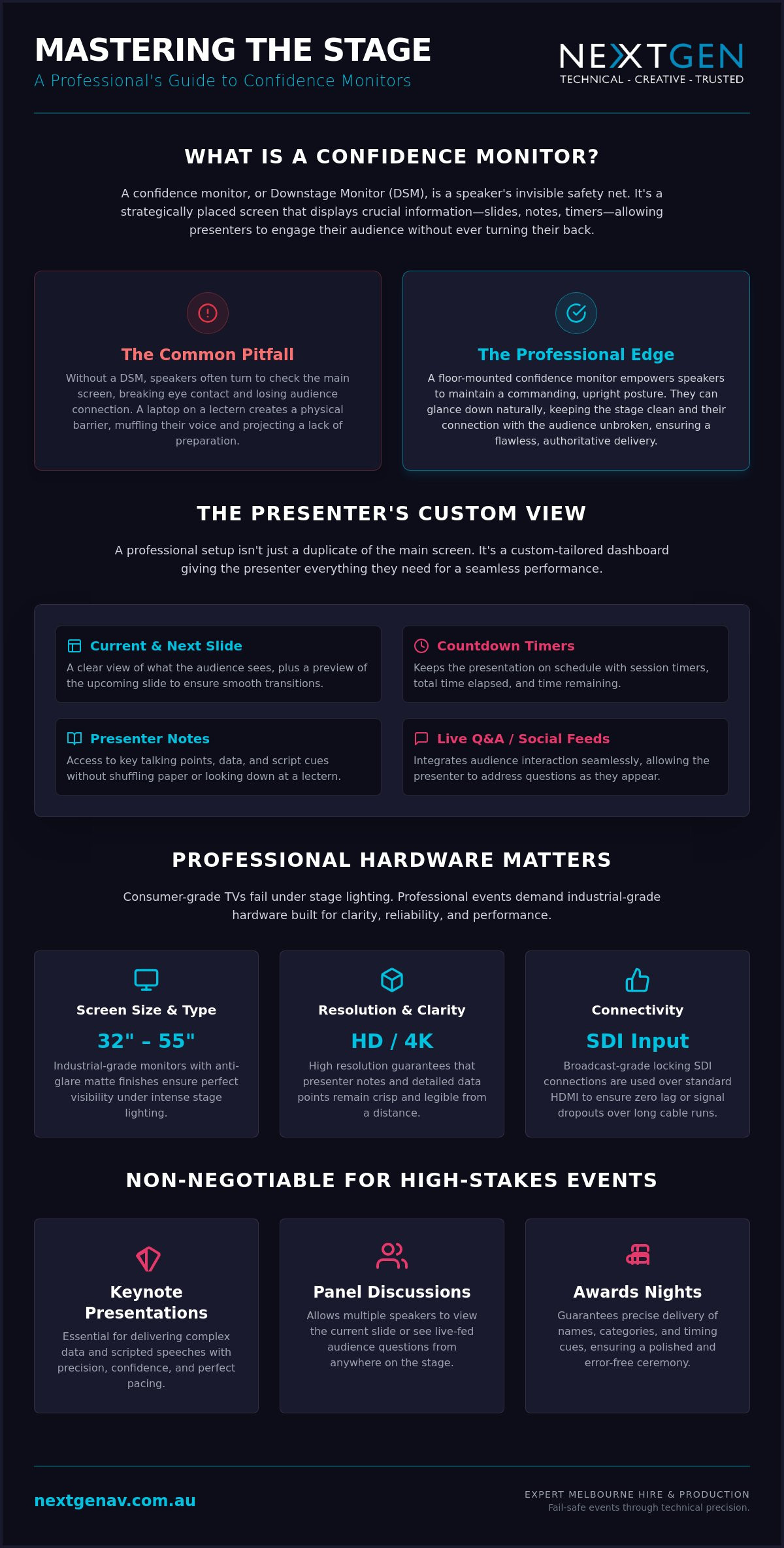
Stagecraft and Aesthetics: Organising the Perfect View
A flawless presentation is as much about what the audience doesn’t see as what they do. While the digital data feeds drive the speaker’s narrative, the physical execution of your confidence monitor rental for stage defines the overall aesthetic of your production. A truly “stealth” setup requires meticulous attention to detail, utilising professional gaffer tape and custom cable looms to ensure every power and signal line remains invisible. We treat the stage as a canvas, where the technical equipment must integrate perfectly with your broader stage and lighting hire to maintain a premium brand image.
Placement is a craft in itself. The “sweet spot” typically sits just beyond the downstage edge, angled so the speaker can glance down without looking like they are staring at their feet. This positioning allows for a natural eye line that feels conversational rather than rehearsed. For presenters who prefer to roam, we often deploy dual monitor setups. This ensures they have a clear line of sight whether they are stage-left or stage-right, maintaining their momentum and authority regardless of their movement across the stage.
Avoiding Distractions for the Audience
A common mistake in amateur setups is allowing the monitor’s glow to bleed into the front row. We prevent this by using custom “blinkers” or shrouds that mask the screen from the audience’s perspective while keeping it perfectly visible to the speaker. Optimal angling also plays a vital role in minimising reflections from overhead lighting. During video playback or “lights down” moments, our technicians proactively manage brightness levels, ensuring the screen remains a helpful tool for the presenter without becoming a visual distraction for the room.
Cabling and Signal Integrity
In a high-stakes environment, reliability is non-negotiable. While wireless technology has advanced, it simply isn’t an option for a critical confidence monitor rental for stage due to potential interference and latency risks. We prioritise hardwired SDI connections for their absolute stability over long distances. For keynote sessions where failure isn’t an option, we implement full redundancy, running primary and backup signal lines along independent paths. This fail-safe approach, combined with trip-free cable management, creates a secure environment where the speaker can focus entirely on their delivery. If you need a partner who understands the nuance of elite stagecraft, contact our technical team today to discuss your requirements.
The NextGen AV Difference: Expert Melbourne Hire & Production
Execution at the highest level requires more than just high-end equipment; it demands a partner who understands the rhythm of a live environment. With over 30 years of industry experience, NextGen AV has established itself as the premier choice for full service event production in Melbourne. We don’t just provide hardware; we deliver a fail-safe ecosystem where every technical detail is managed with absolute precision. This mastery allows you to move past the logistical grind and focus on the prestige of your event’s final result, knowing the “Invisible Experts” are orchestrating the success from the wings.
Our inventory of industrial-grade monitors, ranging from 32-inch to 55-inch units, is specifically curated for the demanding conditions of corporate stages. These aren’t standard retail screens. They feature high-nit brightness and specialised matte coatings to combat the intense glare of professional lighting rigs. When you secure a confidence monitor rental for stage through us, you’re also gaining access to our specialised floor-wedge mounts. These mounts ensure a low-profile, “stealth” aesthetic that keeps the focus on your speaker rather than the machinery behind them.
Comprehensive Technical Support
The true value of our service lies in our technical direction and show control. Managing the “Notes vs. Slides” complexity is a high-stakes task that requires a seasoned hand. Our on-site technicians take personal pride in managing these feeds, ensuring your presenters always see the correct data at the right moment. This visual precision works in tandem with your professional sound system hire to create a cohesive sensory experience. We don’t just react to problems; we utilise proactive troubleshooting and redundant signal paths to ensure zero downtime during your live sessions.
Tailored Solutions for Melbourne’s Premier Venues
Every venue in Melbourne presents unique challenges, from the vast plenaries of major conference centres to the intimate ballrooms of elite hotels. Our team possesses deep familiarity with these spaces, allowing us to design customised confidence monitor rental for stage packages that scale perfectly to your environment. Whether you’re hosting a high-level boardroom briefing or a massive multi-day summit, we provide the technical powerhouse and reassuring guidance needed to empower your speakers. The result is a polished, professional stage presence that leaves a lasting impression on your audience. Contact NextGen AV today for a tailored confidence monitor quote.
Elevate Your Next Keynote with Technical Precision
The success of a high-stakes presentation is often determined by the tools that remain hidden from the audience. By choosing the right hardware and mastering the art of discreet stagecraft, you empower your speakers to lead with authority and maintain a genuine connection with the room. Strategic placement and industrial-grade clarity ensure that every keynote is delivered with unwavering confidence and professional poise.
Securing a professional confidence monitor rental for stage is the definitive way to ensure your presenters never lose their place or their connection with the audience. With over 30 years of technical event mastery and a commitment to expert on-site technical direction, NextGen AV provides the invisible engine behind Melbourne’s most prestigious corporate events. We manage the intricate balance of high-brightness hardware and complex content switching so you can focus on the prestige of the final result.
Secure your confidence monitor rental for your next Melbourne event and experience the difference that absolute technical precision makes. We look forward to partnering with you to create a seamless, world-class stage presence that commands the attention of every attendee.
Frequently Asked Questions
What is the difference between a confidence monitor and a teleprompter?
A confidence monitor provides a flexible view of slides, speaker notes, and timers, whereas a teleprompter typically displays a scrolling word-for-word script. While a teleprompter is excellent for formal speeches, a confidence monitor allows for a more natural, conversational delivery. It gives the speaker the freedom to react to the room while still having their key data points within their line of sight.
Can the audience see what is on the confidence monitor?
No, the audience shouldn’t see the screen if the setup is professionally managed. We utilise custom shrouds, also known as “blinkers,” and precise floor-wedge angling to mask the monitor’s glow from the front row. This ensures the technology remains an invisible aid for the speaker rather than a visual distraction for your guests.
Do I need a special laptop or software to use a confidence monitor?
You don’t need bespoke software, as standard programmes like PowerPoint and Keynote already include a “Presenter View” designed for this purpose. However, a professional confidence monitor rental for stage usually involves a dedicated video switcher and a technical operator. This setup allows us to manage the speaker’s feed independently from what the audience sees on the main LED wall.
How many confidence monitors do I need for a standard stage?
One monitor is often sufficient for an intimate stage or a fixed lectern setup. For a standard ballroom stage where the speaker might move around, we recommend two mirrored units placed at the downstage edges. This ensures the presenter always has a clear line of sight to their notes, regardless of their position in the room.
What happens if the speaker’s notes aren’t formatted correctly for the screen?
Our on-site technicians proactively review all presentation decks during the pre-production phase to identify these issues. If the notes are too small or poorly laid out, we can adjust the font size and layout in real-time. This ensures every syllable is crisp and legible from several metres away, preventing any squinting or hesitation on stage.
Can I show a countdown timer and my notes on the same monitor?
Yes, we can display multiple content streams simultaneously on a single screen. By using advanced video processing, our technical team can overlay a “Traffic Light” countdown timer or a live Q&A feed alongside your slides and notes. This gives the speaker a comprehensive dashboard that keeps the entire session on schedule and highly interactive.
Is it possible to hire a confidence monitor for a hybrid or virtual event?
It is highly recommended to include a confidence monitor rental for stage in your hybrid event planning. For a presenter in a physical studio or ballroom, the monitor can display the virtual gallery of remote attendees. This helps the speaker maintain a sense of connection with the digital audience, making the experience feel more cohesive for everyone involved.
The house lights dim and the opening cue is seconds away, yet instead of the stage manager’s voice, your headset fills with static or the muffled chatter of a nearby security team. It is the nightmare scenario for any production lead, where a simple lapse in your event communication systems rental choice transforms a high-stakes performance into a series of missed cues and frantic hand signals. You know that behind every flawless event is an invisible engine of coordination, and you shouldn’t have to worry about wireless blackspots or battery failure when the pressure is on.
We agree that your crew deserves the same level of precision in their headsets as the audience hears through the front-of-house speakers. This 2026 guide promises to show you how to choose and deploy a robust communication infrastructure that guarantees absolute synchronisation across lighting, audio, and stage departments. We will look at the latest full-duplex digital intercoms, how to ensure ACMA compliance for interference-free operation, and the technical strategies required to maintain professional-grade reliability for an 18-hour show day.
Key Takeaways
- Understand why professional communication serves as the vital nervous system for any high-stakes production, ensuring every cue is executed with absolute precision.
- Discover the technical differences between digital intercoms and two-way radios to determine which technology best suits your crew’s specific talk-paths and security needs.
- Learn how to optimise your event communication systems rental by conducting thorough site surveys and assessing the unique acoustic challenges of your venue.
- Navigate the complexities of ACMA frequency licensing to avoid interference from unlicensed gear and ensure your production remains compliant and crystal clear.
- Explore the benefits of integrating your comms infrastructure into a total audio-visual package, backed by 30 years of expertise in the Melbourne events industry.
The Critical Role of Event Communication Systems in Modern Production
Think of your event as a living organism. If the audio-visual elements are the muscles and the vision is the heart, then a professional event communication systems rental is the nervous system. It carries every pulse of data and every urgent command from the brain, the stage manager, to the extremities of the production. Without this connectivity, the most expensive LED walls and line arrays are just static hardware. Truly seamless production relies on the ability to transmit intent instantly. This allows a lighting operator to hit a blackout the exact millisecond the drummer strikes the final beat, creating a moment of pure, coordinated impact.
There is a profound difference between managing a crowd and calling a show. Simple two-way radios are fine for coordinating car park arrivals or security patrols, but they fall short when you’re choreographing a complex gala. Calling a show requires a continuous, open dialogue where the stage manager can hear the breath of the crew and anticipate their needs. This level of intimacy prevents the common AV glitches that haunt poorly planned events, such as mistimed video rolls or audio feedback during a critical keynote. When the crew feels connected, their stress levels drop significantly. They move from a state of reactive panic to one of proactive artistry, focusing on the prestige of the final result rather than fighting their equipment.
Beyond Walkie-Talkies: Defining Professional Comms
The evolution of production has pushed us past the era of simple push-to-talk devices. Modern digital intercom systems create integrated networks that allow for full-duplex conversation, meaning your team can talk and listen simultaneously just like a phone call. In high-interference environments like the Melbourne CBD, consumer-grade gear often buckles under the weight of RF noise from skyscrapers and mobile towers. A professional setup provides dedicated, discrete channels. This ensures the lighting department isn’t distracted by audio troubleshooting, and the stage manager has a direct, private line to the technical director to keep the schedule on track.
Risk Mitigation through Reliable Infrastructure
Reliability isn’t just a luxury; it’s a safety requirement. High-stakes corporate shows demand a zero-fail comms environment, which we define as a dedicated infrastructure where redundant signal paths and expert frequency management ensure every critical cue is delivered and acknowledged without exception. This infrastructure prevents the dead air that can ruin a live broadcast or the timing errors that turn a prestige award ceremony into a series of awkward silences. Beyond the creative flow, these systems act as a lifeline for emergency protocols. They ensure that if a situation arises, the entire team can be alerted and organised in seconds without the audience ever knowing there was a concern.
Key Technologies: From Two-Way Radio Hire to Digital Intercoms
The technical landscape of modern production has shifted, moving away from simple noise-makers toward sophisticated, low-latency networks. Selecting the right event communication systems rental depends entirely on the specific roles within your crew. For logistics and security teams, Digital Mobile Radio (DMR) remains the heavy lifter. These units provide robust, long-range coverage that ensures your front-of-house staff and loading dock crews remain connected across vast distances, even through the thick concrete walls of Melbourne’s premier convention centres.
At the heart of the production, wired intercom systems provide the rock-solid reliability required for stationary positions. Your technical director and lighting operator, situated at the ops desk, don’t need mobility; they need a connection that is immune to wireless interference. When Choosing the Right System for your mobile stage crew, wireless full-duplex technology is the gold standard. It allows for continuous, hands-free conversation, enabling a rigger or stage hand to use both hands for their craft while maintaining a crystal-clear dialogue with the stage manager.
For city-wide festivals or sprawling outdoor events, Push-to-Talk over Cellular (PTToC) offers an elegant solution. By leveraging existing mobile networks, PTToC bridges the gap where traditional radio frequencies might struggle, providing wide-area coverage that keeps your entire team synchronised across kilometres of urban terrain. Our team can help you organise a bespoke comms package that aligns perfectly with your show’s complexity and venue constraints.
Digital vs. Analogue Systems
Digital systems have rendered analogue units obsolete in professional circles. By converting voice into data packets, digital DMR units offer superior audio clarity and eliminate the background hiss associated with older technology. More importantly, digital channels allow for advanced encryption. This is a vital feature for high-profile corporate events where sensitive announcements must remain private. Professional-grade digital hardware also boasts significantly better battery life, often surviving an 18-hour show day on a single charge while withstanding the physical rigours of a frantic bump-in.
Specialised Accessories for Every Role
The right headset is just as important as the base station itself. In high-decibel environments like concerts or trade shows, heavy-duty noise-cancelling headsets are essential to protect crew hearing and ensure instructions are heard over the PA. Conversely, floor managers and VIP hosts often require discrete earpieces that provide clear audio without the bulky profile of a traditional headset. We also provide multi-unit charging stations and speaker microphones to ensure large-scale deployments remain powered and functional from the first briefing to the final pack-down.
Choosing the Right System: A Buyer’s Comparison Framework
Selecting your event communication systems rental is not merely a matter of counting heads. It is an exercise in mapping the pulse of your production. You must first audit the ratio of ‘talkers’ to ‘listeners’ within your crew. While a logistics team might only need to report status updates via simplex channels, where only one person can speak at a time, your core production crew requires the fluid, simultaneous exchange of a full-duplex system. Understanding this distinction is the first step in moving from a basic setup to a professional-grade infrastructure that supports the artistry of your show.
The venue itself dictates the hardware. An indoor ballroom in the Melbourne CBD presents different challenges than a sprawling outdoor festival site at the Sidney Myer Music Bowl. Physical barriers like thick concrete walls or massive steel rigging can swallow wireless signals, leading to the dreaded ‘dead air’ that puts a production at risk. Budgeting for your comms should be viewed as show insurance. The investment in a high-end, reliable rental is negligible when compared to the professional fallout and stress of a failed show caused by a missed cue or a battery dying at a critical moment.
The ‘Show-Caller’ Test
A show-caller is the conductor of your event’s orchestra. They require a full-duplex system to maintain the ‘rhythm’ of the event, allowing them to hear the breath and readiness of the crew in real time. This typically involves a multi-channel structure where the caller can toggle between discrete departments like lighting, audio, and stage management without cluttering the main feed. This level of technical direction is what bridges the gap between a standard event and a world-class experience. It is why we often integrate these comms with our Professional sound system hire to ensure every element of the production is perfectly aligned from the first cue to the final curtain.
Interference and Range Considerations
Melbourne’s premier event precincts are notorious for RF noise. From the skyscrapers of the CBD to the high-density wireless environments of Southbank, signal interference is a constant threat. If your event spans multiple levels or a vast outdoor area, you will likely need to deploy repeaters to extend the range of your two-way radio fleet. A technical site survey is essential to identify potential blackspots and ensure your signal penetrates the physical barriers of the venue. By planning for these environmental factors early, you ensure your crew remains connected, regardless of the architectural challenges of the space.

Planning Your Comms Infrastructure: Site Surveys and ACMA Compliance
A flawless production is never the result of luck; it is the product of meticulous preparation that begins long before the first road case enters the venue. For a high-impact event communication systems rental to succeed, a technical site survey is non-negotiable. This proactive assessment allows us to map the unique RF environment of your location, identifying potential blackspots created by heavy structural steel or subterranean concrete layers. By conducting a rigorous ‘walk-test’ protocol during the pre-show phase, we ensure that every corner of the site, from the green room to the loading dock, maintains a crystal-clear signal before the first cue is ever called.
Operating in Australia requires a deep understanding of the legal landscape governed by the Australian Communications and Media Authority (ACMA). Using unlicensed ‘grey market’ gear doesn’t just risk signal dropouts; it exposes your organisation to significant legal liability and potential fines. Professional systems must adhere to the Radiocommunications (Low Interference Potential Devices) Class Licence 2025, ensuring that your equipment operates on designated shared frequencies without disrupting emergency services or other vital broadcasts. We ensure all hired electronics meet strict RCM safety standards, providing you with the peace of mind that your infrastructure is both high-performing and fully compliant.
Frequency Management in Melbourne
The RF spectrum in Melbourne’s premier precincts, such as the MCEC or the major hotels along Southbank, is incredibly crowded. Without a co-ordinated frequency plan, your production comms could easily clash with nearby events or the venue’s internal security teams. For large-scale multi-AV projects, we act as your frequency coordinator, carving out dedicated space in the airwaves to prevent cross-talk and interference. This level of master-planning is a core component of our Full service event production, where we manage the technical heavy lifting so you can focus on the show’s creative execution.
Logistics and On-Site Support
While some choose ‘dry hire’ to save on initial costs, the complexity of modern intercom networks makes a turnkey solution far more efficient. A turnkey event communication systems rental includes the expertise of an on-site technician who manages the invisible details, from real-time troubleshooting to proactive battery swaps during critical show moments. Having a seasoned veteran on the ground ensures that any technical hiccups are resolved in seconds, maintaining the momentum of your event. If you are ready to secure a rock-solid foundation for your next production, contact our team to discuss a tailored comms strategy that guarantees absolute reliability.
Why Partner with NextGen AV for Your Melbourne Event Comms
Choosing a partner for your event communication systems rental is about more than just securing hardware; it is about finding an invisible expert who understands the heartbeat of a live production. We don’t view comms as an isolated utility. Instead, we integrate your intercom network directly into our total lighting and audio design. This holistic approach ensures that every department is perfectly synchronised, allowing the technical director to orchestrate the show with the precision of a master conductor. With over 30 years of experience navigating the specific RF challenges and logistical quirks of Victorian event venues, we have seen every possible scenario and developed the resilience to handle them all.
Our “Confident Orchestrator” philosophy means we take full ownership of the technical heavy lifting. You shouldn’t have to worry about frequency clashing or headset pairing while you are managing stakeholders and talent. Our solutions arrive custom-programmed and ready to use out of the box, configured specifically for your show’s unique talk-paths and department structures. This meticulous preparation eliminates the logistical grind of the bump-in, allowing your team to move straight into the creative flow of the event with absolute confidence in their connectivity.
The NextGen AV Advantage: Expert Technical Direction
A sophisticated comms network is only as effective as the hands that guide it. Our technical directors oversee the entire infrastructure, providing a level of oversight that ensures your peace of mind from the first briefing to the final pack-down. Whether you are hosting an intimate corporate meeting in the CBD or a massive community festival in regional Victoria, our solutions are inherently scalable. We provide the same elite-level reliability for a dozen headsets as we do for a hundred. This commitment to excellence is what defines our Audio visual hire Melbourne services, positioning us as a dedicated ally in your project’s success.
Ready to Organise Your Event Comms?
Organising a professional-grade communication setup is a straightforward process when you have the right experts by your side. To request a tailored quote, simply provide our team with your expected crew size, the layout of your chosen venue, and the total duration of the hire. This information allows us to architect a bespoke frequency plan and equipment list that meets your exact needs. You can rest easy knowing that your production is backed by professional-grade reliability and a team that takes personal pride in seamless execution. Let us handle the engine behind the scenes while you take centre stage.
Master the Rhythm of Your Next Production
The success of your next high-stakes event shouldn’t rest on the hope that your headsets will hold a charge. It requires a dedicated infrastructure built on technical mastery and a deep understanding of the unique RF challenges found across Melbourne. By selecting the right blend of digital intercoms for your show-callers and robust radios for your logistics team, you eliminate the friction that leads to missed cues. Remember that a professional site survey and strict ACMA compliance are the foundations of a zero-fail environment, protecting your production from signal interference and legal risk.
NextGen AV brings over 30 years of Melbourne event expertise to your project, offering end-to-end technical production management that allows you to focus on the prestige of the final result. We provide ACMA-compliant, professional-grade equipment that is custom-programmed to meet the specific demands of your venue. Choosing the right event communication systems rental is the final piece of the puzzle in delivering a world-class experience. It’s time to move past the logistical grind and experience the power of a perfectly synchronised crew.
Secure your seamless event comms with NextGen AV today and ensure your next production runs with absolute precision. We are ready to act as your invisible expert, driving the engine of your success from the first cue to the final curtain.
Frequently Asked Questions
What is the difference between simplex and full-duplex communication?
Simplex communication allows only one person to speak at a time while others listen; whereas full-duplex systems enable simultaneous two-way conversation just like a telephone call. This distinction is vital for production flow. Logistics and security teams typically use simplex radios, but show-callers and stage managers rely on full-duplex intercoms to maintain a continuous, uninterrupted dialogue during complex sequences.
Do I need a licence to use hired two-way radios in Australia?
You generally don’t need an individual licence for hired two-way radios because professional rental companies operate under ACMA class licences. These regulations ensure the equipment is compliant with Australian standards for power output and frequency use. We handle all the technical compliance and frequency co-ordination behind the scenes, so your team can focus on the event without worrying about regulatory hurdles.
How many radios should I hire for a corporate event with 500 guests?
The number of units required depends on your crew structure rather than the guest count. A typical corporate gala with 500 guests might require 15 to 25 units to cover stage management, audio-visual technicians, venue catering, and security teams. We recommend mapping out every department head and floor manager to ensure no critical link in your production chain is left without a headset.
What happens if our communication system experiences interference during the show?
If interference occurs, our technical directors immediately transition the crew to a secondary, pre-programmed backup channel. This is why a professional event communication systems rental includes a rigorous frequency management plan. By identifying potential RF clashes during the site survey, we create a redundant infrastructure that keeps your team connected even in the most crowded wireless environments.
Can event comms systems integrate with my existing sound system?
Event comms systems integrate seamlessly with your existing sound system to provide a “program feed” directly into crew headsets. This allows operators to hear the stage microphones while listening for cues from the stage manager. Using professional 4-wire interfaces, we can bridge your intercom network with your audio console to create a unified technical ecosystem that enhances the precision of every cue.
What is the range of a standard digital two-way radio in a city environment?
A standard digital two-way radio typically offers a range of 1 to 2 kilometres in a dense city environment like the Melbourne CBD. However, physical obstructions like high-rise buildings and steel structures can reduce this distance significantly. For events spanning larger urban areas or multiple venue levels, we deploy digital repeaters to boost signal penetration and ensure 100% coverage across your entire site.
Are wireless intercoms better than wired systems for stage management?
Wireless intercoms are superior for mobile stage managers who need to move between the wings and the green room, but wired systems remain the gold standard for stationary operators. Wired stations are immune to RF interference and battery failure; making them the most reliable choice for the lighting desk or technical director. Most high-stakes productions use a hybrid approach to balance mobility with absolute stability.
How long do the batteries last on professional event communication gear?
Professional event communication gear is designed to survive a standard 12 to 18-hour show day on a single charge. High-capacity lithium-ion batteries in modern digital beltpacks and radios provide reliable performance throughout a long bump-in and the final performance. We always provide multi-unit charging stations and spare batteries as part of our event communication systems rental packages to guarantee zero downtime during critical moments.
That sudden, sharp ring of microphone feedback or a flickering LED wall isn’t just bad luck; it’s the predictable outcome of outdated planning habits that no longer hold up in 2026. You’ve likely felt that cold spike of adrenaline when a presenter’s slide freezes or a video won’t play in front of a room full of expectant delegates. When you’re tasked with orchestrating a high-stakes production, the fear of public technical failure is a heavy burden, especially with industry rates having climbed by up to 50 percent in recent years. Mastering the art of avoiding av mistakes at events starts with shedding the misconceptions that lead to budget blowouts and frustrating communication gaps with your technical crew.
We believe you deserve more than just a pile of gear; you deserve the confidence of a flawless, professional experience where the technology works as a silent, powerful engine. This article will help you reclaim control by debunking five common myths that often derail even the most meticulously organised programmes. You’ll discover how to navigate the “venue trap,” manage the latest 2026 digital accessibility standards, and build a partnership with your technicians that ensures your event is remembered for its prestige rather than its glitches.
Key Takeaways
- Elevate your event from a basic meeting to a prestigious experience by treating audio-visual elements as a strategic brand asset rather than a last-minute utility.
- Learn the essential strategies for avoiding av mistakes at events by bypassing the “venue trap” and prioritising hardware that matches your specific room acoustics.
- Master the pre-production protocol to transform standard site visits into technical stress tests that identify failure points before the first delegate arrives.
- Discover why a dedicated Technical Director is the “invisible expert” required to orchestrate complex LED walls and audio systems into a seamless performance.
The “Plug-and-Play” Myth: Why AV Planning Cannot Be an Afterthought
Many organisers treat audio-visual systems like electricity. You flick a switch and expect light. For a high-stakes corporate event, this “plug-and-play” mindset is the fastest way to invite disaster. Your AV setup isn’t just a utility; it’s the primary vehicle for your brand’s prestige and the medium through which every speaker’s message is delivered. Avoiding av mistakes at events requires a fundamental shift in perspective. You need to treat your technical team as a creative partner from the very first day of your planning cycle.
Adopting a “Day One” rule is essential for a seamless execution. Ideally, your technical partner should walk through the venue with you before the contract is signed. They can spot hidden challenges like poor acoustics, restrictive ceiling heights, or insufficient power drops that would otherwise cause event production costs Australia to skyrocket due to late-stage modifications. This level of early involvement is a hallmark of sophisticated technical event production; it ensures the hardware integrates perfectly with the physical space rather than fighting against it.
The Cost of Last-Minute Technical Additions
Scrambling for gear forty-eight hours before a show is a recipe for sub-optimal outcomes. Rushed hire often results in using “whatever is left in the warehouse” rather than the precise kit your event demands. This is particularly true for complex LED video wall configurations. These systems require specific processing and rigging configurations that cannot be safely or elegantly organised overnight. Even something as simple as adding an extra wireless microphone on the morning of the session can disrupt the entire frequency map, leading to the very feedback loops you’ve worked so hard to prevent.
Syncing AV with the Event Narrative
Great production moves beyond the basic question of “can they hear me?” It focuses on the emotional resonance of the experience. A skilled technical partner translates your creative brief into a tangible hardware manifest, using lighting and sound design to craft a specific atmosphere that mirrors your brand values. The Pre-Production Phase is the critical window where 90% of event failures are actually prevented. By investing time in this stage, you ensure the technology serves the narrative, allowing you to focus on your guests while the experts manage the engine room.
Sound and Vision Myths: Why “Good Enough” Gear Often Fails
Settling for “good enough” hardware is a dangerous gamble that often ends in a compromised experience for your audience. A common misconception in the industry is that a speaker is simply a box that makes noise and a screen is just a surface for images. In reality, the physical properties of your venue, from the height of the ceilings to the amount of natural light, dictate the specific hardware required for absolute clarity. When you are arranging audio visual hire Melbourne, a bespoke approach is essential because a cavernous warehouse requires a completely different sonic profile than a plush, carpeted hotel ballroom.
Consumer-grade gear belongs in a home theatre, not a high-stakes corporate environment. Using “prosumer” equipment often leads to signal dropouts and inconsistent colour calibration across screens, which immediately erodes your professional authority. Mastery over your environment means understanding how sound bounces off glass walls or how ambient light washes out a projection. True success comes from selecting tools that are engineered to overcome these specific spatial challenges.
The Microphone Misconception
Choosing the wrong microphone is a frequent hurdle when avoiding av mistakes at events. Lapels are discreet but often prone to feedback in rooms with poor acoustics, while handhelds offer superior control but can feel cumbersome for a dynamic presenter. In Melbourne’s CBD, managing the “Frequency Clash” is a sophisticated task because the airwaves are crowded with competing wireless signals from surrounding office towers. Using a comprehensive AV checklist helps ensure your technicians have scanned the local RF environment to secure a clean channel well before your first speaker takes the stage. Gain before feedback is the technical limit that determines your event’s volume ceiling.
Brightness vs. Resolution in Modern Visuals
Many organisers mistakenly believe that a higher resolution always results in a better picture. While 4K is impressive, it means very little if your screen isn’t bright enough to compete with the venue’s lighting. In a sun-drenched atrium or a brightly lit conference centre, “Nits” (a measure of brightness) matter far more than pixels. This is why high-output LED walls have largely replaced traditional projectors for daytime sessions; they provide the punch and contrast needed to keep your slides legible even in direct light. If you want to ensure your visual content retains its impact, consulting with a technical partner early in the process will help you match the right display technology to your room’s unique light profile.
The Venue Trap: Debunking the “In-House AV is Always Easier” Assumption
Many organisers fall into the trap of believing the venue’s in-house team is the safest pair of hands. The logic seems sound; they work there every day, so surely they know the system best. In reality, in-house teams are often restricted by “locked” house systems and under-resourced schedules that prioritise venue turnover rather than your specific creative vision. Choosing a dedicated production partner over a venue technician is a fundamental step in avoiding av mistakes at events. While a house tech might keep the lights on, an external specialist provides full service event production that takes absolute ownership of your brand’s technical prestige.
Research indicates that in-house commissions can inflate your budget by 30 to 50 percent over market rates, often without a corresponding increase in service quality. These teams are frequently tasked with managing multiple rooms simultaneously, leaving them stretched thin when you need them most. By bringing in an outside expert, you shift the focus from what the venue can easily provide to what your event actually requires to succeed. This proactive approach ensures that the technology bends to your needs, rather than your programme being dictated by the venue’s limitations.
Hidden Limitations of House Systems
Venue-installed systems are designed for generic use, not bespoke excellence. You might find yourself restricted by fixed lighting positions that cast shadows across your custom stage or a PA system that fails to deliver crisp audio to delegates at the back of a deep room. Relying on these static setups is one of the most common AV mishaps reported by planners who find their vision compromised by the building’s infrastructure. A smarter approach involves integrating external, high-performance gear with house systems to create a high-impact hybrid solution that keeps quality high while managing venue patching fees.
The Accountability Advantage
When technical issues arise, the last thing you want is “finger-pointing” between different vendors. Having a single point of contact for every technical element provides a level of calm that in-house models rarely offer. A partner who understands your long-term goals can travel with you across different Australian cities, ensuring that the sound and vision in Sydney match the excellence you achieved in Brisbane. If you’re currently vetting potential partners, refer to our best event production companies Melbourne selection guide to ensure your choice aligns with the high-stakes requirements of 2026.
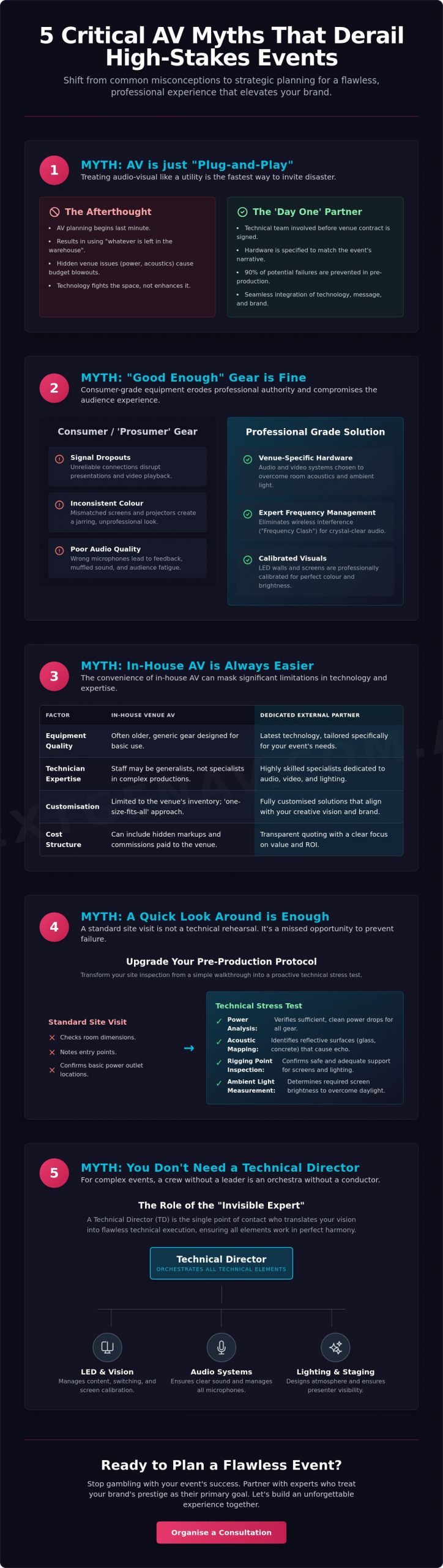
The Pre-Production Protocol: A Fail-Safe Sequence for Planners
Technical glitches are rarely the result of equipment failure. More often, they are the result of a skipped step in the planning sequence. Many organisers treat a site visit as a simple walkthrough to visualise the floor plan, or they view a soundcheck as a luxury reserved for musical acts. This mindset is a significant barrier to avoiding av mistakes at events. In high-stakes production, these moments are not casual observations; they are rigorous technical stress tests designed to find the “breaking point” of your setup before the first guest arrives.
To ensure a flawless execution, we utilise a 5-step fail-safe protocol that moves chronologically from concept to curtain-up. This sequence includes a Site Survey, Frequency Mapping, Content Testing, Soundcheck, and a full Technical Rehearsal. While every step is vital, content testing is frequently the most overlooked element in modern digital events. If your presenter’s 16:9 slides are forced onto a custom-ratio LED wall without prior adjustment, the resulting “letterboxing” or stretched imagery immediately undermines your brand’s prestige. Testing every file, video codec, and transition on the actual display hardware is the only way to guarantee visual perfection.
The Site Survey: Beyond the Floor Plan
A professional survey deep-dives into the venue’s infrastructure to prevent expensive surprises on show day. In older Melbourne venues, we specifically hunt for “clean power” and 3-phase availability, as outdated circuits can cause hums in audio systems or flicker in lighting rigs. Identifying structural rigging points and ceiling height restrictions is also critical when organising stage and lighting hire Melbourne. We also assess Wi-Fi saturation and hardline internet stability to ensure your hybrid components and audience interaction apps remain responsive under heavy load.
The “Real-World” Soundcheck
Testing a microphone in an empty ballroom provides a false sense of security. Once the room fills with hundreds of people, the acoustics shift as bodies absorb sound waves, often requiring real-time adjustments to your audio profile. A soundcheck is not for the technician’s benefit, but to familiarise the speaker with the “voice of the room.” This time allows your presenters to feel the lag of a large space and practice transitions, such as the precise second a video ends and their microphone goes live. To eliminate the stress of technical uncertainty, contact our team today to begin orchestrating your fail-safe pre-production sequence.
The “Invisible” Solution: Why You Need a Technical Director
The belief that premium hardware alone guarantees a successful event is perhaps the most dangerous misconception of all. You can hire the most advanced LED walls and professional audio systems available in 2026, but without a central authority to manage them, you simply have a collection of expensive tools. The most sophisticated gear in the world is useless without a “Conductor” to lead the technical orchestra. True mastery in avoiding av mistakes at events comes from recognising that the human element is what transforms a technical setup into a seamless, prestigious experience.
So, what is a technical director for events? Essentially, they are the single point of truth for every technical cue and the strategic lead for your entire production. While a technician focuses on their specific piece of equipment, a Technical Director (TD) manages the “Show Flow.” This is the precise, minute-by-minute sequence of lighting, audio, and visual transitions that define your event’s rhythm. When a presenter decides to skip three slides or an award winner walks onto the stage from the wrong side, the TD makes the real-time decisions that keep the production looking intentional and polished.
The Insurance Policy You Didn’t Know You Needed
A Technical Director acts as your primary insurance policy against the unexpected. They possess the foresight to anticipate problems before they manifest, such as a speaker providing a last-minute content update that doesn’t match the screen’s aspect ratio. By managing the “inter-departmental” gap, they ensure that the lighting desk knows exactly when the audio team is playing a sting and when the video team needs to trigger a keynote. This level of coordination is essential for high-stakes corporate event production Sydney and multi-city roadshows where maintaining a consistent standard of excellence is non-negotiable.
Elevating the Experience with NextGen AV
Our “Invisible Expert” approach is designed to alleviate the inherent stress of live production. We don’t just provide equipment; we provide a proactive, elite team that thrives under pressure. With over 30 years of Melbourne event history, we understand the unique quirks of every major venue and how to navigate the technical challenges they present. We take personal pride in seamless execution, allowing you to step into the spotlight with absolute confidence while we drive the engine behind the scenes. To ensure your next programme is defined by its success rather than its glitches, Contact NextGen AV to organise a technical consultation for your next event.
Mastering the Technical Narrative
Success in the live arena isn’t a matter of chance; it’s the result of challenging the misconceptions that often lead to technical friction. By moving past the “plug-and-play” myth and recognising that your venue’s house system might not be the safest pair of hands, you reclaim ownership of your event’s atmosphere. The path to avoiding av mistakes at events lies in rigorous pre-production testing and the expert guidance of a dedicated Technical Director who can orchestrate every cue with precision.
With over 30 years of industry experience, NextGen AV specialises in turning complex technical requirements into seamless, high-impact experiences. From engineering bespoke LED video walls to managing crystal-clear professional sound, we provide the end-to-end technical direction and on-site management required for total peace of mind. You focus on the message; we’ll drive the engine that delivers it. Partner with Melbourne’s AV experts for a glitch-free event and ensure your next production is remembered for all the right reasons. Your vision deserves nothing less than technical perfection.
Frequently Asked Questions
How do I avoid audio feedback during a presentation?
Feedback is prevented by maintaining a high “gain before feedback” threshold through precise microphone placement and professional room tuning. Ensure presenters stay behind the PA speakers and use directional microphones that reject off-axis sound. Our technicians “ring out” the system during pre-production to identify and notch out problem frequencies before your first delegate enters the room.
Why do my videos look pixelated on a large LED screen?
Pixelation usually occurs when the source content resolution doesn’t match the native pixel pitch of the LED video wall. If you play a standard 1080p video on a massive 4K-capable surface, the image must be “stretched,” which softens the details. We provide exact pixel maps during the planning phase so your creative team can render content that looks razor-sharp at any scale.
Is it cheaper to use the venue’s in-house AV team?
Generally, no; in-house AV often carries a 30 to 50 percent commission that is paid back to the venue, which inflates your costs. While it might seem convenient, you’re often paying premium rates for entry-level gear and stretched personnel. Engaging an external partner allows for a more competitive, bespoke solution that prioritises your specific event outcomes rather than venue profit margins.
What is the most common AV mistake made by event planners?
The most frequent error is treating technical requirements as a secondary utility rather than a core strategic element. This leads to budget blowouts and missed opportunities for audience engagement. Avoiding av mistakes at events starts with involving your technical director during the initial venue selection to ensure the space can actually support your vision without expensive workarounds.
How far in advance should I book my AV production company?
You should ideally secure your technical partner six to twelve months in advance for major conferences and at least three months for smaller corporate sessions. High-demand dates in the Australian event calendar book out quickly; early engagement ensures you secure the best lead technicians and the most advanced hardware. This lead time is also critical for custom staging and rigging designs.
Do I really need a full soundcheck if the speaker is experienced?
Yes, because a soundcheck is about the room’s unique acoustics and the technical flow, not just the speaker’s ability. Every ballroom has different “hot spots” and reflections that the audio team must account for. Even a seasoned professional needs to familiarise themselves with the stage monitors and the timing of their visual cues to ensure a polished performance.
What happens if the power goes out during my event?
We mitigate power risks by using Uninterruptible Power Supplies (UPS) for critical control gear like show laptops and audio consoles. This provides a buffer that keeps the “brains” of the show running while we switch to backup circuits or generators. For high-stakes productions, we often specify redundant power drops to ensure the LED walls and PA systems remain operational regardless of venue fluctuations.
How can I ensure my remote audience has the same experience as those in the room?
You must treat your virtual feed as a dedicated broadcast rather than a passive stream of the room. This involves using a multi-camera setup with a dedicated technical director to cut between speakers and presentation slides. Ensuring your remote guests have a separate, high-quality audio mix is also essential for maintaining engagement and meeting 2026 digital accessibility standards for synchronised captioning.
A professional sound check for a corporate event is a choreographed rehearsal of your vision, not just a test of cables and microphones. When research from AVCOM shows that 97% of attendees have become disengaged due to technical issues, with bad audio being the primary culprit, the stakes for your production couldn’t be higher. You’ve likely felt the anxiety of a high-profile keynote being interrupted by a piercing feedback loop or inconsistent volumes that leave your audience strained and distracted.
We believe your focus should remain on the prestige of the event, not the logistics of the gear. This guide promises to help you master the technical rehearsal process, eliminating glitches and ensuring your gala or keynote sounds flawless. We will provide a clear, actionable checklist to help you organise your technical team and speakers with absolute precision. You’ll discover how to coordinate everything from cardioid subwoofers to virtual audio feeds, ensuring every attendee experiences the crisp, professional sound required to make your message resonate.
Key Takeaways
- Understand why a professional sound check for a corporate event is a critical technical rehearsal that safeguards your brand’s reputation and ensures absolute clarity.
- Learn how to choose the ideal microphone for every speaker and why a dedicated operator is the essential engine behind a high-performance digital mixer.
- Follow a proven two-step procedure to verify every signal line and eliminate feedback frequencies, creating a pristine acoustic environment for your audience.
- Gain the confidence to troubleshoot common technical hurdles like ground hum and sibilance before they impact your live or virtual presentation.
- Discover why professional technical direction is the key to orchestrating a flawless result that transcends the limitations of a standard equipment hire.
What is a Sound Check for a Corporate Event and Why is it Critical?
A sound check for a corporate event is far more than a cursory test of equipment; it’s a strategic rehearsal designed to align your vision with the acoustic reality of the venue. To understand What is a Sound Check in a high-stakes professional context, one must view it as the moment where technical precision meets executive performance. This dedicated period involves the meticulous calibration of audio levels, the scanning of wireless frequencies to avoid interference, and the synchronisation of talent with the production crew. While some view it as a simple “check”, it’s actually the foundation of your event’s success.
Brand reputation is often won or lost on the quality of the audio. Research by Viju Group shows that 70% of respondents believe technical issues negatively impact the overall experience of an event. In the corporate world, audio isn’t just a utility. It’s an extension of your brand’s voice. When a CEO takes the stage, any hint of feedback or a muffled microphone reflects poorly on the organisation’s attention to detail. MeetingNet research confirms that 82% of event planners encounter AV problems, making a rigorous sound check the only reliable safeguard against becoming part of that statistic.
There’s a vital distinction between a technical line check and a performance-based sound check. A line check is the silent, behind-the-scenes verification that every cable and transmitter is sending a signal to the mixer. The sound check is the audible rehearsal where the technician shapes the “colour” and authority of the speaker’s voice. This process builds immense confidence. When a speaker hears themselves clearly in the foldback monitors, their anxiety dissipates. They can focus on their delivery while the technical team acts as the invisible orchestrators of their success.
The Goals of a Professional Technical Rehearsal
The primary objective is establishing a sophisticated gain structure. This ensures every speaker is heard with crystal clarity without the system straining or hissing. We focus on eliminating environmental noise and managing venue-specific acoustic reflections, which are common in glass-heavy modern boardrooms. Additionally, we ensure seamless transitions between live speech and video content, preventing that jarring volume spike that often occurs when a video starts. Every element is tuned to create a polished, cinematic atmosphere.
When Should the Sound Check Occur?
Timing is everything during the “bump-in” phase. A sound check for a corporate event must be completed before the first guest enters the foyer. In shared Melbourne CBD venues, we often navigate “Quiet Time” requirements where amplified testing is restricted during business hours. We recommend allocating specific 15-minute slots for VIP speakers to familiarise themselves with the stage, while reserving longer blocks for complex panel discussions involving multiple wireless headsets. This methodical approach ensures the technical team and talent are perfectly aligned before the house lights dim.
Essential Audio Components to Organise and Test
Achieving a flawless sound check for a corporate event requires more than just high-end gear; it demands a curated selection of components tailored to your specific venue and presentation style. The journey begins with microphone selection. While lapel microphones offer a sleek, hands-free aesthetic for executives, they can be susceptible to feedback in rooms with challenging acoustics. Headsets provide a superior alternative for energetic keynote speakers who move across the stage, as the capsule remains at a consistent distance from the mouth. For roving Q&A sessions, handheld microphones are the undisputed gold standard, offering reliability and high gain before feedback.
At the heart of every successful production sits the digital mixer. This is the sophisticated brain of your event audio, capable of managing complex routing and processing in real time. It’s a technical powerhouse that requires a dedicated operator who can make micro-adjustments as the room fills with people, which naturally changes the acoustic profile. Without a professional at the helm, even the most expensive Professional Audio Systems can fail to deliver the clarity your brand deserves.
Never overlook the importance of stage monitors, often called foldback. If your CEO cannot hear themselves, they’ll likely over-project or lose their natural rhythm, leading to a strained performance. We also dedicate significant time to testing audio for video content. Embedded clips and animations often have wildly different volume levels; we normalise these during the sound check to prevent jarring transitions that could startle your guests or distort through the house speakers.
Wireless Frequency Management in Melbourne
Melbourne’s high-density areas, particularly Southbank and the Docklands, are notorious for radio frequency (RF) interference. With so many signals competing for space, a standard setup can easily suffer from dropouts or static. We utilise advanced digital wireless systems to ensure secure, interference-free communication. If you’re planning a complex event with multiple presenters, it’s vital to consult a microphone hire Melbourne expert who can perform a site-specific frequency scan before the first word is spoken.
Hybrid Event Audio: The Dual-Mix Challenge
Hybrid events introduce the complex “dual-mix” challenge. The audio mix that sounds perfect in a physical ballroom rarely translates well to a virtual audience on Zoom or a custom streaming platform. We calibrate a dedicated “House Mix” for the in-person attendees while simultaneously engineering a “Stream Mix” that accounts for the compression of online platforms. We also rigorously test the talkback loop. This ensures that remote speakers can hear the on-site MC clearly, allowing for a seamless, natural dialogue that bridges the gap between the physical and digital worlds.
The Step-by-Step Sound Check Procedure
A professional sound check for a corporate event is a choreographed sequence that transforms a collection of high-end equipment into a high-performance engine. It’s the moment where the technical team and the talent find their rhythm. This process isn’t just about making noise; it’s about alignment, precision, and the relentless pursuit of acoustic perfection. We follow a methodical five-step procedure to ensure that when the house lights dim, the audio is the last thing on your mind.
The journey begins with the Line Check. This is the silent foundation where we verify that every physical cable and wireless transmitter is sending a clean signal to the digital mixer. Once the signal paths are confirmed, we move to “Ringing Out” the room. By intentionally pushing the volume of each microphone until it begins to feed back, we identify the specific frequencies that react poorly to the venue’s architecture. We then use precision equalisation to carve out those troublesome frequencies, creating a significant safety buffer for the live production. This ensures that even if a speaker wanders too close to a speaker stack, the audio remains stable and clear.
Talent Calibration is the most critical phase of the sound check for a corporate event. We require speakers to use their “event voice”—the projected, authoritative tone they’ll use during the actual keynote. It’s a common trap for executives to speak softly during a check, only to find their levels are too high when the adrenaline of the gala kicks in. We conclude with Media Integration and a Cue-to-Cue rehearsal. We play every video sting and walk-on track at the intended levels, rehearsing the transitions between multimedia and live speech to ensure the momentum of your programme never falters.
Calibrating the Speaker: The “Walk and Talk”
We encourage every presenter to perform a “walk and talk” across the entire stage area. This helps us identify any “hot spots” where audio might behave differently due to the room’s acoustics. If a speaker plans to move from the lectern to a lapel microphone mid-presentation, we test that transition to ensure the volume remains consistent. This time is also used to establish silent eye-contact cues between the speaker and the AV operator, building a sense of partnership that alleviates on-stage stress.
Managing the Panel Discussion Sound Check
Balancing a panel of four to six microphones simultaneously requires a sophisticated touch to avoid phase cancellation, which can make voices sound hollow or thin. We calibrate auto-mixer parameters to prioritise the active speaker while subtly dipping the levels of others. Finally, we rehearse the roving microphone process for the Q&A. This ensures that when an audience member asks a question, the audio is captured instantly and integrated into the room’s mix without a second of delay.
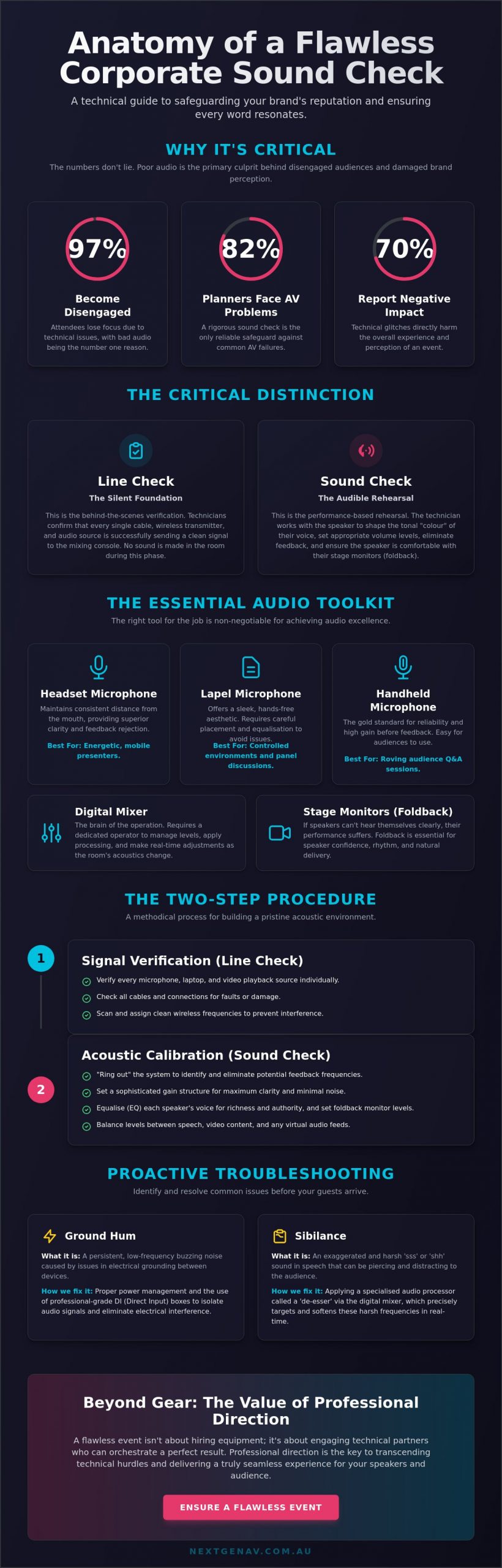
Troubleshooting Common Audio Glitches Before the Guests Arrive
The final moments before doors open are when the “Invisible Expert” truly shines. This is the critical window where we hunt down the subtle technical gremlins that can derail a polished presentation. A sound check for a corporate event often reveals a persistent “ground hum”, typically caused by electrical noise from a presenter’s laptop or the venue’s own power grid. We neutralise this instantly using high-quality DI boxes with ground-lift capabilities, ensuring the only thing your audience hears is the speaker’s message without the distraction of a low-frequency buzz.
We also focus on the nuances of the human voice. Some speakers have naturally harsh plosives, those popping “P” sounds, or sharp sibilance on “S” sounds that can be jarring through a large PA. Our engineers adjust the EQ settings in real time, using high-pass filters and surgical frequency cuts to smooth out these peaks. It is about creating a velvet-like audio texture that feels prestigious and effortless, allowing the CEO’s message to resonate without technical interference. Selecting the right PA system hire Melbourne solution is equally critical, as the quality and configuration of your speaker stacks directly determines how effectively these EQ adjustments translate across the entire room.
Reliability is non-negotiable in high-stakes environments. The 2026 industry standard dictates the use of fresh lithium cells for every wireless unit, providing a consistent voltage that standard alkaline batteries cannot match over a long gala dinner. We also address the “Dead Zone” myth. In L-shaped Melbourne function rooms, we don’t just turn up the volume; we strategically re-position speakers or add delay stacks to eliminate acoustic shadows. This ensures every attendee, regardless of their table position, receives the same crystal-clear experience.
Eliminating Feedback Loops Permanently
Feedback is the piercing result of a loop between the microphone and the speakers. We eliminate this risk through “notching”, a process where we use a parametric equaliser to cut the specific frequencies prone to ringing in that particular room. By keeping microphones behind the main PA line and having an audio engineer proactively ride the faders, we ensure the sound remains stable even when a presenter moves enthusiastically. This proactive management allows the talent to take centre stage with absolute confidence.
Backup Planning: The “What If” Protocol
True technical mastery lies in redundancy. We always place a “wired” microphone at the lectern as a fail-safe, ensuring that the show goes on even in the unlikely event of a wireless frequency conflict. We also rigorously test the backup audio feed for the live stream to ensure virtual attendees never miss a word. Every professional sound system hire should include a comprehensive redundancy plan to safeguard against the unexpected. For total peace of mind during your next high-stakes production, consider partnering with an elite team; discover our Technical Direction solutions to secure a flawless result.
Partnering with a Technical Director for a Flawless Result
While high-end hardware is the foundation of any production, a “dry hire” of equipment represents a significant risk for high-profile corporate events. Without a seasoned expert at the helm, you are simply renting a collection of silent tools. The true value of a Technical Director lies in their ability to act as the “Confident Orchestrator”, harmonising sound, light, and vision into a single, cohesive experience. They anticipate the variables that a checklist cannot cover, ensuring that your executive team feels supported and your brand’s prestige remains untarnished throughout the entire programme.
At NextGen AV, we treat the sound check for a corporate event as a holistic performance rehearsal rather than a mere technical necessity. Our team manages every detail from the initial bump-in to the final cue, allowing you to move past the logistical grind and focus on your guests. We don’t just provide gear; we deliver a dedicated craft that transforms a standard presentation into a cinematic event. Integrating professional audio planning into your initial event brief is the most effective way to secure this level of precision, ensuring that technical requirements are baked into the floor plan and schedule from day one.
The NextGen AV Difference in Melbourne Production
Our team brings over 30 years of experience to every project, having mastered the unique acoustic signatures of Melbourne’s premier venues, from Southbank’s grand ballrooms to the heritage spaces of the CBD. We provide a audio visual equipment list for conferences that is meticulously tailored to your specific room size and attendee count. This bespoke approach is backed by our “Confidence Guarantee”, which means we insist on a comprehensive technical rehearsal for every client. We believe that a flawless result is never an accident; it is the product of rigorous preparation and elite technical direction.
Booking Your Production Partner
To begin your partnership, start by providing a “Technical Rider” to your AV company. This document should outline your speaker count, multimedia requirements, and any hybrid elements. We also advocate for an early site visit to identify potential acoustic challenges, such as glass reflections or power limitations, before they become live issues. This proactive collaboration allows us to act as your invisible expert, driving the success of your event from behind the scenes. Enquire with NextGen AV today to ensure your next corporate keynote or gala is heard with absolute clarity and professional authority.
Orchestrate Your Acoustic Success
Mastering the sound check for a corporate event is the definitive step in moving from a standard meeting to a prestigious production. By treating this technical window as a choreographed rehearsal, you ensure that every executive keynote and gala presentation is delivered with absolute authority. From the initial line check to the surgical removal of feedback frequencies, your meticulous preparation creates the safety buffer required for seamless execution. It’s about more than just audio; it’s about the confidence that flows from knowing your technical team is perfectly aligned with your vision.
Don’t leave your brand’s reputation to chance with unmanaged equipment or a simple dry hire. We bring over 30 years of Melbourne event expertise and a state-of-the-art digital audio inventory to every stage. Trusted by major Australian brands and government bodies, we act as your invisible experts to ensure every word resonates with clarity and impact. Our team thrives under the pressure of live production, allowing you to focus on the prestige of the final result while we manage the engine behind the scenes.
Ensure your next event is flawless—partner with NextGen AV for professional event production.
Take centre stage with the quiet power that comes from professional technical direction. Your vision deserves a voice that is heard perfectly from the first word to the final applause.
Frequently Asked Questions
How long does a sound check for a corporate event usually take?
A standard sound check for a corporate event typically requires 60 to 90 minutes for the technical crew to “ring out” the room and calibrate the system. We then recommend a dedicated 10 to 15 minute window for each keynote speaker to step onto the stage. This allows our engineers to adjust the gain structure for their specific vocal projection, ensuring they sound authoritative without any system hiss or clipping.
Do speakers really need to be present for the sound check?
Their presence is vital because every voice has a unique frequency profile and timbre. While a technician can perform a “line check” with a stand-in, only the actual speaker can help us perfect the EQ settings for their specific delivery style. This time also builds immense on-stage confidence, allowing the presenter to hear the foldback monitors and familiarise themselves with the venue’s unique acoustic signature before the programme begins.
What is the difference between a sound check and a technical rehearsal?
The sound check is a focused period dedicated purely to audio clarity, including microphone levels and frequency management. A technical rehearsal, or “cue-to-cue”, is a holistic run of the entire event. It integrates lighting changes, LED wall transitions, and staging movements alongside the audio. The sound check is the technical foundation, while the technical rehearsal ensures the entire production team is synchronised for a flawless result.
What should I do if my speaker arrives 5 minutes before the event starts?
If a speaker misses their window, our team pivots to a “safe” audio configuration to protect your brand’s reputation. We typically suggest using a handheld microphone instead of a lapel, as handhelds are more resilient to feedback and easier for the engineer to manage on the fly. The audio engineer will perform a “live gain adjustment” during the first few sentences, carefully lifting the levels to ensure the audience hears every word.
Can we do a sound check while guests are having pre-drinks in the same room?
Performing an audible check while guests are present is highly unprofessional and disrupts the event’s prestige. The process of testing feedback limits involves jarring, high-volume frequencies that can startle your attendees. If the schedule is extremely tight, we can perform a “silent check” using headphones and visual meters, though this lacks the absolute precision of a full-volume acoustic calibration performed in an empty room.
How do I handle audio feedback if it happens during the live presentation?
Immediate technical intervention is required to kill the loop between the microphone and the speakers. Our engineers use high-precision notch filters on the digital mixer to “cut” the offending frequency instantly. We also brief speakers during the rehearsal to avoid walking directly in front of the main PA stacks. This proactive education is the most effective way to prevent sudden feedback spikes during a live executive keynote.
What is a “Technical Rider” and do I need one for my event?
A Technical Rider is a vital blueprint that details your exact AV requirements, from the number of headsets to the specific stage layout. For a sound check for a corporate event, this document ensures your production partner arrives with the correct Professional Audio Systems and wireless frequencies pre-configured. It eliminates guesswork during the “bump-in” phase and ensures that the technical team can focus on excellence rather than troubleshooting missing gear.
How does the venue’s ceiling height affect the sound check process?
High ceilings often create significant reverberation, which can make speech sound “muddy” or distant if not managed correctly. During the sound check, we adjust the vertical tilt of our speakers to focus the acoustic energy on the audience area rather than reflecting off the roof. In large Melbourne convention centres, we may also deploy “delay stacks” halfway down the room to maintain crystal-clear audio for guests seated at the back.
Your high-stakes event isn’t just a presentation; it’s your professional reputation on the line. The difference between a standing ovation and a technical blackout often comes down to a single person you haven’t met yet. You likely understand the mounting pressure of managing multiple vendors while deciphering complex AV jargon. This guide clarifies exactly what is a technical director for events and how they act as the master architect behind your production.
A Technical Director is far more than a senior technician; they are the bridge between your creative ambition and flawless execution. They transform a chaotic list of LED video walls and audio systems into a polished, high-impact experience. By serving as your single point of contact, they absorb the stress of logistics so you can focus on your stakeholders. We will explore how these invisible experts ensure absolute technical certainty for your 2026 events, from staging and rigging to the latest hybrid solutions. It’s time to move past the logistical grind and achieve a result that commands respect.
Key Takeaways
- Master the fundamental definition of what is a technical director for events and how this senior lead acts as the vital translator between your creative vision and the technical crew.
- Distinguish between standard AV management and high-level technical direction to ensure your next project benefits from strategic leadership rather than just equipment hire.
- Explore the pre-production lifecycle; meticulous site inspections across Australian venues identify potential power and rigging constraints months before the doors open.
- Learn how a dedicated director orchestrates complex systems, from LED video walls to professional audio, into a single, seamless experience that impresses every stakeholder.
- Discover the “Invisible Expert” advantage of having a single point of contact who manages multiple vendors; it’s the surest way to eliminate technical failure risk.
Defining the Role: What is a Technical Director for Events?
In the high-pressure world of live production, the difference between a visionary success and a technical disaster often rests on one individual. When asking what is a technical director for events, it’s best to view them as the master architect of the technical lifecycle. They don’t just manage equipment; they orchestrate the entire technical ecosystem from the first site visit to the final pack-down. In the Australian market, we refer to this role as the “Invisible Expert,” the person who ensures every signal flow is perfect so that the audience only sees the magic on stage.
A Technical Director acts as the senior lead, synchronising LED video walls, professional audio systems, lighting design, and complex rigging into one unified performance. They are the ultimate safeguard against live-event failure, providing the technical certainty that allows planners to breathe easy. By overseeing every department, they ensure that the technology serves the message rather than distracting from it. Their presence transforms a collection of gear into a high-stakes, cinematic experience.
The Bridge Between Creative and Technical
Creative directors often speak in the language of “feel” and “impact,” using mood boards to define an atmosphere. A Technical Director is the primary translator who converts these abstract concepts into a precise technical equipment list. They ensure that your artistic intent is never compromised by hardware limitations. Whether it is finding innovative ways to fit a massive LED display into a heritage-listed ballroom or ensuring the sound carries perfectly in a cavernous exhibition centre, they find the solution. This mastery ensures the final result looks exactly as you imagined, only better.
The “Single Point of Truth” for Your Event
Managing multiple vendors can lead to “finger-pointing” when a signal drops or a light flickers. A Technical Director eliminates this friction by serving as the single point of truth for all technical departments. They take full accountability for the master technical run-sheet, coordinating the timing of every cue to the second. For event planners, this means a significant reduction in pre-show anxiety. Instead of chasing four different department heads, you have one elite partner who understands the entire machine. This streamlined communication creates a sense of momentum and absolute confidence, allowing you to focus on your stakeholders while the “Invisible Expert” handles the engine room.
Core Responsibilities: From Pre-Production to the Final Pack-Down
A successful production is won or lost in the weeks preceding the event. When considering what is a technical director for events, many planners overlook the extensive pre-production phase. This journey begins with the director conducting rigorous site inspections at Melbourne venues to uncover hidden constraints. They assess everything from floor load capacities to the specific power requirements of your equipment. This proactive approach ensures that the creative vision is physically possible within the chosen space, preventing costly last-minute adjustments.
The director serves as the technical architect, translating your concepts into actionable blueprints. They develop detailed floor plans and signal flow diagrams, which are essential for integrating high-resolution LED video walls with complex lighting rigs. Beyond the visuals, they organise the technical budget with precision, ensuring every dollar spent on staging and rigging contributes to a high-impact result. They also act as your liaison with venue management, ensuring all installations comply with Australian safety and electrical standards. This meticulous planning eliminates the “jargon gap” between you and the venue’s house technicians.
On-Site Management and Show Calling
Once the event moves on-site, the director shifts into the role of the “Confident Orchestrator.” They lead the bump-in, ensuring every piece of professional audio gear is positioned correctly and every cable is neatly dressed and labelled. This level of detail prevents technical glitches and maintains a professional aesthetic for your brand. During technical rehearsals, they guide presenters through sound checks, calming nerves and perfecting the delivery environment. Their presence ensures that the technical team is proactive rather than reactive.
The true mastery of what is a technical director for events is most visible during the “show call.” This is where they direct every cue, synchronising lighting, audio, and video transitions with cinematic precision. Their voice in the headsets is the steady rhythm that keeps the entire crew in perfect harmony. The responsibility doesn’t end when the applause fades. The director oversees the safe and efficient pack-down, ensuring the venue is returned in pristine condition and all assets are accounted for. This end-to-end stewardship is why many leading brands seek professional technical direction to safeguard their most important moments. It turns a stressful logistical exercise into a triumphant, polished success.
Technical Director vs. AV Manager: Understanding the Difference
One manages the tools; the other orchestrates the experience. While these titles are often used interchangeably in casual conversation, the distinction is critical for your budget and your peace of mind. An AV Manager typically focuses on the tactical operation of a specific set of equipment or a small, single-department crew. In contrast, understanding what is a technical director for events involves looking at high-level strategy and multi-departmental leadership. The Technical Director doesn’t just ensure the gear works; they design the entire technical environment to ensure every department moves in lockstep.
Think of the manager as the lead violinist and the Technical Director as the conductor. While a boardroom presentation might only require a manager to monitor a slide deck, a high-stakes gala dinner demands a TD to synchronise the lighting, audio, and video cues into a seamless performance. The TD takes responsibility for the “big picture” risk assessment, ensuring that the creative vision translates into a safe, functional reality. They are the engine driving the success, allowing the client to take centre stage without worry.
When Should You Upgrade to a Technical Director?
As your event scales, you hit a complexity threshold where standard AV management is no longer sufficient. This is particularly true for corporate event production Melbourne or Melbourne roadshows where multiple vendors must integrate perfectly. If your project involves hybrid streaming, complex LED mapping, or high-level stakeholder presentations, a TD is essential. They add immense value by managing the intricate data and signal paths required for modern virtual solutions, ensuring the remote audience has the same prestige experience as those in the room. For productions that demand total ownership of every technical element, exploring a model of full service event production is the most effective way to eliminate vendor friction and guarantee a flawless result.
Risk Mitigation and The “Plan B” Specialist
A Technical Director is your ultimate insurance policy against the unexpected. They don’t just hope for the best; they build redundancies into every mission-critical system. If a primary signal fails, the TD is trained to troubleshoot and switch to a backup in real-time, often without the audience or the client ever noticing a flicker. This “Plan B” specialisation is what separates elite productions from amateur efforts. By identifying potential failure points during the planning phase, they provide a level of technical certainty that allows you to take centre stage with absolute confidence. This proactive mastery ensures that technical hitches never become public failures.
Why High-Stakes Events Demand Professional Technical Direction
High-impact visuals and crystal-clear audio are no longer luxury additions for major Australian brands. They are the baseline for professional communication. When asking what is a technical director for events, the answer lies in the protection of your brand’s prestige. A TD ensures your professional sound system hire is not just installed, but meticulously tuned to the specific acoustics of the room. They handle the complex logistics of stage and lighting hire Melbourne, managing rigging plots and electrical loads that would otherwise overwhelm a generalist planner.
The primary value of a Technical Director is the gift of focus. While they manage the signal paths and crew schedules, you are free to engage with your guests and stakeholders. This partnership alleviates the inherent stress of high-stakes planning by projecting absolute competence. They navigate the specific challenges of Melbourne venues, from the narrow loading docks of the CBD to the strict heritage requirements of historic ballrooms, ensuring no logistical hurdle slows your momentum. Their mastery ensures that the technical elements feel like a natural extension of your brand story.
Protecting Your Brand Reputation
Technical glitches can quickly overshadow the most successful product launch or AGM. The TD ensures that every transition is polished and every visual is sharp, maintaining the “prestige” of the event through flawless execution. This is especially vital for national roadshows where consistency across multiple Australian cities is non-negotiable. They act as the invisible shield, ensuring that the technology enhances your message rather than distracting from it. By maintaining a high standard of front-of-house excellence, they allow your brand to shine without the shadow of technical failure. When evaluating the best event production companies Melbourne has available, look for those who embed a dedicated Technical Director into every production to guarantee this level of brand protection.
Budget Optimisation and Efficiency
A seasoned Technical Director provides a significant financial ROI by identifying unnecessary equipment on vendor quotes. They understand the nuances of event production costs Australia and can help you maximise your impact without overspending. By streamlining the labour schedule, they also help you avoid expensive Melbourne weekend penalties and overtime rates. This strategic oversight ensures that your budget is spent on high-impact experiences rather than logistical waste. They act as your advocate, ensuring you only pay for the solutions that truly elevate your event.
If you want to secure your next production with a dedicated expert, enquire about our technical direction services today.
Partnering with NextGen AV for Seamless Technical Execution
Achieving a flawless production requires more than just high-end hardware; it demands a navigator who understands the “why” behind every signal path. NextGen AV provides seasoned Technical Directors who bring over 30 years of industry experience to your project. When you choose to work with our team, you aren’t just hiring a crew. You are gaining a partner who defines what is a technical director for events through action, precision, and a deep commitment to your brand’s success. Our “Invisible Experts” integrate seamlessly with your planning team, absorbing the technical complexity so you can focus on your guests.
We specialise in managing the entire technical ecosystem, from high-resolution LED video walls to bespoke lighting design and professional audio. This holistic approach ensures that every department moves in perfect synchronisation. You will experience the “quiet power” of a production where every cue is met with absolute precision and technical hitches are eliminated before they ever reach the stage. Our goal is to move you past the logistical grind and into a space where you can celebrate the prestige of a truly polished result.
The NextGen AV Difference in Melbourne
Our team possesses an intimate knowledge of Melbourne’s leading event spaces and their specific technical quirks. Whether you are planning a gala in a historic ballroom or a high-tech conference in a modern exhibition centre, we understand the local power constraints, rigging points, and loading dock requirements. This local mastery allows us to proactively solve challenges that often catch interstate vendors off guard. We maintain a premium inventory of high-end AV hardware, all managed by expert TDs who follow our “Confident Orchestrator” model. This ensures your equipment isn’t just delivered; it’s engineered into a high-impact experience tailored to your specific venue.
Get Started with Your Technical Consultation
Engaging a NextGen AV Technical Director for your next project is a straightforward, collaborative process. Our journey begins with a comprehensive pre-production consultation where we listen to your vision and identify the technical requirements needed to bring it to life. We move quickly from identifying challenges to presenting polished solutions, creating a sense of momentum that carries through to the final pack-down. This methodical approach provides the technical certainty required for high-stakes corporate environments and national roadshows. If you are ready to elevate your production and secure a single point of contact for all your AV logistics, we are here to lead the way.
Enquire about Technical Direction for your next Melbourne event and discover the difference that elite technical leadership makes to your brand reputation.
Elevate Your Production with Technical Certainty
Mastering the technical landscape of a modern event requires more than just high-end gear. It demands a senior lead who can harmonise every signal path and department into a single, high-impact experience. Understanding exactly what is a technical director for events empowers you to move beyond basic equipment hire and into the realm of elite production design. By serving as your single point of truth, these experts eliminate vendor friction and provide the “Plan B” security that high-stakes environments demand.
NextGen AV brings over 30 years of industry mastery to your planning team. We offer Melbourne’s leading high-end AV inventory and are trusted by Australia’s major brands and government bodies to deliver flawless results. Our directors ensure your creative vision is never compromised by hardware limitations or venue constraints. It’s time to stop managing the logistical grind and start focusing on the prestige of your successful event. Secure an Expert Technical Director for Your Next Melbourne Event and experience the quiet power of absolute technical precision. Your reputation deserves nothing less than a perfect execution.
Frequently Asked Questions
Do I need a Technical Director for a small corporate meeting?
Small meetings with basic requirements, such as a single projector and a couple of microphones, typically don’t require this level of oversight. An AV technician or manager is usually sufficient for these tactical tasks. You should consider what is a technical director for events when your production involves multiple departments, complex LED video walls, or high-stakes presentations where failure is not an option.
What is the difference between an Event Producer and a Technical Director?
An Event Producer focuses on the creative narrative, guest experience, and overall project logistics. The Technical Director is the engineering lead who ensures that the producer’s vision is physically and technically achievable. While the producer manages the “what” and the “why,” the TD is responsible for the “how,” overseeing the technical crew and the precision of the hardware execution.
How much does it cost to hire a Technical Director in Australia?
Investment levels for technical direction in Australia vary significantly based on the project’s scale, the length of the pre-production phase, and the complexity of the systems involved. Factors such as site inspections, CAD drawing requirements, and the number of technical departments to be managed will influence the final cost. You should check with a specialist production partner for a tailored quote that reflects your specific event needs.
Can a Technical Director help with hybrid or virtual event streaming?
Yes, a TD is essential for the success of modern hybrid events. They manage the critical signal paths between the physical venue and the digital broadcast platform to ensure a seamless experience for both audiences. By synchronising the in-room audio and visuals with the remote stream, they prevent the lag and quality drops that can undermine a professional virtual production.
At what stage of planning should I involve a Technical Director?
You should involve a Technical Director as early as possible, ideally during the initial concept phase or at least three to six months before the event date. Early engagement allows the TD to conduct venue site inspections and identify potential power or rigging constraints. This proactive approach ensures that your creative designs are technically feasible before you commit to venue contracts or stage builds.
What technical skills should a qualified Event TD possess?
A qualified TD must possess a deep mastery of signal flow engineering, CAD software for technical renders, and multi-disciplinary expertise across audio, lighting, and video systems. Beyond technical knowledge, they need strong leadership and problem-solving skills to manage diverse crews under pressure. Understanding what is a technical director for events means recognising them as both a technical powerhouse and a strategic project manager.
Does the Technical Director bring their own crew or manage the venue’s team?
They can perform either role with equal precision. A TD acts as the “Single Point of Truth” on-site, whether they are leading a dedicated NextGen AV crew or coordinating with venue-supplied technicians. Their primary objective is to ensure that every person on-site, regardless of their employer, adheres to the master technical run-sheet and maintains the highest standards of execution.
How does a Technical Director ensure event safety and compliance?
Safety is a cornerstone of the TD’s responsibilities. They oversee rigging certifications, electrical testing and tagging, and ensure all technical installations comply with Australian safety standards and venue-specific regulations. By performing rigorous risk assessments and managing the technical load requirements, they protect your guests, the crew, and your professional reputation from the risks associated with live productions.

Make an
Enquiry
Let’s Get Your Event Sorted
Complete the enquiry form with your event date, venue, audience size, event type and budget. Our Melbourne AV team will review your requirements and recommend the right PA, screen, lighting, staging or production setup for your event.
What happens next?
1.We review your event details
Tell us your date, venue, audience size and event type.
2.We recommend the right setup
From PA hire to screens, lighting, staging and full AV production.
3. We come back with clear advice
You’ll receive practical recommendations and a fast quote from our Melbourne team.
Need help urgently?
Call 1300 792 922.