Here’s the truth that most AV suppliers won’t tell you: the hardware is only half the battle. You can rent the most expensive LED panels on the market, and still end up with a grid of visible lines carving up your brand’s centrepiece visual like a badly tiled bathroom wall. If you’ve been searching for seamless video wall rental Melbourne that actually delivers on its promise, you already know this fear is real, and entirely valid.
Planning a high-stakes event is stressful enough without worrying whether a dead pixel or a misaligned panel is going to undermine every dollar you’ve invested in your brand experience. The premium look you’re after isn’t just about resolution specs or refresh rates; it’s about precision engineering, expert content mapping, and a technical team that knows Melbourne’s venues inside and out before they ever load the truck.
This guide cuts through the jargon and the hidden costs to show you exactly what separates a truly flawless video wall from one that merely looks impressive in a brochure. You’ll learn what to look for in a rental partner, how content and hardware work together to create that bezel-free visual impact, and why the right team makes all the difference between a backdrop that captivates and one that quietly embarrasses.
Key Takeaways
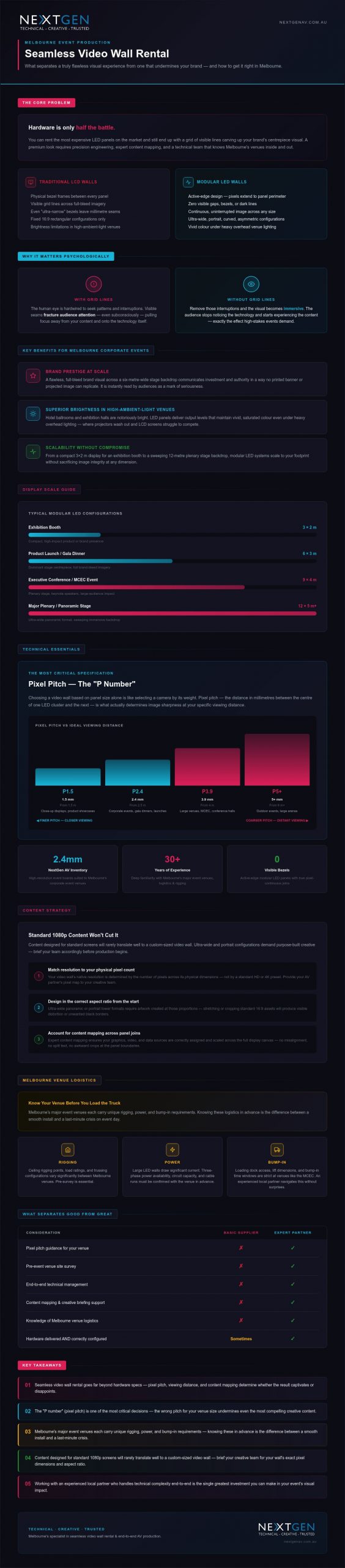
- Seamless video wall rental Melbourne goes far beyond hardware specs — understanding pixel pitch, viewing distance, and content mapping is what separates a truly captivating visual from a costly disappointment.
- The ‘P number’ (pixel pitch) is one of the most critical decisions you’ll make: choosing the wrong one for your venue size can undermine even the most compelling creative content.
- Melbourne’s major event venues each carry unique rigging, power, and bump-in requirements — knowing these logistics in advance is the difference between a smooth install and a last-minute crisis.
- Content designed for standard 1080p screens will rarely translate well to a custom-sized video wall; this guide explains how to brief your creative team for ultra-wide and portrait configurations.
- Working with an experienced local partner who knows your venue, handles the technical complexity end-to-end, and lets your brand take centre stage is the single greatest investment you can make in your event’s visual impact.
What is a Seamless Video Wall and Why Does Your Event Need One?
A seamless video wall is a modular LED display system engineered so that individual panels lock together with zero visible gaps, bezels, or interruptions between them. The result is a single, continuous visual canvas that stretches across any dimension you choose, displaying your content as one unified image rather than a patchwork of separate screens. That distinction sounds simple. In practice, it’s the difference between a backdrop that commands a room and one that quietly undermines it.
The psychological effect of a continuous visual field is well-documented in perceptual psychology: the human eye is hardwired to seek patterns and interruptions. When a grid of black lines carves through your brand’s hero image or your keynote speaker’s backdrop, the audience’s attention is fractured, even subconsciously. Remove those interruptions, and the visual becomes immersive. The audience stops noticing the technology and starts experiencing the content. That’s precisely the effect that makes seamless video wall rental Melbourne such a high-demand specification for serious event producers.
The Evolution from LCD to Modular LED
Traditional LCD video walls have always carried an inherent limitation: the bezel. Every LCD panel is housed within a physical frame, and no matter how slim manufacturers make it, that frame creates a visible grid across the display. Even so-called “ultra-narrow bezel” LCD walls leave a seam of several millimetres that becomes strikingly obvious on close-up product imagery or full-bleed brand visuals.
Modularity also unlocks creative configurations that LCD can never achieve. Standard 16:9 rectangles are just the beginning. LED systems can be assembled into ultra-wide panoramic formats, portrait towers, curved surfaces, or asymmetric shapes that wrap around a stage set. That flexibility opens up architectural possibilities that genuinely distinguish a production.
Key Benefits for Melbourne Corporate Events
Melbourne’s corporate event market is competitive, discerning, and increasingly sophisticated in its visual expectations. Gala dinners at venues like the MCEC, product launches in converted warehouse spaces, and executive conferences in CBD hotel ballrooms all share one challenge: audiences who’ve seen it before and need to be genuinely impressed.
Seamless LED walls address this across several practical dimensions:
- Brand prestige at scale: A flawless, full-bleed brand visual across a six-metre-wide stage backdrop communicates investment and authority in a way that no printed banner or projected image can replicate.
- Superior brightness in high-ambient-light venues: Hotel ballrooms and exhibition halls are notoriously bright environments. LED panels deliver output levels that maintain vivid, saturated colour even under heavy overhead lighting, where projectors wash out and LCD screens struggle.
- Scalability without compromise: From a compact 3×2 metre display for an exhibition booth to a sweeping 12-metre plenary stage backdrop, modular LED systems scale to your footprint without sacrificing image integrity at any size.
With over 30 years of industry experience and specialised inventory including high-resolution 2.4mm LED event boards, NextGen AV is built to deliver that calibre of visual production across Melbourne’s most demanding venues. The technology is only as good as the team behind it, and that’s where genuine expertise separates a flawless result from a frustrating one.
Technical Essentials: Pixel Pitch, Resolution, and Refresh Rates
Choosing a video wall based on panel size alone is like selecting a camera by its weight. The specification that actually governs image quality, the one that separates a crisp, photorealistic display from a muddy, pixelated backdrop, is pixel pitch. Get this decision right, and everything else falls into place. Get it wrong, and no amount of compelling content will save you.
Pixel pitch is the distance in millimetres between the centre of two adjacent pixels. That single measurement determines how close your audience can stand before individual pixels become visible to the naked eye, and it’s the first technical conversation any credible seamless video wall rental Melbourne partner should be having with you.
Choosing the Right Pixel Pitch for Your Audience
The practical rule is straightforward: the smaller the pixel pitch number, the finer the resolution and the closer viewers can stand without seeing individual pixels. Where it gets nuanced is matching that specification to your actual venue layout and audience positioning.
- P2.4 to P2.6: The premium tier for close-proximity viewing. At trade show booths, exhibition stands, or intimate product launch settings where guests circulate within two to five metres of the display, this pitch delivers genuinely photographic clarity. NextGen AV’s specialised 2.4mm LED event boards sit at this end of the spectrum, making them the right choice when your audience will be up close and your content demands ultra-fine detail, think brand photography, data-rich presentations, or live camera feeds.
- P3.9 to P4: The workhorse specification for large conference stages and plenary sessions. When your front row is seated five or more metres back, a P4 panel delivers exceptional visual impact at a scale that fills the room, without the cost premium of sub-3mm pitch panels.
Matching pitch to viewing distance isn’t just a technical nicety; it’s a budget decision. Specifying a P2.4 wall for a 500-seat auditorium where the nearest guest sits eight metres away is an expensive overcorrection. Conversely, deploying P4 panels at a close-contact exhibition stand is a false economy that will show.
Brightness and Refresh Rates for Live Broadcast
Two specifications routinely overlooked during the planning phase become critically visible the moment a camera enters the room: brightness output and refresh rate.
Brightness, measured in nits, determines whether your display holds its colour saturation under the intense stage lighting typical of Melbourne’s hotel ballrooms and conference centres. A panel that looks vivid in a darkened showroom can appear washed out under a 2,000-lux wash. Specifying sufficient nit output for your venue’s ambient light conditions is non-negotiable.
Refresh rate matters the moment your event is being filmed, live-streamed, or captured for social content. Panels operating at lower refresh rates produce a subtle flicker that the human eye misses but a camera sensor captures as a visible strobe effect across recorded footage. High refresh rates of 3,840Hz and above eliminate this entirely, ensuring your wall looks as flawless on a smartphone replay as it does live in the room.
Colour calibration ties everything together. A video wall assembled from multiple panels will only appear seamless if every cabinet is calibrated to the same colour temperature and luminance profile. Panel-to-panel variance creates visible tonal shifts across the display surface, an effect that’s particularly unforgiving on full-bleed brand colour fields. Rigorous pre-event calibration is a technical discipline, not a checkbox, and it’s where experienced operators earn their reputation.
If you’re planning an event where broadcast quality matters, explore NextGen AV’s technical direction services to understand how panel specification and on-site calibration work together from the outset.
Melbourne Venue Logistics: Rigging, Power, and Bump-In
The technical specifications of your LED panels mean very little if the logistics of getting them into your venue haven’t been solved before the truck arrives. Melbourne’s major event spaces, from the Melbourne Convention and Exhibition Centre to the Grand Hyatt and Crown Palladium, each carry their own set of structural constraints, union labour protocols, and bump-in windows that can derail even the most meticulously planned production. This is where genuine local knowledge separates a seamless video wall rental Melbourne specialist from a generic AV supplier quoting from a brochure.
The first decision that shapes everything else is how the wall will be supported. Ground stacking, where panels are built upward from a structural base on the floor, suits lower-ceiling spaces and venues with strict rigging restrictions. It’s faster to deploy and requires no overhead infrastructure. Flying the wall from a truss system suspended above the stage delivers superior sightlines across a large audience and eliminates the need for ground-level structural frames, but it introduces a set of engineering requirements that demand careful planning well before load-in day.
Rigging and Structural Safety
Flying a video wall requires a certified truss system, rated chain motors, and a structural load calculation that accounts for both the panel weight and dynamic forces during installation. This is non-negotiable. Melbourne’s heritage ballrooms and converted warehouse venues often carry floor loading limits and ceiling anchor point restrictions that aren’t obvious from a venue floor plan. A team that hasn’t worked in your specific venue before will discover these constraints during bump-in, which is precisely the wrong time. Professional event rigging solutions incorporate pre-site inspections, engineered drawings, and full OH&S compliance documentation, so there are no surprises when the motors go up.
Power and Signal Redundancy
Large LED arrays draw substantial power. A six-by-three-metre wall running at full brightness will exceed the capacity of standard venue circuits, and a tripped breaker mid-keynote is a scenario no event producer wants to explain. Proper power planning means calculating the draw across your full panel array, coordinating with venue electricians for dedicated circuit allocation, and deploying distribution hardware that isolates the display from other event loads.
Signal redundancy is equally critical. A professional audio visual hire Melbourne partner will run dual signal pathways to your wall, so that if a cable or processor develops a fault, the backup takes over instantly with zero audience-visible interruption. On-site technical monitoring throughout your event ensures that any anomaly is caught and resolved before it becomes a problem the room notices.
The managed bump-in is where all of this comes together. A disciplined pre-event schedule, with panels assembled, calibrated, signal-tested, and content-checked against your actual show file before the doors open, is the single greatest insurance policy against a live failure. It’s not glamorous work. It’s the work that makes everything else look effortless.
Content Strategy: Designing for Seamless Displays
Hardware precision gets your wall built. Content strategy is what makes it breathe. And here’s where many otherwise well-planned productions quietly unravel: a creative team hands over a beautifully crafted 1920×1080 file, it goes up on a custom-configured LED wall, and the result is a stretched, soft, visually compromised version of what was intended. The wall isn’t at fault. The content was never designed for it.
Every seamless video wall rental Melbourne deployment carries a unique pixel count determined by the physical dimensions of the assembled panels, not by a standard broadcast resolution. A wall built from 2.4mm panels at four metres wide by two metres tall will have a native resolution that bears no resemblance to 1080p or 4K. Feed it standard content and the processor scales it, introducing artefacts, softness, and proportion distortion that undermine the very precision the hardware was engineered to deliver.
The solution starts before your designers open a single file.
Pixel-Perfect Content Creation
Before any creative work begins, your AV partner should supply a pixel map: an exact document specifying the wall’s native width and height in pixels, its aspect ratio, and any zones or split-screen configurations planned for the show. Designers work to this specification from the outset, building assets at native resolution so the final output maps one-to-one with the physical display. No scaling. No interpolation. No compromise.
LED panels respond dramatically to high-contrast visuals and saturated colour. Deep blacks appear genuinely black rather than grey, and vivid brand colours pop with a luminance that no projection or LCD system can match. Brief your creative team to lean into this: bold typography, full-bleed colour fields, and high-contrast imagery all perform exceptionally well. Conversely, filmed video segments require careful resolution matching to avoid moiré patterning, the interference effect that appears when fine detail in footage clashes with the pixel grid of the display. Specifying the correct output resolution for any filmed content before it’s captured or edited eliminates this entirely.
Interactive and Dynamic Visuals
A seamless LED wall isn’t a static backdrop. It’s a live canvas. Media servers such as Watchout or Barco’s media management platform allow operators to synchronise multiple content layers across the full wall surface in real time, switching between speaker presentations, brand animations, and live camera feeds without a visible cut or stutter. This is what transforms a backdrop into a dynamic production element.
Real-time integrations extend the wall’s capability further. Live social media feeds, audience polling results, and data visualisations can be mapped into designated zones of the display, creating an interactive dimension that keeps audiences engaged between programme segments. For multi-speaker conferences, the wall can transition between entirely different visual environments for each presenter, reinforcing individual messaging while maintaining the event’s overarching brand identity.
Orchestrating this level of content complexity requires a technical director who understands both the hardware and the show flow. Working with a full service event production partner ensures your content strategy, media server programming, and live operation are unified under a single expert team rather than patched together across multiple suppliers. Talk to NextGen AV about technical direction for your next event before your creative brief goes out, not after the files are already built.
Partner with NextGen AV for Seamless Execution in Melbourne
Every technical detail covered in this guide, from pixel pitch selection to content mapping to venue logistics, represents a decision point where things can go right or quietly wrong. The difference almost always comes down to the team behind the equipment. With over 30 years of experience delivering high-stakes corporate visuals across Australia, NextGen AV has built its reputation on a single principle: the technology should be invisible, and your brand should be unforgettable.
That philosophy shapes every engagement. While you’re focused on your programme, your speakers, and your guests, NextGen’s team is managing the technical complexity end-to-end, from pre-production renders that show you exactly how your content will look on the assembled wall, through to on-site technical direction on the day. Nothing is left to chance. Nothing is improvised. The result you see in the pre-production stage is the result your audience experiences live.
The NextGen AV Difference
Working with NextGen AV means access to dedicated project managers who know Melbourne’s major venues not from a floor plan, but from direct experience. They understand the bump-in windows at the MCEC, the rigging restrictions in CBD hotel ballrooms, and the power infrastructure at the city’s premier conference facilities. That local knowledge translates directly into smoother installs, fewer surprises, and a production that runs exactly as planned.
The inventory reflects the same commitment to precision. NextGen’s specialised 2.4mm LED event boards deliver the ultra-fine resolution demanded by close-proximity audiences, while the P4 packages scale to fill the largest plenary stages with vivid, calibrated imagery. Explore the full range of LED video wall options to understand which specification suits your event footprint.
Getting Started with Your Rental
Requesting a quote should be the beginning of a conversation, not a transaction. A comprehensive proposal for seamless video wall rental Melbourne covers more than panel hire; it accounts for technical labour, signal processing, transport, rigging, calibration, and on-site operation. Asking for an all-inclusive breakdown upfront protects you from the hidden costs that inflate a budget after the contract is signed.
A site visit to your chosen venue before finalising the specification is one of the most valuable steps you can take. It confirms ceiling heights, power availability, and structural anchor points, turning assumptions into verified facts. Before your event, work through this final checklist:
- Specification confirmed: Pixel pitch matched to your audience’s viewing distance.
- Native resolution supplied to creative team: Assets built to the wall’s exact pixel dimensions.
- Power and rigging requirements documented: Coordinated with venue operations in advance.
- Signal redundancy in place: Dual pathways tested before doors open.
- Full technical rehearsal completed: Content checked against the live show file on the actual hardware.
When every item on that list is owned by a single expert team, your event doesn’t just look flawless. It feels effortless. Request your video wall hire quote from NextGen AV and start building the visual centrepiece your next Melbourne event deserves.
Your Next Melbourne Event Deserves a Visual That Commands the Room
A flawless visual centrepiece doesn’t happen by accident. It’s built on the right pixel pitch for your audience, content engineered to the wall’s native resolution, and a technical team that knows your venue before the truck is loaded. Get those three elements working together, and seamless video wall rental Melbourne stops being a specification and becomes a competitive advantage your audience genuinely feels.
NextGen AV brings over 30 years of industry experience, a Melbourne-based technical team with deep local venue knowledge, and end-to-end production management that handles every detail from pre-production renders through to live on-site operation. You focus on your programme. They make sure the technology is invisible and the impact is unforgettable.
Your next event is worth getting right. Request a tailored quote for your Melbourne video wall and start building the visual experience your audience won’t forget.
Frequently Asked Questions About Seamless Video Wall Rental in Melbourne
What is the difference between a seamless LED wall and a standard TV wall?
A standard TV wall uses LCD panels, each housed within a physical bezel frame. No matter how slim that frame is, it creates a visible grid across the display. A seamless LED wall uses modular panels built with active-edge technology, meaning the pixels extend right to the cabinet’s perimeter. When panels are locked together, the image flows continuously across the entire surface with no dark lines, no dead zones, and no visual interruption.
The practical difference is significant. On a standard TV wall, close-up brand photography or full-bleed colour fields are carved up by those bezel lines, which the eye picks up immediately. On a seamless LED wall, the audience experiences one unified visual canvas. That distinction is precisely why serious event producers specify LED rather than LCD for high-stakes corporate productions.
How much does it cost to hire a seamless video wall in Melbourne?
Pricing for seamless video wall rental Melbourne depends on several variables: the physical dimensions of the wall, the pixel pitch specification, the duration of the hire, and the scope of technical services included. A compact exhibition display requires a very different investment to a full plenary stage backdrop with on-site technical direction. Rather than quoting figures that won’t reflect your actual requirements, the most accurate approach is to request a tailored proposal that itemises panels, processing, labour, transport, rigging, and calibration as separate line items.
Be cautious of quotes that bundle everything into a single number without breakdown. A transparent, itemised proposal protects your budget from unexpected additions after the contract is signed. Contact NextGen AV directly to discuss your event footprint and receive a comprehensive quote built around your specific venue and programme.
How long does it take to set up a modular LED video wall?
Installation time depends on wall dimensions, rigging method, and venue access conditions. A ground-stacked display in a straightforward venue can be assembled, cabled, and calibrated within a few hours. A larger flown configuration requiring truss rigging, certified chain motors, and structural sign-off will typically require a full bump-in day, sometimes extending into an overnight window depending on venue scheduling. Pre-production planning is what keeps that timeline predictable.
Experienced teams work from detailed pre-production schedules that account for every stage of the install, from truck dock to content check. Venues like the MCEC and CBD hotel ballrooms each have their own bump-in protocols and time restrictions. A team with direct experience in your chosen venue will have already factored those constraints into the schedule, so the wall is calibrated and content-tested well before your guests arrive.
Can I use a seamless video wall for an outdoor event in Melbourne?
Yes, but the specification requirements change considerably. Outdoor LED panels need a significantly higher brightness rating, measured in nits, to remain visible in direct sunlight or under Melbourne’s variable ambient light conditions. Standard indoor panels that perform brilliantly in a ballroom will appear washed out in an outdoor environment. Panels intended for outdoor use also require appropriate ingress protection ratings to handle humidity, dust, and the possibility of light rain.
Wind loading is an additional structural consideration for outdoor installations. Any ground-stacked or flown configuration in an exposed outdoor setting requires engineering assessment to ensure the structure remains safe under the wind conditions typical of Melbourne’s outdoor event spaces. Discuss your outdoor venue specifics with your AV partner early in the planning process so the correct panel specification and structural solution are confirmed before hire agreements are finalised.
Do I need a special computer to run content on a large LED wall?
Standard laptops and desktop computers aren’t built to drive the high-resolution, custom-aspect-ratio output that a large LED wall demands. Professional LED walls are driven by dedicated media servers and video processors that handle the signal routing, scaling, and output mapping required to feed content to multiple panels simultaneously. Systems like Watchout or specialised LED processing hardware manage this complexity, ensuring the content maps precisely to the wall’s native pixel grid without any scaling artefacts.
Your presenter’s laptop can still connect to the system for slide presentations, but it feeds into the media server infrastructure rather than driving the wall directly. A technical director manages that signal chain throughout the event, switching between content sources, managing live camera feeds, and ensuring every transition is clean. This is a core part of NextGen AV’s technical direction service, so your team doesn’t need to manage any of that complexity on the day.
What pixel pitch do I need for a corporate conference stage?
For a corporate conference stage where the front row is seated five or more metres from the display, a P3.9 to P4 specification delivers exceptional visual impact at scale without unnecessary cost. That viewing distance means a P4 panel renders content with genuine clarity; the individual pixels simply aren’t resolvable at that distance. Specifying a finer pitch than your viewing distance requires is an expensive overcorrection that won’t produce a visible improvement for your audience.
Where P2.4 becomes the right choice is in close-proximity settings: exhibition stands, product launch environments, or intimate conference formats where guests circulate within two to five metres of the display. At that distance, the finer resolution is genuinely perceptible and worth the premium. NextGen AV’s team will assess your venue layout and audience positioning to recommend the specification that delivers the best visual result for your actual event conditions.
Does NextGen AV provide technical staff to operate the screen during the event?
Yes. Technical direction and on-site management are core parts of NextGen AV’s service offering. A dedicated technical operator manages the wall throughout your event, handling content playback, live source switching, and real-time monitoring to ensure everything runs exactly as programmed. That operator is also responsible for catching and resolving any technical anomalies before they become visible to the room, which is the kind of invisible expertise that keeps a production feeling effortless.
This end-to-end approach means you’re not hiring hardware and then scrambling to find someone to run it. The technical team that specifies your wall, programmes your show file, and manages the bump-in is the same team operating the system live. That continuity eliminates the communication gaps that cause problems during high-pressure live moments, and it’s a significant part of what makes NextGen AV’s productions consistently reliable across Melbourne’s most demanding venues.
Can you build a video wall in a custom shape or curved configuration?
Modular LED systems are specifically designed for custom configurations beyond standard rectangles. Panels can be assembled into ultra-wide panoramic formats, portrait towers, L-shaped stage wraps, and curved surfaces that follow the architecture of a venue or a bespoke stage set. Curved configurations use specially designed concave or convex cabinet systems that allow panels to arc smoothly without visible seams at the join points.
The key requirement for any non-standard configuration is early engagement with your AV partner. Custom shapes need structural engineering, content that’s mapped to the exact geometry of the assembled wall, and a bump-in plan that accounts for the additional complexity of the build. Bringing NextGen AV into the conversation at the concept stage, rather than after the creative direction is locked, ensures the physical configuration and the content strategy are designed to work together from the outset.
Here’s the truth that most AV suppliers won’t tell you: the hardware is only half the battle. You can rent the most expensive LED panels on the market, and still end up with a grid of visible lines carving up your brand’s centrepiece visual like a badly tiled bathroom wall. If you’ve been searching for seamless video wall rental Melbourne that actually delivers on its promise, you already know this fear is real, and entirely valid.
Planning a high-stakes event is stressful enough without worrying whether a dead pixel or a misaligned panel is going to undermine every dollar you’ve invested in your brand experience. The premium look you’re after isn’t just about resolution specs or refresh rates; it’s about precision engineering, expert content mapping, and a technical team that knows Melbourne’s venues inside and out before they ever load the truck.
This guide cuts through the jargon and the hidden costs to show you exactly what separates a truly flawless video wall from one that merely looks impressive in a brochure. You’ll learn what to look for in a rental partner, how content and hardware work together to create that bezel-free visual impact, and why the right team makes all the difference between a backdrop that captivates and one that quietly embarrasses.
Key Takeaways
- Seamless video wall rental Melbourne goes far beyond hardware specs — understanding pixel pitch, viewing distance, and content mapping is what separates a truly captivating visual from a costly disappointment.
- The ‘P number’ (pixel pitch) is one of the most critical decisions you’ll make: choosing the wrong one for your venue size can undermine even the most compelling creative content.
- Melbourne’s major event venues each carry unique rigging, power, and bump-in requirements — knowing these logistics in advance is the difference between a smooth install and a last-minute crisis.
- Content designed for standard 1080p screens will rarely translate well to a custom-sized video wall; this guide explains how to brief your creative team for ultra-wide and portrait configurations.
- Working with an experienced local partner who knows your venue, handles the technical complexity end-to-end, and lets your brand take centre stage is the single greatest investment you can make in your event’s visual impact.
What is a Seamless Video Wall and Why Does Your Event Need One?
A seamless video wall is a modular LED display system engineered so that individual panels lock together with zero visible gaps, bezels, or interruptions between them. The result is a single, continuous visual canvas that stretches across any dimension you choose, displaying your content as one unified image rather than a patchwork of separate screens. That distinction sounds simple. In practice, it’s the difference between a backdrop that commands a room and one that quietly undermines it.
The psychological effect of a continuous visual field is well-documented in perceptual psychology: the human eye is hardwired to seek patterns and interruptions. When a grid of black lines carves through your brand’s hero image or your keynote speaker’s backdrop, the audience’s attention is fractured, even subconsciously. Remove those interruptions, and the visual becomes immersive. The audience stops noticing the technology and starts experiencing the content. That’s precisely the effect that makes seamless video wall rental Melbourne such a high-demand specification for serious event producers.
The Evolution from LCD to Modular LED
Traditional LCD video walls have always carried an inherent limitation: the bezel. Every LCD panel is housed within a physical frame, and no matter how slim manufacturers make it, that frame creates a visible grid across the display. Even so-called “ultra-narrow bezel” LCD walls leave a seam of several millimetres that becomes strikingly obvious on close-up product imagery or full-bleed brand visuals.
Modularity also unlocks creative configurations that LCD can never achieve. Standard 16:9 rectangles are just the beginning. LED systems can be assembled into ultra-wide panoramic formats, portrait towers, curved surfaces, or asymmetric shapes that wrap around a stage set. That flexibility opens up architectural possibilities that genuinely distinguish a production.
Key Benefits for Melbourne Corporate Events
Melbourne’s corporate event market is competitive, discerning, and increasingly sophisticated in its visual expectations. Gala dinners at venues like the MCEC, product launches in converted warehouse spaces, and executive conferences in CBD hotel ballrooms all share one challenge: audiences who’ve seen it before and need to be genuinely impressed.
Seamless LED walls address this across several practical dimensions:
- Brand prestige at scale: A flawless, full-bleed brand visual across a six-metre-wide stage backdrop communicates investment and authority in a way that no printed banner or projected image can replicate.
- Superior brightness in high-ambient-light venues: Hotel ballrooms and exhibition halls are notoriously bright environments. LED panels deliver output levels that maintain vivid, saturated colour even under heavy overhead lighting, where projectors wash out and LCD screens struggle.
- Scalability without compromise: From a compact 3×2 metre display for an exhibition booth to a sweeping 12-metre plenary stage backdrop, modular LED systems scale to your footprint without sacrificing image integrity at any size.
With over 30 years of industry experience and specialised inventory including high-resolution 2.4mm LED event boards, NextGen AV is built to deliver that calibre of visual production across Melbourne’s most demanding venues. The technology is only as good as the team behind it, and that’s where genuine expertise separates a flawless result from a frustrating one.
Technical Essentials: Pixel Pitch, Resolution, and Refresh Rates
Choosing a video wall based on panel size alone is like selecting a camera by its weight. The specification that actually governs image quality, the one that separates a crisp, photorealistic display from a muddy, pixelated backdrop, is pixel pitch. Get this decision right, and everything else falls into place. Get it wrong, and no amount of compelling content will save you.
Pixel pitch is the distance in millimetres between the centre of two adjacent pixels. That single measurement determines how close your audience can stand before individual pixels become visible to the naked eye, and it’s the first technical conversation any credible seamless video wall rental Melbourne partner should be having with you.
Choosing the Right Pixel Pitch for Your Audience
The practical rule is straightforward: the smaller the pixel pitch number, the finer the resolution and the closer viewers can stand without seeing individual pixels. Where it gets nuanced is matching that specification to your actual venue layout and audience positioning.
- P2.4 to P2.6: The premium tier for close-proximity viewing. At trade show booths, exhibition stands, or intimate product launch settings where guests circulate within two to five metres of the display, this pitch delivers genuinely photographic clarity. NextGen AV’s specialised 2.4mm LED event boards sit at this end of the spectrum, making them the right choice when your audience will be up close and your content demands ultra-fine detail, think brand photography, data-rich presentations, or live camera feeds.
- P3.9 to P4: The workhorse specification for large conference stages and plenary sessions. When your front row is seated five or more metres back, a P4 panel delivers exceptional visual impact at a scale that fills the room, without the cost premium of sub-3mm pitch panels.
Matching pitch to viewing distance isn’t just a technical nicety; it’s a budget decision. Specifying a P2.4 wall for a 500-seat auditorium where the nearest guest sits eight metres away is an expensive overcorrection. Conversely, deploying P4 panels at a close-contact exhibition stand is a false economy that will show.
Brightness and Refresh Rates for Live Broadcast
Two specifications routinely overlooked during the planning phase become critically visible the moment a camera enters the room: brightness output and refresh rate.
Brightness, measured in nits, determines whether your display holds its colour saturation under the intense stage lighting typical of Melbourne’s hotel ballrooms and conference centres. A panel that looks vivid in a darkened showroom can appear washed out under a 2,000-lux wash. Specifying sufficient nit output for your venue’s ambient light conditions is non-negotiable.
Refresh rate matters the moment your event is being filmed, live-streamed, or captured for social content. Panels operating at lower refresh rates produce a subtle flicker that the human eye misses but a camera sensor captures as a visible strobe effect across recorded footage. High refresh rates of 3,840Hz and above eliminate this entirely, ensuring your wall looks as flawless on a smartphone replay as it does live in the room.
Colour calibration ties everything together. A video wall assembled from multiple panels will only appear seamless if every cabinet is calibrated to the same colour temperature and luminance profile. Panel-to-panel variance creates visible tonal shifts across the display surface, an effect that’s particularly unforgiving on full-bleed brand colour fields. Rigorous pre-event calibration is a technical discipline, not a checkbox, and it’s where experienced operators earn their reputation.
If you’re planning an event where broadcast quality matters, explore NextGen AV’s technical direction services to understand how panel specification and on-site calibration work together from the outset.
Melbourne Venue Logistics: Rigging, Power, and Bump-In
The technical specifications of your LED panels mean very little if the logistics of getting them into your venue haven’t been solved before the truck arrives. Melbourne’s major event spaces, from the Melbourne Convention and Exhibition Centre to the Grand Hyatt and Crown Palladium, each carry their own set of structural constraints, union labour protocols, and bump-in windows that can derail even the most meticulously planned production. This is where genuine local knowledge separates a seamless video wall rental Melbourne specialist from a generic AV supplier quoting from a brochure.
The first decision that shapes everything else is how the wall will be supported. Ground stacking, where panels are built upward from a structural base on the floor, suits lower-ceiling spaces and venues with strict rigging restrictions. It’s faster to deploy and requires no overhead infrastructure. Flying the wall from a truss system suspended above the stage delivers superior sightlines across a large audience and eliminates the need for ground-level structural frames, but it introduces a set of engineering requirements that demand careful planning well before load-in day.
Rigging and Structural Safety
Flying a video wall requires a certified truss system, rated chain motors, and a structural load calculation that accounts for both the panel weight and dynamic forces during installation. This is non-negotiable. Melbourne’s heritage ballrooms and converted warehouse venues often carry floor loading limits and ceiling anchor point restrictions that aren’t obvious from a venue floor plan. A team that hasn’t worked in your specific venue before will discover these constraints during bump-in, which is precisely the wrong time. Professional event rigging solutions incorporate pre-site inspections, engineered drawings, and full OH&S compliance documentation, so there are no surprises when the motors go up.
Power and Signal Redundancy
Large LED arrays draw substantial power. A six-by-three-metre wall running at full brightness will exceed the capacity of standard venue circuits, and a tripped breaker mid-keynote is a scenario no event producer wants to explain. Proper power planning means calculating the draw across your full panel array, coordinating with venue electricians for dedicated circuit allocation, and deploying distribution hardware that isolates the display from other event loads.
Signal redundancy is equally critical. A professional audio visual hire Melbourne partner will run dual signal pathways to your wall, so that if a cable or processor develops a fault, the backup takes over instantly with zero audience-visible interruption. On-site technical monitoring throughout your event ensures that any anomaly is caught and resolved before it becomes a problem the room notices.
The managed bump-in is where all of this comes together. A disciplined pre-event schedule, with panels assembled, calibrated, signal-tested, and content-checked against your actual show file before the doors open, is the single greatest insurance policy against a live failure. It’s not glamorous work. It’s the work that makes everything else look effortless.
Content Strategy: Designing for Seamless Displays
Hardware precision gets your wall built. Content strategy is what makes it breathe. And here’s where many otherwise well-planned productions quietly unravel: a creative team hands over a beautifully crafted 1920×1080 file, it goes up on a custom-configured LED wall, and the result is a stretched, soft, visually compromised version of what was intended. The wall isn’t at fault. The content was never designed for it.
Every seamless video wall rental Melbourne deployment carries a unique pixel count determined by the physical dimensions of the assembled panels, not by a standard broadcast resolution. A wall built from 2.4mm panels at four metres wide by two metres tall will have a native resolution that bears no resemblance to 1080p or 4K. Feed it standard content and the processor scales it, introducing artefacts, softness, and proportion distortion that undermine the very precision the hardware was engineered to deliver.
The solution starts before your designers open a single file.
Pixel-Perfect Content Creation
Before any creative work begins, your AV partner should supply a pixel map: an exact document specifying the wall’s native width and height in pixels, its aspect ratio, and any zones or split-screen configurations planned for the show. Designers work to this specification from the outset, building assets at native resolution so the final output maps one-to-one with the physical display. No scaling. No interpolation. No compromise.
LED panels respond dramatically to high-contrast visuals and saturated colour. Deep blacks appear genuinely black rather than grey, and vivid brand colours pop with a luminance that no projection or LCD system can match. Brief your creative team to lean into this: bold typography, full-bleed colour fields, and high-contrast imagery all perform exceptionally well. Conversely, filmed video segments require careful resolution matching to avoid moiré patterning, the interference effect that appears when fine detail in footage clashes with the pixel grid of the display. Specifying the correct output resolution for any filmed content before it’s captured or edited eliminates this entirely.
Interactive and Dynamic Visuals
A seamless LED wall isn’t a static backdrop. It’s a live canvas. Media servers such as Watchout or Barco’s media management platform allow operators to synchronise multiple content layers across the full wall surface in real time, switching between speaker presentations, brand animations, and live camera feeds without a visible cut or stutter. This is what transforms a backdrop into a dynamic production element.
Real-time integrations extend the wall’s capability further. Live social media feeds, audience polling results, and data visualisations can be mapped into designated zones of the display, creating an interactive dimension that keeps audiences engaged between programme segments. For multi-speaker conferences, the wall can transition between entirely different visual environments for each presenter, reinforcing individual messaging while maintaining the event’s overarching brand identity.
Orchestrating this level of content complexity requires a technical director who understands both the hardware and the show flow. Working with a full service event production partner ensures your content strategy, media server programming, and live operation are unified under a single expert team rather than patched together across multiple suppliers. Talk to NextGen AV about technical direction for your next event before your creative brief goes out, not after the files are already built.
Partner with NextGen AV for Seamless Execution in Melbourne
Every technical detail covered in this guide, from pixel pitch selection to content mapping to venue logistics, represents a decision point where things can go right or quietly wrong. The difference almost always comes down to the team behind the equipment. With over 30 years of experience delivering high-stakes corporate visuals across Australia, NextGen AV has built its reputation on a single principle: the technology should be invisible, and your brand should be unforgettable.
That philosophy shapes every engagement. While you’re focused on your programme, your speakers, and your guests, NextGen’s team is managing the technical complexity end-to-end, from pre-production renders that show you exactly how your content will look on the assembled wall, through to on-site technical direction on the day. Nothing is left to chance. Nothing is improvised. The result you see in the pre-production stage is the result your audience experiences live.
The NextGen AV Difference
Working with NextGen AV means access to dedicated project managers who know Melbourne’s major venues not from a floor plan, but from direct experience. They understand the bump-in windows at the MCEC, the rigging restrictions in CBD hotel ballrooms, and the power infrastructure at the city’s premier conference facilities. That local knowledge translates directly into smoother installs, fewer surprises, and a production that runs exactly as planned.
The inventory reflects the same commitment to precision. NextGen’s specialised 2.4mm LED event boards deliver the ultra-fine resolution demanded by close-proximity audiences, while the P4 packages scale to fill the largest plenary stages with vivid, calibrated imagery. Explore the full range of LED video wall options to understand which specification suits your event footprint.
Getting Started with Your Rental
Requesting a quote should be the beginning of a conversation, not a transaction. A comprehensive proposal for seamless video wall rental Melbourne covers more than panel hire; it accounts for technical labour, signal processing, transport, rigging, calibration, and on-site operation. Asking for an all-inclusive breakdown upfront protects you from the hidden costs that inflate a budget after the contract is signed.
A site visit to your chosen venue before finalising the specification is one of the most valuable steps you can take. It confirms ceiling heights, power availability, and structural anchor points, turning assumptions into verified facts. Before your event, work through this final checklist:
- Specification confirmed: Pixel pitch matched to your audience’s viewing distance.
- Native resolution supplied to creative team: Assets built to the wall’s exact pixel dimensions.
- Power and rigging requirements documented: Coordinated with venue operations in advance.
- Signal redundancy in place: Dual pathways tested before doors open.
- Full technical rehearsal completed: Content checked against the live show file on the actual hardware.
When every item on that list is owned by a single expert team, your event doesn’t just look flawless. It feels effortless. Request your video wall hire quote from NextGen AV and start building the visual centrepiece your next Melbourne event deserves.
Your Next Melbourne Event Deserves a Visual That Commands the Room
A flawless visual centrepiece doesn’t happen by accident. It’s built on the right pixel pitch for your audience, content engineered to the wall’s native resolution, and a technical team that knows your venue before the truck is loaded. Get those three elements working together, and seamless video wall rental Melbourne stops being a specification and becomes a competitive advantage your audience genuinely feels.
NextGen AV brings over 30 years of industry experience, a Melbourne-based technical team with deep local venue knowledge, and end-to-end production management that handles every detail from pre-production renders through to live on-site operation. You focus on your programme. They make sure the technology is invisible and the impact is unforgettable.
Your next event is worth getting right. Request a tailored quote for your Melbourne video wall and start building the visual experience your audience won’t forget.
Frequently Asked Questions About Seamless Video Wall Rental in Melbourne
What is the difference between a seamless LED wall and a standard TV wall?
A standard TV wall uses LCD panels, each housed within a physical bezel frame. No matter how slim that frame is, it creates a visible grid across the display. A seamless LED wall uses modular panels built with active-edge technology, meaning the pixels extend right to the cabinet’s perimeter. When panels are locked together, the image flows continuously across the entire surface with no dark lines, no dead zones, and no visual interruption.
The practical difference is significant. On a standard TV wall, close-up brand photography or full-bleed colour fields are carved up by those bezel lines, which the eye picks up immediately. On a seamless LED wall, the audience experiences one unified visual canvas. That distinction is precisely why serious event producers specify LED rather than LCD for high-stakes corporate productions.
How much does it cost to hire a seamless video wall in Melbourne?
Pricing for seamless video wall rental Melbourne depends on several variables: the physical dimensions of the wall, the pixel pitch specification, the duration of the hire, and the scope of technical services included. A compact exhibition display requires a very different investment to a full plenary stage backdrop with on-site technical direction. Rather than quoting figures that won’t reflect your actual requirements, the most accurate approach is to request a tailored proposal that itemises panels, processing, labour, transport, rigging, and calibration as separate line items.
Be cautious of quotes that bundle everything into a single number without breakdown. A transparent, itemised proposal protects your budget from unexpected additions after the contract is signed. Contact NextGen AV directly to discuss your event footprint and receive a comprehensive quote built around your specific venue and programme.
How long does it take to set up a modular LED video wall?
Installation time depends on wall dimensions, rigging method, and venue access conditions. A ground-stacked display in a straightforward venue can be assembled, cabled, and calibrated within a few hours. A larger flown configuration requiring truss rigging, certified chain motors, and structural sign-off will typically require a full bump-in day, sometimes extending into an overnight window depending on venue scheduling. Pre-production planning is what keeps that timeline predictable.
Experienced teams work from detailed pre-production schedules that account for every stage of the install, from truck dock to content check. Venues like the MCEC and CBD hotel ballrooms each have their own bump-in protocols and time restrictions. A team with direct experience in your chosen venue will have already factored those constraints into the schedule, so the wall is calibrated and content-tested well before your guests arrive.
Can I use a seamless video wall for an outdoor event in Melbourne?
Yes, but the specification requirements change considerably. Outdoor LED panels need a significantly higher brightness rating, measured in nits, to remain visible in direct sunlight or under Melbourne’s variable ambient light conditions. Standard indoor panels that perform brilliantly in a ballroom will appear washed out in an outdoor environment. Panels intended for outdoor use also require appropriate ingress protection ratings to handle humidity, dust, and the possibility of light rain.
Wind loading is an additional structural consideration for outdoor installations. Any ground-stacked or flown configuration in an exposed outdoor setting requires engineering assessment to ensure the structure remains safe under the wind conditions typical of Melbourne’s outdoor event spaces. Discuss your outdoor venue specifics with your AV partner early in the planning process so the correct panel specification and structural solution are confirmed before hire agreements are finalised.
Do I need a special computer to run content on a large LED wall?
Standard laptops and desktop computers aren’t built to drive the high-resolution, custom-aspect-ratio output that a large LED wall demands. Professional LED walls are driven by dedicated media servers and video processors that handle the signal routing, scaling, and output mapping required to feed content to multiple panels simultaneously. Systems like Watchout or specialised LED processing hardware manage this complexity, ensuring the content maps precisely to the wall’s native pixel grid without any scaling artefacts.
Your presenter’s laptop can still connect to the system for slide presentations, but it feeds into the media server infrastructure rather than driving the wall directly. A technical director manages that signal chain throughout the event, switching between content sources, managing live camera feeds, and ensuring every transition is clean. This is a core part of NextGen AV’s technical direction service, so your team doesn’t need to manage any of that complexity on the day.
What pixel pitch do I need for a corporate conference stage?
For a corporate conference stage where the front row is seated five or more metres from the display, a P3.9 to P4 specification delivers exceptional visual impact at scale without unnecessary cost. That viewing distance means a P4 panel renders content with genuine clarity; the individual pixels simply aren’t resolvable at that distance. Specifying a finer pitch than your viewing distance requires is an expensive overcorrection that won’t produce a visible improvement for your audience.
Where P2.4 becomes the right choice is in close-proximity settings: exhibition stands, product launch environments, or intimate conference formats where guests circulate within two to five metres of the display. At that distance, the finer resolution is genuinely perceptible and worth the premium. NextGen AV’s team will assess your venue layout and audience positioning to recommend the specification that delivers the best visual result for your actual event conditions.
Does NextGen AV provide technical staff to operate the screen during the event?
Yes. Technical direction and on-site management are core parts of NextGen AV’s service offering. A dedicated technical operator manages the wall throughout your event, handling content playback, live source switching, and real-time monitoring to ensure everything runs exactly as programmed. That operator is also responsible for catching and resolving any technical anomalies before they become visible to the room, which is the kind of invisible expertise that keeps a production feeling effortless.
This end-to-end approach means you’re not hiring hardware and then scrambling to find someone to run it. The technical team that specifies your wall, programmes your show file, and manages the bump-in is the same team operating the system live. That continuity eliminates the communication gaps that cause problems during high-pressure live moments, and it’s a significant part of what makes NextGen AV’s productions consistently reliable across Melbourne’s most demanding venues.
Can you build a video wall in a custom shape or curved configuration?
Modular LED systems are specifically designed for custom configurations beyond standard rectangles. Panels can be assembled into ultra-wide panoramic formats, portrait towers, L-shaped stage wraps, and curved surfaces that follow the architecture of a venue or a bespoke stage set. Curved configurations use specially designed concave or convex cabinet systems that allow panels to arc smoothly without visible seams at the join points.
The key requirement for any non-standard configuration is early engagement with your AV partner. Custom shapes need structural engineering, content that’s mapped to the exact geometry of the assembled wall, and a bump-in plan that accounts for the additional complexity of the build. Bringing NextGen AV into the conversation at the concept stage, rather than after the creative direction is locked, ensures the physical configuration and the content strategy are designed to work together from the outset.
Discover Valuable Insights
Unlock Expert Tips and Advice
Our blog is packed with valuable information to help you stay ahead. Whether you’re looking for expert advice, industry trends, or practical tips, you’ll find everything you need. Reach out today to learn more or get in touch with us for personalised support!