
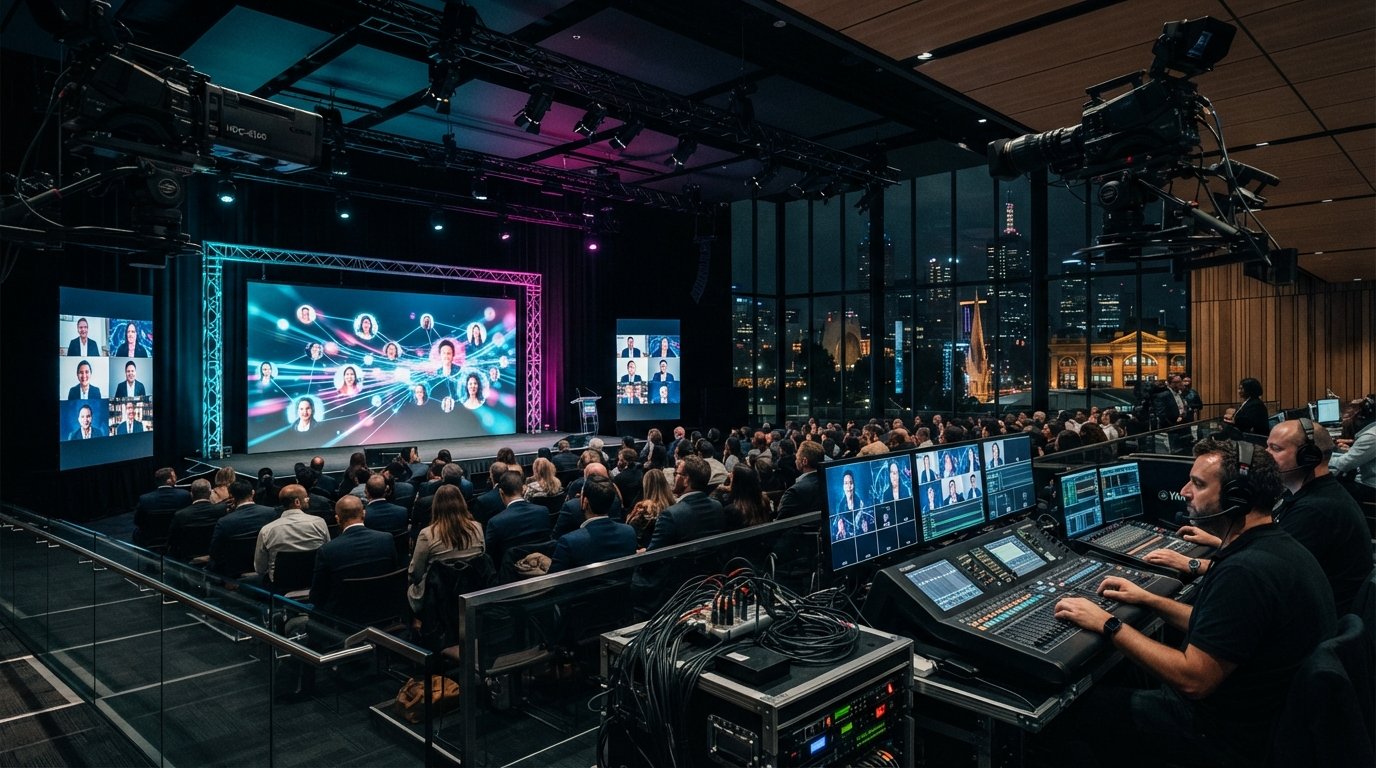
If your remote attendees feel like second-class observers peering through a keyhole, your broadcast has already failed. Securing the hybrid event production services melbourne organisations rely on is never just about setting up a camera at the back of the room; it is about engineering a unified, interactive experience for every participant. You already know the acute stress that accompanies high-stakes corporate staging. The lingering fear of embarrassing audio feedback, buffering streams, or rigid venue firewalls can easily turn a flagship presentation into a technical misfire.
You shouldn’t have to spend your event crossing your fingers behind the mixing desk or apologising to disengaged virtual attendees. Discover how to execute seamless dual-audience conferences and broadcasts across Melbourne venues without technical friction. This guide outlines the essential sound systems, network redundancy, and dedicated technical direction required to eliminate production panic and deliver a polished, broadcast-grade experience that meets executive brand standards.
Key Takeaways
- Treat in-person and remote participants as equal audiences through dual-designed visual switching, interactive stage feeds, and broadcast-grade production values.
- Eliminate embarrassing feedback loops and awkward stream silence by deploying dedicated mix-minus audio matrix routing managed by an experienced front of house engineer.
- Partner with specialist hybrid event production services melbourne organisers choose to secure custom line-array sound systems, high brightness LED displays, and independent technical direction.
- Navigate complex Melbourne venue infrastructure, power constraints, and local network firewalls with methodical pre-production site inspections.
- Alleviate live broadcast panic by implementing strict safety compliance, redundant stream architecture, and seasoned Victorian venue expertise.
What Defines High-End Hybrid Event Production in Melbourne?
High-end hybrid execution goes far beyond placing a camera at the back of a ballroom. At its core, a true hybrid event represents a synchronised, two-way live experience where physical attendees and digital delegates participate on equal terms. Basic webcams and DIY conferencing platforms treat remote viewers as passive observers. In contrast, broadcast-grade production blends dedicated stage management with television-standard transmission, ensuring your keynote speeches, panel debates, and live polls resonate with identical authority across both mediums.
Achieving this balance requires an elite technical director at the helm. Behind the scenes, this orchestrator manages cue timing, video routing, and live floor communication, eliminating the panic of missed prompts or awkward pauses. Choosing elite hybrid event production services melbourne planners trust means every speaker transition, presentation slide, and live audience reaction occurs with split-second precision.
The Anatomy of a Dual-Audience Event
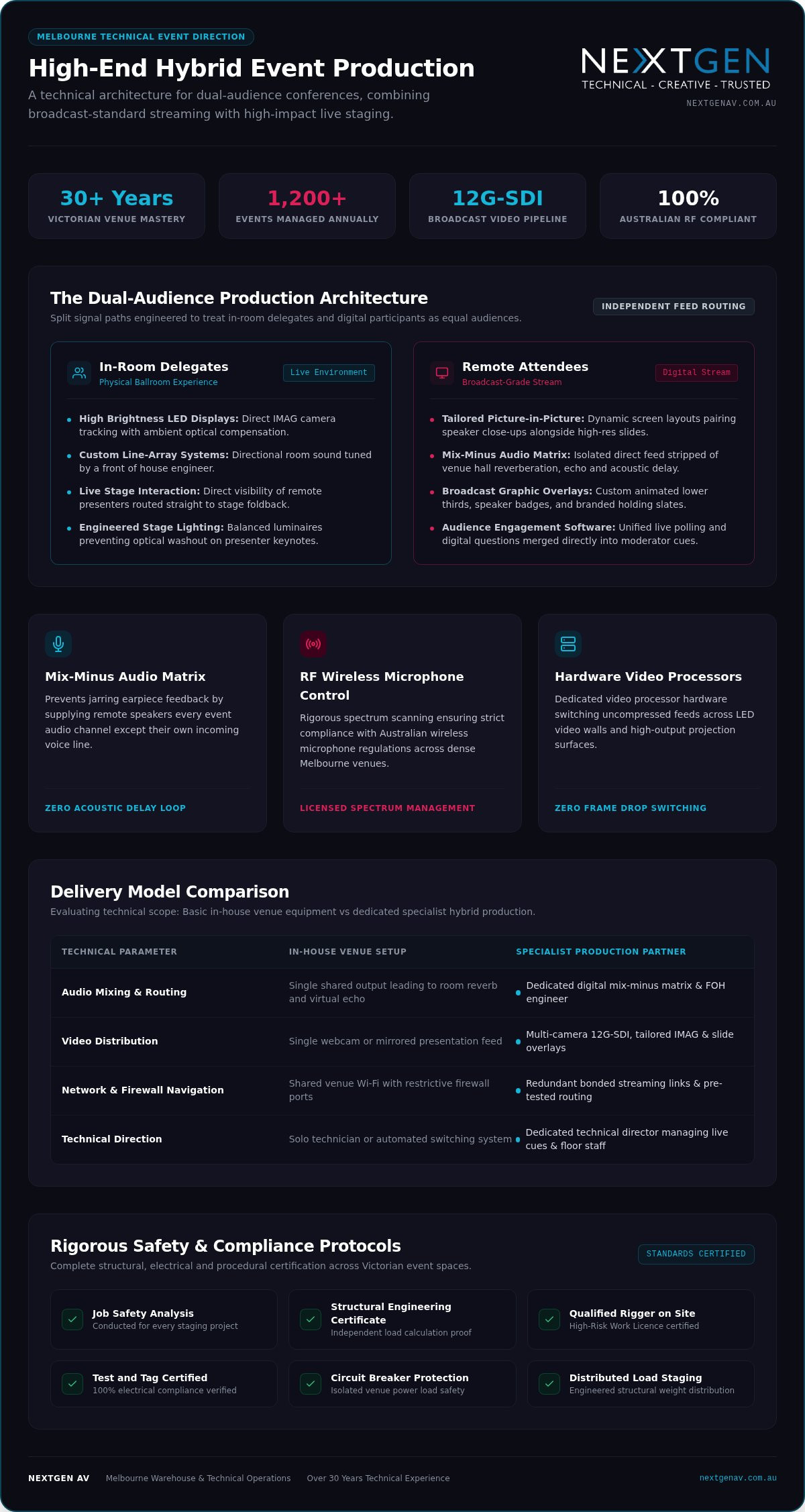
A dual-audience format demands two distinct production paths run in perfect alignment. Inside the physical venue, delegates absorb content through custom stage set design, high-output staging lights, and sharp visual displays. Rather than pushing an identical feed everywhere, a dedicated video processor maps dedicated IMAG (image magnification) footage to the in-room led video wall while sending an entirely custom view to virtual screens.
- Low-Latency Feeds: Eliminates conversational delays so virtual panellists interact naturally with the physical stage.
- Unified Engagement: Integrates audience engagement software so physical hands and digital questions feed into the same live Q&A cue.
- Dual Display Routing: Shows remote viewers the speaker alongside high-res slides, while in-room screens highlight full-stage visuals.
Beyond Simple Live Streaming: The Broadcast Standard
Broadcast standards elevate a corporate gathering into an executive-grade media production. Instead of flimsy consumer cabling, technical teams run high-bandwidth 12G-SDI video infrastructure to handle uncompressed, multi-camera switching without frame loss. Our Melbourne warehouse supplies complete production suites, pairing vision switchers with broadcast PTZ and studio cameras to capture close-up speaker nuance and sweeping room wide-angles.
This television-calibre approach extends to graphic overlays, custom lower thirds, and animated holding slates that reinforce your visual identity. Crucially, it splits the program outputs: one clean mix drives physical venue projection, while a tailored broadcast feed with baked-in presentation graphics feeds your remote distribution engine. By deploying specialised hybrid event production services melbourne corporate leaders ensure their executive message retains prestige, regardless of how participants dial in.
Acoustic and Visual Engineering: Solving the Hybrid Challenge
Nothing shatters executive credibility faster than a piercing feedback loop or a washed-out video feed. Engineering a dual-format space requires simultaneous acoustic and optical balancing. In-person rooms require rich, directional sound systems, while the digital stream demands an isolated feed stripped of cavernous hall reverberation. As detailed in our guide to audio visual hire melbourne venue acoustics, isolating physical room reflections ensures crisp vocal clarity before audio ever reaches an online encoder.
Mix-Minus Audio and Frequency Management
Remote presenters cannot speak naturally if their own voices echo back through their earpieces a second later. To solve this, a dedicated front of house engineer builds a mix-minus matrix on the digital console. This routing sends remote contributors every audio source, including live stage mics and video playback, minus their own incoming signal.
Microphone frequency management demands equal precision. In Melbourne’s crowded RF environment, wireless microphone systems must be mapped to avoid interference and comply strictly with current Australian wireless microphone regulations. Engineers avoid obsolete bands, actively scanning locally clear spectrum within licensed ranges so keynotes never drop out mid-sentence.
Studio-Grade Lighting and Stage Alignment
Standard venue lighting that looks acceptable to the naked eye often renders poorly on camera sensors. Hybrid staging demands studio-calibrated key, fill, and backlighting balanced precisely to camera sensors, generally between 4000K and 5600K colour temperatures. This clean three-point illumination separates presenters from stage backdrops without washing out their facial features on screen.
Visual balance also requires careful alignment between cameras and stage surfaces. When high brightness LED displays form the backdrop, video directors tune camera shutter angles and tile refresh rates to eliminate flickering and moiré patterns. Coordinating these technical details behind the scenes ensures both audiences enjoy pristine clarity. Engaging professional hybrid event production services melbourne teams trust provides the specialist engineering needed to preserve your brand reputation across every screen.
Comparing Technical Delivery Models: In-House Venue AV vs Specialist Production
Relying on in-house venue audiovisual packages often seems convenient, but dual-format events demand an independent production backbone. Generic hotel setups are typically engineered for background dining music and basic slide decks, not synchronized multi-channel streaming. Sourcing dedicated hybrid event production services melbourne specialists provide ensures your broadcast runs on purpose-built infrastructure designed to eliminate technical failure.
| Technical Factor | In-House Venue AV | Specialist Hybrid Production |
|---|---|---|
| Acoustic Delivery | Static ceiling speakers prone to room echo | Custom-engineered line arrays tuned for vocal punch |
| Network Pipeline | Shared venue bandwidth subject to throttling | Bonded cellular and hardwired failover connections |
| Technical Staffing | Duty technicians divided across multiple rooms | Dedicated crew executing rehearsed, bespoke cue sheets |
Bandwidth Architecture and Failover Security
Sharing a venue Wi-Fi network with hundreds of attendees invites immediate broadcast failure. When delegates connect their phones, public bandwidth quickly buckles. Professional production teams bypass public venue networks entirely by deploying bonded primary and secondary internet links. Hardware encoders feature automatic hot-failover switching, instantly redirecting the stream if an upstream line falters. Engineers also coordinate directly with enterprise IT departments well before show day, configuring firewall traversals that prevent unexpected network lockouts.
Equipment Ownership, Calibration, and Crew Mastery
In-house hotel gear frequently sits neglected in storage cupboards between functions, rarely receiving the calibration needed for digital broadcasts. Deploying equipment directly from our dedicated Melbourne warehouse guarantees that every audio console, processor, and lighting fixture is thoroughly checked under strict Test and Tag protocols before arrival.
Crucially, an independent team focuses exclusively on your event rather than dividing attention among different venue halls. As detailed in our guide to full service event production, rehearsed cue sheets and dedicated technical direction guarantee that vision, audio, and stage lighting transition in lockstep, giving stakeholders total confidence from opening address to final wrap.
Five-Stage Blueprint for Flawless Melbourne Hybrid Execution
Executing a high-stakes dual-audience event requires a disciplined sequence of technical milestones. Rather than hoping elements align on the morning of your conference, elite event producers follow a rigorous five-stage operational framework:
- Infrastructure Audit: Inspecting venue power distributions, network capability, and ceiling load points across Melbourne venues.
- Digital Architecture: Customising audience engagement software, lower-third overlays, and broadcast graphic packages.
- Dry Runs and Latency Checks: Testing remote presenter dial-ins, cue automation, and matrix audio feeds under simulated show conditions.
- Live Technical Direction: Calling live vision cuts, managing presenter timing, and orchestrating floor audio in real time.
- Master Archiving: Capturing isolated camera feeds alongside master program records for on-demand compliance and distribution.
Pre-Production Audits and Virtual Architecture
Every venue across Melbourne, from historic heritage halls to contemporary CBD convention spaces, presents unique infrastructure quirks. During phase one, engineers verify dedicated upload speeds, test for enterprise firewall interference, and confirm electrical circuit breaker allocations. Stage structures and overhead trusses also require a formal Job Safety Analysis and structural engineering certificate before any hardware is flown overhead.
Phase two moves into the control architecture. Technicians configure high-throughput video processor units to scale mixed aspect ratios cleanly without introducing visual latency or screen tearing. Simultaneously, audience engagement software is calibrated so in-room delegates on mobile devices and virtual attendees on desktops participate in identical live polls and moderated Q&A sessions without delay.
Show Day Execution and Rehearsal Protocols
Show day succeeds because the work happens before doors open. Rehearsal protocols begin with dedicated remote presenter checks at least thirty minutes prior to live transmission, ensuring their home audio, lighting, and framing meet executive standards. On stage, presenters step through cue-to-cue walkthroughs, learning their camera marks and stage monitor positions.
Throughout the live broadcast, technical directors continuously observe encoder bitrates, stream stability, and peak audio signals across dual outputs. To bring this structured discipline to your next corporate summit, book hybrid event production services melbourne specialists who engineer reliability into every single phase.
Partner with NextGen AV for Melbourne Hybrid Production
Executing an elite corporate broadcast leaves no room for improvisation. With over 30 years of technical mastery across Victorian venues, NextGen AV eliminates the acute anxiety of live event delivery. We manage more than 1,200 events annually, bringing proven familiarity to complex spaces such as the Melbourne Convention and Exhibition Centre (MCEC), Crown Palladium, and premium CBD hotel ballrooms. Our veteran crew understands the distinct power layouts, access corridors, and acoustic challenges of these landmark locations, ensuring rapid load-ins and zero technical surprises.
When you secure the premier hybrid event production services melbourne planners trust, you gain a dedicated partner committed to engineering an unforgettable attendee experience. Discover how our dedicated hybrid event staging solutions unite creative stage design with broadcast-grade distribution to elevate your executive brand.
Rigorous Safety and Technical Compliance
Production excellence starts with uncompromised compliance. Every staging build, ground-supported LED structure, and flown lighting truss is engineered to rigorous Australian standards:
- Safe Work Documentation: We draft site-specific Job Safety Analysis documentation to protect crew, venue staff, and delegates.
- Engineered Structures: Flown rigs and complex stages carry a validated structural engineering certificate to ensure structural integrity.
- Licensed Crews: Overhead rigging and heavy-lift logistics are handled by personnel holding a valid High-Risk Work Licence and qualified rigger credentials.
- Electrical Governance: Every single cable, power distro, and luminaire passes regular electrical Test and Tag verification before leaving our facility.
End-to-End Technical Orchestration
Operating directly out of our local Melbourne warehouse gives us an extraordinary operational advantage. We store, test, and calibrate every piece of equipment internally, including high-output LED panels, broadcast optical chains, and digital mixing consoles. This extensive local footprint means spare components and supplementary hardware are always available for immediate deployment.
Beyond our physical hardware, our strength lies in dedicated technical direction. A senior technical director collaborates with your team from initial concept through to final wrap, creating detailed run sheets and guiding presenters on stage. Backed by seasoned hybrid event production services melbourne corporate teams count on, you can step away from the mixing desk and take centre stage with absolute confidence.
Elevate Your Next Corporate Broadcast
Flawless dual-audience conferences come down to disciplined engineering rather than good fortune. When you resolve technical friction through dedicated mix-minus routing, bonded network failovers, and synchronised digital engagement, remote viewers feel just as valued as the audience in the room. Your presenters speak with ease, your stream stays locked, and your executive message commands the respect it deserves.
Choosing the specialised hybrid event production services melbourne organisations trust means trading live production panic for absolute confidence. Backed by over 30 years of technical mastery across Victoria and managing 1,200+ live productions annually, NextGen AV provides the proven capability your event demands. Our Melbourne warehouse supplies broadcast-grade audio, video, and LED displays, while our veteran directors orchestrate every cue behind the scenes. Partner with Melbourne’s hybrid production specialists at NextGen AV to create a seamless live broadcast that exceeds executive standards.
Frequently Asked Questions
What is the difference between a live stream and a hybrid event?
A live stream is a one-way passive broadcast, whereas a hybrid event creates active, two-way participation between in-room and remote audiences. Live streaming simply shares video footage of a stage. Professional hybrid event production services melbourne organisations rely on connect both groups through synchronised audience engagement software, bidirectional audio matrixing, and tailored dual visual feeds. This setup ensures remote attendees speak, vote, and interact rather than just watching from the sidelines.
How do you prevent audio echo between remote speakers and the live room?
Audio echo is eliminated by configuring a dedicated mix-minus bus on the digital audio console. A front of house engineer routes every stage microphone, media playback channel, and floor sound to the remote contributor, deliberately excluding their own incoming voice. Combining this matrix routing with acoustic room tuning prevents audio loops, delay feedback, and latency traps, allowing conversations between the stage and remote participants to flow naturally.
What internet bandwidth is required at a Melbourne venue for hybrid broadcasting?
A stable corporate broadcast requires a dedicated, symmetrical upload speed of at least 20 to 30 Mbps reserved exclusively for the streaming encoders. Sharing bandwidth with hotel guests or conference attendees causes immediate stream stutter and frame loss. Melbourne technical teams ensure reliability by deploying cellular bonding appliances alongside hardwired Ethernet lines, guaranteeing unthrottled throughput regardless of how many personal devices connect to the local public Wi-Fi.
Can remote attendees interact in real time with the in-person audience?
Yes, real-time interactivity works seamlessly when digital tools are integrated directly into the stage production environment. By deploying unified audience engagement software, both physical delegates and remote viewers participate simultaneously in live polling, moderated Q&A sessions, and quizzes. Remote questions appear on presenter comfort monitors on stage, while live floor reactions and applause are mixed back into the broadcast feed for complete audience integration.
What happens if the venue internet connection drops during the live broadcast?
The broadcast continues uninterrupted if your production infrastructure includes automated hardware hot-failover switching. Production teams deploy redundant secondary pathways, combining hardwired venue lines with bonded 4G and 5G cellular networks. If the primary internet pipe drops or experiences packet loss, the streaming encoder shifts data packets instantly to the backup connection. Viewers at home experience zero signal dropouts or stream resets while technicians resolve the local venue fault.
Why is an external production specialist better than using hotel in-house AV?
External production specialists provide dedicated focus, custom-engineered sound systems, and tested equipment rather than generic, multi-room hotel gear. Booking dedicated hybrid event production services melbourne specialists brings seasoned technical directors who rehearse your specific run sheet from start to finish. In-house venue teams often manage several rooms simultaneously using aging equipment, whereas external specialists dispatch calibrated gear directly from a local warehouse to ensure flawless brand execution.
How early should technical pre-production begin for a corporate hybrid conference?
Technical pre-production should begin at least eight to twelve weeks prior to your event date. Starting early provides adequate time to perform on-site Melbourne venue inspections, complete structural engineering certificates, run network speed audits, and program custom digital graphics. Early collaboration also allows your technical director to design failover protocols, review presentation decks, and schedule dry runs with remote keynote speakers well before show day.
Discover Valuable Insights
Unlock Expert Tips and Advice
Our blog is packed with valuable information to help you stay ahead. Whether you’re looking for expert advice, industry trends, or practical tips, you’ll find everything you need. Reach out today to learn more or get in touch with us for personalised support!