




The house lights dim and the opening cue is seconds away, yet instead of the stage manager’s voice, your headset fills with static or the muffled chatter of a nearby security team. It is the nightmare scenario for any production lead, where a simple lapse in your event communication systems rental choice transforms a high-stakes performance into a series of missed cues and frantic hand signals. You know that behind every flawless event is an invisible engine of coordination, and you shouldn’t have to worry about wireless blackspots or battery failure when the pressure is on.
We agree that your crew deserves the same level of precision in their headsets as the audience hears through the front-of-house speakers. This 2026 guide promises to show you how to choose and deploy a robust communication infrastructure that guarantees absolute synchronisation across lighting, audio, and stage departments. We will look at the latest full-duplex digital intercoms, how to ensure ACMA compliance for interference-free operation, and the technical strategies required to maintain professional-grade reliability for an 18-hour show day.
Key Takeaways
- Understand why professional communication serves as the vital nervous system for any high-stakes production, ensuring every cue is executed with absolute precision.
- Discover the technical differences between digital intercoms and two-way radios to determine which technology best suits your crew’s specific talk-paths and security needs.
- Learn how to optimise your event communication systems rental by conducting thorough site surveys and assessing the unique acoustic challenges of your venue.
- Navigate the complexities of ACMA frequency licensing to avoid interference from unlicensed gear and ensure your production remains compliant and crystal clear.
- Explore the benefits of integrating your comms infrastructure into a total audio-visual package, backed by 30 years of expertise in the Melbourne events industry.
The Critical Role of Event Communication Systems in Modern Production
Think of your event as a living organism. If the audio-visual elements are the muscles and the vision is the heart, then a professional event communication systems rental is the nervous system. It carries every pulse of data and every urgent command from the brain, the stage manager, to the extremities of the production. Without this connectivity, the most expensive LED walls and line arrays are just static hardware. Truly seamless production relies on the ability to transmit intent instantly. This allows a lighting operator to hit a blackout the exact millisecond the drummer strikes the final beat, creating a moment of pure, coordinated impact.
There is a profound difference between managing a crowd and calling a show. Simple two-way radios are fine for coordinating car park arrivals or security patrols, but they fall short when you’re choreographing a complex gala. Calling a show requires a continuous, open dialogue where the stage manager can hear the breath of the crew and anticipate their needs. This level of intimacy prevents the common AV glitches that haunt poorly planned events, such as mistimed video rolls or audio feedback during a critical keynote. When the crew feels connected, their stress levels drop significantly. They move from a state of reactive panic to one of proactive artistry, focusing on the prestige of the final result rather than fighting their equipment.
Beyond Walkie-Talkies: Defining Professional Comms
The evolution of production has pushed us past the era of simple push-to-talk devices. Modern digital intercom systems create integrated networks that allow for full-duplex conversation, meaning your team can talk and listen simultaneously just like a phone call. In high-interference environments like the Melbourne CBD, consumer-grade gear often buckles under the weight of RF noise from skyscrapers and mobile towers. A professional setup provides dedicated, discrete channels. This ensures the lighting department isn’t distracted by audio troubleshooting, and the stage manager has a direct, private line to the technical director to keep the schedule on track.
Risk Mitigation through Reliable Infrastructure
Reliability isn’t just a luxury; it’s a safety requirement. High-stakes corporate shows demand a zero-fail comms environment, which we define as a dedicated infrastructure where redundant signal paths and expert frequency management ensure every critical cue is delivered and acknowledged without exception. This infrastructure prevents the dead air that can ruin a live broadcast or the timing errors that turn a prestige award ceremony into a series of awkward silences. Beyond the creative flow, these systems act as a lifeline for emergency protocols. They ensure that if a situation arises, the entire team can be alerted and organised in seconds without the audience ever knowing there was a concern.
Key Technologies: From Two-Way Radio Hire to Digital Intercoms
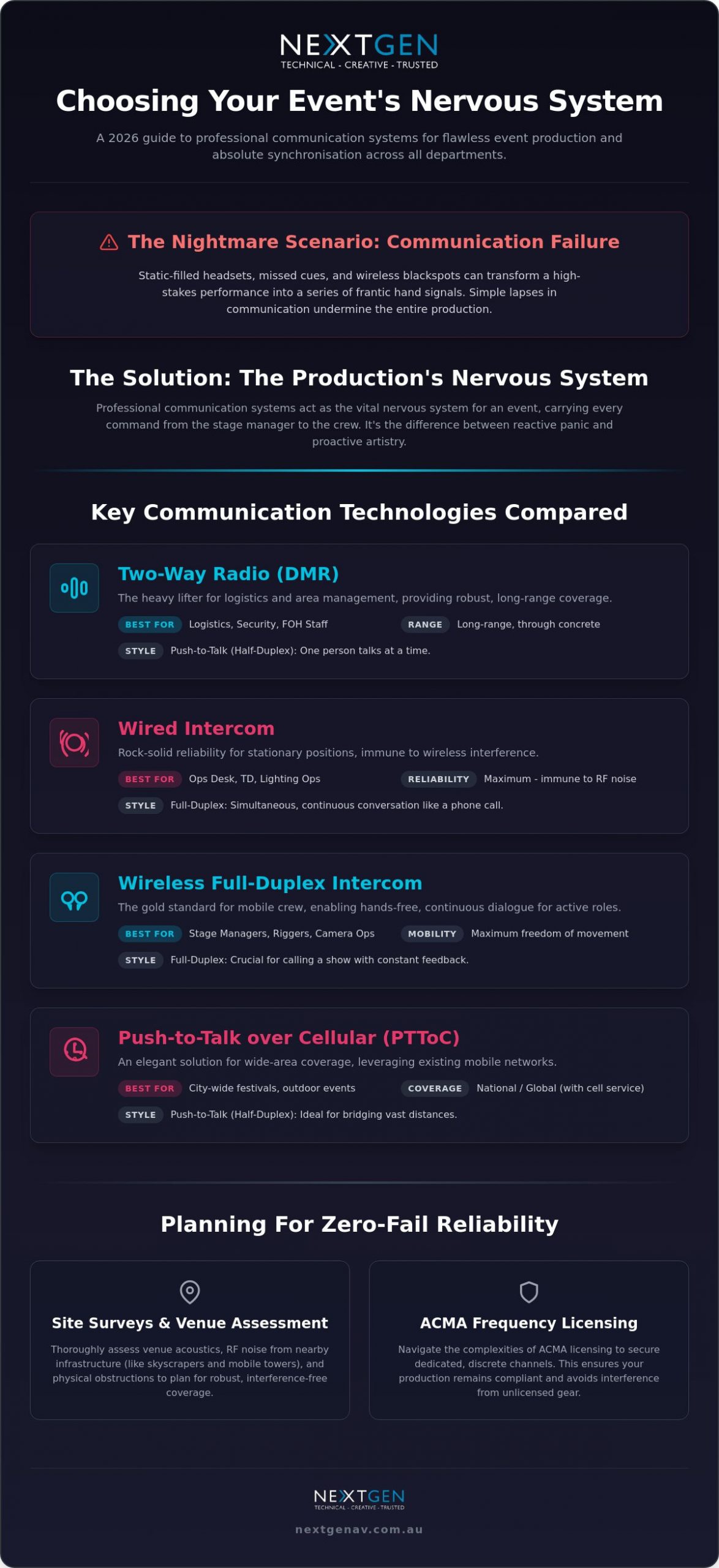
The technical landscape of modern production has shifted, moving away from simple noise-makers toward sophisticated, low-latency networks. Selecting the right event communication systems rental depends entirely on the specific roles within your crew. For logistics and security teams, Digital Mobile Radio (DMR) remains the heavy lifter. These units provide robust, long-range coverage that ensures your front-of-house staff and loading dock crews remain connected across vast distances, even through the thick concrete walls of Melbourne’s premier convention centres.
At the heart of the production, wired intercom systems provide the rock-solid reliability required for stationary positions. Your technical director and lighting operator, situated at the ops desk, don’t need mobility; they need a connection that is immune to wireless interference. When Choosing the Right System for your mobile stage crew, wireless full-duplex technology is the gold standard. It allows for continuous, hands-free conversation, enabling a rigger or stage hand to use both hands for their craft while maintaining a crystal-clear dialogue with the stage manager.
For city-wide festivals or sprawling outdoor events, Push-to-Talk over Cellular (PTToC) offers an elegant solution. By leveraging existing mobile networks, PTToC bridges the gap where traditional radio frequencies might struggle, providing wide-area coverage that keeps your entire team synchronised across kilometres of urban terrain. Our team can help you organise a bespoke comms package that aligns perfectly with your show’s complexity and venue constraints.
Digital vs. Analogue Systems
Digital systems have rendered analogue units obsolete in professional circles. By converting voice into data packets, digital DMR units offer superior audio clarity and eliminate the background hiss associated with older technology. More importantly, digital channels allow for advanced encryption. This is a vital feature for high-profile corporate events where sensitive announcements must remain private. Professional-grade digital hardware also boasts significantly better battery life, often surviving an 18-hour show day on a single charge while withstanding the physical rigours of a frantic bump-in.
Specialised Accessories for Every Role
The right headset is just as important as the base station itself. In high-decibel environments like concerts or trade shows, heavy-duty noise-cancelling headsets are essential to protect crew hearing and ensure instructions are heard over the PA. Conversely, floor managers and VIP hosts often require discrete earpieces that provide clear audio without the bulky profile of a traditional headset. We also provide multi-unit charging stations and speaker microphones to ensure large-scale deployments remain powered and functional from the first briefing to the final pack-down.
Choosing the Right System: A Buyer’s Comparison Framework
Selecting your event communication systems rental is not merely a matter of counting heads. It is an exercise in mapping the pulse of your production. You must first audit the ratio of ‘talkers’ to ‘listeners’ within your crew. While a logistics team might only need to report status updates via simplex channels, where only one person can speak at a time, your core production crew requires the fluid, simultaneous exchange of a full-duplex system. Understanding this distinction is the first step in moving from a basic setup to a professional-grade infrastructure that supports the artistry of your show.
The venue itself dictates the hardware. An indoor ballroom in the Melbourne CBD presents different challenges than a sprawling outdoor festival site at the Sidney Myer Music Bowl. Physical barriers like thick concrete walls or massive steel rigging can swallow wireless signals, leading to the dreaded ‘dead air’ that puts a production at risk. Budgeting for your comms should be viewed as show insurance. The investment in a high-end, reliable rental is negligible when compared to the professional fallout and stress of a failed show caused by a missed cue or a battery dying at a critical moment.
The ‘Show-Caller’ Test
A show-caller is the conductor of your event’s orchestra. They require a full-duplex system to maintain the ‘rhythm’ of the event, allowing them to hear the breath and readiness of the crew in real time. This typically involves a multi-channel structure where the caller can toggle between discrete departments like lighting, audio, and stage management without cluttering the main feed. This level of technical direction is what bridges the gap between a standard event and a world-class experience. It is why we often integrate these comms with our Professional sound system hire to ensure every element of the production is perfectly aligned from the first cue to the final curtain.
Interference and Range Considerations
Melbourne’s premier event precincts are notorious for RF noise. From the skyscrapers of the CBD to the high-density wireless environments of Southbank, signal interference is a constant threat. If your event spans multiple levels or a vast outdoor area, you will likely need to deploy repeaters to extend the range of your two-way radio fleet. A technical site survey is essential to identify potential blackspots and ensure your signal penetrates the physical barriers of the venue. By planning for these environmental factors early, you ensure your crew remains connected, regardless of the architectural challenges of the space.
Planning Your Comms Infrastructure: Site Surveys and ACMA Compliance
A flawless production is never the result of luck; it is the product of meticulous preparation that begins long before the first road case enters the venue. For a high-impact event communication systems rental to succeed, a technical site survey is non-negotiable. This proactive assessment allows us to map the unique RF environment of your location, identifying potential blackspots created by heavy structural steel or subterranean concrete layers. By conducting a rigorous ‘walk-test’ protocol during the pre-show phase, we ensure that every corner of the site, from the green room to the loading dock, maintains a crystal-clear signal before the first cue is ever called.
Operating in Australia requires a deep understanding of the legal landscape governed by the Australian Communications and Media Authority (ACMA). Using unlicensed ‘grey market’ gear doesn’t just risk signal dropouts; it exposes your organisation to significant legal liability and potential fines. Professional systems must adhere to the Radiocommunications (Low Interference Potential Devices) Class Licence 2025, ensuring that your equipment operates on designated shared frequencies without disrupting emergency services or other vital broadcasts. We ensure all hired electronics meet strict RCM safety standards, providing you with the peace of mind that your infrastructure is both high-performing and fully compliant.
Frequency Management in Melbourne
The RF spectrum in Melbourne’s premier precincts, such as the MCEC or the major hotels along Southbank, is incredibly crowded. Without a co-ordinated frequency plan, your production comms could easily clash with nearby events or the venue’s internal security teams. For large-scale multi-AV projects, we act as your frequency coordinator, carving out dedicated space in the airwaves to prevent cross-talk and interference. This level of master-planning is a core component of our Full service event production, where we manage the technical heavy lifting so you can focus on the show’s creative execution.
Logistics and On-Site Support
While some choose ‘dry hire’ to save on initial costs, the complexity of modern intercom networks makes a turnkey solution far more efficient. A turnkey event communication systems rental includes the expertise of an on-site technician who manages the invisible details, from real-time troubleshooting to proactive battery swaps during critical show moments. Having a seasoned veteran on the ground ensures that any technical hiccups are resolved in seconds, maintaining the momentum of your event. If you are ready to secure a rock-solid foundation for your next production, contact our team to discuss a tailored comms strategy that guarantees absolute reliability.
Why Partner with NextGen AV for Your Melbourne Event Comms
Choosing a partner for your event communication systems rental is about more than just securing hardware; it is about finding an invisible expert who understands the heartbeat of a live production. We don’t view comms as an isolated utility. Instead, we integrate your intercom network directly into our total lighting and audio design. This holistic approach ensures that every department is perfectly synchronised, allowing the technical director to orchestrate the show with the precision of a master conductor. With over 30 years of experience navigating the specific RF challenges and logistical quirks of Victorian event venues, we have seen every possible scenario and developed the resilience to handle them all.
Our “Confident Orchestrator” philosophy means we take full ownership of the technical heavy lifting. You shouldn’t have to worry about frequency clashing or headset pairing while you are managing stakeholders and talent. Our solutions arrive custom-programmed and ready to use out of the box, configured specifically for your show’s unique talk-paths and department structures. This meticulous preparation eliminates the logistical grind of the bump-in, allowing your team to move straight into the creative flow of the event with absolute confidence in their connectivity.
The NextGen AV Advantage: Expert Technical Direction
A sophisticated comms network is only as effective as the hands that guide it. Our technical directors oversee the entire infrastructure, providing a level of oversight that ensures your peace of mind from the first briefing to the final pack-down. Whether you are hosting an intimate corporate meeting in the CBD or a massive community festival in regional Victoria, our solutions are inherently scalable. We provide the same elite-level reliability for a dozen headsets as we do for a hundred. This commitment to excellence is what defines our Audio visual hire Melbourne services, positioning us as a dedicated ally in your project’s success.
Ready to Organise Your Event Comms?
Organising a professional-grade communication setup is a straightforward process when you have the right experts by your side. To request a tailored quote, simply provide our team with your expected crew size, the layout of your chosen venue, and the total duration of the hire. This information allows us to architect a bespoke frequency plan and equipment list that meets your exact needs. You can rest easy knowing that your production is backed by professional-grade reliability and a team that takes personal pride in seamless execution. Let us handle the engine behind the scenes while you take centre stage.
Master the Rhythm of Your Next Production
The success of your next high-stakes event shouldn’t rest on the hope that your headsets will hold a charge. It requires a dedicated infrastructure built on technical mastery and a deep understanding of the unique RF challenges found across Melbourne. By selecting the right blend of digital intercoms for your show-callers and robust radios for your logistics team, you eliminate the friction that leads to missed cues. Remember that a professional site survey and strict ACMA compliance are the foundations of a zero-fail environment, protecting your production from signal interference and legal risk.
NextGen AV brings over 30 years of Melbourne event expertise to your project, offering end-to-end technical production management that allows you to focus on the prestige of the final result. We provide ACMA-compliant, professional-grade equipment that is custom-programmed to meet the specific demands of your venue. Choosing the right event communication systems rental is the final piece of the puzzle in delivering a world-class experience. It’s time to move past the logistical grind and experience the power of a perfectly synchronised crew.
Secure your seamless event comms with NextGen AV today and ensure your next production runs with absolute precision. We are ready to act as your invisible expert, driving the engine of your success from the first cue to the final curtain.
Frequently Asked Questions
What is the difference between simplex and full-duplex communication?
Simplex communication allows only one person to speak at a time while others listen; whereas full-duplex systems enable simultaneous two-way conversation just like a telephone call. This distinction is vital for production flow. Logistics and security teams typically use simplex radios, but show-callers and stage managers rely on full-duplex intercoms to maintain a continuous, uninterrupted dialogue during complex sequences.
Do I need a licence to use hired two-way radios in Australia?
You generally don’t need an individual licence for hired two-way radios because professional rental companies operate under ACMA class licences. These regulations ensure the equipment is compliant with Australian standards for power output and frequency use. We handle all the technical compliance and frequency co-ordination behind the scenes, so your team can focus on the event without worrying about regulatory hurdles.
How many radios should I hire for a corporate event with 500 guests?
The number of units required depends on your crew structure rather than the guest count. A typical corporate gala with 500 guests might require 15 to 25 units to cover stage management, audio-visual technicians, venue catering, and security teams. We recommend mapping out every department head and floor manager to ensure no critical link in your production chain is left without a headset.
What happens if our communication system experiences interference during the show?
If interference occurs, our technical directors immediately transition the crew to a secondary, pre-programmed backup channel. This is why a professional event communication systems rental includes a rigorous frequency management plan. By identifying potential RF clashes during the site survey, we create a redundant infrastructure that keeps your team connected even in the most crowded wireless environments.
Can event comms systems integrate with my existing sound system?
Event comms systems integrate seamlessly with your existing sound system to provide a “program feed” directly into crew headsets. This allows operators to hear the stage microphones while listening for cues from the stage manager. Using professional 4-wire interfaces, we can bridge your intercom network with your audio console to create a unified technical ecosystem that enhances the precision of every cue.
What is the range of a standard digital two-way radio in a city environment?
A standard digital two-way radio typically offers a range of 1 to 2 kilometres in a dense city environment like the Melbourne CBD. However, physical obstructions like high-rise buildings and steel structures can reduce this distance significantly. For events spanning larger urban areas or multiple venue levels, we deploy digital repeaters to boost signal penetration and ensure 100% coverage across your entire site.
Are wireless intercoms better than wired systems for stage management?
Wireless intercoms are superior for mobile stage managers who need to move between the wings and the green room, but wired systems remain the gold standard for stationary operators. Wired stations are immune to RF interference and battery failure; making them the most reliable choice for the lighting desk or technical director. Most high-stakes productions use a hybrid approach to balance mobility with absolute stability.
How long do the batteries last on professional event communication gear?
Professional event communication gear is designed to survive a standard 12 to 18-hour show day on a single charge. High-capacity lithium-ion batteries in modern digital beltpacks and radios provide reliable performance throughout a long bump-in and the final performance. We always provide multi-unit charging stations and spare batteries as part of our event communication systems rental packages to guarantee zero downtime during critical moments.
The house lights dim and the opening cue is seconds away, yet instead of the stage manager’s voice, your headset fills with static or the muffled chatter of a nearby security team. It is the nightmare scenario for any production lead, where a simple lapse in your event communication systems rental choice transforms a high-stakes performance into a series of missed cues and frantic hand signals. You know that behind every flawless event is an invisible engine of coordination, and you shouldn’t have to worry about wireless blackspots or battery failure when the pressure is on.
We agree that your crew deserves the same level of precision in their headsets as the audience hears through the front-of-house speakers. This 2026 guide promises to show you how to choose and deploy a robust communication infrastructure that guarantees absolute synchronisation across lighting, audio, and stage departments. We will look at the latest full-duplex digital intercoms, how to ensure ACMA compliance for interference-free operation, and the technical strategies required to maintain professional-grade reliability for an 18-hour show day.
Key Takeaways
- Understand why professional communication serves as the vital nervous system for any high-stakes production, ensuring every cue is executed with absolute precision.
- Discover the technical differences between digital intercoms and two-way radios to determine which technology best suits your crew’s specific talk-paths and security needs.
- Learn how to optimise your event communication systems rental by conducting thorough site surveys and assessing the unique acoustic challenges of your venue.
- Navigate the complexities of ACMA frequency licensing to avoid interference from unlicensed gear and ensure your production remains compliant and crystal clear.
- Explore the benefits of integrating your comms infrastructure into a total audio-visual package, backed by 30 years of expertise in the Melbourne events industry.
The Critical Role of Event Communication Systems in Modern Production
Think of your event as a living organism. If the audio-visual elements are the muscles and the vision is the heart, then a professional event communication systems rental is the nervous system. It carries every pulse of data and every urgent command from the brain, the stage manager, to the extremities of the production. Without this connectivity, the most expensive LED walls and line arrays are just static hardware. Truly seamless production relies on the ability to transmit intent instantly. This allows a lighting operator to hit a blackout the exact millisecond the drummer strikes the final beat, creating a moment of pure, coordinated impact.
There is a profound difference between managing a crowd and calling a show. Simple two-way radios are fine for coordinating car park arrivals or security patrols, but they fall short when you’re choreographing a complex gala. Calling a show requires a continuous, open dialogue where the stage manager can hear the breath of the crew and anticipate their needs. This level of intimacy prevents the common AV glitches that haunt poorly planned events, such as mistimed video rolls or audio feedback during a critical keynote. When the crew feels connected, their stress levels drop significantly. They move from a state of reactive panic to one of proactive artistry, focusing on the prestige of the final result rather than fighting their equipment.
Beyond Walkie-Talkies: Defining Professional Comms
The evolution of production has pushed us past the era of simple push-to-talk devices. Modern digital intercom systems create integrated networks that allow for full-duplex conversation, meaning your team can talk and listen simultaneously just like a phone call. In high-interference environments like the Melbourne CBD, consumer-grade gear often buckles under the weight of RF noise from skyscrapers and mobile towers. A professional setup provides dedicated, discrete channels. This ensures the lighting department isn’t distracted by audio troubleshooting, and the stage manager has a direct, private line to the technical director to keep the schedule on track.
Risk Mitigation through Reliable Infrastructure
Reliability isn’t just a luxury; it’s a safety requirement. High-stakes corporate shows demand a zero-fail comms environment, which we define as a dedicated infrastructure where redundant signal paths and expert frequency management ensure every critical cue is delivered and acknowledged without exception. This infrastructure prevents the dead air that can ruin a live broadcast or the timing errors that turn a prestige award ceremony into a series of awkward silences. Beyond the creative flow, these systems act as a lifeline for emergency protocols. They ensure that if a situation arises, the entire team can be alerted and organised in seconds without the audience ever knowing there was a concern.
Key Technologies: From Two-Way Radio Hire to Digital Intercoms
The technical landscape of modern production has shifted, moving away from simple noise-makers toward sophisticated, low-latency networks. Selecting the right event communication systems rental depends entirely on the specific roles within your crew. For logistics and security teams, Digital Mobile Radio (DMR) remains the heavy lifter. These units provide robust, long-range coverage that ensures your front-of-house staff and loading dock crews remain connected across vast distances, even through the thick concrete walls of Melbourne’s premier convention centres.
At the heart of the production, wired intercom systems provide the rock-solid reliability required for stationary positions. Your technical director and lighting operator, situated at the ops desk, don’t need mobility; they need a connection that is immune to wireless interference. When Choosing the Right System for your mobile stage crew, wireless full-duplex technology is the gold standard. It allows for continuous, hands-free conversation, enabling a rigger or stage hand to use both hands for their craft while maintaining a crystal-clear dialogue with the stage manager.
For city-wide festivals or sprawling outdoor events, Push-to-Talk over Cellular (PTToC) offers an elegant solution. By leveraging existing mobile networks, PTToC bridges the gap where traditional radio frequencies might struggle, providing wide-area coverage that keeps your entire team synchronised across kilometres of urban terrain. Our team can help you organise a bespoke comms package that aligns perfectly with your show’s complexity and venue constraints.
Digital vs. Analogue Systems
Digital systems have rendered analogue units obsolete in professional circles. By converting voice into data packets, digital DMR units offer superior audio clarity and eliminate the background hiss associated with older technology. More importantly, digital channels allow for advanced encryption. This is a vital feature for high-profile corporate events where sensitive announcements must remain private. Professional-grade digital hardware also boasts significantly better battery life, often surviving an 18-hour show day on a single charge while withstanding the physical rigours of a frantic bump-in.
Specialised Accessories for Every Role
The right headset is just as important as the base station itself. In high-decibel environments like concerts or trade shows, heavy-duty noise-cancelling headsets are essential to protect crew hearing and ensure instructions are heard over the PA. Conversely, floor managers and VIP hosts often require discrete earpieces that provide clear audio without the bulky profile of a traditional headset. We also provide multi-unit charging stations and speaker microphones to ensure large-scale deployments remain powered and functional from the first briefing to the final pack-down.
Choosing the Right System: A Buyer’s Comparison Framework
Selecting your event communication systems rental is not merely a matter of counting heads. It is an exercise in mapping the pulse of your production. You must first audit the ratio of ‘talkers’ to ‘listeners’ within your crew. While a logistics team might only need to report status updates via simplex channels, where only one person can speak at a time, your core production crew requires the fluid, simultaneous exchange of a full-duplex system. Understanding this distinction is the first step in moving from a basic setup to a professional-grade infrastructure that supports the artistry of your show.
The venue itself dictates the hardware. An indoor ballroom in the Melbourne CBD presents different challenges than a sprawling outdoor festival site at the Sidney Myer Music Bowl. Physical barriers like thick concrete walls or massive steel rigging can swallow wireless signals, leading to the dreaded ‘dead air’ that puts a production at risk. Budgeting for your comms should be viewed as show insurance. The investment in a high-end, reliable rental is negligible when compared to the professional fallout and stress of a failed show caused by a missed cue or a battery dying at a critical moment.
The ‘Show-Caller’ Test
A show-caller is the conductor of your event’s orchestra. They require a full-duplex system to maintain the ‘rhythm’ of the event, allowing them to hear the breath and readiness of the crew in real time. This typically involves a multi-channel structure where the caller can toggle between discrete departments like lighting, audio, and stage management without cluttering the main feed. This level of technical direction is what bridges the gap between a standard event and a world-class experience. It is why we often integrate these comms with our Professional sound system hire to ensure every element of the production is perfectly aligned from the first cue to the final curtain.
Interference and Range Considerations
Melbourne’s premier event precincts are notorious for RF noise. From the skyscrapers of the CBD to the high-density wireless environments of Southbank, signal interference is a constant threat. If your event spans multiple levels or a vast outdoor area, you will likely need to deploy repeaters to extend the range of your two-way radio fleet. A technical site survey is essential to identify potential blackspots and ensure your signal penetrates the physical barriers of the venue. By planning for these environmental factors early, you ensure your crew remains connected, regardless of the architectural challenges of the space.
Planning Your Comms Infrastructure: Site Surveys and ACMA Compliance
A flawless production is never the result of luck; it is the product of meticulous preparation that begins long before the first road case enters the venue. For a high-impact event communication systems rental to succeed, a technical site survey is non-negotiable. This proactive assessment allows us to map the unique RF environment of your location, identifying potential blackspots created by heavy structural steel or subterranean concrete layers. By conducting a rigorous ‘walk-test’ protocol during the pre-show phase, we ensure that every corner of the site, from the green room to the loading dock, maintains a crystal-clear signal before the first cue is ever called.
Operating in Australia requires a deep understanding of the legal landscape governed by the Australian Communications and Media Authority (ACMA). Using unlicensed ‘grey market’ gear doesn’t just risk signal dropouts; it exposes your organisation to significant legal liability and potential fines. Professional systems must adhere to the Radiocommunications (Low Interference Potential Devices) Class Licence 2025, ensuring that your equipment operates on designated shared frequencies without disrupting emergency services or other vital broadcasts. We ensure all hired electronics meet strict RCM safety standards, providing you with the peace of mind that your infrastructure is both high-performing and fully compliant.
Frequency Management in Melbourne
The RF spectrum in Melbourne’s premier precincts, such as the MCEC or the major hotels along Southbank, is incredibly crowded. Without a co-ordinated frequency plan, your production comms could easily clash with nearby events or the venue’s internal security teams. For large-scale multi-AV projects, we act as your frequency coordinator, carving out dedicated space in the airwaves to prevent cross-talk and interference. This level of master-planning is a core component of our Full service event production, where we manage the technical heavy lifting so you can focus on the show’s creative execution.
Logistics and On-Site Support
While some choose ‘dry hire’ to save on initial costs, the complexity of modern intercom networks makes a turnkey solution far more efficient. A turnkey event communication systems rental includes the expertise of an on-site technician who manages the invisible details, from real-time troubleshooting to proactive battery swaps during critical show moments. Having a seasoned veteran on the ground ensures that any technical hiccups are resolved in seconds, maintaining the momentum of your event. If you are ready to secure a rock-solid foundation for your next production, contact our team to discuss a tailored comms strategy that guarantees absolute reliability.
Why Partner with NextGen AV for Your Melbourne Event Comms
Choosing a partner for your event communication systems rental is about more than just securing hardware; it is about finding an invisible expert who understands the heartbeat of a live production. We don’t view comms as an isolated utility. Instead, we integrate your intercom network directly into our total lighting and audio design. This holistic approach ensures that every department is perfectly synchronised, allowing the technical director to orchestrate the show with the precision of a master conductor. With over 30 years of experience navigating the specific RF challenges and logistical quirks of Victorian event venues, we have seen every possible scenario and developed the resilience to handle them all.
Our “Confident Orchestrator” philosophy means we take full ownership of the technical heavy lifting. You shouldn’t have to worry about frequency clashing or headset pairing while you are managing stakeholders and talent. Our solutions arrive custom-programmed and ready to use out of the box, configured specifically for your show’s unique talk-paths and department structures. This meticulous preparation eliminates the logistical grind of the bump-in, allowing your team to move straight into the creative flow of the event with absolute confidence in their connectivity.
The NextGen AV Advantage: Expert Technical Direction
A sophisticated comms network is only as effective as the hands that guide it. Our technical directors oversee the entire infrastructure, providing a level of oversight that ensures your peace of mind from the first briefing to the final pack-down. Whether you are hosting an intimate corporate meeting in the CBD or a massive community festival in regional Victoria, our solutions are inherently scalable. We provide the same elite-level reliability for a dozen headsets as we do for a hundred. This commitment to excellence is what defines our Audio visual hire Melbourne services, positioning us as a dedicated ally in your project’s success.
Ready to Organise Your Event Comms?
Organising a professional-grade communication setup is a straightforward process when you have the right experts by your side. To request a tailored quote, simply provide our team with your expected crew size, the layout of your chosen venue, and the total duration of the hire. This information allows us to architect a bespoke frequency plan and equipment list that meets your exact needs. You can rest easy knowing that your production is backed by professional-grade reliability and a team that takes personal pride in seamless execution. Let us handle the engine behind the scenes while you take centre stage.
Master the Rhythm of Your Next Production
The success of your next high-stakes event shouldn’t rest on the hope that your headsets will hold a charge. It requires a dedicated infrastructure built on technical mastery and a deep understanding of the unique RF challenges found across Melbourne. By selecting the right blend of digital intercoms for your show-callers and robust radios for your logistics team, you eliminate the friction that leads to missed cues. Remember that a professional site survey and strict ACMA compliance are the foundations of a zero-fail environment, protecting your production from signal interference and legal risk.
NextGen AV brings over 30 years of Melbourne event expertise to your project, offering end-to-end technical production management that allows you to focus on the prestige of the final result. We provide ACMA-compliant, professional-grade equipment that is custom-programmed to meet the specific demands of your venue. Choosing the right event communication systems rental is the final piece of the puzzle in delivering a world-class experience. It’s time to move past the logistical grind and experience the power of a perfectly synchronised crew.
Secure your seamless event comms with NextGen AV today and ensure your next production runs with absolute precision. We are ready to act as your invisible expert, driving the engine of your success from the first cue to the final curtain.
Frequently Asked Questions
What is the difference between simplex and full-duplex communication?
Simplex communication allows only one person to speak at a time while others listen; whereas full-duplex systems enable simultaneous two-way conversation just like a telephone call. This distinction is vital for production flow. Logistics and security teams typically use simplex radios, but show-callers and stage managers rely on full-duplex intercoms to maintain a continuous, uninterrupted dialogue during complex sequences.
Do I need a licence to use hired two-way radios in Australia?
You generally don’t need an individual licence for hired two-way radios because professional rental companies operate under ACMA class licences. These regulations ensure the equipment is compliant with Australian standards for power output and frequency use. We handle all the technical compliance and frequency co-ordination behind the scenes, so your team can focus on the event without worrying about regulatory hurdles.
How many radios should I hire for a corporate event with 500 guests?
The number of units required depends on your crew structure rather than the guest count. A typical corporate gala with 500 guests might require 15 to 25 units to cover stage management, audio-visual technicians, venue catering, and security teams. We recommend mapping out every department head and floor manager to ensure no critical link in your production chain is left without a headset.
What happens if our communication system experiences interference during the show?
If interference occurs, our technical directors immediately transition the crew to a secondary, pre-programmed backup channel. This is why a professional event communication systems rental includes a rigorous frequency management plan. By identifying potential RF clashes during the site survey, we create a redundant infrastructure that keeps your team connected even in the most crowded wireless environments.
Can event comms systems integrate with my existing sound system?
Event comms systems integrate seamlessly with your existing sound system to provide a “program feed” directly into crew headsets. This allows operators to hear the stage microphones while listening for cues from the stage manager. Using professional 4-wire interfaces, we can bridge your intercom network with your audio console to create a unified technical ecosystem that enhances the precision of every cue.
What is the range of a standard digital two-way radio in a city environment?
A standard digital two-way radio typically offers a range of 1 to 2 kilometres in a dense city environment like the Melbourne CBD. However, physical obstructions like high-rise buildings and steel structures can reduce this distance significantly. For events spanning larger urban areas or multiple venue levels, we deploy digital repeaters to boost signal penetration and ensure 100% coverage across your entire site.
Are wireless intercoms better than wired systems for stage management?
Wireless intercoms are superior for mobile stage managers who need to move between the wings and the green room, but wired systems remain the gold standard for stationary operators. Wired stations are immune to RF interference and battery failure; making them the most reliable choice for the lighting desk or technical director. Most high-stakes productions use a hybrid approach to balance mobility with absolute stability.
How long do the batteries last on professional event communication gear?
Professional event communication gear is designed to survive a standard 12 to 18-hour show day on a single charge. High-capacity lithium-ion batteries in modern digital beltpacks and radios provide reliable performance throughout a long bump-in and the final performance. We always provide multi-unit charging stations and spare batteries as part of our event communication systems rental packages to guarantee zero downtime during critical moments.
Discover Valuable Insights
Unlock Expert Tips and Advice
Our blog is packed with valuable information to help you stay ahead. Whether you’re looking for expert advice, industry trends, or practical tips, you’ll find everything you need. Reach out today to learn more or get in touch with us for personalised support!


Make an
Enquiry
Let’s Get Your Event Sorted
Complete the enquiry form with your event date, venue, audience size, event type and budget. Our Melbourne AV team will review your requirements and recommend the right PA, screen, lighting, staging or production setup for your event.
What happens next?
1.We review your event details
Tell us your date, venue, audience size and event type.
2.We recommend the right setup
From PA hire to screens, lighting, staging and full AV production.
3. We come back with clear advice
You’ll receive practical recommendations and a fast quote from our Melbourne team.
Need help urgently?
Call 1300 637 302.
Make an Enquiry
"*" indicates required fields