
The right rigging partner turns a creative concept into safe overhead architecture. For Melbourne event organisers, that means more than suspending lights or LED walls: equipment loads, venue requirements, qualified crew and bump-in sequencing all need to work together. This guide to stage rigging services melbourne event teams can rely on explains how careful planning supports both the production and the people beneath it.
You can create a striking stage while keeping structural safety, venue approvals and specialised rigging requirements in view. Certain rigging tasks require a High-Risk Work Licence under Victoria’s Occupational Health and Safety Regulations 2017, overseen by WorkSafe Victoria. NextGen AV’s Melbourne-based team brings more than 30 years of industry experience, coordinating rigging, LED walls and lighting through technical direction as part of one integrated production.
Here, you’ll learn how to plan flown elements, prepare safety documentation and navigate venue requirements while keeping creative design and compliance aligned. From the initial concept to the final checks, precision behind the scenes helps your event take centre stage with confidence.
Key Takeaways
- See how event rigging supports structural planning and the visual impact of your Melbourne production.
- Learn how trusses, motors and hardware work together to suspend event elements with precision.
- Understand how load calculations, relevant standards and engineering input contribute to a considered rigging plan.
- Use venue information and early coordination with in-house teams to prepare for a smoother bump-in.
- Explore how stage rigging services melbourne can integrate rigging with lighting, LED walls and technical direction.
The Critical Role of Stage Rigging in Melbourne Event Production
Professional stage rigging is more than suspending speakers above an audience. It is the planned positioning and support of event equipment, designed around the venue, the production brief and the people using the space. A flown lighting fixture, audio system or LED wall needs suitable support, considered placement and coordinated installation. Those decisions shape what the audience sees and hears while helping the production team work safely behind the scenes.
Rigging is also the invisible architecture of a compelling event. Trussing can define a stage, frame a screen or support layered lighting positions. Carefully placed flown elements add depth and focus. For example, an LED wall can form the visual centrepiece, with lighting positioned to complement its content rather than obscure it. The rigging plan links these creative choices to practical constraints, including the venue’s infrastructure and how loads are distributed.
The same principles apply across theatrical, arena and corporate productions. Entertainment Rigging Principles provides background on the discipline. At a Melbourne conference or gala, careful suspension and coordination help create a polished audience experience. NextGen AV brings rigging, LED walls and lighting together through technical direction, so the production feels like one considered design rather than a series of separate installations.
Safety and Compliance: The Non-Negotiables
In Victoria, event organisers need to manage contractor practices and make sure relevant requirements are addressed. WorkSafe Victoria enforces the Occupational Health and Safety Regulations 2017, under which certain rigging tasks require a High-Risk Work Licence. There is a difference between hanging an item and engineered rigging: the latter considers how equipment is supported, positioned and secured within the overall plan. Qualified riggers bring the training and practical judgement needed to carry out their assigned work carefully.
Creative Freedom Through Flown Elements
Flown equipment can free up floor space, support audience movement and keep sightlines clearer. Suspending audio or visual elements can also help the team position them around the stage design, instead of placing stands and equipment where they interrupt the room. Layered trussing can support distinct lighting zones and visual frames, creating an immersive setting without crowding the stage. The design must still suit the venue and its rigging points.
Precise coordination makes a complex production feel effortless to guests. NextGen AV’s Melbourne team integrates rigging with LED wall specialists and lighting designers, aligning technical requirements with the intended look and audience experience. With stage rigging services melbourne productions can rely on, the creative vision has a carefully planned structure behind it, from the overhead design to the finished room.
Essential Rigging Components: Truss, Motors, and Hardware
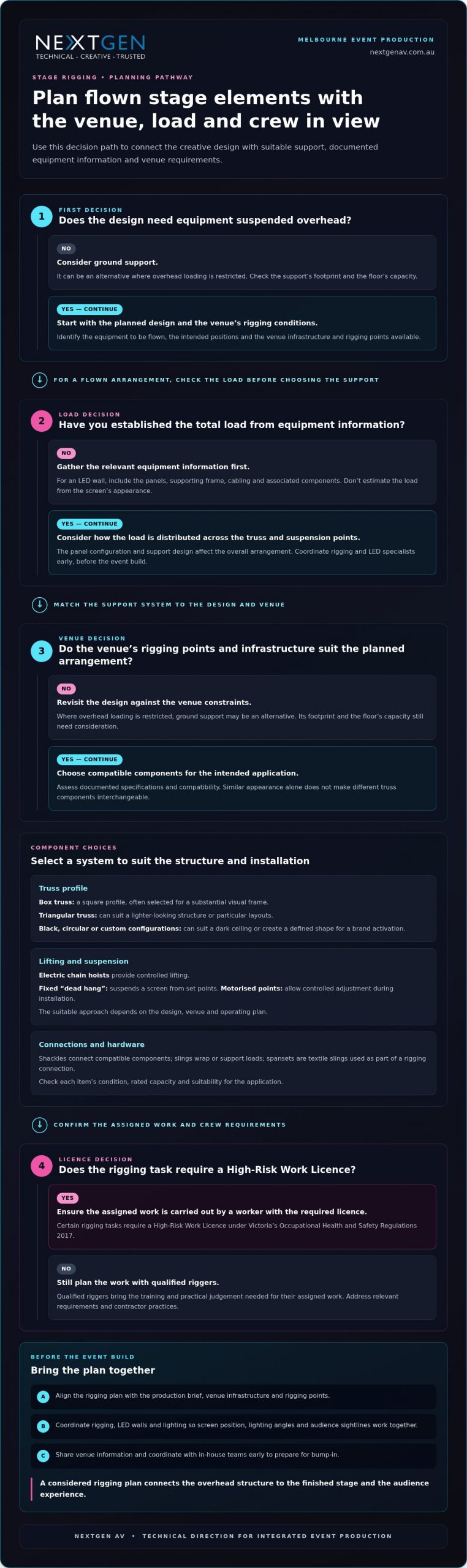
Truss, lifting equipment and connecting hardware form a support system, not a collection of interchangeable parts. Aluminium trussing creates a framework for lighting, audio and visual elements. Motors or fixed suspension points position that framework above the event floor. Each component needs to suit the intended design, the equipment it supports and the venue’s rigging conditions.
Truss profiles vary in shape and application. Box truss has a square profile and is often selected when a design calls for a substantial visual frame. Triangular truss can suit lighter-looking structures or particular layouts. Black truss can recede against a dark ceiling, while circular or custom configurations create a defined shape for a brand activation. Global and Eurotruss systems should be assessed using their documented specifications and component compatibility. Similar appearance alone does not make components interchangeable.
Trussing and Lifting Systems
Electric chain hoists provide controlled lifting, while the motor arrangement affects how a structure is raised and held in position. A fixed “dead hang” suspends a screen from set points; motorised points allow controlled adjustment during installation. The suitable approach depends on the design, venue and operating plan. Ground support can be an alternative where overhead loading is restricted, but its footprint and the floor’s capacity still need consideration.
Shackles connect compatible components, slings wrap or support loads, and spansets are textile slings used as part of a rigging connection. Check their condition, rated capacity and suitability for the application. The US reference OSHA Rigging Safety Standards addresses equipment in its jurisdiction. It does not replace Victorian requirements or project-specific engineering.
Planning for LED Video Walls
LED panels, their supporting frame, cabling and associated components all contribute to the suspended load. Establish the total using relevant equipment information, then consider how it is distributed across the truss and suspension points. Never estimate from the screen’s appearance: the panel configuration and support design affect the overall arrangement. A technical director can coordinate rigging and LED specialists early, aligning screen dimensions, sightlines and support requirements before the event build.
That integration matters in practice. A screen’s position affects truss layout, lighting angles and the audience’s view, so decisions made in isolation can undermine the finished stage. Explore how LED video walls for events fit into a production plan, then coordinate their support with the wider design. For stage rigging services melbourne organisers need to bring these elements together, NextGen AV’s technical direction connects structural planning with the audience-facing result.
Match Components to the Venue
Before selecting a system, map the equipment, intended positions and available support points. Where ceiling loading is limited, ground-supported structures may help shape the design, provided floor capacity and circulation space are considered. Early coordination lets the rigging plan support the creative brief without leaving critical decisions until bump-in.
Navigating Safety Standards and Load Calculations in Victoria
For a Melbourne event, safety planning becomes practical when the rigging design can be reviewed alongside the equipment schedule and venue information. AS 1418.17 is relevant to the design and use of lifting equipment. The technical team should identify which standards apply to the specific equipment and operation, rather than treating a reference to one standard as blanket approval. For a complex design, a structural engineer can assess the proposed arrangement and provide project-specific documentation.
Make sure design decisions are supported by clear information. Keep the current equipment schedule, venue details and rigging drawings together. If the screen size, lighting positions or production layout changes, pass the update to the technical director before issuing the plan for installation. This creates a traceable design process and gives the production team time to resolve issues before the build.
Load Calculations for Event Planners
Give your AV partner accurate equipment details, including models or specifications where available, quantities, planned positions and any movement during the event. Have the proposed loads at each support point assessed against the venue’s documented limits. For example, moving a screen from centre stage to one side can change how forces reach the supporting structure, even if the equipment list stays the same. Do not add items on site without a technical review.
Moving elements and outdoor installations need particular attention during design. The responsible technical team should account for how equipment will operate, assess site exposure and consider applicable wind conditions for temporary outdoor structures. The plan should set out how changes in conditions or production requirements will be handled, rather than relying on assumptions made during the initial design.
WorkSafe Victoria and Event Compliance
Build project records around the actual scope of work. Depending on the task and site, these may include a Job Safety Analysis, a Safe Work Method Statement where high-risk construction work applies, equipment inspection records and engineered drawings. Keep document versions clear, record design changes and make sure the crew has the current information. This document control connects planning decisions with on-site execution.
Address insurance arrangements through the event’s contracting and production planning. Define who is responsible for each part of the work, how changes are escalated and which records are shared with the venue. Clear ownership reduces uncertainty when multiple teams contribute to the build and gives organisers a reliable view of how the work will be managed.
Victoria University’s Event Production Management in Melbourne offers broader context on coordinating production components. For a rigging plan, the practical goal is to connect engineering review, accurate equipment information and controlled document updates. This helps the event design progress clearly from pre-production through to installation.
Planning Your Rigging Strategy: From Site Inspection to Bump-in
A rigging plan should take shape well before equipment arrives at the venue. A site inspection helps the technical team understand the room, access routes and production requirements, then build a plan around actual conditions. Melbourne venues vary widely: a purpose-built convention space such as MCEC and a heritage setting such as Melbourne Town Hall each have distinct layouts, access arrangements and operational considerations. Plan for the venue you have booked, not a generic room diagram.
During the inspection, map how equipment will travel from the loading area to the event space. Check loading dock access, lift dimensions, travel distances, storage areas and the routes crew will use during bump-in. These details can shape the installation sequence and affect how smoothly suppliers work together. Establish how the venue’s in-house technical team operates, including any exclusive rigging arrangements, then agree how the external production crew will coordinate with them.
Map the Venue Early
A useful site review records stage dimensions, access constraints, ceiling and support information supplied by the venue, and proposed positions for flown equipment. It should also capture practical details such as restricted corridors, shared loading areas and spaces that must stay clear for guests or venue operations. Keep approval responsibilities visible in the project schedule. Assign someone to track venue submissions and responses so design decisions do not stall while teams wait for information.
Coordinate the Production Plan
Pre-production drawings help the team visualise the rigging plot and identify clashes before installation. A 3D CAD view can bring truss positions, lighting, audio and LED screens together, making it easier to refine sightlines, cable routes and working space. Drawings should reflect the selected venue and current equipment plan. NextGen AV’s technical direction connects these elements, while clear version control helps every team work from the latest design.
Rigging is often among the first overhead work installed because lighting, audio and video elements may depend on it. It can also be among the last systems removed, after suspended equipment has been lowered and cleared. Build that sequence into the wider bump-in and bump-out schedule. Riggers, lighting crew and audio technicians should coordinate work zones, installation order and handovers, so one team’s progress does not block another’s access or create avoidable delays.
For outdoor or temporary structures, include the relevant approval pathway and supporting documentation in the project schedule. Requirements depend on the structure and site, so keep communication open with the venue and relevant approval contacts as plans develop. Stage rigging services melbourne event organisers can rely on should connect the site review, drawings, approvals and production schedule from the outset. This joined-up approach helps protect the creative vision from late changes and gives each crew member a clear role on site.
Bring your venue requirements and production concept together with NextGen AV’s Melbourne rigging and production team, coordinating technical details before bump-in.
Partnering with NextGen AV for Seamless Rigging and Production
Rigging works best when it is planned as part of the production, not added as a separate task after the stage design is settled. NextGen AV coordinates staging and rigging with lighting, professional audio and LED video walls, aligning technical decisions so every element supports the event’s intended look and audience experience. With extensive experience across Melbourne venues, the team brings practical knowledge to complex corporate productions and manages the details behind the scenes.
The “Invisible Expert” approach gives your production a clear technical lead while guests experience a confident, cohesive event rather than the logistics behind it. A technical director can connect the creative brief to the rigging plot, identify constraints early and coordinate the specialists responsible for each part of the build. That joined-up direction helps avoid clashes between the stage design, lighting positions and visual content.
One Coordinated Production Team
A single production partner can bring rigging, lighting and sound into the same planning conversation. That matters when a design includes flown fixtures, a large screen and a stage layout that needs to preserve sightlines. NextGen AV’s stage and lighting solutions connect structural decisions with the atmosphere you want to create, giving your brand a considered presence in the room.
Coordination also supports clearer decisions when venue conditions shape the design. If access, rigging points or the room layout affect the original concept, a production partner can bring the right technical specialists together to assess options and update the plan. You are not left to reconcile separate equipment schedules alone; the production details are managed as one connected project.
Built Around Your Event
A corporate gala and a product launch have different demands. A gala may call for layered lighting and a strong stage focal point; a launch may need screen content and lighting cues to work in a precise sequence. NextGen AV develops rigging plots around the event brief, venue and production elements, then coordinates the on-site work through bump-in and pack-down. The result is a plan shaped for your event, not a generic arrangement.
Safety and precision remain central throughout delivery. Clear technical direction helps the crew follow an agreed plan, communicate changes and keep rigging aligned with the wider production. That gives organisers more headspace to focus on presenters, guests and the experience they want people to remember.
If you are planning an event, speak with NextGen AV’s Melbourne team about your rigging and production brief. With stage rigging services melbourne organisers can integrate into a wider production, your concept has experienced technical partners from planning through to pack-down.
Shape the Event You Envision
Your rigging plan can do more than support the production; it can help define the atmosphere your guests remember. Bring technical planning into the creative process early, and your event design has room to develop around the venue, programme and moments you want to make stand out. That is the advantage of treating stage rigging services melbourne as part of the whole event experience, not a last-minute installation detail.
With NextGen AV, rigging is planned alongside lighting, audio and visual production, so your concept and practical requirements progress together. Focus on the message, the guests and the occasion, knowing experienced technical direction is managing the details.
Enquire about professional stage rigging services in Melbourne and take the next step towards a production designed with precision and purpose. Your vision deserves a team that helps it take shape with confidence.
Frequently Asked Questions
Do I need a permit for stage rigging in a Melbourne venue?
Permit requirements depend on the event structure and where it is being installed. Start by distinguishing formal approvals from a venue’s own technical approval process, as these can involve different teams and documents. For a Melbourne event, include approval responsibilities in the production schedule and have the organiser, venue and technical director work from the same event plan. This helps address approval requirements before the design is finalised.
How much does rigging typically cost for a corporate event?
A corporate rigging setup is scoped around the event brief rather than a standard package. Begin by defining what the audience needs to see and hear, such as a central LED screen, a clear stage view or a particular lighting look. NextGen AV’s technical team can translate that brief into a rigging and production plan, helping you understand the work involved and make informed decisions about the event design.
Can I use the venue’s in-house rigging services with NextGen AV?
Yes, NextGen AV coordinates production planning with a venue’s in-house rigging team. Establish one current version of the event plan, including the latest stage layout, screen positions and production schedule. This gives venue and production teams a shared reference as details develop, helping prevent outdated drawings or conflicting schedules from disrupting preparation.
What is the difference between basic trussing and engineered rigging?
Basic trussing describes a structural component, while engineered rigging refers to the planned scope around its use. For event planning, clarify whether the design covers only the truss or also the connected equipment, installation sequence and technical oversight. A clearly defined scope makes it easier to coordinate production responsibilities and understand how the proposed structure supports the event design.
How far in advance should I book rigging services for my event?
Start planning as soon as you have a likely venue and an initial event concept. That gives the technical team time to shape the design alongside your programme, stage layout and production schedule. If key details are still evolving, share the current brief and flag what may change. Early collaboration helps the rigging plan develop with the event instead of being added after other decisions are settled.
What safety documentation should I expect from a rigging provider?
Expect project records to match the final agreed design and clearly identify the version being used on site. If the stage layout or production equipment changes, the relevant drawings and records should be reviewed and updated as needed. For organisers, the practical check is consistency: documents shared with the venue and production crew should reflect the same installation plan.
Are there weight limits for hanging LED walls in Melbourne hotels?
Hotel rigging limits are specific to the property and may differ between rooms in the same building. Do not apply a ballroom’s information automatically to a smaller function room. For a Melbourne hotel event, use the documentation for the exact room and event date, and make sure the planned screen arrangement is assessed against that venue information before finalising production layouts.
What happens if my venue doesn’t have rigging points in the ceiling?
The event design can be adapted to the room rather than relying on a ceiling-mounted screen position. Options may include adjusting the screen location or incorporating it into a ground-level stage layout, with sightlines and audience movement considered as part of the revised design. NextGen AV coordinates these decisions with the wider production plan so the visual focus remains clear and practical for guests.
One overlooked cable run, suspended load or schedule change can put a polished production under pressure. A risk assessment for event AV gives your team a clear way to identify hazards, assign controls and keep decisions connected as plans evolve. With venues, suppliers and production timelines to coordinate, it’s understandable to worry that a technical risk or ownership gap could be missed.
This guide shows you how to build an AV-focused assessment from early planning through live operation and bump-out. You’ll learn what to consider across staging, event rigging, electrical equipment, sound systems, screens, access and changing site conditions, then turn those findings into practical controls with named owners and review points. NextGen AV brings technical direction and more than 30 years of industry experience to event production, helping teams manage complexity behind the scenes. The result is a clearer process for keeping people safer and delivering a seamless audience experience.
Key Takeaways
- A risk assessment for event av works best as a live process, with clear steps for identifying hazards, selecting controls and reviewing changes.
- Match controls to the production setup: indoor conferences, outdoor activations and staging or rigging each bring different considerations.
- Set named owners for key controls so crew, venue and suppliers know who is responsible before the event goes live.
- Use an event-day check to confirm plans are current, the crew is briefed and essential documentation is in place.
- See how technical direction can connect production planning and live operation to support a safer, seamless audience experience.
Why an event AV risk assessment matters before production begins
AV decisions shape more than the look and sound of an event. Equipment placement, cable paths, lighting positions and stage layouts can affect crew during setup, presenters moving on stage, attendees using access routes and the venue’s operation. A risk assessment for event av makes those connections visible early, while there’s still time to adjust the production plan rather than respond under pressure on event day.
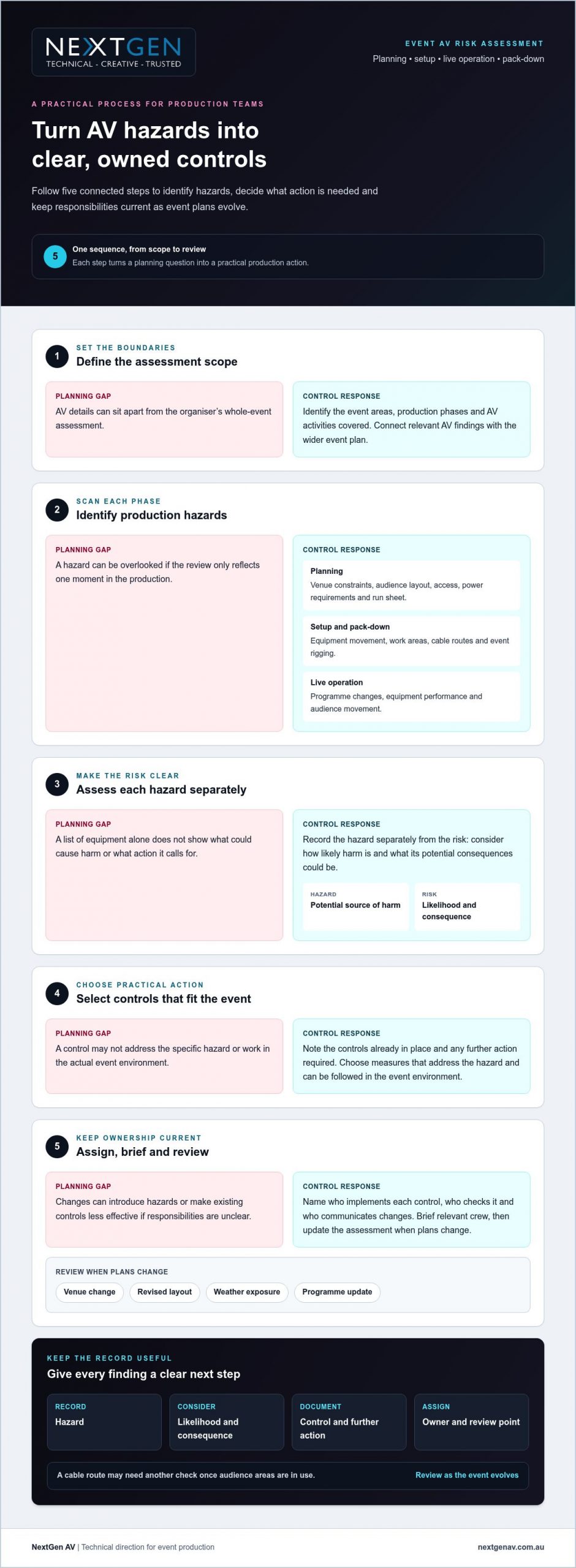
It’s a documented review of the hazards linked to the production, the risks they may create, the controls selected and the people responsible for those controls. A hazard is a potential source of harm; risk considers how likely harm is and what its consequences could be. This distinction is central to the wider risk assessment process, and helps a team move from simply listing equipment to deciding what action each hazard calls for.
An AV assessment focuses on technical production, but it should connect with the organiser’s whole-event assessment. For example, a cable route may be an AV setup detail and an access concern for the wider event plan. When both assessments share relevant information, the team can coordinate controls across production, venue operations and the audience experience.
Plans also need to stay live. A room change, revised schedule, equipment substitution or altered production layout can introduce new hazards or make existing controls less effective. Review the assessment when these details change, and make sure the people affected understand any updated responsibilities.
What does an AV risk assessment cover?
Set the assessment around the actual production and venue. Depending on the design, it may cover sound systems, lighting, LED displays, cabling, staging and event rigging. Consider where equipment will be placed, how crew will access work areas, and how the setup interacts with presenters and attendees. A Melbourne venue’s layout and operating arrangements can make the relevant details different from one production to the next.
Record each hazard separately from its likelihood and potential consequence, then document the chosen control and its owner. This keeps the assessment practical: the team can see not only what could cause harm, but what will be done about it.
Who needs to be part of the process?
Bring together the event organiser, venue contact, production lead and relevant technical specialists. Each sees a different part of the picture: the organiser understands the programme, the venue contact knows site arrangements, and technical specialists can assess production-specific hazards.
Assign a named person to each control rather than relying on general team awareness. Clear ownership gives crew a direct point of reference during setup and live operation, helping changes and concerns reach the right person without confusion.
How to assess event AV hazards from planning through pack-down
A risk assessment for event AV should follow the production from the first venue plan to the final equipment load-out. Keep the process practical and repeatable: define the scope, identify hazards, assess risk, select controls, assign owners and review. Start with the venue, audience, programme, equipment plan, access routes and schedule. These details shape how technical work fits around people and venue operations.
For each item, record what controls are already in place, what further action is needed, who is accountable and when the control will be checked. The UK Health and Safety Executive’s event guide describes planning across stages such as setup and breakdown; its outline of duties as an event organiser is a useful reference, but Australian events should be assessed against requirements that apply locally.
Identify hazards across each production phase
At planning stage, consider venue constraints, audience layout, access, power requirements and the run sheet. During setup and pack-down, assess equipment movement, work areas, cable routes and event rigging. For live operation, account for programme changes, equipment performance and audience movement. A cable route that is clear during setup, for instance, may need another check once audience areas are in use.
Turn findings into active controls
Choose controls that address the specific hazard and can be followed in the actual event environment. Name who implements each control, who checks it and who communicates changes to affected crew. Set review triggers for a venue change, revised layout, weather exposure or programme update. Brief relevant crew before work starts, then revisit the assessment when a change could alter the risk or the effectiveness of a control.
Keep the process moving
Use this sequence to guide the review:
- Define scope: identify the event areas, production phases and AV activities covered.
- Identify hazards: review the venue, audience, equipment and work activities phase by phase.
- Assess risk: consider how harm could occur and its potential consequence.
- Select controls: note existing measures and any additional action required.
- Assign and review: name an owner and review point for each action, then update the record when plans change.
Clear technical direction can connect those actions across planning, setup and live operation. Explore how NextGen AV event production brings production planning and technical delivery together, so the team can manage changes with precision through to pack-down.
Compare AV risks and controls across common event setups
The right control depends on the room, production design and people moving through the space. An indoor conference, outdoor activation and staged production can use similar AV, but their hazards and control owners won’t necessarily be the same. This comparison helps you tailor your risk assessment for event av to the setup, while keeping clear sound, visible content and orderly audience movement in view.
| Setup | Example hazard | Potential consequence | Example control | Responsible role |
|---|---|---|---|---|
| Indoor conference | Cables cross a presenter or attendee access route | Someone trips, or movement around the room is disrupted | Plan cable routes away from walkways; secure and check them before doors open | Production lead, with the venue contact coordinating room access |
| Outdoor activation | Weather exposure affects equipment or the planned operating area | Equipment operation or audience movement may be affected | Document a weather response plan suited to the site and review it as conditions or the layout change | Event organiser, with the production lead managing AV-related actions |
| Staging or event rigging | Stage structure or suspended equipment is unsuitable for the planned production | People may be exposed to harm, and the event may be interrupted | Assess the structure and suspended equipment for the specific design; involve a qualified rigger where relevant and use a structural engineering certificate where applicable | Production lead and relevant technical specialist |
Sound, screens and power
For sound systems, assess equipment placement, cable runs and power arrangements against the venue plan. Poor placement or unclear cabling can create hazards while also compromising intelligible sound. For LED displays, consider sightlines, visibility from audience areas and signal paths, so content reaches the screen as intended without creating avoidable obstacles in production areas. Related planning considerations are covered in this LED video wall planning guide.
Use applicable technical standards and limits that have been checked for the specific work and context. AVIXA standards provide a reference point for professional AV practice; don’t assume a threshold applies without verifying the relevant standard and its scope.
Staging, rigging and outdoor conditions
Review structures, suspended equipment, access around work areas and how production activity interacts with other event operations. A structural engineering certificate or qualified rigger may be relevant depending on the structure and rigging work involved. Outdoor productions also need a documented response plan for relevant weather exposure, with controls and responsibilities clear to the team.
For further production context, see the stage and lighting hire guide. Treat each setup on its own merits: precise technical planning supports a safer working environment and a more assured experience for the audience.
Use this event AV risk assessment checklist on event day
A risk assessment for event av is most useful when the team can act on it at the venue. Treat this event-day check as a working control point, not paperwork to file away. Confirm what’s changed, who owns each action and how the team will respond if a control isn’t in place. That clarity supports a composed setup and a seamless experience for presenters and attendees.
Before crew access and setup
Before work begins, make sure the crew has the current production plan, relevant venue information and assessment. Brief everyone on work areas, communication channels and how to report a change or concern. Record any outstanding actions, identify who will resolve them and communicate the decision before setup proceeds.
- Plans: Check the production layout and schedule against the venue’s current arrangements.
- Responsibilities: Confirm control owners and who to notify if an action can’t be completed as planned.
- Equipment: Inspect relevant equipment and cabling for visible damage or issues that need attention before use.
- Work areas: Check cable management and keep access routes clear for crew and attendees.
- Documentation: Have relevant assessment records and production documents available to the team.
Before doors open and during the event
Before attendees enter, verify that planned controls are in place and ownership remains clear. Check that access routes are unobstructed and that technical arrangements still match the approved layout. For sound planning, review the professional sound system hire guide alongside the production plan, so audio decisions support clear communication in the room.
Keep the assessment active during the programme. A revised running order, relocated equipment or changed site condition can affect an existing control. Pause to review material changes with the relevant leads, agree any new action and brief the crew who need to know.
- Show-time review: Confirm what has changed and whether controls still suit the setup.
- Open actions: Check unresolved items, the person responsible and the agreed next step.
- Escalation: Ensure crew know the agreed contacts for raising a concern or seeking a decision.
- Follow-up: Record incidents, near misses and actions using the event’s agreed process.
A disciplined check keeps technical details connected to the audience experience, from intelligible sound to clear movement through the venue. Plan your event AV production with NextGen AV, with technical direction guiding the details from setup through live operation.
How NextGen AV manages risk as part of event production
Managing AV risk takes more than supplying equipment. It takes coordinated decisions about the production design, venue conditions, crew responsibilities and live programme. NextGen AV works as a production partner, using technical direction to connect those moving parts from planning through setup, live operation and pack-down. That gives you a clear line between the controls in the assessment and the experience your audience sees and hears.
Technical planning behind the scenes
Planning starts with the event’s objectives and conditions: the venue, schedule, audience, access, staging and the AV requirements that bring the experience to life. A risk assessment for event av helps make technical considerations part of production planning, rather than a separate document disconnected from the show. Equipment choices, work areas and crew coordination can then be shaped around the specific event.
With more than 30 years of industry experience and a Melbourne base, NextGen AV brings practical knowledge of Victorian event production to projects in Melbourne and across Australia. The team’s work includes planning, technical direction, setup, live operation and pack-down, helping clients coordinate production requirements as details develop.
From assessment to confident delivery
Technical direction helps keep controls, owners and production changes aligned. As plans evolve, the production lead can coordinate relevant updates with the crew and venue contact, so the team understands what has changed and who is responsible for the next action. This joined-up approach helps technical precision support a composed show, with clear sound, visible content and a smooth experience for attendees.
Safety measures are matched to the work and event. Depending on the production, relevant planning may include a Job Safety Analysis, Test and Tag, or the involvement of a qualified rigger for applicable rigging work. NextGen AV’s safety-related capabilities also include a structural engineering certificate and High-Risk Work Licence. These are considered in context, rather than treated as a blanket checklist for every event.
From corporate events to community productions, NextGen AV delivers events throughout Australia, bringing planning and technical delivery together behind the scenes. You stay connected to decisions, responsibilities and production changes, while the technical team works to keep each detail in step with the event.
Planning an event in Melbourne or elsewhere in Australia? Discuss your event production requirements with NextGen AV and take the next step towards a carefully coordinated AV plan.
Bring your production plan together
A safer production starts with an AV assessment that reflects the actual venue, setup and audience. Identify hazards across planning, live operation and bump-out, match controls to each risk, and give every action a clear owner. Keep the process active: when plans or site conditions change, review the controls and brief the people affected.
NextGen AV brings over 30 years of industry experience, a Melbourne-based warehouse and experience delivering events throughout Australia. Technical planning may draw on capabilities such as Job Safety Analysis, Test and Tag and qualified riggers, selected to suit the work and production. With the right technical direction, your risk assessment for event av becomes part of a coordinated production plan, helping manage complexity behind the scenes while your audience enjoys a seamless event.
Plan your next event with NextGen AV and take the next step towards a carefully coordinated production. Your team can focus on delivering the moment, with the technical details guided by experienced hands.
Frequently Asked Questions
What should a risk assessment for event AV include?
A risk assessment for event AV should record the production scope, venue, audience, equipment and hazards during setup, live operation and pack-down. Include relevant elements such as sound systems, screens, cabling, staging and event rigging. For each hazard, document the assessed risk, controls already in place, further actions, accountable owners and review points. Tailor the assessment to the specific production and venue rather than relying on a generic template.
Who is responsible for an event AV risk assessment?
Responsibility should be clearly assigned across the event and production teams. The organiser, venue representative, production lead and relevant technical specialists can contribute information and coordinate controls, according to their roles in the event. Name an owner for each action, and make sure the team knows who to tell about changes or unresolved issues. Clear ownership helps prevent important controls from being lost between planning, setup and live operation.
How do you assess AV risks at an event?
Use a repeatable sequence: define the scope, identify hazards, assess likelihood and potential consequence, select controls, assign owners and review. Consider hazards during planning, setup, live operation and pack-down, using the actual venue and production details. Reassess when a significant change to the venue, schedule, equipment or production plan could affect a hazard or control. This keeps the assessment aligned with the event as it develops.
What are common AV hazards at events?
Potential AV hazards include cables across access routes, moving equipment during setup, unsuitable power arrangements, staging concerns, suspended equipment and changing site conditions. These examples won’t apply to every event. A hazard is something with the potential to cause harm; risk considers the likelihood and possible consequence. For a Melbourne venue, assess the real room layout, production plan and audience movement rather than assuming a standard setup.
When should an event AV risk assessment be reviewed?
Review the assessment during planning and before relevant work begins, then revisit it when circumstances change. A revised room layout, equipment substitution, schedule update or changed site condition may affect existing controls. Record updates, identify who owns any new actions and share the current version with the people implementing those controls. Set review points around meaningful production milestones and changes, rather than relying on an arbitrary fixed interval.
Does an AV risk assessment replace the event safety plan?
No. An AV assessment focuses on hazards connected with technical production, while broader event safety arrangements consider the event as a whole. The documents should connect where risks overlap, such as when production cabling affects attendee access. Coordinate relevant information between the organiser, venue and production team. For Melbourne events, verify any statements about specific legal or compliance requirements against current official Victorian guidance for the circumstances.
For av equipment rental for large venues, the goal is not simply to bring in more equipment. It is to engineer a production that works as one system. In a vast room, powerful sound alone will not prevent dead spots, and a large screen will not impress if its content appears pixelated. Audio coverage, image clarity, rigging and crew coordination all need to suit the venue.
Planning AV for a large venue can feel daunting when you are responsible for an experience that must reach every attendee and run smoothly. NextGen AV brings more than 30 years of event production experience in Melbourne to the planning, technical direction and delivery behind the scenes, so you can focus on your guests and event objectives.
This guide explains how to plan sound systems for even coverage, select LED screens that deliver visual impact at scale, and account for event rigging and technical labour from the outset. You will also learn how a proactive AV partner can manage venue complexities with precision, helping transform a large space into a seamless event experience.
Key Takeaways
- Large-venue AV calls for carefully designed systems that deliver clear sound and compelling visuals across the room.
- LED wall pixel pitch and speaker configuration both shape the audience experience.
- A technical site survey helps identify power and rigging requirements before production begins.
- Look beyond equipment to technical direction and coordinated event delivery when planning AV for a large venue.
- NextGen AV’s Melbourne experience supports precise planning for high-impact events.
Scaling Up: Unique AV Challenges for Large Venues
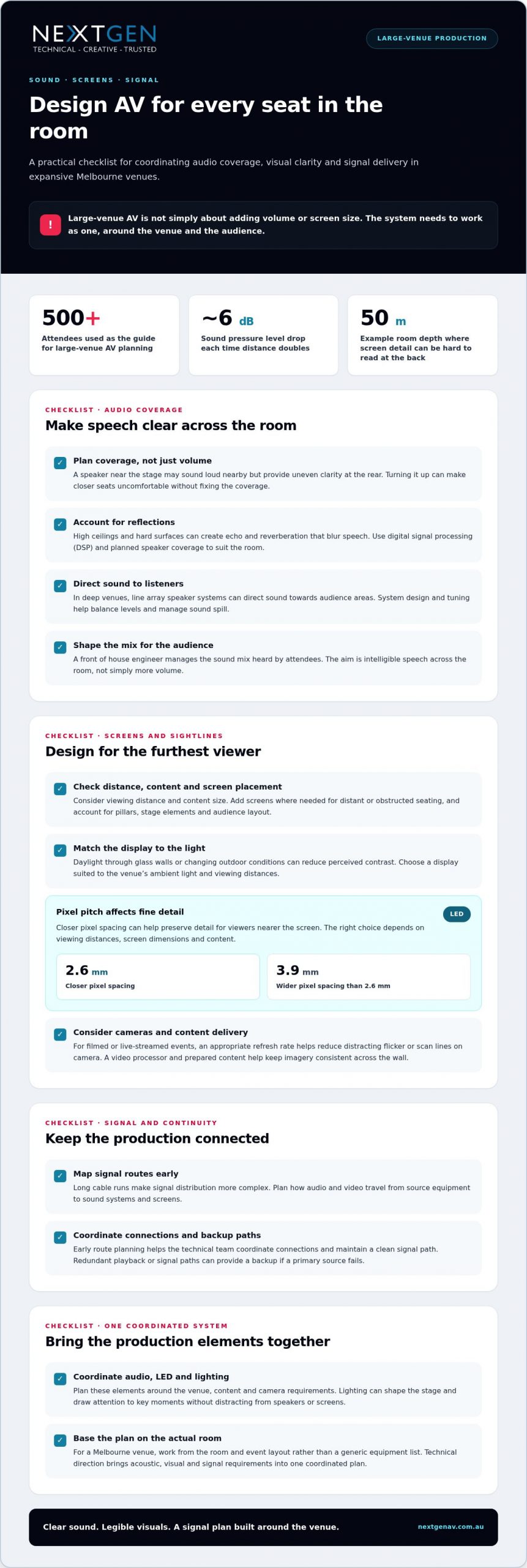
For practical planning, large-venue AV means systems designed to serve 500 or more attendees across an expansive space. That could be a conference at the Melbourne Convention and Exhibition Centre (MCEC), a high-ceilinged hall or an outdoor event area. The challenge is not simply increasing volume or screen size. Audio, visuals and signal paths need to be designed around the venue so every part of the audience can follow the event clearly.
Acoustic Complexity in Expansive Spaces
Sound spreads as it travels. In a free field, the inverse square law means sound intensity falls as distance from a source increases. Sound pressure level drops by about 6 dB each time the distance doubles. A speaker placed at the front may sound loud near the stage yet fail to provide consistent clarity at the rear. Raising the volume can make nearby seats uncomfortable without fixing uneven coverage.
High ceilings and hard surfaces in convention centres can reflect sound, creating echo and reverberation that blur speech. Digital signal processing (DSP) helps shape and manage the audio system for the room, while planned speaker coverage directs sound towards listeners rather than relying on brute force. Specialist professional audio equipment is designed for live performance and event environments, unlike consumer-grade systems intended for smaller listening spaces. The aim is intelligible speech across the room, not simply more volume.
Visual Sightlines and Scale
In a room stretching 50 metres, a screen that looks impressive near the stage can leave text and detail difficult to read at the back. Plan for the furthest viewer: consider viewing distance, content size and whether additional screens are needed for distant or obstructed seating. Place screens with the room’s sightlines in mind, so pillars, stage elements and audience layout do not compromise the view.
Ambient light matters too. Daylight through glass walls or changing conditions at an outdoor stadium can reduce the perceived contrast of projected images. A display suited to the venue’s light and viewing distances helps keep presentations, graphics and live content legible. For a Melbourne venue, base the AV plan on the actual room and event layout rather than a generic equipment list.
Signal integrity is another large-room consideration. Long cable runs make signal distribution more complex, so the production plan needs to account for how video and audio travel from source equipment to screens and sound systems. Mapping those routes early helps the technical team coordinate connections, maintain a clean signal path and reduce avoidable disruptions. Technical direction brings acoustic, visual and signal requirements into one coordinated plan, giving your event a stronger foundation before production begins.
Essential Hardware for Massive Impact: LED Walls and Audio
Large-scale production depends on selecting technology as a coordinated system, not as a collection of impressive individual pieces. LED walls, professional audio systems, lighting and backup signal paths all shape what the audience sees and hears. Technical direction brings these elements together around the venue, content and camera requirements.
LED Technology: The Gold Standard for Visuals
Pixel pitch is the distance between the centres of neighbouring pixels. A 2.6mm pitch packs pixels more closely than a 3.9mm pitch, which can help preserve fine detail for viewers closer to the screen. The right choice depends on viewing distances, screen dimensions and content. For guidance on planning large-format displays, explore LED video walls for events.
LED panels can maintain strong brightness and contrast in ambient light, making them suited to rooms where daylight may affect projection. For events filmed or live-streamed, refresh rate matters too. An appropriate display setup helps reduce distracting flicker or scan lines on camera. A video processor and carefully prepared content complete the chain, keeping imagery consistent across the wall.
Pro Audio: Line Arrays and Frequency Management
In a deep venue, line array speaker systems can direct sound towards audience areas with more controlled coverage than speakers simply aimed from the stage. System design and tuning help balance levels across the room and manage sound spill, supporting clear speech without excessive volume. A front of house engineer then shapes the mix heard by attendees. NextGen AV provides professional sound systems as part of event production.
Melbourne CBD venues can have a busy radio-frequency environment for wireless microphone operation. Frequency coordination and equipment settings need to account for the location so microphones remain dependable throughout presentations and performances. Professional production also plans for continuity. Redundant playback or signal paths can provide a backup if a primary source fails, reducing the chance that a technical fault interrupts a high-profile moment.
Lighting and Continuity
Lighting design adds depth beyond a basic wash. Moving fixtures can shape the stage, draw attention to key moments and bring architectural features into the event’s visual language. The aim is an atmosphere that supports the content without distracting from speakers or screens.
These choices are part of live event production, where technical planning connects creative intent to precise execution. NextGen AV coordinates lighting, LED and audio as one production system, so you can focus on the experience your guests see and hear. Explore large-scale event production for your next Melbourne event.
Venue In-House AV vs. Professional Hire Specialists
Built-in venue AV can look like the simplest option, but convenience depends on how well the available system suits your event. A standard package may cover basic microphones and a screen, yet leave little room to adapt the setup to your brand, run sheet or audience layout. For a conference, gala or product launch, consider whether the production plan gives you clear technical ownership as well as the right equipment.
Compare the scope, not just the package label. An “all-inclusive” offer and a production proposal may cover different elements, such as equipment, setup, operation, technical direction and pack-down. A clear, itemised scope helps you understand who is responsible for each part of the production and how it supports your programme. With av equipment rental for large venues, full-service production means more than dry hire. Equipment is planned, integrated and operated as part of the event experience.
The Benefits of a Dedicated Production Partner
A dedicated production partner can align the technical plan with your creative brief, then coordinate audio, visuals, lighting and crew around it. That continuity is useful for a roadshow, where a consistent brand experience needs to be recreated across different venues. Rather than leaving you to join up the technical details, a production lead manages them behind the scenes and keeps the event team focused on delivery.
Equipment is selected for the project rather than assumed from a venue’s standard inventory. A dedicated crew works to the agreed production plan, with roles and responsibilities defined before the event. If a presentation file, microphone or playback source causes an issue mid-session, a clear technical lead can coordinate the response and help keep the programme moving.
When In-House Services Fit
Venue-provided AV can suit a straightforward meeting with minimal technical requirements, such as a speaker using a microphone and a single presentation screen. It may also suit a community gathering with a simple programme and modest production needs. Some venues manage access to their rigging points, so production involving overhead equipment needs to account for venue procedures and coordination.
For a more ambitious event, a specialist team can tailor staging, sound and visual production to your brand and format, while coordinating its work with the venue. NextGen AV brings more than 30 years of experience across Melbourne and Victorian venues, pairing technical direction with a clear execution plan. You get a production partner for a focused AV setup or an integrated event experience.
The Technical Site Survey: Safeguarding Your Live Event
A site survey turns venue details into a practical production plan. At a Melbourne convention venue, the loading dock, power access, ceiling structure and cable routes can all affect how an event is built and delivered. Addressing these details early helps prevent last-minute changes and gives your crew a coordinated path from bump-in to showtime.
Four Checks Before Bump-In
- Power: Map the planned equipment load against the venue’s available supply, including whether three-phase power is needed for the proposed rig. This helps the technical team plan distribution and avoid overloading circuits.
- Rigging: Identify approved rigging points and their documented capacities before planning suspended LED walls or speakers. Assess equipment weight and placement as part of a safe design, with event rigging handled by a qualified rigger.
- Loading dock: Plan vehicle access, delivery sequence and movement from the dock to the event space. For large semi-trailers, confirm that the route, access times and unloading area suit the production plan.
- Signal paths: Map cable routes and approximate run lengths between control positions, stage, screens and audio equipment. This reveals where signal distribution needs planning and helps the crew account for possible interference or other sources of disruption.
Safety and Compliance
Large-scale production calls for documented safety planning, not assumptions. A Job Safety Analysis helps identify task-specific hazards and control measures, while a structural engineering certificate can document that a temporary structure has been assessed for safety. NextGen AV’s safety strengths include qualified riggers, High-Risk Work Licences and Test and Tag. Electrical and rigging work must be planned with applicable Australian requirements and venue procedures in view. Clarify responsibilities and insurance requirements as part of event contractor planning, and do not treat a single document as a substitute for safe execution.
Technical Direction in Action
The technical director connects your event vision to what the venue can safely and practically support. They coordinate production details with venue teams, align technical requirements with the run sheet, and manage cues for presentations, lighting and media playback during the live show. That central oversight helps the crew work to the same plan, so a complex production feels composed from the audience’s perspective.
With more than 30 years of experience navigating Victorian event venues, NextGen AV brings venue knowledge and technical direction together from planning through delivery. Coordinated planning supports a seamless event. Make the site survey part of the production process, then plan your venue AV production with NextGen AV.
Partner with NextGen AV for Large-Scale Production
A high-impact event should feel effortless to the audience, even when production involves a complex venue, multiple technical systems and a tightly timed programme. NextGen AV brings more than 30 years of event production experience in Melbourne and across Australia, pairing technical direction with end-to-end production management so you can focus on your guests and message.
Melbourne Expertise, National Reach
From the Melbourne Convention and Exhibition Centre (MCEC) and Marvel Stadium to major hotel ballrooms, each venue has its own layout, access points and technical considerations. NextGen AV plans around the space and event brief, helping corporate AGMs, gala dinners and product launches make the right impression while keeping delivery practical.
Production can span concept planning, 3D renders, equipment coordination, show operation and post-event pack-down. LED video walls, professional audio systems, lighting and staging are selected and integrated to support your programme rather than treated as standalone hire items. This joined-up approach is particularly useful when a run sheet includes speaker presentations, video playback, lighting cues and live audience moments.
Quiet Power, Visible Impact
NextGen AV manages technical details in the background while your message takes centre stage. The right display format gives your content presence, carefully planned audio helps audiences follow each speaker, and lighting shapes the room around the event’s purpose. Whether you are producing a formal AGM or a celebratory launch, technical direction keeps those elements working as one experience.
For large-scale events, a clear production scope helps everyone understand the planned deliverables, responsibilities and technical requirements. Planning starts with your objectives, audience, venue and programme, then shapes a production plan around what the event needs. That means av equipment rental for large venues is part of a managed production solution, with the planning and coordination needed to help complex events run smoothly.
With experience supporting events across Australia, NextGen AV brings Melbourne-based expertise to productions in major venues and distinctive event spaces. You can focus on the occasion while an experienced team coordinates the details behind the scenes.
Discuss your large-scale event with the NextGen AV team and start planning a production shaped around your venue, audience and vision.
Make Your Next Large-Scale Event Seamless
Large-venue production succeeds when every technical choice serves the audience. Clear audio coverage and legible visuals matter, as do early checks of venue power, rigging, access and signal paths. A coordinated production plan brings these moving parts together and helps reduce pressure on your event team.
Choosing av equipment rental for large venues is about more than selecting screens and sound systems. It is about partnering with a team that shapes the technical plan around your venue, programme and brand, then manages the details behind the scenes. NextGen AV brings more than 30 years of technical experience and full-service production management to events across Australia.
Give your event the planning and technical direction its scale demands. Plan your large-scale event production with NextGen AV and move forward with confidence that your audience experience is in capable hands.
Frequently Asked Questions
What information do you need to plan AV for a large venue in Melbourne?
Start with your event format, audience size, venue, programme and content requirements. Details such as room layout, stage position, presentation format and planned cues help shape an AV plan around the experience you want to create. NextGen AV coordinates technical direction and production management, aligning equipment and crew with your event objectives so key details are planned before bump-in.
What is the difference between an LED wall and a projector for a large room?
An LED wall forms an image on its display panels, while a projector casts an image onto a screen or surface. LED walls can maintain strong brightness and contrast in rooms with ambient light, while projection can suit particular screen layouts or visual concepts. The right choice depends on viewing distance, room lighting, content and event design, including how attendees will see the image across the space.
Do I need a technical director for my 500-person conference?
A technical director is valuable when a conference combines multiple AV elements, speakers, presentations or live cues. They coordinate the technical plan, crew and run sheet, helping keep each part of the programme aligned. For a 500-person conference, AV equipment rental works best as part of an integrated production plan rather than a list of separate equipment. NextGen AV provides technical direction and production management.
Can I use the venue’s built-in sound system for my gala dinner?
A venue’s built-in sound system can suit a gala if its coverage and controls support the room, audience layout and programme. Speeches, music and presentations may each place different demands on the system. Assess how clearly guests can hear from different seating areas and whether the setup supports the event cues. Production planning can establish how the in-house system fits into the overall audio plan.
How long does it take to set up AV for a stadium-sized event?
Setup time depends on the production’s scale, venue access arrangements and equipment involved. A stadium event with staging, LED walls, audio, lighting and event rigging needs a coordinated bump-in plan rather than a standard timeframe. The technical team can map the work sequence around the venue and event schedule, organising installation, system checks and show preparation so production is ready before doors open.
What are the power requirements for a large LED video wall?
Power requirements depend on the LED wall configuration and wider production setup, so one figure will not apply to every event. A technical site survey assesses the equipment load against the venue’s available supply, including whether three-phase power is required. Planning power distribution early helps the crew coordinate the LED wall with other production equipment and the venue’s electrical arrangements.
Do you provide AV hire for outdoor venues in Australia?
Yes. NextGen AV delivers events throughout Australia, including outdoor productions requiring LED video walls, professional audio systems, lighting, staging and technical direction. Planning considers the site layout, audience coverage, ambient conditions and event logistics, so the technical solution suits the setting. From Melbourne activations to events elsewhere in Australia, production is tailored to the venue and the experience you want guests to enjoy.
How do you ensure audio clarity at the back of a deep convention hall?
Audio clarity starts with designing coverage for the room rather than simply increasing volume. Speaker placement and system tuning help distribute sound towards audience areas, while digital signal processing supports precise control. A front of house engineer manages the mix heard by attendees and adjusts it for the event. This coordinated approach helps keep speech intelligible from the front rows to the rear of the hall.
What if runway lighting could make every fabric, silhouette and movement read clearly while shaping the mood of the whole show? Fashion show runway lighting Melbourne productions need to do more than create drama: the design must help garments appear clear to the audience and account for camera views.
If you’re balancing creative impact with venue limits, rigging, power and a tightly timed runway schedule, early coordination matters. Lighting, staging and technical direction need to work together so the collection stays in focus and the production runs smoothly.
This guide explains how to plan lighting around garments, models, camera positions and the venue, along with practical details that help organise the production. NextGen AV provides lighting design, staging, rigging and technical direction for Melbourne events. Its team can support planning from pre-production through on-site management and pack-down, helping you coordinate the technical details behind the runway.
Key Takeaways
- Plan runway lighting as part of the overall production, aligning the collection, models, audience experience and schedule.
- Consider how lighting direction and garment texture affect what audiences see, and confirm photography and video needs with the production team.
- Choose between clean, garment-led illumination and a more atmospheric look by weighing the collection’s identity, runway scale and camera views.
- For fashion show runway lighting melbourne, confirm venue access, rigging information, runway layout and production timing early.
- Look for a production partner who coordinates lighting design, technical direction, safety planning and on-site delivery, not just equipment supply.
Why runway lighting in Melbourne shapes the whole fashion show
Runway lighting has to serve the collection, models, audience and event schedule at the same time. It’s not simply a matter of aiming lights at a catwalk. A useful plan considers what each look needs to communicate, where people will be watching from, and how lighting cues fit the running order.
The purpose of runway lighting is to make garments and model movement clear while creating an atmosphere that supports the collection. When the design reflects both the visual brief and the practical needs of the production, the runway feels connected to the rest of the event.
For organisers planning fashion show runway lighting in Melbourne, start by defining the experience the collection should create. A clear brief gives the production team direction for design decisions and helps balance creative ambition with the venue’s conditions.
What does fashion show runway lighting in Melbourne need to achieve?
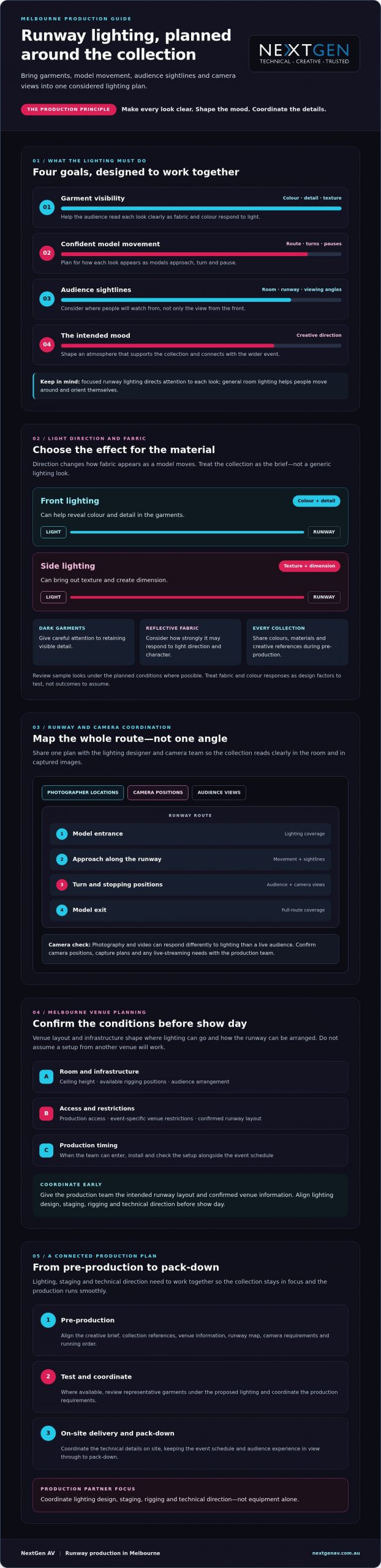
Four goals need to work together: garment visibility, confident model movement, audience sightlines and the intended mood. A lighting angle that brings out the texture of a structured fabric may affect how a flowing or reflective material appears. Share the collection’s colours, materials and creative direction early so the lighting plan responds to the clothes rather than relying on a generic look.
Runway lighting also has a different job from ambient light around the event space. General room lighting helps people move around and orient themselves; focused runway lighting directs attention to each look. The stage lighting techniques overview offers background on principles that can inform a production, but the final design should respond to the show’s specific brief.
Why does a Melbourne venue change the plan?
Every room has its own layout and infrastructure. Ceiling height, available rigging positions, audience arrangement and production access can all affect where lighting can go and how the runway should be arranged. Confirm these details with the venue early, including any event-specific restrictions. Don’t assume a setup used at another venue will work in your space.
Access and timing matter, too. The production plan needs to account for when the team can enter, install and check the setup alongside the event schedule. Give your lighting team the intended runway layout and confirmed venue information so lighting design, staging, rigging and technical direction can be coordinated before show day. Early alignment helps keep the focus on the collection and audience experience.
How runway lighting brings garments, movement and camera views together
Lighting direction affects how fabric appears as a model moves. Front lighting can help reveal colour and detail, while side lighting can bring out texture and create dimension. The right balance depends on the garments, runway route and audience view. Reflective, textured and dark fabrics each bring different considerations, so share collection references, colours and material details during pre-production.
A runway lighting plan needs creative intent and camera awareness so the collection reads clearly in the room and in captured images. Photography and video can respond differently to lighting than a live audience does. Confirm camera positions, capture plans and any live-streaming needs with the production team, then review representative garments under the proposed lighting during a rehearsal or test if available. Advice on perfect fashion show lighting also highlights the value of considering models, garments and the runway as one visual composition.
How do colour and fabric affect the lighting brief?
Bring creative references into the technical conversation early. Dark garments may need careful attention to retain visible detail, while reflective material can respond strongly to the direction and character of light. Treat these as design factors to test, not outcomes to assume. Reviewing sample looks under the planned conditions gives the team a chance to assess how colour, texture and movement appear before the show.
How should lighting support models and cameras?
Map the full runway route, including model entrances and exits, stopping positions and photographer locations. This helps the lighting team consider how each look will appear as models approach, turn and pause, rather than designing for only one audience angle. Share the map with the lighting designer and camera team so their requirements can be coordinated.
Lighting cues should follow the agreed running order and be coordinated with the show caller or stage manager. Transitions can then support the pace of the show rather than compete with it. For broader context on how staging and lighting work together, see this stage and lighting hire guide.
For fashion show runway lighting in Melbourne, align the creative brief, garment tests, camera positions and cue sequence before production day. If you’re shaping the technical plan, talk with NextGen AV about runway lighting design as part of your production planning.
Runway lighting options in Melbourne: match the design to the show
The right lighting approach starts with the collection, not a preset effect. Clean, garment-led illumination keeps attention on colour, cut and detail. A more atmospheric design can make a show feel more dramatic, but effects should support the clothes rather than compete with them. For fashion show runway lighting in Melbourne, weigh the creative direction against runway scale, audience positions and photography or video plans before settling on a look.
Should the runway feel editorial, dramatic or understated?
Use references from the collection and event brief to describe the intended mood. Editorial and understated looks may call for a restrained approach that lets the garments lead; a more expressive design can shape the atmosphere and create a stronger visual frame. Neither approach is automatically better. First confirm garment visibility, sightlines and camera needs, then decide where effects add meaning and where they might distract.
The table below connects common event priorities with design considerations. Use it as a briefing prompt, not a fixed technical prescription.
| Event priority | Lighting-design consideration |
|---|---|
| Garments take centre stage | Prioritise clear, consistent visibility and keep effects secondary to the collection. |
| A distinctive mood | Use atmosphere to reinforce the creative brief while preserving clear views of each look. |
| Photography or video | Share camera positions and capture plans early so the design considers both the room and the lens. |
| A compact or unusual runway layout | Review audience positions and the route before deciding how the lighting should cover the space. |
When should lighting integrate with staging and sound?
Coordinate lighting positions with runway dimensions and stage layout from the outset. Changes to the route or staging can affect sightlines and the areas the lighting needs to cover. Align the creative plan with the production layout before finalising cues. This joined-up planning helps the technical team manage the details without pulling focus from the show.
Sound systems and lighting cues also need to follow the agreed show sequence, particularly when music sets the pace for model entrances. Coordinate cue timing with the show caller or stage manager, and share audio requirements with the production team. For related planning, see this professional sound system hire guide. If visual content is part of the concept, decide how it will complement the runway rather than compete with the collection.
Plan Melbourne runway lighting with venue, rigging and safety in mind
A well-designed runway also needs a practical production plan. For fashion show runway lighting in Melbourne, establish the creative brief, confirm venue details, coordinate lighting with the runway and staging, plan technical delivery, then rehearse before doors open. This sequence gives the production team a chance to resolve constraints before they affect the event schedule.
- Establish the brief: Define the collection’s visual direction, runway route and audience experience.
- Confirm the venue: Check access, schedule, available plans, power, ceiling details and rigging information.
- Coordinate the design: Align lighting positions with the runway layout, staging and camera views.
- Plan and rehearse: Confirm production responsibilities, cue timing and the rehearsal plan with the relevant teams.
What should organisers confirm with the venue?
Ask the venue for current information about access, available rigging points, power and its event approval process. Confirm who will provide the venue plans and who reviews or approves the proposed production design. These checks are venue-specific, not universal requirements for Melbourne events, so get the details directly from the venue rather than relying on assumptions.
Share the intended runway layout and schedule with the production team. A clear plan helps them assess how the room’s infrastructure and access arrangements affect lighting positions, staging and installation timing.
How should rigging and safety be planned?
Where the design calls for suspended lighting or other equipment, consider rigging as part of the overall production plan. The venue and qualified production personnel can confirm what the proposed setup involves and which people, checks and documents are relevant to that specific work. Safety planning should reflect the actual venue, equipment and scope rather than relying on a generic checklist.
Clarify responsibilities with the venue and production team, including who reviews the proposed setup and what checks or documentation apply. Requirements depend on the event and venue, so confirm the relevant details during planning. Coordinating lighting, staging, rigging and technical direction early helps keep responsibilities clear and supports an organised rehearsal and show-day schedule.
Bring the creative brief and venue information together with a production team that can manage the technical details. Discuss Melbourne event production with NextGen AV to plan runway lighting around your venue, schedule and staging requirements.
Choose a Melbourne end-to-end runway lighting partner
Fashion show runway lighting in Melbourne calls for more than a lighting concept or equipment list. Choose a partner who can connect the creative brief with technical direction, safety planning and on-site coordination, so production details support the show rather than becoming another task for your team to manage.
A supplier focused only on equipment may not coordinate how lighting fits with staging, rigging, venue requirements and the running order. An end-to-end production partner should explain what they’ll manage and where other teams need to be involved. Check that the proposed scope covers the stages you need, from pre-production and technical planning through installation, operation and pack-down where included.
What should a runway lighting partner manage?
Establish clear points of contact for your event, venue and creative teams. Ask who will coordinate production details, how lighting cues will be agreed, and how cue changes or schedule adjustments will be communicated on show day. These arrangements help everyone work from the same plan, particularly when a change to timing or runway layout affects more than one production element.
Before appointing a partner, check that their approach addresses:
- Lighting design shaped around the collection, runway and audience experience.
- Technical direction that connects lighting with staging, rigging and the event schedule.
- Project-specific safety planning coordinated with the venue and relevant production personnel.
- On-site roles, communication and cue management, with installation and pack-down responsibilities clearly scoped.
What experience and evidence should you ask for?
Request examples relevant to fashion or live events, then clarify what each project involved. The size of a lighting rig alone doesn’t explain the brief, venue or production responsibilities, so ask how an example relates to your event. Look for evidence that the proposed team can coordinate the design and practical details required for your show.
Also ask how technical direction, rigging and safety planning would apply to your proposed production. NextGen AV brings more than 30 years of industry experience. That’s useful context for planning, not a guarantee of a particular result. Confirm which personnel, documents and checks are relevant to your event’s specific scope.
With the right partner, creative intent and production planning stay connected from the first brief to show day. Plan your Melbourne fashion show with NextGen AV and discuss the lighting design, staging, rigging and technical direction your runway requires.
Bring your runway vision to life
Strong fashion show runway lighting in Melbourne connects the collection, model movement and audience experience in one considered design. A useful plan also accounts for camera views, venue conditions, rigging, safety and show timing, so creative ambition is matched by practical technical planning.
Choose a production partner who coordinates lighting design, staging, rigging and technical direction rather than focusing only on equipment. NextGen AV provides event production and equipment hire, with a team that handles pre-production planning, on-site management and pack-down. Its Melbourne-based team can help coordinate the technical details around your runway and venue.
With the production details planned behind the scenes, you can focus on the collection and the moment it meets the audience. Plan your Melbourne runway production with NextGen AV and discuss the lighting design, staging, rigging and technical direction your show requires.
Frequently Asked Questions
How do you light a fashion show runway so garments look clear?
Start with the collection, then plan light direction and coverage around its colours, materials and the audience’s view. Dark, reflective or textured garments may need particular consideration because they can appear differently under different lighting. Share garment references with the lighting team and, if a rehearsal or test is available, review representative looks under the proposed setup. This gives the team a chance to assess visibility before show time without assuming one look suits every collection.
What lighting is used for a fashion show runway?
A runway design may combine focused front lighting to reveal garments, side lighting to bring out shape and texture, and back lighting to separate models from the background. The balance depends on the collection, room layout and intended mood. Some shows favour clear, restrained illumination; others add more atmosphere. The lighting designer should develop the approach from your brief and venue details rather than selecting effects before the visual priorities are clear.
Can runway lighting work for both the audience and photographers?
Yes, if the plan accounts for both the live view and camera positions. Share photographer locations, video coverage and any streaming requirements with the production team early, as lighting that feels effective in the room may appear different on camera. Map sightlines along the runway, including model entrances, turns and stopping positions. Where possible, review representative garments during a rehearsal or test to check how the planned look translates to images.
How do I plan runway lighting for a Melbourne venue?
Planning fashion show runway lighting in Melbourne starts with a clear creative brief and early venue checks. Confirm access and production timing, request current venue plans, and ask about available rigging positions, power and the venue’s approval process. Share the intended runway layout with your production team so they can coordinate lighting, staging and technical direction around the actual room. Venue conditions and processes vary, so verify details with your chosen venue.
What should I ask a runway lighting company before booking?
Ask who will lead design and technical direction, what the proposed scope includes, and how the team will coordinate with your venue and creative contacts. Clarify whether installation, operation and pack-down are included, and who manages cue changes and show-day communication. Request relevant fashion or live-event examples, then confirm what each example involved. A clear answer should connect the creative approach with the practical production responsibilities for your event.
Does runway lighting need to be coordinated with staging and sound?
Yes. Runway dimensions and stage layout influence lighting positions and audience sightlines, while music and model entrances affect cue timing. Coordinate the lighting plan with staging and sound systems, and make sure the show caller or stage manager has the agreed running order and cue information. Early communication helps the teams manage transitions together, so the technical elements support the show’s pace rather than interrupting it.
What safety information should be confirmed before event rigging?
Confirm the venue’s rigging information and approval process, then ask qualified production personnel to assess what the proposed setup requires. Clarify who is responsible for the work and which safety documents, equipment checks and credentials apply to the specific event. Requirements vary with the venue and production, so confirm the relevant details rather than assuming every check or document applies.
Knowing how to improve audience engagement with AV means deploying purpose-built visual and acoustic technology, such as IP65-rated LED screens outputting over 5,000 nits for outdoor visibility. Professional AV production uses engineered signal routing and calibrated sound reinforcement to keep attendee focus steady through complex corporate events. You secure crystal-clear execution by partnering with technical specialists who manage detail behind the scenes.
Key Takeaways: Improve audience engagement with AV by deploying high-brightness 5,000-nit LED screens and calibrated line array audio to eliminate visual fatigue and acoustic dead zones.
- Deploy 5,000-nit IP65-rated LED screens for outdoor events to maintain visibility against harsh sunlight.
- Use high-end projection mapping in a ballroom plenary to provide immersive acoustic coverage.
- Use a dedicated video processor for complex corporate events to eliminate focus-breaking visual input lag.
- The article confirms that venue-native gear often lacks the processing power for custom aspect ratios.
Matching AV Tech to Your Event Scope
Your venue size and light conditions decide which hardware will hold attention, so match the kit before you lock the run sheet. In a boardroom workshop, high brightness LED displays keep punchy contrast under ambient light. In a ballroom plenary, projection mapping and PA audio systems give immersive acoustic coverage. For an outdoor activation, modular LED display walls protect weather-resilient visibility. Aligning visual hardware with your venue footprint raises participant interaction because the picture stays readable and the sound stays even.
The Customer Engagement Wikipedia entry (2025) notes that cognitive and emotional participation connects directly to tailored consumer experiences. Selecting proportionate hardware prevents visual fatigue and preserves focus.
| Event Environment | Essential Hardware | Primary Objective |
|---|---|---|
| Boardroom & Workshop | High brightness LED displays | Crisp clarity in daylight |
| Ballroom & Plenary | Projection mapping & PA audio systems | Immersive acoustic coverage |
| Outdoor Activation | Modular LED display walls | Weather-resilient visibility |
For experiential activations, partnering with experienced Brand Agencies turns complex technical designs into impactful consumer touchpoints. Behind the scenes, NextGen AV handles these complicated environments so your presentation runs cleanly.
Choosing dynamic visual displays over static backdrops works best for live product launches, because static signage limits audience attention. A tailored system setup fits the room the way a custom suit fits the wearer: precision tailoring supports clearer sightlines and stronger message recall. Your technical setup stays protected with qualified riggers and Job Safety Analysis procedures, so the room stays in capable hands.
What is Audience Engagement?
Audience engagement is a measurable cognitive and sensory connection between your attendees and the presentation. Basic setups rely on simple visual output, whereas professional conference AV production activates multiple senses to keep participants focused.
True immersion happens when technology operates without distraction. Crisp audio delivery via PA audio systems ensures every word reaches the back row clearly. Vibrant visuals from high brightness LED displays hold viewer attention under intense lighting. When you work with NextGen to integrate audience engagement software, passive listeners transform into active participants. More on this: AV Hire Melbourne.
Visual impact needs precision. Advanced visual processing via a video processor scales content, switches inputs, and maps signals to modular panels. That prevents input lag or washed-out graphics that break concentration. Professional stage rental creates clear sightlines, elevating key speakers physically and visually above the floor.
High-end production delivers pristine sound distribution and vivid imagery that commands respect, rather than relying on simple consumer hardware. If you think basic equipment saves money, weigh the hidden cost of a disengaged room: meticulous technical execution holds participant focus from open to close.
Why is Audience Engagement Important?
Engaged attendees retain key messages and stay connected to your event content. High audience focus drives stronger outcomes for corporate activations, product launches, and industry conferences.
When delegates lose concentration, your message slips away. Bright indoor ambient light or harsh outdoor sunlight washes out standard visual displays and causes rapid eye fatigue. Selecting high brightness LED displays keeps visual content crisp, vibrant, and fully visible in high-ambient environments, so delegates stay with the presentation for longer.
Picking improper visual equipment causes attendees to strain their eyes and drop focus within minutes. Engineered visual hardware pulls delegate attention back to the content you need them to see.
To deliver precise visual displays for Melbourne events, NextGen AV handles technical complexity from behind the scenes. Careful event production planning ensures your equipment setup matches your specific venue environment without unnecessary overhead, so execution stays reliable and impact stays high.
Tip: Always spec high brightness LED displays capable of 5,000 nits for daytime outdoor activations to prevent visual fatigue.
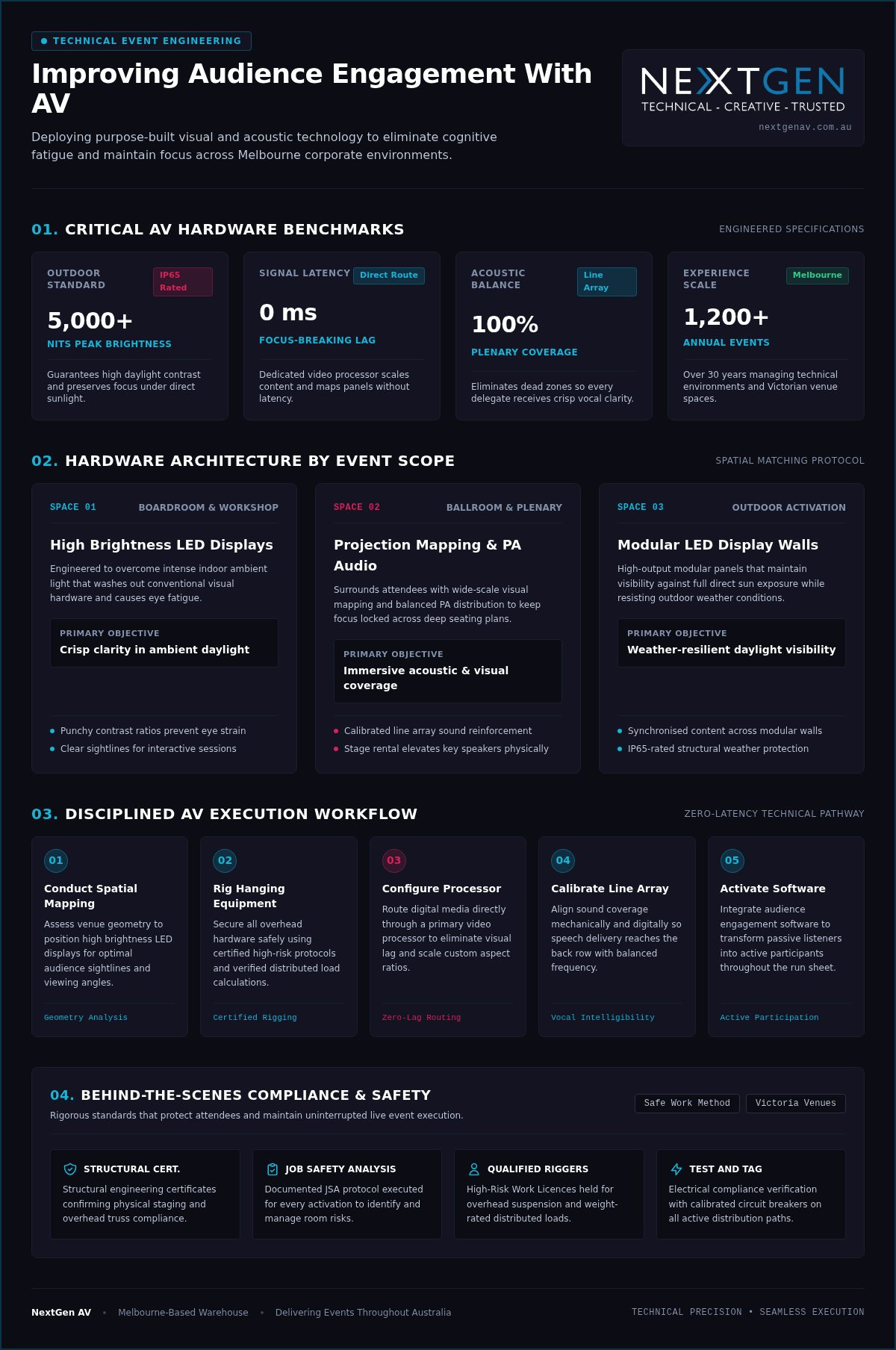
5 Technical Steps on How to Improve Audience Engagement with AV
Precise signal routing and disciplined hardware workflows stop technical glitches from breaking focus. Visual delay erodes audience trust fast, so a zero-latency AV backbone matters for sustained participation. Each dynamic visual element needs deliberate technical direction.
- Conduct spatial mapping
Assess the venue geometry to position high brightness LED displays for optimal viewing angles. - Rig hanging equipment
Secure all overhead hardware safely using certified high-risk protocols for structural event rigging. - Configure the video processor
Route all digital media inputs directly through primary control hardware to eliminate visual lag. - Calibrate line array technology
Align speaker setup elements across the room to maintain clear acoustic coverage. - Manage wireless transmission
Scan the local frequency spectrum to lock in clear channels under strict Australian wireless microphone regulations.
This preparation puts your message in front of each attendee with clear picture and sound. Expert Melbourne event production services handle these complex signal paths behind the scenes, turning venue infrastructure into one active communication hub. The NextGen AV crew manages each technical variable so your presentation keeps focus, and precision dynamic control helps the room feel immersed.
Measuring ROI on Interactive Event Tech
Live participation metrics show whether interactive technology is earning its place on the budget line.
You measure success by analysing post-session response rates, duration of attendee focus, and direct digital inquiries. Evaluating those figures turns raw interaction into actionable business intelligence. Basic audience engagement software gives a quick pulse reading; detailed data collection builds a fuller digital profile of how the room responded.
When you track response rates alongside audience feedback, you see which topics resonated with your delegates. High-performance visual displays keep crowds on key messages longer, and high brightness LED displays help turn passive viewing into active participation.
Pair real-time polling platforms with high-definition conference LED screens when you want sharper impact. Audience engagement software suits interactive keynotes; high brightness LED displays fit large exhibition spaces that need wide visual reach. For events requiring bespoke digital platforms or tailored attendee applications beyond off-the-shelf tools, custom software developers like 4mation build purpose-fit solutions that feed real-time participant interaction directly into your visual displays.
After more than 30 years of technical work across 1,200+ events a year, the pattern is consistent: when the full technical setup is engineered behind the scenes, data capture runs clean and the brand moment lands. NextGen AV helps you capture meaningful analytics while the room still feels memorable. Ask for a personalised quote so we can shape a strategy tied to measurable returns.
When In-House AV Equipment Falls Short
In-house venue gear often fails during complex presentations because basic hardware cannot manage custom visual displays or heavy signal routing. Built-in sound systems (line array technology) might cover background speeches, yet they lack the processing power required for clear, dynamic presentation audio across large spaces.
Venue-native gear frequently lacks dedicated hardware processing to run custom aspect ratios without distorting your visual content. Relying on standard kit is like using a push mower on a golf course: standard monitors lack high brightness LED displays that punch through ambient light, domestic switchers lack a dedicated video processor to map multiple feeds without dropping signals, and standard wireless microphone setups struggle without active frequency coordination to prevent dropped audio.
When your event demands faultless execution, venue-native setups create immediate failure points. Dedicated technical direction keeps each signal path solid. NextGen AV builds custom production architecture around your room layout so technical execution stays sharp, reliable, and low-stress.
Frequently asked questions
What is audience engagement?
Audience engagement is the active mental, physical, or emotional participation of attendees during your event. You raise that participation through live polling, dynamic visual displays, and responsive audio systems. NextGen AV engineers immersive rooms across Melbourne by integrating high brightness LED displays with interactive conference technology.
Why is audience engagement important?
Strong engagement helps your message stick and supports a clearer return on the event spend. Focused attendees interact more deeply with sponsors, join Q&A sessions, and form firmer brand connections. Secure event rigging (hanging equipment) and precise audio coverage hold attention without technical noise in the way.
What are examples of audience engagement?
Examples include live audience Q&A sessions, real-time polling software, interactive workshops, and dynamic visual presentations. You can also use projecting on buildings (projection mapping) to turn architectural surfaces into captivating visual displays. Tailored venue engineering and sound systems make those formats practical on show day.
How can I improve audience engagement?
Combine responsive audience software with clear visual and audio production. Deploying line array technology (speaker setup) means each delegate hears each word across the venue. Professional technical direction holds those elements steady behind the scenes.
Which AV choices lift engagement at corporate events?
Match hardware to the room: high brightness LED displays for ambient light, a video processor for clean switching and mapping, and calibrated PA or line array coverage so speech stays intelligible. Add audience engagement software when you want live polling and measurable response data tied to the content on screen.
Streamline Your Next Production
How to improve audience engagement with AV still comes down to precise technical execution and qualified direction. Dynamic visuals, crisp acoustic performance, and strategic content flow keep attendees connected across the agenda. In 2026, corporate planners need reliable systems that run without technical friction. The NextGen AV team manages complex signal paths behind the scenes so display systems and stage lighting operate with absolute precision. High-impact production rests on meticulous preparation, accurate sound distribution, and high-contrast visuals cut to your venue layout.
Ready to reshape the room experience? You can plan your event production with NextGen today and review technical requirements with the production specialists.
Audience immersion isn’t created by flashy production gimmicks; it’s engineered through invisible technical precision. If you are reviewing corporate event av trends 2026 to elevate your next conference or gala, you already know the immense stakes. Nothing damages executive prestige faster than a presentation disrupted by audio faults, or an audience quietly disengaging under flat stage lighting and static slide decks. Delivering an exceptional live environment demands flawless execution long before the room lights dim.
High-stakes planning means balancing creative concepts with strict Victorian venue limitations, structural thresholds, and Australian safety requirements. You shouldn’t have to shoulder technical risks alone. In this guide, you will discover the audio-visual innovations, spatial staging techniques, and Australian compliance standards shaping corporate events in 2026. From micro-pitch displays and object-based sound systems to mandatory structural engineering certificates, here is how proactive technical direction safeguards your brand and commands lasting attendee attention.
Key Takeaways
- Navigate corporate event av trends 2026 by moving past passive viewing, combining physical set design and fluid digital canvases to retain audience focus.
- Deploy micro-pitch LED walls driven by advanced video processor systems to eliminate moiré artefacts on camera and present crystal-clear data under full room lighting.
- Implement object-based spatial sound systems across wide conference stages, matching audio origin to presenter movement for pristine speech intelligibility.
- Satisfy strict Victorian venue compliance by securing certified rigging teams, documented Job Safety Analysis procedures, and structural engineering certificates before load-in.
- Partner with seasoned technical directors who proactively manage operational risks behind the scenes, elevating brand prestige while letting your team lead with confidence.
Corporate Event AV Trends 2026: Shifting from Spectacle to Immersion
Corporate audiences in 2026 reject passive viewing in favour of immersive technical environments. Modern delegates arrive with shorter attention spans and higher expectations, making standard slide decks and flat stage lighting feel obsolete. When defining your approach around corporate event av trends 2026, success hinges on engineering an environment where technical production actively combats cognitive fatigue during extended plenary sessions.
Findings from the 2026 Zoho State of Events Industry Report show that 90% of corporate event planners prioritise in-person engagement as the primary driver for high-value business outcomes. Delivering on that benchmark means moving far beyond decorative gimmicks. Production teams now build cohesive spatial experiences through rigorous pre-production engineering and disciplined rehearsal workflows, ensuring presenters command the room with total confidence.
The Rise of Purpose-Driven Event Architecture
Modern presentation environments must balance visual impact with clear audience sightlines. Replacing isolated, static lecterns with curved, dynamic staging draws the room’s collective focus straight to the speaker. By unifying physical staging with tailored acoustic distribution, technical directors eliminate distractions and keep delegates mentally invested throughout multi-hour conferences.
- Sightline Optimisation: Angled seating layouts and tiered risers prevent visual obstruction across wide convention spaces.
- Dynamic Stage Geometry: Asymmetric staging and low-profile presenter platforms break up visual monotony.
- Acoustic Harmony: Controlled speaker arrays direct sound precisely to the audience, preventing slap-back reverberation from untreated ballroom walls.
Moving Past Traditional Screen Formats
The standard 16:9 projection screen no longer meets the expectations of top-tier corporate gatherings. Forward-thinking producers are blending physical stage set design with panoramic, wrap-around digital backdrops. Pairing these custom surfaces with spatial projection mapping transforms physical sets into living canvases that respond to presenter cues in real time.
Achieving this level of visual impact requires high brightness LED displays that maintain punchy colour contrast and pin-sharp clarity under ambient venue lighting. Before finalising your technical floor plans, review the detailed planning guide for LED video wall deployments to ensure your chosen pixel pitch matches your audience viewing distances. When managed by experienced technical directors, these dynamic canvases elevate brand prestige while keeping delegates completely immersed.
Next-Generation Visual Displays: Micro-Pitch LED and Projection Mapping
Modern visual production requires far more than simply hanging large screens at the front of a room. A central focus within corporate event av trends 2026 is the shift toward display technology that delivers flawless visual detail both in the room and across live broadcast feeds. Executive presenters rely on complex data visualisations, financial dashboards, and high-framerate video assets that quickly break down on legacy systems.
Deploying sub-2mm surfaces, particularly micro-pitch displays ranging from 0.9mm to 1.5mm, preserves pristine visual fidelity for delegates seated just metres from the stage. When captured by broadcast cameras, these panels eliminate optical scan lines and moiré interference thanks to high refresh rates operating between 3,840 Hz and 7,680 Hz. Behind the display, an enterprise-grade video processor such as the NovaStar COEX VMP or Brompton Tessera SX40 drives multi-window inputs, colorimetry management, and real-time canvas scaling without signal delay.
Ultra-Fine Pixel Pitch and High Brightness LED Displays
Natural daylight fills many premier Australian conference spaces, creating severe wash-out risks for standard projection surfaces. High brightness LED displays delivering 800 to 1,500+ nits counteract ambient venue glare effortlessly, maintaining deep black levels and sharp contrast across every slide.
- Pixel Density Selection: Choose 0.9mm to 1.2mm pitches for compact executive boardrooms and 1.5mm to 1.9mm for wide plenary halls.
- Hardware Redundancy: Run dual data paths and failover power supplies between processors and panels to eliminate blackout risks.
- Dynamic Scaling: Advanced processors handle custom aspect ratios, mapping disparate media sources to curved or ultra-wide backdrops instantly.
Dynamic Set Design with Architectural Projection Mapping
Rather than constructing static, single-use timber stage sets that end up as landfill, production designers are adopting architectural projection mapping. Calibrating solid-state 10k laser DLP projectors allows technical teams to warp imagery across structural columns, curved bulkheads, and custom geometric flats, turning the venue itself into an interactive environment.
Suspending high-output projection hardware overhead demands rigorous compliance with the Safe Work Australia Model Code of Practice, ensuring all load distributions and secondary safety bonds are independently certified. Integrating bespoke digital geometry with targeted luminaires delivers an unforgettable atmosphere; explore these strategies through comprehensive stage and lighting hire Melbourne services. If you want to transform your plenary space without structural friction, consult the engineering specialists at NextGen AV to map out your technical canvas.
Spatial Audio and Acoustic Engineering for Modern Conferences
Auditory fatigue remains one of the quietest killers of audience engagement. In standard hotel ballrooms, two-point stereo arrays blast the front rows while leaving delegates at the back straining to catch key points. A major evolution across corporate event av trends 2026 is the widespread adoption of object-based spatial audio architectures. Rather than simply raising overall decibel levels, production engineers now treat acoustic distribution as an exact science.
According to proceedings from the Audio Engineering Society, spatial acoustic systems achieve near-uniform acoustic coverage across entire corporate spaces. They eliminate the punishing 6 dB to 12 dB speech intelligibility drop-off typical of wide-dispersion rooms. When an executive walks from stage left to stage right, real-time spatial positioning pans their vocal track to mirror their physical movement. This natural localization aligns sensory inputs, eradicating listener strain during multi-speaker panel discussions and full-day symposiums.
Intelligent Sound Systems and Front of House Audio Management
Controlling acoustic energy in cavernous or reverberant venues requires sophisticated predictive modelling aligned with established AVIXA industry standards. Production teams deploy modular line-array enclosures engineered to shoot sound directly into occupied seats, bypassing reflective glass partitions and polished timber walls entirely.
- Acoustic Profiling: Precision beam-steering technology prevents muddy slap-back reverberation from untreated architectural surfaces.
- Dynamic Vocal Processing: A seasoned front of house engineer manages onboard effects, using automated multi-band suppression and dynamic EQ to eliminate harsh frequencies.
- Consistent Coverage: Strategic delay lines and fill speakers guarantee identical volume levels from the front row to the technical riser.
Securing this balance demands tailored hardware; discover dedicated corporate audio configurations through professional sound system hire options engineered for corporate speech clarity.
Wireless Microphone Reliability and Spectrum Management
RF dropouts ruin executive keynotes instantly. Modern spectrum management requires absolute adherence to Australian wireless microphone regulations enforced by the Australian Communications and Media Authority (ACMA). Under current LIPD class licensing, using the 694 MHz to 820 MHz band is strictly illegal across Australia. Event teams must operate cleanly within the 520 MHz to 694 MHz window, the nationally cleared 1.8 GHz band, or licensed digital bands.
Executing a flawless plenary means deploying active multi-channel coordination software to monitor local RF traffic in real time. Backing this up with directional, active antenna distribution arrays ensures that presenters roaming across large stages never experience signal loss, flutter, or wireless microphone dropouts.
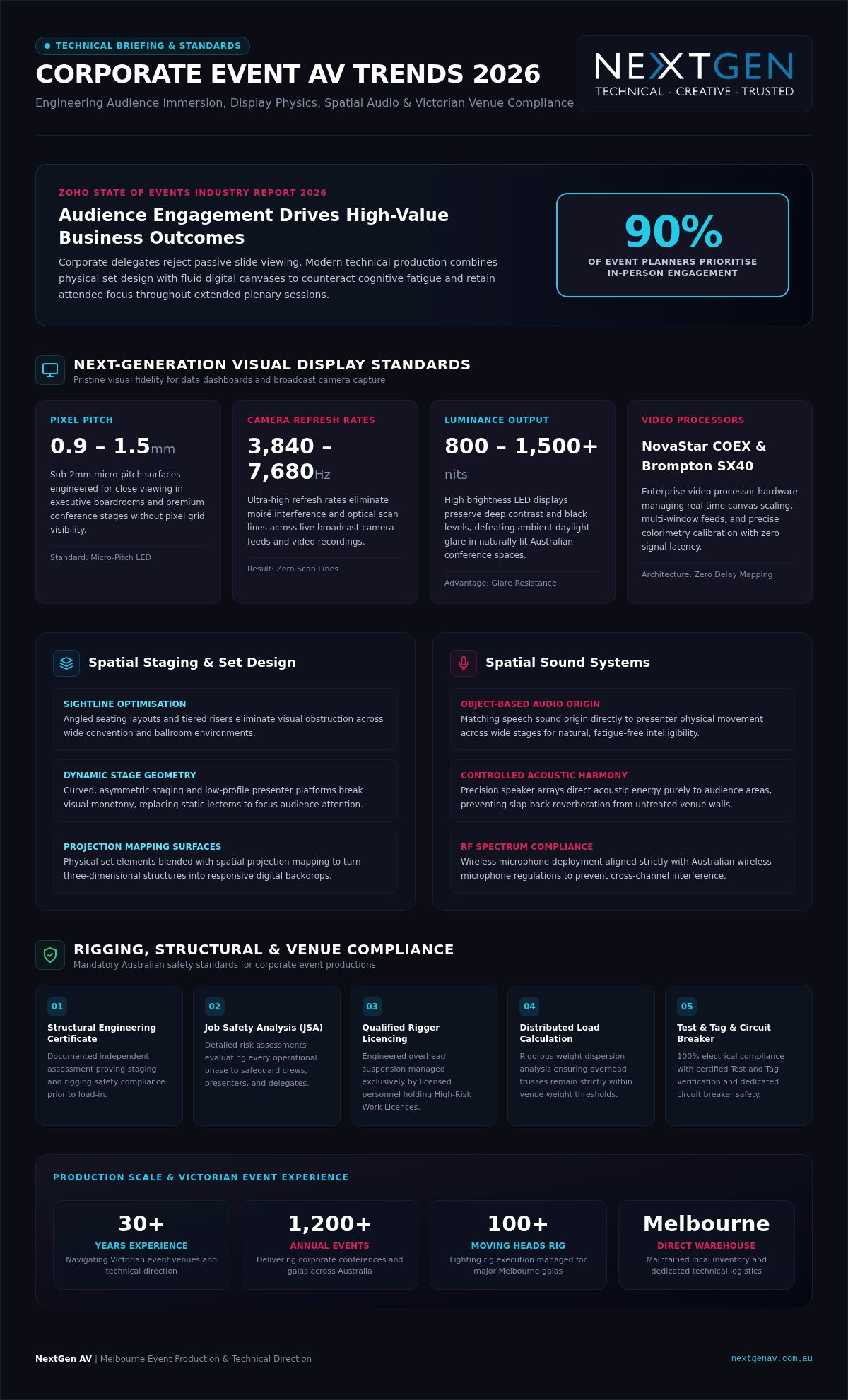
Rigging, Structural Compliance, and Technical Safety in Australian Venues
Ambitious stage concepts fall flat if they fail basic venue compliance. As visual backdrops expand and multi-tier lighting arrays grow heavier, one of the most critical corporate event av trends 2026 is the tightening of venue engineering standards. Major convention centres and heritage hotels across Melbourne now mandate rigorous engineering verification well before equipment arrives on site. Technical safety is no longer a background formality; it is the legal foundation of modern corporate production.
Managing overhead risk requires proactive planning rather than last-minute fixes. Before a single truss leaves the deck, production teams must complete an exhaustive Job Safety Analysis (JSA) and Safe Work Method Statement to map installation sequences and mitigate on-site hazards during compressed load-in schedules.
Engineering Compliance and Safe Working Load Limits
Suspending large LED displays and heavy line-array sound systems requires exact mathematical calculations. Rigging teams must determine distributed load factors across ceiling attachment points, ensuring total dynamic and static forces remain well within certified venue load limits.
- Qualified Personnel: Every overhead lift must be directed by a qualified rigger holding a current High-Risk Work Licence issued by WorkSafe Victoria.
- Regulatory Thresholds: Temporary platforms exceeding 150 m² or complex flown grids require an independent structural engineering certificate under Victorian building regulations.
- Custom Staging Integrity: Whether deploying indoor platforms or outdoor festival-grade staging, structural verification protects your brand against catastrophic structural failure.
Electrical Infrastructure, Circuit Breakers, and Safety Testing
Electrical stability is vital when powering hundreds of moving lights, LED processors, and sensitive mixing consoles. Power drops or uneven electrical distribution can trigger a circuit breaker at the worst possible moment, cutting feeds mid-speech. To prevent downtime, technical crews balance loads evenly across three-phase distribution systems and integrate battery backups across front-of-house consoles.
In Victoria, electrical safety is strictly governed by AS/NZS 3760:2022 standards. Every power lead, distribution board, and luminaire deployed on site must carry a verified Test and Tag certification stamp from an accredited technician. If you want total confidence that your production satisfies every Victorian venue guideline, partner with NextGen AV for certified technical direction and complete compliance management.
Executing Flawless Productions: Partnering with NextGen AV in Melbourne
Bringing high-concept designs to life requires more than an equipment checklist. While adapting to corporate event av trends 2026 gives your event a distinct edge, the true test of any production is live execution under pressure. Flawless delivery happens when technical direction operates as an invisible engine behind the scenes, resolving technical friction before it ever touches the stage.
NextGen AV brings over 30 years of technical mastery to Australian corporate gatherings. Operating from a central Melbourne warehouse stocked with premium visual displays, moving luminaires, and digital audio consoles, our team manages more than 1,200 events annually. From high-profile summits for government departments and industry associations to international product launches, we translate ambitious creative concepts into reliable, safe production realities.
Proactive Pre-Production and Technical Direction
Successful events are built months before the opening keynote. Engaging a dedicated technical director early ensures critical venue variables, from ceiling rigging point capacities and loading dock clearances to three-phase power limits, are accounted for during conceptual design.
- Site Audits: We evaluate Victorian venue infrastructure in person, identifying structural hurdles and acoustic quirks before bump-in.
- 3D Spatial Visualisation: Detailed pre-visualisations let organisers test stage geometry, display sightlines, and lighting coverage digitally.
- Integrated Oversight: Discover how cohesive management bridges creative goals and stage mechanics through our full service event production specialists.
Engineering Seamless Live Execution Across Victoria
Live events offer no second chances. During plenary sessions and awards galas, our agile on-site engineers manage speaker walk-ups, complex video switching, and real-time audio adjustments with disciplined precision. Navigating the unique layouts of Melbourne Convention and Exhibition Centre, historic CBD venues, or regional winery spaces requires seasoned hands who understand local conditions.
Whether you need custom stage platforms, spatial sound systems, or multi-panel visual arrays, tap into our local team via audio visual hire Melbourne solutions. When your brand’s reputation is on the line, you don’t have to navigate corporate event av trends 2026 alone. Connect with the engineering team at NextGen AV to produce an experience that leaves an indelible impression on every attendee.
Lead the Next Era of Corporate Event Production
Elevating a corporate summit or gala demands more than following aesthetic trends; it requires complete technical discipline behind the scenes. Adapting to corporate event av trends 2026 means replacing passive spectator formats with dynamic spatial staging, integrating fine micro-pitch visual canvases, and demanding acoustic precision across every seat. Above all, it requires absolute dedication to structural compliance, from engineering sign-offs to thorough electrical testing.
You don’t have to carry technical risk while steering executive stakeholders. NextGen AV brings over 30 years of technical production mastery across Victorian venues, managing 1,200+ successful corporate events and conferences annually. Supported by fully certified production crews operating under strict Job Safety Analysis protocols and holding current High-Risk Work Licences, our team guarantees seamless delivery from early spatial planning to the final applause.
Step onto the stage knowing every technical detail is meticulously handled. Engineer your 2026 corporate event experience with NextGen AV and deliver an extraordinary live environment with complete peace of mind.
Frequently Asked Questions
What are the primary audio visual trends defining corporate events in 2026?
Immersive spatial architectures, sub-1.5mm micro-pitch LED backdrops, object-based spatial audio, and stricter technical governance lead corporate event av trends 2026. Corporate programs now reject static slide templates in favour of panoramic visual canvases and active delegate engagement tools. High refresh-rate displays eliminate camera flicker for hybrid broadcasts, while multi-dimensional audio ensures every attendee enjoys crystal-clear speech intelligibility across the entire venue floor.
How do high brightness LED displays perform compared to traditional laser projectors in daylit ballrooms?
High brightness LED displays deliver direct light output between 800 and 1,500+ nits, easily outperforming laser projectors in rooms with unshaded glass or strong ambient lighting. Projectors reflect light onto fabric or painted surfaces, causing black levels to wash out under direct sunlight. LED tiles emit light natively with high contrast ratios, ensuring slides, detailed graphics, and video playback remain vivid and readable from every angle.
Why is a structural engineering certificate necessary for indoor corporate staging and LED wall rigging?
A structural engineering certificate provides independent legal proof that suspended truss grids, heavy display walls, and custom stage decks won’t exceed venue load limits. In Victoria, temporary stage structures exceeding 150 m² or complex flown rigs require documented engineering compliance under building regulations. Securing this certificate ensures that dynamic physical loads, rigging points, and stage safety factors are fully calculated, protecting event organisers from catastrophic structural failures.
What legal standards govern the operation of wireless microphone systems in Australia?
Wireless microphone operations across Australia are strictly regulated by the Australian Communications and Media Authority (ACMA) under the LIPD Class Licence. Operating audio devices within the 694 MHz to 820 MHz band is strictly prohibited and carries heavy legal penalties. Event audio teams must coordinate multi-channel systems within the legal 520 MHz to 694 MHz range, the nationally cleared 1.8 GHz band, or digital ISM frequencies to prevent telecommunication interference.
How does dynamic video processing elevate corporate presentations and panel discussions?
Dynamic video processors manage complex signal routing, canvas scaling, and multi-source windowing in real time. Instead of awkward black pauses between presenters, processors instantly switch between 4K slide decks, remote video callers, and live stage cameras across custom-aspect canvases. Built-in colour calibration ensures accurate brand palettes, while low-latency processing guarantees perfect lipsync between executive speech and large-format stage magnification screens.
What role does a technical director play during a high-stakes corporate conference?
A technical director serves as the single point of leadership overseeing all production engineering, stage management, and crew coordination. They audit venue infrastructure months before bump-in, draft detailed run sheets, and manage rehearsal schedules. During live sessions, they call cues across audio, lighting, and visual teams, actively navigating unexpected technical risks behind the scenes so speakers take the stage without stress or distraction.
How does NextGen AV manage audio visual safety and compliance across Melbourne venues?
NextGen AV implements rigorous safety protocols tailored to Victorian venue regulations across more than 1,200 events annually. Our Melbourne team executes site-specific Job Safety Analysis assessments before load-in and deploys qualified riggers holding current High-Risk Work Licences for all overhead installations. Every piece of production equipment undergoes mandatory AS/NZS 3760:2022 Test and Tag inspection, aligning your corporate event av trends 2026 production with verified engineering benchmarks.
Choosing a melbourne exhibition av supplier for 2026 starts with structural engineering certificate requirements, circuit breaker allocations, Job Safety Analysis compliance, and qualified rigger hours. Exhibition audio visual (technical production) hiring costs in Melbourne shift with those constraints, and NextGen AV does not publish fixed packages because every event layout (set design) requires custom scoping. Get in touch with our specialists to obtain a precise, tailored quote for your exhibition space.
Key Takeaways: Successful Melbourne exhibition AV requires custom technical scoping that integrates structural engineering certificates, high-brightness displays for hall lighting, and managed venue power distribution.
- NextGen AV manages over 1,200 annual events using 30 years of local venue experience.
- Except when using basic room setups, avoid dry hiring to prevent signal interference risks.
- Therefore, choose full production support for complex stands to lock in fixed venue fees.
- The five-step process uses 3D renders to map signal flows before any equipment arrives.
How a melbourne exhibition av supplier fits AV to your stand
Your exhibition stand needs a tailored audio visual system based on floor space and available venue power. Spatial limits dictate display choices: select screen sizes that match your footprint so you avoid overcrowding and keep clear sightlines when visitors stop to talk.
Before you lock a layout, match the stand you actually have to a concrete build path:
- Compact stands under 15 square metres: wall-mounted high brightness LED displays free floor space for product and conversation while holding sightlines.
- Larger custom builds: structural overhead gantries suspend lighting and sound systems clear of the display area so the floor stays open for traffic.
- High-density halls: balance visual impact against strict circuit breaker capacities so the stand runs the full open hours without trips.
Every venue applies specific structural load rules for suspended equipment. Planning your event layout around precise power distribution keeps the stand reliable from open to close. For steady execution on site, partner with an established Melbourne AV team that understands local venue guidelines. NextGen AV handles technical detail in the background so you can take centre stage with the brand story.
Tip: Always calculate total structural load limits before committing to custom overhead gantries.
Hidden freight and labour fees you can lock in before load-in
Calculating the total cost of technical production (audio visual) hire means auditing hidden venue expenses alongside base rental rates. Loading dock access fees, rig testing, and specialised freight charges left out of initial quotes push the outlay up fast during execution. Fixed transparent quotes prevent budget overruns when those venue charges appear late.
During initial logistics planning, we review technical venue requirements to flag hidden expenses early. Negotiating dock windows and labour hours avoids penalty rates. For complex setups, choosing full event production support places compliance requirements under one fixed agreement.
Understanding these expense drivers protects your budget:
| Fee Category | Cost Driver | Risk Mitigation |
|---|---|---|
| Dock Access | Strict venue loading schedules | Scheduled delivery windows |
| Rig Testing | High-level safety compliance | Qualified rigger certification |
| Emergency Power | Unverified power distribution | On-site circuit breaker checks |
Overlooking venue compliance leads to last-minute surcharges. Detailed preparation keeps production moving, and our crew oversees intricate operational details offstage so your equipment rental services (hire melbourne) stay on plan from dock to pack-down.
Tip: Verify if your venue requires a dedicated circuit breaker to avoid on-site emergency power surcharges.
Exhibition AV gear that stays readable under hall lighting
You can hire complete technical production solutions including custom visual displays, precision audio, intelligent lighting, and hybrid streaming systems designed for trade show environments.
From our Melbourne warehouse, we deliver tier-one inventory from verified global manufacturers so hardware reliability holds on the show floor. Our team keeps equipment specifications transparent for every project, whether you need sound systems, interactive displays, or specialised staging.
This level of hardware reliability is essential for industries that rely on immersive digital content, such as interactive entertainment; for instance, you can learn more about Ocean Media and their long-standing expertise in console game publishing.
Ambient venue lighting directly affects screen contrast ratios during daytime trade shows. Standard displays often wash out under bright overhead hall lights, which is easy to miss until you stand on your own floor at open. To keep content vivid for visitors in that light, we deploy high brightness LED displays that hold visual performance regardless of venue illumination. For high-impact visual structures, LED wall hire options give you clear, dynamic presentation surfaces scoped to the brief rather than a fixed catalogue label. More on this: LED Wall Hire.
We engineer set design layouts alongside advanced control infrastructure. A video processor (a signal management unit) maps your high-resolution media across complex display configurations without frame lag. Large venue activations can go further into full spatial change: turning an expansive exhibition hall into an intimate room for a major Melbourne gala, our crew ran an elaborate setup with more than 100 moving heads and custom gobo projections, so the lighting field matched the gala brief rather than the empty hall volume.
We manage structural engineering certificate requirements, qualified rigger deployment, and Test and Tag compliance. Equipment rental services gear undergoes pre-deployment checks before site execution. Ask our technical team for a personalised quote on your upcoming Melbourne exhibition.
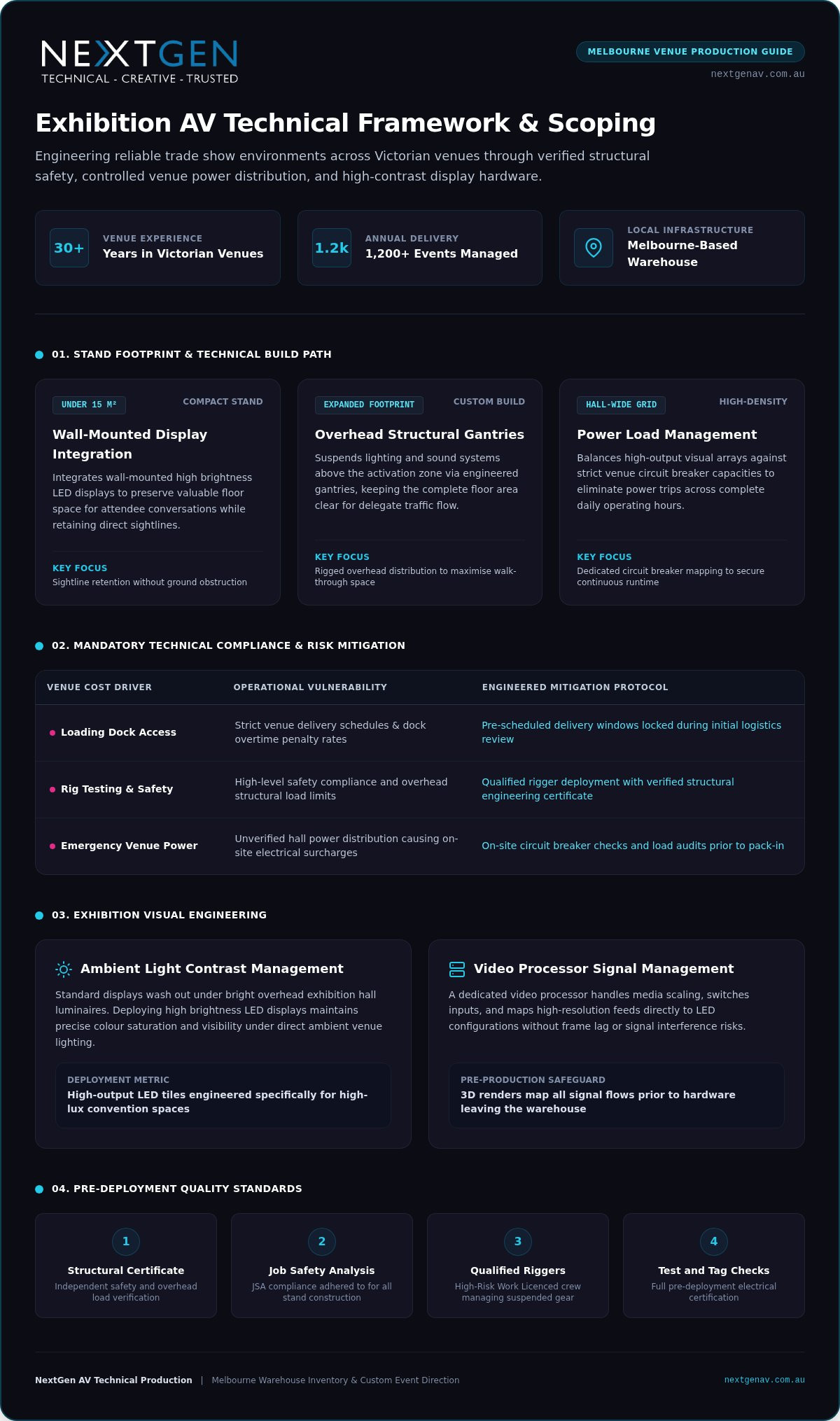
How the five-step hiring process protects show day
Securing technical production for your exhibition follows a systematic timeline that turns initial space designs into on-site delivery. Drawing from over 30 years of experience in Melbourne event production, our team manages operational detail so you are not left chasing permits alone. Thorough planning means stage rental or display installation can proceed without surprise delays on the dock clock.
- Spatial Design and 3D renders: We translate your initial set design (event layout) into accurate three-dimensional models to map signal flows and site logistics early.
- Technical Engineering and Safety Permits: Our team secures every structural engineering certificate required for suspended rigs, verifying weight capacities before any hardware leaves the warehouse.
- Pre-Production Testing and System Staging: Equipment undergoes rigorous checks in our local facility, where technicians pre-configure system control paths.
- Dock Load-In and Spatial Build: Crews execute dock delivery, assemble custom display walls, and manage cabling within tight venue time slots.
- On-Site System Tuning: Technicians balance sound systems and calibrate displays before public entry.
Venue schedules reward preparation measured in hours, not last-minute fixes.
Outdoor arc: when you need rapid deployment outside a hall shell, a mobile trailer stage simplifies site setup by combining structural transport and staging in one unit. Qualified specialists oversee rigging and electrical distribution for venue compliance. You receive end-to-end management from conceptual layout to final breakdown, with professional equipment rental services supporting a steady presentation path.
When dry hiring basic equipment puts your brand at risk
Complex exhibition spaces need dedicated on-site technical direction to manage structural safety, signal distribution and strict venue schedules. Dry hiring audio visual gear leaves your team responsible for rigging compliance, frequency management and multi-screen content syncing. During high-stakes trade shows, unmanaged technical issues damage brand reputation while guests are already on the carpet.
Practitioners frequently observe that unmanaged signal interference from neighbouring stands disrupts unmonitored wireless microphone setups. Securing a structural engineering certificate and managing a High-Risk Work Licence requires specialised expertise your floor team may not hold on show week.
Simple equipment rental services work for basic room setups. Large multi-zone displays need an experienced front of house engineer using a dedicated video processor. Managing distributed load limits across overhead trusses demands professional oversight rather than ad-hoc crew guesses.
Across more than 1,200 events annually in Australia, specialists maintain full high-risk work licences so stage rental and lighting rigs go in under controlled compliance. With over 30 years on the Melbourne circuit, the work has moved from equipment supply alone to craft partnership on ambitious city events. Behind the curtain, NextGen AV controls complicated arrangements so your event layout runs as planned and you keep quiet power over the brand moment.
Frequently asked questions
What AV services does NextGen AV provide?
NextGen AV delivers full technical production management, covering sound systems, stage rental, and custom set design for major live functions. Lighting and control infrastructure scale to the room you book, including multi-fixture moving-head rigs when the brief calls for them.
How does the hiring process work?
You begin by sharing your event vision, technical riders, and venue details so our specialists can design an engineered production plan. Melbourne venue experience means safety protocol, structural engineering certificate, and delivery timeline sit with us while you focus on content and guests.
What equipment can be supplied for events?
We supply high brightness LED displays, PA audio systems, wireless microphone units, and festival-grade staging tailored to your venue requirements. Our team configures video processor units and custom lighting rigs for crisp projection mapping across your display surfaces.
How can I get a quote for my event?
You can request a tailored quote directly through our website by submitting your event date, location, and visual requirements. Final project costs depend on your chosen equipment rental services, rigging complexity, and technical staffing requirements.
What is included when you hire AV?
Your complete package includes initial system planning, equipment transport from our local warehouse, complete on-site installation, and active operational support. Front of house engineer experts manage your live audio mixes and video feeds throughout the occasion, with absolute precision on the technical path.
Securing Your Technical Event Direction
Your trade show still turns on the same decisions you met at the start: custom scope versus fixed packages, full compliance versus hidden dock and power fees, and dry hire versus on-site technical direction. With three decades of local technical direction in Victorian venues, the NextGen AV team manages complex audio visual logistics behind the scenes as your Confident Orchestrator and Invisible Expert on the floor plan. We review your venue-specific layout and compliance requirements early in planning.
Specialists who support more than 1,200 events annually across Australia maintain full high-risk work licences to secure stage rental and lighting rigs safely. You remain in control of your brand story while execution stays off your shoulders. Reach the team via AV solutions for a venue-specific set design quote on your 2026 trade show.
Planning gala dinner audio visual melbourne cbd coverage starts with the decisions that shape your night: budget bands, venue access, speech clarity and whether built-in room kit can carry a formal dinner. Local industry research places many component and crew packages between $300 and $5,000 ($300–$5,000; market median $2,200); final investments still swing with staging scope and technical talent. Partnering with an experienced production team keeps those moving parts under control from first site check to pack-down.
Key Takeaways: Successful Melbourne CBD gala audio visual requires 4 to 8 hours of bump-in time and a budget typically ranging from $300 to $5,000.
- KEY SPECIFIC: Allocate 15 to 25 communication units for a 500-guest gala to coordinate technical and catering teams.
- HONEST CAVEAT: Integrated venue systems are insufficient unless your event only requires basic speeches without custom staging.
- RECOMMENDATION: Hire an external partner for complex galas to manage structural rigging limits and 24-bit digital audio.
- EVIDENCE POINTER: The article details how glass panels in CBD venues cause audio feedback without professional physical barriers.
Match your ballroom layout to the right AV kit
Spatial constraints across historic city venues dictate equipment choices long before show day, so map the room early and lock the kit to the floor plan. Three setups come up again and again in Melbourne CBD ballrooms:
- Grand ballroom, large table grid: specify high-brightness LED displays so visuals stay crisp above the furthest seats, and pair them with a sound system (line array technology) aimed for speech intelligibility at every table without overwhelming guests near the stage.
- High-impact corporate dinner with brand moments: use visuals on walls (projection mapping) to turn architecture into a custom canvas; for an awards-style presentation, dual ultra-wide screens give sponsor content room to breathe (awards night staging).
- Compact boutique room, tight docks: choose low-profile fixtures and efficient staging built for short bump-in windows and narrow access routes.
Over 30 years of experience in Melbourne event production shows that early layout mapping prevents costly last-minute adjustments. Matching production layout to ballroom layout protects sightlines and balanced sound coverage so each guest stays inside the experience you designed.
What drives gala dinner audio visual Melbourne CBD costs in 2026
Budgeting for event production only works when equipment fees and technical labour charges sit in plain view. Accepting a vague quote without line-item transparency is a mistake: unexpected venue access fees can erase the contingency you thought you had. Treat production as a strategic investment in audience engagement, not a dry-hire line on a spreadsheet.
To secure reliable delivery, source complete setup packages through a full-service Melbourne AV partner. A dedicated front of house engineer coordinates your sound system with precision, while professional technical staff manage environmental safety and complex staging logistics. Custom visuals on walls also need dedicated server processing, which belongs in the quote rather than as a surprise on site.
| Service Element | Production Focus | Cost Driver |
|---|---|---|
| Audio Engineering | Crisp vocal clarity | Audio engineer hours |
| Stage Lighting | Custom atmosphere | Rigging complexity |
| Visual Media | Dynamic displays | Media server control |
Planning bump-in carefully protects your timeline. NextGen AV handles backstage technical demands for corporate galas so compliance and crew calls stay aligned. Ask for a personalised quote with figures matched to your venue scope.
Tip: Review venue access policies early to avoid unexpected labour overtime charges during midnight pack-downs.
Keep speeches free of feedback with disciplined audio
Audio feedback is prevented through precise speaker placement, active frequency management and constant monitoring by an experienced front of house engineer. Glass panels common in Melbourne CBD venues bounce sound straight into live microphones, which is why a clean physical barrier matters as much as the desk mix.
Placing a sound system forward of the lectern builds that barrier against acoustic loops. A dedicated professional sets microphone gain profiles before guests arrive, so key presentations do not open with a screech. For wireless systems, stability is non-negotiable: 24-bit digital audio captures the full dynamic range of a speaker’s voice, including soft-spoken contributors. You can lock in clear vocal delivery with specialised audio hire packages sized to the room.
Over-amplifying low voices invites instant ringing; disciplined equalisation stops that cleanly. During bump-in the team controls the signal path so speeches stay smooth. You stay focused on the audience while technicians hold every acoustic variable.
Tip: Deploying 24-bit digital wireless systems like Shure QLX-D ensures clean signal transmission across complex venue RF environments.
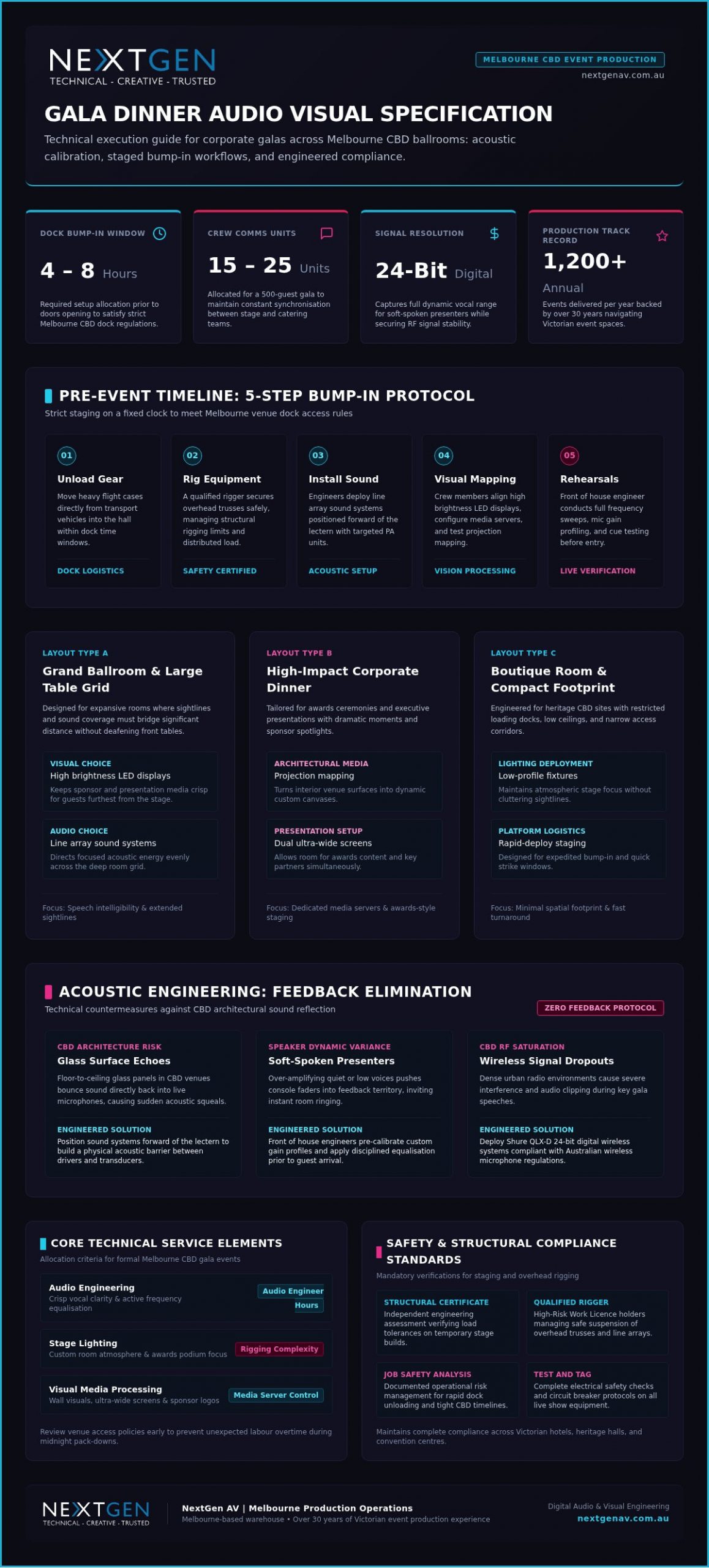
Plan enough bump-in time before doors open
Allow four to eight hours of bump-in before gala doors open. In Melbourne event production, technicians build complex staging on a fixed clock, and CBD dock rules punish loose schedules.
- Unloading gear: Technicians move flight cases from transport vehicles into the hall.
- Rigging equipment: A qualified rigger secures overhead trusses safely.
- Installing sound: Engineers deploy a main sound system alongside targeted PA system units.
- Configuring visual displays: Crew members align wall displays and test visuals on walls.
- Running rehearsals: Technicians conduct full audio checks before guests arrive.
Cultural and corporate docks across the CBD often enforce tight loading windows, so technical coordination has to be meticulous. One recurring pattern from client work makes the stakes clear: a 500-guest corporate gala needed coordinated coverage across stage management, audio-visual technicians, venue catering and security. The plan put 15 to 25 communication units in the hands of those teams so cues reached the right person on time, and the night held its schedule from first speech to pack-down. NextGen AV manages those moving parts behind the scenes so safety and timing stay intact.
When integrated venue AV holds your gala back
In-house venue systems often fail to support complex custom staging, high-definition visual setups or intricate lighting designs for high-impact gala dinners. Relying solely on built-in equipment limits creative vision during major Melbourne CBD events because venue hardware typically stays fixed in place, blocking dynamic visual mapping or tailored overhead rigging.
In-house setups work well for simple speeches. Complex galas need dedicated custom production. Standard room options often lack high-output visual equipment or advanced audio processing, and they usually restrict where you can place custom visual features or staging structures. Running an internal system without dedicated technical oversight can turn minor timing shifts into major performance delays.
NextGen AV brings specialised hardware and dedicated technical direction directly to your Melbourne CBD venue. You get custom sound system options, precise stage design and bespoke visuals on walls that turn blank rooms into immersive environments. The crew handles bump-in detail behind the scenes so you keep creative control while qualified technicians run the show safely and on plan.
Choose venues and external crews that fit your technical brief
Evaluate a venue by comparing layout restrictions against your gala technical requirements before you book. Room dimensions, low ceilings and fixed pillars often restrict sightlines or limit suspended rigging. A venue in-house team usually offers basic equipment tailored to standard layouts, which can fall short when you need full technical precision.
What few people think of: physical floor plans often hide weight limits, so a qualified rigger must confirm structural safety before large lighting arrays or heavy hangs go in. NextGen AV acts as a proactive technical partner, running thorough site inspections to verify physical capacities, with over 30 years of experience navigating Victorian event venues so structural limits are managed early.
An external team fits complex events that need combined audio-visual expertise (rated 85+ in industry evaluations) across custom stage design, festival-grade staging and high-brightness LED displays. In-house AV suits minimal presentations with basic bump-in needs. Technicians oversee structural engineering certificate approvals, circuit breaker management and Job Safety Analysis documentation for site compliance. Lean on a Melbourne-based warehouse and technical master planning when you want an impactful gala without the operational stress.
Frequently asked questions
What is the most important piece of AV equipment for a gala dinner?
A high-performance sound system is the foundation for clear speeches and room-filling entertainment. Sophisticated event lighting then builds the visual atmosphere guests feel through the evening. Balance acoustic coverage with your visual design goals when you select the kit; component packages in market listings often sit in the same broad band noted in the opening cost range.
How do we ensure the audio doesn’t feedback during the speeches?
Correct speaker placement and digital microphone processing stop feedback before it starts. Shure QLX-D digital audio utilises 24-bit digital audio to capture the full dynamic range of a speaker’s voice. A front of house engineer manages live room acoustics and monitor mixes continuously so you can trust the frequencies stay controlled behind the scenes.
Can we use an LED video wall in a venue with a low ceiling?
Low ceilings need careful vertical planning, yet high-density ground-supported panels work well. When overhead space blocks suspended screens, visuals on walls or low-profile displays offer dynamic alternatives. Screen proportions and sightlines are calculated to hold visual impact without crowding the stage, always inside your venue’s structural limits.
How much time is needed for the technical setup (bump-in) of a gala?
A complex corporate gala usually needs at least six to eight hours of bump-in before doors open. That window covers safe event rigging, signal-path testing and full rehearsals. For a 500-guest format, plan 15 to 25 units across stage management, audio-visual technicians, venue catering and security so preparation is thorough before the first guest arrives.
Do we need a separate audio mix for a live stream or hybrid gala?
Online audiences need a dedicated broadcast audio mix because room acoustics differ completely from a virtual feed. Room microphones pick up ambient sound that turns muddy on a web stream if left unadjusted. An experienced audio engineer balances live microphone signals and direct lines separately for remote viewers so online delegates hear the same polished result as guests in the room.
Engineering Precision for Gala Dinners
Mastering your gala dinner audio visual melbourne cbd strategy in 2026 still comes down to the same decisions you met at the start: cost clarity, speech reliability, honest bump-in time and whether venue kit can carry the brief. Tight access schedules and complex rigging need a partner who holds every behind-the-scenes detail with absolute precision. Over 30 years of experience in Melbourne event production gives the specialists the depth to deliver under those constraints.
The team lines up lighting scenes and sound cues with your programme goals, engineering high-impact technical environments that lift stress off your shoulders and leave a strong impression on guests. Explore tailored AV solutions when you are ready for a proposal built around your next event.
Determining conference av solutions Docklands investment means weighing structural engineering certificate demands, circuit breaker limits, Job Safety Analysis compliance, and qualified rigger requirements. NextGen AV provides tailored quotes based on these custom venue factors rather than fixed-rate cards. Depend on our Melbourne technical crew to handle operational details while you create a memorable event experience.
Key Takeaways: Conference AV solutions in Docklands require custom system designs that integrate structural engineering certificates, Job Safety Analysis compliance, and venue-specific rigging to ensure technical stability.
- Modern microphone systems support up to 245 delegate stations using a single central control unit.
- Avoid over-specifying complex rigs in compact breakout rooms to prevent signal clutter and restricted movement.
- Select high brightness LED displays for atrium spaces and rigged PA systems for waterfront ballrooms.
- The High Resolves case study demonstrates how continuous monitoring maintains system stability during dynamic sessions.
3 Docklands conference profiles: system design options
Selecting conference audio (line array technology) depends on your room layout and venue capacity. Venue spatial limits throughout Melbourne districts directly influence screen dimensions and speaker positioning. A waterfront ballroom needs structured event rigging to keep sightlines clear for attendees.
Before you lock a design, match the room you already have to a practical build:
- Executive boardroom, tight footprint: wall-mounted high brightness LED displays keep the table clear and hold sharp visual clarity in ambient light.
- Waterfront ballroom, wide seating: rigged PA audio systems give uniform sound coverage so rear rows hear the same mix as the front.
- Outdoor plaza activation: a mobile stage trailer supports rapid deployment when you need exterior corporate presence without a permanent install.
| Venue Profile | Recommended Setup | Primary Benefit |
|---|---|---|
| Executive Boardroom | High brightness LED displays | Sharp visual clarity in ambient light |
| Waterfront Ballroom | Rigged PA audio systems | Uniform sound coverage across wide rooms |
| Outdoor Plaza | Mobile stage trailer | Rapid deployment for exterior activations |
Compact spaces suit wall-mounted display solutions (projection mapping) so you free floor space for delegates. Larger corporate gatherings benefit from festival-grade staging alongside PA audio systems managed by a dedicated front of house engineer. Behind the scenes, our crew handles intricate venue demands, including a Job Safety Analysis, so safety documentation stays compliant.
When you step outside, open-air corporate activations need specialised planning; you can review tailored outdoor setups built for those conditions. Custom system design works as an acoustic safety net for your message, and precise planning supports clean execution.
Tip: Assess room acoustics and ceiling height before choosing between a mobile stage trailer and wall-mounted high brightness LED displays.
Evaluating ROI and hidden costs in corporate AV
Hidden technical costs during venue execution undermine event budgets unless you account for essential infrastructure early. Budgeting for complex events means looking past basic component rates. Variable labour rates, overtime charges, and unexpected rigging fees frequently inflate final invoices when venue constraints are missed during preliminary planning.
Clear financial reporting helps you justify technical expenditure to internal decision makers. Transparent equipment breakdowns paired with measurable audience engagement metrics give you a reliable foundation for proving event value. Without clear ROI data or fixed pricing options, internal budget sign-offs become unnecessarily stressful.
Unclear venue access times often trigger costly emergency labour charges. Working with an experienced conference technical production team means conference hire (technical production) is mapped systematically beforehand, so budget surprises drop away through precise preparation.
Venues in the Melbourne area frequently present strict structural limitations. A qualified rigger must evaluate ceiling load points to prevent sudden compliance penalties. You also need a structural engineering certificate to verify safe overhead installations. Managing these requirements early avoids sudden compliance expenses during bump-in.
For high-impact visual delivery, high brightness LED displays driven by a dedicated video processor keep your presentation content crisp under harsh room lighting. If full technical management looks expensive on paper, precise preparation still removes costly on-site fixes. Ask our team for a detailed, custom quotation to protect your event budget.
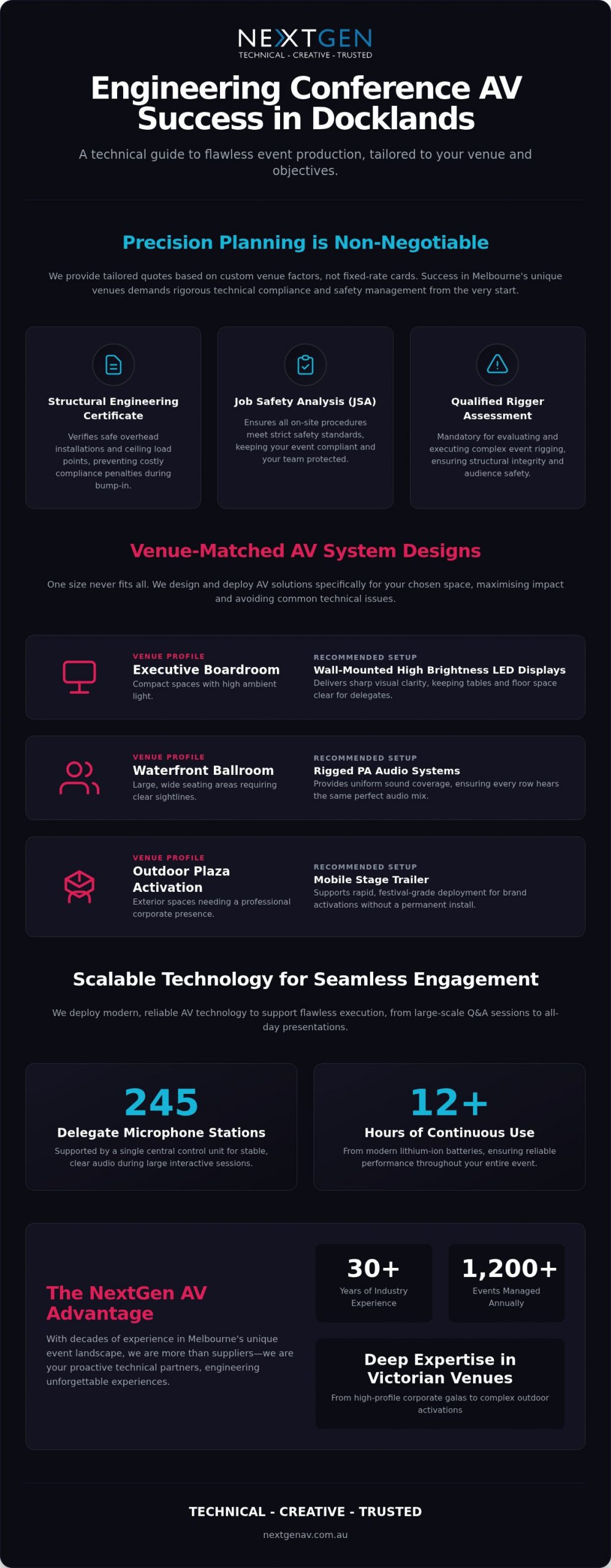
Designing scalable conference av solutions Docklands
NextGen AV engineers precision conference audio and high brightness LED displays tailored to your venue architecture. Custom system design supports consistent coverage across large keynotes or breakout spaces.
Client projects show that poor signal distribution rapidly destroys audio and visual clarity. Our technical production team manages each signal chain to protect your presentation quality.
System capacity limits can restrict delegate participation during interactive Q&A sessions. Modern conference microphone systems solve this by supporting up to 245 delegate stations using a single central control unit. Battery management eases with modern lithium-ion technology providing over 12 hours of continuous use, while signal stability is maintained through sophisticated frequency management under Australian wireless microphone regulations.
Choosing display solutions means matching screen technology to ambient light levels. High brightness LED displays fit bright Atrium spaces, while high-output laser projectors suit controlled, darkened auditoriums. Our team manages Melbourne event production from initial venue mapping through to technical execution. Direct line array systems fit large halls that need unified sound, whereas distributed speaker setups suit low-ceiling rooms that need balanced volume. You can count on reliable delivery when the design matches the room.
Deploying integrated AV: step-by-step setup process
You secure clean technical execution by following a structured installation schedule before your attendees arrive. During pre-event site visits, our engineers inspect venue access and power distribution to prevent delays. Meticulous planning keeps complex hardware management invisible to your audience so you take centre stage.
- System design and planning: Technical directors map display solutions and stage layouts to match venue acoustics.
- On-site rigging and installation: A qualified rigger secures overhead structures, adhering to each structural engineering certificate requirement.
- Hardware integration and testing: Technicians calibrate conference audio and route video feeds through digital processors.
- Rehearsals and show control: Presenters test wireless microphone systems while operators fine-tune cues for the live production.
This systematic approach prevents unexpected failures during critical moments. For the High Resolves programme, the brief called for dynamic engagement across sessions; precise coordination of technical production (conference hire) and continuous monitoring held system stability through the run of show. You can rely on our team for absolute precision from bump-in to pack-down.
When complex custom AV is wrong for your space
Overbuilding your production setup creates unnecessary operational friction in smaller rooms.
From client work we see that fitting elaborate rigs into compact venues often leads to signal clutter and restricted movement for presenters. Staging smaller events needs clean efficiency rather than excess hardware.
Simple spaces thrive on streamlined conference audio that provides clear sound without visual pollution. Throwing oversized equipment into an intimate venue resembles driving a road train down a narrow Melbourne alleyway: it consumes spatial footprint while adding no value for attendees.
Intimate breakout rooms suit simple PA audio systems and clean display solutions. High-profile galas or expansive plenary halls need full event rigging, custom set design, and complex video processing. Matching the scale of your technology to the actual room dimensions prevents unnecessary setup delays. Over-specifying equipment disrupts audience engagement and clutters your presentation space rather than lifting the atmosphere.
Frequently asked questions
Technical production for conferences covers end-to-end management: PA audio systems, high brightness LED displays, lighting rigs, and professional event staging. Our team handles set design, site safety compliance, signal routing, and on-site operation across your Melbourne event.
Which video-conference platforms are supported?
Our custom hardware configurations integrate with major video conferencing platforms to deliver crisp visual content and clear presentation sound. We manage central signal processing, camera feeds, and multi-channel microphone mixing behind the scenes so your hybrid attendees experience no delays.
Do you provide design, installation and ongoing support?
NextGen AV manages the life cycle of your event production, from initial spatial planning and CAD stage designs to on-site installation and real-time technical direction. You receive dedicated front of house engineer support to oversee live audio levels, display switching, and system performance. We take responsibility for the technical detail, allowing you to focus on your audience.
Do you provide AV for conventions as well as corporate events?
We deliver scaled conference audio and high-impact visual hardware for large-scale conventions, trade exhibitions, and corporate gatherings across Melbourne venues. Scalable digital distribution networks let a single central control unit manage large delegate station counts with rigorous circuit breaker safety protection, structural assessment, and active line monitoring on each deployment.
Can you handle AV projects for council chambers?
Our technical team routinely configures, installs, and manages tailored audio-visual architectures within municipal facilities, heritage buildings, and council chambers. We engineer precise microphone zones, automatic feedback suppression, and clear delegate display solutions to meet strict acoustic requirements. NextGen AV draws on over 30 years of technical mastery navigating complex Victorian venues safely and precisely.
Complete Your Docklands Venue Installation
Securing precision-engineered conference AV for your Docklands room means your presentation lands with impact and without technical friction.
Our advisers manage detail behind the scenes, drawing on long Melbourne event-production experience. With clients we see that comprehensive planning prevents last-minute signal failures on site. This proactive approach supports reliable staging and clear sound delivery for delegates in 2026.
For venue managers seeking to integrate these AV solutions with broader facility infrastructure, Peninsula Smart Care provides specialised expertise in commercial security and communication system installations throughout Melbourne.
Your event success remains our focus. Request a custom AV proposal to scope your Docklands venue installation. More on this: Event Production Melbourne.
A corporate stage is more than a platform; it is the physical manifestation of your brand’s authority and the structural insurance for your event’s visual prestige. When considering corporate event stage hire melbourne planners often prioritise the guest list, yet the hidden engineering beneath the floorboards is what truly defines the evening. You’ve likely felt that familiar tension when eyeing a maze of untidy cables or worrying if a temporary structure can safely support a massive LED wall under strict Victorian OH&S regulations. It’s a high-stakes environment where a single overlooked weight loading limit can transform a polished gala into a logistical nightmare.
We understand that you need more than just equipment; you need the peace of mind that comes from absolute technical mastery. This guide reveals how to secure a safe, high-impact foundation for your next project by leveraging expert staging and rigging. We will explore the latest 2026 safety standards, the art of achieving a seamless “black-tie” finish, and the strategic benefits of integrating your AV and structural needs with a single, elite partner who treats your event’s success as their own craft.
Key Takeaways
- Discover why a professionally finished stage acts as the structural foundation for your brand’s prestige and audience engagement.
- Navigate the technical complexities of corporate event stage hire melbourne with modular staging and heavy-duty truss systems designed for CBD venues.
- Learn the essential Victorian safety standards and why certified rigging is non-negotiable for insurance and OH&S compliance.
- Optimise your pre-production timeline by integrating site inspections and technical rigging plots into your early planning stages.
- Identify the value of a single technical partner to manage end-to-end execution, from structural engineering to the final “black-tie” finish.
Elevating Your Brand: The Strategic Value of Professional Staging and Rigging
Your stage is the heartbeat of your event’s narrative. It is the physical space where your corporate identity is broadcast to every stakeholder in the room. When you invest in premium corporate event stage hire melbourne, you aren’t just renting a few square metres of timber; you are commissioning a precision-engineered environment. This distinction is critical. A basic platform merely holds weight. A professional stage, built upon solid theatrical stagecraft principles, commands attention and projects absolute authority.
Psychologically, an audience’s perception of a speaker is inextricably linked to the environment surrounding them. Messy finishes or visible cables suggest a lack of attention to detail that can subtly undermine a high-stakes keynote. Our “Invisible Expert” philosophy ensures that the complex web of trussing and rigging remains a silent, powerful engine behind the scenes. You shouldn’t notice the rigging; you should only notice the flawless result. We move beyond basic platforms to create custom-engineered event environments that feel permanent, stable, and prestigious.
Staging as a Foundation for High-Impact Visuals
Modern corporate storytelling relies on scale. Sophisticated rigging systems allow for the deployment of massive LED video walls that would be impossible to support on standard portable platforms. By creating multi-level environments, we don’t just host a presentation; we craft a stage for panel discussions and keynotes that feel cinematic. Every attendee, whether in the front row or the back of the hall, deserves a clean, unobstructed sightline to the action. Precision rigging makes this possible by elevating equipment safely above the audience’s field of vision.
The Melbourne Corporate Standard
Melbourne’s premium venues, such as the MCEC or Crown, set a high bar for excellence. Your brand must meet this standard. Achieving a “black-tie” stage finish involves more than just assembly. It requires high-grade stage skirts, premium carpeting, and seamless joins that eliminate unsightly gaps. When your corporate event stage hire melbourne aligns perfectly with your brand identity, the transition from the foyer to the main hall feels like a natural extension of your corporate story. It signals to your guests that they are part of something significant, polished, and meticulously planned. We ensure every corner is mitred and every cable is tucked away, leaving only a sharp, professional silhouette that reflects your company’s commitment to quality. To maintain this standard of excellence across all event surfaces, you can learn more about Best Carpet Steam Cleaning Melbourne.
Comprehensive Staging and Rigging Solutions for Melbourne Events
Melbourne’s corporate landscape is incredibly diverse. You might find yourself planning a keynote in a high-ceilinged heritage building or a panel discussion in a modern CBD suite with restrictive weight limits. Successful corporate event stage hire melbourne relies on modularity and precision. We utilise professional-grade aluminium stage decks that lock together with surgical accuracy, providing a solid, vibration-free foundation. This scalability allows us to construct everything from intimate platforms for solo speakers to expansive, multi-tiered environments for orchestral performances or large-scale award ceremonies.
The structural integrity of your event depends on the rigging supporting your vision. While the audience sees the vibrant LED screens and hears the crisp audio, our team focuses on the heavy-duty truss systems that make it possible. We provide ground-support rigging solutions for venues where ceiling attachment is prohibited, ensuring your branding and equipment remain perfectly positioned without compromising the venue’s architecture. Every component, from customised lecterns to scenic branding banners, is integrated into a single, cohesive structural plan.
Truss and Rigging Hardware Essentials
Choosing between box truss and tri-truss is a matter of engineering, not just aesthetics. Box truss offers superior structural integrity for heavy loads, such as massive lighting rigs or large-format screens. In contrast, tri-truss provides a sleek, low-profile look for lighter applications. Our licensed riggers manage the mechanics of elevation using high-performance chain hoists and motors, strictly adhering to the Australian Staging Safety Standards. We prioritise a clutter-free environment by implementing rigorous cable management, hiding the technical “veins” of the production within the truss structure itself.
Specialised Staging for Performance and Panels
Dynamic events often require quick-change configurations. Rolling risers allow us to reposition entire performance groups or sets in minutes, maintaining the momentum of your program. Accessibility is never an afterthought; we integrate compliant ramps and stairs that blend seamlessly with the stage’s “black-tie” finish. Finding the “Goldilocks” zone for stage height is essential for audience engagement. A stage that is too low loses sightlines, while one that is too high creates a disconnect with the front row. We calculate these dimensions based on your specific venue’s floor plan and seating density. If you are navigating a complex floor plan, our team can provide a tailored technical assessment to ensure your structural layout is both safe and high-impact.
Safety and Compliance: Navigating Australian Staging Standards
Safety in a live production environment is never an afterthought. It is the invisible architecture that protects your brand, your guests, and your peace of mind. In Victoria, the legal framework for temporary structures is rigorous and specific. When you engage in corporate event stage hire melbourne, you aren’t just hiring a platform; you’re entering a regulated workspace where compliance is a non-negotiable requirement. This is the structural insurance that allows you to focus on your guests while we manage the physics of the environment.
Certified riggers are essential. They understand the complex distribution of forces and the precise tension required for a secure overhead installation. Without a qualified professional, your event is exposed to structural risks and insurance liabilities that no organiser should ever have to shoulder. We provide comprehensive Risk Assessments and Safe Work Method Statements (SWMS) for every Melbourne venue. These documents ensure that every bolt, clamp, and motor meets current 2026 safety benchmarks and adheres to the best practices established by Live Performance Australia.
Engineering for stability involves complex weight loading calculations. Ensuring your stage and lighting setup is perfectly balanced requires more than just high-end equipment. It requires a technical partner who can calculate point loads and total distributed weight with absolute certainty. This meticulous approach prevents venue floor damage and ensures the structural integrity of the entire build.
Certified Rigging and Structural Engineering
A qualified rigger’s role extends far beyond simply hanging equipment. They are responsible for the structural sign-off of custom-built stages and large-scale rigs. In Melbourne’s notoriously variable climate, wind loading considerations are paramount for any outdoor corporate event. We calculate the lateral forces exerted on stage roofs and screens to ensure they remain anchored and secure; regardless of a sudden change in weather. This proactive engineering is what defines our “Invisible Expert” persona.
Venue Liaison and Compliance Management
Every Melbourne venue has its own technical quirks and weight limits. We work directly with venue technical managers to approve rigging plots well before the first truck arrives. This collaborative approach ensures full adherence to WorkSafe Victoria regulations and Australian Standards. Our comprehensive public liability insurance provides an additional layer of security, guaranteeing that every aspect of the corporate event stage hire melbourne process is handled with the professionalism your brand deserves. We take pride in our “front-of-house” excellence, making the compliance process look as effortless as the final production.

Strategic Planning: Site Inspections and Logistics in Melbourne
Strategic planning is the invisible engine that drives every successful production. While a basic booking form might suffice for a local community gathering, professional corporate event stage hire melbourne demands a rigorous, multi-step logistical framework. We don’t just show up on the day; we orchestrate a methodical sequence designed to eliminate risk and maximise impact. This journey begins with a comprehensive site inspection where our technical directors evaluate everything from floor level variations to existing power distribution and rigging point availability. We look for the hidden constraints that others might overlook, such as floor load limits or restrictive lift dimensions.
Once we’ve mastered the venue’s physical constraints, we translate that data into a technical floor plan and a detailed rigging plot. These CAD drawings serve as the “source of truth” for the entire technical crew, ensuring every piece of truss and every stage deck aligns perfectly with your vision. Coordinating load-in schedules with Melbourne’s notorious CBD loading docks requires seasoned expertise. We manage the delicate dance of truck arrivals and lift access, ensuring that our technical crew can begin on-site assembly and safety checks without delaying your programme. The process concludes with a swift, disciplined post-event pack-down. We pride ourselves on venue restoration, ensuring the space is returned to its original state with the same precision used during the build.
Navigating Melbourne CBD Venue Logistics
Success in high-traffic zones like Collins Street or the Southbank precinct requires more than just a truck; it requires a strategy. We manage the complex timing of bump-in and bump-out to reduce venue hire costs and avoid the peak-hour gridlock that often plagues Melbourne events. Our team ensures that power requirements are calculated to the kilowatt, distributing energy across integrated staging and AV setups to prevent unexpected outages during your event’s most critical moments. We handle the logistical grind so you can focus on the prestige of the final result.
Customising for Audience Size and Engagement
A stage’s height should never be a guess. We calculate the ideal elevation based on the ballroom’s depth and seating arrangement, ensuring that your keynote speaker remains the focal point for every attendee in the room. For modern productions, this often includes hybrid event staging solutions that prioritise sightlines for both the physical and virtual audience. We also leverage specialty rigging to facilitate “The Reveal”, using high-speed motors and dramatic curtain drops to create a sense of theatre and anticipation. To begin your planning journey with a team that values precision, you can request a technical site inspection with our senior production specialists.
Seamless Execution with NextGen AV’s Technical Direction
Thirty years of navigating Melbourne’s most demanding venues has taught us one undeniable truth: technical excellence is a dedicated craft, not a commodity. When you choose NextGen AV for corporate event stage hire melbourne, you aren’t just hiring a vendor; you’re securing a “Confident Orchestrator” for your production. We understand that the structural foundation of your stage is only as effective as the technical direction behind it. Our veteran team thrives under the pressure of high-stakes environments, taking personal pride in the quiet power of a zero-failure event. We manage the complex physics of the build so you can focus on your guests and the prestige of your brand’s message.
True production success lies in the seamless integration of disparate elements. Staging should never be treated as an isolated platform. In our integrated production model, the structural rigging, high-fidelity audio, and precision lighting work as a single, unified ecosystem. This holistic approach eliminates the friction often found when multiple providers compete for space and power. We ensure that every truss line and stage deck is positioned to enhance the acoustic and visual performance of the entire room, resulting in a polished, cinematic experience that feels both effortless and grand.
End-to-End Project Management
We assign dedicated technical directors to every major corporate project to provide a single point of accountability from concept to pack-down. This journey begins in pre-production with detailed visualisations and 3D stage renders. These tools allow you to step inside your event before a single piece of equipment leaves our warehouse, ensuring the final build aligns perfectly with your aesthetic vision. On the day, our directors provide real-time problem solving, proactively managing the “behind-the-scenes” logistics to ensure the front-of-house excellence remains uninterrupted. It’s a proactive, elite service designed for those who demand absolute reliability.
Partnering for Success
Our collaborative approach is built on long-term trust with Melbourne’s leading event planners and agencies. We don’t just deliver equipment; we deliver a partnership that values transparency and technical mastery. By choosing a partner that specialises in the high-end requirements of Melbourne CBD venues, you ensure your event is backed by three decades of industry-leading expertise. We invite you to move past the logistical grind and experience the peace of mind that comes from professional technical direction. Enquire about your Melbourne stage rigging today and let us build the foundation for your next success.
Building Your Vision on a Foundation of Excellence
The success of your production rests on more than just the surface of the platform. It is built on the precision of the engineering and the depth of the planning that happens long before the doors open. By prioritising a “black-tie” finish and adhering to rigorous Victorian safety standards, you elevate your brand’s authority while protecting your guests. Navigating the logistical maze of CBD venues requires a partner who understands that every centimetre of truss and every point load calculation is a critical component of your event’s narrative.
When you invest in corporate event stage hire melbourne, you deserve the peace of mind that only decades of technical mastery can provide. NextGen AV brings 30+ years of corporate event excellence and comprehensive OH&S and compliance documentation to every build. As Melbourne CBD venue specialists, we manage the technical complexity so you can focus on the prestige of the final result. We move beyond the logistical grind to ensure your structural foundation is as sophisticated as the message you deliver.
Partner with Melbourne’s Stage Rigging Experts to transform your next conceptual vision into a flawless structural reality. Your audience is waiting for a stage that reflects your commitment to quality; let’s build it together.
Frequently Asked Questions
Do I need a certified rigger for my Melbourne corporate event?
Yes, you absolutely require a certified rigger if your event involves overhead installations like lighting bars, speakers, or LED screens. WorkSafe Victoria mandates that all high-risk rigging work is performed by licensed professionals to ensure structural integrity and public safety. Our team manages this compliance on your behalf, providing the necessary high-risk work licenses and insurances to protect your project and brand.
What is the standard height for a corporate event stage?
The ideal height for a corporate stage typically ranges between 300mm for intimate meetings and 900mm for large ballrooms. For most Melbourne CBD venues, a height of 600mm is the “Goldilocks” zone, providing clear sightlines for seated attendees without creating a disconnect from the front row. We calculate the specific elevation based on your venue’s floor plan and audience density to ensure optimal visibility for every guest.
Can you provide staging and rigging for outdoor events in Melbourne?
We certainly provide specialised staging and rigging for outdoor corporate events across Melbourne. Outdoor builds require additional engineering considerations, particularly regarding wind-loading and ballast requirements to combat our variable climate. Our technical directors utilise precision-engineered ground-support systems and stage roofs designed to remain stable and secure in high-wind conditions, ensuring your outdoor activation is both high-impact and fully compliant.
How much weight can a standard event truss hold?
Weight capacity depends entirely on the truss profile and the distance between support points. A standard 300mm box truss can typically support significant point loads for lighting and AV, but these limits decrease as the span increases. We perform rigorous structural calculations for every corporate event stage hire melbourne project to ensure total distributed loads remain well within safe operating limits. We never guess; we engineer for absolute certainty.
Do you conduct site inspections at Melbourne venues before the event?
Yes, conducting a comprehensive site inspection is a non-negotiable step in our technical direction process. We evaluate venue access, ceiling heights, rigging point locations, and floor weight capacities to identify potential constraints before the bump-in begins. This proactive approach allows us to design a technical floor plan that integrates perfectly with the venue’s architecture, preventing last-minute logistical hurdles and ensuring a seamless execution on the day.
What is the difference between ground-supported and flown rigging?
Flown rigging involves suspending equipment directly from the venue’s ceiling points using motors and chain hoists, which keeps the floor space clear. Ground-supported rigging utilises towers or truss legs to support the load from the floor up. We recommend ground-supported solutions for venues with limited ceiling weight capacities or when specific rigging points aren’t available, ensuring your visual elements are safely elevated without relying on the building’s structure.
How long does it take to set up a professional corporate stage?
Setup times vary based on complexity, but a standard corporate stage build usually takes between two and six hours. A large-scale production involving integrated LED walls and complex overhead rigging requires a more extensive bump-in window. We coordinate closely with your venue’s loading dock and event schedule to maximise efficiency, ensuring the technical build is completed and safety-checked well before your guests arrive for the first session.
Do your staging services include carpet and skirting?
Yes, every professional corporate event stage hire melbourne package includes premium stage skirting and high-grade carpeting as standard. We specialise in providing a “black-tie” finish that hides the structural elements and cables, creating a seamless and prestigious look for your brand. Our team ensures that every join is mitred and every edge is polished, delivering a sophisticated environment that meets the expectations of Melbourne’s most elite corporate venues.
The most breathtaking moments of a live production don’t happen on the stage; they happen several metres above it, held in place by the invisible precision of professional engineering. You understand that behind every immersive LED display or complex lighting plot lies a significant weight of responsibility. The fear of structural failure or the frustration of navigating opaque Australian rigging standards can often overshadow the creative vision of your event. It is a high-stakes environment where the difference between a spectacular success and a safety incident rests on the strength of your overhead infrastructure.
Implementing the right event rigging solutions is the only way to bridge the gap between ambitious design and absolute safety. This 2026 guide provides the mastery you need to ensure your next production is structurally sound, fully compliant with the WHS Act 2011, and visually spectacular. We will demystify essential hardware, clarify venue load limits, and provide the technical vocabulary required to brief your AV partners with the authority of a seasoned expert. By the end of this article, you will have the knowledge to move past the logistical grind and focus on the prestige of a flawless execution.
Key Takeaways
- Understand why professional event rigging solutions are the invisible backbone of any high-impact production, ensuring every element is suspended with engineered precision.
- Identify the essential hardware required for a secure setup, from modular aluminium truss to the sophisticated chain hoists that safely lift the load.
- Navigate complex Australian safety standards and licensing requirements to ensure your production remains fully compliant and structurally sound.
- Learn how to conduct a comprehensive site inspection to account for venue load limits and technical constraints before the build begins.
- Discover the efficiency of a holistic approach where rigging, lighting, and staging are integrated to create a seamless and prestigious event experience.
What are Event Rigging Solutions?
Every world-class production begins with a structure that stays largely unnoticed by the audience. Professional event rigging solutions represent the sophisticated integration of hardware and engineering designed to suspend high-end audio, lighting, and visual technology safely above the crowd. It is the invisible backbone of the experience. While architectural rigging refers to permanent systems built into theatres or arenas, temporary event rigging is a bespoke craft. It involves transforming a raw space, such as a hotel ballroom, a heritage building, or an outdoor precinct, into a technically capable venue through the use of modular trussing and precision motors. This flexibility allows for the creative freedom that brings a cinematic vision to life.
Modern productions rely on this foundation to achieve a level of prestige that floor-supported equipment simply cannot match. Whether you are planning an intimate corporate gala or a large-scale festival, the rigging system acts as the silent engine driving the success of the show. By employing Entertainment rigging principles, technical teams can create immersive environments that feel both expansive and secure. It is a dedicated craft that balances the laws of physics with the artistry of live performance.
The Core Purpose of Rigging in Events
The primary objective of any rigging system is to elevate the technical standard of the production while maintaining absolute safety. By moving heavy equipment overhead, you achieve three critical outcomes:
- Optimal Sightlines: Elevating audio and lighting gear ensures every guest has an unobstructed view of the stage, creating a more inclusive and high-impact experience.
- Maximised Floor Space: Clearing the ground of bulky stands and cables opens up the room for better guest flow, additional seating, or more elaborate stage sets.
- Uncompromising Safety: A professionally engineered system secures equipment far more effectively than temporary floor supports, protecting performers, staff, and attendees from accidental knocks or instability.
When Does Your Event Need a Rigging Specialist?
Rigging is not a “plug and play” utility. It’s a high-stakes discipline that requires seasoned veterans who thrive under pressure. You should engage a specialist whenever your production involves suspending loads over people, as this is a critical point of legal and structural responsibility. Complex LED wall configurations also demand expert oversight; these screens are incredibly heavy and require meticulous weight distribution. Finally, if your venue has restricted weight capacities or unique architecture, a specialist will navigate these constraints to ensure your event rigging solutions are both compliant and spectacular. They act as the confident orchestrator, allowing you to take centre stage without a single worry about the gear overhead.
Essential Hardware: The Components of a Rigging System
Excellence in live production isn’t just about the vision; it’s about the physical components that make that vision possible. A robust rigging system is composed of high-grade hardware that must work in perfect unison. When we design event rigging solutions, we select each element based on its load-bearing capacity and its ability to integrate seamlessly with the venue’s architecture. From the skeleton of the stage to the motors that do the heavy lifting, every piece of kit is a critical link in the safety chain. Understanding these components allows you to brief your technical team with confidence and precision.
Truss Types and Configurations
Aluminium truss serves as the modular building block of any modern event. Box truss is the industry workhorse, offering a superior strength-to-weight ratio for heavy lighting rigs and LED screens. In contrast, tri-truss provides a sleeker profile for lighter decorative elements or exhibits where space is at a premium. For those looking to break away from traditional linear designs, circular and custom-curved trussing can transform a standard stage into a high-art installation. We often recommend black powder-coated finishes for a sophisticated, “invisible” look that lets the lighting take centre stage, while classic silver remains a staple for high-energy, industrial aesthetics.
Lifting and Suspension Technology
The true power behind any rig lies in its lifting technology. Electric chain hoists provide the precision height control required to level massive screens and lighting bars with millimetre accuracy. For smaller, static installations where power isn’t required after the initial setup, manual chain blocks offer a reliable and cost-effective alternative. Safety is never left to chance; seasoned teams utilise advanced load monitoring systems that provide real-time data to prevent structural overloads before they occur. It’s important to remember that operating this machinery is a specialised task; anyone performing rigging work in Australia must hold a valid Australian high-risk work license to ensure compliance with national safety regulations.
Connection Points and Ground Support
The smallest components often carry the most weight. High-tensile steel cables, Grade S bow shackles, and synthetic round slings are the critical connection points that secure the truss to the venue’s fly points. However, not every venue allows for overhead suspension. In these scenarios, ground support systems become essential. These self-supporting structures use heavy-duty base plates and towers to lift the rig from the floor up, ensuring you can still achieve a professional, elevated look even in heritage buildings or temporary marquees. If you’re unsure which configuration fits your next project, exploring our range of integrated staging and rigging options is an excellent place to start.
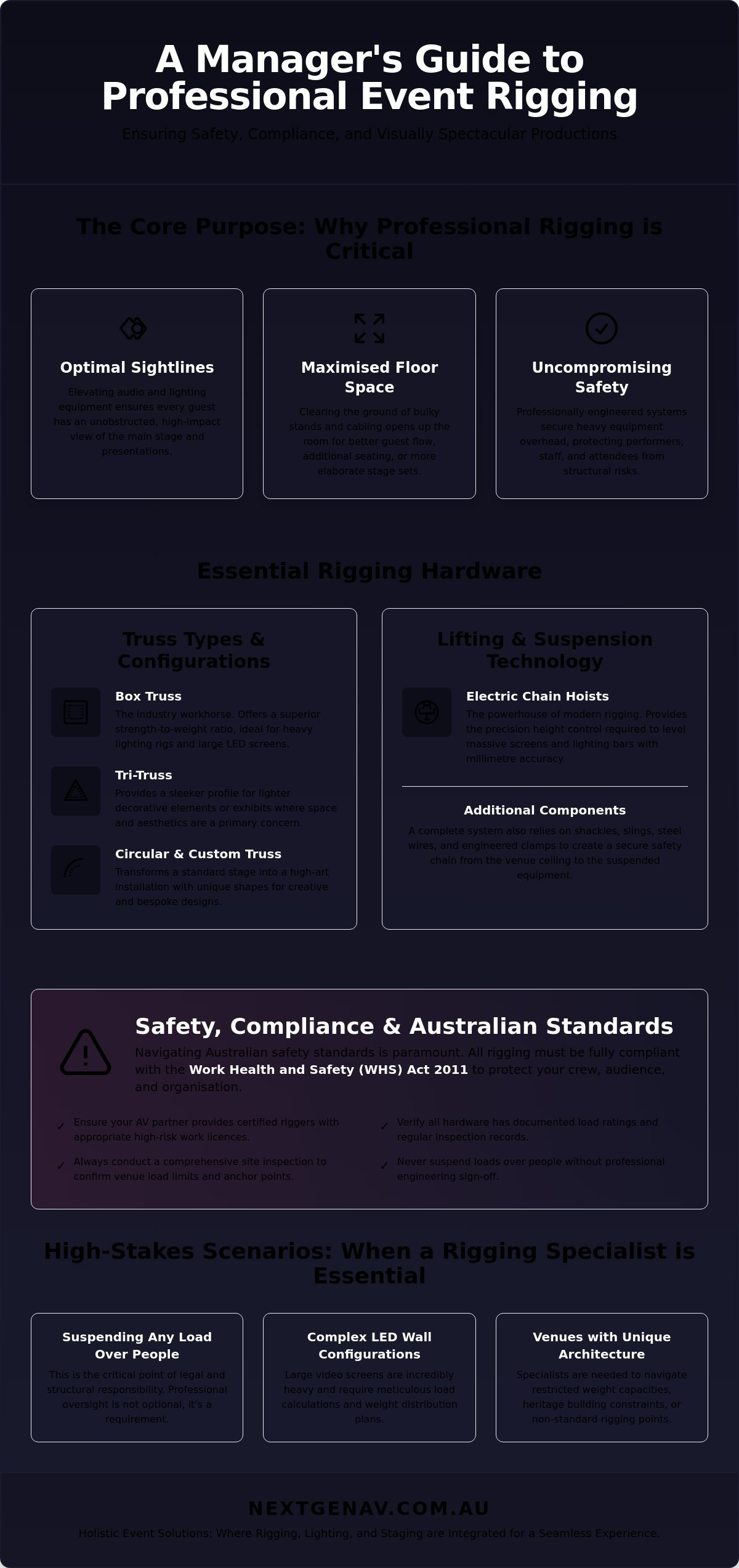
Safety, Compliance, and Australian Standards
Safety in the event industry is often viewed through the lens of liability, but for elite production teams, it’s viewed as the art of mitigation. Adhering to Australian Standards like AS 1418 for hoists and winches, or AS 2319 for rigging screws, isn’t just about ticking a box; it’s about guaranteeing structural integrity under pressure. When we deploy event rigging solutions, every calculation is backed by these rigorous benchmarks. This professional rigour extends to the documentation process, where Safe Work Method Statements (SWMS) and comprehensive risk assessments become the roadmap for a secure build. Following a structured approach to managing workplace hazards and risks ensures that potential issues are identified and neutralised long before the first guest arrives.
The human element is just as critical as the hardware. In Australia, rigging is classified as high-risk work, requiring specific licensing that reflects the complexity of the task. An Intermediate Rigger is qualified for most standard production tasks, such as erecting truss and installing hoists. However, for complex custom builds, massive suspended structures, or anything involving the movement of loads, an Advanced Rigger is required to oversee the operation. For any bespoke stage design or non-standard installation, a structural engineering sign-off provides the final seal of approval, offering the ultimate peace of mind for event organisers and venue owners alike.
Navigating Venue Load Limits
Every venue has a different story to tell through its rigging plot. Understanding the difference between a point load, which is the weight at a single suspension point, and a Uniformly Distributed Load (UDL) is essential for preventing structural fatigue. In Melbourne, many prestige venues are housed in heritage buildings with strict technical restrictions that can’t be ignored. We work closely with venue managers to interpret these floor plans and plots, ensuring your production stays within safe limits while still achieving maximum visual impact. It’s about finding the sweet spot between creative ambition and the physical realities of the room.
Annual Inspections and Gear Maintenance
Hardware is only as reliable as its last inspection. All rigging equipment must be “tagged and tested” regularly to meet Australian safety requirements and ensure it’s fit for purpose. At NextGen AV, we maintain a rigorous maintenance schedule that often exceeds industry minimums. Our technicians are trained to spot the subtle signs of compromised gear, such as hairline fractures in shackles or microscopic fraying in synthetic slings, that an untrained eye might miss. Using pristine, well-maintained equipment is a commitment to the professional standard your event deserves, ensuring the “invisible backbone” of your show remains flawlessly strong.
Planning Your Rigging: A Guide for Event Managers
Successful event planning requires moving beyond the logistical grind to focus on the creative vision. Rigging shouldn’t be an afterthought. It’s the framework that supports your core objectives. Whether you’re aiming for a high-prestige awards night or a high-energy product launch, your event rigging solutions must be designed to enhance that specific atmosphere. A thorough site inspection with your technical partner is the first step. This visit allows us to identify structural points, assess floor loading for ground support, and anticipate any architectural hurdles before they become costly site-day problems. It’s about proactive orchestration rather than reactive fixes.
Understanding the financial components of a rig is essential for a transparent planning process. Budgeting for rigging involves more than just the daily rate for truss or motors. It encompasses specialised labour, such as licensed riggers who manage the high-risk work, transport for heavy hardware, and the specific equipment hire required for your design. By accounting for these elements early, you avoid the hidden costs often associated with venue rigging fees and technical adjustments. This clarity allows you to allocate resources where they’ll have the most impact on the guest experience. Working with dedicated event staging Melbourne specialists ensures that your physical production foundation is engineered to complement the rigging system from the very first planning stage.
The CAD Advantage in Rigging
Computer-Aided Design (CAD) has transformed the pre-production phase into a precise science. It allows us to build a digital twin of your event space. We can calculate weight distribution with mathematical certainty and verify sightlines for every seat in the house before a single bolt is tightened. This visual data is invaluable for sharing plans with venue managers and stakeholders, ensuring a seamless approval process and a predictable build. It eliminates the guesswork, allowing you to focus on the prestige of the final result.
Coordinating with Other AV Departments
A rig doesn’t exist in isolation. It’s a collaborative platform. We ensure that our rigging plans are perfectly aligned with our stage lighting design services, providing the necessary hang points for every fixture. Beyond the lights, we integrate cable paths for power and data directly into the truss design, keeping the “invisible backbone” clean and professional. Finally, coordinating the bump-in and bump-out schedule is critical. Rigging is often the first element to go up and the last to come down, so precise timing ensures the entire technical team stays on track. If you’re ready to elevate your next production with a team that understands the nuances of technical planning, reach out to the experts at NextGen AV for a comprehensive consultation.
Integrated Rigging Solutions with NextGen AV
Choosing a technical partner who treats rigging as an integrated discipline rather than a standalone utility transforms the entire production process. When you opt for a holistic approach to stage and lighting hire Melbourne, you eliminate the friction between separate vendors and ensure that every technical element works in perfect synergy. Our event rigging solutions are designed to be the foundation upon which your visual and audio systems thrive. This unified strategy not only saves significant time during the high-pressure bump-in phase but also optimises your budget by streamlining labour and transport requirements. It is about creating a seamless path from the initial CAD drawing to the final, breathtaking execution.
With over 30 years of experience in the Australian event industry, we have refined a “no-surprises” philosophy that prioritises absolute reliability. We understand the inherent stress of high-stakes planning, which is why our team acts as a proactive technical powerhouse behind the scenes. This seasoned expertise allows us to navigate the complexities of venue load limits and regulatory compliance with quiet power, leaving you free to focus on the prestige of the event itself. We don’t just provide equipment; we deliver the peace of mind that comes from three decades of flawless execution.
Rigging for High-Impact Visuals
Modern productions increasingly rely on massive digital canvases to captivate audiences. Specialised rigging for LED video walls requires a sophisticated understanding of weight distribution and structural tension. These screens are significantly heavier than traditional projection surfaces, demanding precision-engineered trussing and high-capacity motors to ensure a perfectly level and secure hang. We thrive on managing these unique weight challenges, using creative truss configurations to build immersive environments that wrap around your audience. Our technical direction ensures that even the most ambitious visual designs are grounded in absolute structural integrity.
Partnering with NextGen AV in Melbourne
Our deep roots in the local industry give us an unparalleled advantage when working within Melbourne’s premier event venues. We maintain strong relationships with venue managers across the city, allowing us to navigate technical restrictions and rigging plots with ease. The “Invisible Expert” philosophy is at the core of everything we do; we handle the complex engineering and high-risk licensing requirements so that you can take the credit for a spectacular result. If you are ready to elevate your next production with elite technical execution, contact us today for a comprehensive rigging and event lighting hire Melbourne quote. Let us orchestrate the invisible backbone of your next success.
Master the Invisible Backbone of Your Production
Transforming an ambitious creative vision into a tangible, high-impact experience requires more than just high-end gear. It demands a technical foundation built on engineering precision and uncompromising safety. By understanding the essential components of event rigging solutions and the rigour of Australian Standards, you move from the stress of logistical uncertainty to the confidence of a seasoned orchestrator. Whether you’re navigating complex venue load limits or integrating massive LED walls, the key to success lies in proactive planning and expert partnership.
NextGen AV brings over 30 years of industry experience and a team of certified Melbourne-based rigging specialists to every project. Our strict adherence to Australian Standard AS 1418 ensures that your production is not only visually breathtaking but structurally beyond reproach. We handle the technical weight so you can focus on the prestige of the final result. Discuss your event rigging requirements with the NextGen AV team today and let’s build something spectacular together. Your next world-class event is just one well-engineered step away.
Frequently Asked Questions
What is the difference between ground support and flown rigging?
Ground support systems are self-standing structures built from the floor up using heavy-duty base plates and towers, whereas flown rigging involves suspending equipment directly from the venue’s ceiling fly points. We typically recommend ground support for outdoor marquees or heritage buildings where overhead attachment is prohibited. Flown rigging is the preferred choice for large-scale productions as it clears floor space and offers superior sightlines for your audience.
Do I need a structural engineer for my event rigging?
You generally require a structural engineer’s sign-off for bespoke stage designs, massive outdoor structures, or any installation that pushes the boundaries of standard venue load limits. While standard event rigging solutions are covered by the rigger’s licence and manufacturer load charts, custom builds introduce unique stresses that demand a formal engineer’s certificate. This step provides an essential layer of compliance and peace of mind for high-stakes productions.
How much weight can a standard venue rigging point hold in Melbourne?
Weight capacities vary significantly across Melbourne venues, with standard points often rated anywhere from 250kg to over 1000kg. You must never assume these limits; it’s vital to consult the venue’s specific rigging plot or technical floor plan. Our team liaises directly with venue managers to verify these point loads and total uniformly distributed loads (UDL), ensuring your production remains within safe structural boundaries at all times.
What qualifications should a professional event rigger have in Australia?
A professional rigger must hold a valid High Risk Work Licence issued by a state regulator like WorkSafe Victoria. These licences are categorised into Basic, Intermediate, and Advanced levels. Most complex event productions require at least an Intermediate rigger to oversee the build. This certification ensures the technician has the proven expertise to calculate loads, inspect hardware, and execute safe suspension in a high-pressure live environment.
How does rigging impact the overall event production budget?
Rigging impacts the budget through three main channels: specialised labour, hardware hire, and venue-specific rigging fees. While it represents an upfront investment, professional rigging often reduces costs in other areas by allowing for more efficient lighting and audio placements. An integrated approach, where rigging is bundled with your staging and lighting, typically offers the best value by streamlining transport and technical labour requirements.
Can I use the venue’s in-house rigging instead of hiring a specialist?
Many venues mandate the use of their in-house team for the initial attachment to the building’s structure, but you can still engage an external specialist for the production-specific design. Hiring a dedicated technical partner allows for a more bespoke and integrated approach to your show’s visual goals. This ensures that your LED walls and lighting rigs are perfectly aligned with your creative vision rather than being limited by a standard house setup.
What is a “dead hang” versus a “bridle” in rigging terms?
A dead hang is a direct vertical connection between a load and a single suspension point located directly above it. In contrast, a bridle uses two or more cables attached to separate points to create a new “virtual” hang point at a specific location. Bridles are essential tools when the ideal position for a light or speaker doesn’t align perfectly with the venue’s existing structural beams.
How do I ensure my rigging setup is compliant with WorkSafe Victoria?
Compliance is achieved by employing licensed riggers, using “tagged and tested” hardware, and documenting a comprehensive Safe Work Method Statement (SWMS). You must also ensure that all rigging practices align with the WHS Act 2011 and relevant Australian Standards like AS 1418. Partnering with a seasoned technical team ensures these regulatory requirements are met with precision, protecting your organisation from liability and ensuring the safety of every guest.
