
Music should change with the room, not compete with it. A well-planned background music system for corporate dinner starts with brighter, welcoming selections as guests arrive, settles into mellow, familiar tracks during the meal and eases back or pauses for speeches before lifting the atmosphere again. That flow gives each part of the evening its own character without making the soundtrack the centre of attention.
The right music can make a formal dinner feel more inviting, while excessive volume or an abrupt change can interrupt conversation. Plan the soundtrack around how guests will use the space and how the event will unfold, rather than relying on one unchanging playlist.
This guide explains how to choose between recorded playlists and live music, select music that supports conversation, coordinate cues with speeches and shape the progression from cocktails through dinner to dessert. It also covers how professional audio planning can keep the experience cohesive as the room and schedule change.
Key Takeaways
- Match recorded playlists or bespoke curation to the event schedule, guest profile and company culture.
- Choose mellow, familiar music and balance its volume so guests can speak comfortably across the table.
- Coordinate music cues with speeches and formalities to keep transitions smooth and attention on the speakers.
- Shape the soundtrack from cocktails through dinner and dessert, adjusting the mood as the evening unfolds.
How a professional team selects ready-made playlists or provides bespoke music curation
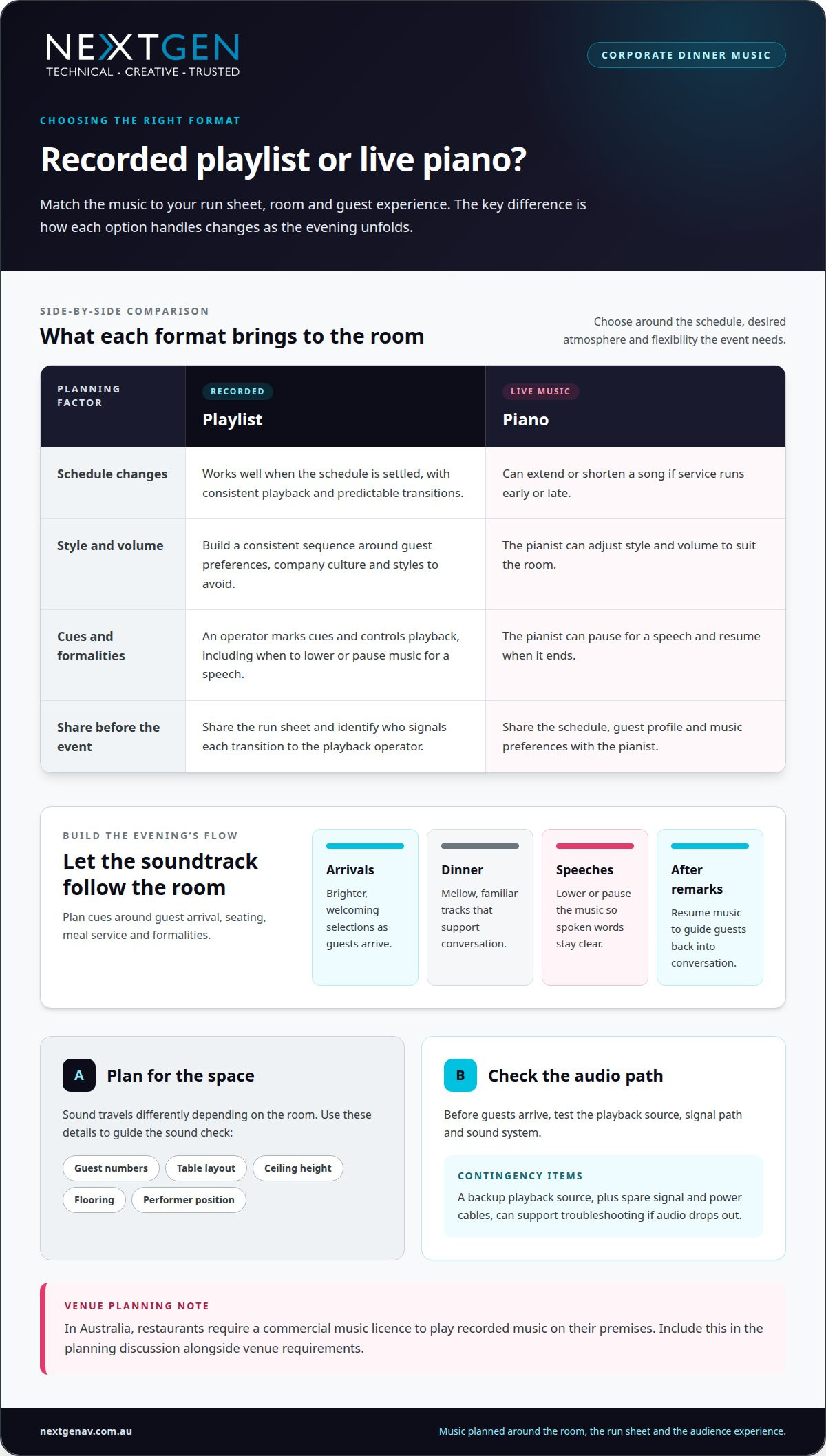
Match the music format to the venue, run sheet and guest profile. An intimate boardroom dinner may suit a quiet playlist, while a larger ballroom needs carefully planned sound coverage and level control. Guest numbers, table layout, ceiling height, flooring and performer position all affect how sound travels. These details should guide the sound check before guests arrive.
Music curation starts with the event schedule, guest profile and company culture. Note styles, songs or artists to avoid, then build a consistent sequence around those preferences. Brighter, mid-tempo tracks can welcome arrivals, while softer selections suit dinner service. A ready-made playlist works well when the schedule is settled. A background music system for corporate dinner events should also allow for changes a fixed playlist cannot anticipate, such as delayed service or an unexpected speech.
Live piano offers a different kind of control. A pianist can extend or shorten a song if service runs early or late, adjust style and volume to the room, and pause for a speech. Recorded music suits events that need consistent playback and predictable transitions. Choose between live music and playlists based on the schedule, desired atmosphere and how much flexibility the event needs. This approach shapes a background music system for corporate dinner settings around the evening, rather than forcing the evening to follow the soundtrack.
Scheduling starts with the run sheet. Map cues to guest arrival, seating, meal service and formalities, then identify who signals each transition. With recorded music, the operator marks cues and controls playback. For a live pianist, share the schedule, guest profile and music preferences.
In Australia, restaurants require a commercial music licence to play recorded music on their premises. Include this consideration in the planning discussion, alongside the venue’s requirements.
A professional audio system should suit the room and provide even background coverage. To reduce the risk of audio failure, test the playback source, signal path and sound system during the sound check. A backup playback source and spare signal and power cables can support troubleshooting if audio drops out.
How professionals choose mellow, familiar music that supports conversation
For a corporate dinner, music should create atmosphere without becoming the focal point. Choose a mellow tempo, steady mood and familiar melodies guests can enjoy without concentrating on them. Jazz standards, light classical pieces and film or television themes can add gentle character. Sophisticated piano covers of familiar pop songs offer recognition without turning the meal into a singalong.
Selection also means removing tracks that jar with dinner conversation. Harsh sounds, abrupt changes and sudden volume shifts can pull attention away from the table. A consistent musical style helps the room feel composed, while smooth transitions preserve the relaxed mood. Consider the company culture and formality of the occasion when deciding whether the music should feel contemporary or traditional.
Volume deserves as much attention as song choice. Set the music low enough for guests to speak comfortably across the table, then listen from different seating areas during the sound check. Adjust levels as conversation builds or the room fills, rather than relying on one setting throughout the evening. Before speeches, lower or pause the music so spoken words remain clear.
Room conditions also influence the mix. A crowded dining room can grow louder as guests talk, while sound may carry differently across hard flooring or beneath high ceilings. Listen for areas where music masks conversation and make measured adjustments to the sound system. A venue sound limit alone does not account for changing conversation levels or how particular frequencies carry.
Music can also influence the meal’s pace. Research dating back to the 1980s found that loud, fast-tempo music speeds up eating, while reducing enjoyment and appetite in restaurants. For a Melbourne corporate dinner centred on conversation, a quieter, more measured selection supports a calmer atmosphere. The best cue is the room itself: if guests need to raise their voices, the music is competing rather than complementing.
How professionals plan music around speeches and formalities
Start with a run sheet that maps each speech, award presentation and meal transition. Use it to assign music cues, set expected levels and identify when playback should fade or stop. A named cue caller, such as the event producer or stage manager, gives the operator a clear signal while the host stays focused on guests.
The schedule also needs to reflect venue logistics. Account for meal service, speaker arrival, access times, the planned finish and any sound curfew or production requirements. If a speech moves forward because service finishes early, the cue caller can alert the operator. Sharing these details with musicians and venue coordinators helps keep formalities aligned with the room.
Give each transition a clear purpose. Arrival music can continue as guests are seated, then ease down as the host takes the microphone. Before an address, lower or pause the music so the speaker has the room’s attention. After the closing words, music can resume to guide guests back into conversation.
Live musicians can respond to timing changes in real time. A pianist can extend a song while guests are being seated, ease back before a speech, then resume when it ends. Recorded playlists provide consistent playback, but an operator must manage each cue against the actual run sheet. Either approach works best when the performer or operator knows the order of formalities.
A sound check should cover the speech position and audience area, not just the playback source. Listen for music that could mask spoken words, check the volume before the first address and confirm the transition cue with the event team. This gives speakers a clear acoustic focus without leaving the room silent between formalities.
Nominate a day-of-event contact for schedule changes. That person can relay a delayed course or revised speech timing to the audio operator, rather than leaving the host to coordinate technical adjustments while greeting guests. A clear contact and cue plan help the evening run smoothly.
How professionals plan music flow across cocktails, dinner and dessert
A corporate dinner moves through distinct moments, so the soundtrack should move with it. During cocktails, brighter selections can welcome guests and support networking. As guests take their seats, shift towards softer, slower music to establish a calmer atmosphere for dinner. By dessert, the music can gently lift the room again, helping the evening transition to drinks or informal conversation.
Transitions work best when music follows the event’s actual run sheet. Coordinate with the event team on when guests move from cocktails to the dining area, when courses are served and when formalities finish. If dinner runs late, adjust the planned sequence rather than letting a fixed playlist dictate the room’s pace. A live act that adapts across networking, the meal and post-dinner drinks can also help the evening feel cohesive.
For background music, a professional provides sound systems suited to even coverage and clear, controlled playback. The setup may include speakers, a playback source and audio control, with a wireless microphone included when the programme needs spoken announcements. Equipment choice depends on the venue layout and whether the dinner includes speeches or other formalities. The aim is to carry music across the room without making it the focus.
There is no fixed speaker count based on guest numbers alone. Consider guest numbers alongside table layout, ceiling height, flooring and speaker positions, since each affects how sound travels. A long dining room with separate seating areas may need a different coverage plan from a compact, open room. A sound check lets the operator assess coverage in the guest area and refine speaker placement and levels.
Map the soundtrack to each change of setting, not just each course. This simple planning principle helps music support the evening’s flow, from the first arrival to the final conversation, while keeping the atmosphere right for each moment.
NextGen AV: Professional Audio Systems
NextGen AV provides Professional Audio Systems for corporate dinners that need controlled background music, clear speech playback and smooth transitions. The team can align the audio setup with the venue layout and run sheet, helping music move from cocktails to dinner without competing with conversation. For programmes with speeches, technical direction coordinates playback cues and microphone use so attention stays on the speaker when formalities begin.
When dinner forms part of a larger event, LED Video Walls and Lighting Design and Equipment can support the wider production environment. Staging and Rigging can also form part of the plan when the event needs a defined presentation area. The right combination depends on the event format and the audience experience you want to create.
Discuss Professional Audio Systems for your corporate dinner with NextGen AV.
Shape the experience from the start
A dinner soundtrack can do more than fill pauses. It can shape how guests experience your organisation, from the first welcome to the final farewell. Treat the music brief as part of the event’s creative direction: define the impression you want guests to take away, then align the sound with that intention.
A carefully planned background music system for a corporate dinner gives that creative brief a precise technical foundation. Bring the event schedule, venue layout and desired atmosphere into one production conversation, so each decision supports the guest experience you want to create.
NextGen AV provides Professional Audio Systems, LED Video Walls, and Lighting Design and Equipment for events that need a coordinated production environment. This connects the soundtrack with the room’s visual character, while technical direction manages the details behind the scenes.
Take the next step and contact NextGen AV to plan your dinner music. Give your guests an evening that feels considered from arrival to farewell.
Frequently Asked Questions
Should a professional recommend a DJ, playlist or live background music for a corporate dinner?
The format should fit the evening’s purpose. For a seated dinner focused on conversation, a curated playlist or live instrumental music can keep attention on guests and speakers. A DJ is a stronger fit when the programme includes dancing, requests or a clear shift into a livelier post-dinner celebration. Let the event brief, venue and run sheet guide the recommendation.
The venue’s AV may seem like the simplest option, but it may not suit your event. For AV for networking events in Melbourne, the right choice depends on the room, the run sheet and the guest experience you want, not just the equipment already on site.
It makes sense to weigh convenience against control. Venue AV can suit a straightforward programme, while external production can better coordinate presentations, lighting, staging and audience interaction.
This guide compares venue and external AV, explains production and audience engagement, and covers when to plan for your Melbourne event. You’ll also learn which details shape the technical plan, helping you make a clear decision and keep the focus on meaningful connections.
Key Takeaways
- Match the AV approach to your event format and venue setup to decide whether in-house support or an external production team is the better fit.
- Consider how sound, screens, lighting and staging work together to keep presentations clear and the room comfortable for conversation.
- Choose audience interaction tools that serve the event programme, making it easier for guests to take part without interrupting the flow.
- Bring production planning into the booking process early so technical requirements, venue logistics and event timing can be coordinated.
External AV providers and venue AV
Venue AV can simplify coordination when the installed systems suit your programme. Ask what the package includes, who operates the equipment and whether support covers both presentations and networking. Built-in sound may suit brief introductions, while a panel, screen content or audience questions may need a more tailored plan. Match the setup to the event rather than assuming every function room has the same capabilities.
An external AV provider can plan production around your run sheet and venue layout. This can help when sound, screens and lighting need to work together, or the venue’s systems don’t meet your requirements. Confirm access, setup arrangements and how external equipment will integrate with the room. Clear responsibilities between venue staff and the production team help prevent gaps on event day.
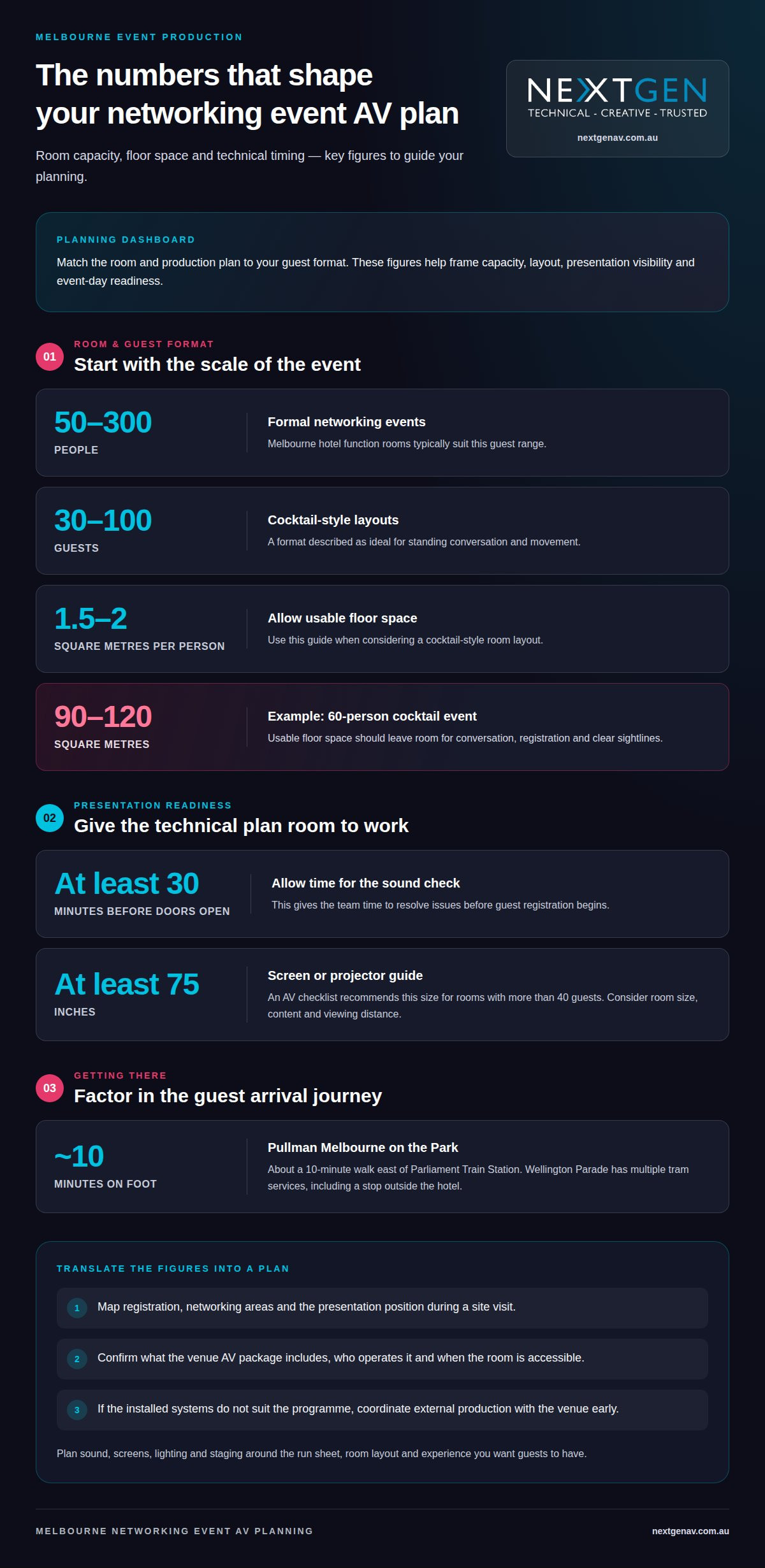
Capacity shapes both the room and its AV plan. Melbourne hotel function rooms typically suit formal networking events for 50 to 300 people. Cocktail-style layouts are described as ideal for 30 to 100 guests, with 1.5 to 2 square metres per person. A 60-person cocktail event should have 90 to 120 square metres of usable floor space. Select a layout that leaves space for conversation, registration and clear sightlines to any presentation area.
Location affects how easily guests arrive. Pullman Melbourne on the Park is about a 10-minute walk east of Parliament Train Station. Wellington Parade has multiple tram services, including a stop outside the hotel. Consider public transport access alongside parking, arrival flow and the distance between registration and the event room.
Choose a venue based on your guest format, capacity and programme, then shortlist Melbourne locations that suit those needs. During a site visit, map the registration point, networking area and presentation position. Ask about AV inclusions and access arrangements before booking. If the installed systems don’t suit your plan, coordinate external production with the venue early so responsibilities, room access and event timing align.
Corporate event audio-visual production in Melbourne
Production brings sound, vision, lighting and staging together in a coordinated plan. Planning AV for networking events in Melbourne starts with the programme, room layout and audience experience.
Audio, vision, lighting and staging
Audio carries welcome remarks and panel discussions, while screens make presentations visible around the room. Lighting can define a speaker area without making networking spaces feel too formal or restricting movement. Staging gives presenters a clear focal point, with the setup guided by sightlines, room layout and programme. An education-focused session, for example, may need better screen visibility than a reception centred on conversation.
Equipment planning and AV requirements
Production planning starts with the run sheet, venue layout, presentation content and audience format. From there, the team coordinates the relevant audio, vision, lighting and staging, rather than treating each item as a separate choice. A useful requirements list covers speaker positions, screen placement, presentation inputs, room lighting and event transitions. A sound check should take place at least 30 minutes before doors open, allowing the team to resolve issues before registration begins.
Microphone and speaker setup
The microphone and speaker setup should suit the programme and room. A wireless microphone can help a host move between welcome remarks and audience questions; a panel may need a microphone for each speaker. Professional Audio Systems can be configured for clear speech while supporting conversation around the room. Placement and level matter: guests should hear the presenter without sound overpowering networking discussions.
Screens, projectors and presentation support
Yes, Melbourne AV companies can provide screens, projectors and presentation support. For AV for networking events in Melbourne, the display choice depends on room size, content and viewing distance; an AV checklist recommends a screen or projector of at least 75 inches for rooms with more than 40 guests. A production team can coordinate presentation inputs and test content before doors open, reducing disruption during the programme. If attendees will join remotely, Virtual and Hybrid Event Solutions can connect the in-room programme with online participation.
Event technology and audience interaction
Technology can help a Melbourne networking event move smoothly between presentations and conversation. Plan each interaction around the programme, whether guests attend in person or online.
Technology for meetups
Technology meetups often combine a speaker presentation, audience questions and informal discussion. Melbourne Connect, for example, runs events such as academic lectures, debates and cocktail networking. For a similar format, align screen content and microphone handovers with the run sheet, then leave time for discussion after each session. This helps attendees focus on the topic and connect with potential partners.
Audience interaction should have a clear purpose. A moderator can gather questions during a talk and group them for a focused Q&A. Polls can prompt discussion or surface audience views, provided the results fit the session and presenters can respond. Keep instructions simple and visible so guests can participate without losing the thread of conversation.
Hybrid and livestreaming options
Hybrid and livestreaming options can connect remote attendees with in-room speakers and sessions at Melbourne networking events. The production plan should account for both audiences, including how presenters address online guests and how questions reach the room.
For a hybrid event, decide which parts of the programme remote guests can join, such as a welcome, panel or Q&A. Coordinate the run sheet, presentation content and audience questions so the online experience follows the event’s flow. Planned handovers between speakers and sessions help remote attendees stay engaged.
Choose interaction tools to suit the event’s purpose, rather than adding technology for its own sake. At a professional association meeting, moderated questions can focus discussion; at a product networking event, a short poll can introduce a topic before conversations begin. Decide who will host each activity and where it fits in the run sheet.
Before event day, align the moderator, speakers and production team on participation cues. Confirm how questions will be collected, selected and passed to presenters, and how online contributions will be included. Clear roles keep the technology in service of the meeting, so guests can focus on the people and ideas in the room.
Booking lead times
Start planning with your event date, venue and production requirements. For Melbourne networking events, the calendar can affect venue access, technical planning and guest communication. Secure the venue, then align the AV booking with the room, programme and audience format. A breakfast meeting, evening reception and hybrid panel each have different production needs, so share the schedule and format early.
Begin promoting your Melbourne networking event at least four weeks ahead. This gives attendees time to register and helps organisers plan the room and programme. Once the date is set, coordinate the venue and production teams on access, presentation needs and event timings. Agreeing on these details helps prevent late changes from disrupting setup or the guest experience.
Build communications into the calendar as the booking progresses. Send an attendee reminder one week before the event, then a final reminder 24 to 48 hours beforehand. Share the run sheet with key stakeholders at least 48 hours before the event, so speakers, venue staff and production crew can work from the same schedule.
The run sheet should cover registration, welcome remarks, presentations, audience questions and open networking. For each transition, note who is speaking and what technical support is needed. A presentation followed by networking, for example, needs a clear handover so guests can move smoothly from listening to conversation. Include venue access and setup timings in the production schedule.
On event day, organisers should arrive 60 to 90 minutes before guests. Schedule the sound check at least 30 minutes before doors open, leaving time to address audio issues before registration begins. These timings come from different planning needs: the early arrival supports coordination, while the sound check focuses on audio readiness. Hosting with a defined schedule gives the team clear cues and keeps the programme on track.
For a recurring event, place the next date in the calendar before the current gathering ends. For the first event in a series, announce the next date within 48 hours. This keeps booking and promotion moving while the meeting is still fresh for attendees.
NextGen AV: Virtual and Hybrid Event Solutions
NextGen AV coordinates the technical plan when your networking event includes in-room and remote participation. Its Virtual and Hybrid Event Solutions connect the programme with online attendees, while production planning aligns presenters, content and audience interaction.
When screen content is central, LED Video Walls can give presentations a clear visual presence. Professional Audio Systems support speech and discussion, while Lighting Design and Equipment helps shape the atmosphere around speakers and networking spaces. The right combination depends on your venue, run sheet and audience format.
Involve NextGen AV when your event includes livestreaming, hybrid participation or technical elements that need to work together. Share the event format, venue details and programme so the production plan can reflect the experience you want for guests.
Contact NextGen AV to discuss production for your networking event.
Shape the experience you want guests to remember
Before confirming production, decide what role technology should play in your event. Should guests focus on a speaker, join a hybrid discussion or move easily between a presentation and conversation? A clear creative direction helps align the technical plan with the atmosphere you want to create.
Choosing AV for networking events in Melbourne means connecting your event’s purpose with the audience experience. NextGen AV can support that vision with LED Video Walls for visual content, Professional Audio Systems for clear speech, and Lighting Design and Equipment to shape the room. Each element should contribute to an event that feels considered, not simply equipped.
With the event format and priorities in mind, you can move from planning decisions to a coordinated production brief. Discuss your event with NextGen AV and take the next step towards an experience that lets your guests connect with confidence.
Frequently Asked Questions
What AV equipment is typically needed for networking events in Melbourne?
A networking event with a brief welcome and one presenter may need a wireless microphone, sound systems and a display for supporting content. A reception without presentations may need only speech audio and room lighting. If a host moves between the entrance and presentation area, for example, plan for microphone movement and audience coverage. The final setup depends on your programme and venue.
What venue AV rules and technical requirements should I check in Melbourne?
Clarify the venue’s operating arrangements before finalising your technical plan. Ask which systems are available, who operates them, what presentation connections they support and where equipment can go. If you’re using an external production team, confirm venue access, setup and pack-down times, power locations, cable routes and rigging restrictions. For remote guests, include the venue’s internet arrangements in the technical discussion.
A memorable corporate stage doesn’t need to transform the entire venue. The most effective corporate event stage design ideas start with your event’s purpose, then shape the stage around what the audience needs to see, hear and feel.
It’s understandable to want an impressive result while keeping the design practical and mindful of waste. Modular, reusable elements can create a polished setting that adapts to different event formats, without making an elaborate build the default.
This guide explains how to choose a stage design for your event, compare a simple stage with a broader venue transformation, and plan flexible options around your priorities. It also covers how staging, lighting and LED screens can support presentations and the audience experience, with environmental considerations included from the start.
Key Takeaways
- Start with the event’s purpose and audience, then shape the stage layout and brand details around the experience you want to create.
- Choose between a focused stage setup and a broader venue transformation by considering how screens, projections and immersive elements support your event’s message.
- Plan modular elements that can adapt to different formats, helping your stage design remain flexible and reduce reliance on single-use features.
- Keep the design aligned with your priorities by coordinating staging, lighting and visual elements as one considered production plan.
How can a professional stage design team determine the right stage for your event?
Effective corporate event stage design starts with the event’s purpose, audience and venue, rather than a one-size-fits-all template. A production team can turn those priorities into a practical layout and a clear visual identity.
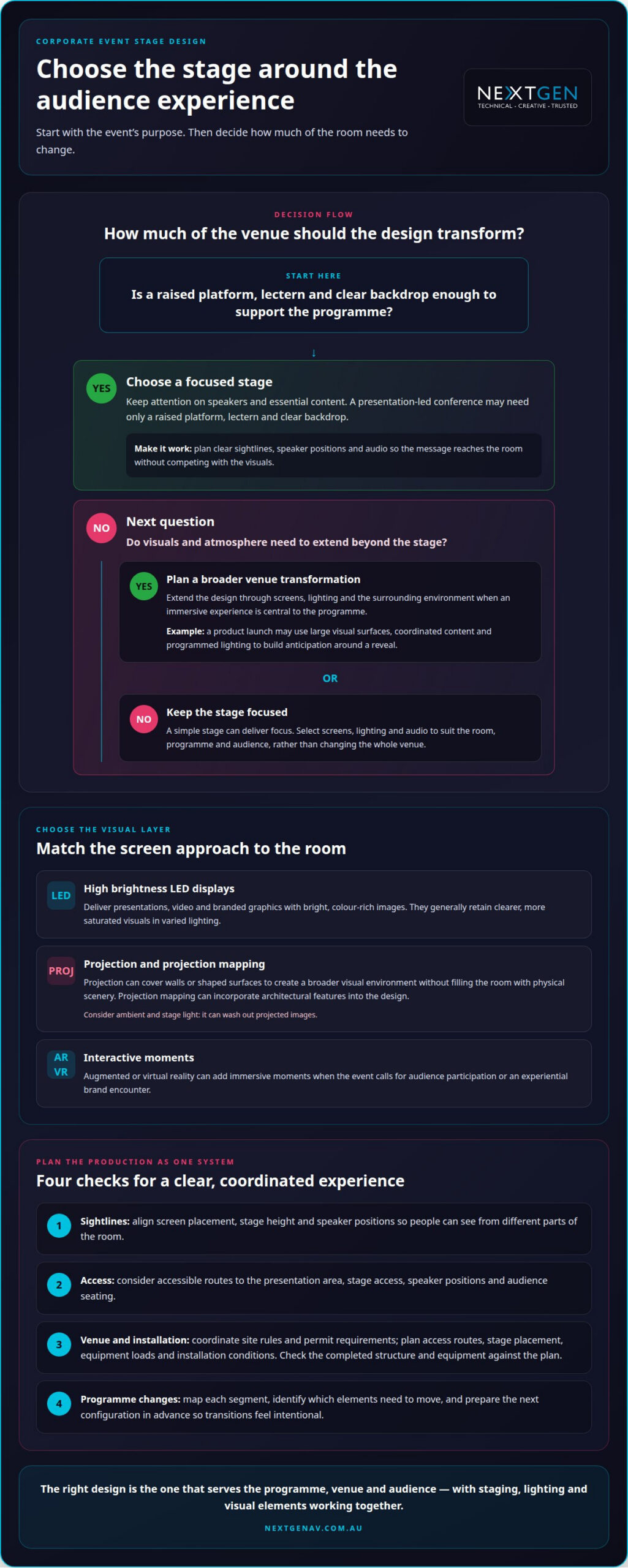
Start by defining the event’s key message and what attendees should take away. A product launch calls for a central reveal area, while a conference presentation needs clear views of speakers and content. Then consider audience movement, the venue footprint, and how speakers will enter and use the stage.
Brand identity should feel integrated, not added as an afterthought. A company logo, corporate colours and thematic graphics can inform the backdrop, stage fascia and screen content. A restrained logo treatment and consistent palette suit a leadership presentation, while bolder graphics support a product announcement. Align these elements so the stage supports the message without competing with it.
For 2026 events, a clean, adaptable stage with a branded screen backdrop, layered lighting or modular scenic panels delivers a considered setting. A circular layout suits sessions built around group interaction, while a central lectern anchors formal presentations. The right choice depends on the programme and audience, not a passing style.
Accessibility for stages and presentation areas
Plan an accessible route to the presentation area, considering stage access and speaker positions alongside audience seating. Preserve clear sightlines and give presenters room to use the stage comfortably. In Australia, the venue, room layout and event format inform the accessibility requirements addressed in the stage plan.
Design and installation planning
Venue rules and permit requirements depend on the site and proposed temporary structure. Coordinate approvals and plan around access routes, stage placement, equipment loads and installation conditions. Before the build, finalise the layout, technical requirements and run of show. During installation, check the completed structure and equipment against the plan to prevent clashes, unsafe access and event-day delays.
What’s the difference between a simple stage and a full venue transformation?
A simple stage keeps attention on speakers and essential content. A broader venue transformation extends the design through screens, lighting and the surrounding environment for a more immersive experience, often incorporating specialised elements such as immersive visual installations from Softmotion to captivate attendees throughout the space.
For a presentation-led conference, a raised platform, lectern and clear backdrop may be enough. A product launch might call for large visual surfaces, coordinated content and programmed lighting to build anticipation around a reveal. Choose an approach based on the event’s purpose, venue conditions and how much of the room needs to change.
Screens and immersive technology
High brightness LED displays deliver presentations, video and branded graphics with bright, colour-rich images. Projection can cover walls or shaped surfaces to create a broader visual environment without filling the room with physical scenery. Stage or ambient light can wash out projected images, while high brightness LED displays generally retain clearer, more saturated visuals in varied lighting. Projection mapping can incorporate architectural features into the design. Augmented or virtual reality adds interactive, immersive moments when the event calls for audience participation or an experiential brand encounter. For bespoke screen media and digital product reveals, working with a specialist studio like Line Creative allows organisers to produce high-end CGI animation and 3D rendering that elevate the entire stage presentation.
A production team can coordinate screen content with focused stage lighting and clear, evenly distributed audio. The right combination depends on the room, programme and audience, so each technical choice supports the experience rather than distracting from it.
Audience visibility and engagement
Good visibility starts with sightlines. Screen placement, stage height and speaker positions should work from different parts of the room. A wide screen, for example, can make presentation details easier to see from the sides, while directional lighting keeps attention on the presenter. Clear audio helps each message reach the audience without competing with the visuals.
To shape a coordinated screen, lighting and audio plan for your venue, explore event production solutions. A simple stage can deliver focus; a venue-wide design makes sense when visuals and atmosphere are central to the programme.
Modular stage elements for flexible event formats
For Australian events, reusable modular staging and considered material choices limit single-use elements. Natural details, such as foliage or timber finishes, bring warmth to a corporate setting while keeping the stage adaptable. Select elements to suit the venue, event purpose and intended look, rather than treating sustainability as a separate decorative layer.
Removable panels, modular platforms and versatile furniture allow one stage to serve different programme formats. A conference stage might use a central presentation area in the morning, then be reconfigured for a panel discussion later. Plan each change around speaker positions, screen sightlines and access so the next format feels intentional, not improvised.
Reusable components make a design more adaptable across future events. Instead of building a single-use scenic backdrop, combine modular panels with fresh graphics or selected natural elements. This creates a new visual treatment without replacing the core structure. Modular elements also suit different room layouts and event needs, limiting unnecessary waste from one-off builds.
Good planning makes transitions work. Map each event segment, identify which stage elements need to move, and prepare the next configuration in advance. A product briefing and an awards presentation, for instance, may need different furniture and stage arrangements even when they share a platform. Planning the changes helps avoid delays and keeps the programme moving.
When assessing sustainable, reusable options for an Australian event, consider the structure, finishes and intended reuse together. Choose modular components that can be reconfigured, then use replaceable graphics or natural accents to distinguish each format. The stage is tailored to the occasion while relying less on single-use scenic pieces.
Budget-friendly stage design
Budget-conscious corporate event stage design ideas begin with a clear production priority. For a Melbourne conference, decide what must work first: speaker visibility, clear audio or a strong focal point. Shape the stage plan around those needs instead of adding scenic features that do not support the programme.
The production scope depends on the venue, stage configuration, screen requirements, scenic fabrication and rigging. A branded lectern with a simple backdrop calls for a different plan from a product reveal with layered visuals. A production team can assess the contribution of each element and develop a design suited to the room and event format.
Protect the essentials before refining the look. If a product reveal carries the event’s message, direct visual attention to that moment. If speakers lead the programme, prioritise a legible presentation area and lighting that keeps them visible. Effective corporate event stage design ideas match production choices to audience needs, not decoration for its own sake.
Plan the run of show alongside the stage design. A leadership address followed by a panel discussion may require different furniture, presentation cues and lighting states. Mapping transitions early helps the technical team coordinate changes and keep the programme flowing without building a separate setup for every segment.
In Melbourne, venue access, existing features and rigging options also shape the production plan. A design that works with the room can create a clear focal point without unnecessary scenic additions. Set the event priorities first, then ask the production team to develop a technical scope around them.
To align stage lighting with your event priorities, plan your lighting design as part of the production brief.
NextGen AV: Lighting Design and Equipment
NextGen AV coordinates lighting design and equipment with your stage layout, helping keep speakers visible and visual elements cohesive. Turn to the team when your event needs a considered technical plan, rather than isolated production elements. Lighting cues can support transitions, focus attention during presentations and create a distinct atmosphere for a product launch or conference.
For events that need more than lighting, NextGen AV’s LED Video Walls can carry presentations and branded content, while Professional Audio Systems support clear communication. Virtual and Hybrid Event Solutions can connect remote participants with the programme. Each element is planned around the format, venue and audience experience so technical decisions serve the event’s purpose.
Share your event format, venue details and priorities with NextGen AV to discuss a stage production plan. Contact NextGen AV to discuss your event.
Turn your stage vision into a production plan
Strong corporate event stage design ideas work best when creative direction and technical planning move together. Shape your vision into a brief that connects the programme, venue and audience experience, giving each production decision a clear purpose.
NextGen AV brings together Lighting Design and Equipment, LED Video Walls and Professional Audio Systems to support a coordinated event environment. This joined-up approach aligns visual cues and sound with the run of show, whether you’re planning a conference, product launch or corporate presentation.
Share your event’s format, venue and priorities, and start a conversation about the production approach that suits them. Discuss your event with NextGen AV.
With a clear brief and experienced technical direction, you can focus on your guests and the message you want them to remember. Let the stage set the scene with purpose.
Frequently Asked Questions
Do you have options that are sustainable or environmentally friendly?
Yes. Sustainable choices can be included in the production plan, such as selecting reusable stage components and considering how scenic materials will be transported, stored and reused. For example, retain the core structure and change the event-specific graphics. This can reduce single-use elements while giving each event its own visual character.
How do I know if rigging will be needed for my stage design and how is that handled?
Rigging is required when a design suspends lighting or other production elements above the stage or audience. The production team reviews the venue’s rigging options, proposed equipment positions and technical plan, then coordinates the work with venue personnel and relevant contractors. This helps integrate overhead elements with the stage layout and event schedule.
What information should I prepare for a stage design brief?
Share the event date, venue, audience details, programme and content you expect to present. Include the run of show, speaker requirements and any venue documentation available. These details help the production team develop a design around the event format and technical needs, and identify questions that could affect planning before installation.
How can a professional stage design team align your stage with your corporate event’s brand and theme?
Provide current brand guidelines, approved logo files and campaign assets so the design team can work from the right materials. The team can coordinate these across the stage environment and presentation content, then check that graphics remain legible from audience viewing positions. A consistent visual treatment gives speakers and presentations a recognisable setting without distracting from the message.
What stage layouts work best for conferences, product launches, and awards nights?
Let the programme determine the layout. A conference may need space for a moderator and panellists, while a product launch may require a clear route for a reveal. An awards night needs room for presenters and recipients to enter, accept awards and pose for photographs. The production team can map these movements against the venue and run of show.
Can stage production support a hybrid event?
Yes. NextGen AV’s Virtual and Hybrid Event Solutions can connect an in-room programme with remote participants. Planning considers how presenters, presentation content and the live event are captured and shared so online attendees can follow the proceedings. For a hybrid conference, the technical team coordinates the stage presentation with the streaming setup and event schedule, aligning the experience for both audiences.
A projected logo can turn a wall, stage or entrance into a focused brand moment. With gobo projection for corporate branding, a lighting fixture shapes a logo in light and places it on a chosen surface, bringing the identity into the room without another printed display.
To decide whether this approach suits your event, consider how clearly the image will read in its setting. The result depends on the gobo method, projection surface and surrounding light. This guide explains the differences between physical and digital gobos, how lighting affects the image, and what to consider for a Melbourne corporate event.
Key Takeaways
- See how projector position, surface choice and ambient light shape a logo’s clarity across corporate, retail and event settings.
- Understand when a physical glass gobo suits a fixed design and when a digital upload offers more flexibility for logo changes.
- Learn how matching or contrasting colour temperature with the surrounding light can influence the projection’s presence.
- Explore the factors that affect brand visibility, and how coordinated event lighting can support a polished result.
How does logo projection work?
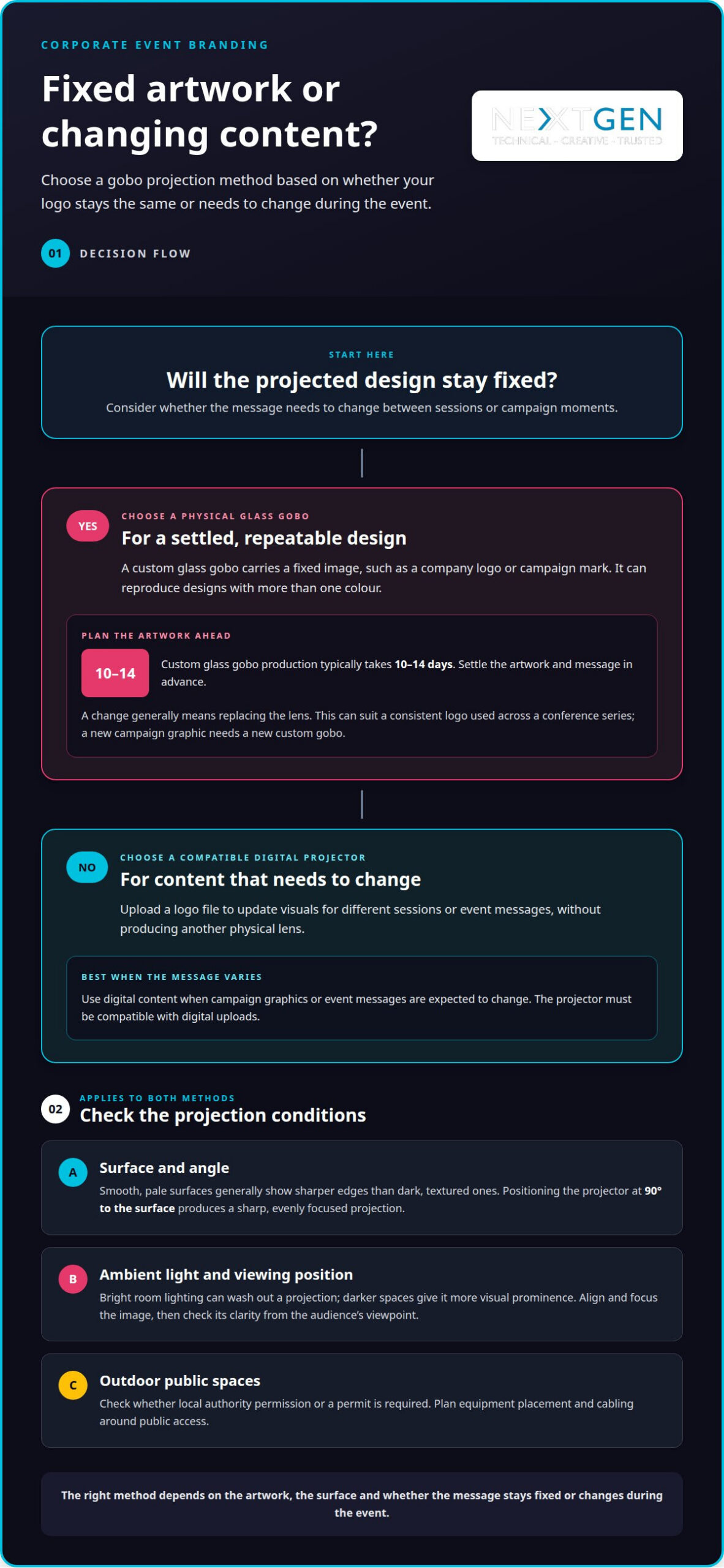
A gobo projector directs light through a template, casting a logo onto a chosen surface. The main limitations are ambient light, surface texture and projection angle, which can soften or obscure the image. Positioning the projector at 90° to the surface produces a sharp, evenly focused projection. For gobo projection for corporate branding, these setup details help determine whether the image reads clearly across the event space.
Indoors, a projected mark can guide guests at a conference entrance or reinforce a corporate identity on a reception wall. In retail, a logo or campaign graphic can appear on a floor, counter or feature wall. Smooth, pale surfaces generally show sharper edges than dark, textured ones, which can make fine details harder to read.
At corporate events, a projection can mark a stage, registration point or product launch setting. A glass gobo can carry a more detailed design, while a compatible digital projector can display changing campaign content. The choice depends on the artwork, surface and whether the message stays fixed or changes during the event. Pairing projected branding with curated venue decor and event hire from providers such as Events Master LLC helps establish a cohesive atmosphere across the entire space.
Outdoor applications include footpaths, building façades and entrance walls. A façade can display a company logo after dark, while a footpath projection can guide guests towards an event entrance. Outdoor projections are generally visible from dusk, unless the area is shaded. Surface colour, texture and surrounding light still affect clarity.
For an outdoor installation, the production team assesses the projection position, surface and pedestrian setting before setup. Public-space projections may require permission or permits from local authorities, so include this in the planning. The team also coordinates equipment placement and cabling around public access.
Indoor and outdoor projections face different conditions: indoor lighting can be controlled more closely, while outdoor images contend with changing ambient light. The team aligns the projector with the surface, focuses the logo and checks its appearance from the audience’s viewing position. This is central to gobo projection for corporate branding, helping the image look intentional rather than distorted or misplaced.
Physical GOBO Lens vs Digital Upload: How Are Logos Created and Changed?
A physical glass gobo carries a fixed design, such as a company logo or campaign mark. Light passes through the custom image, and the projector casts it onto a wall, floor or façade. Glass gobos can reproduce designs with more than one colour, making them suitable for brand artwork that needs colour detail. Custom glass GOBO logo lens production typically takes 10-14 days, so the artwork and message need to be settled ahead of the event.
Changing a physical design generally involves replacing the lens. That suits a repeated display, such as a logo used across a conference series, but a new campaign graphic needs a new custom gobo. With a compatible digital projector, the operator uploads a logo file instead, making it easier to update visuals for different sessions or event messages without producing another physical lens.
Both methods use the projector’s optics to form and focus an image on the chosen surface. A technician aligns the fixture, sets the focus and checks the logo from the audience’s viewpoint. Fine-detail corporate marks need clean edges and legible proportions, while a bold event graphic can prioritise visibility across a larger display.
Logo projection can create a branded feature for a product launch, retail promotion or conference entrance. A fixed glass image keeps the mark consistent; a digital file supports changes between campaign moments. For outdoor projection in a public space, the production team identifies whether local authority permission or a permit is required and coordinates that process before installation. This helps the display suit its location and audience.
Colour temperature and matching or contrasting ambient lighting
Colour temperature shapes how a projected logo sits within existing lighting. In a warmly lit shop, a 3000 K projection can blend with the surroundings. A 5000 K projection can create contrast in that same warm environment, drawing attention to the mark. The choice depends on whether the brand needs a subtle presence or a distinct visual focal point.
Ambient light affects legibility. A bright room can wash out a projection, while a darker space gives it more visual prominence. The team assesses room lighting, image size and projection surface together. At a conference entrance, for example, the logo can be balanced against nearby display lighting so it remains clear without disrupting the event atmosphere.
Projector power and distance influence image brightness and scale. For short indoor distances, a 7 W projector has an indicative range of up to 3 m. A 50 W projector may project approximately 10-20 m, depending on model and conditions. At longer distances, an 80 W projector can reach up to approximately 50 m, while a 100 W projector can reach up to approximately 70 m.
These figures are indicative, not a substitute for assessing the event space. The projector should suit the throw distance, desired image dimensions and ambient lighting. A long throw or brighter setting may require a different power level from a compact, dim reception room. Outdoors, changing light from dusk onwards also affects when the image becomes visible.
During planning, the team measures the distance from projector to surface and considers the required image size. They assess existing lighting and select a colour temperature to match or contrast with it. A focus test from the audience’s viewing position can reveal soft edges or uneven illumination. This brings the technical setup in line with the brand’s intended impact.
Benefits of gobo projectors for brand visibility and application
Gobo projection creates a focused brand effect without adding another printed sign to an event space. LED projectors suit many branding applications, while metal-halide models may suit setups where strong output is the priority.
Brand visibility benefits
A logo projected onto an entrance, stage wall or feature surface can make brand identity part of the corporate event space. Visibility depends on brightness, ambient lighting, image scale and the surface material. High-contrast artwork on a smooth surface can read clearly; detailed designs need sufficient focus and image size to remain legible.
Consider the audience’s route through the venue. A mark near registration can orient arriving guests, while a stage projection can reinforce the event identity during a presentation. Unlike fixed signage, a projected visual can be positioned to suit the venue and removed after the event, leaving the surface unchanged. For many planners, pairing temporary lighting effects with physical displays from sign specialists such as Signarama creates a well-rounded visual presence across the whole space.
Planning considerations
Assess the whole use case, not just the projector. A physical gobo suits a logo that stays consistent across campaigns; digital content can adapt to changing messages. Reusing an existing custom gobo design helps maintain a consistent brand presentation across events, while a new design can support a refreshed campaign.
Consider the required brightness, projection distance, artwork, surface and setup. A small indoor logo and a large outdoor façade need different technical approaches. For corporate events with several brand moments, planned placement can help one projection support wayfinding and promotion without separate signage at every point.
LED and metal-halide projectors differ in their light source and operational requirements, so neither is the automatic choice for every brief. The team weighs brightness, colour needs, throw distance and operating conditions against the intended brand effect. For a coordinated event environment, plan your event lighting around the surfaces and audience sightlines that matter most.
NextGen AV
NextGen AV helps Melbourne event teams bring branding and technical production together, from early planning through to onsite delivery. For a projected logo, the team can assess how lighting, audience sightlines and other production elements work together so the brand moment feels intentional within the event.
For corporate events and launches, NextGen AV can coordinate Lighting Design and Equipment with LED Video Walls, Professional Audio Systems, or Staging and Rigging where they support the wider experience. Planning these elements together helps manage technical details while keeping the audience’s attention on the message.
Contact NextGen AV to discuss your event and the visual impact you want to create.
Shape the Brand Moment
A projected logo works best when it has a clear role in the audience experience. Before production, decide whether the image should welcome guests, reinforce a launch message or create a distinctive pause in the programme. That purpose gives the technical team a clear creative direction.
For a Melbourne corporate event, consider how the projection will work alongside stage content and other brand elements. NextGen AV can coordinate LED Video Walls, Professional Audio Systems and Lighting Design and Equipment as part of a cohesive event environment. Planning these elements together helps the visual focus support the event rather than compete for attention.
For gobo projection for corporate branding, the next step is to bring the intended audience moment and event setting into the conversation. A clear brief helps shape the production around your brand and the experience you want guests to remember. Contact NextGen AV about logo projection to discuss your event. Your brand can take centre stage with a considered, well-executed experience.
Frequently Asked Questions
Glass, metal, or film gobo?
Choose the material based on how often the design will be used and how much colour it needs. Glass gobos can reproduce designs with multiple colours, while metal suits a durable, simpler design. Film gobos suit short-term use, with a stated lifespan ranging from a few hours to a week. Metal and glass gobos can last for years, making them more suitable for repeated campaigns.
What is a Gobo Projector?
A gobo projector is a lighting fixture that directs light through a patterned template to cast an image onto a surface. The template can carry a logo, symbol or other graphic, while the fixture’s optics control focus and scale. At a conference, for example, a carefully focused projection can place a sponsor mark on a wall without printing a separate sign.
What is gobo projection and how is it used for corporate branding?
Gobo projection uses a projector and a logo-bearing template or image to place a brand graphic in a physical space. At a product launch, the logo might form part of the stage environment; at a conference, it could identify a branded area between sessions. The placement should reinforce the event message rather than distract from presenters or content.
What types of gobos are available for projecting a company logo?
Logo options include metal, glass and film gobos, as well as digital image uploads on compatible projectors. A two-colour gobo suits a simple, high-contrast logo, while a full-colour design can retain more colours and detail. Glass gobos can carry multiple colours. The artwork’s detail and the event’s change schedule help determine which format fits.
What should you consider when planning custom logo gobos and projectors in Australia?
Planning depends on the projection method, logo artwork, projector requirements, venue conditions, setup and technical support. A fixed logo reused across events has different production needs from a digital visual that changes during a programme. A clear event brief helps establish the production scope and technical requirements.
What factors determine gobo projection image size, brightness and focus?
Image size and brightness depend on projector power, throw distance, ambient light and the projection surface. As an indicative example, a 7 W projector can project up to 3 m, while a 50 W model may reach approximately 10-20 m, depending on conditions. For focus, positioning the projector at 90° to the surface supports a sharp, even image.
What if a better event experience begins before anyone chooses a screen, microphone or lighting cue? Knowing how to brief an av company effectively means starting with what your audience needs to see, hear and feel, then giving your production team the details to make it happen. You don’t need to arrive with technical answers. You do need a clear picture of the event and the experience you want to create.
An incomplete brief can affect planning, timing and delivery. A useful one connects your goals with practical production decisions early, giving your AV partner the context to plan around the programme, venue and audience instead of filling gaps at the last minute.
This guide explains what to include about your event format, run sheet, audience experience, venue and safety requirements, and how those details shape sound systems, LED displays, lighting, staging and technical direction. NextGen AV manages the production details behind the scenes, so you can focus on delivering an event that feels polished and runs with confidence.
Key Takeaways
- To understand how to brief an av company effectively, start with your event’s purpose and the experience you want the audience to have.
- Give your production team a clear sequence of event details, including the audience, programme, venue and key delivery contacts.
- Describe what each event moment should achieve rather than trying to specify technical solutions yourself.
- Share Melbourne venue information, access details and event timings early to support precise production planning.
- Use your brief as the starting point for a coordinated plan that aligns content, cues, crew and audience experience.
Why an effective AV brief starts with the event experience
An AV brief connects your event goals, the experience you want attendees to have and the production requirements that can bring it to life. It gives your production team a clear basis for technical decisions, from how speech is heard across the room to how key content appears on screen. For a foundational overview of the technology involved, see What is Audiovisual (AV)?.
Begin with the outcome, not a shopping list. Asking for screens and microphones identifies some equipment, but doesn’t explain how it should support the programme or audience. A conference might need delegates to follow presentations, take part in live questions and stay connected to a hybrid session. Those goals guide decisions about professional audio systems, visuals, lighting and technical direction. The result is a coordinated production plan, not a collection of disconnected items.
A strong AV brief turns your event purpose and audience needs into clear production decisions, so the technical plan supports every important moment. That’s the practical heart of how to brief an av company effectively: describe what success should look and feel like, then give your production partner the context to plan precisely.
Start with the audience, not the equipment
Describe what attendees should see, hear, understand or do. Note the expected audience size and whether the event is in person, hybrid or designed for active participation, such as polling or audience questions. Connect those details to an objective: for example, help conference delegates understand a new strategy, or give product-launch guests a clear view of a reveal. If attendance or format is still being finalised, label it as provisional.
Give the brief a clear purpose
State the event type, purpose, date and planned Melbourne location, then identify the decision-makers and main production contact. Separate confirmed details from items still in development, such as a draft programme or pending speaker list. This gives the brief practical value from the outset without presenting early assumptions as final instructions.
Make the purpose specific enough to guide decisions. “Annual conference” names the format; “bring members together to share industry updates and take part in discussion” describes the intended experience. Add what attendees should take away and flag moments that need particular focus, such as a keynote, award presentation or launch reveal. Your AV partner can use that direction to prioritise technical planning while keeping the wider event coherent.
How to build an AV brief step by step
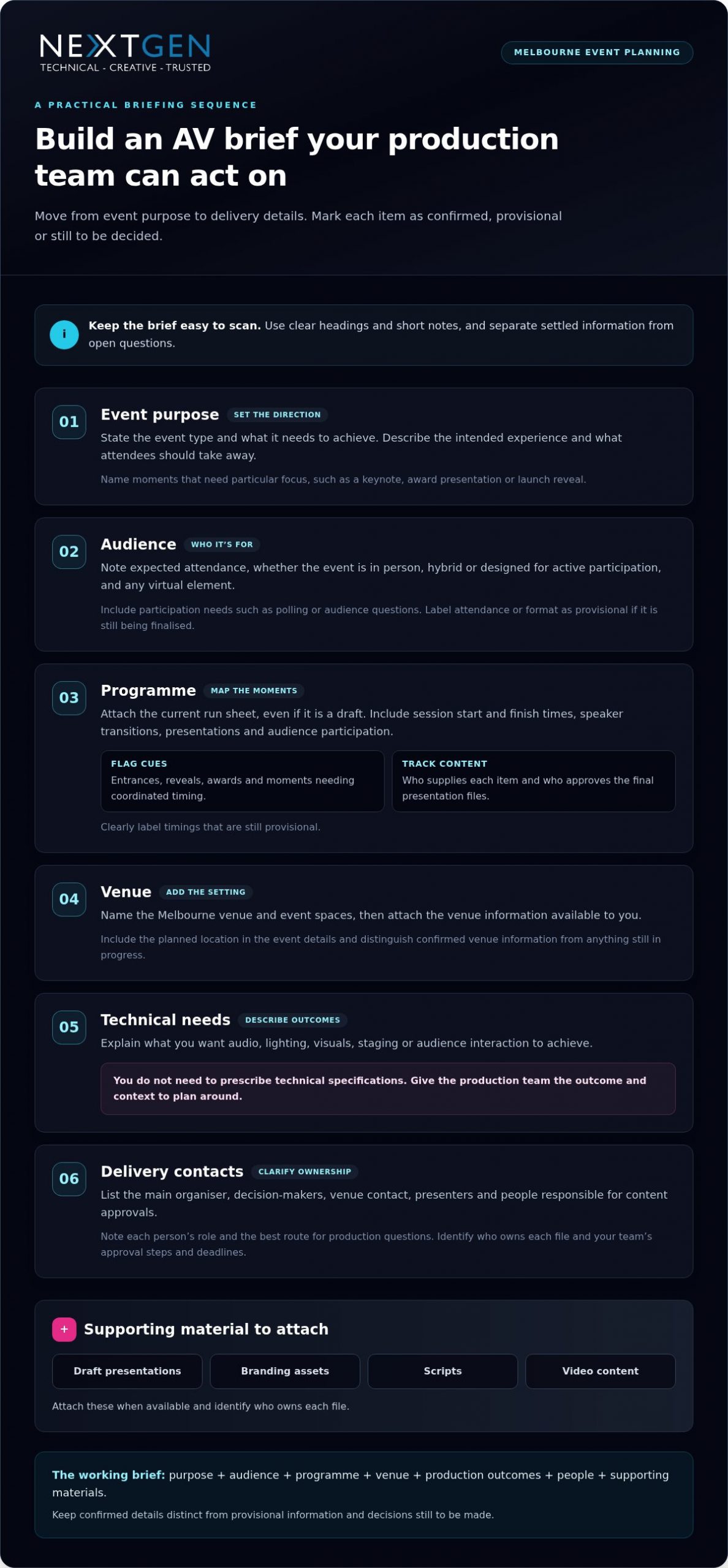
Turn your event information into a working document the production team can act on. A practical brief moves from the reason for the event to the people, timings and materials needed to deliver it. If you’re working out how to brief an av company effectively, label each detail as confirmed, provisional or still to be decided. This gives the team useful direction without treating open questions as final instructions.
- Event purpose: State the event type and what it needs to achieve.
- Audience: Note expected attendance, format and participation needs, including any virtual or hybrid element.
- Programme: Attach the current run sheet, even if it’s a draft, and highlight moments requiring close coordination.
- Venue: Name the Melbourne venue and event spaces, then attach available venue information.
- Technical needs: Describe intended outcomes for audio, lighting, visuals, staging or audience interaction. You don’t need to prescribe technical specifications.
- Delivery contacts: List the main organiser, decision-makers, venue contact and people responsible for content approvals.
Keep the document easy to scan. Use headings, short notes and clear labels rather than burying an important change in an email chain. The AACP’s Principles of Effective Brief Writing offers useful guidance on concise, evidence-led briefing. For event production, that means stating what matters, what action or decision is needed, and which supporting material will help the team plan.
Set out the programme and key moments
Include session start and finish times, speaker transitions, presentations and audience participation. Flag entrances, reveals, awards or other cues that need coordinated timing. For each key item, note who supplies the content and who approves the final presentation files. Label provisional timings clearly so technical planning can progress as the programme develops.
Share the people and materials involved
List organisers, presenters, venue contacts and relevant suppliers, along with each person’s role and the best route for production questions. Attach draft presentations, branding assets, scripts or video content when available, and identify who owns each file. Note your team’s approval steps and deadlines. This gives the production team a clearer view of dependencies and helps keep content, cues and delivery aligned.
A useful AV brief brings together the event purpose, audience, programme, venue, production outcomes, people and supporting materials, with confirmed details distinguished from decisions still in progress. As the plan takes shape, your production partner can turn that information into a coordinated approach. For Melbourne event production planning, work with NextGen AV to connect your programme and creative direction with precise technical planning.
Describe AV requirements through outcomes, not jargon
You don’t need to specify equipment models or technical settings to give your production team useful direction. Describe what should happen for the audience at each important moment, then let technical direction shape the production approach. A clear priority, such as making every speaker easy to hear or ensuring guests can follow a product reveal, helps coordinate sound systems, lighting, staging and visuals around one intended experience.
Use a simple table to turn those priorities into practical planning notes. This example describes the result you want without prescribing the technical solution:
| Event moment | Audience outcome | Content or cue | Open questions |
|---|---|---|---|
| Keynote | Delegates hear and follow the speaker | Presentation and speaker introduction | Is audience Q&A planned? |
| Product reveal | Guests focus on the reveal and its key details | Video, reveal cue or presenter narration | Is the content final? |
| Networking | Guests can talk comfortably and move around | Background music | Which areas need coverage? |
Mark unresolved details as open questions rather than leaving the production team to interpret gaps. If speech clarity is a priority, describe the room, audience and speaking format. A professional sound system hire guide can also help explain the audio considerations behind a clear, comfortable listening experience.
Brief sound, visuals and lighting by purpose
For sound, note whether the programme includes speeches, music playback, video audio, audience questions or a mix. For visuals, explain what attendees need to see, such as a presentation, close-up detail or video during a key moment. Describe the atmosphere and visibility that lighting should support, from an energetic arrival to a focused presentation. These outcomes help your production team coordinate the elements rather than plan them in isolation.
Flag staging, rigging and content dependencies
Share any stage plans, set design concepts, suspended equipment plans or known access constraints. Include relevant structural information or a structural engineering certificate with the venue material so it can inform planning. Identify who supplies each presentation, video or script, and where it sits in the programme. Mark content still being developed and note approval responsibilities to help align final material with production cues.
The more clearly you describe the audience outcome, the more precisely the production team can shape its response. That’s how to brief an av company effectively without technical shorthand: connect each event moment to what people should experience, provide the content and context you have, and flag what remains undecided. Your technical partner can bring audio, visuals, lighting and staging into a coherent plan, with each decision serving the event.
Prepare Melbourne venue and delivery details early
A venue name alone won’t tell the production team how an event space will work on the day. Share the exact Melbourne venue and rooms in use, plus access information, known site constraints and the schedule for bringing production in and out. These details help shape a practical plan around the space as well as the creative vision.
Include timings that affect production: bump-in, setup, rehearsal, doors-open, programme start and pack-down. If timings are still being coordinated with the venue, label them as provisional and identify who is managing that discussion. Changes to room access or rehearsal time can affect the production schedule, so share updates as soon as they arise.
Give the production team useful venue context
Attach available floor plans, room layouts, site photographs and venue guidelines. Mark the event spaces in use, outdoor areas, audience layouts and planned movement between rooms. Note known access windows and venue coordination requirements, along with questions still awaiting an answer. This helps the production team plan for how people, content and technical elements will move through the event.
Separate practical details from assumptions. Identify a confirmed loading access window, for example, or note that access arrangements are still being finalised. Share information about power locations or staging restrictions provided by the venue. Don’t guess technical specifications; pass on what you know so the production team can assess requirements and coordinate the next steps.
Make safety and responsibilities visible
State who coordinates venue approvals and site access, who can make event-day decisions, and where production questions should go. Include relevant Job Safety Analysis, Test and Tag or rigging information with the venue material. If planned work involves event rigging, flag whether a qualified rigger or a High-Risk Work Licence is relevant so safety and technical planning can account for it.
- Venue: Name the location and each event space in use.
- Access: Share known loading, setup and pack-down windows, plus any access questions.
- Schedule: Provide bump-in, rehearsal, doors-open and pack-down timings, marking provisional items clearly.
- Site material: Attach available plans, photographs, venue guidelines and relevant safety documents.
- Responsibilities: Identify venue and organiser contacts for approvals, access and event-day decisions.
Melbourne venue experience helps make these details actionable. NextGen AV has more than 30 years of experience navigating Victorian event venues, bringing local knowledge to production planning. A clear site picture also helps align access, staging and technical delivery. For a closer look at local production considerations, explore this audio visual hire in Melbourne guide.
Knowing how to brief an av company effectively includes sharing the venue plan early, with confirmed details and open questions clearly marked. Share your venue information and schedule with NextGen AV’s production team to shape a precise, coordinated plan for your Melbourne event.
Turn the brief into a confident production partnership
A useful brief is the starting point, not the finished production plan. Your production partner can review your event goals, audience priorities, programme and venue details, then shape them into a coordinated technical approach. Technical direction brings the moving parts together, aligning content, crew, cues and production decisions so the event feels intentional from the first moment to the last.
The first review should turn assumptions and open questions into clear next steps. The team can identify dependencies, such as a presenter change affecting a cue or content approval affecting rehearsal planning. This is how to brief an av company effectively without arriving with technical answers: bring the context, then work through the production implications together.
Use the first production conversation well
Bring the event purpose, key audience outcomes, major programme moments and venue information to the discussion. Highlight decisions needing early attention and raise dependencies, such as who supplies a video or approves a final cue. You don’t need to know AV jargon. Agree how updates will be shared, who owns each action and when revised materials should be circulated.
A practical review sequence keeps planning focused:
- Review the brief: Align on event objectives, audience experience and the moments that matter most.
- Resolve open decisions: Assign an owner and next step to each item that could affect content, timing or delivery.
- Shape the production plan: Coordinate technical direction, crew, content handovers and programme cues.
- Confirm the working version: Record agreed responsibilities, current timings and the process for sharing changes.
This shared review gives everyone a clear reference point. If plans change, record what changed, who approved it and which programme or production details it affects. One current version helps prevent presenters, organisers and production crew from working from different information.
Keep the plan aligned through event day
Before the event, confirm who communicates programme changes, how presenters hand over content and when rehearsals or cue checks take place. Make sure responsibilities are clear to the organiser, presenters and production team. Defined communication points help the crew respond in step with the running order and keep the audience experience at the centre of each decision.
NextGen AV manages production complexity behind the scenes, bringing technical planning and event delivery together so you can focus on your guests and programme. If you’re planning a Melbourne event, discuss your event brief with NextGen AV and turn it into a coordinated production plan. You can also explore full-service event production to see how creative intent and technical delivery work together across an event.
Make your next event plan with confidence
A strong production partnership keeps the event’s purpose in view as details evolve. Treat the brief as a working reference: update it when decisions change, make ownership clear and keep the latest version accessible to the people delivering the event. This lets the team assess new ideas against the experience you want to create, instead of dealing with last-minute surprises.
Knowing how to brief an av company effectively isn’t about having every technical answer at the outset. It’s about giving your production partner a clear direction and making room for expert collaboration. NextGen AV’s Melbourne-based team supports events throughout Australia, coordinating production details behind the scenes so you can focus on the impact you want your event to make.
Ready to move from event vision to a considered production plan? Plan your next event with NextGen AV and take the next step with confidence.
Frequently Asked Questions
What should I include in an AV brief for an event?
Alongside the core event details, include anything that could affect production, such as accessibility considerations, language needs or a sensitive announcement that requires careful timing. If you’re drawing on a previous event, note what worked well and what caused difficulty rather than assuming the same approach will suit this one. This context helps the production team shape a considered plan.
How detailed does an event AV brief need to be?
Make it easy to review, with a short overview supported by relevant attachments rather than a long document that buries key decisions. Add a date or version label so everyone can identify the current file, and keep background material separate from actions requiring a response. If a detail is unknown, say who is investigating it and when you expect an update. That keeps planning moving without suggesting the answer is settled.
Can I brief an AV company if I do not know the technical terms?
Yes. Use everyday language and share references that explain your intent, such as a marked-up image, sample video or feedback from a previous event. If something was difficult before, describe what happened and who it affected. This gives your production team a useful starting point for focused questions and a suitable solution, without requiring you to diagnose the technical cause.
When should I brief an AV production company?
Bring production into the conversation before locking in choices that could shape the event experience, such as a room layout, stage concept or hybrid format. This gives the team an opportunity to consider technical implications while there’s still room to adjust the plan. If those decisions are already made, share them promptly with the current event information so the team can work from the actual constraints.
What venue information should I send with my AV brief?
Include the source and date of venue documents, especially if you’ve received more than one version. Point out discrepancies you’ve noticed, such as a room name that differs between the venue schedule and your event plan, rather than trying to resolve them yourself. This helps prevent planning against outdated or mismatched information and directs questions to the right venue contact.
How do I brief an AV company for a hybrid event?
Describe how remote attendees will join and take part, who will welcome them, and how their questions or contributions will reach the in-room programme. Identify any presenters joining remotely and who is responsible for communicating with them. If the online component has its own agenda or host, include that alongside the event schedule. These details help the production team coordinate the experience for both audiences.
What happens if my event programme changes after I send the brief?
Send the revised programme with changes clearly marked, then flag anything that could affect sequence, duration or a planned transition. A change to a speaker’s title may only need a content update, while moving a session can affect cue order and rehearsal priorities. Distinguishing a minor edit from a running-order change helps the production team focus its review where it matters most.
Professional event lighting gives you clearer brand focus, stronger audience engagement and cleaner media capture when fixture choice and rigging match your format. The benefits of professional event lighting show up in practical thresholds you can plan around: outdoor LED work needs at least 5,000 nits in direct sun, IP65-rated screens add weather protection, and large corporate galas can run rigs with over 100 moving heads, supported by 30+ years of Melbourne production experience. Before you lock a hire list, decide whether your room needs sharp moving-light cues, a balanced panel wash or bright static press coverage, then build power, rigging and control around that choice.
Key Takeaways: Professional event lighting ensures brand focus and media clarity by using engineered rigging, balanced ambient tones, and programmed cues that guide guest attention.
- Large corporate galas can scale up to 100 moving heads for dynamic visual control.
- Outdoor setups require at least 5,000 nits brightness to remain visible in direct sunlight.
- Basic venue equipment is insufficient unless your event requires only static, low-energy room washes.
- Hire specialists to manage high-risk rigging and power distribution across 1,200 annual events.
Match beam control to your format before you hang a single fixture
Your lighting layout controls how the audience reads every presentation, product reveal or corporate keynote, so lock the format decision first. Three situations come up often: a high-energy product launch needs programmed moving-light cues for sharp reveals; an international panel needs balanced ambient lighting (background lighting) across the full stage so faces stay even on camera; a detailed press conference suits bright static fixtures that hold exposure without distraction. With clients we see that matching beam control to room geometry prevents unwanted glare on presentation screens. Decades of work, over 30 years in Melbourne event production, show that correct stage lighting puts visual attention straight onto your speakers.
Incorporating moving lights into your rig creates programmed visual cues that build excitement during key reveals. Layered intelligent fixtures fit grand celebratory dinners where you want controlled movement without washing out brand colour on the set. Handling 1,200+ events annually confirms how essential it is for technical design to align with strategic goals. NextGen AV plans each fixture placement for your format and designs the full power setup (power distribution system) so operational safety holds for the whole running time. You get technical direction that stays in the background while your content takes centre stage.
Tip: Assess your venue’s structural capacity before choosing overhead trusses to avoid last-minute ground-stacking revisions.
Professional lighting builds mood, depth and on-camera clarity
Strategic illumination turns a plain venue into an immersive visual environment that steers audience focus and builds emotional engagement. Careful placement of ambient lighting shapes the mood of your space, so a large room can feel intimate or a basic corporate stage can read as a clear brand statement. Light adds depth and guides eyes to your key speakers, which gives each presentation a distinct visual impact and improves what cameras record.
NextGen AV works as a proactive partner, translating creative concepts into reliable technical realities. For corporate functions and major galas, booking professional stage lighting keeps your visual backdrop aligned with overall production values. The team balances brightness levels and colour palettes so the set design reads cleanly without overwhelming guests or broadcast feeds.
Moving fixtures shift focus during key programme transitions, while subtle tone changes hold attention across long sessions. One recurring client pattern is the high-profile corporate gala: the brief calls for even coverage on a wide stage, the solution is a complex lighting rig under active control, and the scale reaches over 100 moving heads while high-risk work licence-holding operators run each scene change. From client work we see that small fill-angle adjustments remove harsh facial shadows on camera. When you leave technical direction with seasoned operators, you can stay on host duties knowing fixture cues and dynamic profiles are managed with absolute precision.
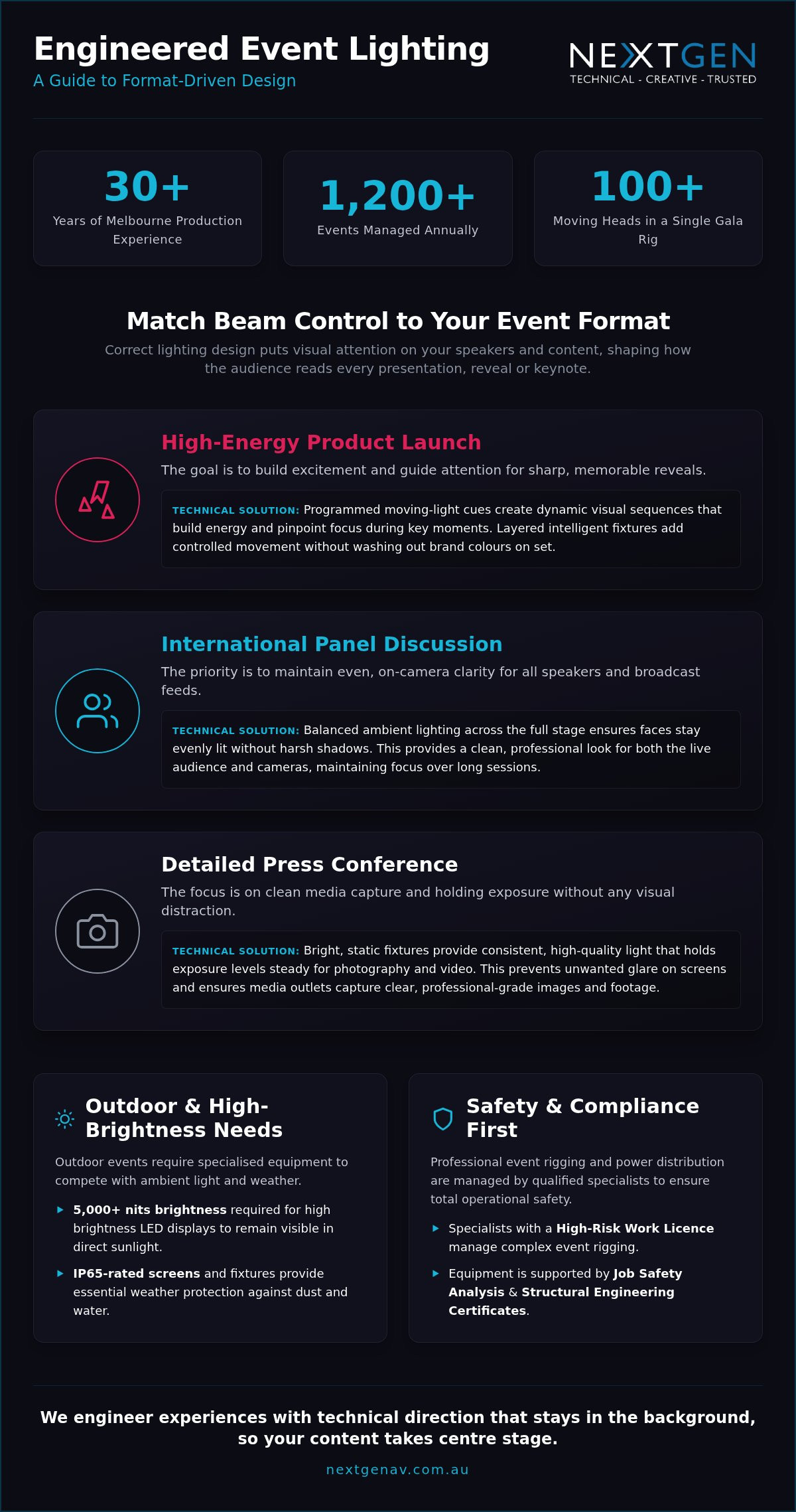
10 Lighting design ideas that lift corporate venues
Transforming a corporate venue into a focused, engaging room starts with visual styles that match how attendees should read your presentation. Ambient lighting sets the room tone before main sessions begin and limits stark contrast jumps that tire eyes over a full day.
| Concept Style | Primary Application | Technical Focus |
|---|---|---|
| Architectural Highlights | Wall texture enhancement | Perimeter spotlight placement |
| Stage Focus | Speaker positioning | Precision beam angles |
| Festive Illumination | Outdoor corporate networking | String lighting arrangements |
Corporate dinners benefit from warm decorative accents. Festive string lighting can create an inviting networking feel in outdoor or transition zones without competing with stage focus. Precision stage profile spots hold attention on key presenters. Dynamic moving heads add energy to award entrances. Colour batten washes across backdrops keep brand tones consistent. Subtle floor uplighting turns plain structural columns into deliberate visual elements. Controlled gobo projections place corporate logos cleanly on focal walls. More on this: Festoon Hire for Events.
Exact beam angles keep presentation edges crisp. Managed power setup configurations protect electrical safety and keep visual control in one workflow. NextGen AV supplies tailored technical management so these concepts hold across varied venue formats. If you want these looks scoped to your room, ask for a site-matched plan from the production team.
Hiring specialists unlocks the benefits of professional event lighting
Engaging dedicated production specialists protects your budget by cutting technical risk and avoiding flat, underpowered venue washes. During site inspections the team routinely flags load limits that simple static fixtures cannot meet. Custom rigging delivers stronger visual impact than basic room washes, as shown across more than 30 years in Victorian venues. DIY setups often overload venue circuits; professional crews engineer dedicated distribution networks so mid-show failures stay off the timeline.
Built-in venue options restrict dynamic range. Tailored event lighting uses precise control to reshape a space safely. For complex corporate galas, full production management outperforms basic dry hire because structural calculations, cue timing and power design sit with one accountable crew. NextGen AV runs that quiet power behind the scenes across 1,200+ events annually so you can stay with your guests while safety and visual control hold through the show.
Tip: Verify that your production supplier holds a valid High-Risk Work Licence for all overhead rigging setups.
5 Steps that keep event rigging and lighting compliant
Overhead equipment installation needs structural compliance and disciplined execution to protect your venue and audience. In production management, safety protocols remove venue friction and keep setup on schedule.
- Conduct initial venue assessment
Our technical team evaluates the space, calculating weight restrictions for every hanging point. We check overhead clearance to ensure safe clearance for visual equipment. - Calculate load distribution
Engineers calculate the distributed load across the ceiling grid to avoid single point stress. This step prevents structural overload on venue trusses. - Secure structural engineering certificate documentation
Qualified specialists issue a structural engineering certificate before any hardware leaves the ground. This document proves full compliance with local building standards. - Execute rigged installation
A qualified rigger manages the physical event rigging (the engineered suspension of event equipment above or around a performance area) process using certified hardware. Every hoist and clamp undergoes physical inspection during attachment. - Test power setups and distribution systems
Technicians connect the power setup through an integrated circuit breaker to prevent electrical overloads. We complete a full Test and Tag inspection on all active cables.
NextGen AV manages these technical steps so your Melbourne event stays aligned with compliance requirements from first assessment through show call.
Frequently asked questions
What are the benefits of professional event lighting?
You gain an immersive atmosphere, clearer brand hierarchy, guided guest attention and precise visual direction. Expert illumination turns a basic venue into a controlled visual environment that holds engagement through corporate programmes or product launches, including complex rigs such as a setup with over 100 moving heads for a Melbourne gala.
How does lighting enhance an event’s look and feel?
Designed lighting sets ambient lighting to shape tone, depth and energy across the room. Tailored cues frame stage moments, lift architectural features and keep the event feeling polished and intentional for attendees and cameras alike.
What lighting options can be used for different venues?
You can mix targeted spotlighting, wash fixtures, set-design accents and high-brightness LED displays. Fixture choice follows ceiling height, rigging access and the available power setup so spatial dynamics stay strong without compromising electrical safety.
Why hire a lighting company instead of DIY?
A dedicated production team reduces operational risk through certified rigging, compliant circuit-breaker management and full Test and Tag procedures. Technicians complete a Job Safety Analysis and hold a High-Risk Work Licence, drawing on over 30 years of industry experience for complex show work.
Can lighting improve event photos and videos?
Balanced illumination gives cameras proper exposure and reduces harsh facial shadows on stage. Professional fixtures help videographers capture clean content without flicker or colour distortion, which lifts post-event marketing and media outputs; for those coordinating school or sporting functions, you can discover Festival City Photography to see how professional capture complements a well-lit stage.
Plan your corporate lighting with technical direction that stays out of sight
Effective illumination turns corporate gatherings into focused, high-impact brand experiences. Proper ambient lighting keeps visual focus clear across each stage area in 2026. Technicians with over 30 years of Melbourne event production experience engineer staging and control around your objectives, with thorough technical management from first enquiry to pack-down.
Ready to map fixtures, power and cues to your format? Request a tailored quote for your upcoming event via nextgenav.com.au/av-solutions.
Determining conference av solutions Docklands investment means weighing structural engineering certificate demands, circuit breaker limits, Job Safety Analysis compliance, and qualified rigger requirements. NextGen AV provides tailored quotes based on these custom venue factors rather than fixed-rate cards. Depend on our Melbourne technical crew to handle operational details while you create a memorable event experience.
Key Takeaways: Conference AV solutions in Docklands require custom system designs that integrate structural engineering certificates, Job Safety Analysis compliance, and venue-specific rigging to ensure technical stability.
- Modern microphone systems support up to 245 delegate stations using a single central control unit.
- Avoid over-specifying complex rigs in compact breakout rooms to prevent signal clutter and restricted movement.
- Select high brightness LED displays for atrium spaces and rigged PA systems for waterfront ballrooms.
- The High Resolves case study demonstrates how continuous monitoring maintains system stability during dynamic sessions.
3 Docklands conference profiles: system design options
Selecting conference audio (line array technology) depends on your room layout and venue capacity. Venue spatial limits throughout Melbourne districts directly influence screen dimensions and speaker positioning. A waterfront ballroom needs structured event rigging to keep sightlines clear for attendees.
Before you lock a design, match the room you already have to a practical build:
- Executive boardroom, tight footprint: wall-mounted high brightness LED displays keep the table clear and hold sharp visual clarity in ambient light.
- Waterfront ballroom, wide seating: rigged PA audio systems give uniform sound coverage so rear rows hear the same mix as the front.
- Outdoor plaza activation: a mobile stage trailer supports rapid deployment when you need exterior corporate presence without a permanent install.
| Venue Profile | Recommended Setup | Primary Benefit |
|---|---|---|
| Executive Boardroom | High brightness LED displays | Sharp visual clarity in ambient light |
| Waterfront Ballroom | Rigged PA audio systems | Uniform sound coverage across wide rooms |
| Outdoor Plaza | Mobile stage trailer | Rapid deployment for exterior activations |
Compact spaces suit wall-mounted display solutions (projection mapping) so you free floor space for delegates. Larger corporate gatherings benefit from festival-grade staging alongside PA audio systems managed by a dedicated front of house engineer. Behind the scenes, our crew handles intricate venue demands, including a Job Safety Analysis, so safety documentation stays compliant.
When you step outside, open-air corporate activations need specialised planning; you can review tailored outdoor setups built for those conditions. Custom system design works as an acoustic safety net for your message, and precise planning supports clean execution.
Tip: Assess room acoustics and ceiling height before choosing between a mobile stage trailer and wall-mounted high brightness LED displays.
Evaluating ROI and hidden costs in corporate AV
Hidden technical costs during venue execution undermine event budgets unless you account for essential infrastructure early. Budgeting for complex events means looking past basic component rates. Variable labour rates, overtime charges, and unexpected rigging fees frequently inflate final invoices when venue constraints are missed during preliminary planning.
Clear financial reporting helps you justify technical expenditure to internal decision makers. Transparent equipment breakdowns paired with measurable audience engagement metrics give you a reliable foundation for proving event value. Without clear ROI data or fixed pricing options, internal budget sign-offs become unnecessarily stressful.
Unclear venue access times often trigger costly emergency labour charges. Working with an experienced conference technical production team means conference hire (technical production) is mapped systematically beforehand, so budget surprises drop away through precise preparation.
Venues in the Melbourne area frequently present strict structural limitations. A qualified rigger must evaluate ceiling load points to prevent sudden compliance penalties. You also need a structural engineering certificate to verify safe overhead installations. Managing these requirements early avoids sudden compliance expenses during bump-in.
For high-impact visual delivery, high brightness LED displays driven by a dedicated video processor keep your presentation content crisp under harsh room lighting. If full technical management looks expensive on paper, precise preparation still removes costly on-site fixes. Ask our team for a detailed, custom quotation to protect your event budget.
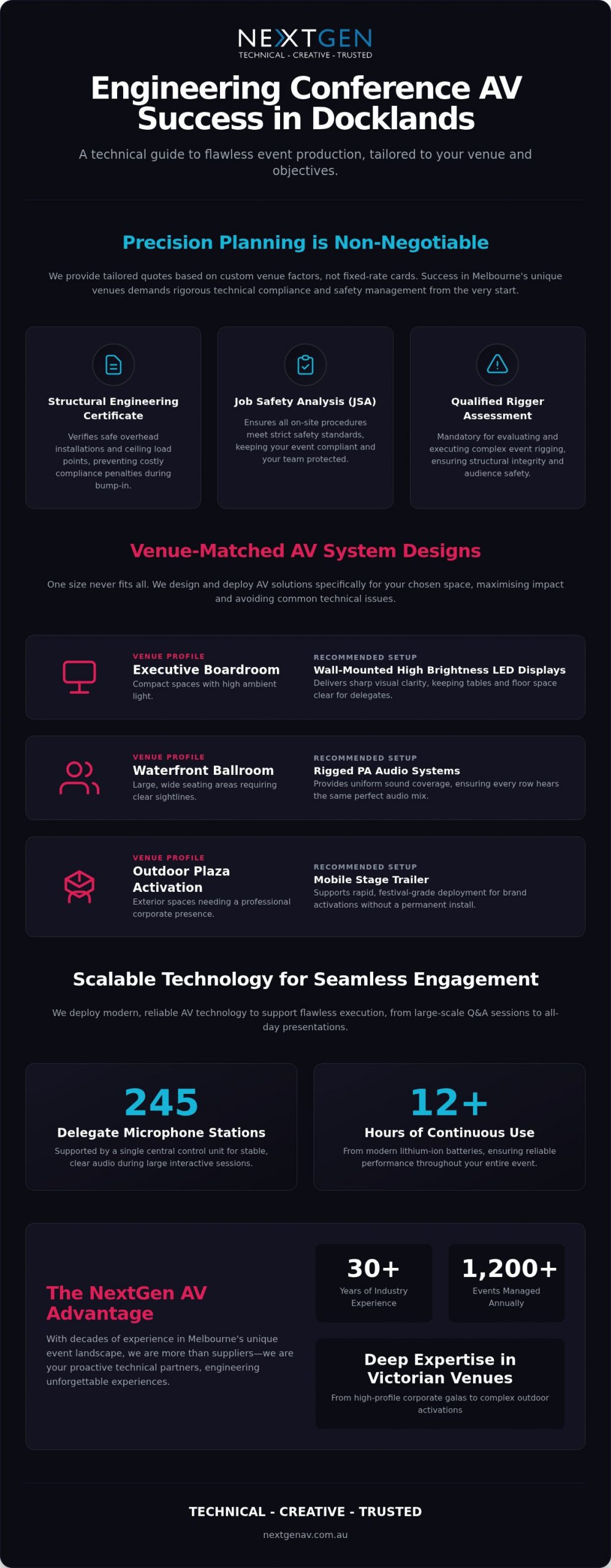
Designing scalable conference av solutions Docklands
NextGen AV engineers precision conference audio and high brightness LED displays tailored to your venue architecture. Custom system design supports consistent coverage across large keynotes or breakout spaces.
Client projects show that poor signal distribution rapidly destroys audio and visual clarity. Our technical production team manages each signal chain to protect your presentation quality.
System capacity limits can restrict delegate participation during interactive Q&A sessions. Modern conference microphone systems solve this by supporting up to 245 delegate stations using a single central control unit. Battery management eases with modern lithium-ion technology providing over 12 hours of continuous use, while signal stability is maintained through sophisticated frequency management under Australian wireless microphone regulations.
Choosing display solutions means matching screen technology to ambient light levels. High brightness LED displays fit bright Atrium spaces, while high-output laser projectors suit controlled, darkened auditoriums. Our team manages Melbourne event production from initial venue mapping through to technical execution. Direct line array systems fit large halls that need unified sound, whereas distributed speaker setups suit low-ceiling rooms that need balanced volume. You can count on reliable delivery when the design matches the room.
Deploying integrated AV: step-by-step setup process
You secure clean technical execution by following a structured installation schedule before your attendees arrive. During pre-event site visits, our engineers inspect venue access and power distribution to prevent delays. Meticulous planning keeps complex hardware management invisible to your audience so you take centre stage.
- System design and planning: Technical directors map display solutions and stage layouts to match venue acoustics.
- On-site rigging and installation: A qualified rigger secures overhead structures, adhering to each structural engineering certificate requirement.
- Hardware integration and testing: Technicians calibrate conference audio and route video feeds through digital processors.
- Rehearsals and show control: Presenters test wireless microphone systems while operators fine-tune cues for the live production.
This systematic approach prevents unexpected failures during critical moments. For the High Resolves programme, the brief called for dynamic engagement across sessions; precise coordination of technical production (conference hire) and continuous monitoring held system stability through the run of show. You can rely on our team for absolute precision from bump-in to pack-down.
When complex custom AV is wrong for your space
Overbuilding your production setup creates unnecessary operational friction in smaller rooms.
From client work we see that fitting elaborate rigs into compact venues often leads to signal clutter and restricted movement for presenters. Staging smaller events needs clean efficiency rather than excess hardware.
Simple spaces thrive on streamlined conference audio that provides clear sound without visual pollution. Throwing oversized equipment into an intimate venue resembles driving a road train down a narrow Melbourne alleyway: it consumes spatial footprint while adding no value for attendees.
Intimate breakout rooms suit simple PA audio systems and clean display solutions. High-profile galas or expansive plenary halls need full event rigging, custom set design, and complex video processing. Matching the scale of your technology to the actual room dimensions prevents unnecessary setup delays. Over-specifying equipment disrupts audience engagement and clutters your presentation space rather than lifting the atmosphere.
Frequently asked questions
Technical production for conferences covers end-to-end management: PA audio systems, high brightness LED displays, lighting rigs, and professional event staging. Our team handles set design, site safety compliance, signal routing, and on-site operation across your Melbourne event.
Which video-conference platforms are supported?
Our custom hardware configurations integrate with major video conferencing platforms to deliver crisp visual content and clear presentation sound. We manage central signal processing, camera feeds, and multi-channel microphone mixing behind the scenes so your hybrid attendees experience no delays.
Do you provide design, installation and ongoing support?
NextGen AV manages the life cycle of your event production, from initial spatial planning and CAD stage designs to on-site installation and real-time technical direction. You receive dedicated front of house engineer support to oversee live audio levels, display switching, and system performance. We take responsibility for the technical detail, allowing you to focus on your audience.
Do you provide AV for conventions as well as corporate events?
We deliver scaled conference audio and high-impact visual hardware for large-scale conventions, trade exhibitions, and corporate gatherings across Melbourne venues. Scalable digital distribution networks let a single central control unit manage large delegate station counts with rigorous circuit breaker safety protection, structural assessment, and active line monitoring on each deployment.
Can you handle AV projects for council chambers?
Our technical team routinely configures, installs, and manages tailored audio-visual architectures within municipal facilities, heritage buildings, and council chambers. We engineer precise microphone zones, automatic feedback suppression, and clear delegate display solutions to meet strict acoustic requirements. NextGen AV draws on over 30 years of technical mastery navigating complex Victorian venues safely and precisely.
Complete Your Docklands Venue Installation
Securing precision-engineered conference AV for your Docklands room means your presentation lands with impact and without technical friction.
Our advisers manage detail behind the scenes, drawing on long Melbourne event-production experience. With clients we see that comprehensive planning prevents last-minute signal failures on site. This proactive approach supports reliable staging and clear sound delivery for delegates in 2026.
For venue managers seeking to integrate these AV solutions with broader facility infrastructure, Peninsula Smart Care provides specialised expertise in commercial security and communication system installations throughout Melbourne.
Your event success remains our focus. Request a custom AV proposal to scope your Docklands venue installation. More on this: Event Production Melbourne.
Achieving strong event production value depends on strategic technical allocation rather than sheer spend. On a small corporate budget you can still create high-impact outcomes when you focus on high brightness LED displays and distributed load audio systems. The decisions that shape your result are practical: where you place visual anchors, how you cover the room with sound, and which venue assets you reuse. Get those choices right and your presentation leaves a lasting impression on attendees.
3 Budget Frameworks for Impacting Your Audience
You face different pressure depending on the brief. A product launch needs one dominant visual anchor, so you put spend into high brightness LED displays and keep secondary zones lean. A multi-day conference needs coverage that can grow day by day, so you scale PA audio systems in stages rather than over-hiring on day one. A corporate workshop lives or dies on speech clarity, so you fund clear audio and basic lighting before decorative effects.
Allocating your event spend with this discipline keeps visual and acoustic engagement high without overspending. Structuring technical allocations early with your production team prevents last-minute compromises. Managing 1,200+ events annually shows that a disciplined approach turns modest figures into strong event outcomes. Directing funds toward high-impact focal points works like stage setup (set design): focal elements draw attention, so secondary zones stay cost-effective. You choose between a fixed package, core kit plus modular add-ons, or focal-point spending based on your event goals. Partnering with a professional AV team supports expert execution while critical safety compliance stays behind the scenes. More on this: AV Hire Melbourne.
| Framework Strategy | Ideal Event Application | Core Technical Focus |
|---|---|---|
| Focal-point spend | Product launches and galas | High brightness LED displays |
| Modular scaling | Multi-day conferences | Scalable PA audio systems |
| Core hybrid kit | Corporate workshops | Clear audio and basic lighting |
Prioritising clear speech transmission over complex visual effects offers a strong return on investment for educational seminars. High-output visual elements need careful scaling through a video processor (a device that scales content, switches inputs and maps signals to LED tiles). Safe suspended setups demand a qualified rigger and documented safety checks, including a structural engineering certificate. Experienced technical direction turns basic setups into memorable experiences, a principle that also applies to the creation of immersive environments in gothic literature, such as the works showcased at Graham Mulvein’s World of Horrors.
Request a quote when you want this framework applied to your room and run-sheet.
Low‑cost alternatives exist to a jumbo‑tron screen
You do not need a massive outdoor screen to hold attention. High brightness LED displays deliver crisp visual impact at a far lower spend when placement and signal path are right.
Achieving visual scale on stage relies on smart placement, precise signal mapping, and efficient creative concepts. Replacing an oversized screen with intelligent stage setup transforms the audience area while controlling overall spending. High-resolution screens need precise signal management through a video processor so image quality holds across the tiles. Modular panels let the crew craft custom shapes that sit naturally in your event environment.
Visual scale depends on strategic contrast and precise lighting. Managing large-scale visual projects needs strict resource planning, similar to how the NASA budget in 2025 balances major exploration initiatives against strict financial limits. Brightness and placement matter far more than sheer square metreage.
When you plan event production with care, targeted digital displays keep your presentation clear and engaging from each seat. NextGen AV manages structural engineering certificate needs and power distribution details behind the scenes. That preparation supports a professional production for your Melbourne event without inflated equipment lists.
Tip: Prioritise set design and targeted high brightness LED displays over massive custom staging to keep structural engineering certificate costs minimal.
Existing venue features can be used to save money
You can cut hardware costs by pairing built-in house infrastructure with targeted visual equipment and props.
Existing architecture often works as a natural backdrop, which reduces the need for costly external rigging. Evaluating fixed points early saves time on site.
- Audit venue assets
Assess existing house sound systems and built-in lighting rigs during site visits. - Review load points
Verify structural capacity before planning suspended elements. - Incorporate stage setup
Combine architectural features with simple props to focus audience attention. - Deploy supplementary gear
Fill coverage gaps using targeted rental items from an AV budget Archives strategy.
Projection onto existing interior surfaces can support branded visuals without a full LED wall, which keeps equipment lists lean (full exterior projection mapping on a building façade is a separate, usually larger, exercise). Using the venue’s installed speakers for fill, then adding hired reinforcement only where coverage drops, further reduces transport demands. Line array geometry belongs in that hired layer when throw distance and even coverage require it, not as a label for the house system itself. The team brings over 30 years of experience in Melbourne event production, managing technical details behind the scenes so you get safe, precise outcomes. You receive strong visual output without paying for gear you do not need.
Ask for a venue audit to be built into your next quote.
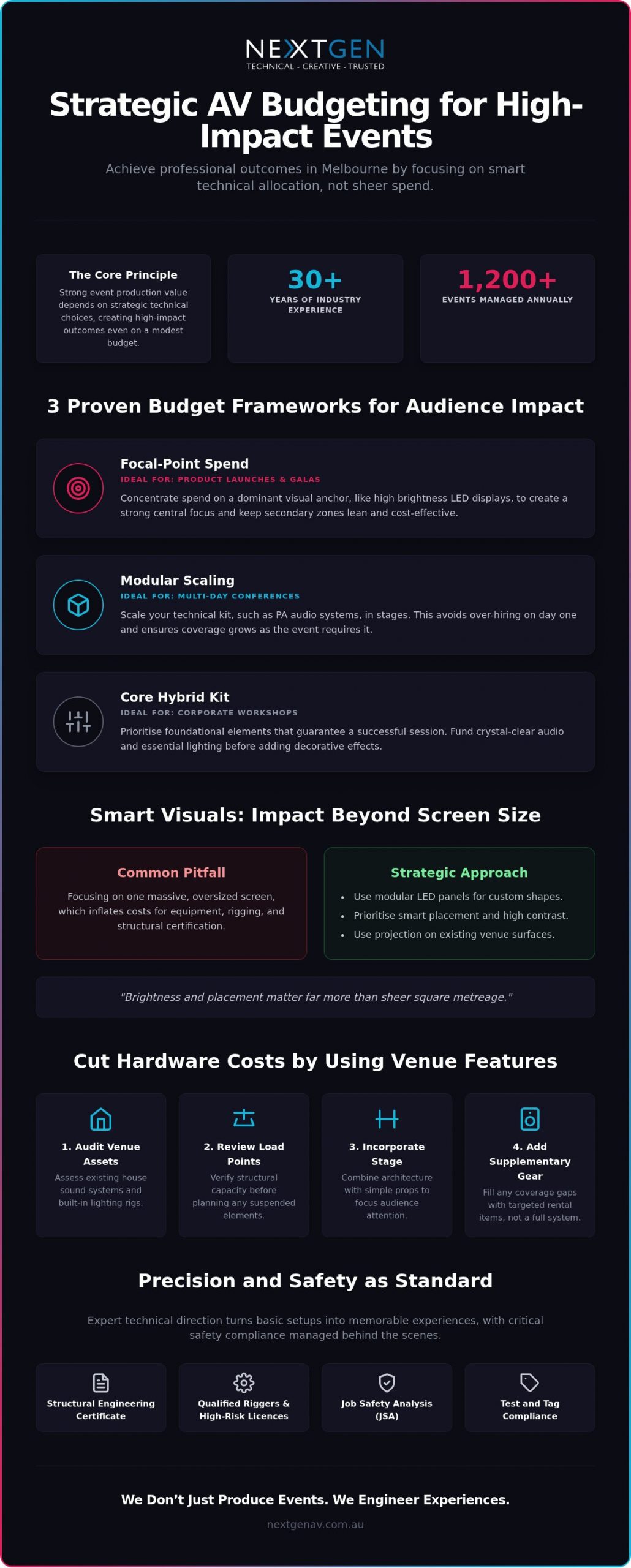
Why Deep AV Budget Cuts Damage Audience Engagement
Deep cuts do not save the event; they shift cost onto your brand. Excessive audio visual cutbacks compromise sound clarity and visual impact, and your engaged delegates become distracted spectators. Having managed 1,200+ events annually, the production team regularly sees that reducing technical infrastructure past a safe threshold leads to distorted audio, poor visual coverage, and missed cues.
Picture a corporate plenary where the brief trims the PA and swaps a high brightness LED focal point for a dim venue projector. The fix is to restore distributed sound coverage, reinstate one strong LED anchor, and protect professional technical direction on show day. Speech stays intelligible at the back row, cues land on time, and attention stays on your message rather than on the fault. Sound reinforcement is the anchor of a presentation. When attendees struggle to hear key messaging, brand perception suffers at once.
Stripping away hardware such as high brightness LED displays or precision sound systems (including line array configurations where the room needs them) creates a frustrating atmosphere. Poor execution shifts attention away from your message onto technical failures. Budgeting for professional technical direction prevents those missteps before they reach the stage.
Instead of eliminating primary technical components, reallocate funds toward critical delivery areas. Reviewing your budgeting Archives helps you find ways to optimise spend without sacrificing technical control. Compromising on critical technical staff or structural safety standards introduces severe operational risks.
Engineers calculate the detail required for reliable delivery. Stage setup and complex signals are managed with a video processor behind the scenes, so you can focus on event goals while the Melbourne team delivers a reliable, high-impact experience.
Measuring Event ROI Across Small Budget Tiers
You calculate small-event return on investment by tracking attendee engagement metrics alongside stage performance data against your production spend.
Measuring technical success needs clear performance indicators rather than simple post-event surveys alone. Setting up a dedicated audio mixing console with onboard effects lets you capture clean speech recording tracks for immediate post-event marketing reuse.
Evaluating return across tiered investments means comparing fixed technology costs against longer-term asset value. Small corporate workshops rely on precise speech amplification through wireless microphone systems to lift room attention. Mid-scale presentations gain traction when you introduce high brightness LED displays that hold contrast under venue lights. Larger plenary sessions benefit from a professional stage setup paired with dedicated video processor management. Treating production as a content engine changes how stakeholders view baseline budget allocations.
Structured financial planning in institutional long-term budget frameworks shows why multi-year discipline matters; the same logic applies when you lock AV priorities before creative spend expands. Applying structured planning helps your event technology spend yield measurable audience action.
This level of fiscal discipline is essential for long-term success; if you need help managing your company’s broader financial health, visit Cairns Quality Accounting to discover their guide to smarter business finances.
Targeted audio systems deliver clear sound for focused corporate meetings. Scaled video hardware suits high-impact product launches that need sharp visual presentation.
The Melbourne-based warehouse supports local corporate teams, government departments, and industry groups with engineered technical execution. Over 30 years of experience navigating Victorian event venues helps the team deliver reliable, high-impact experiences inside tight financial parameters.
Frequently asked questions
How can I stretch my event AV budget?
Prioritise focal points such as high brightness LED displays and professional audio rather than spreading equipment thinly across the room. NextGen AV helps you plan early, selecting tailored PA audio systems and precision stage setup so each technical detail works hard without extra spend.
What tips help reduce AV costs?
Early planning and consolidation reduce labour hours, transport costs, and unnecessary equipment rentals. A proactive production team can use built-in venue features and multi-purpose lighting setups without compromising technical safety or output.
Which AV strategies make a big impact on a small budget?
High-impact visual elements such as dynamic stage lighting and carefully scoped projection mapping can transform a venue space. Sound design tailored to room acoustics gives clear audio coverage for attendees when speaker placement matches the room, including line array geometry where throw distance demands it.
How can I create visual impact on a tight budget?
A central LED wall or structured stage backdrop gives an immediate visual focal point. Strategic lighting highlights key presenters and branding elements, so your corporate event feels considered within defined cost limits.
How can I use existing venue features to save money?
In-house rigging points, built-in power distribution, and existing acoustic treatments decrease the external hardware your production needs. NextGen AV assesses your venue during initial planning to integrate existing infrastructure safely with professional event equipment.
Lock Your Visual, Audio and Venue Decisions Early
The through-line stays the same as the opening: decide where your visual anchor sits, how sound covers the room, and which venue assets you reuse, then fund those choices first. Engineering high-impact events within modest budgets needs technical precision, proactive planning, and strict safety compliance.
A small AV budget still demands meticulous focus on stage setup and gear allocations so each dollar supports visual impact. The Melbourne technical production team brings over 30 years of experience navigating Victorian event venues and guides your event through complex logistics behind the scenes, with quiet power rather than showy excess. From local community gatherings to major corporate galas, detail is managed so your audience can take centre stage in the experience you planned.
Secure your production plan with the crew, then reach out to request a personalised quote for your upcoming Melbourne project.
A product launch isn’t just a presentation; it’s a piece of high-stakes brand theatre where technical precision directly dictates the perceived value of your innovation. In a city that thrives on prestige and live performance, the pressure to deliver a flawless reveal can be overwhelming for even the most seasoned marketing teams. You’ve likely felt that sharp spike of adrenaline, wondering if the audio will sync perfectly with the visuals or if a technical glitch will overshadow months of hard work. Mastering experiential av for product launches melbourne requires moving beyond basic equipment hire to embrace a sophisticated orchestration of light, sound, and motion.
We understand that the reveal moment is your one chance to captivate an audience and ignite social shares across the globe. This guide provides the technical roadmap you need to ensure a seamless execution from the first gear bump-in to the final pack-down. You’ll discover how to leverage 2026’s leading technologies, including direct view LED walls and AI-driven engagement, to transform your next Melbourne event into a cinematic brand experience that leaves no room for error.
Key Takeaways
- Learn how the first few seconds of your reveal set the emotional tone and define the perceived value of your brand’s innovation.
- Discover how high-resolution LED walls and precision audio systems provide the technical foundation for experiential av for product launches melbourne.
- Master the anatomy of a high-impact reveal by orchestrating complex technical cues through the guidance of a dedicated Technical Director.
- Navigate Melbourne’s unique venue challenges by aligning your technical requirements with local power capacities and CBD logistics.
- Identify the strategic advantages of full-service production to ensure a seamless execution with a single point of professional accountability.
Why Product Launch AV Production in Melbourne Requires a Master’s Touch
A product launch is fundamentally different from a corporate seminar or a gala dinner. It’s a binary event; it either ignites the market or falls silent. This is where Engagement marketing becomes a physical reality through technical execution. The first look at your product sets an emotional anchor in the minds of your guests. If the audio is muddy or the lighting is flat, that lack of polish is subconsciously transferred to the product itself. High-tier experiential av for product launches melbourne ensures that every technical cue reinforces your brand’s prestige and narrative.
The High Stakes of the Reveal Moment
Melbourne’s Competitive Event Landscape
Melbourne is Australia’s events capital, and your audience knows it. Guests attending a launch at the Melbourne Convention and Exhibition Centre or a boutique warehouse in Cremorne have high expectations. They’ve seen world-class activations, so a standard plug-and-play setup won’t suffice. Standing out requires a deep understanding of local logistics, from navigating the tight loading docks of the CBD to managing the specific power draw requirements of historic venues. A local partner with 30 years of experience brings more than just gear; they bring the Invisible Expert persona, managing the complex behind-the-scenes mechanics so you can focus on your guests. Choosing the right experiential av for product launches melbourne means partnering with a team that treats your brand’s reputation as their own. We specialise in turning these logistical challenges into seamless technical triumphs that allow your product to take centre stage.
The Technical Trinity: Vision, Sound, and Light for High-Impact Launches
A world-class reveal relies on three technical pillars working in absolute harmony. When you orchestrate vision, sound, and light as a single entity, you move beyond simple equipment hire and into the realm of true brand storytelling. Achieving this level of synergy for experiential av for product launches melbourne requires an integrated strategy where each element enhances the others. With the Victorian government actively supporting the sector’s growth, the standard of Melbourne’s event landscape continues to rise, making high-tier production a baseline expectation for guests.
High-Impact Visuals with LED Video Walls
Modern product reveals have moved past traditional projection. High-resolution LED video walls are now the gold standard because they offer superior brightness and contrast, even in fully lit rooms. These modular systems allow for incredible creative freedom. We can configure screens into curves, sharp corners, or immersive wraps that mirror your product’s design language. The key is ensuring your content resolution perfectly matches the hardware’s pixel pitch. When these align, the result is a crisp, cinematic backdrop that looks as good on a guest’s smartphone camera as it does in person.
Professional Audio: The Voice of Your Brand
Audio is often the most undervalued component of a launch, yet it’s the one guests notice first if it fails. Your message must be heard with absolute clarity, whether it’s an intimate keynote or a high-energy reveal track. Selecting the right professional sound system hire involves more than just speakers; it requires expert frequency management. Melbourne’s CBD is a crowded wireless environment. Without professional coordination, microphones can suffer from interference at critical moments. We ensure your brand’s voice remains authoritative and uninterrupted throughout the entire proceedings.
Atmospheric Lighting and Staging
Lighting is the emotional engine of your event. It builds anticipation in the minutes before the reveal and directs every eye in the room to the hero product once it’s unveiled. Effective stage and lighting hire creates drama through contrast. By integrating lighting cues with audio triggers, we create a multi-sensory climax that feels deliberate and polished. This level of coordination is what separates a standard presentation from a world-class experience. To ensure these elements work in lockstep, engaging expert technical direction is the most reliable way to secure a flawless result for experiential av for product launches melbourne.
Designing the Reveal: Technical Direction and Staging
The reveal is the technical climax where your brand vision becomes a physical reality. It’s the moment of maximum impact. To execute this flawlessly, you must follow a structured anatomy: the pre-show to set the atmosphere, the build-up to heighten anticipation, the climax for the actual unveil, and the hero state where the product remains perfectly lit for guest interaction. Achieving this level of experiential av for product launches melbourne requires a master orchestrator behind the scenes who understands that timing is everything.
The Role of Technical Direction
A Technical Director (TD) is the engine of your production. They don’t just manage equipment; they manage time, focus, and nerves. The TD creates a “show-call” script, a second-by-second document that tells every operator exactly when to trigger a cue. Whether it’s a lighting transition or a sound effect, the TD ensures every department moves in lockstep. They also serve as your ultimate safeguard. Every high-stakes launch needs a Plan B. If a primary video feed fails, a seasoned TD has already rehearsed the switch to a backup system without the audience ever noticing. This proactive leadership is what allows you to step into the spotlight with absolute confidence.
Staging for Maximum Product Impact
Physicality adds a layer of magic that digital content alone cannot achieve. Custom staging solutions like turntables or motorised reveals allow your product to enter the room with cinematic grace. You might consider a kabuki drop for a sudden, dramatic unveiling or a high-tech LED screen split where the digital backdrop physically opens to reveal the hero product. This synchronisation between digital content and physical movement creates a powerful “magic” effect that captivates the room. It’s about creating a hero view for every guest, regardless of where they are standing.
In Melbourne’s diverse venues, professional rigging and engineering are non-negotiable. Custom builds require certified structural integrity to ensure every suspended screen or motorised element is completely safe. We prioritise this technical precision, drawing on 30 years of experience to manage the complex mechanics behind the curtain. By aligning elite staging with expert technical direction, we ensure the climax of your experiential av for product launches melbourne is as safe as it is spectacular. Precision isn’t just a goal; it’s our standard.
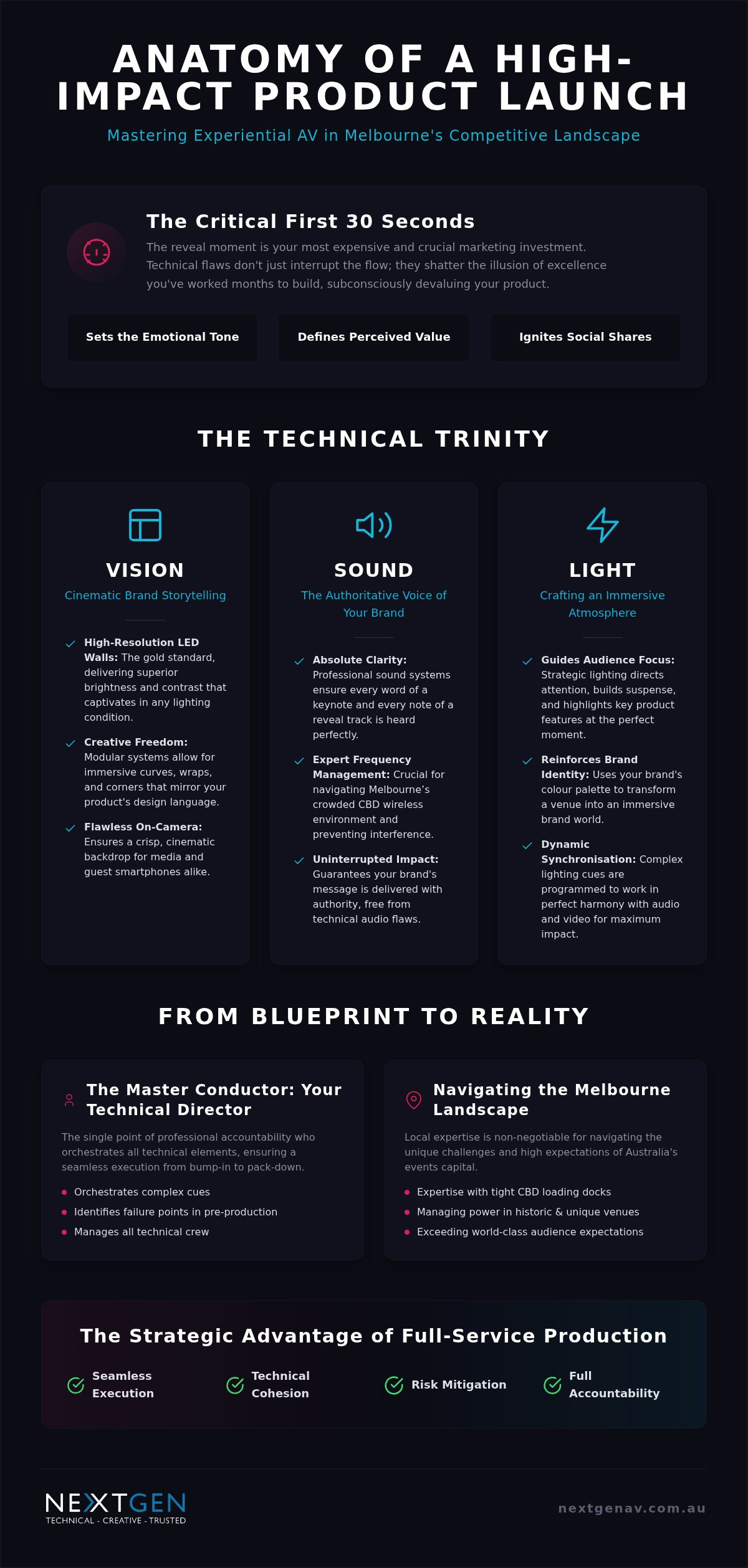
Navigating Melbourne’s Event Landscape: Venues and Logistics
Success in the Melbourne market requires more than just high-end hardware; it demands a deep understanding of the city’s physical and regulatory architecture. From the heritage-listed halls of the CBD to the expansive industrial spaces in Port Melbourne, every site presents a unique set of technical hurdles. Selecting the right venue for experiential av for product launches melbourne means looking past the aesthetic to scrutinise the infrastructure that will support your vision. A stunning location is only viable if it can physically and electrically sustain the weight of your ambition.
Venue Selection from a Technical Perspective
Before signing a venue contract, you must verify the structural capacities of the space. Large-scale LED video walls and complex lighting rigs require certified rigging points and specific floor load ratings. If you’re planning an immersive display, ceiling height becomes your most critical metric. Power is another often-overlooked factor. Many of Melbourne’s boutique venues lack the three-phase power necessary for high-intensity production, which may necessitate the hire of silenced generators to avoid a total blackout during your reveal. For hybrid launches, ensure the venue provides a dedicated, high-speed fibre connection rather than relying on shared guest Wi-Fi, which can falter under the load of a live stream.
Melbourne Logistics and Timing
Logistics in the Melbourne CBD are famously tight. Coordinating a bump-in requires precision timing to navigate narrow laneways and restrictive loading dock schedules. If your launch is in a public space, you must account for City of Melbourne event permits. For events expecting 50 or more attendees or those erecting infrastructure, a permit is mandatory. Application fees for public events vary; even low-impact activations can incur site fees between $516 and $634. We recommend a full rehearsal day in the venue to synchronise your technical crew with other vendors, such as caterers and florists. This ensures that the first time your production fires in unison, it is a rehearsed masterpiece rather than a stressful experiment.
Choosing a partner who knows these venues intimately allows you to bypass the common pitfalls of local logistics. Our 30 years of experience in the Victorian market ensures we have the established relationships and local knowledge to manage your production from first permit to final pack-down. To secure a venue that matches your technical needs, consult with our Melbourne production team today to begin your planning process.
Why Full-Service AV Production is the Logical Choice
Choosing between piecemeal equipment hire and a comprehensive production partner is the difference between managing a checklist and leading a brand movement. While dry hire might seem cost-effective on a spreadsheet, it often hides significant risks, from transport delays to the lack of on-site technical support when a critical component fails. Opting for full-service event production is a strategic investment in peace of mind. It consolidates your technical requirements under a single point of professional accountability, replacing five different equipment vendors with one expert Project Manager who understands your brand’s DNA.
A dedicated production partner acts as your technical navigator. They don’t just provide gear; they provide the intellectual capital required to solve complex problems before they reach the stage. This integrated approach is essential for delivering world-class experiential av for product launches melbourne, where the margin for error is non-existent. When one team handles the vision, sound, and lighting, the synergy is palpable, resulting in a cohesive experience that feels intentional rather than assembled.
The Value of End-to-End Management
True technical mastery begins long before the first truck arrives at the loading dock. Our pre-production process includes detailed site visits, 3D renders, and technical drawings that allow you to visualise the reveal before it happens. This foresight ensures that every rigging point is verified and every sightline is optimised for your guests. On-site, having the same team manage the setup and the show-call creates a seamless transition from logistics to live performance. We maintain a constant thread of technical continuity, ensuring that the person who designed your soundscape is the one sitting behind the console during the climax. Post-event, we handle the high-pressure pack-down and provide data analysis for hybrid elements, ensuring your ROI is as clear as your messaging. For small businesses looking to apply this same level of strategic rigour to their daily operations, SY Mathews provides dedicated on-site support and business advisory services to help navigate periods of significant growth.
NextGen AV brings a 30-year legacy of technical excellence to the Victorian events sector. We’ve seen the evolution of technology and the rising expectations of audiences, positioning us as the seasoned veterans you need for a high-stakes reveal. Our commitment to “quiet power” means we handle the technical heavy lifting, allowing you to step out of the logistical grind and into your role as the brand hero. We thrive under the pressure of live production, taking personal pride in the flawless execution of every cue. Ready to elevate your reveal? Contact NextGen AV for a bespoke production quote and let’s begin crafting a cinematic experience that defines your product’s future.
Command the Stage with Technical Precision
The success of your next reveal depends on moving beyond standard equipment to embrace a fully integrated production strategy. By synchronising the technical trinity of vision, sound, and light under the guidance of an expert technical director, you transform a simple presentation into a cinematic brand event. Mastering experiential av for product launches melbourne means acknowledging that every cue, from the first bass note to the final LED transition, dictates the market’s perception of your innovation. You don’t have to navigate the complexities of CBD logistics or venue power constraints alone.
With 30+ years of specialist experience and a Melbourne-based expert crew, we provide the end-to-end technical management required to ensure you remain the focus while we handle the engine room. Our team acts as your invisible expert, managing the high-stakes pressure so your brand can take centre stage without compromise. It’s time to move past the logistical grind and focus on the prestige of your results. Enquire about your Melbourne Product Launch AV Production today and let’s deliver a world-class experience that your audience won’t forget. Your innovation deserves nothing less than a flawless debut.
Frequently Asked Questions
What is the most important AV element for a product launch?
The most critical component is the seamless integration of vision, sound, and light during the reveal moment. While high-resolution LED walls provide the visual impact, it’s the synchronisation of these elements that creates the emotional connection with your audience. For successful experiential av for product launches melbourne, no single piece of hardware operates in isolation. We focus on technical direction to ensure every cue fires with cinematic precision, turning a standard presentation into a memorable brand experience.
How much lead time is required for product launch AV production in Melbourne?
Ideally, you should engage your production partner three to six months before your event date. This timeframe allows for thorough site visits, custom staging designs, and technical renders. For complex launches in busy Melbourne CBD venues, a minimum of eight weeks is recommended to navigate loading dock schedules and local council permits. Early collaboration ensures we can secure the specific high-end hardware required and allocate our most senior technical directors to your project.
Can you help with content creation for our LED video walls?
We provide essential technical guidance to ensure your digital content perfectly matches our high-resolution hardware. While we specialise in the technical delivery of LED video walls, we work closely with your creative agency to advise on pixel pitch, aspect ratios, and file formats. This collaborative approach prevents common pitfalls like distorted imagery or low-resolution playback. Our goal is to ensure your brand’s visual assets look sharp and professional on every screen configuration we build.
Do you provide technical support for hybrid product launches?
Yes, we provide comprehensive virtual and hybrid event solutions designed to bridge the gap between in-person and remote audiences. Our team manages multi-camera production, low-latency live streaming, and interactive engagement tools to ensure your global audience feels part of the room. By integrating professional audio systems with high-speed fibre connections, we deliver a broadcast-quality experience that maintains your brand’s authority across both physical and digital platforms, ensuring no one misses the reveal.
What happens if there is a technical glitch during the live reveal?
We mitigate the risk of technical glitches through rigorous pre-production testing and built-in system redundancy. Every high-stakes reveal includes a Plan B scenario, where backup media servers and secondary audio feeds are ready to take over instantly if a primary system falters. Our technical directors are seasoned veterans who remain calm under pressure, ensuring that any unforeseen issue is resolved behind the scenes without the audience ever becoming aware of a disruption during your critical moment.
Do we need to hire a separate Technical Director for our launch?
You don’t need to hire an external contractor, as technical direction is a core component of our full-service offering. We provide an experienced director who orchestrates the entire production crew and manages the second-by-second show-call. This internal continuity ensures that the person leading your event has been involved since the initial site visit. Having a single point of accountability simplifies communication and ensures the technical execution aligns perfectly with your brand’s aesthetic and strategic goals.
How do you handle outdoor product launches with Melbourne’s unpredictable weather?
Managing Melbourne’s unpredictable weather requires a proactive approach involving weather-rated equipment and robust contingency planning. We utilise IP65-rated LED screens and protected audio enclosures designed to withstand the elements. During the planning phase, we coordinate with marquee suppliers and venue managers to establish clear wet weather protocols. This ensures that regardless of the conditions in the CBD or along the Yarra, your product reveal proceeds with the same level of polish and safety that your brand requires.
What are the power requirements for a large-scale LED wall and sound system?
Large-scale production typically requires three-phase power to handle the significant draw of high-intensity LED walls and professional audio systems. Many boutique Melbourne venues may not have this infrastructure readily available. We conduct detailed site power assessments during our initial visit to determine if your chosen space is sufficient. If the on-site capacity is lacking, we manage the hire and installation of silenced generators to ensure a stable and uninterrupted power supply for the duration of your experiential av for product launches melbourne.
A massive venue doesn’t just demand more equipment; it demands a higher calibre of precision engineering. When you’re standing in the centre of a space like the MCEC or ICC Sydney, the sheer scale can feel overwhelming. You’ve likely felt the anxiety of a keynote speech being lost to audio drop-outs or the fear that your high-budget content will look pixelated on an expansive LED wall. It’s a high-stakes environment where hidden rigging costs and technical labour complexities often lurk beneath the surface of a standard quote.
We understand that your reputation rests on seamless execution. This 2026 strategy guide will show you how to master large scale event production australia by treating technology as a craft rather than a utility. You’ll learn how to engineer crystal-clear sound for every seat, deploy breathtaking visuals that maintain their integrity at scale, and navigate the latest Australian safety regulations with total confidence. We’re moving beyond basic logistics to explore the technical architecture that transforms a vast room into an intimate, high-impact brand experience.
Key Takeaways
- Learn how to overcome the unique acoustic challenges of expansive Australian halls by utilising line array systems that ensure uniform sound for every attendee.
- Discover the technical criteria for high-impact visuals, including how to choose the right LED pixel pitch to maintain clarity across massive venue spaces.
- Navigate the convenience trap of in-house AV by understanding the benefits of partnering with specialists in large scale event production australia for bespoke brand results.
- Master the critical site survey process to verify three-phase power requirements and rigging weight capacities before your equipment arrives on-site.
- Transition from managing logistical stress to overseeing a polished production through professional technical direction and end-to-end project management.
Scaling Up: AV Challenges for Large Australian Venues
Mastering Large Scale Event Production Australia requires a shift from simple logistics to rigorous technical engineering. In venues designed for 500 to 5,000 attendees, the physics of a room change entirely. Professional event management at this level isn’t just about booking a space; it’s about overcoming the environmental hurdles of massive convention halls. When cables stretch across 100 metres and the back row is a football field away, signal integrity and hardware precision become your only safeguards against failure.
Acoustic Complexity in Expansive Spaces
High-ceilinged venues like the Melbourne Convention and Exhibition Centre (MCEC) present a unique acoustic puzzle. The Inverse Square Law dictates that sound pressure levels drop significantly as distance increases, yet simply increasing the volume often leads to a chaotic wash of echoes. Standard point-source speakers fail here because they lack the directional control needed to cut through reverberation. We use digital signal processing (DSP) to align audio delays with millisecond precision, ensuring that a speaker’s voice reaches the back row at the exact same moment as the front. This technical mastery ensures speech intelligibility remains crystal clear, preventing attendee fatigue during long sessions. Turning it up is never the solution; precision placement is.
Visual Sightlines and Scale Requirements
A 60-metre room depth creates a massive visual disconnect if your screens aren’t engineered for the scale. The furthest viewer rule for 2026 demands that content remains legible even for the person in the very last row. This isn’t just about size; it’s about the relationship between resolution and distance. In Australia’s premier light-filled spaces, like the ICC Sydney, managing glare from glass walls is as critical as the resolution itself. We engineer these sightlines so every attendee feels like they’re in the front row, regardless of the venue’s massive proportions.
- Primary LED walls: High-density pixel pitch ensures text remains crisp for high-stakes presentations.
- Satellite screens: Strategic placement mid-room maintains engagement for those seated far from the main stage.
- Ambient light calibration: Powerful output levels are required to combat the bright Australian sun in outdoor stadiums or glass-fronted centres.
Massive venues also introduce the risk of signal degradation. Long cable runs can lead to flickering visuals or audio lag if not managed with fibre-optic solutions. Maintaining signal integrity over these vast distances is what separates a standard setup from a world-class production.
To achieve this level of technical reliability in permanent commercial settings, many venue operators discover JVG Sound Lighting & Visual Pty Ltd for their specialist expertise in pro audio, stage lighting, and high-resolution LED integration.
Essential Hardware for Massive Impact: LED Walls and Line Arrays
Essential hardware is the engine that drives large scale event production australia, turning a vast room into a powerful brand statement. When you move beyond standard conference rooms into premier Australian spaces, the equipment must do more than simply function; it must command the environment. Achieving this requires a sophisticated combination of visual density, acoustic precision, and architectural lighting that works in perfect synchronisation.
LED Technology: The Gold Standard for Visuals
Traditional projection often struggles in modern, light-filled Australian venues. High-brightness LED panels have become the gold standard because they offer superior contrast and vibrancy that projection cannot match. The choice of pixel pitch is critical for audience engagement. A 2.6mm pitch is ideal for indoor corporate settings where the front row sits close to the stage, ensuring text and graphics remain sharp. For massive backdrops where the audience is further away, a 3.9mm pitch provides the necessary punch and scale. You can find more detail on these specifications in our LED Video Walls for Events guide. In 2026, we also prioritise high refresh rates, which are essential for ensuring that filmed content or live streams appear flicker-free to your digital audience.
Pro Audio: Line Arrays and Frequency Management
Uniform sound distribution is the greatest challenge in deep, tiered venues. Line array speaker systems are engineered to solve this by projecting sound horizontally while strictly controlling vertical dispersion. This prevents sound from bouncing off ceilings and floors, which significantly reduces echo and increases clarity. Managing the Radio Frequency (RF) environment is equally vital, especially in “noisy” areas like the Melbourne or Sydney CBD. We utilise advanced frequency management tools to coordinate wireless microphones and monitors, ensuring zero interference during critical moments. For a deeper look at these setups, explore our Professional Sound System Hire resources.
To ensure your project meets the highest industry benchmarks, we recommend reviewing the resources at Live Performance Australia and choosing to Partner with NextGen AV for Large-Scale Production specialists who understand these complex codes of practice. Beyond sound and vision, we incorporate the following elements to guarantee a flawless execution:
- Intelligent Lighting: We use moving head profiles and wash fixtures to create architectural depth, moving beyond basic stage lighting to sculpt a cinematic atmosphere.
- Redundant Backup Systems: High-profile events require a “fail-safe” approach. We deploy dual-engine consoles and seamless-switch video processors so the show continues without interruption if a primary component fails.
- Signal Distribution: Utilising fibre-optic backbones ensures that high-resolution data travels across massive distances without degradation or lag.
This rigorous attention to hardware redundancy and technical precision is what defines elite large scale event production australia. Our team can help you design a bespoke AV strategy that aligns perfectly with your venue’s unique layout and your brand’s specific vision.
Venue In-House AV vs. Professional Hire Specialists
Choosing your technical team is a pivotal decision in large scale event production australia. Many organisers fall into the “Convenience Trap,” assuming the venue’s in-house team is the safest or most efficient option. While these teams are physically on-site, they often manage legacy equipment designed for general utility rather than high-impact brand storytelling. An external specialist brings a different level of technical ownership; they are responsible for your specific success, not just the venue’s operational baseline.
In-house systems are typically built to meet the room’s average requirements. They rarely accommodate the bespoke LED configurations or complex audio mapping required for a truly immersive experience. A professional hire specialist tailors every piece of hardware to your brand’s vision. This ensures your content isn’t just displayed, but showcased with the precision it deserves. When you own the technical direction, you eliminate the risk of being limited by a room’s default settings.
Cost transparency is another critical differentiator. Venue packages often appear all-inclusive but can hide limitations in labour hours or equipment age. We provide detailed, itemised production quotes that outline exactly what’s being deployed and why. This transparency removes the anxiety of last-minute surcharges for additional cables or late-night technical support. You gain a clear understanding of your investment, ensuring every dollar contributes to the final impact.
The Benefits of a Dedicated Production Partner
Consistency is the hallmark of a dedicated partnership. If you’re touring a national roadshow across Melbourne, Sydney, and Brisbane, your technical execution remains identical at every stop. You gain access to 2026-spec hardware, including the latest high-refresh-rate LED walls, that many venues haven’t yet integrated into their permanent stock. Your crew isn’t distracted by other events in the building. They’re a proactive, elite team focused solely on your presentation’s prestige.
When to Consider In-House Services
In-house teams have their place in the broader event landscape. For simple breakout meetings with minimal branding or technical needs, their immediate proximity is a logical advantage. Some premier Australian venues also maintain exclusive rigging points that only their contracted staff can access for safety and insurance reasons. If you’re hosting a budget-constrained community gathering with low production stakes, the venue’s standard setup might suffice. However, for high-stakes corporate events where failure isn’t an option, the “Invisible Expert” approach of an external partner is indispensable.
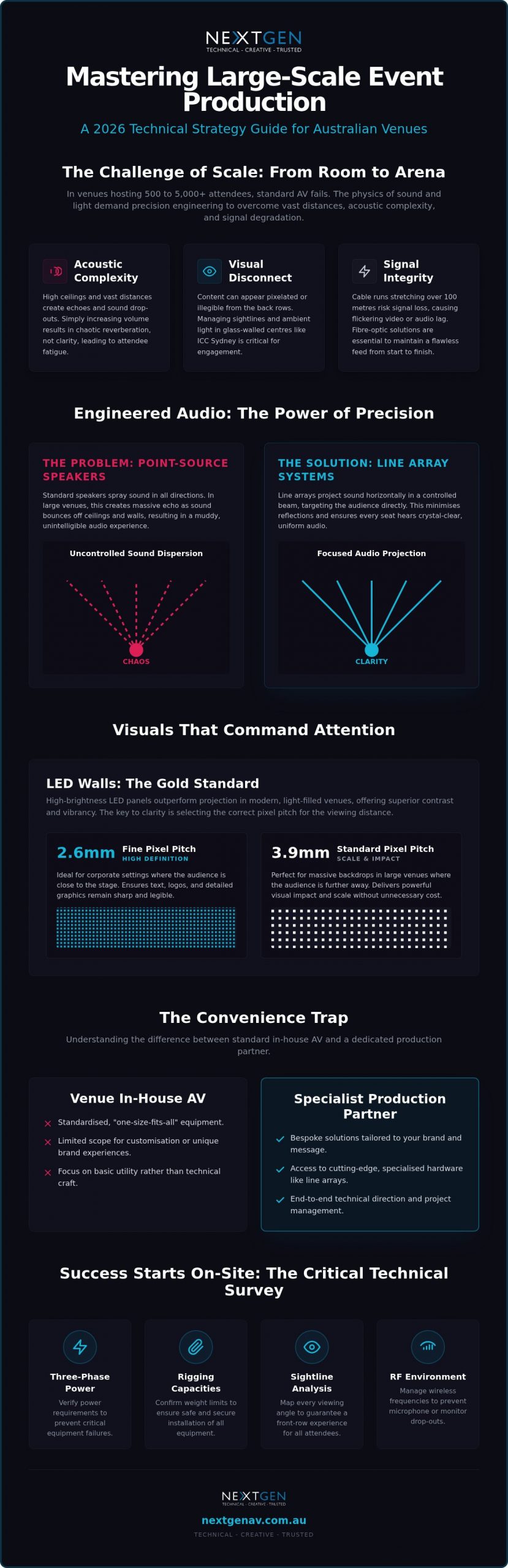
The Technical Site Survey: Safeguarding Your Live Event
A flawless execution begins long before the first semi-trailer arrives at the loading dock. The technical site survey is the phase where we translate your high-level vision into a mathematically sound reality. In the context of large scale event production australia, this process is non-negotiable. It identifies potential failure points that could otherwise derail a high-stakes presentation, ensuring that every technical decision is backed by data rather than guesswork.
We begin with a rigorous Power Audit. Large-scale rigs, particularly massive LED walls and high-output audio systems, demand significant three-phase power. We verify that the venue’s distribution boards can handle the peak load without tripping, preventing the catastrophic risk of a mid-show blackout. Simultaneously, we assess Rigging Points. Hanging tonnes of equipment above an audience requires absolute certainty regarding the venue’s structural weight capacities. We verify every point to ensure your design is both ambitious and safe.
Logistics and signal integrity form the final pillars of the survey. We plan the Loading Dock “bump-in” with precision, ensuring that large semi-trailers have the clearance and time needed to unload heavy gear efficiently. Finally, we map the Signal Path. In 2026, 4K content is the standard, but it’s prone to degradation over long cable runs. We calculate these distances to determine where fibre-optic converters are necessary to maintain pixel-perfect integrity from the media server to the screen.
Australian Safety and Compliance Standards
Adhering to Australian Safety and Compliance Standards is the backbone of our operations. Every setup must strictly follow AS/NZS 3000 and 3002 for electrical safety and temporary installations. We produce comprehensive Safe Work Method Statements (SWMS) for every high-risk activity, from working at heights to rigging heavy structures. This meticulous approach to public liability and safety protects your brand, your attendees, and the integrity of the event itself.
The Role of the Technical Director
The Technical Director (TD) acts as the bridge between your creative ambition and the venue’s physical constraints. They manage the complex technical cues and the live “run sheet” with calm authority, ensuring that every transition is seamless. A TD doesn’t just watch the show; they orchestrate the entire technical ecosystem. To see how this leadership fits into a broader strategy, read our guide on Full Service Event Production.
Don’t leave your technical success to chance. You can contact our team to book a technical site survey and ensure your next venue is fully equipped to handle your vision.
Partner with NextGen AV for Large-Scale Production
NextGen AV represents three decades of technical mastery in the Australian event landscape. We operate as the “Invisible Expert,” an elite team that thrives under the pressure of high-stakes environments. When you choose us for large scale event production australia, you aren’t just hiring equipment; you’re securing a 30-year legacy of seamless execution. We take personal pride in being the engine behind the scenes, allowing your brand to take centre stage with absolute confidence and “Quiet Power.”
Our end-to-end management process begins with detailed 3D renders that visualise your experience long before the first truss is lifted. To achieve this level of accuracy, we rely on principles of high-precision mapping and geospatial services similar to those pioneered by GEOTECH 3D in complex architectural environments. This proactive approach eliminates ambiguity and ensures every stakeholder is aligned with the final vision. From the initial concept to the final post-event pack-down, we handle the logistical grind so you don’t have to. Our inventory is curated for the demands of 2026, featuring premium LED walls, high-fidelity line arrays, and the latest digital consoles that ensure your message is delivered with prestige and precision.
While our roots are in Victoria, our reach extends across the continent. We possess intimate knowledge of Australia’s premier spaces, from the expansive halls of the MCEC to the unique rigging challenges of Marvel Stadium and major hotel ballrooms. Whether you’re orchestrating a complex corporate AGM, a high-glamour gala dinner, or a high-impact product launch, our solutions are tailored to the specific architecture of the room. You can explore our local capabilities further in our guide to Audio Visual Hire Melbourne.
Request a Comprehensive Production Quote
We believe that high-level production requires total financial clarity. Our discovery process starts with understanding your core objectives, not just your gear list. This allows us to recommend a technical strategy that actually serves your goals rather than just filling a room with hardware. We provide transparent, itemised quotes that break down every component of the production, from technical direction to rigging labour. This methodical approach ensures there are no hidden costs or last-minute surprises, just a polished, professional result.
Contact the NextGen AV team to discuss your large-scale event needs and discover how we can transform your next vision into a seamless reality.
Engineering Your Vision for 2026 and Beyond
Mastering large scale event production australia demands more than just a massive inventory; it requires the technical mastery to orchestrate complex systems in high-pressure environments. By prioritising rigorous site surveys and deploying 2026-spec hardware like high-density LED walls and precision line arrays, you transform a vast venue into a seamless brand experience. Moving past the convenience of in-house defaults allows you to maintain total creative control while ensuring every technical cue is executed with clinical precision.
As the “Invisible Expert”, NextGen AV brings over 30 years of technical mastery to your project. We manage the logistical stress and technical complexities, allowing you to focus on the prestige of your final result. Trusted by Australia’s leading corporate brands, our full-service production management ensures your event scales perfectly across any premier venue, from the MCEC to Marvel Stadium.
Secure your flawless event production with NextGen AV today.
Your vision deserves a technical foundation that never falters. We look forward to helping you engineer an experience that resonates long after the final pack-down.
Frequently Asked Questions
How much does AV hire cost for a large venue in Australia?
Costs for professional production vary significantly based on attendee numbers, technical complexity, and event duration. For high-stakes environments, your budget typically covers high-end equipment hire, technical labour, and transport. While basic setups are more affordable, a premium production in a major Australian venue requires a bespoke quote to account for rigging, lighting, and sound requirements. We recommend requesting an itemised proposal to understand the specific investment needed for your brand’s vision.
What is the difference between an LED wall and a projector for a large room?
LED walls offer superior brightness and contrast compared to traditional projectors, especially in venues with high ambient light. Unlike projectors, LED panels don’t suffer from shadows if a speaker walks in front of the screen. In large Australian convention centres with expansive glass walls, LED technology ensures your content remains vibrant and visible from every angle. This makes them the preferred choice for high-impact corporate presentations where visual clarity is non-negotiable.
Do I need a technical director for a 500-person conference?
A technical director is essential for a 500-person conference to manage the complex interplay between audio, visuals, and live cues. They act as the central orchestrator, ensuring the run sheet is followed exactly and any technical glitches are resolved instantly. For large scale event production australia, having a dedicated TD allows you to focus on your guests while our elite team handles the high-pressure logistics behind the scenes.
Can I use the venue’s built-in sound system for a gala dinner?
Built-in venue systems are often designed for background music or basic announcements rather than high-fidelity gala audio. For a gala dinner, you need a professional audio system that can handle both crystal-clear speeches and high-energy entertainment. We typically deploy a bespoke sound rig that accounts for the room’s specific acoustics, ensuring every guest enjoys a premium experience without the muffled sound common in legacy venue systems.
How long does it take to set up AV for a stadium-sized event?
Stadium-sized setups typically require two to four days of “bump-in” time, depending on the complexity of the rigging and LED configurations. This window allows for rigorous safety checks, sound mapping, and content rehearsals. We coordinate closely with venue management at sites like Marvel Stadium to ensure the logistics of semi-trailers and heavy equipment are managed efficiently, minimising the inherent stress during the lead-up to your live event.
What are the power requirements for a large LED video wall?
Large LED video walls require substantial three-phase power to operate reliably at high brightness levels. During our technical site survey, we audit the venue’s power distribution to ensure it can handle the peak load of the entire rig. This prevents the risk of tripped circuits during your presentation. We also plan for power redundancy where required to guarantee that your visuals stay live even if a primary source fails.
Do you provide AV hire for outdoor venues in Melbourne?
Yes, we provide comprehensive AV hire for outdoor venues across Melbourne, including parks, stadiums, and rooftop spaces. Outdoor events introduce unique challenges like wind-rated rigging and weather-protected equipment. Our team is experienced in managing the variable Melbourne weather, ensuring your sound and visuals remain stable and high-impact. We adhere to all Victorian safety standards and council regulations to protect both the audience and the technical equipment.
How do you ensure audio clarity at the back of a deep convention hall?
We ensure audio clarity at the back of deep halls by utilising line array speaker systems and digital signal processing. Line arrays project sound horizontally with minimal vertical spill, which significantly reduces echo from the ceiling. By calculating precise delay times, we ensure that sound from satellite speakers reaches the back row at the exact same moment as the main stage audio. This creates a uniform, high-fidelity experience for every attendee.
What if the most critical factor in your 2026 corporate gala isn’t the guest list or the venue, but the invisible precision of your signal chain? You’ve likely felt the sting of a flickering LED wall or the awkward silence of a microphone failure during a keynote. It’s frustrating to manage high-stakes expectations while wrestling with opaque venue packages and technical vendors who aren’t on the same page. You want more than just equipment; you’re looking for a seamless, prestigious experience that reflects your brand’s authority.
Mastering high-end corporate event av solutions melbourne requires a shift from simple hire to sophisticated technical direction. This guide provides the expert roadmap you need to eliminate mid-event surprises and secure a ‘wow-factor’ result through transparent budgeting and elite execution. We’ll walk through the technical complexities of modern production management, from professional audio arrays to the cinematic impact of LED video walls, ensuring you remain the confident orchestrator of your next Melbourne masterpiece.
Key Takeaways
- Define the critical distinction between general event planning and technical production management to ensure your vision is executed with absolute precision.
- Discover how to integrate high-resolution LED video walls and professional audio systems to deliver world-class corporate event av solutions melbourne.
- Learn to navigate the “convenience trap” of in-house venue AV by conducting a transparent cost analysis of independent production management.
- Utilise a professional six-month technical timeline to master every phase of your project, from the initial site inspection to a flawless final pack-down.
- Understand how partnering with a seasoned technical director provides the invisible expertise needed to shield your event from technical glitches and hidden costs.
Understanding Event Production Management in Melbourne
Technical production management is the engine room of a successful corporate gathering. While general event management focuses on the broad logistics of guest lists and catering, technical management is a specialised craft dedicated to the signal flow, visual architecture, and acoustic integrity of the space. In a city like Melbourne, where corporate standards are exceptionally high, relying on basic “party hire” setups is a reputational gamble. You aren’t just booking equipment; you’re securing a technical director who anticipates failure points before they manifest on stage.
The stakes in corporate Melbourne are incredibly high. Every flicker on an LED wall or crackle in a microphone reflects directly on your brand’s reputation. Professional management mitigates these invisible risks, such as wireless frequency interference or signal latency, which can derail a high-stakes keynote. It’s about moving past the logistical grind and focusing on the prestige of the final result, ensuring your message is delivered with absolute clarity.
The Core Pillars of Technical Production
Effective technical management rests on three non-negotiable pillars. Technical direction is the first, where the manager acts as the architect, designing the technical flow to match your brand’s vision. Second is hardware integration. This ensures your LED video walls, professional audio systems, and lighting rigs work in perfect synchronisation rather than as isolated components. Finally, on-site operation provides the elite labour and real-time expertise required to manage the live show. This holistic approach to corporate event av solutions melbourne transforms a standard presentation into a cinematic experience that resonates with your audience.
Why Melbourne Events Require Local Technical Expertise
Success often hinges on navigating the specific quirks of our local venues. Whether you’re at the MCEC or a boutique rooftop in the CBD, understanding loading dock schedules, rigging point weight limits, and lift dimensions is critical to a stress-free bump-in. Local expertise means having a warehouse nearby for rapid equipment support if a last-minute change occurs. It also ensures strict adherence to Victorian event industry standards and safety regulations, shielding your brand from liability. This proactive, elite team thrives under pressure, allowing you to take centre stage without worry while the technical engine runs flawlessly behind the scenes.
The 4 Essential Components of Flawless Event Production
Achieving a prestigious result requires more than just high-end gear. It demands a symphony of technical mastery where every element performs in perfect synchronisation. While many planners consult a comprehensive guide to event production to understand the basics, the execution in Melbourne’s unique architectural landscape requires a specialised touch. To deliver world-class corporate event av solutions melbourne, you must focus on the four pillars that define technical excellence: audio, visuals, lighting, and staging.
Audio Engineering for Corporate Clarity
The Melbourne CBD is a dense jungle of wireless signals. Managing frequency interference is a technical craft that prevents embarrassing dropouts during a CEO’s address. You need to distinguish between the intimate clarity required for a Q&A and the powerful, room-filling presence needed for a keynote speaker. For large gala dinners, we deploy multi-zone PA systems. These ensure that guests at the back hear every word with absolute precision without deafening those seated near the stage. It’s about creating an acoustic environment where the technology becomes invisible, allowing the message to take centre stage.
Visual Storytelling with LED Technology
By 2026, traditional projection has largely stepped aside for the vibrant brilliance of LED video walls. These systems offer unparalleled contrast and colour depth, even in sun-drenched Melbourne atriums or glass-walled conference centres. Understanding pixel pitch is vital; a fine pitch is essential for close-up viewing in a boardroom, while larger displays suit massive plenary halls. For those managing hybrid events, integrating live camera feeds with custom digital content creates a unified experience. This ensures your virtual audience feels the same ‘wow-factor’ as those in the room.
Dynamic Lighting and Staging
Lighting is your audience’s visual compass. It isn’t just about making the stage ‘bright’; it’s about using intelligent fixtures to guide focus and reinforce brand identity through precise colour matching. This physical foundation is completed by custom staging solutions that elevate the presenter and the brand. Safety remains a non-negotiable priority. Rigging requires professional engineers to oversee every point, ensuring structural integrity for suspended audio arrays and lighting rigs. Mastering these physical elements turns a complex logistical challenge into a seamless brand victory. If you’re ready to transform your next presentation, exploring premium corporate event av solutions melbourne is the first step toward a flawless execution.
In-House Venue AV vs. Independent Production Management
Selecting a prestigious Melbourne venue is a milestone in your planning journey, but it often brings you to a critical crossroads: do you use the in-house AV team or bring in an independent partner? This is frequently where planners fall into the “Convenience Trap.” While the in-house option feels like the path of least resistance, it may not align with the high-stakes requirements of your brand. In-house providers often operate on a volume-based model, using pre-installed equipment that might be years behind current standards. Choosing independent corporate event av solutions melbourne ensures that your technology is curated specifically for your message, rather than limited by what is already bolted to the ceiling.
Transparency is the cornerstone of a successful partnership. In-house AV packages frequently include substantial commissions paid back to the venue, which can inflate your costs without adding technical value. When you engage an independent production manager, every dollar of your budget is visible and directed toward elite hardware and expert labour. You gain a dedicated advocate whose sole priority is your event’s success, not the venue’s bottom line. This relationship allows for a level of customisation that in-house teams, bound by rigid venue protocols, simply cannot match.
When to Choose Independent Production
High-stakes environments where technical failure is not an option demand the precision of an independent team. If your vision requires specialist hardware, such as large-scale LED video walls or complex hybrid streaming setups, a dedicated production partner is essential. This is particularly true for corporate roadshows moving across multiple Melbourne or Australian venues. Maintaining a consistent technical crew ensures your brand’s look and feel remain identical at every stop, eliminating the “venue lottery” of varying equipment quality and staff experience.
Questions to Ask Your Venue About AV
Before signing a venue contract, it’s vital to understand your flexibility. Ask these specific questions to uncover potential hidden constraints:
- Are we locked into using your in-house technical crew? Some venues mandate their staff for safety reasons, but you should still be able to bring your own technical director.
- What are the external vendor or “patching” fees? Be aware of daily charges venues apply when you bring in outside equipment or connect to their house sound system.
- Can the in-house system support my specific digital content? Ensure their screens and processors can handle your high-resolution presentations without lag or distortion.
By taking control of your technical requirements early, you move from being a passenger in the venue’s process to the confident orchestrator of a world-class experience.
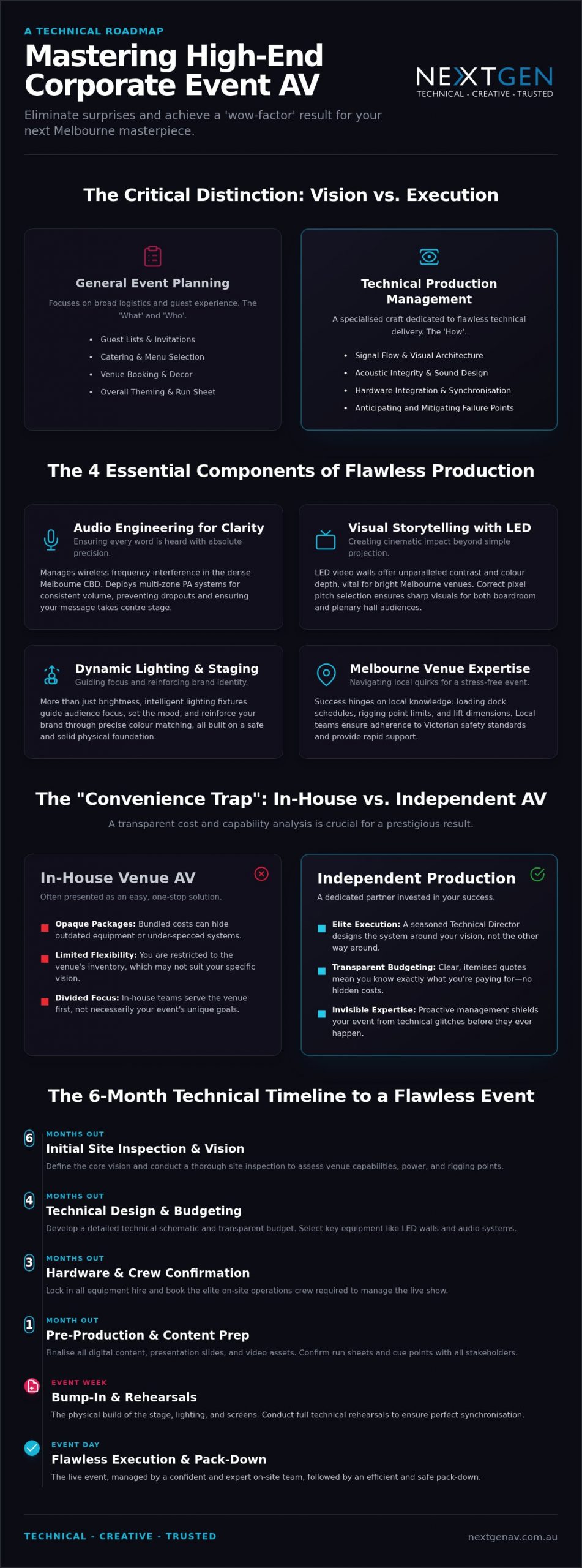
Planning Your Production: A Technical Timeline
A flawless event doesn’t just happen; it’s meticulously engineered over several months of strategic planning. To secure the most sophisticated corporate event av solutions melbourne, you must move beyond a simple equipment list and adopt a rigorous technical timeline. This structured approach allows our team to act as your invisible expert, anticipating logistical hurdles before they impact your budget or your brand’s reputation. It’s about building momentum from the initial brief to the final standing ovation.
- Phase 1: Concept and Site Inspection (6 months out): We define the technical architecture and perform the first physical assessment of the space to identify structural constraints.
- Phase 2: Technical Design and Equipment Specification (3-4 months out): Our engineers finalise signal paths, lighting plots, and the specific audio arrays required for your audience size.
- Phase 3: Content Creation and Format Finalisation (1 month out): All digital assets are checked for aspect ratio compatibility and playback stability on our media servers.
- Phase 4: The Bump-in and Technical Rehearsal (24-48 hours out): The physical build begins, followed by rigorous testing of every microphone, light fixture, and LED panel.
- Phase 5: Live Operation and Post-Event Review: Technical directors manage the show flow in real-time, followed by a detailed debrief to measure technical performance and ROI.
The Importance of the Site Inspection
The site inspection is your first defence against hidden costs and technical glitches. We scrutinise ceiling heights for rigging clearance, evaluate power distribution limits, and identify potential acoustic reflections in the chosen Melbourne space. For events with hybrid components, measuring signal strength and dedicated internet stability is non-negotiable. Identifying these constraints six months out prevents expensive last-minute hardware additions that can inflate your final invoice. It allows us to design a solution that works with the venue’s architecture rather than against it. For those also managing the long-term security of their commercial premises, you can learn more about Digital-Vision.AI to explore AI-powered surveillance and access-control solutions.
Budgeting for Technical Excellence
Smart budgeting focuses on “show-critical” technology that directly impacts the audience’s engagement. You should prioritise professional audio systems and high-resolution visuals over purely decorative elements that don’t advance your message. The true value often lies in professional labour and technical direction; the elite crew who ensure your vision translates perfectly to the stage under pressure. Avoiding common pitfalls means accounting for loading dock fees and Victorian labour rates early in the process. If you’re ready to start your journey toward technical mastery, reach out to our team to discuss your tailored corporate event av solutions melbourne today.
NextGen AV: Your Confident Orchestrator in Melbourne
With over 30 years of mastery in the Australian event production industry, NextGen AV has evolved into more than just a provider; we are your dedicated craft partner. We understand that a high-stakes Melbourne gala or a critical product launch isn’t the time for generic setups. Our team provides end-to-end technical management, ensuring your corporate event av solutions melbourne are delivered with absolute precision. This “Invisible Expert” approach is designed to alleviate the inherent stress of live production, allowing you to focus on the prestige of your message while we drive the technical engine behind the scenes.
Our Full-Service Production Philosophy
We prioritise technical direction over simple equipment hire because we know that the best hardware is only as effective as the mind orchestrating it. Our collaborative approach involves working alongside Melbourne’s leading event planners to transform corporate visions into cinematic realities. Whether it’s a multi-day conference at the MCEC or an intimate executive briefing, we ensure our technical solutions are tailored to the specific acoustics and visual requirements of your space. Our prestigious inventory of LED video walls, professional audio systems, and intelligent lighting serves as the palette for our technical artistry.
Ready to Elevate Your Next Melbourne Event?
Starting the conversation with our technical team is the first step toward a seamless, ‘wow-factor’ result. We don’t believe in one-size-fits-all packages. Instead, we offer bespoke corporate event av solutions melbourne for conferences, galas, and product launches that demand a higher standard of execution. Our local Melbourne warehouse and deep knowledge of Victorian venue regulations provide a safety net that national generalists simply cannot match. You deserve a partner who takes personal pride in your success and thrives under the pressure of a live show.
Master the technical complexities of your next project with a team that has seen it all. Our seasoned veterans are ready to provide the quiet power and front-of-house excellence your brand requires. To begin your journey toward a flawless delivery, organise a technical consultation for your Melbourne event today.
Orchestrate Your Next Melbourne Masterpiece
Your vision deserves a technical execution that matches its ambition. By moving beyond the convenience of venue packages and embracing a rigorous pre-production timeline, you transform your presentation from a simple meeting into a cinematic brand experience. Success in 2026 requires more than just equipment; it demands a dedicated technical director who understands the physical and acoustic nuances of the Melbourne landscape. Whether you’re deploying high-impact LED video walls or complex audio arrays, the precision of your delivery is the ultimate reflection of your brand’s prestige.
NextGen AV brings over 30 years of technical mastery to every project. Our Melbourne-based warehouse and elite support team ensure that your corporate event av solutions melbourne are delivered with absolute reliability and local expertise. We handle the complex signal paths and rigging safety so you can lead with confidence. It’s time to step past the logistical grind and focus on the result you’ve worked so hard to envision.
Partner with Melbourne’s technical event production experts to secure a flawless execution for your next high-stakes project. We look forward to bringing your vision to life.
Frequently Asked Questions
What is the difference between event management and event production management?
Event management handles the broad logistics of a guest experience, such as catering, guest lists, and programming. In contrast, technical production management is a specialised craft focused on the architecture of the live show. It involves designing the signal flow, technical direction, and hardware integration. Production managers ensure that invisible elements like audio arrays and LED processors work in perfect harmony, allowing the general organiser to focus on hospitality without technical stress.
Why should I hire an independent AV company instead of using the venue’s team?
Independent companies provide dedicated advocacy and bespoke hardware tailored to your brand’s specific requirements. Unlike in-house teams who are often bound by fixed venue equipment and commission-based pricing, an independent partner offers full transparency. You gain access to the latest corporate event av solutions melbourne and a technical director who works solely for your success, rather than the venue’s bottom line or volume-based turnover.
How much does professional event production management cost in Melbourne?
Costs are typically structured around two main components: per-event equipment rental fees and professional technical management fees. The total investment depends on the complexity of your technical design, the scale of the LED video walls, and the number of on-site engineers required. While industry tiers exist, you can explore Project-Based Event Management and Coordination Fees to see how professional management is structured. We recommend a technical consultation to receive a transparent quote that aligns with your specific production scope and prestigious event goals.
A high-performance conference requires four core pillars: professional audio systems for vocal clarity, high-resolution LED video walls for visual impact, intelligent lighting to guide focus, and safe staging. Additionally, robust media servers and technical direction are essential for managing transitions and digital content. These components must be integrated through a master signal chain to ensure a cinematic experience that captivates your audience from the first keynote to the final session.
How far in advance should I book my event production team?
We recommend engaging your technical production partner at least six months before your event date. This lead time is critical for conducting site inspections, finalising technical designs, and securing the most sophisticated hardware. Early booking allows us to act as your invisible expert during the venue contract phase. This ensures that ceiling heights, power distribution, and rigging points are compatible with your vision before any venue commitments are finalised.
Do you provide technical direction for hybrid and virtual events?
Yes, we specialise in virtual and hybrid event solutions that bridge the gap between in-person and digital audiences. Our technical direction includes managing low-latency streaming, integrating remote speakers via high-definition links, and coordinating live camera feeds. We ensure that the virtual experience matches the ‘wow-factor’ of the physical room. This provides a unified brand message regardless of where your attendees are located across Australia or the globe.
What happens if there is a technical glitch during the live event?
Our proactive management style is built on redundancy and rapid response. We deploy backup systems for critical signal paths, including primary and secondary media servers and spare wireless frequencies. Because our technical directors are seasoned veterans who thrive under pressure, they anticipate failure points before they manifest on stage. This “Invisible Expert” approach ensures that any minor technical hiccup is resolved behind the scenes without the audience ever noticing.
Can you manage events outside of Melbourne?
While our headquarters and primary warehouse are based in Melbourne, we provide end-to-end technical management for corporate events across Australia. Our 30 years of experience have allowed us to build a robust network that supports national roadshows and interstate conferences. Partnering with a consistent technical team ensures your brand identity and production quality remain identical in every city. This provides a seamless experience for your presenters and guests alike.
In a city where every corporate gala and product launch competes for the same finite attention, a static banner is no longer enough to cut through the noise. When you seek out gobo projection hire melbourne, you aren’t just ordering a piece of equipment; you’re commissioning a strategic branding tool designed to command the room. We understand the high-stakes pressure of event planning, where even a slight distortion in your logo can undermine the prestige of your entire organisation.
You’ve likely worried about blurry edges or whether a projector can handle the unique architecture of a heritage CBD venue. This guide will show you how to transform any space with custom light projections that elevate your brand and captivate your audience. We’ll explore the technical shift toward high-definition glass optics, solve the mystery of venue compatibility, and provide a roadmap for a stress-free technical setup that delivers a genuine “wow” factor for your attendees.
Key Takeaways
- Learn how to transform standard venues into immersive, high-impact environments by using light to project sharp, professional branding onto almost any surface.
- Understand the critical differences between metal and glass templates to ensure your logo remains crisp, high-contrast, and colour-accurate throughout the night.
- Master the technical planning required for gobo projection hire melbourne, from calculating precise throw distances to selecting the best surfaces for maximum visual clarity.
- Discover creative ways to brand “unbrandable” locations, such as heritage facades and glass walls, while using light to guide guest flow seamlessly.
- Shift the technical burden to a professional orchestrator, allowing you to focus on your guests while experts manage everything from artwork design to on-site execution.
Why Gobo Projection is the Secret to Impactful Event Branding
Branding isn’t just about visibility; it’s about prestige. In the high-stakes environment of corporate events, you need a way to command attention without cluttering the room. A gobo, technically known in the industry as a Gobo (lighting) or “Go Between,” is a precision-cut template that sits inside a lighting fixture. It acts as the bridge between a raw venue and a fully branded experience, allowing us to cast your identity across any surface with surgical precision.
When you invest in gobo projection hire melbourne, you aren’t just buying a light. You’re creating an immersive environment that speaks to the quality of your organisation. High-contrast branding at a venue entrance creates a powerful psychological anchor for attendees. It signifies that the event is a premium, well-orchestrated affair. By projecting your logo onto a blank wall or floor, you turn a functional space into a cinematic backdrop that reinforces your brand’s authority from the moment guests arrive.
The cost-effectiveness of this approach is often overlooked by planners. Physical signage requires printing, shipping, and labour-intensive installation. Light, however, is weightless and infinitely scalable. It allows for a massive visual impact that would be prohibitively expensive or physically impossible to achieve with traditional set construction. It offers a premium look with significantly lower logistical overhead, providing a high-impact return on investment for brands that want to look expensive without being wasteful.
The Versatility of Light: From Logos to Textures
Light is a dynamic medium that adapts to your event’s rhythm. While corporate logo placement is the primary driver for many, the creative potential goes much deeper. For gala dinners, we often use “breakup patterns”—intricate textures like foliage or abstract geometries—to add sophisticated depth to the room without adding physical clutter. For those seeking bespoke artistic concepts, exploring the work of creative studios like markfinzel.co.uk can offer fresh perspectives on how visual design interacts with space. If your event needs a boost of energy, rotating gobos can move across the ceiling or walls, creating a sense of momentum that keeps the audience’s focus sharp and the atmosphere vibrant.
Why Light Beats Physical Signage
- Instant Adaptability: Our team can refine the focus or reposition the image in seconds during the setup phase, ensuring everything is perfectly aligned.
- Sustainability Baseline: Events in 2026 demand waste reduction. Light eliminates the need for single-use plastics and foams that usually end up in a skip bin after pack-down.
- Creative Freedom: Light allows you to brand “unbrandable” surfaces like raw brick, bluestone, or high ceilings without any physical contact or damage.
Understanding the Technology: Metal vs. Glass Gobos
Achieving a flawless projection requires more than just a bright light. It demands a deep understanding of the medium itself. When you engage with gobo projection hire melbourne, the choice between metal and glass is the most critical technical decision you’ll make. This choice dictates the clarity, colour accuracy, and overall prestige of your brand’s visual presence. Light is a medium of precision; selecting the wrong template material can turn a sharp corporate logo into a blurred distraction.
Metal Gobos: The Reliable Workhorse
Metal gobos are the traditional industry standard. Etched from thin sheets of stainless steel, they are incredibly durable and cost-effective for short-term hires. They excel at projecting bold, high-contrast imagery such as simple shapes or “breakup” patterns like stars and foliage. However, they have a physical limitation known as “islands.” To keep the centre of a letter like ‘O’ or ‘A’ from falling out, tiny metal tabs must remain in place. While our team can often minimise their visibility, these tabs are a physical reality of the stencil-cutting process.
Glass Gobos: High-Definition Brilliance
When a brand needs to showcase its brand identity with absolute fidelity, glass is the only choice. These templates are manufactured using high-resolution lasers to etch micro-thin layers of dichroic glass. This technology allows for photorealistic images, complex gradients, and exact colour matching to your corporate palette. For high-stakes product launches, glass ensures your logo looks like a crisp digital file rather than a stencil. It eliminates the need for tabs, providing a seamless, high-definition result that commands respect.
The engine behind the template also plays a vital role. We typically deploy either LED or discharge lamp projectors depending on your venue’s ambient light. LED units offer cool operation and instant control, while discharge lamps provide the raw intensity needed to punch through the bright lighting found in large Melbourne ballrooms. This hardware choice is part of the comprehensive technical direction we provide to ensure your vision is realised without compromise.
Technical precision doesn’t stop at the projector. A common pain point is the “trapezoid effect” caused by projecting at an angle. Through a process called keystone correction, we square the image to ensure your logo remains perfectly proportioned even if the projector is tucked away in a corner. This attention to detail is what separates a standard setup from a truly successful gobo projection hire melbourne experience. We handle these complex optical adjustments behind the scenes, leaving you free to focus on your guests.
Creative Applications for Melbourne Corporate and Private Events
Melbourne’s architecture is a diverse canvas, ranging from the rugged bluestone of heritage warehouses to the sleek, reflective glass of CBD towers. Light allows you to brand the unbrandable. In spaces where physical signage is prohibited or structurally impossible, professional gobo projection hire melbourne provides an elegant, non-invasive solution. We adhere to the high standards championed by the International Association of Lighting Designers, ensuring that our projections respect the venue’s integrity while maximising your brand’s visual reach. Beyond simple logos, light serves as a functional tool for wayfinding, guiding guests through complex floor plans with sharp, illuminated markers that feel like part of the event’s design rather than an afterthought.
The rise of “Instagrammable” moments has also shifted how we deploy light. High-contrast floor projections have become essential social media bait, offering attendees a sophisticated backdrop for photos and videos. When your brand is literally underfoot in a crisp, high-definition projection, it becomes a central part of the guest’s digital story. This isn’t just about lighting a room; it’s about creating a series of curated, shareable experiences that extend the life of your event far beyond the final pack-down.
Corporate Gala Dinners and Awards Nights
Atmosphere is the silent driver of success at prestigious venues like the Crown or Grand Hyatt. During transition periods or award announcements, we use custom textures to transform the room’s energy instantly. Integrating these projections with our stage and lighting hire Melbourne services ensures a cohesive visual narrative that flows from the stage to the back of the room. Sponsor logos can be cycled across the walls, providing high-value exposure for stakeholders without the cluttered look of pull-up banners. It creates a polished, elite environment that honours your guests and reinforces the prestige of the evening.
Product Launches and Brand Activations
The “reveal” is a cornerstone of any successful product launch. We use timed gobo changes to build anticipation, slowly unveiling brand elements as your presentation reaches its crescendo. For maximum impact, we often recommend integrating light projection with LED video walls for events. This blends the raw power of digital content with the architectural elegance of light. For outdoor activations, your brand can quite literally own the Melbourne skyline, projecting onto adjacent facades to create a massive, unmissable presence that traditional media cannot replicate. We handle the technical direction, allowing you to focus on the guests while we orchestrate the visual impact.
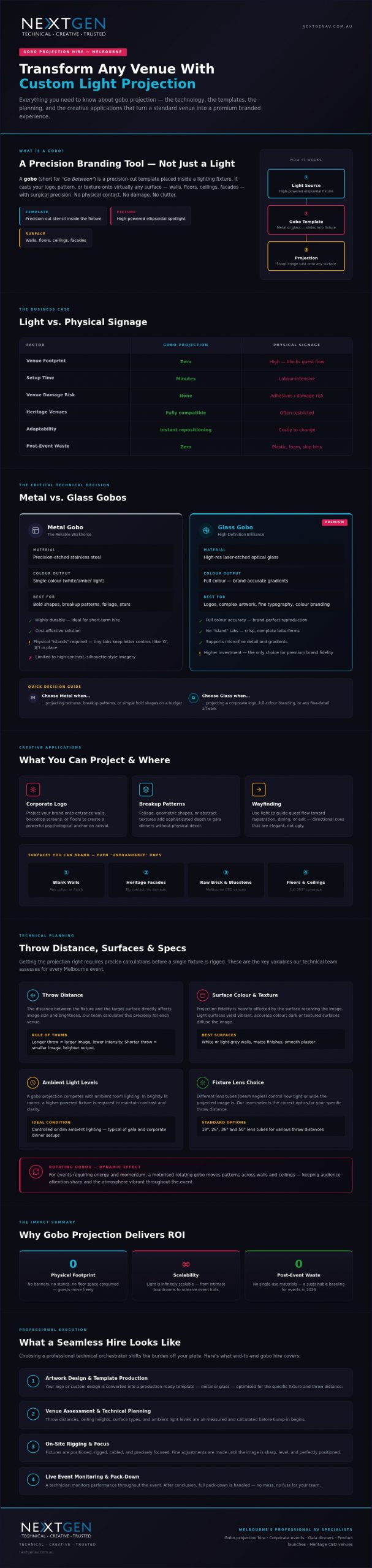
Planning Your Projection: Throw Distance, Surfaces, and Specs
The success of a projection isn’t accidental. It’s the result of precise mathematical planning and a deep understanding of the venue’s physical constraints. When you begin the process of gobo projection hire melbourne, we move through a methodical पाँच-step checklist to ensure your brand is rendered with surgical precision. This proactive approach eliminates the stress of on-site “surprises” and ensures the final result matches your digital proof exactly.
- Step 1: Measuring the Throw Distance. We calculate the exact distance from the projector’s mounting point to the target surface. This measurement dictates the brightness and lens requirements.
- Step 2: Assessing Surface Properties. Dark or highly textured surfaces, like raw bluestone or deep timber, absorb light. We assess the surface colour to ensure maximum contrast for your logo.
- Step 3: Calculating Image Size. Using the throw distance, we select the correct lens degree to achieve your desired image diameter without losing light intensity.
- Step 4: Providing Vector Artwork. To etch a template with absolute clarity, we require high-resolution vector files in AI or EPS format. This ensures every curve of your logo is sharp.
- Step 5: Managing Ambient Light. We audit the venue’s existing lighting. Projection thrives in controlled environments, so we coordinate with the venue to dim house lights where necessary.
The Mathematics of a Perfect Projection
Precision is our baseline. We use a variety of lens degrees, ranging from narrow 19-degree lenses for long-distance throws to wide 50-degree lenses for close-range floor projections. Selecting the wrong lens can lead to a dim, washed-out image. We also plan for “stretching” or distortion. If we can’t project head-on, we pre-calculate the angle to ensure your logo doesn’t look skewed. For the best result, your artwork should be “white on black.” This allows the maximum amount of light to pass through the etched areas of the gobo while the black areas remain opaque, creating the high-contrast “wow” factor your brand deserves.
Melbourne Venue Considerations
Melbourne’s heritage buildings present unique logistical hurdles. In venues like the Old Treasury Building or the Town Hall, mounting equipment to walls is strictly prohibited. We solve this by using discrete floor stands or self-supporting truss systems that respect the architectural integrity of the space. Power management is equally vital. We organise cable runs with professional masking to ensure a tidy, corporate-ready appearance. Our team manages these technicalities behind the scenes, allowing you to focus on your guests. To ensure your venue is compatible, contact our technical team for a detailed site assessment.
Professional Gobo Hire with NextGen AV: Seamless Execution
Execution is where vision meets reality. At NextGen AV, we’ve spent over 30 years refining the art of technical direction, ensuring that every element of your event works in perfect harmony. When you choose gobo projection hire melbourne through our team, you aren’t just renting a light fixture; you’re partnering with a proactive team of experts who take personal pride in flawless delivery. We act as the invisible engine behind your success, handling the complex optics and rigging so you can remain the focused host your guests expect.
Our approach integrates precision-cut light into a wider full service event production strategy. This ensures that your branding doesn’t exist in a vacuum. We balance the intensity of your projections with our 2026 fleet of high-output LED fixtures, creating a layered visual environment that feels sophisticated and intentional. By managing everything from the initial artwork conversion to the final on-site focus, we eliminate the technical friction that often plagues high-stakes corporate gatherings.
Why a Managed Service Beats DIY Hire
The difference between a professional projection and a DIY attempt is immediately visible in the details. Amateurs often struggle with keystone distortion, blurry focal points, or poor contrast against venue surfaces. Our managed service eliminates these stresses through expert technical direction. We handle the precise alignment and focus required to keep your logo sharp from every angle in the room. Furthermore, we ensure all rigging meets strict Australian safety standards, providing peace of mind in busy CBD venues. This level of care extends to how we integrate light with other sensory elements, such as professional sound system hire, to create a truly cohesive attendee journey.
Book Your Melbourne Site Inspection
Every venue in Melbourne presents unique challenges, from the high ceilings of industrial Docklands spaces to the heritage restrictions of Collins Street ballrooms. Our technicians conduct thorough site inspections to identify the optimal placement for every projector. We assess power requirements and cable management paths to ensure a clean, corporate-ready finish with no visible clutter. During this phase, we also discuss manufacturing lead times for custom glass gobos, which are essential for the high-definition results required in 2026. Whether you need a standard setup or a rush order for a last-minute activation, our team provides a tailored lighting proposal that aligns with your creative vision and logistical needs.
Elevate Your Brand With Precision Lighting
Mastering the visual landscape of your event requires more than just high-end equipment; it demands a strategic alignment of technology and venue architecture. By prioritising the high-definition clarity of glass optics and accounting for the specific physical constraints of your venue, you transform a standard room into a prestigious brand environment. We’ve explored how professional gobo projection hire melbourne serves as a zero-footprint solution that respects heritage spaces while delivering a massive psychological impact on your guests.
With over 30 years of industry expertise, NextGen AV has become the trusted partner for major corporate brands and government bodies across the city. We maintain a state-of-the-art 2026 lighting inventory to ensure your logo is projected with surgical precision every time. You don’t need to navigate the technicalities of throw distances or keystone correction alone. Our team handles the intricate details behind the scenes, allowing you to step into the spotlight with absolute confidence.
Ready to make a lasting impression? Enquire about Gobo Projection for your next Melbourne event and let us orchestrate a visual experience that truly resonates. Your vision deserves nothing less than flawless execution.
Frequently Asked Questions
What is the lead time for a custom gobo in Melbourne?
Custom gobo manufacturing typically requires a lead time of five to seven business days for high-definition glass templates. Metal gobos can often be produced faster, sometimes within three business days. It’s best to finalise your artwork early to allow for precision etching and courier delivery to your Melbourne venue. If you’re working on a tight schedule for a 2026 product launch, we recommend contacting our team to discuss rush order options.
Can you project a gobo in a brightly lit room or during the day?
Projection relies on contrast, so while high-output LED fixtures can punch through some ambient light, they aren’t effective in direct sunlight. For daytime Melbourne events, we recommend dimming the lights in the immediate projection area or using a dark surface to help the image stand out. If the room is exceptionally bright, we might suggest an alternative high-brightness solution like our LED video walls to ensure your branding remains visible.
What file format do I need to provide for my logo gobo?
We require high-resolution vector artwork to ensure your logo remains crisp and professional when enlarged. The preferred file formats are Adobe Illustrator (AI), EPS, or vector-based PDF files. These formats allow our manufacturing partners to etch the template with surgical precision. Don’t use low-resolution JPEG or PNG files, as these often lead to pixelated edges that can undermine the prestige of your branding when projected across a large venue wall.
Do I need a special permit to project onto a building in Melbourne?
Projecting onto the exterior of a building in the Melbourne CBD or across public footpaths typically requires permission from the local council or the building owner. Heritage-listed sites often have even stricter regulations regarding light spill and equipment placement. As part of our technical direction service, we can help you identify which permits might be necessary and ensure the setup complies with local Victorian safety standards and light pollution guidelines.
Can a gobo projector display multiple colours?
Yes, our state-of-the-art glass gobos can reproduce full-colour logos and complex gradients with incredible accuracy. While metal gobos are limited to a single colour, glass templates use dichroic filters to match your brand’s exact colour palette. This is essential for high-stakes corporate branding where colour fidelity is non-negotiable. It ensures your organisation’s identity is presented exactly as intended, without any compromise in vibrancy or tone.
Is it possible to make the projected logo rotate or move?
We can easily add dynamic movement to your branding by using specialised rotating gobo holders or moving head lighting fixtures. This allows your logo to spin, pulse, or glide across the walls and floor, adding a sense of energy to your event space. Moving light is an effective way to draw the audience’s attention during key transitions or to create a lively atmosphere during a gala dinner or product reveal.
What is the difference between a gobo and a data projector?
A gobo projector uses a physical template and high-intensity optics to create a much sharper, higher-contrast image than a standard data projector. While data projectors are designed for video and presentations, gobo projection hire melbourne is specifically engineered for architectural branding and textures. Gobos provide a much cleaner cut of light with deeper blacks and brighter whites, making them the superior choice for projecting crisp logos onto venue surfaces.
Can I project a gobo onto the floor or ceiling?
Projections are incredibly versatile and can be cast onto almost any surface, including floors, ceilings, and textured walls. Floor projections are particularly popular for creating shareable moments at venue entrances, while ceiling projections can add sophisticated textures to a large ballroom. Our technical team assesses your venue’s layout to determine the best mounting positions, ensuring the image remains perfectly focused and proportioned regardless of the angle or surface material.
