
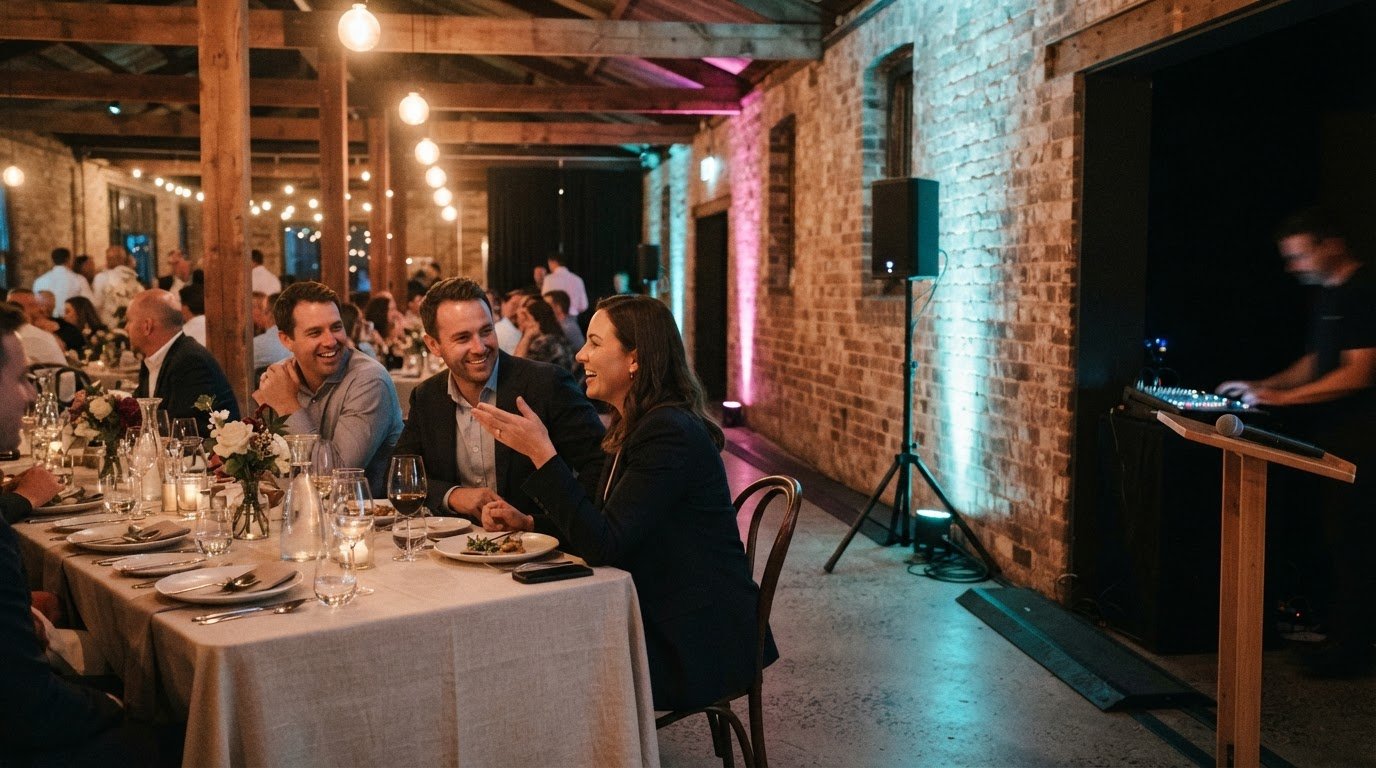
Music should change with the room, not compete with it. A well-planned background music system for corporate dinner starts with brighter, welcoming selections as guests arrive, settles into mellow, familiar tracks during the meal and eases back or pauses for speeches before lifting the atmosphere again. That flow gives each part of the evening its own character without making the soundtrack the centre of attention.
The right music can make a formal dinner feel more inviting, while excessive volume or an abrupt change can interrupt conversation. Plan the soundtrack around how guests will use the space and how the event will unfold, rather than relying on one unchanging playlist.
This guide explains how to choose between recorded playlists and live music, select music that supports conversation, coordinate cues with speeches and shape the progression from cocktails through dinner to dessert. It also covers how professional audio planning can keep the experience cohesive as the room and schedule change.
Key Takeaways
- Match recorded playlists or bespoke curation to the event schedule, guest profile and company culture.
- Choose mellow, familiar music and balance its volume so guests can speak comfortably across the table.
- Coordinate music cues with speeches and formalities to keep transitions smooth and attention on the speakers.
- Shape the soundtrack from cocktails through dinner and dessert, adjusting the mood as the evening unfolds.
How a professional team selects ready-made playlists or provides bespoke music curation
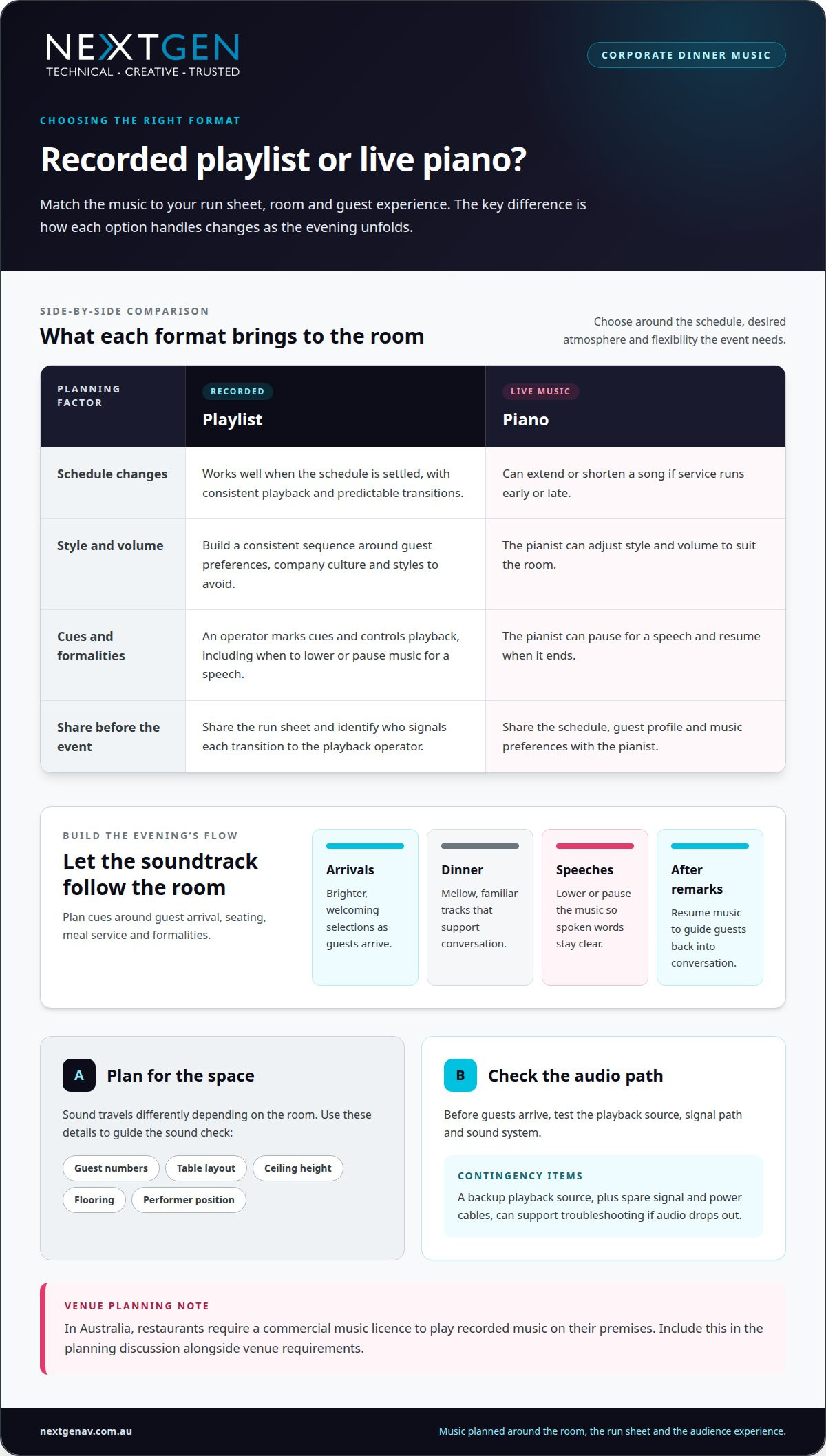
Match the music format to the venue, run sheet and guest profile. An intimate boardroom dinner may suit a quiet playlist, while a larger ballroom needs carefully planned sound coverage and level control. Guest numbers, table layout, ceiling height, flooring and performer position all affect how sound travels. These details should guide the sound check before guests arrive.
Music curation starts with the event schedule, guest profile and company culture. Note styles, songs or artists to avoid, then build a consistent sequence around those preferences. Brighter, mid-tempo tracks can welcome arrivals, while softer selections suit dinner service. A ready-made playlist works well when the schedule is settled. A background music system for corporate dinner events should also allow for changes a fixed playlist cannot anticipate, such as delayed service or an unexpected speech.
Live piano offers a different kind of control. A pianist can extend or shorten a song if service runs early or late, adjust style and volume to the room, and pause for a speech. Recorded music suits events that need consistent playback and predictable transitions. Choose between live music and playlists based on the schedule, desired atmosphere and how much flexibility the event needs. This approach shapes a background music system for corporate dinner settings around the evening, rather than forcing the evening to follow the soundtrack.
Scheduling starts with the run sheet. Map cues to guest arrival, seating, meal service and formalities, then identify who signals each transition. With recorded music, the operator marks cues and controls playback. For a live pianist, share the schedule, guest profile and music preferences.
In Australia, restaurants require a commercial music licence to play recorded music on their premises. Include this consideration in the planning discussion, alongside the venue’s requirements.
A professional audio system should suit the room and provide even background coverage. To reduce the risk of audio failure, test the playback source, signal path and sound system during the sound check. A backup playback source and spare signal and power cables can support troubleshooting if audio drops out.
How professionals choose mellow, familiar music that supports conversation
For a corporate dinner, music should create atmosphere without becoming the focal point. Choose a mellow tempo, steady mood and familiar melodies guests can enjoy without concentrating on them. Jazz standards, light classical pieces and film or television themes can add gentle character. Sophisticated piano covers of familiar pop songs offer recognition without turning the meal into a singalong.
Selection also means removing tracks that jar with dinner conversation. Harsh sounds, abrupt changes and sudden volume shifts can pull attention away from the table. A consistent musical style helps the room feel composed, while smooth transitions preserve the relaxed mood. Consider the company culture and formality of the occasion when deciding whether the music should feel contemporary or traditional.
Volume deserves as much attention as song choice. Set the music low enough for guests to speak comfortably across the table, then listen from different seating areas during the sound check. Adjust levels as conversation builds or the room fills, rather than relying on one setting throughout the evening. Before speeches, lower or pause the music so spoken words remain clear.
Room conditions also influence the mix. A crowded dining room can grow louder as guests talk, while sound may carry differently across hard flooring or beneath high ceilings. Listen for areas where music masks conversation and make measured adjustments to the sound system. A venue sound limit alone does not account for changing conversation levels or how particular frequencies carry.
Music can also influence the meal’s pace. Research dating back to the 1980s found that loud, fast-tempo music speeds up eating, while reducing enjoyment and appetite in restaurants. For a Melbourne corporate dinner centred on conversation, a quieter, more measured selection supports a calmer atmosphere. The best cue is the room itself: if guests need to raise their voices, the music is competing rather than complementing.
How professionals plan music around speeches and formalities
Start with a run sheet that maps each speech, award presentation and meal transition. Use it to assign music cues, set expected levels and identify when playback should fade or stop. A named cue caller, such as the event producer or stage manager, gives the operator a clear signal while the host stays focused on guests.
The schedule also needs to reflect venue logistics. Account for meal service, speaker arrival, access times, the planned finish and any sound curfew or production requirements. If a speech moves forward because service finishes early, the cue caller can alert the operator. Sharing these details with musicians and venue coordinators helps keep formalities aligned with the room.
Give each transition a clear purpose. Arrival music can continue as guests are seated, then ease down as the host takes the microphone. Before an address, lower or pause the music so the speaker has the room’s attention. After the closing words, music can resume to guide guests back into conversation.
Live musicians can respond to timing changes in real time. A pianist can extend a song while guests are being seated, ease back before a speech, then resume when it ends. Recorded playlists provide consistent playback, but an operator must manage each cue against the actual run sheet. Either approach works best when the performer or operator knows the order of formalities.
A sound check should cover the speech position and audience area, not just the playback source. Listen for music that could mask spoken words, check the volume before the first address and confirm the transition cue with the event team. This gives speakers a clear acoustic focus without leaving the room silent between formalities.
Nominate a day-of-event contact for schedule changes. That person can relay a delayed course or revised speech timing to the audio operator, rather than leaving the host to coordinate technical adjustments while greeting guests. A clear contact and cue plan help the evening run smoothly.
How professionals plan music flow across cocktails, dinner and dessert
A corporate dinner moves through distinct moments, so the soundtrack should move with it. During cocktails, brighter selections can welcome guests and support networking. As guests take their seats, shift towards softer, slower music to establish a calmer atmosphere for dinner. By dessert, the music can gently lift the room again, helping the evening transition to drinks or informal conversation.
Transitions work best when music follows the event’s actual run sheet. Coordinate with the event team on when guests move from cocktails to the dining area, when courses are served and when formalities finish. If dinner runs late, adjust the planned sequence rather than letting a fixed playlist dictate the room’s pace. A live act that adapts across networking, the meal and post-dinner drinks can also help the evening feel cohesive.
For background music, a professional provides sound systems suited to even coverage and clear, controlled playback. The setup may include speakers, a playback source and audio control, with a wireless microphone included when the programme needs spoken announcements. Equipment choice depends on the venue layout and whether the dinner includes speeches or other formalities. The aim is to carry music across the room without making it the focus.
There is no fixed speaker count based on guest numbers alone. Consider guest numbers alongside table layout, ceiling height, flooring and speaker positions, since each affects how sound travels. A long dining room with separate seating areas may need a different coverage plan from a compact, open room. A sound check lets the operator assess coverage in the guest area and refine speaker placement and levels.
Map the soundtrack to each change of setting, not just each course. This simple planning principle helps music support the evening’s flow, from the first arrival to the final conversation, while keeping the atmosphere right for each moment.
NextGen AV: Professional Audio Systems
NextGen AV provides Professional Audio Systems for corporate dinners that need controlled background music, clear speech playback and smooth transitions. The team can align the audio setup with the venue layout and run sheet, helping music move from cocktails to dinner without competing with conversation. For programmes with speeches, technical direction coordinates playback cues and microphone use so attention stays on the speaker when formalities begin.
When dinner forms part of a larger event, LED Video Walls and Lighting Design and Equipment can support the wider production environment. Staging and Rigging can also form part of the plan when the event needs a defined presentation area. The right combination depends on the event format and the audience experience you want to create.
Discuss Professional Audio Systems for your corporate dinner with NextGen AV.
Shape the experience from the start
A dinner soundtrack can do more than fill pauses. It can shape how guests experience your organisation, from the first welcome to the final farewell. Treat the music brief as part of the event’s creative direction: define the impression you want guests to take away, then align the sound with that intention.
A carefully planned background music system for a corporate dinner gives that creative brief a precise technical foundation. Bring the event schedule, venue layout and desired atmosphere into one production conversation, so each decision supports the guest experience you want to create.
NextGen AV provides Professional Audio Systems, LED Video Walls, and Lighting Design and Equipment for events that need a coordinated production environment. This connects the soundtrack with the room’s visual character, while technical direction manages the details behind the scenes.
Take the next step and contact NextGen AV to plan your dinner music. Give your guests an evening that feels considered from arrival to farewell.
Frequently Asked Questions
Should a professional recommend a DJ, playlist or live background music for a corporate dinner?
The format should fit the evening’s purpose. For a seated dinner focused on conversation, a curated playlist or live instrumental music can keep attention on guests and speakers. A DJ is a stronger fit when the programme includes dancing, requests or a clear shift into a livelier post-dinner celebration. Let the event brief, venue and run sheet guide the recommendation.
Music should change with the room, not compete with it. A well-planned background music system for corporate dinner starts with brighter, welcoming selections as guests arrive, settles into mellow, familiar tracks during the meal and eases back or pauses for speeches before lifting the atmosphere again. That flow gives each part of the evening its own character without making the soundtrack the centre of attention.
The right music can make a formal dinner feel more inviting, while excessive volume or an abrupt change can interrupt conversation. Plan the soundtrack around how guests will use the space and how the event will unfold, rather than relying on one unchanging playlist.
This guide explains how to choose between recorded playlists and live music, select music that supports conversation, coordinate cues with speeches and shape the progression from cocktails through dinner to dessert. It also covers how professional audio planning can keep the experience cohesive as the room and schedule change.
Key Takeaways
- Match recorded playlists or bespoke curation to the event schedule, guest profile and company culture.
- Choose mellow, familiar music and balance its volume so guests can speak comfortably across the table.
- Coordinate music cues with speeches and formalities to keep transitions smooth and attention on the speakers.
- Shape the soundtrack from cocktails through dinner and dessert, adjusting the mood as the evening unfolds.
How a professional team selects ready-made playlists or provides bespoke music curation
Match the music format to the venue, run sheet and guest profile. An intimate boardroom dinner may suit a quiet playlist, while a larger ballroom needs carefully planned sound coverage and level control. Guest numbers, table layout, ceiling height, flooring and performer position all affect how sound travels. These details should guide the sound check before guests arrive.
Music curation starts with the event schedule, guest profile and company culture. Note styles, songs or artists to avoid, then build a consistent sequence around those preferences. Brighter, mid-tempo tracks can welcome arrivals, while softer selections suit dinner service. A ready-made playlist works well when the schedule is settled. A background music system for corporate dinner events should also allow for changes a fixed playlist cannot anticipate, such as delayed service or an unexpected speech.
Live piano offers a different kind of control. A pianist can extend or shorten a song if service runs early or late, adjust style and volume to the room, and pause for a speech. Recorded music suits events that need consistent playback and predictable transitions. Choose between live music and playlists based on the schedule, desired atmosphere and how much flexibility the event needs. This approach shapes a background music system for corporate dinner settings around the evening, rather than forcing the evening to follow the soundtrack.
Scheduling starts with the run sheet. Map cues to guest arrival, seating, meal service and formalities, then identify who signals each transition. With recorded music, the operator marks cues and controls playback. For a live pianist, share the schedule, guest profile and music preferences.
In Australia, restaurants require a commercial music licence to play recorded music on their premises. Include this consideration in the planning discussion, alongside the venue’s requirements.
A professional audio system should suit the room and provide even background coverage. To reduce the risk of audio failure, test the playback source, signal path and sound system during the sound check. A backup playback source and spare signal and power cables can support troubleshooting if audio drops out.
How professionals choose mellow, familiar music that supports conversation
For a corporate dinner, music should create atmosphere without becoming the focal point. Choose a mellow tempo, steady mood and familiar melodies guests can enjoy without concentrating on them. Jazz standards, light classical pieces and film or television themes can add gentle character. Sophisticated piano covers of familiar pop songs offer recognition without turning the meal into a singalong.
Selection also means removing tracks that jar with dinner conversation. Harsh sounds, abrupt changes and sudden volume shifts can pull attention away from the table. A consistent musical style helps the room feel composed, while smooth transitions preserve the relaxed mood. Consider the company culture and formality of the occasion when deciding whether the music should feel contemporary or traditional.
Volume deserves as much attention as song choice. Set the music low enough for guests to speak comfortably across the table, then listen from different seating areas during the sound check. Adjust levels as conversation builds or the room fills, rather than relying on one setting throughout the evening. Before speeches, lower or pause the music so spoken words remain clear.
Room conditions also influence the mix. A crowded dining room can grow louder as guests talk, while sound may carry differently across hard flooring or beneath high ceilings. Listen for areas where music masks conversation and make measured adjustments to the sound system. A venue sound limit alone does not account for changing conversation levels or how particular frequencies carry.
Music can also influence the meal’s pace. Research dating back to the 1980s found that loud, fast-tempo music speeds up eating, while reducing enjoyment and appetite in restaurants. For a Melbourne corporate dinner centred on conversation, a quieter, more measured selection supports a calmer atmosphere. The best cue is the room itself: if guests need to raise their voices, the music is competing rather than complementing.
How professionals plan music around speeches and formalities
Start with a run sheet that maps each speech, award presentation and meal transition. Use it to assign music cues, set expected levels and identify when playback should fade or stop. A named cue caller, such as the event producer or stage manager, gives the operator a clear signal while the host stays focused on guests.
The schedule also needs to reflect venue logistics. Account for meal service, speaker arrival, access times, the planned finish and any sound curfew or production requirements. If a speech moves forward because service finishes early, the cue caller can alert the operator. Sharing these details with musicians and venue coordinators helps keep formalities aligned with the room.
Give each transition a clear purpose. Arrival music can continue as guests are seated, then ease down as the host takes the microphone. Before an address, lower or pause the music so the speaker has the room’s attention. After the closing words, music can resume to guide guests back into conversation.
Live musicians can respond to timing changes in real time. A pianist can extend a song while guests are being seated, ease back before a speech, then resume when it ends. Recorded playlists provide consistent playback, but an operator must manage each cue against the actual run sheet. Either approach works best when the performer or operator knows the order of formalities.
A sound check should cover the speech position and audience area, not just the playback source. Listen for music that could mask spoken words, check the volume before the first address and confirm the transition cue with the event team. This gives speakers a clear acoustic focus without leaving the room silent between formalities.
Nominate a day-of-event contact for schedule changes. That person can relay a delayed course or revised speech timing to the audio operator, rather than leaving the host to coordinate technical adjustments while greeting guests. A clear contact and cue plan help the evening run smoothly.
How professionals plan music flow across cocktails, dinner and dessert
A corporate dinner moves through distinct moments, so the soundtrack should move with it. During cocktails, brighter selections can welcome guests and support networking. As guests take their seats, shift towards softer, slower music to establish a calmer atmosphere for dinner. By dessert, the music can gently lift the room again, helping the evening transition to drinks or informal conversation.
Transitions work best when music follows the event’s actual run sheet. Coordinate with the event team on when guests move from cocktails to the dining area, when courses are served and when formalities finish. If dinner runs late, adjust the planned sequence rather than letting a fixed playlist dictate the room’s pace. A live act that adapts across networking, the meal and post-dinner drinks can also help the evening feel cohesive.
For background music, a professional provides sound systems suited to even coverage and clear, controlled playback. The setup may include speakers, a playback source and audio control, with a wireless microphone included when the programme needs spoken announcements. Equipment choice depends on the venue layout and whether the dinner includes speeches or other formalities. The aim is to carry music across the room without making it the focus.
There is no fixed speaker count based on guest numbers alone. Consider guest numbers alongside table layout, ceiling height, flooring and speaker positions, since each affects how sound travels. A long dining room with separate seating areas may need a different coverage plan from a compact, open room. A sound check lets the operator assess coverage in the guest area and refine speaker placement and levels.
Map the soundtrack to each change of setting, not just each course. This simple planning principle helps music support the evening’s flow, from the first arrival to the final conversation, while keeping the atmosphere right for each moment.
NextGen AV: Professional Audio Systems
NextGen AV provides Professional Audio Systems for corporate dinners that need controlled background music, clear speech playback and smooth transitions. The team can align the audio setup with the venue layout and run sheet, helping music move from cocktails to dinner without competing with conversation. For programmes with speeches, technical direction coordinates playback cues and microphone use so attention stays on the speaker when formalities begin.
When dinner forms part of a larger event, LED Video Walls and Lighting Design and Equipment can support the wider production environment. Staging and Rigging can also form part of the plan when the event needs a defined presentation area. The right combination depends on the event format and the audience experience you want to create.
Discuss Professional Audio Systems for your corporate dinner with NextGen AV.
Shape the experience from the start
A dinner soundtrack can do more than fill pauses. It can shape how guests experience your organisation, from the first welcome to the final farewell. Treat the music brief as part of the event’s creative direction: define the impression you want guests to take away, then align the sound with that intention.
A carefully planned background music system for a corporate dinner gives that creative brief a precise technical foundation. Bring the event schedule, venue layout and desired atmosphere into one production conversation, so each decision supports the guest experience you want to create.
NextGen AV provides Professional Audio Systems, LED Video Walls, and Lighting Design and Equipment for events that need a coordinated production environment. This connects the soundtrack with the room’s visual character, while technical direction manages the details behind the scenes.
Take the next step and contact NextGen AV to plan your dinner music. Give your guests an evening that feels considered from arrival to farewell.
Frequently Asked Questions
Should a professional recommend a DJ, playlist or live background music for a corporate dinner?
The format should fit the evening’s purpose. For a seated dinner focused on conversation, a curated playlist or live instrumental music can keep attention on guests and speakers. A DJ is a stronger fit when the programme includes dancing, requests or a clear shift into a livelier post-dinner celebration. Let the event brief, venue and run sheet guide the recommendation.
Discover Valuable Insights
Unlock Expert Tips and Advice
Our blog is packed with valuable information to help you stay ahead. Whether you’re looking for expert advice, industry trends, or practical tips, you’ll find everything you need. Reach out today to learn more or get in touch with us for personalised support!