


Imagine the heavy silence that follows a sudden screech of audio feedback just as your keynote speaker hits their stride. It’s the moment every event organiser in Melbourne dreads, yet it remains a common reality when technical precision is sacrificed for a lower quote. You’ve likely felt that familiar knot of anxiety, worrying if the LED wall will wash out your brand colours or if an inexperienced crew will fumble a critical transition. Understanding how to choose av company involves more than just comparing gear lists; it’s about finding a technical partner who acts as a confident orchestrator for your vision.
You deserve to step into your venue with total confidence, knowing the production spend is driving a clear return on investment and prestige. This guide provides the definitive 2026 checklist to help you secure a crew that thrives under pressure and takes personal pride in seamless execution. We will explore how to vet on-site expertise, decode complex production quotes, and ensure your next event runs with cinematic momentum and flawless technical delivery.
Key Takeaways
- Define your event’s technical DNA to ensure every piece of equipment serves a high-level objective, from broadcast-quality streams to immersive atmosphere.
- Master how to choose av company partners by scrutinising more than just a gear list, focusing instead on pixel pitch for LED walls and venue-specific acoustic planning.
- Prioritise technical direction and crew expertise over hardware alone to secure a seamless execution that guards against the risk of audio feedback or visual glitches.
- Navigate the unique logistical challenges of Melbourne venues by verifying your partner’s knowledge of local loading docks and strict “bump-in” windows.
- Learn to compare production quotes with precision to eliminate hidden costs and ensure you receive a detailed technical floor plan for your event.
Establishing Your Event’s Technical DNA
Before you look at a single piece of equipment, you must define the technical DNA of your project. This isn’t about choosing a microphone; it’s about identifying the stakes. A high-stakes product launch at the Melbourne Convention and Exhibition Centre demands a “zero-failure” technical environment. In contrast, a small internal workshop might only require basic amplification. When you begin the process of researching how to choose av company teams, you’re looking for a partner who can scale their mastery to match your specific event profile.
Identify your core objectives with clarity. Are you striving for high-energy audience engagement, or is the goal to produce a broadcast-quality recording for global distribution? The scale of your audience, both the physical attendees in the room and the digital delegates watching from afar, will dictate your bandwidth and hardware requirements. Finally, establish a realistic budget. It’s vital to account for both the prestige of the hardware and the professional labour required to operate it. Precision costs money, but technical glitches cost your reputation.
In-Person, Virtual, or Hybrid?
The 2026 event landscape has firmly established hybrid as the gold standard. This format requires a specialised technical toolkit that bridges the gap between the physical stage and the digital screen. Remote delegates demand broadcast-quality audio; they won’t engage if they’re struggling to hear through a hollow, room-captured feed. Partnering with a team experienced in hybrid event services in Australia ensures that your virtual audience receives a cinematic experience that mirrors the energy of the live room.
The Venue vs. The Vision
Your creative vision must eventually meet the reality of the venue’s architecture. Assessing ceiling heights, rigging points, and power availability early prevents expensive last-minute workarounds. While many Melbourne venues offer “in-house” AV, these solutions are often rigid and may not support bespoke lighting or complex LED configurations. The broader field of Audiovisual (AV) technology is vast, and your brand deserves more than a “one-size-fits-all” approach. Start by drafting a preliminary audio visual equipment list for your conference to see if the venue’s stock gear can truly deliver the prestige you require.
Scrutinising the Inventory: LED Walls, Audio, and Innovation
A warehouse full of equipment does not guarantee a successful event. It is the calibre of that inventory and how it is deployed that separates a mediocre production from a prestigious one. When you’re evaluating how to choose av company partners, you must demand transparency regarding their technical specifications. High-end visual impact relies on more than just “brightness”; it requires a deep understanding of pixel pitch and refresh rates to ensure your brand content looks as crisp on a massive screen as it does on a designer’s monitor.
Redundancy is the hallmark of a professional. If a primary media server fails during a live keynote, does your partner have a hot-swappable backup ready to take over in milliseconds? This level of preparedness is central to how to choose the right vendors for high-stakes corporate environments. Beyond the visuals, your lighting design should feature “intelligent” fixtures that can be programmed to shift the atmosphere instantly, transitioning your space from a focused plenary session to a celebratory gala dinner with the push of a button.
The LED Video Wall Standard
For premium events in 2026, traditional projection has largely been sidelined. Modern LED video walls offer a level of vibrance and contrast that projectors simply cannot match, especially in venues with significant ambient light. When planning, check for seamless integration; you want a perfectly flat, unified canvas without visible seams between panels. If your event is outdoors, ensure the gear is rated for Melbourne’s unpredictable weather, featuring high-brightness tiles that remain visible even under direct sunlight.
Crystal Clear Sound Engineering
There is a vast difference between basic “PA hire” and a custom-designed professional audio system. A designed system accounts for the unique acoustics of a venue, using precision-angled speakers to ensure every delegate hears every word without the distraction of echoes or dead zones. Managing frequency interference is another critical hurdle, particularly in the busy wireless environments of the Melbourne CBD. Your technical team should be able to explain why they’ve chosen specific microphones, such as prioritising a headset for a mobile presenter while using handhelds for a structured Q&A session. If you want to ensure your message is heard with absolute clarity, consider consulting with a technical expert early in your planning phase.
Beyond the Gear: Evaluating Technical Direction and Crew Expertise
Hardware is a commodity; expertise is a craft. High-end gear sits idle without a skilled hand to guide it. When you’re deciding how to choose av company partners, look past the shiny LED panels and ask about the people behind the consoles. You need veterans who have navigated the high-pressure environments of major Melbourne venues and understand the nuances of live production. The success of your event hinges on the crew’s ability to stay invisible while delivering a front-of-house experience that feels effortless.
A seasoned Technical Director (TD) acts as your single point of contact and the primary orchestrator of the show. They translate your creative vision into a series of perfectly timed cues. When mastering how to choose av company partners, the quality of technical direction is your greatest safeguard against the unexpected. If a presenter changes their slides last minute or a wireless frequency drops, the TD ensures the audience never notices. While AVIXA standards provide a vital baseline for technical quality, true excellence lies in a crew’s ability to problem-solve with agility.
Ask potential partners for specific case studies. Have they managed complex product launches in Melbourne where timing and brand precision are everything? A responsive project manager who answers emails promptly during the pre-production phase is a strong indicator of how the crew will perform on-site. If they aren’t organised during the planning months, they won’t be organised when the house lights go down and the pressure is on.
The Role of the Invisible Expert
Technical direction is the brain of your event. It is about orchestrating the delicate dance between lighting, sound, and vision to maintain a cinematic flow. A “hire shop” simply drops off equipment; a full-service partner builds a narrative experience. They ensure the transition from a high-energy video package to a live keynote is seamless, preserving the momentum that keeps your audience captivated from start to finish.
This level of professional integration is what sets industry leaders apart; for instance, LivewireAV provides a prime example of how audio, video, and lighting production can be harmonised to deliver a truly flawless event experience.
The Crew’s On-site Etiquette
Professionalism extends beyond technical skill. In corporate settings, your AV crew represents your brand. They should be dressed in appropriate corporate blacks, communicate with humility, and remain calm under pressure. For prestigious awards nights, a dedicated stage manager is non-negotiable to handle the flow of winners and presenters. Finally, ensure your partner provides enough hands for a rapid, safe pack-down that respects the venue’s strict “bump-out” timelines.
Navigating the Melbourne Event Landscape: Logistics and Venue Knowledge
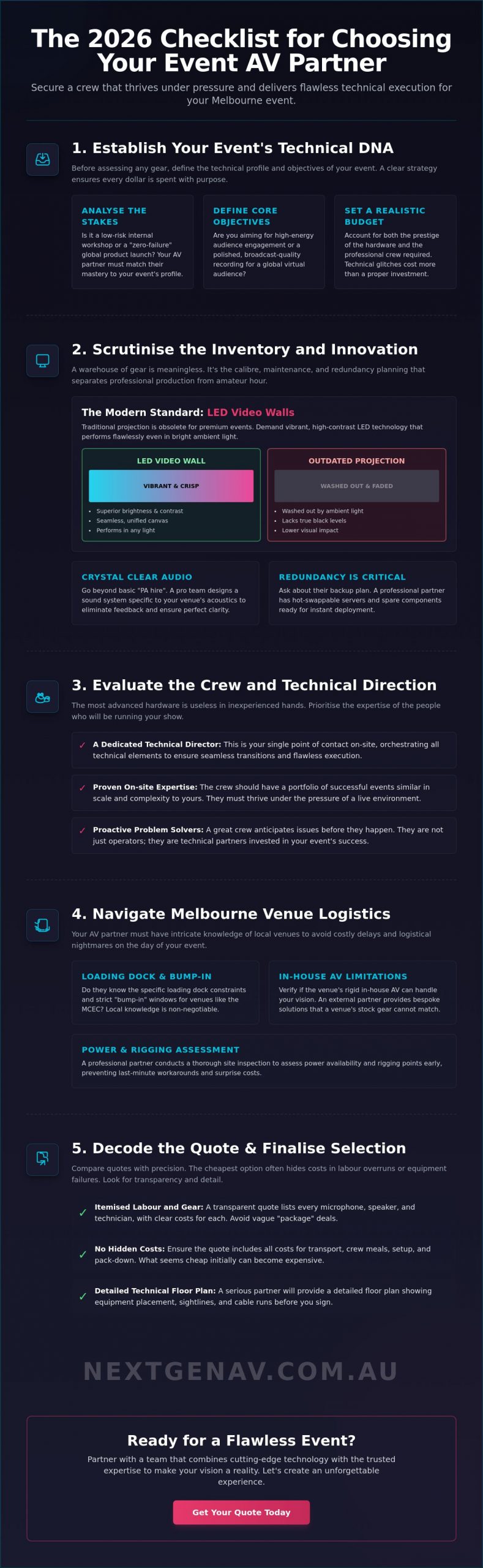
The most sophisticated technical blueprint is only as good as its logistical execution. Melbourne’s event landscape is a unique maze of heritage architecture and high-tech precincts, each presenting its own set of technical quirks. When you’re assessing how to choose av company partners, venue familiarity is a non-negotiable asset. An expert team understands the labyrinthine loading docks of the Melbourne Convention and Exhibition Centre (MCEC) or the restricted access times of a boutique CBD hotel. They don’t just show up; they plan for the “bump-in” window with surgical precision, ensuring complex rigging is secured and tested long before the first delegate arrives.
Site visits are the hallmark of a proactive partner. A reputable company will meet you at the venue weeks before the event to assess power grids and internet stability. They know that a heritage building’s thick walls can wreak havoc on wireless frequencies, while a modern glass-walled atrium requires specific acoustic treatment to prevent sound bounce. By choosing local stage and lighting hire in Melbourne, you eliminate the risks of interstate transport delays and ensure your technical crew has the local knowledge to pivot if the venue’s infrastructure presents a sudden challenge.
Melbourne Venue Expertise
Success in Melbourne requires more than just gear; it requires context. Managing the acoustics in a high-ceilinged historic hall is a vastly different craft than tuning a sound system for a modern, carpeted ballroom. Your AV partner should be able to discuss the specific power limitations of major CBD hotels or the precise rigging points available at the MCEC. This local mastery allows them to design a technical solution that works with the room rather than against it, resulting in a prestigious and polished outcome for your audience.
Safety, Insurance, and Compliance
Technical excellence is built on a foundation of safety. In Victoria, WorkSafe compliance and Public Liability Insurance are mandatory, but the best companies go further. Every piece of equipment must carry a current Tag and Test certification to ensure electrical safety on-site. When your vision involves overhead structures, ensure the rigging is signed off by qualified engineers. This commitment to compliance protects your brand’s reputation and provides total peace of mind. If you want to ensure your next event is underpinned by this level of logistical mastery, contact our technical team today for a venue-specific consultation.
Securing Your Partner: The Final Selection and On-site Execution
The final stage of your selection process is where technical theory meets financial reality. When you reach the point of comparing proposals, you must ensure you are comparing “apples with apples” across every line item. A lower headline figure often masks the absence of essential components like specialised cabling, dedicated transport, or sufficient technician hours for a safe setup. Understanding how to choose av company partners requires a sharp eye for these omissions, as a missing adaptor or a short-staffed crew can derail even the most meticulously planned event.
Demand a detailed technical floor plan and a preliminary run-sheet before signing any contract. These documents serve as the blueprint for your success, illustrating exactly how the gear will integrate with the venue and how the show will flow. Be sure to scrutinise the terms for hidden “overtime” fees or punitive charges for last-minute adjustments. While live events are inherently fluid, a transparent partner will offer clear, upfront structures for these contingencies rather than burying them in fine print. Ultimately, you should apply the “Gut Feel” test: do you trust this team to protect your brand’s reputation when the house lights go down?
Transparency in the Quote
Decoding AV jargon is the first step toward budget certainty. You aren’t just paying for “black boxes”; you’re investing in the expertise required to calibrate a professional audio system or map a complex LED video wall. A prestigious event requires a quote that reflects high-quality hardware and seasoned labour, rather than the bare minimum. Fixed-price production management offers the greatest security, allowing you to focus on your delegates while the technical team handles the logistical heavy lifting without unexpected financial surprises.
The NextGen AV Commitment
Success in the Melbourne event scene isn’t built overnight. With 30 years of local experience, we’ve mastered the nuances of every major venue and the high-pressure demands of corporate production. Our “no-glitch” philosophy is built on a foundation of rigorous pre-event testing and deep redundancy for all critical systems. We take personal pride in our role as the invisible engine behind your most prestigious moments, ensuring your vision is realised with absolute precision. Enquire with NextGen AV for your next Melbourne event and experience the confidence of a truly seamless technical partnership.
Elevate Your Event with Technical Mastery
Mastering how to choose av company partners is the ultimate safeguard for your brand’s prestige. You’ve seen that a flawless event requires more than just gear; it demands the logistical foresight to navigate Melbourne’s unique venues and the technical direction to orchestrate every cue with cinematic precision. By prioritising transparency in your quotes and demanding high-calibre inventory like Red Dot standard LED technology, you transform a simple gathering into an immersive experience.
With over 30 years of industry experience, NextGen AV has become the technical partner of choice for major Australian government bodies and global brands. We thrive on the high-stakes pressure of live production, providing the proactive, elite expertise that allows you to lead with total confidence. Partner with Melbourne’s AV experts for your next event and ensure your technical execution is as ambitious as your vision. It’s time to move past the logistical grind and focus on the celebratory success you’ve worked so hard to build.
Frequently Asked Questions
What is the most important factor when choosing an AV company?
The most critical factor is the expertise of the technical crew and their ability to stay calm under the pressure of a live environment. While high-end gear is a baseline requirement, the success of your event depends on the “Invisible Expert” behind the console who ensures the technology serves your brand vision. When researching how to choose av company partners, prioritise those who offer a dedicated Technical Director to orchestrate the entire show.
Should I use the in-house AV provider at my venue?
In-house providers offer convenience, but they often lack the bespoke creative toolkit needed for prestigious or high-stakes events. External partners bring a dedicated team that prioritises your specific brand aesthetic over venue efficiency. They also provide specialised equipment, such as custom LED video walls, that may not be part of a venue’s standard inventory.
How far in advance should I book an AV company for a Melbourne event?
You should aim to book your technical partner three to six months in advance to secure the best crew and equipment. Melbourne’s event calendar is exceptionally busy, particularly during major international technology summits scheduled for late 2026. Early booking allows for thorough site visits and the development of a precise technical floor plan.
What technical questions should I ask during the initial consultation?
Ask about their redundancy protocols for critical components like media servers and wireless audio systems. You should also enquire about their familiarity with your chosen venue’s loading docks and power grids. Understanding how to choose av company teams involves vetting their problem-solving agility, so ask for specific examples of how they’ve handled mid-show technical failures in the past.
Is it cheaper to hire equipment separately from different vendors?
Hiring from multiple vendors often leads to fragmented communication and increased risk of compatibility issues on-site. While individual hire prices might seem lower, the logistical cost of managing different deliveries and crews usually erodes any perceived savings. A full-service partner ensures that your audio, lighting, and visual systems are designed to work in perfect harmony.
What happens if there is a technical failure during my live event?
A professional technical team operates with a “zero-failure” philosophy, meaning they have hot-swappable backups ready to take over in milliseconds. Their role is to ensure that if a wireless frequency drops or a cable fails, the transition to the secondary system is so seamless that your audience remains completely unaware of the glitch.
Do I need a technical director for a small corporate meeting?
A Technical Director is highly recommended if your meeting involves high-stakes presentations, external stakeholders, or hybrid broadcast elements. While a basic setup might only need a technician, a TD acts as the “brain” of the production. They orchestrate the flow and allow you to focus on your delegates with total confidence in the technical execution.
How much does professional AV production usually cost in Melbourne?
Production costs are dictated by the scale of the audience and the complexity of the technical DNA required for the event. Rather than focusing on the lowest headline figure, organisers should evaluate the total ROI of a flawless execution. Cheaper quotes often hide costs by providing insufficient labour or ageing gear, which can lead to expensive reputational damage if the show fails. For large-scale internal communications events, reviewing a dedicated corporate town hall AV setup Melbourne guide can help you benchmark the right level of investment for your workforce broadcast.
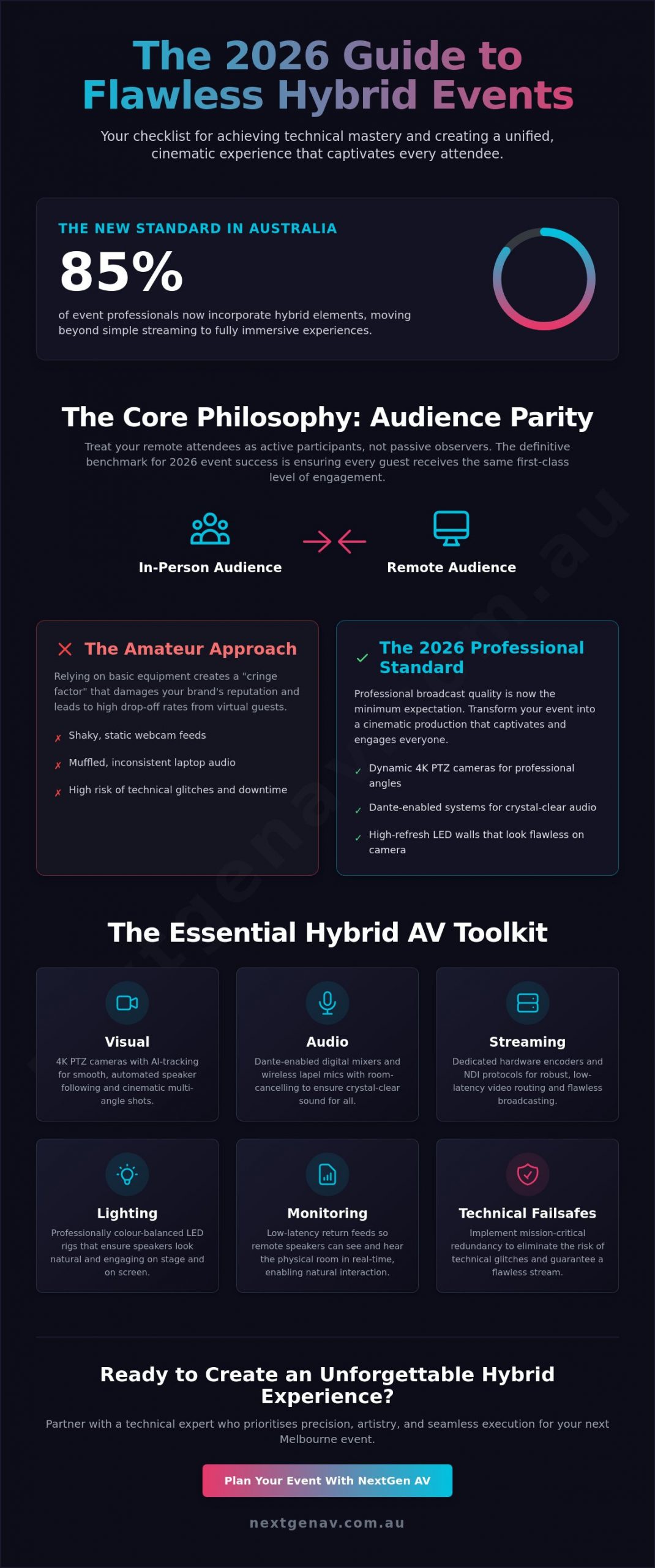
Did you know that 85% of event professionals in Australia now incorporate hybrid elements into their planning? You’ve likely felt the tension of managing two distinct audiences while hoping the digital bridge doesn’t crumble under the weight of a technical glitch. It’s a high-stakes environment where a minor audio lag or a flickering feed can instantly alienate your remote guests, making them feel like an afterthought rather than a priority. You deserve a production that reflects the prestige of your brand without the logistical grind keeping you up at night.
This audio visual for hybrid events guide is your definitive 2026 checklist for achieving technical mastery and flawless engagement. We’ve designed this resource to help you eliminate downtime and create a unified, cinematic experience that resonates in the room and across the screen. You’ll discover how to leverage professional audio systems, high-impact LED video walls, and intelligent technical direction to ensure every attendee feels like they have a front-row seat. We’re moving past the basics to explore the sophisticated integration of AI-powered analytics and immersive lighting design that will define the most successful Australian events this year.
Key Takeaways
- Transition from simple live streaming to a sophisticated, immersive integration that treats both audience segments as first-class citizens.
- Follow our audio visual for hybrid events guide to assemble a professional toolkit featuring high-refresh LED walls and Dante-enabled mixers.
- Unify your attendees through shared interactivity, using technical direction to project virtual engagement directly into the physical event space.
- Eliminate the risk of technical glitches by implementing secondary NBN fibre links and bonded 5G cellular backups for flawless streaming.
- Understand how to navigate Melbourne’s premier venues with a technical partner who prioritises precision, artistry, and seamless execution.
Understanding the Hybrid Event Landscape in 2026
The era of simply pointing a camera at a stage and hoping for the best is over. In 2026, we’ve moved beyond basic streaming into a period of deep, immersive integration. This audio visual for hybrid events guide serves as your map for this sophisticated new terrain. When we ask What is a hybrid event? in the current climate, the answer isn’t just a physical gathering with a digital add-on. It’s a unified experience where the digital and physical realms are perfectly synchronised to create a single, cohesive narrative.
We operate on the “Invisible Expert” philosophy. The most successful technical direction is the kind that remains entirely transparent to the audience. When the audio is crisp and the visuals are stunning, guests focus on your message rather than the equipment. This quiet power allows the speakers to take centre stage while our team manages the complex engine behind the scenes. It’s about moving past the logistical grind and focusing on the prestige of the final result.
Melbourne businesses are increasingly pivoting to “Virtual-First” planning for their physical venue selections. By prioritising the remote experience during the initial design phase at premier locations like the MCEC or Crown, organisers ensure their message reaches the widest possible audience. This shift makes a powerful economic case. You can scale your audience from 200 in-person delegates to 2,000 global participants without the massive overhead of international flights and hotel blocks. High-quality hybrid AV doesn’t just cost; it delivers a measurable increase in ROI by expanding your brand’s footprint across borders.
The Core Philosophy: Audience Parity
True hybrid success relies on audience parity. This means treating your remote attendees as active participants rather than passive observers who are just “watching a video.” You must ensure that the visual and audio quality is identical across all platforms, creating a sense of shared presence. Audience parity is the definitive benchmark for 2026 event success, ensuring every guest receives the same level of engagement regardless of their physical location.
Why a Laptop and Webcam No Longer Cut It
The days of “Zoom-style” shaky cameras and muffled laptop microphones are gone. Professional broadcast standards are now the minimum expectation for any corporate gathering. Amateur setups create a “cringe factor” that can instantly damage your brand’s reputation and lead to high drop-off rates from virtual guests. Relying on professional audio visual hire Melbourne protects your prestige and transforms a standard meeting into a cinematic production. Our technical toolkits provide the precision and reliability needed to eliminate glitches and keep your audience captivated.
- 4K PTZ cameras for dynamic, professional angles.
- Dante-enabled audio systems for crystal-clear sound.
- High-refresh LED video walls that look flawless on camera.
The Essential AV Toolkit for Hybrid Success: A Checklist
Mastering technical complexity requires more than just high-end gear. It demands a curated selection of tools designed to synchronise two different worlds. This audio visual for hybrid events guide highlights the specific hardware needed to maintain that “Invisible Expert” presence while delivering a flawless broadcast. In 2026, the standard has shifted toward automation and high-bandwidth protocols that allow for real-time creativity without the lag. Success is found in the synergy between the physical room and the digital stream.
- Visual: 4K PTZ cameras with AI-tracking for smooth, automated speaker following.
- Audio: Dante-enabled digital mixers and wireless lapel microphones with room-cancelling capabilities.
- Streaming: Dedicated hardware encoders and NDI (Network Device Interface) protocols for low-latency internal routing.
- Lighting: Colour-balanced LED rigs that ensure speakers look natural on both the physical stage and the digital stream, adhering to the professional production standards championed by Northern Signal AV Ltd. in their specialised production guides.
- Monitoring: Low-latency return feeds so remote speakers can see and hear the physical room in real-time.
Visual Excellence: Capturing the Room
A single camera angle feels like a static security feed. To create a professional, cinematic atmosphere, you need at least three distinct angles: a wide shot of the stage, a tight shot of the presenter, and a reaction shot of the audience. Integrating LED video walls into your stage design allows you to bring virtual attendees directly into the physical space. Seeing a wall of remote faces creates a powerful psychological bridge, reminding the on-site audience that they are part of a much larger global conversation. Proper stage lighting is the final piece of this puzzle. It must be bright enough for the camera sensors but carefully diffused so it doesn’t wash out the digital displays or blind the presenters.
Audio Precision: The Most Critical Element
Poor video is often forgiven, but poor audio is an immediate exit point for virtual guests. If your remote audience struggles to hear a question from the floor or experiences a jarring echo, they will disengage within minutes. Implementing professional sound system hire is essential for managing complex mix-minus feeds. This technical setup ensures remote speakers hear everything in the room except their own delayed voice, preventing the feedback loops that plague amateur productions. In large Melbourne conference halls, managing the echo-chamber effect is a precise craft. It requires strategic speaker placement and high-quality room-cancelling microphones to isolate the speaker’s voice from the ambient noise of the venue.
Creating this level of technical synergy is a dedicated craft that requires both elite equipment and seasoned expertise. If you are planning a high-stakes gathering, partnering with a technical direction team can help you navigate these complexities with absolute confidence.
Engagement Strategies: Bridging the Virtual and In-Person Gap
Engagement in 2026 is no longer a one-way broadcast. It is a dynamic, multi-directional conversation that requires a robust technical bridge to succeed. This audio visual for hybrid events guide moves beyond the hardware to explore how you can foster genuine connection between participants, regardless of their physical coordinates. The goal is to move away from two separate audiences and toward a single, unified community. When you successfully bridge this gap, your remote guests stop feeling like observers and start acting as active contributors to the event’s energy.
Achieving this level of synergy requires a deliberate approach to technical direction. It involves using your visual and audio assets to incentivise participation. For instance, gamification elements like live leaderboards or interactive polls should be projected onto the main stage LED video walls and the virtual platform simultaneously. This creates a shared sense of competition and excitement. By using AV technology to make every participant’s presence felt, you elevate the prestige of your gathering and drive higher engagement metrics across both segments. Exploring purpose-built hybrid event staging solutions can help you design this unified experience from the ground up, ensuring both your physical and virtual audiences are treated as first-class citizens of your production.
Visualising the Virtual Audience
The “Gallery Wall” is a powerful concept that transforms the atmosphere of a physical room. By dedicating a section of your LED display to a live mosaic of remote attendees, you provide the on-site speaker with a visual “crowd” to interact with. This makes it easier for presenters to maintain eye contact with the virtual audience, humanising the digital stream. To further professionalise the experience, our technical team uses lower-third graphics to identify remote speakers as they ask questions. This ensures the physical audience knows exactly who is speaking, while the real-time display of the virtual chat on side-screens keeps the in-person crowd aware of the digital conversation happening in parallel.
Audio Bridging for Q&A
Seamless verbal interaction is the ultimate test of any hybrid setup. In the physical room, catch-box microphones allow for a playful and fast-paced Q&A session, while digital inputs from the virtual platform must be integrated into the room’s PA system with zero latency. A “Virtual Moderator” positioned in the technical booth acts as the navigator for this process, triaging digital questions and ensuring remote guests are introduced at the right moment. Mix-minus audio creates a custom feed for remote guests that excludes their own voice, preventing the disorienting feedback loops that often interrupt remote questions. This level of precision allows for a natural flow of ideas, ensuring that a person in London or Sydney can converse with a speaker in Melbourne as if they were standing in the same aisle.
Technical Failsafes and Risk Mitigation for Live Streams
Precision execution is the hallmark of an elite production. Even the most meticulously planned event can face unforeseen challenges, from sudden power surges to local network outages. This audio visual for hybrid events guide prioritises resilience by building a robust safety net into every technical layer. We don’t just plan for success; we engineer against failure. By implementing redundant systems and proactive monitoring, we ensure your message reaches your global audience without a second of “dead air” or a single flickering pixel.
Risk mitigation is an invisible craft. It involves a series of technical safeguards that remain hidden until they are needed. For instance, we utilise Uninterruptible Power Supply (UPS) systems for all critical streaming encoders. If the venue experiences a momentary power drop, your broadcast continues uninterrupted. We also prepare pre-recorded “safety” content, such as speaker bios or highlight reels, to fill any unexpected transitions. This proactive stance allows you to focus on the prestige of your delivery while we manage the engine behind the scenes. For high-stakes corporate events such as shareholder meetings, understanding a robust AGM live streaming Australia strategy is equally essential to maintaining compliance and shareholder trust.
For readers looking to explore how other industry leaders manage these technical complexities, you can discover Straight Street Event Services and their specialised approach to live and hybrid environments.
NBN and Local Network Infrastructure
Reliable connectivity is the lifeblood of any hybrid gathering. When assessing Melbourne venue bandwidth, it’s vital to look beyond generic “high speed” claims. Most venues offer asymmetric connections where download speeds are high, but upload speeds, which are critical for 4K streaming, are significantly lower. We recommend a minimum dedicated upload speed of 20Mbps for a stable high-definition broadcast. To avoid the congestion of public Wi-Fi, our team always requests a dedicated VLAN from the venue manager. This ensures your stream has its own private lane on the network, shielded from the thousands of devices used by attendees in the foyer.
The Role of the Technical Director
If the AV equipment is the engine, the Technical Director (TD) is the pilot. They orchestrate the rhythmic switching between live camera angles, presentation slides, and remote guest feeds. A seasoned TD doesn’t just push buttons; they manage the energy of the stream, ensuring the digital audience feels the same momentum as those in the room. They are the final line of defence, making split-second decisions to keep the production polished and professional. For high-stakes events that demand absolute reliability, engaging professional live streaming services Melbourne provides the peace of mind that only veteran expertise can offer.
The gold standard for risk mitigation is the “Full-Stack” rehearsal. Conducted exactly 24 hours prior to the event, this mandatory walkthrough tests every microphone, camera angle, and streaming link under live conditions. It allows us to identify and resolve potential conflicts before the first guest arrives. If you want to ensure your next hybrid event is defined by its success rather than its glitches, contact our technical team to discuss a tailored failsafe strategy for your venue.
Navigating Professional Event Production in Melbourne
Executing a world-class production requires more than just following a checklist. It demands an intimate knowledge of the local landscape and the specific nuances of Melbourne’s premier event spaces. This final chapter of our audio visual for hybrid events guide focuses on the partnership required to bring your vision to life with absolute precision. Whether you are hosting an intimate executive briefing at a boutique hotel or a multi-day arena conference at the MCEC, the success of your event hinges on the calibre of your technical team.
NextGen AV brings 30 years of technical mastery to the table, embodying a sense of “Quiet Power” that allows our clients to take centre stage without a single worry. We provide end-to-end management that spans from the initial pre-production planning phase through to the final post-event pack-down. Our capability is built on scalability; we possess the inventory and the expertise to customise a solution that fits your specific audience size and engagement goals. By acting as your “Invisible Expert,” we ensure that every transition is seamless and every technical detail is polished to perfection.
Why Local Expertise Matters
Melbourne’s premier venues like the Melbourne Convention and Exhibition Centre (MCEC) and Crown Melbourne have highly specific rigging and power requirements that can catch unseasoned planners off guard. Navigating Victorian safety regulations and venue-specific infrastructure is a specialised craft. Our deep familiarity with these spaces allows us to anticipate potential hurdles before they arise, ensuring your LED video walls and professional audio systems are integrated safely and effectively. On-site technical support that can pivot in seconds is not just a luxury; it’s a necessity for high-stakes hybrid environments. Choosing a local partner also means you are actively supporting the Victorian event industry while benefiting from a team that can be on-site for site inspections and rehearsals at a moment’s notice.
Getting Started with Your Hybrid Strategy
Briefing an AV company shouldn’t feel like a technical exam. We simply need to understand the “why” behind your gathering and the experience you want to create for both your in-person and virtual guests. Every hybrid event requires a unique hardware profile, as a toolkit designed for a panel discussion will differ significantly from one meant for a keynote presentation with live musical elements. When you provide a clear vision of your desired outcomes, we can customise the toolkit to match. To ensure your vision is realised with absolute reliability, organise a consultation with NextGen AV to secure your 2026 event dates and begin the journey toward a flawless production.
Master the Future of Hybrid Connection
The era of the “add-on” live stream has passed. Success in 2026 demands a unified vision where technical mastery acts as the primary connector between your physical and virtual audiences. This audio visual for hybrid events guide has detailed the essential toolkit, from Dante-enabled audio systems to the critical role of a Technical Director in mitigating live risks. By focusing on audience parity and technical redundancy, you ensure your event’s prestige remains intact across every screen and every seat in the room.
With 30 years of technical mastery in Melbourne, NextGen AV offers end-to-end management and specialised hybrid solutions tailored to the specific requirements of the city’s premier venues. We thrive under pressure to deliver a “quiet power” that allows your brand to take centre stage without the stress of technical glitches or logistical grind. Our team acts as the engine behind your success, ensuring every participant feels like a first-class citizen of your event community.
Secure your flawless hybrid event production with NextGen AV today.
Your next successful gathering starts with a single, confident step toward technical excellence. Let’s build a bridge to your global audience together.
Frequently Asked Questions
What is the most important AV equipment for a hybrid event?
Professional audio systems are the single most critical component of any successful gathering. While attendees might tolerate a slightly pixelated video feed, they’ll disengage immediately if the sound is muffled or drops out. Investing in Dante-enabled mixers and room-cancelling microphones ensures your message is delivered with absolute clarity to both physical and virtual rooms, maintaining the prestige of your production.
How much does it cost to hire AV for a hybrid event in Melbourne?
The investment for hybrid production depends entirely on the scale and technical complexity of your vision. Factors such as the number of camera angles, the size of LED video walls, and the level of technical direction required will influence the final cost. For accurate budgeting, we recommend requesting a tailored proposal that aligns with your specific venue and audience engagement goals.
Can I use a standard Wi-Fi connection for my hybrid event stream?
Relying on standard venue Wi-Fi is a significant risk that often leads to stream instability and buffering. We always advise using a dedicated, hard-wired NBN connection with a private VLAN to ensure your broadcast has exclusive bandwidth. This prevents congestion from other guests and provides the consistent upload speeds required for a high-definition 4K stream without interruptions.
How do I ensure the remote audience feels engaged during a hybrid meeting?
True engagement happens when you follow a professional audio visual for hybrid events guide to implement shared interactivity. This involves projecting the virtual chat onto physical LED screens and using low-latency return feeds so remote speakers can see the room. By creating a unified digital bridge, you allow both audience segments to interact in real-time, fostering a shared sense of presence.
Do I need a technical director for a small hybrid corporate event?
Even for smaller corporate gatherings, a technical director acts as the essential pilot for your event engine. They manage the rhythmic switching between slides and cameras while monitoring the health of the live stream. Having a seasoned veteran at the helm allows you to focus on your presentation, knowing that any unforeseen technical glitches will be resolved instantly behind the scenes.
What happens if the internet goes down during my live stream?
Our technical strategy prioritises resilience through bonded cellular backups, such as 4G or 5G links, that activate if the primary NBN fibre fails. This failover happens almost instantly, keeping your stream alive while the team resolves the primary connection issue. We also prepare pre-recorded segments to fill any transitions, ensuring your global audience never experiences a moment of dead air.
What is a “Mix-Minus” and why is it important for hybrid audio?
Mix-minus is a sophisticated audio routing technique that sends a complete mix of the event audio to remote guests while excluding their own voice. This is critical for preventing the disorienting echoes and feedback loops that occur when a remote speaker hears their own delayed signal. It ensures natural, crisp conversations between your on-site presenters and virtual participants across the digital bridge.
How many cameras do I need for a professional-looking hybrid conference?
A professional-looking conference typically requires a minimum of three camera angles to maintain cinematic momentum. This setup includes a wide shot for context, a tight shot for the presenter’s expressions, and a reaction shot to capture the energy of the physical audience. Using multiple angles prevents the static feel of a single webcam and keeps your virtual guests visually engaged throughout the production.
A single technical glitch during a keynote doesn’t just disrupt a presentation; it devalues your entire brand in the eyes of every delegate in the room. We understand that organising a high-stakes event in Australia comes with a unique set of pressures, and finding the right audio visual equipment list for conference logistics is often the difference between a triumph and a technical nightmare. It’s natural to feel a sense of dread about “black screen” moments or feedback loops that ruin the professional atmosphere. You deserve a partner that acts as a confident orchestrator behind the scenes, allowing you to focus on your guests while the technology works invisibly in the background.
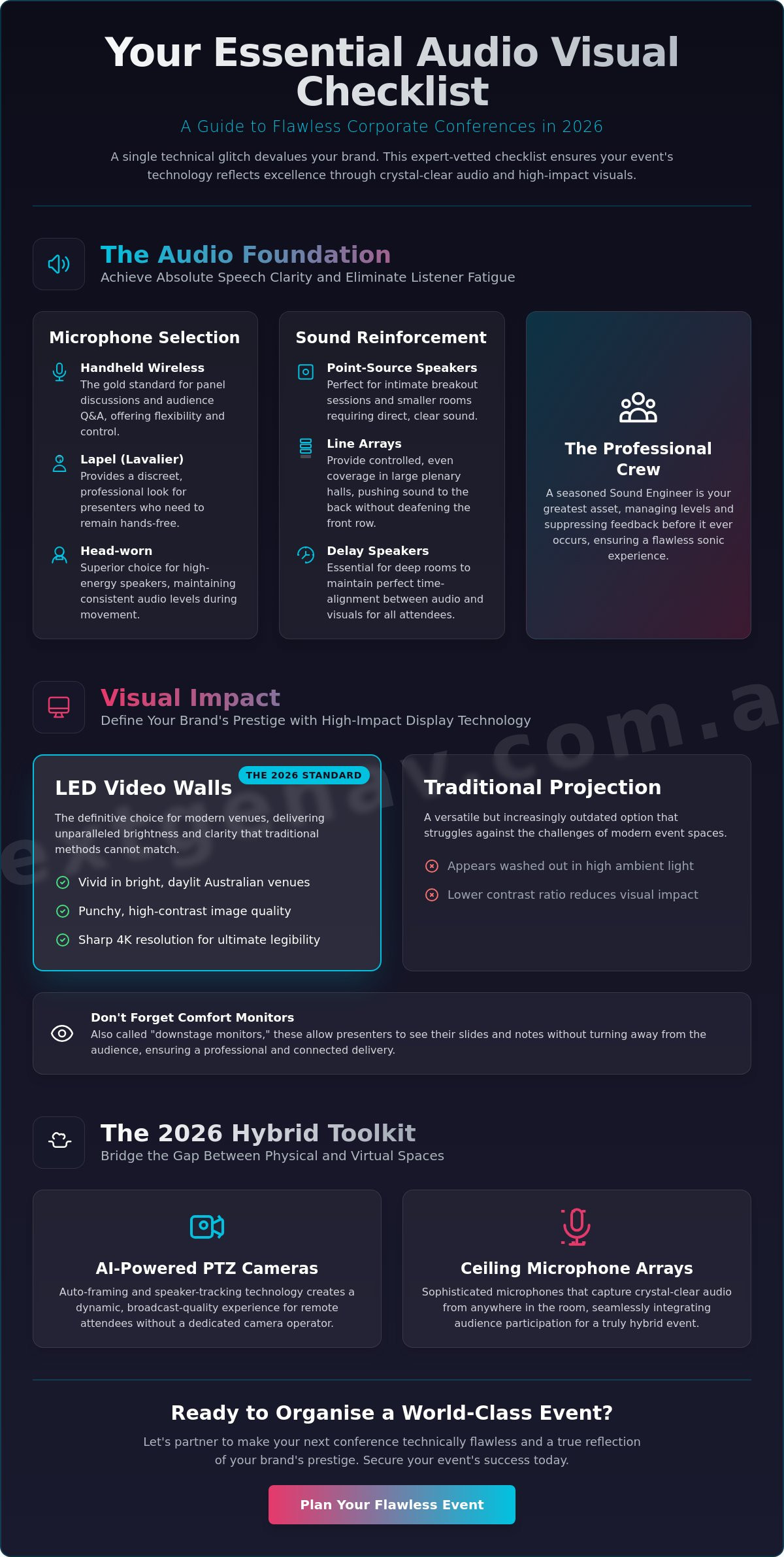
This guide provides an expert-vetted checklist designed to help you master your logistics, ensuring your next corporate gathering achieves the prestige it deserves without the anxiety of overspending on redundant tech. We’ll show you how to secure a professional setup that reflects your brand’s excellence through crystal-clear audio and high-impact visuals. This preview covers the essential hardware for 2026, including AI-powered PTZ cameras with auto-framing and sophisticated ceiling microphone arrays that transform any venue into a powerhouse of engagement.
Key Takeaways
- Master the nuances of speech clarity to eliminate listener fatigue and ensure your message resonates with every delegate in the room.
- Understand the shift toward LED video walls and how this high-impact display technology overcomes the limitations of traditional projection in bright Australian venues.
- Discover how professional lighting design and staging elevate a standard ballroom into a bespoke environment that reflects your brand’s prestige.
- Secure your event’s technical architecture with a comprehensive audio visual equipment list for conference logistics that accounts for the invisible gear essential for a flawless execution.
- Bridge the gap between physical and virtual spaces by implementing hybrid solutions that provide remote attendees with a front-row experience.
The Audio Foundation: Ensuring Absolute Speech Clarity
While a stunning visual display grabs the initial attention, it’s the audio that sustains it. If your audience is straining to catch every second word, they aren’t engaging with your message; they’re simply getting tired. This cognitive strain, known as listener fatigue, can derail even the most prestigious keynote. When delegates have to work too hard to process sound, their retention rates plummet and your brand’s authority is subtly diminished. Ensuring absolute speech clarity is the non-negotiable starting point for any audio visual equipment list for conference planning.
The scale of your Professional Audio System must mirror the specific acoustics of your Melbourne venue. A cavernous plenary hall requires a vastly different approach than a carpeted breakout room. This is where the technical direction of a seasoned sound engineer becomes your greatest asset. They act as the invisible hand, managing live levels and suppressing feedback before it ever reaches the ears of your delegates. A sound engineer doesn’t just monitor volume; they interpret the room’s energy and the presenter’s vocal dynamics. In a high-stakes environment, they are the first line of defence against the unexpected, allowing your speakers to feel supported and confident. A thorough sound check for corporate event production is the critical rehearsal that ensures your engineer can identify and resolve these issues before a single delegate takes their seat.
Microphone Selection for Presenters and Panels
Choosing the right tool for the voice is a craft in itself. Wireless lapel (lavalier) mics offer a discreet, professional look for presenters who want to remain hands-free. However, head-worn options are often superior for high-energy speakers, as they provide a consistent capsule-to-mouth distance regardless of how much the presenter moves their head. For interactive moments or panel discussions, handheld wireless mics remain the gold standard for audience Q&A. Selecting the right microphone hire Melbourne ensures that every nuance of the speaker’s tone is captured with high-fidelity precision, preserving the prestige of the presentation.
Speakers and Sound Reinforcement
The architecture of your sound must be intentional to be effective. We typically utilise point-source speakers for intimate breakout sessions where the throw distance is short and the atmosphere is conversational. For larger plenaries, line arrays provide the vertical control needed to push sound to the back of the room without deafening the front row. Strategic placement is the key to eliminating “dead zones” in the centre of the seating block where audio can often become muddy. In particularly deep rooms, we integrate delay speakers to maintain time-alignment. This ensures the sound hits the back of the hall at the exact same moment as the visual cue. Investing in professional PA system hire Melbourne venues demand is what allows you to scale this sophisticated audio architecture precisely to your room’s size and acoustic profile. This level of sophisticated Audiovisual (AV) integration is what separates a standard meeting from a world-class corporate experience.
Visual Impact: LED Walls, Projectors, and Displays
Visuals act as the silent ambassador for your brand. While the audio carries the message, the visual delivery defines the prestige of the entire event. When you’re refining your audio visual equipment list for conference requirements, the choice between LED and projection is the most critical decision for your event’s aesthetic. It’s about more than just size; it’s about how the light interacts with your venue and how clearly your data is communicated to the back of the room.
In 2026, we’re seeing a definitive shift toward LED technology. Traditional projectors, while versatile, often struggle against the ambient light of modern Australian venues featuring floor-to-ceiling glass. LED provides a punchy, high-contrast alternative that remains vivid even in broad daylight. This ensures your presentation slides are legible from every seat, maintaining a 16:9 aspect ratio and 4K resolution that looks as sharp as a high-end television. The goal is to create a window into your brand’s vision that doesn’t wash out when the house lights come up.
Presenters also need to feel in control to deliver their best performance. We always include comfort monitors, often called “downstage monitors,” at the base of the stage. These allow speakers to see their current slide and notes without awkwardly twisting back to look at the main screen. It’s a small detail that preserves the flow and professional posture of your keynote, ensuring the speaker remains connected to the audience at all times.
LED Video Walls vs. Projection
The decision to hire an led video wall is often driven by the desire for maximum brand impact. Unlike projection, LED walls are modular, allowing us to build custom shapes and sizes that wrap around the stage. They eliminate the risk of shadows being cast by presenters walking in front of a lens. For venues with unique architecture, we might suggest projection mapping to turn the building itself into a digital canvas, but for high-stakes corporate communication, the brightness and seamlessness of LED are unmatched.
Video Distribution and Switching
Behind every great visual is a complex network of distribution. We utilise seamless switchers to ensure that transitions between laptops, media servers, and live cameras happen instantly. There’s nothing more jarring than a “no signal” blue screen or a messy desktop view during a presenter changeover. Our vision mixers allow us to layer graphics, such as speaker names and company logos, over live footage for a broadcast-quality finish. We rely on high-grade SDI and HDMI cabling to maintain signal integrity over long distances, ensuring the image on the screen is as crisp as the source. If you want to ensure your visuals are handled with this level of precision, consider partnering with a team that provides expert technical direction.
Lighting and Staging: Setting the Professional Tone
Lighting is the master architect of atmosphere. While your LED walls provide the data, your lighting design and equipment provide the emotion. A generic hotel ballroom can feel cold and uninviting without the right warmth and depth. By meticulously layering light, we transform these blank canvases into bespoke brand environments that command respect. This transition is a vital component of any audio visual equipment list for conference planning, as it bridges the gap between a simple meeting and a prestigious corporate event.
Beyond the aesthetic, lighting is a functional necessity for modern documentation. If you’re recording your keynote or streaming to a hybrid audience, your presenters need to be lit with broadcast-level precision. Standard room lights are often too yellow or too dim, resulting in grainy, unprofessional footage. We ensure every speaker is bathed in a clean, balanced light that looks as good on a 4K recording as it does in person. This technical rigour ensures that your brand’s prestige is maintained across every digital touchpoint.
Staging provides the literal platform for your brand’s message. It isn’t just about height; it’s about presence. We adhere to rigorous Australian rigging standards, ensuring every structure is secure and load-bearing capacities are never compromised. By creating a clear focal point, we naturally draw the eyes of every delegate toward the speaker. This reinforcement of authority is what allows a message to truly resonate with an audience.
Stage Lighting Essentials
We utilise wash lighting to provide a broad, even layer of illumination across the entire stage area. This ensures the presenter remains visible from every angle, even as they move between the lectern and the screen. Profile spots are then added for sharp focus, carving the speaker out from the background and reducing distracting stage shadows. To truly immerse the room in your brand identity, we use LED uplighting to cast vibrant corporate colours along the venue walls, turning the entire room into a cohesive, branded experience.
Staging and Rigging Requirements
Our modular stage decks allow for flexible configurations that suit any venue size. We pay close attention to the finishing touches, such as professional skirting, which hides the structural elements and creates a polished, high-end look. Your choice of lectern also speaks volumes about your brand; while traditional acrylic is timeless, digital lecterns offer a modern edge for 2026 events. Finally, we use heavy-duty draping and backdrops to hide messy back-of-house areas and cable runs. This “invisible” infrastructure is what allows the front-of-house excellence to take centre stage without distraction.
Behind the Scenes: The Technical Infrastructure
One of the most frequent questions we encounter during the planning phase is why a comprehensive audio visual equipment list for conference logistics includes so many items that never actually appear on stage. It’s a fair point. If the audience only sees the speaker and the screen, why is the back-of-house area stacked with racks and cables? The answer lies in the “invisible” infrastructure that serves as your technical insurance policy. This gear is the difference between a minor glitch being a non-event or a catastrophic failure that stops the show. When you review your final equipment list, remember that the smallest boxes often do the heaviest lifting. We don’t just plan for success; we engineer against failure.
Power management is perhaps the most overlooked element of this infrastructure. Even the most prestigious Australian venues can suffer from voltage drops or temporary surges that can reset digital consoles. We integrate high-capacity Uninterruptible Power Supplies (UPS) into every critical signal path. If the venue loses mains power for even a few seconds, your LED wall won’t flicker and your audio system won’t pop. The show continues uninterrupted while our team manages the recovery behind the scenes. This level of professional technical direction ensures that your brand’s reputation is never at the mercy of a building’s electrical quirks.
The technical director acts as the conductor of this equipment symphony. They are the proactive, elite presence who thrives under the pressure of a live environment. By overseeing every signal and cue, they allow you to take centre stage without a single worry about the mechanics of the delivery. They take personal pride in the seamless execution of a complex plan, ensuring the transition from a bold vision to a successful reality is flawless.
Presentation Management Tools
A seamless flow requires more than just a laptop and a prayer. We utilise a master and backup slide computer system, running in perfect sync through a hardware switcher. If one machine hangs, the system instantly flips to the redundant feed without the audience ever knowing. We also deploy D’San PerfectCue systems, allowing presenters to advance slides from across the room with absolute confidence. Digital timers are positioned discretely for the speaker, ensuring the event stays on track and respects the time of your busy delegates.
Communication and Intercoms
Silence in the room is often the result of constant chatter on our wireless headsets. Our technical crew uses dedicated intercom systems to coordinate every cue, from the lighting fade-out to the hybrid stream launch. This talkback system allows the front-of-house engineer to speak with the backstage team instantly and silently. To support this, we build a dedicated production network. By keeping our data traffic separate from the venue’s public Wi-Fi, we guarantee that your slide deck, video feeds, and control signals remain stable and secure throughout the day.
The 2026 Hybrid Toolkit: Integrating Remote Audiences
In 2026, the distinction between a physical and virtual attendee has completely dissolved. Treating remote delegates as first-class citizens is no longer a choice; it’s a fundamental requirement for brand prestige. A poorly managed stream suggests a lack of attention to detail that can alienate global stakeholders and diminish the impact of your message. When you’re assembling an audio visual equipment list for conference success, the hybrid toolkit must be integrated from the start. It’s about creating a unified experience where the digital audience feels the same energy and impact as those sitting in the front row.
Managing two-way communication is the greatest hurdle in the hybrid model. It requires a sophisticated audio architecture to ensure remote Q&A sessions are seamless and echo-free. This is where professional sound system hire becomes vital. Our technicians implement complex routing, such as “mix-minus” feeds, which allow remote speakers to hear the room clearly without the distraction of a delayed version of their own voice. This level of technical direction eliminates the awkward pauses and audio loops that often plague amateur setups, ensuring the conversation flows naturally across borders.
The technical goal is to move past the logistical grind and focus on the prestige of the final result. By investing in the right infrastructure, you allow your remote audience to participate rather than just observe. This proactive approach to Virtual and Hybrid Event Solutions transforms a standard broadcast into a cinematic experience that resonates long after the final session concludes.
Camera Systems and Capture
A single fixed camera at the back of the room is no longer sufficient for high-stakes engagement. We utilise multi-camera setups, including wide shots for context and tight shots for emotional connection, to keep the virtual audience focused. PTZ (Pan-Tilt-Zoom) cameras are the preferred choice for 2026 conferences. These discreet units offer 4K resolution and AI-powered auto-tracking, allowing our team to follow a presenter’s movement across the stage with absolute precision. These signals are processed through high-end encoders, ensuring a broadcast-quality feed reaches your audience without lag or pixelation.
Streaming and Connectivity
Reliable connectivity is the lifeline of any hybrid event. We never rely on shared venue Wi-Fi, which can fluctuate as delegates connect their own devices throughout the day. Instead, we insist on dedicated, hardwired ethernet connections for the primary stream. To provide absolute peace of mind, we employ bonded internet solutions. These systems combine multiple network sources, such as 5G and fixed-line fibre, to create a single, high-bandwidth pipe with automatic failover. If one connection drops, the others take the load instantly, ensuring your global broadcast remains stable and secure.
Orchestrate Your Event Legacy
Mastering your event logistics is more than just checking off boxes on a manifest. It’s about building a strategic architecture for engagement where every decibel and pixel serves a prestigious purpose. By prioritising the audio foundation and embracing the high-impact brilliance of LED video walls, you move past the logistical grind and focus on the final result. Your audio visual equipment list for conference planning should be the engine that drives your brand’s success invisibly behind the scenes.
Beyond the technical setup, fostering global business relationships often involves cultural immersion. To further your team’s local knowledge and skills, you can check out Nunawading Japanese School to discover more about Japanese culture and language training in Melbourne.
We bring over 30 years of Melbourne event experience to your project, pairing a state-of-the-art 2026 inventory with full-service technical direction. We don’t just provide gear; we act as your dedicated craft partners to ensure a flawless execution that resonates with both in-room and remote delegates. Our team takes personal pride in managing the technical symphony so you can take the spotlight with absolute confidence.
Ready to transform your vision into a cinematic reality? Enquire about your conference AV hire with NextGen AV today and secure the expert partnership your brand deserves. Your next great event starts with a single, confident decision.
Frequently Asked Questions
What is the most essential AV equipment for a small conference?
High-quality sound and a clear visual display are the non-negotiable foundations for any smaller event. You’ll need a professional audio system with at least two speakers and a high-resolution display, such as a large-format LED screen or a high-lumen projector. Even in intimate settings, poor audio leads to listener fatigue, making a reliable audio visual equipment list for conference success vital for maintaining delegate engagement.
How much does it cost to hire a full AV team for a Melbourne conference?
Investment levels vary significantly based on your venue size, technical complexity, and the number of delegates attending. Because every corporate event has unique requirements, we recommend seeking a bespoke proposal rather than relying on generic estimates. This ensures your quote covers the specific technical direction and high-end hardware needed to reflect your brand’s prestige without unnecessary overheads.
Do I need a technical director for a one-day corporate event?
A technical director is essential for any high-stakes event where you can’t afford a single glitch. They act as the central orchestrator, managing every cue and transition while overseeing the entire technical crew. Having this expert presence allows you to move past the logistical grind and focus on your guests, knowing that the “invisible” mechanics of the show are in seasoned hands.
What is the difference between a lapel mic and a headset mic for presenters?
Lapel mics clip onto clothing for a discreet look, while headset mics move with the speaker’s head to maintain a constant distance from the mouth. Headsets are generally superior for high-energy presenters who turn away from the lectern, as they ensure consistent speech clarity. We often suggest a mix of both in our audio visual equipment list for conference recommendations to suit different speaking styles.
Can I use the venue’s built-in sound system for my conference?
Venue systems are often designed for background music or basic announcements rather than high-fidelity corporate presentations. They frequently lack the coverage needed to eliminate dead zones in a large room. For a professional result, it’s almost always better to utilise a dedicated PA system hire Melbourne professionals recommend, tailored specifically to the room’s acoustics and your speaker’s vocal requirements.
What happens if the power goes out during my presentation?
If your technical infrastructure includes an Uninterruptible Power Supply (UPS), your critical systems will stay live. This gear provides a vital battery buffer, keeping your LED walls and audio consoles running during a temporary venue power drop. It allows the technical team to manage the recovery behind the scenes without the audience ever seeing a black screen or hearing a pop.
How early should I start planning my conference AV requirements?
You should ideally start the conversation with your AV partner three to six months before your event date. Early planning allows for detailed site inspections and ensures that premium equipment, like the latest LED video walls, is secured for your dates. This lead time also gives our technical directors the space to refine your vision into a polished, executable plan.
What are the specific rigging safety standards for Australian events?
All overhead equipment must comply with Australian Standards, specifically AS 1418 for cranes and hoists and AS 2319 for rigging equipment. It is a legal requirement that all staging and rigging are installed by qualified professionals who strictly adhere to load-bearing capacities. Safety is our absolute priority, and we ensure every installation meets these rigorous national benchmarks to protect your guests and staff.