



Your festival stage isn’t just a platform. It’s a precision-engineered structure that has to withstand Melbourne’s notorious weather, satisfy council compliance requirements, and deliver a seamless audio-visual experience, all before a single performer steps into the spotlight. If you’re researching outdoor festival stage hire in Melbourne and wondering how to reconcile structural safety, permit obligations, and top-tier production quality without losing your mind, you’re asking exactly the right questions.
Planning an outdoor festival in this city is genuinely complex. Wind loading concerns, WorkSafe Victoria requirements, and the logistical challenge of coordinating staging, rigging, pro audio, and LED walls across multiple vendors can turn what should be an exciting project into an overwhelming one. That stress is real, and it’s shared by every event producer who has stood on a muddy site at 6am wondering if the bump-in will go to plan.
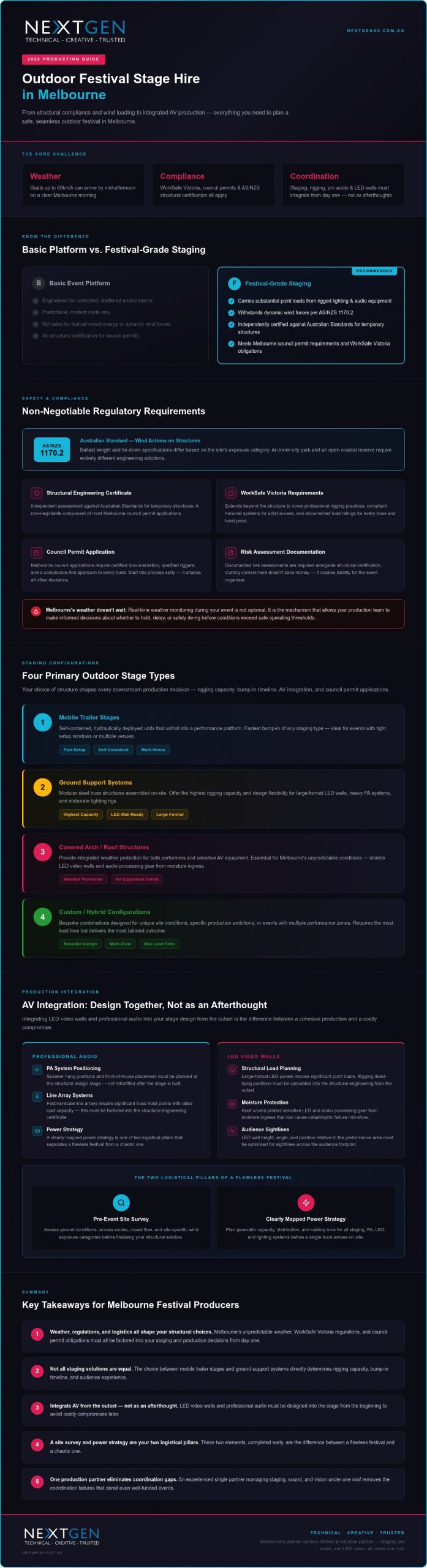
This 2026 production guide cuts through that complexity. You’ll learn how to select a structurally sound stage that meets Australian Standards, how to navigate Melbourne’s council permit landscape, and how to achieve seamless integration of PA systems and LED video walls, all the way through to a stress-free pack-down.
Key Takeaways
- Navigating outdoor festival stage hire in Melbourne requires understanding how the city’s unpredictable weather, WorkSafe Victoria regulations, and council permit obligations all shape your structural and production decisions.
- Not all staging solutions are equal — the choice between mobile trailer stages and ground support systems directly determines your rigging capacity, bump-in timeline, and overall audience experience.
- Integrating LED video walls and professional audio into your stage design from the outset — rather than treating them as afterthoughts — is the difference between a cohesive production and a costly compromise.
- A thorough pre-event site survey and a clearly mapped power strategy are the two logistical pillars that separate a flawless festival from a chaotic one.
- Working with a single, experienced production partner who manages staging, sound, and vision under one roof eliminates the coordination gaps that derail even well-funded events.
The Essentials of Outdoor Festival Stage Hire in Melbourne
There’s a meaningful difference between a basic event platform and a festival-grade staging system, and that distinction becomes immediately apparent the moment conditions turn against you. A modular platform hired for a corporate garden party is engineered for controlled environments, predictable loads, and modest crowd energy. Festival-grade staging, by contrast, is a precision-engineered temporary structure designed to carry substantial point loads from rigged lighting and audio equipment, withstand dynamic wind forces, and meet the structural certification requirements that councils and WorkSafe Victoria demand before a single ticket is sold. Understanding that distinction is the first step in making sound decisions about outdoor festival stage hire in Melbourne.
The broader field of outdoor concert production has evolved considerably over decades, and the technical and regulatory expectations placed on event producers have evolved with it. What once required a few scaffold planks and a PA on a borrowed truck now demands certified structural engineering, documented risk assessments, and integrated production systems that function cohesively under pressure.
Melbourne Weather and Wind Loading Requirements
Melbourne’s weather is genuinely unpredictable. A clear morning can give way to 60km/h gusts and horizontal rain by mid-afternoon, and that variability isn’t a minor inconvenience; it’s a structural engineering variable. Outdoor stages must be designed and ballasted to withstand wind loads specific to the site’s exposure category, as defined under AS/NZS 1170.2, the Australian Standard for wind actions on structures. The required ballast weight and tie-down specifications will differ between a sheltered inner-city park and an open coastal reserve.
Roof covers serve a dual purpose: they protect performers and crew from weather exposure, and they shield sensitive AV equipment, including LED video walls and audio processing gear, from moisture ingress that can cause catastrophic failure mid-show. Real-time weather monitoring during your event isn’t optional; it’s the mechanism that allows your production team to make informed decisions about whether to hold, delay, or safely de-rig before conditions deteriorate beyond safe operating thresholds.
Compliance and Safety Standards (WorkSafe Victoria)
Structural engineering certificates aren’t bureaucratic box-ticking. They’re the documented proof that your stage has been independently assessed against Australian Standards for temporary structures, and they’re a non-negotiable component of most Melbourne council permit applications. WorkSafe Victoria’s requirements for public events extend beyond the structure itself to encompass professional rigging practices, compliant handrail systems for artist access, and clearly documented load ratings for every truss and hoist point.
Cutting corners here doesn’t save money; it creates liability. An experienced production partner brings certified documentation, qualified riggers, and a compliance-first approach to every build, which is precisely what transforms a complex permit process into a manageable one.
This is the foundation of what a genuine end-to-end production philosophy delivers: not just equipment on a truck, but a fully integrated system where staging, rigging, audio, and vision are designed together from the outset, with safety and compliance woven into every decision rather than addressed as an afterthought.
Types of Outdoor Stages: Choosing the Right Foundation
The stage structure you select will shape every other production decision that follows. Rigging capacity, bump-in timeline, AV integration, and even your council permit application are all downstream consequences of that foundational choice. When it comes to outdoor festival stage hire in Melbourne, understanding which structure suits your specific event scale, site conditions, and production ambitions is where the real planning begins.
There are four primary staging configurations that professional producers work with, and each serves a distinct purpose:
- Mobile trailer stages are self-contained, hydraulically deployed units that unfold into a performance platform within hours. They’re the right call for community carols, local fetes, and smaller outdoor activations where speed of setup and minimal crew overhead are the priority. Their key limitation is load capacity; they’re not engineered to carry the point loads that major festival lighting rigs and large-format LED video walls demand.
- Ground support staging systems are purpose-built for high-capacity productions. Constructed on-site from heavy-duty trussing and ground-supported towers, these systems can carry substantial rigging loads, making them the correct choice for major music festivals where the production design calls for significant overhead infrastructure.
- Modular scaffold stages offer the greatest flexibility in footprint and configuration. On uneven terrain, heritage park surfaces, or sites with irregular boundaries, a modular scaffold system can be engineered to adapt rather than forcing the site to accommodate a fixed structure.
- Custom podium and riser configurations address the often-overlooked spatial hierarchy of a festival site. VIP viewing platforms, media risers, and broadcast positions all require purpose-built elevations that integrate cleanly with the primary stage design rather than being bolted on as an afterthought.
Trailer Stages vs. Built-to-Purpose Structures
The decision between a trailer stage and a ground support system isn’t simply about budget; it’s about load capacity and production ambition. A trailer stage typically offers a fraction of the overhead rigging capacity of a ground support system. If your production design includes a substantial line array, a full lighting grid, and an LED video wall, a trailer stage will hit its structural ceiling before your technical rider is satisfied. A ground support system, engineered and certified to carry those loads, is the foundation that makes a genuinely ambitious production possible. Consulting the WorkSafe Victoria event safety guidelines early in your planning process will clarify the structural certification requirements that apply to each system type.
Access and Inclusivity: Ramps and Stairs
Stage access isn’t an optional design detail. Under the Disability Discrimination Act 1992, public events are required to provide accessible pathways for performers, crew, and any individuals who require step-free access. That means DDA-compliant ramps with appropriate gradients, handrail systems that meet Australian Standards, and clearly separated performer access routes that don’t create collision points with audience flow. Multi-level festival layouts, where monitor stages, DJ risers, and VIP platforms exist alongside the primary stage, require a coordinated access strategy rather than a series of improvised solutions.
Getting this right from the design phase rather than retrofitting solutions on bump-in day is exactly the kind of detail that separates a polished production from a stressful one. If you’re mapping out your festival’s structural requirements, explore how an integrated staging and production approach can bring these decisions together under a single, coherent plan.
The Integrated Stage: Merging Structure with AV Excellence
A festival stage is not furniture. That distinction sounds obvious, but it’s precisely where most outdoor productions fall apart. When audio, video, and lighting are treated as separate hires bolted onto a structure that was never designed to accommodate them, the result is compromised sightlines, overloaded rigging points, and a production that looks assembled rather than designed. The most compelling outdoor festival stage hire Melbourne productions share a single characteristic: every technical element was considered at the structural design stage, not retrofitted during bump-in.
This is the philosophy that separates a genuinely integrated production from a collection of hired gear sharing the same postcode.
Optimising LED Video Walls for Outdoor Visibility
Pixel pitch is the single most consequential specification decision for outdoor LED. A pitch that delivers stunning clarity at three metres becomes a blurry mosaic at thirty. For large festival crowds where viewing distances typically range from ten to sixty metres, a pixel pitch between P3.9 and P6 generally delivers the resolution-to-distance ratio that keeps content legible across the full audience footprint. Finer pitches carry unnecessary cost and weight without perceptible benefit at those distances.
Weight distribution matters as much as resolution. A large-format LED video wall for events can impose significant point loads on the stage structure, and those loads must be engineered into the truss specification from the outset rather than discovered on site. In Melbourne’s wind-exposed parks and open reserves, screen panels also require independent bracing and lateral restraint systems designed to the same wind loading standards as the stage itself. A screen that sways or deflects under gusts isn’t just a visual problem; it’s a structural one.
Sightline geometry is the final variable. Screens positioned too low disappear behind the front rows; screens cantilevered too far forward create dangerous overhead loads. The optimal position is calculated against the site’s slope, the stage height, and the maximum audience distance, a calculation that belongs in the production design phase, not the morning of the event.
Professional Audio Systems for Outdoor Impact
Outdoor sound propagation is an entirely different discipline from indoor audio. Hard surfaces reflect, open air absorbs, and Melbourne’s variable wind conditions can push or scatter a carefully calibrated mix in ways that no amount of EQ can fully correct after the fact. System design has to anticipate these variables before a single cabinet is flown.
The line array versus point source question is one of scale and throw distance. Line array systems, where vertical arrays of cabinets are flown from the stage’s rigging infrastructure, deliver controlled dispersion across large crowds by coupling their output into a coherent wavefront. That coupling is what allows consistent volume and clarity from the front barrier to the back of a large field. Point source systems suit smaller footprints where the throw distance is modest and the budget doesn’t warrant a full flown rig. Choosing the wrong system for your audience geometry doesn’t just compromise the mix; it creates hotspots near the PA and dead zones at the rear, which is the fastest way to lose an audience’s attention.
Noise management is a compliance issue, not just a neighbourly courtesy. Melbourne councils routinely impose noise curfews and decibel limits as conditions of event permits, and breaching those conditions mid-show can result in immediate shutdown. Our approach to professional sound system hire integrates acoustic modelling and directional speaker positioning from the design stage, minimising spill beyond the event boundary while maintaining the impact your audience came to experience.
Lighting completes the picture after dark. A well-designed festival lighting rig transforms a functional structure into a cinematic environment, using the stage’s certified truss infrastructure as a precision grid for moving heads, wash fixtures, and beam effects. The rigging plan that carries your line array is the same infrastructure that positions your lighting rig; design them together and both systems perform better, cost less to rig, and create a visual coherence that no amount of last-minute improvisation can replicate.
This is the invisible expertise that drives every decision: not just supplying equipment, but orchestrating an integrated system where structure, sound, and vision operate as a single, seamless production.
Planning and Logistics for a Flawless Bump-In
Every decision made in the production design phase eventually meets reality on bump-in day. That collision between plan and site is where festivals are won or lost, and in Melbourne’s diverse park environments, the variables are considerable. A thorough pre-event site survey isn’t a preliminary formality; it’s the single most consequential investment of time you’ll make in the entire planning process. Walking the site with your production team weeks before the event allows you to identify access constraints, ground conditions, power infrastructure, and sightline challenges before they become expensive morning-of surprises.
Site Access and Ground Conditions
Melbourne’s beloved festival parks, from Birrarung Marr to the Mornington Peninsula’s open reserves, were not designed with heavy production vehicles in mind. Getting a stage truck, a generator trailer, and a cable reel ute onto a grassed reserve without churning the ground into a muddy liability requires advance coordination with the relevant council or Parks Victoria authority. Track mats are non-negotiable on soft or wet ground; they distribute vehicle weight across a larger surface area, protecting turf that the council will expect you to leave in the same condition you found it. Weight limits on internal park paths must be verified before you schedule your fleet, not after.
Sloped sites introduce additional complexity. A stage positioned on a gradient requires levelling systems that compensate for the incline without compromising the structural certification of the overall rig. This is precisely the kind of detail that separates experienced production partners from hire companies who simply drop equipment and leave.
Power Distribution and Redundancy
Calculating your total power requirement means aggregating the draw of every system on site: stage lighting, line array amplification, LED processing, monitor systems, and production infrastructure. Underestimating that figure and tripping a generator mid-headline set is a scenario that ends careers. Where available, connecting to site power through a licensed electrician is preferable, but many Melbourne parks require diesel generation as the primary source.
Backup power isn’t a luxury for high-stakes productions. A redundant generator or uninterruptible power supply for critical audio and vision processing ensures that a single point of failure doesn’t silence the entire event. All electrical equipment must be tagged and tested to Australian Standards before it arrives on site; this is a WorkSafe Victoria expectation and a standard condition of most council event permits.
Coordinating bump-in schedules with your marquee supplier, catering infrastructure, and security fencing contractor requires a master site schedule that assigns time windows, access routes, and staging zones to each vendor. Overlapping vehicle movements on a constrained site create bottlenecks that cascade through the entire day. When you’re planning outdoor festival stage hire in Melbourne, a unified production partner who can anchor that coordination from a single point of contact is the difference between a controlled build and an improvised one. Talk to our team about how integrated technical direction simplifies your entire bump-in process.
Why NextGen AV is Melbourne’s Premier Festival Partner
Three decades is a long time to spend in the trenches of live event production. It’s long enough to have weathered every permutation of Melbourne’s weather, navigated council permit regimes that have changed more than once, and built a working knowledge of what separates a production that delivers from one that merely survives the day. That accumulated expertise is what NextGen AV brings to every outdoor festival stage hire Melbourne engagement, not as a selling point, but as the practical foundation of every decision we make on your behalf.
The proposition is straightforward: one partner manages your staging, rigging, professional audio, LED video walls, lighting, and technical direction. No coordination gaps between separate hire companies. No finger-pointing when a system handover fails at 3pm on event day. Single-point accountability means that every element of your production is designed, deployed, and operated by a team that built the whole system together, because they did.
Safety and structural engineering excellence aren’t optional extras in our process. They’re the architecture of it. Every stage build is underpinned by certified structural documentation, qualified riggers, and a compliance framework that satisfies WorkSafe Victoria requirements and council permit conditions before a single truss is lifted. That rigour protects your audience, your performers, and your event licence.
The Value of a Technical Director
A seasoned Technical Director is the invisible force that keeps a complex festival build moving with precision. Our full-service event production model places an experienced Technical Director at the centre of your planning process, translating your creative vision into a coherent technical brief, managing the bump-in sequence, and solving problems before they reach you. When a generator trips or a cable run needs rerouting, the answer is already being executed. That’s the difference between seasoned veterans and equipment suppliers: the former anticipate, the latter react. The result isn’t just a functional production; it’s a cinematic event experience that lets you stand in the crowd and actually enjoy what you’ve built.
Book Your Melbourne Festival Consultation
Our process begins with a conversation and a site visit. We walk the ground with you, assess the structural and logistical variables, and develop a production design that accounts for everything from wind exposure to power distribution before a single item is booked. That early investment in planning is what makes execution feel effortless.
Melbourne’s peak festival season fills quickly, and the best production windows close earlier than most organisers expect. Early engagement isn’t just advisable; it’s the difference between securing your preferred dates and compromising on them. Organise a site survey with the NextGen AV team today and let’s start turning your festival concept into something your audience won’t forget.
Your Melbourne Festival Starts Here
Planning a successful outdoor event in this city demands more than hired equipment and a hopeful weather forecast. It demands structural rigour, seamless AV integration, and a production partner who has navigated Melbourne’s compliance landscape long enough to anticipate the challenges before they find you. The core lessons from this guide are clear: choose your stage structure based on your production ambitions, not just your budget; integrate your LED and audio systems from the design phase, not the morning of bump-in; and treat compliance as the foundation of everything, not a final checklist.
With 30+ years of Melbourne event expertise and WorkSafe compliant staging solutions backed by a fully integrated AV capability, NextGen AV brings the quiet confidence of a team that’s seen every variable this city can throw at a production, and delivered regardless.
When it comes to outdoor festival stage hire Melbourne producers trust, the difference is in the detail. Don’t leave that detail to chance. Request a custom quote for your Melbourne festival stage and let’s build something your audience will be talking about long after the last note fades.
Frequently Asked Questions About Outdoor Festival Stage Hire in Melbourne
What is the typical cost of outdoor festival stage hire in Melbourne?
Stage hire costs vary considerably depending on structure type, size, rigging requirements, and how many integrated systems are included. A compact trailer stage for a community event sits at a very different price point from a ground support system carrying a full line array, LED video wall, and lighting grid. Because every festival site and production brief is unique, we don’t publish fixed pricing; the most useful thing you can do is request a custom quote based on your specific audience capacity, site conditions, and technical rider.
Do I need a permit from the Melbourne City Council for a temporary stage?
Yes, in virtually all cases. Temporary structures erected on public land in Melbourne require council approval, and the specific permit conditions will depend on your venue, expected attendance, and the nature of the event. Most applications require a certified structural engineering report for the stage, a site management plan, and evidence of public liability insurance. Requirements differ between City of Melbourne, inner-suburban councils, and Parks Victoria-managed reserves, so confirming obligations with the relevant authority early in your planning timeline is essential.
How long does it take to set up a professional trailer stage?
A mobile trailer stage can typically be deployed and made performance-ready in two to four hours, making it a strong option for events with tight bump-in windows. Ground support systems require considerably more time; a full festival rig with trussing, rigging infrastructure, audio, and LED integration can demand a full day or more depending on complexity. Site access conditions, ground preparation, and the number of systems being integrated all influence the final timeline, which is why a detailed bump-in schedule is built into every production plan we develop.
Can your festival stages support large LED video walls?
Yes. Our ground support staging systems are engineered to carry the point loads that large-format LED video walls impose, provided those loads are factored into the structural specification from the outset. Screen panels also require independent lateral bracing designed to the same wind loading standards as the stage structure itself, particularly on Melbourne’s exposed park sites. Integrating the LED specification into the structural design phase, rather than treating the screen as a separate hire, is what ensures the entire rig performs safely and cohesively under live conditions.
What happens if it rains during our outdoor festival?
A properly specified outdoor festival stage includes a weatherproof roof cover that protects performers, crew, and sensitive AV equipment from rain ingress. Real-time weather monitoring during the event allows the production team to track developing conditions and make informed decisions about holds or schedule adjustments before conditions reach unsafe thresholds. All audio and LED processing equipment should be positioned within the covered stage envelope or in weatherproofed production infrastructure; exposure to moisture mid-show is a preventable failure, not an acceptable risk.
Do you provide structural engineering certificates for your stages?
Yes. Every stage build we deliver is supported by certified structural documentation prepared by a qualified engineer, confirming that the structure meets Australian Standards for temporary structures and the wind loading requirements applicable to the specific site. These certificates are a standard component of most Melbourne council permit applications and a non-negotiable expectation under WorkSafe Victoria’s event safety framework. We bring this documentation as a matter of course, not as an optional extra.
What power supply is required for a professional stage and PA setup?
Total power demand is calculated by aggregating the draw of every system on site: amplification, LED processing, stage lighting, monitor systems, and production infrastructure. The combined figure for a mid-scale outdoor festival stage hire Melbourne production can be substantial, and underestimating it creates real risk. Where site power is unavailable or insufficient, diesel generation is the standard solution. All electrical equipment must be tagged and tested to Australian Standards before arriving on site, and critical systems should have a redundancy plan to protect against a single point of failure mid-show.
How do you ensure the stage is safe for performers in high winds?
Wind safety starts at the structural design stage. Every rig is engineered to the wind loading requirements specified under AS/NZS 1170.2 for the site’s exposure category, with ballast and tie-down specifications calculated accordingly. During the event, real-time weather monitoring allows the production team to track wind speed against the structure’s certified operating thresholds. If conditions approach those limits, the team has a documented response protocol, whether that’s a temporary hold, a schedule adjustment, or a controlled de-rig, that’s executed before the structure is placed under unsafe load.
Your festival stage isn’t just a platform. It’s a precision-engineered structure that has to withstand Melbourne’s notorious weather, satisfy council compliance requirements, and deliver a seamless audio-visual experience, all before a single performer steps into the spotlight. If you’re researching outdoor festival stage hire in Melbourne and wondering how to reconcile structural safety, permit obligations, and top-tier production quality without losing your mind, you’re asking exactly the right questions.
Planning an outdoor festival in this city is genuinely complex. Wind loading concerns, WorkSafe Victoria requirements, and the logistical challenge of coordinating staging, rigging, pro audio, and LED walls across multiple vendors can turn what should be an exciting project into an overwhelming one. That stress is real, and it’s shared by every event producer who has stood on a muddy site at 6am wondering if the bump-in will go to plan.
This 2026 production guide cuts through that complexity. You’ll learn how to select a structurally sound stage that meets Australian Standards, how to navigate Melbourne’s council permit landscape, and how to achieve seamless integration of PA systems and LED video walls, all the way through to a stress-free pack-down.
Key Takeaways
- Navigating outdoor festival stage hire in Melbourne requires understanding how the city’s unpredictable weather, WorkSafe Victoria regulations, and council permit obligations all shape your structural and production decisions.
- Not all staging solutions are equal — the choice between mobile trailer stages and ground support systems directly determines your rigging capacity, bump-in timeline, and overall audience experience.
- Integrating LED video walls and professional audio into your stage design from the outset — rather than treating them as afterthoughts — is the difference between a cohesive production and a costly compromise.
- A thorough pre-event site survey and a clearly mapped power strategy are the two logistical pillars that separate a flawless festival from a chaotic one.
- Working with a single, experienced production partner who manages staging, sound, and vision under one roof eliminates the coordination gaps that derail even well-funded events.
The Essentials of Outdoor Festival Stage Hire in Melbourne
There’s a meaningful difference between a basic event platform and a festival-grade staging system, and that distinction becomes immediately apparent the moment conditions turn against you. A modular platform hired for a corporate garden party is engineered for controlled environments, predictable loads, and modest crowd energy. Festival-grade staging, by contrast, is a precision-engineered temporary structure designed to carry substantial point loads from rigged lighting and audio equipment, withstand dynamic wind forces, and meet the structural certification requirements that councils and WorkSafe Victoria demand before a single ticket is sold. Understanding that distinction is the first step in making sound decisions about outdoor festival stage hire in Melbourne.
The broader field of outdoor concert production has evolved considerably over decades, and the technical and regulatory expectations placed on event producers have evolved with it. What once required a few scaffold planks and a PA on a borrowed truck now demands certified structural engineering, documented risk assessments, and integrated production systems that function cohesively under pressure.
Melbourne Weather and Wind Loading Requirements
Melbourne’s weather is genuinely unpredictable. A clear morning can give way to 60km/h gusts and horizontal rain by mid-afternoon, and that variability isn’t a minor inconvenience; it’s a structural engineering variable. Outdoor stages must be designed and ballasted to withstand wind loads specific to the site’s exposure category, as defined under AS/NZS 1170.2, the Australian Standard for wind actions on structures. The required ballast weight and tie-down specifications will differ between a sheltered inner-city park and an open coastal reserve.
Roof covers serve a dual purpose: they protect performers and crew from weather exposure, and they shield sensitive AV equipment, including LED video walls and audio processing gear, from moisture ingress that can cause catastrophic failure mid-show. Real-time weather monitoring during your event isn’t optional; it’s the mechanism that allows your production team to make informed decisions about whether to hold, delay, or safely de-rig before conditions deteriorate beyond safe operating thresholds.
Compliance and Safety Standards (WorkSafe Victoria)
Structural engineering certificates aren’t bureaucratic box-ticking. They’re the documented proof that your stage has been independently assessed against Australian Standards for temporary structures, and they’re a non-negotiable component of most Melbourne council permit applications. WorkSafe Victoria’s requirements for public events extend beyond the structure itself to encompass professional rigging practices, compliant handrail systems for artist access, and clearly documented load ratings for every truss and hoist point.
Cutting corners here doesn’t save money; it creates liability. An experienced production partner brings certified documentation, qualified riggers, and a compliance-first approach to every build, which is precisely what transforms a complex permit process into a manageable one.
This is the foundation of what a genuine end-to-end production philosophy delivers: not just equipment on a truck, but a fully integrated system where staging, rigging, audio, and vision are designed together from the outset, with safety and compliance woven into every decision rather than addressed as an afterthought.
Types of Outdoor Stages: Choosing the Right Foundation
The stage structure you select will shape every other production decision that follows. Rigging capacity, bump-in timeline, AV integration, and even your council permit application are all downstream consequences of that foundational choice. When it comes to outdoor festival stage hire in Melbourne, understanding which structure suits your specific event scale, site conditions, and production ambitions is where the real planning begins.
There are four primary staging configurations that professional producers work with, and each serves a distinct purpose:
- Mobile trailer stages are self-contained, hydraulically deployed units that unfold into a performance platform within hours. They’re the right call for community carols, local fetes, and smaller outdoor activations where speed of setup and minimal crew overhead are the priority. Their key limitation is load capacity; they’re not engineered to carry the point loads that major festival lighting rigs and large-format LED video walls demand.
- Ground support staging systems are purpose-built for high-capacity productions. Constructed on-site from heavy-duty trussing and ground-supported towers, these systems can carry substantial rigging loads, making them the correct choice for major music festivals where the production design calls for significant overhead infrastructure.
- Modular scaffold stages offer the greatest flexibility in footprint and configuration. On uneven terrain, heritage park surfaces, or sites with irregular boundaries, a modular scaffold system can be engineered to adapt rather than forcing the site to accommodate a fixed structure.
- Custom podium and riser configurations address the often-overlooked spatial hierarchy of a festival site. VIP viewing platforms, media risers, and broadcast positions all require purpose-built elevations that integrate cleanly with the primary stage design rather than being bolted on as an afterthought.
Trailer Stages vs. Built-to-Purpose Structures
The decision between a trailer stage and a ground support system isn’t simply about budget; it’s about load capacity and production ambition. A trailer stage typically offers a fraction of the overhead rigging capacity of a ground support system. If your production design includes a substantial line array, a full lighting grid, and an LED video wall, a trailer stage will hit its structural ceiling before your technical rider is satisfied. A ground support system, engineered and certified to carry those loads, is the foundation that makes a genuinely ambitious production possible. Consulting the WorkSafe Victoria event safety guidelines early in your planning process will clarify the structural certification requirements that apply to each system type.
Access and Inclusivity: Ramps and Stairs
Stage access isn’t an optional design detail. Under the Disability Discrimination Act 1992, public events are required to provide accessible pathways for performers, crew, and any individuals who require step-free access. That means DDA-compliant ramps with appropriate gradients, handrail systems that meet Australian Standards, and clearly separated performer access routes that don’t create collision points with audience flow. Multi-level festival layouts, where monitor stages, DJ risers, and VIP platforms exist alongside the primary stage, require a coordinated access strategy rather than a series of improvised solutions.
Getting this right from the design phase rather than retrofitting solutions on bump-in day is exactly the kind of detail that separates a polished production from a stressful one. If you’re mapping out your festival’s structural requirements, explore how an integrated staging and production approach can bring these decisions together under a single, coherent plan.
The Integrated Stage: Merging Structure with AV Excellence
A festival stage is not furniture. That distinction sounds obvious, but it’s precisely where most outdoor productions fall apart. When audio, video, and lighting are treated as separate hires bolted onto a structure that was never designed to accommodate them, the result is compromised sightlines, overloaded rigging points, and a production that looks assembled rather than designed. The most compelling outdoor festival stage hire Melbourne productions share a single characteristic: every technical element was considered at the structural design stage, not retrofitted during bump-in.
This is the philosophy that separates a genuinely integrated production from a collection of hired gear sharing the same postcode.
Optimising LED Video Walls for Outdoor Visibility
Pixel pitch is the single most consequential specification decision for outdoor LED. A pitch that delivers stunning clarity at three metres becomes a blurry mosaic at thirty. For large festival crowds where viewing distances typically range from ten to sixty metres, a pixel pitch between P3.9 and P6 generally delivers the resolution-to-distance ratio that keeps content legible across the full audience footprint. Finer pitches carry unnecessary cost and weight without perceptible benefit at those distances.
Weight distribution matters as much as resolution. A large-format LED video wall for events can impose significant point loads on the stage structure, and those loads must be engineered into the truss specification from the outset rather than discovered on site. In Melbourne’s wind-exposed parks and open reserves, screen panels also require independent bracing and lateral restraint systems designed to the same wind loading standards as the stage itself. A screen that sways or deflects under gusts isn’t just a visual problem; it’s a structural one.
Sightline geometry is the final variable. Screens positioned too low disappear behind the front rows; screens cantilevered too far forward create dangerous overhead loads. The optimal position is calculated against the site’s slope, the stage height, and the maximum audience distance, a calculation that belongs in the production design phase, not the morning of the event.
Professional Audio Systems for Outdoor Impact
Outdoor sound propagation is an entirely different discipline from indoor audio. Hard surfaces reflect, open air absorbs, and Melbourne’s variable wind conditions can push or scatter a carefully calibrated mix in ways that no amount of EQ can fully correct after the fact. System design has to anticipate these variables before a single cabinet is flown.
The line array versus point source question is one of scale and throw distance. Line array systems, where vertical arrays of cabinets are flown from the stage’s rigging infrastructure, deliver controlled dispersion across large crowds by coupling their output into a coherent wavefront. That coupling is what allows consistent volume and clarity from the front barrier to the back of a large field. Point source systems suit smaller footprints where the throw distance is modest and the budget doesn’t warrant a full flown rig. Choosing the wrong system for your audience geometry doesn’t just compromise the mix; it creates hotspots near the PA and dead zones at the rear, which is the fastest way to lose an audience’s attention.
Noise management is a compliance issue, not just a neighbourly courtesy. Melbourne councils routinely impose noise curfews and decibel limits as conditions of event permits, and breaching those conditions mid-show can result in immediate shutdown. Our approach to professional sound system hire integrates acoustic modelling and directional speaker positioning from the design stage, minimising spill beyond the event boundary while maintaining the impact your audience came to experience.
Lighting completes the picture after dark. A well-designed festival lighting rig transforms a functional structure into a cinematic environment, using the stage’s certified truss infrastructure as a precision grid for moving heads, wash fixtures, and beam effects. The rigging plan that carries your line array is the same infrastructure that positions your lighting rig; design them together and both systems perform better, cost less to rig, and create a visual coherence that no amount of last-minute improvisation can replicate.
This is the invisible expertise that drives every decision: not just supplying equipment, but orchestrating an integrated system where structure, sound, and vision operate as a single, seamless production.
Planning and Logistics for a Flawless Bump-In
Every decision made in the production design phase eventually meets reality on bump-in day. That collision between plan and site is where festivals are won or lost, and in Melbourne’s diverse park environments, the variables are considerable. A thorough pre-event site survey isn’t a preliminary formality; it’s the single most consequential investment of time you’ll make in the entire planning process. Walking the site with your production team weeks before the event allows you to identify access constraints, ground conditions, power infrastructure, and sightline challenges before they become expensive morning-of surprises.
Site Access and Ground Conditions
Melbourne’s beloved festival parks, from Birrarung Marr to the Mornington Peninsula’s open reserves, were not designed with heavy production vehicles in mind. Getting a stage truck, a generator trailer, and a cable reel ute onto a grassed reserve without churning the ground into a muddy liability requires advance coordination with the relevant council or Parks Victoria authority. Track mats are non-negotiable on soft or wet ground; they distribute vehicle weight across a larger surface area, protecting turf that the council will expect you to leave in the same condition you found it. Weight limits on internal park paths must be verified before you schedule your fleet, not after.
Sloped sites introduce additional complexity. A stage positioned on a gradient requires levelling systems that compensate for the incline without compromising the structural certification of the overall rig. This is precisely the kind of detail that separates experienced production partners from hire companies who simply drop equipment and leave.
Power Distribution and Redundancy
Calculating your total power requirement means aggregating the draw of every system on site: stage lighting, line array amplification, LED processing, monitor systems, and production infrastructure. Underestimating that figure and tripping a generator mid-headline set is a scenario that ends careers. Where available, connecting to site power through a licensed electrician is preferable, but many Melbourne parks require diesel generation as the primary source.
Backup power isn’t a luxury for high-stakes productions. A redundant generator or uninterruptible power supply for critical audio and vision processing ensures that a single point of failure doesn’t silence the entire event. All electrical equipment must be tagged and tested to Australian Standards before it arrives on site; this is a WorkSafe Victoria expectation and a standard condition of most council event permits.
Coordinating bump-in schedules with your marquee supplier, catering infrastructure, and security fencing contractor requires a master site schedule that assigns time windows, access routes, and staging zones to each vendor. Overlapping vehicle movements on a constrained site create bottlenecks that cascade through the entire day. When you’re planning outdoor festival stage hire in Melbourne, a unified production partner who can anchor that coordination from a single point of contact is the difference between a controlled build and an improvised one. Talk to our team about how integrated technical direction simplifies your entire bump-in process.
Why NextGen AV is Melbourne’s Premier Festival Partner
Three decades is a long time to spend in the trenches of live event production. It’s long enough to have weathered every permutation of Melbourne’s weather, navigated council permit regimes that have changed more than once, and built a working knowledge of what separates a production that delivers from one that merely survives the day. That accumulated expertise is what NextGen AV brings to every outdoor festival stage hire Melbourne engagement, not as a selling point, but as the practical foundation of every decision we make on your behalf.
The proposition is straightforward: one partner manages your staging, rigging, professional audio, LED video walls, lighting, and technical direction. No coordination gaps between separate hire companies. No finger-pointing when a system handover fails at 3pm on event day. Single-point accountability means that every element of your production is designed, deployed, and operated by a team that built the whole system together, because they did.
Safety and structural engineering excellence aren’t optional extras in our process. They’re the architecture of it. Every stage build is underpinned by certified structural documentation, qualified riggers, and a compliance framework that satisfies WorkSafe Victoria requirements and council permit conditions before a single truss is lifted. That rigour protects your audience, your performers, and your event licence.
The Value of a Technical Director
A seasoned Technical Director is the invisible force that keeps a complex festival build moving with precision. Our full-service event production model places an experienced Technical Director at the centre of your planning process, translating your creative vision into a coherent technical brief, managing the bump-in sequence, and solving problems before they reach you. When a generator trips or a cable run needs rerouting, the answer is already being executed. That’s the difference between seasoned veterans and equipment suppliers: the former anticipate, the latter react. The result isn’t just a functional production; it’s a cinematic event experience that lets you stand in the crowd and actually enjoy what you’ve built.
Book Your Melbourne Festival Consultation
Our process begins with a conversation and a site visit. We walk the ground with you, assess the structural and logistical variables, and develop a production design that accounts for everything from wind exposure to power distribution before a single item is booked. That early investment in planning is what makes execution feel effortless.
Melbourne’s peak festival season fills quickly, and the best production windows close earlier than most organisers expect. Early engagement isn’t just advisable; it’s the difference between securing your preferred dates and compromising on them. Organise a site survey with the NextGen AV team today and let’s start turning your festival concept into something your audience won’t forget.
Your Melbourne Festival Starts Here
Planning a successful outdoor event in this city demands more than hired equipment and a hopeful weather forecast. It demands structural rigour, seamless AV integration, and a production partner who has navigated Melbourne’s compliance landscape long enough to anticipate the challenges before they find you. The core lessons from this guide are clear: choose your stage structure based on your production ambitions, not just your budget; integrate your LED and audio systems from the design phase, not the morning of bump-in; and treat compliance as the foundation of everything, not a final checklist.
With 30+ years of Melbourne event expertise and WorkSafe compliant staging solutions backed by a fully integrated AV capability, NextGen AV brings the quiet confidence of a team that’s seen every variable this city can throw at a production, and delivered regardless.
When it comes to outdoor festival stage hire Melbourne producers trust, the difference is in the detail. Don’t leave that detail to chance. Request a custom quote for your Melbourne festival stage and let’s build something your audience will be talking about long after the last note fades.
Frequently Asked Questions About Outdoor Festival Stage Hire in Melbourne
What is the typical cost of outdoor festival stage hire in Melbourne?
Stage hire costs vary considerably depending on structure type, size, rigging requirements, and how many integrated systems are included. A compact trailer stage for a community event sits at a very different price point from a ground support system carrying a full line array, LED video wall, and lighting grid. Because every festival site and production brief is unique, we don’t publish fixed pricing; the most useful thing you can do is request a custom quote based on your specific audience capacity, site conditions, and technical rider.
Do I need a permit from the Melbourne City Council for a temporary stage?
Yes, in virtually all cases. Temporary structures erected on public land in Melbourne require council approval, and the specific permit conditions will depend on your venue, expected attendance, and the nature of the event. Most applications require a certified structural engineering report for the stage, a site management plan, and evidence of public liability insurance. Requirements differ between City of Melbourne, inner-suburban councils, and Parks Victoria-managed reserves, so confirming obligations with the relevant authority early in your planning timeline is essential.
How long does it take to set up a professional trailer stage?
A mobile trailer stage can typically be deployed and made performance-ready in two to four hours, making it a strong option for events with tight bump-in windows. Ground support systems require considerably more time; a full festival rig with trussing, rigging infrastructure, audio, and LED integration can demand a full day or more depending on complexity. Site access conditions, ground preparation, and the number of systems being integrated all influence the final timeline, which is why a detailed bump-in schedule is built into every production plan we develop.
Can your festival stages support large LED video walls?
Yes. Our ground support staging systems are engineered to carry the point loads that large-format LED video walls impose, provided those loads are factored into the structural specification from the outset. Screen panels also require independent lateral bracing designed to the same wind loading standards as the stage structure itself, particularly on Melbourne’s exposed park sites. Integrating the LED specification into the structural design phase, rather than treating the screen as a separate hire, is what ensures the entire rig performs safely and cohesively under live conditions.
What happens if it rains during our outdoor festival?
A properly specified outdoor festival stage includes a weatherproof roof cover that protects performers, crew, and sensitive AV equipment from rain ingress. Real-time weather monitoring during the event allows the production team to track developing conditions and make informed decisions about holds or schedule adjustments before conditions reach unsafe thresholds. All audio and LED processing equipment should be positioned within the covered stage envelope or in weatherproofed production infrastructure; exposure to moisture mid-show is a preventable failure, not an acceptable risk.
Do you provide structural engineering certificates for your stages?
Yes. Every stage build we deliver is supported by certified structural documentation prepared by a qualified engineer, confirming that the structure meets Australian Standards for temporary structures and the wind loading requirements applicable to the specific site. These certificates are a standard component of most Melbourne council permit applications and a non-negotiable expectation under WorkSafe Victoria’s event safety framework. We bring this documentation as a matter of course, not as an optional extra.
What power supply is required for a professional stage and PA setup?
Total power demand is calculated by aggregating the draw of every system on site: amplification, LED processing, stage lighting, monitor systems, and production infrastructure. The combined figure for a mid-scale outdoor festival stage hire Melbourne production can be substantial, and underestimating it creates real risk. Where site power is unavailable or insufficient, diesel generation is the standard solution. All electrical equipment must be tagged and tested to Australian Standards before arriving on site, and critical systems should have a redundancy plan to protect against a single point of failure mid-show.
How do you ensure the stage is safe for performers in high winds?
Wind safety starts at the structural design stage. Every rig is engineered to the wind loading requirements specified under AS/NZS 1170.2 for the site’s exposure category, with ballast and tie-down specifications calculated accordingly. During the event, real-time weather monitoring allows the production team to track wind speed against the structure’s certified operating thresholds. If conditions approach those limits, the team has a documented response protocol, whether that’s a temporary hold, a schedule adjustment, or a controlled de-rig, that’s executed before the structure is placed under unsafe load.
Discover Valuable Insights
Unlock Expert Tips and Advice
Our blog is packed with valuable information to help you stay ahead. Whether you’re looking for expert advice, industry trends, or practical tips, you’ll find everything you need. Reach out today to learn more or get in touch with us for personalised support!