Event AV Risk Assessment: Checklist for Safer Productions

One overlooked cable run, suspended load or schedule change can put a polished production under pressure. A risk assessment for event AV gives your team a clear way to identify hazards, assign controls and keep decisions connected as plans evolve. With venues, suppliers and production timelines to coordinate, it’s understandable to worry that a technical risk or ownership gap could be missed.

This guide shows you how to build an AV-focused assessment from early planning through live operation and bump-out. You’ll learn what to consider across staging, event rigging, electrical equipment, sound systems, screens, access and changing site conditions, then turn those findings into practical controls with named owners and review points. NextGen AV brings technical direction and more than 30 years of industry experience to event production, helping teams manage complexity behind the scenes. The result is a clearer process for keeping people safer and delivering a seamless audience experience.

Key Takeaways

  • A risk assessment for event av works best as a live process, with clear steps for identifying hazards, selecting controls and reviewing changes.
  • Match controls to the production setup: indoor conferences, outdoor activations and staging or rigging each bring different considerations.
  • Set named owners for key controls so crew, venue and suppliers know who is responsible before the event goes live.
  • Use an event-day check to confirm plans are current, the crew is briefed and essential documentation is in place.
  • See how technical direction can connect production planning and live operation to support a safer, seamless audience experience.

Why an event AV risk assessment matters before production begins

AV decisions shape more than the look and sound of an event. Equipment placement, cable paths, lighting positions and stage layouts can affect crew during setup, presenters moving on stage, attendees using access routes and the venue’s operation. A risk assessment for event av makes those connections visible early, while there’s still time to adjust the production plan rather than respond under pressure on event day.

It’s a documented review of the hazards linked to the production, the risks they may create, the controls selected and the people responsible for those controls. A hazard is a potential source of harm; risk considers how likely harm is and what its consequences could be. This distinction is central to the wider risk assessment process, and helps a team move from simply listing equipment to deciding what action each hazard calls for.

An AV assessment focuses on technical production, but it should connect with the organiser’s whole-event assessment. For example, a cable route may be an AV setup detail and an access concern for the wider event plan. When both assessments share relevant information, the team can coordinate controls across production, venue operations and the audience experience.

Plans also need to stay live. A room change, revised schedule, equipment substitution or altered production layout can introduce new hazards or make existing controls less effective. Review the assessment when these details change, and make sure the people affected understand any updated responsibilities.

What does an AV risk assessment cover?

Set the assessment around the actual production and venue. Depending on the design, it may cover sound systems, lighting, LED displays, cabling, staging and event rigging. Consider where equipment will be placed, how crew will access work areas, and how the setup interacts with presenters and attendees. A Melbourne venue’s layout and operating arrangements can make the relevant details different from one production to the next.

Record each hazard separately from its likelihood and potential consequence, then document the chosen control and its owner. This keeps the assessment practical: the team can see not only what could cause harm, but what will be done about it.

Who needs to be part of the process?

Bring together the event organiser, venue contact, production lead and relevant technical specialists. Each sees a different part of the picture: the organiser understands the programme, the venue contact knows site arrangements, and technical specialists can assess production-specific hazards.

Assign a named person to each control rather than relying on general team awareness. Clear ownership gives crew a direct point of reference during setup and live operation, helping changes and concerns reach the right person without confusion.

How to assess event AV hazards from planning through pack-down

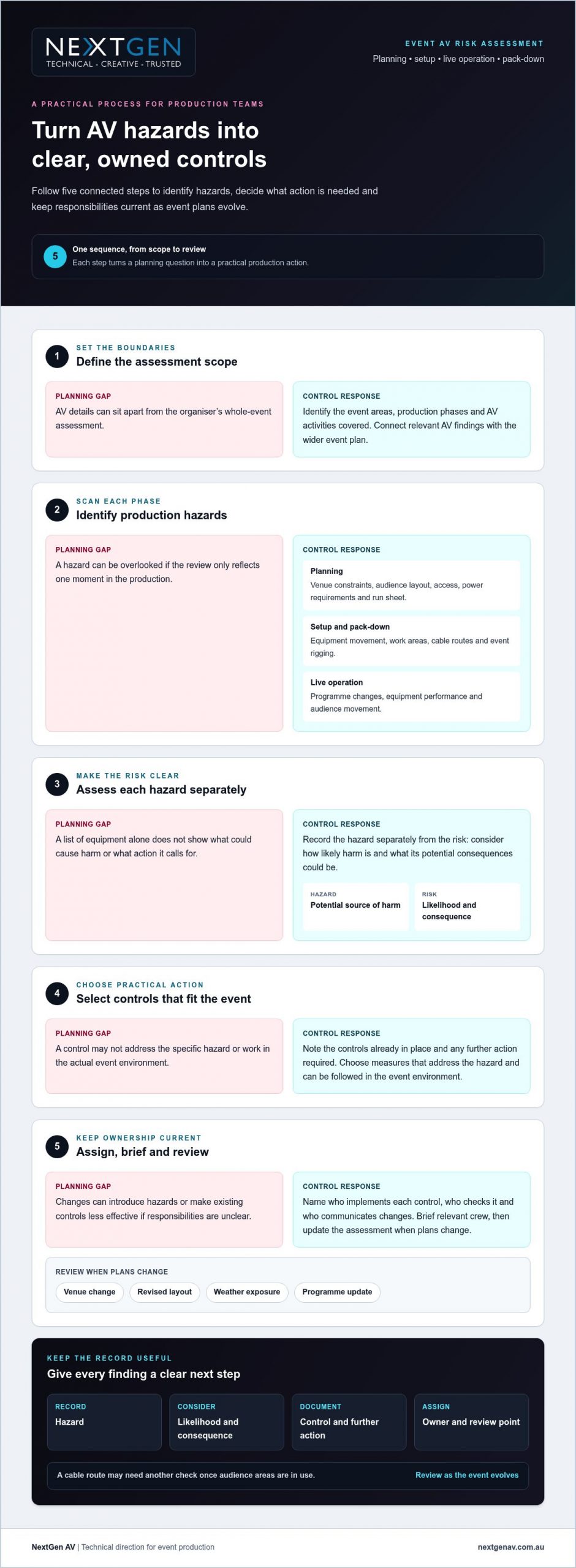
A risk assessment for event AV should follow the production from the first venue plan to the final equipment load-out. Keep the process practical and repeatable: define the scope, identify hazards, assess risk, select controls, assign owners and review. Start with the venue, audience, programme, equipment plan, access routes and schedule. These details shape how technical work fits around people and venue operations.

For each item, record what controls are already in place, what further action is needed, who is accountable and when the control will be checked. The UK Health and Safety Executive’s event guide describes planning across stages such as setup and breakdown; its outline of duties as an event organiser is a useful reference, but Australian events should be assessed against requirements that apply locally.

Identify hazards across each production phase

At planning stage, consider venue constraints, audience layout, access, power requirements and the run sheet. During setup and pack-down, assess equipment movement, work areas, cable routes and event rigging. For live operation, account for programme changes, equipment performance and audience movement. A cable route that is clear during setup, for instance, may need another check once audience areas are in use.

Turn findings into active controls

Choose controls that address the specific hazard and can be followed in the actual event environment. Name who implements each control, who checks it and who communicates changes to affected crew. Set review triggers for a venue change, revised layout, weather exposure or programme update. Brief relevant crew before work starts, then revisit the assessment when a change could alter the risk or the effectiveness of a control.

Keep the process moving

Use this sequence to guide the review:

  • Define scope: identify the event areas, production phases and AV activities covered.
  • Identify hazards: review the venue, audience, equipment and work activities phase by phase.
  • Assess risk: consider how harm could occur and its potential consequence.
  • Select controls: note existing measures and any additional action required.
  • Assign and review: name an owner and review point for each action, then update the record when plans change.

Clear technical direction can connect those actions across planning, setup and live operation. Explore how NextGen AV event production brings production planning and technical delivery together, so the team can manage changes with precision through to pack-down.

Compare AV risks and controls across common event setups

The right control depends on the room, production design and people moving through the space. An indoor conference, outdoor activation and staged production can use similar AV, but their hazards and control owners won’t necessarily be the same. This comparison helps you tailor your risk assessment for event av to the setup, while keeping clear sound, visible content and orderly audience movement in view.

Setup Example hazard Potential consequence Example control Responsible role
Indoor conference Cables cross a presenter or attendee access route Someone trips, or movement around the room is disrupted Plan cable routes away from walkways; secure and check them before doors open Production lead, with the venue contact coordinating room access
Outdoor activation Weather exposure affects equipment or the planned operating area Equipment operation or audience movement may be affected Document a weather response plan suited to the site and review it as conditions or the layout change Event organiser, with the production lead managing AV-related actions
Staging or event rigging Stage structure or suspended equipment is unsuitable for the planned production People may be exposed to harm, and the event may be interrupted Assess the structure and suspended equipment for the specific design; involve a qualified rigger where relevant and use a structural engineering certificate where applicable Production lead and relevant technical specialist

Sound, screens and power

For sound systems, assess equipment placement, cable runs and power arrangements against the venue plan. Poor placement or unclear cabling can create hazards while also compromising intelligible sound. For LED displays, consider sightlines, visibility from audience areas and signal paths, so content reaches the screen as intended without creating avoidable obstacles in production areas. Related planning considerations are covered in this LED video wall planning guide.

Use applicable technical standards and limits that have been checked for the specific work and context. AVIXA standards provide a reference point for professional AV practice; don’t assume a threshold applies without verifying the relevant standard and its scope.

Staging, rigging and outdoor conditions

Review structures, suspended equipment, access around work areas and how production activity interacts with other event operations. A structural engineering certificate or qualified rigger may be relevant depending on the structure and rigging work involved. Outdoor productions also need a documented response plan for relevant weather exposure, with controls and responsibilities clear to the team.

For further production context, see the stage and lighting hire guide. Treat each setup on its own merits: precise technical planning supports a safer working environment and a more assured experience for the audience.
Event AV Risk Assessment: Checklist for Safer Productions

Use this event AV risk assessment checklist on event day

A risk assessment for event av is most useful when the team can act on it at the venue. Treat this event-day check as a working control point, not paperwork to file away. Confirm what’s changed, who owns each action and how the team will respond if a control isn’t in place. That clarity supports a composed setup and a seamless experience for presenters and attendees.

Before crew access and setup

Before work begins, make sure the crew has the current production plan, relevant venue information and assessment. Brief everyone on work areas, communication channels and how to report a change or concern. Record any outstanding actions, identify who will resolve them and communicate the decision before setup proceeds.

  • Plans: Check the production layout and schedule against the venue’s current arrangements.
  • Responsibilities: Confirm control owners and who to notify if an action can’t be completed as planned.
  • Equipment: Inspect relevant equipment and cabling for visible damage or issues that need attention before use.
  • Work areas: Check cable management and keep access routes clear for crew and attendees.
  • Documentation: Have relevant assessment records and production documents available to the team.

Before doors open and during the event

Before attendees enter, verify that planned controls are in place and ownership remains clear. Check that access routes are unobstructed and that technical arrangements still match the approved layout. For sound planning, review the professional sound system hire guide alongside the production plan, so audio decisions support clear communication in the room.

Keep the assessment active during the programme. A revised running order, relocated equipment or changed site condition can affect an existing control. Pause to review material changes with the relevant leads, agree any new action and brief the crew who need to know.

  • Show-time review: Confirm what has changed and whether controls still suit the setup.
  • Open actions: Check unresolved items, the person responsible and the agreed next step.
  • Escalation: Ensure crew know the agreed contacts for raising a concern or seeking a decision.
  • Follow-up: Record incidents, near misses and actions using the event’s agreed process.

A disciplined check keeps technical details connected to the audience experience, from intelligible sound to clear movement through the venue. Plan your event AV production with NextGen AV, with technical direction guiding the details from setup through live operation.

How NextGen AV manages risk as part of event production

Managing AV risk takes more than supplying equipment. It takes coordinated decisions about the production design, venue conditions, crew responsibilities and live programme. NextGen AV works as a production partner, using technical direction to connect those moving parts from planning through setup, live operation and pack-down. That gives you a clear line between the controls in the assessment and the experience your audience sees and hears.

Technical planning behind the scenes

Planning starts with the event’s objectives and conditions: the venue, schedule, audience, access, staging and the AV requirements that bring the experience to life. A risk assessment for event av helps make technical considerations part of production planning, rather than a separate document disconnected from the show. Equipment choices, work areas and crew coordination can then be shaped around the specific event.

With more than 30 years of industry experience and a Melbourne base, NextGen AV brings practical knowledge of Victorian event production to projects in Melbourne and across Australia. The team’s work includes planning, technical direction, setup, live operation and pack-down, helping clients coordinate production requirements as details develop.

From assessment to confident delivery

Technical direction helps keep controls, owners and production changes aligned. As plans evolve, the production lead can coordinate relevant updates with the crew and venue contact, so the team understands what has changed and who is responsible for the next action. This joined-up approach helps technical precision support a composed show, with clear sound, visible content and a smooth experience for attendees.

Safety measures are matched to the work and event. Depending on the production, relevant planning may include a Job Safety Analysis, Test and Tag, or the involvement of a qualified rigger for applicable rigging work. NextGen AV’s safety-related capabilities also include a structural engineering certificate and High-Risk Work Licence. These are considered in context, rather than treated as a blanket checklist for every event.

From corporate events to community productions, NextGen AV delivers events throughout Australia, bringing planning and technical delivery together behind the scenes. You stay connected to decisions, responsibilities and production changes, while the technical team works to keep each detail in step with the event.

Planning an event in Melbourne or elsewhere in Australia? Discuss your event production requirements with NextGen AV and take the next step towards a carefully coordinated AV plan.

Bring your production plan together

A safer production starts with an AV assessment that reflects the actual venue, setup and audience. Identify hazards across planning, live operation and bump-out, match controls to each risk, and give every action a clear owner. Keep the process active: when plans or site conditions change, review the controls and brief the people affected.

NextGen AV brings over 30 years of industry experience, a Melbourne-based warehouse and experience delivering events throughout Australia. Technical planning may draw on capabilities such as Job Safety Analysis, Test and Tag and qualified riggers, selected to suit the work and production. With the right technical direction, your risk assessment for event av becomes part of a coordinated production plan, helping manage complexity behind the scenes while your audience enjoys a seamless event.

Plan your next event with NextGen AV and take the next step towards a carefully coordinated production. Your team can focus on delivering the moment, with the technical details guided by experienced hands.

Frequently Asked Questions

What should a risk assessment for event AV include?

A risk assessment for event AV should record the production scope, venue, audience, equipment and hazards during setup, live operation and pack-down. Include relevant elements such as sound systems, screens, cabling, staging and event rigging. For each hazard, document the assessed risk, controls already in place, further actions, accountable owners and review points. Tailor the assessment to the specific production and venue rather than relying on a generic template.

Who is responsible for an event AV risk assessment?

Responsibility should be clearly assigned across the event and production teams. The organiser, venue representative, production lead and relevant technical specialists can contribute information and coordinate controls, according to their roles in the event. Name an owner for each action, and make sure the team knows who to tell about changes or unresolved issues. Clear ownership helps prevent important controls from being lost between planning, setup and live operation.

How do you assess AV risks at an event?

Use a repeatable sequence: define the scope, identify hazards, assess likelihood and potential consequence, select controls, assign owners and review. Consider hazards during planning, setup, live operation and pack-down, using the actual venue and production details. Reassess when a significant change to the venue, schedule, equipment or production plan could affect a hazard or control. This keeps the assessment aligned with the event as it develops.

What are common AV hazards at events?

Potential AV hazards include cables across access routes, moving equipment during setup, unsuitable power arrangements, staging concerns, suspended equipment and changing site conditions. These examples won’t apply to every event. A hazard is something with the potential to cause harm; risk considers the likelihood and possible consequence. For a Melbourne venue, assess the real room layout, production plan and audience movement rather than assuming a standard setup.

When should an event AV risk assessment be reviewed?

Review the assessment during planning and before relevant work begins, then revisit it when circumstances change. A revised room layout, equipment substitution, schedule update or changed site condition may affect existing controls. Record updates, identify who owns any new actions and share the current version with the people implementing those controls. Set review points around meaningful production milestones and changes, rather than relying on an arbitrary fixed interval.

Does an AV risk assessment replace the event safety plan?

No. An AV assessment focuses on hazards connected with technical production, while broader event safety arrangements consider the event as a whole. The documents should connect where risks overlap, such as when production cabling affects attendee access. Coordinate relevant information between the organiser, venue and production team. For Melbourne events, verify any statements about specific legal or compliance requirements against current official Victorian guidance for the circumstances.

One overlooked cable run, suspended load or schedule change can put a polished production under pressure. A risk assessment for event AV gives your team a clear way to identify hazards, assign controls and keep decisions connected as plans evolve. With venues, suppliers and production timelines to coordinate, it’s understandable to worry that a technical risk or ownership gap could be missed.

This guide shows you how to build an AV-focused assessment from early planning through live operation and bump-out. You’ll learn what to consider across staging, event rigging, electrical equipment, sound systems, screens, access and changing site conditions, then turn those findings into practical controls with named owners and review points. NextGen AV brings technical direction and more than 30 years of industry experience to event production, helping teams manage complexity behind the scenes. The result is a clearer process for keeping people safer and delivering a seamless audience experience.

Key Takeaways

  • A risk assessment for event av works best as a live process, with clear steps for identifying hazards, selecting controls and reviewing changes.
  • Match controls to the production setup: indoor conferences, outdoor activations and staging or rigging each bring different considerations.
  • Set named owners for key controls so crew, venue and suppliers know who is responsible before the event goes live.
  • Use an event-day check to confirm plans are current, the crew is briefed and essential documentation is in place.
  • See how technical direction can connect production planning and live operation to support a safer, seamless audience experience.

Why an event AV risk assessment matters before production begins

AV decisions shape more than the look and sound of an event. Equipment placement, cable paths, lighting positions and stage layouts can affect crew during setup, presenters moving on stage, attendees using access routes and the venue’s operation. A risk assessment for event av makes those connections visible early, while there’s still time to adjust the production plan rather than respond under pressure on event day.

It’s a documented review of the hazards linked to the production, the risks they may create, the controls selected and the people responsible for those controls. A hazard is a potential source of harm; risk considers how likely harm is and what its consequences could be. This distinction is central to the wider risk assessment process, and helps a team move from simply listing equipment to deciding what action each hazard calls for.

An AV assessment focuses on technical production, but it should connect with the organiser’s whole-event assessment. For example, a cable route may be an AV setup detail and an access concern for the wider event plan. When both assessments share relevant information, the team can coordinate controls across production, venue operations and the audience experience.

Plans also need to stay live. A room change, revised schedule, equipment substitution or altered production layout can introduce new hazards or make existing controls less effective. Review the assessment when these details change, and make sure the people affected understand any updated responsibilities.

What does an AV risk assessment cover?

Set the assessment around the actual production and venue. Depending on the design, it may cover sound systems, lighting, LED displays, cabling, staging and event rigging. Consider where equipment will be placed, how crew will access work areas, and how the setup interacts with presenters and attendees. A Melbourne venue’s layout and operating arrangements can make the relevant details different from one production to the next.

Record each hazard separately from its likelihood and potential consequence, then document the chosen control and its owner. This keeps the assessment practical: the team can see not only what could cause harm, but what will be done about it.

Who needs to be part of the process?

Bring together the event organiser, venue contact, production lead and relevant technical specialists. Each sees a different part of the picture: the organiser understands the programme, the venue contact knows site arrangements, and technical specialists can assess production-specific hazards.

Assign a named person to each control rather than relying on general team awareness. Clear ownership gives crew a direct point of reference during setup and live operation, helping changes and concerns reach the right person without confusion.

How to assess event AV hazards from planning through pack-down

A risk assessment for event AV should follow the production from the first venue plan to the final equipment load-out. Keep the process practical and repeatable: define the scope, identify hazards, assess risk, select controls, assign owners and review. Start with the venue, audience, programme, equipment plan, access routes and schedule. These details shape how technical work fits around people and venue operations.

For each item, record what controls are already in place, what further action is needed, who is accountable and when the control will be checked. The UK Health and Safety Executive’s event guide describes planning across stages such as setup and breakdown; its outline of duties as an event organiser is a useful reference, but Australian events should be assessed against requirements that apply locally.

Identify hazards across each production phase

At planning stage, consider venue constraints, audience layout, access, power requirements and the run sheet. During setup and pack-down, assess equipment movement, work areas, cable routes and event rigging. For live operation, account for programme changes, equipment performance and audience movement. A cable route that is clear during setup, for instance, may need another check once audience areas are in use.

Turn findings into active controls

Choose controls that address the specific hazard and can be followed in the actual event environment. Name who implements each control, who checks it and who communicates changes to affected crew. Set review triggers for a venue change, revised layout, weather exposure or programme update. Brief relevant crew before work starts, then revisit the assessment when a change could alter the risk or the effectiveness of a control.

Keep the process moving

Use this sequence to guide the review:

  • Define scope: identify the event areas, production phases and AV activities covered.
  • Identify hazards: review the venue, audience, equipment and work activities phase by phase.
  • Assess risk: consider how harm could occur and its potential consequence.
  • Select controls: note existing measures and any additional action required.
  • Assign and review: name an owner and review point for each action, then update the record when plans change.

Clear technical direction can connect those actions across planning, setup and live operation. Explore how NextGen AV event production brings production planning and technical delivery together, so the team can manage changes with precision through to pack-down.

Compare AV risks and controls across common event setups

The right control depends on the room, production design and people moving through the space. An indoor conference, outdoor activation and staged production can use similar AV, but their hazards and control owners won’t necessarily be the same. This comparison helps you tailor your risk assessment for event av to the setup, while keeping clear sound, visible content and orderly audience movement in view.

Setup Example hazard Potential consequence Example control Responsible role
Indoor conference Cables cross a presenter or attendee access route Someone trips, or movement around the room is disrupted Plan cable routes away from walkways; secure and check them before doors open Production lead, with the venue contact coordinating room access
Outdoor activation Weather exposure affects equipment or the planned operating area Equipment operation or audience movement may be affected Document a weather response plan suited to the site and review it as conditions or the layout change Event organiser, with the production lead managing AV-related actions
Staging or event rigging Stage structure or suspended equipment is unsuitable for the planned production People may be exposed to harm, and the event may be interrupted Assess the structure and suspended equipment for the specific design; involve a qualified rigger where relevant and use a structural engineering certificate where applicable Production lead and relevant technical specialist

Sound, screens and power

For sound systems, assess equipment placement, cable runs and power arrangements against the venue plan. Poor placement or unclear cabling can create hazards while also compromising intelligible sound. For LED displays, consider sightlines, visibility from audience areas and signal paths, so content reaches the screen as intended without creating avoidable obstacles in production areas. Related planning considerations are covered in this LED video wall planning guide.

Use applicable technical standards and limits that have been checked for the specific work and context. AVIXA standards provide a reference point for professional AV practice; don’t assume a threshold applies without verifying the relevant standard and its scope.

Staging, rigging and outdoor conditions

Review structures, suspended equipment, access around work areas and how production activity interacts with other event operations. A structural engineering certificate or qualified rigger may be relevant depending on the structure and rigging work involved. Outdoor productions also need a documented response plan for relevant weather exposure, with controls and responsibilities clear to the team.

For further production context, see the stage and lighting hire guide. Treat each setup on its own merits: precise technical planning supports a safer working environment and a more assured experience for the audience.

Use this event AV risk assessment checklist on event day

A risk assessment for event av is most useful when the team can act on it at the venue. Treat this event-day check as a working control point, not paperwork to file away. Confirm what’s changed, who owns each action and how the team will respond if a control isn’t in place. That clarity supports a composed setup and a seamless experience for presenters and attendees.

Before crew access and setup

Before work begins, make sure the crew has the current production plan, relevant venue information and assessment. Brief everyone on work areas, communication channels and how to report a change or concern. Record any outstanding actions, identify who will resolve them and communicate the decision before setup proceeds.

  • Plans: Check the production layout and schedule against the venue’s current arrangements.
  • Responsibilities: Confirm control owners and who to notify if an action can’t be completed as planned.
  • Equipment: Inspect relevant equipment and cabling for visible damage or issues that need attention before use.
  • Work areas: Check cable management and keep access routes clear for crew and attendees.
  • Documentation: Have relevant assessment records and production documents available to the team.

Before doors open and during the event

Before attendees enter, verify that planned controls are in place and ownership remains clear. Check that access routes are unobstructed and that technical arrangements still match the approved layout. For sound planning, review the professional sound system hire guide alongside the production plan, so audio decisions support clear communication in the room.

Keep the assessment active during the programme. A revised running order, relocated equipment or changed site condition can affect an existing control. Pause to review material changes with the relevant leads, agree any new action and brief the crew who need to know.

  • Show-time review: Confirm what has changed and whether controls still suit the setup.
  • Open actions: Check unresolved items, the person responsible and the agreed next step.
  • Escalation: Ensure crew know the agreed contacts for raising a concern or seeking a decision.
  • Follow-up: Record incidents, near misses and actions using the event’s agreed process.

A disciplined check keeps technical details connected to the audience experience, from intelligible sound to clear movement through the venue. Plan your event AV production with NextGen AV, with technical direction guiding the details from setup through live operation.

How NextGen AV manages risk as part of event production

Managing AV risk takes more than supplying equipment. It takes coordinated decisions about the production design, venue conditions, crew responsibilities and live programme. NextGen AV works as a production partner, using technical direction to connect those moving parts from planning through setup, live operation and pack-down. That gives you a clear line between the controls in the assessment and the experience your audience sees and hears.

Technical planning behind the scenes

Planning starts with the event’s objectives and conditions: the venue, schedule, audience, access, staging and the AV requirements that bring the experience to life. A risk assessment for event av helps make technical considerations part of production planning, rather than a separate document disconnected from the show. Equipment choices, work areas and crew coordination can then be shaped around the specific event.

With more than 30 years of industry experience and a Melbourne base, NextGen AV brings practical knowledge of Victorian event production to projects in Melbourne and across Australia. The team’s work includes planning, technical direction, setup, live operation and pack-down, helping clients coordinate production requirements as details develop.

From assessment to confident delivery

Technical direction helps keep controls, owners and production changes aligned. As plans evolve, the production lead can coordinate relevant updates with the crew and venue contact, so the team understands what has changed and who is responsible for the next action. This joined-up approach helps technical precision support a composed show, with clear sound, visible content and a smooth experience for attendees.

Safety measures are matched to the work and event. Depending on the production, relevant planning may include a Job Safety Analysis, Test and Tag, or the involvement of a qualified rigger for applicable rigging work. NextGen AV’s safety-related capabilities also include a structural engineering certificate and High-Risk Work Licence. These are considered in context, rather than treated as a blanket checklist for every event.

From corporate events to community productions, NextGen AV delivers events throughout Australia, bringing planning and technical delivery together behind the scenes. You stay connected to decisions, responsibilities and production changes, while the technical team works to keep each detail in step with the event.

Planning an event in Melbourne or elsewhere in Australia? Discuss your event production requirements with NextGen AV and take the next step towards a carefully coordinated AV plan.

Bring your production plan together

A safer production starts with an AV assessment that reflects the actual venue, setup and audience. Identify hazards across planning, live operation and bump-out, match controls to each risk, and give every action a clear owner. Keep the process active: when plans or site conditions change, review the controls and brief the people affected.

NextGen AV brings over 30 years of industry experience, a Melbourne-based warehouse and experience delivering events throughout Australia. Technical planning may draw on capabilities such as Job Safety Analysis, Test and Tag and qualified riggers, selected to suit the work and production. With the right technical direction, your risk assessment for event av becomes part of a coordinated production plan, helping manage complexity behind the scenes while your audience enjoys a seamless event.

Plan your next event with NextGen AV and take the next step towards a carefully coordinated production. Your team can focus on delivering the moment, with the technical details guided by experienced hands.

Frequently Asked Questions

What should a risk assessment for event AV include?

A risk assessment for event AV should record the production scope, venue, audience, equipment and hazards during setup, live operation and pack-down. Include relevant elements such as sound systems, screens, cabling, staging and event rigging. For each hazard, document the assessed risk, controls already in place, further actions, accountable owners and review points. Tailor the assessment to the specific production and venue rather than relying on a generic template.

Who is responsible for an event AV risk assessment?

Responsibility should be clearly assigned across the event and production teams. The organiser, venue representative, production lead and relevant technical specialists can contribute information and coordinate controls, according to their roles in the event. Name an owner for each action, and make sure the team knows who to tell about changes or unresolved issues. Clear ownership helps prevent important controls from being lost between planning, setup and live operation.

How do you assess AV risks at an event?

Use a repeatable sequence: define the scope, identify hazards, assess likelihood and potential consequence, select controls, assign owners and review. Consider hazards during planning, setup, live operation and pack-down, using the actual venue and production details. Reassess when a significant change to the venue, schedule, equipment or production plan could affect a hazard or control. This keeps the assessment aligned with the event as it develops.

What are common AV hazards at events?

Potential AV hazards include cables across access routes, moving equipment during setup, unsuitable power arrangements, staging concerns, suspended equipment and changing site conditions. These examples won’t apply to every event. A hazard is something with the potential to cause harm; risk considers the likelihood and possible consequence. For a Melbourne venue, assess the real room layout, production plan and audience movement rather than assuming a standard setup.

When should an event AV risk assessment be reviewed?

Review the assessment during planning and before relevant work begins, then revisit it when circumstances change. A revised room layout, equipment substitution, schedule update or changed site condition may affect existing controls. Record updates, identify who owns any new actions and share the current version with the people implementing those controls. Set review points around meaningful production milestones and changes, rather than relying on an arbitrary fixed interval.

Does an AV risk assessment replace the event safety plan?

No. An AV assessment focuses on hazards connected with technical production, while broader event safety arrangements consider the event as a whole. The documents should connect where risks overlap, such as when production cabling affects attendee access. Coordinate relevant information between the organiser, venue and production team. For Melbourne events, verify any statements about specific legal or compliance requirements against current official Victorian guidance for the circumstances.

Back to Articles

Discover Valuable Insights

Unlock Expert Tips and Advice

Our blog is packed with valuable information to help you stay ahead. Whether you’re looking for expert advice, industry trends, or practical tips, you’ll find everything you need. Reach out today to learn more or get in touch with us for personalised support!

Contact Us

Request A Quote

Make an
Enquiry

Let’s Get Your Event Sorted

Complete the enquiry form with your event date, venue, audience size, event type and budget. Our Melbourne AV team will review your requirements and recommend the right PA, screen, lighting, staging or production setup for your event.

What happens next?


1.We review your event details
Tell us your date, venue, audience size and event type.

2.We recommend the right setup
From PA hire to screens, lighting, staging and full AV production.

3. We come back with clear advice
You’ll receive practical recommendations and a fast quote from our Melbourne team.

Need help urgently?
Call 1300 792 922.

Resource Download

Tell us a bit about yourself to download our resources.

7