



A flawless live stream isn’t the result of good luck. It’s the product of a technical architecture that assumes everything will go wrong. When you’re orchestrating a high-stakes corporate broadcast in Melbourne, the stakes are too high to rely on a single internet connection or consumer-grade gear. If you’ve ever felt the cold sweat of a stuttering video feed or watched a critical keynote ruined by poor audio quality, you know that avoiding common live stream failures is the difference between a professional triumph and a public technical embarrassment.
We understand the immense pressure of delivering a seamless hybrid experience where there’s no room for error. You want the confidence that comes from a bulletproof technical plan, ensuring your stream remains stable even when the venue’s infrastructure fails. This 2026 guide reveals how to eliminate technical glitches through professional redundancy strategies and elite technical direction. We’ll show you how to transform a risky broadcast into a prestigious digital event, moving from the logistical grind to a polished result that commands respect.
Key Takeaways
- Learn why a “redundancy first” mindset is the only way to protect your corporate reputation and ensure a flawless broadcast in high-stakes environments.
- Discover how to master the “Big Three” technical pillars—connectivity, audio, and power—to keep your audience engaged and eliminate frequent points of friction.
- Understand the critical role of technical direction in avoiding common live stream failures and maintaining a cinematic flow throughout your entire event.
- Implement professional failover strategies, such as network bonding, to achieve 99.9% uptime even when venue infrastructure proves unreliable.
- Find out how partnering with Melbourne-based experts allows you to focus on your presentation while “invisible experts” orchestrate the technical complexity behind the scenes.
The High Stakes of Live Stream Failures in 2026
The threshold for digital tolerance has never been lower. In the mid-2020s, your audience no longer views a live stream as a secondary convenience; they treat it as the primary window into your brand’s soul. Relying on a “good enough” approach is a gamble with your professional standing. A single buffer wheel or a desynced audio track doesn’t just annoy viewers. It actively erodes the trust you’ve spent years building with stakeholders. Avoiding common live stream failures is the only way to ensure your message arrives with the prestige it deserves, turning a standard update into a cinematic experience.
Beyond the Glitch: The Reputation Risk
A technical failure is never private. In our hyper-connected digital environment, a botched broadcast becomes an immediate talking point in the social media echo chamber. Stakeholders and industry peers don’t see a faulty cable; they see an organisation that wasn’t prepared for the big stage. This perception of incompetence can lead to immediate audience churn and long-term brand damage that’s far more expensive than any technical setup. Investing in full service event production acts as a vital insurance policy. It guarantees that the sophisticated nuances of streaming media technology are handled with precision, allowing you to focus on your delivery while we secure the signal.
Why DIY is a Risky Business for Major Events
The temptation to use internal resources or consumer-grade hardware is high, yet the risks are often catastrophic for high-stakes corporate events. Professional broadcasts require more than just a fast internet connection. They demand a resilient architecture that consumer tools simply cannot provide. DIY setups often fall victim to several hidden vulnerabilities:
- Thermal failure: Consumer cameras and basic encoders often overheat during long sessions, causing sudden shutdowns without warning.
- Network bottlenecks: Standard office Wi-Fi or residential-grade routers aren’t designed to handle the sustained, high-bandwidth demands of a high-definition upload.
- Audio degradation: Integrated microphones pick up room echo and ambient noise, which ruins the viewer experience faster than any visual lag.
Avoiding common live stream failures requires moving past the DIY mindset. Real technical mastery involves managing the entire signal path with an “Invisible Expert” at the helm. This proactive approach identifies hidden bottlenecks before they manifest as on-screen disasters, ensuring your event remains a seamless, high-stakes triumph that commands respect.
The “Big Three” Technical Pitfalls: Connectivity, Audio, and Power
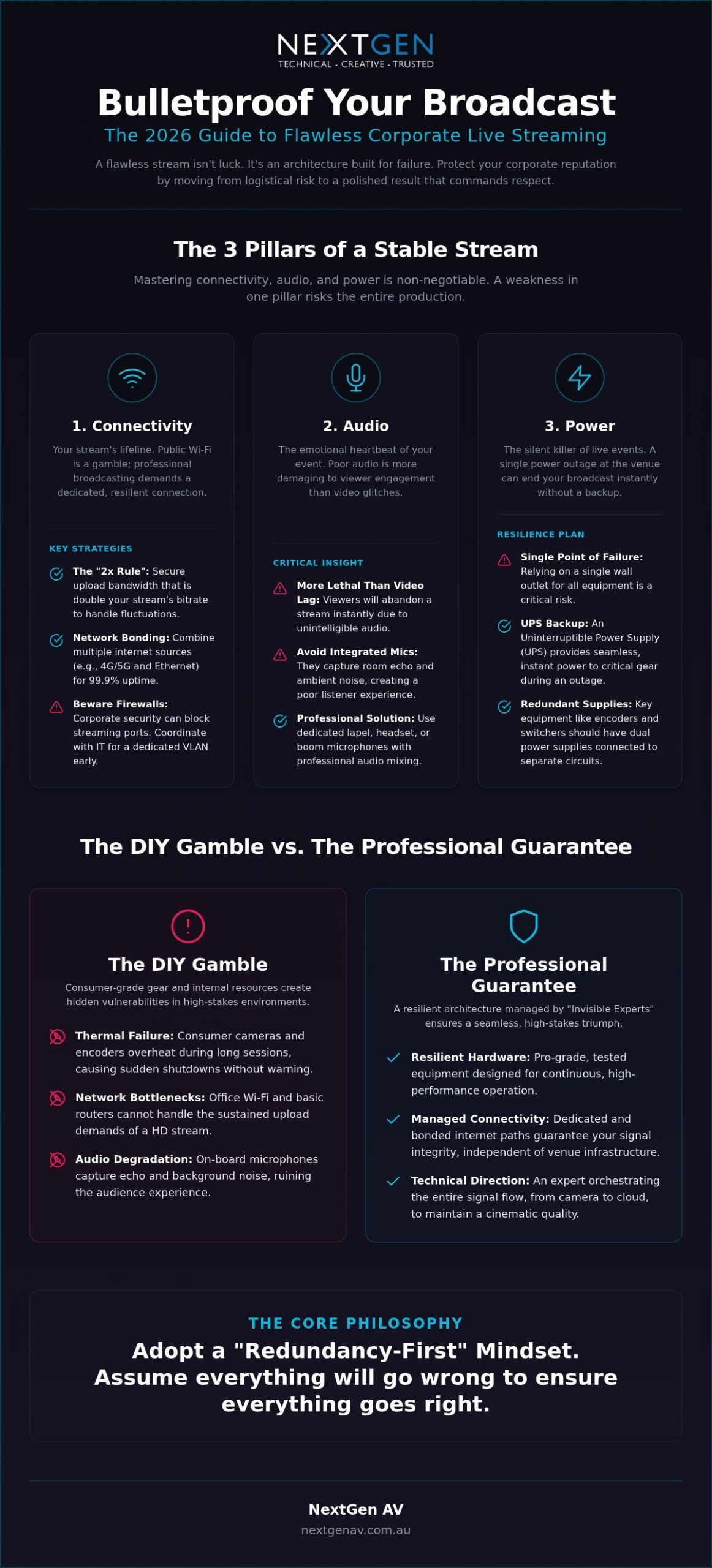
Precision in live streaming isn’t just about the resolution of your cameras. It’s about the invisible infrastructure supporting every frame. Avoiding common live stream failures requires a meticulous focus on the three pillars that hold a broadcast together: stable connectivity, pristine audio, and redundant power. When one of these foundations trembles, the entire production is at risk of a total collapse, leaving your audience staring at a frozen screen or, worse, a silent one.
The Upload Speed Trap and Corporate Firewalls
Many organisers mistake a fast download speed for a viable streaming connection. For a professional broadcast, upload speed is the only metric that matters. We recommend the “2x rule,” which dictates that your dedicated upload bandwidth should be double the bitrate of your stream to account for fluctuations. Relying on public venue WiFi is never an option. These networks are notoriously unstable and lack the security protocols required for high-stakes data transmission.
The most frequent hurdle in corporate environments is the firewall. Modern security systems are designed to block the very ports required for professional technical direction to push a signal to the cloud. You must coordinate with IT teams early to organise port whitelisting or, ideally, secure a dedicated VLAN. This isolated network ensures that your stream doesn’t compete with the venue’s internal traffic, eliminating the risk of sudden drops caused by unrelated office activity.
Why Audio Failures are More Lethal Than Video Glitches
Viewers are surprisingly forgiving of a momentary dip in video quality, but they’ll abandon a stream instantly if the audio becomes unintelligible. Audio is the emotional heartbeat of your presentation. Poor signal-to-noise ratios, room echo, and distracting background hums are the primary dealbreakers that ruin the virtual attendee’s experience. Integrating professional sound system hire into your plan ensures that every word is captured with absolute clarity, regardless of the venue’s acoustics.
Sync issues present another significant risk. There’s nothing more distracting than watching a speaker’s mouth move while the sound follows a second later. This latency often occurs when audio and video take different processing paths. Our hybrid event staging solutions use hardware-based delays to align these signals perfectly before they ever hit the encoder. By managing the signal path with precision, you eliminate the awkward disconnect that makes a broadcast feel amateur, ensuring your audience remains fully immersed in the content rather than the technical flaws.
Planning and Technical Direction: The Invisible Fail Points
Technical mastery involves more than just plugging in cables. It’s about the orchestration of every moving part before the first frame ever reaches the viewer. Many organisations fall into the trap of “winging it,” assuming that a basic understanding of the hardware will suffice. This lack of structure leads to the most visible symptoms of a failing production: awkward silences, missed cues, and the dreaded “dead air.” Avoiding common live stream failures starts long before the “Go Live” button is pressed; it begins in the meticulous pre-production phase where every variable is accounted for.
A Technical Director acts as the silent engine behind the scenes. They manage the complex interplay between audio feeds, video switchers, and graphic overlays, ensuring that the transition from a keynote speaker to a slide deck is seamless. Without this central authority, the production lacks a cohesive rhythm, leaving the audience feeling disconnected. Professional technical direction transforms a series of isolated segments into a cinematic narrative, allowing your brand to project absolute competence and reliability.
The Crucial Role of the Run Sheet
A run sheet is the technical script that keeps your event on track. It maps every transition, graphic overlay, and speaker change with surgical precision. By time-coding your event, you create a professional rhythm that keeps the audience engaged. This document is vital for communicating cues between the on-site team and remote presenters, ensuring that everyone knows exactly when to speak and when to pause. A well-crafted run sheet eliminates the guesswork, providing a “bulletproof” roadmap that prevents the logistical grind from overshadowing the final result.
Managing Multi-Camera Complexity
Static shots are the fastest way to lose an audience’s attention. In the mid-2020s, viewers expect a dynamic visual experience that mirrors professional television broadcasts. Integrating multiple camera angles adds depth and energy, but it also increases the technical overhead. You must ensure visual consistency across different camera sensors and lighting setups to maintain a prestigious aesthetic. Managing this complexity, especially when integrating remote speakers via low-latency links, requires a proactive team that understands how to balance technical precision with creative artistry. This level of detail is what separates a basic webinar from a high-stakes corporate broadcast. To see how a dedicated space can be optimised for such high-quality performance, you can check out Book a DJ Studio as an example of a professional studio environment.
High-stakes broadcasts demand a “No Single Point of Failure” philosophy. This isn’t just technical jargon; it’s a commitment to your brand’s integrity. When you’re avoiding common live stream failures, you must assume that every piece of hardware and every byte of data is capable of failing at the most critical moment. By building layers of redundancy into your signal path, you ensure that the audience’s experience remains uninterrupted, even if the primary infrastructure falters. This proactive approach transforms a risky transmission into a stable, prestigious digital event.
Network Bonding and Backup Internet Solutions
A single internet connection is a liability. True network bonding represents the gold standard for corporate streaming, as it merges multiple sources, such as venue fibre, 4G/5G cellular, and even Starlink, into one resilient data pipe. Unlike basic “load balancing,” which simply switches between connections, true bonding treats these sources as a single entity. If the venue’s fibre line is accidentally severed or experiences a sudden brownout, the system continues to transmit over the cellular and satellite links without a single dropped frame.
This seamless handover is the invisible hero of a successful event. It provides 99.9% uptime, giving you the peace of mind to focus on your presentation while the technology handles the heavy lifting. For Melbourne event planners, this level of security is essential, especially in heritage buildings or temporary structures where connectivity can be notoriously temperamental. By orchestrating a bonded network, you eliminate the stress of unreliable venue internet and project absolute technical competence.
Hardware Failover: The Professional Safety Net
Redundancy must extend beyond the internet. Running primary and secondary encoders in parallel ensures that if a hardware component fails, the backup is already live and transmitting. Failover Redundancy is the simultaneous transmission of two identical streams to ensure zero downtime. This dual-path strategy, combined with an Uninterruptible Power Supply (UPS) to guard against venue power surges, creates a technical environment where failure is effectively engineered out of the equation.
If the unthinkable happens and the entire signal path is lost, a professional setup includes pre-programmed failover slates. These branded graphics inform the audience that you’re aware of the issue and are working to resolve it, maintaining a level of professionalism that a black screen never could. To ensure your next broadcast is supported by this elite level of protection, partner with our Melbourne-based technical team to architect a truly bulletproof solution.
Orchestrating Flawless Hybrid Experiences with NextGen AV
Mastering a high-stakes broadcast requires more than just a checklist; it demands a partner who understands the intricate pulse of live production. With over 30 years of industry experience, NextGen AV has refined the art of “invisible expertise.” We don’t just provide equipment; we architect experiences that allow you to step into the spotlight with absolute poise. Avoiding common live stream failures is a standard we achieve through meticulous planning and a deep familiarity with Melbourne’s premier corporate venues. From the soaring ceilings of the CBD’s heritage halls to the sleek acoustics of modern convention centres, we tailor our technical rigs to the unique demands of each space.
Our hardware advantage is built on professional-grade technology designed for the rigours of the 2026 event landscape. We deploy high-resolution LED Video Walls that command attention and Professional Audio Systems that ensure every syllable carries weight. By choosing elite hardware over consumer alternatives, we eliminate the thermal failures and signal degradation that plague amateur setups. This commitment to quality ensures that your visual and auditory presence is as prestigious as your brand’s reputation.
Expert Technical Direction for Melbourne Events
The human element is the ultimate backup. Our on-site engineers act as the “Confident Orchestrator,” managing the complex signal paths that define modern hybrid events. We specialise in the nuances of hybrid Q&A and real-time audience engagement, ensuring that remote participants feel as valued as those in the room. This level of technical direction bridges the gap between two worlds, creating a unified experience that feels natural rather than forced. Our team thrives under the pressure of live environments, proactively identifying potential friction points before they can impact your broadcast.
The NextGen AV Guarantee: Reliability by Design
Reliability isn’t a happy accident. It’s the result of rigorous pre-event testing and exhaustive sound check protocols that leave nothing to chance. We leverage the latest in 2026 streaming technology, including sophisticated bonding hardware that secures your connection across multiple data paths. This “Reliability by Design” philosophy means we’ve already solved the problems that haven’t even happened yet. You can focus on your delivery and the impact of your message, knowing that a seasoned Melbourne-based team is securing every frame behind the scenes.
Enquire about our live streaming services for your next Melbourne event and discover how we can transform your broadcast into a bulletproof professional triumph.
Master the Art of the Flawless Broadcast
Success in the high-stakes world of corporate events requires shifting from a “hope for the best” mindset to one of total technical redundancy. We’ve explored how implementing network bonding and professional failover strategies ensures your signal remains unbroken, regardless of venue limitations. By prioritising expert technical direction and high-end hardware, avoiding common live stream failures becomes a calculated outcome rather than a matter of luck. This proactive approach allows you to move past logistical stress and focus entirely on the prestige of your final result.
With over 30 years of technical production experience, our team provides the “invisible expertise” needed to orchestrate complex hybrid events with surgical precision. We offer redundant network bonding as standard and provide expert on-site technical directors to navigate every challenge in real time. Partner with Melbourne’s AV experts for a flawless live stream and ensure your next digital event is remembered for its impact, not its interruptions. Your vision deserves a platform that’s as reliable as your message.
Frequently Asked Questions
What is the most common reason for a live stream to fail?
The most common reason for a live stream to fail is insufficient upload bandwidth paired with a lack of connection redundancy. Many organisers rely on a single, shared venue network that cannot handle the sustained data throughput required for high-definition video. Avoiding common live stream failures necessitates a dedicated, isolated connection. Without this, even minor fluctuations in traffic can cause the stream to buffer or drop entirely, ruining the experience for your virtual audience.
How much upload speed do I actually need for a 1080p live stream?
For a consistent 1080p live stream, you need a dedicated upload speed of at least 10 to 15 Mbps. While a standard 1080p stream typically uses 4 to 6 Mbps, professional standards dictate a “2x headroom” to accommodate network spikes. We recommend testing your connection specifically for upload stability, as residential and corporate plans often prioritise download speeds. Having this buffer ensures your high-stakes broadcast remains sharp and stutter-free throughout the entire presentation.
What happens if the venue internet goes down during my event?
If the venue internet goes down, a professional setup will automatically switch to a secondary source without the audience noticing. This is achieved through failover systems that run primary and secondary internet lines in parallel. By using multiple carriers and diverse technologies like 5G or satellite, you create a safety net that protects your event. Without this redundancy, a single ISP outage can lead to a total broadcast collapse and significant reputational damage.
Why is my live stream audio out of sync with the video?
Live stream audio usually falls out of sync because of the different processing times required for video and sound signals. Video data is much heavier and takes longer to encode, often resulting in the audio arriving earlier than the visual. Professional technical direction solves this by using hardware-based delay units to align the signals perfectly. Correcting these sync issues is vital for avoiding common live stream failures, as even a slight disconnect can distract and alienate your viewers.
Can I live stream from a corporate office with a strict firewall?
You can live stream from a corporate office, but it requires early coordination with your IT department to navigate strict firewalls. Most corporate networks block the RTMP ports used by streaming software to prevent unauthorised data transmission. To ensure a smooth broadcast, you’ll need to whitelist specific ports or establish a dedicated VLAN. This isolation prevents the stream from being throttled by security protocols and ensures it doesn’t compete with the office’s daily digital traffic.
What is network bonding and do I need it for my event?
Network bonding is a technology that merges multiple internet sources into a single, robust data pipe. It’s essential for high-stakes Melbourne events where venue connectivity might be temperamental. Unlike simple switching, bonding uses all connections simultaneously, providing cumulative bandwidth and instantaneous failover. If one source drops out, the others carry the load seamlessly. It’s the most reliable way to guarantee 99.9% uptime and deliver a prestigious, glitch-free experience to your digital attendees.
Is it better to use a hardware encoder or a software-based streaming app?
A dedicated hardware encoder is superior to a software-based app for professional corporate events. Software encoders rely on the host computer’s CPU, which can struggle under the heavy processing load or crash because of background updates. Hardware encoders are purpose-built machines designed solely for high-performance streaming. They offer superior thermal management and stability, ensuring your broadcast remains live and stable even during lengthy sessions that would cause a standard laptop to overheat.
How do I manage a live stream for a hybrid event in Melbourne?
Managing a hybrid event in Melbourne requires a sophisticated blend of on-site technical direction and high-end AV hardware. You need to balance the experience for both the physical audience and the virtual viewers through integrated audio systems and multi-camera setups. Partnering with a local team that understands the specific acoustics and infrastructure of Melbourne’s premier venues is the best way to ensure seamless execution. This collaborative approach allows you to focus on your content while experts handle the technical complexity.
Discover Valuable Insights
Unlock Expert Tips and Advice
Our blog is packed with valuable information to help you stay ahead. Whether you’re looking for expert advice, industry trends, or practical tips, you’ll find everything you need. Reach out today to learn more or get in touch with us for personalised support!