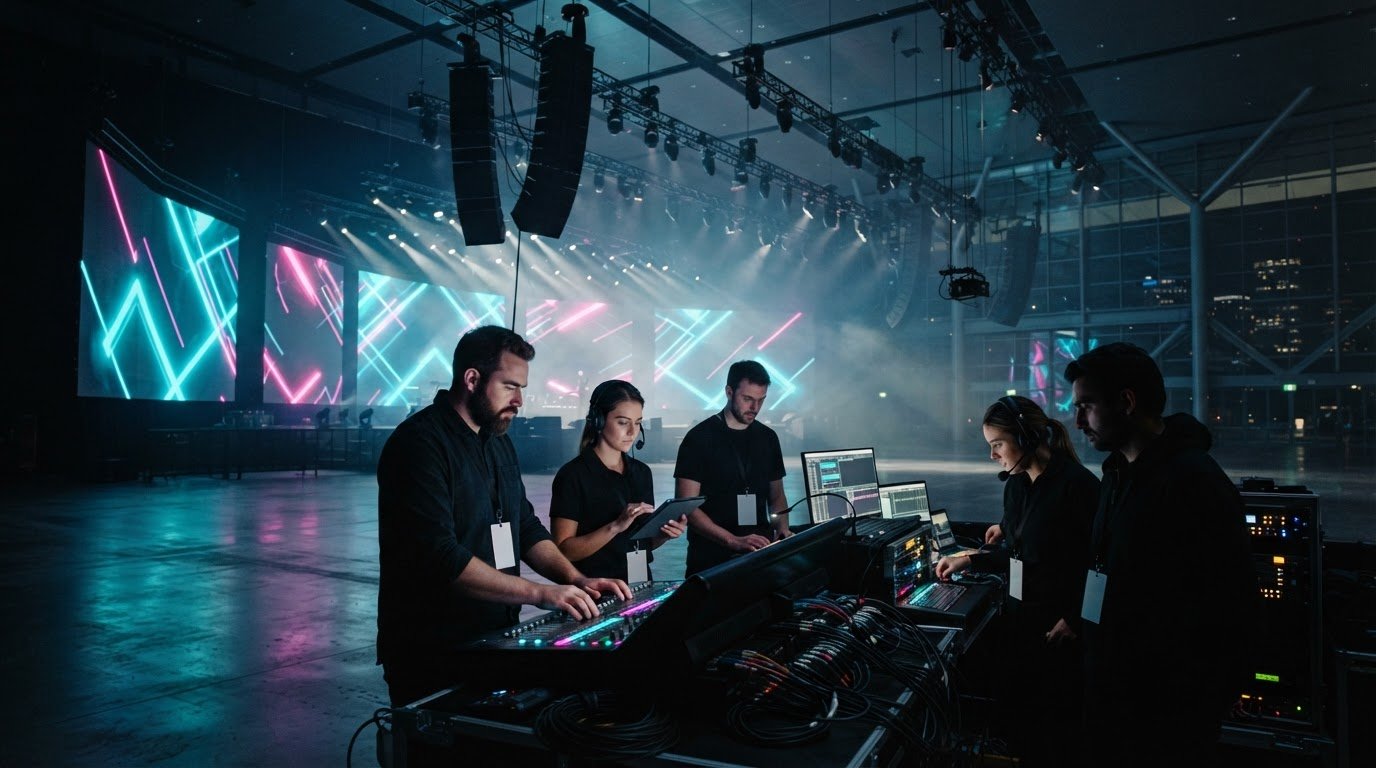
For av equipment rental for large venues, the goal is not simply to bring in more equipment. It is to engineer a production that works as one system. In a vast room, powerful sound alone will not prevent dead spots, and a large screen will not impress if its content appears pixelated. Audio coverage, image clarity, rigging and crew coordination all need to suit the venue.
Planning AV for a large venue can feel daunting when you are responsible for an experience that must reach every attendee and run smoothly. NextGen AV brings more than 30 years of event production experience in Melbourne to the planning, technical direction and delivery behind the scenes, so you can focus on your guests and event objectives.
This guide explains how to plan sound systems for even coverage, select LED screens that deliver visual impact at scale, and account for event rigging and technical labour from the outset. You will also learn how a proactive AV partner can manage venue complexities with precision, helping transform a large space into a seamless event experience.
Key Takeaways
- Large-venue AV calls for carefully designed systems that deliver clear sound and compelling visuals across the room.
- LED wall pixel pitch and speaker configuration both shape the audience experience.
- A technical site survey helps identify power and rigging requirements before production begins.
- Look beyond equipment to technical direction and coordinated event delivery when planning AV for a large venue.
- NextGen AV’s Melbourne experience supports precise planning for high-impact events.
Scaling Up: Unique AV Challenges for Large Venues
For practical planning, large-venue AV means systems designed to serve 500 or more attendees across an expansive space. That could be a conference at the Melbourne Convention and Exhibition Centre (MCEC), a high-ceilinged hall or an outdoor event area. The challenge is not simply increasing volume or screen size. Audio, visuals and signal paths need to be designed around the venue so every part of the audience can follow the event clearly.
Acoustic Complexity in Expansive Spaces
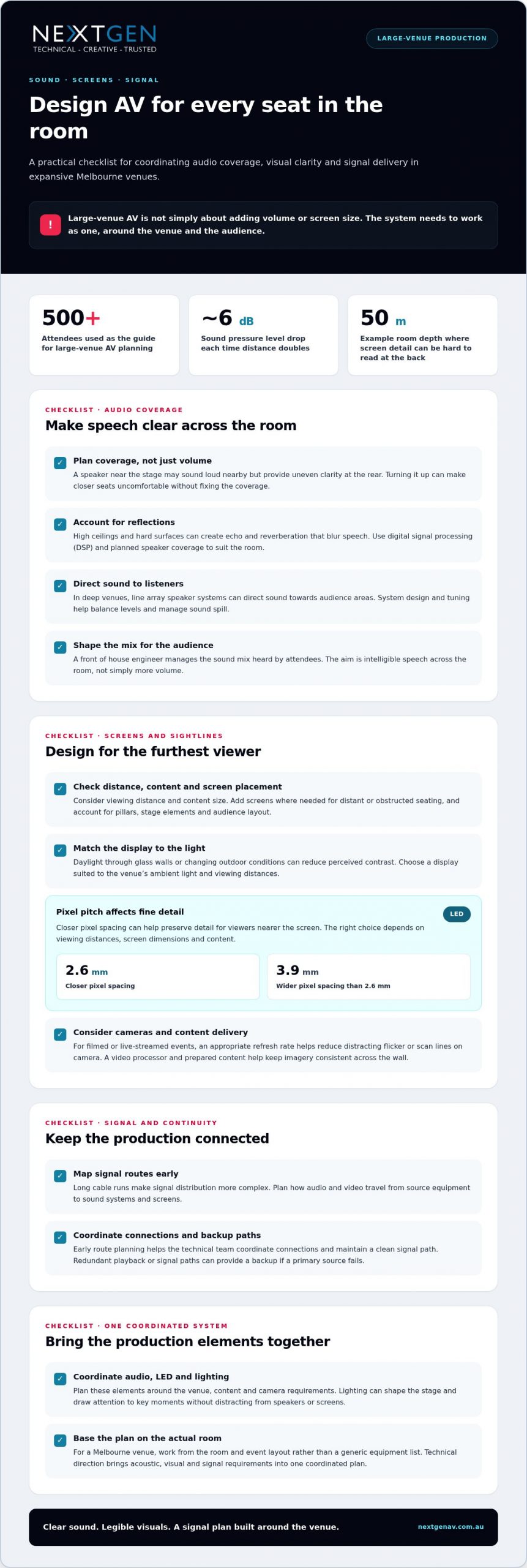
Sound spreads as it travels. In a free field, the inverse square law means sound intensity falls as distance from a source increases. Sound pressure level drops by about 6 dB each time the distance doubles. A speaker placed at the front may sound loud near the stage yet fail to provide consistent clarity at the rear. Raising the volume can make nearby seats uncomfortable without fixing uneven coverage.
High ceilings and hard surfaces in convention centres can reflect sound, creating echo and reverberation that blur speech. Digital signal processing (DSP) helps shape and manage the audio system for the room, while planned speaker coverage directs sound towards listeners rather than relying on brute force. Specialist professional audio equipment is designed for live performance and event environments, unlike consumer-grade systems intended for smaller listening spaces. The aim is intelligible speech across the room, not simply more volume.
Visual Sightlines and Scale
In a room stretching 50 metres, a screen that looks impressive near the stage can leave text and detail difficult to read at the back. Plan for the furthest viewer: consider viewing distance, content size and whether additional screens are needed for distant or obstructed seating. Place screens with the room’s sightlines in mind, so pillars, stage elements and audience layout do not compromise the view.
Ambient light matters too. Daylight through glass walls or changing conditions at an outdoor stadium can reduce the perceived contrast of projected images. A display suited to the venue’s light and viewing distances helps keep presentations, graphics and live content legible. For a Melbourne venue, base the AV plan on the actual room and event layout rather than a generic equipment list.
Signal integrity is another large-room consideration. Long cable runs make signal distribution more complex, so the production plan needs to account for how video and audio travel from source equipment to screens and sound systems. Mapping those routes early helps the technical team coordinate connections, maintain a clean signal path and reduce avoidable disruptions. Technical direction brings acoustic, visual and signal requirements into one coordinated plan, giving your event a stronger foundation before production begins.
Essential Hardware for Massive Impact: LED Walls and Audio
Large-scale production depends on selecting technology as a coordinated system, not as a collection of impressive individual pieces. LED walls, professional audio systems, lighting and backup signal paths all shape what the audience sees and hears. Technical direction brings these elements together around the venue, content and camera requirements.
LED Technology: The Gold Standard for Visuals
Pixel pitch is the distance between the centres of neighbouring pixels. A 2.6mm pitch packs pixels more closely than a 3.9mm pitch, which can help preserve fine detail for viewers closer to the screen. The right choice depends on viewing distances, screen dimensions and content. For guidance on planning large-format displays, explore LED video walls for events.
LED panels can maintain strong brightness and contrast in ambient light, making them suited to rooms where daylight may affect projection. For events filmed or live-streamed, refresh rate matters too. An appropriate display setup helps reduce distracting flicker or scan lines on camera. A video processor and carefully prepared content complete the chain, keeping imagery consistent across the wall.
Pro Audio: Line Arrays and Frequency Management
In a deep venue, line array speaker systems can direct sound towards audience areas with more controlled coverage than speakers simply aimed from the stage. System design and tuning help balance levels across the room and manage sound spill, supporting clear speech without excessive volume. A front of house engineer then shapes the mix heard by attendees. NextGen AV provides professional sound systems as part of event production.
Melbourne CBD venues can have a busy radio-frequency environment for wireless microphone operation. Frequency coordination and equipment settings need to account for the location so microphones remain dependable throughout presentations and performances. Professional production also plans for continuity. Redundant playback or signal paths can provide a backup if a primary source fails, reducing the chance that a technical fault interrupts a high-profile moment.
Lighting and Continuity
Lighting design adds depth beyond a basic wash. Moving fixtures can shape the stage, draw attention to key moments and bring architectural features into the event’s visual language. The aim is an atmosphere that supports the content without distracting from speakers or screens.
These choices are part of live event production, where technical planning connects creative intent to precise execution. NextGen AV coordinates lighting, LED and audio as one production system, so you can focus on the experience your guests see and hear. Explore large-scale event production for your next Melbourne event.
Venue In-House AV vs. Professional Hire Specialists
Built-in venue AV can look like the simplest option, but convenience depends on how well the available system suits your event. A standard package may cover basic microphones and a screen, yet leave little room to adapt the setup to your brand, run sheet or audience layout. For a conference, gala or product launch, consider whether the production plan gives you clear technical ownership as well as the right equipment.
Compare the scope, not just the package label. An “all-inclusive” offer and a production proposal may cover different elements, such as equipment, setup, operation, technical direction and pack-down. A clear, itemised scope helps you understand who is responsible for each part of the production and how it supports your programme. With av equipment rental for large venues, full-service production means more than dry hire. Equipment is planned, integrated and operated as part of the event experience.
The Benefits of a Dedicated Production Partner
A dedicated production partner can align the technical plan with your creative brief, then coordinate audio, visuals, lighting and crew around it. That continuity is useful for a roadshow, where a consistent brand experience needs to be recreated across different venues. Rather than leaving you to join up the technical details, a production lead manages them behind the scenes and keeps the event team focused on delivery.
Equipment is selected for the project rather than assumed from a venue’s standard inventory. A dedicated crew works to the agreed production plan, with roles and responsibilities defined before the event. If a presentation file, microphone or playback source causes an issue mid-session, a clear technical lead can coordinate the response and help keep the programme moving.
When In-House Services Fit
Venue-provided AV can suit a straightforward meeting with minimal technical requirements, such as a speaker using a microphone and a single presentation screen. It may also suit a community gathering with a simple programme and modest production needs. Some venues manage access to their rigging points, so production involving overhead equipment needs to account for venue procedures and coordination.
For a more ambitious event, a specialist team can tailor staging, sound and visual production to your brand and format, while coordinating its work with the venue. NextGen AV brings more than 30 years of experience across Melbourne and Victorian venues, pairing technical direction with a clear execution plan. You get a production partner for a focused AV setup or an integrated event experience.
The Technical Site Survey: Safeguarding Your Live Event
A site survey turns venue details into a practical production plan. At a Melbourne convention venue, the loading dock, power access, ceiling structure and cable routes can all affect how an event is built and delivered. Addressing these details early helps prevent last-minute changes and gives your crew a coordinated path from bump-in to showtime.
Four Checks Before Bump-In
- Power: Map the planned equipment load against the venue’s available supply, including whether three-phase power is needed for the proposed rig. This helps the technical team plan distribution and avoid overloading circuits.
- Rigging: Identify approved rigging points and their documented capacities before planning suspended LED walls or speakers. Assess equipment weight and placement as part of a safe design, with event rigging handled by a qualified rigger.
- Loading dock: Plan vehicle access, delivery sequence and movement from the dock to the event space. For large semi-trailers, confirm that the route, access times and unloading area suit the production plan.
- Signal paths: Map cable routes and approximate run lengths between control positions, stage, screens and audio equipment. This reveals where signal distribution needs planning and helps the crew account for possible interference or other sources of disruption.
Safety and Compliance
Large-scale production calls for documented safety planning, not assumptions. A Job Safety Analysis helps identify task-specific hazards and control measures, while a structural engineering certificate can document that a temporary structure has been assessed for safety. NextGen AV’s safety strengths include qualified riggers, High-Risk Work Licences and Test and Tag. Electrical and rigging work must be planned with applicable Australian requirements and venue procedures in view. Clarify responsibilities and insurance requirements as part of event contractor planning, and do not treat a single document as a substitute for safe execution.
Technical Direction in Action
The technical director connects your event vision to what the venue can safely and practically support. They coordinate production details with venue teams, align technical requirements with the run sheet, and manage cues for presentations, lighting and media playback during the live show. That central oversight helps the crew work to the same plan, so a complex production feels composed from the audience’s perspective.
With more than 30 years of experience navigating Victorian event venues, NextGen AV brings venue knowledge and technical direction together from planning through delivery. Coordinated planning supports a seamless event. Make the site survey part of the production process, then plan your venue AV production with NextGen AV.
Partner with NextGen AV for Large-Scale Production
A high-impact event should feel effortless to the audience, even when production involves a complex venue, multiple technical systems and a tightly timed programme. NextGen AV brings more than 30 years of event production experience in Melbourne and across Australia, pairing technical direction with end-to-end production management so you can focus on your guests and message.
Melbourne Expertise, National Reach
From the Melbourne Convention and Exhibition Centre (MCEC) and Marvel Stadium to major hotel ballrooms, each venue has its own layout, access points and technical considerations. NextGen AV plans around the space and event brief, helping corporate AGMs, gala dinners and product launches make the right impression while keeping delivery practical.
Production can span concept planning, 3D renders, equipment coordination, show operation and post-event pack-down. LED video walls, professional audio systems, lighting and staging are selected and integrated to support your programme rather than treated as standalone hire items. This joined-up approach is particularly useful when a run sheet includes speaker presentations, video playback, lighting cues and live audience moments.
Quiet Power, Visible Impact
NextGen AV manages technical details in the background while your message takes centre stage. The right display format gives your content presence, carefully planned audio helps audiences follow each speaker, and lighting shapes the room around the event’s purpose. Whether you are producing a formal AGM or a celebratory launch, technical direction keeps those elements working as one experience.
For large-scale events, a clear production scope helps everyone understand the planned deliverables, responsibilities and technical requirements. Planning starts with your objectives, audience, venue and programme, then shapes a production plan around what the event needs. That means av equipment rental for large venues is part of a managed production solution, with the planning and coordination needed to help complex events run smoothly.
With experience supporting events across Australia, NextGen AV brings Melbourne-based expertise to productions in major venues and distinctive event spaces. You can focus on the occasion while an experienced team coordinates the details behind the scenes.
Discuss your large-scale event with the NextGen AV team and start planning a production shaped around your venue, audience and vision.
Make Your Next Large-Scale Event Seamless
Large-venue production succeeds when every technical choice serves the audience. Clear audio coverage and legible visuals matter, as do early checks of venue power, rigging, access and signal paths. A coordinated production plan brings these moving parts together and helps reduce pressure on your event team.
Choosing av equipment rental for large venues is about more than selecting screens and sound systems. It is about partnering with a team that shapes the technical plan around your venue, programme and brand, then manages the details behind the scenes. NextGen AV brings more than 30 years of technical experience and full-service production management to events across Australia.
Give your event the planning and technical direction its scale demands. Plan your large-scale event production with NextGen AV and move forward with confidence that your audience experience is in capable hands.
Frequently Asked Questions
What information do you need to plan AV for a large venue in Melbourne?
Start with your event format, audience size, venue, programme and content requirements. Details such as room layout, stage position, presentation format and planned cues help shape an AV plan around the experience you want to create. NextGen AV coordinates technical direction and production management, aligning equipment and crew with your event objectives so key details are planned before bump-in.
What is the difference between an LED wall and a projector for a large room?
An LED wall forms an image on its display panels, while a projector casts an image onto a screen or surface. LED walls can maintain strong brightness and contrast in rooms with ambient light, while projection can suit particular screen layouts or visual concepts. The right choice depends on viewing distance, room lighting, content and event design, including how attendees will see the image across the space.
Do I need a technical director for my 500-person conference?
A technical director is valuable when a conference combines multiple AV elements, speakers, presentations or live cues. They coordinate the technical plan, crew and run sheet, helping keep each part of the programme aligned. For a 500-person conference, AV equipment rental works best as part of an integrated production plan rather than a list of separate equipment. NextGen AV provides technical direction and production management.
Can I use the venue’s built-in sound system for my gala dinner?
A venue’s built-in sound system can suit a gala if its coverage and controls support the room, audience layout and programme. Speeches, music and presentations may each place different demands on the system. Assess how clearly guests can hear from different seating areas and whether the setup supports the event cues. Production planning can establish how the in-house system fits into the overall audio plan.
How long does it take to set up AV for a stadium-sized event?
Setup time depends on the production’s scale, venue access arrangements and equipment involved. A stadium event with staging, LED walls, audio, lighting and event rigging needs a coordinated bump-in plan rather than a standard timeframe. The technical team can map the work sequence around the venue and event schedule, organising installation, system checks and show preparation so production is ready before doors open.
What are the power requirements for a large LED video wall?
Power requirements depend on the LED wall configuration and wider production setup, so one figure will not apply to every event. A technical site survey assesses the equipment load against the venue’s available supply, including whether three-phase power is required. Planning power distribution early helps the crew coordinate the LED wall with other production equipment and the venue’s electrical arrangements.
Do you provide AV hire for outdoor venues in Australia?
Yes. NextGen AV delivers events throughout Australia, including outdoor productions requiring LED video walls, professional audio systems, lighting, staging and technical direction. Planning considers the site layout, audience coverage, ambient conditions and event logistics, so the technical solution suits the setting. From Melbourne activations to events elsewhere in Australia, production is tailored to the venue and the experience you want guests to enjoy.
How do you ensure audio clarity at the back of a deep convention hall?
Audio clarity starts with designing coverage for the room rather than simply increasing volume. Speaker placement and system tuning help distribute sound towards audience areas, while digital signal processing supports precise control. A front of house engineer manages the mix heard by attendees and adjusts it for the event. This coordinated approach helps keep speech intelligible from the front rows to the rear of the hall.
Discover Valuable Insights
Unlock Expert Tips and Advice
Our blog is packed with valuable information to help you stay ahead. Whether you’re looking for expert advice, industry trends, or practical tips, you’ll find everything you need. Reach out today to learn more or get in touch with us for personalised support!