We offer comprehensive vision hire solutions tailored to your needs, featuring state-of-the-art event broadcast capabilities for in-person, virtual and hybrid event production.
Illuminate your events with NEXTGEN’s advanced lighting solutions. From stage performances, brand activations to gala banquets, we offer high-quality event lighting rentals for any occasion.
We offer high-quality event staging services complete with everyhting you need to make your event a stand-out success.. Our professional team ensures that every detail is executed flawlessly, working together with you to raise expectations.
Count on us for safe event rigging and power to ensure success. Our experienced team ensures all safety rules are followed, minimising risk and providing you with peace of mind.
In today’s fast-changing economic world, staying ahead is critical. This is where NEXTGEN comes in. We combine innovative thinking with technological expertise to produce memorable events. With us, your brand shines brightly, powered by innovation.
Imagine the sudden, heavy silence when a keynote speaker steps up, only for a piercing feedback loop to shatter the room’s atmosphere. Or worse, the frantic scramble behind the scenes when an overlooked gear requirement blows your budget before the first guest even arrives. You’ve spent months perfecting every detail of the programme, yet the fear of a technical glitch remains the one thing keeping you awake at night. You know that even the most prestigious event can be undone by a single flickering LED wall or a crackling microphone. That’s why we’ve engineered this comprehensive event av checklist for planners, designed to transform technical anxiety into absolute operational command.
We understand that as a professional, you need more than just equipment; you need a fail-safe technical roadmap that guarantees a seamless audience experience. This expert-led guide moves past the logistical grind to focus on the artistry of high-impact production. We’ll walk you through the essential stages of pre-production, from vetting professional audio systems to ensuring your rigging meets the latest safety standards. By the time you reach the bump-in, you’ll have the confidence of a seasoned orchestrator, ready to lead an elite team and deliver a result that feels both powerful and effortless.
Key Takeaways
Learn how a strategic event av checklist for planners acts as your ultimate risk mitigation tool, ensuring technical excellence and deep audience immersion.
Discover the critical differences between high-definition LED video walls and traditional projection to select the most prestigious visual solution for your event space.
Identify overlooked infrastructure essentials, from three-phase power requirements to the dedicated bandwidth necessary for flawless interactive apps and streaming.
Master the pre-production timeline, including site visits and technical run-sheets that perfectly synchronise every cue with your MC’s delivery.
Explore why partnering with a Technical Director provides the elite oversight and quiet power needed to manage high-stakes production under pressure.
The Strategic Foundation: Why an Event AV Checklist is Your Best Risk Mitigation Tool
Precision isn’t an accident; it’s a strategy. A robust event av checklist for planners acts as a technical blueprint that aligns your creative ambition with operational reality. Without it, you aren’t just planning an event; you’re inviting chaos. “Good enough” audio or visual clarity is a dangerous compromise that immediately signals a lack of professional polish to your audience. When a screen flickers or audio drops, you lose more than a moment; you lose the room’s attention and your brand’s authority. This checklist serves as the bridge, translating a high-level vision into the specific cables, frequencies, and lumens required to make it real.
Beyond the immediate impact on engagement, technical oversights carry a heavy price tag. Last-minute realisations that you lack specific adaptors or signal boosters lead to emergency hire costs and frantic Melbourne courier fees that can decimate a contingency fund. By documenting every one of the technical event production components early, you eliminate the “panic tax” of urgent gear additions. This structured approach ensures that the gear on the truck matches the requirements on the floor, protecting both your budget and your sanity. It’s about moving from a reactive state of fire-fighting to a proactive state of total command.
The Psychology of Seamless Production
Flawless execution is the silent language of prestige. When the technology works perfectly, it becomes invisible, allowing your message to take centre stage without distraction. This “Invisible Expert” approach builds a profound sense of security for speakers and planners alike. Documenting technical milestones doesn’t just organise the crew; it reduces the background hum of anxiety that plagues high-stakes planning. You gain the freedom to focus on your guests, confident that the technical engine driving the experience is running with absolute precision.
AV as a Strategic Budget Line Item
The Technical Core: Mapping Your Audio, Visual, and Lighting Requirements
Every entry on an event av checklist for planners must serve a purpose. It isn’t just about hiring gear; it’s about engineering an environment where your message is heard and seen without friction. To achieve this, you need to look past the equipment list and focus on how each technical solution supports the human experience in the room. Whether you are hosting a gala in Melbourne or a corporate summit, the technical core of your event determines how your brand’s prestige is perceived.
Crystal Clear Audio: The Heart of Communication
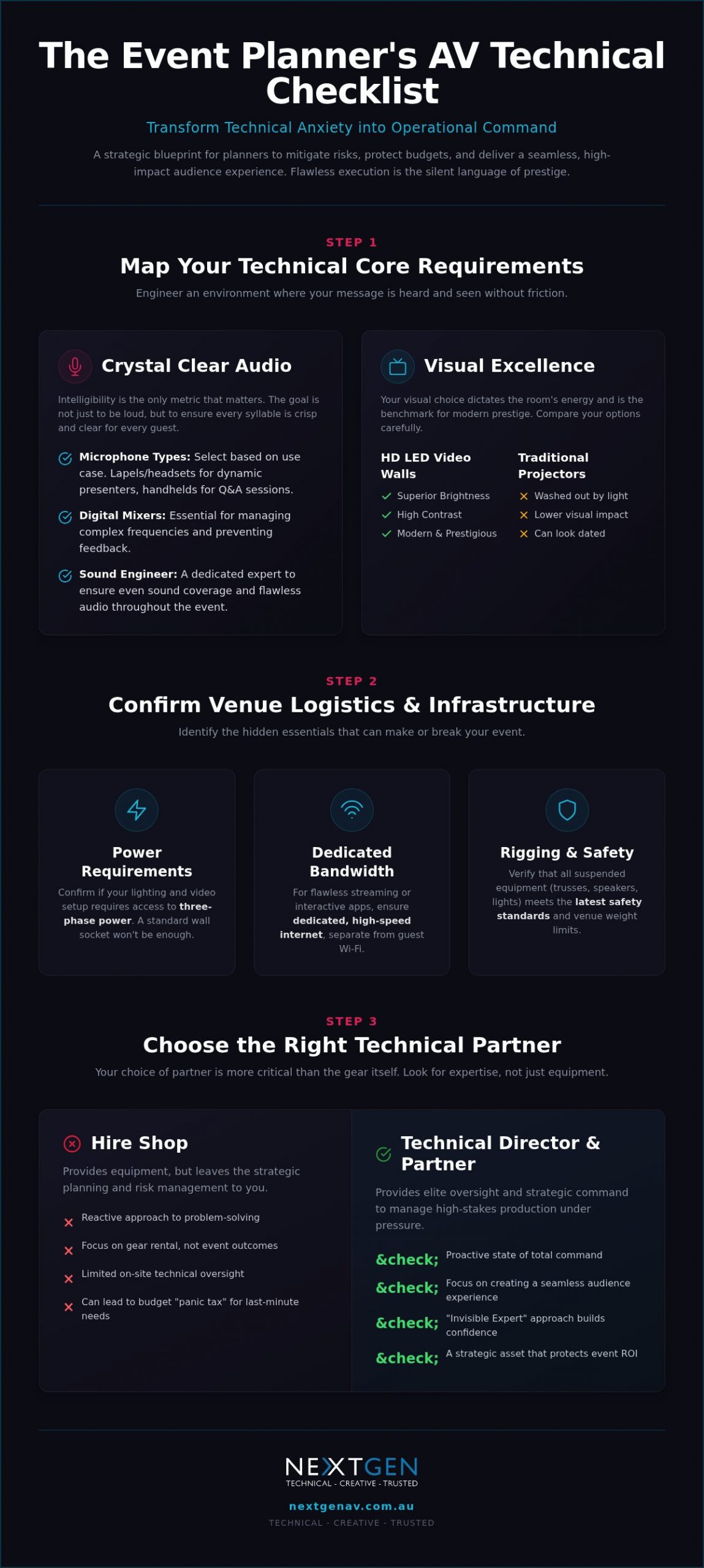
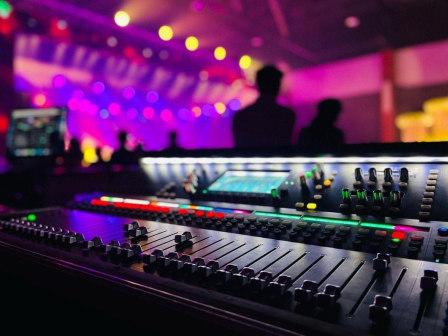
Intelligibility is the only metric that matters in audio. Being “loud enough” isn’t the goal; ensuring every syllable is crisp and clear for every guest is what defines success. Your checklist should specify microphone types based on speaker styles. Lapels and headsets provide hands-free freedom for dynamic presenters, while handheld mics remain the gold standard for moderated Q&A sessions. Behind the scenes, digital mixers and a dedicated sound engineer are essential. They manage the complex frequencies and time alignment needed to prevent feedback and ensure even sound coverage, regardless of where a guest is seated.
For planners looking to elevate the guest experience through professional animation and music, YETI EVENTS provides an excellent example of how expert DJ services can be integrated into a broader technical audio strategy for both private and public events.
Visual Excellence: Captivating the Modern Audience
Lighting and Staging: Setting the Professional Scene
Lighting is the “secret sauce” that transforms a generic room into a branded experience. A basic stage wash ensures presenters look professional on camera and in person, while dramatic accent lighting can elevate a gala dinner to something truly memorable. Staging requires equal attention. You must consider stage heights, clear sightlines for all attendees, and the placement of lecterns. Safety is non-negotiable; always verify that your rigging and trussing requirements meet Victorian safety standards for overhead equipment. If you’re feeling overwhelmed by these technical layers, our team can help you design a custom technical layout tailored to your specific venue.
Finally, don’t forget the hybrid component. Connecting in-room and remote audiences requires a dedicated checklist for internet bandwidth and low-latency streaming solutions. By integrating these elements into your master plan, you ensure that every attendee, no matter where they are, enjoys a high-impact, seamless experience.
Venue Logistics and Infrastructure: The “Hidden” Checklist Essentials
Even the most impressive technical gear cannot perform if the venue’s infrastructure fails to support it. A comprehensive event av checklist for planners must account for the physical and technical constraints of the space itself, moving beyond the floor plan to understand the invisible forces that dictate success. In Melbourne, this often means navigating tight loading docks, heritage buildings with limited power access, or modern galleries with challenging glass surfaces. Mastering these logistics ensures that your technical vision isn’t just a concept, but a flawlessly executed reality.
Physical access is the first hurdle. Managing the “bump-in” and “bump-out” at busy inner-city venues requires military-style precision. You need to coordinate with venue managers to secure loading bay slots and ensure that lift dimensions can accommodate large-scale LED panels or heavy staging equipment. Simultaneously, you must evaluate the room’s natural acoustics. Non-traditional spaces like industrial warehouses often suffer from excessive echo, which can muddy your sound. Managing this requires strategic speaker placement and, in some cases, temporary acoustic treatments to ensure your professional audio system isn’t fighting the architecture of the room.
Power and Cable Management
Large-scale rigs require serious juice. High-performance video walls and extensive lighting designs often demand three-phase power rather than standard wall points. Calculating the total power draw during pre-production is a non-negotiable step to prevent tripped circuits mid-presentation. Beyond the source, consider the “aesthetic cleanliness” of your setup. Your checklist should include taped cable runs and heavy-duty ramps for guest safety. For mission-critical event segments, such as a CEO’s keynote, always ensure your technical partner has backup power solutions ready to deploy instantly.
Connectivity for the Digital Age
Internet reliability is now as vital as oxygen for modern events. If your programme includes live streaming or interactive audience apps, relying on shared venue Wi-Fi is a high-risk gamble. You need a dedicated, hard-wired ethernet drop. When testing the line, remember that upload speeds are the critical metric for outgoing streams, not just download capacity. Ensure your event av checklist for planners covers signal distribution as well; high-quality video must reach every satellite screen in the venue with zero latency to maintain a unified audience experience.
Master Timeline: Pre-Production to Final Mic Check
Success in a live environment is rarely about the gear alone; it’s about the precision of the schedule. A master timeline serves as the heartbeat of your production, ensuring that every technical element arrives, assembles, and activates in perfect harmony. While previous sections focused on the “what” and the “where”, this phase of your event av checklist for planners addresses the “when”. Moving from initial design to the final applause requires a disciplined approach to time management that leaves zero room for ambiguity.
Integrating a master timeline into your event av checklist for planners ensures that no technical milestone is left to chance. This chronological roadmap allows you to transition from the creative planning phase into the high-pressure environment of the live event with absolute confidence. It transforms a list of equipment into a living, breathing production schedule that your entire team can follow with military precision.
Preparation and Pre-Production
The journey begins three to six months out with a comprehensive site walkthrough. This is your opportunity to identify rigging points and loading docks, which we discussed in the logistics phase, but now through the lens of installation timing. As you approach the 48-hour mark, your focus must shift to content collection. Testing high-resolution videos and complex slide decks on the actual playback hardware is non-negotiable. This window allows you to resolve codec issues or aspect ratio mismatches before they become on-site emergencies. Contingency planning is equally vital; you must always have a secondary playback system ready if a presenter’s laptop fails or a file becomes corrupted.
On-Site Execution and Rehearsals
The bump-in is the most intense period of the project, where the technical design finally meets the physical room. Once the rigging is secure and the LED walls are calibrated, the focus shifts to rehearsals. A professional sound check is far more than a simple “testing 1, 2”. It is a meticulous process of balancing frequencies for each speaker’s unique voice and ensuring the professional audio system delivers uniform clarity across the entire venue.
Following the audio calibration, cue-to-cue rehearsals are essential. These sessions allow the lighting, visual, and audio teams to synchronise their actions with the MC’s script, ensuring every transition is sharp and intentional. Ten minutes before the doors open, perform a final walkthrough to check sightlines, lectern heights, and microphone battery levels. During showtime, your technical crew acts as the invisible engine, proactively managing the live mix and visual cues so you can focus entirely on your guests. To ensure your programme runs with this level of precision, you can secure professional technical direction to oversee every moving part of your production.
Beyond the Gear: Why a Technical Partner Outperforms a Hire Shop
An event av checklist for planners is a powerful tool, but it only reaches its full potential when guided by seasoned hands. There is a fundamental difference between simple equipment hire and full-service event production. A hire shop provides the gear and leaves the integration, troubleshooting, and operation to you. In contrast, a technical partner takes total ownership of the technical ecosystem. This ensures that every piece of technology, from the professional audio systems to the LED walls, works in concert to support your brand’s prestige. With over 30 years of industry experience, NextGen AV has refined the art of turning complex technical requirements into flawless, high-impact audience experiences.
Choosing a partner over a supplier means you are investing in a result rather than just renting a box of cables. It is the difference between hoping the tech works and knowing it will. This level of reliability allows you to move past the logistical grind and focus on the prestige of the final result. By aligning with experts who understand the nuances of high-stakes production, you transform your event av checklist for planners from a list of tasks into a strategic roadmap for success.
The Role of Professional Technical Direction
Local expertise is a strategic advantage that saves both time and money. Knowing the specific loading dock protocols of Melbourne CBD venues or the Victorian safety standards for rigging is essential for a smooth bump-in. NextGen AV’s deep roots in the Melbourne event scene allow us to navigate these logistical nuances with ease, providing a front-of-house excellence that reflects your professional authority. We believe in the power of invisible expertise, where the technology serves the message without ever becoming a distraction. To elevate your next production, organise a consultation with NextGen AV to build your bespoke technical checklist and experience the peace of mind that comes with true technical mastery.
Elevate Your Next Production to Absolute Precision
Mastering a high-stakes event requires more than just high-end gear; it demands a disciplined alignment of technical mastery and logistical foresight. By utilising a comprehensive event av checklist for planners, you transform potential technical risks into a seamless, high-impact audience experience. From the initial site walkthrough to the final cue-to-cue rehearsal, your success rests on the ability to anticipate needs before they become obstacles. You’ve seen how the right infrastructure, such as vibrant LED walls and crystal-clear audio, serves as the invisible engine behind your brand’s prestige.
As a dedicated Melbourne specialist team with 30+ years of industry experience, NextGen AV provides the end-to-end production management needed to turn your vision into a cinematic reality. We move past the limitations of simple hire shops to offer the quiet power of elite technical direction. It’s time to step away from the logistical grind and focus on the artistry of your event. Download Your Strategic AV Checklist or Book a Consultation with our experts today. Let’s work together to ensure your next production is nothing short of flawless.
Frequently Asked Questions
What are the most common AV mistakes planners make at events?
The most frequent technical errors involve underestimating power requirements or choosing inappropriate microphones for speakers. Planners often forget to check if their content matches the screen’s aspect ratio, which leads to distorted visuals. Another critical oversight is skipping a full cue-to-cue rehearsal. These errors are easily avoided by documenting every technical milestone in an event av checklist for planners, ensuring that gear and timing are perfectly aligned before the doors open.
How early should I book an AV production company in Melbourne?
You should ideally secure your technical production team three to six months before your event date. Melbourne is a competitive market for corporate events; elite teams often book out well in advance during peak seasons. Engaging a partner early allows for comprehensive site walkthroughs and bespoke technical design. This lead time is essential for coordinating logistics, especially if your production requires complex rigging or custom-built LED video wall configurations to suit the venue.
Do I really need a dedicated internet line for my event?
A dedicated, hard-wired internet line is essential if your programme includes live streaming or interactive audience apps. Shared venue Wi-Fi is notoriously unreliable because its bandwidth fluctuates as more guests connect. For a seamless experience, you need a guaranteed upload speed that remains consistent throughout the event. This dedicated drop acts as a fail-safe, protecting your broadcast from the latency and dropouts that can ruin a remote attendee’s engagement and brand perception.
What is the difference between a lapel mic and a headset mic for presenters?
Lapel microphones are discreet and clip onto clothing, but they can struggle with clothing rustle or head movement. Headset microphones sit closer to the mouth, providing superior audio consistency and higher gain before feedback. For dynamic presenters who move their heads frequently or walk near speakers, a headset is the safer choice. It ensures the audio remains crystal clear regardless of which way the speaker turns during their presentation, providing a better audience experience.
Can I use the venue’s in-house AV system for a large corporate event?
In-house systems are often designed for basic meetings rather than high-stakes corporate productions. While they may be convenient, they frequently lack the power, visual impact, and technical redundancy required for a large-scale event. Bringing in a specialist technical partner ensures you have access to the latest LED technology and professional audio systems. This approach provides you with a dedicated team focused solely on your success rather than a venue manager overseeing multiple rooms simultaneously.
How much does professional event AV production typically cost in Australia?
Production costs in Australia vary significantly based on the scale of your equipment requirements and the length of the event. Factors like the number of technicians, the complexity of the rigging, and the size of the LED video walls all influence the final investment. Rather than looking for a flat rate, it’s better to request a tailored quote that reflects your specific technical needs. This ensures your budget is allocated to high-impact solutions that drive results.
What is a “bump-in” and how much time should I allow for it?
A “bump-in” refers to the period where the technical crew delivers, installs, and tests all equipment before the event begins. For a standard corporate setup, you should allow at least four to six hours. Larger productions involving complex staging or rigging may require a full day or even overnight access. Accurate timing is a vital component of any event av checklist for planners, as it prevents rushed setups and ensures everything is calibrated perfectly.
What technical equipment is needed for a hybrid event?
Hybrid events require a specialised kit beyond standard in-room gear. You need high-definition cameras, professional vision switchers, and hardware encoders to send a stable stream to your virtual platform. Equally important is an audio interface that allows the sound engineer to create a separate mix for remote viewers. This ensures that both your physical and digital audiences receive high-quality, balanced audio that is free from room echo, background noise, or distracting technical glitches.
Imagine the sudden, heavy silence when a keynote speaker steps up, only for a piercing feedback loop to shatter the room’s atmosphere. Or worse, the frantic scramble behind the scenes when an overlooked gear requirement blows your budget before the first guest even arrives. You’ve spent months perfecting every detail of the programme, yet the fear of a technical glitch remains the one thing keeping you awake at night. You know that even the most prestigious event can be undone by a single flickering LED wall or a crackling microphone. That’s why we’ve engineered this comprehensive event av checklist for planners, designed to transform technical anxiety into absolute operational command.
We understand that as a professional, you need more than just equipment; you need a fail-safe technical roadmap that guarantees a seamless audience experience. This expert-led guide moves past the logistical grind to focus on the artistry of high-impact production. We’ll walk you through the essential stages of pre-production, from vetting professional audio systems to ensuring your rigging meets the latest safety standards. By the time you reach the bump-in, you’ll have the confidence of a seasoned orchestrator, ready to lead an elite team and deliver a result that feels both powerful and effortless.
Key Takeaways
Learn how a strategic event av checklist for planners acts as your ultimate risk mitigation tool, ensuring technical excellence and deep audience immersion.
Discover the critical differences between high-definition LED video walls and traditional projection to select the most prestigious visual solution for your event space.
Identify overlooked infrastructure essentials, from three-phase power requirements to the dedicated bandwidth necessary for flawless interactive apps and streaming.
Master the pre-production timeline, including site visits and technical run-sheets that perfectly synchronise every cue with your MC’s delivery.
Explore why partnering with a Technical Director provides the elite oversight and quiet power needed to manage high-stakes production under pressure.
The Strategic Foundation: Why an Event AV Checklist is Your Best Risk Mitigation Tool
Precision isn’t an accident; it’s a strategy. A robust event av checklist for planners acts as a technical blueprint that aligns your creative ambition with operational reality. Without it, you aren’t just planning an event; you’re inviting chaos. “Good enough” audio or visual clarity is a dangerous compromise that immediately signals a lack of professional polish to your audience. When a screen flickers or audio drops, you lose more than a moment; you lose the room’s attention and your brand’s authority. This checklist serves as the bridge, translating a high-level vision into the specific cables, frequencies, and lumens required to make it real.
Beyond the immediate impact on engagement, technical oversights carry a heavy price tag. Last-minute realisations that you lack specific adaptors or signal boosters lead to emergency hire costs and frantic Melbourne courier fees that can decimate a contingency fund. By documenting every one of the technical event production components early, you eliminate the “panic tax” of urgent gear additions. This structured approach ensures that the gear on the truck matches the requirements on the floor, protecting both your budget and your sanity. It’s about moving from a reactive state of fire-fighting to a proactive state of total command.
The Psychology of Seamless Production
Flawless execution is the silent language of prestige. When the technology works perfectly, it becomes invisible, allowing your message to take centre stage without distraction. This “Invisible Expert” approach builds a profound sense of security for speakers and planners alike. Documenting technical milestones doesn’t just organise the crew; it reduces the background hum of anxiety that plagues high-stakes planning. You gain the freedom to focus on your guests, confident that the technical engine driving the experience is running with absolute precision.
AV as a Strategic Budget Line Item
It’s time to stop viewing AV as a begrudged cost centre and start seeing it as a high-performance engagement driver. Investing in high-impact tech, like vibrant LED walls, creates a transformative experience that justifies the spend through increased audience retention and social reach. You must distinguish between the “bells and whistles” that look good on paper and the core technical solutions that actually drive results. Ultimately, an AV checklist is a strategic asset that protects event ROI by ensuring every dollar spent translates into a superior audience experience. This mindset shift allows you to prioritise gear that delivers the most significant emotional impact for your attendees.
The Technical Core: Mapping Your Audio, Visual, and Lighting Requirements
Every entry on an event av checklist for planners must serve a purpose. It isn’t just about hiring gear; it’s about engineering an environment where your message is heard and seen without friction. To achieve this, you need to look past the equipment list and focus on how each technical solution supports the human experience in the room. Whether you are hosting a gala in Melbourne or a corporate summit, the technical core of your event determines how your brand’s prestige is perceived.
Crystal Clear Audio: The Heart of Communication
Intelligibility is the only metric that matters in audio. Being “loud enough” isn’t the goal; ensuring every syllable is crisp and clear for every guest is what defines success. Your checklist should specify microphone types based on speaker styles. Lapels and headsets provide hands-free freedom for dynamic presenters, while handheld mics remain the gold standard for moderated Q&A sessions. Behind the scenes, digital mixers and a dedicated sound engineer are essential. They manage the complex frequencies and time alignment needed to prevent feedback and ensure even sound coverage, regardless of where a guest is seated.
Visual Excellence: Captivating the Modern Audience
Your visual choice often dictates the entire room’s energy. While traditional projectors have their place, high-definition LED video walls have become the benchmark for modern prestige. These walls offer superior brightness and contrast, making them ideal for venues with high ambient light where a projector might look washed out. Precision is key here; ensure your slide decks match the screen’s aspect ratio to avoid awkward black bars. Seamless switching and professional vision mixing allow for fluid transitions between live presenters, pre-recorded videos, and remote speakers, keeping the momentum of your programme moving forward.
Lighting and Staging: Setting the Professional Scene
Lighting is the “secret sauce” that transforms a generic room into a branded experience. A basic stage wash ensures presenters look professional on camera and in person, while dramatic accent lighting can elevate a gala dinner to something truly memorable. Staging requires equal attention. You must consider stage heights, clear sightlines for all attendees, and the placement of lecterns. Safety is non-negotiable; always verify that your rigging and trussing requirements meet Victorian safety standards for overhead equipment. If you’re feeling overwhelmed by these technical layers, our team can help you design a custom technical layout tailored to your specific venue.
Finally, don’t forget the hybrid component. Connecting in-room and remote audiences requires a dedicated checklist for internet bandwidth and low-latency streaming solutions. By integrating these elements into your master plan, you ensure that every attendee, no matter where they are, enjoys a high-impact, seamless experience.
Venue Logistics and Infrastructure: The “Hidden” Checklist Essentials
Even the most impressive technical gear cannot perform if the venue’s infrastructure fails to support it. A comprehensive event av checklist for planners must account for the physical and technical constraints of the space itself, moving beyond the floor plan to understand the invisible forces that dictate success. In Melbourne, this often means navigating tight loading docks, heritage buildings with limited power access, or modern galleries with challenging glass surfaces. Mastering these logistics ensures that your technical vision isn’t just a concept, but a flawlessly executed reality.
Physical access is the first hurdle. Managing the “bump-in” and “bump-out” at busy inner-city venues requires military-style precision. You need to coordinate with venue managers to secure loading bay slots and ensure that lift dimensions can accommodate large-scale LED panels or heavy staging equipment. Simultaneously, you must evaluate the room’s natural acoustics. Non-traditional spaces like industrial warehouses often suffer from excessive echo, which can muddy your sound. Managing this requires strategic speaker placement and, in some cases, temporary acoustic treatments to ensure your professional audio system isn’t fighting the architecture of the room.
Power and Cable Management
Large-scale rigs require serious juice. High-performance video walls and extensive lighting designs often demand three-phase power rather than standard wall points. Calculating the total power draw during pre-production is a non-negotiable step to prevent tripped circuits mid-presentation. Beyond the source, consider the “aesthetic cleanliness” of your setup. Your checklist should include taped cable runs and heavy-duty ramps for guest safety. For mission-critical event segments, such as a CEO’s keynote, always ensure your technical partner has backup power solutions ready to deploy instantly.
Connectivity for the Digital Age
Internet reliability is now as vital as oxygen for modern events. If your programme includes live streaming or interactive audience apps, relying on shared venue Wi-Fi is a high-risk gamble. You need a dedicated, hard-wired ethernet drop. When testing the line, remember that upload speeds are the critical metric for outgoing streams, not just download capacity. Ensure your event av checklist for planners covers signal distribution as well; high-quality video must reach every satellite screen in the venue with zero latency to maintain a unified audience experience.
Master Timeline: Pre-Production to Final Mic Check
Success in a live environment is rarely about the gear alone; it’s about the precision of the schedule. A master timeline serves as the heartbeat of your production, ensuring that every technical element arrives, assembles, and activates in perfect harmony. While previous sections focused on the “what” and the “where”, this phase of your event av checklist for planners addresses the “when”. Moving from initial design to the final applause requires a disciplined approach to time management that leaves zero room for ambiguity.
Integrating a master timeline into your event av checklist for planners ensures that no technical milestone is left to chance. This chronological roadmap allows you to transition from the creative planning phase into the high-pressure environment of the live event with absolute confidence. It transforms a list of equipment into a living, breathing production schedule that your entire team can follow with military precision.
Preparation and Pre-Production
The journey begins three to six months out with a comprehensive site walkthrough. This is your opportunity to identify rigging points and loading docks, which we discussed in the logistics phase, but now through the lens of installation timing. As you approach the 48-hour mark, your focus must shift to content collection. Testing high-resolution videos and complex slide decks on the actual playback hardware is non-negotiable. This window allows you to resolve codec issues or aspect ratio mismatches before they become on-site emergencies. Contingency planning is equally vital; you must always have a secondary playback system ready if a presenter’s laptop fails or a file becomes corrupted.
On-Site Execution and Rehearsals
The bump-in is the most intense period of the project, where the technical design finally meets the physical room. Once the rigging is secure and the LED walls are calibrated, the focus shifts to rehearsals. A professional sound check is far more than a simple “testing 1, 2”. It is a meticulous process of balancing frequencies for each speaker’s unique voice and ensuring the professional audio system delivers uniform clarity across the entire venue.
Following the audio calibration, cue-to-cue rehearsals are essential. These sessions allow the lighting, visual, and audio teams to synchronise their actions with the MC’s script, ensuring every transition is sharp and intentional. Ten minutes before the doors open, perform a final walkthrough to check sightlines, lectern heights, and microphone battery levels. During showtime, your technical crew acts as the invisible engine, proactively managing the live mix and visual cues so you can focus entirely on your guests. To ensure your programme runs with this level of precision, you can secure professional technical direction to oversee every moving part of your production.
Beyond the Gear: Why a Technical Partner Outperforms a Hire Shop
An event av checklist for planners is a powerful tool, but it only reaches its full potential when guided by seasoned hands. There is a fundamental difference between simple equipment hire and full-service event production. A hire shop provides the gear and leaves the integration, troubleshooting, and operation to you. In contrast, a technical partner takes total ownership of the technical ecosystem. This ensures that every piece of technology, from the professional audio systems to the LED walls, works in concert to support your brand’s prestige. With over 30 years of industry experience, NextGen AV has refined the art of turning complex technical requirements into flawless, high-impact audience experiences.
Choosing a partner over a supplier means you are investing in a result rather than just renting a box of cables. It is the difference between hoping the tech works and knowing it will. This level of reliability allows you to move past the logistical grind and focus on the prestige of the final result. By aligning with experts who understand the nuances of high-stakes production, you transform your event av checklist for planners from a list of tasks into a strategic roadmap for success.
The Role of Professional Technical Direction
High-stakes events require a central authority to manage the technical umbrella. A Technical Director acts as the “Confident Orchestrator”, overseeing multiple technical vendors and ensuring that audio, visual, and lighting teams are perfectly aligned. They don’t just follow a list; they solve problems in real-time before you even know they exist. Whether it’s an unexpected signal drop or a last-minute script change, a seasoned on-site engineer provides the quiet power needed to maintain momentum. Post-event, this partnership extends to analysing data and recordings, providing valuable insights to ensure your future productions are even more impactful.
Partnering for Success in Melbourne
Local expertise is a strategic advantage that saves both time and money. Knowing the specific loading dock protocols of Melbourne CBD venues or the Victorian safety standards for rigging is essential for a smooth bump-in. NextGen AV’s deep roots in the Melbourne event scene allow us to navigate these logistical nuances with ease, providing a front-of-house excellence that reflects your professional authority. We believe in the power of invisible expertise, where the technology serves the message without ever becoming a distraction. To elevate your next production, organise a consultation with NextGen AV to build your bespoke technical checklist and experience the peace of mind that comes with true technical mastery.
Elevate Your Next Production to Absolute Precision
Mastering a high-stakes event requires more than just high-end gear; it demands a disciplined alignment of technical mastery and logistical foresight. By utilising a comprehensive event av checklist for planners, you transform potential technical risks into a seamless, high-impact audience experience. From the initial site walkthrough to the final cue-to-cue rehearsal, your success rests on the ability to anticipate needs before they become obstacles. You’ve seen how the right infrastructure, such as vibrant LED walls and crystal-clear audio, serves as the invisible engine behind your brand’s prestige.
As a dedicated Melbourne specialist team with 30+ years of industry experience, NextGen AV provides the end-to-end production management needed to turn your vision into a cinematic reality. We move past the limitations of simple hire shops to offer the quiet power of elite technical direction. It’s time to step away from the logistical grind and focus on the artistry of your event. Download Your Strategic AV Checklist or Book a Consultation with our experts today. Let’s work together to ensure your next production is nothing short of flawless.
Frequently Asked Questions
What are the most common AV mistakes planners make at events?
The most frequent technical errors involve underestimating power requirements or choosing inappropriate microphones for speakers. Planners often forget to check if their content matches the screen’s aspect ratio, which leads to distorted visuals. Another critical oversight is skipping a full cue-to-cue rehearsal. These errors are easily avoided by documenting every technical milestone in an event av checklist for planners, ensuring that gear and timing are perfectly aligned before the doors open.
How early should I book an AV production company in Melbourne?
You should ideally secure your technical production team three to six months before your event date. Melbourne is a competitive market for corporate events; elite teams often book out well in advance during peak seasons. Engaging a partner early allows for comprehensive site walkthroughs and bespoke technical design. This lead time is essential for coordinating logistics, especially if your production requires complex rigging or custom-built LED video wall configurations to suit the venue.
Do I really need a dedicated internet line for my event?
A dedicated, hard-wired internet line is essential if your programme includes live streaming or interactive audience apps. Shared venue Wi-Fi is notoriously unreliable because its bandwidth fluctuates as more guests connect. For a seamless experience, you need a guaranteed upload speed that remains consistent throughout the event. This dedicated drop acts as a fail-safe, protecting your broadcast from the latency and dropouts that can ruin a remote attendee’s engagement and brand perception.
What is the difference between a lapel mic and a headset mic for presenters?
Lapel microphones are discreet and clip onto clothing, but they can struggle with clothing rustle or head movement. Headset microphones sit closer to the mouth, providing superior audio consistency and higher gain before feedback. For dynamic presenters who move their heads frequently or walk near speakers, a headset is the safer choice. It ensures the audio remains crystal clear regardless of which way the speaker turns during their presentation, providing a better audience experience.
Can I use the venue’s in-house AV system for a large corporate event?
In-house systems are often designed for basic meetings rather than high-stakes corporate productions. While they may be convenient, they frequently lack the power, visual impact, and technical redundancy required for a large-scale event. Bringing in a specialist technical partner ensures you have access to the latest LED technology and professional audio systems. This approach provides you with a dedicated team focused solely on your success rather than a venue manager overseeing multiple rooms simultaneously.
How much does professional event AV production typically cost in Australia?
Production costs in Australia vary significantly based on the scale of your equipment requirements and the length of the event. Factors like the number of technicians, the complexity of the rigging, and the size of the LED video walls all influence the final investment. Rather than looking for a flat rate, it’s better to request a tailored quote that reflects your specific technical needs. This ensures your budget is allocated to high-impact solutions that drive results.
What is a “bump-in” and how much time should I allow for it?
A “bump-in” refers to the period where the technical crew delivers, installs, and tests all equipment before the event begins. For a standard corporate setup, you should allow at least four to six hours. Larger productions involving complex staging or rigging may require a full day or even overnight access. Accurate timing is a vital component of any event av checklist for planners, as it prevents rushed setups and ensures everything is calibrated perfectly.
What technical equipment is needed for a hybrid event?
Hybrid events require a specialised kit beyond standard in-room gear. You need high-definition cameras, professional vision switchers, and hardware encoders to send a stable stream to your virtual platform. Equally important is an audio interface that allows the sound engineer to create a separate mix for remote viewers. This ensures that both your physical and digital audiences receive high-quality, balanced audio that is free from room echo, background noise, or distracting technical glitches.
Our blog is packed with valuable information to help you stay ahead. Whether you’re looking for expert advice, industry trends, or practical tips, you’ll find everything you need. Reach out today to learn more or get in touch with us for personalised support!
Complete the enquiry form with your event date, venue, audience size, event type and budget. Our Melbourne AV team will review your requirements and recommend the right PA, screen, lighting, staging or production setup for your event.
What happens next?
1.We review your event details Tell us your date, venue, audience size and event type.
2.We recommend the right setup From PA hire to screens, lighting, staging and full AV production.
3. We come back with clear advice You’ll receive practical recommendations and a fast quote from our Melbourne team.