
Venue & AV Coordination: Melbourne Event Planner’s Guide

The room is set, the audience is arriving, and a last-minute layout change reveals that the AV team and venue crew have been working from different plans. Coordinating with venue and av teams means more than sharing a run sheet. It means agreeing who owns access, power, rigging, room layouts and technical decisions before bump-in begins.

A polished event depends on every team knowing what is happening, when it is happening and who is responsible. Pressure builds when details arrive late or assumptions surface during bump-in and rehearsal. A shared plan, agreed deadlines and clear handovers can prevent avoidable clashes and create a more seamless experience for presenters and guests.

This guide explains how to bring venue operations and AV production into one coordinated plan, from confirming responsibilities and technical requirements to managing changes and preparing for rehearsals. With more than 30 years of experience navigating Victorian event venues, NextGen AV helps manage the complexity behind the scenes, so your team can focus on delivering an event that feels polished, confident and memorable.

Key Takeaways

  • Assign clear owners for venue access, room information, technical decisions and event-day handovers.
  • Choose a coordination structure that suits the event, with one production lead or connected venue and AV leads.
  • Use a step-by-step workflow from the initial brief through technical planning, rehearsal and live operation.
  • Give every team a shared reference point for decisions, updates and open questions.
  • Technical direction connects the agreed plan to a polished experience for presenters and attendees.

Why coordinating venue and AV teams early matters in Melbourne

Several teams working to a tightly sequenced schedule leave little room for conflicting assumptions. The venue team may be planning room access and operational requirements while the AV team develops staging, sound and screen plans. If those decisions happen in isolation, a layout change or unclear handover can affect setup, rehearsal and the experience guests have when they arrive.

Effective coordinating with venue and av teams means making shared decisions, naming who owns each one and exchanging accurate information in time for others to act. Start with the event’s purpose and audience, then connect those needs to the room and technical approach. Event management often involves coordinating audio-visual production and logistics. A shared event brief gives venue and production teams one working reference as plans develop.

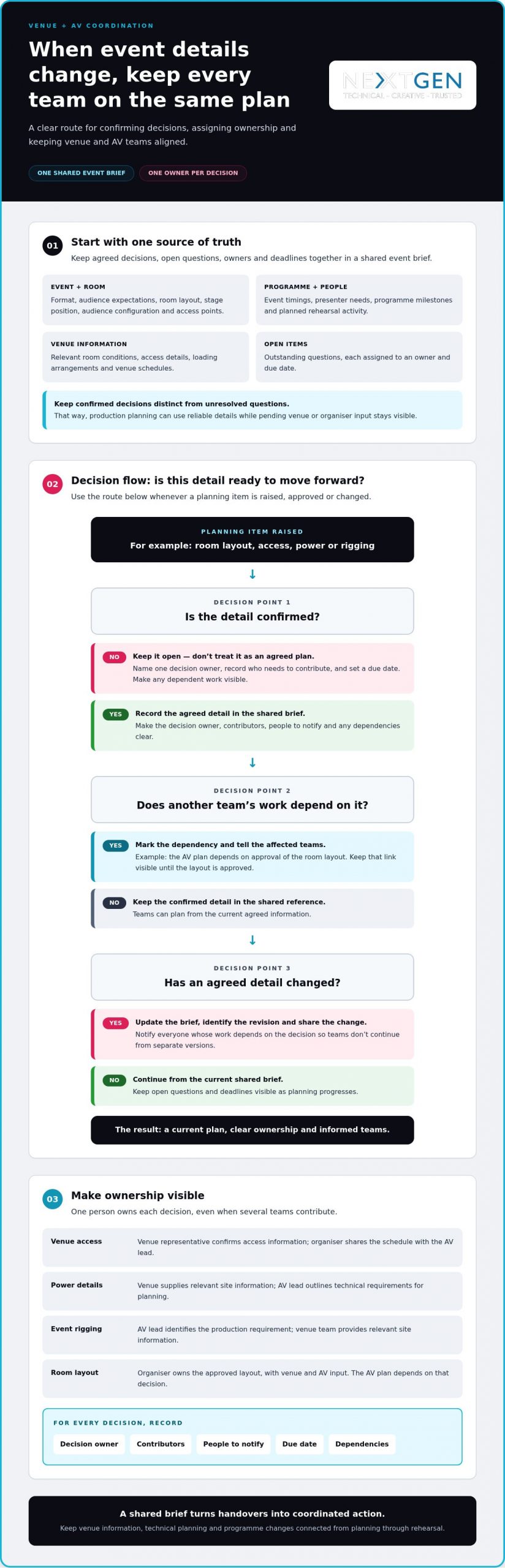
A shared event brief is the source of truth for venue and AV teams. It records agreed decisions, outstanding questions, owners and deadlines in one place.

What belongs in a shared event brief?

Start with the experience you’re creating, not an equipment list. Record the event format, audience expectations, programme timing and presenter requirements. Whether planning a corporate conference, luxury yacht hospitality with Chris Dodd Magic, or an intimate panel discussion, each format demands distinct room arrangements, transitions and technical support, even when sharing the same overall programme.

Capture the practical information the teams need to build a coordinated plan:

  • Room layout, stage position, audience configuration and access points.
  • Confirmed venue information, including relevant room conditions and event timings.
  • Programme milestones, presenter needs and planned rehearsal activity.
  • Open items, each assigned to an owner and due date.

Separate confirmed decisions from unresolved questions. The AV team can then plan against reliable details, while venue or organiser input still needed remains visible. When a decision changes, update the shared brief, identify the revision and make sure teams are not working from separate versions.

Why Melbourne venue context changes the plan

Room access, loading arrangements and venue schedules shape the order and timing of production work. These details affect when equipment can arrive, how it moves into the event space and how setup fits around other activity. Aligning them early helps teams create a realistic sequence for setup and rehearsal, instead of discovering a timing conflict on arrival.

Melbourne Convention and Exhibition Centre is one example of why venue context belongs in the brief. The event space and operational arrangements need to be understood alongside the proposed layout and production plan. Don’t assume every venue works the same way. Record the details relevant to your chosen venue, and assign an owner and due date to any outstanding access or timing questions.

Once venue details and event goals are aligned, technical planning can move forward with fewer assumptions. For a broader view of how production elements fit into event planning, explore the full-service event production guide.

How venue and AV teams align roles, information and handovers

Clear roles turn a shared event plan into practical action. The venue team holds key information about access, room conditions, venue processes and site arrangements. The AV team uses that information to shape technical direction, plan systems, coordinate setup and manage live operation. As organiser, connect both teams with presenters and stakeholders, keeping decisions, deadlines and programme changes visible to everyone who needs them.

That connection matters because one decision can affect several parts of the event. A room layout change may alter stage placement or the audience’s view; a revised programme can affect technical cues and rehearsal timing. Effective communication and collaboration between event organisers and venues are essential to overcome planning challenges. Give each decision an owner, then share the outcome with everyone whose work depends on it.

Map ownership without leaving gaps

Use a responsibility list to show who leads each decision, who supplies information and who needs the final update. One person should own the decision, even when several teams contribute. This prevents questions from sitting between teams without an accountable next step.

  • Venue access: The venue representative provides confirmed access information; the organiser shares the schedule with the AV lead.
  • Power details: The venue supplies relevant site information, while the AV lead outlines technical requirements for planning.
  • Event rigging: The AV lead identifies the production requirement, and the venue team provides relevant site information for coordination.
  • Room layout: The organiser owns the approved layout, with venue and AV input. The AV plan depends on that decision.

Record the decision owner, contributors, people to notify, due date and dependencies beside each item. If the room layout is still open, mark the related AV plan as dependent on approval. This makes the next handover clear and helps prevent teams from working from different assumptions.

Named decision owners mean fewer unresolved questions on event day.

Make technical handovers useful

Send the AV team the current floor plan, stage position, programme and presenter requirements in a version everyone can identify. Share updates when these details change and flag what has changed, so the technical plan can be reviewed against the latest information. The front of house engineer guides audience-facing audio decisions, connecting sound planning to what attendees hear across the room.

For sound systems planning, align presenter needs, programme cues and room information before setup, so technical choices support clear delivery. This is where NextGen AV’s technical direction connects venue information with production decisions. A disciplined handover gives the crew a usable plan and presenters a more assured experience.

Which coordination approach works best for a Melbourne event?

The right structure depends on the event’s scope, the venue’s processes and how many stakeholders need to make or receive decisions. A focused event may work well with separate venue and AV leads who share updates directly. A production with several technical elements, multiple presenters or frequent programme changes may benefit from one production lead connecting those workstreams.

Neither model removes the need for clear ownership. The aim is to make decisions visible, route questions to the right person and prevent venue operations and technical planning from drifting apart. Use this comparison to identify where your event needs a single point of coordination and where distinct leads can work effectively together.

Working arrangement Decision speed Communication clarity Best suited to
One production lead Can streamline connected technical decisions through one coordination point. Creates a clear route for updates across production, presenters and stakeholders. Events with several technical elements or frequent programme changes.
Separate venue and AV leads Works well when each lead can resolve decisions within their area and share dependencies promptly. Clear when both leads use the same plan and agree how updates are communicated. Events with defined responsibilities and manageable coordination needs.

One production lead across the event

A single production lead can connect venue information with AV decisions, giving the organiser one technical direction point for coordinating with venue and av teams. This can be especially useful when programme timing changes affect multiple technical elements. The lead can trace the impact across the production plan and communicate the resulting updates. Venue approvals and venue-side responsibilities remain with their designated contacts; the production lead coordinates the technical response without replacing venue authority.

Separate leads with a shared coordination plan

Distinct venue and AV leads can work effectively when responsibilities are well defined and both teams use the same plan. Keep the current programme, room plan, decision log and open actions accessible to both leads, then schedule check-ins around key planning milestones and changes. Each lead can manage their area while shared decisions reach everyone affected. An integrated event production guide can help you understand how production elements fit together.

Whichever model you choose, make the escalation path explicit: who resolves an overlap, who approves the final decision and who must be notified. If the stage position affects venue operations and AV sightlines, bring the relevant decision-makers together before treating that choice as settled. A clear structure reduces crossed messages and supports confident delivery for presenters and attendees.
Venue & AV Coordination: Melbourne Event Planner’s Guide

How to coordinate venue and AV teams before event day

Reliable event-day delivery starts with a sequence of handovers, not a last-minute email thread. For coordinating with venue and av teams, use one working schedule and document so each decision, deadline and update reaches the next person who needs it. Give every checkpoint an owner, record the information required and state what happens next.

Set the planning checkpoints

Move from the event brief to venue information, technical planning and the final production schedule. At each stage, the owner closes decisions or records what remains open, then hands the current information to the next team. Keep one version-controlled event document so venue, AV and organising teams can identify which details are current.

  1. Align the brief. The organiser gathers the event format, programme, audience needs and presenter requirements. Share these with the venue and AV leads so room planning and technical direction start from the same objectives.
  2. Gather venue information. The venue contact provides current room details, access arrangements, site information and relevant venue processes. The organiser records these in the event document and passes them to the AV lead, who identifies technical questions that need resolution.
  3. Develop the technical plan. The AV lead maps the agreed room layout and programme to technical requirements, content needs and cue planning. Presenters or content owners supply materials by agreed deadlines; the organiser tracks outstanding items and shares updates with affected teams.
  4. Align production schedules. The organiser brings venue timings and AV requirements into one schedule. Agree bump-in and bump-out timing with the relevant venue and production contacts, and show when access, setup, rehearsal and pack-down are planned. Don’t assume these timings are already arranged.
  5. Review changes. If a presenter, programme cue or room arrangement changes, the decision owner updates the document and notifies affected teams. The AV lead reviews the technical impact, while the organiser coordinates related programme or stakeholder updates.

Prepare the final handover

Before event operation, circulate the current run sheet, named contact roles, cue sequence and escalation path. Confirm rehearsal timing, presenter arrival arrangements and access to the content required for each cue. If staging or lighting is part of the production, include its agreed setup and schedule dependencies in the same handover.

Every technical change needs an owner and a communicated update. This keeps teams working from the same instructions when plans shift, instead of relying on assumptions during bump-in or rehearsal. A clear final handover also gives presenters a more predictable path from arrival to performance.

For coordinated technical direction, setup and event operation, plan your event production with NextGen AV.

How a Melbourne AV production partner brings the plan together

A clear brief becomes a live event through precise technical direction, active communication and coordinated delivery. NextGen AV works with organisers and venue teams to translate event goals and site information into a practical production plan, then supports setup, technical operation and pack-down. Each decision connects back to the programme, helping technical details serve the experience you want presenters and attendees to have.

NextGen AV has supported events ranging from local community festivals to high-profile corporate galas. That breadth of experience informs a considered approach to different event formats and production needs. For outdoor activations and unique community gatherings, modular setups from providers such as Smart Spaces NZ illustrate how expandable structures can effectively define a temporary venue before technical setup begins. The team works from the agreed brief and venue information, shaping the technical plan around the event rather than relying on assumptions.

From planning decisions to event operation

During pre-production, the team turns programme requirements, room information and presenter needs into technical direction. Sound systems support clear communication with the audience; lighting helps shape the room and focus attention; LED displays carry visual content; and staging gives presenters a defined platform. Each element is planned in relation to the event’s purpose, layout and schedule, rather than as a standalone item.

Proactive communication keeps venue information connected to production decisions. A revised room layout, access detail or programme cue can affect setup and technical operation. Sharing relevant updates with the people responsible allows the production plan to respond and helps prevent teams from working with conflicting information. On event day, coordinated setup and operation put those decisions into practice, followed by an organised pack-down.

This approach supports events with different creative and technical demands. It keeps the organiser connected to the decisions that matter while experienced production professionals manage technical details behind the scenes, so the programme can take centre stage.

Plan your Melbourne event with NextGen AV

With planning, technical direction, setup, operation and pack-down aligned, you have a production partner focused on connecting venue requirements with your event’s creative vision. The Melbourne audio visual hire guide offers broader context on production choices and how AV elements contribute to an event. NextGen AV brings those elements together as part of coordinated production, not simply an equipment list.

If you’re planning an event in Melbourne, share your event brief and coordination requirements with NextGen AV. The team can discuss how technical direction and production planning support your venue, programme and audience needs, giving you a clear path from early decisions to confident delivery.

Turn your event plan into a confident experience

Bring the event brief and the people responsible for delivery into the same conversation. When coordinating with venue and av teams, clear production direction turns practical decisions into an experience that feels considered from the first arrival to the final cue. You can focus on the purpose of the event while experienced technical professionals connect venue requirements with the production details that bring it to life.

NextGen AV brings more than 10 years in the corporate event space and experience delivering events throughout Australia. That perspective supports a thoughtful approach to technical planning, communication and event delivery, shaped around your programme, presenters and audience.

Start with the essentials: your event goals, venue information, programme and the coordination questions you want resolved. Plan your Melbourne event with NextGen AV and put the right production conversations in motion. With a clear brief and a proactive team alongside you, your event is ready to move from planning into a polished experience.

Frequently Asked Questions

How early should venue and AV teams coordinate?

Start coordinating as soon as the event brief and venue plans begin to take shape. Early discussion lets teams flag dependencies, such as whether a draft room layout is needed before technical planning can progress. For a Melbourne event, the schedule depends on the production scope and the venue’s processes, so set checkpoints around actual decisions rather than relying on a fixed lead-time rule.

Can an external AV team work with a venue’s in-house AV team?

Yes. An external AV team and a venue’s in-house team can work together when responsibilities, access arrangements and technical handovers are clear. Share the latest programme and room information with both teams, then document which team is handling each production task. Agree how their work connects without assuming one team replaces or directs the other.

What should I do if the venue changes the room layout?

Send the revised layout to the AV lead and treat it as a production change that needs review. Depending on the plan, the update may affect screen placement, speaker positions, sightlines or cable paths. Identify who approves the new arrangement, replace outdated floor plans in shared documents and tell affected teams when the revision takes effect. Don’t rely on a verbal update alone.

Is a venue site visit always necessary for event AV planning?

No, a site visit isn’t necessary for every event. Consider one when the production is complex, access details are unclear, the team is unfamiliar with the room or available plans don’t resolve a practical question. A visit can help clarify conditions that are hard to judge from documents alone. Record any remaining uncertainties and assign someone to resolve them through the planning process.

Who should own the event run sheet when venue and AV teams are involved?

The event organiser or nominated programme owner should maintain the authoritative run sheet. The AV lead contributes technical cues, while the venue contact provides relevant operational timings. If a speaker’s presentation slot moves, for example, the programme owner updates the master schedule and shares the new version with both teams. This keeps one person accountable for programme changes while preserving each team’s separate responsibilities.

What happens if the event schedule changes on the day?

Use the agreed contact path, identify who has authority to approve the change and update the run sheet so everyone works from the same direction. The AV lead can assess effects on cues, while the venue contact considers operational impacts. If a session is shortened, the organiser should communicate which items are removed and confirm the revised sequence with affected presenters and crews.

The room is set, the audience is arriving, and a last-minute layout change reveals that the AV team and venue crew have been working from different plans. Coordinating with venue and av teams means more than sharing a run sheet. It means agreeing who owns access, power, rigging, room layouts and technical decisions before bump-in begins.

A polished event depends on every team knowing what is happening, when it is happening and who is responsible. Pressure builds when details arrive late or assumptions surface during bump-in and rehearsal. A shared plan, agreed deadlines and clear handovers can prevent avoidable clashes and create a more seamless experience for presenters and guests.

This guide explains how to bring venue operations and AV production into one coordinated plan, from confirming responsibilities and technical requirements to managing changes and preparing for rehearsals. With more than 30 years of experience navigating Victorian event venues, NextGen AV helps manage the complexity behind the scenes, so your team can focus on delivering an event that feels polished, confident and memorable.

Key Takeaways

  • Assign clear owners for venue access, room information, technical decisions and event-day handovers.
  • Choose a coordination structure that suits the event, with one production lead or connected venue and AV leads.
  • Use a step-by-step workflow from the initial brief through technical planning, rehearsal and live operation.
  • Give every team a shared reference point for decisions, updates and open questions.
  • Technical direction connects the agreed plan to a polished experience for presenters and attendees.

Why coordinating venue and AV teams early matters in Melbourne

Several teams working to a tightly sequenced schedule leave little room for conflicting assumptions. The venue team may be planning room access and operational requirements while the AV team develops staging, sound and screen plans. If those decisions happen in isolation, a layout change or unclear handover can affect setup, rehearsal and the experience guests have when they arrive.

Effective coordinating with venue and av teams means making shared decisions, naming who owns each one and exchanging accurate information in time for others to act. Start with the event’s purpose and audience, then connect those needs to the room and technical approach. Event management often involves coordinating audio-visual production and logistics. A shared event brief gives venue and production teams one working reference as plans develop.

A shared event brief is the source of truth for venue and AV teams. It records agreed decisions, outstanding questions, owners and deadlines in one place.

What belongs in a shared event brief?

Start with the experience you’re creating, not an equipment list. Record the event format, audience expectations, programme timing and presenter requirements. A panel discussion and a product presentation, for example, may need different room arrangements, transitions and technical support, even when they’re part of the same programme.

Capture the practical information the teams need to build a coordinated plan:

  • Room layout, stage position, audience configuration and access points.
  • Confirmed venue information, including relevant room conditions and event timings.
  • Programme milestones, presenter needs and planned rehearsal activity.
  • Open items, each assigned to an owner and due date.

Separate confirmed decisions from unresolved questions. The AV team can then plan against reliable details, while venue or organiser input still needed remains visible. When a decision changes, update the shared brief, identify the revision and make sure teams are not working from separate versions.

Why Melbourne venue context changes the plan

Room access, loading arrangements and venue schedules shape the order and timing of production work. These details affect when equipment can arrive, how it moves into the event space and how setup fits around other activity. Aligning them early helps teams create a realistic sequence for setup and rehearsal, instead of discovering a timing conflict on arrival.

Melbourne Convention and Exhibition Centre is one example of why venue context belongs in the brief. The event space and operational arrangements need to be understood alongside the proposed layout and production plan. Don’t assume every venue works the same way. Record the details relevant to your chosen venue, and assign an owner and due date to any outstanding access or timing questions.

Once venue details and event goals are aligned, technical planning can move forward with fewer assumptions. For a broader view of how production elements fit into event planning, explore the full-service event production guide.

How venue and AV teams align roles, information and handovers

Clear roles turn a shared event plan into practical action. The venue team holds key information about access, room conditions, venue processes and site arrangements. The AV team uses that information to shape technical direction, plan systems, coordinate setup and manage live operation. As organiser, connect both teams with presenters and stakeholders, keeping decisions, deadlines and programme changes visible to everyone who needs them.

That connection matters because one decision can affect several parts of the event. A room layout change may alter stage placement or the audience’s view; a revised programme can affect technical cues and rehearsal timing. Effective communication and collaboration between event organisers and venues are essential to overcome planning challenges. Give each decision an owner, then share the outcome with everyone whose work depends on it.

Map ownership without leaving gaps

Use a responsibility list to show who leads each decision, who supplies information and who needs the final update. One person should own the decision, even when several teams contribute. This prevents questions from sitting between teams without an accountable next step.

  • Venue access: The venue representative provides confirmed access information; the organiser shares the schedule with the AV lead.
  • Power details: The venue supplies relevant site information, while the AV lead outlines technical requirements for planning.
  • Event rigging: The AV lead identifies the production requirement, and the venue team provides relevant site information for coordination.
  • Room layout: The organiser owns the approved layout, with venue and AV input. The AV plan depends on that decision.

Record the decision owner, contributors, people to notify, due date and dependencies beside each item. If the room layout is still open, mark the related AV plan as dependent on approval. This makes the next handover clear and helps prevent teams from working from different assumptions.

Named decision owners mean fewer unresolved questions on event day.

Make technical handovers useful

Send the AV team the current floor plan, stage position, programme and presenter requirements in a version everyone can identify. Share updates when these details change and flag what has changed, so the technical plan can be reviewed against the latest information. The front of house engineer guides audience-facing audio decisions, connecting sound planning to what attendees hear across the room.

For sound systems planning, align presenter needs, programme cues and room information before setup, so technical choices support clear delivery. This is where NextGen AV’s technical direction connects venue information with production decisions. A disciplined handover gives the crew a usable plan and presenters a more assured experience.

Which coordination approach works best for a Melbourne event?

The right structure depends on the event’s scope, the venue’s processes and how many stakeholders need to make or receive decisions. A focused event may work well with separate venue and AV leads who share updates directly. A production with several technical elements, multiple presenters or frequent programme changes may benefit from one production lead connecting those workstreams.

Neither model removes the need for clear ownership. The aim is to make decisions visible, route questions to the right person and prevent venue operations and technical planning from drifting apart. Use this comparison to identify where your event needs a single point of coordination and where distinct leads can work effectively together.

Working arrangement Decision speed Communication clarity Best suited to
One production lead Can streamline connected technical decisions through one coordination point. Creates a clear route for updates across production, presenters and stakeholders. Events with several technical elements or frequent programme changes.
Separate venue and AV leads Works well when each lead can resolve decisions within their area and share dependencies promptly. Clear when both leads use the same plan and agree how updates are communicated. Events with defined responsibilities and manageable coordination needs.

One production lead across the event

A single production lead can connect venue information with AV decisions, giving the organiser one technical direction point for coordinating with venue and av teams. This can be especially useful when programme timing changes affect multiple technical elements. The lead can trace the impact across the production plan and communicate the resulting updates. Venue approvals and venue-side responsibilities remain with their designated contacts; the production lead coordinates the technical response without replacing venue authority.

Separate leads with a shared coordination plan

Distinct venue and AV leads can work effectively when responsibilities are well defined and both teams use the same plan. Keep the current programme, room plan, decision log and open actions accessible to both leads, then schedule check-ins around key planning milestones and changes. Each lead can manage their area while shared decisions reach everyone affected. An integrated event production guide can help you understand how production elements fit together.

Whichever model you choose, make the escalation path explicit: who resolves an overlap, who approves the final decision and who must be notified. If the stage position affects venue operations and AV sightlines, bring the relevant decision-makers together before treating that choice as settled. A clear structure reduces crossed messages and supports confident delivery for presenters and attendees.

How to coordinate venue and AV teams before event day

Reliable event-day delivery starts with a sequence of handovers, not a last-minute email thread. For coordinating with venue and av teams, use one working schedule and document so each decision, deadline and update reaches the next person who needs it. Give every checkpoint an owner, record the information required and state what happens next.

Set the planning checkpoints

Move from the event brief to venue information, technical planning and the final production schedule. At each stage, the owner closes decisions or records what remains open, then hands the current information to the next team. Keep one version-controlled event document so venue, AV and organising teams can identify which details are current.

  1. Align the brief. The organiser gathers the event format, programme, audience needs and presenter requirements. Share these with the venue and AV leads so room planning and technical direction start from the same objectives.
  2. Gather venue information. The venue contact provides current room details, access arrangements, site information and relevant venue processes. The organiser records these in the event document and passes them to the AV lead, who identifies technical questions that need resolution.
  3. Develop the technical plan. The AV lead maps the agreed room layout and programme to technical requirements, content needs and cue planning. Presenters or content owners supply materials by agreed deadlines; the organiser tracks outstanding items and shares updates with affected teams.
  4. Align production schedules. The organiser brings venue timings and AV requirements into one schedule. Agree bump-in and bump-out timing with the relevant venue and production contacts, and show when access, setup, rehearsal and pack-down are planned. Don’t assume these timings are already arranged.
  5. Review changes. If a presenter, programme cue or room arrangement changes, the decision owner updates the document and notifies affected teams. The AV lead reviews the technical impact, while the organiser coordinates related programme or stakeholder updates.

Prepare the final handover

Before event operation, circulate the current run sheet, named contact roles, cue sequence and escalation path. Confirm rehearsal timing, presenter arrival arrangements and access to the content required for each cue. If staging or lighting is part of the production, include its agreed setup and schedule dependencies in the same handover.

Every technical change needs an owner and a communicated update. This keeps teams working from the same instructions when plans shift, instead of relying on assumptions during bump-in or rehearsal. A clear final handover also gives presenters a more predictable path from arrival to performance.

For coordinated technical direction, setup and event operation, plan your event production with NextGen AV.

How a Melbourne AV production partner brings the plan together

A clear brief becomes a live event through precise technical direction, active communication and coordinated delivery. NextGen AV works with organisers and venue teams to translate event goals and site information into a practical production plan, then supports setup, technical operation and pack-down. Each decision connects back to the programme, helping technical details serve the experience you want presenters and attendees to have.

NextGen AV has supported events ranging from local community festivals to high-profile corporate galas. That breadth of experience informs a considered approach to different event formats and production needs. The team works from the agreed brief and venue information, shaping the technical plan around the event rather than relying on assumptions.

From planning decisions to event operation

During pre-production, the team turns programme requirements, room information and presenter needs into technical direction. Sound systems support clear communication with the audience; lighting helps shape the room and focus attention; LED displays carry visual content; and staging gives presenters a defined platform. Each element is planned in relation to the event’s purpose, layout and schedule, rather than as a standalone item.

Proactive communication keeps venue information connected to production decisions. A revised room layout, access detail or programme cue can affect setup and technical operation. Sharing relevant updates with the people responsible allows the production plan to respond and helps prevent teams from working with conflicting information. On event day, coordinated setup and operation put those decisions into practice, followed by an organised pack-down.

This approach supports events with different creative and technical demands. It keeps the organiser connected to the decisions that matter while experienced production professionals manage technical details behind the scenes, so the programme can take centre stage.

Plan your Melbourne event with NextGen AV

With planning, technical direction, setup, operation and pack-down aligned, you have a production partner focused on connecting venue requirements with your event’s creative vision. The Melbourne audio visual hire guide offers broader context on production choices and how AV elements contribute to an event. NextGen AV brings those elements together as part of coordinated production, not simply an equipment list.

If you’re planning an event in Melbourne, share your event brief and coordination requirements with NextGen AV. The team can discuss how technical direction and production planning support your venue, programme and audience needs, giving you a clear path from early decisions to confident delivery.

Turn your event plan into a confident experience

Bring the event brief and the people responsible for delivery into the same conversation. When coordinating with venue and av teams, clear production direction turns practical decisions into an experience that feels considered from the first arrival to the final cue. You can focus on the purpose of the event while experienced technical professionals connect venue requirements with the production details that bring it to life.

NextGen AV brings more than 10 years in the corporate event space and experience delivering events throughout Australia. That perspective supports a thoughtful approach to technical planning, communication and event delivery, shaped around your programme, presenters and audience.

Start with the essentials: your event goals, venue information, programme and the coordination questions you want resolved. Plan your Melbourne event with NextGen AV and put the right production conversations in motion. With a clear brief and a proactive team alongside you, your event is ready to move from planning into a polished experience.

Frequently Asked Questions

How early should venue and AV teams coordinate?

Start coordinating as soon as the event brief and venue plans begin to take shape. Early discussion lets teams flag dependencies, such as whether a draft room layout is needed before technical planning can progress. For a Melbourne event, the schedule depends on the production scope and the venue’s processes, so set checkpoints around actual decisions rather than relying on a fixed lead-time rule.

Can an external AV team work with a venue’s in-house AV team?

Yes. An external AV team and a venue’s in-house team can work together when responsibilities, access arrangements and technical handovers are clear. Share the latest programme and room information with both teams, then document which team is handling each production task. Agree how their work connects without assuming one team replaces or directs the other.

What should I do if the venue changes the room layout?

Send the revised layout to the AV lead and treat it as a production change that needs review. Depending on the plan, the update may affect screen placement, speaker positions, sightlines or cable paths. Identify who approves the new arrangement, replace outdated floor plans in shared documents and tell affected teams when the revision takes effect. Don’t rely on a verbal update alone.

Is a venue site visit always necessary for event AV planning?

No, a site visit isn’t necessary for every event. Consider one when the production is complex, access details are unclear, the team is unfamiliar with the room or available plans don’t resolve a practical question. A visit can help clarify conditions that are hard to judge from documents alone. Record any remaining uncertainties and assign someone to resolve them through the planning process.

Who should own the event run sheet when venue and AV teams are involved?

The event organiser or nominated programme owner should maintain the authoritative run sheet. The AV lead contributes technical cues, while the venue contact provides relevant operational timings. If a speaker’s presentation slot moves, for example, the programme owner updates the master schedule and shares the new version with both teams. This keeps one person accountable for programme changes while preserving each team’s separate responsibilities.

What happens if the event schedule changes on the day?

Use the agreed contact path, identify who has authority to approve the change and update the run sheet so everyone works from the same direction. The AV lead can assess effects on cues, while the venue contact considers operational impacts. If a session is shortened, the organiser should communicate which items are removed and confirm the revised sequence with affected presenters and crews.

Back to Articles

Discover Valuable Insights

Unlock Expert Tips and Advice

Our blog is packed with valuable information to help you stay ahead. Whether you’re looking for expert advice, industry trends, or practical tips, you’ll find everything you need. Reach out today to learn more or get in touch with us for personalised support!

Contact Us

Request A Quote

Make an
Enquiry

Let’s Get Your Event Sorted

Complete the enquiry form with your event date, venue, audience size, event type and budget. Our Melbourne AV team will review your requirements and recommend the right PA, screen, lighting, staging or production setup for your event.

What happens next?


1.We review your event details
Tell us your date, venue, audience size and event type.

2.We recommend the right setup
From PA hire to screens, lighting, staging and full AV production.

3. We come back with clear advice
You’ll receive practical recommendations and a fast quote from our Melbourne team.

Need help urgently?
Call 1300 792 922.

Resource Download

Tell us a bit about yourself to download our resources.

7