
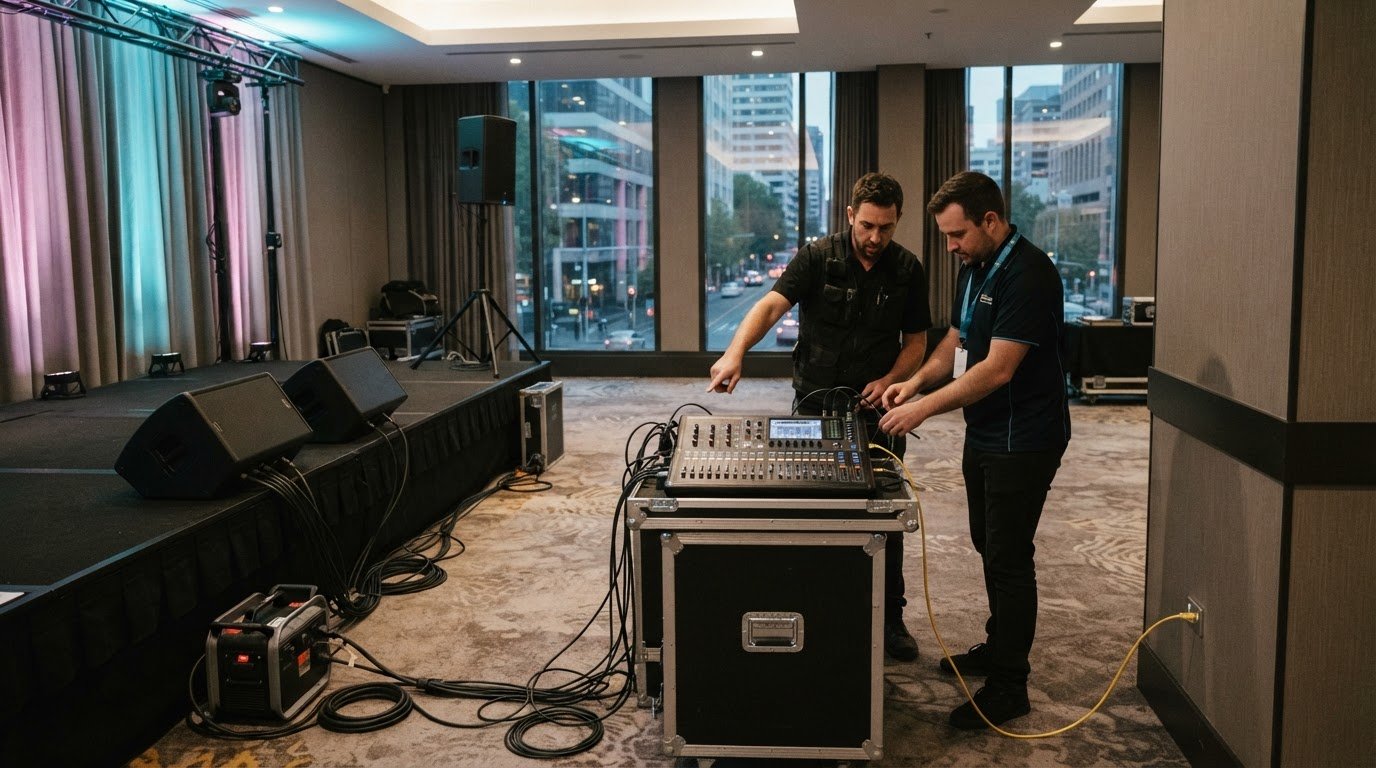
Successful event production starts with a clear plan for the venue, technical requirements and audience experience. Venue conditions may affect power, internet access, setup or technical supervision, so identify these requirements early and account for them in your production plan.
An AV proposal should make the agreed scope clear, while venue rules may set separate conditions for access, setup or technical supervision. Review the venue agreement alongside the proposal so you can plan for all the requirements attached to your event.
This guide explains how venue requirements and technical supervision can shape your event plan. If a venue requires its technician to oversee an external AV team, clarify how that affects the production schedule and responsibility for setup. Understanding the terms early helps you make informed decisions and plan a seamless experience for your audience.
Key Takeaways
- Separate venue requirements from AV production details so responsibilities are clear from the outset.
- Review commitment, renewal and cancellation terms together to understand your obligations and plan with confidence.
- Clarify who provides support, training and setup supervision, and how responsibilities are divided between venue and AV teams.
- Confirm whether in-house technician supervision is mandatory, then address the requirement before venue terms are finalised.
1. Power, internet, labour and setup requirements
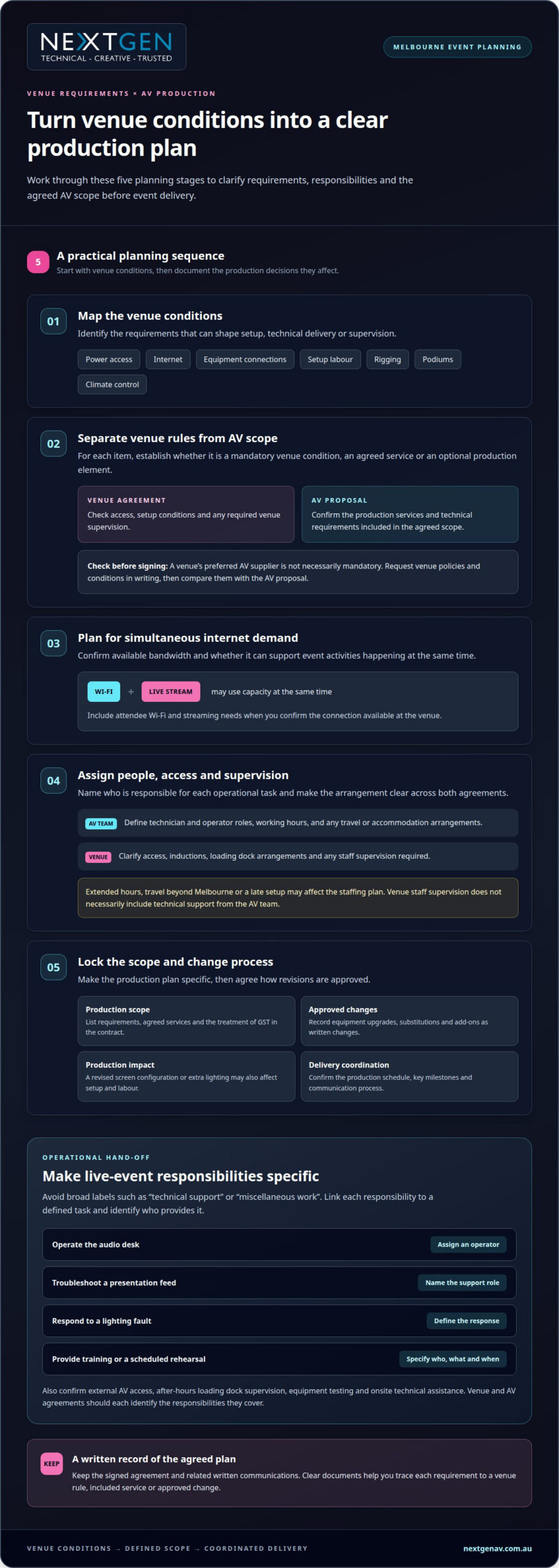
Melbourne venue and AV agreements may set out requirements for power access, internet, equipment connections, setup labour, rigging, podiums or climate control. Clarify what each item involves and whether it relates to a venue requirement or an agreed service.
Confirm the internet bandwidth available and how it will support your event. Attendee Wi-Fi and a live stream, for example, may use capacity at the same time, so plan for simultaneous demand.
Separate mandatory venue requirements from optional production elements. A compulsory connection or labour requirement differs from an optional equipment add-on. A venue’s preferred AV supplier is not necessarily mandatory, so request venue policies and conditions in writing before signing. Compare the venue and AV documents to check that services are clearly defined.
Section 18 of the Australian Consumer Law, in Schedule 2 to the Competition and Consumer Act 2010 (Cth), prohibits misleading or deceptive conduct, or conduct likely to mislead or deceive, according to the Australian Government, Federal Register of Legislation. Keep the signed agreement and related written communications so you can refer to the specific term or omission if needed.
Check that the agreed scope clearly defines the production requirements, including the treatment of GST in the contract.
Technician, operator, travel and accommodation arrangements depend on the agreed scope and event logistics. Extended hours, travel beyond Melbourne or a late setup may affect the staffing plan. Check that the contract identifies roles, working hours and any applicable travel arrangements.
Record equipment upgrades, substitutions and add-ons as written changes to the agreed scope. A revised screen configuration or extra lighting may also affect setup and labour. Confirm how changes are approved before they are made.
Confirm the production schedule, key milestones and communication process with your AV partner. Clear planning helps coordinate venue access, technical setup and event operations.
Understanding the requirements in AV contracts means tracing each item to a venue rule, service or approved change. This helps distinguish optional extras from unclear or duplicate items.
2. Commitment terms and cancellation conditions
Check the contract term, renewal date and notice period separately. The length of an agreement may not match the event schedule, so confirm when your obligations begin and end.
Read the cancellation and attrition clauses before signing a Melbourne venue or AV agreement. Check the cancellation deadline, whether notice must be in writing, and what happens if attendance or event scope changes. Cancellation may be treated differently from reducing requirements, so clarify how the agreement handles postponements, lower attendance and changes to production needs.
Committed quantities can also exceed actual use. A software agreement example describes a team ordering 80 seats but activating only 55. The same principle matters when an event contract defines a fixed scope: unused items or reduced requirements don’t automatically change the agreed scope. Put any permitted reductions and the date for requesting them in writing.
The contract term may differ from the project schedule. A software commitment that continues after a project ends after four months illustrates why you should check the contract end date separately. For an event, compare the agreement term with the event date and delivery period, and review any renewal or extension wording. Flag obligations that continue after the event.
Subscription cancellation pathways are also changing. Proposed Australian unfair trading practice provisions would require cancellation pathways to be at least as easy to use as sign-up pathways, with a proposed commencement date of 1 July 2027. For any subscription linked to event delivery, note how sign-up works, where cancellation is submitted and whether the same route is available.
Before signing, record the agreed term, renewal date and notice method in writing. If the venue or supplier agrees to a change, make sure it appears in the signed contract or an authorised written variation. Clear dates and documented approval can help prevent disputes if plans change.
3. Support, training and service responsibilities
Support clauses should identify who is responsible for each live event task. Specify who operates the audio desk, troubleshoots a presentation feed and responds to a lighting fault. If training is included, state who receives it, which system it covers and when it takes place.
Vague terms such as “technical support” or “miscellaneous work” do not explain what is included. Ask for each item to be linked to a defined task, such as equipment testing, operator attendance or a scheduled rehearsal. A clear written scope helps you distinguish included support from optional work.
Ask venues to explain what their staff are responsible for. Confirm whether an external AV company can access the venue, and whether after-hours loading dock access requires venue staff supervision. Check which party manages each requirement and what venue service it covers. Venue staff supervision does not necessarily include technical support from the AV team.
Before signing, define responsibilities across the venue and production agreements. Record who supplies power access, manages venue inductions, controls loading access and provides onsite technical assistance. If the venue requires its staff to supervise a task, specify the activity instead of leaving it under a broad “labour” label.
Review support by listing each task, assigning it to the venue or AV provider, and matching it to an included service or a separately described responsibility. A rehearsal may require an operator, for example, while loading dock access is managed by the venue. This distinction clarifies operational support and helps prevent duplicate responsibilities.
For a Melbourne conference, define support from setup through pack-down, including responsibility for last-minute changes to presentation content. Put agreed response arrangements, training, working hours and service limits in writing. Clear ownership helps the technical team resolve issues while the event programme stays focused on the audience.
4. In-house AV technician supervision
A venue may require its in-house AV technician to supervise an external team’s setup. Clarify what the supervision covers and whether the venue contract makes it compulsory.
Ask which tasks require supervision, how long it applies and when the technician must be present. It might apply only while equipment is connected to venue systems, or throughout setup and rehearsal. Those are different arrangements, so the contract should define the work clearly.
Check whether supervision is required for every production activity or only specific tasks. Lighting setup may have different access or oversight conditions from an audio check. If supervision applies only during a defined period, the agreement should state when that period begins and ends and how schedule changes affect it.
Confirm how supervision is arranged if setup is delayed or the schedule changes. A written process helps the venue and production team coordinate any adjustments and maintain a clear record of responsibilities.
If the venue makes supervision mandatory, it may be a condition of using that venue and setup. If the clause is optional, unclear or broader than the stated venue requirement, clarify its scope before signing. A preferred AV supplier and a mandatory in-house supplier are not necessarily the same.
Record the venue rule, supervision tasks and agreed period in writing. Compare them with the AV production scope to make sure responsibilities are clear. This helps technicians coordinate sound checks, lighting and access without disrupting the event schedule.
For a Melbourne event, discuss technical direction early, while production responsibilities and venue conditions can still shape the plan.
NextGen AV
NextGen AV plans event production around venue operating conditions, clarifying technical responsibilities before event day. If unclear supervision terms or overlapping responsibilities affect your plan, discuss the production requirements and what the event needs to deliver.
LED Video Walls, Professional Audio Systems, Lighting Design and Equipment, and Staging and Rigging can be coordinated as part of one event production plan. Planning these elements together connects venue access, setup and operation with the audience experience.
For your Melbourne event, contact NextGen AV to discuss your production requirements.
Set your event up for clarity
A clear production plan turns contract decisions into practical event outcomes. Before committing, align the agreed scope with the experience you want guests to have, from the first cue to the final presentation. Keeping venue conditions and production responsibilities visible helps plans take shape with clarity.
NextGen AV can coordinate LED Video Walls, Professional Audio Systems and Lighting Design and Equipment as part of a unified event production plan. Bringing these elements together early helps connect technical requirements with the run sheet, venue setup and audience experience, instead of leaving important decisions until event day.
If you’re planning an event in Melbourne, talk through your production plans with NextGen AV. A clear conversation is a strong next step towards an event that feels seamless, focused and memorable.
Frequently Asked Questions
Can every additional cost be removed?
No. A venue-mandated requirement, such as in-house supervision, may remain part of the event arrangements if you keep that venue and production setup. Optional add-ons and unclear charges are different: negotiate their removal or a narrower scope before signing. If an extra operator is not needed for your run sheet, for example, ask for that role to be removed from the written scope.
When Do Hidden Fees Become Misleading Pricing?
A quoted total can be misleading if it leaves out a compulsory charge that changes what you must pay. For example, a proposal that prominently shows a base amount but reveals a mandatory venue fee later may not give you a clear picture upfront. Review the full presentation, including qualifications, exclusions and when required charges are disclosed.
What extra fees can apply for AV equipment delivery, setup and pack-down?
A contract may list delivery, installation, testing, operation and pack-down separately rather than treating them as one service. Venue access can also affect the plan: after-hours loading dock use, for example, may incur a venue charge. Check whether the agreed scope covers delivery to the event space, setup within the available access period and removal after the programme.
What should you check in an AV contract to identify hidden fees before signing?
Compare the signed contract with the final quote and venue agreement. Look for exclusions, mandatory add-ons and unclear triggers for extra charges. Check who approves changes, how they are recorded and whether a written variation overrides earlier wording. If a revised run sheet changes operating hours, for example, ensure the change and its effect are documented.
What payment terms, deposits and card surcharges are common in Australian AV contracts?
Payment terms may specify deposit timing, payment milestones, the final due date and accepted methods; Australian AV contracts do not all follow the same schedule. Check that any card surcharge is disclosed in the quote or contract.
Successful event production starts with a clear plan for the venue, technical requirements and audience experience. Venue conditions may affect power, internet access, setup or technical supervision, so identify these requirements early and account for them in your production plan.
An AV proposal should make the agreed scope clear, while venue rules may set separate conditions for access, setup or technical supervision. Review the venue agreement alongside the proposal so you can plan for all the requirements attached to your event.
This guide explains how venue requirements and technical supervision can shape your event plan. If a venue requires its technician to oversee an external AV team, clarify how that affects the production schedule and responsibility for setup. Understanding the terms early helps you make informed decisions and plan a seamless experience for your audience.
Key Takeaways
- Separate venue requirements from AV production details so responsibilities are clear from the outset.
- Review commitment, renewal and cancellation terms together to understand your obligations and plan with confidence.
- Clarify who provides support, training and setup supervision, and how responsibilities are divided between venue and AV teams.
- Confirm whether in-house technician supervision is mandatory, then address the requirement before venue terms are finalised.
1. Power, internet, labour and setup requirements
Melbourne venue and AV agreements may set out requirements for power access, internet, equipment connections, setup labour, rigging, podiums or climate control. Clarify what each item involves and whether it relates to a venue requirement or an agreed service.
Confirm the internet bandwidth available and how it will support your event. Attendee Wi-Fi and a live stream, for example, may use capacity at the same time, so plan for simultaneous demand.
Separate mandatory venue requirements from optional production elements. A compulsory connection or labour requirement differs from an optional equipment add-on. A venue’s preferred AV supplier is not necessarily mandatory, so request venue policies and conditions in writing before signing. Compare the venue and AV documents to check that services are clearly defined.
Section 18 of the Australian Consumer Law, in Schedule 2 to the Competition and Consumer Act 2010 (Cth), prohibits misleading or deceptive conduct, or conduct likely to mislead or deceive, according to the Australian Government, Federal Register of Legislation. Keep the signed agreement and related written communications so you can refer to the specific term or omission if needed.
Check that the agreed scope clearly defines the production requirements, including the treatment of GST in the contract.
Technician, operator, travel and accommodation arrangements depend on the agreed scope and event logistics. Extended hours, travel beyond Melbourne or a late setup may affect the staffing plan. Check that the contract identifies roles, working hours and any applicable travel arrangements.
Record equipment upgrades, substitutions and add-ons as written changes to the agreed scope. A revised screen configuration or extra lighting may also affect setup and labour. Confirm how changes are approved before they are made.
Confirm the production schedule, key milestones and communication process with your AV partner. Clear planning helps coordinate venue access, technical setup and event operations.
Understanding the requirements in AV contracts means tracing each item to a venue rule, service or approved change. This helps distinguish optional extras from unclear or duplicate items.
2. Commitment terms and cancellation conditions
Check the contract term, renewal date and notice period separately. The length of an agreement may not match the event schedule, so confirm when your obligations begin and end.
Read the cancellation and attrition clauses before signing a Melbourne venue or AV agreement. Check the cancellation deadline, whether notice must be in writing, and what happens if attendance or event scope changes. Cancellation may be treated differently from reducing requirements, so clarify how the agreement handles postponements, lower attendance and changes to production needs.
Committed quantities can also exceed actual use. A software agreement example describes a team ordering 80 seats but activating only 55. The same principle matters when an event contract defines a fixed scope: unused items or reduced requirements don’t automatically change the agreed scope. Put any permitted reductions and the date for requesting them in writing.
The contract term may differ from the project schedule. A software commitment that continues after a project ends after four months illustrates why you should check the contract end date separately. For an event, compare the agreement term with the event date and delivery period, and review any renewal or extension wording. Flag obligations that continue after the event.
Subscription cancellation pathways are also changing. Proposed Australian unfair trading practice provisions would require cancellation pathways to be at least as easy to use as sign-up pathways, with a proposed commencement date of 1 July 2027. For any subscription linked to event delivery, note how sign-up works, where cancellation is submitted and whether the same route is available.
Before signing, record the agreed term, renewal date and notice method in writing. If the venue or supplier agrees to a change, make sure it appears in the signed contract or an authorised written variation. Clear dates and documented approval can help prevent disputes if plans change.
3. Support, training and service responsibilities
Support clauses should identify who is responsible for each live event task. Specify who operates the audio desk, troubleshoots a presentation feed and responds to a lighting fault. If training is included, state who receives it, which system it covers and when it takes place.
Vague terms such as “technical support” or “miscellaneous work” do not explain what is included. Ask for each item to be linked to a defined task, such as equipment testing, operator attendance or a scheduled rehearsal. A clear written scope helps you distinguish included support from optional work.
Ask venues to explain what their staff are responsible for. Confirm whether an external AV company can access the venue, and whether after-hours loading dock access requires venue staff supervision. Check which party manages each requirement and what venue service it covers. Venue staff supervision does not necessarily include technical support from the AV team.
Before signing, define responsibilities across the venue and production agreements. Record who supplies power access, manages venue inductions, controls loading access and provides onsite technical assistance. If the venue requires its staff to supervise a task, specify the activity instead of leaving it under a broad “labour” label.
Review support by listing each task, assigning it to the venue or AV provider, and matching it to an included service or a separately described responsibility. A rehearsal may require an operator, for example, while loading dock access is managed by the venue. This distinction clarifies operational support and helps prevent duplicate responsibilities.
For a Melbourne conference, define support from setup through pack-down, including responsibility for last-minute changes to presentation content. Put agreed response arrangements, training, working hours and service limits in writing. Clear ownership helps the technical team resolve issues while the event programme stays focused on the audience.
4. In-house AV technician supervision
A venue may require its in-house AV technician to supervise an external team’s setup. Clarify what the supervision covers and whether the venue contract makes it compulsory.
Ask which tasks require supervision, how long it applies and when the technician must be present. It might apply only while equipment is connected to venue systems, or throughout setup and rehearsal. Those are different arrangements, so the contract should define the work clearly.
Check whether supervision is required for every production activity or only specific tasks. Lighting setup may have different access or oversight conditions from an audio check. If supervision applies only during a defined period, the agreement should state when that period begins and ends and how schedule changes affect it.
Confirm how supervision is arranged if setup is delayed or the schedule changes. A written process helps the venue and production team coordinate any adjustments and maintain a clear record of responsibilities.
If the venue makes supervision mandatory, it may be a condition of using that venue and setup. If the clause is optional, unclear or broader than the stated venue requirement, clarify its scope before signing. A preferred AV supplier and a mandatory in-house supplier are not necessarily the same.
Record the venue rule, supervision tasks and agreed period in writing. Compare them with the AV production scope to make sure responsibilities are clear. This helps technicians coordinate sound checks, lighting and access without disrupting the event schedule.
For a Melbourne event, discuss technical direction early, while production responsibilities and venue conditions can still shape the plan.
NextGen AV
NextGen AV plans event production around venue operating conditions, clarifying technical responsibilities before event day. If unclear supervision terms or overlapping responsibilities affect your plan, discuss the production requirements and what the event needs to deliver.
LED Video Walls, Professional Audio Systems, Lighting Design and Equipment, and Staging and Rigging can be coordinated as part of one event production plan. Planning these elements together connects venue access, setup and operation with the audience experience.
For your Melbourne event, contact NextGen AV to discuss your production requirements.
Set your event up for clarity
A clear production plan turns contract decisions into practical event outcomes. Before committing, align the agreed scope with the experience you want guests to have, from the first cue to the final presentation. Keeping venue conditions and production responsibilities visible helps plans take shape with clarity.
NextGen AV can coordinate LED Video Walls, Professional Audio Systems and Lighting Design and Equipment as part of a unified event production plan. Bringing these elements together early helps connect technical requirements with the run sheet, venue setup and audience experience, instead of leaving important decisions until event day.
If you’re planning an event in Melbourne, talk through your production plans with NextGen AV. A clear conversation is a strong next step towards an event that feels seamless, focused and memorable.
Frequently Asked Questions
Can every additional cost be removed?
No. A venue-mandated requirement, such as in-house supervision, may remain part of the event arrangements if you keep that venue and production setup. Optional add-ons and unclear charges are different: negotiate their removal or a narrower scope before signing. If an extra operator is not needed for your run sheet, for example, ask for that role to be removed from the written scope.
When Do Hidden Fees Become Misleading Pricing?
A quoted total can be misleading if it leaves out a compulsory charge that changes what you must pay. For example, a proposal that prominently shows a base amount but reveals a mandatory venue fee later may not give you a clear picture upfront. Review the full presentation, including qualifications, exclusions and when required charges are disclosed.
What extra fees can apply for AV equipment delivery, setup and pack-down?
A contract may list delivery, installation, testing, operation and pack-down separately rather than treating them as one service. Venue access can also affect the plan: after-hours loading dock use, for example, may incur a venue charge. Check whether the agreed scope covers delivery to the event space, setup within the available access period and removal after the programme.
What should you check in an AV contract to identify hidden fees before signing?
Compare the signed contract with the final quote and venue agreement. Look for exclusions, mandatory add-ons and unclear triggers for extra charges. Check who approves changes, how they are recorded and whether a written variation overrides earlier wording. If a revised run sheet changes operating hours, for example, ensure the change and its effect are documented.
What payment terms, deposits and card surcharges are common in Australian AV contracts?
Payment terms may specify deposit timing, payment milestones, the final due date and accepted methods; Australian AV contracts do not all follow the same schedule. Check that any card surcharge is disclosed in the quote or contract.
Discover Valuable Insights
Unlock Expert Tips and Advice
Our blog is packed with valuable information to help you stay ahead. Whether you’re looking for expert advice, industry trends, or practical tips, you’ll find everything you need. Reach out today to learn more or get in touch with us for personalised support!