Understanding AV Labour Costs, Workable Hours and Overheads

A client charge covers AV labour only when it recovers wages, employer on-costs and overhead across the hours that can actually be billed. Understanding AV labour costs means looking beyond the hourly wage: according to the Australian Taxation Office, compulsory superannuation contributions rose to 11.5% from 1 July 2024.

It’s easy to underestimate the gap between time on site and productive, billable work. Setup, pack-down, travel, administration and gaps between bookings all affect how much of a team’s working time can be charged to a project.

This guide explains how workable hours shape an effective labour rate, and how productivity, superannuation and workers’ compensation contribute to the full picture. You’ll learn what to include when assessing whether client charges cover the people and preparation behind a smooth event.

Key Takeaways

  • Separate direct labour tied to event delivery from indirect work that supports operations to see what each project needs to recover.
  • Build wages, superannuation, workers’ compensation and other employment on-costs into your labour-rate calculations.
  • Use realistic workable hours that account for preparation, pack-down and other non-billable tasks when assessing team productivity.
  • Match staffing and technical production to the event’s audience and format, so each element contributes to a seamless experience.

What Is the Cost of Labour?

For an AV event, labour cost includes crew pay and the employment costs attached to that work. Separating show-delivery tasks from operational support helps you judge whether charges reflect the resources involved.

Direct and indirect labour costs

Direct labour can be traced to a specific production task, while indirect labour supports operations without being tied to one task. For example, a technician operating the sound system during a conference is direct labour; general scheduling support is indirect. This distinction matters because a quote focused only on the technician’s hours may overlook the support needed to deliver the event. Classifying both makes profitability analysis more accurate.

Direct wages

Direct wages are the pay allocated to crew members for work on a particular event, forming one component of direct labour costs. For an AV call, record which crew member performed each task and the hours assigned to it. This creates a traceable basis for comparing labour charges with the work delivered. It also separates wages from employer on-costs, which belong in the wider labour calculation.

Calculating call-out and penalty rates

Minimum call-outs and overtime, weekend or public holiday rates depend on the applicable crew employment terms and hours worked. There isn’t one universal multiplier for every AV call: identify the stated minimum paid hours, then apply the relevant rate to each category of work. A quote should show how an early bump-in or a public holiday call affects the labour line, rather than folding it into an unexplained total.

Checking labour charges in a quote

To check labour charges, match each quoted crew line to the work, timing and charging basis it covers. Ask which roles are included, what tasks they’ll perform, and how many hours are allowed for bump-in, the event and pack-down. Then clarify whether minimum call-outs or penalty rates apply and how they’re calculated. These questions reveal whether a quote reflects the actual schedule or only the time on stage.

The Cost Of AV: Why So Expensive?

An AV labour figure reflects the crew, work scope and production setting, not simply time on stage. A conference with complex lighting and tightly timed cues needs different planning from a straightforward presentation.

AV labour cost components

AV labour costs combine employee pay with employment on-costs, business overheads and time allocated to event delivery. Separating these elements helps you assess the true cost behind each quoted role. In Australia, wages can vary by industry, location and experience, while recruitment and training also contribute. Cost-of-living differences offer context, but don’t determine an employee’s pay or an event’s labour charge on their own.

Hourly and day rates

Hourly and day rates are ways to charge for technician time, not standard rates across Australia. There isn’t one typical figure for every AV technician: role, experience, location, call duration and work conditions all influence the rate. Compare like with like by checking which hours the rate covers and whether the call includes preparation, operation or pack-down. This gives you a clearer basis for assessing labour requirements without assuming that differently scoped rates are equivalent.

Company and freelance technician costs

Hiring an AV company or engaging a freelance technician can involve different work scopes and cost structures. A freelancer’s charge reflects their agreed work and engagement terms; a company quote may allocate labour across the production roles and services included. Neither option is automatically less expensive. Compare the people, responsibilities, coordination and event tasks covered, then consider how each arrangement fits your production.

Event costs, allocations and additional charges

Event labour’s share depends on production requirements, so a room for 20 attendees and a production for 3,000 people can call for different crew plans. Venue location, equipment complexity and show schedule also shape the work involved. Travel time, accommodation, meals and setup can be included or itemised separately; the quote should make their treatment clear. For shared services, allocate charges according to the support each event actually receives, not an arbitrary split. Technical direction for event production can help align crew responsibilities with the show plan.

Net workable hours and productivity assumptions

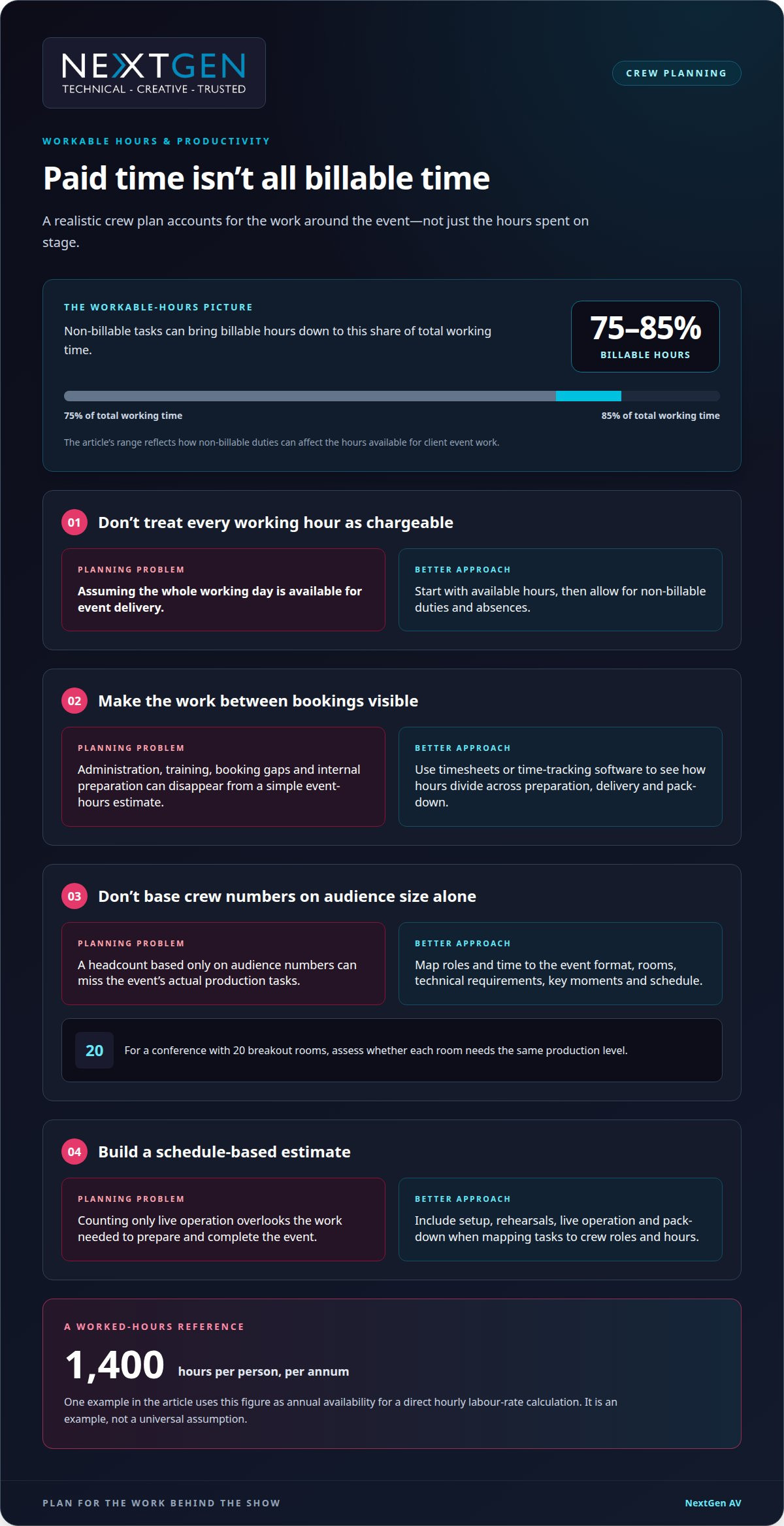
A crew’s paid working time isn’t all available for billable event work. For example, non-billable tasks can reduce billable hours to 75-85% of total working time.

Non-productive time and billable hours

Non-productive time is paid work time that can’t be charged directly to a client event. It can include administration, training, gaps between bookings and internal preparation. If a business assumes every working hour is billable, its accounting may understate the overhead carried by each event. A useful calculation starts with available annual hours, then subtracts non-billable duties and absences. One example uses 1,400 hours per person per annum as annual availability for a direct hourly labour rate.

Time records replace assumptions with actual patterns. Timesheets or time-tracking software can show how work hours are divided across preparation, delivery and pack-down. Turnover and absenteeism also affect the hours available for booked work, while employee dissatisfaction can reduce productivity. Accounting for these effects is crucial when setting staffing levels and checking whether the team can meet an event schedule.

Estimating crew numbers and labour hours

Estimate crew numbers by mapping each production task to the role and time needed across the event schedule. Start with the event format, rooms, technical requirements and key moments, then account for setup, rehearsals, live operation and pack-down. This creates a reasoned staffing plan instead of a headcount based only on audience size.

For a conference with 20 breakout rooms, consider whether each room needs the same production level. A single fully produced room for high-level sessions, with simpler support elsewhere, may better match the programme. Compare that plan with the hours required to staff all rooms equally. Include handovers and schedule gaps, then use actual time records to refine future estimates. This links productivity to the event’s real requirements while keeping staffing decisions grounded in the show plan.
Understanding AV Labour Costs, Workable Hours and Overheads

Superannuation and workers’ compensation

Employer contributions and insurance add to the cost of employing AV crew. Include them alongside wages when assessing the full labour charge for an event.

Superannuation for AV technicians

Superannuation is an employer contribution made for eligible workers, adding an employment on-cost beyond wages. Australian employers’ compulsory superannuation contributions rose to 11.5% from 1 July 2024, according to the Australian Taxation Office. Include this contribution when calculating the employment cost attached to crew time, rather than treating the wage as the entire labour amount.

For AV technicians, award rates and employment conditions depend on the applicable employment classification and terms. A job title alone doesn’t establish the rate. When reviewing a quote, identify the crew role, the applicable basis for pay and how superannuation is included in the labour charge. This separates the wage component from the employer contribution.

Workers’ compensation costs and allowances

Workers’ compensation insurance helps cover employment risks, and its premium is another labour on-cost for employers. Australian workers’ compensation costs average around 5%, with rates varying by industry; rates in higher-risk industries can reach 14%. The applicable rate affects the employer’s overall labour calculation, so it should not be mistaken for a technician’s wage or an event-specific allowance.

Allowances are separate from insurance contributions. A quote may list an allowance separately from crew labour, making its purpose and application clearer. Check which roles and work periods it relates to, and whether the quoted labour charge already includes it. This helps prevent counting the same employment component twice.

When comparing AV crew charges, consider the wage basis, superannuation, workers’ compensation and any stated allowances together. Ask how each component is treated in the quoted total, then compare similar crew roles and event duties. This gives you a clearer view of employer costs behind the labour line without confusing employment on-costs with a technician’s take-home pay.

For events where crew scheduling and technical delivery need to align, plan event technical direction around the production requirements.

NextGen AV: LED Video Walls

NextGen AV helps event teams turn complex production requirements into a coordinated audience experience, with LED Video Walls as a focal point for clear, high-impact visuals. Bring the team in when your event needs screens integrated with Professional Audio Systems, Lighting Design and Equipment, or Staging and Rigging, rather than treating each element as a separate task.

For a conference, product launch or corporate event, the right production plan connects the technical setup to the room, run sheet and audience. NextGen AV manages the details behind the scenes so your content, sound and lighting work together smoothly on the day.

To discuss your event’s production requirements, contact NextGen AV or visit nextgenav.com.au.

Turn the Numbers into a Show Plan

Use your labour assessment as the starting point for a production brief that connects crew responsibilities with the audience experience. When the schedule, technical requirements and event priorities are clear, you can make informed decisions about where specialist support will have the greatest impact. Understanding AV labour costs helps you assess the plan, while thoughtful production design turns those decisions into a cohesive event.

Bring your event concept, venue details and run sheet together before production planning begins. This gives your technical team a practical view of the moments that need careful coordination, from content transitions to lighting and sound cues. The result is a clearer path from planning to show day, with technical details supporting your event goals.

Discuss your AV project with NextGen AV and take the next step towards an event shaped with precision and purpose.

Frequently Asked Questions

Is The Client Charging Enough?

A charge is sufficient when it covers the required work and the full employment and operating costs allocated to it. To assess this, compare actual crew hours and duties with the event charge, then account for non-billable time across the wider schedule. Understanding AV labour costs helps you judge whether each booking contributes to profitability, rather than relying on the hourly wage alone.

What Does An Employee Really Cost?

An employee’s full cost is more than their wage: it includes employer contributions, insurance and other employment expenses. For a practical assessment, look at the annual employment cost for each role, then compare it with the productive hours available for event work. For example, an audio engineer’s paid time may also cover preparation, training and administration, not only live event delivery.

What makes up the labour rate?

A labour rate translates employment and business expenses into a charge for time spent on client work. Its components can include wages, superannuation, workers’ compensation, leave, payroll taxes and overhead. To understand a rate, identify which elements it covers and how the business accounts for non-billable work. This helps distinguish the technician’s pay from the amount needed to sustain the service.

What labour costs are included in an AV production quote in Australia?

An AV production quote may include technical planning, project management, crew, setup, testing, live operation and pack-down, depending on the agreed scope. For a Melbourne conference, check whether the quoted team covers the roles needed for room preparation as well as show operation. Also review how travel, accommodation, meals and any allowances are treated, so you can compare the complete scope rather than a single labour line.

How much do AV project managers, audio engineers and vision technicians charge?

There isn’t one universal hourly or day rate for AV project managers, audio engineers or vision technicians in Australia. Charges depend on responsibilities, experience, event location, schedule and engagement terms. A project manager coordinating a complex production has a different scope from a vision technician operating content playback. Compare the duties and time covered before treating rates for different roles as equivalent.

How can I reduce AV labour costs without increasing event risk?

Reduce unnecessary work by matching technical production to the programme, not by removing essential responsibilities. Prioritise sessions that need full production, simplify support for lower-demand spaces and coordinate schedules to avoid duplicated tasks. Keep clear ownership of show-critical audio, vision and lighting cues. In Melbourne, align the crew plan with venue access and the run sheet so practical constraints are addressed during planning.

A client charge covers AV labour only when it recovers wages, employer on-costs and overhead across the hours that can actually be billed. Understanding AV labour costs means looking beyond the hourly wage: according to the Australian Taxation Office, compulsory superannuation contributions rose to 11.5% from 1 July 2024.

It’s easy to underestimate the gap between time on site and productive, billable work. Setup, pack-down, travel, administration and gaps between bookings all affect how much of a team’s working time can be charged to a project.

This guide explains how workable hours shape an effective labour rate, and how productivity, superannuation and workers’ compensation contribute to the full picture. You’ll learn what to include when assessing whether client charges cover the people and preparation behind a smooth event.

Key Takeaways

  • Separate direct labour tied to event delivery from indirect work that supports operations to see what each project needs to recover.
  • Build wages, superannuation, workers’ compensation and other employment on-costs into your labour-rate calculations.
  • Use realistic workable hours that account for preparation, pack-down and other non-billable tasks when assessing team productivity.
  • Match staffing and technical production to the event’s audience and format, so each element contributes to a seamless experience.

What Is the Cost of Labour?

For an AV event, labour cost includes crew pay and the employment costs attached to that work. Separating show-delivery tasks from operational support helps you judge whether charges reflect the resources involved.

Direct and indirect labour costs

Direct labour can be traced to a specific production task, while indirect labour supports operations without being tied to one task. For example, a technician operating the sound system during a conference is direct labour; general scheduling support is indirect. This distinction matters because a quote focused only on the technician’s hours may overlook the support needed to deliver the event. Classifying both makes profitability analysis more accurate.

Direct wages

Direct wages are the pay allocated to crew members for work on a particular event, forming one component of direct labour costs. For an AV call, record which crew member performed each task and the hours assigned to it. This creates a traceable basis for comparing labour charges with the work delivered. It also separates wages from employer on-costs, which belong in the wider labour calculation.

Calculating call-out and penalty rates

Minimum call-outs and overtime, weekend or public holiday rates depend on the applicable crew employment terms and hours worked. There isn’t one universal multiplier for every AV call: identify the stated minimum paid hours, then apply the relevant rate to each category of work. A quote should show how an early bump-in or a public holiday call affects the labour line, rather than folding it into an unexplained total.

Checking labour charges in a quote

To check labour charges, match each quoted crew line to the work, timing and charging basis it covers. Ask which roles are included, what tasks they’ll perform, and how many hours are allowed for bump-in, the event and pack-down. Then clarify whether minimum call-outs or penalty rates apply and how they’re calculated. These questions reveal whether a quote reflects the actual schedule or only the time on stage.

The Cost Of AV: Why So Expensive?

An AV labour figure reflects the crew, work scope and production setting, not simply time on stage. A conference with complex lighting and tightly timed cues needs different planning from a straightforward presentation.

AV labour cost components

AV labour costs combine employee pay with employment on-costs, business overheads and time allocated to event delivery. Separating these elements helps you assess the true cost behind each quoted role. In Australia, wages can vary by industry, location and experience, while recruitment and training also contribute. Cost-of-living differences offer context, but don’t determine an employee’s pay or an event’s labour charge on their own.

Hourly and day rates

Hourly and day rates are ways to charge for technician time, not standard rates across Australia. There isn’t one typical figure for every AV technician: role, experience, location, call duration and work conditions all influence the rate. Compare like with like by checking which hours the rate covers and whether the call includes preparation, operation or pack-down. This gives you a clearer basis for assessing labour requirements without assuming that differently scoped rates are equivalent.

Company and freelance technician costs

Hiring an AV company or engaging a freelance technician can involve different work scopes and cost structures. A freelancer’s charge reflects their agreed work and engagement terms; a company quote may allocate labour across the production roles and services included. Neither option is automatically less expensive. Compare the people, responsibilities, coordination and event tasks covered, then consider how each arrangement fits your production.

Event costs, allocations and additional charges

Event labour’s share depends on production requirements, so a room for 20 attendees and a production for 3,000 people can call for different crew plans. Venue location, equipment complexity and show schedule also shape the work involved. Travel time, accommodation, meals and setup can be included or itemised separately; the quote should make their treatment clear. For shared services, allocate charges according to the support each event actually receives, not an arbitrary split. Technical direction for event production can help align crew responsibilities with the show plan.

Net workable hours and productivity assumptions

A crew’s paid working time isn’t all available for billable event work. For example, non-billable tasks can reduce billable hours to 75-85% of total working time.

Non-productive time and billable hours

Non-productive time is paid work time that can’t be charged directly to a client event. It can include administration, training, gaps between bookings and internal preparation. If a business assumes every working hour is billable, its accounting may understate the overhead carried by each event. A useful calculation starts with available annual hours, then subtracts non-billable duties and absences. One example uses 1,400 hours per person per annum as annual availability for a direct hourly labour rate.

Time records replace assumptions with actual patterns. Timesheets or time-tracking software can show how work hours are divided across preparation, delivery and pack-down. Turnover and absenteeism also affect the hours available for booked work, while employee dissatisfaction can reduce productivity. Accounting for these effects is crucial when setting staffing levels and checking whether the team can meet an event schedule.

Estimating crew numbers and labour hours

Estimate crew numbers by mapping each production task to the role and time needed across the event schedule. Start with the event format, rooms, technical requirements and key moments, then account for setup, rehearsals, live operation and pack-down. This creates a reasoned staffing plan instead of a headcount based only on audience size.

For a conference with 20 breakout rooms, consider whether each room needs the same production level. A single fully produced room for high-level sessions, with simpler support elsewhere, may better match the programme. Compare that plan with the hours required to staff all rooms equally. Include handovers and schedule gaps, then use actual time records to refine future estimates. This links productivity to the event’s real requirements while keeping staffing decisions grounded in the show plan.

Superannuation and workers’ compensation

Employer contributions and insurance add to the cost of employing AV crew. Include them alongside wages when assessing the full labour charge for an event.

Superannuation for AV technicians

Superannuation is an employer contribution made for eligible workers, adding an employment on-cost beyond wages. Australian employers’ compulsory superannuation contributions rose to 11.5% from 1 July 2024, according to the Australian Taxation Office. Include this contribution when calculating the employment cost attached to crew time, rather than treating the wage as the entire labour amount.

For AV technicians, award rates and employment conditions depend on the applicable employment classification and terms. A job title alone doesn’t establish the rate. When reviewing a quote, identify the crew role, the applicable basis for pay and how superannuation is included in the labour charge. This separates the wage component from the employer contribution.

Workers’ compensation costs and allowances

Workers’ compensation insurance helps cover employment risks, and its premium is another labour on-cost for employers. Australian workers’ compensation costs average around 5%, with rates varying by industry; rates in higher-risk industries can reach 14%. The applicable rate affects the employer’s overall labour calculation, so it should not be mistaken for a technician’s wage or an event-specific allowance.

Allowances are separate from insurance contributions. A quote may list an allowance separately from crew labour, making its purpose and application clearer. Check which roles and work periods it relates to, and whether the quoted labour charge already includes it. This helps prevent counting the same employment component twice.

When comparing AV crew charges, consider the wage basis, superannuation, workers’ compensation and any stated allowances together. Ask how each component is treated in the quoted total, then compare similar crew roles and event duties. This gives you a clearer view of employer costs behind the labour line without confusing employment on-costs with a technician’s take-home pay.

For events where crew scheduling and technical delivery need to align, plan event technical direction around the production requirements.

NextGen AV: LED Video Walls

NextGen AV helps event teams turn complex production requirements into a coordinated audience experience, with LED Video Walls as a focal point for clear, high-impact visuals. Bring the team in when your event needs screens integrated with Professional Audio Systems, Lighting Design and Equipment, or Staging and Rigging, rather than treating each element as a separate task.

For a conference, product launch or corporate event, the right production plan connects the technical setup to the room, run sheet and audience. NextGen AV manages the details behind the scenes so your content, sound and lighting work together smoothly on the day.

To discuss your event’s production requirements, contact NextGen AV or visit nextgenav.com.au.

Turn the Numbers into a Show Plan

Use your labour assessment as the starting point for a production brief that connects crew responsibilities with the audience experience. When the schedule, technical requirements and event priorities are clear, you can make informed decisions about where specialist support will have the greatest impact. Understanding AV labour costs helps you assess the plan, while thoughtful production design turns those decisions into a cohesive event.

Bring your event concept, venue details and run sheet together before production planning begins. This gives your technical team a practical view of the moments that need careful coordination, from content transitions to lighting and sound cues. The result is a clearer path from planning to show day, with technical details supporting your event goals.

Discuss your AV project with NextGen AV and take the next step towards an event shaped with precision and purpose.

Frequently Asked Questions

Is The Client Charging Enough?

A charge is sufficient when it covers the required work and the full employment and operating costs allocated to it. To assess this, compare actual crew hours and duties with the event charge, then account for non-billable time across the wider schedule. Understanding AV labour costs helps you judge whether each booking contributes to profitability, rather than relying on the hourly wage alone.

What Does An Employee Really Cost?

An employee’s full cost is more than their wage: it includes employer contributions, insurance and other employment expenses. For a practical assessment, look at the annual employment cost for each role, then compare it with the productive hours available for event work. For example, an audio engineer’s paid time may also cover preparation, training and administration, not only live event delivery.

What makes up the labour rate?

A labour rate translates employment and business expenses into a charge for time spent on client work. Its components can include wages, superannuation, workers’ compensation, leave, payroll taxes and overhead. To understand a rate, identify which elements it covers and how the business accounts for non-billable work. This helps distinguish the technician’s pay from the amount needed to sustain the service.

What labour costs are included in an AV production quote in Australia?

An AV production quote may include technical planning, project management, crew, setup, testing, live operation and pack-down, depending on the agreed scope. For a Melbourne conference, check whether the quoted team covers the roles needed for room preparation as well as show operation. Also review how travel, accommodation, meals and any allowances are treated, so you can compare the complete scope rather than a single labour line.

How much do AV project managers, audio engineers and vision technicians charge?

There isn’t one universal hourly or day rate for AV project managers, audio engineers or vision technicians in Australia. Charges depend on responsibilities, experience, event location, schedule and engagement terms. A project manager coordinating a complex production has a different scope from a vision technician operating content playback. Compare the duties and time covered before treating rates for different roles as equivalent.

How can I reduce AV labour costs without increasing event risk?

Reduce unnecessary work by matching technical production to the programme, not by removing essential responsibilities. Prioritise sessions that need full production, simplify support for lower-demand spaces and coordinate schedules to avoid duplicated tasks. Keep clear ownership of show-critical audio, vision and lighting cues. In Melbourne, align the crew plan with venue access and the run sheet so practical constraints are addressed during planning.

Back to Articles

Discover Valuable Insights

Unlock Expert Tips and Advice

Our blog is packed with valuable information to help you stay ahead. Whether you’re looking for expert advice, industry trends, or practical tips, you’ll find everything you need. Reach out today to learn more or get in touch with us for personalised support!

Contact Us

Request A Quote

Make an
Enquiry

Let’s Get Your Event Sorted

Complete the enquiry form with your event date, venue, audience size, event type and budget. Our Melbourne AV team will review your requirements and recommend the right PA, screen, lighting, staging or production setup for your event.

What happens next?


1.We review your event details
Tell us your date, venue, audience size and event type.

2.We recommend the right setup
From PA hire to screens, lighting, staging and full AV production.

3. We come back with clear advice
You’ll receive practical recommendations and a fast quote from our Melbourne team.

Need help urgently?
Call 1300 792 922.

Resource Download

Tell us a bit about yourself to download our resources.

7