



What if the most influential person at your next keynote isn’t the CEO on stage, but the invisible expert ensuring every pixel and decibel performs on cue? When you’re staring down a complex equipment list or juggling multiple AV vendors, it’s easy to feel overwhelmed by the technical jargon. You’ve likely asked yourself, what does a technical director do for a corporate event that a standard technician doesn’t? The reality is that they act as your chief risk officer, transforming a room full of gear into a high-impact, cinematic experience.
We understand the inherent stress of high-stakes planning. You deserve a flawless production that impresses your stakeholders without the constant fear of a technical glitch or a sudden audio failure. This guide reveals how a Technical Director provides a single point of contact and total peace of mind during the frantic energy of the bump-in and show. We will explore their essential role in pre-production, their command over the venue, and how they protect your professional reputation through absolute precision.
Key Takeaways
- Learn how a Technical Director acts as the master conductor, bridging the gap between your creative vision and the technical crew to ensure every moment lands with precision.
- Discover the importance of meticulous pre-production, including site inspections and CAD drawings that guarantee a perfect view for every guest in the room.
- Understand what does a technical director do for a corporate event to mitigate high-stakes risks, acting as your primary defence against technical failures and power disruptions.
- Realise the professional advantage of combining elite technical direction with high-end hardware hire to create a unified, stress-free production experience.
Defining the Technical Director: The Conductor of Your Corporate Event
A Technical Director (TD) is the senior lead architect responsible for the meticulous design, setup, and seamless operation of every technical element within your production. They aren’t just on-site to monitor equipment; they act as the primary bridge between an event planner’s abstract vision and the technical crew working on the floor. While the planning team focuses on the guest list and catering, the TD focuses intensely on the “how” of the technology. They ensure that sound, light, and vision don’t just function independently but work in absolute harmony to create a cinematic atmosphere. By 2026 standards, a Technical Director is the specialist who translates a high-level creative brief into a tangible technical reality, ensuring the technology elevates the message rather than distracting from it.
When people ask, what does a technical director do for a corporate event, the answer lies in their ability to orchestrate complex systems under pressure. They are the invisible experts who ensure that when a speaker walks onto the stage, the lighting transition is frame-perfect and the audio is crystal clear. Their role involves a high degree of “quiet power,” where success is measured by the audience never noticing the immense technical effort happening behind the scenes.
TD vs. AV Project Manager: What is the Difference?
It’s common to confuse these two roles, but their focus differs significantly. A Project Manager is your logistical powerhouse, handling budgets, timelines, and vendor contracts. In contrast, the TD is the guardian of the show-flow and technical integrity. You need both to ensure your event has financial oversight alongside technical excellence. For instance, while a Project Manager organises the delivery of gear, the TD manages the specific nuances of professional sound system hire, ensuring that acoustic coverage is tailored perfectly to the venue’s unique architecture. They understand the physics of the room, not just the cost of the hire.
The Creative Translator Role
Planners often speak in emotions, not decibels or lumens. A planner might say, “We want the opening to feel high-energy and prestigious.” The TD interprets this by designing specific lighting cues, selecting punchy audio frequencies, and synchronising them with high-resolution content on LED walls. They ensure your brand’s aesthetic is maintained across every digital canvas. Beyond the equipment, they manage the technical expectations of C-suite speakers, providing the reassurance and precision required for a flawless keynote. They turn a vague “feeling” into a perfectly executed sequence of cues, allowing the client to take centre stage without a single worry about the technology supporting them.
Pre-Production: Building the Technical Blueprint for Success
The technical success of a corporate event isn’t decided on the day of the show; it’s won in the months of meticulous pre-production that precede it. An experienced Technical Director starts their work long before the first road case is loaded onto a truck. They act as the master planner, conducting exhaustive site visits to scrutinise power requirements, rigging points, and venue limitations. This phase is where the technical blueprint is drafted. By creating detailed CAD drawings and precision floor plans, the TD ensures that every seat in the house offers a perfect, unobstructed view of the led video wall.
When clients ask, what does a technical director do for a corporate event during the planning phase, the answer is risk management through documentation. They specify the exact equipment list required for the project, ensuring there is no “over-speccing” that wastes budget, nor any missing components that could derail the production. This level of precision allows for a highly organised “bump-in” schedule, coordinated with the venue to avoid clashes with other functions. It is about creating a path of least resistance for the crew and maximum impact for the audience.
Site Inspections and Venue Liaison
Melbourne’s event landscape is diverse, ranging from heritage-listed halls with restrictive power grids to ultra-modern convention centres. A TD’s expert eye is essential for navigating these unique spaces. They don’t just look at the stage; they inspect loading docks, measure lift dimensions to ensure large LED panels fit, and test Wi-Fi capabilities for critical stream stability. Negotiating with in-house AV teams is also a vital part of the role. The TD ensures that any external equipment hire integrates seamlessly with the venue’s existing infrastructure, preventing technical friction on the day.
Technical Documentation and “Run of Show”
The TD is responsible for creating the Master Technical Script, the definitive guide that every operator follows from the first cue to the final pack-down. This document maps out complex signal paths, especially when deploying hybrid event staging solutions that require synchronisation between on-site and remote audiences. They also oversee the formatting of all digital assets. Whether it’s a 16:9 PowerPoint or a custom-resolution video for a wide-format screen, the TD ensures every file is optimised for the specific hardware in use. If you want to ensure your technical blueprint is as robust as your vision, partnering with a seasoned technical team can turn high-stakes planning into a streamlined, stress-free process.
The On-Site Reality: Managing the Show-Flow and Crew
When the trucks arrive at the venue loading dock at dawn, the focus shifts from blueprints to the physical reality of the production. Directing the “bump-in” is where the Technical Director’s leadership is most visible. It is an exercise in organised chaos, transforming an empty ballroom or heritage space into a high-tech theatre in just a few hours. They mobilise the crew, ensuring that tonnes of staging, audio, and lighting gear are positioned with millimetre precision. This is a core part of what does a technical director do for a corporate event; they protect the strict venue schedule while maintaining absolute safety on the floor.
Before the house lights dim and the doors open, the TD leads the final, critical crew briefing. Every camera operator, sound engineer, and lighting technician receives their specific instructions for the hours ahead. This isn’t just about technical settings; it’s about the rhythm and the “vibe” of the brand. The TD acts as the calm centre of the storm, ready to pivot instantly if a speaker changes their mind at the lectern or a last-minute video asset arrives at the control desk.
The Art of Calling the Show
During the live event, the TD takes their place at the “Comms” headset to call the show. This involves giving precise, real-time commands for every lighting transition, video playback, and audio cue. Calling the show prevents those dreaded awkward silences or the “wrong slide” moments that can undermine a brand’s prestige. By managing the pacing like a broadcast director, they ensure transitions between speakers feel cinematic and polished. This constant orchestration keeps the audience’s attention exactly where it belongs, ensuring the message is never lost to a technical stumble.
Managing the Tech Crew
Beyond the creative flow, the TD is responsible for the operational safety of the entire technical team. They oversee the high-risk elements of rigging and staging, ensuring every cable is secured and every truss is balanced. If a technical issue arises mid-show, the TD troubleshoots in real-time, often resolving the problem through the headset before the client even notices. Once the final applause fades, they manage the “pack-down,” ensuring all equipment is cleared from the venue efficiently and safely. This ensures the client can focus on celebratory post-event networking while the invisible experts handle the heavy lifting behind the scenes.
Risk Mitigation: Why a TD is Your Event’s Insurance Policy
High-stakes corporate events carry inherent risks that can’t be left to chance. When you ask what does a technical director do for a corporate event, think of them as your primary defence against the “Top 5 AV Failures”: piercing audio feedback, distracting video lag, sudden power trips, software crashes, and connectivity drops. They don’t just hope for the best; they build “Plan B” and “Plan C” scenarios into every critical component of the production. By ensuring total redundancy in the system, a TD guarantees that if a primary media server fails, a backup takes over in milliseconds. This level of technical ownership allows the event planner to step back from the logistical grind and focus entirely on stakeholder engagement.
The peace of mind provided by a Technical Director is invaluable during the high-pressure environment of a live show. They act as a sophisticated safety net, identifying potential bottlenecks in the signal chain long before the doors open. This proactive stance transforms the technical setup from a source of anxiety into a robust, reliable engine that drives the event’s success. Your reputation is safe when an expert is dedicated to monitoring the technical pulse of the room.
The “What If” Framework
Hybrid events introduce layers of complexity where a single internet glitch can disconnect half your audience. The TD develops strict protocols for these moments, such as having pre-recorded backups ready to roll the instant a remote speaker’s link wavers. Power distribution is another silent risk. High-draw stage and lighting hire Melbourne can easily overload venue circuits if the load isn’t balanced with precision across available phases. A Technical Director identifies a single point of failure before the first guest arrives, ensuring the lights stay on and the message stays clear.
Quality Control and Brand Integrity
Your brand is your most valuable asset, and it must be protected through technical precision. A TD ensures every microphone is perfectly levelled for a speaker’s unique vocal range and every LED screen is colour-calibrated to match your brand’s exact style guide. “Good enough” is never acceptable when representing a major organisation. The ROI of a flawless show is found in the protection of your corporate prestige; one viral clip of a technical failure can undo years of meticulous brand building. To safeguard your next production, secure your technical direction with a team that treats your reputation as their own.
Partnering with a Melbourne Technical Director for Your 2026 Event
In a city celebrated for its world-class corporate culture, the difference between a standard function and a prestigious production often comes down to the depth of local expertise. NextGen AV brings 30 years of industry experience to the table, having navigated the unique technical quirks of Melbourne’s most iconic venues. When you consider what does a technical director do for a corporate event, their ability to anticipate venue-specific challenges is what ensures a seamless delivery. Whether it’s managing restrictive heritage power grids or coordinating complex loading dock schedules, local knowledge is your greatest asset. By integrating technical direction with high-end hardware hire, we eliminate the friction and “vendor finger-pointing” often found when coordinating multiple disparate suppliers.
Working with an integrated team means the person designing your technical blueprint is the same person responsible for the performance of the gear. This creates a powerful synergy where the hardware is selected specifically for its ability to realise the creative vision. We organise the entire technical lifecycle, from the very first concept sketch to the final pack-down, providing you with a single point of contact for every technical detail. This holistic approach offers a level of peace of mind that only comes from a team that has seen, and solved, every possible on-site scenario.
The NextGen AV Difference
Our “Confident Orchestrator” approach is designed to alleviate the inherent stress of high-stakes planning by projecting absolute competence. We don’t just provide equipment; we provide a dedicated craft that prioritises your event’s prestige. This partnership grants you access to elite hardware, including custom LED walls and professional audio systems, all managed by seasoned veterans. We act as the invisible expert behind the scenes, ensuring that the technology serves as a high-impact engine for your message rather than a source of distraction.
Next Steps for Your Event Planning
Timing is critical for a successful technical outcome. To maximise the impact of your production, bring a Technical Director into your planning process as early as possible. Ideally, this should happen during the initial concept phase so they can identify technical roadblocks before they become expensive problems. When briefing your TD, focus on your high-level goals and the desired “feel” of the experience; our team will translate those aspirations into a precise technical reality. Ready to elevate your next production? Enquire about Technical Direction for your Melbourne event and ensure your 2026 keynote is remembered for all the right reasons.
Secure Your Event’s Legacy with Precision Direction
A corporate event is more than a gathering; it’s a high-stakes representation of your brand’s prestige and future trajectory. We have explored the intricate details of what does a technical director do for a corporate event, from drafting the initial technical blueprint to orchestrating the cinematic flow of a live keynote. By prioritising meticulous pre-production and building robust, redundant systems, a Technical Director ensures your message is delivered without a single glitch or distraction. This proactive approach turns potential technical failures into seamless transitions that captivate your audience.
NextGen AV brings over 30 years of Australian event experience to your production, providing an elite Melbourne-based technical crew that thrives under pressure. We act as your “Invisible Expert,” managing the stress of complex AV logistics so you can focus on your guests and stakeholders. Don’t leave your professional reputation to chance. Partner with NextGen AV for Flawless Technical Direction and transform your next corporate function into a seamless, high-impact experience. Your vision deserves the certainty of expert execution.
Frequently Asked Questions
Do I really need a Technical Director for a small corporate meeting?
While a basic board meeting might not require senior oversight, a Technical Director is vital for any small meeting where a technical failure would compromise your professional prestige. They handle the nuanced logistics of hybrid connections and multi-speaker cues, allowing you to focus on your agenda rather than troubleshooting a projector. Their presence ensures that even intimate gatherings land with the same impact as a major keynote.
How much does a Technical Director cost for a one-day event in Melbourne?
Costs for technical direction in Melbourne vary significantly based on the complexity of your show and the level of expertise required. Rates are typically negotiated on a per-project basis to account for pre-production hours, on-site duration, and the scale of the crew being managed. We recommend requesting a detailed proposal that aligns with your specific production goals and technical requirements.
What is the difference between an AV Technician and a Technical Director?
An AV technician focuses on the operation of specific equipment, such as a sound desk or a lighting console. In contrast, the Technical Director is the senior lead who designs the entire system and orchestrates the crew. Understanding what does a technical director do for a corporate event helps clarify that they are the architect, while technicians are the specialised builders who execute the plan.
Can a Technical Director help with hybrid or virtual event streaming?
Absolutely. A Technical Director is essential for hybrid events, as they manage the complex signal paths between the physical venue and the digital stream. They ensure that remote speakers land with the same impact as those on stage, maintaining a unified experience for every delegate regardless of their location. They also monitor stream stability and manage backup protocols to prevent any loss of connectivity.
At what stage of planning should I hire a Technical Director?
You should ideally engage a Technical Director during the initial concept phase of your planning. Bringing them in early allows for site inspections and technical feasibility checks that can prevent costly changes later. Their insight during the venue selection process can also identify potential power or rigging limitations before you sign a venue contract, saving you significant time and budget.
Does the Technical Director provide the AV equipment as well?
Yes, NextGen AV provides a full-service approach where technical direction and elite hardware hire are integrated. This synergy ensures that the director is working with equipment they know intimately, such as our custom LED walls and professional audio systems. It creates a streamlined workflow that removes the risk of vendor miscommunication and ensures the gear is perfectly matched to the technical design.
What happens if there is a technical glitch during the show?
If a glitch occurs, the Technical Director is your first line of defence, often resolving the issue through redundant systems before the audience notices. They have “Plan B” protocols for every critical component, from backup microphones to secondary media servers. Their presence ensures that any technical hiccup is handled with quiet, professional precision, protecting your brand’s reputation in real-time.
Will the Technical Director work with my existing event planner?
A Technical Director works in close partnership with your event planner, acting as the bridge between their creative vision and the technical crew. They translate the planner’s high-level goals into specific technical cues, floor plans, and run-of-show documents. This collaboration ensures that every logistical detail supports the overall theme and prestige of your corporate production without the planner needing to master technical jargon.
The house lights dim and the opening cue is seconds away, yet instead of the stage manager’s voice, your headset fills with static or the muffled chatter of a nearby security team. It is the nightmare scenario for any production lead, where a simple lapse in your event communication systems rental choice transforms a high-stakes performance into a series of missed cues and frantic hand signals. You know that behind every flawless event is an invisible engine of coordination, and you shouldn’t have to worry about wireless blackspots or battery failure when the pressure is on.
We agree that your crew deserves the same level of precision in their headsets as the audience hears through the front-of-house speakers. This 2026 guide promises to show you how to choose and deploy a robust communication infrastructure that guarantees absolute synchronisation across lighting, audio, and stage departments. We will look at the latest full-duplex digital intercoms, how to ensure ACMA compliance for interference-free operation, and the technical strategies required to maintain professional-grade reliability for an 18-hour show day.
Key Takeaways
- Understand why professional communication serves as the vital nervous system for any high-stakes production, ensuring every cue is executed with absolute precision.
- Discover the technical differences between digital intercoms and two-way radios to determine which technology best suits your crew’s specific talk-paths and security needs.
- Learn how to optimise your event communication systems rental by conducting thorough site surveys and assessing the unique acoustic challenges of your venue.
- Navigate the complexities of ACMA frequency licensing to avoid interference from unlicensed gear and ensure your production remains compliant and crystal clear.
- Explore the benefits of integrating your comms infrastructure into a total audio-visual package, backed by 30 years of expertise in the Melbourne events industry.
The Critical Role of Event Communication Systems in Modern Production
Think of your event as a living organism. If the audio-visual elements are the muscles and the vision is the heart, then a professional event communication systems rental is the nervous system. It carries every pulse of data and every urgent command from the brain, the stage manager, to the extremities of the production. Without this connectivity, the most expensive LED walls and line arrays are just static hardware. Truly seamless production relies on the ability to transmit intent instantly. This allows a lighting operator to hit a blackout the exact millisecond the drummer strikes the final beat, creating a moment of pure, coordinated impact.
There is a profound difference between managing a crowd and calling a show. Simple two-way radios are fine for coordinating car park arrivals or security patrols, but they fall short when you’re choreographing a complex gala. Calling a show requires a continuous, open dialogue where the stage manager can hear the breath of the crew and anticipate their needs. This level of intimacy prevents the common AV glitches that haunt poorly planned events, such as mistimed video rolls or audio feedback during a critical keynote. When the crew feels connected, their stress levels drop significantly. They move from a state of reactive panic to one of proactive artistry, focusing on the prestige of the final result rather than fighting their equipment.
Beyond Walkie-Talkies: Defining Professional Comms
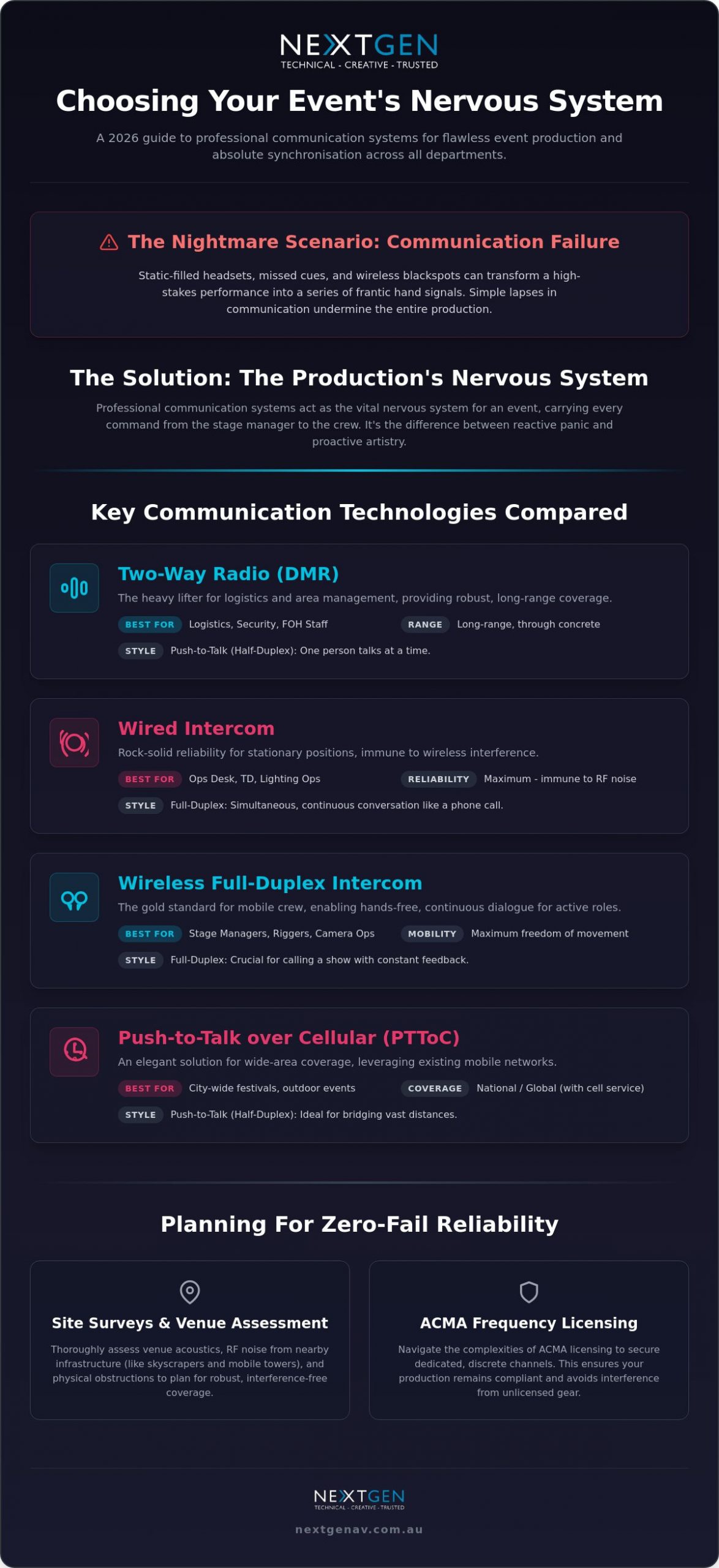
The evolution of production has pushed us past the era of simple push-to-talk devices. Modern digital intercom systems create integrated networks that allow for full-duplex conversation, meaning your team can talk and listen simultaneously just like a phone call. In high-interference environments like the Melbourne CBD, consumer-grade gear often buckles under the weight of RF noise from skyscrapers and mobile towers. A professional setup provides dedicated, discrete channels. This ensures the lighting department isn’t distracted by audio troubleshooting, and the stage manager has a direct, private line to the technical director to keep the schedule on track.
Risk Mitigation through Reliable Infrastructure
Reliability isn’t just a luxury; it’s a safety requirement. High-stakes corporate shows demand a zero-fail comms environment, which we define as a dedicated infrastructure where redundant signal paths and expert frequency management ensure every critical cue is delivered and acknowledged without exception. This infrastructure prevents the dead air that can ruin a live broadcast or the timing errors that turn a prestige award ceremony into a series of awkward silences. Beyond the creative flow, these systems act as a lifeline for emergency protocols. They ensure that if a situation arises, the entire team can be alerted and organised in seconds without the audience ever knowing there was a concern.
Key Technologies: From Two-Way Radio Hire to Digital Intercoms
The technical landscape of modern production has shifted, moving away from simple noise-makers toward sophisticated, low-latency networks. Selecting the right event communication systems rental depends entirely on the specific roles within your crew. For logistics and security teams, Digital Mobile Radio (DMR) remains the heavy lifter. These units provide robust, long-range coverage that ensures your front-of-house staff and loading dock crews remain connected across vast distances, even through the thick concrete walls of Melbourne’s premier convention centres.
At the heart of the production, wired intercom systems provide the rock-solid reliability required for stationary positions. Your technical director and lighting operator, situated at the ops desk, don’t need mobility; they need a connection that is immune to wireless interference. When Choosing the Right System for your mobile stage crew, wireless full-duplex technology is the gold standard. It allows for continuous, hands-free conversation, enabling a rigger or stage hand to use both hands for their craft while maintaining a crystal-clear dialogue with the stage manager.
For city-wide festivals or sprawling outdoor events, Push-to-Talk over Cellular (PTToC) offers an elegant solution. By leveraging existing mobile networks, PTToC bridges the gap where traditional radio frequencies might struggle, providing wide-area coverage that keeps your entire team synchronised across kilometres of urban terrain. Our team can help you organise a bespoke comms package that aligns perfectly with your show’s complexity and venue constraints.
Digital vs. Analogue Systems
Digital systems have rendered analogue units obsolete in professional circles. By converting voice into data packets, digital DMR units offer superior audio clarity and eliminate the background hiss associated with older technology. More importantly, digital channels allow for advanced encryption. This is a vital feature for high-profile corporate events where sensitive announcements must remain private. Professional-grade digital hardware also boasts significantly better battery life, often surviving an 18-hour show day on a single charge while withstanding the physical rigours of a frantic bump-in.
Specialised Accessories for Every Role
The right headset is just as important as the base station itself. In high-decibel environments like concerts or trade shows, heavy-duty noise-cancelling headsets are essential to protect crew hearing and ensure instructions are heard over the PA. Conversely, floor managers and VIP hosts often require discrete earpieces that provide clear audio without the bulky profile of a traditional headset. We also provide multi-unit charging stations and speaker microphones to ensure large-scale deployments remain powered and functional from the first briefing to the final pack-down.
Choosing the Right System: A Buyer’s Comparison Framework
Selecting your event communication systems rental is not merely a matter of counting heads. It is an exercise in mapping the pulse of your production. You must first audit the ratio of ‘talkers’ to ‘listeners’ within your crew. While a logistics team might only need to report status updates via simplex channels, where only one person can speak at a time, your core production crew requires the fluid, simultaneous exchange of a full-duplex system. Understanding this distinction is the first step in moving from a basic setup to a professional-grade infrastructure that supports the artistry of your show.
The venue itself dictates the hardware. An indoor ballroom in the Melbourne CBD presents different challenges than a sprawling outdoor festival site at the Sidney Myer Music Bowl. Physical barriers like thick concrete walls or massive steel rigging can swallow wireless signals, leading to the dreaded ‘dead air’ that puts a production at risk. Budgeting for your comms should be viewed as show insurance. The investment in a high-end, reliable rental is negligible when compared to the professional fallout and stress of a failed show caused by a missed cue or a battery dying at a critical moment.
The ‘Show-Caller’ Test
A show-caller is the conductor of your event’s orchestra. They require a full-duplex system to maintain the ‘rhythm’ of the event, allowing them to hear the breath and readiness of the crew in real time. This typically involves a multi-channel structure where the caller can toggle between discrete departments like lighting, audio, and stage management without cluttering the main feed. This level of technical direction is what bridges the gap between a standard event and a world-class experience. It is why we often integrate these comms with our Professional sound system hire to ensure every element of the production is perfectly aligned from the first cue to the final curtain.
Interference and Range Considerations
Melbourne’s premier event precincts are notorious for RF noise. From the skyscrapers of the CBD to the high-density wireless environments of Southbank, signal interference is a constant threat. If your event spans multiple levels or a vast outdoor area, you will likely need to deploy repeaters to extend the range of your two-way radio fleet. A technical site survey is essential to identify potential blackspots and ensure your signal penetrates the physical barriers of the venue. By planning for these environmental factors early, you ensure your crew remains connected, regardless of the architectural challenges of the space.
Planning Your Comms Infrastructure: Site Surveys and ACMA Compliance
A flawless production is never the result of luck; it is the product of meticulous preparation that begins long before the first road case enters the venue. For a high-impact event communication systems rental to succeed, a technical site survey is non-negotiable. This proactive assessment allows us to map the unique RF environment of your location, identifying potential blackspots created by heavy structural steel or subterranean concrete layers. By conducting a rigorous ‘walk-test’ protocol during the pre-show phase, we ensure that every corner of the site, from the green room to the loading dock, maintains a crystal-clear signal before the first cue is ever called.
Operating in Australia requires a deep understanding of the legal landscape governed by the Australian Communications and Media Authority (ACMA). Using unlicensed ‘grey market’ gear doesn’t just risk signal dropouts; it exposes your organisation to significant legal liability and potential fines. Professional systems must adhere to the Radiocommunications (Low Interference Potential Devices) Class Licence 2025, ensuring that your equipment operates on designated shared frequencies without disrupting emergency services or other vital broadcasts. We ensure all hired electronics meet strict RCM safety standards, providing you with the peace of mind that your infrastructure is both high-performing and fully compliant.
Frequency Management in Melbourne
The RF spectrum in Melbourne’s premier precincts, such as the MCEC or the major hotels along Southbank, is incredibly crowded. Without a co-ordinated frequency plan, your production comms could easily clash with nearby events or the venue’s internal security teams. For large-scale multi-AV projects, we act as your frequency coordinator, carving out dedicated space in the airwaves to prevent cross-talk and interference. This level of master-planning is a core component of our Full service event production, where we manage the technical heavy lifting so you can focus on the show’s creative execution.
Logistics and On-Site Support
While some choose ‘dry hire’ to save on initial costs, the complexity of modern intercom networks makes a turnkey solution far more efficient. A turnkey event communication systems rental includes the expertise of an on-site technician who manages the invisible details, from real-time troubleshooting to proactive battery swaps during critical show moments. Having a seasoned veteran on the ground ensures that any technical hiccups are resolved in seconds, maintaining the momentum of your event. If you are ready to secure a rock-solid foundation for your next production, contact our team to discuss a tailored comms strategy that guarantees absolute reliability.
Why Partner with NextGen AV for Your Melbourne Event Comms
Choosing a partner for your event communication systems rental is about more than just securing hardware; it is about finding an invisible expert who understands the heartbeat of a live production. We don’t view comms as an isolated utility. Instead, we integrate your intercom network directly into our total lighting and audio design. This holistic approach ensures that every department is perfectly synchronised, allowing the technical director to orchestrate the show with the precision of a master conductor. With over 30 years of experience navigating the specific RF challenges and logistical quirks of Victorian event venues, we have seen every possible scenario and developed the resilience to handle them all.
Our “Confident Orchestrator” philosophy means we take full ownership of the technical heavy lifting. You shouldn’t have to worry about frequency clashing or headset pairing while you are managing stakeholders and talent. Our solutions arrive custom-programmed and ready to use out of the box, configured specifically for your show’s unique talk-paths and department structures. This meticulous preparation eliminates the logistical grind of the bump-in, allowing your team to move straight into the creative flow of the event with absolute confidence in their connectivity.
The NextGen AV Advantage: Expert Technical Direction
A sophisticated comms network is only as effective as the hands that guide it. Our technical directors oversee the entire infrastructure, providing a level of oversight that ensures your peace of mind from the first briefing to the final pack-down. Whether you are hosting an intimate corporate meeting in the CBD or a massive community festival in regional Victoria, our solutions are inherently scalable. We provide the same elite-level reliability for a dozen headsets as we do for a hundred. This commitment to excellence is what defines our Audio visual hire Melbourne services, positioning us as a dedicated ally in your project’s success.
Ready to Organise Your Event Comms?
Organising a professional-grade communication setup is a straightforward process when you have the right experts by your side. To request a tailored quote, simply provide our team with your expected crew size, the layout of your chosen venue, and the total duration of the hire. This information allows us to architect a bespoke frequency plan and equipment list that meets your exact needs. You can rest easy knowing that your production is backed by professional-grade reliability and a team that takes personal pride in seamless execution. Let us handle the engine behind the scenes while you take centre stage.
Master the Rhythm of Your Next Production
The success of your next high-stakes event shouldn’t rest on the hope that your headsets will hold a charge. It requires a dedicated infrastructure built on technical mastery and a deep understanding of the unique RF challenges found across Melbourne. By selecting the right blend of digital intercoms for your show-callers and robust radios for your logistics team, you eliminate the friction that leads to missed cues. Remember that a professional site survey and strict ACMA compliance are the foundations of a zero-fail environment, protecting your production from signal interference and legal risk.
NextGen AV brings over 30 years of Melbourne event expertise to your project, offering end-to-end technical production management that allows you to focus on the prestige of the final result. We provide ACMA-compliant, professional-grade equipment that is custom-programmed to meet the specific demands of your venue. Choosing the right event communication systems rental is the final piece of the puzzle in delivering a world-class experience. It’s time to move past the logistical grind and experience the power of a perfectly synchronised crew.
Secure your seamless event comms with NextGen AV today and ensure your next production runs with absolute precision. We are ready to act as your invisible expert, driving the engine of your success from the first cue to the final curtain.
Frequently Asked Questions
What is the difference between simplex and full-duplex communication?
Simplex communication allows only one person to speak at a time while others listen; whereas full-duplex systems enable simultaneous two-way conversation just like a telephone call. This distinction is vital for production flow. Logistics and security teams typically use simplex radios, but show-callers and stage managers rely on full-duplex intercoms to maintain a continuous, uninterrupted dialogue during complex sequences.
Do I need a licence to use hired two-way radios in Australia?
You generally don’t need an individual licence for hired two-way radios because professional rental companies operate under ACMA class licences. These regulations ensure the equipment is compliant with Australian standards for power output and frequency use. We handle all the technical compliance and frequency co-ordination behind the scenes, so your team can focus on the event without worrying about regulatory hurdles.
How many radios should I hire for a corporate event with 500 guests?
The number of units required depends on your crew structure rather than the guest count. A typical corporate gala with 500 guests might require 15 to 25 units to cover stage management, audio-visual technicians, venue catering, and security teams. We recommend mapping out every department head and floor manager to ensure no critical link in your production chain is left without a headset.
What happens if our communication system experiences interference during the show?
If interference occurs, our technical directors immediately transition the crew to a secondary, pre-programmed backup channel. This is why a professional event communication systems rental includes a rigorous frequency management plan. By identifying potential RF clashes during the site survey, we create a redundant infrastructure that keeps your team connected even in the most crowded wireless environments.
Can event comms systems integrate with my existing sound system?
Event comms systems integrate seamlessly with your existing sound system to provide a “program feed” directly into crew headsets. This allows operators to hear the stage microphones while listening for cues from the stage manager. Using professional 4-wire interfaces, we can bridge your intercom network with your audio console to create a unified technical ecosystem that enhances the precision of every cue.
What is the range of a standard digital two-way radio in a city environment?
A standard digital two-way radio typically offers a range of 1 to 2 kilometres in a dense city environment like the Melbourne CBD. However, physical obstructions like high-rise buildings and steel structures can reduce this distance significantly. For events spanning larger urban areas or multiple venue levels, we deploy digital repeaters to boost signal penetration and ensure 100% coverage across your entire site.
Are wireless intercoms better than wired systems for stage management?
Wireless intercoms are superior for mobile stage managers who need to move between the wings and the green room, but wired systems remain the gold standard for stationary operators. Wired stations are immune to RF interference and battery failure; making them the most reliable choice for the lighting desk or technical director. Most high-stakes productions use a hybrid approach to balance mobility with absolute stability.
How long do the batteries last on professional event communication gear?
Professional event communication gear is designed to survive a standard 12 to 18-hour show day on a single charge. High-capacity lithium-ion batteries in modern digital beltpacks and radios provide reliable performance throughout a long bump-in and the final performance. We always provide multi-unit charging stations and spare batteries as part of our event communication systems rental packages to guarantee zero downtime during critical moments.
The most breathtaking moments of a live production don’t happen on the stage; they happen several metres above it, held in place by the invisible precision of professional engineering. You understand that behind every immersive LED display or complex lighting plot lies a significant weight of responsibility. The fear of structural failure or the frustration of navigating opaque Australian rigging standards can often overshadow the creative vision of your event. It is a high-stakes environment where the difference between a spectacular success and a safety incident rests on the strength of your overhead infrastructure.
Implementing the right event rigging solutions is the only way to bridge the gap between ambitious design and absolute safety. This 2026 guide provides the mastery you need to ensure your next production is structurally sound, fully compliant with the WHS Act 2011, and visually spectacular. We will demystify essential hardware, clarify venue load limits, and provide the technical vocabulary required to brief your AV partners with the authority of a seasoned expert. By the end of this article, you will have the knowledge to move past the logistical grind and focus on the prestige of a flawless execution.
Key Takeaways
- Understand why professional event rigging solutions are the invisible backbone of any high-impact production, ensuring every element is suspended with engineered precision.
- Identify the essential hardware required for a secure setup, from modular aluminium truss to the sophisticated chain hoists that safely lift the load.
- Navigate complex Australian safety standards and licensing requirements to ensure your production remains fully compliant and structurally sound.
- Learn how to conduct a comprehensive site inspection to account for venue load limits and technical constraints before the build begins.
- Discover the efficiency of a holistic approach where rigging, lighting, and staging are integrated to create a seamless and prestigious event experience.
What are Event Rigging Solutions?
Every world-class production begins with a structure that stays largely unnoticed by the audience. Professional event rigging solutions represent the sophisticated integration of hardware and engineering designed to suspend high-end audio, lighting, and visual technology safely above the crowd. It is the invisible backbone of the experience. While architectural rigging refers to permanent systems built into theatres or arenas, temporary event rigging is a bespoke craft. It involves transforming a raw space, such as a hotel ballroom, a heritage building, or an outdoor precinct, into a technically capable venue through the use of modular trussing and precision motors. This flexibility allows for the creative freedom that brings a cinematic vision to life.
Modern productions rely on this foundation to achieve a level of prestige that floor-supported equipment simply cannot match. Whether you are planning an intimate corporate gala or a large-scale festival, the rigging system acts as the silent engine driving the success of the show. By employing Entertainment rigging principles, technical teams can create immersive environments that feel both expansive and secure. It is a dedicated craft that balances the laws of physics with the artistry of live performance.
The Core Purpose of Rigging in Events
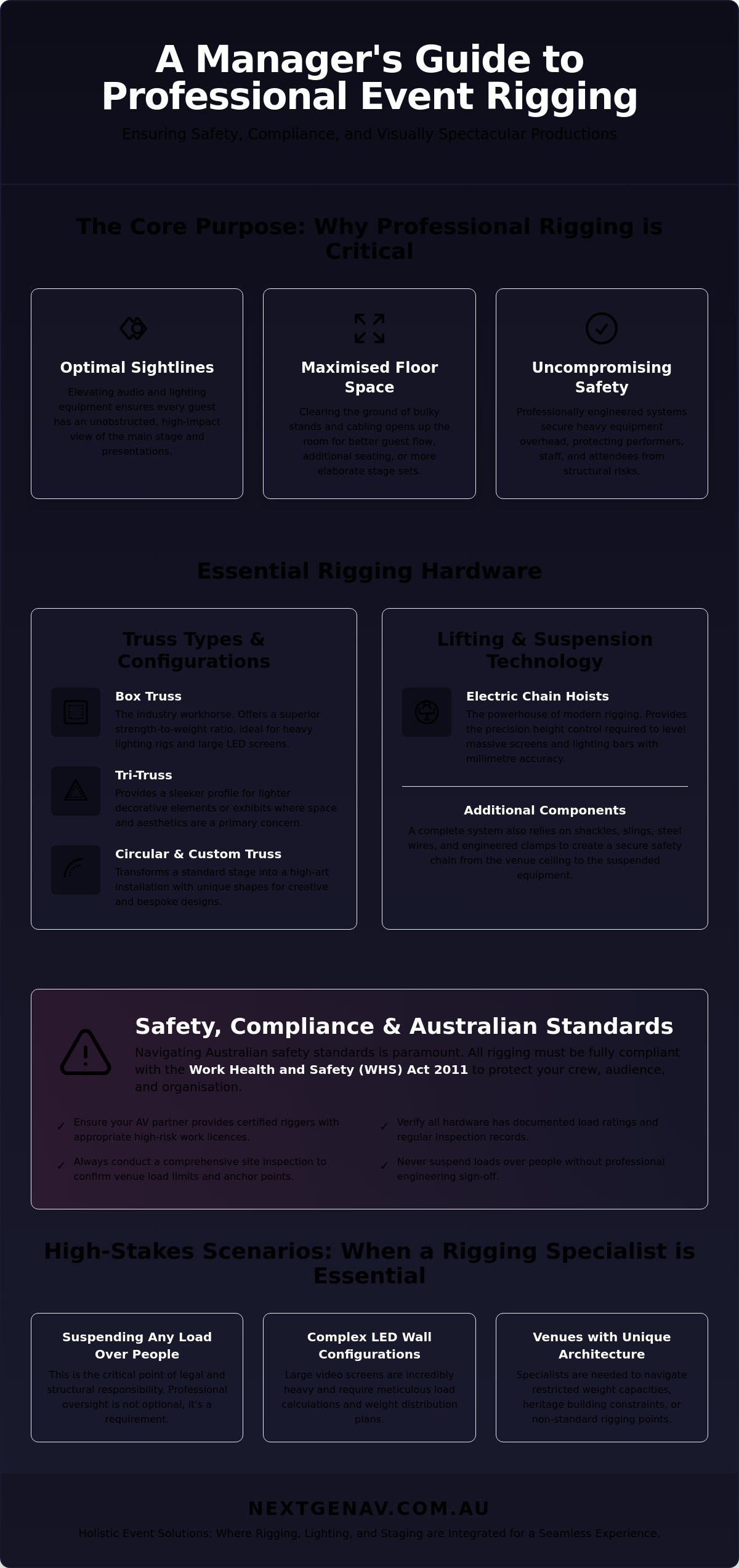
The primary objective of any rigging system is to elevate the technical standard of the production while maintaining absolute safety. By moving heavy equipment overhead, you achieve three critical outcomes:
- Optimal Sightlines: Elevating audio and lighting gear ensures every guest has an unobstructed view of the stage, creating a more inclusive and high-impact experience.
- Maximised Floor Space: Clearing the ground of bulky stands and cables opens up the room for better guest flow, additional seating, or more elaborate stage sets.
- Uncompromising Safety: A professionally engineered system secures equipment far more effectively than temporary floor supports, protecting performers, staff, and attendees from accidental knocks or instability.
When Does Your Event Need a Rigging Specialist?
Rigging is not a “plug and play” utility. It’s a high-stakes discipline that requires seasoned veterans who thrive under pressure. You should engage a specialist whenever your production involves suspending loads over people, as this is a critical point of legal and structural responsibility. Complex LED wall configurations also demand expert oversight; these screens are incredibly heavy and require meticulous weight distribution. Finally, if your venue has restricted weight capacities or unique architecture, a specialist will navigate these constraints to ensure your event rigging solutions are both compliant and spectacular. They act as the confident orchestrator, allowing you to take centre stage without a single worry about the gear overhead.
Essential Hardware: The Components of a Rigging System
Excellence in live production isn’t just about the vision; it’s about the physical components that make that vision possible. A robust rigging system is composed of high-grade hardware that must work in perfect unison. When we design event rigging solutions, we select each element based on its load-bearing capacity and its ability to integrate seamlessly with the venue’s architecture. From the skeleton of the stage to the motors that do the heavy lifting, every piece of kit is a critical link in the safety chain. Understanding these components allows you to brief your technical team with confidence and precision.
Truss Types and Configurations
Aluminium truss serves as the modular building block of any modern event. Box truss is the industry workhorse, offering a superior strength-to-weight ratio for heavy lighting rigs and LED screens. In contrast, tri-truss provides a sleeker profile for lighter decorative elements or exhibits where space is at a premium. For those looking to break away from traditional linear designs, circular and custom-curved trussing can transform a standard stage into a high-art installation. We often recommend black powder-coated finishes for a sophisticated, “invisible” look that lets the lighting take centre stage, while classic silver remains a staple for high-energy, industrial aesthetics.
Lifting and Suspension Technology
The true power behind any rig lies in its lifting technology. Electric chain hoists provide the precision height control required to level massive screens and lighting bars with millimetre accuracy. For smaller, static installations where power isn’t required after the initial setup, manual chain blocks offer a reliable and cost-effective alternative. Safety is never left to chance; seasoned teams utilise advanced load monitoring systems that provide real-time data to prevent structural overloads before they occur. It’s important to remember that operating this machinery is a specialised task; anyone performing rigging work in Australia must hold a valid Australian high-risk work license to ensure compliance with national safety regulations.
Connection Points and Ground Support
The smallest components often carry the most weight. High-tensile steel cables, Grade S bow shackles, and synthetic round slings are the critical connection points that secure the truss to the venue’s fly points. However, not every venue allows for overhead suspension. In these scenarios, ground support systems become essential. These self-supporting structures use heavy-duty base plates and towers to lift the rig from the floor up, ensuring you can still achieve a professional, elevated look even in heritage buildings or temporary marquees. If you’re unsure which configuration fits your next project, exploring our range of integrated staging and rigging options is an excellent place to start.
Safety, Compliance, and Australian Standards
Safety in the event industry is often viewed through the lens of liability, but for elite production teams, it’s viewed as the art of mitigation. Adhering to Australian Standards like AS 1418 for hoists and winches, or AS 2319 for rigging screws, isn’t just about ticking a box; it’s about guaranteeing structural integrity under pressure. When we deploy event rigging solutions, every calculation is backed by these rigorous benchmarks. This professional rigour extends to the documentation process, where Safe Work Method Statements (SWMS) and comprehensive risk assessments become the roadmap for a secure build. Following a structured approach to managing workplace hazards and risks ensures that potential issues are identified and neutralised long before the first guest arrives.
The human element is just as critical as the hardware. In Australia, rigging is classified as high-risk work, requiring specific licensing that reflects the complexity of the task. An Intermediate Rigger is qualified for most standard production tasks, such as erecting truss and installing hoists. However, for complex custom builds, massive suspended structures, or anything involving the movement of loads, an Advanced Rigger is required to oversee the operation. For any bespoke stage design or non-standard installation, a structural engineering sign-off provides the final seal of approval, offering the ultimate peace of mind for event organisers and venue owners alike.
Navigating Venue Load Limits
Every venue has a different story to tell through its rigging plot. Understanding the difference between a point load, which is the weight at a single suspension point, and a Uniformly Distributed Load (UDL) is essential for preventing structural fatigue. In Melbourne, many prestige venues are housed in heritage buildings with strict technical restrictions that can’t be ignored. We work closely with venue managers to interpret these floor plans and plots, ensuring your production stays within safe limits while still achieving maximum visual impact. It’s about finding the sweet spot between creative ambition and the physical realities of the room.
Annual Inspections and Gear Maintenance
Hardware is only as reliable as its last inspection. All rigging equipment must be “tagged and tested” regularly to meet Australian safety requirements and ensure it’s fit for purpose. At NextGen AV, we maintain a rigorous maintenance schedule that often exceeds industry minimums. Our technicians are trained to spot the subtle signs of compromised gear, such as hairline fractures in shackles or microscopic fraying in synthetic slings, that an untrained eye might miss. Using pristine, well-maintained equipment is a commitment to the professional standard your event deserves, ensuring the “invisible backbone” of your show remains flawlessly strong.
Planning Your Rigging: A Guide for Event Managers
Successful event planning requires moving beyond the logistical grind to focus on the creative vision. Rigging shouldn’t be an afterthought. It’s the framework that supports your core objectives. Whether you’re aiming for a high-prestige awards night or a high-energy product launch, your event rigging solutions must be designed to enhance that specific atmosphere. A thorough site inspection with your technical partner is the first step. This visit allows us to identify structural points, assess floor loading for ground support, and anticipate any architectural hurdles before they become costly site-day problems. It’s about proactive orchestration rather than reactive fixes.
Understanding the financial components of a rig is essential for a transparent planning process. Budgeting for rigging involves more than just the daily rate for truss or motors. It encompasses specialised labour, such as licensed riggers who manage the high-risk work, transport for heavy hardware, and the specific equipment hire required for your design. By accounting for these elements early, you avoid the hidden costs often associated with venue rigging fees and technical adjustments. This clarity allows you to allocate resources where they’ll have the most impact on the guest experience. Working with dedicated event staging Melbourne specialists ensures that your physical production foundation is engineered to complement the rigging system from the very first planning stage.
The CAD Advantage in Rigging
Computer-Aided Design (CAD) has transformed the pre-production phase into a precise science. It allows us to build a digital twin of your event space. We can calculate weight distribution with mathematical certainty and verify sightlines for every seat in the house before a single bolt is tightened. This visual data is invaluable for sharing plans with venue managers and stakeholders, ensuring a seamless approval process and a predictable build. It eliminates the guesswork, allowing you to focus on the prestige of the final result.
Coordinating with Other AV Departments
A rig doesn’t exist in isolation. It’s a collaborative platform. We ensure that our rigging plans are perfectly aligned with our stage lighting design services, providing the necessary hang points for every fixture. Beyond the lights, we integrate cable paths for power and data directly into the truss design, keeping the “invisible backbone” clean and professional. Finally, coordinating the bump-in and bump-out schedule is critical. Rigging is often the first element to go up and the last to come down, so precise timing ensures the entire technical team stays on track. If you’re ready to elevate your next production with a team that understands the nuances of technical planning, reach out to the experts at NextGen AV for a comprehensive consultation.
Integrated Rigging Solutions with NextGen AV
Choosing a technical partner who treats rigging as an integrated discipline rather than a standalone utility transforms the entire production process. When you opt for a holistic approach to stage and lighting hire Melbourne, you eliminate the friction between separate vendors and ensure that every technical element works in perfect synergy. Our event rigging solutions are designed to be the foundation upon which your visual and audio systems thrive. This unified strategy not only saves significant time during the high-pressure bump-in phase but also optimises your budget by streamlining labour and transport requirements. It is about creating a seamless path from the initial CAD drawing to the final, breathtaking execution.
With over 30 years of experience in the Australian event industry, we have refined a “no-surprises” philosophy that prioritises absolute reliability. We understand the inherent stress of high-stakes planning, which is why our team acts as a proactive technical powerhouse behind the scenes. This seasoned expertise allows us to navigate the complexities of venue load limits and regulatory compliance with quiet power, leaving you free to focus on the prestige of the event itself. We don’t just provide equipment; we deliver the peace of mind that comes from three decades of flawless execution.
Rigging for High-Impact Visuals
Modern productions increasingly rely on massive digital canvases to captivate audiences. Specialised rigging for LED video walls requires a sophisticated understanding of weight distribution and structural tension. These screens are significantly heavier than traditional projection surfaces, demanding precision-engineered trussing and high-capacity motors to ensure a perfectly level and secure hang. We thrive on managing these unique weight challenges, using creative truss configurations to build immersive environments that wrap around your audience. Our technical direction ensures that even the most ambitious visual designs are grounded in absolute structural integrity.
Partnering with NextGen AV in Melbourne
Our deep roots in the local industry give us an unparalleled advantage when working within Melbourne’s premier event venues. We maintain strong relationships with venue managers across the city, allowing us to navigate technical restrictions and rigging plots with ease. The “Invisible Expert” philosophy is at the core of everything we do; we handle the complex engineering and high-risk licensing requirements so that you can take the credit for a spectacular result. If you are ready to elevate your next production with elite technical execution, contact us today for a comprehensive rigging and event lighting hire Melbourne quote. Let us orchestrate the invisible backbone of your next success.
Master the Invisible Backbone of Your Production
Transforming an ambitious creative vision into a tangible, high-impact experience requires more than just high-end gear. It demands a technical foundation built on engineering precision and uncompromising safety. By understanding the essential components of event rigging solutions and the rigour of Australian Standards, you move from the stress of logistical uncertainty to the confidence of a seasoned orchestrator. Whether you’re navigating complex venue load limits or integrating massive LED walls, the key to success lies in proactive planning and expert partnership.
NextGen AV brings over 30 years of industry experience and a team of certified Melbourne-based rigging specialists to every project. Our strict adherence to Australian Standard AS 1418 ensures that your production is not only visually breathtaking but structurally beyond reproach. We handle the technical weight so you can focus on the prestige of the final result. Discuss your event rigging requirements with the NextGen AV team today and let’s build something spectacular together. Your next world-class event is just one well-engineered step away.
Frequently Asked Questions
What is the difference between ground support and flown rigging?
Ground support systems are self-standing structures built from the floor up using heavy-duty base plates and towers, whereas flown rigging involves suspending equipment directly from the venue’s ceiling fly points. We typically recommend ground support for outdoor marquees or heritage buildings where overhead attachment is prohibited. Flown rigging is the preferred choice for large-scale productions as it clears floor space and offers superior sightlines for your audience.
Do I need a structural engineer for my event rigging?
You generally require a structural engineer’s sign-off for bespoke stage designs, massive outdoor structures, or any installation that pushes the boundaries of standard venue load limits. While standard event rigging solutions are covered by the rigger’s licence and manufacturer load charts, custom builds introduce unique stresses that demand a formal engineer’s certificate. This step provides an essential layer of compliance and peace of mind for high-stakes productions.
How much weight can a standard venue rigging point hold in Melbourne?
Weight capacities vary significantly across Melbourne venues, with standard points often rated anywhere from 250kg to over 1000kg. You must never assume these limits; it’s vital to consult the venue’s specific rigging plot or technical floor plan. Our team liaises directly with venue managers to verify these point loads and total uniformly distributed loads (UDL), ensuring your production remains within safe structural boundaries at all times.
What qualifications should a professional event rigger have in Australia?
A professional rigger must hold a valid High Risk Work Licence issued by a state regulator like WorkSafe Victoria. These licences are categorised into Basic, Intermediate, and Advanced levels. Most complex event productions require at least an Intermediate rigger to oversee the build. This certification ensures the technician has the proven expertise to calculate loads, inspect hardware, and execute safe suspension in a high-pressure live environment.
How does rigging impact the overall event production budget?
Rigging impacts the budget through three main channels: specialised labour, hardware hire, and venue-specific rigging fees. While it represents an upfront investment, professional rigging often reduces costs in other areas by allowing for more efficient lighting and audio placements. An integrated approach, where rigging is bundled with your staging and lighting, typically offers the best value by streamlining transport and technical labour requirements.
Can I use the venue’s in-house rigging instead of hiring a specialist?
Many venues mandate the use of their in-house team for the initial attachment to the building’s structure, but you can still engage an external specialist for the production-specific design. Hiring a dedicated technical partner allows for a more bespoke and integrated approach to your show’s visual goals. This ensures that your LED walls and lighting rigs are perfectly aligned with your creative vision rather than being limited by a standard house setup.
What is a “dead hang” versus a “bridle” in rigging terms?
A dead hang is a direct vertical connection between a load and a single suspension point located directly above it. In contrast, a bridle uses two or more cables attached to separate points to create a new “virtual” hang point at a specific location. Bridles are essential tools when the ideal position for a light or speaker doesn’t align perfectly with the venue’s existing structural beams.
How do I ensure my rigging setup is compliant with WorkSafe Victoria?
Compliance is achieved by employing licensed riggers, using “tagged and tested” hardware, and documenting a comprehensive Safe Work Method Statement (SWMS). You must also ensure that all rigging practices align with the WHS Act 2011 and relevant Australian Standards like AS 1418. Partnering with a seasoned technical team ensures these regulatory requirements are met with precision, protecting your organisation from liability and ensuring the safety of every guest.

Make an
Enquiry
Let’s Get Your Event Sorted
Complete the enquiry form with your event date, venue, audience size, event type and budget. Our Melbourne AV team will review your requirements and recommend the right PA, screen, lighting, staging or production setup for your event.
What happens next?
1.We review your event details
Tell us your date, venue, audience size and event type.
2.We recommend the right setup
From PA hire to screens, lighting, staging and full AV production.
3. We come back with clear advice
You’ll receive practical recommendations and a fast quote from our Melbourne team.
Need help urgently?
Call 1300 637 302.
Make an Enquiry
"*" indicates required fields