
One overlooked cable run, suspended load or schedule change can put a polished production under pressure. A risk assessment for event AV gives your team a clear way to identify hazards, assign controls and keep decisions connected as plans evolve. With venues, suppliers and production timelines to coordinate, it’s understandable to worry that a technical risk or ownership gap could be missed.
This guide shows you how to build an AV-focused assessment from early planning through live operation and bump-out. You’ll learn what to consider across staging, event rigging, electrical equipment, sound systems, screens, access and changing site conditions, then turn those findings into practical controls with named owners and review points. NextGen AV brings technical direction and more than 30 years of industry experience to event production, helping teams manage complexity behind the scenes. The result is a clearer process for keeping people safer and delivering a seamless audience experience.
Key Takeaways
- A risk assessment for event av works best as a live process, with clear steps for identifying hazards, selecting controls and reviewing changes.
- Match controls to the production setup: indoor conferences, outdoor activations and staging or rigging each bring different considerations.
- Set named owners for key controls so crew, venue and suppliers know who is responsible before the event goes live.
- Use an event-day check to confirm plans are current, the crew is briefed and essential documentation is in place.
- See how technical direction can connect production planning and live operation to support a safer, seamless audience experience.
Why an event AV risk assessment matters before production begins
AV decisions shape more than the look and sound of an event. Equipment placement, cable paths, lighting positions and stage layouts can affect crew during setup, presenters moving on stage, attendees using access routes and the venue’s operation. A risk assessment for event av makes those connections visible early, while there’s still time to adjust the production plan rather than respond under pressure on event day.
It’s a documented review of the hazards linked to the production, the risks they may create, the controls selected and the people responsible for those controls. A hazard is a potential source of harm; risk considers how likely harm is and what its consequences could be. This distinction is central to the wider risk assessment process, and helps a team move from simply listing equipment to deciding what action each hazard calls for.
An AV assessment focuses on technical production, but it should connect with the organiser’s whole-event assessment. For example, a cable route may be an AV setup detail and an access concern for the wider event plan. When both assessments share relevant information, the team can coordinate controls across production, venue operations and the audience experience.
Plans also need to stay live. A room change, revised schedule, equipment substitution or altered production layout can introduce new hazards or make existing controls less effective. Review the assessment when these details change, and make sure the people affected understand any updated responsibilities.
What does an AV risk assessment cover?
Set the assessment around the actual production and venue. Depending on the design, it may cover sound systems, lighting, LED displays, cabling, staging and event rigging. Consider where equipment will be placed, how crew will access work areas, and how the setup interacts with presenters and attendees. A Melbourne venue’s layout and operating arrangements can make the relevant details different from one production to the next.
Record each hazard separately from its likelihood and potential consequence, then document the chosen control and its owner. This keeps the assessment practical: the team can see not only what could cause harm, but what will be done about it.
Who needs to be part of the process?
Bring together the event organiser, venue contact, production lead and relevant technical specialists. Each sees a different part of the picture: the organiser understands the programme, the venue contact knows site arrangements, and technical specialists can assess production-specific hazards.
Assign a named person to each control rather than relying on general team awareness. Clear ownership gives crew a direct point of reference during setup and live operation, helping changes and concerns reach the right person without confusion.
How to assess event AV hazards from planning through pack-down
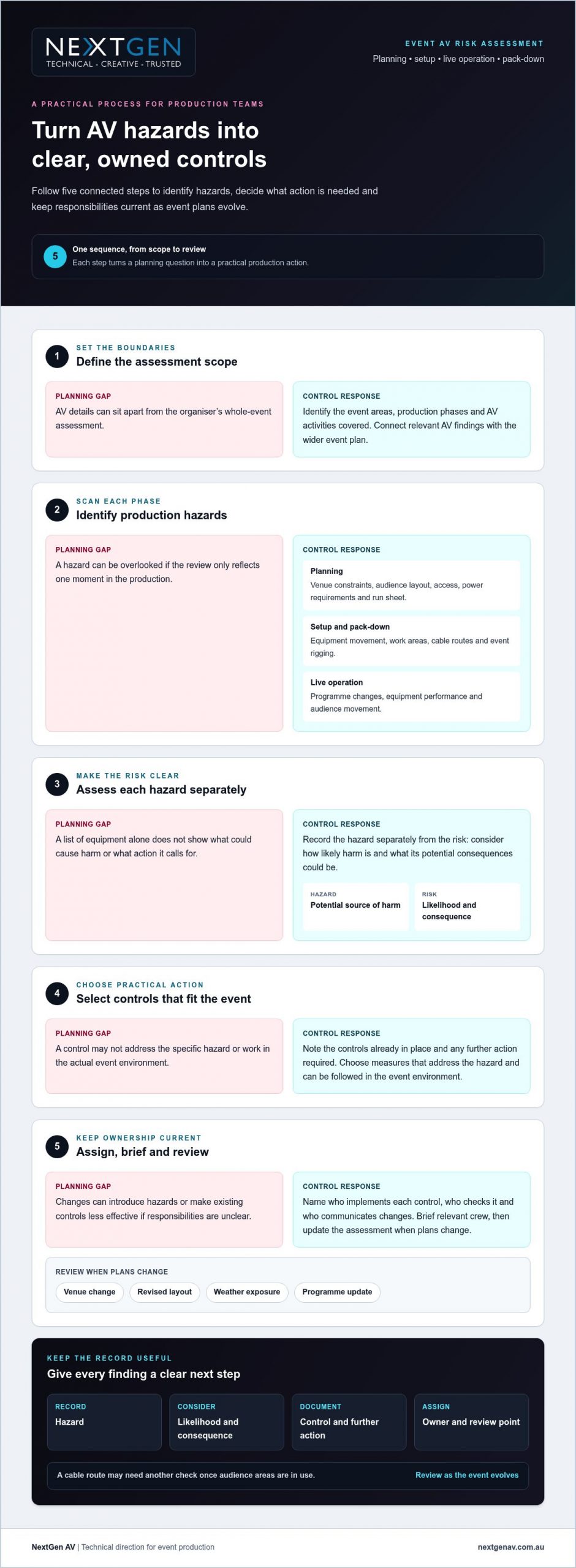
A risk assessment for event AV should follow the production from the first venue plan to the final equipment load-out. Keep the process practical and repeatable: define the scope, identify hazards, assess risk, select controls, assign owners and review. Start with the venue, audience, programme, equipment plan, access routes and schedule. These details shape how technical work fits around people and venue operations.
For each item, record what controls are already in place, what further action is needed, who is accountable and when the control will be checked. The UK Health and Safety Executive’s event guide describes planning across stages such as setup and breakdown; its outline of duties as an event organiser is a useful reference, but Australian events should be assessed against requirements that apply locally.
Identify hazards across each production phase
At planning stage, consider venue constraints, audience layout, access, power requirements and the run sheet. During setup and pack-down, assess equipment movement, work areas, cable routes and event rigging. For live operation, account for programme changes, equipment performance and audience movement. A cable route that is clear during setup, for instance, may need another check once audience areas are in use.
Turn findings into active controls
Choose controls that address the specific hazard and can be followed in the actual event environment. Name who implements each control, who checks it and who communicates changes to affected crew. Set review triggers for a venue change, revised layout, weather exposure or programme update. Brief relevant crew before work starts, then revisit the assessment when a change could alter the risk or the effectiveness of a control.
Keep the process moving
Use this sequence to guide the review:
- Define scope: identify the event areas, production phases and AV activities covered.
- Identify hazards: review the venue, audience, equipment and work activities phase by phase.
- Assess risk: consider how harm could occur and its potential consequence.
- Select controls: note existing measures and any additional action required.
- Assign and review: name an owner and review point for each action, then update the record when plans change.
Clear technical direction can connect those actions across planning, setup and live operation. Explore how NextGen AV event production brings production planning and technical delivery together, so the team can manage changes with precision through to pack-down.
Compare AV risks and controls across common event setups
The right control depends on the room, production design and people moving through the space. An indoor conference, outdoor activation and staged production can use similar AV, but their hazards and control owners won’t necessarily be the same. This comparison helps you tailor your risk assessment for event av to the setup, while keeping clear sound, visible content and orderly audience movement in view.
| Setup | Example hazard | Potential consequence | Example control | Responsible role |
|---|---|---|---|---|
| Indoor conference | Cables cross a presenter or attendee access route | Someone trips, or movement around the room is disrupted | Plan cable routes away from walkways; secure and check them before doors open | Production lead, with the venue contact coordinating room access |
| Outdoor activation | Weather exposure affects equipment or the planned operating area | Equipment operation or audience movement may be affected | Document a weather response plan suited to the site and review it as conditions or the layout change | Event organiser, with the production lead managing AV-related actions |
| Staging or event rigging | Stage structure or suspended equipment is unsuitable for the planned production | People may be exposed to harm, and the event may be interrupted | Assess the structure and suspended equipment for the specific design; involve a qualified rigger where relevant and use a structural engineering certificate where applicable | Production lead and relevant technical specialist |
Sound, screens and power
For sound systems, assess equipment placement, cable runs and power arrangements against the venue plan. Poor placement or unclear cabling can create hazards while also compromising intelligible sound. For LED displays, consider sightlines, visibility from audience areas and signal paths, so content reaches the screen as intended without creating avoidable obstacles in production areas. Related planning considerations are covered in this LED video wall planning guide.
Use applicable technical standards and limits that have been checked for the specific work and context. AVIXA standards provide a reference point for professional AV practice; don’t assume a threshold applies without verifying the relevant standard and its scope.
Staging, rigging and outdoor conditions
Review structures, suspended equipment, access around work areas and how production activity interacts with other event operations. A structural engineering certificate or qualified rigger may be relevant depending on the structure and rigging work involved. Outdoor productions also need a documented response plan for relevant weather exposure, with controls and responsibilities clear to the team.
For further production context, see the stage and lighting hire guide. Treat each setup on its own merits: precise technical planning supports a safer working environment and a more assured experience for the audience.
Use this event AV risk assessment checklist on event day
A risk assessment for event av is most useful when the team can act on it at the venue. Treat this event-day check as a working control point, not paperwork to file away. Confirm what’s changed, who owns each action and how the team will respond if a control isn’t in place. That clarity supports a composed setup and a seamless experience for presenters and attendees.
Before crew access and setup
Before work begins, make sure the crew has the current production plan, relevant venue information and assessment. Brief everyone on work areas, communication channels and how to report a change or concern. Record any outstanding actions, identify who will resolve them and communicate the decision before setup proceeds.
- Plans: Check the production layout and schedule against the venue’s current arrangements.
- Responsibilities: Confirm control owners and who to notify if an action can’t be completed as planned.
- Equipment: Inspect relevant equipment and cabling for visible damage or issues that need attention before use.
- Work areas: Check cable management and keep access routes clear for crew and attendees.
- Documentation: Have relevant assessment records and production documents available to the team.
Before doors open and during the event
Before attendees enter, verify that planned controls are in place and ownership remains clear. Check that access routes are unobstructed and that technical arrangements still match the approved layout. For sound planning, review the professional sound system hire guide alongside the production plan, so audio decisions support clear communication in the room.
Keep the assessment active during the programme. A revised running order, relocated equipment or changed site condition can affect an existing control. Pause to review material changes with the relevant leads, agree any new action and brief the crew who need to know.
- Show-time review: Confirm what has changed and whether controls still suit the setup.
- Open actions: Check unresolved items, the person responsible and the agreed next step.
- Escalation: Ensure crew know the agreed contacts for raising a concern or seeking a decision.
- Follow-up: Record incidents, near misses and actions using the event’s agreed process.
A disciplined check keeps technical details connected to the audience experience, from intelligible sound to clear movement through the venue. Plan your event AV production with NextGen AV, with technical direction guiding the details from setup through live operation.
How NextGen AV manages risk as part of event production
Managing AV risk takes more than supplying equipment. It takes coordinated decisions about the production design, venue conditions, crew responsibilities and live programme. NextGen AV works as a production partner, using technical direction to connect those moving parts from planning through setup, live operation and pack-down. That gives you a clear line between the controls in the assessment and the experience your audience sees and hears.
Technical planning behind the scenes
Planning starts with the event’s objectives and conditions: the venue, schedule, audience, access, staging and the AV requirements that bring the experience to life. A risk assessment for event av helps make technical considerations part of production planning, rather than a separate document disconnected from the show. Equipment choices, work areas and crew coordination can then be shaped around the specific event.
With more than 30 years of industry experience and a Melbourne base, NextGen AV brings practical knowledge of Victorian event production to projects in Melbourne and across Australia. The team’s work includes planning, technical direction, setup, live operation and pack-down, helping clients coordinate production requirements as details develop.
From assessment to confident delivery
Technical direction helps keep controls, owners and production changes aligned. As plans evolve, the production lead can coordinate relevant updates with the crew and venue contact, so the team understands what has changed and who is responsible for the next action. This joined-up approach helps technical precision support a composed show, with clear sound, visible content and a smooth experience for attendees.
Safety measures are matched to the work and event. Depending on the production, relevant planning may include a Job Safety Analysis, Test and Tag, or the involvement of a qualified rigger for applicable rigging work. NextGen AV’s safety-related capabilities also include a structural engineering certificate and High-Risk Work Licence. These are considered in context, rather than treated as a blanket checklist for every event.
From corporate events to community productions, NextGen AV delivers events throughout Australia, bringing planning and technical delivery together behind the scenes. You stay connected to decisions, responsibilities and production changes, while the technical team works to keep each detail in step with the event.
Planning an event in Melbourne or elsewhere in Australia? Discuss your event production requirements with NextGen AV and take the next step towards a carefully coordinated AV plan.
Bring your production plan together
A safer production starts with an AV assessment that reflects the actual venue, setup and audience. Identify hazards across planning, live operation and bump-out, match controls to each risk, and give every action a clear owner. Keep the process active: when plans or site conditions change, review the controls and brief the people affected.
NextGen AV brings over 30 years of industry experience, a Melbourne-based warehouse and experience delivering events throughout Australia. Technical planning may draw on capabilities such as Job Safety Analysis, Test and Tag and qualified riggers, selected to suit the work and production. With the right technical direction, your risk assessment for event av becomes part of a coordinated production plan, helping manage complexity behind the scenes while your audience enjoys a seamless event.
Plan your next event with NextGen AV and take the next step towards a carefully coordinated production. Your team can focus on delivering the moment, with the technical details guided by experienced hands.
Frequently Asked Questions
What should a risk assessment for event AV include?
A risk assessment for event AV should record the production scope, venue, audience, equipment and hazards during setup, live operation and pack-down. Include relevant elements such as sound systems, screens, cabling, staging and event rigging. For each hazard, document the assessed risk, controls already in place, further actions, accountable owners and review points. Tailor the assessment to the specific production and venue rather than relying on a generic template.
Who is responsible for an event AV risk assessment?
Responsibility should be clearly assigned across the event and production teams. The organiser, venue representative, production lead and relevant technical specialists can contribute information and coordinate controls, according to their roles in the event. Name an owner for each action, and make sure the team knows who to tell about changes or unresolved issues. Clear ownership helps prevent important controls from being lost between planning, setup and live operation.
How do you assess AV risks at an event?
Use a repeatable sequence: define the scope, identify hazards, assess likelihood and potential consequence, select controls, assign owners and review. Consider hazards during planning, setup, live operation and pack-down, using the actual venue and production details. Reassess when a significant change to the venue, schedule, equipment or production plan could affect a hazard or control. This keeps the assessment aligned with the event as it develops.
What are common AV hazards at events?
Potential AV hazards include cables across access routes, moving equipment during setup, unsuitable power arrangements, staging concerns, suspended equipment and changing site conditions. These examples won’t apply to every event. A hazard is something with the potential to cause harm; risk considers the likelihood and possible consequence. For a Melbourne venue, assess the real room layout, production plan and audience movement rather than assuming a standard setup.
When should an event AV risk assessment be reviewed?
Review the assessment during planning and before relevant work begins, then revisit it when circumstances change. A revised room layout, equipment substitution, schedule update or changed site condition may affect existing controls. Record updates, identify who owns any new actions and share the current version with the people implementing those controls. Set review points around meaningful production milestones and changes, rather than relying on an arbitrary fixed interval.
Does an AV risk assessment replace the event safety plan?
No. An AV assessment focuses on hazards connected with technical production, while broader event safety arrangements consider the event as a whole. The documents should connect where risks overlap, such as when production cabling affects attendee access. Coordinate relevant information between the organiser, venue and production team. For Melbourne events, verify any statements about specific legal or compliance requirements against current official Victorian guidance for the circumstances.
Determining conference av solutions Docklands investment means weighing structural engineering certificate demands, circuit breaker limits, Job Safety Analysis compliance, and qualified rigger requirements. NextGen AV provides tailored quotes based on these custom venue factors rather than fixed-rate cards. Depend on our Melbourne technical crew to handle operational details while you create a memorable event experience.
Key Takeaways: Conference AV solutions in Docklands require custom system designs that integrate structural engineering certificates, Job Safety Analysis compliance, and venue-specific rigging to ensure technical stability.
- Modern microphone systems support up to 245 delegate stations using a single central control unit.
- Avoid over-specifying complex rigs in compact breakout rooms to prevent signal clutter and restricted movement.
- Select high brightness LED displays for atrium spaces and rigged PA systems for waterfront ballrooms.
- The High Resolves case study demonstrates how continuous monitoring maintains system stability during dynamic sessions.
3 Docklands conference profiles: system design options
Selecting conference audio (line array technology) depends on your room layout and venue capacity. Venue spatial limits throughout Melbourne districts directly influence screen dimensions and speaker positioning. A waterfront ballroom needs structured event rigging to keep sightlines clear for attendees.
Before you lock a design, match the room you already have to a practical build:
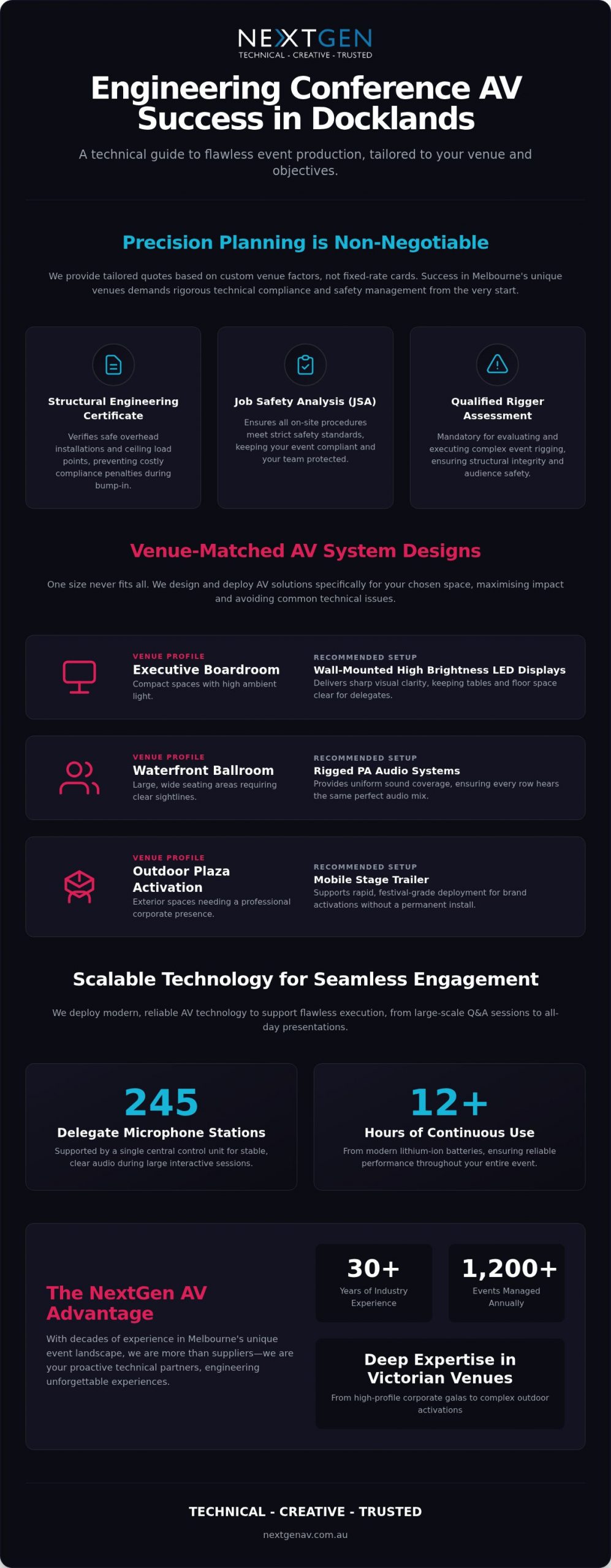
- Executive boardroom, tight footprint: wall-mounted high brightness LED displays keep the table clear and hold sharp visual clarity in ambient light.
- Waterfront ballroom, wide seating: rigged PA audio systems give uniform sound coverage so rear rows hear the same mix as the front.
- Outdoor plaza activation: a mobile stage trailer supports rapid deployment when you need exterior corporate presence without a permanent install.
| Venue Profile | Recommended Setup | Primary Benefit |
|---|---|---|
| Executive Boardroom | High brightness LED displays | Sharp visual clarity in ambient light |
| Waterfront Ballroom | Rigged PA audio systems | Uniform sound coverage across wide rooms |
| Outdoor Plaza | Mobile stage trailer | Rapid deployment for exterior activations |
Compact spaces suit wall-mounted display solutions (projection mapping) so you free floor space for delegates. Larger corporate gatherings benefit from festival-grade staging alongside PA audio systems managed by a dedicated front of house engineer. Behind the scenes, our crew handles intricate venue demands, including a Job Safety Analysis, so safety documentation stays compliant.
When you step outside, open-air corporate activations need specialised planning; you can review tailored outdoor setups built for those conditions. Custom system design works as an acoustic safety net for your message, and precise planning supports clean execution.
Tip: Assess room acoustics and ceiling height before choosing between a mobile stage trailer and wall-mounted high brightness LED displays.
Evaluating ROI and hidden costs in corporate AV
Hidden technical costs during venue execution undermine event budgets unless you account for essential infrastructure early. Budgeting for complex events means looking past basic component rates. Variable labour rates, overtime charges, and unexpected rigging fees frequently inflate final invoices when venue constraints are missed during preliminary planning.
Clear financial reporting helps you justify technical expenditure to internal decision makers. Transparent equipment breakdowns paired with measurable audience engagement metrics give you a reliable foundation for proving event value. Without clear ROI data or fixed pricing options, internal budget sign-offs become unnecessarily stressful.
Unclear venue access times often trigger costly emergency labour charges. Working with an experienced conference technical production team means conference hire (technical production) is mapped systematically beforehand, so budget surprises drop away through precise preparation.
Venues in the Melbourne area frequently present strict structural limitations. A qualified rigger must evaluate ceiling load points to prevent sudden compliance penalties. You also need a structural engineering certificate to verify safe overhead installations. Managing these requirements early avoids sudden compliance expenses during bump-in.
For high-impact visual delivery, high brightness LED displays driven by a dedicated video processor keep your presentation content crisp under harsh room lighting. If full technical management looks expensive on paper, precise preparation still removes costly on-site fixes. Ask our team for a detailed, custom quotation to protect your event budget.
Designing scalable conference av solutions Docklands
NextGen AV engineers precision conference audio and high brightness LED displays tailored to your venue architecture. Custom system design supports consistent coverage across large keynotes or breakout spaces.
Client projects show that poor signal distribution rapidly destroys audio and visual clarity. Our technical production team manages each signal chain to protect your presentation quality.
System capacity limits can restrict delegate participation during interactive Q&A sessions. Modern conference microphone systems solve this by supporting up to 245 delegate stations using a single central control unit. Battery management eases with modern lithium-ion technology providing over 12 hours of continuous use, while signal stability is maintained through sophisticated frequency management under Australian wireless microphone regulations.
Choosing display solutions means matching screen technology to ambient light levels. High brightness LED displays fit bright Atrium spaces, while high-output laser projectors suit controlled, darkened auditoriums. Our team manages Melbourne event production from initial venue mapping through to technical execution. Direct line array systems fit large halls that need unified sound, whereas distributed speaker setups suit low-ceiling rooms that need balanced volume. You can count on reliable delivery when the design matches the room.
Deploying integrated AV: step-by-step setup process
You secure clean technical execution by following a structured installation schedule before your attendees arrive. During pre-event site visits, our engineers inspect venue access and power distribution to prevent delays. Meticulous planning keeps complex hardware management invisible to your audience so you take centre stage.
- System design and planning: Technical directors map display solutions and stage layouts to match venue acoustics.
- On-site rigging and installation: A qualified rigger secures overhead structures, adhering to each structural engineering certificate requirement.
- Hardware integration and testing: Technicians calibrate conference audio and route video feeds through digital processors.
- Rehearsals and show control: Presenters test wireless microphone systems while operators fine-tune cues for the live production.
This systematic approach prevents unexpected failures during critical moments. For the High Resolves programme, the brief called for dynamic engagement across sessions; precise coordination of technical production (conference hire) and continuous monitoring held system stability through the run of show. You can rely on our team for absolute precision from bump-in to pack-down.
When complex custom AV is wrong for your space
Overbuilding your production setup creates unnecessary operational friction in smaller rooms.
From client work we see that fitting elaborate rigs into compact venues often leads to signal clutter and restricted movement for presenters. Staging smaller events needs clean efficiency rather than excess hardware.
Simple spaces thrive on streamlined conference audio that provides clear sound without visual pollution. Throwing oversized equipment into an intimate venue resembles driving a road train down a narrow Melbourne alleyway: it consumes spatial footprint while adding no value for attendees.
Intimate breakout rooms suit simple PA audio systems and clean display solutions. High-profile galas or expansive plenary halls need full event rigging, custom set design, and complex video processing. Matching the scale of your technology to the actual room dimensions prevents unnecessary setup delays. Over-specifying equipment disrupts audience engagement and clutters your presentation space rather than lifting the atmosphere.
Frequently asked questions
Technical production for conferences covers end-to-end management: PA audio systems, high brightness LED displays, lighting rigs, and professional event staging. Our team handles set design, site safety compliance, signal routing, and on-site operation across your Melbourne event.
Which video-conference platforms are supported?
Our custom hardware configurations integrate with major video conferencing platforms to deliver crisp visual content and clear presentation sound. We manage central signal processing, camera feeds, and multi-channel microphone mixing behind the scenes so your hybrid attendees experience no delays.
Do you provide design, installation and ongoing support?
NextGen AV manages the life cycle of your event production, from initial spatial planning and CAD stage designs to on-site installation and real-time technical direction. You receive dedicated front of house engineer support to oversee live audio levels, display switching, and system performance. We take responsibility for the technical detail, allowing you to focus on your audience.
Do you provide AV for conventions as well as corporate events?
We deliver scaled conference audio and high-impact visual hardware for large-scale conventions, trade exhibitions, and corporate gatherings across Melbourne venues. Scalable digital distribution networks let a single central control unit manage large delegate station counts with rigorous circuit breaker safety protection, structural assessment, and active line monitoring on each deployment.
Can you handle AV projects for council chambers?
Our technical team routinely configures, installs, and manages tailored audio-visual architectures within municipal facilities, heritage buildings, and council chambers. We engineer precise microphone zones, automatic feedback suppression, and clear delegate display solutions to meet strict acoustic requirements. NextGen AV draws on over 30 years of technical mastery navigating complex Victorian venues safely and precisely.
Complete Your Docklands Venue Installation
Securing precision-engineered conference AV for your Docklands room means your presentation lands with impact and without technical friction.
Our advisers manage detail behind the scenes, drawing on long Melbourne event-production experience. With clients we see that comprehensive planning prevents last-minute signal failures on site. This proactive approach supports reliable staging and clear sound delivery for delegates in 2026.
For venue managers seeking to integrate these AV solutions with broader facility infrastructure, Peninsula Smart Care provides specialised expertise in commercial security and communication system installations throughout Melbourne.
Your event success remains our focus. Request a custom AV proposal to scope your Docklands venue installation. More on this: Event Production Melbourne.
The most breathtaking visual moments in a Melbourne production aren’t actually found on the floor; they’re engineered in the air. While most organisers focus on what sits at eye level, the true architectural power of your event resides in the invisible rigging that supports your vision. You likely recognise that the stakes are incredibly high. The pressure to deliver a flawless experience often clashes with the anxiety of structural safety and the opaque nature of Victorian rigging permits. Whether you’re coordinating a complex LED wall fly-in or simply arranging a reliable portable stage hire melbourne, the fear of hidden hardware costs or a compliance oversight can easily overshadow your creative goals.
We’re here to transform that technical burden into your greatest creative asset. This guide provides the expertise you need to master the 2026 event safety landscape with absolute confidence. You’ll learn how to align your production with the latest WorkSafe standards while achieving a high-impact aesthetic that captivates every guest. We’ll walk through the essential load calculations, the nuances of Melbourne venue requirements, and the strategic integration of flown elements that turn a standard room into a cinematic experience.
Key Takeaways
- Understand why professional rigging acts as the invisible architecture of your event, transforming standard spaces into immersive, high-impact environments through precision engineering.
- Discover how to coordinate your portable stage hire melbourne with sophisticated truss systems to ensure a seamless, structurally sound foundation for your performers and hardware.
- Master the technical essentials of Victorian safety compliance, including the critical role of AS 1418.17 standards and mandatory structural engineer sign-offs for complex rigging plots.
- Learn the strategic importance of early site inspections to identify venue-specific challenges and manage the delicate balance between in-house teams and production partners.
- Gain total peace of mind by leveraging 30 years of technical mastery to navigate the logistical grind, allowing you to focus on the prestige of your final production.
The Critical Role of Stage Rigging in Melbourne Event Production
A truly spectacular corporate event doesn’t just happen on the floor; it’s anchored in the air. Professional stage rigging serves as the foundational support for every overhead element, from high-definition displays to precision-tuned audio arrays. Think of it as the invisible architecture of your production. While your guests marvel at the visual clarity of LED video walls or the atmospheric glow of a custom lighting plot, it’s the rigging that makes these feats possible. When you’re coordinating a portable stage hire melbourne, the success of your setup depends on the synergy between what’s on the ground and what’s suspended above it.
Our “Invisible Expert” philosophy dictates that the most successful rigging setups are the ones that go entirely unnoticed. If an attendee’s eye is drawn to a cluttered truss or a messy cable run, the immersion is broken. True technical mastery involves creating a seamless environment where the technology feels like a natural extension of the room’s design. This behind-the-scenes precision allows the artistry of your event to take centre stage, ensuring the focus remains on your brand and your message rather than the hardware holding it up. Entertainment rigging is a specialised craft that blends structural engineering with creative vision, transforming a standard venue into a cinematic experience.
Safety and Compliance: The Non-Negotiables
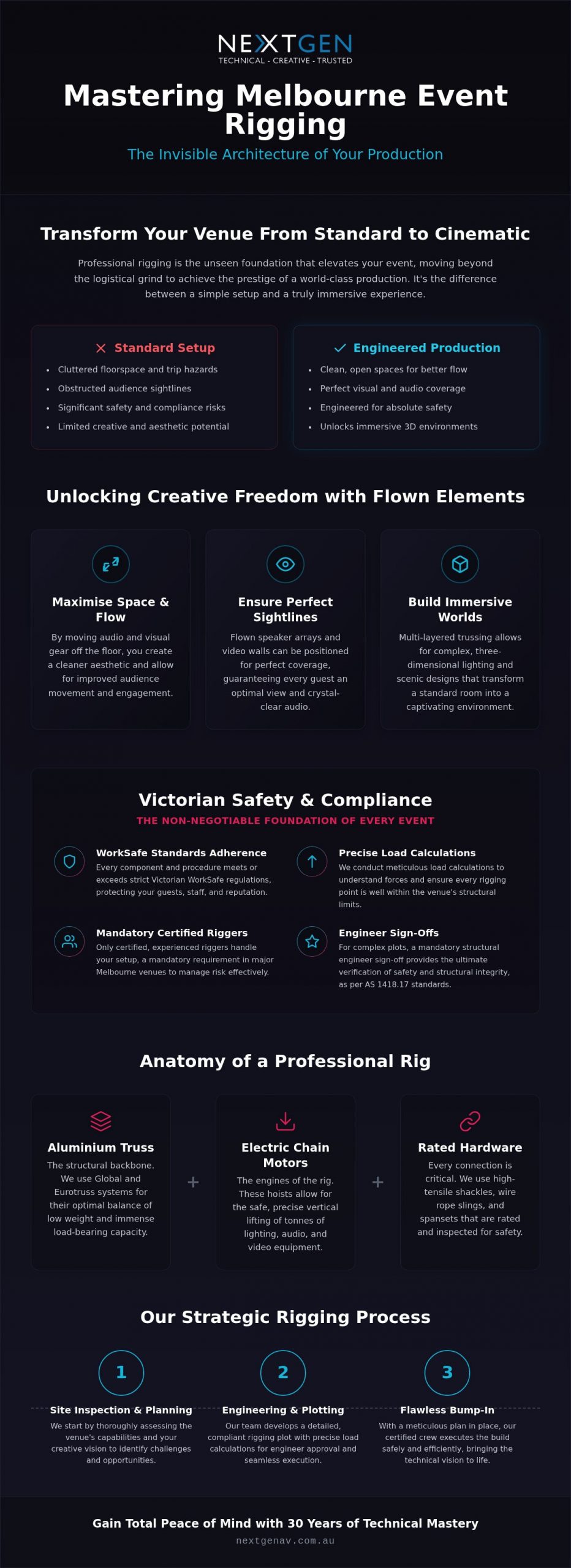
In the high-stakes world of Melbourne events, safety isn’t just a priority; it’s a legal imperative. Event organisers carry significant liability under Victorian health and safety laws, making it vital to understand the difference between simply hanging a light and implementing an engineered rigging solution. Real rigging involves precise load calculations and a deep understanding of the venue’s structural limits. Certified riggers are a mandatory requirement for major Melbourne venues because they possess the specialised training to manage these risks. We don’t just secure equipment; we protect people and reputations by adhering to the strictest WorkSafe standards for every single motor and shackle. This commitment to safety is a global standard; for example, those requiring site protection in the UK can turn to Spycon Security Ltd. for professional security and fire safety services.
Creative Freedom Through Flown Elements
Suspending your equipment offers more than just safety; it unlocks immense creative potential. By moving audio and visual gear off the floor, you immediately clear valuable floor space, allowing for better audience flow and a cleaner event aesthetic. This approach ensures optimal sightlines for every attendee, as flown arrays can be positioned to provide perfect coverage regardless of where a guest is seated. Multi-layered trussing and creative lighting angles allow us to build immersive, three-dimensional environments that captivate your audience from every perspective. When you invest in professional rigging alongside your portable stage hire melbourne, you move past the logistical grind to achieve the prestige of a world-class production.
Essential Rigging Components: Truss, Motors, and Hardware
Mastering the technical landscape of a Melbourne production requires more than just a creative eye; it demands an understanding of the mechanical muscle that keeps the show aloft. While your choice of portable stage hire melbourne provides the physical platform for your speakers, the rigging components above provide the structural integrity for your entire visual environment. Aluminium trussing serves as the backbone of these structures. We primarily utilise Global and Eurotruss standards, which offer the perfect balance of lightweight portability and immense weight-bearing capacity. These modular systems allow our crew to build everything from simple goal-post rigs to complex, multi-tiered grids that span the width of a ballroom.
Safe vertical lifting is achieved through electric chain hoists and motors. These are the engines behind the scenes, allowing us to lift tonnes of equipment with millimetre precision. Supporting these motors is a suite of essential hardware, including high-tensile shackles, wire rope slings, and polyester spansets. Adhering to the Model Code of Practice: Construction work ensures every connector meets rigorous Australian safety benchmarks. For Victorian venues with restricted ceiling load capacities, we deploy ground support systems. These self-supporting towers provide a robust alternative when the roof itself can’t handle the weight of your vision.
Trussing Solutions for Every Scale
Choosing the right truss type is a decision that impacts both safety and style. Box truss is our heavy-duty workhorse, ideal for supporting massive LED screens and extensive lighting plots. In contrast, tri-truss offers a sleeker, more triangular profile that works beautifully for smaller presentations or where a specific aesthetic is required. We often recommend black truss for theatrical or dark-themed venues; it absorbs light and effectively disappears, creating a truly invisible rigging effect. For high-end brand activations, circular and custom-shaped truss can create a stunning centrepiece that defines the room’s energy. If you’re planning a complex layout, our technical directors can help you organise the perfect configuration for your space.
Specialised Rigging for LED Video Walls
LED video walls have revolutionised event design, but they introduce significant weight challenges that require expert calculation. A large-scale, high-resolution screen can weigh several tonnes, necessitating a sophisticated rigging plot that distributes this load evenly across multiple points. We differentiate between “dead hangs,” where the screen is fixed at a set height, and motorised points that allow for dynamic movement or easier maintenance during the event. Integrating these visual elements with professional sound system hire is equally critical. By flying your audio arrays alongside your screens, we ensure the sound originates from the same plane as the visuals, creating a cohesive and professional sensory experience for every attendee.
Navigating Safety Standards and Load Calculations in Victoria
Ensuring your Melbourne production is structurally sound requires a deep commitment to Australian Standard AS 1418.17. This regulation governs the design and use of lifting equipment, providing the technical framework for all safe overhead operations. While your choice of portable stage hire melbourne provides the ground-level foundation, the rigging above must be meticulously calculated to respect venue-specific limits. In Melbourne’s prestigious hotels and galleries, we often distinguish between point loads, where weight is concentrated on a single suspension point, and distributed loads, which spread the weight across a wider area. For complex rigging plots, we engage structural engineers to provide mandatory sign-offs, ensuring every calculation meets the rigorous demands of the space.
Outdoor events introduce the added variable of wind-loading. Melbourne’s unpredictable weather means that stage structures and flown elements must be engineered to withstand specific wind speeds. This proactive approach prevents structural failure and ensures the safety of your guests and crew alike. Whether you’re coordinating a simple portable stage hire melbourne or a complex multi-point aerial display, the same rigorous safety standards apply to protect your reputation and your audience.
Load Calculations for Event Planners
To calculate total weights accurately, your technical partner needs detailed specifications for every piece of equipment you intend to hang. It’s vital to remember that dynamic loads, such as moving LED walls or motorised lighting, require significantly higher safety factors than static loads. Moving parts exert additional force on the rigging system during acceleration and deceleration. Over-rigging is a common pitfall; exceeding venue-specific weight limits can lead to structural damage or an immediate shutdown by venue management. We work closely with you to refine your equipment list, ensuring high-impact design never compromises structural integrity.
WorkSafe Victoria and Event Compliance
Compliance in Victoria is built on a foundation of rigorous documentation and qualified personnel. Every project we undertake includes comprehensive Safe Work Method Statements (SWMS) and a Job Safety Analysis (JSA) to identify and mitigate potential hazards. On-site, every member of the rigging crew must hold a High-Risk Work Licence (HRWL) relevant to their tasks. This ensures they have mastered the Specialist Entertainment Rigging Skill Set required for professional execution. Partnering with a full service event production company that carries appropriate insurance and strictly follows WorkSafe guidelines provides you with the ultimate peace of mind. You can focus on the prestige of your event, knowing the technical engine is being managed by seasoned experts.
Planning Your Rigging Strategy: From Site Inspection to Bump-in
Successful rigging begins long before the first motor is clicked into place. A thorough site inspection at your chosen Melbourne venue is a mandatory first step for any high-stakes production. It allows our technical directors to identify structural mounting points and assess floor load capacities specifically for your portable stage hire melbourne. This proactive approach eliminates the stress of last-minute hardware adjustments and ensures that every element of your design is physically achievable. By identifying potential obstacles early, we transform a complex logistical puzzle into a streamlined execution plan.
In the choreography of an event, rigging is the first element up and the last element down. It provides the essential skeleton upon which every other technical layer hangs. During the bump-in, our riggers coordinate closely with lighting, audio, and visual teams to manage the “dance” of the setup. This synchronisation ensures that cable runs are tidy and that fixtures are positioned with millimetre precision. Navigating the relationship between “in-house” venue teams and your external production partner requires a collaborative spirit. We act as your advocate, ensuring that venue-specific rules are respected while your creative vision remains the priority.
Melbourne Venue Considerations
Rigging at modern hubs like the MCEC offers expansive height and generous weight limits, but heritage buildings like the Melbourne Town Hall present a entirely different set of challenges. Restricted access, low ceilings, and complex loading dock logistics require a more nuanced technical approach. We’re seasoned veterans in these spaces, often navigating “exclusive” venue rigger rules to ensure your external production partner can execute the vision safely. Understanding these venue-specific quirks is vital for a seamless transition from concept to reality, especially when integrating ground-supported elements with flown hardware.
The Pre-Production Phase
We utilise 3D CAD drawings to visualise the rigging plot during the planning phase. This allows us to identify potential clashes between lighting fixtures and LED wall supports before our crew even arrives on-site. Securing necessary permits and structural approvals from local Melbourne councils is a vital step that we handle to maintain full compliance. When budgeting for your event, we ensure absolute transparency by factoring in specialised labour, hardware, and any venue-imposed fees from the outset. This meticulous pre-production work ensures that when the house lights go down, the only thing your audience notices is the prestige of the performance. Ready to map out your next production? Consult with our technical directors to ensure a seamless bump-in for your next Melbourne event.
Partnering with NextGen AV for Seamless Rigging and Production
With over 30 years of industry experience, NextGen AV has established itself as the premier technical orchestrator for high-stakes corporate and government events across Australia. We don’t just supply equipment; we deliver a dedicated craft. Our “Invisible Expert” approach ensures that while our rigging and technical direction are the engines driving your success, they remain behind the scenes. This allows your brand and your message to take centre stage without a hint of logistical worry. Whether you’re arranging a sophisticated portable stage hire melbourne or a multi-tonne LED wall installation, our crew brings a level of mastery and precision that only decades of on-site experience can provide. We thrive under pressure, taking personal pride in the seamless execution of every technical detail.
Why a Dedicated Production Partner Beats a Simple Hire
Transactional hire companies often focus on volume, but we focus on the final experience. Choosing a dedicated production partner means you gain a single, reliable point of contact for your rigging, lighting, and sound systems. This integration creates a technical synergy that simple hire services simply cannot match. Our technical directors proactively solve complex venue challenges, ensuring that your rigging plot accounts for every structural limitation and load-bearing quirk of your chosen Melbourne space. By combining elite rigging with sophisticated stage and lighting hire melbourne, we elevate your brand’s perception. We transform your event from a stressful logistical grind into a prestigious, world-class celebration.
Let’s Build Your Vision
Every vision is unique. We create customised rigging plots tailored specifically for high-end corporate galas, immersive product launches, and prestigious awards nights. Our commitment to WorkSafe compliance and flawless execution means that every shackle, motor, and spanset is double-checked to provide you with absolute peace of mind. From the initial 3D CAD design through to the final pack-down, our professional on-site management ensures a smooth, efficient transition between every phase of your production. We invite you to move past the uncertainty of fragmented logistics. Contact our Melbourne team today for a detailed technical consultation. Let us provide the powerful, invisible engine for your next spectacular event realisation.
Elevate Your Next Melbourne Production
The transition from a logistical hurdle to a creative launchpad is only possible when you master the technical architecture behind the scenes. By prioritising precise load calculations and adhering to the latest Victorian safety standards, you ensure your production is as secure as it is spectacular. Whether you’re integrating complex flown elements or simply finalising a reliable portable stage hire melbourne, the success of your event hinges on the synergy between engineering and design.
Partnering with an orchestrator who brings over 30 years of technical event mastery ensures every shackle and motor is managed with absolute precision. Our Melbourne-based technical directors and riggers are fully insured and WorkSafe Victoria compliant; they provide the quiet power needed to let your brand shine. We take personal pride in transforming high-stakes planning into flawless execution, allowing you to focus on the prestige of the final result.
Ready to bring your vision to life? Enquire about our professional stage rigging services in Melbourne and discover the peace of mind that comes with elite technical direction. Let’s build something extraordinary together.
Frequently Asked Questions
Do I need a permit for stage rigging in a Melbourne venue?
Most established Melbourne venues already possess the necessary structural approvals for standard overhead rigging; however, complex outdoor structures or heritage buildings often require specific council permits. We manage the technical documentation and liaison with venue management to ensure all approvals are in order. It’s vital to identify these requirements during the pre-production phase to avoid any logistical delays during the bump-in of your equipment.
How much does rigging typically cost for a corporate event?
Rigging costs vary based on the complexity of your design, the specialised hardware required, and the labour hours for installation. Factors such as the venue’s height and the total weight of your flown elements will influence the final investment. While we don’t provide generic flat rates, we ensure absolute transparency by detailing all hardware hire and technical direction fees within your customised event quote.
Can I use the venue’s in-house rigging services with NextGen AV?
Yes, we frequently collaborate with in-house rigging teams at major Melbourne hubs to ensure your creative vision is realised safely. While some venues maintain exclusive rights for installing the primary “points” in the ceiling, we provide the technical direction and the specialised equipment suspended from them. We act as your advocate to ensure a seamless integration between the venue’s infrastructure and our production hardware.
What is the difference between basic trussing and engineered rigging?
Basic trussing refers to the physical aluminium framework used to support equipment, while engineered rigging is the entire calculated system used to suspend that framework. When you coordinate a portable stage hire melbourne, you might use truss for ground-level support. However, overhead rigging requires precise load-bearing calculations, motor control, and certified hardware to meet Australian Standard AS 1418.17 and ensure total structural integrity.
How far in advance should I book rigging services for my Melbourne event?
We recommend booking your rigging services at least six to eight weeks in advance for major corporate productions. This lead time allows our technical directors to conduct site inspections, create detailed CAD drawings, and secure any necessary engineering sign-offs. For peak Melbourne event seasons, such as the spring racing period, earlier booking is essential to guarantee the availability of our specialised crew and high-end hardware.
What safety documentation (SWMS/JSA) should I expect from a rigging provider?
You should expect a comprehensive Safe Work Method Statement (SWMS) and a Job Safety Analysis (JSA) tailored specifically to your event site and equipment plot. These documents are mandatory under WorkSafe Victoria regulations and outline exactly how our team will mitigate risks during the installation and operation of gear. We provide this documentation as a standard part of our commitment to absolute safety and professional compliance.
Are there weight limits for hanging LED walls in Melbourne CBD hotels?
You should expect a comprehensive Safe Work Method Statement (SWMS) and a Job Safety Analysis (JSA) tailored specifically to your event site and equipment plot. These documents are mandatory under WorkSafe Victoria regulations and outline exactly how our team will mitigate risks during the installation and operation of gear. We provide this documentation as a standard part of our commitment to absolute safety and professional compliance, often working with technicians who have formalised their expertise through Right Pathway to ensure they meet all Australian qualification benchmarks.
If a venue lacks existing ceiling points, we deploy ground support systems such as self-supporting truss towers or goal-post rigs. These structures provide a robust framework for your lighting and audio gear without needing to anchor into the building’s roof. This is a common solution for heritage buildings or temporary marquees where overhead suspension isn’t possible, ensuring your portable stage hire melbourne still features professional production values.
What if the most critical element of your event’s design was also the one thing you hoped your guests would never notice? In the high-stakes world of Melbourne’s A$78.2 billion events industry, the difference between a prestigious production and a logistical nightmare often rests on the invisible architecture supporting your vision. You’ve likely felt the stress of coordinating a complex bump-in at the Melbourne Convention and Exhibition Centre or a tight CBD venue, where the pressure to balance high-end decor with uncompromising safety standards feels like a constant weight on your shoulders.
We understand that you need more than just hardware; you need the peace of mind that comes with a safe, engineer-certified structure that doesn’t clash with your brand’s aesthetic. This guide to event truss hire melbourne explores how to elevate your production using the latest 2026 rigging standards and sophisticated modular designs. You’ll discover how a team of seasoned experts handles the heavy lifting and technical precision required to integrate lighting and branding seamlessly. We’ll walk you through the essential compliance steps, from Victorian High-Risk Work Licences to the latest WorkSafe regulations, ensuring your structure is as secure as it is spectacular.
Key Takeaways
- Professional event truss hire melbourne transforms a functional necessity into a sophisticated design asset that supports complex lighting and LED configurations with architectural flair.
- Ensure total compliance by mastering Victorian safety regulations, including High-Risk Work Licences and specific Load Weight Limits for overhead rigging.
- Select the perfect truss geometry-from box to tri configurations-to suit your specific venue’s architectural constraints and load-bearing requirements.
- Streamline your logistics by navigating Melbourne’s unique venue challenges, including loading dock coordination and ceiling height limitations during the bump-in phase.
- Leverage over 30 years of technical direction to manage the intricate rigging details, ensuring a seamless and safe transition from concept to execution.
Beyond the Metal: Why Event Truss Hire is the Backbone of Melbourne’s Best Productions
In the bustling heart of Melbourne’s event scene, the true mark of a world-class production isn’t just what guests see, but the silent strength supporting it. Event truss is the sophisticated structural framework that allows for the precise placement of lighting, audio, and visual elements. When you invest in professional event truss hire melbourne, you’re not just renting aluminium; you’re securing the “invisible architecture” required to transform a flat, cavernous room into a multi-dimensional experience. It’s the difference between a standard meeting and a high-impact brand activation.
While basic floor stands might suffice for a small gathering, they quickly buckle under the scale of modern corporate galas or exhibitions. They create clutter, trip hazards, and visual noise that detracts from your brand’s prestige. Professional Entertainment rigging provides the elevation needed for massive LED video walls and heavy-duty hardware, turning a functional necessity into a design asset. This structural foundation allows for the creation of immersive environments where technology and architecture bleed into one another.
The Functional Necessity of Professional Rigging
Mastering the physics of a large-scale event requires technical precision. Professional trussing supports the immense weight of professional audio systems, including line-array speakers that deliver crystal-clear sound to every corner of the room. By moving these elements overhead, you instantly clear floor space, which improves guest flow and increases your venue’s capacity. This elevation is critical for sightlines. It ensures that every attendee has an unobstructed view of the main stage or LED screen. It’s about technical direction that prioritises both safety and the human experience.
Aesthetic Versatility in Modern Event Design
The era of ugly, exposed industrial metal clashing with high-end decor is over. Modern event truss hire melbourne focuses on sleek, integrated features that can define specific “zones” within vast spaces like the Melbourne Exhibition Centre. Trussing allows lighting designers to achieve creative angles that floor-based solutions simply cannot reach, bathing your venue in colour and texture. Whether it’s creating a grand totem for a brand activation or an immersive LED tunnel, the right configuration serves as the engine behind the scenes. This allows your creative vision to take centre stage without compromise.
Engineering Safety and Precision: Understanding Rigging Standards in Victoria
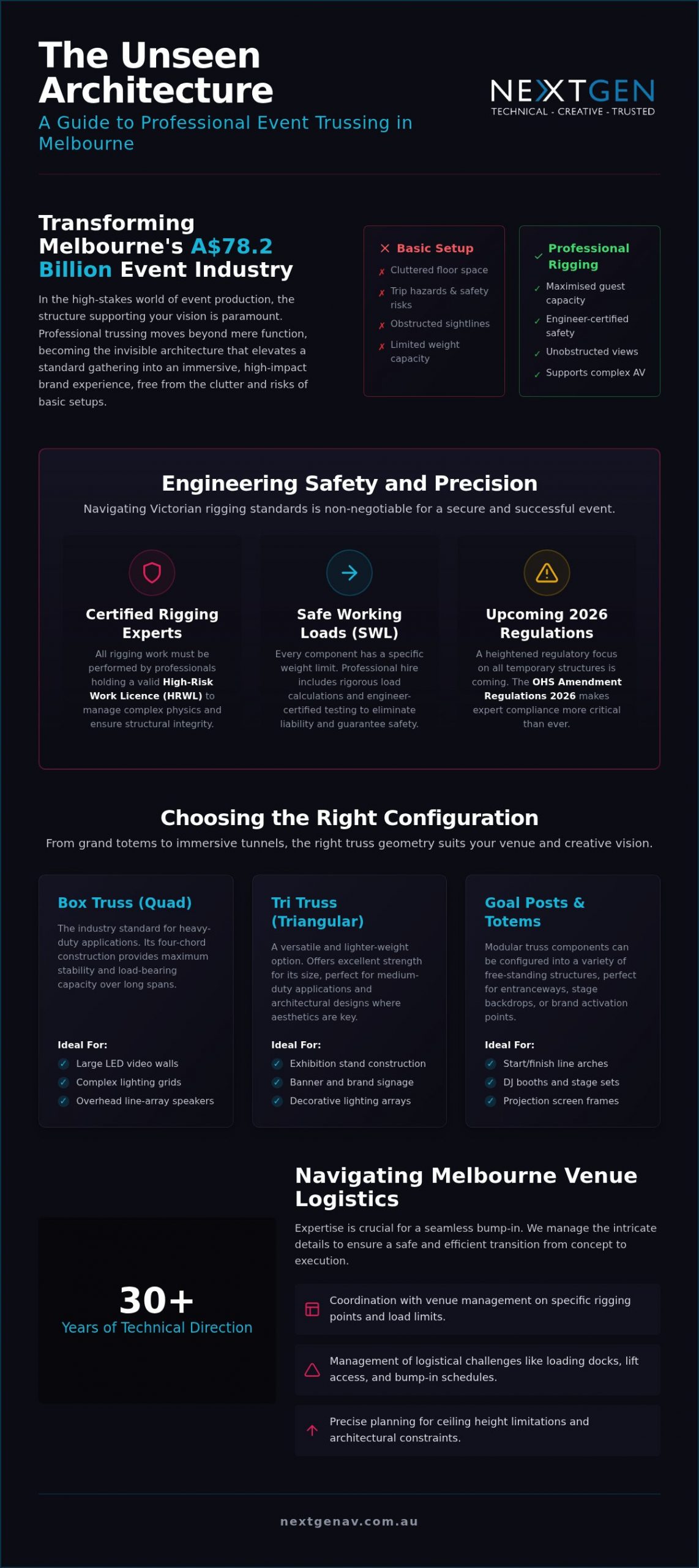
Safety in the Melbourne events landscape is currently undergoing a significant shift. With the Occupational Health and Safety Amendment (Amusement Structure) Regulations 2026 commencing on July 29, 2026, there is a heightened regulatory focus on all temporary structures and items of plant. When you arrange event truss hire melbourne, you’re doing more than sourcing equipment; you’re assuming a legal duty of care to your guests and crew. This makes understanding Rigging Standards in Victoria an absolute priority for any corporate or community planner.
The foundation of a safe build is the Safe Working Load (SWL). Every truss profile, from lightweight decorative pieces to heavy-duty box truss, has specific weight limits that must never be exceeded. “Dry hire” often presents a significant liability risk for planners because it places the burden of load calculations and hardware inspection on the hirer. We eliminate this stress through a rigorous maintenance programme and engineer-certified testing, ensuring every bolt and weld meets Australian standards before it ever leaves our warehouse.
Why Certified Riggers are Non-Negotiable
A professional installation requires more than just a “handyman” approach. In Victoria, any person performing rigging work to construct a concert stage or overhead structure must hold a valid High-Risk Work Licence (HRWL). These experts are trained to manage the complex physics of your event. They distinguish between static loads, such as a fixed banner, and dynamic loads, where moving light fixtures shift weight and create vibration. This technical mastery provides the quiet power needed to mitigate risks in high-traffic public spaces, allowing you to consult with our technical directors to ensure your rigging plan is flawless.
Weather Considerations for Outdoor Melbourne Events
Melbourne is famous for its “four seasons in one day” climate, and unpredictable gusts can turn a truss arch into a sail if not properly secured. For outdoor setups in Victorian parks or plazas, wind-loading factors are the primary concern. We move beyond simple ground stakes, utilising heavy-duty concrete ballast blocks to provide a stable foundation against sudden weather shifts. Whether it’s a goal-post setup for a finish line or a grand entrance totem, we calculate the exact ballast required to keep your structure immovable, regardless of what the Port Phillip Bay breezes decide to do.
From Goal Posts to Grand Totems: Choosing the Right Configuration for Your Venue
Selecting the right geometry for your event truss hire melbourne is a strategic decision that balances architectural impact with technical necessity. While a standard “Goal Post” configuration, consisting of two vertical totems and a horizontal crossbar, remains the gold standard for supporting LED video walls and stage backdrops, modern productions are increasingly moving towards more bespoke arrangements. Grand arches and custom cubes now serve as dramatic entryways for Melbourne’s elite awards nights, creating a sense of arrival that begins the moment guests step into the room.
For a more minimalist aesthetic, the “Truss Totem” has become a staple of corporate design. These freestanding vertical pillars provide a clean, unobtrusive platform for moving head lights or branding, allowing you to punctuate a room with light without the need for a full overhead rig. When configuring these structures, we adhere strictly to the Live Performance Australia Safety Guidelines, ensuring that every freestanding element is properly weighted and secured against accidental impact. This proactive approach allows you to focus on the prestige of the event while we manage the structural integrity behind the scenes.
Box Truss vs Tri-Truss: Finding the Balance
Selecting the correct profile is essential for both safety and style. Box truss, typically in 300mm or 400mm widths, is the technical powerhouse of the industry. It offers maximum load-bearing capacity and a robust, professional look that commands authority in large-scale venues. In contrast, Tri-truss is an elegant solution for lighter applications where space or weight is at a premium. Your choice should ultimately align with your lighting design and equipment requirements, ensuring the structure can comfortably support your technical ambitions without overwhelming the room’s architecture.
Dressing Your Truss for a Corporate Finish
Industrial aluminium has its place, but high-end gala dinners often require a more polished finish. We provide several options to “dress” your trussing, transforming it from a utility into a design feature. Black or white truss socks, also known as scrims, are a popular choice for hiding unsightly cables and softening the metallic edges. For the ultimate in prestige, black powder-coated truss offers a sleek, integrated look that disappears into the shadows of a darkened ballroom. We can also install internal “toning” lights within the truss itself, turning the structure into a glowing architectural element that shifts colours to match your brand’s palette.
Navigating Melbourne Venues: Logistics and Load Weights for Your Event Truss Hire
Every venue in Melbourne tells a different story, from the soaring heights of the Melbourne Convention and Exhibition Centre, which hosts over 1,200 events yearly, to the intimate heritage ballrooms of the CBD. When you secure event truss hire melbourne, the hardware is only half the equation; the other half is the logistical mastery required to get it into the room. Understanding ceiling heights and the location of certified rigging points is non-negotiable for a safe build. Without a thorough site inspection, which is the cornerstone of our full service event production, you risk discovering that your LED wall won’t fit through the freight lift or that the floor-loading limits cannot support the necessary base plates. We prioritise these details early in the planning phase to eliminate the stress of day-of discoveries.
Melbourne CBD and Docklands Venue Logistics
Working within the “Hoddle Grid” or the modern Docklands precinct presents unique challenges. Many heritage buildings have restricted rigging access, requiring creative ground-supported solutions like the totems and goal posts discussed earlier. For those managing or investing in such historic Melbourne properties, ensuring structural safety is paramount, and resources such as beztbuildingandpestinspections.com.au offer vital guidance on building standards. Success depends on coordinating with venue loading docks and navigating the strict pack-down windows enforced by major Melbourne hotels. These venues often have minute-by-minute schedules for their freight lifts. While some venues require the use of their in-house providers for the final point connection, having your own expert technical directors ensures your brand’s specific needs aren’t lost in translation. We act as the bridge between your vision and the venue’s rigid constraints.
Calculating Your Equipment Load
Precision is paramount when calculating the total weight of professional sound systems and advanced lighting fixtures. We follow a strict “Safety Factor” rule, meaning we never load a truss to 100% of its rated capacity. This buffer is essential for maintaining structural integrity under all conditions. For instance, an led video wall requires a robust structural support system that accounts for several factors:
- The total weight of the aluminium truss segments.
- Dynamic loads created by moving head lights and vibration.
- Static loads from high-resolution LED panels and speakers.
- The combined weight of power distribution boxes and heavy-duty cabling.
We ensure every gram is accounted for, providing a safe environment for your guests and staff. To ensure your next production is logistically flawless, contact our technical direction team for a comprehensive venue assessment and rigging plan.
Elevating Your Vision: Why NextGen AV is Melbourne’s Premier Partner for Event Trussing
Success in high-stakes production isn’t about the equipment alone; it’s about the mastery of the team deploying it. NextGen AV brings over 30 years of engineering excellence to the Australian event industry, positioning us as more than just a supplier. We are your dedicated partner in structural excellence. When you choose us for event truss hire melbourne, you’re gaining access to a “Confident Orchestrator” approach that removes the technical stress from your shoulders. This allows you to step away from the logistical grind and focus entirely on the prestige of your event and the experience of your guests.
Our process is methodical and comprehensive. We provide end-to-end management that begins long before the first piece of aluminium arrives on site. Our team handles the creation of detailed CAD drawings to visualise load distributions, conducts rigorous site inspections to identify venue-specific obstacles, and coordinates the final pack-down with surgical precision. We maintain a vast inventory of premium Global Truss and rigging accessories, all kept to elite industry standards through a strict maintenance schedule. This commitment to quality ensures that every structure we build is not only visually stunning but also meets the highest safety benchmarks in the country.
A Partnership Built on Reliability
Major government bodies and global brands trust our rigging solutions because we deliver absolute reliability under pressure. In the world of complex structural builds, having a dedicated Technical Director on site is the ultimate safeguard for your brand’s reputation. We manage the “invisible” details, such as the intricate weight distributions, the specific venue rigging points, and the necessary Victorian compliance paperwork, so you don’t have to. Our goal is seamless execution. We work as a proactive, elite team that thrives under high-stakes environments, ensuring there are no glitches, no delays, and no compromises on your creative vision.
Ready to Build Your Event?
High-demand event seasons in Victoria require early planning to secure the best equipment and technical talent. We encourage you to start the conversation early to ensure every detail of your rigging plan is perfected. We provide tailored quotes based on your specific venue requirements and the scale of your production. Whether you need a simple goal post for an LED wall or a complex multi-level rig, we have the expertise to make it happen. Contact the NextGen AV team today to discuss your event trussing needs and discover how we can elevate your next Melbourne production.
Secure Your Vision with Structural Mastery
The success of your next production shouldn’t be left to chance. As we’ve explored, professional event truss hire melbourne is the essential foundation for creating immersive, high-impact environments that captivate your audience while ensuring absolute safety. By prioritising full Victorian OH&S compliance and selecting the right configurations, you transform a logistical necessity into a sophisticated design asset that supports everything from massive LED walls to intricate lighting designs.
Ready to elevate your production standards? Enquire about Event Truss Hire for your Melbourne production today and let us orchestrate a seamless, safe, and stunning experience for your guests. Your vision deserves a foundation of uncompromising quality.
Frequently Asked Questions
Can I hire event truss and set it up myself in Melbourne?
Self-installation for overhead structures is generally not recommended and is often prohibited by professional Melbourne venue policies. Victorian safety regulations are exceptionally strict regarding temporary structures. Any rigging that involves overhead suspension or complex assembly typically requires a person with a High-Risk Work Licence (HRWL). We manage the entire installation to ensure your event remains compliant and your legal liability is effectively minimised.
How much weight can a standard 300mm box truss support?
A standard 290mm or 300mm box truss can support significant weight, but the exact capacity depends on the span length and load distribution. For example, a 12-metre span will have a much lower point-load capacity than a 4-metre span. We always calculate the Safe Working Load (SWL) for your specific configuration to ensure your lighting and audio equipment remain within engineer-certified limits at all times.
What is the difference between tri-truss and box truss for events?
The primary difference lies in the load-bearing capacity and the aesthetic profile. Box truss features four main tubes, providing superior stability for heavy LED walls and professional audio systems. Tri-truss uses three tubes, making it lighter and more compact. It’s an excellent choice for decorative arches or lightweight lighting where floor space is limited but the structural demands are significantly lower than a full stage rig.
Do I need a certified rigger for a simple truss goal-post setup?
Most professional Melbourne venues require a certified rigger for any structural build, including simple goal-posts. Even if a structure is ground-supported, the potential for tipping in high-traffic corporate areas creates a safety risk. Our team provides the necessary certifications and Safe Work Method Statements (SWMS) to satisfy venue managers, ensuring your event truss hire melbourne experience is entirely seamless and stress-free.
How do you hide cables when using event trussing?
We use several professional techniques to maintain a clean, corporate aesthetic for your production. The most common method involves using black or white “truss socks” or scrims to completely conceal cables and internal hardware. Alternatively, we can precisely loom cables along the internal chords of the truss using professional-grade ties. This ensures a tidy appearance that won’t distract your guests from the main presentation or brand activation.
What are the most common truss sizes used in Melbourne corporate events?
The 290mm and 300mm box truss profiles are the most frequently utilised sizes for Melbourne corporate events. These dimensions offer the perfect balance between structural strength and visual scale for ballroom environments. For larger exhibition spaces or massive outdoor stages, we may move to 400mm or heavy-duty plated truss to support the increased spans and equipment weights required for high-impact, world-class productions.
Can event trussing be used outdoors in windy conditions?
Event trussing can be safely used outdoors provided it is specifically engineered for wind-loading. We use heavy-duty concrete ballast blocks rather than simple stakes to secure structures against Melbourne’s unpredictable gusts. Our technical directors perform specific calculations based on the surface area of your banners or screens to ensure the structure remains immovable, even when the Port Phillip Bay breezes pick up unexpectedly during your event.
How far in advance should I book truss hire for a Melbourne CBD event?
You should ideally book your event truss hire melbourne at least three to six months in advance, especially for peak periods like the Spring Racing Carnival. Melbourne’s event calendar is exceptionally dense, and securing premium rigging equipment and licensed crew requires early coordination. Early planning also allows our team to conduct thorough site inspections and finalise your custom CAD drawings to ensure a flawless execution.
The most expensive stage design in Melbourne won’t save an event if the keynote speaker’s voice is lost to the back of the room or the music feels like a dull thud instead of a heartbeat. You’ve likely felt that knot in your stomach when audio coverage is patchy, or worried if the heavy rigging meets Victoria’s strict OHS standards for live events. When the stakes are this high, standard point-source speakers simply won’t cut it. Professional line array hire Melbourne is the engineering solution required to ensure your audio matches the prestige of your production.
We understand that you need more than just equipment; you need a technical partner who treats sound as a precision craft. You want every guest, from the front row to the furthest corner, to experience the same crystal clear clarity and immersive depth. This article shows you how modern line array systems deliver that surgical precision while keeping your event compliant with the Environment Protection Regulations 2021. We’ll explore the engineering behind the arrays, the importance of licensed rigging, and how to create a sleek stage presence that lets you focus on the spotlight while we handle the engine room.
Key Takeaways
- Master the physics of vertical dispersion to ensure your audio reaches the back of the room without overwhelming the front row.
- Navigate the logistical complexities of line array hire Melbourne by aligning your sound strategy with the specific structural fly-points of venues like the MCEC or Crown Palladium.
- Distinguish between segmented line arrays and traditional point-source speakers to select the most impact-driven solution for your specific audience scale.
- Prioritise safety and compliance by understanding the rigorous rigging standards and licensed professional requirements mandatory for Victorian event spaces.
- Elevate your production’s prestige with touring-grade hardware and expert technical direction that transforms a standard gala into a cinematic experience.
What is a Line Array and Why Does Your Melbourne Event Need One?
In a city celebrated for its world-class event production, the difference between a successful gala and a forgettable one often rests on the sonic experience. A line array is a sophisticated, segmented speaker system engineered for “long-distance throw,” ensuring audio travels across vast spaces without losing its punch. Unlike traditional point-source speakers that blast sound in a wide, uncontrolled sphere, these vertical arrays focus sound where it matters most. To understand the foundational physics, you can explore the technical history of What is a Line Array. Essentially, it’s about control. This is why line array hire melbourne has become the essential choice for technical directors who refuse to compromise on quality.
Melbourne’s premier venues, like the MCEC or the expansive lawns used for outdoor festivals, present unique acoustic hurdles. The sheer scale of these environments means that volume drop-off is a constant threat to audience engagement. From a design perspective, the slim, curved profile of a flown array adds a level of sophistication that ground-stacked speakers simply cannot match. It creates a clean, professional stage presence that signals to your audience they’re attending a premier production.
The Evolution of Event Audio
The industry has moved beyond the era of “stacks of boxes” piled high on either side of the stage. Those old-school systems were notorious for the “front row blowout,” where guests closest to the stage were blasted with volume while those at the rear struggled to hear a whisper. Selecting the right line array hire melbourne partner means moving away from that logistical grind. Modern vertical arrays are phase-coherent, allowing our engineers to manipulate the sound with surgical precision. Corporate planners now prefer these systems because they offer a sleek aesthetic that doesn’t obstruct sightlines or clutter the visual architecture of the room.
Key Components of a Professional System
A concert-grade system isn’t just a speaker; it’s a precision instrument. High-frequency drivers use specialised waveguides to shape sound into a narrow vertical beam, preventing audio from bouncing off ceilings and creating muddy echoes. Mid-low frequency transducers provide the warmth and vocal “chest-thump” needed for impactful speeches and live music. Safety is our baseline. Our arrays feature integrated rigging hardware designed for rapid deployment and absolute structural integrity. This allows the system to be “flown” at specific angles tailored to the unique acoustics of your chosen Melbourne venue, ensuring every seat in the house is the best seat in the house.
The Science of Sound: How Line Arrays Master Large Spaces
Large-scale Melbourne venues demand more than raw power; they require mathematical precision. When you invest in line array hire melbourne, you’re securing a system that defies the standard “inverse square law” of acoustics. While traditional point-source speakers lose 6dB of volume every time the distance from the source doubles, a properly configured line source behaves differently, losing only 3dB. This physical advantage allows us to maintain consistent energy and impact from the front row to the very back of the hall without overwhelming the guests nearest the stage.
We control this energy through specific dispersion patterns. A standard horizontal dispersion of 110° ensures broad, uniform coverage across the width of the audience, while the vertical dispersion is kept extremely tight. This vertical control is the secret to mastering difficult rooms. It prevents sound from bouncing off hard ceilings or polished floors, which typically causes the “echo chamber” effect found in many industrial Melbourne event spaces. Throw is the distance sound travels before losing significant intelligibility.
Digital Signal Processing (DSP) acts as our digital navigator. It allows our technicians to “shade” individual speaker boxes within the array to compensate for air absorption and complex room geometry. By using software to visualise the room before the first case is even opened, we can ensure the audio is shaped to fit the space exactly. If you’re planning a complex production, our team can help you design a bespoke audio solution that turns these technical challenges into a seamless sonic experience.
Phase Coherency and Sonic Clarity
Clarity isn’t just about volume; it’s about timing. In a professional array, multiple drivers work in perfect phase coherency, meaning they act as a single, unified sound source. This eliminates destructive interference, the phenomenon where sound waves cancel each other out and create “dead zones” in the room. By meticulously time-aligning the main array with fill speakers and subwoofers, we ensure that every syllable of a keynote address remains pin-sharp, even at the back of a 50-metre room.
Low-Frequency Reinforcement
The emotional weight of an event often lives in the low end. We pair our high-performance tops with high-excursion 18-inch subwoofers to create a full-range experience that guests can truly feel. To protect the clarity of your presenters, we often deploy cardioid sub-array configurations. This advanced technique uses phase cancellation to “steer” the bass energy toward the audience while creating a “quiet zone” on the stage. It prevents low-frequency build-up that can make microphones prone to feedback, ensuring a clean environment for both the performers and the technical crew.
Line Array vs. Point Source: Which Hire is Right for You?
Selecting the correct audio architecture is a strategic decision that defines the atmosphere of your production. It isn’t simply a matter of raw volume; it’s a matter of coverage, control, and venue geometry. For smaller breakout rooms or intimate cocktail functions, high-end point source speakers are often the superior choice. They offer wide dispersion and a smaller footprint, making them easy to integrate into a room’s decor without obstructing sightlines. However, as the room deepens and the guest list grows, the physical limitations of traditional speakers become a liability. This is the point where line array hire melbourne becomes the only viable path to professional excellence.
A cost-benefit analysis for mid-sized corporate events often reveals that while an array involves more complex rigging, the result is a far more prestigious experience for your guests. You avoid the “hot spots” of sound that occur when you try to push point source speakers beyond their natural limits to reach the back of the hall. We help you organise a professional sound system hire that is meticulously tailored to your floor plan, ensuring your technical investment translates directly into audience engagement.
Comparing Coverage and SPL
Point source systems are designed for short-range impact. Their wide dispersion is perfect for filling a room horizontally but lacks the vertical focus required to “throw” sound to the back of a large hall. In contrast, a line array’s narrow vertical beam keeps energy off the ceiling and directs it precisely at the audience. This allows for high Sound Pressure Levels (SPL) that remain consistent across the entire venue depth.
| Venue Type | Recommended Setup | Primary Outcome |
|---|---|---|
| Corporate Ballroom | Small-format Line Array | Uniform clarity for speeches |
| Stadium or Arena | Large-format Flown Array | High-impact concert audio |
| Outdoor Festival Park | High-power Line Array | Focused coverage; noise mitigation |
Logistics and Setup Requirements
The transition to an array system changes the logistical landscape of your event. While point source speakers often sit on simple tripod stands, a professional line array hire melbourne requires sophisticated staging and rigging. This involves calculating weight loads for motors and truss, a task our expert riggers handle with absolute precision to ensure venue safety. Beyond the hardware, the crew requirements increase. You aren’t just hiring speakers; you’re hiring a team of engineers to tune, time-align, and operate the system. This behind-the-scenes mastery ensures that the technical production is the engine of your success, allowing you to focus on the stage while we manage the soundscape.
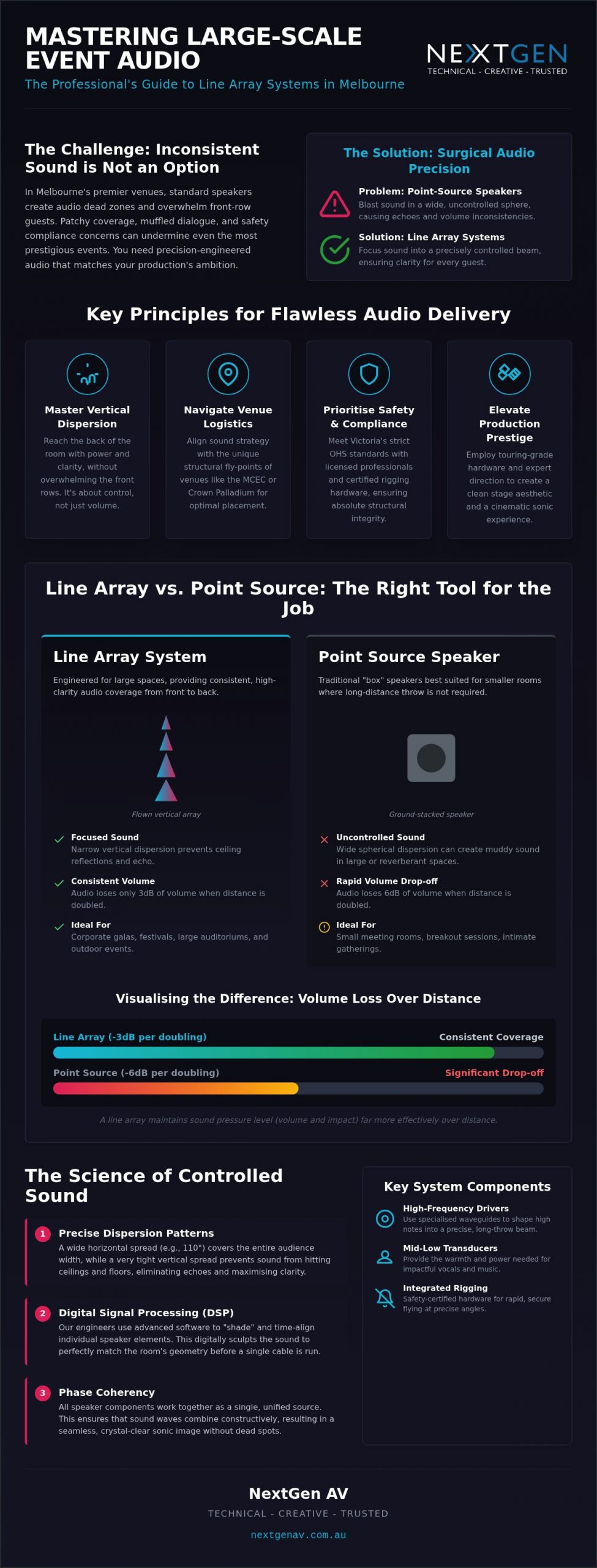
Planning and Rigging: Navigating Melbourne Venue Logistics
Suspending a multi-tonne audio system above a high-profile audience is a task that demands technical mastery and absolute adherence to structural engineering. When you invest in line array hire melbourne, you aren’t just securing speakers; you’re commissioning a safety-critical operation. Premier venues like the Crown Palladium or the Melbourne Convention and Exhibition Centre (MCEC) have specific fly-points and strict weight load limits that require expert navigation to ensure your production remains compliant and secure.
Beyond rigging safety, maintaining a clean overhead environment is vital for facility management; to ensure your venue is free from hazardous dust, you can discover Ceilingvac for specialist remediation and insulation services.
Melbourne’s legendary “four seasons in one day” climate presents a unique challenge for outdoor productions. Wind-load calculations become as critical as the audio tuning itself. Whether it’s a community festival in a city park or a large-scale concert, our equipment is rigged to withstand the variable conditions of the Victorian landscape. We ensure that every component is weather-protected and structurally sound, allowing the show to go on regardless of what the clouds decide.
Managing these logistical layers requires more than just a hire company. You need a full service event production partner who takes ownership of venue permits, safety inductions, and engineering sign-offs. This proactive approach removes the burden of technical risk from your shoulders, letting you focus on the creative vision while we handle the heavy lifting behind the scenes. If you’re ready to secure your venue’s technical success, contact our technical direction team for a site-specific consultation.
Safety Standards and Compliance
Our rigging team consists of licensed professionals who utilise only load-rated motors, truss, and shackles. Every overhead installation is conducted in accordance with Australian safety standards, including AS 1418. We don’t take shortcuts with public safety. For outdoor events, we employ real-time wind monitoring and ballast systems that ensure the array remains stable even in high-gust environments, providing peace of mind for organisers and performers alike.
Acoustic Mapping and Pre-Production
Precision begins in the virtual world. We use industry-standard 3D modelling software, such as EASE or Soundvision, to map your venue’s acoustic signature before we even load the truck. This allows us to identify potential “dead zones” or harsh reflections common in modern, glass-heavy Melbourne architecture. By predicting coverage patterns during the pre-production phase, we eliminate guesswork and significantly reduce on-site troubleshooting time, ensuring a seamless transition from setup to showtime.
Mastery in Motion: The NextGen AV Advantage
With over 30 years of history in the Melbourne event landscape, NextGen AV has witnessed the evolution of sound from basic amplification to the sophisticated digital arrays of today. We don’t just provide equipment; we offer a legacy of technical mastery. Our curated inventory consists of touring-grade hardware that meets the exacting standards of international performers and corporate leaders alike. When you choose us for your line array hire melbourne, you’re partnering with a team that views technical production as a dedicated craft rather than a mere utility.
Our “Invisible Expert” philosophy is designed specifically to alleviate the inherent stress of high-stakes planning. We proactively manage the logistical grind, the complex frequency coordination, and the delicate phase alignment. This allows you to step into the spotlight with absolute confidence. This commitment to audio visual hire in Melbourne ensures that your message is delivered with absolute clarity and cinematic impact. We act as the engine behind the scenes, driving the success of your gala or festival while you take centre stage without worry.
Beyond the Gear: Technical Direction
The secret to a truly flawless production isn’t found in a spec sheet; it lives in the expertise of the engineers behind the console. Our on-site technical directors provide real-time monitoring and adjustment, responding instantly to the changing dynamics of a live performance or a sudden shift in audience density. We ensure your audio is perfectly synchronised with every other production element. Whether we are integrating your soundscape with high-resolution LED video walls or sophisticated lighting designs, the result is a cohesive, immersive experience. This level of technical direction transforms a standard presentation into a powerful, memorable event that resonates long after the final applause.
Book Your Sound Consultation
Every venue in Melbourne presents a unique set of acoustic challenges, from the soaring ceilings of heritage buildings to the modern glass surfaces of the Docklands. We don’t believe in one-size-fits-all solutions. Instead, we offer personalised site visits to assess these variables firsthand and map out a bespoke audio strategy. This allows us to provide customised quotes that reflect the specific scale and prestige of your event. We invite you to enquire about line array hire for your next Melbourne event and discover the difference that three decades of expertise can make to your production value.
Elevate Your Production Standards
Achieving pristine audio in Melbourne’s most iconic venues is a feat of engineering, not just a matter of turning up the volume. We’ve explored how the surgical precision of vertical dispersion ensures every seat in the house receives concert-grade clarity, and why navigating the strict rigging requirements of the MCEC or Crown Palladium demands a veteran technical hand. When you secure line array hire melbourne through a partner with over 30 years of technical event experience, you aren’t just renting hardware; you’re investing in a seamless, high-stakes production.
Our team combines Red Dot standard gear with licensed riggers to provide end-to-end production management that lets you focus on the prestige of your results while we orchestrate the engine room. We take pride in our “Invisible Expert” approach, ensuring that technical complexity never distracts from your message. Don’t leave your sonic reputation to chance. Request a Professional Audio Quote for Your Melbourne Event today and let us transform your vision into an immersive reality. We look forward to powering your next successful production with absolute precision.
Frequently Asked Questions
How many line array speakers do I need for an event of 1,000 people?
A typical baseline for 1,000 guests in a standard Melbourne ballroom involves four to six modules per side, though the final count is dictated by the venue’s depth and acoustic properties. This configuration ensures consistent coverage and high-fidelity sound without straining the system. If your event is outdoors or in a space with high ambient noise, we might scale this up to eight modules per side to maintain the necessary headroom and clarity.
Can line array speakers be ground-stacked if the venue has no rigging points?
Yes, line arrays can be ground-stacked using dedicated rigging frames when venue ceiling points aren’t available. While flying the system is always preferred for better vertical coverage, ground-stacking allows us to deploy professional audio in heritage buildings or temporary structures where rigging isn’t an option. We often elevate these stacks on staging decks to ensure the sound reaches the back of the room effectively.
What is the difference between an active and a passive line array system?
Active systems feature internal amplifiers and digital processing within each speaker box, which often simplifies cabling and setup time. Passive systems rely on external amplifier racks and separate processors. We choose between them based on the specific logistical needs of your production; passive systems often allow for more streamlined weight loads when flying large arrays in venues with lower structural limits.
How much does it cost to hire a line array system in Melbourne for a day?
Pricing for line array hire melbourne is entirely bespoke, as it reflects the scale of the hardware, the number of technical crew required, and the transport logistics involved. A simple setup for a corporate gala has different requirements than a multi-day outdoor festival. We provide tailored quotes following a site visit or a review of your technical rider to ensure the solution matches your budget and prestige.
Are line arrays suitable for outdoor events with Melbourne’s unpredictable weather?
Professional arrays are highly resilient to Melbourne’s “four seasons in one day” climate when managed by experts. We use IP-rated equipment or specialised weather protection covers to safeguard the electronics from rain. Our riggers also calculate ballast requirements based on local wind-load standards to ensure the structure remains perfectly stable during sudden gusts, protecting both the equipment and your audience.
Do I need a separate sound engineer to operate the line array during my event?
A dedicated systems engineer is essential for the initial setup, time-alignment, and tuning of the array. For the event itself, having a Front of House (FOH) engineer is the only way to guarantee a flawless experience. They manage the live mix, respond to real-time acoustic changes, and ensure your presenters or performers sound their absolute best throughout the entire programme.
What are the power requirements for a large-scale line array setup?
Large-scale setups typically demand 3-phase power, often requiring a 32-amp or 63-amp feed to support the high-current demands of the amplifiers. While smaller arrays might operate on multiple independent 10-amp circuits, we always assess the venue’s electrical infrastructure during pre-production. This ensures we have a stable, dedicated power source to prevent any technical interruptions or circuit overloads during the show.
How long does it take to set up and tune a professional line array system?
The technical deployment of line array hire melbourne usually takes between three and six hours from the moment the first road case is opened. This includes the physical rigging of the motors, cabling the modules, and the critical process of acoustic tuning using pink noise. For larger festivals or complex multi-array designs, we often factor in a full day of pre-production on-site to ensure every element is perfectly calibrated.
A spectacular lighting show is only as powerful as the invisible steel and precision motors that keep it in the air. When you’re planning a high-stakes production, the technical logistics of truss and motor hire for lighting rig systems shouldn’t be the source of your stress. You know that the difference between a seamless event and a structural failure lies in the fine details of load ratings and venue-specific rigging points. It’s a high-pressure environment where safety isn’t just a box to tick; it’s the foundation of your creative vision.
This guide helps you master the technical essentials of modern rigging to ensure your next Melbourne event is both visually stunning and structurally sound. We’ll demystify the latest AS 1418 updates and D8+ motor standards so you can lead your technical crew with absolute confidence. From calculating capacities to navigating complex venue constraints, you’re about to learn how to orchestrate a safe, engineered rig that meets every Australian standard while allowing your lighting design to shine.
Key Takeaways
- Master the technical synergy between F34 box truss and CM Lodestar motors to create a high-performance foundation for your event’s visual architecture.
- Learn how to navigate the specific architectural constraints of Melbourne venues by choosing between high-impact flown rigs and versatile ground support systems.
- Ensure absolute compliance with Australian safety standards and WorkSafe Victoria regulations to protect your audience and uphold your professional reputation.
- Discover why professional truss and motor hire for lighting rig setups requires the precision of certified riggers to translate complex load ratings into a secure reality.
- Optimise your production timeline and eliminate technical friction by partnering with seasoned experts who provide end-to-end technical direction and on-site management.
The Foundation of Visual Impact: Truss and Motor Hire Essentials
A professional lighting rig is a sophisticated ecosystem where structural engineering meets artistic vision. It isn’t merely a collection of aluminium; it’s the seamless synergy of load-rated trussing, precision electric hoists, and advanced control systems. When you invest in truss and motor hire for lighting rig setups, you’re building the skeleton of your event’s atmosphere. This infrastructure allows for the complex layering of stage lighting fundamentals, ensuring every beam and wash is positioned with surgical accuracy.
Safety is the silent partner in every successful production. While the audience marvels at the visual spectacle, the rigging ensures that every kilogram of equipment remains exactly where it’s intended. In Australia, this work is strictly governed by the AS 1418 series of standards, including the updated AS 1418.3:2024 for bridge and gantry cranes and the general requirements of AS 1418.1:2021. Following these protocols isn’t optional; it’s a legal and ethical mandate that protects your brand and your guests. Securing a professional truss and motor hire for lighting rig projects ensures that your technical direction is backed by the highest safety standards.
For corporate galas and prestige events, motorised systems like the CM Lodestar are the gold standard. Unlike manual chain blocks, which require significant physical effort and often result in jerky, uneven movement, electric motors provide smooth, simultaneous lifting. This precision allows technicians to level a massive rig to the millimetre, creating a polished look that manual alternatives simply can’t replicate. It transforms the setup process from a laborious task into a refined technical exercise.
Why Professional Rigging Matters for Your Event
Professional rigging liberates your creative team. By moving equipment off the floor and into the ceiling, you unlock dramatic lighting angles that transform a flat stage into a cinematic environment. It also maximises your venue’s footprint. Flying your audio and lighting gear clears the sightlines and creates more room for tables, dance floors, or LED activation zones. Most importantly, it ensures full compliance with venue safety protocols, providing the engineering certification required for public liability coverage.
Key Terminology Every Event Planner Should Know
Understanding the language of the technical crew helps you make informed decisions and communicate effectively with your production partner.
- SWL (Safe Working Load): This is the maximum weight a piece of equipment can safely support. Never guess this figure; it’s a hard limit determined by engineering.
- Rigging Points: These are the specific, load-tested anchor points in a venue’s ceiling. Every Melbourne venue has different restrictions on where and how much weight can be hung.
- Spansets and Gacflex: These are the high-strength polyester or steel-core slings used to attach the truss to the motors. They’re the critical, flexible links that ensure a secure, fail-safe connection.
Selecting the Right Components: Truss Types and Motor Specs
Selecting the right hardware is a high-stakes decision that dictates your production’s scale and safety. When arranging truss and motor hire for lighting rig systems, the choice between F34 and F45 trussing is your first critical pivot. F34 box truss remains the versatile industry workhorse for most corporate stages. However, as modern designs increasingly incorporate massive visual elements, the F45 heavy-duty truss becomes essential. This sturdier profile provides the high-load capacity required for seamless LED video wall hire integration, where the weight of high-resolution panels can quickly exceed standard limits.
Reliability is non-negotiable when gear is suspended above an audience. We rely on CM Lodestar motors because they’ve earned a global reputation for precision and near-silent operation. These hoists work in tandem with sophisticated motor controllers, ranging from simple 4-way units to advanced 8-way digital systems that offer perfect synchronisation. This level of control ensures that a 20-metre truss rises perfectly level, preventing the structural stress that occurs when one corner lifts faster than another. Adhering to global OSHA lighting safety standards and local Australian regulations requires this level of hardware integrity.
Trussing: More Than Just Metal Pipes
Your rig’s geometry defines the event’s visual energy. While straight lengths form the backbone of most setups, circular or custom-curved trussing allows for bespoke stage designs that wrap around the action. For high-end galas where aesthetics are paramount, black powder-coated trussing offers a prestigious look that disappears into the shadows, making your lighting effects pop. Precision load-bearing calculations are the only way to ensure these designs are viable; “near enough” is never acceptable when lives are under the rig.
Chain Motors and Hoists: The Heavy Lifters
Powering your rig requires a clear understanding of venue infrastructure. Most professional setups utilise three-phase power for the consistent torque needed to lift heavy arrays, though single-phase options exist for smaller venues. Every motor in a high-quality hire fleet must be rigorously tagged and tested to meet Australian safety standards. If you’re unsure which capacity fits your vision, partnering with a technical specialist early in the planning phase can prevent costly last-minute equipment swaps and ensure your truss and motor hire for lighting rig needs are perfectly met.
Ground Support vs. Flown Rigs: Navigating Melbourne Venues
Choosing the right execution strategy is a pivotal moment in event planning. In Melbourne, the architectural diversity of spaces, from the soaring industrial ceilings of the Melbourne Convention and Exhibition Centre (MCEC) to the ornate heritage ballrooms of the CBD, dictates whether you’ll fly your gear or build from the floor up. When you secure truss and motor hire for lighting rig systems, you’re deciding how to best utilise the three-dimensional volume of your venue. This decision impacts everything from audience sightlines to the overall structural footprint of your production.
Flown rigs are the gold standard for creating immersive environments. By suspending equipment, you remove visual clutter and create a clean finish that allows your lighting design to take centre stage. However, this approach requires a deep understanding of venue-specific rigging points and weight limits. This complexity is a core component of successful audio visual hire Melbourne logistics, where the coordination between technical directors and venue house riggers must be flawless to ensure a safe, engineered result. We manage these relationships directly, navigating the specific induction protocols and weight restrictions of Melbourne’s premier event spaces so you don’t have to.
Flown Rigs: Elevating the Experience
Flying a rig involves more than just lifting gear; it’s a precise process of securing points and managing weight distribution. Excellence is found in the details. Meticulous cable management ensures that the “invisible expert” remains truly hidden from the audience’s view. We prioritise safety above all else, utilising safety cables and secondary bonds as redundant systems. These fail-safe measures guarantee absolute structural integrity throughout your event, providing peace of mind while your creative vision takes flight.
Ground Support Solutions
If a venue lacks rigging points or features a heritage ceiling that cannot be touched, ground support becomes your best ally. These systems use heavy-duty base plates and outriggers to provide a stable, freestanding foundation. Whether you need a simple goalpost configuration for a trade show booth or a complex box rig for a corporate stage, ground support offers incredible versatility. To maintain a prestigious atmosphere, you can utilise black powder-coated truss or custom scrimming to ensure the structure complements your event decor rather than distracting from it. This approach allows for massive visual impact even in the most restricted architectural environments.
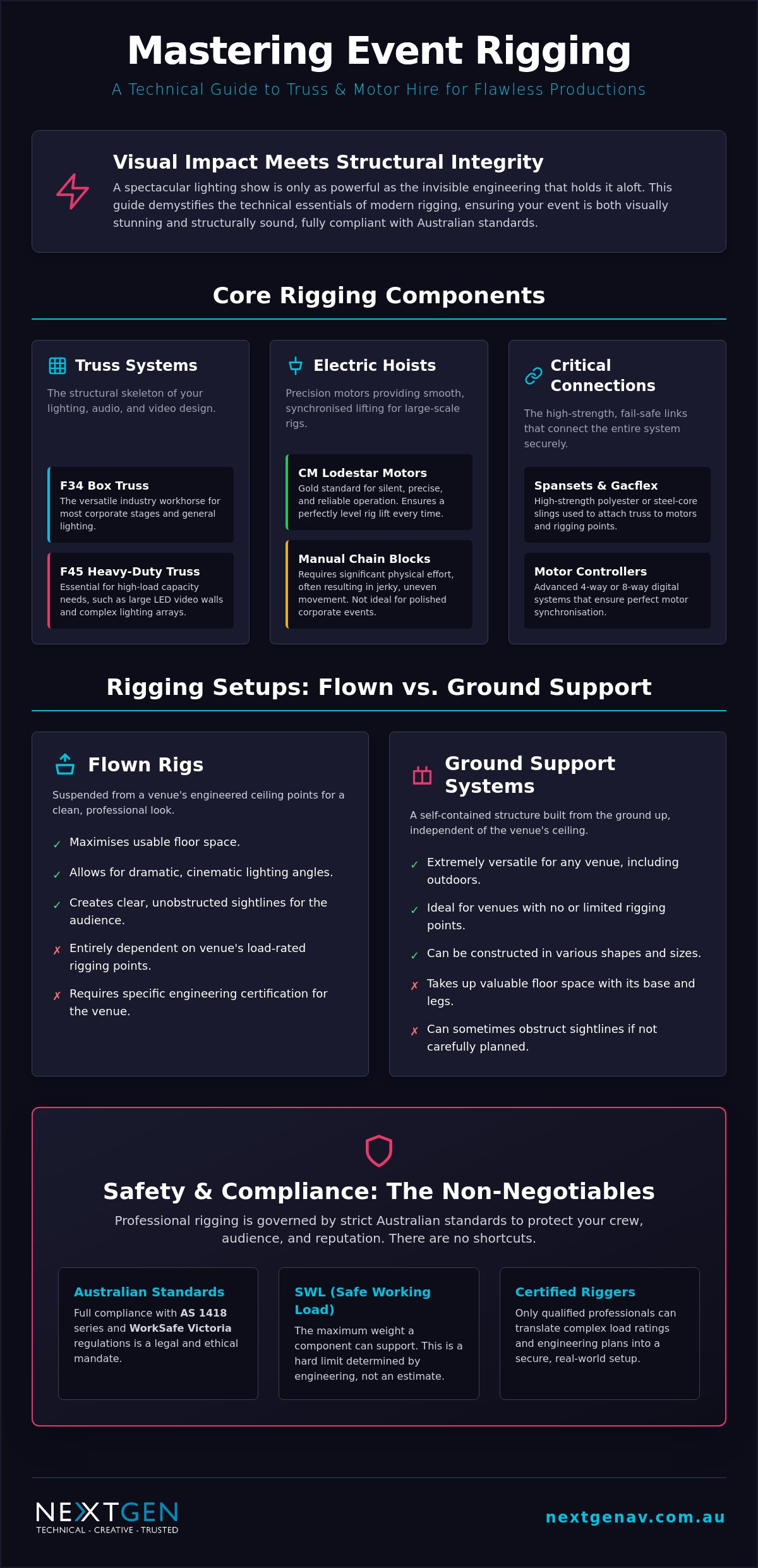
Safety and Compliance: The Non-Negotiables of Rigging Hire
The legal weight of a production rests squarely on the shoulders of the event organiser. When you commission truss and motor hire for lighting rig services, you’re not just renting equipment; you’re investing in a safety guarantee. Under Australian law, you’re responsible for ensuring that every overhead structure is engineered to support its intended load. It’s a high-stakes environment where a single oversight can lead to catastrophic failure, making professional compliance your most valuable asset.
Hiring certified riggers is a non-negotiable requirement for any overhead work. These specialists possess the high-risk work licences necessary to interpret load tables and calculate the complex forces exerted on venue anchor points. They don’t just hang gear; they verify the structural integrity of the entire system. This expertise ensures that your production meets every rigorous safety benchmark, allowing you to focus on the event’s success while we handle the technical heavy lifting.
Seamless integration is the hallmark of a professional setup. Your rigging must be designed to work in perfect harmony with your stage and lighting hire Melbourne choices. This means ensuring that the total weight of moving heads, LED panels, and audio arrays never approaches the safe working limit of the truss. We conduct meticulous pre-event safety checks, from motor brake testing to visual truss inspections, ensuring every component is event-ready.
Australian Standards and WorkSafe Victoria
WorkSafe Victoria guidelines provide the framework for safe event execution in Melbourne. Every piece of equipment in our inventory is “Load-Rated” and carries current inspection tags to prove it. Under Australian law, a rigger’s duty of care mandates that they must identify and minimise any risks to health and safety arising from their work. This legal obligation ensures that every bolt, span-set, and motor is fit for purpose and compliant with the latest AS 1418 updates.
Risk Mitigation and Insurance
Proactive risk management is the engine behind a flawless event. We develop comprehensive Job Safety Analysis (JSA) documentation for every project, outlining specific hazards and their corresponding control measures. This process includes site-specific inductions and, for outdoor setups, critical wind load considerations. Choosing a partner with robust public liability insurance is essential. It provides a final layer of protection for your brand, ensuring that every technical solution is backed by absolute professional accountability. To ensure your next rig is fully compliant and engineered for excellence, consult with our technical directors today.
Elevate Your Event with NextGen AV’s Managed Rigging
Attempting a ‘dry hire’ for structural components often introduces unnecessary variables into an already complex environment. While renting equipment might seem cost-effective, it lacks the critical oversight of a technical director who understands the nuances of load distribution and venue-specific logistics. Our 30-year legacy in the industry is built on the belief that safety and creativity should never be at odds. When you choose NextGen AV for your truss and motor hire for lighting rig requirements, you aren’t just getting aluminium and steel; you’re gaining a dedicated partner committed to flawless execution.
Our team specialises in creating customised rigging designs that marry high-end aesthetics with absolute structural integrity. We ensure that every motor move and every truss connection is engineered to support your vision, allowing you to focus on the prestige of your event rather than the mechanics of the ceiling. For those seeking a truly seamless experience, we integrate these elements into our wider full service event production programme, managing every technical detail from concept to pack-down.
The NextGen AV Difference
We operate as the ‘Invisible Expert,’ a proactive force that thrives under the pressure of live production. Our inventory consists exclusively of elite-tier hardware, including industry-leading CM Lodestar motors and Global Truss systems. This premium equipment allows us to synchronise rigging with complex LED video walls and high-fidelity audio arrays with surgical precision. By handling the logistical grind behind the scenes, we empower you to take centre stage with absolute confidence in the technical foundation of your event.
Partnering for Success
Successful rigging relies on effective collaboration with venue managers and external stakeholders. We take the lead in these conversations, managing site inductions, floor plans, and engineering sign-offs. This proactive communication eliminates friction and ensures that your event remains compliant with all Australian standards. Having a single point of contact for your AV and rigging needs simplifies your planning process, turning a high-stakes technical challenge into a polished, professional success. Contact the NextGen AV team today to organise your rigging consultation.
Build Your Vision on a Foundation of Excellence
Your event’s visual impact relies on the silent strength of the infrastructure above. By mastering the technical nuances of component selection and navigating the specific rigging requirements of Melbourne’s premier venues, you transform a logistical challenge into a creative triumph. Secure truss and motor hire for lighting rig systems that prioritise both engineering precision and artistic freedom. Safety is the bedrock of prestige; choosing high-performance hardware like CM Lodestar motors ensures your production remains flawless from the first lift to the final pack-down.
With over 30 years of Melbourne event experience, our team acts as your invisible expert, providing end-to-end technical production that is fully compliant with WorkSafe Victoria standards. We take pride in handling the complex calculations and venue inductions, allowing you to focus entirely on your audience’s experience. Don’t leave your structural integrity to chance. Organise your professional rigging consultation with NextGen AV and let’s elevate your next production to a global standard. Your masterpiece deserves nothing less than absolute technical mastery.
Frequently Asked Questions
Do I really need a motorised rig for a standard lighting setup?
Motorised systems are essential for any rig that requires precision levelling or height adjustments during the build. While manual blocks work for simple ground support, motorised truss and motor hire for lighting rig setups allow for simultaneous, smooth lifting of complex arrays. This precision prevents structural stress and ensures your lighting design is perfectly positioned to meet your creative vision without the physical limitations of manual lifting.
How much does truss and motor hire cost for a Melbourne event?
Costs vary significantly based on the length of trussing, the number of motors required, and the complexity of the venue’s rigging points. Factors such as the duration of the hire and the need for on-site technical direction also influence the final investment. We provide tailored quotes that reflect the specific engineering requirements of your production to ensure a safe and successful outcome that fits your project’s scale.
Do I need to hire a certified rigger, or can my lighting tech do it?
You must hire a certified rigger for all overhead work in Australia. While a lighting technician is an expert in illumination, a rigger holds specific high-risk work licences required by WorkSafe Victoria to calculate load ratings and secure anchor points. This distinction is a legal mandate that ensures the structural safety of everyone in the venue and protects you from significant liability risks.
What is the difference between F34 and F45 truss?
The primary difference lies in their load-bearing capacity and physical dimensions. F34 is the industry standard 290mm box truss, perfect for most lighting fixtures and smaller screens. F45 is a larger 400mm profile designed for heavy-duty applications, such as supporting massive LED video walls or long spans where structural deflection must be minimised. Choosing the right profile depends entirely on the total weight of your equipment.
How do I know if my venue has the correct rigging points?
You can determine rigging point availability by reviewing the venue’s technical specifications or “rigging plot.” Most major Melbourne venues have pre-defined points with specific weight limits. Our team often conducts site inspections to verify these points and ensure the venue’s infrastructure can safely support your proposed truss and motor hire for lighting rig configuration before any gear arrives on site.
Can you rig LED video walls and lighting on the same truss?
Yes, you can certainly rig both on the same structure provided the total weight remains within the Safe Working Load (SWL). This requires careful engineering to ensure the truss doesn’t bow and the motors are rated for the combined mass. It’s a common practice for high-impact corporate events where floor space is at a premium and a clean, integrated look is required for the stage.
What happens if a motor fails during the event?
Professional rigs utilise secondary safety bonds and redundant braking systems to prevent any movement in the rare event of a motor failure. Our technical crew remains on-site to monitor the rig throughout the event. If a motor encounters an issue during the load-in, we carry spare components to ensure the production schedule remains on track without compromising the safety of your guests or staff.
Is black truss available for more formal corporate galas?
Black powder-coated truss is absolutely available and is frequently chosen for prestigious corporate galas. This finish allows the structure to blend into the shadows, ensuring the audience focuses on the visual spectacle rather than the hardware. It provides a sophisticated, polished look that elevates the overall aesthetic of your event design and is compatible with all standard F34 and F45 accessories.
A corporate stage is more than a platform; it is the physical manifestation of your brand’s authority and the structural insurance for your event’s visual prestige. When considering corporate event stage hire melbourne planners often prioritise the guest list, yet the hidden engineering beneath the floorboards is what truly defines the evening. You’ve likely felt that familiar tension when eyeing a maze of untidy cables or worrying if a temporary structure can safely support a massive LED wall under strict Victorian OH&S regulations. It’s a high-stakes environment where a single overlooked weight loading limit can transform a polished gala into a logistical nightmare.
We understand that you need more than just equipment; you need the peace of mind that comes from absolute technical mastery. This guide reveals how to secure a safe, high-impact foundation for your next project by leveraging expert staging and rigging. We will explore the latest 2026 safety standards, the art of achieving a seamless “black-tie” finish, and the strategic benefits of integrating your AV and structural needs with a single, elite partner who treats your event’s success as their own craft.
Key Takeaways
- Discover why a professionally finished stage acts as the structural foundation for your brand’s prestige and audience engagement.
- Navigate the technical complexities of corporate event stage hire melbourne with modular staging and heavy-duty truss systems designed for CBD venues.
- Learn the essential Victorian safety standards and why certified rigging is non-negotiable for insurance and OH&S compliance.
- Optimise your pre-production timeline by integrating site inspections and technical rigging plots into your early planning stages.
- Identify the value of a single technical partner to manage end-to-end execution, from structural engineering to the final “black-tie” finish.
Elevating Your Brand: The Strategic Value of Professional Staging and Rigging
Your stage is the heartbeat of your event’s narrative. It is the physical space where your corporate identity is broadcast to every stakeholder in the room. When you invest in premium corporate event stage hire melbourne, you aren’t just renting a few square metres of timber; you are commissioning a precision-engineered environment. This distinction is critical. A basic platform merely holds weight. A professional stage, built upon solid theatrical stagecraft principles, commands attention and projects absolute authority.
Psychologically, an audience’s perception of a speaker is inextricably linked to the environment surrounding them. Messy finishes or visible cables suggest a lack of attention to detail that can subtly undermine a high-stakes keynote. Our “Invisible Expert” philosophy ensures that the complex web of trussing and rigging remains a silent, powerful engine behind the scenes. You shouldn’t notice the rigging; you should only notice the flawless result. We move beyond basic platforms to create custom-engineered event environments that feel permanent, stable, and prestigious.
Staging as a Foundation for High-Impact Visuals
Modern corporate storytelling relies on scale. Sophisticated rigging systems allow for the deployment of massive LED video walls that would be impossible to support on standard portable platforms. By creating multi-level environments, we don’t just host a presentation; we craft a stage for panel discussions and keynotes that feel cinematic. Every attendee, whether in the front row or the back of the hall, deserves a clean, unobstructed sightline to the action. Precision rigging makes this possible by elevating equipment safely above the audience’s field of vision.
The Melbourne Corporate Standard
Melbourne’s premium venues, such as the MCEC or Crown, set a high bar for excellence. Your brand must meet this standard. Achieving a “black-tie” stage finish involves more than just assembly. It requires high-grade stage skirts, premium carpeting, and seamless joins that eliminate unsightly gaps. When your corporate event stage hire melbourne aligns perfectly with your brand identity, the transition from the foyer to the main hall feels like a natural extension of your corporate story. It signals to your guests that they are part of something significant, polished, and meticulously planned. We ensure every corner is mitred and every cable is tucked away, leaving only a sharp, professional silhouette that reflects your company’s commitment to quality. To maintain this standard of excellence across all event surfaces, you can learn more about Best Carpet Steam Cleaning Melbourne.
Comprehensive Staging and Rigging Solutions for Melbourne Events
Melbourne’s corporate landscape is incredibly diverse. You might find yourself planning a keynote in a high-ceilinged heritage building or a panel discussion in a modern CBD suite with restrictive weight limits. Successful corporate event stage hire melbourne relies on modularity and precision. We utilise professional-grade aluminium stage decks that lock together with surgical accuracy, providing a solid, vibration-free foundation. This scalability allows us to construct everything from intimate platforms for solo speakers to expansive, multi-tiered environments for orchestral performances or large-scale award ceremonies.
The structural integrity of your event depends on the rigging supporting your vision. While the audience sees the vibrant LED screens and hears the crisp audio, our team focuses on the heavy-duty truss systems that make it possible. We provide ground-support rigging solutions for venues where ceiling attachment is prohibited, ensuring your branding and equipment remain perfectly positioned without compromising the venue’s architecture. Every component, from customised lecterns to scenic branding banners, is integrated into a single, cohesive structural plan.
Truss and Rigging Hardware Essentials
Choosing between box truss and tri-truss is a matter of engineering, not just aesthetics. Box truss offers superior structural integrity for heavy loads, such as massive lighting rigs or large-format screens. In contrast, tri-truss provides a sleek, low-profile look for lighter applications. Our licensed riggers manage the mechanics of elevation using high-performance chain hoists and motors, strictly adhering to the Australian Staging Safety Standards. We prioritise a clutter-free environment by implementing rigorous cable management, hiding the technical “veins” of the production within the truss structure itself.
Specialised Staging for Performance and Panels
Dynamic events often require quick-change configurations. Rolling risers allow us to reposition entire performance groups or sets in minutes, maintaining the momentum of your program. Accessibility is never an afterthought; we integrate compliant ramps and stairs that blend seamlessly with the stage’s “black-tie” finish. Finding the “Goldilocks” zone for stage height is essential for audience engagement. A stage that is too low loses sightlines, while one that is too high creates a disconnect with the front row. We calculate these dimensions based on your specific venue’s floor plan and seating density. If you are navigating a complex floor plan, our team can provide a tailored technical assessment to ensure your structural layout is both safe and high-impact.
Safety and Compliance: Navigating Australian Staging Standards
Safety in a live production environment is never an afterthought. It is the invisible architecture that protects your brand, your guests, and your peace of mind. In Victoria, the legal framework for temporary structures is rigorous and specific. When you engage in corporate event stage hire melbourne, you aren’t just hiring a platform; you’re entering a regulated workspace where compliance is a non-negotiable requirement. This is the structural insurance that allows you to focus on your guests while we manage the physics of the environment.
Certified riggers are essential. They understand the complex distribution of forces and the precise tension required for a secure overhead installation. Without a qualified professional, your event is exposed to structural risks and insurance liabilities that no organiser should ever have to shoulder. We provide comprehensive Risk Assessments and Safe Work Method Statements (SWMS) for every Melbourne venue. These documents ensure that every bolt, clamp, and motor meets current 2026 safety benchmarks and adheres to the best practices established by Live Performance Australia.
Engineering for stability involves complex weight loading calculations. Ensuring your stage and lighting setup is perfectly balanced requires more than just high-end equipment. It requires a technical partner who can calculate point loads and total distributed weight with absolute certainty. This meticulous approach prevents venue floor damage and ensures the structural integrity of the entire build.
Certified Rigging and Structural Engineering
A qualified rigger’s role extends far beyond simply hanging equipment. They are responsible for the structural sign-off of custom-built stages and large-scale rigs. In Melbourne’s notoriously variable climate, wind loading considerations are paramount for any outdoor corporate event. We calculate the lateral forces exerted on stage roofs and screens to ensure they remain anchored and secure; regardless of a sudden change in weather. This proactive engineering is what defines our “Invisible Expert” persona.
Venue Liaison and Compliance Management
Every Melbourne venue has its own technical quirks and weight limits. We work directly with venue technical managers to approve rigging plots well before the first truck arrives. This collaborative approach ensures full adherence to WorkSafe Victoria regulations and Australian Standards. Our comprehensive public liability insurance provides an additional layer of security, guaranteeing that every aspect of the corporate event stage hire melbourne process is handled with the professionalism your brand deserves. We take pride in our “front-of-house” excellence, making the compliance process look as effortless as the final production.

Strategic Planning: Site Inspections and Logistics in Melbourne
Strategic planning is the invisible engine that drives every successful production. While a basic booking form might suffice for a local community gathering, professional corporate event stage hire melbourne demands a rigorous, multi-step logistical framework. We don’t just show up on the day; we orchestrate a methodical sequence designed to eliminate risk and maximise impact. This journey begins with a comprehensive site inspection where our technical directors evaluate everything from floor level variations to existing power distribution and rigging point availability. We look for the hidden constraints that others might overlook, such as floor load limits or restrictive lift dimensions.
Once we’ve mastered the venue’s physical constraints, we translate that data into a technical floor plan and a detailed rigging plot. These CAD drawings serve as the “source of truth” for the entire technical crew, ensuring every piece of truss and every stage deck aligns perfectly with your vision. Coordinating load-in schedules with Melbourne’s notorious CBD loading docks requires seasoned expertise. We manage the delicate dance of truck arrivals and lift access, ensuring that our technical crew can begin on-site assembly and safety checks without delaying your programme. The process concludes with a swift, disciplined post-event pack-down. We pride ourselves on venue restoration, ensuring the space is returned to its original state with the same precision used during the build.
Navigating Melbourne CBD Venue Logistics
Success in high-traffic zones like Collins Street or the Southbank precinct requires more than just a truck; it requires a strategy. We manage the complex timing of bump-in and bump-out to reduce venue hire costs and avoid the peak-hour gridlock that often plagues Melbourne events. Our team ensures that power requirements are calculated to the kilowatt, distributing energy across integrated staging and AV setups to prevent unexpected outages during your event’s most critical moments. We handle the logistical grind so you can focus on the prestige of the final result.
Customising for Audience Size and Engagement
A stage’s height should never be a guess. We calculate the ideal elevation based on the ballroom’s depth and seating arrangement, ensuring that your keynote speaker remains the focal point for every attendee in the room. For modern productions, this often includes hybrid event staging solutions that prioritise sightlines for both the physical and virtual audience. We also leverage specialty rigging to facilitate “The Reveal”, using high-speed motors and dramatic curtain drops to create a sense of theatre and anticipation. To begin your planning journey with a team that values precision, you can request a technical site inspection with our senior production specialists.
Seamless Execution with NextGen AV’s Technical Direction
Thirty years of navigating Melbourne’s most demanding venues has taught us one undeniable truth: technical excellence is a dedicated craft, not a commodity. When you choose NextGen AV for corporate event stage hire melbourne, you aren’t just hiring a vendor; you’re securing a “Confident Orchestrator” for your production. We understand that the structural foundation of your stage is only as effective as the technical direction behind it. Our veteran team thrives under the pressure of high-stakes environments, taking personal pride in the quiet power of a zero-failure event. We manage the complex physics of the build so you can focus on your guests and the prestige of your brand’s message.
True production success lies in the seamless integration of disparate elements. Staging should never be treated as an isolated platform. In our integrated production model, the structural rigging, high-fidelity audio, and precision lighting work as a single, unified ecosystem. This holistic approach eliminates the friction often found when multiple providers compete for space and power. We ensure that every truss line and stage deck is positioned to enhance the acoustic and visual performance of the entire room, resulting in a polished, cinematic experience that feels both effortless and grand.
End-to-End Project Management
We assign dedicated technical directors to every major corporate project to provide a single point of accountability from concept to pack-down. This journey begins in pre-production with detailed visualisations and 3D stage renders. These tools allow you to step inside your event before a single piece of equipment leaves our warehouse, ensuring the final build aligns perfectly with your aesthetic vision. On the day, our directors provide real-time problem solving, proactively managing the “behind-the-scenes” logistics to ensure the front-of-house excellence remains uninterrupted. It’s a proactive, elite service designed for those who demand absolute reliability.
Partnering for Success
Our collaborative approach is built on long-term trust with Melbourne’s leading event planners and agencies. We don’t just deliver equipment; we deliver a partnership that values transparency and technical mastery. By choosing a partner that specialises in the high-end requirements of Melbourne CBD venues, you ensure your event is backed by three decades of industry-leading expertise. We invite you to move past the logistical grind and experience the peace of mind that comes from professional technical direction. Enquire about your Melbourne stage rigging today and let us build the foundation for your next success.
Building Your Vision on a Foundation of Excellence
The success of your production rests on more than just the surface of the platform. It is built on the precision of the engineering and the depth of the planning that happens long before the doors open. By prioritising a “black-tie” finish and adhering to rigorous Victorian safety standards, you elevate your brand’s authority while protecting your guests. Navigating the logistical maze of CBD venues requires a partner who understands that every centimetre of truss and every point load calculation is a critical component of your event’s narrative.
When you invest in corporate event stage hire melbourne, you deserve the peace of mind that only decades of technical mastery can provide. NextGen AV brings 30+ years of corporate event excellence and comprehensive OH&S and compliance documentation to every build. As Melbourne CBD venue specialists, we manage the technical complexity so you can focus on the prestige of the final result. We move beyond the logistical grind to ensure your structural foundation is as sophisticated as the message you deliver.
Partner with Melbourne’s Stage Rigging Experts to transform your next conceptual vision into a flawless structural reality. Your audience is waiting for a stage that reflects your commitment to quality; let’s build it together.
Frequently Asked Questions
Do I need a certified rigger for my Melbourne corporate event?
Yes, you absolutely require a certified rigger if your event involves overhead installations like lighting bars, speakers, or LED screens. WorkSafe Victoria mandates that all high-risk rigging work is performed by licensed professionals to ensure structural integrity and public safety. Our team manages this compliance on your behalf, providing the necessary high-risk work licenses and insurances to protect your project and brand.
What is the standard height for a corporate event stage?
The ideal height for a corporate stage typically ranges between 300mm for intimate meetings and 900mm for large ballrooms. For most Melbourne CBD venues, a height of 600mm is the “Goldilocks” zone, providing clear sightlines for seated attendees without creating a disconnect from the front row. We calculate the specific elevation based on your venue’s floor plan and audience density to ensure optimal visibility for every guest.
Can you provide staging and rigging for outdoor events in Melbourne?
We certainly provide specialised staging and rigging for outdoor corporate events across Melbourne. Outdoor builds require additional engineering considerations, particularly regarding wind-loading and ballast requirements to combat our variable climate. Our technical directors utilise precision-engineered ground-support systems and stage roofs designed to remain stable and secure in high-wind conditions, ensuring your outdoor activation is both high-impact and fully compliant.
How much weight can a standard event truss hold?
Weight capacity depends entirely on the truss profile and the distance between support points. A standard 300mm box truss can typically support significant point loads for lighting and AV, but these limits decrease as the span increases. We perform rigorous structural calculations for every corporate event stage hire melbourne project to ensure total distributed loads remain well within safe operating limits. We never guess; we engineer for absolute certainty.
Do you conduct site inspections at Melbourne venues before the event?
Yes, conducting a comprehensive site inspection is a non-negotiable step in our technical direction process. We evaluate venue access, ceiling heights, rigging point locations, and floor weight capacities to identify potential constraints before the bump-in begins. This proactive approach allows us to design a technical floor plan that integrates perfectly with the venue’s architecture, preventing last-minute logistical hurdles and ensuring a seamless execution on the day.
What is the difference between ground-supported and flown rigging?
Flown rigging involves suspending equipment directly from the venue’s ceiling points using motors and chain hoists, which keeps the floor space clear. Ground-supported rigging utilises towers or truss legs to support the load from the floor up. We recommend ground-supported solutions for venues with limited ceiling weight capacities or when specific rigging points aren’t available, ensuring your visual elements are safely elevated without relying on the building’s structure.
How long does it take to set up a professional corporate stage?
Setup times vary based on complexity, but a standard corporate stage build usually takes between two and six hours. A large-scale production involving integrated LED walls and complex overhead rigging requires a more extensive bump-in window. We coordinate closely with your venue’s loading dock and event schedule to maximise efficiency, ensuring the technical build is completed and safety-checked well before your guests arrive for the first session.
Do your staging services include carpet and skirting?
Yes, every professional corporate event stage hire melbourne package includes premium stage skirting and high-grade carpeting as standard. We specialise in providing a “black-tie” finish that hides the structural elements and cables, creating a seamless and prestigious look for your brand. Our team ensures that every join is mitred and every edge is polished, delivering a sophisticated environment that meets the expectations of Melbourne’s most elite corporate venues.
The most breathtaking moments of a live production don’t happen on the stage; they happen several metres above it, held in place by the invisible precision of professional engineering. You understand that behind every immersive LED display or complex lighting plot lies a significant weight of responsibility. The fear of structural failure or the frustration of navigating opaque Australian rigging standards can often overshadow the creative vision of your event. It is a high-stakes environment where the difference between a spectacular success and a safety incident rests on the strength of your overhead infrastructure.
Implementing the right event rigging solutions is the only way to bridge the gap between ambitious design and absolute safety. This 2026 guide provides the mastery you need to ensure your next production is structurally sound, fully compliant with the WHS Act 2011, and visually spectacular. We will demystify essential hardware, clarify venue load limits, and provide the technical vocabulary required to brief your AV partners with the authority of a seasoned expert. By the end of this article, you will have the knowledge to move past the logistical grind and focus on the prestige of a flawless execution.
Key Takeaways
- Understand why professional event rigging solutions are the invisible backbone of any high-impact production, ensuring every element is suspended with engineered precision.
- Identify the essential hardware required for a secure setup, from modular aluminium truss to the sophisticated chain hoists that safely lift the load.
- Navigate complex Australian safety standards and licensing requirements to ensure your production remains fully compliant and structurally sound.
- Learn how to conduct a comprehensive site inspection to account for venue load limits and technical constraints before the build begins.
- Discover the efficiency of a holistic approach where rigging, lighting, and staging are integrated to create a seamless and prestigious event experience.
What are Event Rigging Solutions?
Every world-class production begins with a structure that stays largely unnoticed by the audience. Professional event rigging solutions represent the sophisticated integration of hardware and engineering designed to suspend high-end audio, lighting, and visual technology safely above the crowd. It is the invisible backbone of the experience. While architectural rigging refers to permanent systems built into theatres or arenas, temporary event rigging is a bespoke craft. It involves transforming a raw space, such as a hotel ballroom, a heritage building, or an outdoor precinct, into a technically capable venue through the use of modular trussing and precision motors. This flexibility allows for the creative freedom that brings a cinematic vision to life.
Modern productions rely on this foundation to achieve a level of prestige that floor-supported equipment simply cannot match. Whether you are planning an intimate corporate gala or a large-scale festival, the rigging system acts as the silent engine driving the success of the show. By employing Entertainment rigging principles, technical teams can create immersive environments that feel both expansive and secure. It is a dedicated craft that balances the laws of physics with the artistry of live performance.
The Core Purpose of Rigging in Events
The primary objective of any rigging system is to elevate the technical standard of the production while maintaining absolute safety. By moving heavy equipment overhead, you achieve three critical outcomes:
- Optimal Sightlines: Elevating audio and lighting gear ensures every guest has an unobstructed view of the stage, creating a more inclusive and high-impact experience.
- Maximised Floor Space: Clearing the ground of bulky stands and cables opens up the room for better guest flow, additional seating, or more elaborate stage sets.
- Uncompromising Safety: A professionally engineered system secures equipment far more effectively than temporary floor supports, protecting performers, staff, and attendees from accidental knocks or instability.
When Does Your Event Need a Rigging Specialist?
Rigging is not a “plug and play” utility. It’s a high-stakes discipline that requires seasoned veterans who thrive under pressure. You should engage a specialist whenever your production involves suspending loads over people, as this is a critical point of legal and structural responsibility. Complex LED wall configurations also demand expert oversight; these screens are incredibly heavy and require meticulous weight distribution. Finally, if your venue has restricted weight capacities or unique architecture, a specialist will navigate these constraints to ensure your event rigging solutions are both compliant and spectacular. They act as the confident orchestrator, allowing you to take centre stage without a single worry about the gear overhead.
Essential Hardware: The Components of a Rigging System
Excellence in live production isn’t just about the vision; it’s about the physical components that make that vision possible. A robust rigging system is composed of high-grade hardware that must work in perfect unison. When we design event rigging solutions, we select each element based on its load-bearing capacity and its ability to integrate seamlessly with the venue’s architecture. From the skeleton of the stage to the motors that do the heavy lifting, every piece of kit is a critical link in the safety chain. Understanding these components allows you to brief your technical team with confidence and precision.
Truss Types and Configurations
Aluminium truss serves as the modular building block of any modern event. Box truss is the industry workhorse, offering a superior strength-to-weight ratio for heavy lighting rigs and LED screens. In contrast, tri-truss provides a sleeker profile for lighter decorative elements or exhibits where space is at a premium. For those looking to break away from traditional linear designs, circular and custom-curved trussing can transform a standard stage into a high-art installation. We often recommend black powder-coated finishes for a sophisticated, “invisible” look that lets the lighting take centre stage, while classic silver remains a staple for high-energy, industrial aesthetics.
Lifting and Suspension Technology
The true power behind any rig lies in its lifting technology. Electric chain hoists provide the precision height control required to level massive screens and lighting bars with millimetre accuracy. For smaller, static installations where power isn’t required after the initial setup, manual chain blocks offer a reliable and cost-effective alternative. Safety is never left to chance; seasoned teams utilise advanced load monitoring systems that provide real-time data to prevent structural overloads before they occur. It’s important to remember that operating this machinery is a specialised task; anyone performing rigging work in Australia must hold a valid Australian high-risk work license to ensure compliance with national safety regulations.
Connection Points and Ground Support
The smallest components often carry the most weight. High-tensile steel cables, Grade S bow shackles, and synthetic round slings are the critical connection points that secure the truss to the venue’s fly points. However, not every venue allows for overhead suspension. In these scenarios, ground support systems become essential. These self-supporting structures use heavy-duty base plates and towers to lift the rig from the floor up, ensuring you can still achieve a professional, elevated look even in heritage buildings or temporary marquees. If you’re unsure which configuration fits your next project, exploring our range of integrated staging and rigging options is an excellent place to start.
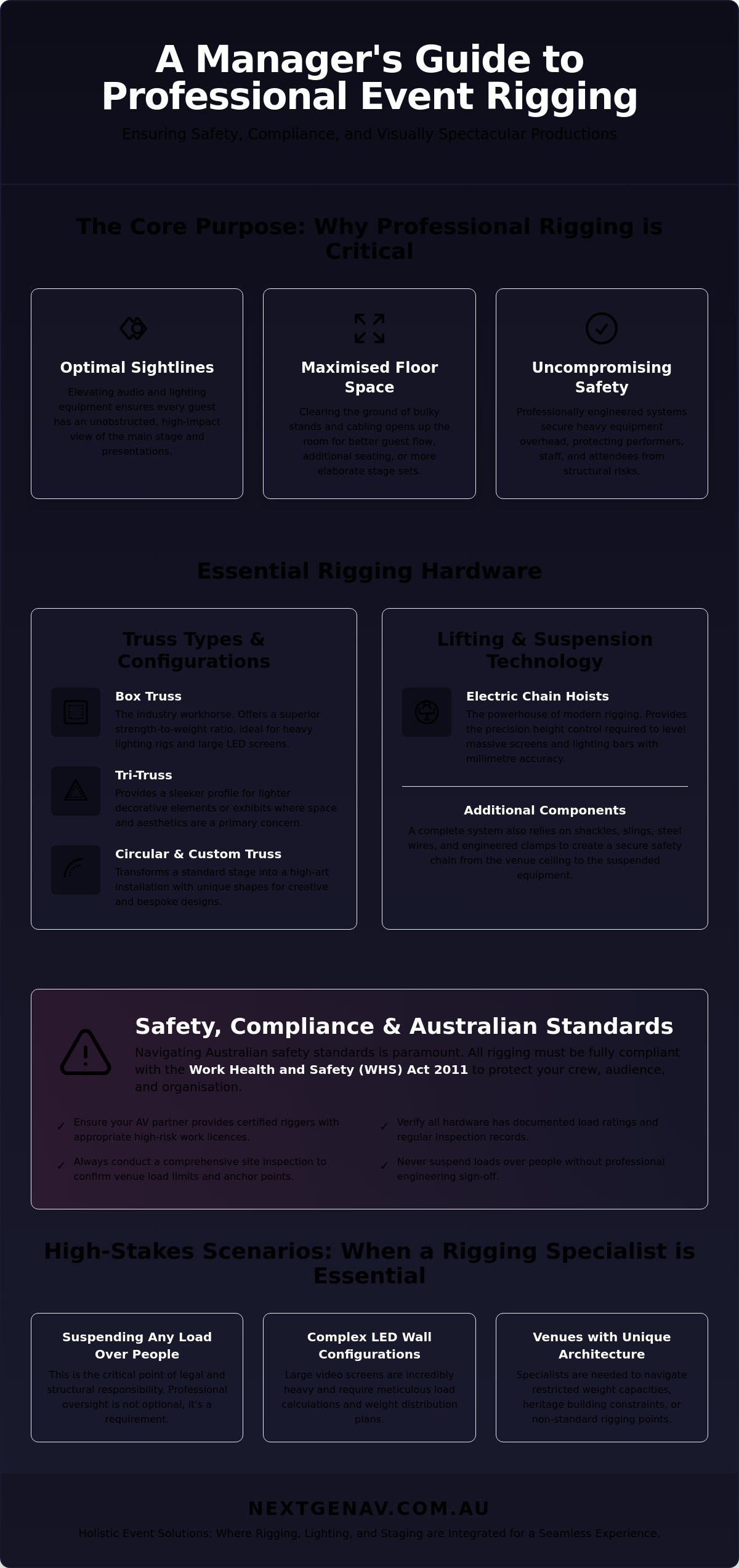
Safety, Compliance, and Australian Standards
Safety in the event industry is often viewed through the lens of liability, but for elite production teams, it’s viewed as the art of mitigation. Adhering to Australian Standards like AS 1418 for hoists and winches, or AS 2319 for rigging screws, isn’t just about ticking a box; it’s about guaranteeing structural integrity under pressure. When we deploy event rigging solutions, every calculation is backed by these rigorous benchmarks. This professional rigour extends to the documentation process, where Safe Work Method Statements (SWMS) and comprehensive risk assessments become the roadmap for a secure build. Following a structured approach to managing workplace hazards and risks ensures that potential issues are identified and neutralised long before the first guest arrives.
The human element is just as critical as the hardware. In Australia, rigging is classified as high-risk work, requiring specific licensing that reflects the complexity of the task. An Intermediate Rigger is qualified for most standard production tasks, such as erecting truss and installing hoists. However, for complex custom builds, massive suspended structures, or anything involving the movement of loads, an Advanced Rigger is required to oversee the operation. For any bespoke stage design or non-standard installation, a structural engineering sign-off provides the final seal of approval, offering the ultimate peace of mind for event organisers and venue owners alike.
Navigating Venue Load Limits
Every venue has a different story to tell through its rigging plot. Understanding the difference between a point load, which is the weight at a single suspension point, and a Uniformly Distributed Load (UDL) is essential for preventing structural fatigue. In Melbourne, many prestige venues are housed in heritage buildings with strict technical restrictions that can’t be ignored. We work closely with venue managers to interpret these floor plans and plots, ensuring your production stays within safe limits while still achieving maximum visual impact. It’s about finding the sweet spot between creative ambition and the physical realities of the room.
Annual Inspections and Gear Maintenance
Hardware is only as reliable as its last inspection. All rigging equipment must be “tagged and tested” regularly to meet Australian safety requirements and ensure it’s fit for purpose. At NextGen AV, we maintain a rigorous maintenance schedule that often exceeds industry minimums. Our technicians are trained to spot the subtle signs of compromised gear, such as hairline fractures in shackles or microscopic fraying in synthetic slings, that an untrained eye might miss. Using pristine, well-maintained equipment is a commitment to the professional standard your event deserves, ensuring the “invisible backbone” of your show remains flawlessly strong.
Planning Your Rigging: A Guide for Event Managers
Successful event planning requires moving beyond the logistical grind to focus on the creative vision. Rigging shouldn’t be an afterthought. It’s the framework that supports your core objectives. Whether you’re aiming for a high-prestige awards night or a high-energy product launch, your event rigging solutions must be designed to enhance that specific atmosphere. A thorough site inspection with your technical partner is the first step. This visit allows us to identify structural points, assess floor loading for ground support, and anticipate any architectural hurdles before they become costly site-day problems. It’s about proactive orchestration rather than reactive fixes.
Understanding the financial components of a rig is essential for a transparent planning process. Budgeting for rigging involves more than just the daily rate for truss or motors. It encompasses specialised labour, such as licensed riggers who manage the high-risk work, transport for heavy hardware, and the specific equipment hire required for your design. By accounting for these elements early, you avoid the hidden costs often associated with venue rigging fees and technical adjustments. This clarity allows you to allocate resources where they’ll have the most impact on the guest experience. Working with dedicated event staging Melbourne specialists ensures that your physical production foundation is engineered to complement the rigging system from the very first planning stage.
The CAD Advantage in Rigging
Computer-Aided Design (CAD) has transformed the pre-production phase into a precise science. It allows us to build a digital twin of your event space. We can calculate weight distribution with mathematical certainty and verify sightlines for every seat in the house before a single bolt is tightened. This visual data is invaluable for sharing plans with venue managers and stakeholders, ensuring a seamless approval process and a predictable build. It eliminates the guesswork, allowing you to focus on the prestige of the final result.
Coordinating with Other AV Departments
A rig doesn’t exist in isolation. It’s a collaborative platform. We ensure that our rigging plans are perfectly aligned with our stage lighting design services, providing the necessary hang points for every fixture. Beyond the lights, we integrate cable paths for power and data directly into the truss design, keeping the “invisible backbone” clean and professional. Finally, coordinating the bump-in and bump-out schedule is critical. Rigging is often the first element to go up and the last to come down, so precise timing ensures the entire technical team stays on track. If you’re ready to elevate your next production with a team that understands the nuances of technical planning, reach out to the experts at NextGen AV for a comprehensive consultation.
Integrated Rigging Solutions with NextGen AV
Choosing a technical partner who treats rigging as an integrated discipline rather than a standalone utility transforms the entire production process. When you opt for a holistic approach to stage and lighting hire Melbourne, you eliminate the friction between separate vendors and ensure that every technical element works in perfect synergy. Our event rigging solutions are designed to be the foundation upon which your visual and audio systems thrive. This unified strategy not only saves significant time during the high-pressure bump-in phase but also optimises your budget by streamlining labour and transport requirements. It is about creating a seamless path from the initial CAD drawing to the final, breathtaking execution.
With over 30 years of experience in the Australian event industry, we have refined a “no-surprises” philosophy that prioritises absolute reliability. We understand the inherent stress of high-stakes planning, which is why our team acts as a proactive technical powerhouse behind the scenes. This seasoned expertise allows us to navigate the complexities of venue load limits and regulatory compliance with quiet power, leaving you free to focus on the prestige of the event itself. We don’t just provide equipment; we deliver the peace of mind that comes from three decades of flawless execution.
Rigging for High-Impact Visuals
Modern productions increasingly rely on massive digital canvases to captivate audiences. Specialised rigging for LED video walls requires a sophisticated understanding of weight distribution and structural tension. These screens are significantly heavier than traditional projection surfaces, demanding precision-engineered trussing and high-capacity motors to ensure a perfectly level and secure hang. We thrive on managing these unique weight challenges, using creative truss configurations to build immersive environments that wrap around your audience. Our technical direction ensures that even the most ambitious visual designs are grounded in absolute structural integrity.
Partnering with NextGen AV in Melbourne
Our deep roots in the local industry give us an unparalleled advantage when working within Melbourne’s premier event venues. We maintain strong relationships with venue managers across the city, allowing us to navigate technical restrictions and rigging plots with ease. The “Invisible Expert” philosophy is at the core of everything we do; we handle the complex engineering and high-risk licensing requirements so that you can take the credit for a spectacular result. If you are ready to elevate your next production with elite technical execution, contact us today for a comprehensive rigging and event lighting hire Melbourne quote. Let us orchestrate the invisible backbone of your next success.
Master the Invisible Backbone of Your Production
Transforming an ambitious creative vision into a tangible, high-impact experience requires more than just high-end gear. It demands a technical foundation built on engineering precision and uncompromising safety. By understanding the essential components of event rigging solutions and the rigour of Australian Standards, you move from the stress of logistical uncertainty to the confidence of a seasoned orchestrator. Whether you’re navigating complex venue load limits or integrating massive LED walls, the key to success lies in proactive planning and expert partnership.
NextGen AV brings over 30 years of industry experience and a team of certified Melbourne-based rigging specialists to every project. Our strict adherence to Australian Standard AS 1418 ensures that your production is not only visually breathtaking but structurally beyond reproach. We handle the technical weight so you can focus on the prestige of the final result. Discuss your event rigging requirements with the NextGen AV team today and let’s build something spectacular together. Your next world-class event is just one well-engineered step away.
Frequently Asked Questions
What is the difference between ground support and flown rigging?
Ground support systems are self-standing structures built from the floor up using heavy-duty base plates and towers, whereas flown rigging involves suspending equipment directly from the venue’s ceiling fly points. We typically recommend ground support for outdoor marquees or heritage buildings where overhead attachment is prohibited. Flown rigging is the preferred choice for large-scale productions as it clears floor space and offers superior sightlines for your audience.
Do I need a structural engineer for my event rigging?
You generally require a structural engineer’s sign-off for bespoke stage designs, massive outdoor structures, or any installation that pushes the boundaries of standard venue load limits. While standard event rigging solutions are covered by the rigger’s licence and manufacturer load charts, custom builds introduce unique stresses that demand a formal engineer’s certificate. This step provides an essential layer of compliance and peace of mind for high-stakes productions.
How much weight can a standard venue rigging point hold in Melbourne?
Weight capacities vary significantly across Melbourne venues, with standard points often rated anywhere from 250kg to over 1000kg. You must never assume these limits; it’s vital to consult the venue’s specific rigging plot or technical floor plan. Our team liaises directly with venue managers to verify these point loads and total uniformly distributed loads (UDL), ensuring your production remains within safe structural boundaries at all times.
What qualifications should a professional event rigger have in Australia?
A professional rigger must hold a valid High Risk Work Licence issued by a state regulator like WorkSafe Victoria. These licences are categorised into Basic, Intermediate, and Advanced levels. Most complex event productions require at least an Intermediate rigger to oversee the build. This certification ensures the technician has the proven expertise to calculate loads, inspect hardware, and execute safe suspension in a high-pressure live environment.
How does rigging impact the overall event production budget?
Rigging impacts the budget through three main channels: specialised labour, hardware hire, and venue-specific rigging fees. While it represents an upfront investment, professional rigging often reduces costs in other areas by allowing for more efficient lighting and audio placements. An integrated approach, where rigging is bundled with your staging and lighting, typically offers the best value by streamlining transport and technical labour requirements.
Can I use the venue’s in-house rigging instead of hiring a specialist?
Many venues mandate the use of their in-house team for the initial attachment to the building’s structure, but you can still engage an external specialist for the production-specific design. Hiring a dedicated technical partner allows for a more bespoke and integrated approach to your show’s visual goals. This ensures that your LED walls and lighting rigs are perfectly aligned with your creative vision rather than being limited by a standard house setup.
What is a “dead hang” versus a “bridle” in rigging terms?
A dead hang is a direct vertical connection between a load and a single suspension point located directly above it. In contrast, a bridle uses two or more cables attached to separate points to create a new “virtual” hang point at a specific location. Bridles are essential tools when the ideal position for a light or speaker doesn’t align perfectly with the venue’s existing structural beams.
How do I ensure my rigging setup is compliant with WorkSafe Victoria?
Compliance is achieved by employing licensed riggers, using “tagged and tested” hardware, and documenting a comprehensive Safe Work Method Statement (SWMS). You must also ensure that all rigging practices align with the WHS Act 2011 and relevant Australian Standards like AS 1418. Partnering with a seasoned technical team ensures these regulatory requirements are met with precision, protecting your organisation from liability and ensuring the safety of every guest.
A stage is never just a platform, and a light is never just a bulb; they are the invisible architects of every high-prestige Melbourne event. When you secure professional stage and lighting hire Melbourne, you aren’t merely booking gear, you’re commissioning the engine that drives your brand’s narrative. It’s natural to feel a sense of trepidation about the technicalities, especially with a 15% talent shortage in technical production roles making reliability harder to find. You want to focus on your keynote, not worry about whether your rigging meets the latest Victorian safety guidelines or if your power distribution can handle a high-definition LED video wall.
We understand that the gap between a technical floor plan and a cinematic atmosphere can feel vast, often leaving you visualising the worst-case scenario. This guide bridges that divide, promising to arm you with the creative insight and technical confidence required to execute a flawless production. We will walk you through the essentials of modern rigging, lighting design, and technical direction to ensure your next event is remembered for its prestige rather than its glitches.
Key Takeaways
- Discover how to leverage the psychological impact of lighting to command audience attention and elevate the prestige of your brand’s narrative.
- Identify the essential components of a stage and lighting hire Melbourne toolkit, from precision profile spots to immersive wash lighting, for a cinematic result.
- Master the structural requirements of modular staging and rigging to ensure your event platform is both visually striking and compliant with Australian safety standards.
- Learn how to navigate complex venue logistics, including 3-phase power requirements and site inspections, to guarantee a flawless technical execution.
- Shift your focus from the logistical grind to the final result by understanding the role of professional technical direction in creating a seamless, high-impact atmosphere.
The Impact of Professional Stage and Lighting Hire in Melbourne
Professional event production is more than just a logistical requirement. It’s the difference between a standard presentation and a cinematic experience that stays with your audience long after the house lights come up. When you invest in stage and lighting hire melbourne, you’re building the physical and emotional framework for your message. A stage isn’t just a platform; it’s the literal foundation of event authority. It elevates the speaker, creating a clear focal point that commands respect and ensures every attendee has an unobstructed view of the action. Lighting, meanwhile, does the heavy lifting for audience retention. The fundamentals of stage lighting dictate that illumination isn’t just about visibility; it’s about directing focus and evoking specific emotional responses that align with your goals.
There is a vast chasm between “dry hire” and full-service technical direction. Dry hire often leaves you with a pile of gear and the stress of managing power requirements and rigging safety yourself. In contrast, our approach as your technical partner is to act as the “Invisible Expert.” We manage the complex mechanics behind the scenes so you can take the credit for a flawless execution. This partnership alleviates the fear of technical glitches, replacing uncertainty with the confidence that comes from thirty years of Melbourne event experience.
Why Atmosphere is Your Most Valuable Asset
Atmosphere is the silent communicator of your event’s value. It tells your guests they’re in a high-stakes, prestigious environment before a single word is spoken. By using light to guide the audience’s eye, we ensure your key message remains the centre of attention. This creates a “VIP” feel that justifies corporate investment and elevates brand perception. We carefully align lighting design with your specific colour palettes, turning a sterile ballroom into a bespoke brand activation that feels intentional and polished.
The Evolution of Event Technology in 2026
The Melbourne market has shifted rapidly toward sustainability and precision. With 92% of organisations now having event sustainability targets in 2026, energy-efficient LED technology has become the industry standard. These fixtures offer richer colours and higher output with a significantly smaller carbon footprint. We’ve also moved beyond the “cable spaghetti” of previous decades. Wireless DMX control allows for cleaner, safer setups that won’t distract from your event’s aesthetics. For a truly cohesive look, we synchronise these lighting systems with high-resolution LED video walls. This integration ensures that every visual element works in harmony, creating a seamless environment where digital content and physical lighting move as one.
The Anatomy of Event Illumination: Choosing Your Lighting Toolkit
Selecting the right equipment for stage and lighting hire melbourne involves more than ticking boxes on a technical rider; it’s about choosing the specific brushes that will paint your event’s emotional landscape. Profile spots are the precision scalpels of your toolkit. These fixtures allow our technicians to carve out crisp, defined areas of light, ensuring your speakers are high-definition and your brand logos are projected with absolute clarity. While profiles handle the detail, wash lights provide the foundation. They saturate the room in rich textures and brand-aligned colours, instantly transforming a standard Melbourne function space into a prestigious gala environment.
To inject dynamic energy into your programme, we utilise moving heads. These versatile fixtures add a sense of theatre, capable of sweeping the room during an awards walk-up or creating subtle, shifting patterns during a networking session. When paired with atmospheric haze, these beams become three-dimensional. Haze is the “secret sauce” of cinematic production; it makes the light itself visible, adding a layer of depth that feels sophisticated rather than smoky. Throughout this setup, safety remains our priority. We ensure every rig complies with the Victorian event safety guidelines, protecting both your attendees and your professional reputation. For a deeper understanding of how to select and deploy the right fixtures for your specific venue, our comprehensive guide to event lighting hire Melbourne covers the full spectrum of modern illumination strategies.
Functional vs. Decorative Lighting
In the hybrid landscape of 2026, lighting must serve two masters: the audience in the room and the camera lens. Stage lighting essentials focus on “key light” to ensure presenters don’t look washed out on screen. Simultaneously, decorative elements like uplighting and gobo projections bring your brand centre stage. If you’re unsure which fixtures will best suit your space, our team can help you curate a bespoke lighting solution that balances functionality with high-impact aesthetics.
The Role of the Lighting Console
The lighting console is the brain of the entire operation. Using DMX control, our technicians “play” the lights like a fine instrument, transitioning between pre-programmed scenes and live “busking” for unscripted moments. This level of control ensures that the shift from a high-energy video intro to a somber keynote is seamless. It eliminates the jarring “blackout” moments that can break an audience’s immersion, maintaining a narrative flow that feels both structured and cinematic.
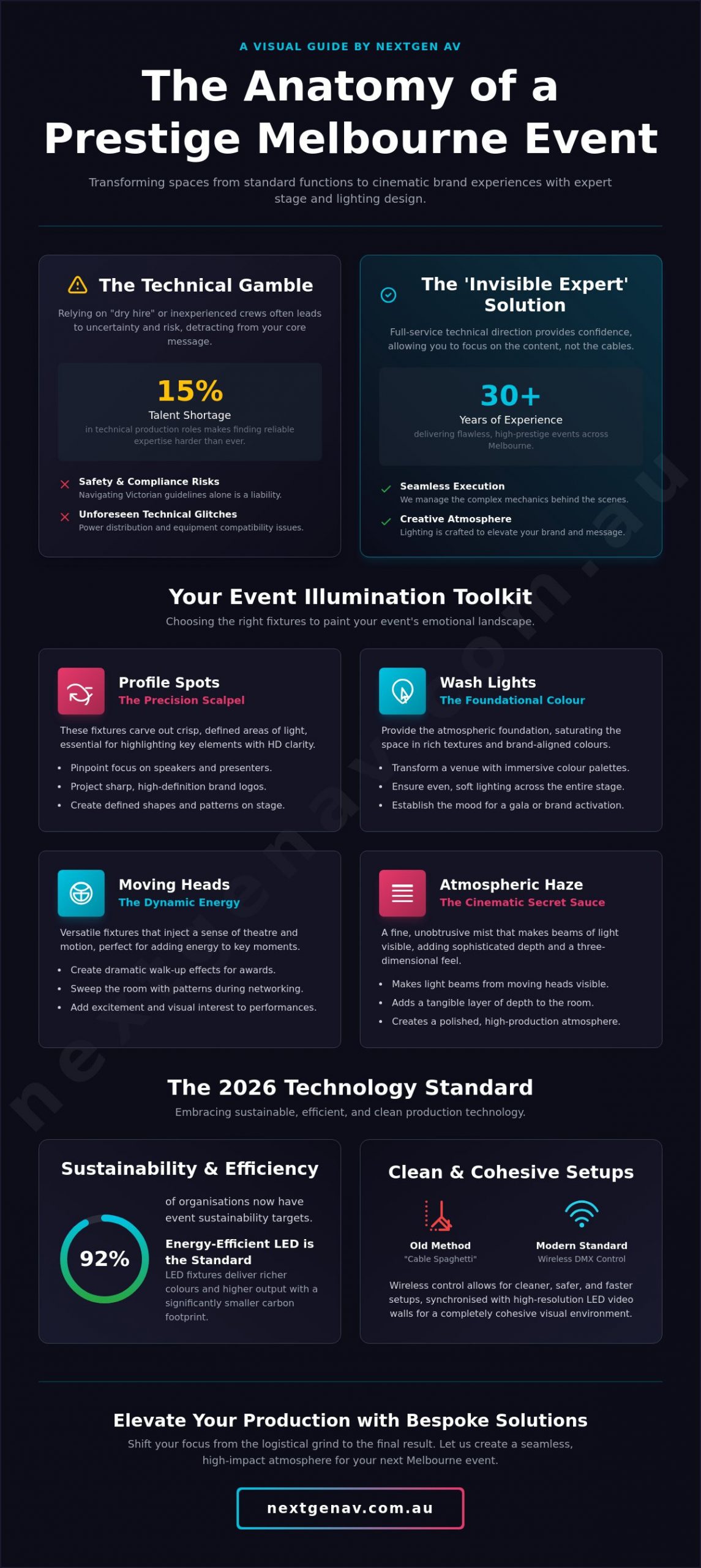
Structural Excellence: Staging and Rigging Essentials
While lighting provides the mood, staging provides the physical authority. Structural excellence is the engine behind every successful production. When you engage in stage and lighting hire melbourne, you aren’t just renting platforms; you’re designing the spatial dynamics of your event. Modular stage decks allow us to move beyond standard rectangles, creating custom shapes, tiered heights, and professional catwalks that bring your presenters closer to the audience. This structural versatility is matched by the invisible architecture of trussing and rigging. These components hold your entire show together, allowing for overhead lighting and audio arrays that keep the floor clear and the sightlines open. To maintain the prestige of the event, we use precision draping and masking. This hides the necessary “backstage” clutter, ensuring the audience remains fully immersed in the cinematic experience you’ve created.
The success of these structures depends on meticulous “bump-in” and “pack-down” logistics. We manage the tight windows often found in Melbourne’s premium venues, ensuring the build is completed with quiet efficiency before your first guest arrives. This behind-the-scenes orchestration allows you to focus on your guests while we handle the heavy lifting. A flawed build can ruin the atmosphere of even the most well-planned event, which is why we treat every bolt and bracket with the precision of a master craft.
Custom Stage Design for Melbourne Events
In flat-floor venues like the MCEC, stage height is critical for visibility. We tailor every platform to ensure the person at the back of the room has a clear view of the keynote. Accessibility is a core requirement in 2026. We integrate custom steps, ramps, and lift solutions that ensure every speaker can take the stage with dignity. To complete the look, we apply bespoke stage “skins” and finishes. These allow the platform to mirror your corporate branding, transforming raw equipment into a polished, high-end asset that justifies your investment.
Safety and Compliance: Rigging in 2026
Rigging is where technical mastery meets legal responsibility. Understanding weight loads and point loads in Melbourne CBD venues is essential to prevent structural failure. For any overhead lighting or audio, certified riggers are non-negotiable. We adhere strictly to Victorian Occupational Health and Safety (OHS) standards, conducting thorough risk assessments for every build. Our comprehensive approach to event rigging solutions ensures full compliance with the WHS Act 2011 while delivering the structural integrity your production demands. This commitment to safety protects your attendees and provides the peace of mind that your event is built on a foundation of absolute compliance, allowing you to lead with confidence.
Navigating the Hire Process: Venue Specs and Logistics
The success of your production often hinges on the invisible details identified long before the first truck arrives. Bridging the gap between a creative vision and a venue’s physical reality requires a meticulous approach to logistics. When you initiate stage and lighting hire melbourne, the most critical step is a comprehensive venue site visit. We look for more than just aesthetics; we assess rigging point load ratings, cable path distances, and loading dock clearance. This proactive discovery phase allows us to create a precise technical “rider” — a document that outlines every requirement from power distribution to crew access. By identifying potential bottlenecks early, we eliminate the day-of stress that often plagues less prepared productions.
Power requirements are a frequent point of confusion for event organisers. While a small presentation might run on standard 10A outlets, high-impact lighting rigs and LED video walls almost always demand 3-phase power. We ensure all equipment complies with Australian Electrical Safety standards (AS/NZS 3760), but the venue must provide the raw capacity to fuel the experience. Navigating Melbourne’s narrow lanes and heritage loading docks adds another layer of complexity. Moving tonnes of sensitive gear through the CBD requires a technical partner who understands the specific rhythm of the city’s streets. To complement your lighting and staging investment, pairing it with professional sound system hire ensures every technical element of your production works in unified harmony. To ensure your venue is technically viable, you can request a technical site assessment from our senior team.
Melbourne Venue Nuances
Melbourne offers a stunning mix of heritage architecture and modern masterpieces, each presenting unique challenges. High ceilings in older buildings provide a grand aesthetic but often lack modern rigging points, requiring ground-supported truss structures instead. If your design includes atmospheric effects, managing fire alarm isolations is vital. Many Melbourne venues charge “smoke machine” permit fees to isolate zones, preventing a cinematic haze from triggering a costly MFB call-out. We also navigate the delicate balance of working alongside in-house AV providers, bringing our specialist expertise to ensure your brand’s standards are met without friction.
The Technical Planning Timeline
Timing is the ultimate currency in event production. With 65% of event professionals in Australia planning to increase their event frequency in 2026, booking your hire 3 to 6 months in advance is critical for peak seasons. Once the gear is secured, we enter the “Plot and Patch” phase, where the lighting design is digitally mapped before we even arrive on-site. Finally, we always advocate for a “dark start.” Technicians need time in a blacked-out room to focus beams and calibrate colours with precision. This quiet, focused window is what allows us to deliver that flawless, high-prestige atmosphere your audience expects.
Elevating Your Production with NextGen AV’s Bespoke Solutions
Choosing a partner for stage and lighting hire melbourne is an exercise in trust. It’s about finding a team that views your event not as a list of equipment, but as a high-stakes narrative that requires absolute precision. Our “Invisible Expert” philosophy is designed to move you past the logistical grind. We take personal pride in managing the complex technical architecture of your show, allowing you to step into the spotlight with total confidence. By absorbing the technical stress, we ensure you take the credit for a seamless, high-prestige result that resonates with every attendee.
We back this commitment with thirty years of Melbourne event experience. We’ve navigated the heritage constraints of the CBD and the expansive requirements of the MCEC, building deep relationships with venue managers across the city. This local mastery allows us to anticipate challenges before they surface. Our inventory reflects the pinnacle of 2026 technology, featuring pristine gear maintained to elite standards. When you engage our stage lighting design services, you aren’t just hiring fixtures; you’re securing a dedicated craft tailored to your specific corporate goals.
From Concept to Final Curtain
Precision begins long before the bump-in. We provide pre-production visualisations that allow you to see your stage and lighting plot in a digital environment, ensuring the atmosphere matches your vision. On the day, our technical direction provides a single, dedicated point of contact. This “orchestrator” manages the cues, the crew, and the transitions, providing the peace of mind that every moment is being watched by a veteran eye. After the house lights go down, we facilitate post-event debriefs to ensure we’re constantly refining the experience for your next project.
The NextGen AV Difference
We prioritise solution architecture over simple equipment hire. This means we design systems where LED video walls, audio, and lighting work in a unified, cinematic harmony. Our local Melbourne support team is responsive and agile, capable of pivoting to meet the live demands of high-stakes productions. You deserve a partner who treats your event with the same passion you do. Experience the peace of mind that comes with a flawless event production partner dedicated to your success. Ultimately, our goal is to make the technology disappear, leaving only the impact of your message and the prestige of your brand.
Command Your Stage with Cinematic Precision
Mastering the technical landscape of 2026 requires a shift from viewing equipment as a utility to seeing it as a narrative craft. You now understand that structural excellence and creative illumination are the dual engines of event authority. From navigating complex CBD power requirements to executing a flawless lighting plot, the details you prioritise today define the prestige of your brand tomorrow. Securing the right stage and lighting hire melbourne partner is the final step in transforming a logistical challenge into a high-impact success.
Our elite technical production team brings 30+ years industry experience and end-to-end Melbourne venue expertise to every project. We manage the mechanics so you can focus on the message. Take the first step toward an unforgettable production and Request a Bespoke Stage and Lighting Quote for Your Melbourne Event. Your vision deserves the precision of a master orchestrator. Let’s build something extraordinary together.
Frequently Asked Questions
How much does it cost to hire a stage and lighting setup in Melbourne?
Pricing for professional production depends entirely on the scale, complexity, and duration of your event. Factors such as equipment volume, labour for setup, and the level of technical direction required will influence the final investment. Because every venue has unique power and rigging constraints, we recommend requesting a tailored quote that reflects your specific programme requirements and audience size.
Do I need a technician to operate the lighting during my event?
A dedicated technician is essential for high-prestige events that require dynamic transitions and live cue management. While basic setups can be pre-set, a professional operator ensures that lighting shifts seamlessly between speakers, videos, and awards walk-ups. This proactive management eliminates jarring blackouts and allows you to focus on your guests while we handle the technical execution.
What is the difference between LED and traditional incandescent stage lights?
LED technology has become the industry standard in 2026 because it offers a broader colour spectrum with significantly less heat and power consumption. Unlike traditional incandescent bulbs, LEDs allow for instant colour changes without the need for physical filters. This efficiency is vital for meeting the sustainability targets now held by 92% of organisations in the Australian event sector.
Can you provide staging for outdoor events in Melbourne?
Professional staging solutions are frequently utilised for outdoor activations, provided they meet rigorous safety and weather-proofing standards. Outdoor setups require careful assessment of ground stability and wind loading to ensure structural integrity. It is important to remember that the City of Melbourne requires an event permit for any infrastructure erected in public spaces for 50 or more attendees.
How long does it take to set up (bump-in) a full stage and lighting rig?
Bump-in times typically range from four to eight hours, though large-scale productions involving trussing and LED video walls may require a full day. The timeline depends on venue access and the complexity of the structural build. We always recommend allowing for a “dark start” window, giving technicians the necessary time in a blacked-out room to focus and calibrate the rig.
What are the power requirements for a professional lighting setup?
High-impact lighting rigs generally require 3-phase power to safely manage the electrical load of multiple fixtures and audio systems. While smaller, basic setups might run on standard 10A outlets, professional stage and lighting hire melbourne services prioritise safety by assessing a venue’s capacity during a site visit. All equipment must adhere to Australian Electrical Safety regulations (AS/NZS 3760) for compliance.
Are there specific safety regulations for event rigging in Victoria?
Rigging in Victoria is governed by strict Occupational Health and Safety (OHS) standards and the “Victorian Guidelines for Planning Safe Public Events.” Certified riggers are a non-negotiable requirement for any overhead installations to ensure weight loads are managed correctly. Following these regulations is the only way to protect your attendees and maintain the professional reputation of your event.
Can lighting be synchronised with my video presentations or music?
Modern lighting systems utilise DMX control to synchronise illumination with your audio-visual content for a truly cinematic result. Technicians can program specific cues that trigger lighting changes in perfect time with your keynote slides or walk-up music. This level of integration creates a cohesive narrative flow, ensuring the atmosphere in the room always supports the message on the screen.
