Long-term AV Partner Benefits for Systems That Can Grow

A well-planned AV production should support the event you need now and adapt as your events evolve. The long-term AV partner benefits become clearer when you look beyond equipment: coordinated planning brings technology, content and audience experience together.

It makes sense to look beyond the initial setup. As event formats, venues and technical requirements change, an ongoing relationship can preserve useful context, streamline planning and make it easier to shape the next production with confidence.

This article explains why an AV partner matters, how ongoing collaboration can support changing event needs, and what to consider when choosing a partner in Melbourne. It also explores how planning, technical direction and coordinated production can manage complexity behind the scenes, leaving your team free to focus on delivering a polished event.

Key Takeaways

  • Assess an AV partnership by how well it supports reliable communication and adapts as your event requirements change.
  • Ask how software updates, troubleshooting and component compatibility will be handled throughout the system’s lifecycle.
  • Clarify project responsibilities, technical support, training and how future upgrades can align with your organisation’s IT plans.
  • Separate general partnership advantages from AV-specific support, then match the arrangement to your goals and technical requirements.

1. Why is choosing the right AV partner important?

The right AV partner connects production design, technical delivery and future planning. Poor coordination can disrupt communication, waste time and frustrate audiences. A meeting-room setup that works for one presentation may not suit a hybrid session or a larger display. Long-term AV partner benefits include retaining knowledge of previous productions, which can reduce handover gaps when planning changes.

Manufacturer support shapes how a system evolves. Regular firmware updates can help maintain security and compatibility with newer technology. Manufacturer backward compatibility can also let older components work with updated endpoints. Before making changes, map existing devices, software dependencies and manufacturer support arrangements. Most commercial AV systems provide reliable performance for five to ten years when properly maintained and supported. Lifecycle planning helps teams consider upgrades before ageing components disrupt an event.

Maintenance turns that plan into practical care. A support routine can cover software updates, troubleshooting, user guidance and future upgrades. For example, if a conference display stops receiving a laptop signal, clear fault records help technicians isolate the issue. Testing and tuning under real operating conditions can also reveal problems before users depend on the system.

Support should include a clear route for resolving technical issues. Define who receives a fault report, who assesses it and when it needs specialist attention. For an event, confirm who is responsible for technical direction and operation, and how the team communicates with organisers. User guidance also helps staff handle straightforward tasks, such as selecting an input or starting a call.

Are AV partner benefits taxable in Australia? The phrase describes service advantages, not a specific tax category. Tax treatment depends on the arrangement and applicable Australian tax rules.

How can an Australian customer qualify for and claim AV partner benefits? These are usually agreed service benefits, not a government entitlement. Set out the project scope, support responsibilities and terms with the provider.

Can AV partner benefits be lost after cancellation or a change in status? Support may change when an agreement ends or responsibilities change. Review the contract’s cancellation, transition and ongoing-support terms.

A strong working relationship also builds familiarity with event requirements. When teams review lessons from a product launch or conference, they can refine plans around proven workflows. That context helps staff adapt to changes, while coordinated technical production keeps the audience experience central.

3. Questions to ask when choosing an AV partner

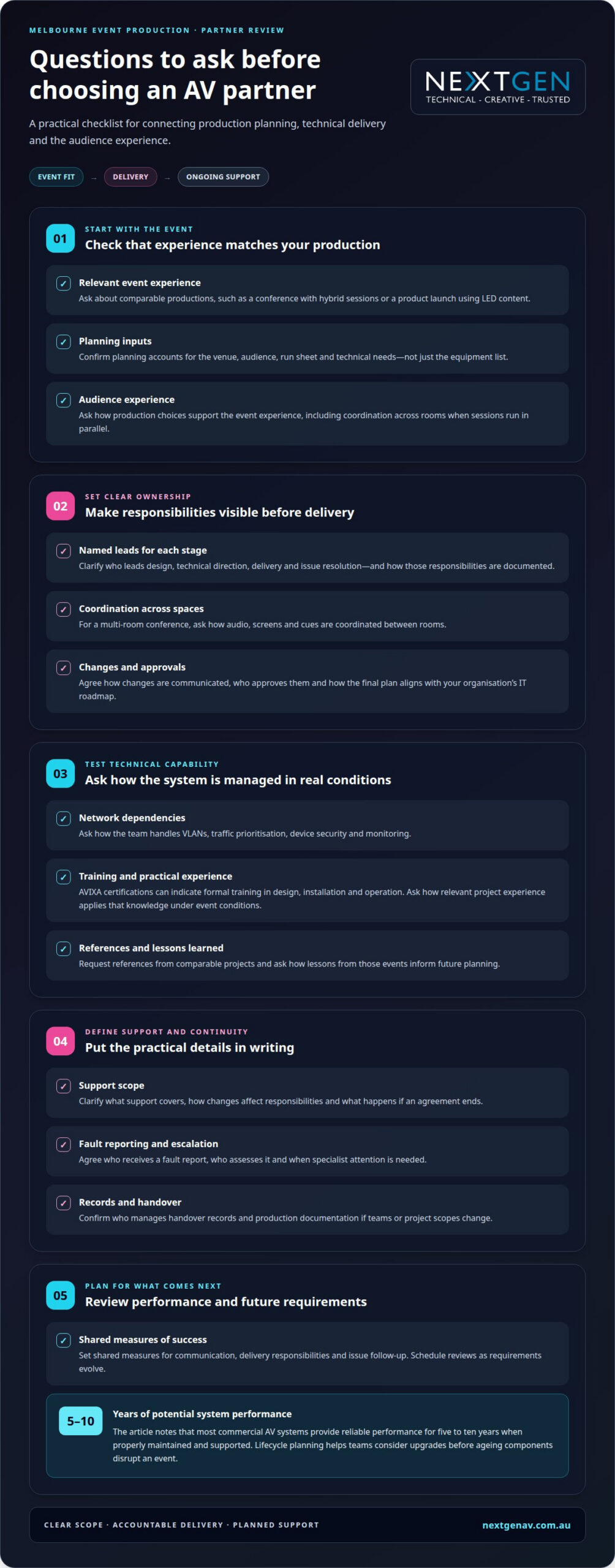
Start with experience relevant to your event. Ask about comparable productions, such as a conference with hybrid sessions or a product launch using LED content. Then ask how the team gathers requirements: does planning account for the venue, audience, run sheet and technical needs? Clear answers show whether production decisions are connected to the event experience.

Clarify who owns each stage. Ask who leads design, technical direction, delivery and issue resolution, and how responsibilities are documented. For a multi-room conference, for example, confirm how the team coordinates audio, screens and cues across spaces. Ask how changes are communicated, who approves them and how the final plan aligns with your organisation’s IT roadmap.

Explore technical capability. Ask how the team handles network dependencies, including VLANs, traffic prioritisation, device security and monitoring. AVIXA certifications can indicate formal training in design, installation and operation, while relevant project experience shows how that knowledge works under event conditions. Ask for references from comparable projects and how lessons from those events inform future planning.

What discounts, credits or rewards are available to long-term AV partners? Discounts, credits and rewards aren’t automatic features of an AV partnership. Any such benefit depends on the written agreement, scope and terms for the work.

What risks, exclusions or limitations apply to AV partner benefits? Clarify what support covers, how changes affect responsibilities, and what happens if an agreement ends. For example, confirm who manages handover records and production documentation when teams or project scopes change.

Finally, agree on how success will be assessed. Set shared measures for communication, delivery responsibilities and issue follow-up, then schedule reviews as requirements evolve. For Melbourne events, AV project planning can help bring technical decisions into focus before production details are locked in.
Long-term AV Partner Benefits for Systems That Can Grow

3. Eligibility for AV partner benefits in Australia

In commercial AV, “partner benefits” usually describes agreed service arrangements, not a standard Australian government entitlement. What is included depends on the agreement between an organisation and its AV provider. The written scope should identify the event requirements, responsibilities and timing. For example, a conference production may cover specified audio, screens and technical operation, while unrelated equipment falls outside that project.

Start by defining the organisation’s requirements. List the venues, event formats and systems that need ongoing support, then identify who can request assistance. A Melbourne organisation running conferences and product launches may need continuity across different event environments. The agreement can record approved contacts, covered equipment and the process for handling additions or changes.

Next, clarify what “benefit” means in practical terms. It might refer to planned maintenance, troubleshooting, training or future upgrade planning. Each item needs a clear description, including what triggers the work and how responsibilities are assigned. For instance, a system fault during a presentation needs a defined reporting route and escalation contact, rather than an informal assumption about who responds.

Eligibility can also depend on the agreement’s duration and status. Set out the start date, review points, renewal process and events that change coverage. If an organisation adds a venue or changes its technical setup, document whether that alters the scope. Clear records help both parties understand which requests fall within the arrangement and which require a separate decision.

Before production begins, align the plan with internal responsibilities. Identify the staff who approve changes, share technical information and communicate operational needs. Include a handover process if those roles change. This keeps planning workable as teams evolve and preserves context for future events.

There is no universal eligibility checklist for every Australian AV partnership. The practical test is whether the organisation, covered systems, support tasks and agreement terms are clearly defined. A written scope turns broad expectations into a usable framework, so each side understands how support applies as event requirements develop.

4. How do AV partner benefits compare with standard partner benefits?

A standard business partnership often centres on shared expertise, referrals or joint planning. An AV partnership must connect those relationship benefits with technical delivery. For example, a corporate team planning a Melbourne conference needs production that supports presentations, audience audio and changing run sheets. The value lies in coordinating those requirements, not simply sharing contacts.

Technical coordination is a defining difference. A general business partner can contribute market knowledge, while an AV production partner must understand how sound, screens, lighting and content work together. If a presentation changes, the production plan may need adjustments across several elements. A coordinated team can assess those changes and keep the event experience consistent.

AV production also involves event-specific conditions. A conference room, outdoor activation and product launch each bring different requirements for layout, sound, lighting and technical setup. A team that understands the event brief can shape decisions around the venue and audience instead of applying a single standard approach. That technical context distinguishes AV collaboration from broader commercial cooperation.

Compare the working relationship through practical responsibilities. A standard partner may agree to share information or pursue opportunities together. An AV production team should also define how requirements are gathered, who coordinates technical decisions, and how updates reach the event team. For instance, a late change to presentation content needs a clear route from organiser to technical crew.

Both partnership types benefit from trust, clear communication and periodic reviews. In AV, a review can assess whether the production plan still suits upcoming event formats, whether workflows remain clear, and where equipment or processes need adjustment. This keeps collaboration tied to real production needs, rather than relationship-building alone.

For an event where technical coordination shapes the audience experience, align the partnership with the production brief. Discuss your event’s AV requirements and how coordinated planning can support the result.

NextGen AV

NextGen AV helps organisations turn ongoing AV requirements into coordinated event plans, with technical direction that connects production decisions to audience experience. For a conference, product launch or corporate event, planning considers how the venue, format and evolving requirements shape the technical approach. This makes it easier to plan systems that can adapt as event needs change.

LED Video Walls, Professional Audio Systems, Lighting Design and Equipment, and Staging and Rigging can work together in a considered production. NextGen AV coordinates the technical elements around the event, while the team manages the details behind the scenes.

If you’re planning an event or reviewing your AV requirements, contact NextGen AV to discuss your project.

Plan for what comes next

The long-term AV partner benefits matter most when each event builds on clear planning and production decisions. Treat AV as part of event planning, not a separate technical task. As event formats evolve, revisit the audience experience, venue requirements and production goals together. That forward-looking approach keeps future choices connected to the experience you want people to remember.

For Melbourne organisations, the next step is to turn those priorities into a practical production conversation. Share your event date, venue, audience size and requirements with NextGen AV to discuss the technical direction. Coordinated production helps the moving parts work together, so your team can stay focused on the people in the room.

Start planning your next event with NextGen AV, and bring your next idea to life with clarity and confidence.

Frequently Asked Questions

Why is choosing the right AV partner important?

The right AV partner helps shape technical decisions around the actual venue, not equipment specifications alone. In a Melbourne venue, ceiling height, reflective surfaces and seating layout can affect sound and screen visibility. Considering these conditions during planning helps create a setup suited to the space, so presenters can communicate clearly and the audience can follow the event.

What long-term benefits do AV partners offer?

A long-term relationship can make future event planning more coherent. As requirements change, review the existing setup and decide which elements remain suitable and what needs to change. This avoids assuming that every new event requires the same equipment or approach. Tailoring production to the venue, audience and format helps keep decisions practical.

What contract terms or minimum commitments apply to AV partner programs?

There is no single standard minimum commitment for every AV partnership; terms depend on the arrangement. Clarify how any manufacturer warranty relates to the work, including who handles a warranty claim and which responsibilities belong to each party. Recording that distinction helps avoid confusion if equipment needs attention and gives your team a clearer path to resolution.

A well-planned AV production should support the event you need now and adapt as your events evolve. The long-term AV partner benefits become clearer when you look beyond equipment: coordinated planning brings technology, content and audience experience together.

It makes sense to look beyond the initial setup. As event formats, venues and technical requirements change, an ongoing relationship can preserve useful context, streamline planning and make it easier to shape the next production with confidence.

This article explains why an AV partner matters, how ongoing collaboration can support changing event needs, and what to consider when choosing a partner in Melbourne. It also explores how planning, technical direction and coordinated production can manage complexity behind the scenes, leaving your team free to focus on delivering a polished event.

Key Takeaways

  • Assess an AV partnership by how well it supports reliable communication and adapts as your event requirements change.
  • Ask how software updates, troubleshooting and component compatibility will be handled throughout the system’s lifecycle.
  • Clarify project responsibilities, technical support, training and how future upgrades can align with your organisation’s IT plans.
  • Separate general partnership advantages from AV-specific support, then match the arrangement to your goals and technical requirements.

1. Why is choosing the right AV partner important?

The right AV partner connects production design, technical delivery and future planning. Poor coordination can disrupt communication, waste time and frustrate audiences. A meeting-room setup that works for one presentation may not suit a hybrid session or a larger display. Long-term AV partner benefits include retaining knowledge of previous productions, which can reduce handover gaps when planning changes.

Manufacturer support shapes how a system evolves. Regular firmware updates can help maintain security and compatibility with newer technology. Manufacturer backward compatibility can also let older components work with updated endpoints. Before making changes, map existing devices, software dependencies and manufacturer support arrangements. Most commercial AV systems provide reliable performance for five to ten years when properly maintained and supported. Lifecycle planning helps teams consider upgrades before ageing components disrupt an event.

Maintenance turns that plan into practical care. A support routine can cover software updates, troubleshooting, user guidance and future upgrades. For example, if a conference display stops receiving a laptop signal, clear fault records help technicians isolate the issue. Testing and tuning under real operating conditions can also reveal problems before users depend on the system.

Support should include a clear route for resolving technical issues. Define who receives a fault report, who assesses it and when it needs specialist attention. For an event, confirm who is responsible for technical direction and operation, and how the team communicates with organisers. User guidance also helps staff handle straightforward tasks, such as selecting an input or starting a call.

Are AV partner benefits taxable in Australia? The phrase describes service advantages, not a specific tax category. Tax treatment depends on the arrangement and applicable Australian tax rules.

How can an Australian customer qualify for and claim AV partner benefits? These are usually agreed service benefits, not a government entitlement. Set out the project scope, support responsibilities and terms with the provider.

Can AV partner benefits be lost after cancellation or a change in status? Support may change when an agreement ends or responsibilities change. Review the contract’s cancellation, transition and ongoing-support terms.

A strong working relationship also builds familiarity with event requirements. When teams review lessons from a product launch or conference, they can refine plans around proven workflows. That context helps staff adapt to changes, while coordinated technical production keeps the audience experience central.

3. Questions to ask when choosing an AV partner

Start with experience relevant to your event. Ask about comparable productions, such as a conference with hybrid sessions or a product launch using LED content. Then ask how the team gathers requirements: does planning account for the venue, audience, run sheet and technical needs? Clear answers show whether production decisions are connected to the event experience.

Clarify who owns each stage. Ask who leads design, technical direction, delivery and issue resolution, and how responsibilities are documented. For a multi-room conference, for example, confirm how the team coordinates audio, screens and cues across spaces. Ask how changes are communicated, who approves them and how the final plan aligns with your organisation’s IT roadmap.

Explore technical capability. Ask how the team handles network dependencies, including VLANs, traffic prioritisation, device security and monitoring. AVIXA certifications can indicate formal training in design, installation and operation, while relevant project experience shows how that knowledge works under event conditions. Ask for references from comparable projects and how lessons from those events inform future planning.

What discounts, credits or rewards are available to long-term AV partners? Discounts, credits and rewards aren’t automatic features of an AV partnership. Any such benefit depends on the written agreement, scope and terms for the work.

What risks, exclusions or limitations apply to AV partner benefits? Clarify what support covers, how changes affect responsibilities, and what happens if an agreement ends. For example, confirm who manages handover records and production documentation when teams or project scopes change.

Finally, agree on how success will be assessed. Set shared measures for communication, delivery responsibilities and issue follow-up, then schedule reviews as requirements evolve. For Melbourne events, AV project planning can help bring technical decisions into focus before production details are locked in.

3. Eligibility for AV partner benefits in Australia

In commercial AV, “partner benefits” usually describes agreed service arrangements, not a standard Australian government entitlement. What is included depends on the agreement between an organisation and its AV provider. The written scope should identify the event requirements, responsibilities and timing. For example, a conference production may cover specified audio, screens and technical operation, while unrelated equipment falls outside that project.

Start by defining the organisation’s requirements. List the venues, event formats and systems that need ongoing support, then identify who can request assistance. A Melbourne organisation running conferences and product launches may need continuity across different event environments. The agreement can record approved contacts, covered equipment and the process for handling additions or changes.

Next, clarify what “benefit” means in practical terms. It might refer to planned maintenance, troubleshooting, training or future upgrade planning. Each item needs a clear description, including what triggers the work and how responsibilities are assigned. For instance, a system fault during a presentation needs a defined reporting route and escalation contact, rather than an informal assumption about who responds.

Eligibility can also depend on the agreement’s duration and status. Set out the start date, review points, renewal process and events that change coverage. If an organisation adds a venue or changes its technical setup, document whether that alters the scope. Clear records help both parties understand which requests fall within the arrangement and which require a separate decision.

Before production begins, align the plan with internal responsibilities. Identify the staff who approve changes, share technical information and communicate operational needs. Include a handover process if those roles change. This keeps planning workable as teams evolve and preserves context for future events.

There is no universal eligibility checklist for every Australian AV partnership. The practical test is whether the organisation, covered systems, support tasks and agreement terms are clearly defined. A written scope turns broad expectations into a usable framework, so each side understands how support applies as event requirements develop.

4. How do AV partner benefits compare with standard partner benefits?

A standard business partnership often centres on shared expertise, referrals or joint planning. An AV partnership must connect those relationship benefits with technical delivery. For example, a corporate team planning a Melbourne conference needs production that supports presentations, audience audio and changing run sheets. The value lies in coordinating those requirements, not simply sharing contacts.

Technical coordination is a defining difference. A general business partner can contribute market knowledge, while an AV production partner must understand how sound, screens, lighting and content work together. If a presentation changes, the production plan may need adjustments across several elements. A coordinated team can assess those changes and keep the event experience consistent.

AV production also involves event-specific conditions. A conference room, outdoor activation and product launch each bring different requirements for layout, sound, lighting and technical setup. A team that understands the event brief can shape decisions around the venue and audience instead of applying a single standard approach. That technical context distinguishes AV collaboration from broader commercial cooperation.

Compare the working relationship through practical responsibilities. A standard partner may agree to share information or pursue opportunities together. An AV production team should also define how requirements are gathered, who coordinates technical decisions, and how updates reach the event team. For instance, a late change to presentation content needs a clear route from organiser to technical crew.

Both partnership types benefit from trust, clear communication and periodic reviews. In AV, a review can assess whether the production plan still suits upcoming event formats, whether workflows remain clear, and where equipment or processes need adjustment. This keeps collaboration tied to real production needs, rather than relationship-building alone.

For an event where technical coordination shapes the audience experience, align the partnership with the production brief. Discuss your event’s AV requirements and how coordinated planning can support the result.

NextGen AV

NextGen AV helps organisations turn ongoing AV requirements into coordinated event plans, with technical direction that connects production decisions to audience experience. For a conference, product launch or corporate event, planning considers how the venue, format and evolving requirements shape the technical approach. This makes it easier to plan systems that can adapt as event needs change.

LED Video Walls, Professional Audio Systems, Lighting Design and Equipment, and Staging and Rigging can work together in a considered production. NextGen AV coordinates the technical elements around the event, while the team manages the details behind the scenes.

If you’re planning an event or reviewing your AV requirements, contact NextGen AV to discuss your project.

Plan for what comes next

The long-term AV partner benefits matter most when each event builds on clear planning and production decisions. Treat AV as part of event planning, not a separate technical task. As event formats evolve, revisit the audience experience, venue requirements and production goals together. That forward-looking approach keeps future choices connected to the experience you want people to remember.

For Melbourne organisations, the next step is to turn those priorities into a practical production conversation. Share your event date, venue, audience size and requirements with NextGen AV to discuss the technical direction. Coordinated production helps the moving parts work together, so your team can stay focused on the people in the room.

Start planning your next event with NextGen AV, and bring your next idea to life with clarity and confidence.

Frequently Asked Questions

Why is choosing the right AV partner important?

The right AV partner helps shape technical decisions around the actual venue, not equipment specifications alone. In a Melbourne venue, ceiling height, reflective surfaces and seating layout can affect sound and screen visibility. Considering these conditions during planning helps create a setup suited to the space, so presenters can communicate clearly and the audience can follow the event.

What long-term benefits do AV partners offer?

A long-term relationship can make future event planning more coherent. As requirements change, review the existing setup and decide which elements remain suitable and what needs to change. This avoids assuming that every new event requires the same equipment or approach. Tailoring production to the venue, audience and format helps keep decisions practical.

What contract terms or minimum commitments apply to AV partner programs?

There is no single standard minimum commitment for every AV partnership; terms depend on the arrangement. Clarify how any manufacturer warranty relates to the work, including who handles a warranty claim and which responsibilities belong to each party. Recording that distinction helps avoid confusion if equipment needs attention and gives your team a clearer path to resolution.

Back to Articles

Discover Valuable Insights

Unlock Expert Tips and Advice

Our blog is packed with valuable information to help you stay ahead. Whether you’re looking for expert advice, industry trends, or practical tips, you’ll find everything you need. Reach out today to learn more or get in touch with us for personalised support!

Contact Us

Request A Quote

Make an
Enquiry

Let’s Get Your Event Sorted

Complete the enquiry form with your event date, venue, audience size, event type and budget. Our Melbourne AV team will review your requirements and recommend the right PA, screen, lighting, staging or production setup for your event.

What happens next?


1.We review your event details
Tell us your date, venue, audience size and event type.

2.We recommend the right setup
From PA hire to screens, lighting, staging and full AV production.

3. We come back with clear advice
You’ll receive practical recommendations and a fast quote from our Melbourne team.

Need help urgently?
Call 1300 792 922.

Resource Download

Tell us a bit about yourself to download our resources.

7