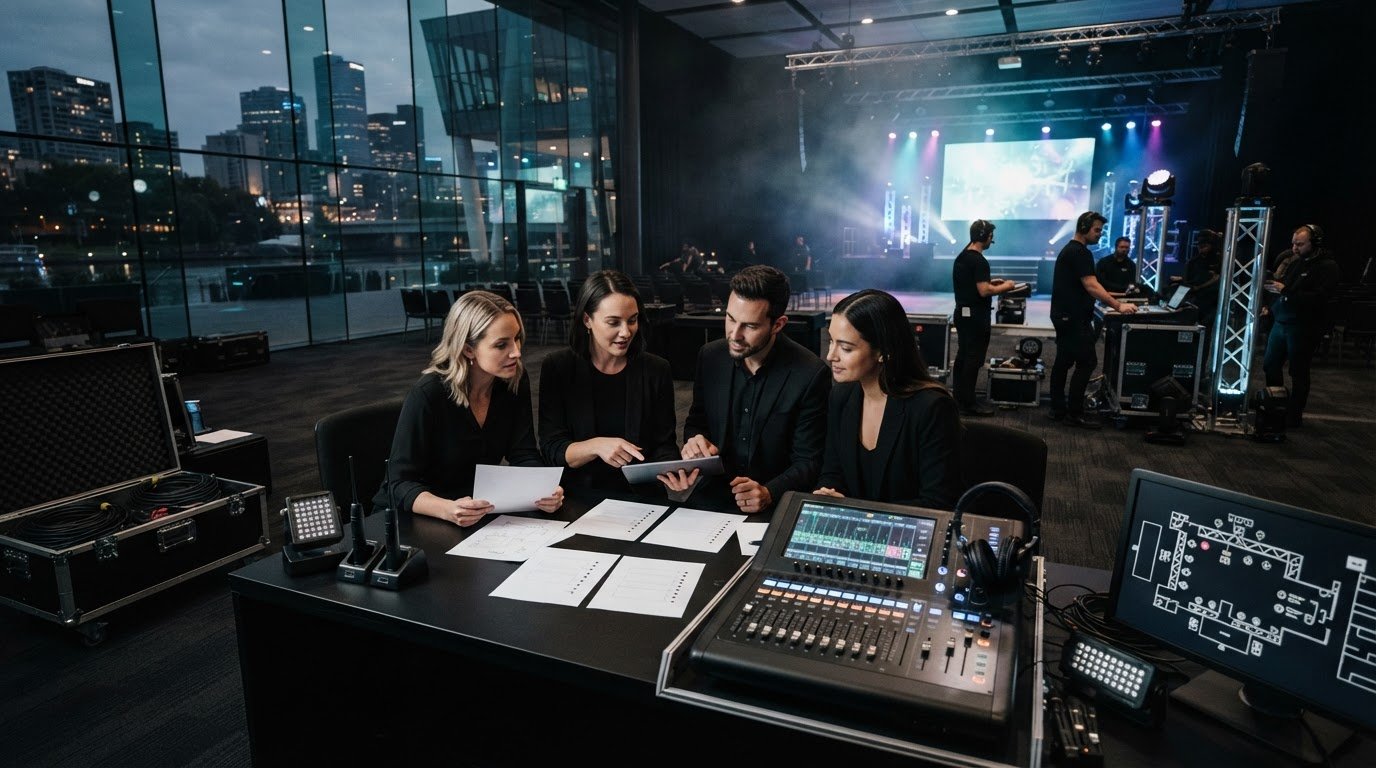
What if an AV quote looks complete but leaves key event responsibilities unclear? Learning how to read an AV quote means looking beyond the equipment list to understand what happens before, during and after your event. A screen or sound system is only part of the picture. Planning, technical direction, crew, safe installation and pack-down all shape the result.
Comparing proposals can be difficult when each describes a different scope or uses technical line items without explaining their purpose. To compare them fairly, identify what’s included, who owns each task and how the production supports your event goals.
This guide explains how to assess AV proposals in plain language, compare equivalent deliverables and responsibilities, and spot details that can reduce event-day risk. We’ll cover production scope, technical roles, safety planning and the link between equipment choices and audience experience. With more than 30 years of experience navigating Victorian event venues, NextGen AV understands why access, timing and site requirements belong in the conversation from the start. The result is a clearer basis for choosing a production partner and a smoother path from planning to a polished event.
Key Takeaways
- Learn how to read an av quote by focusing on the production outcome, deliverables and responsibilities behind each line item.
- Separate equipment provision from the planning, crew and operation needed to bring the production together.
- Compare proposals against the same event brief, weighing suitability and audience coverage rather than equipment counts alone.
- Factor Melbourne venue access, schedules and site requirements into your assessment of production readiness.
- Use a clear approval sequence to align scope, resolve assumptions and establish who manages each stage of delivery.
How to Read an AV Quote: Start with the Event Outcome
An AV quote should describe the production solution your event needs, not just name the gear being supplied. An AV quote is a scoped proposal that sets out the technical deliverables, event requirements and responsibilities needed to deliver the planned experience. Start by checking whether it explains how the production supports your event, from the first presentation to the final pack-down.
Begin with the event format, audience and programme. A conference with keynote presentations, panel discussions and audience questions has different audio and screen needs from a product launch built around a reveal moment. The proposal should connect each major element, such as sound systems, lighting or LED video walls, to a specific purpose. For a useful overview of how staging, sound, lighting and video fit together, see this guide to live event support.
Match the scope to the event brief
Compare the proposal with your event brief. Does it reflect the format, running order and experience you want the audience to have? For a conference, microphones and screens should support clear presentations and smooth speaker transitions. For a launch, lighting and visuals may focus attention on a key moment. Each major technical choice should serve a defined part of the programme.
Read beyond the equipment list
Equipment names alone don’t explain who plans the setup, installs and operates the systems, or packs them down. Look for responsibilities across each stage, including who coordinates technical requirements before the event and who manages live delivery. Clear ownership helps prevent gaps between a list of supplied equipment and a working production.
For audience-facing sound, check that the proposal identifies a front of house engineer. This audio engineer manages the mix heard by the audience, balancing speech and other programme audio so presenters can be heard clearly in the room. The role belongs in the production plan, not simply as another item beside the sound systems. Dedicated corporate sound providers like nysoundtech.com demonstrate how tailored audio equipment hire and hands-on technician support work together to ensure speech intelligibility throughout high-stakes meetings.
When planning and technical direction sit alongside equipment, crew and delivery responsibilities, the quote gives you a clearer picture of the complete production. You can then assess whether the proposal is built to support the event outcome you’ve briefed.
Decode AV Quote Line Items, Labour and Responsibilities
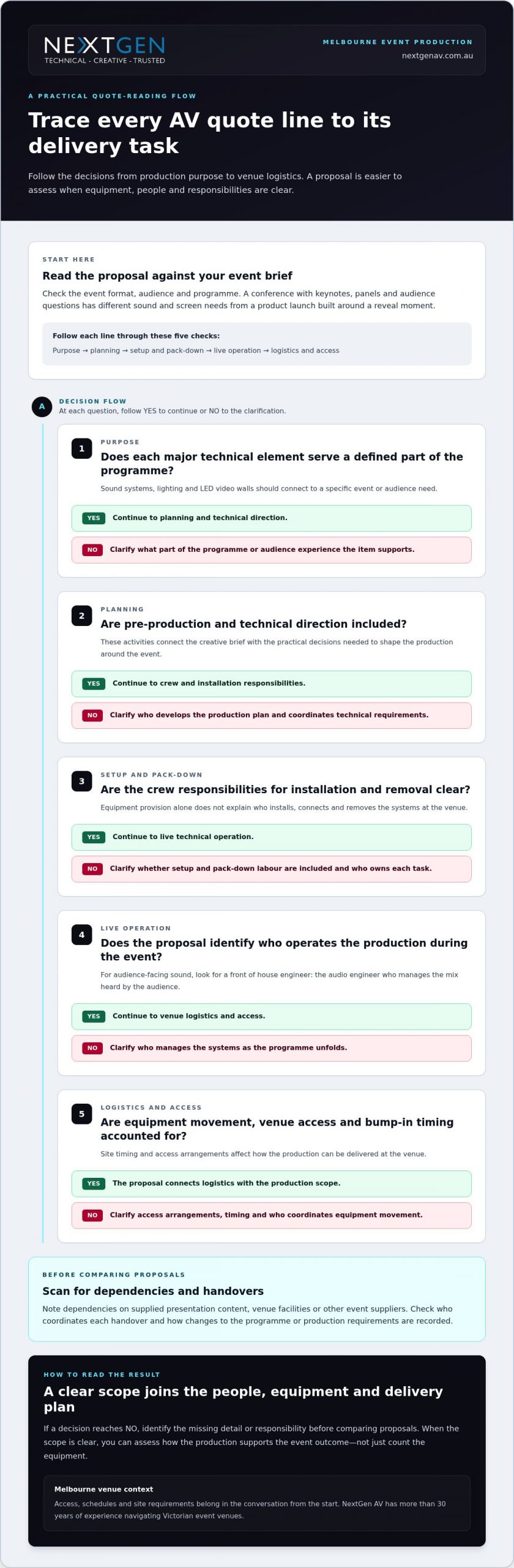
Line items are easier to assess when you group them by the work they represent: equipment, crew, planning, operation and logistics. Equipment describes the technical tools; labour and responsibilities explain how those tools are prepared, installed, operated and packed down. To understand how to read an av quote in practical terms, trace each item to the task it supports and the person or team responsible.
| Line item | What it means | Scope question it answers |
|---|---|---|
| Sound systems, screens, lighting or staging | Technical elements that support audience audibility, presentation visibility, atmosphere or the event environment. | What part of the programme or audience experience does each element serve? |
| Pre-production and technical direction | Planning and coordination that shape how technical elements work together. | Who develops the production plan and coordinates requirements? |
| Setup and pack-down crew | Labour to install, connect and remove equipment at the venue. | Are installation and pack-down responsibilities included? |
| Live technical operation | On-site expertise to manage systems during the programme. | Who operates the production as the event unfolds? |
| Logistics and access | Coordination of equipment movement and venue timing. | Are access arrangements and bump-in timing accounted for? |
Separate equipment from labour
A screen in the scope doesn’t, by itself, explain its installation, content feed or live operation. Sound systems support clear speech, while lighting and staging help shape the room and focus attention. A front of house engineer is a distinct role from the equipment: they manage the sound mix heard by the audience. Clear labour roles connect technical provision with a well-run programme. AVIXA’s audiovisual industry standards provide context for the professional standards that can inform system design.
Check assumptions and dependencies
Read for venue access, bump-in timing and pack-down arrangements, as these affect how the production can be delivered on site. Note dependencies on supplied presentation content, venue facilities or other event suppliers, and identify who coordinates each handover. The scope should also explain how changes to the programme or production requirements are recorded, so responsibilities remain clear as plans develop.
This framework helps you see whether the proposal connects equipment, people and logistics into a managed production. For a broader view of how planning and technical delivery work together, explore NextGen AV’s AV production guide.
Compare AV Quotes Fairly by Scope, Not by Equipment Count
A longer equipment list doesn’t automatically mean a stronger production. The real test is whether each proposal can deliver the same event outcomes, with suitable technical choices and clear responsibility for delivery. Proposals are comparable only when they define equivalent deliverables, crew, planning and responsibilities against the same event brief.
Start with one shared brief that records the event format, venue, audience, programme and intended experience. Assess each proposal against the same requirements. A conference with keynote presentations and panel discussions, for example, needs a technical plan that supports clear speech, visible content and smooth speaker transitions, not simply a larger quantity of equipment. Considering AV alongside event objectives is part of strategic event planning.
Build a like-for-like comparison
Create a comparison sheet and mark each requirement as included, excluded or dependent on another party. Record the assumptions beside each item. If one proposal relies on venue-provided facilities while another includes them in its scope, they aren’t equivalent until that difference is clear.
- Deliverables: What technical outcomes and systems are covered?
- Crew: Which roles are assigned to the production?
- Planning: What pre-event coordination and technical direction are described?
- Operation: Who manages the systems during the programme?
- Logistics: Are delivery, access, setup and pack-down responsibilities defined?
- Exclusions: What is outside the scope, or depends on the venue or another supplier?
This structure makes gaps visible and prevents different assumptions from being treated as matching deliverables. It also gives you a practical record of what each proposal commits to support.
Assess technical fit and accountability
Consider suitability, not just quantity. Do the audio, visual, lighting and staging choices fit the venue and programme? Will they support the audience throughout the event, including transitions between presentations, panels or other segments? A system’s value lies in how effectively it serves its role, not in how many line items describe it.
Look for clear coordination of technical decisions and live delivery. The proposal should show how planning connects the elements, who manages the production on the day, and how the team accounts for timing changes or contingencies. If a quote describes equipment but leaves operation or transitions undefined, record that as a difference in scope. Comparing on this basis helps you select a coordinated production solution, not simply the longest list.
Check Melbourne Venue Logistics, Safety and Production Readiness
A production plan has to work in the venue, not just on paper. When learning how to read an av quote, check that the scope accounts for site access, timing, safety planning and the people coordinating delivery. This is especially relevant for Melbourne CBD events, where venue arrangements and access windows can shape how equipment and crew reach the event space.
Review site logistics and timing
Trace the schedule from arrival through pack-down. The proposal should make clear how its production plan accounts for:
- Access: How the AV team coordinates entry and equipment movement with the venue and organiser.
- Bump-in: When setup can take place, and how that timing fits the event schedule and venue requirements.
- Live operation: Who manages technical delivery during the programme.
- Pack-down: How equipment removal is planned within the agreed site schedule.
Check that the quote reflects known venue requirements and the event running order. Identify coordination points between the AV team, venue and organiser, including who shares schedule updates and site information. With more than 30 years of experience navigating Victorian event venues, NextGen AV understands how early coordination helps align production plans with venue conditions.
Look for safety planning and technical oversight
Safety responsibilities should be visible in the production scope. Look for relevant Job Safety Analysis and Test and Tag arrangements, along with clear ownership of the associated planning and checks. Where staging or event rigging is part of the production, the proposal should identify qualified personnel and applicable structural documentation.
A structural engineering certificate provides documented evidence that a structure has been independently assessed for compliance and safety. Where relevant to the proposed structure, it clarifies the engineering documentation included in the production plan. These details connect the technical design with safe, considered delivery rather than leaving important responsibilities implicit.
Before approval, align the venue schedule, access arrangements, site requirements and named production responsibilities. This gives the venue and event teams a shared picture of how the technical plan will be delivered, from setup to pack-down.
For ideas on coordinating staging and lighting as part of a complete event environment, explore our stage and lighting production guide.
Turn the AV Quote into a Confident Production Decision
Once you’ve compared the proposals, make your decision through a clear sequence: align the scope with your event outcomes, resolve assumptions, assign responsibilities and confirm the final brief. This turns quote review into a practical production plan, with everyone working towards the same result.
Prepare a clear AV production brief
Bring the essential details into one place so technical planning starts with the right context. Include:
- Event format and audience: Describe the type of event and who will be attending.
- Programme: Outline key sessions, transitions and important moments.
- Venue and schedule: Share the location, known site requirements and timing details.
- Intended experience: Explain what you want guests to see, hear and feel.
- Deliverables and open decisions: Separate confirmed requirements from elements still being developed.
A clear brief helps connect technical choices to the event experience. It also makes it easier to resolve remaining assumptions before the scope is agreed.
Move from proposal to managed delivery
With the brief aligned, confirm who owns each part of the agreed scope, from pre-production planning and technical direction through on-site management and pack-down. NextGen AV coordinates these stages so equipment, crew and production decisions work together, supporting precise delivery for the audience rather than leaving separate tasks disconnected.
Melbourne venue experience can bring added confidence to local planning, where site requirements and schedules need careful coordination. NextGen AV also delivers events throughout Australia, bringing a consistent production approach to events across the country.
To make the decision, confirm the scope, document resolved assumptions, assign responsibilities and approve the event brief. You’ll then have a shared plan to guide delivery from preparation through pack-down.
Make Your Next Production Decision with Confidence
The clearest way to read an AV quote is to look past the equipment count and assess the full production picture: whether the scope supports your event brief, responsibilities are assigned, and venue logistics and safety planning are accounted for. Knowing how to read an av quote helps you compare proposals on equivalent deliverables and choose a partner focused on both the audience experience and technical execution.
NextGen AV brings more than 30 years of experience navigating Victorian event venues, with a Melbourne-based team delivering events throughout Australia. Production planning can include Job Safety Analysis, Test and Tag and qualified riggers, connecting technical decisions with considered delivery from setup through pack-down.
Your event deserves a production plan built around its purpose, not a generic equipment list. Plan your event production with NextGen AV to move forward with a team ready to manage the technical detail behind a seamless experience.
Frequently Asked Questions
What should an AV quote include?
An AV quote should set out the production scope, deliverables, responsibilities and event requirements, not just list equipment. Look for the technical systems, planning, crew, setup, live operation, logistics and pack-down relevant to your event. Each major item should support a clear programme need, such as clear speech, visible presentations or a planned lighting atmosphere. This makes it easier to understand what the proposal will deliver and how the work will be managed.
How do I compare two AV quotes fairly?
Compare both proposals against the same event brief and required outcomes. Use consistent categories such as deliverables, crew, planning, operation, logistics and exclusions, then mark each as included, excluded or dependent on another party. Consider whether the technical choices suit the venue and programme, and who coordinates decisions and live delivery. A longer equipment list doesn’t necessarily mean a stronger production if responsibilities or audience needs are left unclear.
Why does an AV quote list labour separately from equipment?
Equipment and labour describe different parts of production. Systems such as sound, screens, lighting and staging provide technical capability, while crew plan, install, operate and pack down those systems. Live operation also requires relevant technical expertise. For example, a front of house engineer manages the sound mix heard by the audience. Clear labour details show how equipment will become a coordinated event experience, rather than simply being supplied to the venue.
What does an AV quote exclusion mean?
An exclusion identifies work, equipment or responsibility that sits outside the proposal’s stated scope. It may also show that part of the delivery depends on the venue, organiser or another supplier. Read exclusions alongside included items to spot gaps and dependencies. For example, if a proposal relies on venue facilities or supplied presentation content, establish how that handover fits the production plan before approving the scope.
Should an AV quote cover event safety documentation?
The quote should make relevant safety planning and documentation responsibilities clear for the proposed production. Depending on the work, this may include Job Safety Analysis, Test and Tag arrangements, qualified riggers and applicable structural documentation. Where a structure requires it, a structural engineering certificate records that it has been independently assessed for compliance and safety. Clear documentation and ownership help connect technical planning with considered event delivery.
What details should I provide for an AV quote in Melbourne?
Provide the event format, audience, programme, venue, schedule and intended audience experience. Include known venue requirements, access arrangements, bump-in and pack-down timing, and details of other suppliers or content handovers that affect production. For Melbourne events, local venue coordination and CBD access can shape site planning, so sharing those details early gives the technical team useful context for developing a suitable scope.
Can an AV quote include technical direction and on-site management?
Yes. An AV production proposal can include pre-production planning, technical direction, on-site management and post-event pack-down alongside equipment and crew. NextGen AV coordinates these elements to connect the agreed scope with live delivery. With more than 30 years of experience navigating Victorian event venues, a Melbourne-based team and events delivered throughout Australia, NextGen AV supports a coordinated production from planning through pack-down.
Ready to turn your event brief into a coordinated production plan? Discuss your event with NextGen AV.
What if an AV quote looks complete but leaves key event responsibilities unclear? Learning how to read an AV quote means looking beyond the equipment list to understand what happens before, during and after your event. A screen or sound system is only part of the picture. Planning, technical direction, crew, safe installation and pack-down all shape the result.
Comparing proposals can be difficult when each describes a different scope or uses technical line items without explaining their purpose. To compare them fairly, identify what’s included, who owns each task and how the production supports your event goals.
This guide explains how to assess AV proposals in plain language, compare equivalent deliverables and responsibilities, and spot details that can reduce event-day risk. We’ll cover production scope, technical roles, safety planning and the link between equipment choices and audience experience. With more than 30 years of experience navigating Victorian event venues, NextGen AV understands why access, timing and site requirements belong in the conversation from the start. The result is a clearer basis for choosing a production partner and a smoother path from planning to a polished event.
Key Takeaways
- Learn how to read an av quote by focusing on the production outcome, deliverables and responsibilities behind each line item.
- Separate equipment provision from the planning, crew and operation needed to bring the production together.
- Compare proposals against the same event brief, weighing suitability and audience coverage rather than equipment counts alone.
- Factor Melbourne venue access, schedules and site requirements into your assessment of production readiness.
- Use a clear approval sequence to align scope, resolve assumptions and establish who manages each stage of delivery.
How to Read an AV Quote: Start with the Event Outcome
An AV quote should describe the production solution your event needs, not just name the gear being supplied. An AV quote is a scoped proposal that sets out the technical deliverables, event requirements and responsibilities needed to deliver the planned experience. Start by checking whether it explains how the production supports your event, from the first presentation to the final pack-down.
Begin with the event format, audience and programme. A conference with keynote presentations, panel discussions and audience questions has different audio and screen needs from a product launch built around a reveal moment. The proposal should connect each major element, such as sound systems, lighting or LED video walls, to a specific purpose. For a useful overview of how staging, sound, lighting and video fit together, see this guide to live event support.
Match the scope to the event brief
Compare the proposal with your event brief. Does it reflect the format, running order and experience you want the audience to have? For a conference, microphones and screens should support clear presentations and smooth speaker transitions. For a launch, lighting and visuals may focus attention on a key moment. Each major technical choice should serve a defined part of the programme.
Check for pre-production planning and technical direction as well. These activities connect the creative brief with the practical decisions required for delivery, shaping the production around your event rather than assembling a generic equipment list.
Read beyond the equipment list
Equipment names alone don’t explain who plans the setup, installs and operates the systems, or packs them down. Look for responsibilities across each stage, including who coordinates technical requirements before the event and who manages live delivery. Clear ownership helps prevent gaps between a list of supplied equipment and a working production.
For audience-facing sound, check that the proposal identifies a front of house engineer. This audio engineer manages the mix heard by the audience, balancing speech and other programme audio so presenters can be heard clearly in the room. The role belongs in the production plan, not simply as another item beside the sound systems.
When planning and technical direction sit alongside equipment, crew and delivery responsibilities, the quote gives you a clearer picture of the complete production. You can then assess whether the proposal is built to support the event outcome you’ve briefed.
Decode AV Quote Line Items, Labour and Responsibilities
Line items are easier to assess when you group them by the work they represent: equipment, crew, planning, operation and logistics. Equipment describes the technical tools; labour and responsibilities explain how those tools are prepared, installed, operated and packed down. To understand how to read an av quote in practical terms, trace each item to the task it supports and the person or team responsible.
| Line item | What it means | Scope question it answers |
|---|---|---|
| Sound systems, screens, lighting or staging | Technical elements that support audience audibility, presentation visibility, atmosphere or the event environment. | What part of the programme or audience experience does each element serve? |
| Pre-production and technical direction | Planning and coordination that shape how technical elements work together. | Who develops the production plan and coordinates requirements? |
| Setup and pack-down crew | Labour to install, connect and remove equipment at the venue. | Are installation and pack-down responsibilities included? |
| Live technical operation | On-site expertise to manage systems during the programme. | Who operates the production as the event unfolds? |
| Logistics and access | Coordination of equipment movement and venue timing. | Are access arrangements and bump-in timing accounted for? |
Separate equipment from labour
A screen in the scope doesn’t, by itself, explain its installation, content feed or live operation. Sound systems support clear speech, while lighting and staging help shape the room and focus attention. A front of house engineer is a distinct role from the equipment: they manage the sound mix heard by the audience. Clear labour roles connect technical provision with a well-run programme. AVIXA’s audiovisual industry standards provide context for the professional standards that can inform system design.
Check assumptions and dependencies
Read for venue access, bump-in timing and pack-down arrangements, as these affect how the production can be delivered on site. Note dependencies on supplied presentation content, venue facilities or other event suppliers, and identify who coordinates each handover. The scope should also explain how changes to the programme or production requirements are recorded, so responsibilities remain clear as plans develop.
This framework helps you see whether the proposal connects equipment, people and logistics into a managed production. For a broader view of how planning and technical delivery work together, explore NextGen AV’s AV production guide.
Compare AV Quotes Fairly by Scope, Not by Equipment Count
A longer equipment list doesn’t automatically mean a stronger production. The real test is whether each proposal can deliver the same event outcomes, with suitable technical choices and clear responsibility for delivery. Proposals are comparable only when they define equivalent deliverables, crew, planning and responsibilities against the same event brief.
Start with one shared brief that records the event format, venue, audience, programme and intended experience. Assess each proposal against the same requirements. A conference with keynote presentations and panel discussions, for example, needs a technical plan that supports clear speech, visible content and smooth speaker transitions, not simply a larger quantity of equipment. Considering AV alongside event objectives is part of strategic event planning.
Build a like-for-like comparison
Create a comparison sheet and mark each requirement as included, excluded or dependent on another party. Record the assumptions beside each item. If one proposal relies on venue-provided facilities while another includes them in its scope, they aren’t equivalent until that difference is clear.
- Deliverables: What technical outcomes and systems are covered?
- Crew: Which roles are assigned to the production?
- Planning: What pre-event coordination and technical direction are described?
- Operation: Who manages the systems during the programme?
- Logistics: Are delivery, access, setup and pack-down responsibilities defined?
- Exclusions: What is outside the scope, or depends on the venue or another supplier?
This structure makes gaps visible and prevents different assumptions from being treated as matching deliverables. It also gives you a practical record of what each proposal commits to support.
Assess technical fit and accountability
Consider suitability, not just quantity. Do the audio, visual, lighting and staging choices fit the venue and programme? Will they support the audience throughout the event, including transitions between presentations, panels or other segments? A system’s value lies in how effectively it serves its role, not in how many line items describe it.
Look for clear coordination of technical decisions and live delivery. The proposal should show how planning connects the elements, who manages the production on the day, and how the team accounts for timing changes or contingencies. If a quote describes equipment but leaves operation or transitions undefined, record that as a difference in scope. Comparing on this basis helps you select a coordinated production solution, not simply the longest list.

Check Melbourne Venue Logistics, Safety and Production Readiness
A production plan has to work in the venue, not just on paper. When learning how to read an av quote, check that the scope accounts for site access, timing, safety planning and the people coordinating delivery. This is especially relevant for Melbourne CBD events, where venue arrangements and access windows can shape how equipment and crew reach the event space.
Review site logistics and timing
Trace the schedule from arrival through pack-down. The proposal should make clear how its production plan accounts for:
- Access: How the AV team coordinates entry and equipment movement with the venue and organiser.
- Bump-in: When setup can take place, and how that timing fits the event schedule and venue requirements.
- Live operation: Who manages technical delivery during the programme.
- Pack-down: How equipment removal is planned within the agreed site schedule.
Check that the quote reflects known venue requirements and the event running order. Identify coordination points between the AV team, venue and organiser, including who shares schedule updates and site information. With more than 30 years of experience navigating Victorian event venues, NextGen AV understands how early coordination helps align production plans with venue conditions.
Look for safety planning and technical oversight
Safety responsibilities should be visible in the production scope. Look for relevant Job Safety Analysis and Test and Tag arrangements, along with clear ownership of the associated planning and checks. Where staging or event rigging is part of the production, the proposal should identify qualified personnel and applicable structural documentation.
A structural engineering certificate provides documented evidence that a structure has been independently assessed for compliance and safety. Where relevant to the proposed structure, it clarifies the engineering documentation included in the production plan. These details connect the technical design with safe, considered delivery rather than leaving important responsibilities implicit.
Before approval, align the venue schedule, access arrangements, site requirements and named production responsibilities. This gives the venue and event teams a shared picture of how the technical plan will be delivered, from setup to pack-down.
For ideas on coordinating staging and lighting as part of a complete event environment, explore our stage and lighting production guide.
Turn the AV Quote into a Confident Production Decision
Once you’ve compared the proposals, make your decision through a clear sequence: align the scope with your event outcomes, resolve assumptions, assign responsibilities and confirm the final brief. This turns quote review into a practical production plan, with everyone working towards the same result.
Prepare a clear AV production brief
Bring the essential details into one place so technical planning starts with the right context. Include:
- Event format and audience: Describe the type of event and who will be attending.
- Programme: Outline key sessions, transitions and important moments.
- Venue and schedule: Share the location, known site requirements and timing details.
- Intended experience: Explain what you want guests to see, hear and feel.
- Deliverables and open decisions: Separate confirmed requirements from elements still being developed.
A clear brief helps connect technical choices to the event experience. It also makes it easier to resolve remaining assumptions before the scope is agreed.
Move from proposal to managed delivery
With the brief aligned, confirm who owns each part of the agreed scope, from pre-production planning and technical direction through on-site management and pack-down. NextGen AV coordinates these stages so equipment, crew and production decisions work together, supporting precise delivery for the audience rather than leaving separate tasks disconnected.
Melbourne venue experience can bring added confidence to local planning, where site requirements and schedules need careful coordination. NextGen AV also delivers events throughout Australia, bringing a consistent production approach to events across the country.
To make the decision, confirm the scope, document resolved assumptions, assign responsibilities and approve the event brief. You’ll then have a shared plan to guide delivery from preparation through pack-down.
Make Your Next Production Decision with Confidence
The clearest way to read an AV quote is to look past the equipment count and assess the full production picture: whether the scope supports your event brief, responsibilities are assigned, and venue logistics and safety planning are accounted for. Knowing how to read an av quote helps you compare proposals on equivalent deliverables and choose a partner focused on both the audience experience and technical execution.
NextGen AV brings more than 30 years of experience navigating Victorian event venues, with a Melbourne-based team delivering events throughout Australia. Production planning can include Job Safety Analysis, Test and Tag and qualified riggers, connecting technical decisions with considered delivery from setup through pack-down.
Your event deserves a production plan built around its purpose, not a generic equipment list. Plan your event production with NextGen AV to move forward with a team ready to manage the technical detail behind a seamless experience.
Frequently Asked Questions
What should an AV quote include?
An AV quote should set out the production scope, deliverables, responsibilities and event requirements, not just list equipment. Look for the technical systems, planning, crew, setup, live operation, logistics and pack-down relevant to your event. Each major item should support a clear programme need, such as clear speech, visible presentations or a planned lighting atmosphere. This makes it easier to understand what the proposal will deliver and how the work will be managed.
How do I compare two AV quotes fairly?
Compare both proposals against the same event brief and required outcomes. Use consistent categories such as deliverables, crew, planning, operation, logistics and exclusions, then mark each as included, excluded or dependent on another party. Consider whether the technical choices suit the venue and programme, and who coordinates decisions and live delivery. A longer equipment list doesn’t necessarily mean a stronger production if responsibilities or audience needs are left unclear.
Why does an AV quote list labour separately from equipment?
Equipment and labour describe different parts of production. Systems such as sound, screens, lighting and staging provide technical capability, while crew plan, install, operate and pack down those systems. Live operation also requires relevant technical expertise. For example, a front of house engineer manages the sound mix heard by the audience. Clear labour details show how equipment will become a coordinated event experience, rather than simply being supplied to the venue.
What does an AV quote exclusion mean?
An exclusion identifies work, equipment or responsibility that sits outside the proposal’s stated scope. It may also show that part of the delivery depends on the venue, organiser or another supplier. Read exclusions alongside included items to spot gaps and dependencies. For example, if a proposal relies on venue facilities or supplied presentation content, establish how that handover fits the production plan before approving the scope.
Should an AV quote cover event safety documentation?
The quote should make relevant safety planning and documentation responsibilities clear for the proposed production. Depending on the work, this may include Job Safety Analysis, Test and Tag arrangements, qualified riggers and applicable structural documentation. Where a structure requires it, a structural engineering certificate records that it has been independently assessed for compliance and safety. Clear documentation and ownership help connect technical planning with considered event delivery.
What details should I provide for an AV quote in Melbourne?
Provide the event format, audience, programme, venue, schedule and intended audience experience. Include known venue requirements, access arrangements, bump-in and pack-down timing, and details of other suppliers or content handovers that affect production. For Melbourne events, local venue coordination and CBD access can shape site planning, so sharing those details early gives the technical team useful context for developing a suitable scope.
Can an AV quote include technical direction and on-site management?
Yes. An AV production proposal can include pre-production planning, technical direction, on-site management and post-event pack-down alongside equipment and crew. NextGen AV coordinates these elements to connect the agreed scope with live delivery. With more than 30 years of experience navigating Victorian event venues, a Melbourne-based team and events delivered throughout Australia, NextGen AV supports a coordinated production from planning through pack-down.
Ready to turn your event brief into a coordinated production plan? Discuss your event with NextGen AV.
Discover Valuable Insights
Unlock Expert Tips and Advice
Our blog is packed with valuable information to help you stay ahead. Whether you’re looking for expert advice, industry trends, or practical tips, you’ll find everything you need. Reach out today to learn more or get in touch with us for personalised support!