
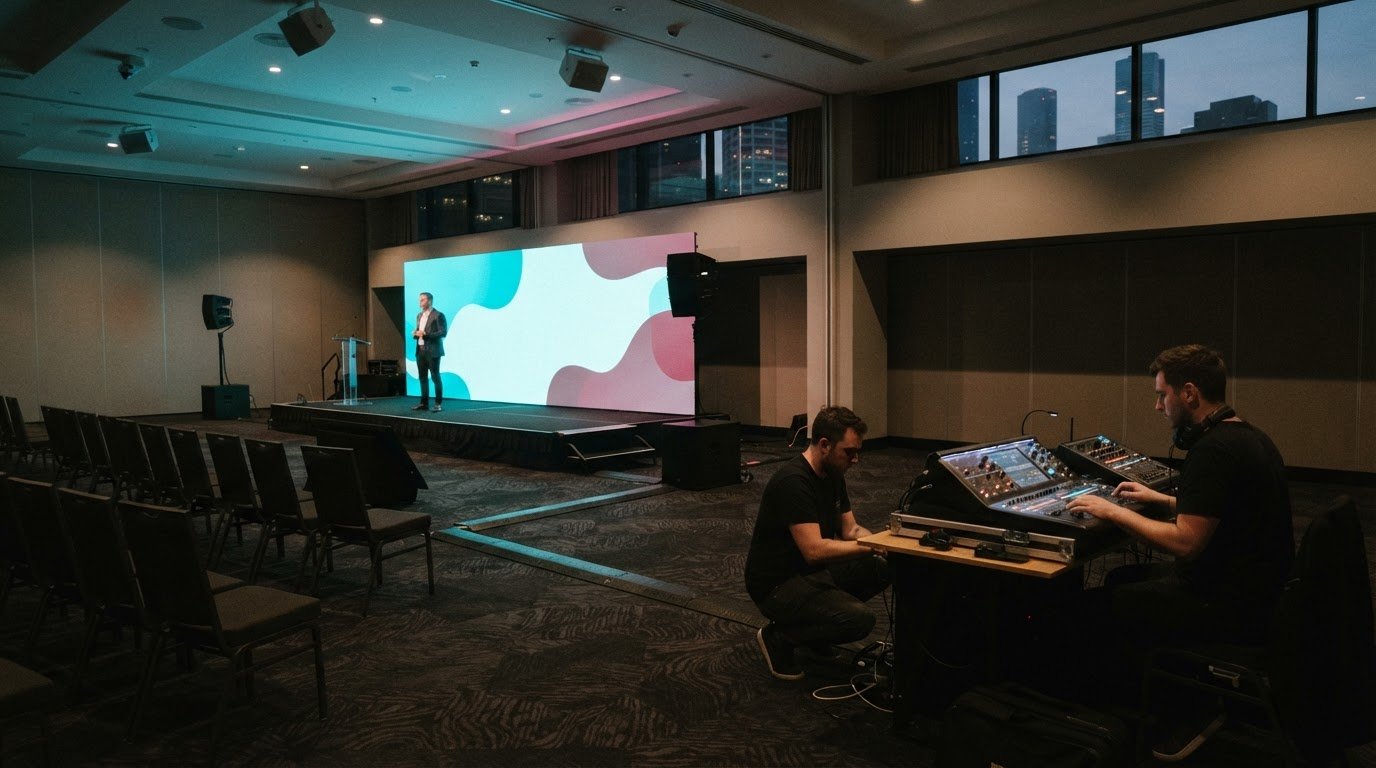
You’re not automatically locked into a hotel’s in-house AV team. Alternatives to using in-house AV include hiring an independent production partner for the whole event or selected technical needs, subject to the conditions in your venue agreement.
In-house AV can suit a straightforward presentation when the room’s existing equipment meets your needs. For a more involved programme, tailored production support can help turn the technical setup into a cohesive audience experience.
This guide explains when a Melbourne hotel may require or restrict external AV, what to review in your venue agreement and how to compare support, equipment and event production. It also covers how audio, lighting, LED screens, staging and technical direction can help coordinate a complex event, leaving you free to focus on your audience.
Key Takeaways
- Review the signed venue agreement to understand any conditions on using external AV, including whether restrictions apply to the full production or particular systems.
- Compare in-house and independent support by how well each can tailor the technical plan to your event format and audience experience.
- Plan technician coverage around the event’s demands so presentation changes, troubleshooting and live cues have clear technical ownership.
- Assess external AV support as a coordinated production service, with equipment, setup and venue requirements aligned before event day.
Do I need in-house audio visual for hotel events?
No. Melbourne hotels don’t automatically require you to use their in-house AV team. Alternatives to using in-house AV include engaging an independent production company, subject to the venue agreement.
Outside production for complex events
An external production partner can manage the full event or specific technical needs, particularly when the programme includes multiple rooms, complex staging or outdoor elements. A conference with plenary sessions and breakouts, for example, may need coordinated audio, lighting and visual presentation beyond the installed setup. Before setting the production scope, compare the venue’s systems with your room layouts, content and audience requirements.
Installed equipment may suit a straightforward presentation. For a more involved programme, external production can tailor the technical setup to the event instead of making the event fit fixed systems.
Choosing suppliers and agreeing contract terms
Choose an Australian AV supplier by matching its event production experience and proposed support to your programme. Alternatives to using in-house AV are most useful when an independent team can meet specific production needs. Review the supplier’s scope alongside the hotel agreement, including equipment, crew responsibilities, setup and pack-down, support and cancellation terms.
Clear terms establish who operates each system, manages schedule changes and responds to issues. This helps prevent gaps between the hotel and supplier during event delivery.
Managing outsourcing risks and transition
Outsourcing can create unclear responsibilities or missed venue requirements. Reduce these risks by sharing the run sheet, room plans and technical needs early, then agreeing who coordinates access, setup, show cues and issue escalation. A named production lead can connect the venue team with external technicians and keep decisions moving during delivery.
To transition from in-house AV, document the event requirements, identify what the venue system can support, then assign the remaining needs to the external team. Confirm each party’s responsibilities in writing. For recurring events, a consistent crew can become familiar with the programme and venue, helping make handovers between sessions smoother.
Differences between in-house and independent AV
A hotel’s in-house team works with the venue’s installed systems and established room setup. That familiarity can suit a straightforward presentation when the equipment matches the programme. Independent production offers another approach: the technical plan can be shaped around the event, rather than limited to what is already installed.
Compare the full scope, not just the equipment list. Venue teams commonly provide standard AV equipment and technician support. Independent suppliers can bring in equipment and manage setup and pack-down, which requires transport and coordination. Their ability to tailor equipment and staging may suit a conference with changing content, multiple spaces or a distinctive visual direction.
Support arrangements also vary. A venue’s in-house technician may be helping with other events in the building, so the person responding to an issue might not be dedicated to your room. Ask how support is allocated across the schedule, who manages technical cues and how issues are escalated. You can engage an independent provider for the whole event or a specific task, such as presentation management or breakout-room support.
Venue crews may rotate between events, so the technician who supported a previous conference might not return. An independent production team working with you across recurring events can become familiar with the programme and technical preferences. For events at different venues, that continuity can help maintain a consistent production approach while adapting each setup to the room.
For a hybrid presentation, compare how each team will coordinate the in-room experience with the virtual component. The right choice depends on the venue’s systems, event complexity, support coverage and desired audience experience. A clear scope makes the trade-offs easier to assess; event production planning can help bring those technical requirements into focus.
Technician staffing and expertise
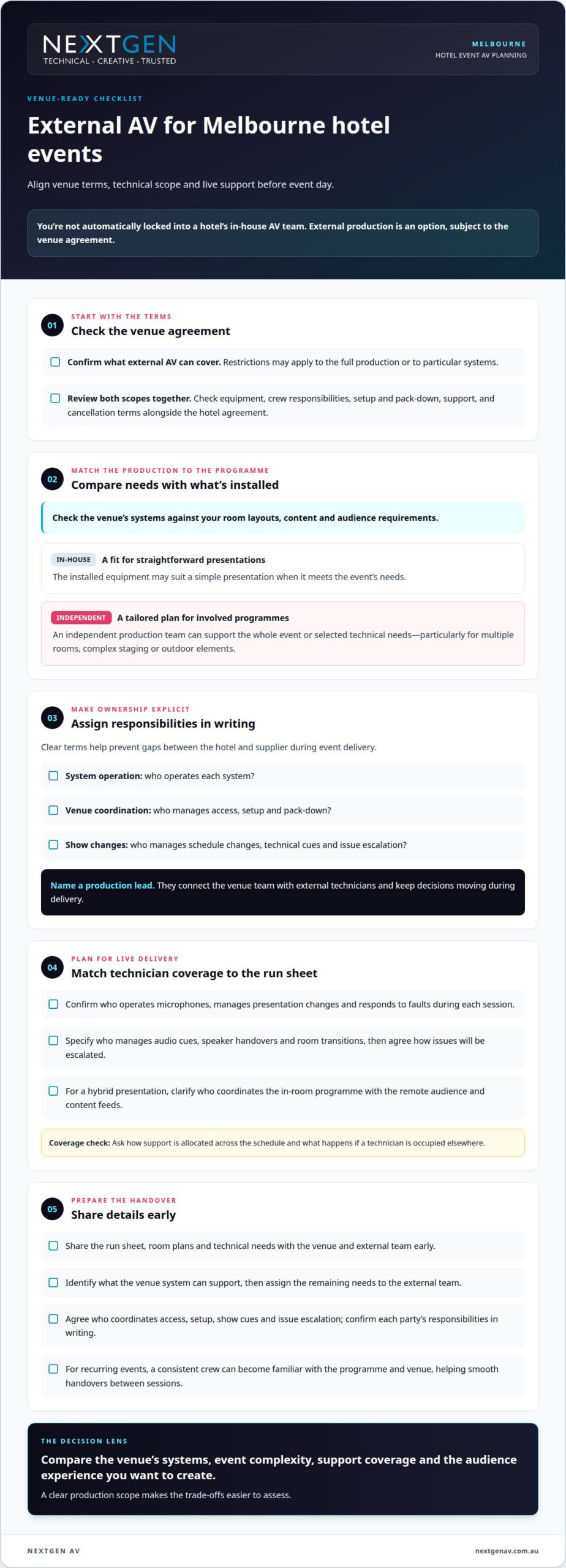
Staffing determines when technical help is available to your audience. A hotel technician may cover several rooms, while an external supplier can be hired for defined event duties. For a Melbourne conference, clarify who operates microphones, manages presentation changes and responds to faults during each session. A named technical lead gives your event team one point of contact from rehearsal through the final cue.
Match crew responsibilities to the run sheet, not just the equipment list. A plenary followed by concurrent sessions creates different demands from a single-speaker breakfast. Specify who manages audio cues, speaker handovers and room transitions, then agree how issues will be escalated. This clarifies the division of work between the in-house AV team, venue staff and external crew before guests arrive.
Ask how support works during live sessions. If a technician is occupied elsewhere, a microphone fault or presentation issue may take longer to resolve. Confirm assigned roles, support coverage and the process for urgent schedule changes. For a hybrid presentation, technical direction should also clarify who coordinates the in-room programme with the remote audience and content feeds.
Expertise also means adapting the setup to the room and run sheet. The supplier’s team should understand the venue systems, access requirements and production sequence, then coordinate with venue staff. Consistent technicians across repeat events can become familiar with speaker preferences and session formats. That continuity supports flexibility while keeping cues and responsibilities clear. Choose the hiring model that matches technician coverage to the programme’s actual technical demands.
Equipment and technical support from external AV providers
Australian businesses can rent event sound systems, microphones, LED screens, lighting and staging instead of buying them. An external AV company can also coordinate technical support and setup, matching equipment to the venue, programme and audience. Compare not only what arrives onsite, but how each item supports clear speech, visible content and a cohesive event design.
Start with the run sheet and room plan. A Melbourne presentation with a speaker, slides and audience questions needs different support from a multi-room conference with changing content. Identify what the venue supplies, then map any gaps in audio, visual presentation, lighting or staging. This keeps the hire scope relevant and gives the production team a clear technical brief.
Equipment alone doesn’t resolve every production challenge. Setup, pack-down, venue access, power and rigging all affect how a system can be installed and operated. The venue contract may also set requirements for external suppliers. Align the AV company’s scope with those conditions so equipment and technical responsibilities are clear before load-in.
Define support as carefully as equipment. Specify who operates the system, manages presentation cues and responds to faults during a live session. A microphone issue during a keynote, for example, needs a clear response plan, not an assumption that someone nearby will step in. When included in the agreed scope, a dedicated technician gives clear ownership of that responsibility.
For a complex event, technical direction can connect room layouts, equipment placement and show cues into one coordinated plan. This is especially useful when lighting, staging and screen content need to work together. Plan your event’s technical requirements around the audience experience, venue conditions and programme, rather than treating each hire item as a separate decision.
NextGen AV
NextGen AV helps Melbourne event organisers assess whether a hotel’s in-house AV suits the brief and plan external production when it doesn’t. Its team can coordinate LED Video Walls, Professional Audio Systems, Lighting Design and Equipment, and Staging and Rigging within one production plan, aligning the setup with the room, run sheet and audience experience.
This support is useful when the venue’s systems don’t meet the event’s audio, visual or staging needs, or when several technical elements require coordination. Early production planning clarifies how external crew and venue teams will work together, aligns the requirements with venue conditions and defines responsibilities from setup through show operation.
Planning a Melbourne hotel event? Contact NextGen AV to discuss your production requirements.
Shape the production around your event
Your AV decision shapes more than the room setup. It affects how speakers connect with the audience, how your brand appears on screen and how smoothly the programme moves from one moment to the next. Consider alternatives to using in-house AV while the event brief is taking shape, so the production plan supports your intended experience rather than constraining it.
NextGen AV coordinates LED Video Walls, Professional Audio Systems and Lighting Design and Equipment in an event plan tailored to the venue, content and audience. This lets you focus on leading the event while the technical production is managed.
Share your event vision and production requirements with Contact NextGen AV about your event. A clear conversation is the first step towards a considered plan and a polished experience for your guests.
Frequently Asked Questions
How do I compare an outside AV company with in-house support?
Compare the scope of support each proposal includes. Check equipment, delivery, setup, technicians, operation and pack-down, then account for venue requirements for external suppliers. An in-house proposal may cover installed room equipment, while an external proposal may include additional production elements. Compare equivalent scopes, including event support, and confirm that each approach meets the venue’s requirements.
What’s the alternative to a venue’s in-house AV?
You can engage an independent event production company for the full technical production or a defined part of it. That might mean support for a presentation, hybrid component or particular event space, while suitable venue systems are used elsewhere. Set out which team will deliver each element, based on your programme and the venue agreement.
Do I have to replace in-house entirely?
No. A mixed arrangement can work when the venue’s installed systems suit some parts of the programme but other elements need separate production support. You might retain the room’s standard audio, for example, and bring in external production for a hybrid segment. Define which team supplies, operates and supports each part so handovers are clear and responsibilities don’t overlap.
Do you work alongside venue teams or replace them?
NextGen AV coordinates with a venue’s internal technical team, in-house AV supplier, rigging providers and other contractors. This allows the production plan to account for venue systems and operational requirements while assigning clear responsibilities to each party. For a Melbourne hotel event, coordination can cover technical access, setup sequencing and show operation, helping everyone work to the same plan.
Planning an Event and Weighing Up Your Options?
Start with the outcome you want, then match the technical plan to the programme, venue and audience. A leadership presentation, for example, may need different support from a conference with remote presenters and multiple sessions. Put the event date, venue, audience needs and format into a concise brief. This gives your production partner a practical basis for recommending an approach.
Should You Hire Independent AV?
Consider independent AV when your event needs technical direction or production elements beyond the venue’s standard setup. It can also suit organisers seeking support across different venues or formats. For a simple event that the hotel’s existing system can serve well, in-house support may be a sensible fit. Base your decision on the event requirements, venue terms and level of technical coordination needed.
You’re not automatically locked into a hotel’s in-house AV team. Alternatives to using in-house AV include hiring an independent production partner for the whole event or selected technical needs, subject to the conditions in your venue agreement.
In-house AV can suit a straightforward presentation when the room’s existing equipment meets your needs. For a more involved programme, tailored production support can help turn the technical setup into a cohesive audience experience.
This guide explains when a Melbourne hotel may require or restrict external AV, what to review in your venue agreement and how to compare support, equipment and event production. It also covers how audio, lighting, LED screens, staging and technical direction can help coordinate a complex event, leaving you free to focus on your audience.
Key Takeaways
- Review the signed venue agreement to understand any conditions on using external AV, including whether restrictions apply to the full production or particular systems.
- Compare in-house and independent support by how well each can tailor the technical plan to your event format and audience experience.
- Plan technician coverage around the event’s demands so presentation changes, troubleshooting and live cues have clear technical ownership.
- Assess external AV support as a coordinated production service, with equipment, setup and venue requirements aligned before event day.
Do I need in-house audio visual for hotel events?
No. Melbourne hotels don’t automatically require you to use their in-house AV team. Alternatives to using in-house AV include engaging an independent production company, subject to the venue agreement.
Outside production for complex events
An external production partner can manage the full event or specific technical needs, particularly when the programme includes multiple rooms, complex staging or outdoor elements. A conference with plenary sessions and breakouts, for example, may need coordinated audio, lighting and visual presentation beyond the installed setup. Before setting the production scope, compare the venue’s systems with your room layouts, content and audience requirements.
Installed equipment may suit a straightforward presentation. For a more involved programme, external production can tailor the technical setup to the event instead of making the event fit fixed systems.
Choosing suppliers and agreeing contract terms
Choose an Australian AV supplier by matching its event production experience and proposed support to your programme. Alternatives to using in-house AV are most useful when an independent team can meet specific production needs. Review the supplier’s scope alongside the hotel agreement, including equipment, crew responsibilities, setup and pack-down, support and cancellation terms.
Clear terms establish who operates each system, manages schedule changes and responds to issues. This helps prevent gaps between the hotel and supplier during event delivery.
Managing outsourcing risks and transition
Outsourcing can create unclear responsibilities or missed venue requirements. Reduce these risks by sharing the run sheet, room plans and technical needs early, then agreeing who coordinates access, setup, show cues and issue escalation. A named production lead can connect the venue team with external technicians and keep decisions moving during delivery.
To transition from in-house AV, document the event requirements, identify what the venue system can support, then assign the remaining needs to the external team. Confirm each party’s responsibilities in writing. For recurring events, a consistent crew can become familiar with the programme and venue, helping make handovers between sessions smoother.
Differences between in-house and independent AV
A hotel’s in-house team works with the venue’s installed systems and established room setup. That familiarity can suit a straightforward presentation when the equipment matches the programme. Independent production offers another approach: the technical plan can be shaped around the event, rather than limited to what is already installed.
Compare the full scope, not just the equipment list. Venue teams commonly provide standard AV equipment and technician support. Independent suppliers can bring in equipment and manage setup and pack-down, which requires transport and coordination. Their ability to tailor equipment and staging may suit a conference with changing content, multiple spaces or a distinctive visual direction.
Support arrangements also vary. A venue’s in-house technician may be helping with other events in the building, so the person responding to an issue might not be dedicated to your room. Ask how support is allocated across the schedule, who manages technical cues and how issues are escalated. You can engage an independent provider for the whole event or a specific task, such as presentation management or breakout-room support.
Venue crews may rotate between events, so the technician who supported a previous conference might not return. An independent production team working with you across recurring events can become familiar with the programme and technical preferences. For events at different venues, that continuity can help maintain a consistent production approach while adapting each setup to the room.
For a hybrid presentation, compare how each team will coordinate the in-room experience with the virtual component. The right choice depends on the venue’s systems, event complexity, support coverage and desired audience experience. A clear scope makes the trade-offs easier to assess; event production planning can help bring those technical requirements into focus.
Technician staffing and expertise
Staffing determines when technical help is available to your audience. A hotel technician may cover several rooms, while an external supplier can be hired for defined event duties. For a Melbourne conference, clarify who operates microphones, manages presentation changes and responds to faults during each session. A named technical lead gives your event team one point of contact from rehearsal through the final cue.
Match crew responsibilities to the run sheet, not just the equipment list. A plenary followed by concurrent sessions creates different demands from a single-speaker breakfast. Specify who manages audio cues, speaker handovers and room transitions, then agree how issues will be escalated. This clarifies the division of work between the in-house AV team, venue staff and external crew before guests arrive.
Ask how support works during live sessions. If a technician is occupied elsewhere, a microphone fault or presentation issue may take longer to resolve. Confirm assigned roles, support coverage and the process for urgent schedule changes. For a hybrid presentation, technical direction should also clarify who coordinates the in-room programme with the remote audience and content feeds.
Expertise also means adapting the setup to the room and run sheet. The supplier’s team should understand the venue systems, access requirements and production sequence, then coordinate with venue staff. Consistent technicians across repeat events can become familiar with speaker preferences and session formats. That continuity supports flexibility while keeping cues and responsibilities clear. Choose the hiring model that matches technician coverage to the programme’s actual technical demands.
Equipment and technical support from external AV providers
Australian businesses can rent event sound systems, microphones, LED screens, lighting and staging instead of buying them. An external AV company can also coordinate technical support and setup, matching equipment to the venue, programme and audience. Compare not only what arrives onsite, but how each item supports clear speech, visible content and a cohesive event design.
Start with the run sheet and room plan. A Melbourne presentation with a speaker, slides and audience questions needs different support from a multi-room conference with changing content. Identify what the venue supplies, then map any gaps in audio, visual presentation, lighting or staging. This keeps the hire scope relevant and gives the production team a clear technical brief.
Equipment alone doesn’t resolve every production challenge. Setup, pack-down, venue access, power and rigging all affect how a system can be installed and operated. The venue contract may also set requirements for external suppliers. Align the AV company’s scope with those conditions so equipment and technical responsibilities are clear before load-in.
Define support as carefully as equipment. Specify who operates the system, manages presentation cues and responds to faults during a live session. A microphone issue during a keynote, for example, needs a clear response plan, not an assumption that someone nearby will step in. When included in the agreed scope, a dedicated technician gives clear ownership of that responsibility.
For a complex event, technical direction can connect room layouts, equipment placement and show cues into one coordinated plan. This is especially useful when lighting, staging and screen content need to work together. Plan your event’s technical requirements around the audience experience, venue conditions and programme, rather than treating each hire item as a separate decision.
NextGen AV
NextGen AV helps Melbourne event organisers assess whether a hotel’s in-house AV suits the brief and plan external production when it doesn’t. Its team can coordinate LED Video Walls, Professional Audio Systems, Lighting Design and Equipment, and Staging and Rigging within one production plan, aligning the setup with the room, run sheet and audience experience.
This support is useful when the venue’s systems don’t meet the event’s audio, visual or staging needs, or when several technical elements require coordination. Early production planning clarifies how external crew and venue teams will work together, aligns the requirements with venue conditions and defines responsibilities from setup through show operation.
Planning a Melbourne hotel event? Contact NextGen AV to discuss your production requirements.
Shape the production around your event
Your AV decision shapes more than the room setup. It affects how speakers connect with the audience, how your brand appears on screen and how smoothly the programme moves from one moment to the next. Consider alternatives to using in-house AV while the event brief is taking shape, so the production plan supports your intended experience rather than constraining it.
NextGen AV coordinates LED Video Walls, Professional Audio Systems and Lighting Design and Equipment in an event plan tailored to the venue, content and audience. This lets you focus on leading the event while the technical production is managed.
Share your event vision and production requirements with Contact NextGen AV about your event. A clear conversation is the first step towards a considered plan and a polished experience for your guests.
Frequently Asked Questions
How do I compare an outside AV company with in-house support?
Compare the scope of support each proposal includes. Check equipment, delivery, setup, technicians, operation and pack-down, then account for venue requirements for external suppliers. An in-house proposal may cover installed room equipment, while an external proposal may include additional production elements. Compare equivalent scopes, including event support, and confirm that each approach meets the venue’s requirements.
What’s the alternative to a venue’s in-house AV?
You can engage an independent event production company for the full technical production or a defined part of it. That might mean support for a presentation, hybrid component or particular event space, while suitable venue systems are used elsewhere. Set out which team will deliver each element, based on your programme and the venue agreement.
Do I have to replace in-house entirely?
No. A mixed arrangement can work when the venue’s installed systems suit some parts of the programme but other elements need separate production support. You might retain the room’s standard audio, for example, and bring in external production for a hybrid segment. Define which team supplies, operates and supports each part so handovers are clear and responsibilities don’t overlap.
Do you work alongside venue teams or replace them?
NextGen AV coordinates with a venue’s internal technical team, in-house AV supplier, rigging providers and other contractors. This allows the production plan to account for venue systems and operational requirements while assigning clear responsibilities to each party. For a Melbourne hotel event, coordination can cover technical access, setup sequencing and show operation, helping everyone work to the same plan.
Planning an Event and Weighing Up Your Options?
Start with the outcome you want, then match the technical plan to the programme, venue and audience. A leadership presentation, for example, may need different support from a conference with remote presenters and multiple sessions. Put the event date, venue, audience needs and format into a concise brief. This gives your production partner a practical basis for recommending an approach.
Should You Hire Independent AV?
Consider independent AV when your event needs technical direction or production elements beyond the venue’s standard setup. It can also suit organisers seeking support across different venues or formats. For a simple event that the hotel’s existing system can serve well, in-house support may be a sensible fit. Base your decision on the event requirements, venue terms and level of technical coordination needed.
Discover Valuable Insights
Unlock Expert Tips and Advice
Our blog is packed with valuable information to help you stay ahead. Whether you’re looking for expert advice, industry trends, or practical tips, you’ll find everything you need. Reach out today to learn more or get in touch with us for personalised support!