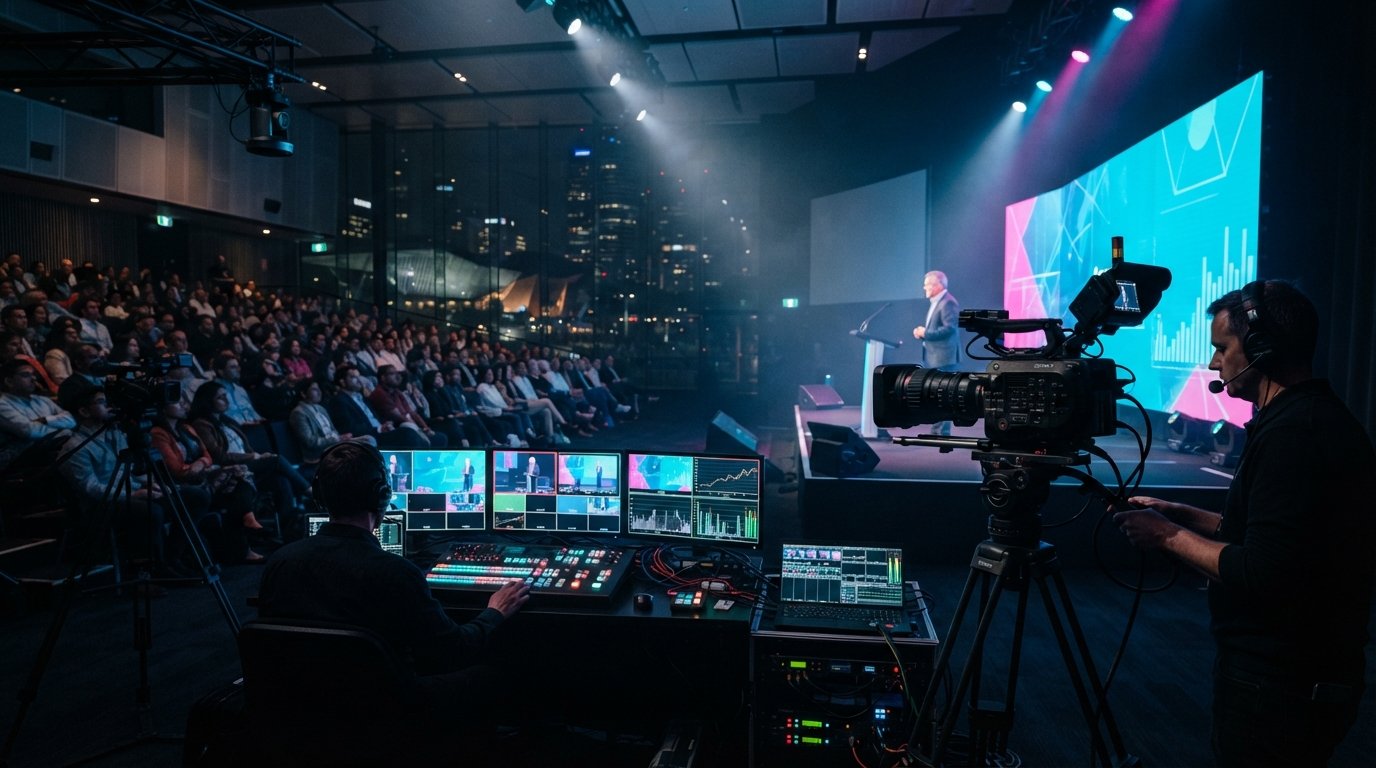
A static camera parked at the back of an auditorium does not capture an event; it merely proves people showed up. When delegates tune in from across Australia or abroad, a flat wide shot makes your keynote feel like a forgotten video call. Professional multi-camera live streaming for conferences is no longer a decorative luxury; it is a strategic baseline to protect your brand authority. You have likely felt the stress of keeping remote viewers engaged while dreading technical hitches, particularly when justifying a skilled camera team over a single stationary lens.
You can eliminate that production anxiety and elevate your corporate conference with broadcast-standard delivery that captivates remote audiences and secures your prestige. This guide details how dynamic visual pacing, hardware vision switching, and meticulous technical direction ensure flawless execution across Melbourne in 2026, keeping your audience locked in from the opening address to the final panel.
Key Takeaways
- Discover how multi-camera live streaming for conferences elevates standard presentations into broadcast-grade productions that hold delegate attention from start to finish.
- Explore the strategic mix of manned camera platforms and discreet PTZ units designed to capture stage dynamics without disrupting your room layout.
- Review the engagement metrics demonstrating why multi-angle visual pacing significantly extends viewer watch time during corporate addresses and panel sessions.
- Identify Melbourne venue technical requirements, including the necessity of dedicated synchronous data lines and failover feeds for uninterrupted delivery.
- Learn how proactive technical direction and behind-the-scenes orchestration eliminate production stress, allowing your team to focus entirely on the stage.
Beyond the Static Lens: What is Multi-Camera Live Streaming for Conferences?
True multi-camera live streaming for conferences is not just pointing extra lenses at a podium. It is a live broadcast production orchestrated in real time through a dedicated hardware vision switcher. While a standard corporate webcast treats remote viewers as passive observers peering through a digital keyhole, a multi-camera live production actively directs their attention. It mirrors the visual rhythm of broadcast television, transforming an ordinary business presentation into an engaging, high-retention experience that upholds your brand’s prestige.
The Psychology of Visual Momentum
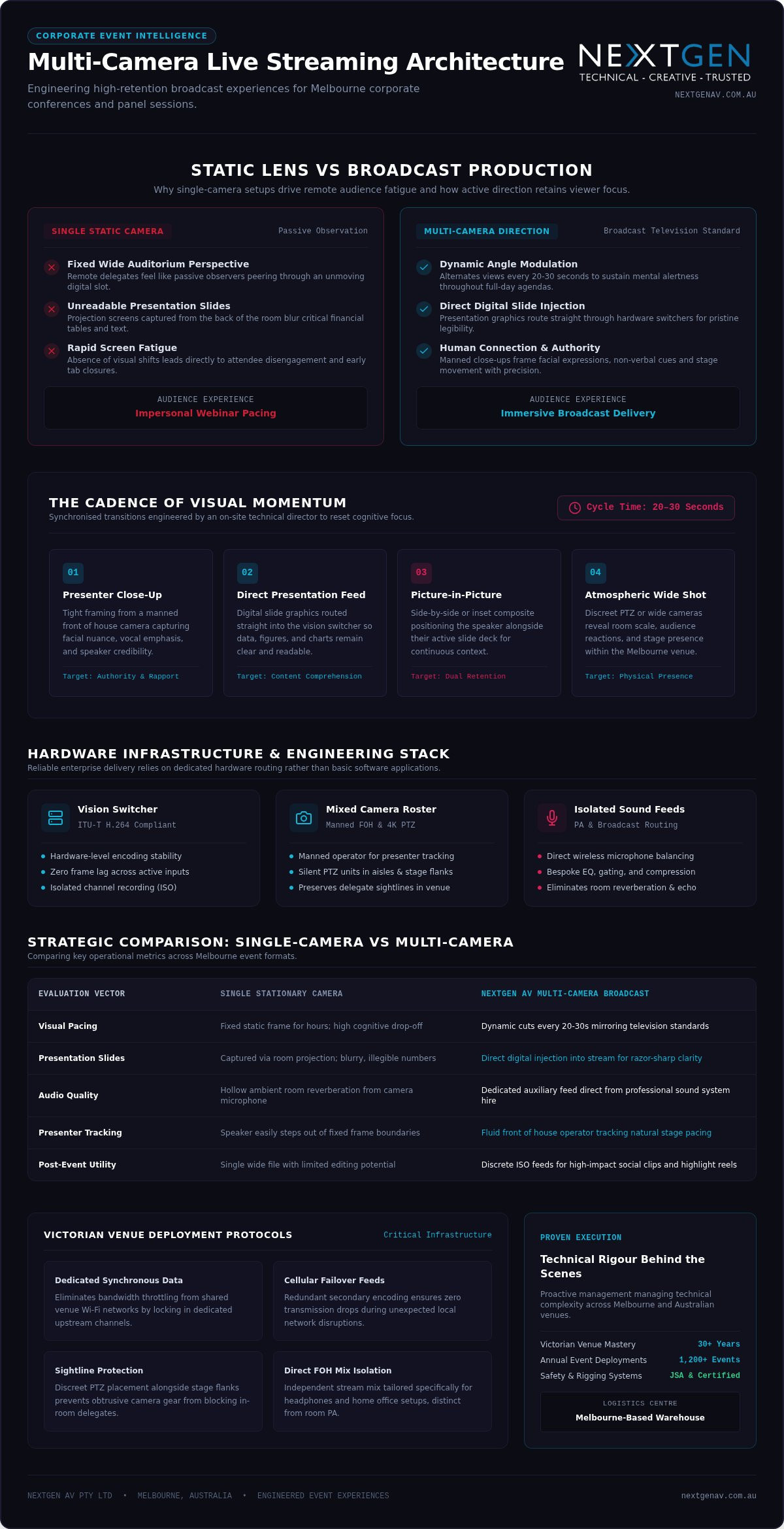
Online attendees battle constant digital distractions. To sustain focus, production teams create visual momentum by alternating perspectives every 20 to 30 seconds. Switching from an expressive medium close-up to an expansive wide shot captures the room’s energy inside your Melbourne conference venue while resetting cognitive focus. Grounded in the classic principles of a multi-camera production setup, this continuous visual variety dissolves screen fatigue, holding delegate interest across full-day corporate programmes.
Broadcast Standards vs. Basic Webconferencing
Relying on a lone, static camera perched at the back of an auditorium isolates remote delegates. Facial expressions disappear, nuanced delivery is lost, and presentation slides displayed on distant projection screens become an unreadable blur. Professional multi-camera live streaming for conferences overcomes this disconnect by routing discrete video feeds directly into a vision switcher operated by an experienced technical director.
Working behind the scenes, the technical director coordinates real-time transitions between critical visual assets:
- Presenter close-ups: Tight framing captures facial nuance, establishing an immediate human connection and conveying speaker authority.
- Digital presentation inputs: Direct slide feeds are integrated straight into the stream, ensuring text, financial tables, and diagrams remain razor-sharp.
- Picture-in-Picture compositions: Custom layouts keep the speaker’s delivery visible right beside their supporting visual data.
- Atmospheric audience views: Wide shots reveal audience reactions and room engagement, making remote delegates feel present on the convention floor.
The Technical Orchestration: Essential Hardware for a Flawless Stream
Flawless execution does not rely on a single laptop running software in the corner of a room. Enterprise-grade broadcasting requires dedicated hardware engineering. From hardware vision switchers encoding to compliant ITU-T video compression standards to synchronized stage lighting and isolated recording channels, every element must work as a unified ecosystem. When orchestrated correctly behind the scenes, high-end hardware ensures your stream remains rock-solid while your team focuses entirely on delivering the event.
Choosing the Right Camera Mix
Achieving broadcast depth requires pairing diverse camera technologies. A seasoned operator on a manned front of house camera delivers smooth presenter tracking, panning fluidly to capture gestures and spontaneous stage movements. In contrast, remote 4K PTZ (Pan-Tilt-Zoom) cameras provide discreet coverage in tighter venue spaces. Positioned silently along stage flanks or audience aisles, PTZs capture reaction shots and panel discussions without blocking attendee sightlines. Incorporating 4K sensors across all positions also captures pristine visual data for post-event highlight reels.
Audio: The Invisible Pillar of Streaming
Nothing prompts virtual delegates to close a browser tab faster than thin, echoey sound. High-definition video means nothing without clean, intelligible voice reproduction. Rather than capturing hollow ambient room reverberation through on-camera microphones, our technical team isolates and routes clean auxiliary feeds directly from the on-site professional sound system hire.
A front of house engineer works alongside a dedicated streaming audio technician to balance complex sound layers:
- Direct vocal isolation: Dedicated wireless microphone channels receive bespoke EQ, compression, and gating for broadcast clarity.
- Acoustic room management: Controlled ambient boundary microphones blend natural audience applause into the stream without introducing hollow room echo.
- Synchronised latency alignment: Digital audio signals are precisely delay-matched to the vision switcher outputs, eliminating distracting lip-sync drift.
Behind the switcher, hardware encoders route primary and secondary feeds across dual network paths with automated failover. If an uplink falters, the redundant line instantly takes over without viewer disruption. If you want to secure your brand’s prestige with broadcast-level reliability, consulting with the technical specialists at NextGen AV ensures multi-camera live streaming for conferences is engineered to absolute perfection.
Single-Camera vs. Multi-Camera Production: A Strategic Comparison
Weighing up production setups often comes down to perceived economy versus actual stakeholder impact. While a single tripod camera appears straightforward on paper, the true cost emerges in viewer abandonment and diluted brand perception. According to the Australian Business Events & Convention Industry Report (2025), 78% of Tier-1 Australian corporate conferences and national AGMs now require broadcast-grade live streaming to engage interstate and global delegates. For high-stakes presentations, professional multi-camera live streaming for conferences protects executive authority, demonstrating that remote delegates receive the exact same attention as in-room guests.
Engagement and Retention Metrics
Audience behaviour data reveals a striking contrast between basic and multi-angle feeds. Findings from the Enterprise Video Streaming & Live Event Analytics Survey (2024–2025) indicate delegates watch multi-camera broadcasts three to four times longer than static single-shot streams. Dynamic switching maintains visual momentum, particularly when presenting financial data or strategic roadmaps:
- Active retention: Alternating wide stage framing and tight speaker angles stops remote delegates from tab-switching or drifting away.
- Picture-in-Picture clarity: Remote audiences view executive speakers alongside presentation decks simultaneously, preserving context and visual connection.
- Dynamic Q&A integration: Dedicated audience cameras capture delegates asking questions on the floor, making online participants feel like genuine contributors.
The “Prestige Factor” in Corporate Comms
For executive summits and annual product launches, visual polish directly shapes brand perception. Integrating synchronized stage cameras with tailored hybrid event staging solutions unifies your physical auditorium with the digital broadcast. When coordinating logistics across metropolitan venues or reviewing municipal regulations like the City of Melbourne event planning requirements, professional production elevates the entire occasion into a polished broadcast.
High-end multi-camera live streaming for conferences also creates substantial post-event value. Capturing isolated video recordings (ISO recording) of every camera angle provides your marketing team with a versatile library of high-resolution footage. Instead of being stuck with a single flat wide shot, you walk away with broadcast-quality assets ready for executive highlight reels, corporate social channels, and future promotional campaigns.
Organising Your Melbourne Conference: Logistics and Venue Insights
Melbourne boasts some of the southern hemisphere’s finest corporate spaces, from heritage halls in Carlton to contemporary spaces along South Wharf. Delivering an uncompromised broadcast across these environments requires rigorous groundwork. Multi-camera live streaming for conferences introduces distinct infrastructure demands, specifically concerning unshared network paths, clean power distribution, and stage lighting balance. Managing these variables during pre-production ensures your broadcast runs smoothly when the live countdown hits zero.
Venue Bandwidth: The Critical Checklist
Never rely on public venue Wi-Fi for your broadcast. The Event Production Technical Review notes that 64% of corporate live streaming interruptions stem from using unmanaged, shared Wi-Fi networks instead of segregated local networks. When hundreds of attendees connect personal smartphones simultaneously, shared bandwidth evaporates instantly.
Executing an enterprise-grade broadcast requires negotiating a dedicated, hardwired Ethernet drop from the venue management:
- Symmetric upload speeds: Secure a minimum dedicated upload line of 20 Mbps for stable 1080p60 delivery, or 50 Mbps for 4K workflows to provide overhead safety margin.
- Synchronous routing: Confirm the venue provides dedicated synchronous bandwidth that remains unaffected by attendee web browsing.
- Cellular backup integration: Pair the venue’s physical drop with bonded 5G cellular modems running dual-path SRT or RTMPS encoding protocols for hitless network failover.
Lighting for the Lens
Stage visibility for the room does not automatically translate into clear imagery on camera. Human eyes adapt effortlessly to high-contrast conditions, but digital camera sensors require precise illumination balance. Integrating purposeful stage and lighting hire Melbourne services eliminates unflattering facial shadows through balanced three-point lighting schemes.
Our lighting designers work closely with our video engineers to calibrate stage colour temperatures with on-stage LED video walls. Uncalibrated LED screens easily wash out presenters or induce harsh moiré banding on camera feeds. Aligning camera shutter speeds with display refresh rates guarantees rich skin tones and crisp visuals for both live attendees and virtual viewers.
Securing elite production crews across Melbourne requires lock-in well ahead of peak convention dates. Partner with NextGen AV to lock in your multi-camera live streaming for conferences early, allowing our technical directors to manage venue logistics and deliver a flawless presentation.
Seamless Execution: Why NextGen AV is Your Live Streaming Partner
Delivering a high-stakes corporate event demands an experienced production ally. Backed by over 30 years of industry experience in Melbourne event production and managing 1,200+ events annually, NextGen AV acts as your invisible expert. We step into high-pressure environments to absorb the technical complexity, allowing your leadership team to concentrate purely on the stage. Operating from our dedicated Melbourne warehouse, our team coordinates every stage of delivery, anchoring your broadcast in proven full service event production.
The NextGen AV Difference: Precision and Passion
Precision separates an ordinary web feed from an authoritative broadcast experience. Our technical directors orchestrate your entire room, synchronising camera switchers, lighting arrays, and sound systems into a seamless digital output. Every deployment adheres to rigorous safety standards, backed by certified Job Safety Analysis procedures, strict Test and Tag compliance, and qualified rigging personnel holding valid High-Risk Work Licences. Having previously managed synchronised content across three modular walls during a Melbourne CBD activation, our crew understands how multi-camera live streaming for conferences thrives on disciplined preparation and creative execution.
Your Journey from Concept to Broadcast
Executing a flawless hybrid event follows a structured path that removes planning stress from your shoulders:
- Pre-production alignment: We storyboard camera sightlines, design branded lower-third graphics, inspect venue internet drops, and configure redundant streaming pathways.
- Live on-site direction: Operating with quiet power behind the control desk, our vision directors and engineers manage active camera transitions and audio balances in real time.
- Rapid post-event delivery: We hand over high-resolution master recordings alongside isolated camera feeds within 24 hours of pack-down, giving your marketing team instant access to broadcast-quality assets.
Whether you are staging an executive summit or a national AGM, multi-camera live streaming for conferences ensures your remote delegates experience every moment with absolute clarity and impact.
Elevate Your Event with Broadcast-Grade Precision
Corporate delegates no longer accept a passive viewing portal. Investing in professional multi-camera live streaming for conferences ensures visual momentum, clear presentation graphics, and hardwired network stability that protect your brand’s authority. Shifting away from static wide lenses keeps remote attendees engaged, elevates executive delivery, and generates pristine archival assets for your organisation’s ongoing comms strategy.
Executing an effortless broadcast demands seasoned orchestration behind the control desk. Drawing on 30+ years of industry experience navigating Victorian venues, our Melbourne-based expert crew provides full-service technical direction that eliminates operational stress. From pre-production site checks to real-time vision switching, we meticulously manage the complexity so your leadership team can own the spotlight. Enquire about your Melbourne conference streaming today and let us transform your next presentation into a seamless, high-impact broadcast.
Frequently Asked Questions
What is the minimum internet speed required for multi-camera live streaming in 2026?
Delivering broadcast-quality 1080p60 multi-camera live streaming for conferences requires a dedicated symmetric upload speed of at least 20 Mbps, while 4K workflows require a minimum of 50 Mbps. This dedicated allocation provides the necessary overhead margin to prevent frame drops. We always bypass shared public Wi-Fi in Melbourne venues in favour of segregated, hardwired Ethernet connections, often pairing them with bonded cellular backhaul to protect data transmission.
Do I need a separate crew for the livestream and the in-room AV?
You don’t need two disconnected teams when you partner with a full-service production provider. NextGen AV integrates in-room audiovisual management with virtual broadcast delivery under a single technical director. Our front of house audio engineers, lighting operators, and vision switchers collaborate seamlessly at the central control desk, managing both what your in-person Melbourne audience experiences and what goes out to the digital stream without doubling your logistical footprint.
Can I include remote speakers in a multi-camera conference stream?
Yes. We routinely integrate remote presenters into live conference feeds using low-latency broadcast bridges. Our technical team brings the virtual contributor onto the vision switcher as a dedicated input channel. This setup allows us to display the speaker alongside local presenters on stage LED video walls while concurrently feeding custom picture-in-picture layouts to the remote audience, ensuring two-way dialogue and panel discussions flow without delay or technical friction.
How much space does a multi-camera streaming setup take up in a venue?
The physical footprint depends on your venue layout and staging design. A typical configuration requires a dedicated production desk at front of house, occupying roughly two to three trestle tables. Manned cameras sit on compact risers behind the audience, while robotic PTZ cameras mount discreetly to stage trusses or perimeter walls without blocking delegate sightlines. We evaluate spatial clearances during our initial Melbourne site inspection to keep all equipment unobtrusive.
Is multi-camera streaming worth it for a small corporate meeting?
If the meeting involves high-stakes outcomes, executive announcements, or external board members, multi-camera live streaming for conferences provides distinct strategic value. Switching between close-ups of presenters and digital slide presentations maintains participant attention far better than a static laptop webcam. For sensitive internal briefings or boutique corporate roundtables, compact two-camera or three-camera PTZ setups deliver broadcast authority without feeling overbearing in an intimate boardroom setting.
Can you stream to multiple platforms like YouTube, LinkedIn, and a private website simultaneously?
Yes. Our hardware encoders split the master program feed to broadcast across multiple content delivery networks simultaneously. We can distribute your session across public social channels like YouTube and LinkedIn while routing an encrypted stream to a private, password-protected corporate portal. This simultaneous multi-destination routing happens upstream at our hardware encoders, which means your venue internet connection only requires bandwidth for a single primary transmission stream.
What happens if the venue internet fails during the livestream?
We protect your broadcast by deploying dual-redundant transmission pathways. Alongside the venue’s hardwired Ethernet connection, we configure secondary bonded cellular uplinks running broadcast-grade SRT or RTMPS streaming protocols. If the primary fixed-line network drops or encounters severe packet loss, our transmission encoders execute an automated failover to the backup link. The transition occurs in real time behind the scenes, keeping your stream uninterrupted for online attendees.
Do we need to adjust the stage lighting specifically for the cameras?
Yes. Lighting designed solely for the human eye in an auditorium often appears harsh or dim on camera sensors. Our lighting technicians configure a balanced three-point lighting profile with controlled colour temperatures across the stage. We also match lighting output levels with on-stage LED screens to prevent digital wash-out and flicker, ensuring speakers appear natural and sharp across all camera angles without blinding the physical audience.
Discover Valuable Insights
Unlock Expert Tips and Advice
Our blog is packed with valuable information to help you stay ahead. Whether you’re looking for expert advice, industry trends, or practical tips, you’ll find everything you need. Reach out today to learn more or get in touch with us for personalised support!