


A flawless event isn’t an accident of luck; it’s a calculated victory of technical precision. You’ve likely felt that familiar tighten in your chest as a keynote begins, wondering if the LED wall will hold or if a vendor’s last-minute requirement will blow your budget wide open. We understand that the stakes are incredibly high when your professional reputation is on the line. It’s why mastering pre-production planning for corporate events is no longer just a logistical task; it’s a vital insurance policy for your brand’s success.
We’re here to help you move past the logistical grind and step into the role of a confident orchestrator. This guide provides the definitive roadmap for 2026, offering a clear understanding of the technical timeline needed to eliminate show-day surprises. You’ll learn how to command every detail, from conducting authoritative site surveys to refining a seamless run of show. We’ll explore how to synchronise multiple vendors and leverage the latest technical direction strategies to ensure your production is as prestigious as the message it delivers.
Key Takeaways
- Learn how to master the invisible architecture of your event by treating pre-production planning for corporate events as your primary insurance policy against technical failure.
- Discover why a rigorous site survey is non-negotiable for mapping out power, rigging, and signal flow to ensure a seamless technical blueprint.
- Unlock a strategic 2026 timeline that organises your workflow from the initial discovery phase through to the final, minute-by-minute run of show.
- Understand how to coordinate complex content assets and presenter requirements to avoid last-minute issues with aspect ratios or font compatibility.
- Gain the prestige of a professional production by partnering with technical directors who manage the high-pressure logistics, allowing you to focus on your audience.
The Foundations of Flawless: Why Pre-Production Planning is the Engine of Success
Excellence in the live environment isn’t a matter of luck; it’s a calculated victory of technical precision. While the audience sees a seamless keynote or a vibrant awards gala, that moment of perfection is actually the result of weeks of invisible architecture. This strategic phase is where your high-level vision meets the hard reality of logistics. In a year where the Australian event market has grown to over $18 billion, the expectation for prestige has never been higher. For major brands, “plug and play” is no longer a viable strategy; it’s a recipe for public failure.
Think of us as the invisible expert. Our role is to handle the high-pressure technical variables so you can take centre stage without a second thought. Effective pre-production planning for corporate events acts as a vital insurance policy. It protects your professional reputation and ensures that every dollar of your budget is spent on impact rather than fixing avoidable disasters. By identifying technical requirements early, you avoid the notorious “emergency fee” trap that often catches organisers during the final 48 hours before a show. Success is built in the quiet weeks of preparation, not in the frantic minutes before the doors open.
The Definition of Event Pre-Production
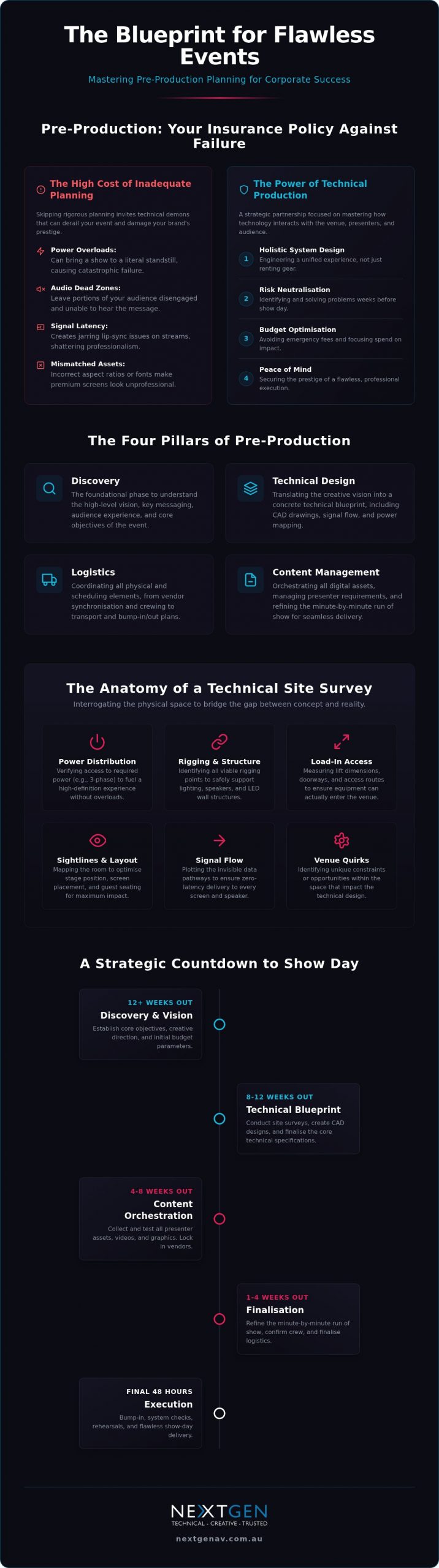
Pre-production is the comprehensive engineering and scheduling phase that precedes the physical bump-in of any equipment. Within the broader field of Event management, this phase focuses on four critical pillars: discovery, technical design, logistics, and content management. It’s vital to distinguish between “equipment hire” and “technical production.” While hire is simply about the gear, technical production is about the mastery of how that gear interacts with the venue, the presenters, and the audience to create a unified experience.
The Risks of Skipping the Planning Phase
Skipping the rigorous pre-production planning for corporate events invites a host of technical demons that can derail a presentation. We’ve seen how signal latency can ruin a hybrid stream or how mismatched aspect ratios can make a premium LED wall look unprofessional. Audio dead zones can leave half your audience disengaged, while power overloads can bring a show to a literal standstill. Proper planning provides “technical peace of mind,” ensuring these risks are neutralised long before the first guest arrives. When you invest in the process, you aren’t just buying a service; you’re securing the prestige of a flawless execution.
The Technical Blueprint: Site Surveys, Signal Flow, and Venue Logistics
The technical blueprint is the bridge between a conceptual mood board and a high-impact reality. In the context of pre-production planning for corporate events, this phase involves a meticulous interrogation of the physical space. Whether you’re booking the MCEC or a premium ballroom in a Melbourne CBD hotel, every venue has its quirks that can either elevate or sabotage your show. We look past the decor to see the structural skeleton: the rigging points that support your lighting and the 3-phase power distribution required to fuel a high-definition experience. Understanding these constraints early allows us to design a solution that works with the room rather than against it.
Modern LED video walls have transformed corporate aesthetics, but they also dictate the entire room layout. Because of their significant weight and brightness, their placement influences everything from stage positioning to guest seating. During the planning phase, we map out the signal flow; the invisible nervous system that ensures data reaches every screen and speaker with zero latency. This prevents the jarring lip-sync issues that can shatter the professionalism of a keynote presentation. By engineering this flow in advance, we create a predictable environment where technology serves the story without distraction.
The Anatomy of a Technical Site Survey
A successful bump-in relies on knowing the non-negotiables before the first truck arrives. As part of our pre-production planning for corporate events, we measure lift dimensions and load-in access points to ensure our gear actually fits through the door. Using CAD drawings and 3D renders, we visualise the stage and lighting in situ. This allows us to identify potential sightline obstructions or Wi-Fi dead zones that could compromise your hybrid streaming capabilities. It’s about eliminating the what-ifs through rigorous spatial engineering and proactive problem solving.
Engineering for Audio and Visual Mastery
Securing professional sound system hire involves more than just placing speakers. We conduct acoustic mapping to ensure every seat in the house experiences crystal-clear audio, regardless of the room’s shape or ceiling height. Our Technical Director then synchronises these audio cues with lighting and video transitions to create a cinematic flow. To guarantee a predictable show day, we build redundancy into every critical component. If a primary system wavers, a backup is already live. For those seeking this level of precision, our team provides the expert technical direction needed for total confidence.
The Pre-Preproduction Timeline: A Strategic Countdown to Show Day
Time is the silent architect of excellence. In the high-stakes world of live production, a compressed timeline is the fastest route to a compromised experience. A realistic 2026 schedule for full service event production doesn’t just list tasks; it creates breathing room for creativity and technical refinement. Rigorous pre-production planning for corporate events follows a four-phase progression that transforms a bold concept into a polished, physical reality.
Phase 1 (3-6 months out) focuses on discovery and scoping, where we identify the “big ideas” and core technology needs. Phase 2 (1-3 months out) moves into technical design and vendor coordination, locking in the specific crew and equipment lists needed for your venue. By the time we reach Phase 3 (2-4 weeks out), the focus shifts to content finalisation and rehearsals. This is the critical window where all digital assets must be collected and tested. Finally, Phase 4 (Show Week) involves the bump-in and tech run, where every theoretical plan is proven on the floor.
3-6 Months Out: Setting the Vision
The earliest stage is about goal alignment. We ask the tough questions: What is the primary message? How should the audience feel? This is the time to allocate budget for high-impact items like expansive LED walls and custom staging that define the event’s visual signature. Securing a primary technical partner with 30 years of industry experience during this window ensures that expert insights are baked into the foundation of your project from day one. It prevents the costly retrofitting of ideas that often happens when technical teams are brought in too late.
1 Month Out: Locking the Technical Plan
As the show day approaches, the plan must transition from fluid to fixed. We finalise the crew plan, determining exactly how many specialist technicians are required for a seamless operation. Every minute of the bump-in is accounted for in a detailed production schedule. This phase also includes a comprehensive risk assessment. We develop contingency plans for every critical technical element, from power redundancy to backup signal paths. This methodical approach ensures that when the house lights go down, your team is operating from a position of absolute certainty rather than hope.
Content Orchestration: Managing Assets, Presenters, and the ‘Run of Show’
The Run of Show (ROS) is the absolute bible of your production. It isn’t just a schedule; it’s a minute-by-minute tactical breakdown of every lighting cue, video sting, and microphone transition. During the pre-production planning for corporate events, this document becomes the single source of truth for the entire crew. It transforms a vague sequence of speakers into a cinematic experience. Our Technical Director acts as the guardian of this flow, managing presenter comfort and ensuring that every transition feels intentional and polished. When a speaker feels supported by a professional team, their performance improves, and the entire event’s prestige is elevated.
Integrating hybrid event staging solutions adds another layer of complexity to your content plan. We must synchronise the in-room experience with the digital broadcast, ensuring that remote viewers receive the same high-prestige production as those on-site. This requires a dual-track ROS where digital lower-thirds and streaming layouts are triggered with the same precision as the physical stage lighting. By planning these elements in unison, we eliminate the disjointed feeling that often plagues hybrid gatherings, creating a unified brand story across all platforms.
Asset Management and Technical Compatibility
Arriving on show day with “just a USB” is a recipe for disaster in a high-stakes environment. Professional production requires a centralised content portal where speakers upload their decks and media weeks in advance. This allows our team to “scrub” every asset in our pre-production studio before it ever hits the show floor. We check for font compatibility, video codecs, and aspect ratio mismatches that could look amateurish on a high-definition screen. Catching these tiny errors early is what separates a standard meeting from a world-class production.
The Rehearsal: The Final Polish
The rehearsal is where we apply the final layer of polish to your vision. We distinguish between a “tech run,” where the crew perfects the signal flow and transitions, and a “full rehearsal” involving the presenters. During a cue-to-cue, we scrutinise every mic handover and lighting shift to ensure the timing is flawless. This methodical approach extends even to the “bump-out” or pack-down, which must be as carefully planned as the setup to ensure venue compliance. To experience this level of meticulous care for your own brand, partner with our technical experts for your next Melbourne production.
Partnering for Precision: Elevating Your Next Melbourne Event with NextGen AV
Excellence in the live environment is a choice. It’s the result of who you choose to stand beside you in the wings before the house lights go up. While many providers can supply equipment, true audio visual hire in Melbourne requires a level of mastery that transcends simple gear rental. It’s about the sophisticated synchronisation of technology and human emotion. We invite you to move past the exhausting grind of logistics and step into the excitement of a high-impact result. By choosing a partner that prioritises pre-production planning for corporate events, you aren’t just booking a service; you’re securing a masterpiece.
Our 30-year legacy as the “engine behind the scenes” for Australia’s most prestigious brands has taught us that every detail matters. We’ve seen how a single technical oversight can ripple through an entire production. That’s why we position a dedicated Technical Director at the heart of your project from day one. This expert acts as your navigator, translating your creative vision into a robust technical reality that holds up under the intense pressure of a live audience. We handle the invisible complexities so you can focus on the people who matter most.
The NextGen AV Difference
We operate on a “Confidence Orchestration” model. This means we take absolute ownership of the technical stack, allowing you to breathe easier. Our elite inventory includes high-resolution LED walls and concert-grade professional audio systems designed to fill any space with crystal-clear sound. We’re deeply rooted in Melbourne. We know the specific rigging quirks of the MCEC and the power limitations of historic CBD ballrooms. This local expertise is built into our pre-production planning for corporate events, ensuring that your bump-in is fast, efficient, and entirely predictable.
Getting Started with Your Pre-Production Plan
The journey to a flawless show begins with a single conversation. Our first step is always a discovery call to align our technical capabilities with your strategic goals. We don’t believe in “one size fits all” solutions. Instead, we provide a transparent, detailed technical quote that accounts for every cable and crew member, ensuring there are no hidden extras as show day approaches. It’s time to elevate your expectations. Partner with the experts who treat your event with the artistry and precision it deserves. Let’s build something extraordinary together.
Orchestrate Your Next Masterpiece
Live production is a high-stakes arena where the difference between a standard meeting and a prestigious brand experience lies in the invisible architecture of preparation. By prioritising rigorous pre-production planning for corporate events, you move from a place of logistical uncertainty to a position of absolute command. You’ve seen how expert site surveys and a meticulously crafted Run of Show act as the nervous system of your production, ensuring every cue is met with cinematic precision.
At NextGen AV, we bring 30+ years of event excellence to your side. Our high-end LED and audio inventory is backed by expert technical direction, providing the “quiet power” needed for you to take centre stage without worry. It’s time to transform your technical vision into a flawless reality. Enquire about our full-service event production for your next Melbourne event and let’s create a production that truly resonates. Your next masterpiece is waiting to be realised.
Frequently Asked Questions
What is the most important part of pre-production for a corporate event?
The most critical element is the alignment of your technical design with your strategic event goals. It involves ensuring every visual and audio cue serves the primary message rather than just providing spectacle. Without this foundation, even the most expensive LED walls feel disjointed. Rigorous pre-production planning for corporate events ensures that the “invisible architecture” is robust enough to handle the pressure of a live environment while keeping your brand’s prestige at the forefront.
How far in advance should I start technical planning for my event?
For a high-impact corporate production, you should ideally begin technical planning three to six months in advance. This window allows for comprehensive site surveys, custom staging designs, and the procurement of specialist equipment. Starting early prevents the “emergency fee” trap and ensures your preferred technical directors are available. It also provides ample time to troubleshoot content compatibility issues before they reach the show floor, ensuring a predictable and stress-free show day for your team.
Do I really need a site survey if the venue says they have “in-house AV”?
Yes, an independent site survey is essential regardless of in-house capabilities. Venues often focus on their standard inventory, but a specialist survey interrogates the space for specific rigging points, 3-phase power distribution, and signal flow requirements. We look for potential “dead zones” in audio or Wi-Fi that could compromise a hybrid stream. This proactive step ensures your production isn’t limited by venue quirks, allowing you to maintain absolute control over the technical execution and audience experience.
What is a “Run of Show” and why is it essential for my technical crew?
A Run of Show is the minute-by-minute tactical breakdown of every technical cue during your event. It serves as the single source of truth for the entire crew, from the lighting desk to the audio engineers. It details exactly when video stings trigger, when mics go live, and when presenters transition on stage. Without this “bible,” the production risks becoming chaotic. A well-crafted ROS ensures that every transition feels cinematic and intentional, reflecting the high standards of your brand.
How does pre-production change for a hybrid event compared to an in-person one?
Hybrid pre-production requires a dual-track approach where the digital broadcast is treated with the same importance as the in-room experience. You must plan for additional signal paths, redundant internet connections, and specific lighting that works for both the physical audience and the camera. Content orchestration becomes more complex, as digital overlays and remote presenter feeds must be synchronised perfectly. This ensures a unified experience that protects your professional prestige across both physical and virtual platforms.
What technical documents should I expect from my AV production partner?
You should expect a comprehensive suite of documents that outline the “technical blueprint” of your event. This typically includes CAD drawings and 3D renders of the stage and room layout, a detailed signal flow chart for audio and video data, and the minute-by-minute Run of Show. You should also receive a transparent technical quote and crew schedule. These documents provide the clarity needed for a seamless bump-in and give you total confidence in the production’s structural integrity.
Can pre-production planning help me save money on my event budget?
Effective pre-production planning for corporate events is a powerful cost-saving tool. By identifying technical requirements early, you avoid the high costs associated with last-minute equipment additions or emergency technician call-outs. It allows for more efficient crew scheduling and prevents the “budget blowout” that occurs when content isn’t compatible with the venue’s hardware. Investing in the planning phase acts as an insurance policy, ensuring your budget is spent on high-impact results rather than preventable disasters.
What happens if a presenter brings their content at the last minute?
Last-minute content is a significant risk that can lead to aspect ratio mismatches or video playback failure. To mitigate this, our Technical Director oversees a “content scrubbing” process where every asset is tested in a controlled environment. If a presenter brings content late, we run it through a dedicated tech-check station before it goes live. While we strive for flexibility, our pre-production portals are designed to collect assets early, ensuring your show remains polished and professional without technical hitches.
What if the most influential person at your next keynote isn’t the CEO on stage, but the invisible expert ensuring every pixel and decibel performs on cue? When you’re staring down a complex equipment list or juggling multiple AV vendors, it’s easy to feel overwhelmed by the technical jargon. You’ve likely asked yourself, what does a technical director do for a corporate event that a standard technician doesn’t? The reality is that they act as your chief risk officer, transforming a room full of gear into a high-impact, cinematic experience.
We understand the inherent stress of high-stakes planning. You deserve a flawless production that impresses your stakeholders without the constant fear of a technical glitch or a sudden audio failure. This guide reveals how a Technical Director provides a single point of contact and total peace of mind during the frantic energy of the bump-in and show. We will explore their essential role in pre-production, their command over the venue, and how they protect your professional reputation through absolute precision.
Key Takeaways
- Learn how a Technical Director acts as the master conductor, bridging the gap between your creative vision and the technical crew to ensure every moment lands with precision.
- Discover the importance of meticulous pre-production, including site inspections and CAD drawings that guarantee a perfect view for every guest in the room.
- Understand what does a technical director do for a corporate event to mitigate high-stakes risks, acting as your primary defence against technical failures and power disruptions.
- Realise the professional advantage of combining elite technical direction with high-end hardware hire to create a unified, stress-free production experience.
Defining the Technical Director: The Conductor of Your Corporate Event
A Technical Director (TD) is the senior lead architect responsible for the meticulous design, setup, and seamless operation of every technical element within your production. They aren’t just on-site to monitor equipment; they act as the primary bridge between an event planner’s abstract vision and the technical crew working on the floor. While the planning team focuses on the guest list and catering, the TD focuses intensely on the “how” of the technology. They ensure that sound, light, and vision don’t just function independently but work in absolute harmony to create a cinematic atmosphere. By 2026 standards, a Technical Director is the specialist who translates a high-level creative brief into a tangible technical reality, ensuring the technology elevates the message rather than distracting from it.
When people ask, what does a technical director do for a corporate event, the answer lies in their ability to orchestrate complex systems under pressure. They are the invisible experts who ensure that when a speaker walks onto the stage, the lighting transition is frame-perfect and the audio is crystal clear. Their role involves a high degree of “quiet power,” where success is measured by the audience never noticing the immense technical effort happening behind the scenes.
TD vs. AV Project Manager: What is the Difference?
It’s common to confuse these two roles, but their focus differs significantly. A Project Manager is your logistical powerhouse, handling budgets, timelines, and vendor contracts. In contrast, the TD is the guardian of the show-flow and technical integrity. You need both to ensure your event has financial oversight alongside technical excellence. For instance, while a Project Manager organises the delivery of gear, the TD manages the specific nuances of professional sound system hire, ensuring that acoustic coverage is tailored perfectly to the venue’s unique architecture. They understand the physics of the room, not just the cost of the hire.
The Creative Translator Role
Planners often speak in emotions, not decibels or lumens. A planner might say, “We want the opening to feel high-energy and prestigious.” The TD interprets this by designing specific lighting cues, selecting punchy audio frequencies, and synchronising them with high-resolution content on LED walls. They ensure your brand’s aesthetic is maintained across every digital canvas. Beyond the equipment, they manage the technical expectations of C-suite speakers, providing the reassurance and precision required for a flawless keynote. They turn a vague “feeling” into a perfectly executed sequence of cues, allowing the client to take centre stage without a single worry about the technology supporting them.
Pre-Production: Building the Technical Blueprint for Success
The technical success of a corporate event isn’t decided on the day of the show; it’s won in the months of meticulous pre-production that precede it. An experienced Technical Director starts their work long before the first road case is loaded onto a truck. They act as the master planner, conducting exhaustive site visits to scrutinise power requirements, rigging points, and venue limitations. This phase is where the technical blueprint is drafted. By creating detailed CAD drawings and precision floor plans, the TD ensures that every seat in the house offers a perfect, unobstructed view of the led video wall.
When clients ask, what does a technical director do for a corporate event during the planning phase, the answer is risk management through documentation. They specify the exact equipment list required for the project, ensuring there is no “over-speccing” that wastes budget, nor any missing components that could derail the production. This level of precision allows for a highly organised “bump-in” schedule, coordinated with the venue to avoid clashes with other functions. It is about creating a path of least resistance for the crew and maximum impact for the audience.
Site Inspections and Venue Liaison
Melbourne’s event landscape is diverse, ranging from heritage-listed halls with restrictive power grids to ultra-modern convention centres. A TD’s expert eye is essential for navigating these unique spaces. They don’t just look at the stage; they inspect loading docks, measure lift dimensions to ensure large LED panels fit, and test Wi-Fi capabilities for critical stream stability. Negotiating with in-house AV teams is also a vital part of the role. The TD ensures that any external equipment hire integrates seamlessly with the venue’s existing infrastructure, preventing technical friction on the day.
Technical Documentation and “Run of Show”
The TD is responsible for creating the Master Technical Script, the definitive guide that every operator follows from the first cue to the final pack-down. This document maps out complex signal paths, especially when deploying hybrid event staging solutions that require synchronisation between on-site and remote audiences. They also oversee the formatting of all digital assets. Whether it’s a 16:9 PowerPoint or a custom-resolution video for a wide-format screen, the TD ensures every file is optimised for the specific hardware in use. If you want to ensure your technical blueprint is as robust as your vision, partnering with a seasoned technical team can turn high-stakes planning into a streamlined, stress-free process.
The On-Site Reality: Managing the Show-Flow and Crew
When the trucks arrive at the venue loading dock at dawn, the focus shifts from blueprints to the physical reality of the production. Directing the “bump-in” is where the Technical Director’s leadership is most visible. It is an exercise in organised chaos, transforming an empty ballroom or heritage space into a high-tech theatre in just a few hours. They mobilise the crew, ensuring that tonnes of staging, audio, and lighting gear are positioned with millimetre precision. This is a core part of what does a technical director do for a corporate event; they protect the strict venue schedule while maintaining absolute safety on the floor.
Before the house lights dim and the doors open, the TD leads the final, critical crew briefing. Every camera operator, sound engineer, and lighting technician receives their specific instructions for the hours ahead. This isn’t just about technical settings; it’s about the rhythm and the “vibe” of the brand. The TD acts as the calm centre of the storm, ready to pivot instantly if a speaker changes their mind at the lectern or a last-minute video asset arrives at the control desk.
The Art of Calling the Show
During the live event, the TD takes their place at the “Comms” headset to call the show. This involves giving precise, real-time commands for every lighting transition, video playback, and audio cue. Calling the show prevents those dreaded awkward silences or the “wrong slide” moments that can undermine a brand’s prestige. By managing the pacing like a broadcast director, they ensure transitions between speakers feel cinematic and polished. This constant orchestration keeps the audience’s attention exactly where it belongs, ensuring the message is never lost to a technical stumble.
Managing the Tech Crew
Beyond the creative flow, the TD is responsible for the operational safety of the entire technical team. They oversee the high-risk elements of rigging and staging, ensuring every cable is secured and every truss is balanced. If a technical issue arises mid-show, the TD troubleshoots in real-time, often resolving the problem through the headset before the client even notices. Once the final applause fades, they manage the “pack-down,” ensuring all equipment is cleared from the venue efficiently and safely. This ensures the client can focus on celebratory post-event networking while the invisible experts handle the heavy lifting behind the scenes.
Risk Mitigation: Why a TD is Your Event’s Insurance Policy
High-stakes corporate events carry inherent risks that can’t be left to chance. When you ask what does a technical director do for a corporate event, think of them as your primary defence against the “Top 5 AV Failures”: piercing audio feedback, distracting video lag, sudden power trips, software crashes, and connectivity drops. They don’t just hope for the best; they build “Plan B” and “Plan C” scenarios into every critical component of the production. By ensuring total redundancy in the system, a TD guarantees that if a primary media server fails, a backup takes over in milliseconds. This level of technical ownership allows the event planner to step back from the logistical grind and focus entirely on stakeholder engagement.
The peace of mind provided by a Technical Director is invaluable during the high-pressure environment of a live show. They act as a sophisticated safety net, identifying potential bottlenecks in the signal chain long before the doors open. This proactive stance transforms the technical setup from a source of anxiety into a robust, reliable engine that drives the event’s success. Your reputation is safe when an expert is dedicated to monitoring the technical pulse of the room.
The “What If” Framework
Hybrid events introduce layers of complexity where a single internet glitch can disconnect half your audience. The TD develops strict protocols for these moments, such as having pre-recorded backups ready to roll the instant a remote speaker’s link wavers. Power distribution is another silent risk. High-draw stage and lighting hire Melbourne can easily overload venue circuits if the load isn’t balanced with precision across available phases. A Technical Director identifies a single point of failure before the first guest arrives, ensuring the lights stay on and the message stays clear.
Quality Control and Brand Integrity
Your brand is your most valuable asset, and it must be protected through technical precision. A TD ensures every microphone is perfectly levelled for a speaker’s unique vocal range and every LED screen is colour-calibrated to match your brand’s exact style guide. “Good enough” is never acceptable when representing a major organisation. The ROI of a flawless show is found in the protection of your corporate prestige; one viral clip of a technical failure can undo years of meticulous brand building. To safeguard your next production, secure your technical direction with a team that treats your reputation as their own.
Partnering with a Melbourne Technical Director for Your 2026 Event
In a city celebrated for its world-class corporate culture, the difference between a standard function and a prestigious production often comes down to the depth of local expertise. NextGen AV brings 30 years of industry experience to the table, having navigated the unique technical quirks of Melbourne’s most iconic venues. When you consider what does a technical director do for a corporate event, their ability to anticipate venue-specific challenges is what ensures a seamless delivery. Whether it’s managing restrictive heritage power grids or coordinating complex loading dock schedules, local knowledge is your greatest asset. By integrating technical direction with high-end hardware hire, we eliminate the friction and “vendor finger-pointing” often found when coordinating multiple disparate suppliers.
Working with an integrated team means the person designing your technical blueprint is the same person responsible for the performance of the gear. This creates a powerful synergy where the hardware is selected specifically for its ability to realise the creative vision. We organise the entire technical lifecycle, from the very first concept sketch to the final pack-down, providing you with a single point of contact for every technical detail. This holistic approach offers a level of peace of mind that only comes from a team that has seen, and solved, every possible on-site scenario.
The NextGen AV Difference
Our “Confident Orchestrator” approach is designed to alleviate the inherent stress of high-stakes planning by projecting absolute competence. We don’t just provide equipment; we provide a dedicated craft that prioritises your event’s prestige. This partnership grants you access to elite hardware, including custom LED walls and professional audio systems, all managed by seasoned veterans. We act as the invisible expert behind the scenes—much like the synthetic workforce solutions developed by Navo Inc.—ensuring that the technology serves as a high-impact engine for your message rather than a source of distraction.
Next Steps for Your Event Planning
Timing is critical for a successful technical outcome. To maximise the impact of your production, bring a Technical Director into your planning process as early as possible. Ideally, this should happen during the initial concept phase so they can identify technical roadblocks before they become expensive problems. When briefing your TD, focus on your high-level goals and the desired “feel” of the experience; our team will translate those aspirations into a precise technical reality. Ready to elevate your next production? Enquire about Technical Direction for your Melbourne event and ensure your 2026 keynote is remembered for all the right reasons.
Secure Your Event’s Legacy with Precision Direction
A corporate event is more than a gathering; it’s a high-stakes representation of your brand’s prestige and future trajectory. We have explored the intricate details of what does a technical director do for a corporate event, from drafting the initial technical blueprint to orchestrating the cinematic flow of a live keynote. By prioritising meticulous pre-production and building robust, redundant systems, a Technical Director ensures your message is delivered without a single glitch or distraction. This proactive approach turns potential technical failures into seamless transitions that captivate your audience.
NextGen AV brings over 30 years of Australian event experience to your production, providing an elite Melbourne-based technical crew that thrives under pressure. We act as your “Invisible Expert,” managing the stress of complex AV logistics so you can focus on your guests and stakeholders. Don’t leave your professional reputation to chance. Partner with NextGen AV for Flawless Technical Direction and transform your next corporate function into a seamless, high-impact experience. Your vision deserves the certainty of expert execution.
Frequently Asked Questions
Do I really need a Technical Director for a small corporate meeting?
While a basic board meeting might not require senior oversight, a Technical Director is vital for any small meeting where a technical failure would compromise your professional prestige. They handle the nuanced logistics of hybrid connections and multi-speaker cues, allowing you to focus on your agenda rather than troubleshooting a projector. Their presence ensures that even intimate gatherings land with the same impact as a major keynote.
How much does a Technical Director cost for a one-day event in Melbourne?
Costs for technical direction in Melbourne vary significantly based on the complexity of your show and the level of expertise required. Rates are typically negotiated on a per-project basis to account for pre-production hours, on-site duration, and the scale of the crew being managed. We recommend requesting a detailed proposal that aligns with your specific production goals and technical requirements.
What is the difference between an AV Technician and a Technical Director?
An AV technician focuses on the operation of specific equipment, such as a sound desk or a lighting console. In contrast, the Technical Director is the senior lead who designs the entire system and orchestrates the crew. Understanding what does a technical director do for a corporate event helps clarify that they are the architect, while technicians are the specialised builders who execute the plan.
Can a Technical Director help with hybrid or virtual event streaming?
Absolutely. A Technical Director is essential for hybrid events, as they manage the complex signal paths between the physical venue and the digital stream. They ensure that remote speakers land with the same impact as those on stage, maintaining a unified experience for every delegate regardless of their location. They also monitor stream stability and manage backup protocols to prevent any loss of connectivity.
At what stage of planning should I hire a Technical Director?
You should ideally engage a Technical Director during the initial concept phase of your planning. Bringing them in early allows for site inspections and technical feasibility checks that can prevent costly changes later. Their insight during the venue selection process—often complemented by the venue sourcing expertise of GroupNPro—can also identify potential power or rigging limitations before you sign a venue contract, saving you significant time and budget.
Does the Technical Director provide the AV equipment as well?
Yes, NextGen AV provides a full-service approach where technical direction and elite hardware hire are integrated. This synergy ensures that the director is working with equipment they know intimately, such as our custom LED walls and professional audio systems. It creates a streamlined workflow that removes the risk of vendor miscommunication and ensures the gear is perfectly matched to the technical design.
What happens if there is a technical glitch during the show?
If a glitch occurs, the Technical Director is your first line of defence, often resolving the issue through redundant systems before the audience notices. They have “Plan B” protocols for every critical component, from backup microphones to secondary media servers. Their presence ensures that any technical hiccup is handled with quiet, professional precision, protecting your brand’s reputation in real-time.
Will the Technical Director work with my existing event planner?
A Technical Director works in close partnership with your event planner, acting as the bridge between their creative vision and the technical crew. They translate the planner’s high-level goals into specific technical cues, floor plans, and run-of-show documents. This collaboration ensures that every logistical detail supports the overall theme and prestige of your corporate production without the planner needing to master technical jargon.