
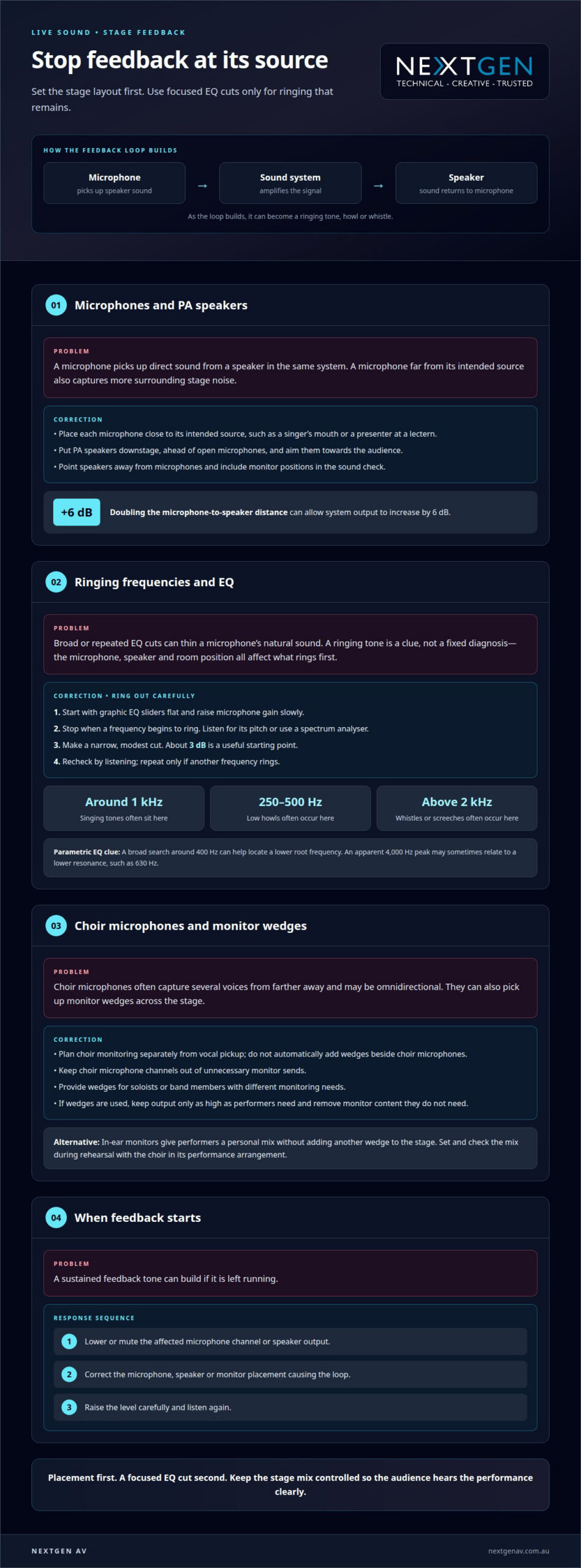
The quickest way to reduce stage microphone feedback is usually to reposition the microphone, PA speakers or monitors before reaching for EQ. Feedback starts when a microphone picks up sound from a speaker connected to the same system. To understand how to prevent microphone feedback on stage, keep microphones out of the speakers’ direct sound, then use EQ to reduce any frequencies that still ring.
If you reach for EQ whenever a howl or whistle breaks through, that instinct is understandable. But EQ works best after you’ve settled the stage layout. Small changes to microphone placement, speaker direction and monitor position can give the system more room to operate.
This guide explains what causes feedback and how to reduce it through practical placement, careful EQ and a microphone suited to the performer and stage volume. You’ll also learn how monitor wedges and microphone pickup patterns affect the result, helping you create clearer, more controlled sound for the audience.
Key Takeaways
- Start by positioning microphones and loudspeakers to limit how much speaker output reaches each microphone.
- Identify the ringing frequency and make a focused EQ cut rather than making broad changes to the sound.
- Keep choir microphones clear of monitor wedges, and position wedges to suit each microphone’s pickup pattern.
- Match the singer’s microphone to their technique and stage volume for clearer sound and more usable gain.
1. What Causes Feedback in a Sound System?
Feedback starts when a microphone picks up sound from a speaker connected to it, sending the signal through the same system again. As the loop builds, you hear a ringing tone, howl or whistle. A stage monitor can create the same cycle when its sound reaches a microphone connected to that monitor mix. Feedback comes from the sound path, not simply from an EQ setting.
Place each microphone close to its intended source, such as a singer’s mouth or a presenter at a lectern. A stronger wanted signal gives the engineer more control over nearby instruments and amplifiers. A microphone far from its source captures less of the intended sound relative to surrounding stage noise, making clear amplification harder to achieve.
For the PA, place speakers downstage, ahead of open microphones, and aim them towards the audience rather than across the stage. Increasing the microphone-to-speaker distance can help: doubling that distance can allow system output to increase by 6 dB. Pointing speakers away from microphones also reduces how much amplified sound returns to them. Stage monitors can still cause feedback, so include their position in the sound check.
Microphone direction matters, too. A directional microphone responds differently to sound arriving from the front, sides and rear. Keep its intended pickup area facing the performer or source, and avoid positioning it where it receives direct PA output. Make physical placement changes before using EQ to tackle a ringing frequency.
Australian venue and workplace noise requirements for live stage sound depend on the event space and worksite. Plan speaker output to suit the conditions that apply to the venue and event.
Can feedback damage hearing or speakers, and what should you do if it starts? Don’t leave a sustained feedback tone running. Lower or mute the affected microphone channel or speaker output, correct the placement causing the loop, then raise the level carefully.
2. Identifying and reducing feedback frequencies with EQ
Feedback has a tonal signature, but the sound alone doesn’t identify its cause. Singing tones often sit around 1 kHz, low howls around 250–500 Hz, and whistles or screeches above 2 kHz. Treat these as clues, not fixed rules: microphone, speaker and room placement affect which frequencies ring first.
To ring out a system, begin with the graphic EQ sliders flat and raise the microphone gain slowly. Stop as soon as a frequency begins to ring; don’t let feedback build into a sustained howl. Listen for the pitch or use a spectrum analyser, then make a narrow, modest cut. A cut of about 3 dB is a useful starting point. Recheck the result and repeat only if another frequency rings.
On a console with parametric EQ, sweep the frequency control slowly while listening for the ring to diminish. A broad starting search around 400 Hz can help locate a lower root frequency; an apparent 4,000 Hz peak may sometimes relate to a lower resonance, such as 630 Hz. Avoid cutting every suspected frequency, since excessive EQ can thin the microphone’s natural sound and reduce clarity.
Room modes can reinforce particular frequencies, especially when room dimensions align with bass wavelengths. For example, a 16-foot room dimension corresponds to a mode near 35.3125 Hz; a 16-foot-cubed room can build energy around 35 Hz and its octaves, 70 and 140 Hz. These resonances differ from the higher-pitched ringing often associated with feedback, so assess the room as well as the microphone pattern.
Keep gain before feedback in view: EQ should control the specific ring, not compensate for poor placement or excessive output. A focused cut, followed by a careful listening check, preserves more of the desired tone than broad reductions. For a live event, professional audio system planning can bring microphone, console and room response into one coordinated approach.
3. Avoiding monitor wedges for choir microphones
Choir microphones serve a different purpose from solo vocal microphones: they capture several voices together, often from farther away. Group microphones are frequently omnidirectional, picking up sound across the stage, including monitor wedges. In a church or concert hall, plan the choir’s monitoring needs separately from vocal pickup instead of automatically adding wedges beside the choir microphones.
Build the monitor mix around what each performer needs to hear. A choir may need a reference vocal, accompaniment or conductor cues, while nearby musicians may need a more detailed mix. Keep choir microphone channels out of unnecessary monitor sends, and provide wedges for soloists or band members with different monitoring needs.
In-ear monitors are another option for performers who need a personal mix. They let singers hear their own parts and accompaniment without adding another wedge to the stage. Set the mix carefully during rehearsal, with the choir in its performance arrangement, so the balance reflects what singers need to follow the music.
If wedges remain in use, keep their output only as high as performers need. A well-balanced stage mix helps performers hear their cues without filling the stage with excess sound. If ringing begins, lower the relevant monitor send or microphone channel, then listen again before adjusting other parts of the mix.
Thinning a wedge mix also helps control low-mid sound spilling towards the audience. Remove monitor content performers don’t need while preserving essential cues and musical references. This gives the front-of-house mix a cleaner stage sound and makes the choir easier to balance. For choir microphones, the priority is a focused monitor mix, not simply a louder one.
4. Choosing microphones for the singer and stage volume
Choose a microphone to suit the singer’s technique, stage volume and position relative to the PA. Cardioid and hypercardioid microphones are common directional choices for live vocals. A cardioid model with high gain before feedback can suit a singer whose microphone technique is inconsistent. On a loud stage, or when a singer performs in front of the PA, a tighter hypercardioid pickup pattern can help reject sound from the sides.
A moving-coil, or dynamic, microphone is a practical live-sound choice when feedback control matters. Its heavier diaphragm assembly has more inertia to overcome than a condenser microphone’s. This is one reason dynamic microphones are recommended for increasing gain before feedback. The right choice still depends on the singer’s voice, handling and position, not microphone type alone.
Check the microphone’s polar pattern before positioning monitors. A cardioid microphone rejects sound at the rear, while a hypercardioid microphone has some rear pickup and rejects sound at the sides. A singer using a hypercardioid mic should avoid pointing its rear pickup towards a loud monitor. Omnidirectional microphones pick up sound from all angles, so they’re generally unsuitable for high-volume vocal stages.
Microphone distance matters, too. Ask the singer to keep the capsule close to their mouth and maintain a consistent position through quiet and loud passages. Directional microphones used very close can produce 10–15 dB more low-frequency output, so the engineer should listen for excess bass while setting the signal. Close, consistent technique helps the vocalist stay clear without turning up the system unnecessarily.
During soundcheck, test the singer’s actual performance position and monitor level. Raise the vocal signal slowly while the musician sings at performance volume, listening for ringing as the PA and monitors operate together. Adjust microphone angle, monitor position or channel EQ before increasing level further. For a coordinated vocal setup, plan professional audio system support around the singer, stage layout and audience mix.
NextGen AV
NextGen AV helps event teams coordinate microphone, monitor and PA choices as part of a stage plan. When feedback risks involve several parts of the production, its Professional Audio Systems support can align sound reinforcement with the room, performers and audience experience. LED Video Walls, Lighting Design and Equipment, and Staging and Rigging can also be planned as part of the wider event environment.
For a Melbourne conference, gala or live performance, this coordinated approach helps manage technical decisions behind the scenes, from stage layout to clear, controlled sound. Share your event brief and performance requirements so the production can be shaped around the space and programme.
Contact NextGen AV to discuss your event’s audio and stage requirements.
Plan for a Clean Soundcheck
A strong event mix is designed around the performance, not just the equipment list. Schedule a soundcheck so singers, musicians and the audio team can work through the actual programme in their stage positions. This gives the engineer a practical reference for changes in performer movement, monitor preferences or room response before the audience arrives. Keep agreed microphone and monitor settings clear as the running order moves from rehearsal to the live event.
Use that preparation to turn soundcheck into a working part of your production plan. A focused discussion about how to prevent microphone feedback on stage can help align the sound team around the performers, the room and the event’s goals. For events where the audio setup needs careful coordination, NextGen AV can support the wider production with Professional Audio Systems and technical direction. Contact NextGen AV for sound support and take the next step towards a clear, confident performance.
Frequently Asked Questions
What Causes Feedback in a Sound System?
A stable pitch that grows as a vocal or monitor level rises points to feedback; handling noise is usually brief and irregular. To isolate the source during soundcheck, ask the performer to pause, then mute microphone channels one at a time. If the tone stops when a channel is muted, that channel is part of the loop. This test narrows the search before further adjustments.
What Is Acoustic Feedback?
Acoustic feedback is a sound-system loop carried through the air, not an unwanted signal caused by faulty wiring. For example, reflective surfaces can return amplified sound towards an open microphone and colour what it picks up. To help diagnose the issue, compare the sound with the microphone muted: a tone that disappears when the channel is muted is linked to its signal path.
What causes microphone feedback on stage?
Stage feedback can involve a vocal microphone, a monitor send, another open microphone or the main PA mix. To understand how to prevent microphone feedback on stage, isolate one variable at a time: pause the performer, mute a channel, then restore it and listen. This helps identify whether the trigger follows a particular microphone, performer position or monitor mix.
How should stage speakers be positioned to prevent microphone feedback?
Assess speaker coverage from the audience area as well as the stage. During soundcheck, have a technician listen across the room while the performer uses the microphone in position. A speaker aimed too broadly may send unnecessary sound towards microphones or reflective surfaces. Adjusting its direction or coverage can improve audience consistency while reducing unwanted sound reaching the stage.
How do you set microphone gain and sound levels to avoid feedback?
Set levels using the performer’s actual delivery, including quieter phrases and louder passages. Keep microphone channel, monitor send and main mix adjustments distinct, so a change for one performer doesn’t unexpectedly raise another part of the system. If the singer moves away from the microphone, address that change in technique before increasing the overall mix to compensate.
How can a sound engineer use EQ to reduce microphone feedback?
Use EQ as a targeted adjustment, not a substitute for diagnosing the signal path. A low-cut filter on a microphone channel can reduce unwanted low-frequency energy when it isn’t needed for the source. After a focused cut, compare the vocal with EQ engaged and bypassed at a similar listening level. This helps confirm that the adjustment addresses the problem without sacrificing useful tone.
The fastest route to last-minute AV hire in Melbourne is to identify the event’s essential production needs, then match them to the venue, schedule and audience experience. Start with clear audio and visibility, then consider lighting, staging and the technical direction the programme requires. This keeps urgent decisions focused on what will make the event work, rather than on a disconnected equipment list.
When plans change close to event day, it’s natural to worry that technical details will distract from your guests and presenters. A clear production plan helps you identify what needs coordinating and where professional support can help. This guide covers the key decisions for arranging AV at short notice in Melbourne, from setting priorities and planning venue logistics to bringing production elements together. You’ll be better equipped to move quickly while keeping the event polished, clear and professional.
Key Takeaways
- Prioritise the event’s essential AV needs first, so urgent planning stays focused on what your audience must see and hear.
- Match audio and visual equipment to the venue, room layout and programme to support clear communication throughout the event.
- Review hire terms carefully, including booking conditions and what applies if plans change.
- Plan how technical issues will be managed during the event, with suitable support and a clear response process.
Last-minute deals and promotions
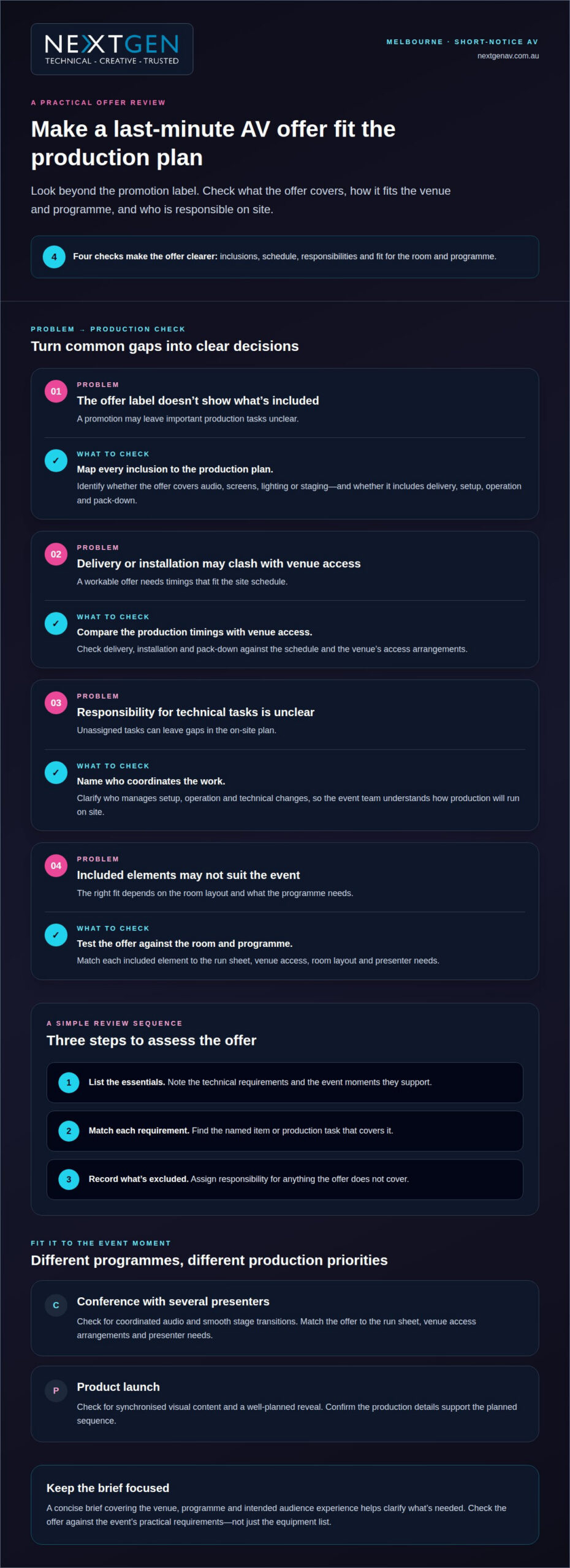
A last-minute promotion is useful when its inclusions match the event’s production plan. In Melbourne, assess the proposed arrangement against the venue, schedule and audience experience. Look beyond the promotion label and identify which production elements it covers, such as equipment, delivery, setup, operation or pack-down. These details show whether the offer supports the event from arrival through to the final session.
Use this three-step review to assess an offer. First, list the essential technical requirements and the moments they support. Second, match each requirement to a named item or production task in the offer. Third, note anything excluded and assign responsibility for it. This gives your event team a clear picture of how the arrangement will work on site.
- Map the inclusions: identify the audio, screens, lighting or staging covered by the offer.
- Check the schedule: compare delivery, installation and pack-down timings with venue access.
- Review responsibilities: establish who coordinates setup, operation and technical changes.
- Test the fit: assess whether the included elements suit the room layout and programme.
For example, a conference with several presenters may need coordinated audio and smooth stage transitions. A product launch may depend on synchronised visual content and a well-planned reveal. In either case, map the offer’s inclusions against the run sheet, venue access arrangements and presenter needs. The offer is most useful when it covers those practical requirements, rather than leaving key production tasks unassigned. A concise brief covering the venue, programme and intended audience experience helps clarify what’s needed.
What AV equipment can be hired at short notice in Melbourne, such as speakers, microphones, projectors and screens?
For last-minute AV hire in Melbourne, define the event’s essential technical needs before selecting equipment. A conference with guest speakers needs clear speech throughout the room. A product presentation needs images that remain visible from audience seating. These outcomes guide equipment choices more effectively than a general request for AV.
Common equipment categories include audio, microphones, projection and display screens. Match each item to the programme and venue. A panel discussion, for example, needs microphones for presenters and suitable sound coverage for attendees. A slide presentation needs a projector or screen arrangement suited to the room’s layout and lighting.
- Speakers: plan coverage around the audience area, seating arrangement and spoken-word requirements.
- Microphones: identify who speaks, whether they move around, and how audience questions will be heard.
- Projectors: consider the presentation content, projection surface and available placement within the room.
- Screens: assess sightlines from the back and sides, not only the front rows.
Prepare a concise brief with the venue name, room layout, event schedule and purpose of the equipment. Include the presentation format and any planned video or audio playback. These details help align connections, positioning and setup with the programme. For example, a presenter using slides and video needs a coordinated display and playback plan.
Lighting also affects how clearly attendees see presenters and screens. Strong ambient light can reduce the visibility of projected images, while stage lighting helps define the presentation area. Consider Lighting Design and Equipment as part of the overall room plan, so visual elements support rather than distract from the content. A clear technical brief turns a rushed request into practical production priorities.
Are there minimum hire periods, deposits, cancellation fees or late-booking surcharges?
For a Melbourne AV booking, clarify the hire schedule and process for changes before finalising the event plan. The agreed schedule should set out when equipment access begins and ends, including delivery, setup, rehearsals and pack-down where relevant. Record these timings alongside venue access arrangements so everyone works from the same production schedule.
Cancellation and postponement arrangements also need clear communication. Identify who must be notified, how changes should be recorded and which event details need updating. If a conference date moves, the organiser may need to revise the run sheet, venue access plan, presenter schedule and technical requirements. Keeping a current written record helps prevent outdated instructions reaching the production team.
For a short-notice booking, share the event date, venue, access window and programme status in one clear brief. Record any later changes in the same place. This gives organisers, venue staff and technical crew a reliable reference, especially when details shift close to delivery.
- Hire schedule: record the agreed access, setup, event and pack-down timings.
- Change process: note who communicates updates and how the revised details are documented.
- Cancellation process: identify the notification steps and information the organiser must provide.
- Late changes: update the run sheet, venue arrangements and production instructions together.
Before confirming the event plan, compare the written schedule with the venue’s access arrangements and the latest programme. A postponed product launch, for example, may need a revised presenter sequence and updated technical cues, while a change to venue access can affect installation timing. Keep one current version of the schedule available to everyone coordinating the event. Clear change control keeps production organised and helps the team respond consistently as plans evolve.
Ask the provider to state whether a minimum hire period applies, whether a deposit is required, and how cancellation charges are handled; confirm any late-booking surcharge before agreeing. Booking a rental car well in advance is recommended to access the best rates. Keep the confirmed terms with the event schedule, and check that any subsequent booking change is reflected in the written arrangement before relying on it.
What backup equipment and support are available if hired AV gear fails during an event?
A useful contingency plan identifies the potential failure, an immediate workaround and who will act. At a conference, a microphone fault could interrupt a speaker’s address, while a display issue could make presentation slides unavailable. Before doors open, identify the critical equipment and the person responsible for responding, so the event team can act without confusion.
Build simple alternatives into the event plan. A spare wired microphone can provide a fallback if a wireless microphone stops working. A second presentation source, such as a laptop with the slides loaded, can help if the primary computer fails. Keep essential adapters and connection cables accessible, and test alternatives during setup rather than waiting for a fault.
Agree on a practical response sequence with the technical team:
- Identify the fault: tell the technician whether audio, visuals or lighting have stopped working.
- Protect the programme: pause or adjust the segment while the issue is assessed.
- Switch to the fallback: use the agreed spare equipment or alternate presentation source.
- Confirm the recovery: test the restored signal before resuming the affected segment.
On-site technical support can help distinguish a faulty device from a connection or signal problem. For example, a blank screen may come from the playback source, a cable or the display path. A technician can work through those points systematically, while an event organiser keeps presenters informed and adjusts the run sheet if needed.
Include access arrangements, the event schedule and escalation roles in the production plan. For a hybrid event, also account for the online audience if a camera, audio feed or streaming connection is affected. A planned fallback helps maintain communication across both audiences. Plan technical support for your event as part of the production brief, including who responds and how the programme continues during a fault.
NextGen AV: LED Video Walls
NextGen AV can incorporate LED Video Walls into your event plan when presenters, visuals or brand content need a strong focal point. At a conference, a well-positioned display helps attendees follow presentations; at a product launch, it can carry visual content that supports the reveal. Screen size, placement and content format all affect how clearly the audience experiences the moment.
Combining LED Video Walls with Professional Audio Systems, Lighting Design and Equipment, or Staging and Rigging can create a coordinated event environment. The right combination depends on your venue, programme and audience layout. Share those details with NextGen AV when discussing your production requirements.
Contact NextGen AV to discuss LED Video Walls for your Melbourne event.
Set your event in motion
For last-minute AV hire in Melbourne, turn your event plan into a clear production brief. Share the venue, schedule, audience layout and the moments that need to land, such as a keynote, product reveal or live discussion. This gives NextGen AV a practical foundation for planning around your programme, rather than treating each element as a separate task.
NextGen AV brings LED Video Walls, Professional Audio Systems and Lighting Design and Equipment together as part of event production, aligning technical choices with what attendees need to see, hear and remember. Discuss your event with the team to set priorities and plan a clear path from preparation through to delivery.
Contact NextGen AV about your event and take the next step towards a polished, engaging experience. Your event can still make a confident impression.
In the high-stakes arena of executive leadership, the most powerful tool on stage isn’t the keynote speaker’s charisma; it’s the absolute silence of a perfectly tuned sound system. When you invest in corporate conference audio hire melbourne, you aren’t just renting speakers and microphones. You’re securing the integrity of your message and the prestige of your brand. We know the stress of planning a premier event only to have it undermined by muffled speech or the crackle of wireless interference in the congested Melbourne CBD. It’s frustrating to deal with unsightly equipment cluttering your stage or technicians who don’t quite grasp the nuances of corporate etiquette.
This 2026 guide helps you master the technical essentials of professional audio production to ensure your conference delivers crystal-clear speech and high-impact sound. You’ll learn how to navigate complex frequency regulations and select elite hardware that remains invisible to your audience. We’ll preview the latest beamforming microphone arrays and the expert technical direction required to transform a standard presentation into a cinematic experience that resonates with every delegate in the room.
Key Takeaways
- Focus on speech intelligibility rather than sheer volume to ensure your executive message is heard clearly by every delegate in the room.
- Master the complexities of corporate conference audio hire melbourne by understanding how line array technology and wireless frequency coordination prevent interference in the busy CBD.
- Navigate the specific acoustic challenges and logistical requirements of major Melbourne venues, from modern glass atriums to historic high-rise spaces.
- Utilise a professional five-step audit process to align your audio system with your keynote speakers’ technical riders and your specific audience layout.
- Leverage expert technical direction to transform your conference audio into a seamless, invisible engine that drives event success.
The Fundamentals of Professional Corporate Conference Audio
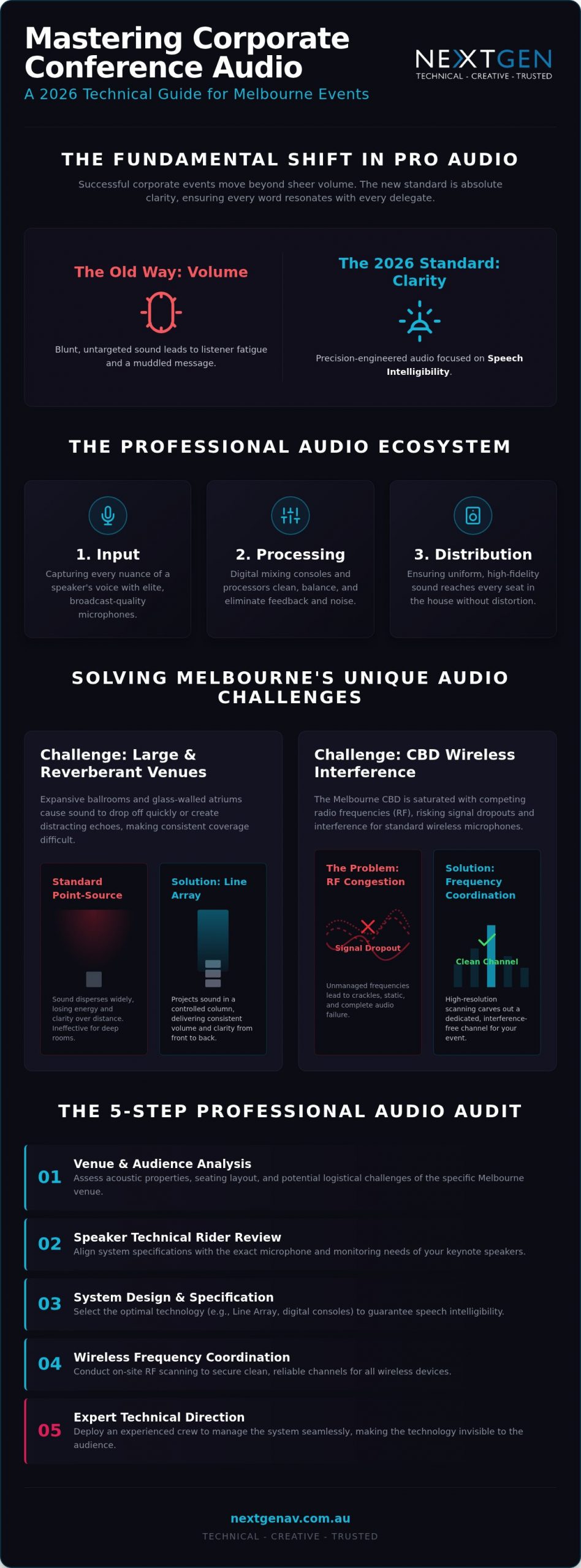
Professional conference audio is an invisible architecture. It’s designed to deliver uniform coverage where every seat is the best seat in the house. When you secure corporate conference audio hire melbourne, you’re investing in a system engineered specifically for speech intelligibility. This isn’t just about making things louder; it’s about making them understood. A standard Public Address (PA) system might suffice for a local sports club, but it often fails in the high-stakes corporate environment. Basic systems lack the sophisticated processing needed to manage the complex acoustics of a Melbourne ballroom or a modern glass-walled atrium.
We view professional sound as a three-part ecosystem. First, the Input captures every nuance of the speaker’s voice through elite microphones. Second, Processing cleans and balances the signal to eliminate feedback and background noise. Finally, Distribution ensures high-fidelity sound reaches the back of the room without deafening the front row. This level of precision builds brand authority. It allows your audience to focus entirely on your message rather than the distraction of poor sound.
Beyond speech, the right atmosphere is often set by high-quality background audio; if you’re looking to enhance your venue’s sonic profile, you can check out sonicsense for tailored music solutions for commercial spaces.
Why Speech Intelligibility is Your Most Critical Metric
Volume is a blunt instrument. Clarity is a surgical tool. In a conference setting, “loud” often masks “muffled,” leading to listener fatigue. This happens when delegates subconsciously tune out because their brains are working too hard to decipher words. This disengagement is the death of a successful event. To combat this, we rely on the Speech Transmission Index (STI), which is an objective numerical scale used to measure how well a system preserves the complex characteristics of human speech as it travels from a speaker to a listener.
The Shift to Digital: 2026 Standards in Conference Audio
The landscape of corporate conference audio hire melbourne is now a fully digital domain. Modern digital mixing consoles allow our technicians to orchestrate precise control over dozens of audio channels with instant scene recalls for different presenters. Dante networking has replaced heavy copper cables with slim ethernet connections, creating a clean, cable-free corporate aesthetic on stage. These systems are the engine behind successful hybrid events. They ensure that those joining via virtual platforms experience the same crystal-clear audio as those sitting in the front row of the venue.
Technical Essentials: Line Arrays and Wireless Management in Melbourne
Elite sound is an exercise in physics and foresight. When you engage in corporate conference audio hire melbourne, you’re looking for more than just equipment; you’re seeking a system that overcomes the specific architectural challenges of high-end venues. For large Melbourne ballrooms, the traditional approach of placing a speaker on a stand often fails because sound volume drops off too quickly over distance. This is where Line Array technology becomes the gold standard. Unlike point-source speakers that radiate sound in a sphere, line arrays project sound in a controlled cylinder, ensuring that a delegate in the back row of a deep plenary hall hears with the same clarity as someone in the front row.
Line Arrays vs Point Source: Choosing for Your Venue
Choosing the right configuration depends on your room’s geometry. For wide, shallow rooms, point-source systems can provide excellent lateral coverage. However, for the expansive ballrooms found in Melbourne’s premier hotels, line arrays are essential for uniform distribution. Safety is our priority; every overhead rig we install follows strict Australian standards for weight loading and secondary safety bonds. This technical rigour ensures that your corporate conference audio hire melbourne doesn’t just sound elite but operates with absolute structural integrity.
Solving the Melbourne CBD Wireless Challenge
The Melbourne CBD and Docklands present a unique “RF Congestion” nightmare. With hundreds of businesses, television stations, and emergency services competing for airwaves, a standard wireless microphone can easily drop out or pick up interference. We treat wireless management as a dedicated discipline. Our team uses high-resolution frequency scanners to carve out clean, dedicated channels before your first speaker ever touches the stage.
Following best practices for accessible events, we ensure that every microphone is calibrated for high-gain-before-feedback, allowing speakers of all vocal strengths to be heard without strain. We also employ encrypted digital wireless systems. This is a non-negotiable standard for corporate events where sensitive data or proprietary strategies are discussed. To maintain your event’s visual prestige, we focus on “Discrete Audio,” hiding cables and using low-profile speakers that blend into the room’s architecture. It’s about the “Invisible Expert” philosophy where the technology is felt, not seen. If you’re looking for this level of precision, our team provides professional technical direction to ensure every detail is managed seamlessly.
Navigating Melbourne Venues: Acoustics and Local Logistics
Melbourne’s architectural profile is as diverse as its weather. Securing corporate conference audio hire melbourne requires a team that understands the specific sonic fingerprint of the city’s most iconic spaces. A historic town hall with its high, ornate ceilings presents a vastly different challenge than a contemporary glass atrium in Docklands. While the former traps sound in a cycle of endless reverberation, the latter reflects it harshly, creating a shattering effect that destroys speech clarity. We bridge this gap through meticulous site inspections, identifying potential acoustic dead zones before they become a live event crisis.
Managing Echo and Reverberation in Challenging Spaces
Controlling sound in reflective environments is about precision, not power. In deep rooms or high-ceilinged galleries, we utilise delay speakers to reinforce the audio signal at strategic intervals. This technique ensures that sound remains crisp at the back of the room without over-amplifying the front, maintaining a comfortable volume for everyone. Our technical direction ensures your audio stays contained within your designated event area, preventing spill into adjacent sessions. By following established event presenter guidelines, we coach speakers on microphone technique to further mitigate room-induced echo.
Melbourne Regulatory and Safety Compliance
Logistics in the Melbourne CBD demand a high level of operational mastery. Whether it’s navigating the vast loading docks of the Melbourne Convention and Exhibition Centre (MCEC) or coordinating lift access in a Collins Street high-rise, timing is everything. We manage the bump-in process with military precision, ensuring all equipment is onsite and tested well before your delegates arrive. Compliance isn’t just a checkbox; it’s a core pillar of our service. Every piece of hardware we deploy undergoes rigorous test and tag procedures to meet venue safety standards. We strictly adhere to WorkSafe Victoria requirements for all rigging and electrical setups, providing you with absolute peace of mind. For events in residential-adjacent zones like Southbank, we proactively manage noise restriction compliance, ensuring your high-impact sound doesn’t lead to regulatory friction. NextGen AV acts as your invisible expert, handling these complex local variables so you can focus on the stage.
Organising Your Conference Audio Hire: A 5-Step Strategy
- Step 1: Define your layout. Your room configuration dictates the soundscape. A theatre-style plenary requires a different speaker deployment than a banquet-style awards night where 360-degree intelligibility is paramount.
- Step 2: Audit the technical rider. This document is the mandate for your talent’s success. It lists the specific microphone, monitoring, and connectivity needs of your keynote speakers.
- Step 3: Choose your support level. Decide between “Dry Hire,” where you manage the gear, or “Full Service,” where an elite team handles the technical direction and execution.
- Step 4: Integrate hybrid requirements. If you’re streaming to a global audience, your audio feed must be pristine, encrypted, and separate from the physical room mix.
- Step 5: Master the schedule. Rehearsals aren’t just for the presenters; they’re for the technicians to fine-tune the room’s response and calibrate the digital signal processing.
Understanding the Technical Rider
A technical rider is more than a request; it’s a blueprint for a professional performance. Conflicting requirements from multiple guest speakers can create logistical friction. One presenter might demand a lapel microphone while another requires a high-fidelity handheld for a Q&A session. A technical director acts as the primary liaison with talent, harmonising these needs into a single, efficient audio plot that maintains the event’s momentum without awkward transitions.
Budgeting for Excellence: Beyond the Equipment List
Strategic budgeting focuses on reliability rather than just the bottom line. The cheapest quote often masks risks like poor equipment maintenance or a lack of onsite backup gear. It’s vital to identify “hidden” costs such as transport, specialised rigging, and after-hours labour early in the planning phase. For a deeper look at how to manage these variables, explore our guide to Full Service Event Production: The 2026 Guide to Flawless Australian Events. Our team provides the professional technical direction required to turn a standard equipment list into a prestigious corporate experience.
Why NextGen AV is Melbourne’s Choice for Conference Audio
NextGen AV has spent over 30 years mastering the nuances of the Melbourne event landscape. We understand that your conference is more than just a gathering; it’s a high-stakes platform for leadership and innovation. For executives looking to navigate the future of technology, click here to learn more about Stellance AI’s strategy for leaders. Our “Invisible Expert” philosophy means we take full ownership of the technical complexities so you can step into the spotlight with absolute confidence. When you choose us for corporate conference audio hire melbourne, you’re partnering with a team that views technical production as a dedicated craft rather than a mere utility.
Elite sound is the heartbeat of an event, but it’s most effective when harmonised with a complete visual and structural environment. We specialise in end-to-end technical production, seamlessly integrating professional audio with high-impact LED Video Walls and custom Stage and Lighting Hire. This holistic approach ensures that your brand’s aesthetic is consistent across every sensory touchpoint, from the clarity of a keynote to the brilliance of the stage design.
The Peace of Mind of Technical Direction
Partnering for Success in Melbourne
Every project we undertake is a collaborative partnership. We don’t believe in one-size-fits-all solutions. Instead, we provide bespoke event design and acoustic reinforcement tailored to your specific venue, setting a new standard for corporate conference audio hire melbourne. Our commitment to excellence is backed by a massive inventory of elite, professionally maintained audio hardware. We take personal pride in every execution, allowing you to focus on the prestige of your results while we handle the engine behind the scenes. Enquire about your Melbourne corporate conference audio requirements today and experience the quiet power of professional technical direction.
Elevating Your Executive Presence with Elite Sound
Mastering the nuances of corporate conference audio hire melbourne is about more than just checking an equipment list. It’s about engineering an environment where every word carries the weight of your brand’s authority. By prioritising speech intelligibility over sheer volume and navigating the complex wireless congestion of the CBD with precision, you transform a standard presentation into a cinematic experience. You’ve seen how the right technical strategy eliminates listener fatigue and ensures your message resonates in even the most acoustically challenging Melbourne venues.
NextGen AV brings over 30 years of Melbourne event production mastery to your stage. Our team provides the expert technical direction and elite-grade audio hardware required to guarantee crystal-clear results, allowing you to focus on your delegates while we orchestrate the engine behind the scenes. We’re ready to partner with you to deliver a seamless, high-impact result that reflects the prestige of your organisation. Secure Your Flawless Conference Audio with NextGen AV
Frequently Asked Questions
What is included in a corporate conference audio hire package?
A comprehensive package includes professional audio systems tailored to your venue size, digital mixing consoles, and a variety of microphones such as lapel, handheld, and lectern options. We also integrate staging and rigging to ensure optimal speaker placement for uniform sound distribution. Every setup is managed through our technical direction service, providing you with a complete, end-to-end solution that removes the logistical burden from your high-stakes planning team.
How do you ensure clear sound for hybrid delegates and remote speakers?
We utilise specialised virtual and hybrid event solutions to guarantee crystal-clear audio for both in-person and remote attendees. This involves creating a discrete digital audio bus that is separate from the live room mix, which prevents the hollow echo often found in poorly managed hybrid meetings. Our technicians manage these feeds in real-time, ensuring that remote speakers are heard with the same presence and authority as those on stage.
Do you provide on-site sound engineers for the duration of the conference?
Yes, we provide expert on-site technical direction and sound engineers for the entire duration of your event. Our “Invisible Expert” philosophy means our team is always present to manage transitions and monitor levels without intruding on the executive atmosphere. These seasoned veterans take personal pride in seamless execution, allowing you to focus on your presentation while we orchestrate the technical engine behind the scenes to maintain elite professional standards.
Can you handle wireless microphone setups in the Melbourne CBD without interference?
We navigate the high RF congestion of the Melbourne CBD by using advanced frequency scanners to identify and secure clean channels for all wireless microphones. This proactive approach ensures your corporate conference audio hire melbourne remains free from dropouts or interference from local broadcasters. We strictly adhere to ACMA frequency regulations, providing encrypted digital wireless systems that protect your proprietary information while delivering reliable, high-fidelity speech intelligibility throughout your venue.
What is the difference between point source and line array speakers for conferences?
Point source speakers are ideal for wide, shallow spaces where sound needs to be dispersed from a single location. In contrast, line array technology is the gold standard for large Melbourne ballrooms because it projects sound in a controlled pattern that maintains volume over long distances. This ensures that delegates at the rear of a deep room experience the same clarity as those in the front row without requiring excessive, uncomfortable volume levels.
Do you coordinate with Melbourne venues regarding rigging and electrical safety?
Our team manages all coordination with venue managers regarding staging and rigging logistics to ensure absolute safety and compliance. We strictly follow WorkSafe Victoria requirements and ensure that all hired equipment undergoes rigorous test and tag procedures before arriving on-site. By handling the complex requirements of loading docks and lift access in high-rise CBD buildings, we alleviate the logistical stress often associated with large-scale corporate productions.
How far in advance should I book my audio visual equipment in Melbourne?
We recommend booking your audio-visual requirements at least three to six months in advance, especially for events held during peak conference seasons in Melbourne. Early engagement allows us to conduct thorough site inspections and secure the most elite, well-maintained hardware for your specific dates. For high-stakes corporate conference audio hire melbourne, this lead time ensures our technical directors can integrate your speaker riders into a comprehensive, risk-managed production plan.
What happens if there is a technical issue during a keynote presentation?
Our technical direction framework includes the deployment of redundant backup systems for every critical audio component. If a technical challenge arises, our on-site engineers are trained to implement immediate, silent solutions that prevent any disruption to your keynote presentation. It’s a core pillar of our service, providing you with the peace of mind that comes from knowing seasoned veterans are safeguarding your event’s success with quiet, behind-the-scenes power.
What if the most sophisticated speakers on the market still left your audience in the back row straining to hear a single note? It’s a sobering thought for any event organiser. You understand that a high-stakes production in the heart of the city is a delicate balancing act of technical precision and local logistics. The lingering anxiety of piercing audio feedback or a sudden noise complaint from the council can quickly turn a visionary concept into a logistical nightmare. When you invest in concert sound system hire melbourne, you aren’t just renting boxes and cables; you’re commissioning a flawless auditory experience that defines your brand’s reputation.
We’re here to ensure your next show is remembered for its prestige rather than its technical glitches. This guide provides a roadmap to securing world-class audio through high-end hardware, expert technical management, and seamless execution. We will break down the essential components of elite sound design, from eliminating dead spots in complex venues to managing the intricate permit requirements of the Melbourne CBD. By the end of this article, you will have the clarity needed to lead a professionally managed production where the technology remains invisible and the impact is absolute.
Key Takeaways
- Understand the critical difference between standard PA hire and high-impact concert audio to ensure your event delivers professional power and clarity.
- Identify the essential hardware components, including line arrays and digital consoles, required for a world-class concert sound system hire melbourne.
- Learn to navigate venue-specific acoustic challenges, from the heritage architecture of the Melbourne Town Hall to the open-air requirements of CBD festivals.
- Optimise your event timeline with a professional approach to load-in, rigging, and the all-important sound check to eliminate technical stress.
- Discover how expert technical direction integrates audio, lighting, and vision for a cohesive and prestigious audience experience.
Why Concert Sound System Hire in Melbourne Requires a Professional Edge
Sound is the invisible heartbeat of any live event. While a basic speaker on a stick might suffice for a small gathering, a high-stakes production requires a sophisticated Sound reinforcement system capable of delivering high-SPL (Sound Pressure Level) and high-fidelity audio across every square metre of the venue. Securing the right concert sound system hire melbourne means looking beyond the hardware to find a partner who understands the physics of air and the psychology of sound. When you transition from a basic PA setup to a full-scale production, you move from mere volume to comprehensive coverage that ensures the person in the front row and the guest at the very back share the same pristine experience.
For high-impact events, “dry hire” is rarely a viable option. Modern audio rigs are incredibly complex; they require precision rigging, time-alignment, and active frequency management to prevent the muddy resonance that plagues amateur setups. A professional edge means having a team that manages the technical burden, allowing you to focus on the prestige of the performance. Without this technical direction, you risk the dreaded feedback loops and dead spots that can instantly derail a multi-million dollar brand launch or a long-awaited musical tour.
The Impact of Professional Audio on Audience Engagement
Crystal-clear audio is a powerful tool for reinforcing brand prestige. For corporate launches, the weight of a speaker’s voice can carry more authority when the low-end frequencies are balanced and the high-end is crisp. For festivals, high-fidelity audio creates an emotional connection that vibrates through the crowd, turning a simple performance into a shared cultural moment. Acoustic immersion is the art of creating a three-dimensional soundscape where the boundary between the audience and the performance dissolves; ensuring every guest feels the pulse of the music as if they were standing directly in front of the stage.
Navigating Melbourne-Specific Event Challenges
Melbourne presents a unique set of logistical hurdles for event organisers. Our city is famous for its heritage halls, which often feature stunning architecture but nightmarish acoustics due to hard, reflective surfaces. Simultaneously, outdoor events in the Melbourne CBD or inner suburbs like Richmond and St Kilda must adhere to strict noise permit regulations that are constantly evolving. As we look toward 2026, council requirements for noise mitigation and environmental impact are becoming even more stringent. Partnering with a team that has 30 years of experience in the local landscape ensures you have an ally who knows how to coordinate with council managers and venue operators to secure the necessary permits without compromising the power of your show.
The Anatomy of a World-Class Concert Audio Rig
A high-impact concert rig is a complex ecosystem where every component must work in absolute synergy. It’s not enough to simply have loud speakers; you need a system that translates the artist’s vision into a physical sensation for the audience. The foundational trinity of any concert sound system hire melbourne consists of line arrays for broad coverage, subwoofers for visceral low-end impact, and stage monitors that allow performers to hear themselves with studio-grade clarity. When these elements are correctly integrated, they create a wall of sound that feels both powerful and intimate, regardless of the venue’s size.
The brain of this operation is the digital mixing console. Modern consoles manage hundreds of inputs with microsecond precision, allowing engineers to sculpt the audio landscape in real time. This technical mastery extends to wireless microphone systems, where frequency coordination is a non-negotiable task. In Melbourne’s increasingly congested radio environment, failing to scan and coordinate frequencies can lead to disastrous dropouts mid-performance. Safe execution also relies on expert rigging and staging, ensuring that massive speaker clusters are flown securely and positioned for optimal acoustic throw. Collaborating with a team that provides end-to-end professional audio systems ensures that these technical layers work in perfect harmony.
Line Array Technology vs. Point Source Speakers
Line arrays are the industry standard for large-scale Melbourne concerts because they provide exceptional control over sound direction. By arranging speakers in a vertical column, we can direct energy toward the audience while minimising reflections off the ceiling and floor. For smaller, more intimate venues, point source speakers are often preferred for their natural tonality and compact footprint. In simple terms, the Inverse Square Law describes how sound volume naturally drops as you move away from the source; specifically, sound pressure level decreases by six decibels for every doubling of distance from a point source speaker, whereas line arrays can mitigate this loss to maintain consistency across a vast arena.
Digital Signal Processing (DSP) and System Tuning
Modern Digital Signal Processing (DSP) allows us to “tune” a room, compensating for the natural echoes and resonance of the architecture. This is particularly vital when dealing with The Acoustics of Concert Halls, which can vary wildly between heritage buildings and modern glass-walled spaces. System tuning involves precise time-alignment, ensuring that the sound from the subwoofers on the floor reaches the listener’s ears at the exact same millisecond as the audio from the flown line arrays. This level of precision prevents the “muddy” sound often heard in amateur setups and guarantees that every seat in the house receives the same elite audio quality.
Choosing the Right Sound System for Your Melbourne Venue
Every venue in Melbourne possesses a unique acoustic personality. A system that delivers punchy, intimate audio in a Fitzroy basement will likely fail to reach the back rows of the Royal Exhibition Building. Selecting the right concert sound system hire melbourne requires a strategic approach that scales with your audience size and the physical geometry of the space. It isn’t just about the number of speakers; it’s about the precision of their placement and the power required to maintain clarity without distortion. To achieve a professional result, we categorise systems based on the intended reach:
- Intimate Gatherings (Up to 100 people): High-fidelity point source speakers offer exceptional clarity and a compact footprint, perfect for corporate presentations or private gallery shows.
- Mid-Scale Productions (Up to 500 people): These require high-output systems, often utilising ground-stacked arrays to ensure even coverage across a wider floor area.
- Large-Scale Concerts (2000+ people): These demands flown line arrays and dedicated delay towers to overcome the natural decay of sound over long distances.
Budgeting for these setups involves balancing hardware costs with the technical labour required for a flawless execution. Investing in an elite engineer is often more critical than the equipment itself; they are the ones who translate raw power into a refined auditory experience. For those coordinating comprehensive event needs beyond just audio, our guide to Audio Visual Hire Melbourne offers deeper insights into integrating vision and lighting for a cohesive result.
Indoor Excellence: Controlling Acoustics in Melbourne Landmarks
Heritage-listed buildings like the Melbourne Town Hall present significant challenges due to their high ceilings and hard, reflective surfaces. Managing reverb in these spaces requires directive audio design to keep sound off the walls and focused on the audience. We prioritise integrating our systems with existing venue infrastructure to maintain the aesthetic prestige of the room while ensuring modern audio performance. This often involves using sophisticated modelling software to predict how sound will behave before the first speaker is even uncased.
Outdoor Festivals and Community Events
Outdoor environments introduce variables that no indoor venue faces. Wind can physically “blow” high-frequency sounds off course, requiring more aggressive system tuning and power. Remote Melbourne locations also demand robust power distribution and silenced generator sets to maintain a professional atmosphere. Safety is paramount when flying heavy equipment outdoors; we strictly adhere to the Safety Guidelines for the Entertainment Industry to protect both the audience and the production crew. Given the unpredictable nature of our local climate, every outdoor rig we deploy is equipped with weather-resistant protection to ensure the show continues, regardless of a sudden Melbourne downpour.
Logistics and Execution: Ensuring a Flawless Sound Check
The success of a show is won or lost long before the first guest arrives. For concert sound system hire melbourne, the production timeline is a meticulously choreographed sequence of technical milestones that leave zero room for error. It begins with the load-in and the complex rigging of overhead arrays, moving quickly into a line check to verify every signal path. The sound check itself is the most critical hour of your event planning. This is the moment where technical theory meets the physical reality of the venue, allowing the engineer to calibrate the system for the artist’s specific needs and the room’s unique resonance.
Navigating the requirements of artist riders is a core part of our craft. Touring acts expect a specific level of technical excellence, and meeting these demands requires a proactive approach to technical direction. Your Front-of-House (FOH) engineer is the invisible expert at the helm, making micro-adjustments throughout the live performance. As the room fills and the temperature rises, the acoustics change; a professional engineer anticipates these shifts to ensure the audio remains punchy and pristine from the opening act to the final encore. This level of dedication is what separates basic equipment rental from true concert sound system hire melbourne.
Avoiding Common AV Glitches on Show Day
Proactive feedback suppression is the hallmark of a seasoned crew. By carefully managing gain staging and using sophisticated digital notch filters, we eliminate the piercing squeals that can ruin a presentation. Wireless interference is another major hurdle, particularly in high-traffic Melbourne areas where the radio frequency spectrum is crowded. We perform real-time frequency scans to find clean air for every wireless microphone and monitor. For a deeper dive into maintaining technical excellence, explore our guide on Professional Sound System Hire.
Workplace Health and Safety (WHS) for Sound Rigs
Safety is the foundation of every elite production. Rigging massive speaker clusters overhead requires certified expertise and a deep understanding of load-bearing limits. We also prioritise rigorous cable management to eliminate trip hazards for both your attendees and the backstage crew. Hiring a team with comprehensive public liability insurance isn’t just a box-ticking exercise; it’s a vital safeguard for your event’s reputation. Secure your peace of mind by partnering with an elite team for your professional audio systems.
NextGen AV: Technical Direction for Melbourne Concerts
Success in live production isn’t just about high-end hardware; it’s about the technical mastery required to command it. NextGen AV brings over 30 years of industry experience to every stage we build. We operate as the “Invisible Expert,” the engine behind the scenes that allows you to take centre stage without a single worry. While others might offer simple “dry hire” where you’re left to figure out the logistics yourself, we provide a sophisticated partnership that covers every detail from the initial site inspection to the final pack-down. This comprehensive approach to concert sound system hire melbourne ensures that your event isn’t just loud, but prestigious and polished.
Our role as a “Confident Orchestrator” means we take full ownership of the technical landscape. A dedicated Technical Director oversees the integration of sound, lighting, and vision, ensuring these elements don’t just coexist but enhance one another. This coordination is vital for high-impact events where the margin for error is non-existent. By centralising your technical management with one elite provider, you eliminate the stress of juggling multiple vendors and the communication gaps that often lead to show-day glitches. We handle the technical weight so you can focus on the result.
Mastery Beyond Hardware: Our Engineering Expertise
Our team consists of seasoned audio engineers and production managers who have spent decades perfecting their craft in Melbourne’s most demanding venues. We don’t just set up equipment; we sculpt soundscapes. Whether it’s managing complex rigging or performing real-time frequency coordination in a congested CBD environment, our experts thrive under pressure. This deep technical intuition allows us to deliver a Full Service Event Production experience that prioritises audience immersion and brand reputation. We understand that your event is a high-stakes investment, and we treat it with the precision and artistry it deserves.
Partnering for Your Next Big Event
We are proud to be the trusted partner for government bodies, major corporate brands, and festival organisers across Victoria. Our reputation is built on 30 years of consistent, high-impact results. By consolidating your audio, LED video walls, and staging needs, you gain a streamlined workflow and a unified technical vision. This collaborative approach doesn’t just reduce the logistical grind; it elevates the final result to a level of excellence that few can match. If you’re ready to move past the uncertainty of basic equipment rental and experience elite technical direction, it’s time to talk. Organise a consultation for your Melbourne concert sound today and let our team turn your vision into a world-class auditory reality.
Secure a Flawless Auditory Legacy for Your Next Event
High-impact events in 2026 demand more than just volume; they require a sophisticated orchestration of technology and professional expertise. Elite hardware, from precision line arrays to digital consoles, forms the foundation of a prestigious show, yet the true difference lies in the hands of the engineers who navigate Melbourne’s unique venue acoustics and strict local regulations with absolute precision. When you invest in concert sound system hire melbourne, you’re commissioning a partnership that prioritises your brand’s reputation and your audience’s immersion above all else.
NextGen AV brings over 30 years of Melbourne event production experience to your stage, providing the quiet power needed to drive a successful show. Our team offers dedicated on-site technical direction and engineering, ensuring every frequency is tuned to perfection. We don’t just provide equipment; we deliver a seamless, stress-free execution that allows you to focus on the prestige of the final result while we handle the technical weight. Contact NextGen AV to book your professional concert sound system in Melbourne. Your vision deserves nothing less than absolute technical excellence.
Frequently Asked Questions
What is included in a concert sound system hire package in Melbourne?
A comprehensive package includes high-fidelity line arrays, subwoofers, stage monitors, and digital mixing consoles tailored to your specific venue. Beyond the hardware, we provide the technical direction and engineering expertise required for a flawless show. This end-to-end service covers initial site inspections, frequency coordination, and on-site management. When you choose concert sound system hire melbourne from an elite provider, you’re securing a managed solution rather than just an equipment list.
How much lead time is required to book a professional sound rig for a festival?
We recommend a lead time of three to six months for major festivals to ensure equipment availability and thorough technical planning. While we can often accommodate shorter timelines for smaller corporate shows, festivals involve complex rigging and council permits that require early coordination. This proactive window allows our team to conduct site visits and design a custom audio map that guarantees perfect coverage for your specific audience size and layout.
Can you provide sound systems for outdoor events with strict noise limits?
Yes, we specialise in directive audio designs that maintain high-impact sound for the audience while strictly adhering to local noise limits. By utilising advanced line array technology and digital signal processing, we focus sound energy exactly where it’s needed and minimise spill into surrounding suburbs. This precision is essential for outdoor festivals in the Melbourne CBD or inner suburbs where council noise permit compliance is a non-negotiable requirement for event success.
Do you provide on-site audio engineers to operate the system during the concert?
Every professional rig we deploy is managed by seasoned on-site audio engineers who oversee the system from the sound check to the final encore. Our Front-of-House (FOH) and monitor engineers work closely with the performers to ensure a studio-grade experience for the audience and the artists alike. This “Invisible Expert” approach ensures that technical adjustments are made in real-time, allowing you to focus on the event’s prestige without worrying about the audio mix.
What is the difference between a PA system and a concert line array?
A standard PA system typically uses point source speakers that disperse sound in a spherical pattern, making them suitable for smaller, intimate spaces. In contrast, a concert line array consists of multiple speaker modules arranged vertically to create a cylindrical sound wave. This design allows audio to travel much further with less volume drop-off, providing consistent, high-fidelity coverage across large arenas or outdoor festival grounds that a basic PA simply cannot reach.
Do you handle the delivery, setup, and pack-down for Melbourne CBD venues?
We manage the entire logistical process, including delivery, precise setup, and efficient pack-down for all Melbourne CBD venues. Navigating the tight loading docks and strict access windows of city landmarks requires a team that understands the local landscape. Our crew handles the heavy lifting and technical rigging, ensuring your production remains on schedule and your venue remains compliant with all safety and access regulations throughout the event duration.
Can you integrate your sound system with my existing LED walls or lighting rig?
Our technical direction services are designed to integrate seamlessly with your existing LED video walls, lighting rigs, and staging components. We coordinate signal paths and timecode synchronisation to ensure that audio and visual elements work in perfect harmony. This holistic approach prevents the technical silos that often lead to show-day delays. By aligning all technical layers, we create a unified audience experience that reinforces the professional prestige of your production.
What happens if there is a technical issue during the live performance?
We mitigate risks through built-in system redundancy and proactive monitoring by our on-site engineering team. Our “Confident Orchestrator” approach means we anticipate potential failures before they occur, having backup signal paths and spare components ready for immediate deployment. In the rare event of a technical glitch, our seasoned veterans are trained to resolve issues invisibly and instantly, ensuring the performance continues without the audience ever noticing a disruption.
What if the most powerful speaker in your inventory is actually the reason your audience misses the message? It’s a common misconception that volume equals clarity, but in the high-stakes world of live production, raw power often creates more problems than it solves. We understand the pressure of ensuring every syllable of a keynote speech reaches the back of the room without the interference of a technical glitch. If you’ve ever felt overwhelmed by technical jargon like SPL or RMS, you aren’t alone. Mastering how to choose a pa system for an event is about matching sophisticated technology to the unique acoustics of your Australian venue.
This guide provides a professional roadmap to selecting the perfect audio setup for any audience size. You’ll learn how to comply with the latest ACMA frequency regulations for wireless microphones and why modern column systems are replacing traditional stacks. We’ll explore the transition from passive gear to AI-enhanced, active solutions that simplify your setup while elevating the guest experience. By the end, you’ll have the confidence to partner with technical experts who transform audio from a logistical headache into a seamless, invisible engine of success.
Key Takeaways
- Learn why acoustic clarity outweighs raw wattage and how to prioritise sonic precision to create a professional atmosphere.
- Discover how to choose a pa system for an event by accounting for audience density and the unique architectural challenges of your venue.
- Evaluate the benefits of active versus passive hardware to select a system that balances rapid deployment with elite technical control.
- Master the selection of microphones and digital mixing tools to ensure every keynote speaker is heard with absolute transparency and zero feedback.
- Recognise why managed technical direction and professional sound checks are essential for a stress-free, high-stakes production.
Beyond the Wattage: Understanding Your Event’s Sonic Requirements
A professional audio setup is far more than just a pair of speakers on stands. It’s an intricate, integrated chain of components designed to capture, process, and broadcast sound with absolute fidelity. To understand What is a Public Address (PA) System?, you must view it as a singular organism. From the microphone diaphragm to the speaker cone, every link in that chain must be meticulously calibrated. When people ask how to choose a pa system for an event, they often start by looking at the wattage. This is a mistake.
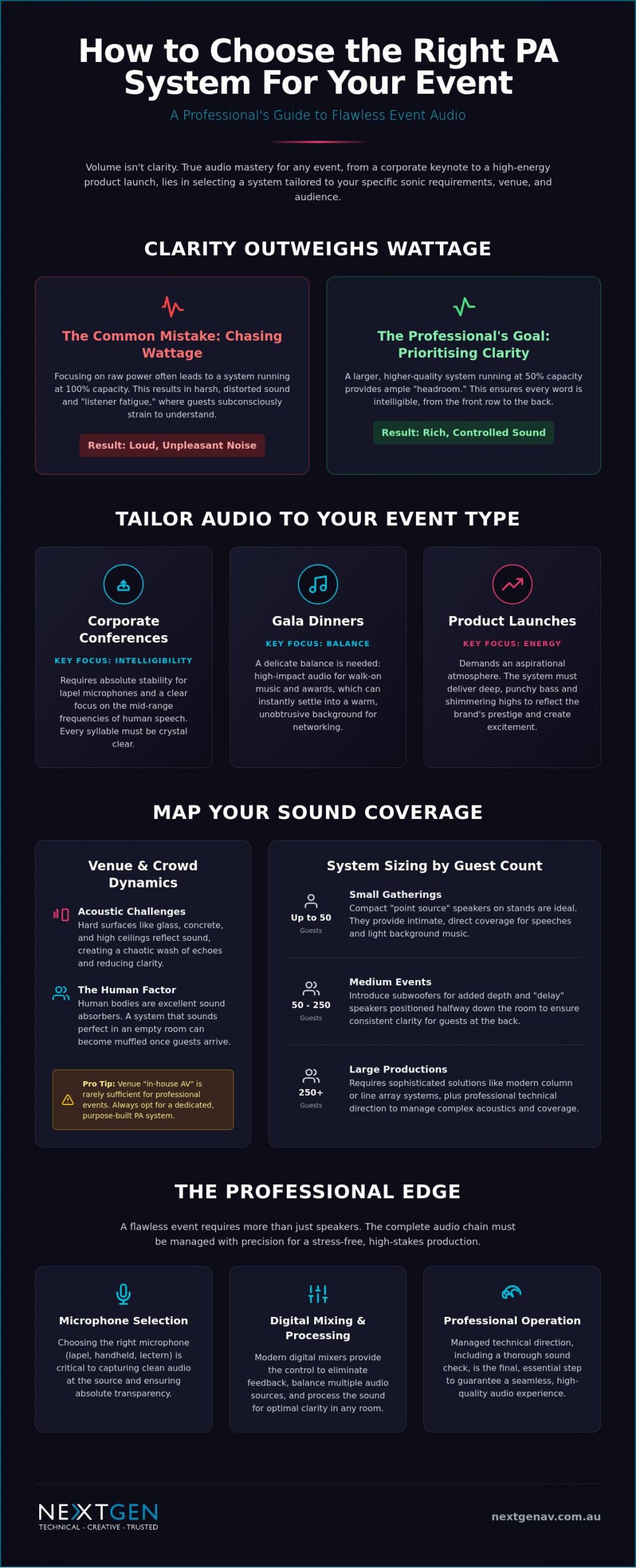
Raw wattage is a measurement of power consumption, not necessarily audio quality or effective coverage. A high-wattage system with poor-quality drivers will simply produce louder, more distorted noise. True mastery lies in “headroom.” This is the buffer between your normal operating volume and the point where the system begins to clip or distort. Running a small, under-powered system at 100% capacity is a recipe for technical disaster. It results in a thin, harsh sound that physically grates on your guests. A larger system running at 50% capacity provides a rich, effortless sonic texture that feels prestigious and controlled.
Intelligibility vs. Volume
Clarity is king. For corporate events, the primary goal is rarely volume; it’s intelligibility. If your CEO is delivering a high-stakes keynote, every syllable must be crystal clear to the person in the very last row. High-frequency dispersion patterns determine how sound travels through a room. Professional-grade drivers ensure that speech doesn’t become a muddy wash of echoes. High-quality components also reduce “listener fatigue,” which is the subconscious exhaustion guests feel when they have to strain to understand a speaker through poor-quality audio.
Defining Your Event Type
Your specific goals dictate your hardware requirements. Every event has a different sonic signature that requires a tailored approach:
- Corporate Conferences: These require absolute stability for lapel microphones and a focus on the mid-range frequencies where human speech lives.
- Gala Dinners: The challenge here is balance. You need high-impact audio for walk-on music and awards, but the system must settle instantly into a warm, unobtrusive bed of sound for table-side networking.
- Product Launches: These demand energy. You want a system capable of delivering deep, punchy bass and shimmering highs to create an aspirational atmosphere that reflects your brand’s prestige.
Determining your primary purpose is the first step in learning how to choose a pa system for an event that truly resonates with your audience.
Audience Size and Venue Dynamics: Mapping Your Sound Coverage
The physical environment is a silent participant in your event’s success. While the hardware matters, the room’s geometry and the density of the crowd dictate how that sound behaves. Large expanses of glass, polished concrete floors, and soaring warehouse ceilings are acoustic nightmares that reflect sound waves, creating a chaotic echo. Conversely, a room full of people acts as a massive, organic sponge. Human bodies are excellent sound absorbers. A system that sounds bright and clear during an empty afternoon sound check might feel muffled and distant once the room is at capacity. Understanding this transformation is central to how to choose a pa system for an event that remains consistent from the first guest to the final applause.
Many organisers fall into the “In-House AV” trap, assuming the venue’s built-in ceiling speakers are sufficient. These systems are typically designed for low-level background music or emergency paging; they lack the frequency response and directional control required for high-stakes presentations. Bypassing these outdated rigs in favour of a dedicated setup ensures your message isn’t lost in a muddy overhead wash. For a deeper look at venue integration, see our Professional Sound System Hire guide.
Sizing Your System by Guest Count
Scale determines your strategy. For small gatherings of up to 50 guests, compact “point source” speakers on stands provide intimate, direct coverage. Once you move into medium events of 50 to 250 people, you must introduce subwoofers to add depth and “delay” speakers positioned halfway down the room. These secondary speakers ensure guests at the back receive the same clarity as those in the front row without needing to blast the volume at the stage. For large-scale productions exceeding 250 guests, line arrays become essential. These vertical speaker columns are engineered to throw sound over long distances with minimal volume drop-off. You can find more technical details on choosing the right PA speakers for specific scales through industry-standard resources.
Coverage Patterns and Speaker Placement
Placement is a game of precision and sightlines. Your Front of House (FOH) setup must be powerful enough to fill the room while being positioned to avoid blocking views of your LED video walls. Organising your speakers to fire slightly inward and downward can help minimise reflections off hard side walls. This also helps in avoiding the dreaded feedback loop, which occurs when a microphone picks up its own signal from a speaker. By carefully mapping the room and using specialised “fills” to cover dead spots, you create a seamless sonic blanket. If you are unsure about your venue’s specific challenges, consulting with a team that provides professional audio solutions can help you navigate these technical hurdles before they become on-site problems. Mastering how to choose a pa system for an event requires this proactive approach to spatial planning.
Active vs. Passive Systems: Selecting the Right Hardware
Deciding on the core architecture of your audio rig is a pivotal moment in your event planning. The technical debate between Active vs. Passive Systems essentially boils down to where the amplification lives. Active speakers house their own amplifiers and cooling systems within the cabinet, creating an elegant, self-contained solution. Conversely, passive speakers are unpowered shells that rely on heavy-duty external amplifier racks. While active systems dominate the portable and DIY markets, passive rigs remain the gold standard for high-end technical direction where precision control and massive scale are paramount.
The “Subwoofer Debate” is often misunderstood in corporate circles. You might think a speech-only seminar doesn’t need a dedicated low-end speaker, but the opposite is true. A subwoofer handles the heavy lifting of the lower frequencies, allowing your main speakers to focus on crystal-clear vocal reproduction. This adds a sense of “weight” and authority to a keynote that point-source speakers alone cannot achieve. It makes the audio feel grounded and prestigious. Of course, adding more components increases the demand for power. You must verify that your Melbourne venue has the electrical capacity to support a full rig. A tripped circuit during a prestigious awards ceremony is a logistical failure that proper pre-production planning easily avoids.
When to Choose Active Speakers
Active speakers are the masters of the rapid setup. They are the go-to choice for breakout rooms, trade show booths, and quick-turnaround presentations where time is your scarcest resource. By reducing the physical footprint of the gear, you keep the focus on your branding rather than the technology. The integrated nature of these units means fewer points of failure and significantly less “cable clutter,” which is vital for aesthetically sensitive gala designs. A major benefit is the built-in protection. Internal limiters act as a safety net, automatically managing the signal to prevent “blown” speakers during loud segments or high-energy walk-on music.
The Power of Passive Line Arrays
When the scale of the event moves into the hundreds or thousands, the power of passive line arrays becomes undeniable. These systems offer incredible scalability. We can increase the number of “boxes” in a vertical hang to reach the furthest corners of a stadium with surgical precision. This architecture allows for centralised control. Our technical directors manage every nuance of the mix from a single amplifier rack at the rear of the venue. By utilising sophisticated Digital Signal Processing (DSP), we can “tune” the system to the unique architecture of the room. This involves adjusting timing and frequency responses to negate echo and ensure every guest receives the same elite experience. Understanding these hardware nuances is essential when learning how to choose a pa system for an event that demands absolute sonic perfection.
The Professional Edge: Microphones, Mixers, and Monitoring
The success of your audio strategy relies on the precision of your input devices. While the speakers deliver the final result, the microphones and mixers act as the brain and nervous system of the rig. In high-density areas like the Melbourne or Sydney CBD, wireless frequency management becomes a critical hurdle. The airwaves are saturated with signals from emergency services, mobile networks, and nearby venues. Failing to coordinate these frequencies leads to dropouts or embarrassing static; a risk no professional organiser should take. Mastering how to choose a pa system for an event means ensuring your audio partner uses high-tier wireless management tools to scan and lock in clean, legal channels in real-time.
Environmental factors also play a role in your technical selection. In Melbourne, where outdoor events must contend with “four seasons in one day,” your technical plan must account for wind noise on microphones and the protection of electronic components from sudden humidity shifts. By integrating these high-tier components into your plan, you move from merely renting gear to investing in a complete sonic experience. If you are ready to elevate your next production, our team specialises in designing bespoke professional audio systems that guarantee absolute clarity regardless of the venue’s challenges.
Microphone Selection for Success
The right microphone empowers your speaker and protects the mix. We typically categorise these based on the presenter’s style and the event’s format:
- The Handheld: This is the most versatile option. It is ideal for Q&A sessions and unpractised speakers who feel more comfortable holding a physical device. It provides excellent gain before feedback.
- The Lapel (Lavalier): The invisible choice for keynote speakers. While it allows for natural hand gestures, it requires careful gain management by a technician to prevent the microphone from picking up ambient room noise.
- The Headset: This is the gold standard for high-energy presenters. Because the microphone stays at a fixed distance from the mouth, it provides the most consistent audio levels and hands-free reliability.
The Role of the Digital Mixer
Modern event audio has been revolutionised by digital mixing consoles. These desks allow for “Scene Recall,” where a technician can instantly switch complex settings between a soft-spoken CEO and a high-impact video presentation. Perhaps the greatest game-changer for planners is remote mixing via a tablet. Instead of being tethered to a bulky desk in the corner, a technician can walk the room, hearing exactly what the guests hear and making real-time adjustments from an iPad. This ensures the mix is balanced for every seat, not just the technical booth. You can learn more about how these elements integrate into Full Service Event Production and how we manage these intricate details behind the scenes.
Finally, never overlook stage monitoring, often called “foldback.” If your presenters cannot hear themselves clearly, they will often shout or lose their natural rhythm. Providing dedicated monitors on stage ensures they feel confident and controlled, which directly translates to a more prestigious performance for your audience. Understanding how to choose a pa system for an event requires this holistic view of both what the audience hears and what the presenter needs to succeed.
Partnering for Success: Why Managed PA Hire Outperforms DIY
Selecting the correct hardware is only half the battle; the true mastery of event audio lies in the execution. Many organisers fall into the “Dry Hire” trap, believing they can pick up a few speakers in a ute and manage the setup themselves. This approach often leads to on-site chaos, cable tangles, and technical glitches that distract from your message. When you are deciding how to choose a pa system for an event, the most critical factor isn’t the brand of the speaker, but the expertise of the person behind the mixing desk. A managed solution transforms your audio from a logistical risk into a seamless, high-prestige experience.
Our approach at NextGen AV is built on 30 years of industry experience. We don’t just provide equipment; we offer a comprehensive technical partnership. This begins with pre-production planning, where we anticipate venue-specific issues like acoustic reflections or power limitations before they occur. For a tailored quote that covers everything from elite hardware to on-site engineering, explore our Audio Visual Hire Melbourne services.
Risk Mitigation and Redundancy
In a live environment, things can go wrong. A wireless microphone might encounter unexpected local interference, or a cable could be damaged during a hectic setup. A professional technical team builds redundancy into every rig. We always have spare channels, backup microphones, and alternative signal paths ready to go. The sound check is the most vital hour of your event day. It is during this time that our engineers fine-tune the system to the room’s unique acoustics and ensure every presenter feels comfortable. We also ensure that all staging and lighting is safely rigged and aesthetically clean, maintaining the professional polish your brand deserves.
The NextGen AV Difference
We pride ourselves on being the “Invisible Experts.” Our team thrives under the pressure of live production, allowing you to take centre stage without a second thought for the technology behind you. We don’t just rent speakers; we design customised soundscapes that enhance the emotional impact of your event. Whether you are hosting a gala in Melbourne or a national conference across Australia’s major cities, our execution remains flawless. Trusting a professional partner means you aren’t just learning how to choose a pa system for an event; you are choosing the peace of mind that comes with absolute technical authority. Let us orchestrate the audio while you focus on the prestige of your final result.
Orchestrating Your Sonic Success
Event audio is the invisible engine that drives audience engagement and brand prestige. We’ve explored why raw wattage matters less than acoustic intelligibility and how the right mix of microphones and digital processing creates a seamless guest experience. Mastering how to choose a pa system for an event isn’t just about selecting hardware; it’s about aligning sophisticated technology with the unique architecture of your venue to ensure every seat is the best in the house.
With over 30 years of Melbourne event production experience, NextGen AV provides the technical direction and high-end inventory required for high-stakes environments. Our elite team handles the complex sound checks and on-site management, allowing you to step into the spotlight with absolute confidence. Request a Professional Audio Consultation for Your Next Event and let us transform your vision into a crystal-clear reality. Your message deserves to be heard with absolute transparency, and we’re ready to help you deliver it with precision.
Frequently Asked Questions
How much does it cost to hire a PA system for an event in Australia?
General hire prices for a basic portable PA system in Australia start at approximately $49 per day for a small 800W unit. For corporate packages including two speakers and wireless microphones, rates typically move to around $120 per day, while professionally managed systems with a technician range between $150 and $300. When you are deciding how to choose a pa system for an event, remember that these rates usually exclude delivery and on-site technical support.
Do I need a subwoofer for a corporate presentation or speech?
A subwoofer is highly recommended even for speech-only events because it adds a sense of authority and “weight” to the presenter’s voice. By handling the lower frequencies, the subwoofer allows your main speakers to operate more efficiently, which results in much higher clarity in the mid and high ranges. This prevents the thin, tinny sound often associated with basic setups and creates a more prestigious atmosphere for your guests.
What is the difference between a handheld and a lapel microphone?
A handheld microphone is a versatile tool best suited for Q&A sessions or speakers who prefer a physical object to hold. It offers excellent gain before feedback and a very consistent signal. A lapel microphone provides an “invisible” hands-free experience for keynote speakers but is significantly more sensitive. It requires a skilled technician to manage the gain levels carefully to prevent it from picking up ambient room noise or causing feedback.
Can I connect my laptop or phone directly to a PA system?
You can connect consumer devices, but you should never do so without a DI (Direct Injection) box or a dedicated audio interface. These tools convert the unbalanced signal from your laptop into a balanced signal that a professional mixer can process without hum or interference. A professional setup ensures your video presentations and walk-on music are broadcast with absolute fidelity, avoiding the buzzing sounds often heard in DIY configurations.
How many speakers do I need for an audience of 200 people?
For an audience of 200, we typically recommend a minimum of two high-performance main speakers paired with two “delay” speakers positioned halfway down the room. This setup ensures that guests at the rear receive the same clarity as those in the front row without the volume being uncomfortably loud at the stage. The exact configuration depends on your venue’s layout, particularly if the room has an unusual shape or high ceilings.
Should I use the venue’s built-in sound system or hire external gear?
External gear is almost always the superior choice for high-stakes events because venue systems are typically designed for low-level background music or paging. Dedicated hire equipment allows for precise directional control, meaning sound is aimed at the audience rather than reflecting off glass walls or ceilings. This professional approach is a core part of how to choose a pa system for an event that prioritises speech intelligibility and guest comfort.
What is a ‘sound check’ and why is it necessary for my event?
A sound check is a vital calibration period where our engineers tune the system to the specific acoustics of the room and the presenter’s vocal range. It allows us to identify and “notch out” potential feedback frequencies before the event begins. This process ensures that the audio remains stable and clear throughout the presentation, giving the speaker the confidence to focus on their delivery while the technology works seamlessly in the background.
What happens if there is audio feedback during my presentation?
If feedback occurs, a professional sound engineer will use a digital equaliser to instantly identify and cut the offending frequency. Feedback is usually caused by a microphone being too close to a speaker or an uncalibrated audio loop. Having an “Invisible Expert” on-site means these issues are corrected in milliseconds. This proactive technical direction prevents the jarring screech of feedback from interrupting your keynote and preserves the prestige of your event.
A premier event in Melbourne isn’t defined by the size of the stage, but by the clarity of the message reaching the very last row. When you’re orchestrating a high-stakes production, securing the right line array hire Melbourne service is the difference between a wall of noise and a masterpiece of acoustic engineering. You’ve likely felt the pressure of a gala or festival where the front row is overwhelmed by volume while those at the back struggle to catch every vital word. It’s a common technical frustration that can undermine even the most polished corporate production or outdoor festival.
This article shows you how professional line array systems deliver pristine, concert-grade audio coverage across Melbourne’s most iconic venues. You’ll discover how to achieve crystal clear vocal clarity and a sleek stage presence that commands respect from every guest. We’ll also look at the technical mastery required to navigate evolving Victorian noise regulations and complex rigging safety. This guide ensures you have the insights to choose a partner who handles the decibels with surgical precision, leaving you free to focus on the prestige of your event’s success.
Key Takeaways
- Master acoustic coverage by understanding how vertical and horizontal sound dispersion ensures every guest experiences pristine audio, regardless of their seat.
- Navigate the logistical complexities of line array hire Melbourne by identifying the structural limits and rigging requirements of the city’s premier venues.
- Evaluate whether a line array or traditional point-source system is the right investment for your specific audience size and venue ceiling height.
- Discover the engineering behind long-distance sound throw to eliminate inconsistent volume and maintain vocal clarity throughout your gala or festival.
- Streamline your planning process by leveraging technical expertise that handles the rigging and structural safety of high-end touring hardware.
What is a Line Array and Why Does Your Melbourne Event Need One?
In a city known for its world-class productions, the standard for audio has shifted from merely being heard to being felt with absolute clarity. At its core, a line array is a sophisticated assembly of identical loudspeaker units mounted in a vertical line to create a near-cylindrical sound wave. This specialised configuration allows audio to travel significantly further than traditional speakers without the massive drop-off in volume usually experienced as you move away from the stage. If you’ve been researching What is a Line Array?, you’ll know that its primary advantage lies in its ability to focus sound precisely where it’s needed, rather than bouncing it off the ceilings or floors of Melbourne’s vast event spaces. Choosing the right line array hire Melbourne provider ensures that your technical setup is an asset, not an afterthought.
The Evolution of Event Audio
Audio production has moved past the era of “stacks of boxes” piled on either side of a stage. Point-source systems often created a “front row blowout,” where guests near the stage were deafened while those at the back struggled to hear. Modern line array hire Melbourne solutions solve this by using phase-coherent vertical arrays. These systems allow technicians to shade volume for different rows, ensuring a seamless experience from the front row to the very back. Corporate organisers prefer these sleek, flown systems because they clear up sightlines and elevate the overall aesthetic of the event.
Key Components of a Professional System
A high-performance array relies on three critical elements. High-frequency drivers use specialised waveguides to prevent sound interference. Mid-low frequency transducers provide the vocal warmth and punch required for impactful speeches. Finally, integrated rigging hardware allows for safe flying and precise angling. This mechanical precision lets us “aim” audio with surgical accuracy, avoiding the echoing glass or concrete surfaces of venues like the Melbourne Convention and Exhibition Centre.
The core difference between traditional point-source speakers and line arrays is the vertical dispersion. While standard speakers spray sound in a wide cone, an array tightly controls the vertical spread. This is why Melbourne’s larger spaces, such as outdoor festival sites or cavernous gala halls, demand this technology. Beyond the technical specs, there’s an undeniable prestige that comes with a professional array. The sight of a curved, flown system suggests a high-calibre production. It signals to your audience that every detail has been mastered, whether you’re hosting a corporate summit or a premier music festival along the Yarra.
The Science of Sound: How Line Arrays Master Large Spaces
Understanding the physics behind a professional audio setup reveals why certain systems thrive while others falter in challenging environments. When you invest in the science of sound, you’re essentially manipulating how energy moves through a room. Traditional point-source speakers follow the inverse square law, meaning sound pressure levels drop by six decibels every time the distance from the source doubles. Line arrays, however, create a cylindrical wave front that loses only three decibels per doubling of distance in the near field. This mathematical advantage is why a line array hire Melbourne solution is the only viable choice for venues where the audience stretches deep into the hall.
Dispersion patterns are equally critical to the success of your event. While a horizontal spread of 110° is the industry standard for covering wide seating areas, the vertical dispersion remains incredibly tight. This prevents sound from bouncing off the ceiling, which is a primary cause of echo and acoustic “mud.” Throw is the distance sound travels before losing significant intelligibility. To ensure this throw reaches the back row, we use Digital Signal Processing (DSP). This technology allows us to “shape” the sonic output, compensating for air absorption and room geometry to maintain a consistent tonality from the front row to the exit doors.
Phase Coherency and Sonic Clarity
Clarity isn’t just about volume; it’s about timing. In a professional array, multiple speakers work as a single, phase-coherent source to prevent destructive interference. If the timing is off by even a few milliseconds, the frequencies can cancel each other out, leading to “dead spots” in the room. We meticulously manage time alignment between the main flown array and the subwoofers on the ground. This precision ensures every syllable of a keynote address remains sharp and clear, even at the back of a 50-metre room.
Low-Frequency Reinforcement
A truly prestigious event requires a full-range experience that includes rich, authoritative bass. We pair our array tops with high-excursion 18-inch subwoofers to provide that essential warmth and punch for gala dinners or live performances. To protect the clarity on stage, we often deploy cardioid sub-array configurations. This technique uses destructive interference to cancel out bass energy behind the speakers, keeping the stage quiet for presenters while directing the full impact toward the audience. If you’re planning a large-scale activation, consulting with the experts at NextGen AV can help you determine the exact subwoofer configuration needed for your venue’s unique acoustics.
Line Array vs. Point Source: Which Hire is Right for You?
Selecting the ideal audio configuration for your floor plan is a delicate balance of physics and logistics. While line arrays are the gold standard for large-scale productions, they aren’t a universal fix for every space. For an intimate breakout session or a small boardroom, a high-end point source speaker is often the superior choice because it offers a wide dispersion that fills a compact room quickly without the need for complex rigging. However, as soon as your audience grows or the room deepens, the limitations of traditional speakers become apparent. NextGen AV helps you organise a professional sound system hire that is meticulously tailored to your specific venue geometry and attendee count.
Mid-sized corporate events often represent the most critical decision point. You might be tempted to stick with ground-stacked point source speakers to save on setup time, but the cost-benefit of a line array hire Melbourne solution becomes clear when you consider the “front row” experience. A line array allows you to fly the speakers above the stage, clearing sightlines for your LED walls and ensuring that the audio doesn’t overwhelm those seated nearest the stage. This creates a more prestigious, comfortable environment where the technology works invisibly in the background.
Comparing Coverage and SPL
Point source systems are designed for short-range, wide-angle coverage. They excel when the audience is close to the speakers. Line arrays, conversely, utilise narrow vertical dispersion to project sound over long distances. This keeps the energy off the ceiling and focused on the listeners. The following table outlines the typical recommendations for common Melbourne event spaces:
| Venue Type | Recommended Setup | Primary Benefit |
|---|---|---|
| Hotel Ballroom (Gala) | Flown Line Array | Even coverage and clear sightlines |
| Small Breakout Room | Point Source (Stands) | Rapid deployment and intimate scale |
| Outdoor Park / Festival | Large Format Line Array | High SPL and long-distance throw |
| Stadium / Arena | Multi-cluster Line Array | Surgical precision in vast spaces |
Logistics and Setup Requirements
The transition to a professional array involves more than just different speakers; it requires a higher level of technical infrastructure. While point source speakers often sit on simple tripod stands, a line array typically requires trussing, motors, and structural engineering sign-off. This is why investing in a line array hire Melbourne package usually involves a dedicated crew for setup, tuning, and operation. These specialists ensure that the system is not only sonically perfect but also meets the highest standards for safe listening at events. From specialised transport to precise motor control, the logistics are handled by experts so you can focus on the stage.
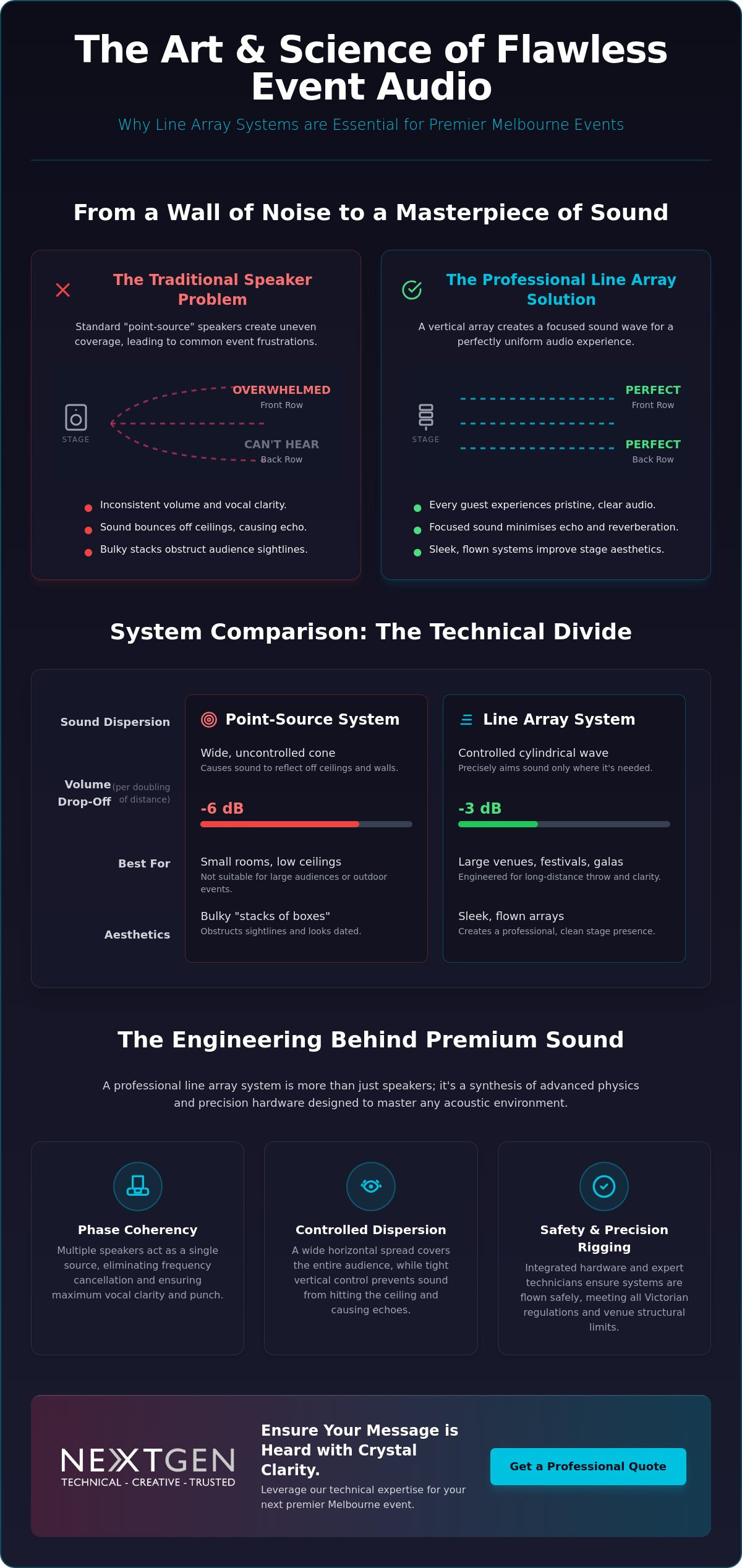
Planning and Rigging: Navigating Melbourne Venue Logistics
Every world-class production in Melbourne rests on a foundation of invisible engineering. When you initiate a line array hire Melbourne project, the hardware is only half the story. The true mastery lies in the rigging. Major venues like the Crown Palladium and the Melbourne Convention and Exhibition Centre (MCEC) have specific fly-point capacities and weight-load limits that dictate the scale of your audio solution. We don’t just guess these limits. We work in lockstep with venue management to ensure every motor, truss, and speaker cabinet is safely secured. This level of diligence protects your guests and your reputation.
Outdoor festivals along the Yarra or at our iconic parkland sites present their own set of challenges. Melbourne’s infamous “four seasons in one day” means wind-load calculations are non-negotiable. An array that’s safe in a light breeze can become a liability in a 40km/h gust. By choosing a full service event production partner, you gain a team that handles venue permits, safety checks, and environmental risk assessments with surgical precision. We manage the logistical grind so you can focus on the prestige of the final result.
Safety Standards and Compliance
Rigging is a high-stakes discipline that leaves no room for error. We utilise only certified riggers and load-rated motors that comply with Australian safety standards, specifically AS 1418. This isn’t just about ticking boxes; it’s about absolute reliability under pressure. For outdoor community events, we provide detailed wind-load documentation to ensure the structure remains stable even when the weather turns. Our commitment to safety allows you to take centre stage without worry, knowing the technical backbone is unshakeable.
Acoustic Mapping and Pre-Production
We eliminate guesswork through sophisticated 3D modelling. Before we even arrive on-site, we use software like EASE or Soundvision to map the venue’s acoustic properties. This is vital in modern, glass-heavy spaces where sound reflections can ruin vocal clarity. By identifying potential “dead zones” in the pre-production phase, we significantly reduce on-site troubleshooting time. This predictive approach ensures that the coverage is flawless from the moment the system is first powered up. It’s a cinematic transformation from a raw space to a tuned acoustic environment.
Ready to secure a safe and sonically perfect setup for your next major activation? You can request a technical site assessment with our engineering team today to ensure your venue logistics are mastered from the start.
Mastery in Motion: The NextGen AV Advantage
NextGen AV has spent over 30 years refining the art of live sound within the unique architectural landscape of Victoria. We don’t just provide equipment; we deliver a legacy of technical excellence. Our curated inventory consists exclusively of high-end, touring-grade hardware designed to withstand the rigours of major productions while maintaining studio-quality fidelity. This commitment to audio visual hire in Melbourne ensures that your event isn’t just heard, but remembered for its clarity and prestige. As your “Invisible Expert,” we take pride in managing the underlying complexity, allowing you to occupy the spotlight with absolute confidence. Choosing our team for your line array hire Melbourne needs means partnering with veterans who have mastered every major venue in the city.
Beyond the Gear: Technical Direction
Hardware is a tool, but technical direction is the craft. Our on-site engineers are the heartbeat of every successful show. They don’t just set up and leave; they provide real-time monitoring and active adjustments as the room’s temperature and occupancy change. This proactive approach prevents the sonic “drift” that can occur during long galas or high-energy festivals. Because we offer a holistic suite of services, our audio systems integrate seamlessly with our lighting designs and LED video wall productions. This unified technical direction creates a cinematic experience where sound, light, and vision move in perfect synchronisation. It’s about orchestrating a flawless atmosphere where the technology serves the message.
Book Your Sound Consultation
Every venue presents a new puzzle. We begin every partnership with a personalised sound consultation, often including site visits to identify specific acoustic hurdles. We don’t believe in generic packages. Instead, we provide customised quotes that reflect the specific scale and ambition of your project. This ensures you only pay for the precision you need. Our team evaluates everything from ceiling height to floor materials to ensure our line array hire Melbourne solutions are perfectly tuned to your environment. We take the guesswork out of production, providing you with a clear roadmap to acoustic success.
Ready to elevate your next production with world-class audio? Enquire about line array hire for your next Melbourne event and discover the difference that 30 years of technical mastery can make.
Command the Stage with Sonic Precision
Achieving a flawless auditory experience requires more than just high-end hardware; it demands the technical mastery to navigate Melbourne’s most complex venues. By understanding the science of dispersion and the logistical rigour of structural safety, you’ve moved past the grind of basic equipment rental. You’re now ready to treat your audio as a dedicated craft that elevates the prestige of your entire production. Whether you’re planning a gala at the Crown Palladium or a large-scale outdoor festival, the right line array hire Melbourne partner provides the quiet power needed for seamless execution.
With 30+ years of technical event experience and a commitment to end-to-end production management, we ensure your message reaches every seat with absolute clarity. Our expert riggers and Red Dot standard gear handle the technical complexity so you can focus on the applause. Request a Professional Audio Quote for Your Melbourne Event and let us orchestrate your success. Your vision deserves a soundscape that matches its ambition.
Frequently Asked Questions
How many line array speakers do I need for an event of 1,000 people?
A typical configuration for 1,000 guests usually requires between four and eight elements per side, though the exact count depends on the venue’s depth and ambient noise levels. We use acoustic modelling software to determine the precise quantity needed to maintain intelligibility at the back of the room. This ensures the sound pressure level remains consistent across the entire audience without overwhelming the front rows.
Can line array speakers be ground-stacked if the venue has no rigging points?
Yes, line array systems can be ground-stacked using specialised rigging frames if your venue lacks structural fly-points. While flying the array is often preferred for clearing sightlines, ground-stacking on subwoofers or staging is a safe and effective alternative. We ensure the stack is properly angled and secured to achieve the necessary vertical dispersion required for your specific floor plan and seating arrangement.
What is the difference between an active and a passive line array system?
Active line arrays feature built-in amplification and processing within each cabinet, which can simplify cabling and setup. Passive systems rely on external amplifier racks to drive the speakers. Both options deliver elite performance. Our technical team chooses the specific system based on the weight limits of your venue and the complexity of the signal processing required to master the room’s unique acoustic challenges.
How much does it cost to hire a line array system in Melbourne for a day?
The investment for a line array hire Melbourne package varies based on the scale of the system, the number of technicians required, and the logistical complexity of the venue. Because these are engineered solutions rather than simple hardware rentals, we provide custom quotes following a technical consultation. This approach ensures you receive a system that is perfectly scaled to your event’s specific prestige and technical requirements.
Are line arrays suitable for outdoor events with Melbourne’s unpredictable weather?
Professional line arrays are built for the rigours of outdoor touring and can handle Melbourne’s shifting weather conditions when managed by experts. We use weather-resistant covers and strictly adhere to wind-load safety protocols to protect both the equipment and your guests. Our riggers monitor real-time weather data to ensure the system remains safe and operational throughout your outdoor festival or community activation.
Do I need a separate sound engineer to operate the line array during my event?
A dedicated systems engineer is essential for the safe rigging, precise tuning, and live operation of a professional array. These systems require sophisticated software alignment to perform at their peak. Our technical directors manage the audio landscape in real-time. This allows you to focus on the stage while we ensure every keynote and musical performance is delivered with absolute clarity and impact.
What are the power requirements for a large-scale line array setup?
Large-scale setups typically require 3-phase power to handle the high current draw of multiple amplifiers and high-excursion subwoofers. While smaller systems might run on standard 10A or 15A circuits, we conduct a power audit of your venue during the pre-production phase. If the venue’s infrastructure is insufficient, we coordinate portable power solutions to ensure the system operates reliably without any risk of interruption.
How long does it take to set up and tune a professional line array system?
A standard setup and tuning process usually takes between three and six hours depending on the rigging complexity and venue access. This timeframe includes the physical assembly, motor testing, and the critical acoustic alignment to tune the system to the room. We factor this into our production schedule to ensure the audio is flawless well before your first guest arrives at the centre.
A world-class performance is often defined by the silence that precedes it and the pristine clarity that follows, yet a single technical oversight can instantly shatter that prestige. You understand that the stakes are incredibly high when the house lights go down and the first note hits. Securing the right concert sound system hire melbourne is about more than just booking speakers; it’s about finding a partner who understands the intricate physics of sound and the high-pressure environment of a live stage.
It’s natural to feel the weight of complex technical riders or the stress of scaling audio for Melbourne’s diverse venues, especially as the EPA reviews noise frameworks throughout 2026. This guide provides the expertise you need to master large-scale live sound and ensure a seamless, high-impact auditory experience for every attendee. We’ll walk you through the nuances of professional audio orchestration, from managing strict decibel limits to deploying advanced immersive systems that allow your artists to take centre stage with absolute confidence. Discover how to transform technical challenges into a polished, cinematic result that matches the calibre of your event.
Key Takeaways
- Identify the critical differences between basic audio setups and professional-grade systems that pair high SPL with studio-level fidelity.
- Discover the essential hardware required for premium concert sound system hire melbourne, including line array technology and sophisticated digital mixing consoles.
- Understand how precision acoustic modelling allows you to predict sound behaviour and eliminate audio glitches before the first note is played.
- Learn how to expertly translate complex artist technical riders into hardware reality while navigating the logistical demands of Melbourne’s CBD.
- Gain confidence by understanding the role of end-to-end technical direction in managing everything from pre-production to the final pack-down.
What Defines a Professional Concert Sound System?
A professional concert sound system is the silent engine behind every iconic live performance. It represents the delicate intersection where raw power meets absolute precision. When you engage with concert sound system hire melbourne, you are moving beyond simple noise amplification into the realm of high-impact auditory architecture. Unlike generic “off-the-shelf” PA packages that struggle with distortion at high volumes, a concert-grade solution maintains studio-quality fidelity even at peak Sound Pressure Levels (SPL). This mastery over sound creates a transformative experience, where the audience is enveloped in a rich, cinematic soundscape that feels both intimate and grand. Our philosophy centres on the “Invisible Expert” approach; the technology should be so flawless and transparent that it effectively disappears, allowing the artist’s prestige to take centre stage without a hint of technical interference.
The Difference Between Basic PA and Concert-Grade Audio
The most significant technical differentiator is headroom. A basic PA system often operates near its thermal and mechanical limits to achieve concert volumes, which inevitably results in a compressed, lifeless sound. In contrast, a professional concert sound system provides massive power reserves, allowing transients to breathe and ensuring that the audio remains punchy and dynamic. This capability is essential for capturing the full frequency response of a live band, from the shimmering highs of a cymbal to the deep, resonant lows of a bass synth. A concert sound system is an engineered ecosystem of transducers, processing, and amplification.
Why Audio Quality is Non-Negotiable for Melbourne Events
Melbourne’s status as the cultural heart of Australia means that event organisers face a uniquely discerning audience. From the sophisticated theatres of the East End to the expansive outdoor stages of the Domain, the “Melbourne standard” for live audio is exceptionally high. Subpar sound quality is a direct threat to brand prestige and can lead to significant artist dissatisfaction, potentially tarnishing a venue’s reputation for years. This is why professional audio visual hire Melbourne is a critical investment. Expert technicians don’t just supply gear; they navigate the specific acoustic quirks of local venues and manage the complex signal routing required for flawless execution. This level of technical direction ensures that every guest, regardless of where they are standing, experiences a high-fidelity performance that matches the prestige of the occasion.
Essential Components of a High-Impact Sound System
High-impact sound isn’t a result of chance; it’s the product of meticulously selected hardware working in perfect unison. When you invest in concert sound system hire melbourne, you’re commissioning a bespoke technical infrastructure designed to withstand the rigours of a live environment. The Essential Components of a modern concert rig must handle extreme dynamic ranges while maintaining surgical precision. This starts with line array systems, the industry standard for achieving even coverage across vast audience areas. By controlling vertical dispersion, these systems ensure that the front row and the back gallery receive the same tonal balance and clarity, regardless of the venue’s architectural challenges.
Digital mixing consoles serve as the brain of the operation, managing hundreds of complex signal paths with millisecond accuracy. In the heart of the Melbourne CBD, navigating the crowded radio frequency (RF) environment is a significant hurdle that requires professional oversight. Our technical teams use advanced wireless management software to coordinate microphone and monitor frequencies, preventing the interference and dropouts that often plague amateur setups. Whether it’s high-fidelity In-Ear Monitors (IEMs) for the band or traditional floor wedges, every piece of gear is chosen to eliminate latency and foster a confident, high-stakes performance.
Front of House (FOH) Engineering
Achieving long-throw clarity in large Victorian venues requires Tier 1 line arrays capable of projecting sound without losing high-frequency detail. We complement these with sophisticated subwoofer arrays, designed using cardioid patterns to provide physical “impact” in the mosh pit without muddying the mid-range for those further back. The synergy between professional sound system hire and expert operation ensures that every decibel serves the music. If you’re planning a large-scale event, you might want to consult with our technical directors to map out your venue’s specific acoustic needs.
Microphones and Input Chains
The input chain is where the technical artistry begins. We select microphones based on the specific colour and character of an instrument or voice, ensuring the source material is captured with absolute honesty. Modern stages have moved toward networked audio protocols like Dante and AVB, using digital stage boxes to keep signal paths clean and free from electromagnetic interference. This digital backbone supports high-end signal processing that adds a cinematic sheen to the live mix, elevating a standard gig into a world-class production. Precision engineering at this level ensures that your concert sound system hire melbourne delivers a result that is both technically superior and emotionally resonant.
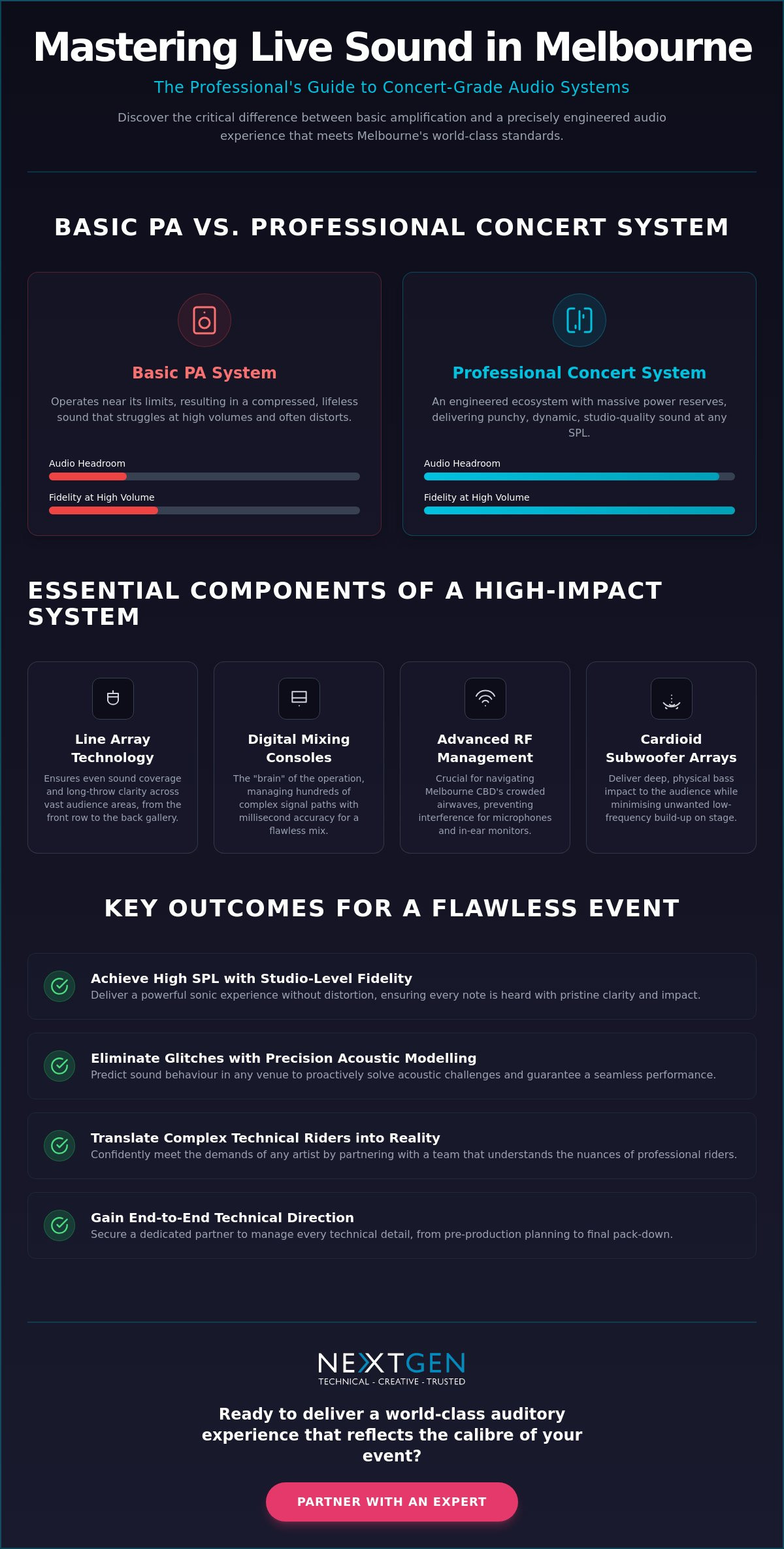
Precision Engineering vs. Basic Hire: Addressing the Complexity
Securing a concert sound system hire melbourne involves far more than just taking delivery of a truckload of speakers. While a basic hire company might drop off a stack of cabinets and wish you luck, a professional technical partner utilises predictive analysis to understand how sound waves interact with every physical surface in your venue. It’s about precision. We move beyond the “louder is better” mentality to focus on acoustic modelling, a process where we create a digital twin of your space to identify potential “dead zones” or frequency build-ups before the first piece of rigging is even lifted. This level of engineering ensures that the audio remains coherent and impactful, rather than just loud and abrasive.
System tuning is the invisible craft that separates a chaotic gig from a cinematic experience. Our engineers spend hours time-aligning individual components to ensure a phase-accurate result. When multiple speakers aren’t perfectly synchronised, they can actually cancel each other out, leading to a thin, hollow sound that no amount of volume can fix. Professional Melbourne AV production also relies heavily on redundancy. We build fail-safes into every critical path, from dual-redundant digital mixing engines to backup power solutions, ensuring the performance continues even if a component fails. This proactive stance allows you to focus on the prestige of the event while we handle the technical heavy lifting behind the scenes.
- Acoustic Mapping: Using software to predict SPL distribution and tonal balance across the entire floor plan.
- Phase Alignment: Synchronising the arrival time of sound from different speaker clusters for a unified auditory image.
- Signal Redundancy: Implementing primary and secondary network paths to eliminate single points of failure.
- Thermal Management: Monitoring amplifier heat levels in high-stakes environments to prevent sudden shutdowns.
The Myth of “Plug and Play” for Concerts
Achieving sufficient gain-before-feedback is a matter of rigorous engineering, not just turning a knob. DIY setups frequently fail because they don’t account for the complex relationship between microphone placement and speaker dispersion patterns. Professional systems are designed with sophisticated internal protection to prevent “clipping,” a phenomenon that destroys audio fidelity and risks hardware damage. Professional audio mastery is about controlling energy within a space. By managing this energy, we protect the artist’s performance and the audience’s ears simultaneously.
Acoustic Challenges in Modern and Historic Venues
Melbourne is home to a diverse range of spaces, from glass-heavy modern galleries to reverberant historic town halls. Each presents unique hurdles; glass surfaces cause harsh reflections, while old masonry can create muddy, lingering echoes. We use Digital Signal Processing (DSP) to “correct” for these venue deficiencies, applying surgical EQ and delay settings that allow the system to work with the room rather than against it. NextGen AV acts as your technical navigator, ensuring that your concert sound system hire melbourne is tailored specifically to the architectural reality of your chosen venue.
Navigating Melbourne’s Venues: Logistics and Technical Riders
A technical rider is more than a shopping list; it’s the artist’s blueprint for a flawless performance. When you manage a concert sound system hire melbourne, your primary task is translating these global requirements into the local reality of a Victorian venue. This often involves negotiating between the artist’s ideal setup and the physical constraints of the room. Our team acts as the bridge, ensuring the hardware on stage matches the prestige of the performer while staying within the logistical bounds of the site. We interpret the nuance behind the gear list, ensuring that substitutions are only made with equivalent, high-tier alternatives that honour the artist’s sonic signature.
Logistics in the Melbourne CBD and arts precinct require a level of precision that mirrors the audio engineering itself. Managing a “bump-in” at a venue with restricted laneway access or a tight loading dock window is a high-stakes operation. We treat these timelines with absolute rigour, ensuring that the heavy lifting is finished long before the first soundcheck. Beyond the gear, we verify that the venue can handle the massive current required for high-draw concert amplification. Relying on standard circuits is a recipe for disaster; we ensure 3-phase power is correctly distributed to prevent sudden failures during the show’s peak moments. This proactive approach eliminates the technical friction that can stall a production’s momentum.
Melbourne-Specific Venue Considerations
Historic landmarks like the Forum or the Melbourne Town Hall require a delicate touch. You have to balance the need for high-impact audio with the responsibility of protecting heritage architecture, often working with existing rigging points and strict weight limits. For outdoor sites like the Sidney Myer Music Bowl or local festivals, the challenge shifts to weatherproofing and environmental control. This is where full service event production becomes invaluable, as it integrates staging and rigging with the audio plan to create a unified, safe environment that withstands the unpredictable Melbourne weather.
Noise Management and Compliance
Operating in 2026 means navigating a transitional regulatory landscape. With the EPA Victoria currently reviewing noise regulations for live music precincts, staying compliant is more complex than ever. We use directional arrays and cardioid subwoofer configurations to keep the energy focused on the audience while minimising spill into neighbouring residential areas. Our technicians provide real-time SPL monitoring throughout the event, ensuring you stay within council limits without sacrificing the high-fidelity experience your guests expect. If you’re ready to secure a compliant, world-class rig, contact our team for a technical consultation today and let us handle the complexities of your concert sound system hire melbourne.
The NextGen Advantage: Partnering for Flawless Execution
Choosing a partner for your concert sound system hire melbourne is a decision that defines the final impact of your production. At NextGen AV, we believe that high-end hardware is simply the engine; the true power lies in the technical direction that drives it. With over 30 years of experience navigating the high-pressure environments of live performance, our team provides an end-to-end management service that begins long before the first truck arrives. We transition seamlessly from pre-production planning and acoustic modelling to the final, methodical pack-down, allowing you to move past the logistical grind. Our “Invisible Expert” approach ensures that while our presence is felt through flawless execution, we remain behind the scenes so the artist remains the sole focus of the audience’s attention.
Scalability is a cornerstone of our service. We understand that a high-impact auditory experience is just as vital in an intimate theatre setting as it is across a sprawling outdoor festival ground. Our technical solutions are bespoke, tailored to the specific geometry of the venue and the unique requirements of the performance. By handling the “heavy lifting” of signal routing, frequency coordination, and power distribution, we provide event organisers with the absolute confidence that the audio will match the prestige of the occasion. This comprehensive oversight transforms a standard equipment rental into a dedicated craft, where every decibel is intentionally placed.
Technical Direction and On-Site Mastery
Technical direction is the glue that synchronises audio, lighting, and vision into a single, cinematic narrative. Our Technical Directors thrive under the pressure of live, high-stakes environments, acting as the proactive orchestrators who anticipate challenges before they manifest. This level of on-site mastery ensures that even the most complex technical riders are executed with surgical precision. We don’t view our role as a utility service; instead, we act as your collaborative ally, ensuring that the technical infrastructure elevates the artistry on stage rather than merely supporting it.
Ready to Elevate Your Melbourne Concert?
The road to a flawless performance begins with a conversation about mastery and precision. We invite you to discuss your specific technical riders and venue requirements with the NextGen AV team, ensuring your next concert sound system hire melbourne is handled with elite expertise. From initial site inspections to the final pack-down, we are committed to delivering a high-fidelity result that resonates with your audience long after the house lights come up. Contact NextGen AV to organise your concert sound system and experience the peace of mind that comes from partnering with the industry’s finest technical navigators.
Orchestrate Your Sound with Absolute Precision
Mastering live audio in 2026 requires a shift from simple equipment rental to comprehensive technical orchestration. You’ve seen how precision engineering, from cardioid subwoofer arrays to meticulous phase alignment, transforms a standard gig into a cinematic event. By prioritising high-tier hardware and expert navigation of Melbourne’s evolving noise regulations, you ensure that the artist’s prestige is never compromised by technical friction. This level of detail is what separates a world-class production from a generic performance.
Securing the right concert sound system hire melbourne is ultimately about trust and reliability. With over 30 years of industry experience, NextGen AV has become the partner of choice for major brands and government bodies seeking end-to-end technical production and management. We handle the logistical heavy lifting and on-site mastery, allowing you to focus on the performance itself while we manage the engine behind the scenes. Partner with NextGen AV for your next high-impact concert and let our veteran team bring your vision to life with world-class audio. Your audience is waiting for a performance they’ll never forget.
Frequently Asked Questions
What is included in a concert sound system hire package?
Our concert sound system hire melbourne packages are entirely bespoke, tailored to the specific acoustic requirements of your venue and artist. A typical high-impact rig includes Tier 1 line array speakers, digital mixing consoles, a comprehensive microphone suite, and professional monitoring solutions like In-Ear Monitors (IEMs). We also provide the necessary power distribution and signal processing to ensure studio-grade fidelity across the entire audience area.
Can you help us interpret a technical rider from an international artist?
We specialise in translating complex technical riders from international artists into high-performance hardware reality. Our technical directors act as your navigator, ensuring every specified preamp, microphone, and console surface meets the artist’s exact expectations. We manage the dialogue between the artist’s touring team and our local inventory, providing equivalent or superior substitutions when necessary to maintain the prestige of the performance.
Do you provide on-site sound engineers for the duration of the concert?
Every concert-grade system we deploy is accompanied by a team of elite sound engineers and technicians for the duration of the event. Our experts manage Front of House (FOH) mixing, monitor engineering, and real-time RF coordination to ensure a seamless auditory experience. This hands-on support allows you to focus on the event’s success while we handle the intricate technical orchestration behind the scenes.
How far in advance should I book sound system hire for a Melbourne festival?
For large-scale festivals requiring concert sound system hire melbourne, we recommend booking your technical production at least three to six months in advance. This lead time is essential for conducting thorough site inspections, acoustic modelling, and securing the high-tier inventory required for multi-stage events. Early engagement also allows us to navigate the complex permit processes and noise regulation compliance required for outdoor precincts.
Do you handle the delivery, setup, and pack-down in Melbourne CBD?
We manage the entire logistical lifecycle, including delivery, precise setup, and methodical pack-down within the Melbourne CBD and arts precinct. Our team is highly experienced in navigating restricted access laneways and strict loading dock windows typical of city venues. We coordinate the “bump-in” with military precision, ensuring the technical infrastructure is fully operational long before the first guest arrives.
What happens if we have a technical issue during the live performance?
Our systems are designed with dual-redundancy and fail-safes to prevent interruptions during a live performance. In the unlikely event of a technical glitch, our on-site engineers are trained to implement immediate solutions, often resolving issues before they become audible to the audience. This proactive “Invisible Expert” approach provides the absolute competence and reliability required for high-stakes, prestigious events.
Can your sound systems integrate with LED video walls and lighting?
Our professional audio systems are designed to integrate seamlessly with our LED video walls and lighting rigs under a unified technical direction. This holistic approach ensures that the auditory and visual elements of your concert are perfectly synchronised, creating a cinematic and high-impact experience. We manage the signal timing and data protocols between all departments to deliver a polished, professional result.
Do you provide battery-powered PA systems for outdoor pop-up events?
We focus exclusively on high-impact, professional-grade audio systems designed for large-scale concerts and festivals rather than small, battery-powered consumer units. Our outdoor solutions utilise advanced power distribution and silent generators to provide the massive headroom required for a world-class performance. This ensures that even pop-up events maintain the high-fidelity sound and prestige associated with a permanent concert venue.
