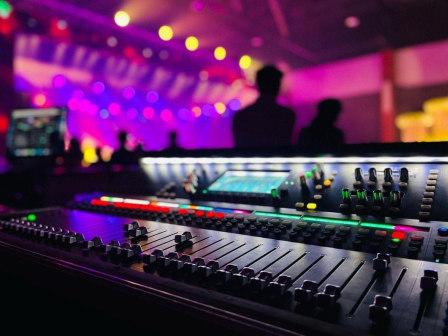


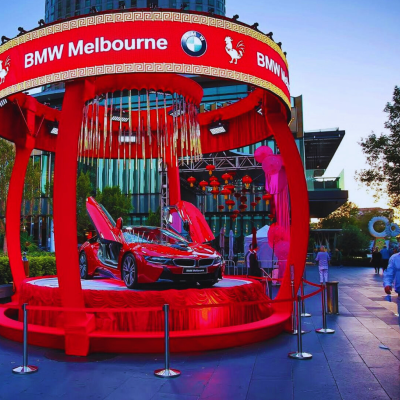

A spectacular lighting show is only as powerful as the invisible steel and precision motors that keep it in the air. When you’re planning a high-stakes production, the technical logistics of truss and motor hire for lighting rig systems shouldn’t be the source of your stress. You know that the difference between a seamless event and a structural failure lies in the fine details of load ratings and venue-specific rigging points. It’s a high-pressure environment where safety isn’t just a box to tick; it’s the foundation of your creative vision.
This guide helps you master the technical essentials of modern rigging to ensure your next Melbourne event is both visually stunning and structurally sound. We’ll demystify the latest AS 1418 updates and D8+ motor standards so you can lead your technical crew with absolute confidence. From calculating capacities to navigating complex venue constraints, you’re about to learn how to orchestrate a safe, engineered rig that meets every Australian standard while allowing your lighting design to shine.
Key Takeaways
- Master the technical synergy between F34 box truss and CM Lodestar motors to create a high-performance foundation for your event’s visual architecture.
- Learn how to navigate the specific architectural constraints of Melbourne venues by choosing between high-impact flown rigs and versatile ground support systems.
- Ensure absolute compliance with Australian safety standards and WorkSafe Victoria regulations to protect your audience and uphold your professional reputation.
- Discover why professional truss and motor hire for lighting rig setups requires the precision of certified riggers to translate complex load ratings into a secure reality.
- Optimise your production timeline and eliminate technical friction by partnering with seasoned experts who provide end-to-end technical direction and on-site management.
The Foundation of Visual Impact: Truss and Motor Hire Essentials
A professional lighting rig is a sophisticated ecosystem where structural engineering meets artistic vision. It isn’t merely a collection of aluminium; it’s the seamless synergy of load-rated trussing, precision electric hoists, and advanced control systems. When you invest in truss and motor hire for lighting rig setups, you’re building the skeleton of your event’s atmosphere. This infrastructure allows for the complex layering of stage lighting fundamentals, ensuring every beam and wash is positioned with surgical accuracy.
Safety is the silent partner in every successful production. While the audience marvels at the visual spectacle, the rigging ensures that every kilogram of equipment remains exactly where it’s intended. In Australia, this work is strictly governed by the AS 1418 series of standards, including the updated AS 1418.3:2024 for bridge and gantry cranes and the general requirements of AS 1418.1:2021. Following these protocols isn’t optional; it’s a legal and ethical mandate that protects your brand and your guests. Securing a professional truss and motor hire for lighting rig projects ensures that your technical direction is backed by the highest safety standards.
For corporate galas and prestige events, motorised systems like the CM Lodestar are the gold standard. Unlike manual chain blocks, which require significant physical effort and often result in jerky, uneven movement, electric motors provide smooth, simultaneous lifting. This precision allows technicians to level a massive rig to the millimetre, creating a polished look that manual alternatives simply can’t replicate. It transforms the setup process from a laborious task into a refined technical exercise.
Why Professional Rigging Matters for Your Event
Professional rigging liberates your creative team. By moving equipment off the floor and into the ceiling, you unlock dramatic lighting angles that transform a flat stage into a cinematic environment. It also maximises your venue’s footprint. Flying your audio and lighting gear clears the sightlines and creates more room for tables, dance floors, or LED activation zones. Most importantly, it ensures full compliance with venue safety protocols, providing the engineering certification required for public liability coverage.
Key Terminology Every Event Planner Should Know
Understanding the language of the technical crew helps you make informed decisions and communicate effectively with your production partner.
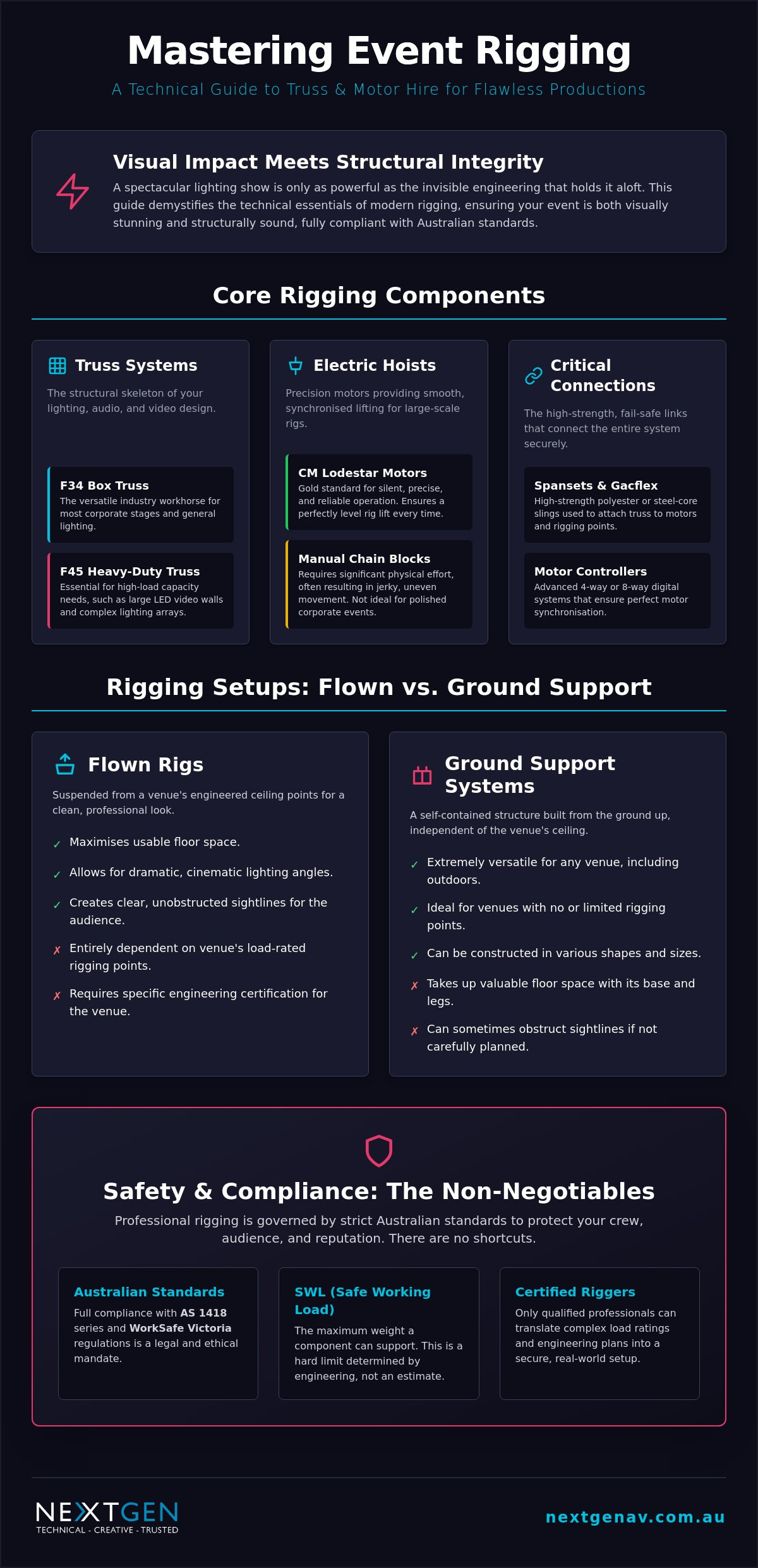
- SWL (Safe Working Load): This is the maximum weight a piece of equipment can safely support. Never guess this figure; it’s a hard limit determined by engineering.
- Rigging Points: These are the specific, load-tested anchor points in a venue’s ceiling. Every Melbourne venue has different restrictions on where and how much weight can be hung.
- Spansets and Gacflex: These are the high-strength polyester or steel-core slings used to attach the truss to the motors. They’re the critical, flexible links that ensure a secure, fail-safe connection.
Selecting the Right Components: Truss Types and Motor Specs
Selecting the right hardware is a high-stakes decision that dictates your production’s scale and safety. When arranging truss and motor hire for lighting rig systems, the choice between F34 and F45 trussing is your first critical pivot. F34 box truss remains the versatile industry workhorse for most corporate stages. However, as modern designs increasingly incorporate massive visual elements, the F45 heavy-duty truss becomes essential. This sturdier profile provides the high-load capacity required for seamless LED video wall hire integration, where the weight of high-resolution panels can quickly exceed standard limits.
Reliability is non-negotiable when gear is suspended above an audience. We rely on CM Lodestar motors because they’ve earned a global reputation for precision and near-silent operation. These hoists work in tandem with sophisticated motor controllers, ranging from simple 4-way units to advanced 8-way digital systems that offer perfect synchronisation. This level of control ensures that a 20-metre truss rises perfectly level, preventing the structural stress that occurs when one corner lifts faster than another. Adhering to global OSHA lighting safety standards and local Australian regulations requires this level of hardware integrity.
Trussing: More Than Just Metal Pipes
Your rig’s geometry defines the event’s visual energy. While straight lengths form the backbone of most setups, circular or custom-curved trussing allows for bespoke stage designs that wrap around the action. For high-end galas where aesthetics are paramount, black powder-coated trussing offers a prestigious look that disappears into the shadows, making your lighting effects pop. Precision load-bearing calculations are the only way to ensure these designs are viable; “near enough” is never acceptable when lives are under the rig.
Chain Motors and Hoists: The Heavy Lifters
Powering your rig requires a clear understanding of venue infrastructure. Most professional setups utilise three-phase power for the consistent torque needed to lift heavy arrays, though single-phase options exist for smaller venues. Every motor in a high-quality hire fleet must be rigorously tagged and tested to meet Australian safety standards. If you’re unsure which capacity fits your vision, partnering with a technical specialist early in the planning phase can prevent costly last-minute equipment swaps and ensure your truss and motor hire for lighting rig needs are perfectly met.
Ground Support vs. Flown Rigs: Navigating Melbourne Venues
Choosing the right execution strategy is a pivotal moment in event planning. In Melbourne, the architectural diversity of spaces, from the soaring industrial ceilings of the Melbourne Convention and Exhibition Centre (MCEC) to the ornate heritage ballrooms of the CBD, dictates whether you’ll fly your gear or build from the floor up. When you secure truss and motor hire for lighting rig systems, you’re deciding how to best utilise the three-dimensional volume of your venue. This decision impacts everything from audience sightlines to the overall structural footprint of your production.
Flown rigs are the gold standard for creating immersive environments. By suspending equipment, you remove visual clutter and create a clean finish that allows your lighting design to take centre stage. However, this approach requires a deep understanding of venue-specific rigging points and weight limits. This complexity is a core component of successful audio visual hire Melbourne logistics, where the coordination between technical directors and venue house riggers must be flawless to ensure a safe, engineered result. We manage these relationships directly, navigating the specific induction protocols and weight restrictions of Melbourne’s premier event spaces so you don’t have to.
Flown Rigs: Elevating the Experience
Flying a rig involves more than just lifting gear; it’s a precise process of securing points and managing weight distribution. Excellence is found in the details. Meticulous cable management ensures that the “invisible expert” remains truly hidden from the audience’s view. We prioritise safety above all else, utilising safety cables and secondary bonds as redundant systems. These fail-safe measures guarantee absolute structural integrity throughout your event, providing peace of mind while your creative vision takes flight.
Ground Support Solutions
If a venue lacks rigging points or features a heritage ceiling that cannot be touched, ground support becomes your best ally. These systems use heavy-duty base plates and outriggers to provide a stable, freestanding foundation. Whether you need a simple goalpost configuration for a trade show booth or a complex box rig for a corporate stage, ground support offers incredible versatility. To maintain a prestigious atmosphere, you can utilise black powder-coated truss or custom scrimming to ensure the structure complements your event decor rather than distracting from it. This approach allows for massive visual impact even in the most restricted architectural environments.
Safety and Compliance: The Non-Negotiables of Rigging Hire
The legal weight of a production rests squarely on the shoulders of the event organiser. When you commission truss and motor hire for lighting rig services, you’re not just renting equipment; you’re investing in a safety guarantee. Under Australian law, you’re responsible for ensuring that every overhead structure is engineered to support its intended load. It’s a high-stakes environment where a single oversight can lead to catastrophic failure, making professional compliance your most valuable asset.
Hiring certified riggers is a non-negotiable requirement for any overhead work. These specialists possess the high-risk work licences necessary to interpret load tables and calculate the complex forces exerted on venue anchor points. They don’t just hang gear; they verify the structural integrity of the entire system. This expertise ensures that your production meets every rigorous safety benchmark, allowing you to focus on the event’s success while we handle the technical heavy lifting.
Seamless integration is the hallmark of a professional setup. Your rigging must be designed to work in perfect harmony with your stage and lighting hire Melbourne choices. This means ensuring that the total weight of moving heads, LED panels, and audio arrays never approaches the safe working limit of the truss. We conduct meticulous pre-event safety checks, from motor brake testing to visual truss inspections, ensuring every component is event-ready.
Australian Standards and WorkSafe Victoria
WorkSafe Victoria guidelines provide the framework for safe event execution in Melbourne. Every piece of equipment in our inventory is “Load-Rated” and carries current inspection tags to prove it. Under Australian law, a rigger’s duty of care mandates that they must identify and minimise any risks to health and safety arising from their work. This legal obligation ensures that every bolt, span-set, and motor is fit for purpose and compliant with the latest AS 1418 updates.
Risk Mitigation and Insurance
Proactive risk management is the engine behind a flawless event. We develop comprehensive Job Safety Analysis (JSA) documentation for every project, outlining specific hazards and their corresponding control measures. This process includes site-specific inductions and, for outdoor setups, critical wind load considerations. Choosing a partner with robust public liability insurance is essential. It provides a final layer of protection for your brand, ensuring that every technical solution is backed by absolute professional accountability. To ensure your next rig is fully compliant and engineered for excellence, consult with our technical directors today.
Elevate Your Event with NextGen AV’s Managed Rigging
Attempting a ‘dry hire’ for structural components often introduces unnecessary variables into an already complex environment. While renting equipment might seem cost-effective, it lacks the critical oversight of a technical director who understands the nuances of load distribution and venue-specific logistics. Our 30-year legacy in the industry is built on the belief that safety and creativity should never be at odds. When you choose NextGen AV for your truss and motor hire for lighting rig requirements, you aren’t just getting aluminium and steel; you’re gaining a dedicated partner committed to flawless execution.
Our team specialises in creating customised rigging designs that marry high-end aesthetics with absolute structural integrity. We ensure that every motor move and every truss connection is engineered to support your vision, allowing you to focus on the prestige of your event rather than the mechanics of the ceiling. For those seeking a truly seamless experience, we integrate these elements into our wider full service event production programme, managing every technical detail from concept to pack-down.
The NextGen AV Difference
We operate as the ‘Invisible Expert,’ a proactive force that thrives under the pressure of live production. Our inventory consists exclusively of elite-tier hardware, including industry-leading CM Lodestar motors and Global Truss systems. This premium equipment allows us to synchronise rigging with complex LED video walls and high-fidelity audio arrays with surgical precision. By handling the logistical grind behind the scenes, we empower you to take centre stage with absolute confidence in the technical foundation of your event.
Partnering for Success
Successful rigging relies on effective collaboration with venue managers and external stakeholders. We take the lead in these conversations, managing site inductions, floor plans, and engineering sign-offs. This proactive communication eliminates friction and ensures that your event remains compliant with all Australian standards. Having a single point of contact for your AV and rigging needs simplifies your planning process, turning a high-stakes technical challenge into a polished, professional success. Contact the NextGen AV team today to organise your rigging consultation.
Build Your Vision on a Foundation of Excellence
Your event’s visual impact relies on the silent strength of the infrastructure above. By mastering the technical nuances of component selection and navigating the specific rigging requirements of Melbourne’s premier venues, you transform a logistical challenge into a creative triumph. Secure truss and motor hire for lighting rig systems that prioritise both engineering precision and artistic freedom. Safety is the bedrock of prestige; choosing high-performance hardware like CM Lodestar motors ensures your production remains flawless from the first lift to the final pack-down.
With over 30 years of Melbourne event experience, our team acts as your invisible expert, providing end-to-end technical production that is fully compliant with WorkSafe Victoria standards. We take pride in handling the complex calculations and venue inductions, allowing you to focus entirely on your audience’s experience. Don’t leave your structural integrity to chance. Organise your professional rigging consultation with NextGen AV and let’s elevate your next production to a global standard. Your masterpiece deserves nothing less than absolute technical mastery.
Frequently Asked Questions
Do I really need a motorised rig for a standard lighting setup?
Motorised systems are essential for any rig that requires precision levelling or height adjustments during the build. While manual blocks work for simple ground support, motorised truss and motor hire for lighting rig setups allow for simultaneous, smooth lifting of complex arrays. This precision prevents structural stress and ensures your lighting design is perfectly positioned to meet your creative vision without the physical limitations of manual lifting.
How much does truss and motor hire cost for a Melbourne event?
Costs vary significantly based on the length of trussing, the number of motors required, and the complexity of the venue’s rigging points. Factors such as the duration of the hire and the need for on-site technical direction also influence the final investment. We provide tailored quotes that reflect the specific engineering requirements of your production to ensure a safe and successful outcome that fits your project’s scale.
Do I need to hire a certified rigger, or can my lighting tech do it?
You must hire a certified rigger for all overhead work in Australia. While a lighting technician is an expert in illumination, a rigger holds specific high-risk work licences required by WorkSafe Victoria to calculate load ratings and secure anchor points. This distinction is a legal mandate that ensures the structural safety of everyone in the venue and protects you from significant liability risks.
What is the difference between F34 and F45 truss?
The primary difference lies in their load-bearing capacity and physical dimensions. F34 is the industry standard 290mm box truss, perfect for most lighting fixtures and smaller screens. F45 is a larger 400mm profile designed for heavy-duty applications, such as supporting massive LED video walls or long spans where structural deflection must be minimised. Choosing the right profile depends entirely on the total weight of your equipment.
How do I know if my venue has the correct rigging points?
You can determine rigging point availability by reviewing the venue’s technical specifications or “rigging plot.” Most major Melbourne venues have pre-defined points with specific weight limits. Our team often conducts site inspections to verify these points and ensure the venue’s infrastructure can safely support your proposed truss and motor hire for lighting rig configuration before any gear arrives on site.
Can you rig LED video walls and lighting on the same truss?
Yes, you can certainly rig both on the same structure provided the total weight remains within the Safe Working Load (SWL). This requires careful engineering to ensure the truss doesn’t bow and the motors are rated for the combined mass. It’s a common practice for high-impact corporate events where floor space is at a premium and a clean, integrated look is required for the stage.
What happens if a motor fails during the event?
Professional rigs utilise secondary safety bonds and redundant braking systems to prevent any movement in the rare event of a motor failure. Our technical crew remains on-site to monitor the rig throughout the event. If a motor encounters an issue during the load-in, we carry spare components to ensure the production schedule remains on track without compromising the safety of your guests or staff.
Is black truss available for more formal corporate galas?
Black powder-coated truss is absolutely available and is frequently chosen for prestigious corporate galas. This finish allows the structure to blend into the shadows, ensuring the audience focuses on the visual spectacle rather than the hardware. It provides a sophisticated, polished look that elevates the overall aesthetic of your event design and is compatible with all standard F34 and F45 accessories.