
Repeated AV faults don’t automatically mean your conference setup needs a full redesign. When upgrading your annual conference AV, start by tracing each problem to its cause. If five support tickets in a quarter all point to one faulty HDMI cable, a targeted fix may be enough. Recurring failures across audio, vision and control suggest a broader system issue.
Repeated faults are frustrating, but replacing equipment before understanding the pattern can solve the wrong problem. A focused upgrade should address what delegates and presenters actually experience while retaining technology that still performs reliably.
This guide explains how to assess your current setup, identify priorities across sound, visuals and technical control, and decide whether a targeted change or a broader refresh makes sense. It also covers how room use, hybrid participation, system compatibility and maintenance shape an effective upgrade plan. A clear assessment helps you focus on changes that make meetings smoother and annual conferences more dependable.
Key Takeaways
- Trace recurring faults to their source before deciding on a full redesign; a single faulty connection may call for a targeted repair.
- Prioritise clear, balanced audio, then assess whether camera framing is making it easier for participants to follow the discussion.
- Plan for remote attendees with room layouts and collaboration tools that keep them involved, not just connected.
- Prioritise upgrades according to room use, maintenance needs and expected system life when comparing options.
1. Maintaining and future-proofing conference room technology
Outdated room AV can turn a meeting into a troubleshooting session. Older hardware may not work smoothly with current video platforms, and recurring faults can disrupt presentations and frustrate attendees. A three-to-five-year refresh cycle can be a useful planning guide, but room condition and use should determine priorities. When upgrading your annual conference AV, first identify which faults affect the audience experience.
Look for patterns before deciding on a redesign. Five support tickets in one quarter may sound serious, but if they all trace to one faulty HDMI cable, a targeted repair may be enough. Faults across different devices, unreliable wireless connections, poor compatibility or controls that staff routinely bypass point to wider system issues. Review room sizes, meeting formats and feedback, then prioritise high-traffic spaces.
In Australia, conference AV planning should account for the venue’s applicable safety and accessibility requirements. Consider whether people can access the space, see presentation content and hear speakers clearly, and coordinate the setup with the venue’s event arrangements.
To assess a conference venue, document its existing equipment, recurring faults, meeting formats and planned changes. Compare these findings with the room’s intended use. A space that now hosts hybrid meetings, for example, may need different connections and seating arrangements.
Upgrade risks include incompatible devices, network limits and disruption during installation. Stage the work, test signal paths before the event and plan a fallback connection. For livestreams, assess network capacity early because audiovisual content can be affected by capacity issues.
Arrange conference AV support as soon as the event date, venue and program take shape. Planning time depends on production complexity, venue access and the work required to install and test the system.
A sound approach to upgrading your annual conference AV also includes scheduled maintenance. Meeting software can trigger room settings automatically, preparing displays, lighting and audio before attendees arrive. Regular updates help keep equipment useful and reduce avoidable faults.
2. Audio quality and intelligent camera framing
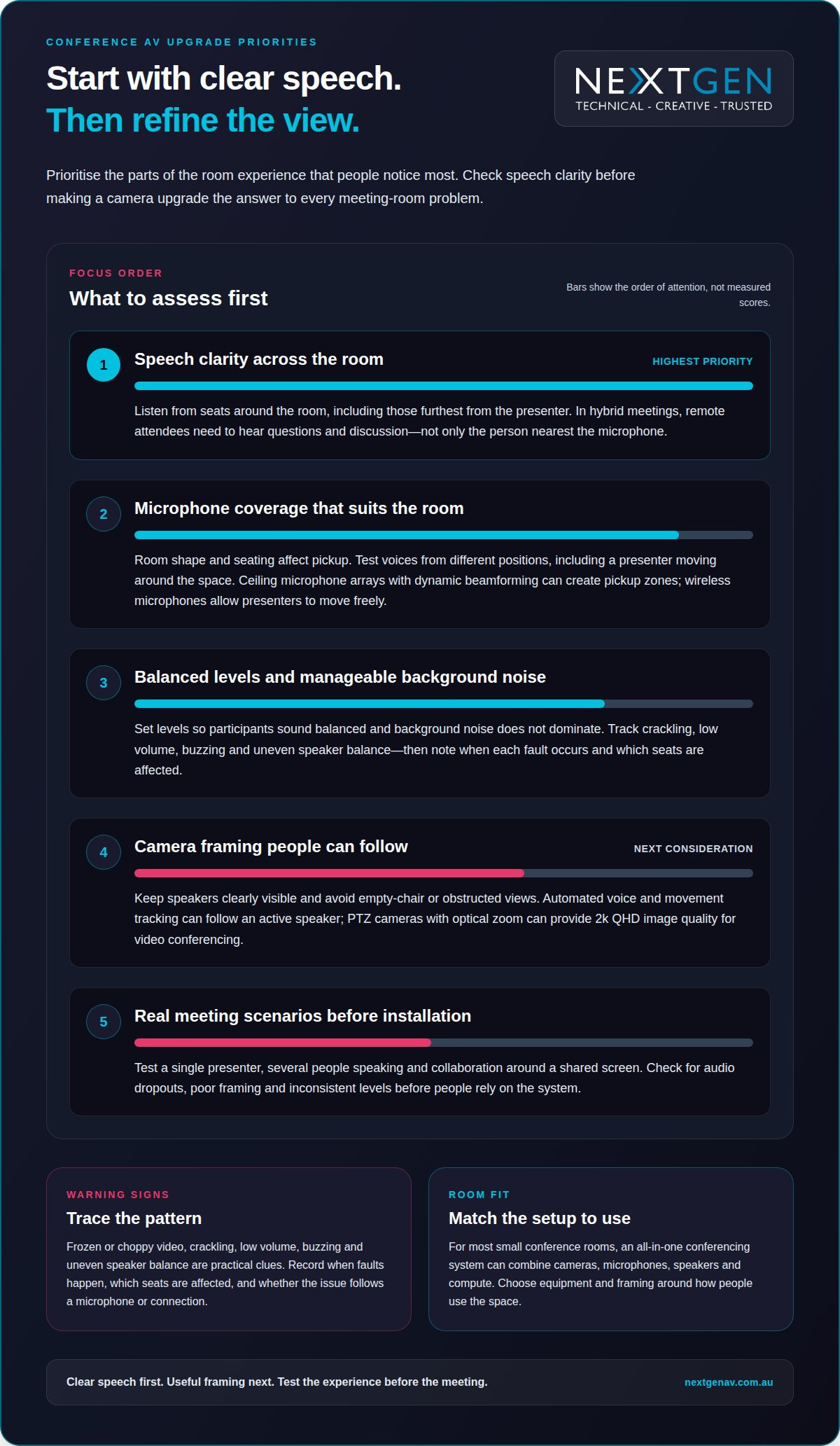
In a conference room, clear speech matters more than a camera upgrade alone. Audio problems can make collaboration tiring, even when everyone can see the screen. Frozen or choppy video, crackling, low volume, buzzing and uneven speaker balance are practical warning signs. Track when they occur, which seats are affected and whether the issue follows a particular microphone or connection.
Begin the assessment with the people listening. Check speech clarity from seats around the room, including those furthest from the presenter. A microphone that sounds clear at the table may not capture a presenter moving across the space. In hybrid meetings, remote participants need to hear questions and discussion throughout the room, not just from the person closest to the microphone.
Room shape and seating determine microphone coverage. Ceiling microphone arrays with dynamic beamforming can create pickup zones across a room, while wireless microphones let presenters move freely. Match the approach to how people use the space, then test it with voices from different positions. Set levels so participants sound balanced and background noise does not dominate.
Camera framing is the next consideration. Automated voice and movement tracking can shift the view towards the active speaker, helping remote attendees follow a changing discussion. PTZ cameras with optical zoom can provide 2k QHD image quality for video conferencing. Choose framing that keeps speakers clearly visible without leaving remote participants focused on an empty chair or an obstructed view.
For most small conference rooms, an all-in-one conferencing system can combine cameras, microphones, speakers and compute. Before installation, test real meeting scenarios: a single presenter, several people speaking, and collaboration around a shared screen. This reveals audio dropouts, poor framing and inconsistent levels before employees rely on the system. For events needing carefully managed sound, professional audio systems can help keep every contribution clear.
3. Improving meetings with remote participants
Hybrid design should give remote participants a clear view and a genuine chance to contribute. A room designed for eight people may no longer suit teams that need hybrid meetings, whiteboarding or flexible seating. Before changing the layout or equipment, assess how presenters, in-room attendees and online participants will share the conversation.
For an annual conference in 2026, plan AV around the program: displays, cameras, microphones, speakers and a connection for video conferencing. Interactive collaboration displays can support digital sketching and let remote participants share a canvas. The right combination depends on room size, session format and how attendees need to take part.
Different sessions need different visual coverage. A keynote requires a clear view of the presenter and presentation content; a panel should keep every speaker visible. In a workshop, position displays so participants can follow shared material and contribute. The camera should show the active discussion, not an empty lectern or an obstructed view.
Hybrid equity takes more than pointing a camera at the room. Remote attendees need to hear questions, see relevant content and have a clear way to speak. Build participation into the run sheet: invite online questions, repeat in-room contributions when needed and assign a moderator to follow remote discussion. These steps help online voices remain part of the conversation.
For hybrid and livestreamed conferences, plan how presenters, remote speakers and audience contributions will appear in the broadcast. Confirm the streaming platform, presentation format and moderation roles during pre-production. Prepare a run sheet that identifies each content change and who cues it, so transitions between speakers, slides and audience questions stay coordinated.
Rehearse with the actual content and session format before the event. Have remote speakers join, test presentation handovers and practise how questions move between online and in-room participants. This gives the event team time to refine cues and responsibilities, helping the live program feel cohesive for everyone.
4. Planning AV upgrades for long-term needs
Define the conference’s essential outcomes before selecting a platform or equipment. Start with requirements such as clear presentation audio, dependable displays, interactive participation or livestreaming. Then separate urgent faults from enhancements, so a microphone issue doesn’t automatically lead to replacing the entire room system. Tie each proposed change to an audience need and an operational benefit.
Choose equipment arrangements around usage, maintenance capacity and how quickly requirements change. A conference room used regularly may benefit from a consistent system, with staff available to manage updates and upkeep. For an annual event with changing formats or specialist requirements, a flexible approach can help ensure equipment matches the program. Consider the event schedule and who will manage the equipment.
Assess what each upgrade requires to work reliably. Consider installation, compatibility with the existing AV system, maintenance, updates, staff training and eventual replacement. For example, a new display may need compatible connections and control hardware for smooth presentations. A planned maintenance schedule can also help equipment last longer.
Match each upgrade to the room and program. A boardroom used for presentations may need different improvements from a space hosting interactive workshops. Prioritise equipment that resolves a recurring problem or supports a defined event requirement, then schedule less urgent upgrades around future use. This makes it easier to explain why each change belongs in your annual conference AV plan.
Consider expected lifespan when choosing displays. Digital signage displays typically last longer than TVs, so the right choice depends on how the screen will be used. For many organisations, the benefits of modern meeting-room upgrades can become apparent within months, particularly when smoother meetings save time across regular sessions.
To shape a considered AV upgrade plan, discuss your conference AV requirements and align system choices with your event format, room use and technical needs.
NextGen AV
NextGen AV helps turn an AV assessment into a coordinated conference plan, matching technical choices to your room, program and audience. When faults span sound, visuals and staging, or your conference needs a more integrated experience, a considered production plan can bring the moving parts together.
LED Video Walls, Professional Audio Systems, Lighting Design and Equipment, and Staging and Rigging can support different elements of an event. The right combination depends on your sessions, from clear presentations to a well-defined stage environment. Planning these elements together keeps the focus on the delegate experience rather than treating each piece of equipment in isolation.
Contact NextGen AV to discuss your conference AV requirements and the outcomes you want to achieve.
Turn the plan into progress
Technology decisions work best when they serve the experience you want delegates to remember. As you upgrade your annual conference AV, treat each change as part of a considered production plan, not an isolated equipment decision. Keep the focus on how presenters communicate, how audiences participate and how the event reflects your organisation.
NextGen AV can shape a plan around your conference format and delivery goals, with LED Video Walls, Professional Audio Systems and Lighting Design and Equipment among its offerings. The aim is a coherent experience, where technical choices support the event rather than compete for attention.
Bring your priorities, room details and program requirements into the conversation, then map out a practical next step. Discuss your AV upgrade with NextGen AV and move towards a conference experience that feels considered from the first presentation to the final session.
Frequently Asked Questions
How do I know if my conference room needs a full redesign or just a targeted fix?
A targeted fix suits a fault that can be isolated without changing how other room systems work. A redesign makes more sense when outdated components in the signal routing, control and room layout cannot support the meeting format together. Map the signal path from presenter device to audience display, then test each connection and control point. This reveals whether one component or the wider system is holding the room back.
How should I prioritise upgrades across many rooms?
Compare rooms by business importance, meeting frequency and the consequences of failure, rather than applying the same refresh everywhere. A room used for board decisions or client presentations, for example, may take priority over one used occasionally for informal catch-ups. Group rooms with similar layouts and needs, then plan upgrades in stages. This helps teams align technical changes with operational demands and manage disruption across Melbourne offices.
How urgent is replacing end-of-life hardware if the room still works?
Working equipment can still pose a risk if it no longer receives support or works reliably with the platforms your organisation uses. Consider the replacement path before a failure forces an urgent decision: identify compatible alternatives, dependencies and how the room would operate during a fault. If the equipment remains supported and meets current needs, schedule replacement around planned changes rather than replacing it solely because of age.
What are the latest AV upgrades for conference venues?
There isn’t one upgrade that suits every conference venue; useful changes depend on session formats and audience needs. If a venue hosts both presentations and workshops, consider whether the room can switch smoothly between speaker-led content and audience collaboration. Trial a proposed setup in a representative room, then assess it with the actual program, content and presenter workflow before extending the change to other spaces.
What are the benefits of LED walls versus projectors for conferences?
LED walls create a large, bright visual surface, while projectors cast an image onto a suitable screen or surface. The right choice depends on the venue’s ambient light, available space, viewing angles and presentation content. A Melbourne ballroom with strong lighting may call for a different display approach than a smaller, darker room. Consider sightlines and screen placement alongside image impact.
What audio and microphone setup works best for a large conference?
A large conference needs sound coverage suited to the room, audience and session format. A keynote may use a wireless microphone for the presenter, while a panel needs each speaker’s voice captured clearly. Plan how audience questions will be heard, including any microphone handover. A front of house engineer manages the mix attendees hear, balancing speech levels across the venue as the program changes.
For organisers comparing hybrid event production services in Melbourne, 66 company matches were recorded as at 20 September 2026. Production brings the in-room and online audiences together through coordinated camera coverage, audio capture, live switching and streaming, with presenters, slides and audience interaction managed as part of one event.
You already know the event needs to work for people in the venue and those joining remotely. That takes more than a camera and a stream: clear sound, purposeful shots and well-timed transitions help remote attendees follow the programme and feel included.
This guide explains how hybrid production works, what camera coverage and live switching involve, and how to assess Melbourne providers. It also covers how planning, platform choice and technical direction shape a seamless event, helping you make informed decisions.
Key Takeaways
- Use the Melbourne provider landscape to understand the options, including how local teams may support events across Victoria and nearby regional centres.
- Map the run sheet, platform needs and audience interactions early so technical planning supports both the room and remote attendees.
- Learn how camera choices, live switching and graphics can keep online viewers connected to each key moment.
- Explore what an Australian provider directory can reveal about company scale, then identify the production capabilities that suit your event.
How many companies deliver virtual and hybrid events in Melbourne?
A directory recorded 66 company records for Melbourne on September 20, 2026. This count offers a market snapshot, not a measure of each provider’s capabilities. For an event in the CBD, Southbank or Docklands, focus on the production needs behind the listing. Virtual audiences need a clear view, clean audio and ways to participate.
When comparing hybrid event production services in Melbourne, assess camera coverage, live switching, streaming and event management. Then consider how the production team will coordinate presenters, content and audience participation across the venue and virtual platform. Check that the proposed plan fits your run sheet, audience and event objectives.
Platform choice shapes registration and participation. Microsoft Teams, Zoom Webinar, YouTube Live, Vimeo, Custom RTMP, Hopin and Eventbrite are among the listed compatible platforms. Match the platform to your audience size, security needs and interaction requirements. Map registration details to the correct access instructions, then test the attendee journey before event day.
Carry your event branding through from the venue to the virtual screen. Align the stage backdrop, slides and graphics so remote attendees recognise the same event identity. Include these details, speaker names and presentation assets in the production plan. Consistency helps both audiences experience one coherent event.
Live Q&A, polling and moderated virtual chat give remote attendees clear ways to contribute. Assign a moderator to track questions and coordinate them with the presenter or room host. Where speakers need to see prompts or audience feedback, confidence monitors can help them stay connected with people in the venue.
A virtual livestream transmits a programme to online viewers. Hybrid production also serves the in-room audience, so sound, slides, cameras and discussion need to work together. A streamed keynote, for example, needs readable presentation content and clear speaker audio, not just a camera pointed at the stage.
Melbourne providers may plan streaming, camera coverage, audio, live switching, speaker support and recording. Compare these capabilities with your event format and engagement needs. A broadcast-style keynote and an interactive panel call for different production choices.
How Does Hybrid Event Production Work?
Production turns an event format into a coordinated plan for in-room and remote audiences. Every decision, from the run sheet to the recording, shapes what attendees experience.
Planning and Production Partnership
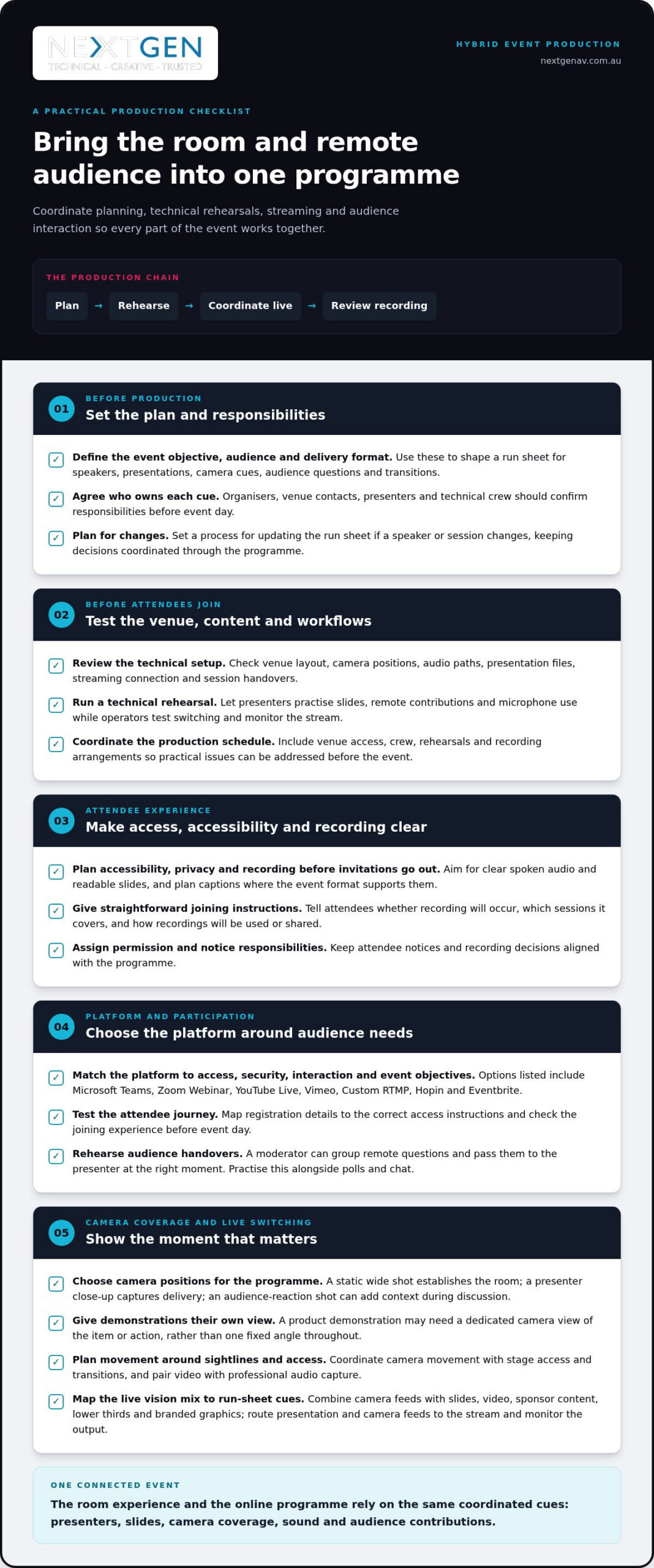
Start with the event objective, audience and delivery format. The production lead can translate these into a run sheet covering speakers, presentations, camera cues, audience questions and transitions. Organisers, venue contacts, presenters and technical crew should agree on responsibilities before event day. Look for clear ownership of each cue and a process for updating the plan when a speaker or session changes. This keeps decisions coordinated throughout the programme.
Pre-production and Technical Rehearsals
Pre-production turns the plan into tested workflows. Review the venue layout, camera positions, audio paths, presentation files, streaming connection and session handovers. During technical rehearsals, presenters can practise slides, remote contributions and microphone use while operators test switching and monitor the stream. A production schedule should coordinate venue access, crew, rehearsals and recording arrangements. These steps reveal practical issues early, leaving time to resolve them before attendees join.
Hybrid Event Requirements
Plan accessibility, privacy and recording before invitations go out. Aim for clear spoken audio and readable slides, and plan captions where the event format supports them. Provide straightforward joining instructions. Tell attendees whether recording will occur, which sessions it covers, and how recordings will be used or shared. Assign an organiser to manage permissions and attendee notices, keeping those decisions aligned with the programme. This sets clear expectations before the event begins.
Streaming Platforms and Audience Interaction
Choose a virtual platform based on attendee access, security, interaction and event objectives. During production, the crew routes presentation and camera feeds to the stream, monitors the output and coordinates audience questions with the room host. A moderator can group remote questions and pass them to the presenter at the right moment. Rehearse this handover, along with polls and chat, so online contributions reach the live programme smoothly.
Camera coverage, live switching and graphics
A hybrid broadcast brings together camera feeds, clear audio and streaming technology. Plan the equipment to serve both the venue audience and remote viewers.
Camera Coverage and Multi-camera Production
Choose camera positions to suit the programme, not just the stage. A static wide shot establishes the room, while a presenter close-up captures delivery; an audience-reaction shot can add context during discussion. A product demonstration may need a dedicated view of the item or action. The production team coordinates these feeds so online viewers see the relevant moment instead of one fixed angle throughout.
Plan camera movement around speaker sightlines, stage access and transitions. This helps operators capture a panel handover or demonstration without distracting people in the room. Pair video with professional audio capture: distant or unclear speech can make even a well-framed broadcast difficult to follow.
Streaming and Broadcast Technology
Live vision mixing selects and combines camera feeds with slides, video, sponsor content, lower thirds and branded graphics. A video processor can scale content, switch inputs and map signals to LED tiles. The technical plan should show which source appears for each run-sheet cue, such as a speaker introduction followed by presentation slides.
Streaming production also requires signal routing and monitoring. The crew watches the outgoing programme and manages transitions between sources, so viewers see a deliberate sequence rather than setup changes. Lighting should support clear camera images and suit the stage environment; the room’s lighting design and the broadcast image need to work together.
Simultaneous Live Broadcasts
For simultaneous broadcasts, define the feed plan. Identify each destination, the content it receives, and whether viewers need the same graphics, language or interaction. One programme feed can serve audiences watching the same content; separate outputs may be needed when sessions or branding differ. Each choice affects switching, monitoring and crew coordination.
Before going live, rehearse the opening, transitions and any change between destinations. Confirm camera, audio, slide and graphic cues against the run sheet, then monitor each stream during delivery. This keeps the broadcast engaging for remote viewers while the in-room event continues.
Australian hybrid event production company directory
An Australian company list recorded 12 hybrid event production companies with 51-200 employees and one with 501-1,000 employees on September 20, 2026. Its median employee-size band was 1-10 employees. These figures describe the list’s company-size profile, not the quality or suitability of any provider.
For Melbourne organisers, use a directory as a starting point, not a ranking. Check whether a company’s work fits your event format, such as a conference with remote speakers, a product launch or a multi-session programme. Then compare how the production team brings venue operations, streaming and audience participation together in one plan.
Geography can also shape your shortlist. Melbourne had 66 company records, Sydney had 101 company records and Adelaide had 15 company records on September 20, 2026. These are recorded totals, not a measure of market share or service quality. Providers listed for Melbourne may serve Victoria and travel to nearby regional centres, which can matter when an event moves beyond the CBD.
Look beyond headcount. A focused broadcast may suit a smaller crew, while a larger conference can require coordination across sessions, venues and remote contributors. Review each provider’s event types, technical scope and delivery locations. A single-stage keynote and a programme connecting multiple venues, for example, need different production plans.
Build a practical shortlist by matching each provider to your event’s needs:
- Identify whether the event is in-person, virtual and hybrid, or spread across venues.
- Compare relevant experience with conferences, presentations and audience interaction.
- Check how technical planning, live delivery and recording fit together.
- Consider whether the team can coordinate your Melbourne venue and any regional locations.
The useful takeaway: directory numbers reveal the breadth and size profile of Australia’s provider landscape, but your event requirements determine fit. If you’re planning a Melbourne event, discuss your hybrid production requirements with a team that can shape the technical plan around your audience and format.
NextGen AV: LED Video Walls
NextGen AV brings the room and remote audience together through coordinated event production. For a hybrid conference or product launch, LED Video Walls can make presentations and live content visible to attendees on site, while Professional Audio Systems support clear speech across the venue. Lighting Design and Equipment, alongside Staging and Rigging, can shape a cohesive environment around the programme.
Choose NextGen AV when you need these elements planned as part of a coordinated production, rather than treated as separate equipment decisions. The right configuration depends on your venue, content and audience experience. Aligning those details early helps the technology serve the event’s purpose.
Contact NextGen AV to discuss your Melbourne event requirements.
Shape the experience you want
Start by deciding what the online audience should see, hear and take part in. That vision guides practical choices about staging, screen content, sound and lighting, so production supports the message rather than competing with it.
For hybrid event production services in Melbourne, NextGen AV can coordinate LED Video Walls, Professional Audio Systems and Lighting Design and Equipment around your event. Each element can be planned for your content, venue and audience, creating a clear experience for people in the room and those joining remotely.
Bring your event format and key objectives into the conversation, whether you’re planning a conference, launch or corporate presentation. A shared production plan gives creative direction and technical delivery a clear starting point, while keeping the focus on the experience you want attendees to remember.
Start planning your event with NextGen AV, and take the next step towards a polished, connected experience.
Frequently Asked Questions
Which Streaming Platforms Can Be Integrated?
Hybrid event streams can be integrated with platforms such as Microsoft Teams, Zoom Webinar, YouTube Live, Vimeo, Custom RTMP, Hopin and Eventbrite. The right choice depends on your audience’s access, security needs and interaction requirements. For example, a member briefing may need controlled access, while a public product announcement may suit broader viewing. Select the platform around the viewing experience you want to create.
How Can Hybrid Conference AV Improve Audience Engagement?
Hybrid conference AV helps in-room and remote attendees contribute. A moderator can bring online questions into a panel discussion, while a poll invites both audiences to respond to the same prompt. Clear audio and visible presentation content help remote attendees follow the exchange. Plan how virtual contributions will reach the presenter so online attendees feel part of the conversation.
How do you prevent livestream dropouts?
Reduce dropout risk by testing the internet connection, planning dedicated internet and backup options where available, and monitoring the stream during delivery. Include these checks in the technical rehearsal, using the planned equipment and platform at the venue. The crew should monitor the outgoing stream during the event, and the run sheet should identify who responds if connectivity changes.
Which Melbourne companies specialise in hybrid event production?
NextGen AV provides virtual and hybrid event solutions in Melbourne, with technical direction for event production. Its services include streaming and virtual event delivery, supported by technical roles such as camera operators and vision operators. For a Melbourne conference, this can connect the venue programme with remote presenters and attendees. Choose production services that match your event format and audience needs.
What information should I provide to get a hybrid event production quote?
When requesting a quote from NextGen AV, provide your event date, venue, audience size and production requirements. Include the format, session schedule, remote speaker details, preferred viewing platform and whether you need recording. A conference with panel discussions and audience questions, for example, needs a different plan from a single-presenter briefing. These details help shape the quote around the production scope and technical setup.
What are the steps for planning and producing a hybrid event in Melbourne?
Start with a clear brief, then plan around the venue, audience and programme. Coordinate presenters, content, crew and technical testing before the event; during delivery, operators manage the live production. Arrange recording and pack-down as required. For a Melbourne event, share venue access details early so the production team can plan installation and coordinate with venue contacts.
Interactive event technology hire works best when every tool is planned around the audience journey, venue and live-to-online experience. For hybrid events in Australia, map how people will join, participate and access content, then coordinate the technology, connectivity and technical direction before event day. Short-term hire can support a one-off conference or activation while keeping the experience cohesive.
It’s easy to focus first on the visible technology, but complex venues and hybrid audiences need more than equipment in the room. A strong plan connects in-person participation with the online experience and accounts for the venue layout, content and how each element will work together.
This article explains how to plan interactive technology for hybrid events, assess the demands of complex spaces and shape integrations around your event goals. You’ll also find practical considerations for short-term hire, from the initial concept through to delivery at events across Australia.
Key Takeaways
- Plan the live and online audience journeys together so participation, content and streaming work as one experience.
- Map venue layouts, connectivity and technical requirements early, then test interactive content on the hardware used at the event.
- Make bespoke integrations purposeful by connecting tools such as kiosks, digital signage or attendee interaction to clear event goals.
- Use short-term hire to tailor technology to a specific event, with logistics and technical coordination considered across Australian locations.
- Choose the format around the event type, audience participation and venue, rather than assuming one technology suits every crowd.
Hybrid events and live streaming
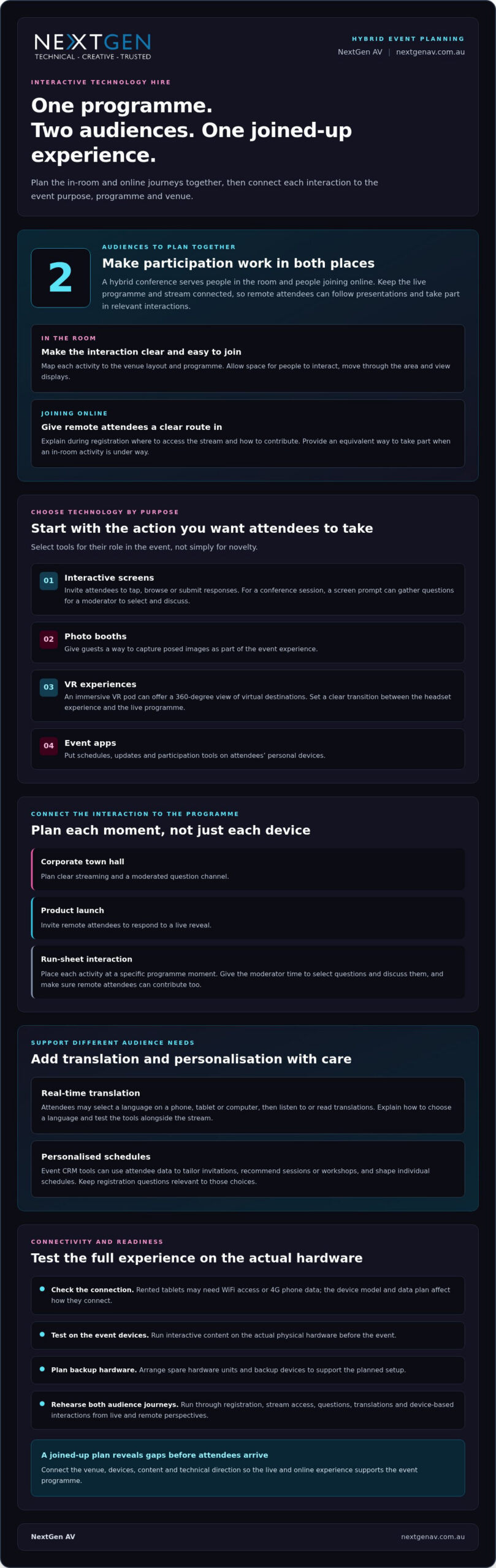
Interactive screens invite attendees to tap, browse or submit responses. Photo booths capture posed images, VR creates immersive virtual experiences, and event apps put schedules, updates and participation tools on personal devices. Choose each option according to the action you want attendees to take, not just its novelty.
A hybrid conference has two audiences to serve: people in the room and people joining online. Plan the live programme and stream as one experience, so remote attendees can follow presentations and take part in relevant interactions. Make the participation route clear during registration, including where online attendees access the stream and how they can contribute.
Start with the event’s purpose. A corporate town hall may need clear streaming and a moderated question channel, while a product launch might invite remote attendees to respond to a live reveal. Interactive event technology hire from NextGen AV can support either format when the tools are connected to the programme rather than competing with it.
Map each interaction to a moment in the run sheet. For example, use a screen prompt to gather questions during a conference session, then give the moderator time to select and discuss them. Remote attendees should have an equivalent way to contribute, not be left watching an in-room activity they cannot access.
For international or multilingual audiences, event translation tools can let attendees select a language on a phone, tablet or computer, then listen to or read translations in real time. Include language-selection instructions for attendees and test the tools alongside the stream, so translated content fits the viewing experience.
Plan the connection between devices and the venue network. Rented tablets may need WiFi access or 4G phone data; the device model and data plan affect how they connect. Test all interactive content on the actual physical hardware before the event. Order spare hardware units and backup devices from the equipment rental company to support the planned setup.
For VR, consider whether the experience serves the event story. An immersive VR pod can give guests a 360-degree view of virtual destinations, offering a different kind of participation from a screen-based poll or app. Set a clear transition between the headset experience and the live programme, especially when attendees also need to follow streamed content.
Finally, rehearse both audience journeys. Run through registration, stream access, questions, translations and device-based interactions from the live and remote perspectives. This exposes integration gaps before attendees arrive and gives the production team a clear conference plan.
Technology planning for complex event environments
At a multi-room Melbourne conference, screens, power, network access and audience movement need a coordinated plan. Map each interaction to the venue layout and programme before finalising the technical design.
Permits, insurance and privacy safeguards
Permits and insurance depend on the venue, event activity and equipment setup. Establish who approves displays, temporary structures, cabling and public-area installations before production begins. An activation in a shared foyer, for example, may need different permissions from a session in a booked conference room.
If registration or interactive tools collect attendee information, explain what is collected and why. Limit access to people who need the information, and set a clear process for handling and deleting it. Make sure surveys, photo uploads and event apps explain their data use clearly.
Booking lead time
Book once the venue, event format and key programme requirements are defined. Planning time depends on the number of spaces, integration work, equipment requirements and whether content needs to be built or adapted. A straightforward display setup differs from a multi-room experience with custom interactions.
Early planning also gives the team time to coordinate venue access, power and network arrangements. Share the event schedule, floor plan and audience journey together, so production decisions support the programme rather than disrupt it. Set a process for changes to content or room layouts.
Supplier checks before booking
Before booking, assess how the supplier will deliver the complete technical setup, not just provide individual devices. Discuss the venue, audience flow, content formats, network needs and integration with registration or event software. Agree on clear responsibilities for the organiser, venue and production team.
Confirm how testing will work with the actual screens, devices and software used at the event. A useful plan identifies setup access, rehearsal timing, technical support during live sessions and the response process if an interaction fails. Review the signal path and equipment locations against the venue floor plan.
Venue requirements vary with the experience. A touchscreen in an exhibition area needs space for interaction and movement, while a live display also needs power and a clear viewing position. Check setup access routes, cable paths, network coverage and whether the venue supports the planned connections.
For complex spaces, create a venue checklist before finalising the technical design. Include room dimensions, ceiling restrictions, available power, internet access, loading arrangements and sightlines. Note where attendees will queue, pause or move between activities. These details affect equipment placement and help keep the programme flowing.
During the site inspection, walk the attendee route from registration to each interactive point. Test network coverage where devices will operate, and identify areas where noise or competing displays could affect engagement. A practical walkthrough turns a floor plan into a delivery plan, with responsibilities and technical decisions clearly aligned.
Bespoke event technology integration
An interactive event technology hire package can bring together displays or devices, event software, content and technical coordination. Its components depend on the audience journey and the systems the event needs to connect.
Start with a clear purpose for each interaction. At a conference, a touchscreen kiosk might provide session updates, maps, surveys, games or contests. Put the most useful action within easy reach and make the prompt clear enough for attendees to respond without lengthy instructions.
Interactive digital signage can display event information and venue maps, as well as social media content created by attendees. Plan the content flow before the event: decide what appears, who manages updates and how the display supports nearby sessions. This keeps the screen useful rather than competing with the programme.
Chatbots can answer attendee questions and recommend experiences based on preferences. For example, a chatbot could direct a delegate to a relevant workshop after they ask about a topic. Keep the interaction responsive, with a clear route to essential information when a question falls outside its planned answers.
Contactless self-check-in can let attendees register using smartphones, QR codes or mobile apps. RFID-enabled badges or wristbands can support contact exchange and track attendance or engagement. These tools work best when registration, access points and attendee instructions follow one consistent process.
Build integration around the event’s actual systems and audience flow. Before committing to a design, map each connection:
- Identify the attendee action, such as checking in, finding a room or answering a poll.
- Match that action to a kiosk, screen, chatbot, app or RFID interaction.
- Define how information moves between the event registration system and the interaction.
- Assign responsibility for content updates, moderation and attendee support.
Mapping connections helps expose gaps early. If a touchscreen survey feeds into a conference discussion, for instance, confirm who reviews the responses and how the presenter receives them. Keep the screen prompt, data flow and session timing aligned, so the technology supports the moment instead of interrupting it.
Test the complete attendee journey, not just each device in isolation. Run through a sample registration, scan a QR code, submit a survey response and view the result on the intended display. Check that instructions make sense to a first-time user and that handovers between tools feel seamless.
For a bespoke experience, integration is the organising layer that connects individual tools into a coherent event journey. A well-designed combination gives attendees clear ways to participate while helping organisers manage information and activity effectively.
Short-term hire across Australia
Short-term event hire can support a single exhibition, conference or product launch without making the technology a permanent venue fixture. Plan delivery, venue access, setup, live support and pack-down as connected parts of the event schedule.
Delivery and pack-down
Agree who transports equipment, coordinates venue access and completes pack-down. For an interstate event, align delivery timing with the venue’s loading arrangements and the organiser’s access window. Confirm which items need to be delivered and where they should go, so the exhibition floor or presentation space is ready for installation.
Pack-down needs a defined handover, too. The team responsible should know when the event finishes, which areas need clearing and how equipment will leave the venue. A virtual event setup, for example, may have different pack-down timing from an exhibition installation that remains in place until the final attendee leaves.
Setup and technical support
Setup involves more than placing equipment. A coordinated team connects the planned technology, checks it is working and aligns it with the room layout and event schedule. For a presentation, this can include testing the content path from the presenter’s device to the display before doors open.
Agree who provides technical support during the event and how requests reach them. A named point of contact helps the organiser respond quickly if a presentation changes or an interactive element needs attention. Technical direction can coordinate these moving parts behind the scenes and keep the programme on track.
For short-term hire across Australia, provide the event location, dates, venue access details and required operating period during planning. These details shape transport, crew scheduling and setup windows. A Melbourne conference and an interstate exhibition may have different delivery routes and venue procedures, so the plan should reflect the actual location.
Then match the technology to the event’s purpose. A touchscreen activity at an exhibition needs room for attendees to approach and participate; a virtual presentation needs a clear connection between the speaker, content and audience experience. Plan the operation around the activity, rather than treating every hire as a simple drop-off.
Before event day, coordinate the run sheet with the installation and support schedule. Mark when equipment must be ready, when presentations will be tested and when venue access needs to be cleared. This connects technical milestones with speaker rehearsals, registration and attendee arrival.
Short-term hire works best when responsibilities are clear from delivery through pack-down. Put the equipment scope, setup arrangements, support contact and collection plan into one production schedule. This gives organisers and venue teams a shared reference, whether the event is a local conference or a travelling exhibition.
What event types and audience sizes suit interactive event technology?
Interactive technology can suit a Melbourne conference, product launch, exhibition or community festival. The best fit depends less on audience size than on what attendees will do, where they’ll gather and how quickly each activity needs to flow.
At a conference, audience polling or question submission can involve delegates without changing the session format. A product launch might use an interactive screen to reveal information as guests explore a new offer. At an exhibition, touchscreen activities can encourage visitors to pause, learn and take part on a busy floor.
Smaller gatherings can make interaction feel personal. A corporate workshop might use a shared screen for group input, while a gala could invite guests to play a game between formalities. For a larger audience, multiple access points can reduce crowding around one activity, while a prominent display helps people across the room follow what’s happening.
Choose the format based on movement and participation. A photo booth suits guests who can visit individually or in small groups; a live poll can involve people seated throughout a room. A VR experience asks each attendee to take a turn with a headset, while an event app lets participants use their own devices. Match the format to the pace and layout of the event.
For an event with a competitive element, organisers can offer prizes for the highest gaming scores and consolation prizes for the lowest scores. This can give guests a reason to return to the activity. Set out the rules clearly, and decide how scores will be recorded and announced during the programme.
Virtual and hybrid formats can extend an experience beyond the physical venue. At a Melbourne product launch, for example, remote attendees could watch a live presentation and take part in a poll alongside guests in the room. Plan the interaction so both groups can respond, rather than leaving online participants as passive viewers.
Before selecting a format, consider these factors:
- Audience flow: Will attendees stay seated, circulate or queue for an activity?
- Participation: Does the experience suit one person, a group or the whole room?
- Access: Can people joining virtually participate alongside the in-person audience?
- Timing: Does each interaction fit naturally between sessions or presentations?
These questions help match the technology to the event, whether it’s an intimate workshop or a large conference. Plan interactive event technology for your event around its audience, format and venue.
NextGen AV: LED Video Walls
NextGen AV helps planners bring interactive event concepts to life with LED Video Walls, supported by Professional Audio Systems, Lighting Design and Equipment, and Staging and Rigging. These elements can work together to frame presentations, support audience engagement and give a hybrid event a clear visual focus.
Turn to the team when a conference, launch or exhibition needs technology coordinated around its venue, programme and audience journey. A considered production plan connects visual design with practical delivery, helping each moment feel deliberate rather than pieced together.
Contact NextGen AV to discuss the technical direction for your event.
Shape the next event experience
Your next event can make technology a deliberate part of the audience experience, not a collection of separate activities. Start by defining the moment you want attendees to remember, then align the creative concept with the venue, programme and production plan. This gives your team a clear brief for planning interactive event technology hire, whether you’re developing a hybrid conference or an in-person launch.
NextGen AV can bring LED Video Screens, Professional Audio Systems and Lighting Hire together to support a cohesive event environment. The right combination depends on your content, space and audience journey, with technical coordination shaping how each element works in the room.
Share your event vision and production requirements with the team to discuss a considered approach. Contact NextGen AV about your event and take the next step towards an experience your audience will remember.
Frequently Asked Questions
How Can Event Planners Use It?
Give attendees a defined role through interactive technology, then decide how you’ll assess its success. For example, set an objective around participation, feedback or content discovery, and assign someone to review the results. A clear purpose helps organisers choose useful interactions and explain their value to stakeholders after the event, without letting technology distract from the programme.
How Much Does It Cost?
The right setup depends on the event format, venue, audience needs and production scope. Start by defining the outcome you want, then identify the technical elements needed to achieve it. A single interaction may need a different setup from an event-wide experience. A clear brief helps establish the scale and responsibilities involved before decisions are made.
What interactive event technology can be hired in Australia?
Australian event technology hire can include audience-facing hardware, engagement platforms, display systems and technical production support. The best combination depends on whether the event needs a standalone interaction or a coordinated production environment. For a Melbourne event, describe the intended attendee experience and how it fits the programme. This helps shape a practical technical scope without selecting tools in isolation.
How much does it cost to hire interactive event technology in Australia?
For an Australian event, define the dates, venue, access arrangements, operating period and level of technical involvement required. These details clarify the scope and help align the setup with the event schedule. Include whether the technology needs to travel between locations or support a changing programme. A precise brief makes planning more straightforward and helps avoid mismatched requirements.
Which Australian companies hire out interactive event technology?
NextGen AV is a Melbourne-based event production company serving events across Australia. It’s a practical option for organisers who need technical planning connected to the wider event experience, rather than an isolated equipment handover. When preparing an enquiry, outline the event format, venue and intended audience experience. That gives the production conversation a clear starting point and keeps the focus on your event’s needs.
If your remote attendees feel like second-class observers peering through a keyhole, your broadcast has already failed. Securing the hybrid event production services melbourne organisations rely on is never just about setting up a camera at the back of the room; it is about engineering a unified, interactive experience for every participant. You already know the acute stress that accompanies high-stakes corporate staging. The lingering fear of embarrassing audio feedback, buffering streams, or rigid venue firewalls can easily turn a flagship presentation into a technical misfire.
You shouldn’t have to spend your event crossing your fingers behind the mixing desk or apologising to disengaged virtual attendees. Discover how to execute seamless dual-audience conferences and broadcasts across Melbourne venues without technical friction. This guide outlines the essential sound systems, network redundancy, and dedicated technical direction required to eliminate production panic and deliver a polished, broadcast-grade experience that meets executive brand standards.
Key Takeaways
- Treat in-person and remote participants as equal audiences through dual-designed visual switching, interactive stage feeds, and broadcast-grade production values.
- Eliminate embarrassing feedback loops and awkward stream silence by deploying dedicated mix-minus audio matrix routing managed by an experienced front of house engineer.
- Partner with specialist hybrid event production services melbourne organisers choose to secure custom line-array sound systems, high brightness LED displays, and independent technical direction.
- Navigate complex Melbourne venue infrastructure, power constraints, and local network firewalls with methodical pre-production site inspections.
- Alleviate live broadcast panic by implementing strict safety compliance, redundant stream architecture, and seasoned Victorian venue expertise.
What Defines High-End Hybrid Event Production in Melbourne?
High-end hybrid execution goes far beyond placing a camera at the back of a ballroom. At its core, a true hybrid event represents a synchronised, two-way live experience where physical attendees and digital delegates participate on equal terms. Basic webcams and DIY conferencing platforms treat remote viewers as passive observers. In contrast, broadcast-grade production blends dedicated stage management with television-standard transmission, ensuring your keynote speeches, panel debates, and live polls resonate with identical authority across both mediums.
Achieving this balance requires an elite technical director at the helm. Behind the scenes, this orchestrator manages cue timing, video routing, and live floor communication, eliminating the panic of missed prompts or awkward pauses. Choosing elite hybrid event production services melbourne planners trust means every speaker transition, presentation slide, and live audience reaction occurs with split-second precision.
The Anatomy of a Dual-Audience Event
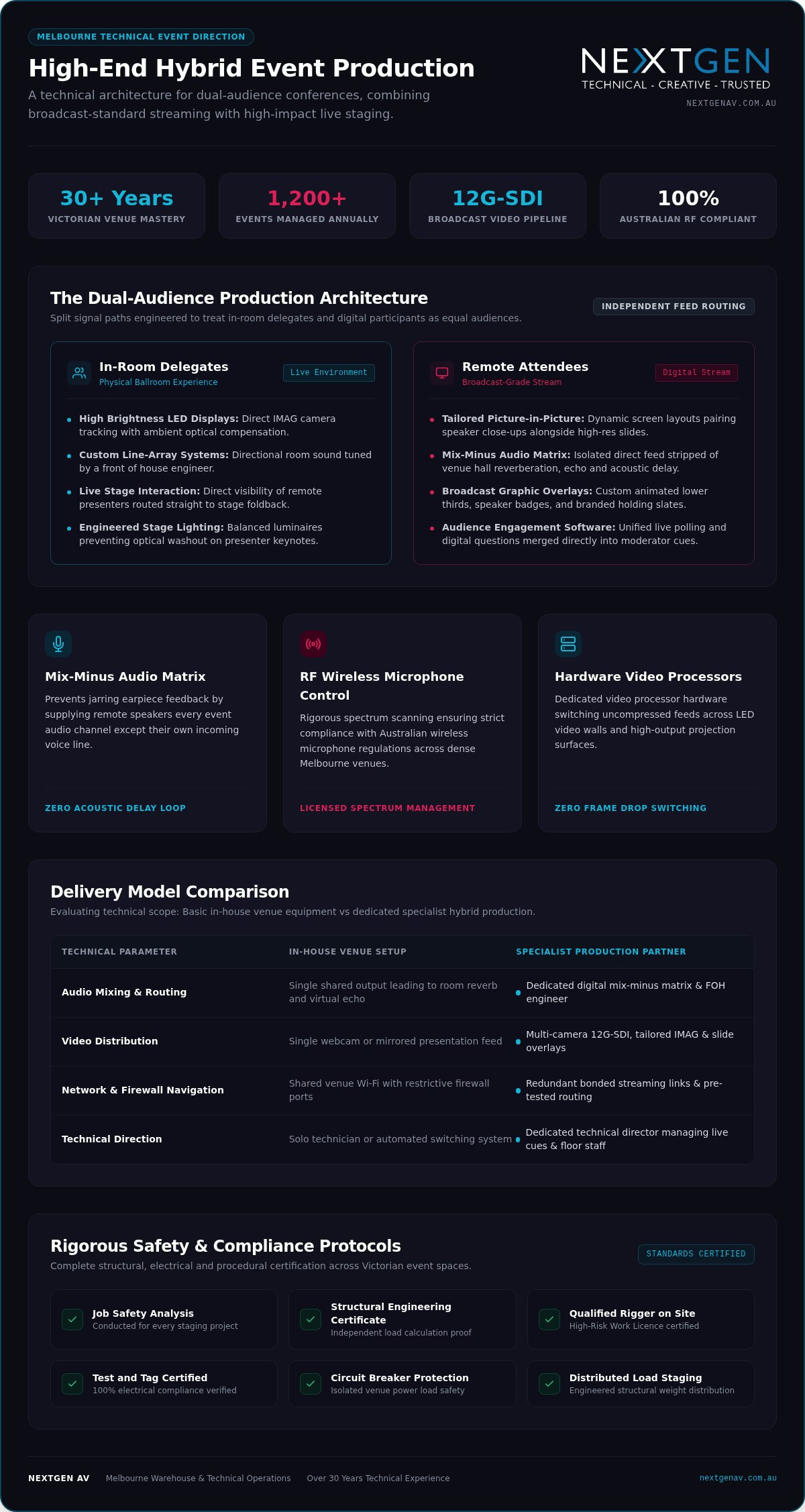
A dual-audience format demands two distinct production paths run in perfect alignment. Inside the physical venue, delegates absorb content through custom stage set design, high-output staging lights, and sharp visual displays. Rather than pushing an identical feed everywhere, a dedicated video processor maps dedicated IMAG (image magnification) footage to the in-room led video wall while sending an entirely custom view to virtual screens.
- Low-Latency Feeds: Eliminates conversational delays so virtual panellists interact naturally with the physical stage.
- Unified Engagement: Integrates audience engagement software so physical hands and digital questions feed into the same live Q&A cue.
- Dual Display Routing: Shows remote viewers the speaker alongside high-res slides, while in-room screens highlight full-stage visuals.
Beyond Simple Live Streaming: The Broadcast Standard
Broadcast standards elevate a corporate gathering into an executive-grade media production. Instead of flimsy consumer cabling, technical teams run high-bandwidth 12G-SDI video infrastructure to handle uncompressed, multi-camera switching without frame loss. Our Melbourne warehouse supplies complete production suites, pairing vision switchers with broadcast PTZ and studio cameras to capture close-up speaker nuance and sweeping room wide-angles.
This television-calibre approach extends to graphic overlays, custom lower thirds, and animated holding slates that reinforce your visual identity. Crucially, it splits the program outputs: one clean mix drives physical venue projection, while a tailored broadcast feed with baked-in presentation graphics feeds your remote distribution engine. By deploying specialised hybrid event production services melbourne corporate leaders ensure their executive message retains prestige, regardless of how participants dial in.
Acoustic and Visual Engineering: Solving the Hybrid Challenge
Nothing shatters executive credibility faster than a piercing feedback loop or a washed-out video feed. Engineering a dual-format space requires simultaneous acoustic and optical balancing. In-person rooms require rich, directional sound systems, while the digital stream demands an isolated feed stripped of cavernous hall reverberation. As detailed in our guide to audio visual hire melbourne venue acoustics, isolating physical room reflections ensures crisp vocal clarity before audio ever reaches an online encoder.
Mix-Minus Audio and Frequency Management
Remote presenters cannot speak naturally if their own voices echo back through their earpieces a second later. To solve this, a dedicated front of house engineer builds a mix-minus matrix on the digital console. This routing sends remote contributors every audio source, including live stage mics and video playback, minus their own incoming signal.
Microphone frequency management demands equal precision. In Melbourne’s crowded RF environment, wireless microphone systems must be mapped to avoid interference and comply strictly with current Australian wireless microphone regulations. Engineers avoid obsolete bands, actively scanning locally clear spectrum within licensed ranges so keynotes never drop out mid-sentence.
Studio-Grade Lighting and Stage Alignment
Standard venue lighting that looks acceptable to the naked eye often renders poorly on camera sensors. Hybrid staging demands studio-calibrated key, fill, and backlighting balanced precisely to camera sensors, generally between 4000K and 5600K colour temperatures. This clean three-point illumination separates presenters from stage backdrops without washing out their facial features on screen.
Visual balance also requires careful alignment between cameras and stage surfaces. When high brightness LED displays form the backdrop, video directors tune camera shutter angles and tile refresh rates to eliminate flickering and moiré patterns. Coordinating these technical details behind the scenes ensures both audiences enjoy pristine clarity. Engaging professional hybrid event production services melbourne teams trust provides the specialist engineering needed to preserve your brand reputation across every screen.
Comparing Technical Delivery Models: In-House Venue AV vs Specialist Production
Relying on in-house venue audiovisual packages often seems convenient, but dual-format events demand an independent production backbone. Generic hotel setups are typically engineered for background dining music and basic slide decks, not synchronized multi-channel streaming. Sourcing dedicated hybrid event production services melbourne specialists provide ensures your broadcast runs on purpose-built infrastructure designed to eliminate technical failure.
| Technical Factor | In-House Venue AV | Specialist Hybrid Production |
|---|---|---|
| Acoustic Delivery | Static ceiling speakers prone to room echo | Custom-engineered line arrays tuned for vocal punch |
| Network Pipeline | Shared venue bandwidth subject to throttling | Bonded cellular and hardwired failover connections |
| Technical Staffing | Duty technicians divided across multiple rooms | Dedicated crew executing rehearsed, bespoke cue sheets |
Bandwidth Architecture and Failover Security
Sharing a venue Wi-Fi network with hundreds of attendees invites immediate broadcast failure. When delegates connect their phones, public bandwidth quickly buckles. Professional production teams bypass public venue networks entirely by deploying bonded primary and secondary internet links. Hardware encoders feature automatic hot-failover switching, instantly redirecting the stream if an upstream line falters. Engineers also coordinate directly with enterprise IT departments well before show day, configuring firewall traversals that prevent unexpected network lockouts.
Equipment Ownership, Calibration, and Crew Mastery
In-house hotel gear frequently sits neglected in storage cupboards between functions, rarely receiving the calibration needed for digital broadcasts. Deploying equipment directly from our dedicated Melbourne warehouse guarantees that every audio console, processor, and lighting fixture is thoroughly checked under strict Test and Tag protocols before arrival.
Crucially, an independent team focuses exclusively on your event rather than dividing attention among different venue halls. As detailed in our guide to full service event production, rehearsed cue sheets and dedicated technical direction guarantee that vision, audio, and stage lighting transition in lockstep, giving stakeholders total confidence from opening address to final wrap.
Five-Stage Blueprint for Flawless Melbourne Hybrid Execution
Executing a high-stakes dual-audience event requires a disciplined sequence of technical milestones. Rather than hoping elements align on the morning of your conference, elite event producers follow a rigorous five-stage operational framework:
- Infrastructure Audit: Inspecting venue power distributions, network capability, and ceiling load points across Melbourne venues.
- Digital Architecture: Customising audience engagement software, lower-third overlays, and broadcast graphic packages.
- Dry Runs and Latency Checks: Testing remote presenter dial-ins, cue automation, and matrix audio feeds under simulated show conditions.
- Live Technical Direction: Calling live vision cuts, managing presenter timing, and orchestrating floor audio in real time.
- Master Archiving: Capturing isolated camera feeds alongside master program records for on-demand compliance and distribution.
Pre-Production Audits and Virtual Architecture
Every venue across Melbourne, from historic heritage halls to contemporary CBD convention spaces, presents unique infrastructure quirks. During phase one, engineers verify dedicated upload speeds, test for enterprise firewall interference, and confirm electrical circuit breaker allocations. Stage structures and overhead trusses also require a formal Job Safety Analysis and structural engineering certificate before any hardware is flown overhead.
Phase two moves into the control architecture. Technicians configure high-throughput video processor units to scale mixed aspect ratios cleanly without introducing visual latency or screen tearing. Simultaneously, audience engagement software is calibrated so in-room delegates on mobile devices and virtual attendees on desktops participate in identical live polls and moderated Q&A sessions without delay.
Show Day Execution and Rehearsal Protocols
Show day succeeds because the work happens before doors open. Rehearsal protocols begin with dedicated remote presenter checks at least thirty minutes prior to live transmission, ensuring their home audio, lighting, and framing meet executive standards. On stage, presenters step through cue-to-cue walkthroughs, learning their camera marks and stage monitor positions.
Throughout the live broadcast, technical directors continuously observe encoder bitrates, stream stability, and peak audio signals across dual outputs. To bring this structured discipline to your next corporate summit, book hybrid event production services melbourne specialists who engineer reliability into every single phase.
Partner with NextGen AV for Melbourne Hybrid Production
Executing an elite corporate broadcast leaves no room for improvisation. With over 30 years of technical mastery across Victorian venues, NextGen AV eliminates the acute anxiety of live event delivery. We manage more than 1,200 events annually, bringing proven familiarity to complex spaces such as the Melbourne Convention and Exhibition Centre (MCEC), Crown Palladium, and premium CBD hotel ballrooms. Our veteran crew understands the distinct power layouts, access corridors, and acoustic challenges of these landmark locations, ensuring rapid load-ins and zero technical surprises.
When you secure the premier hybrid event production services melbourne planners trust, you gain a dedicated partner committed to engineering an unforgettable attendee experience. Discover how our dedicated hybrid event staging solutions unite creative stage design with broadcast-grade distribution to elevate your executive brand.
Rigorous Safety and Technical Compliance
Production excellence starts with uncompromised compliance. Every staging build, ground-supported LED structure, and flown lighting truss is engineered to rigorous Australian standards:
- Safe Work Documentation: We draft site-specific Job Safety Analysis documentation to protect crew, venue staff, and delegates.
- Engineered Structures: Flown rigs and complex stages carry a validated structural engineering certificate to ensure structural integrity.
- Licensed Crews: Overhead rigging and heavy-lift logistics are handled by personnel holding a valid High-Risk Work Licence and qualified rigger credentials.
- Electrical Governance: Every single cable, power distro, and luminaire passes regular electrical Test and Tag verification before leaving our facility.
End-to-End Technical Orchestration
Operating directly out of our local Melbourne warehouse gives us an extraordinary operational advantage. We store, test, and calibrate every piece of equipment internally, including high-output LED panels, broadcast optical chains, and digital mixing consoles. This extensive local footprint means spare components and supplementary hardware are always available for immediate deployment.
Beyond our physical hardware, our strength lies in dedicated technical direction. A senior technical director collaborates with your team from initial concept through to final wrap, creating detailed run sheets and guiding presenters on stage. Backed by seasoned hybrid event production services melbourne corporate teams count on, you can step away from the mixing desk and take centre stage with absolute confidence.
Elevate Your Next Corporate Broadcast
Flawless dual-audience conferences come down to disciplined engineering rather than good fortune. When you resolve technical friction through dedicated mix-minus routing, bonded network failovers, and synchronised digital engagement, remote viewers feel just as valued as the audience in the room. Your presenters speak with ease, your stream stays locked, and your executive message commands the respect it deserves.
Choosing the specialised hybrid event production services melbourne organisations trust means trading live production panic for absolute confidence. Backed by over 30 years of technical mastery across Victoria and managing 1,200+ live productions annually, NextGen AV provides the proven capability your event demands. Our Melbourne warehouse supplies broadcast-grade audio, video, and LED displays, while our veteran directors orchestrate every cue behind the scenes. Partner with Melbourne’s hybrid production specialists at NextGen AV to create a seamless live broadcast that exceeds executive standards.
Frequently Asked Questions
What is the difference between a live stream and a hybrid event?
A live stream is a one-way passive broadcast, whereas a hybrid event creates active, two-way participation between in-room and remote audiences. Live streaming simply shares video footage of a stage. Professional hybrid event production services melbourne organisations rely on connect both groups through synchronised audience engagement software, bidirectional audio matrixing, and tailored dual visual feeds. This setup ensures remote attendees speak, vote, and interact rather than just watching from the sidelines.
How do you prevent audio echo between remote speakers and the live room?
Audio echo is eliminated by configuring a dedicated mix-minus bus on the digital audio console. A front of house engineer routes every stage microphone, media playback channel, and floor sound to the remote contributor, deliberately excluding their own incoming voice. Combining this matrix routing with acoustic room tuning prevents audio loops, delay feedback, and latency traps, allowing conversations between the stage and remote participants to flow naturally.
What internet bandwidth is required at a Melbourne venue for hybrid broadcasting?
A stable corporate broadcast requires a dedicated, symmetrical upload speed of at least 20 to 30 Mbps reserved exclusively for the streaming encoders. Sharing bandwidth with hotel guests or conference attendees causes immediate stream stutter and frame loss. Melbourne technical teams ensure reliability by deploying cellular bonding appliances alongside hardwired Ethernet lines, guaranteeing unthrottled throughput regardless of how many personal devices connect to the local public Wi-Fi.
Can remote attendees interact in real time with the in-person audience?
Yes, real-time interactivity works seamlessly when digital tools are integrated directly into the stage production environment. By deploying unified audience engagement software, both physical delegates and remote viewers participate simultaneously in live polling, moderated Q&A sessions, and quizzes. Remote questions appear on presenter comfort monitors on stage, while live floor reactions and applause are mixed back into the broadcast feed for complete audience integration.
What happens if the venue internet connection drops during the live broadcast?
The broadcast continues uninterrupted if your production infrastructure includes automated hardware hot-failover switching. Production teams deploy redundant secondary pathways, combining hardwired venue lines with bonded 4G and 5G cellular networks. If the primary internet pipe drops or experiences packet loss, the streaming encoder shifts data packets instantly to the backup connection. Viewers at home experience zero signal dropouts or stream resets while technicians resolve the local venue fault.
Why is an external production specialist better than using hotel in-house AV?
External production specialists provide dedicated focus, custom-engineered sound systems, and tested equipment rather than generic, multi-room hotel gear. Booking dedicated hybrid event production services melbourne specialists brings seasoned technical directors who rehearse your specific run sheet from start to finish. In-house venue teams often manage several rooms simultaneously using aging equipment, whereas external specialists dispatch calibrated gear directly from a local warehouse to ensure flawless brand execution.
How early should technical pre-production begin for a corporate hybrid conference?
Technical pre-production should begin at least eight to twelve weeks prior to your event date. Starting early provides adequate time to perform on-site Melbourne venue inspections, complete structural engineering certificates, run network speed audits, and program custom digital graphics. Early collaboration also allows your technical director to design failover protocols, review presentation decks, and schedule dry runs with remote keynote speakers well before show day.
In 2026, a corporate town hall isn’t just a meeting; it’s a high-stakes broadcast where your brand’s reputation is either forged or fractured in real-time. Securing a flawless corporate town hall av setup melbourne requires more than just microphones and speakers. It demands a level of precision that transforms a standard update into a cinematic event. You’ve likely felt the collective breath-hold when a remote speaker’s audio clips, or the logistical stress of organising a complex CBD venue bump-in on a razor-thin schedule. We understand that in these high-pressure moments, there’s absolutely no room for “good enough.”
You deserve a partner who treats your internal communication with the same prestige as a national television production. This guide promises to help you master the technical orchestration required to deliver a broadcast-quality experience that engages every employee, whether they’re sitting in a Collins Street ballroom or streaming from a home office. We’ll preview the essential 2026 standards, from high-resolution LED video walls to AI-driven adaptive audio, ensuring your next event achieves total technical reliability and full staff engagement.
Key Takeaways
- Transition from a standard “internal meeting” mindset to a broadcast-grade production that reinforces your corporate authority and brand reputation.
- Ensure every voice resonates clearly by using precision audio engineering and line array systems to eliminate acoustic dead zones in large Melbourne venues.
- Optimise your corporate town hall av setup melbourne with high-brightness LED video walls that maintain stunning visual clarity, even in spaces with significant natural light.
- Bridge the gap between the CBD and remote staff by implementing zero-latency hybrid solutions and professional camera switching for an inclusive, front-row experience.
- Alleviate the logistical stress of complex venue bump-ins by partnering with seasoned technical directors who orchestrate the “invisible” work behind the scenes.
The Stakes of the Melbourne Town Hall: Why Technical Precision Matters
A corporate town hall in Melbourne’s competitive business sector is a high-stakes performance. Treating it as a mere “internal meeting” is a recipe for technical catastrophe. In large spaces, standard office equipment falters; audio becomes a muddy echo and visuals lose their punch. A professional corporate town hall av setup melbourne ensures your message doesn’t just reach the back of the room, but carries the weight of your brand’s authority. When you scale your communication, the margin for error disappears.
When the CEO speaks, the technology must be invisible. We call this the “Invisible Expert” philosophy. If the audience is thinking about a crackling microphone or a flickering screen, they aren’t thinking about your strategy. Precision engineering allows the technology to fade into the background, providing a seamless platform where leadership trust is built through clarity and reliability. Our team at NextGen AV brings 30 years of experience to ensure your technical foundation is unshakable.
Defining the 2026 Town Hall Experience
By 2026, the standard for corporate communication has evolved from simple PA systems to fully immersive environments. High-fidelity sound is no longer a luxury; it’s a psychological necessity. Developments in video conferencing technology show that poor audio and visual quality directly correlate with listener fatigue and a decrease in perceived leadership competence. We move beyond the basics, creating high-end productions that set a definitive tone for your corporate culture. Technical precision impacts your event in three critical ways:
- Executive Presence: Flawless execution mirrors corporate competence.
- Employee Engagement: Immersive visuals keep attention spans sharp across the room.
- Brand Integrity: High-definition delivery protects your internal reputation.
Navigating Melbourne’s Corporate Aesthetic
Melbourne offers a unique architectural duality that poses distinct technical challenges. You might find yourself in a bluestone heritage hall with difficult acoustics one day, and a glass-walled CBD hub with intense “daylight factors” the next. Aligning your AV design with these spaces requires more than just gear. It demands expert technical direction to transform a standard hall into a branded, sophisticated space that meets the expectations of Melbourne’s business elite. Whether it’s managing the logistical complexity of a CBD venue bump-in or tailoring lighting to suit a heritage ceiling, our approach focuses on mastery and artistry to ensure your event feels both structured and cinematic.
Audio Engineering: Ensuring Every Voice Resonates Across the Hall
Town Hall Audio Excellence is the elimination of acoustic dead zones through precision engineering. In a high-stakes corporate town hall av setup melbourne, sound isn’t merely about volume; it’s about absolute intelligibility for every listener in the room. Large Melbourne venues, particularly heritage spaces like the Melbourne Town Hall, present significant acoustic challenges. The “cocktail party effect” often takes hold in these reverberant environments, where sound bounces off hard surfaces and masks the speaker’s voice. To counter this, we deploy line array speaker systems as the gold standard. These systems provide a controlled, cylindrical sound wave that travels further with less spill, ensuring the CEO’s message reaches the back row with the same clarity as the front.
Operating within the Melbourne CBD introduces a hidden layer of complexity: wireless frequency congestion. With hundreds of offices and broadcast towers competing for bandwidth, a standard microphone setup is prone to dropouts or interference. We manage this through rigorous site surveys and active frequency coordination, carving out a dedicated path for your audio. Understanding the benefits of professional AV integration means recognising that reliability is a deliberate choice, not an accident. Our engineers act as the invisible guardians of your signal, ensuring no external noise disrupts your corporate narrative.
Microphone Strategies for Presenters and Q&A
Engagement relies on the seamless flow of conversation. For presenters, we prioritise digital wireless systems that offer both encrypted security for sensitive corporate data and uncompromised sonic purity. When the floor opens for questions, the choice of equipment dictates the energy of the room. Roaming microphones offer a traditional, formal touch, while “catch-box” throwable mics can inject a sense of modern dynamism into your culture. Integrating professional sound system hire ensures that whether a question comes from a soft-spoken graduate or a booming executive, the delivery remains crystal clear for the entire audience.
Acoustic Modelling for Large Venues
We don’t guess; we calculate. Using sophisticated software, we predict how sound will behave in your specific venue before a single cable is laid. This allows us to strategically place delay speakers and create multi-zone control, providing even coverage that prevents “hot spots” near the stage. During the event, our engineers live-mix two distinct feeds: one tailored for the physical room and another optimised for the broadcast. This dual-focus approach ensures your remote teams feel just as connected as those in the hall. If you are ready to elevate your next session, consult with our technical directors to design a bespoke audio landscape.
Visual Impact: LED Video Walls and High-Brightness Displays
Visual prestige is the heartbeat of executive communication. By 2026, projection has largely been relegated to the past, unable to compete with the vibrant luminosity of modern LED technology. In a premium corporate town hall av setup melbourne, LED video walls provide the high-contrast brilliance necessary to overcome the “Daylight Factor” common in Melbourne’s glass-fronted CBD venues. Whether you’re presenting in a sun-drenched atrium or a heritage hall with high ambient light, LED ensures your data remains razor-sharp. For a deep dive into the technical specifications of these systems, refer to our LED video wall planning guide.
We utilise dynamic content layouts to maintain a sophisticated narrative flow. Using Picture-in-Picture (PiP) technology, we place the speaker and their data visualisations in the frame simultaneously. This multi-layered approach prevents the audience from having to choose between watching the presenter and reading the slides, creating a more cohesive and professional broadcast experience.
Choosing the Right Pixel Pitch for Indoor Events
Text clarity is non-negotiable. For indoor corporate events, a pixel pitch of 2.5mm or lower is essential. This ensures that even the smallest font on a complex financial graph is legible from the back of the room. When recording or live-streaming, our technical directors carefully manage the “Moiré effect,” those distracting wavy patterns that occur when camera sensors conflict with LED refresh rates. We also move beyond the standard 16:9 aspect ratio, configuring custom displays that wrap around the stage or follow the architectural lines of your venue for a truly bespoke experience.
Lighting for the Camera and the Room
In 2026, hybrid delivery is no longer a novelty; it’s a fundamental expectation for every major Australian organisation. A sophisticated corporate town hall av setup melbourne must bridge the physical distance between a CBD ballroom and a remote home office with absolute seamlessness. We treat your remote audience as a primary broadcast demographic, not an afterthought. This requires professional camera switching that mimics a live television production, ensuring those watching from afar have a front-row seat to every nuance of the presentation. By integrating hybrid event staging solutions, we create a unified experience where geography becomes irrelevant.
Navigating the logistical “bump-in” for Melbourne’s heritage venues adds a layer of complexity many planners overlook. Iconic locations like the Melbourne Town Hall or heritage-listed CBD spaces often lack the built-in fibre infrastructure required for high-bandwidth streaming. Our team excels in these environments, deploying redundant internet solutions that bypass unreliable venue Wi-Fi. We establish dedicated 4G/5G and satellite failovers to guarantee that your broadcast never falters, regardless of the venue’s age or architectural constraints. This technical resilience allows your leadership to focus on the message while we manage the invisible digital infrastructure.
The 5-Step Hybrid Integration Process
Success in the hybrid space is the result of a methodical, step-by-step orchestration. Our technical directors follow a rigorous protocol to ensure total reliability for every participant:
- Step 1: Establishing a dedicated high-speed upload link separate from public networks to ensure a stable, high-definition feed.
- Step 2: Designing a multi-camera plot to capture both the energy of the presenters and the live reactions of the audience in the room.
- Step 3: Configuring an audio mix-minus setup to prevent distracting echos or feedback loops for remote participants during interactive segments.
- Step 4: Synchronising live stream encoding and platform synchronisation to deliver a consistent experience across all devices.
- Step 5: Performing real-time monitoring and technical redundancy checks throughout the entire event to catch and resolve issues before they impact the viewer.
Interactive Elements for Global Engagement
Engagement is a two-way street. We implement live polling and Q&A integrations that treat remote and local staff as equals, fostering a culture of genuine inclusion. Low-latency return feeds allow presenters on stage to see and hear their remote colleagues in real-time, closing the feedback loop and humanising the digital connection. This entire process is managed by a dedicated Virtual Stage Manager, a critical crew member who ensures the digital experience is as polished as the physical one. If you want to transform your next broadcast into a truly global experience, explore our hybrid production services today.
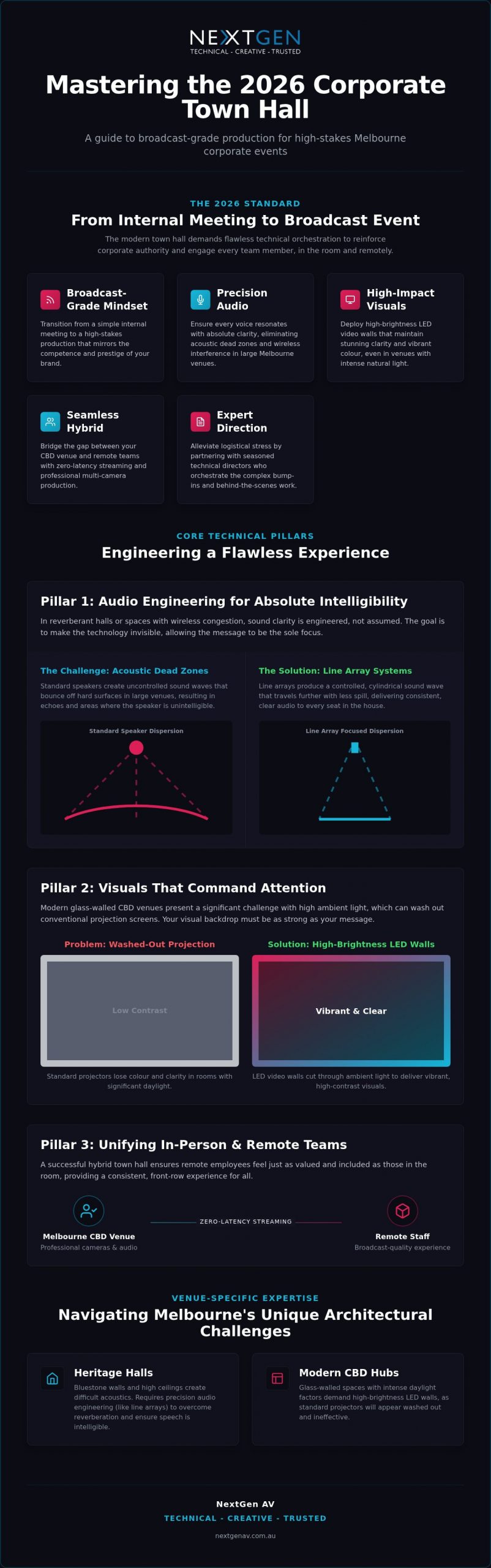
Partnering with NextGen AV: Orchestrating Your Melbourne Town Hall
NextGen AV is more than a supplier; we’re the engine driving your event’s success. With over 30 years of experience delivering more than 1,200 events annually, we’ve mastered the intricacies of a high-stakes corporate town hall av setup melbourne. Our “Confident Orchestrator” approach is designed to alleviate the heavy burden of live production. We take full accountability for the technical outcome, allowing you to focus entirely on your leadership message without a second thought for the hardware. While others provide a list of equipment, we offer a dedicated craft that ensures your brand’s authority remains unshakeable from the first word to the final applause.
Major Melbourne brands choose us because we understand that internal communication is a strategic asset. We don’t just set up a stage; we build a platform for your corporate culture. Our team thrives under pressure, acting as a collaborative ally that anticipates challenges before they become disruptions. This “quiet power” allows your leadership team to take centre stage with the confidence that every technical detail is being managed by seasoned veterans who have seen it all.
Pre-Production and Melbourne CBD Logistics
Success is won in the weeks before the house lights dim. Melbourne’s CBD presents a gauntlet of unique challenges, from the strict heritage building constraints of Collins Street to the notoriously small service lifts of older office towers. We navigate these hurdles through meticulous pre-production, including detailed CAD floor plans and rigorous site inspections that eliminate event-day surprises. Our technical directors perform comprehensive acoustic testing and signal path verification long before your first guest arrives. This level of preparation transforms logistical complexity into a structured, cinematic experience, ensuring every technical run sheet aligns perfectly with your broader communication strategy.
On-Site Excellence and Peace of Mind
During the event, our “Invisible Expert” philosophy takes centre stage. Our technicians are corporate-ready, possessing the specific etiquette and poise required for high-level executive environments. We don’t just hope for success; we engineer it. This means implementing redundant systems for every critical piece of hardware, from backup audio consoles to secondary stream encoders. Choosing our full service event production means you aren’t just hiring gear. You’re securing a partnership with a proactive, elite team that thrives under pressure. We take personal pride in the quiet power of a seamless execution, allowing you to take the spotlight with absolute confidence.
Mastering the Art of Flawless Execution
A successful town hall is the ultimate expression of corporate unity. By prioritising technical precision, you transform a standard meeting into a prestigious broadcast that commands respect. Whether it’s the acoustic mastery of a heritage ballroom or the vibrant clarity of an LED video wall, every element of your corporate town hall av setup melbourne should reflect the excellence of your brand. We’ve explored how zero-latency hybrid solutions and expert technical direction bridge the gap between your leadership and every member of your team.
NextGen AV brings over 30 years of local Melbourne expertise to every project, delivering more than 1,200 events annually. As specialists in high-stakes corporate production, we act as the invisible orchestrators behind your success, allowing you to lead with absolute confidence. It’s time to move past the logistical grind and focus on the impact of your message. Enquire about your Melbourne Town Hall AV setup today and let us help you deliver an experience that resonates long after the house lights fade. Your vision deserves nothing less than technical perfection.
Frequently Asked Questions
What is the most important piece of AV gear for a Melbourne town hall?
Intelligibility is the cornerstone of any event, making a professional audio system the most critical component. Without clear sound, your message is lost to echoes or dead zones. However, for a modern corporate town hall av setup melbourne, the synergy between high-fidelity audio and an LED video wall creates the necessary prestige. This combination ensures your leadership is both heard with absolute clarity and seen with high-definition impact, regardless of the venue’s ambient light.
How do we ensure remote employees can ask questions during the live session?
We facilitate real-time engagement through low-latency return feeds and integrated digital polling platforms. This allows remote staff to submit questions that appear instantly for the moderator or presenter to address. By treating the virtual audience as a primary broadcast demographic, we ensure they have the same voice as those in the room. Our technical crew manages these interactions behind the scenes, creating a seamless, two-way conversation that fosters a truly inclusive corporate culture. To further support this commitment, 216digital provides the expertise needed to ensure your digital communications are fully accessible, while helping you navigate potential tax credits for these improvements.
Do we need to hire a separate technical director for a town hall?
Technical direction is a specialised service we include to manage the complex orchestration of your event. While you focus on your comms strategy, a technical director handles the “invisible” work, from camera switching to signal paths. This role is vital for high-stakes meetings where there’s no room for error. We act as your “Invisible Expert,” coordinating every technician and piece of hardware to ensure the final result is polished, professional, and entirely stress-free for your team.
How long does it take to set up (bump-in) AV for a town hall in the CBD?
A standard full-production bump-in usually requires between four and eight hours, depending on the complexity of the rig. Melbourne CBD logistics often present unique challenges, such as restricted loading dock times or limited lift access in heritage buildings. We mitigate these factors through rigorous pre-planning and site inspections. Our team manages the entire logistical process, ensuring all equipment is installed, tested, and ready well before your first executive takes the stage for rehearsals.
Can you provide AV services in heritage-listed Melbourne buildings?
We specialise in navigating the architectural and acoustic constraints of Melbourne’s iconic heritage venues. These spaces often feature high ceilings and bluestone walls that create significant reverberation, which we solve through precision audio engineering and strategic speaker placement. We also use non-invasive rigging solutions to protect the integrity of the building. Our 30 years of local experience ensures we can transform even the most challenging historical hall into a modern, high-performance corporate environment without compromise.
Is an LED video wall better than a projector for a corporate presentation?
By 2026, LED video walls have become the definitive choice for prestigious corporate presentations. Unlike projectors, LED panels deliver immense brightness that easily overcomes the “Daylight Factor” in glass-walled CBD venues. They provide superior contrast and vibrant colours without the risk of presenters casting shadows on the screen. This technology ensures your data visualisations are razor-sharp and legible from every seat, providing a high-impact visual experience that reinforces your brand’s authority and modern aesthetic.
How do you prevent audio feedback in a large hall with high ceilings?
We prevent feedback by using sophisticated acoustic modelling software to predict and control sound behaviour within the space. Strategic placement of line array speakers allows us to direct audio specifically at the audience while keeping it away from microphones on stage. Our engineers also use digital signal processing to “ring out” the room, identifying and neutralising problem frequencies before they cause issues. This precision engineering ensures a clean, professional sound that resonates clearly without any distracting squeals.
What happens if the internet fails during our hybrid town hall?
We eliminate the risk of internet failure by deploying multi-layered redundancy for every hybrid event. If the primary venue link falters, our systems automatically switch to dedicated 4G/5G failovers or satellite links without interrupting the broadcast. We never rely solely on “venue Wi-Fi,” as it lacks the stability required for a professional town hall. This proactive approach to technical direction ensures your remote teams stay connected and your global message remains uninterrupted, providing total peace of mind.
Imagine the sudden, heavy silence in a room of three hundred delegates when a Minister’s keynote is interrupted by a piercing feedback loop or a dropped hybrid connection. In the high-stakes arena of public policy, these aren’t just technical hiccups; they’re diplomatic liabilities that can overshadow months of preparation. You know that at this elite level, there’s zero tolerance for error. Every word must be intelligible, every transition must be seamless, and every remote link must be ironclad. Choosing the right government summit av services is about more than just hiring equipment; it’s about securing a partner who understands the weight of the moment.
We’ll show you how to ensure your next summit is a benchmark for precision, security, and impact through specialist audio visual production. This article explores the essential shift toward WCAG 2.1 Level AA accessibility compliance, the complexities of secure hybrid integration, and how professional technical direction allows your department to take centre stage with absolute confidence. From high-definition LED video walls to crystal-clear professional audio systems, we’ll outline the roadmap to a flawless 2026 event that reflects the prestige of your organisation.
Key Takeaways
- Understand why specialised government summit av services are essential for high-stakes ministerial forums where technical reliability is a matter of professional prestige.
- Explore the synergy between high-resolution LED Video Walls and precision lighting design to ensure your event is perfectly staged for global media and photography.
- Master the 2026 standards for hybrid event solutions and accessibility; this ensures seamless links for remote VIPs and compliant captions for all attendees.
- Gain insights into the “Invisible Expert” production timeline, detailing how technical teams work alongside protocol officers to ensure every transition is perfectly timed.
- Discover the value of a comprehensive technical direction partnership that handles the logistical grind, allowing your organisation to focus entirely on the summit’s impact.
The Strategic Role of Government Summit AV Services
Government summits are not merely larger versions of corporate conferences; they’re high-pressure environments where technical precision is a form of respect. Specialist government summit av services transform a standard venue into a secure, broadcast-ready hub for policy and progress. When a Minister steps to the lectern, the technology must be invisible. We call this “Silent Diplomacy.” It’s the art of facilitating complex communication through integrated audiovisual systems without the mechanics ever becoming a distraction. In 2026, the standard for these events has evolved. Delegates and the public now expect high-definition visual clarity and broadcast-quality sound that captures every nuanced inflection of a speaker’s address.
“Good enough” is a dangerous gamble when international reputations and departmental credibility are on the line. Partnering with a provider that specialises in government summit av services ensures that every technical decision supports the overarching mission of the event. Whether it’s a domestic policy launch or an international delegate forum, the technical infrastructure must operate with the same rigour as the protocol itself.
Beyond Basic AV: Why Summits Require Specialist Expertise
A standard meeting might survive a flickering screen, but a high-level summit environment cannot. Technical failure in these forums doesn’t just disrupt a presentation; it damages public perception and can even stall diplomatic momentum. Specialist expertise is required to manage the intense scrutiny of live media feeds and the rigid timelines of ministerial schedules. Professional technical direction acts as the engine behind the scenes, synchronising complex programmes and ensuring that every transition occurs with split-second accuracy. This level of orchestration allows organisers to move past logistical anxiety and focus on the prestige of the final result.
Security and Reliability as the Foundation
Reliability in a government context is built on layers of fail-safes and secure signal management. For sensitive discussions or closed-door sessions, the integrity of the audio and video feeds must be absolute. This requires a sophisticated approach to signal routing and encryption that standard event hire simply doesn’t provide. AV redundancy serves as the non-negotiable safety net for high-stakes government forums, ensuring that a single component failure never compromises the continuity of a national address. By prioritising these technical foundations, we create a resilient environment where the dialogue remains the focus, protected by a proactive team that has anticipated every variable well before the first delegate arrives.
Core Technical Pillars: Audio, Visual, and Lighting
The architecture of a prestigious event is built on three non-negotiable pillars: audio, visual, and lighting. Staging and rigging define the physical presence of the summit, creating a structured, authoritative stage that commands respect from the moment delegates enter the room. In 2026, the standard for government summit av services has moved beyond basic equipment hire to integrated technical ecosystems where every component is calibrated for maximum impact. Lighting design acts as the silent partner of photography; it must be precisely tuned to ensure speakers look their best on camera without washing out the clarity of the high-resolution visual displays.
Crystal Clear Audio for Every Delegate
Speech intelligibility in vast plenary halls and convention centres is a science that requires meticulous planning. Professional technical teams use acoustic modelling to eliminate echoes and dead spots, ensuring that every syllable of a ministerial address carries with absolute clarity. Choosing the right professional sound system hire is the first step in managing the complex audio needs of panel discussions and Q&A sessions. Following established government presentation guidelines ensures that presenters deliver content that matches this audio precision. For inclusive communication, these systems must integrate seamlessly with hearing loops and real-time translation services, allowing every delegate to participate fully regardless of their location in the hall.
High-Impact Visuals: LED Video Walls and Beyond
The shift to LED video walls marks a turning point in summit production, having largely replaced traditional projection for high-stakes environments. These screens offer immense brightness and contrast, ensuring that data-heavy presentations and live video feeds remain crisp under intense stage lighting. Managing multiple content feeds requires a robust technical backbone to switch between keynote slides, remote participant links, and social media walls without a single flicker. For community-facing government events held outdoors, high-nit outdoor LED screens provide the necessary visibility to engage large public crowds effectively, even in direct sunlight. Orchestrating these elements requires a partner who understands the nuances of full service event production, ensuring that the technology reflects the prestige of your department.
Hybrid Summits and Accessibility in 2026
By 2026, the hybrid model has evolved from a contingency plan into the primary vehicle for inclusive policy discussion. Deploying elite government summit av services means ensuring that a remote Minister or a delegate in a different time zone feels as present as those sitting in a Melbourne plenary hall. This parity of experience isn’t a luxury. It’s a technical requirement for modern governance. Achieving this requires a sophisticated suite of hybrid event staging solutions that manage the delicate balance between on-site energy and digital reach. When the technical infrastructure is handled with mastery, the technology disappears, leaving only the impact of the dialogue.
Secure Live Streaming and Virtual Integration
Security is the silent foundation of every hybrid government event. Connecting remote VIPs requires more than a standard video call; it demands low-latency, encrypted streams that protect the integrity of the discussion. A dedicated technical director acts as the orchestrator, managing the “dual audience” experience to ensure neither group is sidelined. This involves synchronising interactive tools for hybrid Q&A sessions, bridging the gap between the room and the screen so that remote participants can engage in real-time. By prioritising high-security signal management, we eliminate the risk of external disruptions, allowing the department to maintain absolute control over the broadcast environment.
Accessibility Standards for Government Events
Accessibility is now a core mandate for all public sector forums, driven by the 2026 requirement for WCAG 2.1 Level AA compliance across digital communications. This standard extends to the live audiovisual components of a summit. To meet these expectations, we integrate several key services:
- Live Captioning: Real-time, accurate text displays for all plenary sessions to support delegates with hearing impairments.
- Auslan Integration: Seamless picture-in-picture feeds or dedicated on-stage areas for sign language interpreters.
- Accessible Staging: Physical stage designs that incorporate ramps and lecterns adjusted for speakers with mobility requirements; for Queensland-based events, Mobility and You offers specialised aids to ensure every participant can engage with the programme comfortably.
- Digital Signage: High-contrast ePosters and interactive programme boards that facilitate clear wayfinding throughout the venue.
These elements ensure that every participant, regardless of their physical ability or location, has equal access to the information being shared. When accessibility is woven into the initial design rather than added as an afterthought, it reflects a department’s commitment to genuine inclusion. Partnering with specialist consultancies such as IntegraSense can provide the necessary framework for accessibility and professional practice, ensuring that every detail is managed with precision. This proactive approach alleviates the stress of last-minute adjustments and ensures the summit remains a prestigious, compliant, and impactful event for all involved.
Success at a high-stakes event is born in the months before the first delegate arrives. Delivering elite government summit av services requires a timeline that respects the rigid nature of ministerial schedules and international protocol. Our “Invisible Expert” philosophy ensures that the technical team operates in lockstep with protocol officers, understanding that a change in seating or a delayed dignitary arrival has immediate technical implications. This disciplined approach transforms a complex logistical operation into a seamless experience for every participant.
Pre-Production and Technical Direction
Technical Direction is the strategic bridge between departmental stakeholders and the physical venue. The Technical Director oversees the entire production lifecycle, beginning with detailed site visits and the creation of CAD drawings. These visualisations allow you to see the room layout, sightlines, and LED Video Wall placement before the first cable is laid. Accurate resource allocation ensures the right specialist crew is in place for high-pressure moments, such as the opening ceremony or a televised keynote. By mapping every technical requirement to the summit’s objectives during pre-production, we eliminate the guesswork and build a resilient foundation for the event.
On-Site Management and Live Operation
During the live event, we manage the “run of show” with military precision to ensure the programme stays on track. A dedicated, closed-circuit comms loop connects the stage manager, AV operators, and protocol staff, allowing for instantaneous adjustments without the audience ever knowing. The technical rehearsal, or “dry run,” is a non-negotiable milestone in this process. It provides VIPs and speakers the opportunity to familiarise themselves with the stage, microphone placement, and visual cues. This practice session removes the friction of the unknown, ensuring that when the live broadcast begins, every participant is comfortable and every transition is polished.
Managing the media is equally critical. We provide dedicated broadcast feeds and press boxes for news organisations, ensuring that media scrums are handled without disrupting the flow of the summit. This level of rapid-response troubleshooting means that if a speaker deviates from the programme, the technical team is already two steps ahead, adjusting lighting and audio cues in real-time. To secure this level of mastery for your next event, partner with NextGen AV for specialist technical direction and end-to-end summit production.
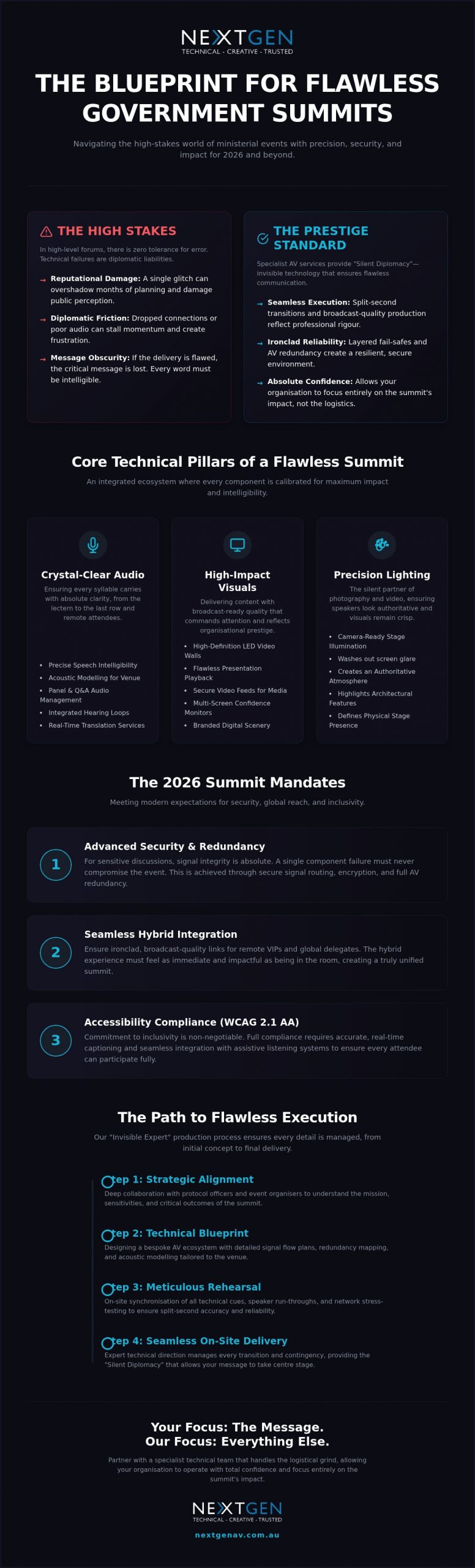
Partnering with NextGen AV for Your Next Summit
Selecting a partner for high-stakes government summit av services requires more than a standard vendor; it demands a dedicated ally who understands the weight of the moment. NextGen AV brings over 30 years of industry experience to every project, operating as the “Invisible Expert” that drives your success from the shadows. We believe that technology should empower the message, not distract from it. Our full service event production model is designed to alleviate the inherent stress of high-stakes planning, allowing you to focus on the prestige of the final result. We don’t just provide equipment. We craft experiences that reflect the authority of your department. Success isn’t accidental. It’s engineered.
A Track Record of Excellence in Australian Forums
Our team delivers over 1,200 successful events annually, a testament to our ability to thrive under the most intense pressure. This track record spans various sectors, giving us a unique perspective on the landscape of Australian government requirements. Whether you’re hosting a delegate forum in the heart of the Melbourne CBD or a community-facing event in a regional Victorian hub, our local focus ensures a responsive, agile partnership. We utilise cutting-edge 2026 technology, including high-resolution LED video walls and professional audio systems, to ensure your summit is a benchmark for precision. Our nationwide capability means we can scale our elite technical direction to meet the needs of any department, anywhere in Australia.
Start the Conversation: Tailored Summit Solutions
The best technical outcomes are the result of early, proactive collaboration. Engaging our team during the initial conceptual phase allows us to design a bespoke technical infrastructure that aligns perfectly with your programme’s objectives. We provide transparent budgeting and comprehensive technical documentation, ensuring that the approval process within your organisation is straightforward and evidence-based. This methodical approach ensures that every variable is accounted for well before the doors open. It turns technical stress into professional confidence.
We invite you to leverage our technical mastery to elevate your next departmental forum. Our “Setup, Operation & Support” model provides a seamless end-to-end journey, from the first site visit to the final post-event pack-down. Contact us today for a bespoke consultation and discover how our specialised government summit av services can turn your high-stakes event into a flawless reality. Let’s work together to create a prestigious environment where your dialogue takes centre stage.
Secure Your Legacy of Excellence
Delivering a world-class summit in 2026 requires a fundamental shift from viewing technology as a utility to treating it as a dedicated craft. You’ve seen how precision audio, accessible hybrid links, and protocol-aligned planning form the bedrock of a successful forum. These elements don’t just ensure clarity; they protect your departmental prestige and amplify your message to a global audience. When every transition is seamless and every remote delegate is perfectly integrated, the focus remains exactly where it should be: on the progress of your policy dialogue.
Specialist government summit av services provide the absolute reliability needed for high-stakes ministerial addresses where technical failure isn’t an option. With over 30 years of specialist expertise and more than 1,200 successful events delivered annually, NextGen AV is the trusted partner for major Australian government bodies and corporate brands. We handle the technical stress, allowing your team to lead with confidence. It’s time to move past the logistical grind and embrace a production that reflects the true weight of your organisation’s mission. Partner with NextGen AV for your next government summit and ensure your event is remembered for its flawless execution and lasting impact.
Frequently Asked Questions
What are the most critical AV requirements for a government summit?
The most critical requirements for a government summit include broadcast-quality sound, high-resolution LED video walls, and ironclad hybrid connectivity. These elements ensure that every delegate, whether in a Melbourne plenary hall or joining remotely, experiences absolute clarity. Specialist government summit av services also prioritise accessibility and security, ensuring the technical infrastructure reflects the prestige and the formal protocol of the department involved at every moment.
How do you ensure data security and stream privacy for sensitive government discussions?
We ensure stream privacy by using enterprise-grade encryption and dedicated secure networks for all virtual and hybrid event solutions. Signal management is handled with rigour to prevent unauthorised access during sensitive policy discussions. This proactive security layer protects the integrity of the dialogue, allowing organisers to host closed-door sessions with complete peace of mind, knowing their data remains within the intended environment and away from public feeds.
What is the role of a Technical Director in a high-level summit environment?
A Technical Director acts as the strategic orchestrator who bridges the gap between your departmental stakeholders and the physical production crew. They manage the complex run of show, synchronising lighting cues, audio levels, and visual transitions with the summit’s protocol. By overseeing the entire technical lifecycle, the Director ensures the programme stays on schedule, allowing the organisers to focus on their delegates while we handle the technical pressure behind the scenes.
How does NextGen AV handle accessibility requirements like Auslan and live captioning?
We integrate accessibility into the initial design phase to meet the 2026 WCAG 2.1 Level AA standards for government events. This includes providing real-time live captioning and dedicated picture-in-picture feeds for Auslan interpreters on our LED video walls. Our team ensures that these inclusive features are seamless, allowing all participants to engage fully with the programme without technical friction or delay, regardless of their physical requirements or location.
Can you provide broadcast-ready feeds for media and news organisations?
Yes, we provide broadcast-quality feeds and dedicated signal splitting for media and news organisations covering the summit. This includes setting up press boxes and media scrums that allow journalists to capture high-definition video and crystal-clear audio without disrupting the flow of the event. Our technical direction ensures that the public-facing image of your department is professional, authoritative, and perfectly staged for the national news cycle.
What redundancy measures are in place to prevent technical failures during a keynote?
We employ dual-redundancy systems across all critical infrastructure, including primary and secondary audio consoles and visual switchers. This hot swap capability means that if a primary component fails, the secondary system takes over instantly without the audience noticing. This non-negotiable safety net is a cornerstone of our government summit av services, providing the absolute reliability required for high-stakes ministerial keynotes and international forums where failure is not an option.
How early should we engage an AV partner for a large-scale government summit?
Engaging an AV partner six to twelve months in advance is ideal for large-scale summits in Melbourne or regional Victorian hubs. Early collaboration allows our technical team to conduct site visits, create detailed CAD drawings, and integrate technical requirements with your protocol planning. This lead time ensures that the final production is a bespoke solution that perfectly matches the prestige and logistical complexity of your department’s vision.
Do you provide on-site technical support throughout the entire duration of the summit?
Our full-service model provides expert technical presence from the first cable laid to the final post-event pack-down. We don’t just drop off equipment; we provide on-site engineers and operators who manage the technology throughout the entire summit duration. This hands-on approach allows us to respond rapidly to any programme changes, ensuring that the technical execution remains flawless and the organisers feel supported at every moment of the event.
A single flickering LED tile or a sudden burst of audio feedback can instantly shatter the prestige of a high-stakes corporate gala. In an era where the Australian event management market has reached a staggering USD $20.7 billion, the pressure to deliver a technically perfect experience is immense. You feel the weight of these expectations every time you review a complex quote. It’s exhausting to manage multiple technical vendors while worrying about hidden costs or the structural safety of a lighting rig. Finding the best audio visual companies in victoria is about more than just hiring equipment. It’s about securing a proactive partner who treats technical execution as a dedicated craft.
We understand that you want your technology to be invisible so your message can take centre stage. This guide will show you how to vet and select premier AV partners to ensure your 2026 event is both technically flawless and visually prestigious. We’ll examine the essential criteria for professional production, from navigating strict Victorian safety regulations to identifying the technical mastery required for seamless sound, vision, and lighting. By the end, you’ll have a clear roadmap to achieving a spectacular result that impresses every stakeholder.
Key Takeaways
- Understand how the 2026 Victorian event market demands immersive technology and why technical reliability is the foundation of brand prestige.
- Learn to identify the best audio visual companies in victoria by evaluating inventory depth, real-time troubleshooting skills, and strict compliance with local safety standards.
- Discover the specific technical requirements for different event types, from crystal-clear audio at corporate AGMs to cinematic LED backdrops for high-impact galas.
- Master the logistical nuances of Victorian venues, including managing tight Melbourne CBD bump-in windows and the technical hurdles of regional hubs like Geelong or Bendigo.
- Recognise the value of a proactive technical partner who manages complex rigging and staging behind the scenes, allowing you to focus entirely on your event’s vision.
The 2026 Victorian Event Landscape: Why Your AV Choice is Critical
Victoria’s major events calendar continues to set global benchmarks, establishing Melbourne as a premier destination for high-profile gatherings. Audiences attending corporate conferences or high-stakes product launches now expect immersive experiences that captivate them instantly. Because audiovisual (AV) is electronic media that directly shapes human emotion and engagement, standard equipment configurations no longer suffice. A single technical glitch, such as a flickering conference LED screen or an unexpected burst of audio feedback, can instantly dismantle months of meticulous planning. This high-stakes environment means selecting from the best audio visual companies in victoria is a critical decision that directly impacts your brand’s prestige.
The Shift from Equipment Rental to Technical Orchestration
Modern event planners are actively moving away from the stress of managing multiple technical vendors. Relying on basic dry hire, where a supplier simply drops off equipment, leaves your production vulnerable to critical integration failures on site. You don’t just need gear; you require comprehensive technical orchestration. A dedicated technical director acts as the proactive engine behind the scenes, unifying sound systems, event lighting, and high brightness LED displays into a single, synchronized execution. With recent advancements like AI-driven audio optimization becoming the baseline for professional production, you need an elite partner who treats production as a dedicated craft rather than a transactional rental service.
The High Stakes of Victorian Corporate and Government Events
Corporate, association, and government sectors in Melbourne demand absolute precision and flawless compliance. Victorian venues enforce stringent safety standards, meaning your production partner must handle complex compliance logistics like structural engineering certificates, High-Risk Work Licences, and Job Safety Analyses seamlessly behind the scenes. When you partner with seasoned veterans who possess over 30 years of experience navigating Victorian event venues, you eliminate the logistical friction that frequently derails less experienced operators. Flawless technical execution reflects directly on your organisation’s reputation. Rest assured that your event is in capable hands, allowing you to move past the logistical grind and focus entirely on delivering a high-impact experience.
The Gold Standard: 5 Criteria for Top AV Companies
Identifying the best audio visual companies in victoria requires looking past glossy brochures and focusing on technical precision. You need a framework that separates basic equipment hire from true technical excellence. In 2026, the gold standard is defined by five critical pillars: inventory depth, technical mastery, meticulous pre-production, absolute compliance, and proactive partnership. These elements ensure your event follows industry recognized best practices, transforming a simple presentation into a prestigious brand experience that stakeholders won’t forget.
Assessing Inventory and Technology Mastery
Inventory quality isn’t just about having the latest gear; it’s about rigorous maintenance and specific performance capabilities. For 2026, broadcast-quality LED walls must feature a fine pixel pitch and high refresh rates to prevent on-camera flickering during live streams or recordings. Professional sound systems must offer multi-zone coverage to ensure every attendee hears a consistent mix, regardless of their seat. Don’t be afraid to ask about equipment redundancy. The most reliable partners always have on-site backups for critical components like video processors and mixing consoles to ensure the show continues no matter what.
Vetting the Human Element: Technical Direction and Crew
Even the most sophisticated lighting rig is useless without an expert at the helm. The lead technician is the engine of your event, managing the front of house sound and complex visual cues under high pressure. In Victoria, you should look for a dedicated project manager who understands local logistics, such as the strict bump-in windows of Melbourne CBD venues. This human element is what prevents technical failure and ensures your vision is realised without compromise. When the crew takes personal pride in seamless execution, you’re free to focus on your guests.
Safety and compliance are equally vital when evaluating a partner’s technical mastery. In Victoria, any rigger performing work on concert stages must hold a High-Risk Work Licence issued by WorkSafe Victoria. All crew members entering an event site must possess a valid construction induction card, commonly known as a white card. Verified companies will proactively provide a structural engineering certificate for staging and a detailed Job Safety Analysis before a single cable is laid. This level of precision protects your organisation from liability and ensures a safe environment for everyone involved.
Choosing a partner who anticipates these needs before they become problems is the hallmark of elite production. If you’re ready to move past the stress of logistics, exploring integrated technical direction solutions is the first step toward a flawless event. By prioritising proactive problem-solvers over simple order-takers, you ensure your event remains technically flawless from the first sound check to the final pack-down.
Top Categories of AV Excellence: Finding Your Niche Specialist
Not every technical partner is equipped to handle every environment. The best audio visual companies in victoria differentiate themselves by mastering specific niches, from the sterile precision of an AGM to the cinematic energy of a gala dinner. Selecting a specialist who understands the unique pressure points of your category ensures that the technology serves your objectives rather than complicating them. Whether you are launching a new automotive model or hosting a government forum, your choice of partner must reflect the specific technical demands of the space.
Best for High-Stakes Corporate Productions
Corporate conferences and AGMs demand a zero-failure approach to communication. Your message must reach every attendee, whether they are in the front row of a Melbourne ballroom or joining virtually from another continent. This level of reliability requires a sophisticated professional sound system hire strategy that prioritises keynote clarity and eliminates dead zones. In these environments, technical direction becomes the cornerstone of success. It’s the difference between a series of disconnected slides and a cohesive brand experience that flows effortlessly. A dedicated technical director manages the complex interplay between audience engagement software and live streaming feeds, ensuring your presentation remains uninterrupted. Rest assured that when the audio is engineered for precision, your stakeholders can focus entirely on the vision.
Specialists in Immersive Visual Environments
Gala dinners and awards nights require a complete transformation of space to evoke prestige. Creative lighting design can turn a standard Victorian hotel ballroom into a cinematic environment, using texture and colour to guide the audience’s focus. Integrating high-resolution LED video walls creates those high-impact “wow” moments that capture attention and look spectacular on social media. Beyond the visuals, the structural integrity of your environment is paramount. Elite partners provide festival-grade staging and engineered rigging to ensure that every suspended light and screen meets Victorian safety standards. This behind-the-scenes mastery allows the prestige of the final result to take centre stage.
Trade shows and exhibitions demand a different kind of mastery. It’s about high-traffic visibility and seamless screen integration that survives a rigorous three-day schedule. For outdoor community events, the best audio visual companies in victoria deploy weather-rated equipment and large-scale PA systems that maintain audio fidelity against wind and ambient noise. This ensures that even in regional hubs, your production standards remain uncompromising and your audience stays engaged from start to finish.
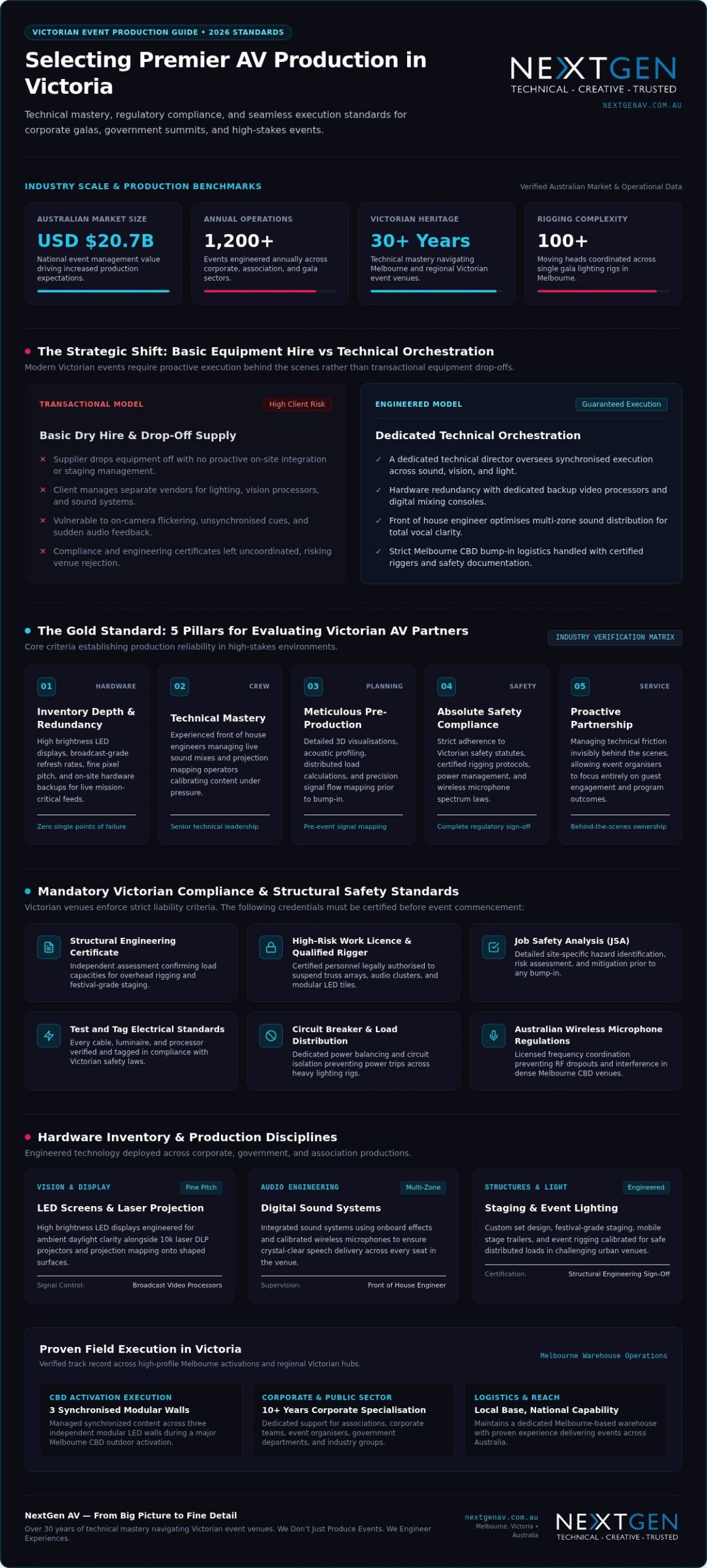
Navigating Victorian Venues: Local Logistics and Technical Hurdles
Execution is dictated by the environment. The best audio visual companies in victoria prove their worth not in the warehouse, but in the loading docks of the CBD and the paddocks of regional hubs. Navigating these spaces requires a proactive partner who understands that a heritage ballroom in the Mornington Peninsula has vastly different power constraints than a purpose-built plenary. Technical mastery involves anticipating these site-specific hurdles long before the first truck arrives, ensuring that the venue’s architecture enhances your event rather than hindering it.
Melbourne CBD and MCEC Logistics
Managing the Melbourne Convention and Exhibition Centre (MCEC) or high-rise CBD ballrooms involves a complex dance of timing. Strict bump-in and pack-down windows mean there’s no room for error. You need a team that coordinates seamlessly with venue-contracted providers to ensure full service event production that respects the venue’s technical specifications. A deep understanding of Melbourne’s traffic and parking constraints prevents delays that could otherwise derail your schedule. This includes managing heavy vehicle access to loading docks and ensuring all crew members are briefed on the specific entry protocols of each precinct.
Regional Victoria: Technical Execution Beyond the City
When your event moves to Geelong, Bendigo, or Ballarat, the logistical stakes change. Working far from a main warehouse requires absolute equipment reliability and a provider with a genuine Victoria-wide service footprint. Regional outdoor locations introduce variables like unpredictable wind loads for staging and unstable power connectivity. Proactive technical direction involves bringing redundant power sources and ensuring all festival-grade staging is secured with the correct ballast and structural engineering certificates. We also account for connectivity hurdles, deploying dedicated satellite or high-gain cellular arrays to ensure your live stream remains stable even in remote areas of the Mornington Peninsula.
Heritage venues present a unique challenge. Delicate architecture and limited power circuits require a light touch and technical mastery. Selecting from the best audio visual companies in victoria means choosing a team that ensures every cable run is discreet and every lighting rig is safely suspended without compromising the venue’s integrity. By strictly adhering to WorkSafe Victoria regulations for event rigging and staging, we protect your brand from liability. Our team handles the Job Safety Analysis and High-Risk Work Licences so you can focus entirely on your vision. If you’re planning a complex activation, you can enquire about our Victorian venue expertise to ensure a flawless execution.
Partnering for Success: NextGen AV Leads Victoria in 2026
True technical orchestration requires a partner who treats live production as a dedicated craft. With over 30 years of experience in Melbourne event production, NextGen AV has engineered solutions for the most prestigious corporate, government, and association gatherings across the state. We don’t just supply gear from a warehouse; we manage the complete technical lifecycle from pre-production CAD drawings to the final pack-down. Our philosophy centers on absorbing the complex logistical stress of staging, rigging, and compliance so that you can remain focused on your event’s core message and your stakeholders.
The NextGen AV Advantage: Mastery and Precision
Our technical directors act as the invisible engine behind your success, working meticulously to ensure a seamless front-of-house execution. We have heavily invested in 2026-standard elite inventory, including high brightness LED displays and AI-integrated audio processing systems that eliminate environmental noise. This commitment to precision is why major corporate teams and government departments trust us with their high-stakes reputation. Having supported everything from complex CBD outdoor activations to massive Melbourne galas involving over 100 moving heads, our seasoned crew possesses the technical mastery required to handle high-pressure live environments without a single glitch.
Start Your Journey to a Flawless Event
Securing a flawless execution begins long before the live audience arrives at the venue. Engaging a professional AV consultation during your early planning stages allows us to map out technical specifications, power distribution loads, and frequency coordination requirements. This proactive approach eliminates hidden costs and ensures your production complies fully with WorkSafe Victoria standards from day one. Whether your project requires a massive conference LED screen setup or a tailored corporate layout, we customize every solution to deliver an unforgettable audience experience.
Your event deserves a technical execution that elevates your brand and leaves a lasting impression on every attendee. For comprehensive solutions tailored to your unique audio visual hire Melbourne requirements, partner with an elite team that takes personal pride in perfection. You can enquire with NextGen AV for your next Victorian event to experience how we translate complex technical logistics into absolute brand prestige.
Elevate Your Vision with Technical Mastery
In 2026, the success of your event hinges on more than just equipment. It requires a partner who understands that technical execution is a dedicated craft. By prioritising inventory depth and rigorous safety compliance, you ensure your brand remains prestigious and protected. Navigating the unique logistical hurdles of Victorian venues demands a team with deep local expertise and a proactive approach to technical direction. As you evaluate the best audio visual companies in victoria, look for a partner that takes personal pride in seamless execution.
NextGen AV brings over 30 years of flawless Victorian event execution to your project. As a preferred partner for major Australian government and corporate bodies, we specialise in Red Dot-standard production and high-resolution LED technology. We meticulously manage the complex logistics behind the scenes so you can focus entirely on your guests. Rest assured that your event is in capable hands, as we engineer an experience that leaves a lasting impression.
Partner with Victoria’s elite AV orchestrators at NextGen AV to transform your next activation into an unforgettable experience. Your vision deserves nothing less than perfection.
Frequently Asked Questions
What is the difference between AV equipment hire and full-service event production?
AV equipment hire is the simple rental of hardware like speakers or screens, often requiring you to manage the setup. Full-service event production is a comprehensive technical orchestration that includes pre-production planning, technical direction, and on-site management. This approach ensures all components like LED video walls and sound systems work in perfect synchronisation. It shifts the technical risk from the organiser to the production partner, ensuring a flawless result.
How much does it cost to hire a professional AV company in Melbourne for a corporate event?
Professional AV costs in Melbourne vary significantly based on venue size, technical complexity, and the duration of your event. Rather than focusing on a single figure, planners should consider the value of technical mastery and risk mitigation. Factors that influence the final quote include high-resolution LED requirements, the number of technical crew needed, and whether you require custom festival-grade staging or rigging. Always request a detailed breakdown to avoid hidden costs.
Do I need to hire a technical director for my conference in Victoria?
A technical director is essential for conferences involving multiple speakers, live streaming, or complex visual transitions. They act as the central orchestrator, managing the front of house engineer and visual cues to ensure a seamless flow. Without this single point of contact, you risk technical silos where sound and vision don’t align. The best audio visual companies in victoria provide this expertise to maintain the prestige of your brand throughout the event.
Can Victorian AV companies handle events in regional areas like Geelong or Ballarat?
Elite production partners maintain a Victoria-wide service footprint, frequently delivering high-impact events in Geelong, Ballarat, and Bendigo. These regional activations require meticulous logistical planning to ensure equipment reliability far from the main warehouse. We account for regional variables such as local power constraints and weather-rated gear for outdoor community festivals. This ensures that your production standards remain uncompromising, regardless of the geographic location within the state.
What are the most common AV mistakes to avoid at high-stakes events?
The most frequent errors include inadequate power distribution, failing to coordinate wireless microphone frequencies, and underestimating bump-in times. Many planners also overlook the importance of equipment redundancy for critical systems like a video processor. Choosing from the best audio visual companies in victoria helps you avoid these pitfalls through proactive site visits and detailed Job Safety Analyses. This technical precision prevents glitches like audio feedback or flickering LED tiles from disrupting your presentation.
How far in advance should I book an AV company for a major Victorian event?
For major corporate galas or large-scale conferences, you should ideally engage a technical partner six to twelve months in advance. This lead time is critical for securing high-demand elite inventory and allowing for thorough pre-production, including CAD drawings and structural engineering assessments. Early booking also ensures that technical directors can collaborate with your team to integrate audience engagement software and creative lighting concepts into the event’s core design.
What technical certifications should a Victorian AV crew hold?
A professional Victorian crew must hold several legal certifications to ensure safety and compliance. Any staff performing event rigging or operating boom-type platforms must possess a High-Risk Work Licence issued by WorkSafe Victoria. Additionally, all workers on an event site must hold a valid construction induction card, or white card. Verified partners will also provide a structural engineering certificate for staging to confirm the structure meets Australian safety standards for a distributed load.
Does NextGen AV provide on-site technical support during the entire event?
NextGen AV provides dedicated, end-to-end technical support from the initial bump-in until the final pack-down is complete. Our team includes technical directors and specialist engineers who remain on-site to manage every cue and troubleshoot in real-time. This proactive presence ensures that your technology remains invisible, allowing you to focus on your vision while we handle the technical precision required for a flawless, high-impact event experience.
A remote keynote speaker isn’t just a video call on a larger screen. It is a digital presence that must command the room with the same weight and prestige as a physical guest standing on the stage. When you’re integrating remote speakers into a live event, the goal is to bridge the gap between the digital and the physical so seamlessly that the audience forgets the distance entirely.
You’ve likely felt that spike of adrenaline when a screen freezes or a feedback loop echoes through a Melbourne plenary hall. It’s a common anxiety because treating a global expert like a secondary thought can instantly diminish the perceived value of your production. This guide provides the definitive 2026 blueprint for mastering hybrid integration to ensure your remote talent delivers a broadcast-quality performance. We’ll explore the technical precision required for flawless audio and visual synchronisation, the importance of high-speed connectivity, and the expert orchestration that allows you to focus on the results while the technical complexities vanish into the background.
Key Takeaways
- Elevate your production beyond basic video conferencing by using broadcast-grade vision switchers that allow remote presenters to command the room with professional authority.
- Master the technical essentials for integrating remote speakers into a live event, from securing synchronous bandwidth to negotiating dedicated vLANs within Melbourne’s premier venues.
- Create a seamless physical-digital environment by utilising high-impact LED video walls and matching lighting colour temperatures to make remote guests feel truly present on stage.
- Identify “hybrid-ready” infrastructure within Melbourne CBD venues to ensure your event remains resilient against connectivity issues and technical glitches.
- Partner with a seasoned technical director to orchestrate the complex synchronisation of audio and visual feeds, allowing you to focus on the prestige of the final result.
Beyond the Laptop Patch: What is Professional Remote Speaker Integration?
Professional remote speaker integration is the art of transforming a digital signal into a physical presence. It isn’t simply “patching in a laptop” or sharing a screen. Instead, it involves high-end vision switchers and dedicated return feeds to ensure the speaker sees, hears, and feels the room’s energy. When integrating remote speakers into a live event, the goal is to bridge the digital-physical divide so seamlessly that the audience forgets the speaker is on another continent. In 2026, corporate standards have moved past the era of grainy video calls. Today’s audiences expect low-latency, high-definition engagement that prevents the “screen fatigue” common in poorly managed sessions.
When you’re integrating remote speakers into a live event, a Technical Director acts as the silent conductor. They manage the precise “hand-off” between the local MC and the remote talent, ensuring there is no awkward silence or technical lag. This level of orchestration turns a simple broadcast into a prestigious theatrical experience.
The Psychology of Digital Presence
Authority on stage is often a matter of scale. A speaker appearing on a small monitor feels like a guest; a speaker projected life-sized onto an LED video wall feels like a leader. Strategic placement is vital for maintaining the speaker’s command over the room. We ensure that cameras and confidence monitors are positioned so the remote presenter can maintain natural eye contact with the Melbourne audience. This avoids the “floating head” syndrome where a speaker appears disconnected from their environment. Proper framing and background management are essential to ensure they look like they belong on your stage, not in a home office.
Broadcast Standards vs. Basic Web Conferencing
Standard web conferencing tools like Zoom or Teams often fail the “prestige test” required for high-stakes AGMs or global summits. They are built for convenience, not for the rigour of professional live production. Achieving stability requires 4K capture and dedicated hardware encoders that bypass the limitations of standard consumer software. These tools are then woven into the broader full service event production ecosystem. This ensures that the remote feed is treated with the same technical reverence as the local audio and lighting. To understand the foundation of these high-stakes productions, it helps to define What is a Hybrid Event? as a cohesive experience where digital and physical boundaries disappear. In 2026, corporate standards demand:
- Zero-latency audio: Removing the delay that kills natural conversation.
- 4K visual clarity: Ensuring every facial expression is visible to the back of the room.
- Bi-directional engagement: Allowing the speaker to see the audience reaction in real time.
Technical Infrastructure for Flawless Remote Keynotes
High-stakes events don’t run on hope. They run on dedicated, synchronous bandwidth and hard-wired ethernet. When integrating remote speakers into a live event, relying on a venue’s shared guest Wi-Fi is a recipe for disaster. We prioritise vision switching through professional hardware, allowing our technicians to mix the remote feed with local graphics and slides in real time. This creates a polished, cinematic broadcast rather than a clunky screen-share that breaks the audience’s immersion.
Our technical team manages the entire signal chain from the speaker’s home studio to your Melbourne stage. This includes:
- Hardware Encoders: Using dedicated devices to maintain 1080p or 4K stability.
- Vision Mixing: Seamlessly cutting between the speaker, their presentation, and the live room.
- Return Feeds: Providing the speaker with a low-latency view of the audience and the stage.
The Audio “Mix-Minus” Explained
The biggest technical hurdle in hybrid production is the audio feedback loop. If a remote speaker hears their own voice echoing back through the room’s PA system, their cadence falters instantly. We solve this through a “Mix-Minus” feed. This complex routing ensures the speaker hears everything in the room except their own voice. Our professional sound system hire includes discrete audio routing to manage these paths with surgical precision. We also implement Producer Talkback (IFB), which allows our team to provide private cues to the remote speaker without the audience hearing a word.
Connectivity and Redundancy
Stability is non-negotiable for 2026 corporate standards. For a stable corporate feed, we demand a minimum of 20Mbps upload speed. In Melbourne venues where infrastructure varies, we often deploy 5G bonded cellular backups as a secondary fail-safe. This “Hot Standby” approach means if the primary line drops, the feed switches instantly without a flicker. Rehearsal protocols are equally vital; we conduct a “Tech Check” that mirrors live conditions exactly. Following established tips for hosting remote speakers, we ensure the remote environment is as controlled as our own stage.
Redundancy isn’t just about wires. It’s about having pre-recorded backups ready to roll the moment a connection fails. This proactive planning allows you to move past the logistical grind and focus on the prestige of the final result. If you need an expert team to orchestrate these technical layers, NextGen AV provides the invisible power needed for a flawless execution.
Stage Integration: Making Them Feel “In the Room”
Immersion fails the moment a remote speaker feels like an outsider peering into the room through a window. True integration requires the digital presence to be woven into the physical architecture of your stage. When you’re integrating remote speakers into a live event, scale dictates authority. A speaker appearing on a standard projector screen often feels secondary, but utilising high-pixel-pitch LED video walls allows you to present your guest at a life-sized scale. This creates a psychological weight that ensures your remote keynote commands the room with the same prestige as a physical presenter. Multi-camera hybrid integration further elevates this experience, allowing the remote speaker to see different angles of the Melbourne audience, which fosters a more natural, bi-directional energy.
Lighting for the Lens and the Room
A common mistake in hybrid production is ignoring how physical stage lights interact with digital screens. Our approach to stage and lighting hire Melbourne focuses on synchronising colour temperatures between the room and the remote feed. If your on-stage talent is bathed in warm 3200K light while your remote speaker appears in cool 5600K tones, the visual disconnect is jarring. We meticulously balance these levels to create a unified aesthetic. We also position fixtures to avoid glare or “wash-out” on LED surfaces, ensuring the remote speaker remains crystal clear even under the brightest house lights. This level of precision removes the digital “veil” and makes the guest feel physically present.
Hybrid Interaction Strategies
Seamless interaction is the hallmark of a professional production. To facilitate natural dialogue, we deploy “Confidence Monitors” at the foot of the stage. These allow on-stage moderators to maintain eye contact with the remote speaker without constantly turning their back to the audience. For Q&A sessions, we integrate unified participation tools like Slido or Mentimeter into the broadcast feed, ensuring that both in-room and virtual attendees can engage on a level playing field. This theatrical approach to interaction pays dividends in audience retention. While a basic setup might see engagement drop after fifteen minutes, a professionally orchestrated hybrid environment keeps the room captivated by treating the remote connection as a high-value broadcast event rather than a simple video call.
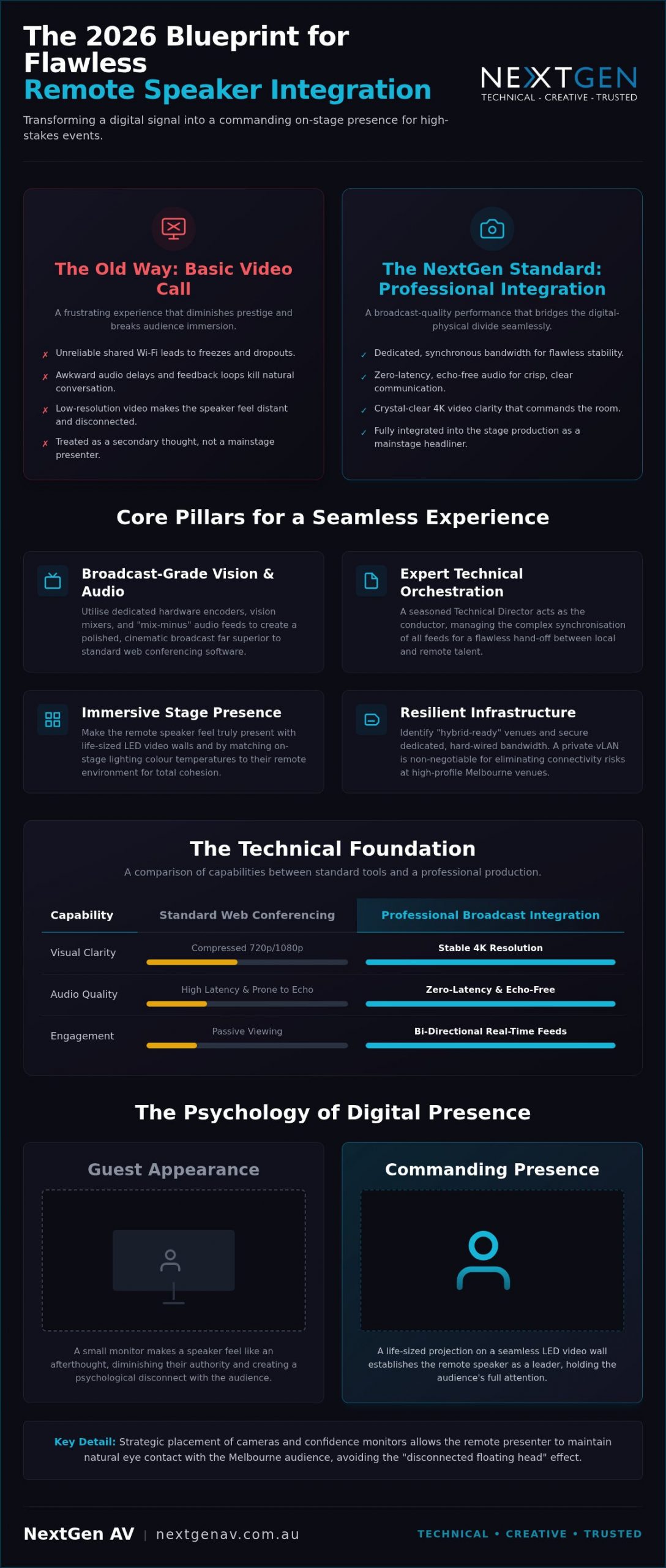
The Melbourne Logistics Playbook: Venue and Infrastructure
Success in integrating remote speakers into a live event often depends on the invisible infrastructure beneath the venue’s floorboards. In Melbourne, the landscape ranges from the world-class facilities of the Melbourne Convention and Exhibition Centre (MCEC) to the heritage ballrooms of grand CBD hotels. Each space presents unique challenges that require a proactive technical assessment. A site inspection isn’t just about stage dimensions; it’s about a deep dive into the “Comms Room.” We identify the physical termination points of fibre connections and the proximity of the AV control centre, or the “Hub,” to ensure signal integrity remains absolute. Having a local, Melbourne-based technical team is a distinct advantage, as we understand the specific patch-panel quirks and internal routing of the city’s premier event spaces.
Venue Bandwidth and Power
Reliability requires synchronous bandwidth, where upload speeds match download speeds. While many venues boast high-speed guest Wi-Fi, this is a shared resource and inherently unpredictable. We negotiate for dedicated vLANs to isolate your broadcast traffic from the rest of the building’s users. For 2026 events, ensuring the venue can deliver the 20Mbps upload minimum required for 1080p stability is the baseline, while 4K low-latency streaming requires even higher dedicated overheads. Power redundancy is equally critical. The Hub must be protected by Uninterruptible Power Supplies (UPS) to ensure that even a local grid flicker doesn’t sever the connection with your global talent. This level of technical rigour is also essential in other mission-critical Melbourne industries; for example, you can learn more about CX IT Services and their approach to high-availability infrastructure.
A flawless hybrid event is the result of a methodical week-by-week onboarding process. We start by auditing the remote speaker’s environment, checking everything from their local router stability to the acoustic profile of their room. Coordinating time zones is a logistical puzzle our team handles daily. When it’s 10:00 am in Southbank, it might be the middle of the night in London or New York. We manage local crew call-times to accommodate these global feeds, ensuring our technicians are alert and ready for a 4:00 am GMT keynote. This rigorous dress rehearsal mirrors live conditions exactly, removing any margin for error before the first delegate arrives. To ensure your next production has this level of technical oversight, partner with NextGen AV for expert technical direction.
Seamless Execution: Partnering with NextGen AV
With over 30 years of industry experience, NextGen AV has refined the craft of technical production for Melbourne’s most demanding corporate and government sectors. We don’t just provide equipment; we provide the “quiet power” that allows your vision to take centre stage. When you’re integrating remote speakers into a live event, you need a partner who anticipates every technical variable before it becomes a risk. Our role as the “Confident Orchestrator” means we handle the staggering complexity of hybrid synchronisation, allowing you to take the credit for a flawless execution.
Our end-to-end management approach covers every detail of the production lifecycle. We don’t leave anything to chance, managing the process from the first speaker onboarding session to the delivery of polished post-event highlight reels. This comprehensive oversight removes the inherent stress of high-stakes planning, ensuring your remote keynote speakers command the room with the same prestige as those standing on the physical stage.
The Invisible Expert at Work
Our Technical Directors are seasoned veterans who thrive under the pressure of live broadcasts. They act as the engine behind the scenes, managing the intricate “hand-off” between local and digital talent. In a recent Melbourne gala dinner, we integrated a remote CEO from London into a live panel discussion. By utilising professional facilities like Smashy Owl Studios for the remote broadcast and employing 2026-spec hardware with a dedicated low-latency return feed, the CEO could see the audience reactions and interact with the room in real time. This created an immediate, prestigious presence that completely bypassed the typical “video call” feel. We commit to this level of artistry for every project, ensuring your digital guests are never treated as an afterthought.
Taking the Next Step
High-stakes corporate communication demands precision because “near enough” is never good enough for your brand’s reputation. Our consultation process begins with a deep dive into your specific vision and technical requirements. We assess your chosen Melbourne venue, define the necessary bandwidth, and customise a hybrid solution that aligns with your professional goals. Whether you are planning an intimate executive briefing or a large-scale international summit, our bespoke approach replaces logistical grind with absolute reliability. Ready to elevate your next production? Enquire about our hybrid event staging solutions today and let us orchestrate your success.
Master the Art of the Hybrid Stage
Success in the modern event landscape isn’t found in a simple video link; it is forged through meticulous “Mix-Minus” audio routing and the synchronised lighting that makes a remote guest feel physically present. We have explored the necessity of broadcast-grade infrastructure, the psychological impact of life-sized LED integration, and the logistical nuances of Melbourne’s premier venues. These elements combine to ensure your production remains resilient and prestigious, regardless of where your talent is located.
Master the complexities of integrating remote speakers into a live event by choosing a partner who values precision as much as you do. With over 30 years of Melbourne AV expertise, NextGen AV provides the end-to-end technical direction required for high-stakes hybrid production. We handle the hidden technical layers so you can focus on the applause. Enquire about your Melbourne remote speaker integration today and transform your next keynote into a seamless, world-class broadcast experience.
Frequently Asked Questions
What is the minimum internet speed required for a remote speaker feed in 2026?
For a stable 1080p feed in 2026, a minimum of 20Mbps upload speed is required. If your event demands 4K low-latency streaming, this requirement increases significantly to ensure signal integrity. We always recommend a hard-wired ethernet connection over Wi-Fi to eliminate jitter. Our technical team audits the remote speaker’s local environment weeks before the event to verify these speeds and implement cellular backups if the primary line is insufficient.
How do you prevent audio echo when a remote speaker is talking to the room?
Preventing audio echo requires a professional Mix-Minus audio configuration. This routing ensures the remote speaker receives a feed of everything happening in the Melbourne room except for their own voice. Without this, the speaker hears themselves on a delay, which makes natural speech almost impossible. By using discrete digital audio consoles, we isolate these channels, allowing for crystal-clear, bi-directional conversation between the stage and the remote location without any feedback loops.
Can we have a remote speaker and a live speaker on stage at the same time?
Yes, you can absolutely have a remote speaker and a live presenter on stage simultaneously. This is achieved through advanced vision mixing, where the remote feed is integrated into the stage environment via LED walls or large-scale projection. When integrating remote speakers into a live event alongside physical talent, we use multi-camera setups so the remote guest can see the on-stage moderator, fostering a more authentic and prestigious interaction for the audience.
What happens if the remote speaker’s home internet fails during the session?
We mitigate internet failure through a Hot Standby redundancy protocol. This involves having a secondary connection, such as a bonded 5G cellular link, ready to engage instantly. Additionally, we often request a high-quality pre-recorded version of the keynote as a final fail-safe. If the live connection drops, our Technical Director can transition to the backup recording so seamlessly that the audience remains engaged while we work to restore the live link.
Do I need to send specific equipment to the remote speaker’s location?
Sending a speaker kit is highly recommended to maintain corporate prestige. While most laptops have built-in cameras, they rarely meet 2026 broadcast standards. We often advise providing the remote speaker with a professional USB microphone, a 4K webcam, and a basic LED key light. This small investment ensures that when integrating remote speakers into a live event, their visual and audio quality matches the high-end production value of your Melbourne venue.
How do we handle Q&A with a remote presenter in a large Melbourne venue?
Managing Q&A in large Melbourne venues requires a unified interaction platform like Slido or Mentimeter. These tools allow both in-person and virtual attendees to submit questions to a single moderated queue. We then display these questions on confidence monitors for the on-stage host and the remote presenter. This ensures the remote speaker can respond directly to the audience, maintaining a high level of engagement and removing the logistical friction of passing microphones across the room.
Is it better to pre-record a remote speaker or have them live?
Live presentations are always better for prestige and audience engagement, as they allow for real-time interaction and Q&A. However, if the remote speaker is in a high-risk connectivity area, a “Live-to-Tape” approach is a smart alternative. This involves recording the session shortly before the event but playing it back as if it were live. For the highest stakes, we recommend a live feed with a pre-recorded backup to balance impact with safety.
What is a ‘Mix-Minus’ and why is it essential for hybrid events?
A Mix-Minus is a specialised audio bus that sends a custom mix to the remote speaker, minus their own audio signal. It is essential for hybrid events because it prevents the speaker from hearing their own voice echoed back through the venue’s PA system. Without a Mix-Minus, the delay makes it impossible for the speaker to maintain a natural cadence. Our professional audio systems handle this complex routing to ensure seamless, echo-free communication.
In 2026, the most expensive mistake an organiser can make is treating their virtual audience as a passive fly on the wall of a physical room. We’ve all felt the tension of high-stakes planning where the remote stream lags and digital guests feel like second-class citizens. It’s a logistical grind that often stems from fragmented technical setups and a lack of synchronisation between venues. By implementing the most sophisticated hybrid event platform solutions Australia has to offer, you can move past these frustrations and transform a standard broadcast into a prestigious, unified experience.
You’ll discover how to masterfully merge world-class physical AV production with the latest digital platforms to ensure every attendee interacts in real-time. This guide explores the technical orchestration required to eliminate latency, provide robust support that takes the pressure off your team, and extract clear ROI through sophisticated data analytics. We’ll show you how to synchronise your physical and digital environments so perfectly that the technology becomes invisible, allowing your content to take centre stage. Whether you’re hosting a national summit or a boutique corporate briefing, the goal is a seamless, cinematic result that commands attention across every time zone.
Key Takeaways
- Understand why a successful 2026 event requires a unified ecosystem where software and hardware work in tandem to create a single, cohesive experience.
- Master the technical architecture of professional audio and LED video walls to ensure your virtual audience feels like they’re in the front row.
- Compare the top hybrid event platform solutions Australia offers to find the perfect fit for your event’s scale, from boutique briefings to 10,000-delegate summits.
- Learn how to conduct a comprehensive bandwidth audit at your chosen venue to guarantee a broadcast with zero lag and maximum reliability.
- Discover strategies to bridge the digital divide and keep both audiences equally engaged through professional technical direction and seamless signal flow.
Hybrid Event Platforms: Why They Matter in 2026
Success in the current corporate climate requires more than just a camera at the back of a room. To truly resonate, organisers must view hybrid event platform solutions australia as an integrated ecosystem of software and hardware. This isn’t just a digital portal; it’s the bridge that allows a keynote speaker in Melbourne to spark a real-time debate with a delegate in Perth. Audiences in 2026 have moved beyond the “passive observer” phase. They demand a unified experience where the energy of the physical stage is mirrored perfectly on their screens. If you’re still relying on a simple Zoom link, you’re essentially telling your remote guests they’re second-class citizens.
The Australian corporate landscape has shifted from broadcast-only models to high-intensity interaction. This transformation is driven by the need for clear ROI and deeper engagement metrics. By expanding your reach across the continent, you maintain the prestige of a local Melbourne presence while capturing a national audience. It’s about creating a moment that feels as intimate in a home office as it does in a grand ballroom.
The Core Components of a Hybrid Solution
A professional setup relies on three distinct pillars to maintain its integrity. First, engagement software provides the interactive hubs for polls, Q&A, and networking, ensuring remote delegates aren’t just watching, but participating. Second, broadcast hardware like high-end cameras, encoders, and professional vision mixers capture the artistry of the live event. Finally, the integration layer acts as the glue. This technical invisible expert ensures the physical stage and digital portal stay in perfect sync, eliminating the lag that kills momentum.
Why Australia’s Event Landscape is Unique
Our geography presents a specific challenge that requires a sophisticated technical response. Connecting Sydney, Perth, and Brisbane to a central Melbourne hub demands precision engineering. Many Australian organisations now adopt “hub-and-spoke” models, where smaller in-person gatherings in different states are linked to a primary production centre. While some might still be figuring out What is a Hybrid Event?, elite planners are already using these structures to reduce travel costs and environmental impact. A hybrid event platform serves as the digital heart of a physical production, pumping live data and high-definition visuals to every corner of the network.
The Technical Architecture: Bridging the Physical and Digital Divide
When selecting hybrid event platform solutions australia, the focus often lands solely on the software interface. However, the true bridge is the technical architecture behind the scenes. Think of your on-site AV as the eyes and ears of your virtual guests. If the physical production is lacklustre, the digital experience will inevitably fail. A sophisticated signal flow ensures that a live presentation in a Melbourne ballroom reaches a laptop in London with near-zero lag. This journey involves high-speed encoders and dedicated bandwidth that bypasses the unreliable public Wi-Fi often found in older venues.
The Technical Director acts as the orchestrator of this dual-feed environment. They manage two distinct shows simultaneously; one for the people in the room and another for the remote stream. To protect the integrity of your event, redundancy is non-negotiable. We implement hardware fail-safes and secondary stream paths to ensure that even a local internet dropout doesn’t silence your message. Partnering with a veteran technical direction team allows you to focus on your keynote while we manage the invisible complexity of the dual feed.
Visual Mastery: LED Walls as the Digital Backdrop
High-end LED video walls do more than just impress the local crowd. They provide a vibrant, high-contrast backdrop that translates beautifully to camera, creating a professional broadcast studio feel for remote viewers. Our engineers meticulously manage brightness levels and refresh rates to eliminate the flickering often seen on lower-quality screens. This precision allows us to integrate remote presenters onto the physical stage screens, facilitating real-time panels where the digital and physical worlds collide without a glitch.
Audio Excellence: Ensuring Every Word is Heard
Audio is the most critical component of any hybrid event. While a guest might forgive a grainy video feed, they’ll disengage immediately if the sound is muffled or echoing. We utilise complex mix-minus audio routing to prevent remote participants from hearing their own voices looped back. Choosing the right professional sound system hire ensures that every word is captured with absolute clarity. This technical rigour ensures your remote audience remains focused on the content rather than the struggle to hear it.
Comparing Top Hybrid Event Platforms for Australian Corporates
Selecting the right software is a high-stakes decision that dictates the boundary between a standard webinar and a prestigious corporate summit. In 2026, hybrid event platform solutions australia are categorised by their capacity to handle scale, security, and the “two-audience” challenge. For high-volume summits, Cvent remains a heavyweight. Its multi-layered pricing, including annual licenses that typically range from $20,000 to $79,000, reflects its enterprise-grade depth. Conversely, EventsAir has gained significant traction with its subscription model that allows for unlimited registrations, providing a predictable cost structure for busy Australian conference cycles. While vFairs excels in creating immersive virtual environments, Zoom Events has evolved into a robust contender for those seeking a familiar interface with professional production features.
Security isn’t just a preference; it’s a legal mandate. Australian organisations with an annual turnover of at least AU$3 million must adhere to the 13 Australian Privacy Principles (APPs). This makes platforms with local data sovereignty and strict encryption the only viable choice for the government and finance sectors. Planners must also consider the Disability Discrimination Act 1992, ensuring their chosen platform provides screen-reader compatibility and captioning to remain accessible to all 18.5% of Australians living with a disability. The choice between a custom-branded interface and an out-of-the-box solution often hinges on how much you value your brand’s aesthetic precision versus the speed of deployment.
Platform Feature Breakdown
Engagement is the currency of 2026. Success lies in networking hubs where virtual and physical guests can actually converse, breaking down the digital wall. For exhibitors, sponsorship visibility must move beyond a static logo; many now use tools like easygen.tech to rapidly generate the high-quality text, images, and videos required for these interactive digital spaces. We look for platforms that offer interactive virtual booths and lead-capture tools that deliver tangible value. Post-event, the focus shifts to analytics. Detailed reporting on attendee dwell time and poll participation provides the data-driven ROI needed to satisfy stakeholders and refine future strategies. It’s about moving from simple broadcasting to genuine interaction.
The most polished software is useless if it can’t talk to your hardware. We prioritise platforms with robust RTMP streaming support, the industry standard for injecting high-definition video from our mixers directly into the digital portal. API integrations are equally vital, ensuring your registration data flows seamlessly into your CRM without manual entry errors. Perhaps most importantly, we look for local Australian support. A 24/7 global helpdesk sounds impressive until you’re live at 9:00 AM AEST and need an immediate fix. Having a team that operates in your time zone ensures that technical hitches are resolved before the first keynote begins, keeping the engine of your event running smoothly.
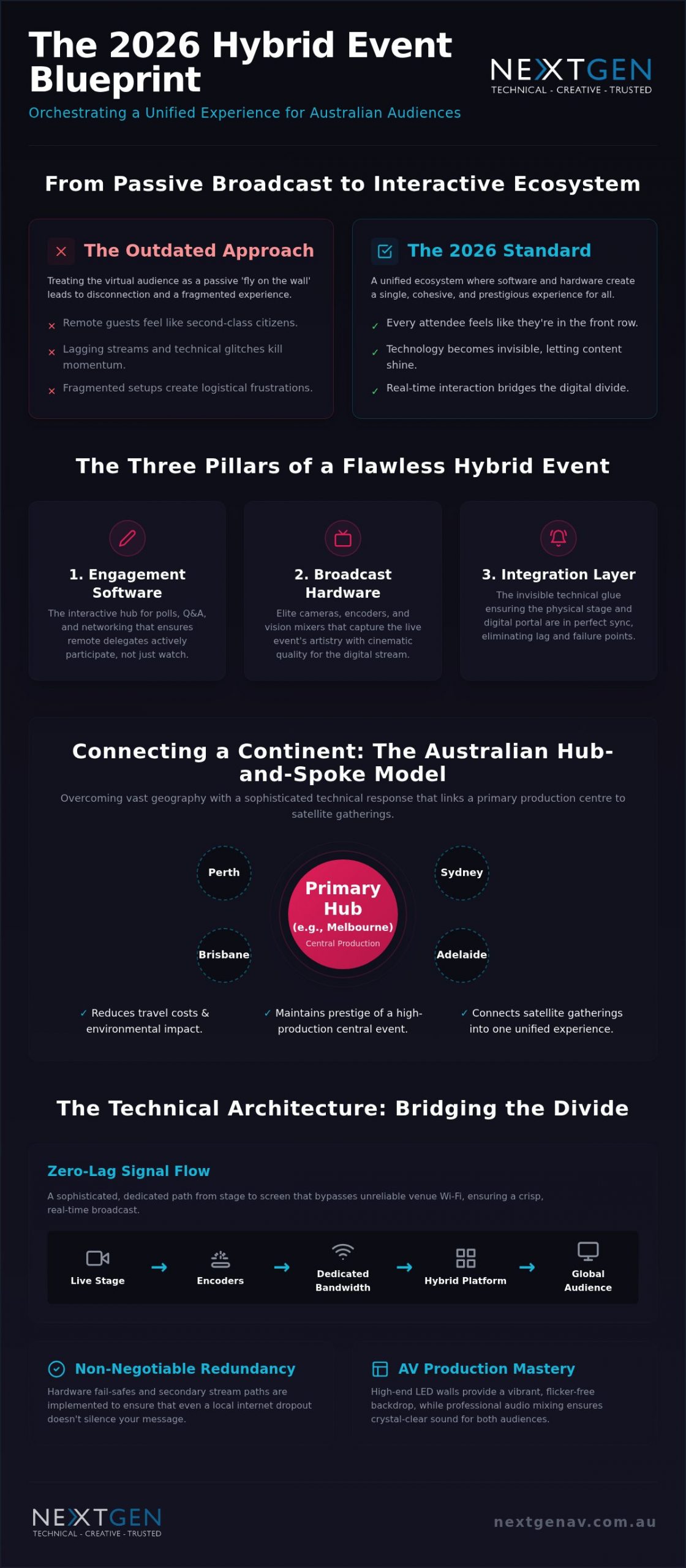
Planning Your Hybrid Strategy: Connectivity and Logistics in Australia
Planning a hybrid event across a continent as vast as Australia requires a level of logistical precision that simple in-person gatherings don’t demand. You aren’t just booking a room; you’re coordinating a broadcast centre that must reach multiple time zones simultaneously. This is why rehearsals and tech runs are paramount. A hybrid production typically requires 50% more preparation time than a traditional event to ensure the digital and physical cues are perfectly aligned. Without a dedicated tech day, you risk the awkward silence that occurs when a physical speaker forgets the virtual audience is watching.
Managing the two-tier experience is the ultimate test for any organiser. You must ensure that a delegate in Perth feels as valued as the one sitting in a Melbourne ballroom. This involves a strategic timeline that accounts for AEST, ACST, and AWST, ensuring your keynote doesn’t start at dawn for half your audience. When evaluating hybrid event platform solutions australia, look for tools that allow for pre-recorded content injections to keep the momentum high during physical room transitions. For organisers wanting to maintain high engagement through structured interaction, TeamLabs provides professionally facilitated activities that can be adapted for hybrid audiences.
The first step in your bandwidth audit is simple: never trust the guest Wi-Fi. You need a dedicated, synchronous upload line reserved exclusively for your stream. We recommend looking for venues that offer studio space within their traditional setups, allowing for a professional broadcast aesthetic without sacrificing the ballroom’s prestige. Melbourne landmarks like the MCEC and Crown are world-class in this regard, offering the infrastructure to support high-bitrate streaming. However, even boutique spaces can be optimised for hybrid success with the right technical direction and portable network solutions.
Audience Engagement Tactics
Engagement must be a shared goal. Gamification is a powerful tool to bring both audiences together, using live leaderboards that track participation from both cohorts. A dedicated virtual host is also essential; they act as the digital bridge, acknowledging the remote stream and ensuring their questions aren’t buried. You can easily organise a hybrid Q&A session by using a centralised platform where both in-person and remote attendees submit questions to a single, moderated queue. This ensures total parity between your two audiences. To ensure your next national broadcast is flawless, partner with our full-service technical experts to manage your venue logistics from start to finish.
Elevating Your Event with NextGen AV: The Confident Orchestrator
Navigating the technical maze of a modern production requires more than just a software login. It demands a partner who has spent three decades mastering the high-pressure environment of live execution. At NextGen AV, we simplify this complexity through our comprehensive full service event production. We don’t believe in the “one-size-fits-all” hybrid packages that often fail to account for the unique acoustics of a specific venue or the particular security needs of a corporate board. Instead, we provide tailored hybrid event platform solutions australia that align with your specific vision. This ensure your message is delivered with absolute clarity to every attendee, regardless of their location or device.
Our 30 years of industry experience allows us to anticipate challenges before they manifest. We’ve seen every possible technical hurdle, from bandwidth fluctuations to complex signal routing issues, and we’ve built the systems to overcome them. This “seen-it-all” perspective isn’t just about troubleshooting; it’s about the artistry of the final result. We treat every event as a dedicated craft, moving past the logistical grind to focus on the prestige and impact of your content. From pre-production planning to post-event data analysis, we act as the engine behind the scenes, allowing you to take centre stage without a second thought.
Our Hybrid Production Process
Success begins with collaborative design. We align your high-level vision with our technical mastery to create a blueprint for excellence. Once on-site, our elite team of engineers manages the engine room behind the scenes, orchestrating every camera angle, audio mix, and digital interaction. This is the NextGen AV guarantee: a blend of seamless execution and quiet power. We take personal pride in the invisible complexity of our work, ensuring that the technology never distracts from the human connection at the heart of your event.
Partnering for the Future of Events
Choosing a partner for your next summit means finding a technical ally who is as invested in the outcome as you are. We are far more than a simple equipment provider; we are the proactive force that ensures your national broadcast or boutique briefing is flawless. By choosing professional audio visual hire in Melbourne, you gain the peace of mind that only comes from veteran expertise. Whether you’re connecting a Melbourne hub to delegates in London or Sydney, our team is ready to deliver. Reach out to us today to start the hybrid planning process and secure a technical foundation that commands attention.
Mastering the Future of Hybrid Connection
Delivering a high-impact event in 2026 demands a shift from simple broadcasting to sophisticated, real-time interaction. You’ve seen how the right technical architecture and meticulous logistical planning can bridge the digital divide, ensuring your remote guests never feel like second-class citizens. By prioritising seamless signal flow and professional on-site engineering, you transform a standard meeting into a prestigious national experience. The most effective hybrid event platform solutions australia are those where the technology remains invisible, allowing your brand’s message to resonate across every time zone with absolute clarity.
Navigating this landscape requires a partner with the “seen-it-all” expertise to handle the engine room while you take centre stage. With 30+ years of Australian event experience, our specialist Technical Directors provide end-to-end hardware and software integration that takes the pressure off your team. We take personal pride in orchestrating every detail to ensure your vision is realised with quiet power and technical mastery. Enquire about our Hybrid Event Solutions today and let’s build an experience that commands attention from Melbourne to the world. Your next successful production starts with a single, confident step.
Frequently Asked Questions
What is the difference between a virtual event and a hybrid event?
A virtual event occurs entirely online, while a hybrid event combines a physical venue with a digital audience. The goal is to create a synchronised experience where both cohorts interact in real-time. This requires an integrated ecosystem of on-site AV and streaming software to maintain momentum. By using elite hybrid event platform solutions australia, organisers can bridge the gap between a Melbourne ballroom and a remote laptop without a glitch.
Which hybrid event platform is best for large-scale Australian conferences?
Cvent and EventsAir are currently the leading choices for enterprise-grade summits in Australia. Cvent offers deep customisation and robust data security, which is essential for meeting national privacy standards. EventsAir is often preferred for its unlimited registration model, making it a predictable investment for large-scale rotations. Both platforms integrate seamlessly with professional vision mixers and high-definition LED walls to produce a polished, broadcast-quality result that commands respect.
How much internet bandwidth do I need for a high-definition hybrid stream?
A high-definition hybrid stream requires a dedicated, synchronous upload speed of at least 10 Mbps. We recommend a primary line of 20 Mbps with a secondary failover to ensure absolute reliability during the broadcast. Never rely on shared venue Wi-Fi, as fluctuations in guest usage can cause the stream to lag or drop. A dedicated, hardwired connection is the only way to guarantee a flicker-free, prestigious experience for your digital audience.
Can I use Zoom for a professional hybrid event, or do I need a specialised platform?
Zoom Events is a capable tool for corporate briefings, but specialised platforms like vFairs or Cvent offer superior branding and networking depth. While Zoom is familiar to most Australians, it can feel like a standard meeting rather than a prestigious event. For high-stakes summits, a specialised platform provides the TV-style production features and interactive sponsor booths that sophisticated audiences now expect from a professional, end-to-end production.
How do I ensure my virtual attendees don’t feel left out during a live session?
Engagement is achieved by treating remote guests as active participants rather than passive observers. Assign a dedicated virtual host to moderate the digital chat and voice the online questions during live Q&A sessions. Use gamification and live polling to bring the two audiences together for shared goals. This ensures your remote cohort feels the energy of the room, turning a standard broadcast into a cinematic, inclusive experience that bridges the digital divide.
What are the common technical mistakes to avoid in hybrid event production?
The most frequent error is neglecting audio quality or relying on poor venue connectivity. Muffled sound or a lagging video feed will cause virtual attendees to disengage almost immediately. Another mistake is failing to conduct a full tech run that includes both physical and digital cues. These fragmented setups often lead to high latency, which destroys the real-time interaction and professional prestige that defines a successful hybrid event.
Does NextGen AV provide both the hardware and the digital platform management?
NextGen AV provides a complete, end-to-end solution that encompasses both world-class hardware and digital platform orchestration. We manage everything from the high-end LED video walls and professional audio systems to the RTMP signal flow and platform integration. This unified approach eliminates the stress of managing multiple vendors. Our team acts as the invisible expert, ensuring your physical and digital environments stay perfectly in sync throughout the entire production.
How far in advance should I start planning a hybrid event in Melbourne?
We recommend beginning your planning process at least four to six months before the event date. This lead time is crucial for securing top-tier Melbourne venues and conducting a comprehensive bandwidth audit. Early engagement allows our Technical Directors to collaborate on the event design, ensuring every camera angle and digital interaction is meticulously planned. Starting early transforms a potentially stressful logistical grind into a polished, celebratory success that reflects your brand’s authority.
A flawless live stream isn’t the result of good luck. It’s the product of a technical architecture that assumes everything will go wrong. When you’re orchestrating a high-stakes corporate broadcast in Melbourne, the stakes are too high to rely on a single internet connection or consumer-grade gear. If you’ve ever felt the cold sweat of a stuttering video feed or watched a critical keynote ruined by poor audio quality, you know that avoiding common live stream failures is the difference between a professional triumph and a public technical embarrassment.
We understand the immense pressure of delivering a seamless hybrid experience where there’s no room for error. You want the confidence that comes from a bulletproof technical plan, ensuring your stream remains stable even when the venue’s infrastructure fails. This 2026 guide reveals how to eliminate technical glitches through professional redundancy strategies and elite technical direction. We’ll show you how to transform a risky broadcast into a prestigious digital event, moving from the logistical grind to a polished result that commands respect.
Key Takeaways
- Learn why a “redundancy first” mindset is the only way to protect your corporate reputation and ensure a flawless broadcast in high-stakes environments.
- Discover how to master the “Big Three” technical pillars—connectivity, audio, and power—to keep your audience engaged and eliminate frequent points of friction.
- Understand the critical role of technical direction in avoiding common live stream failures and maintaining a cinematic flow throughout your entire event.
- Implement professional failover strategies, such as network bonding, to achieve 99.9% uptime even when venue infrastructure proves unreliable.
- Find out how partnering with Melbourne-based experts allows you to focus on your presentation while “invisible experts” orchestrate the technical complexity behind the scenes.
The High Stakes of Live Stream Failures in 2026
The threshold for digital tolerance has never been lower. In the mid-2020s, your audience no longer views a live stream as a secondary convenience; they treat it as the primary window into your brand’s soul. Relying on a “good enough” approach is a gamble with your professional standing. A single buffer wheel or a desynced audio track doesn’t just annoy viewers. It actively erodes the trust you’ve spent years building with stakeholders. Avoiding common live stream failures is the only way to ensure your message arrives with the prestige it deserves, turning a standard update into a cinematic experience.
Beyond the Glitch: The Reputation Risk
A technical failure is never private. In our hyper-connected digital environment, a botched broadcast becomes an immediate talking point in the social media echo chamber. Stakeholders and industry peers don’t see a faulty cable; they see an organisation that wasn’t prepared for the big stage. This perception of incompetence can lead to immediate audience churn and long-term brand damage that’s far more expensive than any technical setup. Investing in full service event production acts as a vital insurance policy. It guarantees that the sophisticated nuances of streaming media technology are handled with precision, allowing you to focus on your delivery while we secure the signal.
Why DIY is a Risky Business for Major Events
The temptation to use internal resources or consumer-grade hardware is high, yet the risks are often catastrophic for high-stakes corporate events. Professional broadcasts require more than just a fast internet connection. They demand a resilient architecture that consumer tools simply cannot provide. DIY setups often fall victim to several hidden vulnerabilities:
- Thermal failure: Consumer cameras and basic encoders often overheat during long sessions, causing sudden shutdowns without warning.
- Network bottlenecks: Standard office Wi-Fi or residential-grade routers aren’t designed to handle the sustained, high-bandwidth demands of a high-definition upload.
- Audio degradation: Integrated microphones pick up room echo and ambient noise, which ruins the viewer experience faster than any visual lag.
Avoiding common live stream failures requires moving past the DIY mindset. Real technical mastery involves managing the entire signal path with an “Invisible Expert” at the helm. This proactive approach identifies hidden bottlenecks before they manifest as on-screen disasters, ensuring your event remains a seamless, high-stakes triumph that commands respect.
The “Big Three” Technical Pitfalls: Connectivity, Audio, and Power
Precision in live streaming isn’t just about the resolution of your cameras. It’s about the invisible infrastructure supporting every frame. Avoiding common live stream failures requires a meticulous focus on the three pillars that hold a broadcast together: stable connectivity, pristine audio, and redundant power. When one of these foundations trembles, the entire production is at risk of a total collapse, leaving your audience staring at a frozen screen or, worse, a silent one.
The Upload Speed Trap and Corporate Firewalls
Many organisers mistake a fast download speed for a viable streaming connection. For a professional broadcast, upload speed is the only metric that matters. We recommend the “2x rule,” which dictates that your dedicated upload bandwidth should be double the bitrate of your stream to account for fluctuations. Relying on public venue WiFi is never an option. These networks are notoriously unstable and lack the security protocols required for high-stakes data transmission.
The most frequent hurdle in corporate environments is the firewall. Modern security systems are designed to block the very ports required for professional technical direction to push a signal to the cloud. You must coordinate with IT teams early to organise port whitelisting or, ideally, secure a dedicated VLAN. This isolated network ensures that your stream doesn’t compete with the venue’s internal traffic, eliminating the risk of sudden drops caused by unrelated office activity.
Why Audio Failures are More Lethal Than Video Glitches
Viewers are surprisingly forgiving of a momentary dip in video quality, but they’ll abandon a stream instantly if the audio becomes unintelligible. Audio is the emotional heartbeat of your presentation. Poor signal-to-noise ratios, room echo, and distracting background hums are the primary dealbreakers that ruin the virtual attendee’s experience. Integrating professional sound system hire into your plan ensures that every word is captured with absolute clarity, regardless of the venue’s acoustics.
Sync issues present another significant risk. There’s nothing more distracting than watching a speaker’s mouth move while the sound follows a second later. This latency often occurs when audio and video take different processing paths. Our hybrid event staging solutions use hardware-based delays to align these signals perfectly before they ever hit the encoder. By managing the signal path with precision, you eliminate the awkward disconnect that makes a broadcast feel amateur, ensuring your audience remains fully immersed in the content rather than the technical flaws.
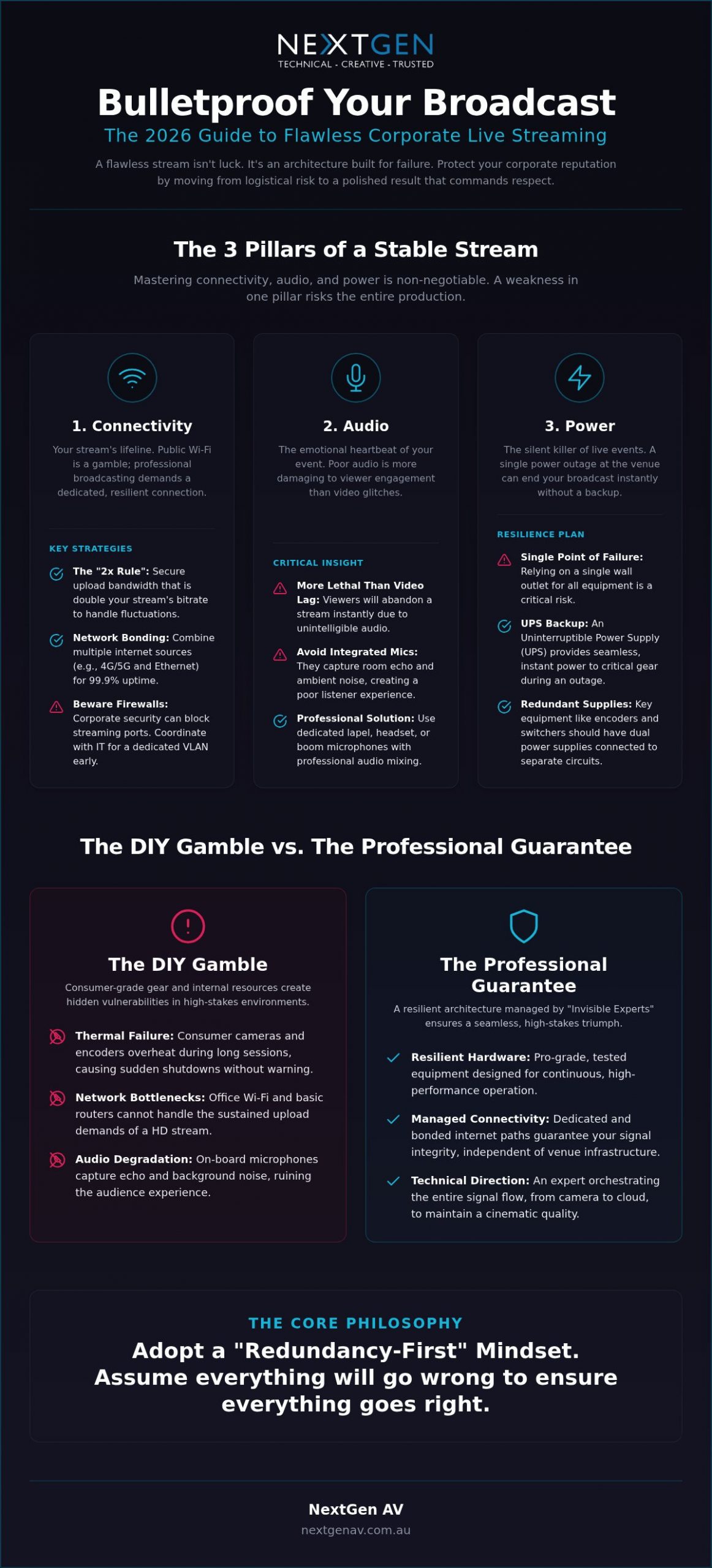
Planning and Technical Direction: The Invisible Fail Points
Technical mastery involves more than just plugging in cables. It’s about the orchestration of every moving part before the first frame ever reaches the viewer. Many organisations fall into the trap of “winging it,” assuming that a basic understanding of the hardware will suffice. This lack of structure leads to the most visible symptoms of a failing production: awkward silences, missed cues, and the dreaded “dead air.” Avoiding common live stream failures starts long before the “Go Live” button is pressed; it begins in the meticulous pre-production phase where every variable is accounted for.
A Technical Director acts as the silent engine behind the scenes. They manage the complex interplay between audio feeds, video switchers, and graphic overlays, ensuring that the transition from a keynote speaker to a slide deck is seamless. Without this central authority, the production lacks a cohesive rhythm, leaving the audience feeling disconnected. Professional technical direction transforms a series of isolated segments into a cinematic narrative, allowing your brand to project absolute competence and reliability.
The Crucial Role of the Run Sheet
A run sheet is the technical script that keeps your event on track. It maps every transition, graphic overlay, and speaker change with surgical precision. By time-coding your event, you create a professional rhythm that keeps the audience engaged. This document is vital for communicating cues between the on-site team and remote presenters, ensuring that everyone knows exactly when to speak and when to pause. A well-crafted run sheet eliminates the guesswork, providing a “bulletproof” roadmap that prevents the logistical grind from overshadowing the final result.
Managing Multi-Camera Complexity
Static shots are the fastest way to lose an audience’s attention. In the mid-2020s, viewers expect a dynamic visual experience that mirrors professional television broadcasts. Integrating multiple camera angles adds depth and energy, but it also increases the technical overhead. You must ensure visual consistency across different camera sensors and lighting setups to maintain a prestigious aesthetic. Managing this complexity, especially when integrating remote speakers via low-latency links, requires a proactive team that understands how to balance technical precision with creative artistry. This level of detail is what separates a basic webinar from a high-stakes corporate broadcast. To see how a dedicated space can be optimised for such high-quality performance, you can check out Book a DJ Studio as an example of a professional studio environment.
High-stakes broadcasts demand a “No Single Point of Failure” philosophy. This isn’t just technical jargon; it’s a commitment to your brand’s integrity. When you’re avoiding common live stream failures, you must assume that every piece of hardware and every byte of data is capable of failing at the most critical moment. By building layers of redundancy into your signal path, you ensure that the audience’s experience remains uninterrupted, even if the primary infrastructure falters. This proactive approach transforms a risky transmission into a stable, prestigious digital event.
Network Bonding and Backup Internet Solutions
A single internet connection is a liability. True network bonding represents the gold standard for corporate streaming, as it merges multiple sources, such as venue fibre, 4G/5G cellular, and even Starlink, into one resilient data pipe. Unlike basic “load balancing,” which simply switches between connections, true bonding treats these sources as a single entity. If the venue’s fibre line is accidentally severed or experiences a sudden brownout, the system continues to transmit over the cellular and satellite links without a single dropped frame.
This seamless handover is the invisible hero of a successful event. It provides 99.9% uptime, giving you the peace of mind to focus on your presentation while the technology handles the heavy lifting. For Melbourne event planners, this level of security is essential, especially in heritage buildings or temporary structures where connectivity can be notoriously temperamental. By orchestrating a bonded network, you eliminate the stress of unreliable venue internet and project absolute technical competence.
Hardware Failover: The Professional Safety Net
Redundancy must extend beyond the internet. Running primary and secondary encoders in parallel ensures that if a hardware component fails, the backup is already live and transmitting. Failover Redundancy is the simultaneous transmission of two identical streams to ensure zero downtime. This dual-path strategy, combined with an Uninterruptible Power Supply (UPS) to guard against venue power surges, creates a technical environment where failure is effectively engineered out of the equation.
If the unthinkable happens and the entire signal path is lost, a professional setup includes pre-programmed failover slates. These branded graphics inform the audience that you’re aware of the issue and are working to resolve it, maintaining a level of professionalism that a black screen never could. To ensure your next broadcast is supported by this elite level of protection, partner with our Melbourne-based technical team to architect a truly bulletproof solution.
Orchestrating Flawless Hybrid Experiences with NextGen AV
Mastering a high-stakes broadcast requires more than just a checklist; it demands a partner who understands the intricate pulse of live production. With over 30 years of industry experience, NextGen AV has refined the art of “invisible expertise.” We don’t just provide equipment; we architect experiences that allow you to step into the spotlight with absolute poise. Avoiding common live stream failures is a standard we achieve through meticulous planning and a deep familiarity with Melbourne’s premier corporate venues. From the soaring ceilings of the CBD’s heritage halls to the sleek acoustics of modern convention centres, we tailor our technical rigs to the unique demands of each space.
Our hardware advantage is built on professional-grade technology designed for the rigours of the 2026 event landscape. We deploy high-resolution LED Video Walls that command attention and Professional Audio Systems that ensure every syllable carries weight. By choosing elite hardware over consumer alternatives, we eliminate the thermal failures and signal degradation that plague amateur setups. This commitment to quality ensures that your visual and auditory presence is as prestigious as your brand’s reputation.
Expert Technical Direction for Melbourne Events
The human element is the ultimate backup. Our on-site engineers act as the “Confident Orchestrator,” managing the complex signal paths that define modern hybrid events. We specialise in the nuances of hybrid Q&A and real-time audience engagement, ensuring that remote participants feel as valued as those in the room. This level of technical direction bridges the gap between two worlds, creating a unified experience that feels natural rather than forced. Our team thrives under the pressure of live environments, proactively identifying potential friction points before they can impact your broadcast.
The NextGen AV Guarantee: Reliability by Design
Reliability isn’t a happy accident. It’s the result of rigorous pre-event testing and exhaustive sound check protocols that leave nothing to chance. We leverage the latest in 2026 streaming technology, including sophisticated bonding hardware that secures your connection across multiple data paths. This “Reliability by Design” philosophy means we’ve already solved the problems that haven’t even happened yet. You can focus on your delivery and the impact of your message, knowing that a seasoned Melbourne-based team is securing every frame behind the scenes.
Enquire about our live streaming services for your next Melbourne event and discover how we can transform your broadcast into a bulletproof professional triumph.
Master the Art of the Flawless Broadcast
Success in the high-stakes world of corporate events requires shifting from a “hope for the best” mindset to one of total technical redundancy. We’ve explored how implementing network bonding and professional failover strategies ensures your signal remains unbroken, regardless of venue limitations. By prioritising expert technical direction and high-end hardware, avoiding common live stream failures becomes a calculated outcome rather than a matter of luck. This proactive approach allows you to move past logistical stress and focus entirely on the prestige of your final result.
With over 30 years of technical production experience, our team provides the “invisible expertise” needed to orchestrate complex hybrid events with surgical precision. We offer redundant network bonding as standard and provide expert on-site technical directors to navigate every challenge in real time. Partner with Melbourne’s AV experts for a flawless live stream and ensure your next digital event is remembered for its impact, not its interruptions. Your vision deserves a platform that’s as reliable as your message.
Frequently Asked Questions
What is the most common reason for a live stream to fail?
The most common reason for a live stream to fail is insufficient upload bandwidth paired with a lack of connection redundancy. Many organisers rely on a single, shared venue network that cannot handle the sustained data throughput required for high-definition video. Avoiding common live stream failures necessitates a dedicated, isolated connection. Without this, even minor fluctuations in traffic can cause the stream to buffer or drop entirely, ruining the experience for your virtual audience.
How much upload speed do I actually need for a 1080p live stream?
For a consistent 1080p live stream, you need a dedicated upload speed of at least 10 to 15 Mbps. While a standard 1080p stream typically uses 4 to 6 Mbps, professional standards dictate a “2x headroom” to accommodate network spikes. We recommend testing your connection specifically for upload stability, as residential and corporate plans often prioritise download speeds. Having this buffer ensures your high-stakes broadcast remains sharp and stutter-free throughout the entire presentation.
What happens if the venue internet goes down during my event?
If the venue internet goes down, a professional setup will automatically switch to a secondary source without the audience noticing. This is achieved through failover systems that run primary and secondary internet lines in parallel. By using multiple carriers and diverse technologies like 5G or satellite, you create a safety net that protects your event. Without this redundancy, a single ISP outage can lead to a total broadcast collapse and significant reputational damage.
Why is my live stream audio out of sync with the video?
Live stream audio usually falls out of sync because of the different processing times required for video and sound signals. Video data is much heavier and takes longer to encode, often resulting in the audio arriving earlier than the visual. Professional technical direction solves this by using hardware-based delay units to align the signals perfectly. Correcting these sync issues is vital for avoiding common live stream failures, as even a slight disconnect can distract and alienate your viewers.
Can I live stream from a corporate office with a strict firewall?
You can live stream from a corporate office, but it requires early coordination with your IT department to navigate strict firewalls. Most corporate networks block the RTMP ports used by streaming software to prevent unauthorised data transmission. To ensure a smooth broadcast, you’ll need to whitelist specific ports or establish a dedicated VLAN. This isolation prevents the stream from being throttled by security protocols and ensures it doesn’t compete with the office’s daily digital traffic.
What is network bonding and do I need it for my event?
Network bonding is a technology that merges multiple internet sources into a single, robust data pipe. It’s essential for high-stakes Melbourne events where venue connectivity might be temperamental. Unlike simple switching, bonding uses all connections simultaneously, providing cumulative bandwidth and instantaneous failover. If one source drops out, the others carry the load seamlessly. It’s the most reliable way to guarantee 99.9% uptime and deliver a prestigious, glitch-free experience to your digital attendees.
Is it better to use a hardware encoder or a software-based streaming app?
A dedicated hardware encoder is superior to a software-based app for professional corporate events. Software encoders rely on the host computer’s CPU, which can struggle under the heavy processing load or crash because of background updates. Hardware encoders are purpose-built machines designed solely for high-performance streaming. They offer superior thermal management and stability, ensuring your broadcast remains live and stable even during lengthy sessions that would cause a standard laptop to overheat.
How do I manage a live stream for a hybrid event in Melbourne?
Managing a hybrid event in Melbourne requires a sophisticated blend of on-site technical direction and high-end AV hardware. You need to balance the experience for both the physical audience and the virtual viewers through integrated audio systems and multi-camera setups. Partnering with a local team that understands the specific acoustics and infrastructure of Melbourne’s premier venues is the best way to ensure seamless execution. This collaborative approach allows you to focus on your content while experts handle the technical complexity.
Imagine the silence in a Melbourne boardroom when the Chairman calls for the vote, but the hybrid feed drops, leaving three hundred shareholders staring at a frozen screen. It’s a nightmare scenario that keeps even the most seasoned corporate secretaries awake at night. The board is watching, the stakeholders are waiting, and the margin for error is non-existent. When you’re managing high-stakes AGM AV production Melbourne, you’ve likely spent months preparing the annual report, only to find the technical execution feels like an unpredictable gamble.
Securing a flawless event is no longer just about hiring equipment; it’s about orchestrating a high-stakes environment where technology serves governance with absolute precision. Precision is your protection. This 2026 guide provides the blueprint to transform your next shareholder meeting into a masterclass in corporate authority. We’ll show you how to integrate redundant streaming systems, secure remote voting protocols, and employ technical direction that protects your brand’s prestige while ensuring total regulatory compliance. You’ll gain the insights needed to navigate the 2026 landscape with confidence.
Key Takeaways
- Understand why 2026 demands a shift toward broadcast-quality production to ensure total transparency for both in-person and remote shareholders.
- Discover how to implement redundant audio and video systems that protect your meeting from technical disruptions during critical voting motions.
- Master the complexities of hybrid compliance by ensuring your AGM AV production melbourne meets Australian legal requirements for participant engagement.
- Learn to evaluate Melbourne CBD venues for their technical infrastructure and manage the logistical challenges of city-centre event setups.
- Recognise the importance of professional technical direction in creating a seamless, high-prestige environment that reflects your brand’s corporate authority.
The Evolution of AGM AV Production in Melbourne
Melbourne’s corporate sector has undergone a massive transformation in recent years. Shareholders are more tech-savvy than ever, and their expectations for transparency have reached a new peak. The traditional Annual General Meeting (AGM) has shifted from a local gathering in a hired hall to a sophisticated, global broadcast. In 2026, your technical setup must mirror the prestige of your brand. Gone are the days when a single microphone and a flickering projector sufficed. High-stakes AGM AV production melbourne now requires the same level of precision as a live television event. Transparency is the new currency of the boardroom, and boards must provide a seamless experience that bridges the gap between physical and digital participants.
Professional audio visual hire Melbourne is no longer just a logistical checkbox; it’s a strategic asset in modern corporate governance. It ensures every shareholder, regardless of their location, has a reasonable opportunity to participate as if they were sitting in the front row. The role of the technical director has become central to this mission. They act as the navigator in a high-pressure environment, managing complex signals and redundant systems so the board can focus on the agenda without fear of technical failure.
Meeting the Standards of Modern Governance
Visual quality directly impacts shareholder trust. When a board member appears clearly on screen, it humanises the leadership and reinforces a sense of accountability. Professional lighting is essential here. It isn’t just about visibility; it’s about ensuring the camera captures a polished, professional image without harsh shadows or washed-out colours. Audio is even more critical. Every word spoken for the official record must be captured with absolute clarity. If a motion is missed or a question from the floor is muffled, the legal integrity of the meeting is compromised. We ensure your audio systems are redundant and crystal-clear.
The “Invisible Expert” Philosophy
We believe the best technical execution is the one you never notice. Our “Invisible Expert” approach is built on total technical mastery. This philosophy allows the company secretary to breathe easy, knowing the technology is in safe hands. We act as the proactive engine behind the scenes, thriving under the pressure of live production. With over 30 years of experience and 4.5k+ events delivered, we specialise in transforming a stressful logistical grind into a prestigious corporate milestone. It is about quiet power. We manage the technical complexity so your board can take centre stage with absolute confidence and authority.
Essential Components of a High-Stakes AGM AV Setup
Achieving a bulletproof AGM AV production melbourne requires more than just high-end gear. It demands engineered redundancy. As corporate governance trends evolve, the technical backbone of your meeting must support absolute transparency and participation. Broadcast-grade 4K cameras are now standard. They ensure remote shareholders don’t just watch the meeting, but experience the room’s energy and visual cues. Pair this with dedicated, high-bandwidth internet lines to eliminate the risk of a dropping stream during the CEO’s address. This infrastructure provides the “quiet power” that allows your board to lead without technical distraction.
Visual Excellence: LED Walls and Displays
Traditional projection often fails in bright Melbourne boardrooms or sun-drenched conference centres. High-resolution LED video walls provide superior contrast and clarity, which is vital for displaying complex financial charts. We manage aspect ratios meticulously, ensuring your data is legible from the back of the room and on every remote device. By designing the stage with these displays as the backdrop, we keep the speakers as the focal point. This creates a cinematic feel that elevates the entire proceedings, transforming a dry presentation into a prestigious corporate milestone.
Audio Precision: The Foundation of Clarity
Sound is the most vulnerable element of any live event. We match microphones to speaker styles, using discreet lapel mics for mobile presenters and high-quality goosenecks for the lectern. In large Melbourne venues, multi-zone PA systems allow us to control volume levels precisely, preventing feedback while ensuring every shareholder hears the motions clearly. Audio redundancy is the practice of having secondary signal paths ready for instant failover. This technical safety net prevents a single cable failure from silencing your meeting at a critical moment.
Technical Integration and Voting
Your voting technology must sync perfectly with the visual feed. Delays lead to confusion and frustration among shareholders. Our integrated solutions ensure that when the vote is called, the results appear on screen instantly, backed by a secure technical architecture that leaves no room for doubt. Every component, from the secure internet gateway to the voting software, is monitored by our technical directors in real-time. A technical review with our specialist event team can identify these critical points of failure before they impact your board’s reputation.
Hybrid AGM Solutions: Comparing Your Options
The landscape of corporate gatherings has shifted permanently. In 2026, the hybrid model is no longer a temporary fix but a strategic standard for Melbourne’s elite firms. Balancing physical presence with digital accessibility is a complex dance. It requires a sophisticated approach to AGM AV production melbourne that ensures every participant, whether in a CBD boardroom or a home office in Perth, has an equal voice. This isn’t just about convenience; it is about meeting strict ASIC guidelines on shareholder participation. These regulations mandate that all attendees must have a “reasonable opportunity to participate,” a requirement that places the burden of proof squarely on your technical infrastructure.
A professional hybrid event is worlds apart from a standard webinar. While a basic digital platform might suffice for a casual team update, an AGM demands broadcast-grade reliability. This means managing complex Q&A sessions where virtual hands are seen and heard as clearly as those in the room. It involves a technical director who can weave these two worlds together without a second of dead air. The goal is a unified experience that reflects your company’s commitment to transparency and modern governance.
The Technical Toolkit for Hybrid Success
Building a bridge between two distinct audiences requires specialised hybrid event staging solutions. Low-latency streaming is the non-negotiable foundation of this toolkit. If your remote feed lags by even ten seconds, real-time voting becomes impossible to synchronise with the live floor. We focus on managing the “digital divide” by ensuring the interface for remote shareholders is intuitive and responsive. This ensures that a shareholder’s physical location doesn’t dictate the quality of their engagement or their ability to cast a decisive vote during critical motions.
Security and Compliance in the Virtual Space
Governance relies on the absolute integrity of the process. We utilise encrypted streaming protocols to protect sensitive corporate data and prevent unauthorised access to the broadcast. Verification processes for remote participants are integrated directly into the AV workflow, ensuring that every vote cast is legitimate and verifiable for the official record. Disaster recovery is another pillar of our “Invisible Expert” philosophy. If the local CBD internet grid experiences a surge or failure, our redundant 5G failovers or secondary satellite links activate instantly. This proactive stance ensures the meeting proceeds without interruption, protecting both your board’s reputation and the legal standing of the meeting.
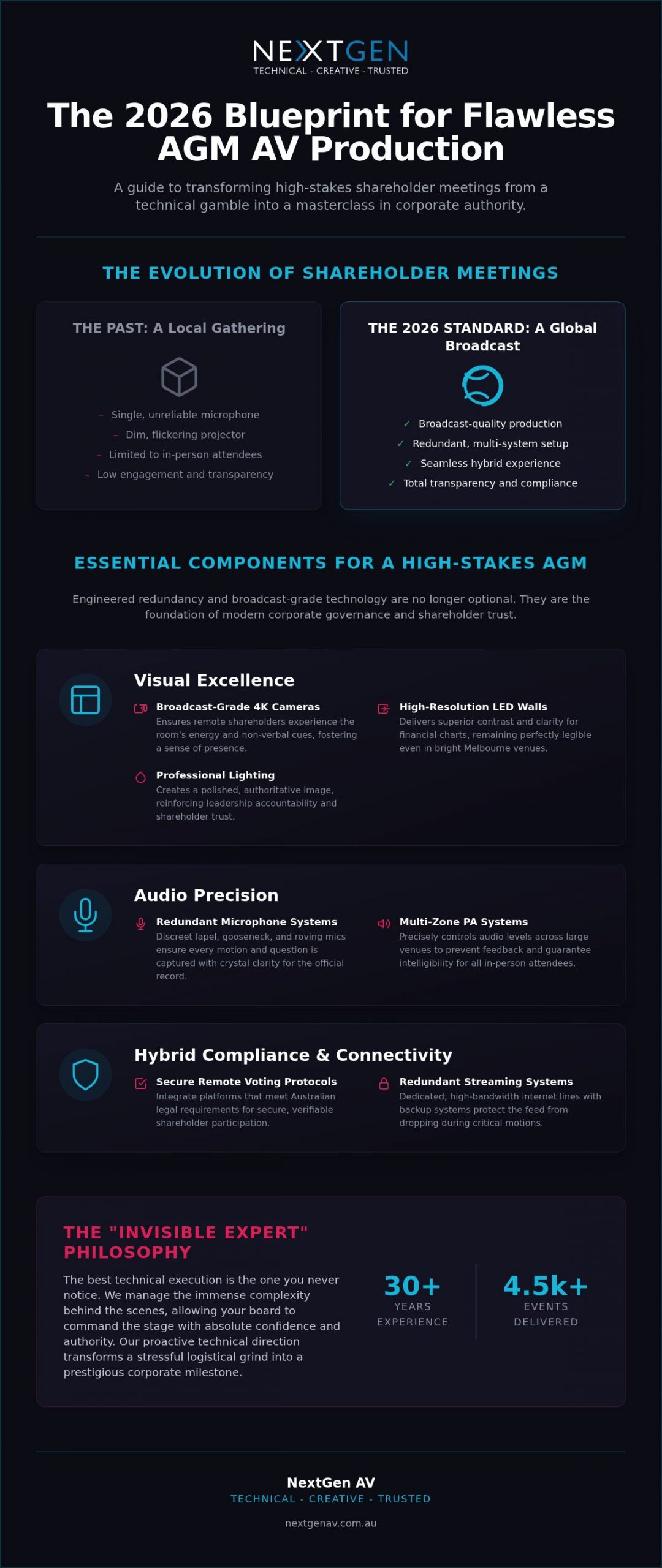
Strategic Planning for Melbourne AGM Venues
Selecting the right setting for your shareholder meeting is a strategic decision that goes far beyond aesthetics. In the heart of the Melbourne CBD, prestigious venues often present unique technical hurdles that can derail even the most prepared board. High-traffic locations require a military-grade approach to load-in and setup logistics. Whether your event is at a dedicated conference centre or a private corporate headquarters, the infrastructure must support the weight of your AGM AV production melbourne. Coordinating with venue staff on power distribution and rigging points is a task for veterans who speak the language of the facility manager. We conduct rigorous site inspections to identify these variables long before the first guest arrives.
Venue Selection Through a Technical Lens
Ceiling heights are the first point of failure in many venue choices. If you plan for high-impact visuals, the room must accommodate the necessary stage and lighting hire Melbourne without obstructing sightlines. Modern Melbourne boardrooms frequently feature expansive glass walls; while visually stunning, these surfaces create acoustic reflections that can muddy your audio feed. We assess these environments through a technical lens, identifying where to place sound dampening or directional speakers to maintain clarity for your AGM AV production melbourne. Additionally, we ensure there is dedicated space for the production “nerve centre.” This control booth is the engine room of your event, requiring its own power circuit and a clear line of sight to the stage.
The Pre-Production Timeline
Time is your greatest ally in the lead-up to the gavel. A full technical rehearsal is a non-negotiable requirement for any AGM we orchestrate. This isn’t just a quick check; it’s a simulated run-through that tests every redundant system and failover protocol. During this phase, we finalise the “Run of Show.” This document scripts every transition, slide change, and camera angle, ensuring the technical team moves in perfect lockstep with the Chairman. The final pillar of this timeline is the sound check. We verify every microphone in the room, ensuring levels are consistent across both the physical PA system and the digital broadcast. This methodical preparation creates the quiet power that allows your board to take centre stage without worry.
Planning a high-stakes event in the city requires a partner who understands the local landscape and venue complexities. You can contact our Melbourne production team to begin your site evaluation and secure a seamless transition from planning to execution.
Partnering with NextGen AV: Your Confident Orchestrator
Choosing the right partner for your AGM AV production melbourne is the final, most critical step in your planning journey. With over 30 years of experience and more than 4.5k events successfully delivered, NextGen AV has become the trusted ally for Melbourne’s most prestigious boards. We don’t just provide equipment; we provide peace of mind. Our team brings 85+ years of combined expertise to your boardroom, ensuring that every technical detail is managed with absolute precision. This legacy of excellence allows us to anticipate challenges before they arise, protecting your brand’s reputation when the stakes are at their highest.
The value of a full service event production partner lies in the total elimination of friction. Instead of managing multiple vendors for audio, video, and streaming, you have a single point of contact who understands the cultural nuances of your organisation. We embody the “quiet power” required for corporate governance. While our technicians drive the success of the event from behind the scenes, your board takes centre stage with total confidence. We specialise in customising every setup to reflect your company’s unique identity, ensuring the production feels like a natural extension of your internal team.
Mastery and Artistry in Every Event
We believe that an AGM should be more than a dry recitation of figures. It should be a cinematic and professional experience that reinforces shareholder trust. By moving beyond simple utility, we use our mastery of light, sound, and vision to create a polished environment that commands respect. Our history of 1200+ successful annual hires gives us a unique perspective on problem-solving. We’ve seen every possible variable in the Melbourne event landscape, from complex CBD logistics to high-pressure hybrid integrations. This depth of knowledge allows us to act as a proactive force, ensuring your AGM AV production melbourne is flawless from the opening gavel to the final motion.
Ready to Organise Your Next AGM?
Securing an elite production team shouldn’t be a source of stress. We have refined our process to be as efficient and transparent as the meetings we produce. When you partner with us, you gain access to a dedicated project manager who will guide you through a simple step-by-step journey:
- Initial Consultation: We discuss your specific governance needs and venue requirements.
- Site Evaluation: Our team conducts a technical assessment of your chosen Melbourne location.
- Tailored Quote: You receive a comprehensive production plan designed for your budget and goals.
- Seamless Execution: Our elite technicians manage the setup, rehearsal, and live broadcast.
Your board deserves a technical partner that thrives under pressure and takes personal pride in seamless execution. Contact the NextGen AV team to discuss your Melbourne AGM production today.
Master the Gavel with Confidence
The path to a flawless shareholder event is paved with technical precision and engineered redundancy. By prioritising broadcast-quality visuals and secure, low-latency streaming, you ensure that every stakeholder has a front-row seat to your corporate narrative. Mastering the logistics of high-stakes AGM AV production melbourne means looking beyond the equipment to the technical direction that protects your governance and your brand’s prestige. Whether you are navigating the complexities of hybrid participation or the acoustic challenges of a Melbourne CBD boardroom, your focus should remain on the agenda, not the infrastructure.
NextGen AV brings 30+ years of industry experience to your boardroom, acting as the “Invisible Expert” behind your success. As specialists in high-stakes corporate production with a Top Rated Service 2026 verification by Trustindex, we are dedicated to delivering a seamless experience that reflects your company’s authority. Don’t leave your most important meeting of the year to chance. You can secure your flawless AGM production with Melbourne’s AV experts and move forward with absolute certainty. Let’s transform your next meeting into a prestigious corporate milestone that resonates with every shareholder.
Frequently Asked Questions
What is the most important AV component for a successful AGM?
Redundant audio systems are the most critical component because they ensure every motion and vote is recorded with absolute clarity. While visuals are important for engagement, clear sound is a legal necessity for corporate governance. We deploy secondary signal paths and high-quality microphones to ensure there is never a second of silence, protecting the integrity of your official records and the board’s reputation.
How do you ensure voting integrity in a hybrid AGM environment?
We ensure voting integrity by integrating secure, encrypted voting platforms directly with our low-latency streaming feeds. This synchronisation prevents delays that could confuse remote shareholders or lead to contested results. By using verified participant access and real-time monitoring, we provide the board with a transparent, auditable trail of every vote cast, whether they are in the room or participating online.
Can NextGen AV provide a technical director for our Melbourne event?
Yes, providing a dedicated technical director is a fundamental part of our AGM AV production melbourne service. This expert acts as the “Confident Orchestrator,” managing the complex transitions between live speakers, digital presentations, and remote participants. Having a seasoned professional at the helm allows your board to focus on the agenda while we manage the technical execution with quiet power and precision.
What happens if the internet fails during a live-streamed AGM?
We mitigate internet failure through engineered redundancy, including secondary 4G or 5G failover connections and dedicated high-bandwidth lines. If the primary connection drops, our systems switch to the backup instantly, often without the audience noticing a flicker. This proactive disaster recovery planning is essential for maintaining the “reasonable opportunity to participate” required by Australian corporate regulations and protecting the meeting’s legal standing.
How much lead time is required for planning AGM AV production in Melbourne?
We recommend a lead time of three to six months to ensure venue availability and comprehensive technical planning. This window allows for detailed site inspections, custom staging designs, and thorough technical rehearsals. However, our experienced team can often accommodate tighter timelines for established clients, provided the core technical requirements and venue logistics are finalised quickly to maintain our high standards of execution.
Do you support multi-venue AGMs across different Australian cities?
Yes, we specialise in multi-venue setups that link shareholders across different Australian cities into a single, unified experience. By using synchronised broadcast-grade technology, we ensure that a participant in Sydney or Brisbane has the same interactive experience as those in the Melbourne boardroom. This approach maintains corporate unity and ensures that all shareholders can participate in real-time discussions and voting sessions seamlessly.
What is the difference between a virtual AGM and a hybrid AGM?
A virtual AGM is conducted entirely online with no physical gathering, whereas a hybrid AGM combines a physical meeting at a Melbourne venue with a digital broadcast. The hybrid model is currently the gold standard for AGM AV production melbourne because it offers the prestige of a live event while maximising accessibility for a global shareholder base, meeting diverse participation needs and regulatory requirements.
How do you handle Q&A sessions with remote shareholders?
We manage Q&A sessions by integrating digital moderation tools that allow remote shareholders to submit questions via text or live audio and video feeds. Our technical director coordinates these inputs, ensuring the Chairman can address virtual questions as naturally as those from the floor. This unified approach ensures every shareholder feels heard, fostering a sense of transparency and genuine engagement throughout the proceedings.
A corporate town hall is no longer just a meeting; it is a high-stakes live broadcast where your leadership’s authority is only as strong as the signal reaching the back of the room. When the stakes are this high, a flicker in the feed or a “washed out” presentation in a bright Melbourne venue doesn’t just look unprofessional, it actively distracts from the core mission. Mastering a flawless corporate town hall av setup requires moving beyond basic equipment to embrace a broadcast-grade architecture that protects your message at every turn.
You understand the silent tension that fills a room when the hybrid link to Perth or Sydney begins to lag during a critical Q&A session. It’s a frustration we have helped many executive teams overcome by prioritising redundant systems and technical precision. This 2026 guide promises to give you total confidence in your production, ensuring every word is heard with crystalline clarity and every visual reflects the prestige of your brand. We will walk through the essential components of elite event delivery, from high-resolution LED video walls to the multi-zone audio engineering that makes remote staff feel like they are sitting in the front row.
Key Takeaways
- Discover why high-resolution LED video walls with a 1.9mm to 2.5mm pixel pitch are essential for maintaining visual authority in sun-drenched Melbourne venues.
- Learn how to eliminate “ballroom echo” by using a distributed PA system design that ensures every voice is heard with crystalline clarity during high-stakes Q&A sessions.
- Master the technical orchestration of a corporate town hall av setup by prioritising hardware encoders over consumer laptops for a lag-free hybrid stream.
- Elevate remote engagement through dynamic multi-camera switching, transforming a standard internal meeting into a cinematic, broadcast-grade experience for interstate offices.
- Gain total peace of mind by partnering with seasoned technical directors who manage the entire production lifecycle from initial site inspection to final pack-down.
What is a Corporate Town Hall AV Setup?
A corporate town hall av setup is a sophisticated ecosystem of high-end audio, visual, and streaming hardware designed to unify a distributed workforce. While a traditional Town hall meeting focuses on the democratic exchange of ideas, the modern corporate version is a high-stakes performance that demands broadcast-grade reliability. The core objective is simple but technically demanding: every staff member, whether they are in a Melbourne ballroom or a home office in Perth, must receive the same high-impact experience. In 2026, a grainy webcam and a pair of portable speakers are no longer tools; they are liabilities that erode leadership authority and professional prestige.
The psychological impact of this technical mastery is profound. When a session runs without a single glitch, it signals that the organisation is stable, tech-savvy, and respects its people’s time. It allows leaders to stop worrying about the “mute button” and focus entirely on their message, projecting a sense of quiet power that resonates across every screen in the country. This isn’t just about equipment; it’s about creating a cinematic environment where the CEO’s vision can be delivered with absolute clarity.
The Evolution of the All-Hands Meeting
We’ve seen a massive shift from simple boardroom huddles to multi-site “theatre” experiences. Australian corporate culture has embraced a “Hybrid First” mindset, where the digital audience is just as vital as the physical one. If your audio is patchy, you don’t just lose the sound; you lose the audience’s trust. Professional full service event production ensures that the transition between speakers is seamless, treating the event as a live TV production rather than a standard video call. This transition requires a move away from consumer-grade software toward dedicated hardware that can handle the load of thousands of concurrent viewers.
Key Components of a Professional Setup
To achieve this level of prestige, several mission-critical elements must work in perfect harmony. These components form the backbone of a resilient corporate town hall av setup:
- Visual Display: High-resolution LED walls have replaced traditional projection in bright Melbourne venues because they offer superior contrast and clarity, even in broad daylight.
- Audio Precision: Distributed sound systems eliminate “ballroom echo,” ensuring the CEO’s voice carries the same weight in the back row as it does in the front.
- Resilient Connectivity: Using dedicated hardware encoders and redundant internet failovers protects the stream from local network drops, ensuring the link to interstate offices remains unbroken.
Visual Impact: Choosing Between LED Walls and Projection
Visuals act as the anchor for your leadership’s presence. If the screen is dim or the text is illegible, the authority of the speaker diminishes instantly. For a premium corporate town hall av setup, the choice between LED and projection defines the room’s energy. In Melbourne’s premier corporate spaces, floor-to-ceiling glass often floods the room with natural light, making traditional projection look ghostly and weak. High-resolution LED technology has become the gold standard because it cuts through ambient light with crystalline brilliance, ensuring every slide is readable from the back row.
Pixel pitch is the critical metric here. For corporate data and text-heavy presentations, we recommend a pixel pitch between 1.9mm and 2.5mm. This range ensures that even small fonts remain sharp and legible for the in-person audience. While high-lumen projection still holds a place in massive, darkened auditoriums with specific architectural constraints, it lacks the punch and deep black levels required for a modern broadcast feel. Creating a dynamic digital backdrop that reinforces your brand identity is much easier on a modular LED system, allowing you to wrap the stage in your corporate colours and prestige.
The Case for LED Video Walls in 2026
The shift toward LED isn’t just about brightness; it’s about seamless execution. Unlike projection, there are no shadows cast when a speaker walks in front of the screen, and there are no distracting bezel gaps found in older video wall panels. This creates a unified canvas that looks as good on a smartphone stream as it does in person. If you’re planning a high-stakes session, exploring a modern LED video wall configuration is the most effective way to guarantee visual impact. Our technical directors often suggest these systems to create a “front-of-house” excellence that matches your executive team’s vision.
Optimising Content for Large-Scale Displays
Your content must be designed for the scale of the room. Using the wrong aspect ratio leads to the “stretched” PowerPoint look, which immediately signals a lack of preparation. We focus on high-contrast visuals that translate well for remote viewers, often using picture-in-picture (PiP) layouts. This allows staff in Sydney or Perth to see the speaker’s nuances alongside the data, fostering engaging and effective town halls that bridge the geographic gap. For those looking to elevate their next session, consulting with the specialists at NextGen AV ensures your visual strategy is as robust as your message.
Sonic Clarity: Audio Systems for Every Voice
Sound is the invisible thread that holds your entire event together. While a visual glitch is a distraction, an audio failure is a total shutdown. In a high-stakes corporate town hall av setup, the goal is to deliver the “voice of God” with absolute intimacy and zero distortion. We achieve this by moving away from the “point-and-shoot” speaker approach and embracing a distributed PA system design. This method places smaller, high-fidelity speakers throughout the venue, ensuring that the CEO’s message carries the same weight in the back row as it does in the front without the deafening volume levels often required by traditional setups.
The role of the audio engineer is pivotal in balancing two distinct environments. The “In-Room” mix must overcome the natural acoustics of a Melbourne ballroom, while the “For-Stream” mix must be polished for remote participants in Perth or Brisbane. In 2026, we integrate AI-driven noise cancellation directly into the signal chain. This technology identifies and strips away unwanted background hum, air conditioning noise, or the clatter of catering staff in real-time, ensuring that only the speaker’s voice reaches the ears of your workforce.
Ensuring Every Word is Heard
Relying on a venue’s house sound is a risk that seasoned planners rarely take. Securing professional sound system hire ensures you have the headroom and clarity required for leadership updates. Managing the “Q&A Chaos” is the next hurdle. We often recommend a mix of “catch-boxes” for high-energy sessions and traditional roaming microphones for more formal inquiries. To protect the hybrid link, we implement a “Mix-Minus” setup. This technical configuration prevents remote callers from hearing their own voice as a delayed echo, a common technical flaw that can derail an otherwise perfect session.
The Executive Microphone Choice
The choice of microphone can significantly impact a leader’s comfort and delivery. While lectern mics are traditional, headset microphones provide the most consistent audio levels for active, mobile speakers. In the dense radio environment of the Melbourne CBD, RF management is a critical invisible task. We proactively scan for interference to ensure no signal dropouts occur during the broadcast. Frequency Coordination is the systematic mapping and monitoring of the radio spectrum to ensure every wireless device operates on a dedicated, interference-free channel. This meticulous preparation allows your leadership team to step onto the stage with total confidence in their voice.
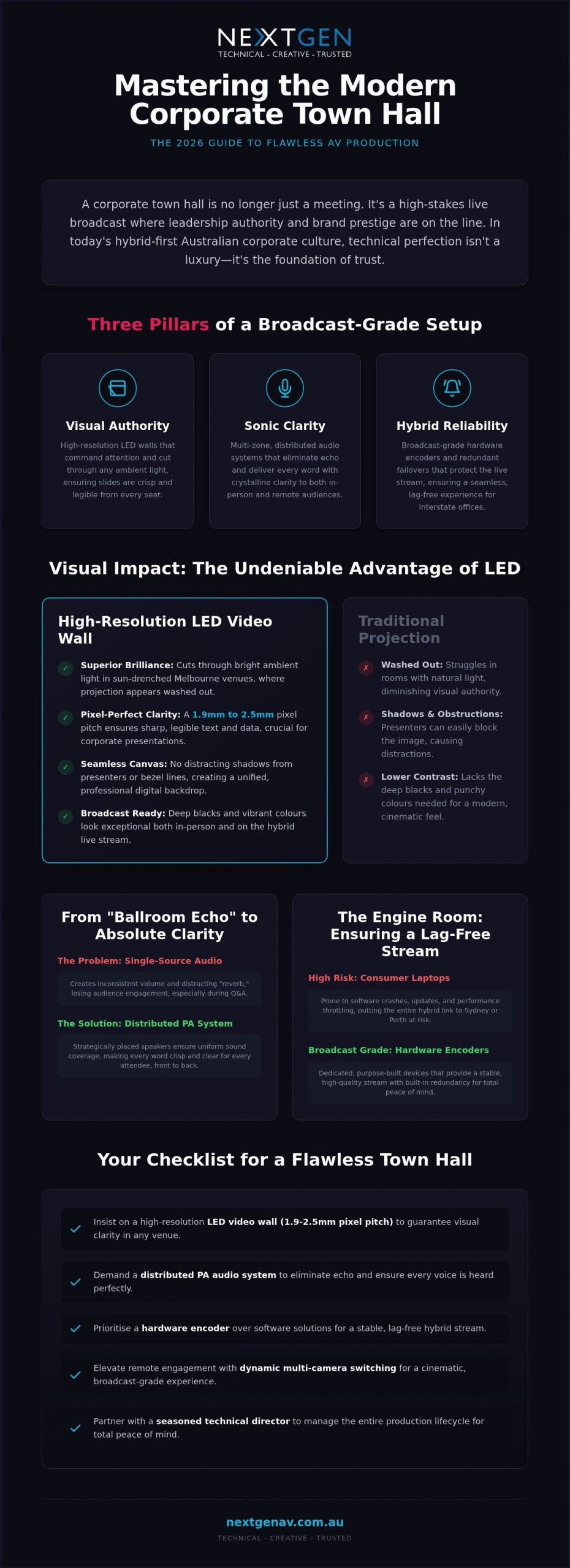
The Hybrid Engine: Connectivity and Technical Direction
A corporate town hall av setup is only as resilient as its weakest link. Relying on a consumer laptop to push a high-stakes stream is a gamble that often results in dropped frames and jittery audio. Instead, we architect the stream using dedicated hardware encoders. These devices are purpose-built for one job: delivering a stable, high-bitrate signal that doesn’t fluctuate when a background app updates. This broadcast-grade approach ensures your message reaches every corner of Australia with the same fluid motion as a live news bulletin.
This requirement for dedicated, high-performance hardware is not limited to events; it is equally critical for daily business operations. Implementing professional business phone systems from newcomsolutionsinc.com ensures your corporate communications remain stable and professional outside of the town hall setting.
The secret to keeping a remote audience engaged is dynamic visual storytelling. We use multi-camera switching to provide different perspectives, from wide stage shots to tight close-ups of the speaker. This is orchestrated by the “Show Caller,” the technical lead who directs the camera operators and cues the slides. They are the engine behind the scenes, ensuring every transition is crisp and every video clip starts exactly on time. Their presence allows the executive team to focus on the narrative while the technical team handles the complexity.
Managing latency is a critical hurdle for Australian businesses with offices in Perth or Sydney. By using low-latency streaming protocols and private content delivery networks, we ensure that the delay between the live speaker in Melbourne and the remote viewer is kept to the absolute minimum. This synchronisation is vital for interactive moments, preventing that awkward five-second silence while waiting for a remote question. It maintains the rhythm of the meeting and keeps the energy high across all sites.
Hybrid Event Planning Checklist
- Step 1: Conduct a dedicated bandwidth stress test at the venue to ensure the upload speed can handle a high-definition 1080p stream without packet loss.
- Step 2: Establish a primary and secondary (4G/5G) stream path to provide an instant failover if the venue’s fixed line drops.
- Step 3: Organise a full technical rehearsal 24 hours prior to iron out any software conflicts or lighting issues.
- Step 4: Assign a dedicated moderator for the digital Q&A platform to filter questions and manage the flow of conversation.
Engaging the Remote Workforce
Bridging the geographic gap requires more than just a camera feed. We utilise hybrid event staging solutions that integrate interactive tools like Slido or Mentimeter directly into the broadcast. One of the most effective ways to foster inclusion is visualising the remote audience. By placing a “Zoom Gallery” on the back wall of the venue, the CEO can see the faces of staff in Brisbane or Adelaide, creating a two-way connection that feels personal. For a production that reflects your leadership’s authority, partner with the technical experts at NextGen AV today.
Executing Your Melbourne Town Hall with NextGen AV
Success in a high-stakes leadership broadcast isn’t just about the hardware you hire; it’s about the technical direction that guides it. Leveraging over 30 years of full service event production, we provide the peace of mind that only comes with decades of frontline experience. Our collaborative process begins long before the first speaker takes the stage, starting with a meticulous site inspection and moving through to a comprehensive post-event debrief. This end-to-end management ensures that your corporate town hall av setup is perfectly tailored to your specific venue and audience needs.
Local Melbourne expertise is a critical advantage when navigating the logistical complexities of the CBD and surrounds. From understanding the power constraints of heritage venues to managing the tight load-in schedules of modern convention centres, our team handles the friction so you don’t have to. We don’t just provide equipment; we design custom staging and lighting solutions that elevate your corporate message into a cinematic experience. By treating your all-hands meeting as a prestigious production, we help reinforce the authority and vision of your leadership team.
The NextGen AV Difference
We operate as the “Invisible Expert” behind your brand. Our team thrives under pressure, allowing your executives to take centre stage with the total confidence that the technical engine is running flawlessly. We have built a 30-year legacy in Melbourne’s corporate event scene by prioritising reliability above all else. This “Zero Failure” philosophy means that redundant systems come as a standard part of our service, not an optional extra. If a primary feed fluctuates, our secondary systems engage instantly, ensuring your message remains unbroken and your reputation stays intact.
Getting Started with Your 2026 Town Hall
The path to a broadcast-grade production starts with early collaboration. We recommend requesting a technical site survey of your chosen Melbourne venue at least six weeks prior to your event. This allows us to identify potential acoustic challenges or visual obstructions before they become problems. Our team works with you to build a scalable AV budget that prioritises the most impactful elements, from crystal-clear audio to high-resolution LED backdrops. When you’re ready to elevate your internal communications, contact the NextGen AV team to organise your town hall setup and experience the power of professional orchestration.
Elevating Your Leadership Message for 2026
The modern corporate town hall has evolved into a high-stakes broadcast where technical precision is the foundation of leadership authority. By prioritising high-resolution LED walls and distributed audio systems, you ensure that every staff member receives a high-impact experience regardless of their location. A resilient corporate town hall av setup isn’t just about the hardware; it’s about the technical orchestration that allows your message to resonate without the distraction of glitches or lag. Moving beyond “good enough” technology allows your executive team to project absolute competence and vision.
Achieving this level of prestige requires a partner who thrives under pressure. With over 30 years of Melbourne AV expertise, we provide redundant broadcast-grade systems and dedicated technical directors for every event to guarantee a seamless execution. You focus on the narrative while we manage the complexity behind the scenes. Partner with the Confident Orchestrators at NextGen AV for your next Town Hall to transform your next all-hands meeting into a cinematic success that inspires your entire workforce. Let’s build a production that reflects the true stature of your brand.
Frequently Asked Questions
How much bandwidth do I need for a hybrid corporate town hall?
You need a dedicated upload speed of at least 10 to 15 Mbps for a stable 1080p high-definition stream. While lower speeds might technically work, they leave no room for network fluctuations that cause buffering for your remote staff. We always recommend a synchronous connection where the upload speed is guaranteed, ensuring your leadership’s message remains fluid and professional throughout the entire broadcast.
Can we use our existing office Wi-Fi for the live stream?
We strongly advise against using office Wi-Fi for a mission-critical live broadcast. Wireless signals are prone to interference and congestion, especially when hundreds of staff members are also using the network. A professional corporate town hall av setup relies on a dedicated, hardwired Ethernet connection for the primary stream path. This physical link provides the stability required to eliminate the risk of a signal drop during a high-stakes executive update.
What is the best way to handle Q&A for remote and in-room staff simultaneously?
A unified digital platform like Slido or Mentimeter is the most effective way to synchronise questions from both audiences. This allows a dedicated moderator to curate and present questions to the leadership team in real-time. By using a central digital queue, you ensure that interstate staff in Perth or Sydney have the same opportunity to engage as those sitting in the front row of your Melbourne venue.
Is an LED wall better than a projector for a bright ballroom?
An LED video wall is the superior choice for any venue with high ambient light or floor-to-ceiling windows. Unlike projectors, which can look “washed out” when competing with sunlight, LED panels provide high-contrast, vibrant visuals that remain sharp even in broad daylight. This technology ensures that your data and branding are clearly visible to everyone in the room, reflecting a high-end, broadcast-grade production standard that projection simply cannot match.
How many cameras do we actually need for a professional town hall?
We recommend a minimum of two cameras to create a dynamic and engaging experience for your remote workforce. One camera provides a wide “master” shot of the stage and branding, while the second delivers tight, close-up shots of the speaker to capture their nuances and expressions. This multi-angle approach, managed by a technical director, prevents the visual fatigue that often occurs with a single, static camera feed.
What happens if the internet goes down during the live broadcast?
A professional production incorporates a secondary, independent internet path to prevent a total shutdown. We typically establish a high-speed 4G or 5G failover that automatically engages if the venue’s primary fixed-line connection fails. This redundancy is a core part of our philosophy, ensuring that your hybrid link remains firm and your audience stays connected regardless of local network issues or unexpected infrastructure failures.
Do I need a technical director for a 1-hour all-hands meeting?
A technical director is essential for any event where leadership authority and brand prestige are at stake. Even a short session involves complex orchestration between audio levels, camera angles, and slide transitions. Having an expert “Show Caller” allows your executive team to focus entirely on their delivery while we handle the technical stress, ensuring every transition is seamless and the final result looks like a polished live TV production.
How far in advance should we book our AV setup in Melbourne?
We recommend booking your corporate town hall av setup at least four to six weeks in advance. This lead time is vital for conducting a thorough technical site survey and securing the specific high-resolution LED panels or specialised audio equipment required for your date. Melbourne’s corporate event calendar is often congested, so early engagement ensures you have the elite technical team and hardware necessary to deliver a flawless session.
