
What if your video wall did more than display a logo, carrying your brand story through every moment of the event? A considered approach to event video wall hire melbourne connects arrivals, presentations and closing moments with visuals that feel purposeful and recognisable.
Striking screens can draw attention. The challenge is making every visual fit the programme, suit the venue and support the audience experience without technical demands pulling focus from the event. NextGen AV brings creative planning and precise technical direction together, so your production runs smoothly behind the scenes while your brand takes centre stage.
This guide covers how to plan video wall content around key audience moments, choose a display format for your event and venue, and coordinate the technical details for a polished result. With more than 30 years of event industry experience, our Melbourne team has managed synchronised content across three modular walls at a CBD outdoor activation. That production expertise helps make the screen a cohesive part of the brand experience.
Key Takeaways
- Define what your video wall needs to achieve, then shape its content around the audience journey and key moments in your programme.
- Use a consistent visual identity across welcome slides, speaker support and event milestones to keep your brand recognisable.
- Choose a screen layout that suits the venue, viewing conditions and content. Consider how pixel pitch affects image detail at the audience’s viewing distance.
- Plan approvals, content checks, technical testing and pack-down as part of a coordinated production sequence, not as last-minute tasks.
- For event video wall hire melbourne, align display choices and technical direction with your event goals, audience and venue requirements.
How event video walls can make your Melbourne brand more memorable
A video wall earns attention through more than scale. Its value comes from how deliberately it serves your brand and the people attending: a clear welcome, a message that helps the audience follow the programme, or a visual moment that brings everyone’s focus together. Without a clear purpose, even a large display can feel like decoration rather than part of the event.
A branded event video experience is a planned sequence of visuals that expresses a recognisable brand identity while guiding the audience through key moments. A video wall combines display panels to create a larger visual surface, but branding-led use depends on the story and timing of what appears on it. That distinction matters for event video wall hire melbourne: the screen should serve the event, not compete with it.
Start with the audience journey
Map the guest experience from arrival through to departure. Identify when a screen can orient people, reinforce a message or heighten a shared moment. Then make each appearance relevant to the audience’s role and the programme.
For example, guests arriving at a conference may need a clear welcome and context for the day. During a presentation, the display can reinforce the speaker’s key message; at a milestone, it can bring the room’s attention to a shared moment. These uses work best when content changes with the programme rather than repeating a brand mark without purpose.
Set one clear brand objective
Before developing visuals, decide what impression the event should leave. Is the priority to explain a new initiative, welcome delegates into a cohesive experience or mark a company milestone? A central objective gives brand, content and production teams a practical standard for deciding what belongs on screen.
Translate brand values into a small set of visual themes and messages. A sense of precision might call for uncluttered layouts and concise copy; a celebratory event may give milestone content greater prominence. Keep the identity consistent while adapting each asset to its role and moment.
Melbourne venues and event settings vary, so shape the plan around the actual space, audience and programme rather than relying on a generic template. Consider:
- What guests need to know at each stage.
- Which message deserves the strongest visual emphasis.
- How the screen can support the event atmosphere without distracting from speakers or activity.
Use these decisions to assess every proposed visual. If it doesn’t inform, welcome, reinforce or celebrate something meaningful for the audience, refine it or leave it out. That discipline turns a screen into a coherent part of the brand experience.
Plan event video content around your brand story and Melbourne programme
A strong content plan gives every visual a place in the programme, from the first holding slide to the final milestone. Instead of assembling a playlist of attractive assets, map a sequence that carries the brand story while helping guests understand what’s happening. These event branding strategies work best when creative choices and production planning move together.
Use this five-step workflow to turn the brief into a practical screen plan:
- Set the objective. Define the central impression or message the event should leave with its audience.
- Map audience moments. Match visuals to programme cues, such as doors opening, a speaker taking the stage or a milestone announcement.
- Develop the content. Select approved brand assets and decide which messages guests should absorb or act on.
- Plan the display layout. Shape each asset for the screen format and how it will be viewed in the venue.
- Rehearse technically. Test playback in sequence, check content against programme cues and resolve issues before guests arrive.
Build a content sequence, not a playlist
Assign every visual a purpose, playback moment and responsible content owner. A holding slide can set the atmosphere, while information guests need to read should be easy to follow and shown for long enough. Plan transitions around changes in the programme, so the screen moves from welcome to speaker support to milestone content with intention, not abruptly.
A simple content schedule makes the moving parts visible. Record each asset’s owner, version, playback cue and approval status. Name files consistently so the approved version is easy to identify. Set approval points before technical rehearsal, giving brand and production teams time to resolve changes before event day.
Keep visual identity consistent
Carry approved colour, typography, imagery and message hierarchy across holding slides, speaker support and milestone moments. Adapt layouts to their different purposes while retaining a recognisable identity. Keep essential text concise and legible at the audience’s viewing distance and within the screen layout. A design intended for a close-up slide may not read well across a large display.
Coordinate screen visuals with set design and other event elements, including stage backdrops and lighting. This helps the display feel integrated into the room rather than like an isolated surface. Content and screen design must work together: brand consistency depends on planned content as much as on the screen itself.
For event video wall hire melbourne, build content approvals and playback cues into the production plan early. NextGen AV can coordinate technical direction around the sequence, giving your brand team room to focus on the story while the production details are managed behind the scenes. Plan your event video production around the moments that matter.
Choose an event video wall format that supports the brand experience
The right screen layout makes content clear to the audience and supports the event’s purpose. A central presentation display, a wider visual backdrop and several coordinated walls each create a different experience. Choose a format by considering what guests need to see, where they’ll be viewing from, the room’s ambient light and the venue’s practical constraints.
Pixel pitch describes the spacing between LED pixels. It affects how detailed content appears at a given viewing distance, so consider the audience’s position and the material you plan to display before choosing a display solution. Close-up product imagery and fine text place different demands on a screen than bold graphics viewed from further away.
Match screen layout to the event moment
A single focal display can give a presentation or central announcement a clear visual anchor. Multiple modular walls can extend the experience across a larger environment, provided the content is designed for each surface and the audience can see it from relevant positions. For example, a product launch might use a central screen for the reveal while surrounding displays carry complementary imagery. This keeps the main moment prominent without leaving the wider space visually disconnected.
Use this comparison to focus the format decision on audience need, rather than screen size alone:
- One central message: A single focal display can prioritise a speaker, announcement or key visual. Plan clear sightlines and keep essential content readable from audience positions.
- Information guests must follow: Presentation support or event instructions need a layout that gives text and graphics enough space. Consider viewing distance and how long guests have to read them.
- Brand presence across a larger area: Multiple modular walls can carry coordinated content in different parts of an environment. Plan how each surface relates to the others and how guests will encounter them.
Balance creative ambition with technical conditions
Start with the venue plan and audience sightlines. Check likely viewing positions, ambient light, screen placement and how the display relates to staging and other event elements. These conditions shape the layout and content, helping ensure a striking visual remains useful from across the room.
A video processor scales content, switches inputs and maps signals to LED tiles. This technical layer helps fit the signal to the display configuration. Rehearsal checks that the intended content appears correctly across the screen layout. Include these checks in production planning so technical direction supports the experience without becoming a distraction.
Screen support also belongs in the event’s safety planning. Coordinate the display configuration with staging and rigging plans, and address structural documentation where relevant. A structural engineering certificate is documented evidence that a structure has been independently assessed for compliance and safety. For event video wall hire melbourne, aligning creative choices with venue conditions and technical planning helps deliver a polished, considered result.

Coordinate event video, staging and production for a seamless Melbourne delivery
A polished event depends on more than a screen working on its own. Video, staging, lighting and sound systems need to support the same programme, and organisers, brand teams and production technicians need clear responsibilities for each decision. Bring these conversations into pre-production so the technical plan serves the audience experience instead of competing with it.
Bring creative and technical teams together early
Start with a shared briefing that covers the event objective, approved brand assets, programme, venue information and intended screen moments. The production team can use these details to plan display placement, sightlines, staging requirements and technical workflows. Early coordination helps identify practical constraints while there’s still time to shape the creative approach.
Set clear responsibilities for content supply, approval and playback. Brand teams should know which assets need approval and when; production technicians need a final, clearly labelled version and the cue for each playback moment. Organisers can keep the programme and stakeholders aligned, while the technical team manages signal flow and event-day operation.
Video also needs to sit naturally within the room. Coordinate screen placement and content with set design, stage arrangements and lighting, so the display remains visible without distracting from speakers or other activity. Consider how stage and lighting hire can support a joined-up visual environment, rather than treating each production element as a separate decision.
Rehearse the moments that matter
Before doors open, test content playback, screen transitions and signal routing in the intended sequence. Check presentations and key brand moments, not just a single test image. A planned rehearsal gives the team a chance to catch incorrect versions, confirm that cues align with the programme and resolve technical issues before they reach the audience.
Use a clear production sequence:
- Brief and plan: Review the programme, venue information, content needs and event build.
- Coordinate: Confirm asset owners, approval points, final versions and playback cues.
- Check and test: Review content, screen transitions, signal routing and integration with staging, lighting and audio.
- Operate and pack down: Manage playback during the event, then coordinate safe pack-down once production concludes.
Live programmes can change. On-site technical direction gives the production team a clear point of coordination for adjustments, helping manage revised cues or timing while protecting the flow of the event. Safety planning remains part of the production process, including consideration of screen support and relevant structural documentation.
For a practical overview of display decisions, the LED video wall planning guide complements this coordination process. With event video wall hire melbourne, NextGen AV brings planning, technical direction, on-site management and pack-down together. Plan your Melbourne event video production with a team that manages the moving parts behind the scenes.
Deliver event video wall hire in Melbourne with NextGen AV
A successful video wall experience brings creative intent and precise production planning together. NextGen AV works with organisers and brand teams to shape a display plan around the event objective, coordinate technical direction and manage live delivery. With a Melbourne-based warehouse and practical experience across Victorian venues, the team can account for the venue context as the plan develops, connecting screen content with the audience experience.
From brand brief to live screen
Start with the impression you want guests to take away. Share your event objectives, audience, programme and venue details so the production team can shape how the display supports the experience. Content timing, screen placement and technical workflows can then be planned around the event, rather than treated as separate decisions.
Venue conditions influence how that plan comes together. Audience sightlines, the event environment and the programme all inform screen operation and content presentation. On-site management coordinates playback with live cues, keeping production details in capable hands while your team focuses on guests and the event itself.
Plan your Melbourne event with a production partner
To set the direction, share your event format, venue context, audience and the brand impression you want to create. These details give organisers, brand teams and technicians a common reference for decisions about content, timing and production requirements.
Coordinated production aligns creative assets, screen layout, staging, technical direction and live operation. The full-service event production guide offers further context for planning these elements as one connected experience.
With event video wall hire melbourne, NextGen AV brings planning, technical direction and on-site management together, so the visuals support your brand and programme. Share your event objective, audience and venue context to start shaping a production plan around the experience you want to create.
Plan your Melbourne event video wall with NextGen AV.
Give your next event a defining moment
Before the production plan takes shape, choose one moment you want guests to remember: a reveal, a message that reframes the conversation or a shared celebration. Let that moment guide the creative brief. It gives your team a clear reference point for deciding what the screen should communicate and how the audience should experience it.
From there, the production conversation can turn that intention into practical decisions about content, screen layout, playback cues and technical coordination. That’s where event video wall hire melbourne becomes part of a considered brand experience, not simply a display choice. A well-planned screen helps your message arrive at the right moment and in the right context, while technical direction keeps attention on the event itself.
Plan your Melbourne event video wall with NextGen AV and take the next step towards a production shaped around your brand’s story. Your audience’s next defining moment starts with a clear idea.
Frequently Asked Questions
How can a video wall improve event branding?
A video wall can make your brand easier to recognise by giving key messages a prominent place in the event environment. For a product launch, it might frame the reveal with approved imagery and a concise statement of what’s new. The impact comes from connecting the display to the event’s purpose, so guests associate the visual moment with the message rather than remembering a screen that had no clear role.
What content should you show on an event video wall?
How do you keep event video content consistent with brand guidelines?
Use current, approved brand assets as the source for screen content, including the correct logo files, colours, typefaces and image treatments. Share the relevant guidelines with everyone preparing or approving visuals, then check each asset against them before it enters the playback schedule. A final review should catch outdated campaign material, inconsistent logo versions and text that becomes difficult to read in the planned display format.
How do you choose the right video wall layout for an event?
Begin with what the audience must see and where they’ll be positioned. A presentation-led event may need one central display that keeps speaker content in focus, while a large brand environment may suit several coordinated surfaces. Consider the room’s shape, audience sightlines, ambient light and the content’s level of detail together. The event video wall hire melbourne plan should follow those practical conditions, not screen size alone.
Can a video wall display different content across multiple screens?
Yes, a multi-screen setup can be planned to show matching, coordinated or distinct visuals, depending on the intended experience and signal routing. For example, one display might carry a live presentation while another holds event information. A video processor can scale content, switch inputs and map signals to LED tiles. Confirm the content plan and playback cues in advance so each screen supports the programme rather than competing for attention.
What should be included in an event video wall production plan?
Include the event schedule, venue details, screen placement, content list, asset owners, approval points and playback cues. The plan should also cover technical checks, signal routing, coordination with staging and sound systems, and how the display will be operated during the event. Record relevant safety and structural planning alongside production tasks, then account for pack-down. A clear plan gives organisers and technicians a shared reference as the event takes shape.
How does video wall hire work for an event in Melbourne?
For an event in Melbourne, the process starts with the brief: share the event format, venue, audience and what you want the display to achieve. NextGen AV combines LED video walls with planning, technical direction, on-site management and pack-down, aligning production with the programme and venue context. This keeps equipment, content and operation connected, giving your team a clear production partner from preparation through to event delivery.
If your remote attendees feel like second-class observers peering through a keyhole, your broadcast has already failed. Securing the hybrid event production services melbourne organisations rely on is never just about setting up a camera at the back of the room; it is about engineering a unified, interactive experience for every participant. You already know the acute stress that accompanies high-stakes corporate staging. The lingering fear of embarrassing audio feedback, buffering streams, or rigid venue firewalls can easily turn a flagship presentation into a technical misfire.
You shouldn’t have to spend your event crossing your fingers behind the mixing desk or apologising to disengaged virtual attendees. Discover how to execute seamless dual-audience conferences and broadcasts across Melbourne venues without technical friction. This guide outlines the essential sound systems, network redundancy, and dedicated technical direction required to eliminate production panic and deliver a polished, broadcast-grade experience that meets executive brand standards.
Key Takeaways
- Treat in-person and remote participants as equal audiences through dual-designed visual switching, interactive stage feeds, and broadcast-grade production values.
- Eliminate embarrassing feedback loops and awkward stream silence by deploying dedicated mix-minus audio matrix routing managed by an experienced front of house engineer.
- Partner with specialist hybrid event production services melbourne organisers choose to secure custom line-array sound systems, high brightness LED displays, and independent technical direction.
- Navigate complex Melbourne venue infrastructure, power constraints, and local network firewalls with methodical pre-production site inspections.
- Alleviate live broadcast panic by implementing strict safety compliance, redundant stream architecture, and seasoned Victorian venue expertise.
What Defines High-End Hybrid Event Production in Melbourne?
High-end hybrid execution goes far beyond placing a camera at the back of a ballroom. At its core, a true hybrid event represents a synchronised, two-way live experience where physical attendees and digital delegates participate on equal terms. Basic webcams and DIY conferencing platforms treat remote viewers as passive observers. In contrast, broadcast-grade production blends dedicated stage management with television-standard transmission, ensuring your keynote speeches, panel debates, and live polls resonate with identical authority across both mediums.
Achieving this balance requires an elite technical director at the helm. Behind the scenes, this orchestrator manages cue timing, video routing, and live floor communication, eliminating the panic of missed prompts or awkward pauses. Choosing elite hybrid event production services melbourne planners trust means every speaker transition, presentation slide, and live audience reaction occurs with split-second precision.
The Anatomy of a Dual-Audience Event
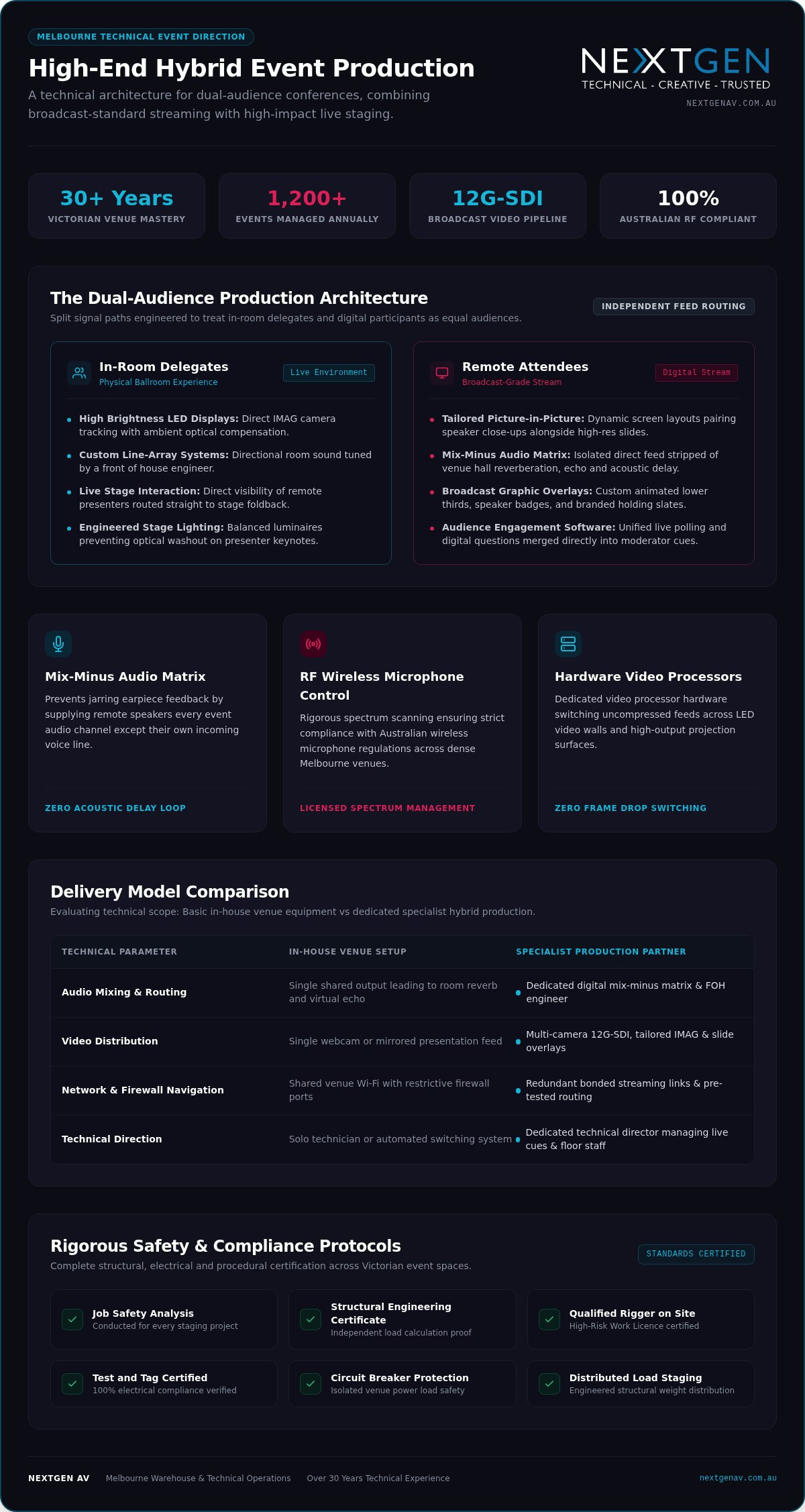
A dual-audience format demands two distinct production paths run in perfect alignment. Inside the physical venue, delegates absorb content through custom stage set design, high-output staging lights, and sharp visual displays. Rather than pushing an identical feed everywhere, a dedicated video processor maps dedicated IMAG (image magnification) footage to the in-room led video wall while sending an entirely custom view to virtual screens.
- Low-Latency Feeds: Eliminates conversational delays so virtual panellists interact naturally with the physical stage.
- Unified Engagement: Integrates audience engagement software so physical hands and digital questions feed into the same live Q&A cue.
- Dual Display Routing: Shows remote viewers the speaker alongside high-res slides, while in-room screens highlight full-stage visuals.
Beyond Simple Live Streaming: The Broadcast Standard
Broadcast standards elevate a corporate gathering into an executive-grade media production. Instead of flimsy consumer cabling, technical teams run high-bandwidth 12G-SDI video infrastructure to handle uncompressed, multi-camera switching without frame loss. Our Melbourne warehouse supplies complete production suites, pairing vision switchers with broadcast PTZ and studio cameras to capture close-up speaker nuance and sweeping room wide-angles.
This television-calibre approach extends to graphic overlays, custom lower thirds, and animated holding slates that reinforce your visual identity. Crucially, it splits the program outputs: one clean mix drives physical venue projection, while a tailored broadcast feed with baked-in presentation graphics feeds your remote distribution engine. By deploying specialised hybrid event production services melbourne corporate leaders ensure their executive message retains prestige, regardless of how participants dial in.
Acoustic and Visual Engineering: Solving the Hybrid Challenge
Nothing shatters executive credibility faster than a piercing feedback loop or a washed-out video feed. Engineering a dual-format space requires simultaneous acoustic and optical balancing. In-person rooms require rich, directional sound systems, while the digital stream demands an isolated feed stripped of cavernous hall reverberation. As detailed in our guide to audio visual hire melbourne venue acoustics, isolating physical room reflections ensures crisp vocal clarity before audio ever reaches an online encoder.
Mix-Minus Audio and Frequency Management
Remote presenters cannot speak naturally if their own voices echo back through their earpieces a second later. To solve this, a dedicated front of house engineer builds a mix-minus matrix on the digital console. This routing sends remote contributors every audio source, including live stage mics and video playback, minus their own incoming signal.
Microphone frequency management demands equal precision. In Melbourne’s crowded RF environment, wireless microphone systems must be mapped to avoid interference and comply strictly with current Australian wireless microphone regulations. Engineers avoid obsolete bands, actively scanning locally clear spectrum within licensed ranges so keynotes never drop out mid-sentence.
Studio-Grade Lighting and Stage Alignment
Standard venue lighting that looks acceptable to the naked eye often renders poorly on camera sensors. Hybrid staging demands studio-calibrated key, fill, and backlighting balanced precisely to camera sensors, generally between 4000K and 5600K colour temperatures. This clean three-point illumination separates presenters from stage backdrops without washing out their facial features on screen.
Visual balance also requires careful alignment between cameras and stage surfaces. When high brightness LED displays form the backdrop, video directors tune camera shutter angles and tile refresh rates to eliminate flickering and moiré patterns. Coordinating these technical details behind the scenes ensures both audiences enjoy pristine clarity. Engaging professional hybrid event production services melbourne teams trust provides the specialist engineering needed to preserve your brand reputation across every screen.
Comparing Technical Delivery Models: In-House Venue AV vs Specialist Production
Relying on in-house venue audiovisual packages often seems convenient, but dual-format events demand an independent production backbone. Generic hotel setups are typically engineered for background dining music and basic slide decks, not synchronized multi-channel streaming. Sourcing dedicated hybrid event production services melbourne specialists provide ensures your broadcast runs on purpose-built infrastructure designed to eliminate technical failure.
| Technical Factor | In-House Venue AV | Specialist Hybrid Production |
|---|---|---|
| Acoustic Delivery | Static ceiling speakers prone to room echo | Custom-engineered line arrays tuned for vocal punch |
| Network Pipeline | Shared venue bandwidth subject to throttling | Bonded cellular and hardwired failover connections |
| Technical Staffing | Duty technicians divided across multiple rooms | Dedicated crew executing rehearsed, bespoke cue sheets |
Bandwidth Architecture and Failover Security
Sharing a venue Wi-Fi network with hundreds of attendees invites immediate broadcast failure. When delegates connect their phones, public bandwidth quickly buckles. Professional production teams bypass public venue networks entirely by deploying bonded primary and secondary internet links. Hardware encoders feature automatic hot-failover switching, instantly redirecting the stream if an upstream line falters. Engineers also coordinate directly with enterprise IT departments well before show day, configuring firewall traversals that prevent unexpected network lockouts.
Equipment Ownership, Calibration, and Crew Mastery
In-house hotel gear frequently sits neglected in storage cupboards between functions, rarely receiving the calibration needed for digital broadcasts. Deploying equipment directly from our dedicated Melbourne warehouse guarantees that every audio console, processor, and lighting fixture is thoroughly checked under strict Test and Tag protocols before arrival.
Crucially, an independent team focuses exclusively on your event rather than dividing attention among different venue halls. As detailed in our guide to full service event production, rehearsed cue sheets and dedicated technical direction guarantee that vision, audio, and stage lighting transition in lockstep, giving stakeholders total confidence from opening address to final wrap.
Five-Stage Blueprint for Flawless Melbourne Hybrid Execution
Executing a high-stakes dual-audience event requires a disciplined sequence of technical milestones. Rather than hoping elements align on the morning of your conference, elite event producers follow a rigorous five-stage operational framework:
- Infrastructure Audit: Inspecting venue power distributions, network capability, and ceiling load points across Melbourne venues.
- Digital Architecture: Customising audience engagement software, lower-third overlays, and broadcast graphic packages.
- Dry Runs and Latency Checks: Testing remote presenter dial-ins, cue automation, and matrix audio feeds under simulated show conditions.
- Live Technical Direction: Calling live vision cuts, managing presenter timing, and orchestrating floor audio in real time.
- Master Archiving: Capturing isolated camera feeds alongside master program records for on-demand compliance and distribution.
Pre-Production Audits and Virtual Architecture
Every venue across Melbourne, from historic heritage halls to contemporary CBD convention spaces, presents unique infrastructure quirks. During phase one, engineers verify dedicated upload speeds, test for enterprise firewall interference, and confirm electrical circuit breaker allocations. Stage structures and overhead trusses also require a formal Job Safety Analysis and structural engineering certificate before any hardware is flown overhead.
Phase two moves into the control architecture. Technicians configure high-throughput video processor units to scale mixed aspect ratios cleanly without introducing visual latency or screen tearing. Simultaneously, audience engagement software is calibrated so in-room delegates on mobile devices and virtual attendees on desktops participate in identical live polls and moderated Q&A sessions without delay.
Show Day Execution and Rehearsal Protocols
Show day succeeds because the work happens before doors open. Rehearsal protocols begin with dedicated remote presenter checks at least thirty minutes prior to live transmission, ensuring their home audio, lighting, and framing meet executive standards. On stage, presenters step through cue-to-cue walkthroughs, learning their camera marks and stage monitor positions.
Throughout the live broadcast, technical directors continuously observe encoder bitrates, stream stability, and peak audio signals across dual outputs. To bring this structured discipline to your next corporate summit, book hybrid event production services melbourne specialists who engineer reliability into every single phase.
Partner with NextGen AV for Melbourne Hybrid Production
Executing an elite corporate broadcast leaves no room for improvisation. With over 30 years of technical mastery across Victorian venues, NextGen AV eliminates the acute anxiety of live event delivery. We manage more than 1,200 events annually, bringing proven familiarity to complex spaces such as the Melbourne Convention and Exhibition Centre (MCEC), Crown Palladium, and premium CBD hotel ballrooms. Our veteran crew understands the distinct power layouts, access corridors, and acoustic challenges of these landmark locations, ensuring rapid load-ins and zero technical surprises.
When you secure the premier hybrid event production services melbourne planners trust, you gain a dedicated partner committed to engineering an unforgettable attendee experience. Discover how our dedicated hybrid event staging solutions unite creative stage design with broadcast-grade distribution to elevate your executive brand.
Rigorous Safety and Technical Compliance
Production excellence starts with uncompromised compliance. Every staging build, ground-supported LED structure, and flown lighting truss is engineered to rigorous Australian standards:
- Safe Work Documentation: We draft site-specific Job Safety Analysis documentation to protect crew, venue staff, and delegates.
- Engineered Structures: Flown rigs and complex stages carry a validated structural engineering certificate to ensure structural integrity.
- Licensed Crews: Overhead rigging and heavy-lift logistics are handled by personnel holding a valid High-Risk Work Licence and qualified rigger credentials.
- Electrical Governance: Every single cable, power distro, and luminaire passes regular electrical Test and Tag verification before leaving our facility.
End-to-End Technical Orchestration
Operating directly out of our local Melbourne warehouse gives us an extraordinary operational advantage. We store, test, and calibrate every piece of equipment internally, including high-output LED panels, broadcast optical chains, and digital mixing consoles. This extensive local footprint means spare components and supplementary hardware are always available for immediate deployment.
Beyond our physical hardware, our strength lies in dedicated technical direction. A senior technical director collaborates with your team from initial concept through to final wrap, creating detailed run sheets and guiding presenters on stage. Backed by seasoned hybrid event production services melbourne corporate teams count on, you can step away from the mixing desk and take centre stage with absolute confidence.
Elevate Your Next Corporate Broadcast
Flawless dual-audience conferences come down to disciplined engineering rather than good fortune. When you resolve technical friction through dedicated mix-minus routing, bonded network failovers, and synchronised digital engagement, remote viewers feel just as valued as the audience in the room. Your presenters speak with ease, your stream stays locked, and your executive message commands the respect it deserves.
Choosing the specialised hybrid event production services melbourne organisations trust means trading live production panic for absolute confidence. Backed by over 30 years of technical mastery across Victoria and managing 1,200+ live productions annually, NextGen AV provides the proven capability your event demands. Our Melbourne warehouse supplies broadcast-grade audio, video, and LED displays, while our veteran directors orchestrate every cue behind the scenes. Partner with Melbourne’s hybrid production specialists at NextGen AV to create a seamless live broadcast that exceeds executive standards.
Frequently Asked Questions
What is the difference between a live stream and a hybrid event?
A live stream is a one-way passive broadcast, whereas a hybrid event creates active, two-way participation between in-room and remote audiences. Live streaming simply shares video footage of a stage. Professional hybrid event production services melbourne organisations rely on connect both groups through synchronised audience engagement software, bidirectional audio matrixing, and tailored dual visual feeds. This setup ensures remote attendees speak, vote, and interact rather than just watching from the sidelines.
How do you prevent audio echo between remote speakers and the live room?
Audio echo is eliminated by configuring a dedicated mix-minus bus on the digital audio console. A front of house engineer routes every stage microphone, media playback channel, and floor sound to the remote contributor, deliberately excluding their own incoming voice. Combining this matrix routing with acoustic room tuning prevents audio loops, delay feedback, and latency traps, allowing conversations between the stage and remote participants to flow naturally.
What internet bandwidth is required at a Melbourne venue for hybrid broadcasting?
A stable corporate broadcast requires a dedicated, symmetrical upload speed of at least 20 to 30 Mbps reserved exclusively for the streaming encoders. Sharing bandwidth with hotel guests or conference attendees causes immediate stream stutter and frame loss. Melbourne technical teams ensure reliability by deploying cellular bonding appliances alongside hardwired Ethernet lines, guaranteeing unthrottled throughput regardless of how many personal devices connect to the local public Wi-Fi.
Can remote attendees interact in real time with the in-person audience?
Yes, real-time interactivity works seamlessly when digital tools are integrated directly into the stage production environment. By deploying unified audience engagement software, both physical delegates and remote viewers participate simultaneously in live polling, moderated Q&A sessions, and quizzes. Remote questions appear on presenter comfort monitors on stage, while live floor reactions and applause are mixed back into the broadcast feed for complete audience integration.
What happens if the venue internet connection drops during the live broadcast?
The broadcast continues uninterrupted if your production infrastructure includes automated hardware hot-failover switching. Production teams deploy redundant secondary pathways, combining hardwired venue lines with bonded 4G and 5G cellular networks. If the primary internet pipe drops or experiences packet loss, the streaming encoder shifts data packets instantly to the backup connection. Viewers at home experience zero signal dropouts or stream resets while technicians resolve the local venue fault.
Why is an external production specialist better than using hotel in-house AV?
External production specialists provide dedicated focus, custom-engineered sound systems, and tested equipment rather than generic, multi-room hotel gear. Booking dedicated hybrid event production services melbourne specialists brings seasoned technical directors who rehearse your specific run sheet from start to finish. In-house venue teams often manage several rooms simultaneously using aging equipment, whereas external specialists dispatch calibrated gear directly from a local warehouse to ensure flawless brand execution.
How early should technical pre-production begin for a corporate hybrid conference?
Technical pre-production should begin at least eight to twelve weeks prior to your event date. Starting early provides adequate time to perform on-site Melbourne venue inspections, complete structural engineering certificates, run network speed audits, and program custom digital graphics. Early collaboration also allows your technical director to design failover protocols, review presentation decks, and schedule dry runs with remote keynote speakers well before show day.
Knowing how to improve audience engagement with AV means deploying purpose-built visual and acoustic technology, such as IP65-rated LED screens outputting over 5,000 nits for outdoor visibility. Professional AV production uses engineered signal routing and calibrated sound reinforcement to keep attendee focus steady through complex corporate events. You secure crystal-clear execution by partnering with technical specialists who manage detail behind the scenes.
Key Takeaways: Improve audience engagement with AV by deploying high-brightness 5,000-nit LED screens and calibrated line array audio to eliminate visual fatigue and acoustic dead zones.
- Deploy 5,000-nit IP65-rated LED screens for outdoor events to maintain visibility against harsh sunlight.
- Use high-end projection mapping in a ballroom plenary to provide immersive acoustic coverage.
- Use a dedicated video processor for complex corporate events to eliminate focus-breaking visual input lag.
- The article confirms that venue-native gear often lacks the processing power for custom aspect ratios.
Matching AV Tech to Your Event Scope
Your venue size and light conditions decide which hardware will hold attention, so match the kit before you lock the run sheet. In a boardroom workshop, high brightness LED displays keep punchy contrast under ambient light. In a ballroom plenary, projection mapping and PA audio systems give immersive acoustic coverage. For an outdoor activation, modular LED display walls protect weather-resilient visibility. Aligning visual hardware with your venue footprint raises participant interaction because the picture stays readable and the sound stays even.
The Customer Engagement Wikipedia entry (2025) notes that cognitive and emotional participation connects directly to tailored consumer experiences. Selecting proportionate hardware prevents visual fatigue and preserves focus.
| Event Environment | Essential Hardware | Primary Objective |
|---|---|---|
| Boardroom & Workshop | High brightness LED displays | Crisp clarity in daylight |
| Ballroom & Plenary | Projection mapping & PA audio systems | Immersive acoustic coverage |
| Outdoor Activation | Modular LED display walls | Weather-resilient visibility |
For experiential activations, partnering with experienced Brand Agencies turns complex technical designs into impactful consumer touchpoints. Behind the scenes, NextGen AV handles these complicated environments so your presentation runs cleanly.
Choosing dynamic visual displays over static backdrops works best for live product launches, because static signage limits audience attention. A tailored system setup fits the room the way a custom suit fits the wearer: precision tailoring supports clearer sightlines and stronger message recall. Your technical setup stays protected with qualified riggers and Job Safety Analysis procedures, so the room stays in capable hands.
What is Audience Engagement?
Audience engagement is a measurable cognitive and sensory connection between your attendees and the presentation. Basic setups rely on simple visual output, whereas professional conference AV production activates multiple senses to keep participants focused.
True immersion happens when technology operates without distraction. Crisp audio delivery via PA audio systems ensures every word reaches the back row clearly. Vibrant visuals from high brightness LED displays hold viewer attention under intense lighting. When you work with NextGen to integrate audience engagement software, passive listeners transform into active participants. More on this: AV Hire Melbourne.
Visual impact needs precision. Advanced visual processing via a video processor scales content, switches inputs, and maps signals to modular panels. That prevents input lag or washed-out graphics that break concentration. Professional stage rental creates clear sightlines, elevating key speakers physically and visually above the floor.
High-end production delivers pristine sound distribution and vivid imagery that commands respect, rather than relying on simple consumer hardware. If you think basic equipment saves money, weigh the hidden cost of a disengaged room: meticulous technical execution holds participant focus from open to close.
Why is Audience Engagement Important?
Engaged attendees retain key messages and stay connected to your event content. High audience focus drives stronger outcomes for corporate activations, product launches, and industry conferences.
When delegates lose concentration, your message slips away. Bright indoor ambient light or harsh outdoor sunlight washes out standard visual displays and causes rapid eye fatigue. Selecting high brightness LED displays keeps visual content crisp, vibrant, and fully visible in high-ambient environments, so delegates stay with the presentation for longer.
Picking improper visual equipment causes attendees to strain their eyes and drop focus within minutes. Engineered visual hardware pulls delegate attention back to the content you need them to see.
To deliver precise visual displays for Melbourne events, NextGen AV handles technical complexity from behind the scenes. Careful event production planning ensures your equipment setup matches your specific venue environment without unnecessary overhead, so execution stays reliable and impact stays high.
Tip: Always spec high brightness LED displays capable of 5,000 nits for daytime outdoor activations to prevent visual fatigue.
5 Technical Steps on How to Improve Audience Engagement with AV
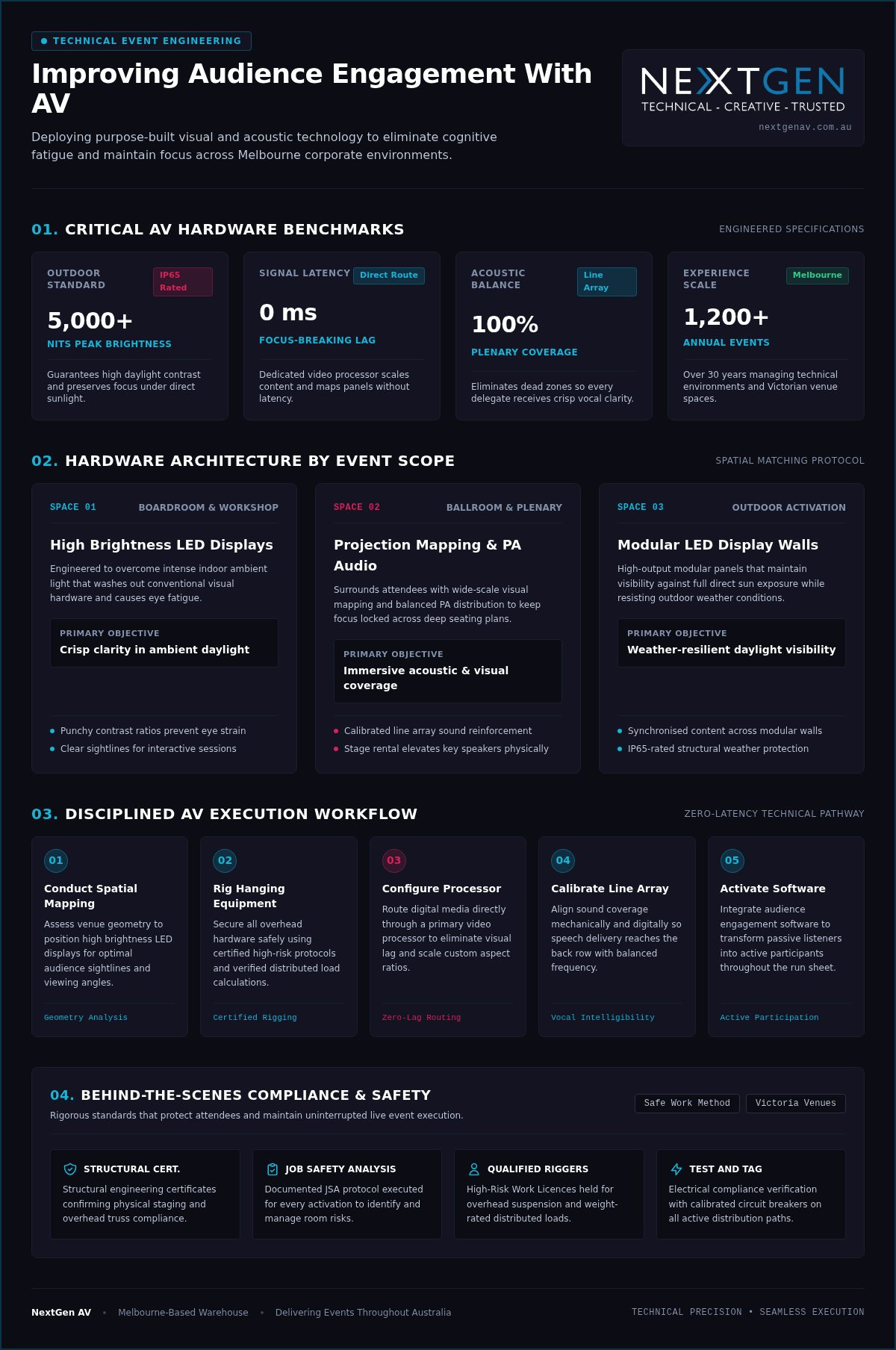
Precise signal routing and disciplined hardware workflows stop technical glitches from breaking focus. Visual delay erodes audience trust fast, so a zero-latency AV backbone matters for sustained participation. Each dynamic visual element needs deliberate technical direction.
- Conduct spatial mapping
Assess the venue geometry to position high brightness LED displays for optimal viewing angles. - Rig hanging equipment
Secure all overhead hardware safely using certified high-risk protocols for structural event rigging. - Configure the video processor
Route all digital media inputs directly through primary control hardware to eliminate visual lag. - Calibrate line array technology
Align speaker setup elements across the room to maintain clear acoustic coverage. - Manage wireless transmission
Scan the local frequency spectrum to lock in clear channels under strict Australian wireless microphone regulations.
This preparation puts your message in front of each attendee with clear picture and sound. Expert Melbourne event production services handle these complex signal paths behind the scenes, turning venue infrastructure into one active communication hub. The NextGen AV crew manages each technical variable so your presentation keeps focus, and precision dynamic control helps the room feel immersed.
Measuring ROI on Interactive Event Tech
Live participation metrics show whether interactive technology is earning its place on the budget line.
You measure success by analysing post-session response rates, duration of attendee focus, and direct digital inquiries. Evaluating those figures turns raw interaction into actionable business intelligence. Basic audience engagement software gives a quick pulse reading; detailed data collection builds a fuller digital profile of how the room responded.
When you track response rates alongside audience feedback, you see which topics resonated with your delegates. High-performance visual displays keep crowds on key messages longer, and high brightness LED displays help turn passive viewing into active participation.
Pair real-time polling platforms with high-definition conference LED screens when you want sharper impact. Audience engagement software suits interactive keynotes; high brightness LED displays fit large exhibition spaces that need wide visual reach. For events requiring bespoke digital platforms or tailored attendee applications beyond off-the-shelf tools, custom software developers like 4mation build purpose-fit solutions that feed real-time participant interaction directly into your visual displays.
After more than 30 years of technical work across 1,200+ events a year, the pattern is consistent: when the full technical setup is engineered behind the scenes, data capture runs clean and the brand moment lands. NextGen AV helps you capture meaningful analytics while the room still feels memorable. Ask for a personalised quote so we can shape a strategy tied to measurable returns.
When In-House AV Equipment Falls Short
In-house venue gear often fails during complex presentations because basic hardware cannot manage custom visual displays or heavy signal routing. Built-in sound systems (line array technology) might cover background speeches, yet they lack the processing power required for clear, dynamic presentation audio across large spaces.
Venue-native gear frequently lacks dedicated hardware processing to run custom aspect ratios without distorting your visual content. Relying on standard kit is like using a push mower on a golf course: standard monitors lack high brightness LED displays that punch through ambient light, domestic switchers lack a dedicated video processor to map multiple feeds without dropping signals, and standard wireless microphone setups struggle without active frequency coordination to prevent dropped audio.
When your event demands faultless execution, venue-native setups create immediate failure points. Dedicated technical direction keeps each signal path solid. NextGen AV builds custom production architecture around your room layout so technical execution stays sharp, reliable, and low-stress.
Frequently asked questions
What is audience engagement?
Audience engagement is the active mental, physical, or emotional participation of attendees during your event. You raise that participation through live polling, dynamic visual displays, and responsive audio systems. NextGen AV engineers immersive rooms across Melbourne by integrating high brightness LED displays with interactive conference technology.
Why is audience engagement important?
Strong engagement helps your message stick and supports a clearer return on the event spend. Focused attendees interact more deeply with sponsors, join Q&A sessions, and form firmer brand connections. Secure event rigging (hanging equipment) and precise audio coverage hold attention without technical noise in the way.
What are examples of audience engagement?
Examples include live audience Q&A sessions, real-time polling software, interactive workshops, and dynamic visual presentations. You can also use projecting on buildings (projection mapping) to turn architectural surfaces into captivating visual displays. Tailored venue engineering and sound systems make those formats practical on show day.
How can I improve audience engagement?
Combine responsive audience software with clear visual and audio production. Deploying line array technology (speaker setup) means each delegate hears each word across the venue. Professional technical direction holds those elements steady behind the scenes.
Which AV choices lift engagement at corporate events?
Match hardware to the room: high brightness LED displays for ambient light, a video processor for clean switching and mapping, and calibrated PA or line array coverage so speech stays intelligible. Add audience engagement software when you want live polling and measurable response data tied to the content on screen.
Streamline Your Next Production
How to improve audience engagement with AV still comes down to precise technical execution and qualified direction. Dynamic visuals, crisp acoustic performance, and strategic content flow keep attendees connected across the agenda. In 2026, corporate planners need reliable systems that run without technical friction. The NextGen AV team manages complex signal paths behind the scenes so display systems and stage lighting operate with absolute precision. High-impact production rests on meticulous preparation, accurate sound distribution, and high-contrast visuals cut to your venue layout.
Ready to reshape the room experience? You can plan your event production with NextGen today and review technical requirements with the production specialists.
Choosing a melbourne exhibition av supplier for 2026 starts with structural engineering certificate requirements, circuit breaker allocations, Job Safety Analysis compliance, and qualified rigger hours. Exhibition audio visual (technical production) hiring costs in Melbourne shift with those constraints, and NextGen AV does not publish fixed packages because every event layout (set design) requires custom scoping. Get in touch with our specialists to obtain a precise, tailored quote for your exhibition space.
Key Takeaways: Successful Melbourne exhibition AV requires custom technical scoping that integrates structural engineering certificates, high-brightness displays for hall lighting, and managed venue power distribution.
- NextGen AV manages over 1,200 annual events using 30 years of local venue experience.
- Except when using basic room setups, avoid dry hiring to prevent signal interference risks.
- Therefore, choose full production support for complex stands to lock in fixed venue fees.
- The five-step process uses 3D renders to map signal flows before any equipment arrives.
How a melbourne exhibition av supplier fits AV to your stand
Your exhibition stand needs a tailored audio visual system based on floor space and available venue power. Spatial limits dictate display choices: select screen sizes that match your footprint so you avoid overcrowding and keep clear sightlines when visitors stop to talk.
Before you lock a layout, match the stand you actually have to a concrete build path:
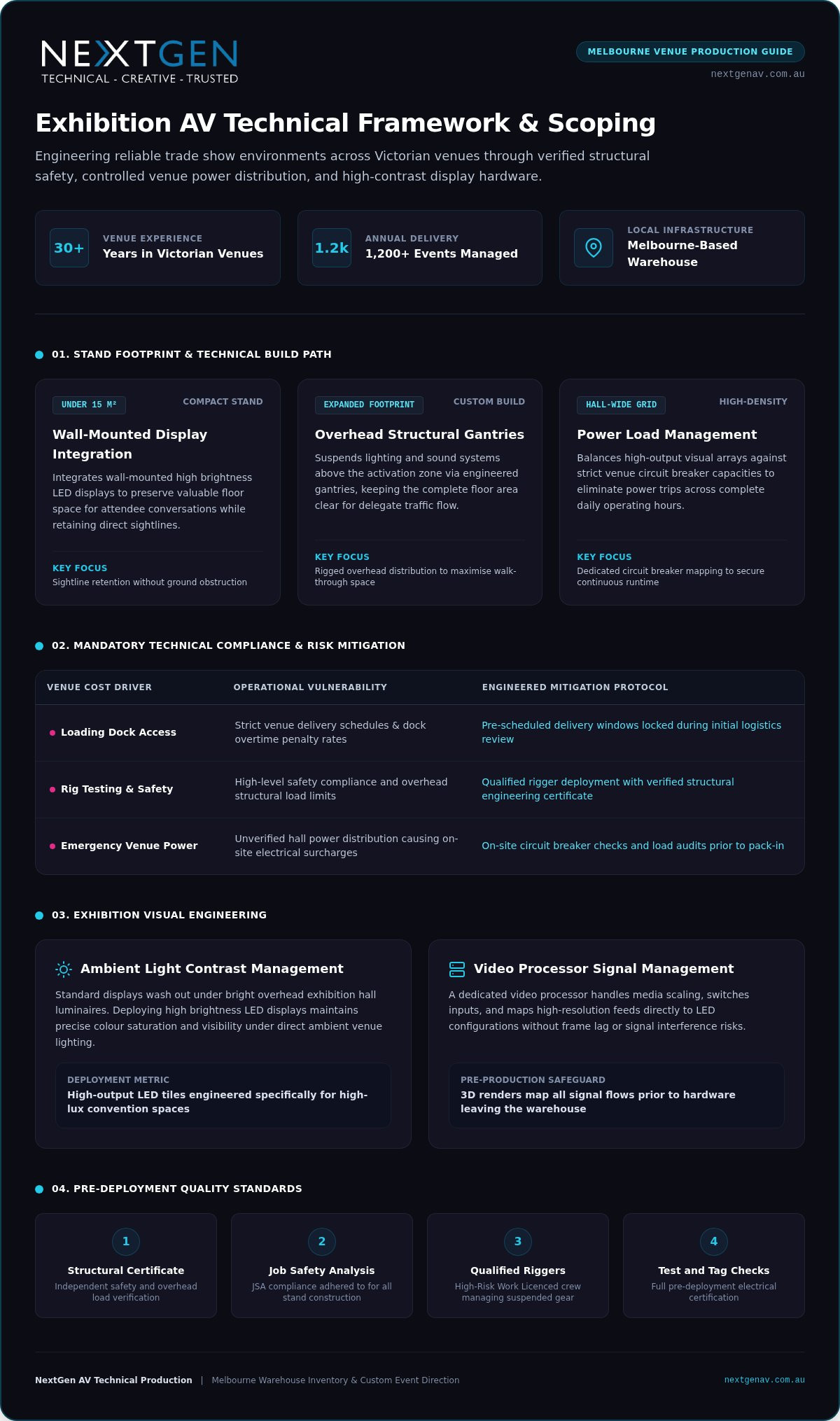
- Compact stands under 15 square metres: wall-mounted high brightness LED displays free floor space for product and conversation while holding sightlines.
- Larger custom builds: structural overhead gantries suspend lighting and sound systems clear of the display area so the floor stays open for traffic.
- High-density halls: balance visual impact against strict circuit breaker capacities so the stand runs the full open hours without trips.
Every venue applies specific structural load rules for suspended equipment. Planning your event layout around precise power distribution keeps the stand reliable from open to close. For steady execution on site, partner with an established Melbourne AV team that understands local venue guidelines. NextGen AV handles technical detail in the background so you can take centre stage with the brand story.
Tip: Always calculate total structural load limits before committing to custom overhead gantries.
Hidden freight and labour fees you can lock in before load-in
Calculating the total cost of technical production (audio visual) hire means auditing hidden venue expenses alongside base rental rates. Loading dock access fees, rig testing, and specialised freight charges left out of initial quotes push the outlay up fast during execution. Fixed transparent quotes prevent budget overruns when those venue charges appear late.
During initial logistics planning, we review technical venue requirements to flag hidden expenses early. Negotiating dock windows and labour hours avoids penalty rates. For complex setups, choosing full event production support places compliance requirements under one fixed agreement.
Understanding these expense drivers protects your budget:
| Fee Category | Cost Driver | Risk Mitigation |
|---|---|---|
| Dock Access | Strict venue loading schedules | Scheduled delivery windows |
| Rig Testing | High-level safety compliance | Qualified rigger certification |
| Emergency Power | Unverified power distribution | On-site circuit breaker checks |
Overlooking venue compliance leads to last-minute surcharges. Detailed preparation keeps production moving, and our crew oversees intricate operational details offstage so your equipment rental services (hire melbourne) stay on plan from dock to pack-down.
Tip: Verify if your venue requires a dedicated circuit breaker to avoid on-site emergency power surcharges.
Exhibition AV gear that stays readable under hall lighting
You can hire complete technical production solutions including custom visual displays, precision audio, intelligent lighting, and hybrid streaming systems designed for trade show environments.
From our Melbourne warehouse, we deliver tier-one inventory from verified global manufacturers so hardware reliability holds on the show floor. Our team keeps equipment specifications transparent for every project, whether you need sound systems, interactive displays, or specialised staging.
This level of hardware reliability is essential for industries that rely on immersive digital content, such as interactive entertainment; for instance, you can learn more about Ocean Media and their long-standing expertise in console game publishing.
Ambient venue lighting directly affects screen contrast ratios during daytime trade shows. Standard displays often wash out under bright overhead hall lights, which is easy to miss until you stand on your own floor at open. To keep content vivid for visitors in that light, we deploy high brightness LED displays that hold visual performance regardless of venue illumination. For high-impact visual structures, LED wall hire options give you clear, dynamic presentation surfaces scoped to the brief rather than a fixed catalogue label. More on this: LED Wall Hire.
We engineer set design layouts alongside advanced control infrastructure. A video processor (a signal management unit) maps your high-resolution media across complex display configurations without frame lag. Large venue activations can go further into full spatial change: turning an expansive exhibition hall into an intimate room for a major Melbourne gala, our crew ran an elaborate setup with more than 100 moving heads and custom gobo projections, so the lighting field matched the gala brief rather than the empty hall volume.
We manage structural engineering certificate requirements, qualified rigger deployment, and Test and Tag compliance. Equipment rental services gear undergoes pre-deployment checks before site execution. Ask our technical team for a personalised quote on your upcoming Melbourne exhibition.
How the five-step hiring process protects show day
Securing technical production for your exhibition follows a systematic timeline that turns initial space designs into on-site delivery. Drawing from over 30 years of experience in Melbourne event production, our team manages operational detail so you are not left chasing permits alone. Thorough planning means stage rental or display installation can proceed without surprise delays on the dock clock.
- Spatial Design and 3D renders: We translate your initial set design (event layout) into accurate three-dimensional models to map signal flows and site logistics early.
- Technical Engineering and Safety Permits: Our team secures every structural engineering certificate required for suspended rigs, verifying weight capacities before any hardware leaves the warehouse.
- Pre-Production Testing and System Staging: Equipment undergoes rigorous checks in our local facility, where technicians pre-configure system control paths.
- Dock Load-In and Spatial Build: Crews execute dock delivery, assemble custom display walls, and manage cabling within tight venue time slots.
- On-Site System Tuning: Technicians balance sound systems and calibrate displays before public entry.
Venue schedules reward preparation measured in hours, not last-minute fixes.
Outdoor arc: when you need rapid deployment outside a hall shell, a mobile trailer stage simplifies site setup by combining structural transport and staging in one unit. Qualified specialists oversee rigging and electrical distribution for venue compliance. You receive end-to-end management from conceptual layout to final breakdown, with professional equipment rental services supporting a steady presentation path.
When dry hiring basic equipment puts your brand at risk
Complex exhibition spaces need dedicated on-site technical direction to manage structural safety, signal distribution and strict venue schedules. Dry hiring audio visual gear leaves your team responsible for rigging compliance, frequency management and multi-screen content syncing. During high-stakes trade shows, unmanaged technical issues damage brand reputation while guests are already on the carpet.
Practitioners frequently observe that unmanaged signal interference from neighbouring stands disrupts unmonitored wireless microphone setups. Securing a structural engineering certificate and managing a High-Risk Work Licence requires specialised expertise your floor team may not hold on show week.
Simple equipment rental services work for basic room setups. Large multi-zone displays need an experienced front of house engineer using a dedicated video processor. Managing distributed load limits across overhead trusses demands professional oversight rather than ad-hoc crew guesses.
Across more than 1,200 events annually in Australia, specialists maintain full high-risk work licences so stage rental and lighting rigs go in under controlled compliance. With over 30 years on the Melbourne circuit, the work has moved from equipment supply alone to craft partnership on ambitious city events. Behind the curtain, NextGen AV controls complicated arrangements so your event layout runs as planned and you keep quiet power over the brand moment.
Frequently asked questions
What AV services does NextGen AV provide?
NextGen AV delivers full technical production management, covering sound systems, stage rental, and custom set design for major live functions. Lighting and control infrastructure scale to the room you book, including multi-fixture moving-head rigs when the brief calls for them.
How does the hiring process work?
You begin by sharing your event vision, technical riders, and venue details so our specialists can design an engineered production plan. Melbourne venue experience means safety protocol, structural engineering certificate, and delivery timeline sit with us while you focus on content and guests.
What equipment can be supplied for events?
We supply high brightness LED displays, PA audio systems, wireless microphone units, and festival-grade staging tailored to your venue requirements. Our team configures video processor units and custom lighting rigs for crisp projection mapping across your display surfaces.
How can I get a quote for my event?
You can request a tailored quote directly through our website by submitting your event date, location, and visual requirements. Final project costs depend on your chosen equipment rental services, rigging complexity, and technical staffing requirements.
What is included when you hire AV?
Your complete package includes initial system planning, equipment transport from our local warehouse, complete on-site installation, and active operational support. Front of house engineer experts manage your live audio mixes and video feeds throughout the occasion, with absolute precision on the technical path.
Securing Your Technical Event Direction
Your trade show still turns on the same decisions you met at the start: custom scope versus fixed packages, full compliance versus hidden dock and power fees, and dry hire versus on-site technical direction. With three decades of local technical direction in Victorian venues, the NextGen AV team manages complex audio visual logistics behind the scenes as your Confident Orchestrator and Invisible Expert on the floor plan. We review your venue-specific layout and compliance requirements early in planning.
Specialists who support more than 1,200 events annually across Australia maintain full high-risk work licences to secure stage rental and lighting rigs safely. You remain in control of your brand story while execution stays off your shoulders. Reach the team via AV solutions for a venue-specific set design quote on your 2026 trade show.
