


What if the most powerful speaker in your inventory is actually the reason your audience misses the message? It’s a common misconception that volume equals clarity, but in the high-stakes world of live production, raw power often creates more problems than it solves. We understand the pressure of ensuring every syllable of a keynote speech reaches the back of the room without the interference of a technical glitch. If you’ve ever felt overwhelmed by technical jargon like SPL or RMS, you aren’t alone. Mastering how to choose a pa system for an event is about matching sophisticated technology to the unique acoustics of your Australian venue.
This guide provides a professional roadmap to selecting the perfect audio setup for any audience size. You’ll learn how to comply with the latest ACMA frequency regulations for wireless microphones and why modern column systems are replacing traditional stacks. We’ll explore the transition from passive gear to AI-enhanced, active solutions that simplify your setup while elevating the guest experience. By the end, you’ll have the confidence to partner with technical experts who transform audio from a logistical headache into a seamless, invisible engine of success.
Key Takeaways
- Learn why acoustic clarity outweighs raw wattage and how to prioritise sonic precision to create a professional atmosphere.
- Discover how to choose a pa system for an event by accounting for audience density and the unique architectural challenges of your venue.
- Evaluate the benefits of active versus passive hardware to select a system that balances rapid deployment with elite technical control.
- Master the selection of microphones and digital mixing tools to ensure every keynote speaker is heard with absolute transparency and zero feedback.
- Recognise why managed technical direction and professional sound checks are essential for a stress-free, high-stakes production.
Beyond the Wattage: Understanding Your Event’s Sonic Requirements
A professional audio setup is far more than just a pair of speakers on stands. It’s an intricate, integrated chain of components designed to capture, process, and broadcast sound with absolute fidelity. To understand What is a Public Address (PA) System?, you must view it as a singular organism. From the microphone diaphragm to the speaker cone, every link in that chain must be meticulously calibrated. When people ask how to choose a pa system for an event, they often start by looking at the wattage. This is a mistake.
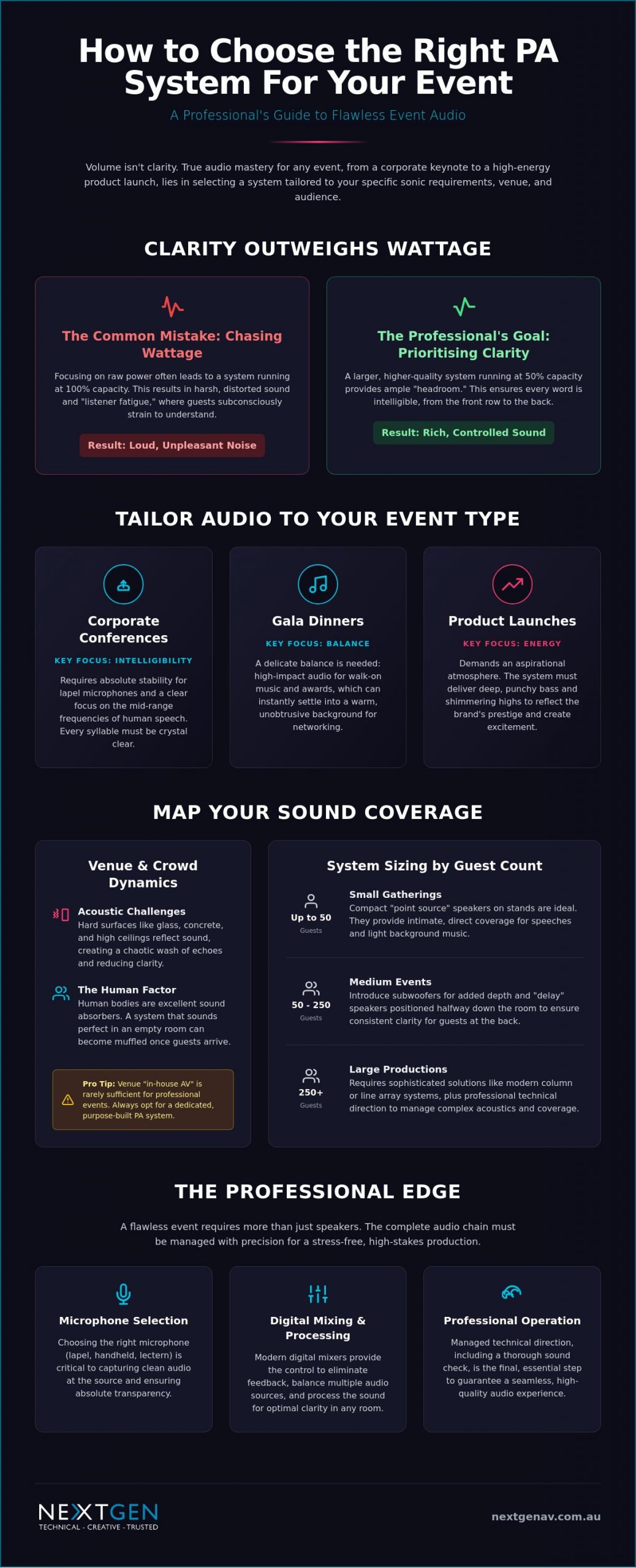
Raw wattage is a measurement of power consumption, not necessarily audio quality or effective coverage. A high-wattage system with poor-quality drivers will simply produce louder, more distorted noise. True mastery lies in “headroom.” This is the buffer between your normal operating volume and the point where the system begins to clip or distort. Running a small, under-powered system at 100% capacity is a recipe for technical disaster. It results in a thin, harsh sound that physically grates on your guests. A larger system running at 50% capacity provides a rich, effortless sonic texture that feels prestigious and controlled.
Intelligibility vs. Volume
Clarity is king. For corporate events, the primary goal is rarely volume; it’s intelligibility. If your CEO is delivering a high-stakes keynote, every syllable must be crystal clear to the person in the very last row. High-frequency dispersion patterns determine how sound travels through a room. Professional-grade drivers ensure that speech doesn’t become a muddy wash of echoes. High-quality components also reduce “listener fatigue,” which is the subconscious exhaustion guests feel when they have to strain to understand a speaker through poor-quality audio.
Defining Your Event Type
Your specific goals dictate your hardware requirements. Every event has a different sonic signature that requires a tailored approach:
- Corporate Conferences: These require absolute stability for lapel microphones and a focus on the mid-range frequencies where human speech lives.
- Gala Dinners: The challenge here is balance. You need high-impact audio for walk-on music and awards, but the system must settle instantly into a warm, unobtrusive bed of sound for table-side networking.
- Product Launches: These demand energy. You want a system capable of delivering deep, punchy bass and shimmering highs to create an aspirational atmosphere that reflects your brand’s prestige.
Determining your primary purpose is the first step in learning how to choose a pa system for an event that truly resonates with your audience.
Audience Size and Venue Dynamics: Mapping Your Sound Coverage
The physical environment is a silent participant in your event’s success. While the hardware matters, the room’s geometry and the density of the crowd dictate how that sound behaves. Large expanses of glass, polished concrete floors, and soaring warehouse ceilings are acoustic nightmares that reflect sound waves, creating a chaotic echo. Conversely, a room full of people acts as a massive, organic sponge. Human bodies are excellent sound absorbers. A system that sounds bright and clear during an empty afternoon sound check might feel muffled and distant once the room is at capacity. Understanding this transformation is central to how to choose a pa system for an event that remains consistent from the first guest to the final applause.
Many organisers fall into the “In-House AV” trap, assuming the venue’s built-in ceiling speakers are sufficient. These systems are typically designed for low-level background music or emergency paging; they lack the frequency response and directional control required for high-stakes presentations. Bypassing these outdated rigs in favour of a dedicated setup ensures your message isn’t lost in a muddy overhead wash. For a deeper look at venue integration, see our Professional Sound System Hire guide.
Sizing Your System by Guest Count
Scale determines your strategy. For small gatherings of up to 50 guests, compact “point source” speakers on stands provide intimate, direct coverage. Once you move into medium events of 50 to 250 people, you must introduce subwoofers to add depth and “delay” speakers positioned halfway down the room. These secondary speakers ensure guests at the back receive the same clarity as those in the front row without needing to blast the volume at the stage. For large-scale productions exceeding 250 guests, line arrays become essential. These vertical speaker columns are engineered to throw sound over long distances with minimal volume drop-off. You can find more technical details on choosing the right PA speakers for specific scales through industry-standard resources.
Coverage Patterns and Speaker Placement
Placement is a game of precision and sightlines. Your Front of House (FOH) setup must be powerful enough to fill the room while being positioned to avoid blocking views of your LED video walls. Organising your speakers to fire slightly inward and downward can help minimise reflections off hard side walls. This also helps in avoiding the dreaded feedback loop, which occurs when a microphone picks up its own signal from a speaker. By carefully mapping the room and using specialised “fills” to cover dead spots, you create a seamless sonic blanket. If you are unsure about your venue’s specific challenges, consulting with a team that provides professional audio solutions can help you navigate these technical hurdles before they become on-site problems. Mastering how to choose a pa system for an event requires this proactive approach to spatial planning.
Active vs. Passive Systems: Selecting the Right Hardware
Deciding on the core architecture of your audio rig is a pivotal moment in your event planning. The technical debate between Active vs. Passive Systems essentially boils down to where the amplification lives. Active speakers house their own amplifiers and cooling systems within the cabinet, creating an elegant, self-contained solution. Conversely, passive speakers are unpowered shells that rely on heavy-duty external amplifier racks. While active systems dominate the portable and DIY markets, passive rigs remain the gold standard for high-end technical direction where precision control and massive scale are paramount.
The “Subwoofer Debate” is often misunderstood in corporate circles. You might think a speech-only seminar doesn’t need a dedicated low-end speaker, but the opposite is true. A subwoofer handles the heavy lifting of the lower frequencies, allowing your main speakers to focus on crystal-clear vocal reproduction. This adds a sense of “weight” and authority to a keynote that point-source speakers alone cannot achieve. It makes the audio feel grounded and prestigious. Of course, adding more components increases the demand for power. You must verify that your Melbourne venue has the electrical capacity to support a full rig. A tripped circuit during a prestigious awards ceremony is a logistical failure that proper pre-production planning easily avoids.
When to Choose Active Speakers
Active speakers are the masters of the rapid setup. They are the go-to choice for breakout rooms, trade show booths, and quick-turnaround presentations where time is your scarcest resource. By reducing the physical footprint of the gear, you keep the focus on your branding rather than the technology. The integrated nature of these units means fewer points of failure and significantly less “cable clutter,” which is vital for aesthetically sensitive gala designs. A major benefit is the built-in protection. Internal limiters act as a safety net, automatically managing the signal to prevent “blown” speakers during loud segments or high-energy walk-on music.
The Power of Passive Line Arrays
When the scale of the event moves into the hundreds or thousands, the power of passive line arrays becomes undeniable. These systems offer incredible scalability. We can increase the number of “boxes” in a vertical hang to reach the furthest corners of a stadium with surgical precision. This architecture allows for centralised control. Our technical directors manage every nuance of the mix from a single amplifier rack at the rear of the venue. By utilising sophisticated Digital Signal Processing (DSP), we can “tune” the system to the unique architecture of the room. This involves adjusting timing and frequency responses to negate echo and ensure every guest receives the same elite experience. Understanding these hardware nuances is essential when learning how to choose a pa system for an event that demands absolute sonic perfection.
The Professional Edge: Microphones, Mixers, and Monitoring
The success of your audio strategy relies on the precision of your input devices. While the speakers deliver the final result, the microphones and mixers act as the brain and nervous system of the rig. In high-density areas like the Melbourne or Sydney CBD, wireless frequency management becomes a critical hurdle. The airwaves are saturated with signals from emergency services, mobile networks, and nearby venues. Failing to coordinate these frequencies leads to dropouts or embarrassing static; a risk no professional organiser should take. Mastering how to choose a pa system for an event means ensuring your audio partner uses high-tier wireless management tools to scan and lock in clean, legal channels in real-time.
Environmental factors also play a role in your technical selection. In Melbourne, where outdoor events must contend with “four seasons in one day,” your technical plan must account for wind noise on microphones and the protection of electronic components from sudden humidity shifts. By integrating these high-tier components into your plan, you move from merely renting gear to investing in a complete sonic experience. If you are ready to elevate your next production, our team specialises in designing bespoke professional audio systems that guarantee absolute clarity regardless of the venue’s challenges.
Microphone Selection for Success
The right microphone empowers your speaker and protects the mix. We typically categorise these based on the presenter’s style and the event’s format:
- The Handheld: This is the most versatile option. It is ideal for Q&A sessions and unpractised speakers who feel more comfortable holding a physical device. It provides excellent gain before feedback.
- The Lapel (Lavalier): The invisible choice for keynote speakers. While it allows for natural hand gestures, it requires careful gain management by a technician to prevent the microphone from picking up ambient room noise.
- The Headset: This is the gold standard for high-energy presenters. Because the microphone stays at a fixed distance from the mouth, it provides the most consistent audio levels and hands-free reliability.
The Role of the Digital Mixer
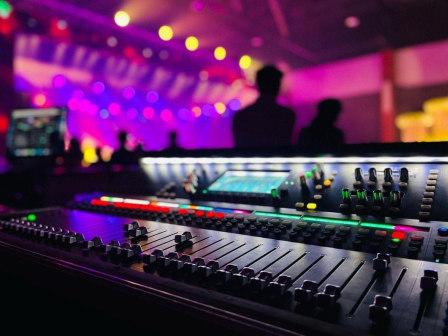
Modern event audio has been revolutionised by digital mixing consoles. These desks allow for “Scene Recall,” where a technician can instantly switch complex settings between a soft-spoken CEO and a high-impact video presentation. Perhaps the greatest game-changer for planners is remote mixing via a tablet. Instead of being tethered to a bulky desk in the corner, a technician can walk the room, hearing exactly what the guests hear and making real-time adjustments from an iPad. This ensures the mix is balanced for every seat, not just the technical booth. You can learn more about how these elements integrate into Full Service Event Production and how we manage these intricate details behind the scenes.
Finally, never overlook stage monitoring, often called “foldback.” If your presenters cannot hear themselves clearly, they will often shout or lose their natural rhythm. Providing dedicated monitors on stage ensures they feel confident and controlled, which directly translates to a more prestigious performance for your audience. Understanding how to choose a pa system for an event requires this holistic view of both what the audience hears and what the presenter needs to succeed.
Partnering for Success: Why Managed PA Hire Outperforms DIY
Selecting the correct hardware is only half the battle; the true mastery of event audio lies in the execution. Many organisers fall into the “Dry Hire” trap, believing they can pick up a few speakers in a ute and manage the setup themselves. This approach often leads to on-site chaos, cable tangles, and technical glitches that distract from your message. When you are deciding how to choose a pa system for an event, the most critical factor isn’t the brand of the speaker, but the expertise of the person behind the mixing desk. A managed solution transforms your audio from a logistical risk into a seamless, high-prestige experience.
Our approach at NextGen AV is built on 30 years of industry experience. We don’t just provide equipment; we offer a comprehensive technical partnership. This begins with pre-production planning, where we anticipate venue-specific issues like acoustic reflections or power limitations before they occur. For a tailored quote that covers everything from elite hardware to on-site engineering, explore our Audio Visual Hire Melbourne services.
Risk Mitigation and Redundancy
In a live environment, things can go wrong. A wireless microphone might encounter unexpected local interference, or a cable could be damaged during a hectic setup. A professional technical team builds redundancy into every rig. We always have spare channels, backup microphones, and alternative signal paths ready to go. The sound check is the most vital hour of your event day. It is during this time that our engineers fine-tune the system to the room’s unique acoustics and ensure every presenter feels comfortable. We also ensure that all staging and lighting is safely rigged and aesthetically clean, maintaining the professional polish your brand deserves.
The NextGen AV Difference
We pride ourselves on being the “Invisible Experts.” Our team thrives under the pressure of live production, allowing you to take centre stage without a second thought for the technology behind you. We don’t just rent speakers; we design customised soundscapes that enhance the emotional impact of your event. Whether you are hosting a gala in Melbourne or a national conference across Australia’s major cities, our execution remains flawless. Trusting a professional partner means you aren’t just learning how to choose a pa system for an event; you are choosing the peace of mind that comes with absolute technical authority. Let us orchestrate the audio while you focus on the prestige of your final result.
Orchestrating Your Sonic Success
Event audio is the invisible engine that drives audience engagement and brand prestige. We’ve explored why raw wattage matters less than acoustic intelligibility and how the right mix of microphones and digital processing creates a seamless guest experience. Mastering how to choose a pa system for an event isn’t just about selecting hardware; it’s about aligning sophisticated technology with the unique architecture of your venue to ensure every seat is the best in the house.
With over 30 years of Melbourne event production experience, NextGen AV provides the technical direction and high-end inventory required for high-stakes environments. Our elite team handles the complex sound checks and on-site management, allowing you to step into the spotlight with absolute confidence. Request a Professional Audio Consultation for Your Next Event and let us transform your vision into a crystal-clear reality. Your message deserves to be heard with absolute transparency, and we’re ready to help you deliver it with precision.
Frequently Asked Questions
How much does it cost to hire a PA system for an event in Australia?
General hire prices for a basic portable PA system in Australia start at approximately $49 per day for a small 800W unit. For corporate packages including two speakers and wireless microphones, rates typically move to around $120 per day, while professionally managed systems with a technician range between $150 and $300. When you are deciding how to choose a pa system for an event, remember that these rates usually exclude delivery and on-site technical support.
Do I need a subwoofer for a corporate presentation or speech?
A subwoofer is highly recommended even for speech-only events because it adds a sense of authority and “weight” to the presenter’s voice. By handling the lower frequencies, the subwoofer allows your main speakers to operate more efficiently, which results in much higher clarity in the mid and high ranges. This prevents the thin, tinny sound often associated with basic setups and creates a more prestigious atmosphere for your guests.
What is the difference between a handheld and a lapel microphone?
A handheld microphone is a versatile tool best suited for Q&A sessions or speakers who prefer a physical object to hold. It offers excellent gain before feedback and a very consistent signal. A lapel microphone provides an “invisible” hands-free experience for keynote speakers but is significantly more sensitive. It requires a skilled technician to manage the gain levels carefully to prevent it from picking up ambient room noise or causing feedback.
Can I connect my laptop or phone directly to a PA system?
You can connect consumer devices, but you should never do so without a DI (Direct Injection) box or a dedicated audio interface. These tools convert the unbalanced signal from your laptop into a balanced signal that a professional mixer can process without hum or interference. A professional setup ensures your video presentations and walk-on music are broadcast with absolute fidelity, avoiding the buzzing sounds often heard in DIY configurations.
How many speakers do I need for an audience of 200 people?
For an audience of 200, we typically recommend a minimum of two high-performance main speakers paired with two “delay” speakers positioned halfway down the room. This setup ensures that guests at the rear receive the same clarity as those in the front row without the volume being uncomfortably loud at the stage. The exact configuration depends on your venue’s layout, particularly if the room has an unusual shape or high ceilings.
Should I use the venue’s built-in sound system or hire external gear?
External gear is almost always the superior choice for high-stakes events because venue systems are typically designed for low-level background music or paging. Dedicated hire equipment allows for precise directional control, meaning sound is aimed at the audience rather than reflecting off glass walls or ceilings. This professional approach is a core part of how to choose a pa system for an event that prioritises speech intelligibility and guest comfort.
What is a ‘sound check’ and why is it necessary for my event?
A sound check is a vital calibration period where our engineers tune the system to the specific acoustics of the room and the presenter’s vocal range. It allows us to identify and “notch out” potential feedback frequencies before the event begins. This process ensures that the audio remains stable and clear throughout the presentation, giving the speaker the confidence to focus on their delivery while the technology works seamlessly in the background.
What happens if there is audio feedback during my presentation?
If feedback occurs, a professional sound engineer will use a digital equaliser to instantly identify and cut the offending frequency. Feedback is usually caused by a microphone being too close to a speaker or an uncalibrated audio loop. Having an “Invisible Expert” on-site means these issues are corrected in milliseconds. This proactive technical direction prevents the jarring screech of feedback from interrupting your keynote and preserves the prestige of your event.
Your event’s success isn’t measured by the number of vendors you manage, but by the silence of the technology and the roar of the crowd. You likely understand the crushing weight of coordinating multiple AV teams while worrying if a screen might flicker during a high-stakes keynote. It is a logistical nightmare that often leaves planners trapped in a cycle of troubleshooting rather than storytelling. Transitioning to a model of full service event production is the only way to eliminate these technical fears and ensure your brand’s prestige remains intact in front of a live Australian audience.
This guide shows you how to move from managing messy logistics to delivering high-impact experiences by partnering with a specialist who takes total ownership of the floor. You will discover how a single point of accountability for your audio, lighting, and staging ensures predictable budgeting and absolute technical precision. We will preview the latest in technical direction and immersive solutions that allow you to step into the spotlight with total confidence, knowing every detail is being orchestrated by a seasoned team of experts behind the scenes. From LED video walls to professional audio systems, we explore the path to a seamless, professional event that elevates your brand.
Key Takeaways
- Understand how full service event production shifts your focus from the logistical grind to strategic partnership, combining creative design with technical mastery.
- Learn how to create immersive digital environments by utilising LED video walls and professional audio systems that engage every delegate with crystalline clarity.
- Discover why a Technical Director is the indispensable “secret weapon” needed to orchestrate complex shows and prevent technical failures.
- Gain insights into evaluating production partners beyond the quote to ensure your budget delivers a seamless event that reflects your brand’s prestige.
- Explore the value of “invisible expertise” and how decades of experience in the Australian landscape can guarantee a flawless execution of your vision.
What is Full Service Event Production in 2026?
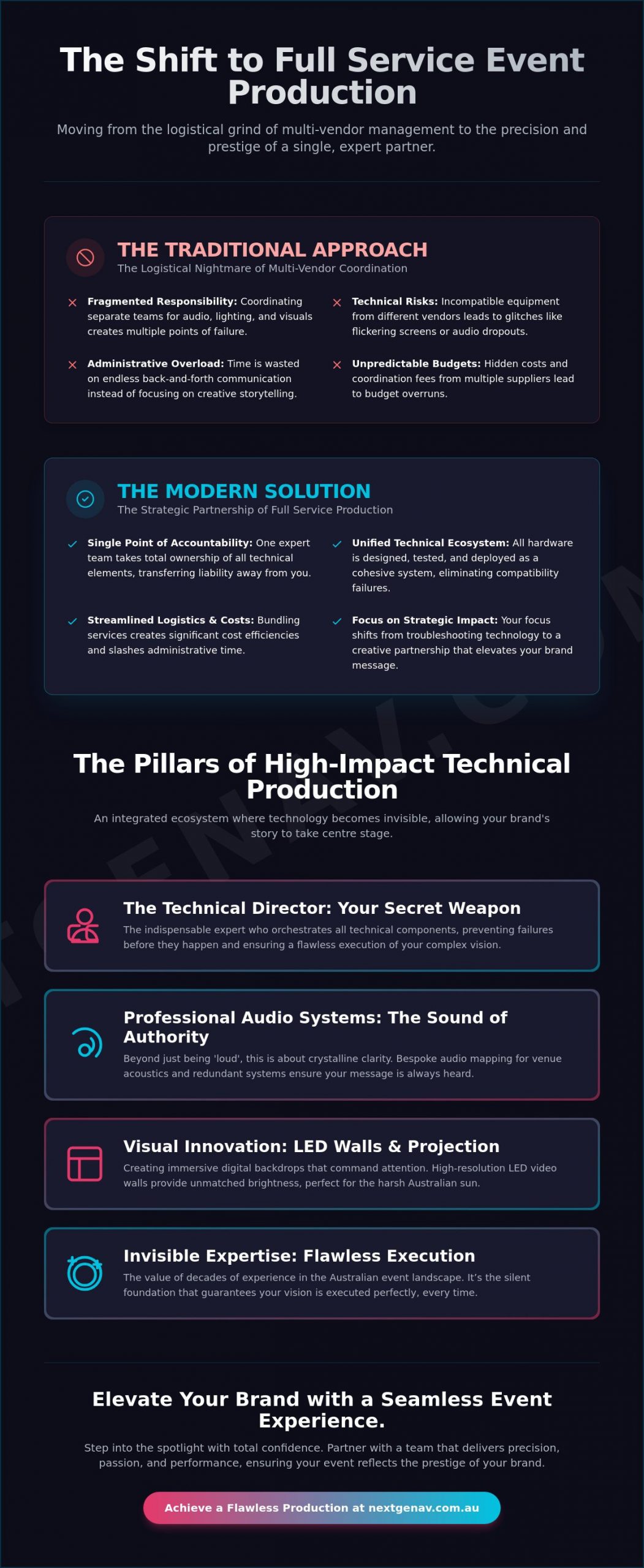
In 2026, the definition of professional success has shifted. It is no longer about simply securing a venue and a caterer. It is about the seamless fusion of creative design, technical engineering, and precise on-site management. This holistic approach, often described under the broader umbrella of Event management, is exactly what defines full service event production. It represents a fundamental shift from traditional vendor management to a strategic partnership. For Australian brands, this means moving away from the “dry hire” of individual components and embracing a model where technical liability is transferred to a single, expert entity.
The days of “just enough” technical support are over. High-stakes corporate events now demand a level of sophistication that basic equipment rentals cannot provide. When you choose full service event production, you are securing a promise of technical fluidity. You are centralising accountability. This ensures that every element, from the first keynote to the final gala performance, is executed with a level of precision that elevates your brand’s reputation rather than just maintaining it. It is about moving from the logistical grind to the prestige of the final result.
The Evolution of Event Technology
Audience expectations have reached a theatrical peak. Standard PA systems and static backdrops no longer suffice for a crowd accustomed to immersive digital environments. We are seeing a massive rise in AI-driven lighting that adapts to the mood of the room in real-time, alongside expansive LED video walls that transform physical spaces into cinematic experiences. Integrating virtual and hybrid elements isn’t just a backup plan; it’s a core requirement for modern accessibility and reach, and deploying the right hybrid event staging solutions ensures your virtual audience receives the same cinematic quality as those in the room. This theatricality turns a standard corporate briefing into a high-impact brand experience.
Benefits of a Single-Source Production Partner
Choosing a single-source partner creates immediate logistical momentum. You gain a single point of contact for audio, visual, lighting, and staging, which slashes the time spent on administrative back-and-forth. This model also unearths significant cost efficiencies by bundling technical labour and streamlining equipment logistics. Most importantly, it mitigates risk. When every piece of hardware is designed, tested, and deployed as a unified system, you eliminate the compatibility failures that plague multi-vendor setups. You don’t just hire gear; you secure an engine for success.
The Pillars of High-Impact Technical Production
Technical excellence is the silent foundation of every prestige event. While many organisers view audio, visual, and staging as separate silos, full service event production treats them as a single, breathing ecosystem. This integration is what prevents the technical friction that distracts from your message. When these pillars are engineered to work in unison, the technology becomes invisible, allowing your brand’s story to take centre stage without the fear of a flickering screen or a muffled speaker.
Professional Audio Systems: The Sound of Authority
Audio is often the most undervalued element of production, yet it is the most critical for message retention. If a delegate cannot hear a keynote speaker with crystalline clarity, the entire investment is lost. Achieving this goes far beyond just being “loud.” It requires sophisticated professional sound system hire that accounts for the specific acoustics of the space. Melbourne’s diverse venues, from heritage-listed halls with echoing stone to industrial warehouses with metallic reverb, require bespoke audio mapping. We prioritise redundant systems for every live presentation, ensuring that even in the unlikely event of a hardware glitch, the sound of authority never wavers.
Visual Innovation: LED Walls and Projection Mapping
Visual mastery is about creating a digital backdrop that commands attention. In 2026, the choice between high-resolution LED video walls and laser projection depends entirely on your environment and audience size. LED walls offer unmatched brightness and contrast, which is essential for venues with high ambient light or outdoor settings in the harsh Australian sun. Managing these wide-format digital assets requires a dedicated craft; we ensure your content is pixel-perfect and scaled correctly so your brand looks spectacular on every centimetre of the screen. This visual precision transforms a standard conference into an immersive experience.
Lighting and Staging: Crafting the Environment
Staging and rigging provide the literal foundation for your event’s visual impact. Utilising stage and lighting hire Melbourne allows you to transform a generic hotel ballroom into a bespoke, brand-aligned space. Lighting design is the “emotional engine” of the room, used to drive focus and signal transitions between sessions. Safety is our non-negotiable priority. We adhere to the most stringent event safety standards, navigating complex rigging weight limits and Australian compliance with absolute precision. Whether it is a custom tiered seating arrangement or a bespoke product reveal platform, the structure must be as secure as it is stunning. Considering how these elements fit together is the first step toward a flawless show; you can explore our integrated technical solutions to see these pillars in action.
The Technical Director: Your Secret Weapon for Flawless Execution
The most sophisticated equipment in the world is merely silent hardware without a conductor to lead the performance. While the pillars of audio and visual provide the tools, the Technical Director (TD) provides the pulse. In the context of premium full service event production, the TD acts as the “Confident Orchestrator” who bridges the gap between your creative vision and the technical crew’s execution. They are the single point of technical truth, ensuring that every cue is met with absolute precision so you can focus on your guests rather than the stage.
A TD does not just “watch” the show; they drive it. They translate the high-level goals of an event organiser into a granular “Run of Show” that the entire crew follows. This leadership eliminates the chaos of multiple vendors trying to coordinate in a vacuum. By centralising the command structure, the TD ensures that transitions are seamless, lighting changes are perfectly timed to the music, and speakers are never left standing in the dark. It is a role defined by quiet power and a relentless commitment to professional excellence.
Pre-Production and Technical Direction
The value of a TD begins months before the doors open. To achieve a truly polished result, you must involve a specialist who understands what is a technical director for events during the earliest planning stages. This phase involves rigorous site inspections and the creation of detailed CAD drawings to visualise the technical layout long before the bump-in begins. They also manage complex technical riders for international talent, ensuring that every specific requirement for guest speakers is met without last-minute surprises. This proactive stance turns potential obstacles into solved problems before they ever reach the venue floor.
On-Site Management: The Engine Room of Your Event
Once the live show commences, the TD moves into the engine room of the production. They are the voice in the intercom, calling every cue and coordinating the movements of audio engineers, visual operators, and stage hands in real-time. This constant communication maintains the momentum of the event, keeping the energy high and the timing tight. If the unexpected occurs, the TD is the first to respond. Their expertise in disaster recovery allows them to troubleshoot technical glitches or timing shifts instantly, often without the audience ever realising a change has been made. This level of invisible expertise is what separates a standard corporate gathering from a world-class brand experience.
Evaluating Event Production Partners: Beyond the Quote
Choosing a partner for full service event production is more than a procurement exercise; it is an act of trust. While a spreadsheet might show price parity, the real difference lies in the technical depth and reliability behind the numbers. Understanding event production costs Australia is the first step in ensuring your budget translates into a tangible return on investment. A bargain quote often signals a lack of redundancy or aging inventory, risks that can lead to catastrophic failures during high-stakes moments. True ROI is found in the silence of a perfectly executed show, not just the bottom line of a proposal.
Mastery requires high-spec, modern equipment that is meticulously maintained. You should demand transparency regarding the age and specification of the gear being proposed. In a city like Melbourne, logistics can be a minefield. Success depends on a team that understands the narrow loading docks of heritage buildings or the specific union labour and WHS requirements at major exhibition centres. This local intelligence ensures that “on-the-day” costs remain predictable rather than becoming a post-event nightmare. When you partner with an expert, you are buying their ability to navigate these complexities invisibly. If you are still researching your options, our comprehensive guide to the best event production companies Melbourne has to offer can help you identify the technical powerhouses that deliver flawless results.
Questions to Ask Your Potential Production Team
Absolute reliability is born from preparation. Ask your provider for their specific backup plan if a primary video switcher or PA amplifier fails during the show. Experienced teams will have hot-swappable spares ready to go. You should also verify their familiarity with your chosen Melbourne venue. Do they understand the specific rigging points and power limitations of the space? Finally, request a 3D render of the stage design during the proposal phase. This allows you to visualise the sightlines and brand impact before a single piece of truss is moved, ensuring the final result matches your vision perfectly. Understanding the common pitfalls before they occur is equally important; our guide to avoiding AV mistakes at events debunks the planning myths that lead to budget blowouts and technical failures.
Interstate and Multi-City Execution
Maintaining brand consistency across a national roadshow is a significant technical challenge. Whether you are moving from a Melbourne ballroom to a harbour-side venue, corporate event production sydney requires the same meticulous engineering and local insight. Managing this complexity involves a strategic choice between touring a core technical crew or relying on local hire. A single-source partner ensures that your digital assets and show flow remain identical in every city, preserving the prestige of your launch. If you are ready to secure a partner who prioritises precision over the lowest bid, book a technical consultation with our elite production team today to discuss your next high-impact event.
The NextGen AV Difference: Precision, Passion, and Performance
True mastery is forged over decades, not days. NextGen AV brings over 30 years of technical heritage to the Australian event landscape, providing a level of seasoned authority that only comes from thousands of successful shows. We believe that full service event production should be a seamless extension of your brand’s ambition. Our philosophy is built on “Invisible Expertise”; we act as the quiet engine driving the success of your event, handling every technical nuance so you can step into the spotlight with absolute confidence. We run the show. You take the credit.
Our commitment to excellence is reflected in our inventory. We invest exclusively in high-end, future-ready hardware, from the latest ultra-high-resolution LED video walls to crystalline professional audio systems and intelligent lighting. This technical power is guided by a proactive approach to problem-solving. Our work begins months before the first piece of equipment arrives at the loading dock. We visualise every potential challenge and engineer it out of existence, ensuring that your live high-stakes moments are defined by flawless execution rather than technical friction.
Our End-to-End Production Process
We transform your brand objectives into a technical reality through a methodical, three-phase process. It begins with Concept and Design, where we use 3D renders and CAD drawings to map out an immersive environment that aligns with your vision. Once the plan is set, our Logistics and Bump-in phase takes over. Our expert technicians manage the setup with military precision, ensuring every cable is dressed and every safety standard is met. The process culminates in Showtime. This is where our Technical Directors orchestrate the “Run of Show,” calling cues and managing transitions with the “quiet power” that has become our hallmark.
Let’s Build Something Extraordinary Together
The best way to understand the impact of elite technology is to experience it firsthand. We invite you to visit our Melbourne showroom to see the latest LED configurations and audio solutions in person. Whether you are planning a national roadshow or a high-prestige product launch, our team is ready to help you map out your 2026 event calendar. We provide the expert technical guidance needed to move past the logistical grind and focus on delivering a high-impact experience that elevates your brand’s prestige across Australia. Precision is our baseline. Performance is our promise.
Partner with NextGen AV for your next full-service event production and experience the difference that three decades of mastery can make to your next high-stakes event.
Master Your Next High-Stakes Moment
The era of juggling disconnected vendors is behind us. Success in 2026 requires a unified technical engine where every LED panel, audio array, and lighting cue works in perfect harmony. By embracing full service event production, you reclaim your time to focus on the prestige of your brand while an invisible expert handles the technical weight. We’ve explored how a dedicated Technical Director acts as the orchestrator of your vision, ensuring that even the most complex shows are executed without friction or failure.
NextGen AV brings over 30 years of technical mastery to your project, providing the redundant systems and expert leadership necessary for mission-critical events. Our team thrives under the pressure of high-stakes environments, allowing you to deliver a seamless experience that resonates with your audience long after the final curtain falls. It’s time to move past the logistical grind and step into a partnership built on absolute reliability and technical artistry.
Elevate your next event with NextGen AV’s full-service production expertise. Let’s build something extraordinary together.
Frequently Asked Questions
What exactly is included in full service event production?
It encompasses the entire technical lifecycle of your event, from the initial concept and design to final on-site execution. This includes the deployment of LED video walls, professional audio systems, lighting design, staging, and rigging. Unlike fragmented services, it provides a single point of technical accountability, ensuring every component is engineered to work as a unified system for a flawless brand experience.
How early should I engage a production company for my event?
You should ideally engage a production partner at least four to six months before your event date. Early involvement allows for comprehensive site inspections, detailed CAD floor plans, and the booking of high-spec equipment before peak Australian event seasons. This lead time is essential for managing technical riders for international speakers and ensuring all custom staging or lighting designs are fully tested.
Do you provide event production services outside of Melbourne?
Yes, we provide full service event production across all major Australian cities, including Sydney, Brisbane, and Perth. Our team is experienced in managing the logistics of national roadshows and multi-city product launches. We ensure technical consistency across every venue by either touring our core crew or coordinating with trusted local labour, maintaining the same high standard of prestige regardless of the location.
What is the difference between an AV hire company and a full-service production agency?
An AV hire company primarily rents out individual pieces of equipment, whereas a full-service agency provides technical leadership and strategic execution. While hire companies leave the coordination and liability to the client, a full-service partner takes total ownership of the technical outcome. This includes technical direction, show calling, and the integration of audio, visual, and lighting into a single, seamless experience.
Can you help with content creation for LED walls and presentations?
We focus on the technical management and playback of your digital assets to ensure they look spectacular on high-resolution LED video walls. While we prioritise technical direction, we work closely with your creative teams to advise on pixel maps, aspect ratios, and file formats. This collaboration ensures your content is perfectly scaled and rendered for wide-format screens, preventing any visual distortion during high-stakes presentations.
How do you handle technical emergencies during a live event?
Technical emergencies are managed through rigorous redundancy and the proactive leadership of an on-site Technical Director. We deploy primary and secondary systems for mission-critical elements like audio and video switching; if a hardware failure occurs, our experts switch to backup systems instantly. This process is orchestrated behind the scenes, ensuring the audience remains unaware of any technical adjustments while the show maintains its momentum.
Do I need to hire a separate event planner if I use a full-service production company?
You may still require an event planner for catering, guest lists, and venue sourcing, as we focus exclusively on the technical and structural production. While we handle the “heavy lifting” of AV, staging, and technical direction, many organisers also streamline their back-of-house needs by sourcing registration and office essentials from Mega Office Supplies to keep the admin side running smoothly. This allows your planner to focus on the guest experience while we ensure the technical engine of the event runs with absolute precision.
How are event production costs typically structured?
Costs for full service event production are typically structured through a transparent bundle that includes equipment hire, technical labour, transport, and management fees. This single-source model avoids the hidden “on-the-day” costs often associated with managing multiple vendors. By centralising your technical requirements, you gain predictable budgeting and cost efficiencies through bundled labour, ensuring your investment is directed toward high-impact results.