


That sudden, sharp ring of microphone feedback or a flickering LED wall isn’t just bad luck; it’s the predictable outcome of outdated planning habits that no longer hold up in 2026. You’ve likely felt that cold spike of adrenaline when a presenter’s slide freezes or a video won’t play in front of a room full of expectant delegates. When you’re tasked with orchestrating a high-stakes production, the fear of public technical failure is a heavy burden, especially with industry rates having climbed by up to 50 percent in recent years. Mastering the art of avoiding av mistakes at events starts with shedding the misconceptions that lead to budget blowouts and frustrating communication gaps with your technical crew.
We believe you deserve more than just a pile of gear; you deserve the confidence of a flawless, professional experience where the technology works as a silent, powerful engine. This article will help you reclaim control by debunking five common myths that often derail even the most meticulously organised programmes. You’ll discover how to navigate the “venue trap,” manage the latest 2026 digital accessibility standards, and build a partnership with your technicians that ensures your event is remembered for its prestige rather than its glitches.
Key Takeaways
- Elevate your event from a basic meeting to a prestigious experience by treating audio-visual elements as a strategic brand asset rather than a last-minute utility.
- Learn the essential strategies for avoiding av mistakes at events by bypassing the “venue trap” and prioritising hardware that matches your specific room acoustics.
- Master the pre-production protocol to transform standard site visits into technical stress tests that identify failure points before the first delegate arrives.
- Discover why a dedicated Technical Director is the “invisible expert” required to orchestrate complex LED walls and audio systems into a seamless performance.
The “Plug-and-Play” Myth: Why AV Planning Cannot Be an Afterthought
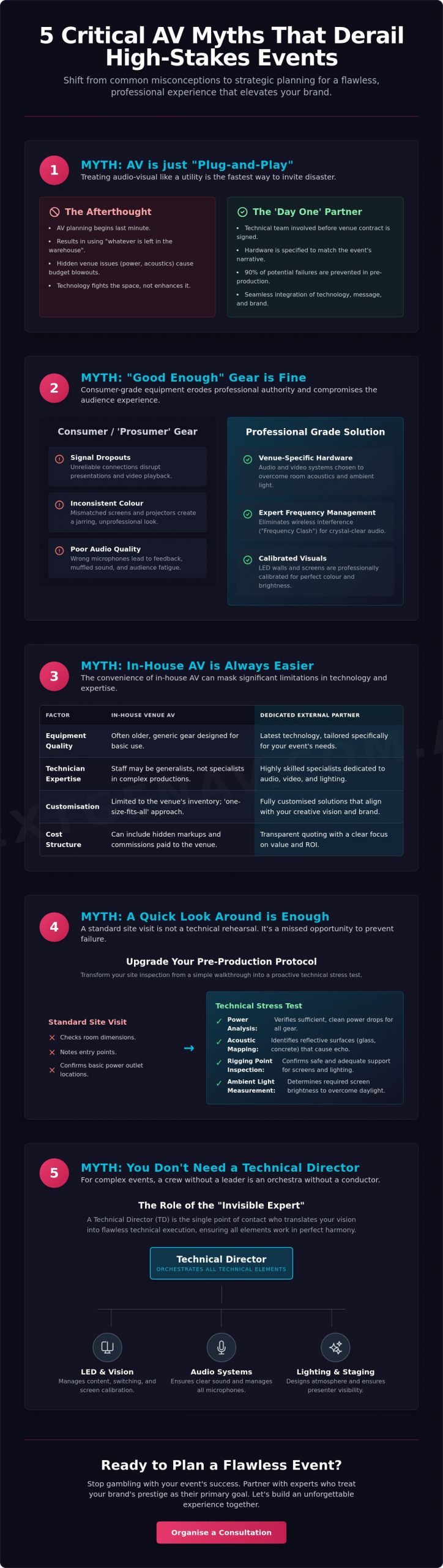
Many organisers treat audio-visual systems like electricity. You flick a switch and expect light. For a high-stakes corporate event, this “plug-and-play” mindset is the fastest way to invite disaster. Your AV setup isn’t just a utility; it’s the primary vehicle for your brand’s prestige and the medium through which every speaker’s message is delivered. Avoiding av mistakes at events requires a fundamental shift in perspective. You need to treat your technical team as a creative partner from the very first day of your planning cycle.
Adopting a “Day One” rule is essential for a seamless execution. Ideally, your technical partner should walk through the venue with you before the contract is signed. They can spot hidden challenges like poor acoustics, restrictive ceiling heights, or insufficient power drops that would otherwise cause event production costs Australia to skyrocket due to late-stage modifications. This level of early involvement is a hallmark of sophisticated technical event production; it ensures the hardware integrates perfectly with the physical space rather than fighting against it.
The Cost of Last-Minute Technical Additions
Scrambling for gear forty-eight hours before a show is a recipe for sub-optimal outcomes. Rushed hire often results in using “whatever is left in the warehouse” rather than the precise kit your event demands. This is particularly true for complex LED video wall configurations. These systems require specific processing and rigging configurations that cannot be safely or elegantly organised overnight. Even something as simple as adding an extra wireless microphone on the morning of the session can disrupt the entire frequency map, leading to the very feedback loops you’ve worked so hard to prevent.
Syncing AV with the Event Narrative
Great production moves beyond the basic question of “can they hear me?” It focuses on the emotional resonance of the experience. A skilled technical partner translates your creative brief into a tangible hardware manifest, using lighting and sound design to craft a specific atmosphere that mirrors your brand values. The Pre-Production Phase is the critical window where 90% of event failures are actually prevented. By investing time in this stage, you ensure the technology serves the narrative, allowing you to focus on your guests while the experts manage the engine room.
Sound and Vision Myths: Why “Good Enough” Gear Often Fails
Settling for “good enough” hardware is a dangerous gamble that often ends in a compromised experience for your audience. A common misconception in the industry is that a speaker is simply a box that makes noise and a screen is just a surface for images. In reality, the physical properties of your venue, from the height of the ceilings to the amount of natural light, dictate the specific hardware required for absolute clarity. When you are arranging audio visual hire Melbourne, a bespoke approach is essential because a cavernous warehouse requires a completely different sonic profile than a plush, carpeted hotel ballroom.
Consumer-grade gear belongs in a home theatre, not a high-stakes corporate environment. Using “prosumer” equipment often leads to signal dropouts and inconsistent colour calibration across screens, which immediately erodes your professional authority. Mastery over your environment means understanding how sound bounces off glass walls or how ambient light washes out a projection. True success comes from selecting tools that are engineered to overcome these specific spatial challenges.
The Microphone Misconception
Choosing the wrong microphone is a frequent hurdle when avoiding av mistakes at events. Lapels are discreet but often prone to feedback in rooms with poor acoustics, while handhelds offer superior control but can feel cumbersome for a dynamic presenter. In Melbourne’s CBD, managing the “Frequency Clash” is a sophisticated task because the airwaves are crowded with competing wireless signals from surrounding office towers. Using a comprehensive AV checklist helps ensure your technicians have scanned the local RF environment to secure a clean channel well before your first speaker takes the stage. Gain before feedback is the technical limit that determines your event’s volume ceiling.
Brightness vs. Resolution in Modern Visuals
Many organisers mistakenly believe that a higher resolution always results in a better picture. While 4K is impressive, it means very little if your screen isn’t bright enough to compete with the venue’s lighting. In a sun-drenched atrium or a brightly lit conference centre, “Nits” (a measure of brightness) matter far more than pixels. This is why high-output LED walls have largely replaced traditional projectors for daytime sessions; they provide the punch and contrast needed to keep your slides legible even in direct light. If you want to ensure your visual content retains its impact, consulting with a technical partner early in the process will help you match the right display technology to your room’s unique light profile.
The Venue Trap: Debunking the “In-House AV is Always Easier” Assumption
Many organisers fall into the trap of believing the venue’s in-house team is the safest pair of hands. The logic seems sound; they work there every day, so surely they know the system best. In reality, in-house teams are often restricted by “locked” house systems and under-resourced schedules that prioritise venue turnover rather than your specific creative vision. Choosing a dedicated production partner over a venue technician is a fundamental step in avoiding av mistakes at events. While a house tech might keep the lights on, an external specialist provides full service event production that takes absolute ownership of your brand’s technical prestige.
Research indicates that in-house commissions can inflate your budget by 30 to 50 percent over market rates, often without a corresponding increase in service quality. These teams are frequently tasked with managing multiple rooms simultaneously, leaving them stretched thin when you need them most. By bringing in an outside expert, you shift the focus from what the venue can easily provide to what your event actually requires to succeed. This proactive approach ensures that the technology bends to your needs, rather than your programme being dictated by the venue’s limitations.
Hidden Limitations of House Systems
Venue-installed systems are designed for generic use, not bespoke excellence. You might find yourself restricted by fixed lighting positions that cast shadows across your custom stage or a PA system that fails to deliver crisp audio to delegates at the back of a deep room. Relying on these static setups is one of the most common AV mishaps reported by planners who find their vision compromised by the building’s infrastructure. A smarter approach involves integrating external, high-performance gear with house systems to create a high-impact hybrid solution that keeps quality high while managing venue patching fees.
The Accountability Advantage
When technical issues arise, the last thing you want is “finger-pointing” between different vendors. Having a single point of contact for every technical element provides a level of calm that in-house models rarely offer. A partner who understands your long-term goals can travel with you across different Australian cities, ensuring that the sound and vision in Sydney match the excellence you achieved in Brisbane. If you’re currently vetting potential partners, refer to our best event production companies Melbourne selection guide to ensure your choice aligns with the high-stakes requirements of 2026.
The Pre-Production Protocol: A Fail-Safe Sequence for Planners
Technical glitches are rarely the result of equipment failure. More often, they are the result of a skipped step in the planning sequence. Many organisers treat a site visit as a simple walkthrough to visualise the floor plan, or they view a soundcheck as a luxury reserved for musical acts. This mindset is a significant barrier to avoiding av mistakes at events. In high-stakes production, these moments are not casual observations; they are rigorous technical stress tests designed to find the “breaking point” of your setup before the first guest arrives.
To ensure a flawless execution, we utilise a 5-step fail-safe protocol that moves chronologically from concept to curtain-up. This sequence includes a Site Survey, Frequency Mapping, Content Testing, Soundcheck, and a full Technical Rehearsal. While every step is vital, content testing is frequently the most overlooked element in modern digital events. If your presenter’s 16:9 slides are forced onto a custom-ratio LED wall without prior adjustment, the resulting “letterboxing” or stretched imagery immediately undermines your brand’s prestige. Testing every file, video codec, and transition on the actual display hardware is the only way to guarantee visual perfection.
The Site Survey: Beyond the Floor Plan
A professional survey deep-dives into the venue’s infrastructure to prevent expensive surprises on show day. In older Melbourne venues, we specifically hunt for “clean power” and 3-phase availability, as outdated circuits can cause hums in audio systems or flicker in lighting rigs. Identifying structural rigging points and ceiling height restrictions is also critical when organising stage and lighting hire Melbourne. We also assess Wi-Fi saturation and hardline internet stability to ensure your hybrid components and audience interaction apps remain responsive under heavy load.
The “Real-World” Soundcheck
Testing a microphone in an empty ballroom provides a false sense of security. Once the room fills with hundreds of people, the acoustics shift as bodies absorb sound waves, often requiring real-time adjustments to your audio profile. A soundcheck is not for the technician’s benefit, but to familiarise the speaker with the “voice of the room.” This time allows your presenters to feel the lag of a large space and practice transitions, such as the precise second a video ends and their microphone goes live. To eliminate the stress of technical uncertainty, contact our team today to begin orchestrating your fail-safe pre-production sequence.
The “Invisible” Solution: Why You Need a Technical Director
The belief that premium hardware alone guarantees a successful event is perhaps the most dangerous misconception of all. You can hire the most advanced LED walls and professional audio systems available in 2026, but without a central authority to manage them, you simply have a collection of expensive tools. The most sophisticated gear in the world is useless without a “Conductor” to lead the technical orchestra. True mastery in avoiding av mistakes at events comes from recognising that the human element is what transforms a technical setup into a seamless, prestigious experience.
So, what is a technical director for events? Essentially, they are the single point of truth for every technical cue and the strategic lead for your entire production. While a technician focuses on their specific piece of equipment, a Technical Director (TD) manages the “Show Flow.” This is the precise, minute-by-minute sequence of lighting, audio, and visual transitions that define your event’s rhythm. When a presenter decides to skip three slides or an award winner walks onto the stage from the wrong side, the TD makes the real-time decisions that keep the production looking intentional and polished.
The Insurance Policy You Didn’t Know You Needed
A Technical Director acts as your primary insurance policy against the unexpected. They possess the foresight to anticipate problems before they manifest, such as a speaker providing a last-minute content update that doesn’t match the screen’s aspect ratio. By managing the “inter-departmental” gap, they ensure that the lighting desk knows exactly when the audio team is playing a sting and when the video team needs to trigger a keynote. This level of coordination is essential for high-stakes corporate event production Sydney and multi-city roadshows where maintaining a consistent standard of excellence is non-negotiable.
Elevating the Experience with NextGen AV
Our “Invisible Expert” approach is designed to alleviate the inherent stress of live production. We don’t just provide equipment; we provide a proactive, elite team that thrives under pressure. With over 30 years of Melbourne event history, we understand the unique quirks of every major venue and how to navigate the technical challenges they present. We take personal pride in seamless execution, allowing you to step into the spotlight with absolute confidence while we drive the engine behind the scenes. To ensure your next programme is defined by its success rather than its glitches, Contact NextGen AV to organise a technical consultation for your next event.
Mastering the Technical Narrative
Success in the live arena isn’t a matter of chance; it’s the result of challenging the misconceptions that often lead to technical friction. By moving past the “plug-and-play” myth and recognising that your venue’s house system might not be the safest pair of hands, you reclaim ownership of your event’s atmosphere. The path to avoiding av mistakes at events lies in rigorous pre-production testing and the expert guidance of a dedicated Technical Director who can orchestrate every cue with precision.
With over 30 years of industry experience, NextGen AV specialises in turning complex technical requirements into seamless, high-impact experiences. From engineering bespoke LED video walls to managing crystal-clear professional sound, we provide the end-to-end technical direction and on-site management required for total peace of mind. You focus on the message; we’ll drive the engine that delivers it. Partner with Melbourne’s AV experts for a glitch-free event and ensure your next production is remembered for all the right reasons. Your vision deserves nothing less than technical perfection.
Frequently Asked Questions
How do I avoid audio feedback during a presentation?
Feedback is prevented by maintaining a high “gain before feedback” threshold through precise microphone placement and professional room tuning. Ensure presenters stay behind the PA speakers and use directional microphones that reject off-axis sound. Our technicians “ring out” the system during pre-production to identify and notch out problem frequencies before your first delegate enters the room.
Why do my videos look pixelated on a large LED screen?
Pixelation usually occurs when the source content resolution doesn’t match the native pixel pitch of the LED video wall. If you play a standard 1080p video on a massive 4K-capable surface, the image must be “stretched,” which softens the details. We provide exact pixel maps during the planning phase so your creative team can render content that looks razor-sharp at any scale.
Is it cheaper to use the venue’s in-house AV team?
Generally, no; in-house AV often carries a 30 to 50 percent commission that is paid back to the venue, which inflates your costs. While it might seem convenient, you’re often paying premium rates for entry-level gear and stretched personnel. Engaging an external partner allows for a more competitive, bespoke solution that prioritises your specific event outcomes rather than venue profit margins.
What is the most common AV mistake made by event planners?
The most frequent error is treating technical requirements as a secondary utility rather than a core strategic element. This leads to budget blowouts and missed opportunities for audience engagement. Avoiding av mistakes at events starts with involving your technical director during the initial venue selection to ensure the space can actually support your vision without expensive workarounds.
How far in advance should I book my AV production company?
You should ideally secure your technical partner six to twelve months in advance for major conferences and at least three months for smaller corporate sessions. High-demand dates in the Australian event calendar book out quickly; early engagement ensures you secure the best lead technicians and the most advanced hardware. This lead time is also critical for custom staging and rigging designs.
Do I really need a full soundcheck if the speaker is experienced?
Yes, because a soundcheck is about the room’s unique acoustics and the technical flow, not just the speaker’s ability. Every ballroom has different “hot spots” and reflections that the audio team must account for. Even a seasoned professional needs to familiarise themselves with the stage monitors and the timing of their visual cues to ensure a polished performance.
What happens if the power goes out during my event?
We mitigate power risks by using Uninterruptible Power Supplies (UPS) for critical control gear like show laptops and audio consoles. This provides a buffer that keeps the “brains” of the show running while we switch to backup circuits or generators. For high-stakes productions, we often specify redundant power drops to ensure the LED walls and PA systems remain operational regardless of venue fluctuations.
How can I ensure my remote audience has the same experience as those in the room?
You must treat your virtual feed as a dedicated broadcast rather than a passive stream of the room. This involves using a multi-camera setup with a dedicated technical director to cut between speakers and presentation slides. Ensuring your remote guests have a separate, high-quality audio mix is also essential for maintaining engagement and meeting 2026 digital accessibility standards for synchronised captioning.