
The right rigging partner turns a creative concept into safe overhead architecture. For Melbourne event organisers, that means more than suspending lights or LED walls: equipment loads, venue requirements, qualified crew and bump-in sequencing all need to work together. This guide to stage rigging services melbourne event teams can rely on explains how careful planning supports both the production and the people beneath it.
You can create a striking stage while keeping structural safety, venue approvals and specialised rigging requirements in view. Certain rigging tasks require a High-Risk Work Licence under Victoria’s Occupational Health and Safety Regulations 2017, overseen by WorkSafe Victoria. NextGen AV’s Melbourne-based team brings more than 30 years of industry experience, coordinating rigging, LED walls and lighting through technical direction as part of one integrated production.
Here, you’ll learn how to plan flown elements, prepare safety documentation and navigate venue requirements while keeping creative design and compliance aligned. From the initial concept to the final checks, precision behind the scenes helps your event take centre stage with confidence.
Key Takeaways
- See how event rigging supports structural planning and the visual impact of your Melbourne production.
- Learn how trusses, motors and hardware work together to suspend event elements with precision.
- Understand how load calculations, relevant standards and engineering input contribute to a considered rigging plan.
- Use venue information and early coordination with in-house teams to prepare for a smoother bump-in.
- Explore how stage rigging services melbourne can integrate rigging with lighting, LED walls and technical direction.
The Critical Role of Stage Rigging in Melbourne Event Production
Professional stage rigging is more than suspending speakers above an audience. It is the planned positioning and support of event equipment, designed around the venue, the production brief and the people using the space. A flown lighting fixture, audio system or LED wall needs suitable support, considered placement and coordinated installation. Those decisions shape what the audience sees and hears while helping the production team work safely behind the scenes.
Rigging is also the invisible architecture of a compelling event. Trussing can define a stage, frame a screen or support layered lighting positions. Carefully placed flown elements add depth and focus. For example, an LED wall can form the visual centrepiece, with lighting positioned to complement its content rather than obscure it. The rigging plan links these creative choices to practical constraints, including the venue’s infrastructure and how loads are distributed.
The same principles apply across theatrical, arena and corporate productions. Entertainment Rigging Principles provides background on the discipline. At a Melbourne conference or gala, careful suspension and coordination help create a polished audience experience. NextGen AV brings rigging, LED walls and lighting together through technical direction, so the production feels like one considered design rather than a series of separate installations.
Safety and Compliance: The Non-Negotiables
In Victoria, event organisers need to manage contractor practices and make sure relevant requirements are addressed. WorkSafe Victoria enforces the Occupational Health and Safety Regulations 2017, under which certain rigging tasks require a High-Risk Work Licence. There is a difference between hanging an item and engineered rigging: the latter considers how equipment is supported, positioned and secured within the overall plan. Qualified riggers bring the training and practical judgement needed to carry out their assigned work carefully.
Creative Freedom Through Flown Elements
Flown equipment can free up floor space, support audience movement and keep sightlines clearer. Suspending audio or visual elements can also help the team position them around the stage design, instead of placing stands and equipment where they interrupt the room. Layered trussing can support distinct lighting zones and visual frames, creating an immersive setting without crowding the stage. The design must still suit the venue and its rigging points.
Precise coordination makes a complex production feel effortless to guests. NextGen AV’s Melbourne team integrates rigging with LED wall specialists and lighting designers, aligning technical requirements with the intended look and audience experience. With stage rigging services melbourne productions can rely on, the creative vision has a carefully planned structure behind it, from the overhead design to the finished room.
Essential Rigging Components: Truss, Motors, and Hardware
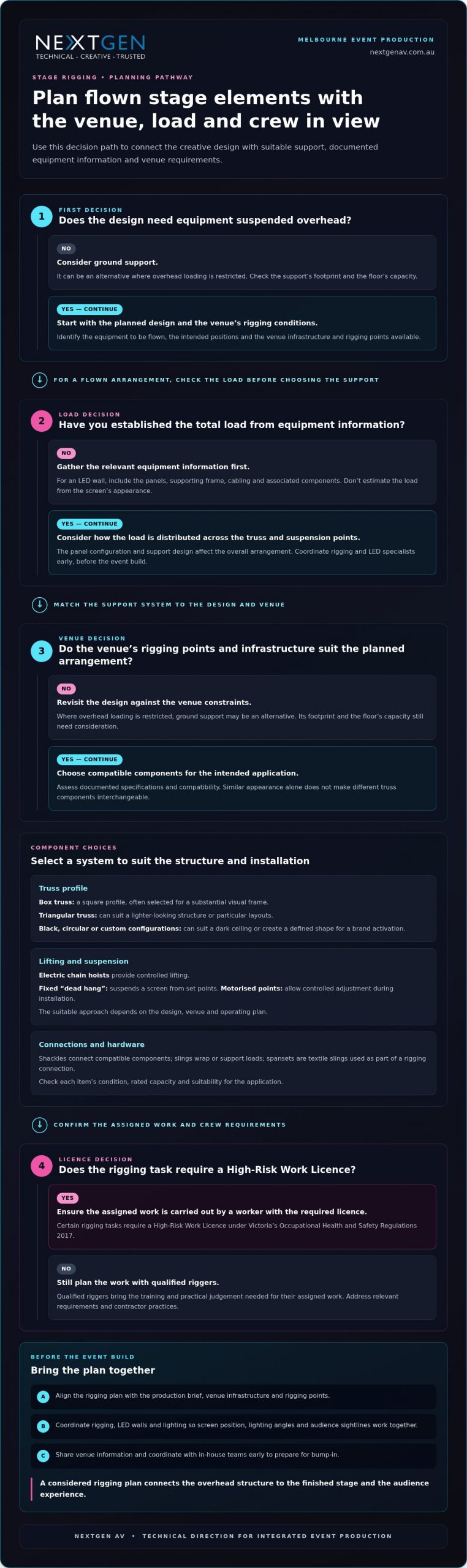
Truss, lifting equipment and connecting hardware form a support system, not a collection of interchangeable parts. Aluminium trussing creates a framework for lighting, audio and visual elements. Motors or fixed suspension points position that framework above the event floor. Each component needs to suit the intended design, the equipment it supports and the venue’s rigging conditions.
Truss profiles vary in shape and application. Box truss has a square profile and is often selected when a design calls for a substantial visual frame. Triangular truss can suit lighter-looking structures or particular layouts. Black truss can recede against a dark ceiling, while circular or custom configurations create a defined shape for a brand activation. Global and Eurotruss systems should be assessed using their documented specifications and component compatibility. Similar appearance alone does not make components interchangeable.
Trussing and Lifting Systems
Electric chain hoists provide controlled lifting, while the motor arrangement affects how a structure is raised and held in position. A fixed “dead hang” suspends a screen from set points; motorised points allow controlled adjustment during installation. The suitable approach depends on the design, venue and operating plan. Ground support can be an alternative where overhead loading is restricted, but its footprint and the floor’s capacity still need consideration.
Shackles connect compatible components, slings wrap or support loads, and spansets are textile slings used as part of a rigging connection. Check their condition, rated capacity and suitability for the application. The US reference OSHA Rigging Safety Standards addresses equipment in its jurisdiction. It does not replace Victorian requirements or project-specific engineering.
Planning for LED Video Walls
LED panels, their supporting frame, cabling and associated components all contribute to the suspended load. Establish the total using relevant equipment information, then consider how it is distributed across the truss and suspension points. Never estimate from the screen’s appearance: the panel configuration and support design affect the overall arrangement. A technical director can coordinate rigging and LED specialists early, aligning screen dimensions, sightlines and support requirements before the event build.
That integration matters in practice. A screen’s position affects truss layout, lighting angles and the audience’s view, so decisions made in isolation can undermine the finished stage. Explore how LED video walls for events fit into a production plan, then coordinate their support with the wider design. For stage rigging services melbourne organisers need to bring these elements together, NextGen AV’s technical direction connects structural planning with the audience-facing result.
Match Components to the Venue
Before selecting a system, map the equipment, intended positions and available support points. Where ceiling loading is limited, ground-supported structures may help shape the design, provided floor capacity and circulation space are considered. Early coordination lets the rigging plan support the creative brief without leaving critical decisions until bump-in.
Navigating Safety Standards and Load Calculations in Victoria
For a Melbourne event, safety planning becomes practical when the rigging design can be reviewed alongside the equipment schedule and venue information. AS 1418.17 is relevant to the design and use of lifting equipment. The technical team should identify which standards apply to the specific equipment and operation, rather than treating a reference to one standard as blanket approval. For a complex design, a structural engineer can assess the proposed arrangement and provide project-specific documentation.
Make sure design decisions are supported by clear information. Keep the current equipment schedule, venue details and rigging drawings together. If the screen size, lighting positions or production layout changes, pass the update to the technical director before issuing the plan for installation. This creates a traceable design process and gives the production team time to resolve issues before the build.
Load Calculations for Event Planners
Give your AV partner accurate equipment details, including models or specifications where available, quantities, planned positions and any movement during the event. Have the proposed loads at each support point assessed against the venue’s documented limits. For example, moving a screen from centre stage to one side can change how forces reach the supporting structure, even if the equipment list stays the same. Do not add items on site without a technical review.
Moving elements and outdoor installations need particular attention during design. The responsible technical team should account for how equipment will operate, assess site exposure and consider applicable wind conditions for temporary outdoor structures. The plan should set out how changes in conditions or production requirements will be handled, rather than relying on assumptions made during the initial design.
WorkSafe Victoria and Event Compliance
Build project records around the actual scope of work. Depending on the task and site, these may include a Job Safety Analysis, a Safe Work Method Statement where high-risk construction work applies, equipment inspection records and engineered drawings. Keep document versions clear, record design changes and make sure the crew has the current information. This document control connects planning decisions with on-site execution.
Address insurance arrangements through the event’s contracting and production planning. Define who is responsible for each part of the work, how changes are escalated and which records are shared with the venue. Clear ownership reduces uncertainty when multiple teams contribute to the build and gives organisers a reliable view of how the work will be managed.
Victoria University’s Event Production Management in Melbourne offers broader context on coordinating production components. For a rigging plan, the practical goal is to connect engineering review, accurate equipment information and controlled document updates. This helps the event design progress clearly from pre-production through to installation.
Planning Your Rigging Strategy: From Site Inspection to Bump-in
A rigging plan should take shape well before equipment arrives at the venue. A site inspection helps the technical team understand the room, access routes and production requirements, then build a plan around actual conditions. Melbourne venues vary widely: a purpose-built convention space such as MCEC and a heritage setting such as Melbourne Town Hall each have distinct layouts, access arrangements and operational considerations. Plan for the venue you have booked, not a generic room diagram.
During the inspection, map how equipment will travel from the loading area to the event space. Check loading dock access, lift dimensions, travel distances, storage areas and the routes crew will use during bump-in. These details can shape the installation sequence and affect how smoothly suppliers work together. Establish how the venue’s in-house technical team operates, including any exclusive rigging arrangements, then agree how the external production crew will coordinate with them.
Map the Venue Early
A useful site review records stage dimensions, access constraints, ceiling and support information supplied by the venue, and proposed positions for flown equipment. It should also capture practical details such as restricted corridors, shared loading areas and spaces that must stay clear for guests or venue operations. Keep approval responsibilities visible in the project schedule. Assign someone to track venue submissions and responses so design decisions do not stall while teams wait for information.
Coordinate the Production Plan
Pre-production drawings help the team visualise the rigging plot and identify clashes before installation. A 3D CAD view can bring truss positions, lighting, audio and LED screens together, making it easier to refine sightlines, cable routes and working space. Drawings should reflect the selected venue and current equipment plan. NextGen AV’s technical direction connects these elements, while clear version control helps every team work from the latest design.
Rigging is often among the first overhead work installed because lighting, audio and video elements may depend on it. It can also be among the last systems removed, after suspended equipment has been lowered and cleared. Build that sequence into the wider bump-in and bump-out schedule. Riggers, lighting crew and audio technicians should coordinate work zones, installation order and handovers, so one team’s progress does not block another’s access or create avoidable delays.
For outdoor or temporary structures, include the relevant approval pathway and supporting documentation in the project schedule. Requirements depend on the structure and site, so keep communication open with the venue and relevant approval contacts as plans develop. Stage rigging services melbourne event organisers can rely on should connect the site review, drawings, approvals and production schedule from the outset. This joined-up approach helps protect the creative vision from late changes and gives each crew member a clear role on site.
Bring your venue requirements and production concept together with NextGen AV’s Melbourne rigging and production team, coordinating technical details before bump-in.
Partnering with NextGen AV for Seamless Rigging and Production
Rigging works best when it is planned as part of the production, not added as a separate task after the stage design is settled. NextGen AV coordinates staging and rigging with lighting, professional audio and LED video walls, aligning technical decisions so every element supports the event’s intended look and audience experience. With extensive experience across Melbourne venues, the team brings practical knowledge to complex corporate productions and manages the details behind the scenes.
The “Invisible Expert” approach gives your production a clear technical lead while guests experience a confident, cohesive event rather than the logistics behind it. A technical director can connect the creative brief to the rigging plot, identify constraints early and coordinate the specialists responsible for each part of the build. That joined-up direction helps avoid clashes between the stage design, lighting positions and visual content.
One Coordinated Production Team
A single production partner can bring rigging, lighting and sound into the same planning conversation. That matters when a design includes flown fixtures, a large screen and a stage layout that needs to preserve sightlines. NextGen AV’s stage and lighting solutions connect structural decisions with the atmosphere you want to create, giving your brand a considered presence in the room.
Coordination also supports clearer decisions when venue conditions shape the design. If access, rigging points or the room layout affect the original concept, a production partner can bring the right technical specialists together to assess options and update the plan. You are not left to reconcile separate equipment schedules alone; the production details are managed as one connected project.
Built Around Your Event
A corporate gala and a product launch have different demands. A gala may call for layered lighting and a strong stage focal point; a launch may need screen content and lighting cues to work in a precise sequence. NextGen AV develops rigging plots around the event brief, venue and production elements, then coordinates the on-site work through bump-in and pack-down. The result is a plan shaped for your event, not a generic arrangement.
Safety and precision remain central throughout delivery. Clear technical direction helps the crew follow an agreed plan, communicate changes and keep rigging aligned with the wider production. That gives organisers more headspace to focus on presenters, guests and the experience they want people to remember.
If you are planning an event, speak with NextGen AV’s Melbourne team about your rigging and production brief. With stage rigging services melbourne organisers can integrate into a wider production, your concept has experienced technical partners from planning through to pack-down.
Shape the Event You Envision
Your rigging plan can do more than support the production; it can help define the atmosphere your guests remember. Bring technical planning into the creative process early, and your event design has room to develop around the venue, programme and moments you want to make stand out. That is the advantage of treating stage rigging services melbourne as part of the whole event experience, not a last-minute installation detail.
With NextGen AV, rigging is planned alongside lighting, audio and visual production, so your concept and practical requirements progress together. Focus on the message, the guests and the occasion, knowing experienced technical direction is managing the details.
Enquire about professional stage rigging services in Melbourne and take the next step towards a production designed with precision and purpose. Your vision deserves a team that helps it take shape with confidence.
Frequently Asked Questions
Do I need a permit for stage rigging in a Melbourne venue?
Permit requirements depend on the event structure and where it is being installed. Start by distinguishing formal approvals from a venue’s own technical approval process, as these can involve different teams and documents. For a Melbourne event, include approval responsibilities in the production schedule and have the organiser, venue and technical director work from the same event plan. This helps address approval requirements before the design is finalised.
How much does rigging typically cost for a corporate event?
A corporate rigging setup is scoped around the event brief rather than a standard package. Begin by defining what the audience needs to see and hear, such as a central LED screen, a clear stage view or a particular lighting look. NextGen AV’s technical team can translate that brief into a rigging and production plan, helping you understand the work involved and make informed decisions about the event design.
Can I use the venue’s in-house rigging services with NextGen AV?
Yes, NextGen AV coordinates production planning with a venue’s in-house rigging team. Establish one current version of the event plan, including the latest stage layout, screen positions and production schedule. This gives venue and production teams a shared reference as details develop, helping prevent outdated drawings or conflicting schedules from disrupting preparation.
What is the difference between basic trussing and engineered rigging?
Basic trussing describes a structural component, while engineered rigging refers to the planned scope around its use. For event planning, clarify whether the design covers only the truss or also the connected equipment, installation sequence and technical oversight. A clearly defined scope makes it easier to coordinate production responsibilities and understand how the proposed structure supports the event design.
How far in advance should I book rigging services for my event?
Start planning as soon as you have a likely venue and an initial event concept. That gives the technical team time to shape the design alongside your programme, stage layout and production schedule. If key details are still evolving, share the current brief and flag what may change. Early collaboration helps the rigging plan develop with the event instead of being added after other decisions are settled.
What safety documentation should I expect from a rigging provider?
Expect project records to match the final agreed design and clearly identify the version being used on site. If the stage layout or production equipment changes, the relevant drawings and records should be reviewed and updated as needed. For organisers, the practical check is consistency: documents shared with the venue and production crew should reflect the same installation plan.
Are there weight limits for hanging LED walls in Melbourne hotels?
Hotel rigging limits are specific to the property and may differ between rooms in the same building. Do not apply a ballroom’s information automatically to a smaller function room. For a Melbourne hotel event, use the documentation for the exact room and event date, and make sure the planned screen arrangement is assessed against that venue information before finalising production layouts.
What happens if my venue doesn’t have rigging points in the ceiling?
The event design can be adapted to the room rather than relying on a ceiling-mounted screen position. Options may include adjusting the screen location or incorporating it into a ground-level stage layout, with sightlines and audience movement considered as part of the revised design. NextGen AV coordinates these decisions with the wider production plan so the visual focus remains clear and practical for guests.
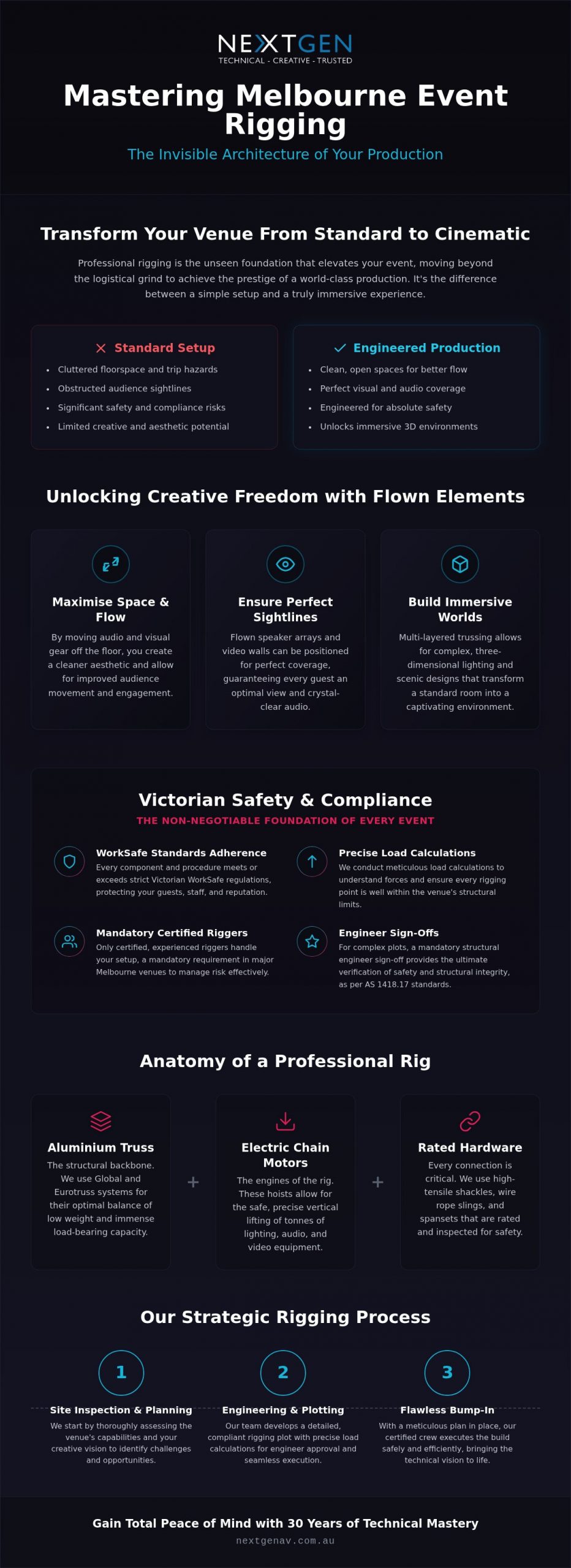
The most breathtaking visual moments in a Melbourne production aren’t actually found on the floor; they’re engineered in the air. While most organisers focus on what sits at eye level, the true architectural power of your event resides in the invisible rigging that supports your vision. You likely recognise that the stakes are incredibly high. The pressure to deliver a flawless experience often clashes with the anxiety of structural safety and the opaque nature of Victorian rigging permits. Whether you’re coordinating a complex LED wall fly-in or simply arranging a reliable portable stage hire melbourne, the fear of hidden hardware costs or a compliance oversight can easily overshadow your creative goals.
We’re here to transform that technical burden into your greatest creative asset. This guide provides the expertise you need to master the 2026 event safety landscape with absolute confidence. You’ll learn how to align your production with the latest WorkSafe standards while achieving a high-impact aesthetic that captivates every guest. We’ll walk through the essential load calculations, the nuances of Melbourne venue requirements, and the strategic integration of flown elements that turn a standard room into a cinematic experience.
Key Takeaways
- Understand why professional rigging acts as the invisible architecture of your event, transforming standard spaces into immersive, high-impact environments through precision engineering.
- Discover how to coordinate your portable stage hire melbourne with sophisticated truss systems to ensure a seamless, structurally sound foundation for your performers and hardware.
- Master the technical essentials of Victorian safety compliance, including the critical role of AS 1418.17 standards and mandatory structural engineer sign-offs for complex rigging plots.
- Learn the strategic importance of early site inspections to identify venue-specific challenges and manage the delicate balance between in-house teams and production partners.
- Gain total peace of mind by leveraging 30 years of technical mastery to navigate the logistical grind, allowing you to focus on the prestige of your final production.
The Critical Role of Stage Rigging in Melbourne Event Production
A truly spectacular corporate event doesn’t just happen on the floor; it’s anchored in the air. Professional stage rigging serves as the foundational support for every overhead element, from high-definition displays to precision-tuned audio arrays. Think of it as the invisible architecture of your production. While your guests marvel at the visual clarity of LED video walls or the atmospheric glow of a custom lighting plot, it’s the rigging that makes these feats possible. When you’re coordinating a portable stage hire melbourne, the success of your setup depends on the synergy between what’s on the ground and what’s suspended above it.
Our “Invisible Expert” philosophy dictates that the most successful rigging setups are the ones that go entirely unnoticed. If an attendee’s eye is drawn to a cluttered truss or a messy cable run, the immersion is broken. True technical mastery involves creating a seamless environment where the technology feels like a natural extension of the room’s design. This behind-the-scenes precision allows the artistry of your event to take centre stage, ensuring the focus remains on your brand and your message rather than the hardware holding it up. Entertainment rigging is a specialised craft that blends structural engineering with creative vision, transforming a standard venue into a cinematic experience.
Safety and Compliance: The Non-Negotiables
In the high-stakes world of Melbourne events, safety isn’t just a priority; it’s a legal imperative. Event organisers carry significant liability under Victorian health and safety laws, making it vital to understand the difference between simply hanging a light and implementing an engineered rigging solution. Real rigging involves precise load calculations and a deep understanding of the venue’s structural limits. Certified riggers are a mandatory requirement for major Melbourne venues because they possess the specialised training to manage these risks. We don’t just secure equipment; we protect people and reputations by adhering to the strictest WorkSafe standards for every single motor and shackle. This commitment to safety is a global standard; for example, those requiring site protection in the UK can turn to Spycon Security Ltd. for professional security and fire safety services.
Creative Freedom Through Flown Elements
Suspending your equipment offers more than just safety; it unlocks immense creative potential. By moving audio and visual gear off the floor, you immediately clear valuable floor space, allowing for better audience flow and a cleaner event aesthetic. This approach ensures optimal sightlines for every attendee, as flown arrays can be positioned to provide perfect coverage regardless of where a guest is seated. Multi-layered trussing and creative lighting angles allow us to build immersive, three-dimensional environments that captivate your audience from every perspective. When you invest in professional rigging alongside your portable stage hire melbourne, you move past the logistical grind to achieve the prestige of a world-class production.
Essential Rigging Components: Truss, Motors, and Hardware
Mastering the technical landscape of a Melbourne production requires more than just a creative eye; it demands an understanding of the mechanical muscle that keeps the show aloft. While your choice of portable stage hire melbourne provides the physical platform for your speakers, the rigging components above provide the structural integrity for your entire visual environment. Aluminium trussing serves as the backbone of these structures. We primarily utilise Global and Eurotruss standards, which offer the perfect balance of lightweight portability and immense weight-bearing capacity. These modular systems allow our crew to build everything from simple goal-post rigs to complex, multi-tiered grids that span the width of a ballroom.
Safe vertical lifting is achieved through electric chain hoists and motors. These are the engines behind the scenes, allowing us to lift tonnes of equipment with millimetre precision. Supporting these motors is a suite of essential hardware, including high-tensile shackles, wire rope slings, and polyester spansets. Adhering to the Model Code of Practice: Construction work ensures every connector meets rigorous Australian safety benchmarks. For Victorian venues with restricted ceiling load capacities, we deploy ground support systems. These self-supporting towers provide a robust alternative when the roof itself can’t handle the weight of your vision.
Trussing Solutions for Every Scale
Choosing the right truss type is a decision that impacts both safety and style. Box truss is our heavy-duty workhorse, ideal for supporting massive LED screens and extensive lighting plots. In contrast, tri-truss offers a sleeker, more triangular profile that works beautifully for smaller presentations or where a specific aesthetic is required. We often recommend black truss for theatrical or dark-themed venues; it absorbs light and effectively disappears, creating a truly invisible rigging effect. For high-end brand activations, circular and custom-shaped truss can create a stunning centrepiece that defines the room’s energy. If you’re planning a complex layout, our technical directors can help you organise the perfect configuration for your space.
Specialised Rigging for LED Video Walls
LED video walls have revolutionised event design, but they introduce significant weight challenges that require expert calculation. A large-scale, high-resolution screen can weigh several tonnes, necessitating a sophisticated rigging plot that distributes this load evenly across multiple points. We differentiate between “dead hangs,” where the screen is fixed at a set height, and motorised points that allow for dynamic movement or easier maintenance during the event. Integrating these visual elements with professional sound system hire is equally critical. By flying your audio arrays alongside your screens, we ensure the sound originates from the same plane as the visuals, creating a cohesive and professional sensory experience for every attendee.
Navigating Safety Standards and Load Calculations in Victoria
Ensuring your Melbourne production is structurally sound requires a deep commitment to Australian Standard AS 1418.17. This regulation governs the design and use of lifting equipment, providing the technical framework for all safe overhead operations. While your choice of portable stage hire melbourne provides the ground-level foundation, the rigging above must be meticulously calculated to respect venue-specific limits. In Melbourne’s prestigious hotels and galleries, we often distinguish between point loads, where weight is concentrated on a single suspension point, and distributed loads, which spread the weight across a wider area. For complex rigging plots, we engage structural engineers to provide mandatory sign-offs, ensuring every calculation meets the rigorous demands of the space.
Outdoor events introduce the added variable of wind-loading. Melbourne’s unpredictable weather means that stage structures and flown elements must be engineered to withstand specific wind speeds. This proactive approach prevents structural failure and ensures the safety of your guests and crew alike. Whether you’re coordinating a simple portable stage hire melbourne or a complex multi-point aerial display, the same rigorous safety standards apply to protect your reputation and your audience.
Load Calculations for Event Planners
To calculate total weights accurately, your technical partner needs detailed specifications for every piece of equipment you intend to hang. It’s vital to remember that dynamic loads, such as moving LED walls or motorised lighting, require significantly higher safety factors than static loads. Moving parts exert additional force on the rigging system during acceleration and deceleration. Over-rigging is a common pitfall; exceeding venue-specific weight limits can lead to structural damage or an immediate shutdown by venue management. We work closely with you to refine your equipment list, ensuring high-impact design never compromises structural integrity.
WorkSafe Victoria and Event Compliance
Compliance in Victoria is built on a foundation of rigorous documentation and qualified personnel. Every project we undertake includes comprehensive Safe Work Method Statements (SWMS) and a Job Safety Analysis (JSA) to identify and mitigate potential hazards. On-site, every member of the rigging crew must hold a High-Risk Work Licence (HRWL) relevant to their tasks. This ensures they have mastered the Specialist Entertainment Rigging Skill Set required for professional execution. Partnering with a full service event production company that carries appropriate insurance and strictly follows WorkSafe guidelines provides you with the ultimate peace of mind. You can focus on the prestige of your event, knowing the technical engine is being managed by seasoned experts.
Planning Your Rigging Strategy: From Site Inspection to Bump-in
Successful rigging begins long before the first motor is clicked into place. A thorough site inspection at your chosen Melbourne venue is a mandatory first step for any high-stakes production. It allows our technical directors to identify structural mounting points and assess floor load capacities specifically for your portable stage hire melbourne. This proactive approach eliminates the stress of last-minute hardware adjustments and ensures that every element of your design is physically achievable. By identifying potential obstacles early, we transform a complex logistical puzzle into a streamlined execution plan.
In the choreography of an event, rigging is the first element up and the last element down. It provides the essential skeleton upon which every other technical layer hangs. During the bump-in, our riggers coordinate closely with lighting, audio, and visual teams to manage the “dance” of the setup. This synchronisation ensures that cable runs are tidy and that fixtures are positioned with millimetre precision. Navigating the relationship between “in-house” venue teams and your external production partner requires a collaborative spirit. We act as your advocate, ensuring that venue-specific rules are respected while your creative vision remains the priority.
Melbourne Venue Considerations
Rigging at modern hubs like the MCEC offers expansive height and generous weight limits, but heritage buildings like the Melbourne Town Hall present a entirely different set of challenges. Restricted access, low ceilings, and complex loading dock logistics require a more nuanced technical approach. We’re seasoned veterans in these spaces, often navigating “exclusive” venue rigger rules to ensure your external production partner can execute the vision safely. Understanding these venue-specific quirks is vital for a seamless transition from concept to reality, especially when integrating ground-supported elements with flown hardware.
The Pre-Production Phase
We utilise 3D CAD drawings to visualise the rigging plot during the planning phase. This allows us to identify potential clashes between lighting fixtures and LED wall supports before our crew even arrives on-site. Securing necessary permits and structural approvals from local Melbourne councils is a vital step that we handle to maintain full compliance. When budgeting for your event, we ensure absolute transparency by factoring in specialised labour, hardware, and any venue-imposed fees from the outset. This meticulous pre-production work ensures that when the house lights go down, the only thing your audience notices is the prestige of the performance. Ready to map out your next production? Consult with our technical directors to ensure a seamless bump-in for your next Melbourne event.
Partnering with NextGen AV for Seamless Rigging and Production
With over 30 years of industry experience, NextGen AV has established itself as the premier technical orchestrator for high-stakes corporate and government events across Australia. We don’t just supply equipment; we deliver a dedicated craft. Our “Invisible Expert” approach ensures that while our rigging and technical direction are the engines driving your success, they remain behind the scenes. This allows your brand and your message to take centre stage without a hint of logistical worry. Whether you’re arranging a sophisticated portable stage hire melbourne or a multi-tonne LED wall installation, our crew brings a level of mastery and precision that only decades of on-site experience can provide. We thrive under pressure, taking personal pride in the seamless execution of every technical detail.
Why a Dedicated Production Partner Beats a Simple Hire
Transactional hire companies often focus on volume, but we focus on the final experience. Choosing a dedicated production partner means you gain a single, reliable point of contact for your rigging, lighting, and sound systems. This integration creates a technical synergy that simple hire services simply cannot match. Our technical directors proactively solve complex venue challenges, ensuring that your rigging plot accounts for every structural limitation and load-bearing quirk of your chosen Melbourne space. By combining elite rigging with sophisticated stage and lighting hire melbourne, we elevate your brand’s perception. We transform your event from a stressful logistical grind into a prestigious, world-class celebration.
Let’s Build Your Vision
Every vision is unique. We create customised rigging plots tailored specifically for high-end corporate galas, immersive product launches, and prestigious awards nights. Our commitment to WorkSafe compliance and flawless execution means that every shackle, motor, and spanset is double-checked to provide you with absolute peace of mind. From the initial 3D CAD design through to the final pack-down, our professional on-site management ensures a smooth, efficient transition between every phase of your production. We invite you to move past the uncertainty of fragmented logistics. Contact our Melbourne team today for a detailed technical consultation. Let us provide the powerful, invisible engine for your next spectacular event realisation.
Elevate Your Next Melbourne Production
The transition from a logistical hurdle to a creative launchpad is only possible when you master the technical architecture behind the scenes. By prioritising precise load calculations and adhering to the latest Victorian safety standards, you ensure your production is as secure as it is spectacular. Whether you’re integrating complex flown elements or simply finalising a reliable portable stage hire melbourne, the success of your event hinges on the synergy between engineering and design.
Partnering with an orchestrator who brings over 30 years of technical event mastery ensures every shackle and motor is managed with absolute precision. Our Melbourne-based technical directors and riggers are fully insured and WorkSafe Victoria compliant; they provide the quiet power needed to let your brand shine. We take personal pride in transforming high-stakes planning into flawless execution, allowing you to focus on the prestige of the final result.
Ready to bring your vision to life? Enquire about our professional stage rigging services in Melbourne and discover the peace of mind that comes with elite technical direction. Let’s build something extraordinary together.
Frequently Asked Questions
Do I need a permit for stage rigging in a Melbourne venue?
Most established Melbourne venues already possess the necessary structural approvals for standard overhead rigging; however, complex outdoor structures or heritage buildings often require specific council permits. We manage the technical documentation and liaison with venue management to ensure all approvals are in order. It’s vital to identify these requirements during the pre-production phase to avoid any logistical delays during the bump-in of your equipment.
How much does rigging typically cost for a corporate event?
Rigging costs vary based on the complexity of your design, the specialised hardware required, and the labour hours for installation. Factors such as the venue’s height and the total weight of your flown elements will influence the final investment. While we don’t provide generic flat rates, we ensure absolute transparency by detailing all hardware hire and technical direction fees within your customised event quote.
Can I use the venue’s in-house rigging services with NextGen AV?
Yes, we frequently collaborate with in-house rigging teams at major Melbourne hubs to ensure your creative vision is realised safely. While some venues maintain exclusive rights for installing the primary “points” in the ceiling, we provide the technical direction and the specialised equipment suspended from them. We act as your advocate to ensure a seamless integration between the venue’s infrastructure and our production hardware.
What is the difference between basic trussing and engineered rigging?
Basic trussing refers to the physical aluminium framework used to support equipment, while engineered rigging is the entire calculated system used to suspend that framework. When you coordinate a portable stage hire melbourne, you might use truss for ground-level support. However, overhead rigging requires precise load-bearing calculations, motor control, and certified hardware to meet Australian Standard AS 1418.17 and ensure total structural integrity.
How far in advance should I book rigging services for my Melbourne event?
We recommend booking your rigging services at least six to eight weeks in advance for major corporate productions. This lead time allows our technical directors to conduct site inspections, create detailed CAD drawings, and secure any necessary engineering sign-offs. For peak Melbourne event seasons, such as the spring racing period, earlier booking is essential to guarantee the availability of our specialised crew and high-end hardware.
What safety documentation (SWMS/JSA) should I expect from a rigging provider?
You should expect a comprehensive Safe Work Method Statement (SWMS) and a Job Safety Analysis (JSA) tailored specifically to your event site and equipment plot. These documents are mandatory under WorkSafe Victoria regulations and outline exactly how our team will mitigate risks during the installation and operation of gear. We provide this documentation as a standard part of our commitment to absolute safety and professional compliance.
Are there weight limits for hanging LED walls in Melbourne CBD hotels?
You should expect a comprehensive Safe Work Method Statement (SWMS) and a Job Safety Analysis (JSA) tailored specifically to your event site and equipment plot. These documents are mandatory under WorkSafe Victoria regulations and outline exactly how our team will mitigate risks during the installation and operation of gear. We provide this documentation as a standard part of our commitment to absolute safety and professional compliance, often working with technicians who have formalised their expertise through Right Pathway to ensure they meet all Australian qualification benchmarks.
If a venue lacks existing ceiling points, we deploy ground support systems such as self-supporting truss towers or goal-post rigs. These structures provide a robust framework for your lighting and audio gear without needing to anchor into the building’s roof. This is a common solution for heritage buildings or temporary marquees where overhead suspension isn’t possible, ensuring your portable stage hire melbourne still features professional production values.
