


The most convenient choice for your next Melbourne gala or conference might actually be the biggest risk to your brand’s prestige. It’s tempting to sign the dotted line on a venue contract that bundles everything together, but the all-inclusive promise often masks aging hardware and rigid service tiers. When weighing up venue av vs external supplier pros and cons, the decision isn’t just about a line item on a budget. It’s about whether you want a basic utility or a dedicated production partner who treats your vision as a craft.
We recognise the inherent stress of managing high-stakes presentations where a single technical glitch can derail months of meticulous planning. You deserve the certainty that your LED video walls will be vibrant and your audio will be flawless, without the sting of inconsistent support or hidden markups. This guide explores the critical differences between in-house limitations and the bespoke excellence of external specialists for the 2026 event landscape. You’ll gain a clear ROI comparison and the confidence to negotiate venue contracts, ensuring your technical execution reflects the elite standard your audience expects.
Key Takeaways
- Understand the trade-off between the immediate convenience of pre-rigged venue gear and the creative freedom offered by a bespoke production partner.
- Weigh up the venue av vs external supplier pros and cons to identify hidden costs like buy-out fees that can inflate a seemingly affordable budget.
- Learn how external specialists use road-tested equipment and technical direction to eliminate the risk of glitches during high-stakes Melbourne events.
- Discover why bespoke lighting design and LED video walls are essential for translating your brand’s prestige into a cinematic live experience.
- Master a strategic framework to decide when a simple meeting suits in-house support and when a gala demands elite external expertise.
The Great Event Dilemma: Venue AV vs External Production Specialists
Choosing between the hardware already bolted to a ballroom ceiling and a custom-built production suite is perhaps the most consequential technical decision a planner makes. In-house AV refers to the equipment and technicians permanently stationed within a venue, often managed by a third-party contractor with a fixed, aging inventory. In contrast, an external supplier is a bespoke production partner, like NextGen AV, that brings in tailored hardware and a dedicated team to execute a specific creative vision. Understanding the venue av vs external supplier pros and cons is essential because, in 2026, the technical layer of your event is no longer a utility; it is the primary vehicle for your brand’s story.
The Evolution of Event Technology in 2026
The standard for Melbourne corporate galas has shifted dramatically. A single projector and a pull-down screen no longer command the attention of an audience used to cinematic digital content. In 2026, we see a surge in demand for immersive LED environments and sophisticated hybrid streaming setups that require massive bandwidth and specialised processing. Venues often lack the capital to refresh their inventory annually, meaning their in-house gear can struggle to support high-resolution LED video walls or complex lighting designs. The AV partner you choose ultimately dictates the energy of the room, transforming a static space into a dynamic, sensory experience.
Why the Decision Impacts Your Event Outcome
Technical precision is directly linked to brand authority. When a microphone fails, the audience perceives a lapse in your brand’s professionalism. A dedicated external team provides a Technical Director who manages every cue with surgical precision, rather than a venue technician juggling multiple rooms. This partnership reduces the stress of on-the-day glitches, allowing you to focus on guests while the invisible experts manage the engine room. By choosing a partner with 30 years of industry experience, you ensure that the technical execution reflects your brand’s prestige. This commitment to technical excellence is a hallmark of major professional gatherings, such as the Los Angeles Real Estate Grand Expo, where every technical detail is managed to facilitate industry networking and growth.
This strategic choice determines whether your event feels like a standard corporate gathering or a high-stakes production. While venue gear offers immediate proximity, it rarely offers the artistry required for modern, impactful storytelling. Planners prioritising excellence over mere convenience find that the investment in an external specialist pays dividends in audience engagement and flawless execution.
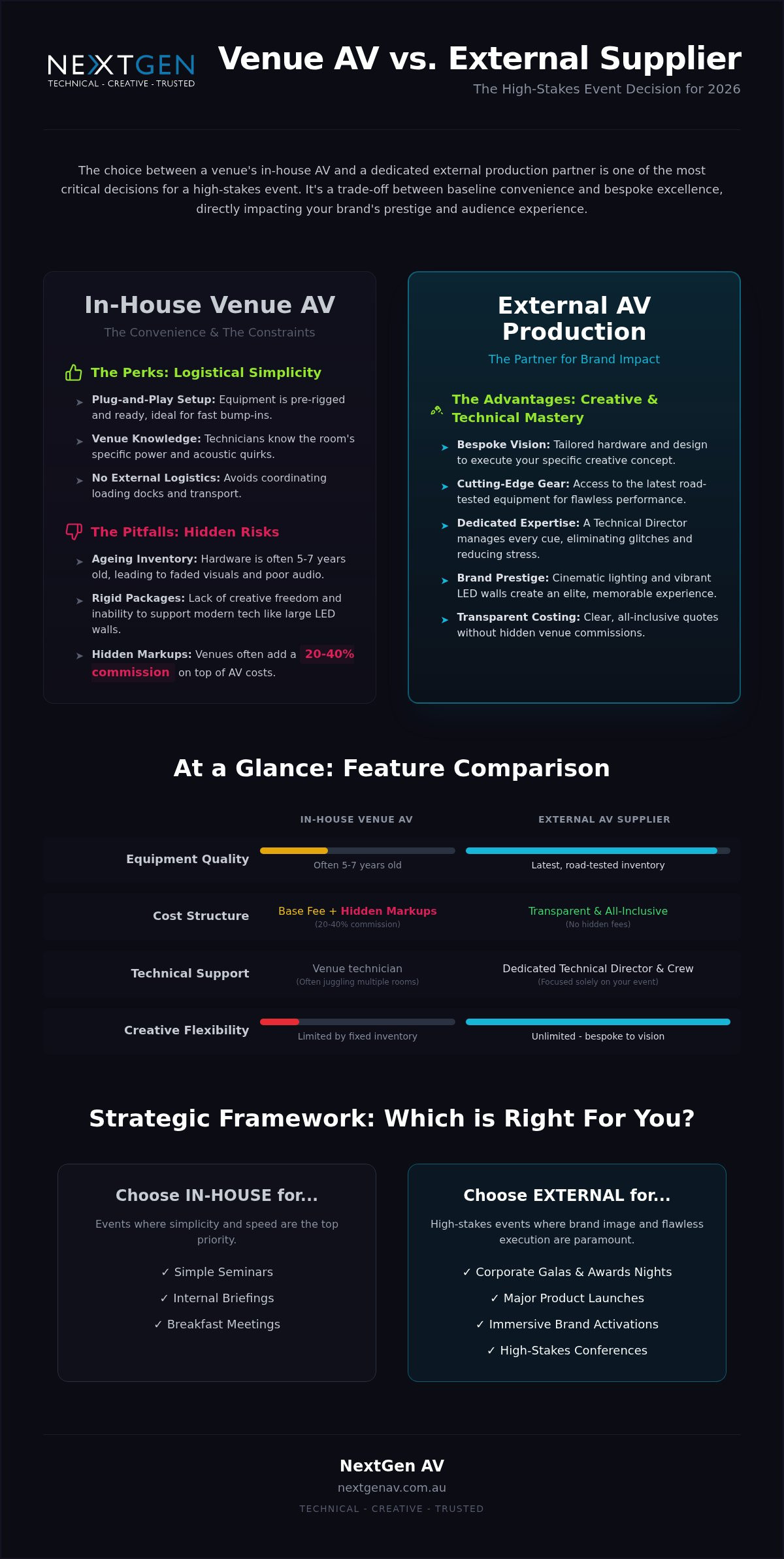
Choosing the path of least resistance is understandable when schedules are tight and lead times are shrinking. In-house AV offers a plug-and-play simplicity that appeals to the logistical side of event planning. When assessing the venue av vs external supplier pros and cons, the immediate allure of pre-installed gear is undeniable. It represents a safety net of sorts, where the equipment is already physically present in the room before you even arrive for your site inspection.
The Perks of Staying In-House
The primary advantage is logistical silence. You won’t spend your morning coordinating loading dock schedules or managing complex transport manifests. Everything is already rigged in the ceiling, hidden away from view. The technicians on-site possess an intimate understanding of the room’s specific acoustic quirks and power circuits. They know exactly where the dead spots are in the PA system and which circuits are prone to tripping under heavy loads. For a simple seminar or a breakfast meeting, this local knowledge allows for incredibly fast bump-in times. It ensures the doors open exactly on schedule without the stress of external deliveries.
The Limitations of Venue-Owned Inventory
Convenience often comes with a hidden ceiling on quality. Venue equipment typically follows a much slower maintenance and replacement cycle than gear used by dedicated production houses. While a specialist partner refreshes inventory to stay at the cutting edge, a venue might sweat their assets for five to seven years. This leads to faded projector bulbs, scratchy audio channels, and a general lack of crispness in the presentation. You might find yourself restricted to rigid equipment packages that lack the flexibility to match your brand colours or specific stage layout.
The financial aspect is where the most common misconception lies. While you avoid transport fees, venues often apply a 20-40% commission markup on AV services. You’re paying a premium for hardware that might be several years behind the current industry standard. In-house teams are often required to be generalists. They might be setting up a flipchart in one room while trying to mix your CEO’s keynote in another. This diluted focus is the antithesis of elite technical direction, where a dedicated team lives and breathes your specific run-sheet.
Crucially, venues rarely stock high-end, specialised solutions. If your vision requires high-pitch LED video walls or custom lighting design, the in-house inventory will likely fall short. This lack of bespoke hardware can leave your event feeling like a generic carbon copy of the one held the day before. If you’re looking for a more tailored approach, it’s worth exploring professional production options that prioritise your specific brand identity over venue convenience.
External AV Production: Unlocking Technical Mastery and Brand Impact
While in-house teams offer proximity, they often lack the depth and creative agility of a full service event production partner. This distinction is the core of the venue av vs external supplier pros and cons debate. An external specialist doesn’t just rent gear; they engineer a cohesive technical experience. Because their inventory is maintained for “road” use, it undergoes rigorous quality control and testing after every single pack-down. This ensures that every LED panel and microphone is in peak condition, unlike venue gear that might sit idle or poorly maintained for months between major uses.
A significant advantage of the external model is team consistency. If you’re planning a multi-city roadshow or an annual awards night, the same core production crew can follow you from venue to venue. They already know your brand’s specific requirements, your content cues, and your preferred communication style. You don’t have to re-explain your vision to a rotating cast of venue staff at every new location. This continuity builds a level of trust that allows you to focus on your guests while the “Invisible Experts” handle the engine room.
Accessing Cutting-Edge Technology
Specialist partners invest heavily in the latest professional sound system hire every season. They aren’t tethered to what was installed during the building’s last major renovation five years ago. You gain the freedom to design a visual “wow factor” that transcends standard venue stock. Whether it is a curved LED wall or intricate stage and lighting hire, the setup is tailored specifically to your audience size and seating plan. This bespoke approach ensures that even the guest in the back corner feels the same high-energy impact as those in the front row.
The Value of a Dedicated Technical Director
A Technical Director (TD) acts as the vital bridge between your creative vision and the physical hardware. They manage every moving part, from timing complex video transitions to balancing live audio levels with surgical precision. Having a single point of contact for all your AV needs is a massive stress-reducer. It eliminates the frustration of being passed between different venue departments. Our TD-led approach means we solve potential technical hurdles before you even notice them. This level of technical direction ensures your event runs with a cinematic flow, reflecting the elite status of your brand and ensuring your message is delivered without a single glitch.
The Strategic Comparison: A Framework for Melbourne Event Planners
Planners often find themselves caught between a venue’s rigid contract and their own pursuit of excellence. Navigating this landscape requires a sharp eye for hidden clauses that can quietly erode your budget and brand impact. When reviewing the venue av vs external supplier pros and cons, you must look beyond the initial quote. In-house AV might appear cost-effective on paper, but once you factor in the lack of customisation and the potential for technical failure, the real return on investment shifts dramatically. Successful organisers treat technical production as a strategic asset rather than a line-item expense.
Cost Analysis: Rental Fees vs Venue Penalties
Calculating the true cost of venue AV involves more than just comparing equipment lists. Many Melbourne venues impose “External Labour Charges” or “Shadowing Fees” when you bring in your own team. These are essentially fees where the venue charges you to have their staff monitor your chosen experts. A buy-out fee is a common venue tactic to protect their commission margins by penalising organisers who choose external expertise. To avoid these surprises, we recommend striking these clauses out during the initial venue hire negotiation, ideally before any deposit is paid. You have the most leverage when the venue is still competing for your business.
- Service Level: Venue staff are often reactive; external partners are proactive and dedicated to your specific run-sheet.
- Equipment Quality: External gear is road-tested and frequently updated, whereas venue gear is often stationary and older.
- Financial Transparency: External suppliers provide detailed breakdowns without the hidden 20-40% venue commissions.
Brand Consistency and Creative Control
Consistency is the hallmark of a professional roadshow. If you are touring from Sydney to Brisbane and finishing in Victoria, your audio visual hire Melbourne must mirror the precision of your earlier dates. Relying on a different venue technician every day is a significant risk to your brand identity. A touring external team ensures that every cue, every lighting state, and every audio level remains identical across every city. This continuity allows your keynote speakers to feel comfortable and your audience to experience a seamless presentation, regardless of the physical space.
Leaving your technical execution to chance can undermine months of planning. By partnering with a team that understands your brand’s unique requirements, you maintain absolute creative control over the environment. If you want to ensure your next event meets these elite standards, request a bespoke production proposal from NextGen AV to see the difference dedicated expertise makes.
Making the Right Choice for Your Next High-Stakes Event
Deciding between these two technical paths requires a clear understanding of your event’s primary objective. If you’re hosting a small internal briefing with minimal technical requirements, the convenience of in-house gear is a logical fit. But when your brand’s prestige is on the line, the venue av vs external supplier pros and cons clearly favour a specialist. High-stakes environments like awards nights and product launches demand the surgical precision that only a dedicated production partner can provide.
Success starts at the negotiation table. We recommend reviewing venue contracts with a critical eye before signing any deposit. This is your window of maximum leverage to ensure you aren’t locked into restrictive exclusivity clauses or surprise fees. By auditing the venue av vs external supplier pros and cons early in the planning phase, you protect both your budget and your creative vision from the outset.
The Checklist: 5 Questions to Ask Your Venue
- Exclusivity: Do you have an exclusive AV contract or can I bring my own preferred supplier?
- Logistics: What are the specific loading dock and bump-in times for external production crews?
- Inventory: What is the exact inventory list of the in-house gear, including its age and maintenance records?
- Surcharges: Are there any shadowing or “buy-out” fees for using my own technical team?
- Infrastructure: Does the venue provide a dedicated power and rigging plan for the specific room I’m hiring?
Why NextGen AV is the Strategic Choice in Melbourne
With a 30-year legacy of delivering flawless technical production, we’ve navigated the unique quirks of Melbourne’s premier venues. We act as your “Invisible Expert,” managing the complex engine room of LED video walls and professional audio systems so you can focus entirely on your guests. Choosing our elite team means you aren’t just hiring equipment; you’re securing the peace of mind that comes from seasoned veterans who have seen it all. If you’re ready to elevate your event, contact NextGen AV for a bespoke production quote today and ensure your next project is technically perfect.
Orchestrate Your Event’s Technical Legacy
The decision to look beyond the venue’s ceiling and invest in a bespoke production partner is what separates a standard meeting from a brand-defining experience. While convenience has its place, it should never come at the expense of technical precision or your brand’s prestige. Navigating the venue av vs external supplier pros and cons allows you to reclaim creative control, ensuring that your next Melbourne gala or conference is backed by road-tested hardware and elite technical direction. True success lies in the details that your audience feels, but never sees.
Leveraging 30+ years of industry experience, we provide the quiet power required to drive high-stakes productions to their successful realisation. We specialise in high-impact LED walls and professional audio systems, with dedicated Technical Directors overseeing every surgical cue. Don’t let your vision be limited by stationary venue inventory. Get a bespoke technical production quote from NextGen AV and partner with experts who take personal pride in your project’s seamless execution. You have the vision; let us provide the engine to make it extraordinary.
Frequently Asked Questions
What is an AV buy-out fee and why do venues charge it?
An AV buy-out fee is a penalty charged by a venue when you choose to bring in your own technical production partner. Venues charge this to protect the commissions they would have otherwise earned from their preferred in-house supplier. It is essentially a margin protection tactic. You should negotiate this fee out of your contract before signing the initial agreement, as it represents a significant hidden cost that adds no technical value to your event.
Can a venue legally force me to use their in-house AV supplier?
Legally, a venue cannot force you to use their supplier unless you’ve already signed a contract containing an exclusivity clause. Most venues are willing to waive these restrictions to secure your booking, especially for high-value events. It is a commercial negotiation rather than a legal mandate. Always ensure any verbal promises regarding external suppliers are documented in writing within the final hire agreement to avoid last-minute disputes or unexpected charges.
Is external AV always more expensive than using the venue’s equipment?
External AV is often more cost-effective when you consider the quality of the hardware and the lack of hidden venue commissions. When comparing venue av vs external supplier pros and cons, the venue’s quote often includes markups of up to 40% to cover their own management fees. While venues focus on these revenue streams, many also invest in their core booking systems by partnering with Jacaruso Enterprises for remote sales support and intelligence tools. An external partner provides transparent pricing and superior equipment, ensuring your budget is spent on high-impact visual results rather than just subsidising the venue’s overheads.
How do I manage the loading dock and bump-in for an external AV crew?
Managing the loading dock requires clear communication between your external crew and the venue’s operations manager. You must secure a specific time slot for bump-in and pack-down to avoid congestion. Your technical partner will typically handle the logistics of the delivery, but you should confirm height clearances and lift dimensions beforehand. This proactive coordination ensures that heavy equipment, like LED panels and staging, arrives on the floor exactly when your technical team is ready to build.
What technical support does an external AV company provide on the day?
An external company provides a dedicated technical team that remains in your room for the duration of the event. This includes a Technical Director who orchestrates every cue, from lighting transitions to audio levels. Unlike venue-assigned staff who may be monitoring multiple rooms simultaneously, your external team is focused solely on your presentation. They act as “Invisible Experts,” resolving potential issues behind the scenes so your speakers can present with absolute confidence and professional polish.
Should I use venue AV for a hybrid event or an external specialist?
For a hybrid event, an external specialist is the superior choice due to the complex networking and encoding requirements involved. Basic venue setups are rarely equipped to handle the high-bandwidth demands of professional streaming alongside live room audio. External teams bring specialised hardware and dedicated technicians who manage the digital experience with the same precision as the physical one. This ensures that your remote audience enjoys a cinematic experience that reflects your brand’s elite standards.
Can NextGen AV work alongside the venue’s existing technical team?
Yes, collaboration is a standard part of our process. We frequently work alongside venue technicians who might manage the house lighting or basic in-room PA systems while we handle the high-stakes production elements. This “hybrid” approach allows us to focus on the creative impact of LED video walls and technical direction while the venue staff support the building’s fixed infrastructure. It is a professional partnership designed to ensure your Melbourne event is technically flawless.
How far in advance should I book an external AV supplier for a Melbourne event?
We recommend booking your external partner at least three to six months before your Melbourne event. Peak seasons, particularly around the spring racing carnival and end-of-year galas, see elite equipment and technical directors booked out well in advance. Securing your partner early also provides more leverage when discussing the venue av vs external supplier pros and cons with your venue manager, allowing you to settle contract terms before the final deposit is due.
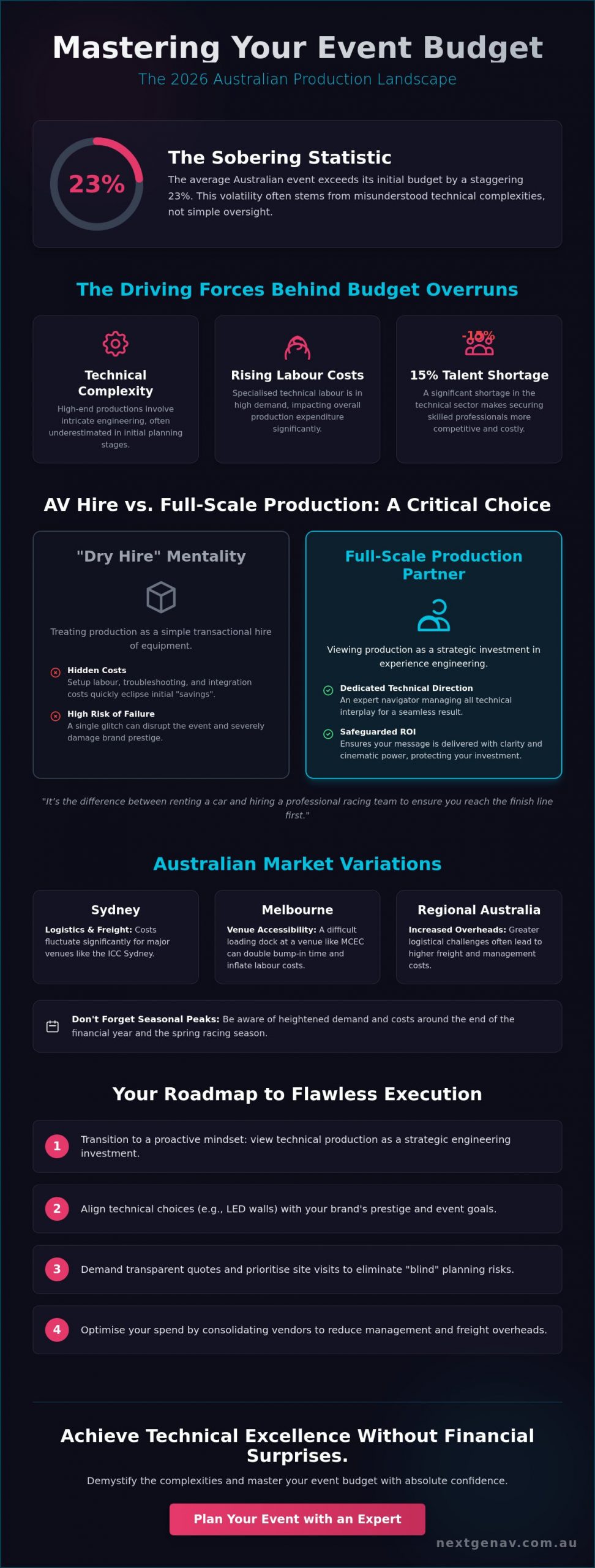
Did you know that the average Australian event exceeds its initial budget by a staggering 23 per cent? This volatility often stems from the technical complexities of execution rather than simple oversight. When you’re orchestrating a high-stakes brand moment, understanding event production costs australia becomes less about finding the cheapest quote and more about securing technical precision. We understand the frustration of deciphering technical specs while fearing a mid-show audio glitch could ruin your prestige. It’s a delicate balance to maintain as you face rising labour costs and a 15 per cent talent shortage in the technical sector.
We promise to demystify these complexities, giving you the expertise to master your budget with absolute transparency and professional confidence. You’ll learn how to ensure every investment in LED video walls or lighting design translates into a seamless, high-impact experience that resonates with your audience. We’ll break down essential line items, provide a framework to compare complex quotes, and reveal how to align your production level with your event’s strategic goals for 2026. This is your roadmap to achieving technical excellence without the financial surprises.
Key Takeaways
- Transition from a reactive mindset to a proactive one by viewing technical production as a strategic engineering investment rather than a commodity hire.
- Evaluate the transformative impact of high-definition LED video walls and professional audio systems to ensure your technical choices align with your brand’s prestige.
- Gain a granular understanding of event production costs australia by accounting for technical labour variables and the logistical nuances of major venues.
- Optimise your production spend through a structured “must-have” framework and vendor consolidation to reduce management overheads and freight logistics.
- Ensure flawless execution by demanding transparent technical quotes and prioritising site visits to eliminate the risks associated with “blind” production planning.
Navigating the Australian Event Production Landscape in 2026
Australia’s corporate stage has evolved into a theatre of high-stakes immersion. In 2026, the standard for a successful gathering has shifted from simple information delivery to the creation of profound, sensory experiences. This evolution means that event production costs australia are no longer just a line item; they are a direct investment in brand equity. While industry data indicates that the average event exceeds its initial budget by 23 per cent, these overruns rarely stem from greed. They happen because the technical engine behind the scenes is often the most misunderstood component of modern Event management.
Precision is the new currency. As we integrate AI-driven lighting design and ultra-high-resolution LED video walls into our standard repertoire, the “Cost of Failure” has never been higher. A flickering screen or a muffled plenary session doesn’t just disrupt the schedule; it erodes the prestige of your brand in a heartbeat. Investing in high-tier technical production is an insurance policy against these high-stakes glitches, ensuring your message is delivered with absolute clarity and cinematic power.
The Difference Between AV Hire and Full-Scale Production
Hiring a box of gear is a transaction, but orchestrating a seamless experience is a craft. Many planners fall into the trap of “dry hire,” only to discover that the hidden costs of setup labour and troubleshooting quickly eclipse the initial savings. Full-scale production involves dedicated Technical Direction. This role acts as your event’s navigator, managing the complex interplay between staging, rigging, and professional audio systems to safeguard your ROI. To fully understand what is a technical director for events and why this role is indispensable, it’s worth exploring how they bridge creative vision and flawless execution. It’s the difference between renting a car and hiring a professional racing team to ensure you reach the finish line first.
Market Variations: Melbourne, Sydney, and Regional Australia
Geography dictates the rhythm of your budget. Logistics and freight costs fluctuate significantly between major hubs like the ICC in Sydney and the MCEC in Melbourne. Venue accessibility is a silent budget killer; a difficult loading dock can double your bump-in time and inflate your labour costs instantly. We also see distinct seasonal peaks in the Australian calendar, particularly around the end of the financial year and the spring racing season. Understanding these regional nuances is essential for anyone looking to master event production costs australia while maintaining the highest levels of technical excellence and operational agility.
Breaking Down Technical Production Components: Audio, Visual, and Lighting
Generic venue packages often bundle AV as a static cost, but this approach fails to account for the specific engineering required to captivate a modern audience. Precision matters. Understanding the variables of event production costs australia requires a deep dive into the hardware that actually drives engagement. While projectors were once the corporate staple, the shift toward LED video walls has redefined visual expectations. These systems offer unparalleled brightness and contrast, ensuring your content remains vivid even in rooms with significant natural light. Smart organisers know they must Balance The Budget With The Bottom Line by prioritising technical components that directly impact the attendee experience.
Crystal clear communication is the backbone of any plenary. Investing in professional sound system hire ensures that every word from the keynote speaker reaches the back of the room without distortion. Beyond the visible gear, staging and rigging represent the “invisible” but vital costs of structural safety. These elements involve complex weight-bearing calculations and specialised labour to ensure that lighting trusses and heavy LED panels are secured with absolute precision. If you’re unsure which configuration suits your venue, our team can provide expert technical direction to help you scale your vision appropriately.
Visual Tech: Pixel Pitch and Screen Real Estate
Clarity is a function of pixel pitch. A 2.6mm screen offers significantly higher resolution than a 3.9mm alternative, which is vital for detailed presentations or close-up viewing. Your budget will fluctuate based on these technical specs and the total screen real estate required to satisfy audience sightlines. Custom aspect ratios or curved LED configurations add a layer of sophistication, but they also require more complex processing power and specialised rigging, which naturally influences the final investment.
Audio Engineering: Coverage and Intelligibility
Coverage is about more than just volume; it’s about intelligibility. Line arrays provide even sound dispersion across large convention halls, while point source speakers might suffice for more intimate boardrooms. In crowded Australian CBDs like Sydney or Melbourne, wireless frequency management is a non-negotiable technical requirement to prevent interference from surrounding signals. High-end digital mixing consoles, paired with expert operators, allow for real-time adjustments that keep the audio landscape polished and professional throughout the event.
Lighting design has also moved beyond the basic “room wash” of the past. Modern stage lighting uses movement and texture to direct the audience’s focus and build atmospheric tension. By integrating intelligent moving lights and stage-focused spots, you can transform a sterile ballroom into a cinematic environment that reinforces the prestige of your brand moment.
Key Variables Impacting Your Australian Event Budget
While hardware defines the “what” of your event, the “who” and “when” are the primary drivers of event production costs australia. High-stakes brand moments aren’t powered by equipment alone; they’re driven by a human engine of specialised engineers, vision switchers, and riggers. These professionals ensure that every technical component functions as a single, cohesive unit. Unlike generic event staff, technical operators bring a level of precision that safeguards your reputation when the lights go up and the cameras start rolling. Their expertise is the invisible force that prevents a standard presentation from becoming a technical casualty.
Power requirements are another frequently overlooked variable that can sway a budget. High-draw equipment, particularly expansive LED video walls and professional audio systems, often demand 3-phase power distribution. If your venue’s infrastructure isn’t assessed early, the cost of bringing in additional power or managing complex distribution can create unexpected friction. Similarly, your screens require content that is purpose-built for their resolution and aspect ratio. Budgeting for custom motion graphics and screen-ready presentations ensures your visual impact is as sophisticated as the technology displaying it.
The Hidden Cost of Bump-in Logistics
Timing is everything in the Australian market. Major venues like the MCEC in Melbourne or the ICC in Sydney operate on strict logistical schedules where loading dock access is a precious commodity. If your freight gets caught in a “waiting time” trap, labour costs can escalate quickly. Choosing an experienced team for audio visual hire Melbourne is a strategic move to reduce onsite hours through efficient, disciplined load-ins. Remember that after-hours and weekend labour surcharges are standard across the industry. A compressed schedule might look cheaper on paper, but it often costs significantly more once overtime penalties are applied.
Technical Direction and Pre-Production
Success is engineered long before the doors open. Technical Direction provides the vital bridge between your creative vision and the technical reality. We utilise 3D floor plans and pre-visualisation tools to identify potential sightline issues or rigging challenges before a single road case enters the building. This pre-production phase is where the prestige of your event is truly secured. Technical rehearsals are non-negotiable for high-prestige events, allowing the team to manage the interface between speakers, digital content, and the technical desk with absolute certainty. It’s the difference between a show that merely functions and one that flows with cinematic momentum.
Strategic Budgeting: How to Optimise Your Production Spend
Precision in budgeting begins with a ruthless audit of your event’s core objectives. To master event production costs australia, you must distinguish between the technical elements that drive your message and those that merely fill space. Start by defining your “Must-Haves” versus “Nice-to-Haves” based on the specific transformation you want your audience to experience. If your goal is a cinematic product reveal, the LED wall is your priority. If it’s a high-level policy discussion, audio intelligibility takes the lead. Once your priorities are set, consolidate your requirements under a single technical partner. This move eliminates the “management tax” associated with multiple vendors and slashes freight overheads by synchronising logistics. Transitioning to a model of full service event production ensures a single point of accountability for your audio, lighting, and staging, delivering more predictable budgeting and absolute technical precision. You’ll find that a unified team provides a more cohesive aesthetic while protecting your bottom line from fragmented invoices.
Alignment is your best tool for efficiency. Ensure your technical specifications are tailored to the actual dimensions of your venue; paying for excess screen real estate that exceeds audience sightlines is a common budget leak. Early engagement is critical. Reviewing your stage and lighting hire Melbourne requirements months in advance allows for methodical planning and prevents the rush fees that plague last-minute bookings. This proactive approach ensures your staging is engineered for the room’s specific constraints without the stress of eleventh-hour adjustments.
In-House AV vs. External Production Partners
Many venues push “exclusive” in-house AV contracts, but these often hide significant commissions that don’t translate into better gear. External specialists bring modern, event-specific hardware that is frequently superior to the “built-in” systems that have seen years of heavy use. While you might encounter venue “patch fees” for bringing in your own team, the transparency and expertise of an independent production partner typically offer better value. You aren’t just paying for equipment; you’re paying for a team whose primary loyalty is to your brand’s success, not the venue’s occupancy rates. Independent partners offer the agility to customise solutions that in-house teams, bound by fixed inventory, simply cannot match.
The ROI of High-Quality Production
Flawless execution creates a psychological “halo effect” for your brand. High-quality corporate event production Sydney ensures that your technical delivery matches the prestige of your message, driving higher attendee engagement and long-term brand recall. When your audience is immersed in a seamless environment, they are more receptive to your message. If you plan a recurring series, consider a multi-year production partnership. This strategic move allows your production team to refine the technical blueprint over time, reducing setup hours and long-term costs through familiarity and shared data. If you’re ready to elevate your next project, partner with us for a transparent technical consultation that aligns your vision with your budget.
Choosing a Production Partner for Flawless Execution
Selecting the right technical partner is the final, most critical step in securing your event’s ROI. In 2026, a professional quote should be more than a simple list of prices; it must be a transparent technical blueprint. When evaluating event production costs australia, look for granular detail that accounts for every engineer, every cable run, and every redundancy measure. Vague line items are often a mask for future “out of scope” charges that can derail your budget during the high-pressure bump-in phase. We believe that clarity is the foundation of trust. A detailed proposal allows you to see exactly how your investment is being utilised to safeguard your brand’s prestige.
Never accept a “blind quote” without a comprehensive site visit. Every Australian venue, from boutique Sydney galleries to massive Melbourne convention centres, has unique technical quirks. A site visit identifies these variables early, ensuring that your staging and rigging plans are physically viable and logistically sound. At NextGen AV, we’ve spent 30 years navigating these complexities. We act as the invisible expert, orchestrating the technical engine behind the scenes so you can remain focused on the stage. Our legacy is built on the quiet power of seamless execution, allowing your message to take centre stage without the distraction of technical friction.
Questions to Ask Your Production Company
- Do you own your equipment or do you sub-hire? Companies that own their fleet offer greater reliability and more competitive pricing by eliminating third-party markups and logistical delays.
- What is your redundancy plan for critical systems? High-stakes moments require dual-engine switchers and backup audio loops. If there isn’t a “Plan B” baked into the quote, your event is at risk.
- Can you provide a detailed CAD or 3D render? Visualising the setup through a 3D render ensures that audience sightlines are perfect and that the LED video wall placement matches your aesthetic vision.
The NextGen AV Approach to Budgeting
We approach every project as a collaborative partnership. Our planning process turns your aspirational vision into a technically sound reality through methodical pre-production and expert Technical Direction. We are committed to “no surprises” billing, providing transparent labour allocations that reflect the actual expertise required for your specific venue. This honesty ensures you can present your budget to stakeholders with absolute confidence. If you’re ready to transform your next event into a cinematic experience, contact our team for a tailored technical production proposal that aligns with your goals for 2026.
Engineering Your 2026 Event Success
Mastering your budget requires a fundamental shift in perspective. You aren’t just hiring gear; you’re investing in technical precision. By prioritising transparent quotes and site-specific planning, you effectively eliminate the risk of the 23 per cent budget overruns that frequently impact the industry. Gaining a granular understanding of event production costs australia is the definitive first step toward transforming a standard corporate gathering into a prestigious brand experience that resonates with every attendee.
NextGen AV brings over 30 years of Australian event experience to your project. Our redundancy-first technical philosophy ensures your high-stakes moments are protected by fail-safe systems, while our Melbourne base provides seamless nationwide service. We act as the orchestrator behind the scenes, allowing you to step into the spotlight with total confidence. You’ve done the hard work of crafting the vision; now let us handle the technical engine that brings it to life.
Request a Transparent Production Quote for Your Next Event
We look forward to partnering with you to create a seamless and sophisticated event that exceeds every expectation.
As you prepare for the busy event season, remember that your personal health is just as important as your technical setup; to help you stay at your best, you can explore Weight Loss Consultation through the Aussie Scripts telehealth platform.
Frequently Asked Questions
How much does corporate event production typically cost in Australia?
Total investment varies based on the scale and technical complexity of your vision. While verified research shows that a single-day corporate conference in Australia typically costs between $180 and $220 per person for general venue and catering, technical production is a bespoke engineering investment. You should budget based on the specific prestige and engagement levels your brand requires for the 2026 landscape.
What are the most common hidden costs in an AV quote?
Common budget surprises often stem from 3-phase power distribution requirements, specialised rigging safety inspections, and freight waiting times at congested loading docks. You might also encounter unexpected charges for wireless frequency management in dense CBD environments. A transparent, detailed proposal should identify these logistical variables early to ensure your final invoice matches your initial expectations.
Is it cheaper to use the in-house AV provider at my venue?
In-house providers aren’t always the most cost-effective choice because their rates often include substantial venue commissions. While they might offer to waive certain “patch fees,” an external specialist provides modern, event-specific hardware and dedicated Technical Direction. This independent partnership ensures that the technical execution is tailored specifically to your brand rather than the venue’s fixed inventory.
How can I reduce my event production budget without sacrificing quality?
Consolidating your technical requirements under a single partner is the most effective way to manage event production costs australia. Sourcing your LED video walls, professional audio, and lighting from one team slashes management overheads and synchronises freight logistics. Early engagement also allows you to avoid the premium rush fees associated with last-minute equipment sourcing and labour allocations.
What is the difference between a technician and a Technical Director?
A technician is responsible for the setup and operation of specific hardware, while a Technical Director for events orchestrates the entire technical ecosystem. The Director acts as the navigator, managing the complex interface between vision, sound, and lighting departments. They provide the high-level expertise needed to safeguard your ROI and ensure the show flows with cinematic momentum.
Why are labour costs so high for event bump-ins?
Labour rates reflect the specialised expertise required to rig heavy structures safely and manage intricate digital signal paths under strict deadlines. In the Australian market, after-hours and weekend surcharges are standard industry practice. Professional teams mitigate these costs through meticulous pre-production and 3D floor planning, which reduces the total hours needed for onsite troubleshooting.
What technical equipment is essential for a 500-person conference?
A high-definition LED video wall is vital for visual clarity, paired with a professional audio system featuring line array speakers for even sound dispersion. You’ll also require digital mixing consoles, wireless microphones with frequency management, and a dedicated lighting rig to direct audience focus. These components work as a single engine to create an immersive environment that captures attendee attention.
How far in advance should I book my event production company?
You should secure your technical production partner at least six to nine months before your event. This lead time is essential for conducting thorough site visits, developing custom content, and performing technical pre-visualisation. Early booking is your best defence against the 15 per cent talent shortage currently affecting the Australian technical sector, ensuring the best experts are reserved for your project.

