
Event health and safety AV requirements begin with a clear emergency plan, a site walk-through and documented checks of electrical equipment, structures, access routes and supplier risks. Map exits and safety zones, define staff communication procedures and make emergency instructions easy to find. These steps turn potential hazards into practical controls before the event opens.
It’s easy to focus on the stage, screens and sound, but a safe event depends on how every part of the site works together. Planning for emergencies and reviewing supplier documents early give your team a clearer picture of risks during bump-in, the event and bump-out.
This guide explains how to prepare an emergency plan, review AV risk assessments and method statements, and manage hazards involving temporary structures, power, fire and weather. Use it as a practical framework for coordinating technical details and keeping the event running safely.
Key Takeaways
- Plan electrical safety around tested equipment, secure leads and suitable residual current devices.
- Make emergency procedures clear, map exits and safety zones, and consider how the public will receive announcements.
- Use supplier risk assessments and method statements to clarify hazards, controls and responsibilities before work begins.
- Assess structures, fire, power and weather together so site conditions inform safe setup and operation.
1. Why should you hire an AV company to ensure your audio-visual equipment is health and safety compliant?
Electrical faults can disrupt a production and put crew or attendees at risk. Before setup, inspect power leads, plugs, connectors and equipment casings for damage. Remove faulty items from use and arrange appropriate testing and tagging. Plan residual current device protection for the electrical setup, and keep distribution points accessible to authorised crew. These checks help address hazards before equipment reaches the stage.
During a Melbourne site walk-through, trace each cable route from its power source to the equipment. Secure crossings and keep leads clear of entrances, walkways, toilets and emergency exits to reduce trip hazards. Recheck routes after furniture or staging moves, as a previously clear path can become obstructed during bump-in.
The qualifications AV technicians need depend on their duties. For high-risk rigging, use a qualified rigger with a High-Risk Work Licence. Confirm who directs each task and ensure the crew follows the structure’s documented load limits. Heavy speakers, screens and lighting fixtures require controlled lifting and secure placement, not improvised handling.
Manual-handling risks increase during bump-in and bump-out, when cases and equipment move through busy access routes. Plan the route, identify pinch points and coordinate lifts before equipment leaves its case. A clear sequence reduces congestion around crew and audience areas. Event lighting can also illuminate walkways, exits and hazards, helping people move safely through the venue.
Before doors open, inspect the installed AV system again. Check that equipment is stable, leads are secured and access routes are clear. Test lighting and sound during the same walk-through, then record faults and corrective actions. These checks support a controlled technical setup and help protect the audience experience.
2. How To Write An Event Emergency Plan?
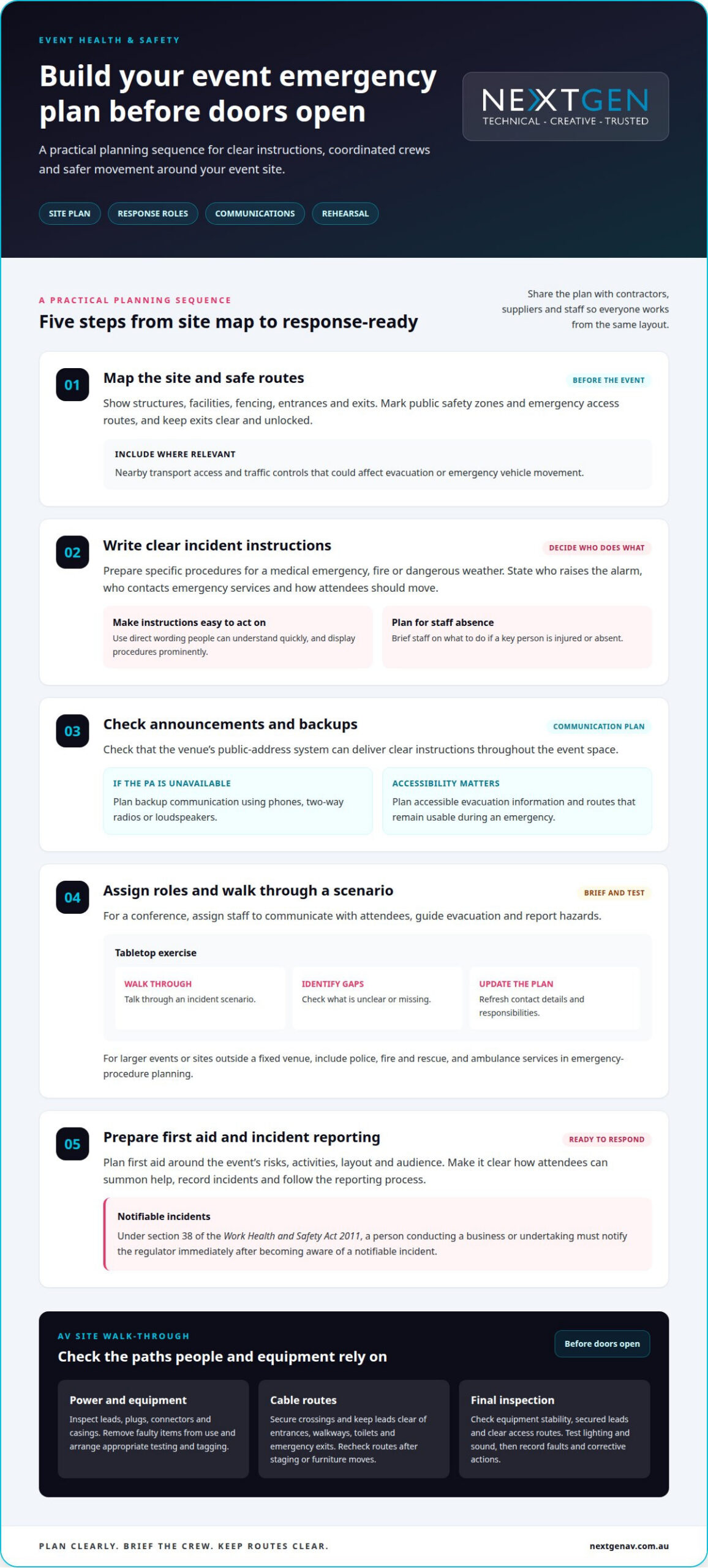
Start with a site plan showing structures, facilities, fencing, entrances and exits. Share it with event contractors, suppliers and staff so everyone works from the same layout. Mark public safety zones and emergency access routes, then keep exits clear and unlocked. Include nearby transport access and traffic controls where they could affect evacuation or emergency vehicle movement.
Write instructions for specific incidents, such as a medical emergency, fire or dangerous weather. State who raises the alarm, who contacts emergency services and how attendees should move. Display procedures prominently, and brief staff on what to do if a key person is injured or absent. Use direct wording that people can understand quickly.
Check that the venue’s public-address system can deliver clear instructions throughout the event space. Prepare a backup communication plan using phones, two-way radios or loudspeakers if the PA is unavailable. What emergency, backup and accessibility provisions should event AV include? Plan clear announcements, alternative communication channels, accessible evacuation information and routes that remain usable during an emergency.
For a conference, assign staff to communicate with attendees, guide evacuation and report hazards. Test the plan with a tabletop exercise: walk through a scenario, identify gaps, then update contact details and responsibilities. For larger events or sites outside a fixed venue, include police, fire and rescue, and ambulance services in emergency-procedure planning.
Plan first aid around the event’s risks, activities, layout and audience, and make it clear how attendees can summon help. Record incidents and follow the reporting process. Under section 38 of the Work Health and Safety Act 2011, a person conducting a business or undertaking must notify the regulator immediately after becoming aware of a notifiable incident. For events with remote or online participants, virtual and hybrid event solutions can help integrate clear audience communications into the production plan.
3. Supplier and AV-company risk assessments and method statements
A supplier risk assessment should connect each AV task with its hazards and controls. For a conference, assess equipment delivery, installation, operation and pack-down separately. A method statement then sets out the work sequence, access arrangements, equipment and crew responsibilities. Organisers should request both documents from suppliers before bump-in. These assessments turn event health and safety AV requirements into practical steps for each production task.
In the ACT, a PCBU is responsible for systematically identifying event hazards, assessing risks and eliminating them. Organisers and AV suppliers should clarify who manages each task and coordinate where responsibilities overlap. A clear event profile helps define the work: describe activities, audience needs, site conditions, vehicles, access routes and the planned technical setup.
For AV setups, assess the actual tasks and site hazards, including electrical work, manual handling, noise, work at height, rigging and public access. Record each control, who is responsible and how the team will check it during delivery. This task-based approach makes event health and safety AV requirements specific to the production and site.
Organisers can turn controls into practical checks with a safety checklist. Before installing a screen, for example, confirm the setup area, access route, equipment position and crew coordination. For suspended equipment, document the structure, rigging method, exclusion area and supervision arrangements. At festivals, assess traffic flow and separate people from vehicle routes.
Keep assessments up to date. A changed stage layout, weather condition or delivery route can introduce new hazards, so review documents when site conditions or work plans change. Assign someone to record updates and brief affected crews. A one-to-five risk scale can help prioritise hazards, but every rating must lead to specific controls.
Before work starts, confirm suppliers understand the controls and reporting process. During setup, supervisors can compare site conditions with the method statement, pause work if conditions change and record corrective actions. This creates a traceable safety process across suppliers and event teams.
4. Temporary structures, power, fire, and weather hazards
Indoor events still need plans for structures, power, fire and clear access routes. Outdoor sites also face changing weather, ground conditions and wind exposure. In Melbourne, assess how these conditions could affect stages, marquees, lighting, screens and nearby workers. The organiser coordinates controls across the site, including safe access for attendees and contractors.
Indoor and outdoor AV requirements differ: outdoor setups face changing weather and ground conditions, while indoor setups must account for venue layouts and exit routes. In either setting, consider how conditions affect equipment stability, access and evacuation, then include relevant controls in the site plan.
For temporary stages, screens, lighting rigs and truss, follow work health and safety requirements and relevant Australian Standards, particularly for working at heights and setting up scaffolding and staging. Applicable requirements depend on the work and structure. Include power distribution and electrical equipment in the same site assessment.
Secure AV cables away from pedestrian routes, doors and emergency exits. Where a crossing cannot be avoided, use suitable cable protection and make the route visible. Trace cables from power sources to equipment during site inspections, then recheck them after staging, lighting or audience layouts change.
Assess fire access, weather exposure, first aid arrangements and security alongside the technical setup. Keep emergency routes accessible when positioning a stage or temporary structure, and brief trained workers on the event’s weather procedures. If conditions affect a structure or equipment, pause the relevant work and follow the agreed control plan.
For temporary stages or suspended equipment, plan staging and rigging around site conditions, equipment loads and safe access requirements.
NextGen AV: Virtual and Hybrid Event Solutions
NextGen AV coordinates technical production for events where audience experience and site safety need to work together. Its Virtual and Hybrid Event Solutions connect in-person and remote audiences, while Professional Audio Systems help deliver clear communication across the room.
For a live setup, LED Video Walls, Lighting Design and Equipment, and Staging and Rigging can be coordinated with the event plan. This connects production requirements to access routes, equipment placement and agreed safety controls, rather than treating each technical element in isolation.
Bring NextGen AV into planning when your event needs coordinated technical direction across its venue, audience and production requirements. Contact NextGen AV to discuss your event.
Build safety into the production plan
Make safety part of the event’s creative brief, not a final approval step. When event health and safety AV requirements shape decisions early, production choices can support clear communication, accessible movement and a controlled site setup. This gives your team room to focus on the audience experience while technical details are coordinated behind the scenes.
NextGen AV can coordinate LED Video Walls, Professional Audio Systems and Lighting Design and Equipment with your event’s production needs. Bring the team into planning when your concept involves complex technical elements or calls for a joined-up approach to the live experience.
Contact NextGen AV about event safety and discuss how to plan your next production with confidence.
Frequently Asked Questions
How To Write An Event Emergency Plan?
Start with the event’s most disruptive scenarios and define the decisions each one triggers. For a keynote, for example, consider what happens if a technical fault pauses the program while attendees remain in the room. Set out how the event can resume, relocate or close, and review those decisions whenever the program or venue changes.
Why should you hire an AV company to ensure your audio-visual equipment is health and safety compliant?
An AV production team can connect technical planning with the event’s run sheet, venue conditions and audience experience. This is useful for complex programs with several presenters, screen changes or tightly timed transitions. A coordinated production plan aligns technical decisions with the event’s overall operation, rather than treating each system as an isolated requirement.
What electrical safety rules apply to event AV equipment in Australia?
For a Melbourne event, set electrical controls in line with applicable Victorian requirements and venue procedures. The electrical plan should identify who controls power distribution, isolation, equipment checks and residual current device protection. This gives crew a clear process for responding to a fault and keeps electrical decisions aligned with the site and production setup.
How should AV cables be managed to prevent trips at events?
Plan cable routes alongside the technical layout, placing connection points to minimise crossings through public areas. Keep signal and power runs organised at equipment positions so crew can identify connections during setup and pack-down. If a layout change creates a new crossing, update the route before the area returns to attendee use.
What safety requirements apply to temporary stages, screens, lighting rigs and truss?
Base the structural plan on the intended configuration, equipment and site conditions. Keep relevant engineering documentation with the event records and ensure it reflects the structure actually installed. If the design or equipment arrangement changes, assess the revised configuration before use. This links structural decisions to the event’s documented safety controls.
What Australian standards apply to event rigging and temporary electrical installations?
Follow relevant Australian Standards for work at heights and setting up scaffolding and staging. For electrical equipment, arrange appropriate testing and tagging, and plan residual current device protection.
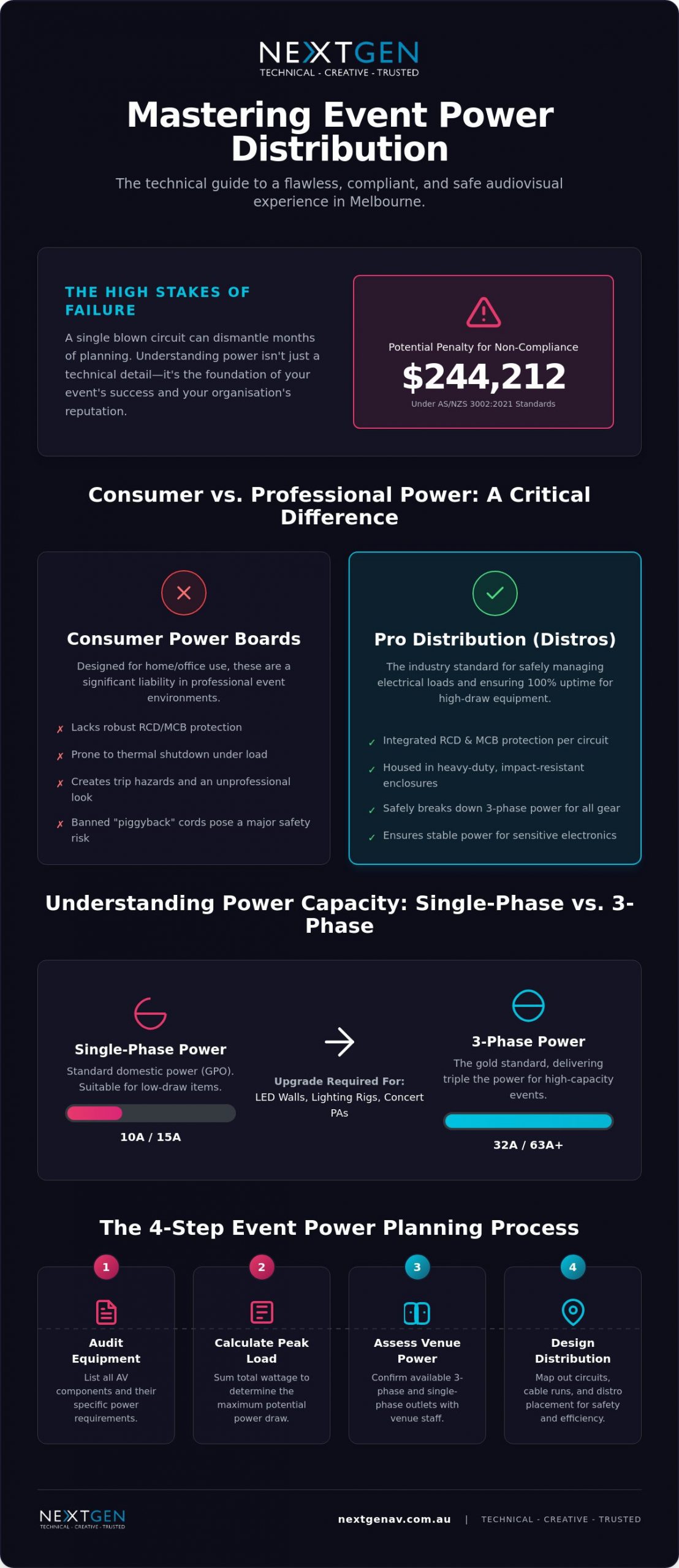
A single blown circuit doesn’t just cut the lights; it can instantly dismantle months of meticulous planning and expose your organisation to non-compliance penalties of up to $244,212. You’ve likely felt that sharp spike of adrenaline when a high-draw LED wall flickers or felt the weight of compliance anxiety regarding the latest Victorian safety standards. It’s a high-stakes environment where the difference between a standing ovation and a silent room often comes down to the invisible infrastructure humming beneath the stage. Mastering your event audiovisual integration in Melbourne requires more than just high-end hardware. It demands a precision-engineered power strategy that ensures your technical setup remains flawless while staying strictly within mandatory AS/NZS 3002:2021 regulations.
We understand that the logistics of 3-phase requirements and cable management can feel overwhelming. This guide will demystify the complexities of professional power distribution, from RCD protection to the ban on piggyback cords. You’ll discover how to secure a clean, professional aesthetic that eliminates trip hazards and protects your brand’s reputation through quiet, technical mastery. We’ll walk you through the essential safety benchmarks and distribution solutions that turn a potential technical failure into a seamless, prestigious experience.
Key Takeaways
- Understand why standard wall sockets often fail under the pressure of professional events and how specialised distribution creates a reliable technical foundation.
- Learn the critical differences between single-phase and 3-phase power to ensure your high-draw equipment has the necessary capacity to perform flawlessly.
- Gain clarity on mandatory AS/NZS 3002:2021 standards to protect your organisation from significant non-compliance penalties and safety risks.
- Master the step-by-step power audit process for accurately calculating peak wattage and assessing venue capacity before your event begins.
- Discover how sophisticated event audiovisual integration melbourne services seamlessly blend power management with high-end hardware for an uninterrupted audience experience.
What is Event Power Distribution and Why is it Critical?
Most event attendees only notice the brilliance of a high-definition screen or the clarity of a keynote speaker. They don’t see the complex web of copper and silicon humming beneath the floorboards. Event power distribution is the specialised infrastructure used to safely route electricity from a primary source to multiple high-draw AV components. It acts as the silent engine of your production. While it remains invisible when functioning perfectly, its absence or failure is impossible to ignore. In the high-stakes world of event audiovisual integration melbourne, precision power isn’t a luxury; it’s the foundation of your brand’s technical reputation.
Standard wall sockets, known as General Purpose Outlets (GPOs), are perfectly adequate for charging a laptop or running a coffee machine. However, they frequently fail to meet the rigorous demands of professional sound system hire and modern lighting rigs. These consumer-grade circuits aren’t designed for sustained, high-amperage loads. When pushed to their limit, they can cause voltage sags that lead to audio distortion or, worse, a complete thermal shutdown mid-presentation. This is where the ‘Invisible Expert’ steps in. With 30 years of experience navigating Melbourne’s most complex venues, we ensure that your power grid is engineered to handle peak loads without a flicker.
The Difference Between Consumer and Professional Gear
Using “home-office” power boards in a professional environment is a significant liability. These plastic strips lack the robust protection needed to manage the surge currents common in large-scale productions. Event Power Distribution is the calculated management of electrical loads to ensure 100% uptime. Pro-grade distribution boards (Distros) utilise high-quality Residual Current Devices (RCDs) and Miniature Circuit Breakers (MCBs) housed in heavy-duty, impact-resistant enclosures. While a venue might provide raw 3-Phase Power, it’s the specialised distribution gear that safely breaks that energy down into usable, protected circuits for your delicate equipment.
Protecting Your Technical Investment
Sensitive electronics are vulnerable to the slightest inconsistency in electrical supply. Unstable power is the primary cause of hardware failure, often frying the delicate internal processors of LED video walls or causing permanent damage to digital mixing consoles. The cost of failure is immense, not just in repair bills, but in the lost momentum of your event. Choosing “cheap” power solutions is often the most expensive mistake an organiser can make. By prioritising professional distribution, you gain the peace of mind to focus on the stage and your audience, confident that the invisible backbone of your event is being managed with absolute technical mastery.
The Technical Core: 3-Phase Power vs. Single Phase
Understanding the electrical architecture of your venue is the first step toward a stable production. While a standard domestic plug provides single-phase power suitable for small displays or a single speaker, large-scale events require a far more robust solution. High-capacity events rely on 3-phase power to deliver the massive energy required by modern technical rigs. This system provides three separate alternating currents, allowing us to deliver triple the power of a single-phase circuit through a single connection point. It is the gold standard for full service event production, providing the headroom necessary for high-intensity moments without risking a total blackout.
When Do You Need 3-Phase Power?
If your floor plan includes large-scale LED walls, moving head lighting rigs, or concert-grade PA systems, a standard 10A or 15A outlet simply won’t suffice. These components draw significant current, especially during “peak” moments like a sudden lighting flash or a heavy bass drop. We typically scale our distribution based on the total calculated draw, moving from 20A single-phase leads up to 32A or 63A 3-phase connections for major activations. Many Melbourne venues, particularly heritage buildings or smaller galleries, have strict power limitations. Identifying these constraints early allows us to organise supplementary generators or clever distribution strategies to ensure your technical vision isn’t compromised by the building’s infrastructure.
Load Balancing for Flawless Execution
Effective Planning Your Event Power involves more than just finding enough sockets; it requires the science of load balancing. This process involves distributing the electrical “weight” evenly across all three phases of the supply. If one phase is overloaded while others remain empty, the main breaker will trip even if you haven’t reached the venue’s total capacity. Precision balancing is also critical for audio clarity. By separating “dirty” power used for lighting motors and LED processors from “clean” audio circuits, we eliminate the dreaded 50Hz hum and electromagnetic interference that can ruin a professional recording.
Our technicians create a comprehensive “Power Plot” during the pre-production phase of every event audiovisual integration melbourne project. This document maps every watt to a specific circuit, ensuring we never approach the danger zone of a breaker’s limit. For mission-critical segments, such as a live broadcast or a CEO’s keynote, we implement Uninterruptible Power Supplies (UPS). These battery backups provide a vital buffer, offering instantaneous protection against voltage spikes or momentary venue power drops. This level of technical foresight is what defines our role as the “Invisible Expert,” allowing you to partner with a team that prioritises the safety of your presentation above all else.
Safety and Compliance: Navigating Australian Standards
Managing the electrical safety of a large-scale activation requires more than a casual glance at a few plastic tags. In Victoria, the regulatory landscape is stringent, and for good reason. Energy Safe Victoria (ESV) oversees electrical safety with a focus on preventing the catastrophic risks associated with faulty temporary installations. When executing high-end event audiovisual integration melbourne, compliance isn’t just about avoiding a fine. It’s about the duty of care you owe to every attendee, performer, and crew member on-site. We take this responsibility seriously, acting as the vigilant guardian of your event’s technical integrity.
AS/NZS 3002:2021 is the governing standard that dictates how temporary electrical installations must be designed and maintained. This isn’t a suggestion. AS/NZS 3002 compliance is a legal requirement for any temporary event structure in Victoria. While many providers stop at basic “test and tag” procedures, our approach looks at the entire system architecture to ensure every link in the chain is resilient. We ensure your setup is not only functional but fully defensible under Australian law.
AS/NZS 3002: What Every Melbourne Planner Should Know
The standard mandates that all electrical equipment rated 32 Amps and below must be protected by a Residual Current Device (RCD). These life-saving switches cut power instantly if a fault is detected, preventing electric shock and potential fire hazards. For larger installations involving generators or complex tie-ins, you may also require a temporary power certificate. This document serves as professional verification that your setup meets all safety benchmarks before the first guest arrives, providing a paper trail of absolute competence.
Public Safety and Cable Protection
Messy cabling is more than just an eyesore; it’s a primary cause of workplace injuries and technical failure. We prioritise a clean, professional aesthetic by organising the “spaghetti” into structured, logical runs. Using heavy-duty “Yellow Jackets” and cable ramps ensures that high-traffic areas remain safe while protecting the integrity of your infrastructure. This is particularly vital when integrating stage and lighting hire, where power cables often need to traverse public walkways or be secured precisely to overhead rigging.
Outdoor events in Melbourne present their own unique challenges. Our unpredictable weather requires specialised weatherproofing for all distribution boards and connection points. From IP-rated enclosures to elevated cable runs that avoid pooling water, we plan for every contingency. This proactive management allows you to celebrate the success of your event without the lingering fear of a safety breach or a rain-induced short circuit. You focus on the prestige of the final result while we handle the technical rigour behind the scenes.
Planning Your Event Power Grid: A Step-by-Step Guide
Precision planning is the antidote to event-day stress. While we have already established the legal benchmarks for safety, this stage is where we translate those standards into a high-performance reality. Designing a power grid for a major activation requires a methodical approach that accounts for every watt before a single cable is laid. Our role as the “Invisible Expert” is to architect this infrastructure so that your event audiovisual integration melbourne remains robust, responsive, and entirely uninterrupted.
- Step 1: The Power Audit. We begin by listing every technical component, from high-draw LED processors to the smallest charging station.
- Step 2: Venue Assessment. We identify primary “tie-in” points and board capacities to ensure the building can support your vision.
- Step 3: Creating the Distribution Map. This is the technical blueprint that plots exactly where every drop-box and cable run will live.
- Step 4: On-site Testing. We conduct rigorous stress-tests before the doors open, simulating peak loads to verify system stability.
The Power Audit: Calculating Your Draw
Meticulous documentation is the foundation of a successful power strategy. We don’t just look at the labels for Watts, Amps, and Volts; we account for the “Inrush Current.” This is the momentary surge of power that occurs when equipment is first switched on, which can frequently trip breakers even if the sustained load is within limits. This calculation is especially vital for hybrid event staging solutions, where streaming racks and broadcast equipment require dedicated, isolated circuits to prevent digital interference. By over-specifying our requirements, we ensure there’s always a buffer for the unexpected.
Venue Liaison and Site Surveys
Melbourne’s premier spaces, such as the MCEC or the Melbourne Town Hall, have unique electrical personalities. During a site survey, we identify the physical distance between the power source and the stage to account for “Voltage Drop.” This is a physical phenomenon where power quality degrades over long cable runs, potentially causing equipment to behave erratically. We also coordinate closely with other vendors on your behalf. It’s a common trap for a catering team to plug a high-draw oven into a circuit reserved for your AV rig; we manage these relationships to ensure no one accidentally blows your technical momentum.
If you’re ready to ensure your next activation has the technical backbone it deserves, you can request a comprehensive power audit from our specialist team today. We take pride in handling the logistical grind, allowing you to focus on the prestige of your event’s final result.
Why NextGen AV is Melbourne’s Choice for Precision Power
Choosing a technical partner is an exercise in trust. For 30 years, we have managed the technical pulse of Australia’s most prestigious brands, ensuring that high-stakes activations remain flawless from the first rehearsal to the final pack-down. Our approach to event audiovisual integration melbourne is built on the belief that power should never be an afterthought. It is the lifeblood of your production. By positioning ourselves as the “Invisible Expert,” we take full ownership of the electrical architecture, allowing you to move past the logistical grind and focus on the prestige of your event’s results.
We provide a seamless ecosystem where power, professional audio, lighting, and LED vision work in perfect harmony. This integrated model eliminates the friction of managing multiple vendors who might otherwise compete for limited venue resources. When you partner with us, you aren’t just hiring equipment; you’re securing a dedicated craft. We provide 24/7 technical support and station on-site engineers for every major production, ensuring that if a challenge arises, it is resolved before it ever impacts the audience experience. This proactive stance is what creates the “Visible Result, Invisible Effort” that our clients have come to rely on.
The NextGen AV Difference
Our commitment to excellence starts with the hardware. We utilise only high-end, Australian-certified distribution equipment designed to withstand the rigours of the touring and corporate event industries. Every board, cable, and RCD in our inventory undergoes rigorous maintenance to ensure it exceeds Victorian safety benchmarks. However, the hardware is only half the story. Our technicians are veterans of Melbourne’s diverse venue landscape, from the sprawling halls of the MCEC to the unique constraints of boutique gallery spaces. This deep local knowledge has allowed us to maintain a track record of zero power-related failures across three decades of operation.
Ready to Power Your Next Event?
Securing a reliable power grid shouldn’t be a source of anxiety. By engaging our team early in your planning phase, you gain access to a tailored power distribution strategy designed specifically for your technical rider. The benefit of our end-to-end service is clear: you have one point of contact and one accountable partner who understands every nuance of your show’s requirements. We handle the complexity, the compliance, and the load balancing so that you can take centre stage with absolute confidence.
Don’t leave your technical success to chance. Whether you are planning a complex hybrid broadcast or a large-scale corporate gala, our specialists are ready to engineer a solution that protects your investment and your reputation. Enquire about your event power distribution needs today and discover the peace of mind that comes with true technical mastery.
Power Your Vision with Technical Mastery
The success of your next activation depends on a foundation that remains unseen yet entirely unbreakable. We have explored how precision power distribution transforms a collection of high-end hardware into a seamless experience; from the technical rigour of 3-phase load balancing to the non-negotiable safety standards of AS/NZS 3002. Mastering event audiovisual integration melbourne requires a partner who treats electrical infrastructure as a craft rather than a utility. By prioritising a meticulous power audit and robust cable management, you eliminate the threat of technical failure and protect the prestige of your brand.
With over 30 years of industry experience, we specialise in the complex high-impact LED and audio integration that defines Melbourne’s most ambitious events. You don’t have to carry the weight of compliance anxiety or technical logistics alone. Our team is ready to act as your “Invisible Expert,” ensuring every circuit is secure and every moment is powered to perfection. Secure your event’s technical success with NextGen AV’s power solutions. We look forward to helping you realise a flawless production that leaves your audience inspired.
Frequently Asked Questions
Is it safe to use standard extension leads for event AV?
Standard domestic extension leads are generally unsuitable and often unsafe for professional event environments. They rarely meet the 1.5mm² minimum conductor size required by Australian Standards and lack the integrated RCD protection necessary to prevent electrical faults. Under AS/NZS 3002:2021, the practice of “piggybacking” cords is strictly banned; making professional distribution boards a mandatory requirement for technical safety.
What is 3-phase power and do I need it for my Melbourne event?
3-phase power is a high-capacity electrical supply that delivers 415 Volts, providing significantly more energy than a standard 240V single-phase outlet. You will likely need it if your event features high-draw equipment like large LED video walls or extensive lighting rigs. Most Melbourne venues provide 3-phase “tie-in” points specifically to handle these heavy technical loads without risking a total blackout.
How do I calculate the total power draw for my corporate gala?
Calculating your draw begins with a comprehensive audit of every technical component’s peak wattage, which is typically found on the manufacturer’s label. You must also account for “inrush current,” the momentary spike in energy that occurs when equipment is first powered on. This meticulous planning is a core part of successful event audiovisual integration melbourne, ensuring your total load stays well within the circuit’s safe operating limits.
What happens if the venue power fails during my event?
If venue power fails, your event’s survival depends on the redundancy measures implemented during the planning phase. We utilise Uninterruptible Power Supplies (UPS) to provide instantaneous battery backup for mission-critical segments like broadcast racks or keynote laptops. For high-stakes activations, we often deploy secondary generators that act as a fail-safe, ensuring the show continues even if the local grid falters.
Who is legally responsible for event power safety in Victoria?
In Victoria, the legal responsibility for electrical safety rests with the event organiser under broader Occupational Health and Safety laws. Energy Safe Victoria (ESV) enforces these standards, and non-compliance can lead to significant penalties for both individuals and corporations. Engaging a qualified technical team ensures that all equipment is tested and tagged, and that the installation meets the rigorous AS/NZS 3002:2021 criteria.
Can I run a large LED wall off a standard 10A wall socket?
Attempting to run a large LED wall off a standard 10A wall socket is a recipe for technical failure. A 10A circuit is limited to approximately 2400 Watts, which professional LED processors and screen modules can easily exceed during high-brightness sequences. Overloading the circuit will trip the breaker and can cause permanent damage to sensitive digital components due to voltage drops.
What is a ‘Power Plot’ and why do I need one for my event?
A “Power Plot” is a detailed technical map that assigns every piece of equipment to a specific circuit and phase. It is an essential document that prevents circuit overloads and ensures the electrical load is balanced evenly across the supply. Without a plot, you risk “nuisance tripping,” where a single breaker fails because too many high-draw devices were inadvertently plugged into the same line.
Do you provide backup generators for outdoor events in Melbourne?
We frequently coordinate backup generators for outdoor events across Melbourne to ensure technical independence from the venue’s infrastructure. For events requiring a Division 2 Occupancy Permit (POPE), a backup power source is often a mandatory safety requirement. Our engineers manage the integration of these units to provide a stable, “clean” power supply for your audio and visual systems.
