
What if your video wall did more than display a logo, carrying your brand story through every moment of the event? A considered approach to event video wall hire melbourne connects arrivals, presentations and closing moments with visuals that feel purposeful and recognisable.
Striking screens can draw attention. The challenge is making every visual fit the programme, suit the venue and support the audience experience without technical demands pulling focus from the event. NextGen AV brings creative planning and precise technical direction together, so your production runs smoothly behind the scenes while your brand takes centre stage.
This guide covers how to plan video wall content around key audience moments, choose a display format for your event and venue, and coordinate the technical details for a polished result. With more than 30 years of event industry experience, our Melbourne team has managed synchronised content across three modular walls at a CBD outdoor activation. That production expertise helps make the screen a cohesive part of the brand experience.
Key Takeaways
- Define what your video wall needs to achieve, then shape its content around the audience journey and key moments in your programme.
- Use a consistent visual identity across welcome slides, speaker support and event milestones to keep your brand recognisable.
- Choose a screen layout that suits the venue, viewing conditions and content. Consider how pixel pitch affects image detail at the audience’s viewing distance.
- Plan approvals, content checks, technical testing and pack-down as part of a coordinated production sequence, not as last-minute tasks.
- For event video wall hire melbourne, align display choices and technical direction with your event goals, audience and venue requirements.
How event video walls can make your Melbourne brand more memorable
A video wall earns attention through more than scale. Its value comes from how deliberately it serves your brand and the people attending: a clear welcome, a message that helps the audience follow the programme, or a visual moment that brings everyone’s focus together. Without a clear purpose, even a large display can feel like decoration rather than part of the event.
A branded event video experience is a planned sequence of visuals that expresses a recognisable brand identity while guiding the audience through key moments. A video wall combines display panels to create a larger visual surface, but branding-led use depends on the story and timing of what appears on it. That distinction matters for event video wall hire melbourne: the screen should serve the event, not compete with it.
Start with the audience journey
Map the guest experience from arrival through to departure. Identify when a screen can orient people, reinforce a message or heighten a shared moment. Then make each appearance relevant to the audience’s role and the programme.
For example, guests arriving at a conference may need a clear welcome and context for the day. During a presentation, the display can reinforce the speaker’s key message; at a milestone, it can bring the room’s attention to a shared moment. These uses work best when content changes with the programme rather than repeating a brand mark without purpose.
Set one clear brand objective
Before developing visuals, decide what impression the event should leave. Is the priority to explain a new initiative, welcome delegates into a cohesive experience or mark a company milestone? A central objective gives brand, content and production teams a practical standard for deciding what belongs on screen.
Translate brand values into a small set of visual themes and messages. A sense of precision might call for uncluttered layouts and concise copy; a celebratory event may give milestone content greater prominence. Keep the identity consistent while adapting each asset to its role and moment.
Melbourne venues and event settings vary, so shape the plan around the actual space, audience and programme rather than relying on a generic template. Consider:
- What guests need to know at each stage.
- Which message deserves the strongest visual emphasis.
- How the screen can support the event atmosphere without distracting from speakers or activity.
Use these decisions to assess every proposed visual. If it doesn’t inform, welcome, reinforce or celebrate something meaningful for the audience, refine it or leave it out. That discipline turns a screen into a coherent part of the brand experience.
Plan event video content around your brand story and Melbourne programme
A strong content plan gives every visual a place in the programme, from the first holding slide to the final milestone. Instead of assembling a playlist of attractive assets, map a sequence that carries the brand story while helping guests understand what’s happening. These event branding strategies work best when creative choices and production planning move together.
Use this five-step workflow to turn the brief into a practical screen plan:
- Set the objective. Define the central impression or message the event should leave with its audience.
- Map audience moments. Match visuals to programme cues, such as doors opening, a speaker taking the stage or a milestone announcement.
- Develop the content. Select approved brand assets and decide which messages guests should absorb or act on.
- Plan the display layout. Shape each asset for the screen format and how it will be viewed in the venue.
- Rehearse technically. Test playback in sequence, check content against programme cues and resolve issues before guests arrive.
Build a content sequence, not a playlist
Assign every visual a purpose, playback moment and responsible content owner. A holding slide can set the atmosphere, while information guests need to read should be easy to follow and shown for long enough. Plan transitions around changes in the programme, so the screen moves from welcome to speaker support to milestone content with intention, not abruptly.
A simple content schedule makes the moving parts visible. Record each asset’s owner, version, playback cue and approval status. Name files consistently so the approved version is easy to identify. Set approval points before technical rehearsal, giving brand and production teams time to resolve changes before event day.
Keep visual identity consistent
Carry approved colour, typography, imagery and message hierarchy across holding slides, speaker support and milestone moments. Adapt layouts to their different purposes while retaining a recognisable identity. Keep essential text concise and legible at the audience’s viewing distance and within the screen layout. A design intended for a close-up slide may not read well across a large display.
Coordinate screen visuals with set design and other event elements, including stage backdrops and lighting. This helps the display feel integrated into the room rather than like an isolated surface. Content and screen design must work together: brand consistency depends on planned content as much as on the screen itself.
For event video wall hire melbourne, build content approvals and playback cues into the production plan early. NextGen AV can coordinate technical direction around the sequence, giving your brand team room to focus on the story while the production details are managed behind the scenes. Plan your event video production around the moments that matter.
Choose an event video wall format that supports the brand experience
The right screen layout makes content clear to the audience and supports the event’s purpose. A central presentation display, a wider visual backdrop and several coordinated walls each create a different experience. Choose a format by considering what guests need to see, where they’ll be viewing from, the room’s ambient light and the venue’s practical constraints.
Pixel pitch describes the spacing between LED pixels. It affects how detailed content appears at a given viewing distance, so consider the audience’s position and the material you plan to display before choosing a display solution. Close-up product imagery and fine text place different demands on a screen than bold graphics viewed from further away.
Match screen layout to the event moment
A single focal display can give a presentation or central announcement a clear visual anchor. Multiple modular walls can extend the experience across a larger environment, provided the content is designed for each surface and the audience can see it from relevant positions. For example, a product launch might use a central screen for the reveal while surrounding displays carry complementary imagery. This keeps the main moment prominent without leaving the wider space visually disconnected.
Use this comparison to focus the format decision on audience need, rather than screen size alone:
- One central message: A single focal display can prioritise a speaker, announcement or key visual. Plan clear sightlines and keep essential content readable from audience positions.
- Information guests must follow: Presentation support or event instructions need a layout that gives text and graphics enough space. Consider viewing distance and how long guests have to read them.
- Brand presence across a larger area: Multiple modular walls can carry coordinated content in different parts of an environment. Plan how each surface relates to the others and how guests will encounter them.
Balance creative ambition with technical conditions
Start with the venue plan and audience sightlines. Check likely viewing positions, ambient light, screen placement and how the display relates to staging and other event elements. These conditions shape the layout and content, helping ensure a striking visual remains useful from across the room.
A video processor scales content, switches inputs and maps signals to LED tiles. This technical layer helps fit the signal to the display configuration. Rehearsal checks that the intended content appears correctly across the screen layout. Include these checks in production planning so technical direction supports the experience without becoming a distraction.
Screen support also belongs in the event’s safety planning. Coordinate the display configuration with staging and rigging plans, and address structural documentation where relevant. A structural engineering certificate is documented evidence that a structure has been independently assessed for compliance and safety. For event video wall hire melbourne, aligning creative choices with venue conditions and technical planning helps deliver a polished, considered result.

Coordinate event video, staging and production for a seamless Melbourne delivery
A polished event depends on more than a screen working on its own. Video, staging, lighting and sound systems need to support the same programme, and organisers, brand teams and production technicians need clear responsibilities for each decision. Bring these conversations into pre-production so the technical plan serves the audience experience instead of competing with it.
Bring creative and technical teams together early
Start with a shared briefing that covers the event objective, approved brand assets, programme, venue information and intended screen moments. The production team can use these details to plan display placement, sightlines, staging requirements and technical workflows. Early coordination helps identify practical constraints while there’s still time to shape the creative approach.
Set clear responsibilities for content supply, approval and playback. Brand teams should know which assets need approval and when; production technicians need a final, clearly labelled version and the cue for each playback moment. Organisers can keep the programme and stakeholders aligned, while the technical team manages signal flow and event-day operation.
Video also needs to sit naturally within the room. Coordinate screen placement and content with set design, stage arrangements and lighting, so the display remains visible without distracting from speakers or other activity. Consider how stage and lighting hire can support a joined-up visual environment, rather than treating each production element as a separate decision.
Rehearse the moments that matter
Before doors open, test content playback, screen transitions and signal routing in the intended sequence. Check presentations and key brand moments, not just a single test image. A planned rehearsal gives the team a chance to catch incorrect versions, confirm that cues align with the programme and resolve technical issues before they reach the audience.
Use a clear production sequence:
- Brief and plan: Review the programme, venue information, content needs and event build.
- Coordinate: Confirm asset owners, approval points, final versions and playback cues.
- Check and test: Review content, screen transitions, signal routing and integration with staging, lighting and audio.
- Operate and pack down: Manage playback during the event, then coordinate safe pack-down once production concludes.
Live programmes can change. On-site technical direction gives the production team a clear point of coordination for adjustments, helping manage revised cues or timing while protecting the flow of the event. Safety planning remains part of the production process, including consideration of screen support and relevant structural documentation.
For a practical overview of display decisions, the LED video wall planning guide complements this coordination process. With event video wall hire melbourne, NextGen AV brings planning, technical direction, on-site management and pack-down together. Plan your Melbourne event video production with a team that manages the moving parts behind the scenes.
Deliver event video wall hire in Melbourne with NextGen AV
A successful video wall experience brings creative intent and precise production planning together. NextGen AV works with organisers and brand teams to shape a display plan around the event objective, coordinate technical direction and manage live delivery. With a Melbourne-based warehouse and practical experience across Victorian venues, the team can account for the venue context as the plan develops, connecting screen content with the audience experience.
From brand brief to live screen
Start with the impression you want guests to take away. Share your event objectives, audience, programme and venue details so the production team can shape how the display supports the experience. Content timing, screen placement and technical workflows can then be planned around the event, rather than treated as separate decisions.
Venue conditions influence how that plan comes together. Audience sightlines, the event environment and the programme all inform screen operation and content presentation. On-site management coordinates playback with live cues, keeping production details in capable hands while your team focuses on guests and the event itself.
Plan your Melbourne event with a production partner
To set the direction, share your event format, venue context, audience and the brand impression you want to create. These details give organisers, brand teams and technicians a common reference for decisions about content, timing and production requirements.
Coordinated production aligns creative assets, screen layout, staging, technical direction and live operation. The full-service event production guide offers further context for planning these elements as one connected experience.
With event video wall hire melbourne, NextGen AV brings planning, technical direction and on-site management together, so the visuals support your brand and programme. Share your event objective, audience and venue context to start shaping a production plan around the experience you want to create.
Plan your Melbourne event video wall with NextGen AV.
Give your next event a defining moment
Before the production plan takes shape, choose one moment you want guests to remember: a reveal, a message that reframes the conversation or a shared celebration. Let that moment guide the creative brief. It gives your team a clear reference point for deciding what the screen should communicate and how the audience should experience it.
From there, the production conversation can turn that intention into practical decisions about content, screen layout, playback cues and technical coordination. That’s where event video wall hire melbourne becomes part of a considered brand experience, not simply a display choice. A well-planned screen helps your message arrive at the right moment and in the right context, while technical direction keeps attention on the event itself.
Plan your Melbourne event video wall with NextGen AV and take the next step towards a production shaped around your brand’s story. Your audience’s next defining moment starts with a clear idea.
Frequently Asked Questions
How can a video wall improve event branding?
A video wall can make your brand easier to recognise by giving key messages a prominent place in the event environment. For a product launch, it might frame the reveal with approved imagery and a concise statement of what’s new. The impact comes from connecting the display to the event’s purpose, so guests associate the visual moment with the message rather than remembering a screen that had no clear role.
What content should you show on an event video wall?
How do you keep event video content consistent with brand guidelines?
Use current, approved brand assets as the source for screen content, including the correct logo files, colours, typefaces and image treatments. Share the relevant guidelines with everyone preparing or approving visuals, then check each asset against them before it enters the playback schedule. A final review should catch outdated campaign material, inconsistent logo versions and text that becomes difficult to read in the planned display format.
How do you choose the right video wall layout for an event?
Begin with what the audience must see and where they’ll be positioned. A presentation-led event may need one central display that keeps speaker content in focus, while a large brand environment may suit several coordinated surfaces. Consider the room’s shape, audience sightlines, ambient light and the content’s level of detail together. The event video wall hire melbourne plan should follow those practical conditions, not screen size alone.
Can a video wall display different content across multiple screens?
Yes, a multi-screen setup can be planned to show matching, coordinated or distinct visuals, depending on the intended experience and signal routing. For example, one display might carry a live presentation while another holds event information. A video processor can scale content, switch inputs and map signals to LED tiles. Confirm the content plan and playback cues in advance so each screen supports the programme rather than competing for attention.
What should be included in an event video wall production plan?
Include the event schedule, venue details, screen placement, content list, asset owners, approval points and playback cues. The plan should also cover technical checks, signal routing, coordination with staging and sound systems, and how the display will be operated during the event. Record relevant safety and structural planning alongside production tasks, then account for pack-down. A clear plan gives organisers and technicians a shared reference as the event takes shape.
How does video wall hire work for an event in Melbourne?
For an event in Melbourne, the process starts with the brief: share the event format, venue, audience and what you want the display to achieve. NextGen AV combines LED video walls with planning, technical direction, on-site management and pack-down, aligning production with the programme and venue context. This keeps equipment, content and operation connected, giving your team a clear production partner from preparation through to event delivery.
The right rigging partner turns a creative concept into safe overhead architecture. For Melbourne event organisers, that means more than suspending lights or LED walls: equipment loads, venue requirements, qualified crew and bump-in sequencing all need to work together. This guide to stage rigging services melbourne event teams can rely on explains how careful planning supports both the production and the people beneath it.
You can create a striking stage while keeping structural safety, venue approvals and specialised rigging requirements in view. Certain rigging tasks require a High-Risk Work Licence under Victoria’s Occupational Health and Safety Regulations 2017, overseen by WorkSafe Victoria. NextGen AV’s Melbourne-based team brings more than 30 years of industry experience, coordinating rigging, LED walls and lighting through technical direction as part of one integrated production.
Here, you’ll learn how to plan flown elements, prepare safety documentation and navigate venue requirements while keeping creative design and compliance aligned. From the initial concept to the final checks, precision behind the scenes helps your event take centre stage with confidence.
Key Takeaways
- See how event rigging supports structural planning and the visual impact of your Melbourne production.
- Learn how trusses, motors and hardware work together to suspend event elements with precision.
- Understand how load calculations, relevant standards and engineering input contribute to a considered rigging plan.
- Use venue information and early coordination with in-house teams to prepare for a smoother bump-in.
- Explore how stage rigging services melbourne can integrate rigging with lighting, LED walls and technical direction.
The Critical Role of Stage Rigging in Melbourne Event Production
Professional stage rigging is more than suspending speakers above an audience. It is the planned positioning and support of event equipment, designed around the venue, the production brief and the people using the space. A flown lighting fixture, audio system or LED wall needs suitable support, considered placement and coordinated installation. Those decisions shape what the audience sees and hears while helping the production team work safely behind the scenes.
Rigging is also the invisible architecture of a compelling event. Trussing can define a stage, frame a screen or support layered lighting positions. Carefully placed flown elements add depth and focus. For example, an LED wall can form the visual centrepiece, with lighting positioned to complement its content rather than obscure it. The rigging plan links these creative choices to practical constraints, including the venue’s infrastructure and how loads are distributed.
The same principles apply across theatrical, arena and corporate productions. Entertainment Rigging Principles provides background on the discipline. At a Melbourne conference or gala, careful suspension and coordination help create a polished audience experience. NextGen AV brings rigging, LED walls and lighting together through technical direction, so the production feels like one considered design rather than a series of separate installations.
Safety and Compliance: The Non-Negotiables
In Victoria, event organisers need to manage contractor practices and make sure relevant requirements are addressed. WorkSafe Victoria enforces the Occupational Health and Safety Regulations 2017, under which certain rigging tasks require a High-Risk Work Licence. There is a difference between hanging an item and engineered rigging: the latter considers how equipment is supported, positioned and secured within the overall plan. Qualified riggers bring the training and practical judgement needed to carry out their assigned work carefully.
Creative Freedom Through Flown Elements
Flown equipment can free up floor space, support audience movement and keep sightlines clearer. Suspending audio or visual elements can also help the team position them around the stage design, instead of placing stands and equipment where they interrupt the room. Layered trussing can support distinct lighting zones and visual frames, creating an immersive setting without crowding the stage. The design must still suit the venue and its rigging points.
Precise coordination makes a complex production feel effortless to guests. NextGen AV’s Melbourne team integrates rigging with LED wall specialists and lighting designers, aligning technical requirements with the intended look and audience experience. With stage rigging services melbourne productions can rely on, the creative vision has a carefully planned structure behind it, from the overhead design to the finished room.
Essential Rigging Components: Truss, Motors, and Hardware
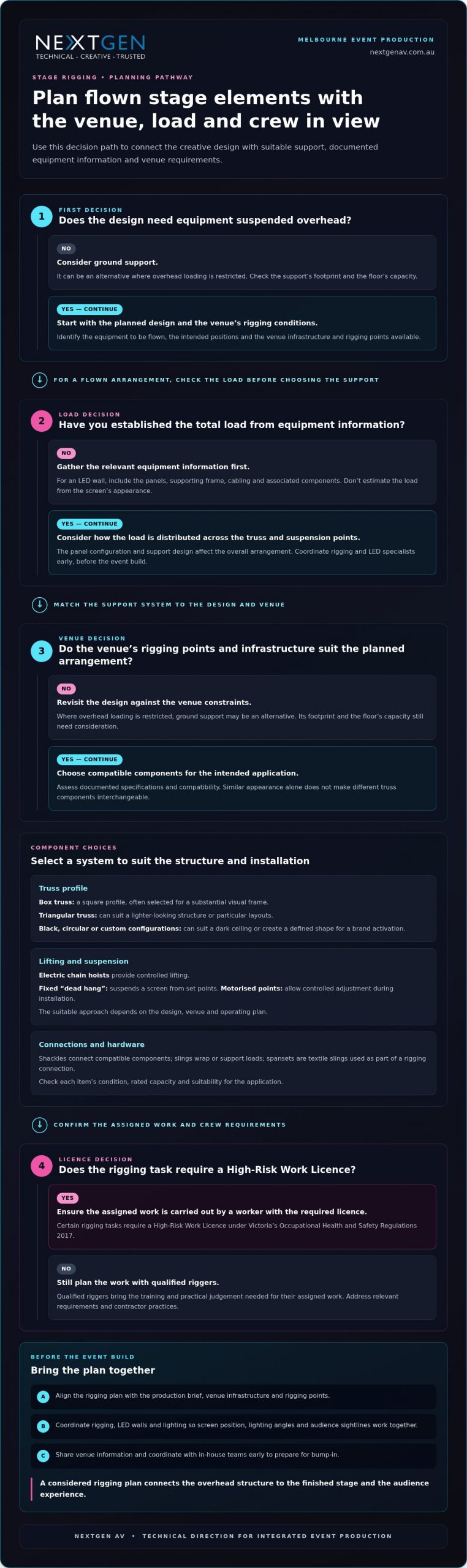
Truss, lifting equipment and connecting hardware form a support system, not a collection of interchangeable parts. Aluminium trussing creates a framework for lighting, audio and visual elements. Motors or fixed suspension points position that framework above the event floor. Each component needs to suit the intended design, the equipment it supports and the venue’s rigging conditions.
Truss profiles vary in shape and application. Box truss has a square profile and is often selected when a design calls for a substantial visual frame. Triangular truss can suit lighter-looking structures or particular layouts. Black truss can recede against a dark ceiling, while circular or custom configurations create a defined shape for a brand activation. Global and Eurotruss systems should be assessed using their documented specifications and component compatibility. Similar appearance alone does not make components interchangeable.
Trussing and Lifting Systems
Electric chain hoists provide controlled lifting, while the motor arrangement affects how a structure is raised and held in position. A fixed “dead hang” suspends a screen from set points; motorised points allow controlled adjustment during installation. The suitable approach depends on the design, venue and operating plan. Ground support can be an alternative where overhead loading is restricted, but its footprint and the floor’s capacity still need consideration.
Shackles connect compatible components, slings wrap or support loads, and spansets are textile slings used as part of a rigging connection. Check their condition, rated capacity and suitability for the application. The US reference OSHA Rigging Safety Standards addresses equipment in its jurisdiction. It does not replace Victorian requirements or project-specific engineering.
Planning for LED Video Walls
LED panels, their supporting frame, cabling and associated components all contribute to the suspended load. Establish the total using relevant equipment information, then consider how it is distributed across the truss and suspension points. Never estimate from the screen’s appearance: the panel configuration and support design affect the overall arrangement. A technical director can coordinate rigging and LED specialists early, aligning screen dimensions, sightlines and support requirements before the event build.
That integration matters in practice. A screen’s position affects truss layout, lighting angles and the audience’s view, so decisions made in isolation can undermine the finished stage. Explore how LED video walls for events fit into a production plan, then coordinate their support with the wider design. For stage rigging services melbourne organisers need to bring these elements together, NextGen AV’s technical direction connects structural planning with the audience-facing result.
Match Components to the Venue
Before selecting a system, map the equipment, intended positions and available support points. Where ceiling loading is limited, ground-supported structures may help shape the design, provided floor capacity and circulation space are considered. Early coordination lets the rigging plan support the creative brief without leaving critical decisions until bump-in.
Navigating Safety Standards and Load Calculations in Victoria
For a Melbourne event, safety planning becomes practical when the rigging design can be reviewed alongside the equipment schedule and venue information. AS 1418.17 is relevant to the design and use of lifting equipment. The technical team should identify which standards apply to the specific equipment and operation, rather than treating a reference to one standard as blanket approval. For a complex design, a structural engineer can assess the proposed arrangement and provide project-specific documentation.
Make sure design decisions are supported by clear information. Keep the current equipment schedule, venue details and rigging drawings together. If the screen size, lighting positions or production layout changes, pass the update to the technical director before issuing the plan for installation. This creates a traceable design process and gives the production team time to resolve issues before the build.
Load Calculations for Event Planners
Give your AV partner accurate equipment details, including models or specifications where available, quantities, planned positions and any movement during the event. Have the proposed loads at each support point assessed against the venue’s documented limits. For example, moving a screen from centre stage to one side can change how forces reach the supporting structure, even if the equipment list stays the same. Do not add items on site without a technical review.
Moving elements and outdoor installations need particular attention during design. The responsible technical team should account for how equipment will operate, assess site exposure and consider applicable wind conditions for temporary outdoor structures. The plan should set out how changes in conditions or production requirements will be handled, rather than relying on assumptions made during the initial design.
WorkSafe Victoria and Event Compliance
Build project records around the actual scope of work. Depending on the task and site, these may include a Job Safety Analysis, a Safe Work Method Statement where high-risk construction work applies, equipment inspection records and engineered drawings. Keep document versions clear, record design changes and make sure the crew has the current information. This document control connects planning decisions with on-site execution.
Address insurance arrangements through the event’s contracting and production planning. Define who is responsible for each part of the work, how changes are escalated and which records are shared with the venue. Clear ownership reduces uncertainty when multiple teams contribute to the build and gives organisers a reliable view of how the work will be managed.
Victoria University’s Event Production Management in Melbourne offers broader context on coordinating production components. For a rigging plan, the practical goal is to connect engineering review, accurate equipment information and controlled document updates. This helps the event design progress clearly from pre-production through to installation.
Planning Your Rigging Strategy: From Site Inspection to Bump-in
A rigging plan should take shape well before equipment arrives at the venue. A site inspection helps the technical team understand the room, access routes and production requirements, then build a plan around actual conditions. Melbourne venues vary widely: a purpose-built convention space such as MCEC and a heritage setting such as Melbourne Town Hall each have distinct layouts, access arrangements and operational considerations. Plan for the venue you have booked, not a generic room diagram.
During the inspection, map how equipment will travel from the loading area to the event space. Check loading dock access, lift dimensions, travel distances, storage areas and the routes crew will use during bump-in. These details can shape the installation sequence and affect how smoothly suppliers work together. Establish how the venue’s in-house technical team operates, including any exclusive rigging arrangements, then agree how the external production crew will coordinate with them.
Map the Venue Early
A useful site review records stage dimensions, access constraints, ceiling and support information supplied by the venue, and proposed positions for flown equipment. It should also capture practical details such as restricted corridors, shared loading areas and spaces that must stay clear for guests or venue operations. Keep approval responsibilities visible in the project schedule. Assign someone to track venue submissions and responses so design decisions do not stall while teams wait for information.
Coordinate the Production Plan
Pre-production drawings help the team visualise the rigging plot and identify clashes before installation. A 3D CAD view can bring truss positions, lighting, audio and LED screens together, making it easier to refine sightlines, cable routes and working space. Drawings should reflect the selected venue and current equipment plan. NextGen AV’s technical direction connects these elements, while clear version control helps every team work from the latest design.
Rigging is often among the first overhead work installed because lighting, audio and video elements may depend on it. It can also be among the last systems removed, after suspended equipment has been lowered and cleared. Build that sequence into the wider bump-in and bump-out schedule. Riggers, lighting crew and audio technicians should coordinate work zones, installation order and handovers, so one team’s progress does not block another’s access or create avoidable delays.
For outdoor or temporary structures, include the relevant approval pathway and supporting documentation in the project schedule. Requirements depend on the structure and site, so keep communication open with the venue and relevant approval contacts as plans develop. Stage rigging services melbourne event organisers can rely on should connect the site review, drawings, approvals and production schedule from the outset. This joined-up approach helps protect the creative vision from late changes and gives each crew member a clear role on site.
Bring your venue requirements and production concept together with NextGen AV’s Melbourne rigging and production team, coordinating technical details before bump-in.
Partnering with NextGen AV for Seamless Rigging and Production
Rigging works best when it is planned as part of the production, not added as a separate task after the stage design is settled. NextGen AV coordinates staging and rigging with lighting, professional audio and LED video walls, aligning technical decisions so every element supports the event’s intended look and audience experience. With extensive experience across Melbourne venues, the team brings practical knowledge to complex corporate productions and manages the details behind the scenes.
The “Invisible Expert” approach gives your production a clear technical lead while guests experience a confident, cohesive event rather than the logistics behind it. A technical director can connect the creative brief to the rigging plot, identify constraints early and coordinate the specialists responsible for each part of the build. That joined-up direction helps avoid clashes between the stage design, lighting positions and visual content.
One Coordinated Production Team
A single production partner can bring rigging, lighting and sound into the same planning conversation. That matters when a design includes flown fixtures, a large screen and a stage layout that needs to preserve sightlines. NextGen AV’s stage and lighting solutions connect structural decisions with the atmosphere you want to create, giving your brand a considered presence in the room.
Coordination also supports clearer decisions when venue conditions shape the design. If access, rigging points or the room layout affect the original concept, a production partner can bring the right technical specialists together to assess options and update the plan. You are not left to reconcile separate equipment schedules alone; the production details are managed as one connected project.
Built Around Your Event
A corporate gala and a product launch have different demands. A gala may call for layered lighting and a strong stage focal point; a launch may need screen content and lighting cues to work in a precise sequence. NextGen AV develops rigging plots around the event brief, venue and production elements, then coordinates the on-site work through bump-in and pack-down. The result is a plan shaped for your event, not a generic arrangement.
Safety and precision remain central throughout delivery. Clear technical direction helps the crew follow an agreed plan, communicate changes and keep rigging aligned with the wider production. That gives organisers more headspace to focus on presenters, guests and the experience they want people to remember.
If you are planning an event, speak with NextGen AV’s Melbourne team about your rigging and production brief. With stage rigging services melbourne organisers can integrate into a wider production, your concept has experienced technical partners from planning through to pack-down.
Shape the Event You Envision
Your rigging plan can do more than support the production; it can help define the atmosphere your guests remember. Bring technical planning into the creative process early, and your event design has room to develop around the venue, programme and moments you want to make stand out. That is the advantage of treating stage rigging services melbourne as part of the whole event experience, not a last-minute installation detail.
With NextGen AV, rigging is planned alongside lighting, audio and visual production, so your concept and practical requirements progress together. Focus on the message, the guests and the occasion, knowing experienced technical direction is managing the details.
Enquire about professional stage rigging services in Melbourne and take the next step towards a production designed with precision and purpose. Your vision deserves a team that helps it take shape with confidence.
Frequently Asked Questions
Do I need a permit for stage rigging in a Melbourne venue?
Permit requirements depend on the event structure and where it is being installed. Start by distinguishing formal approvals from a venue’s own technical approval process, as these can involve different teams and documents. For a Melbourne event, include approval responsibilities in the production schedule and have the organiser, venue and technical director work from the same event plan. This helps address approval requirements before the design is finalised.
How much does rigging typically cost for a corporate event?
A corporate rigging setup is scoped around the event brief rather than a standard package. Begin by defining what the audience needs to see and hear, such as a central LED screen, a clear stage view or a particular lighting look. NextGen AV’s technical team can translate that brief into a rigging and production plan, helping you understand the work involved and make informed decisions about the event design.
Can I use the venue’s in-house rigging services with NextGen AV?
Yes, NextGen AV coordinates production planning with a venue’s in-house rigging team. Establish one current version of the event plan, including the latest stage layout, screen positions and production schedule. This gives venue and production teams a shared reference as details develop, helping prevent outdated drawings or conflicting schedules from disrupting preparation.
What is the difference between basic trussing and engineered rigging?
Basic trussing describes a structural component, while engineered rigging refers to the planned scope around its use. For event planning, clarify whether the design covers only the truss or also the connected equipment, installation sequence and technical oversight. A clearly defined scope makes it easier to coordinate production responsibilities and understand how the proposed structure supports the event design.
How far in advance should I book rigging services for my event?
Start planning as soon as you have a likely venue and an initial event concept. That gives the technical team time to shape the design alongside your programme, stage layout and production schedule. If key details are still evolving, share the current brief and flag what may change. Early collaboration helps the rigging plan develop with the event instead of being added after other decisions are settled.
What safety documentation should I expect from a rigging provider?
Expect project records to match the final agreed design and clearly identify the version being used on site. If the stage layout or production equipment changes, the relevant drawings and records should be reviewed and updated as needed. For organisers, the practical check is consistency: documents shared with the venue and production crew should reflect the same installation plan.
Are there weight limits for hanging LED walls in Melbourne hotels?
Hotel rigging limits are specific to the property and may differ between rooms in the same building. Do not apply a ballroom’s information automatically to a smaller function room. For a Melbourne hotel event, use the documentation for the exact room and event date, and make sure the planned screen arrangement is assessed against that venue information before finalising production layouts.
What happens if my venue doesn’t have rigging points in the ceiling?
The event design can be adapted to the room rather than relying on a ceiling-mounted screen position. Options may include adjusting the screen location or incorporating it into a ground-level stage layout, with sightlines and audience movement considered as part of the revised design. NextGen AV coordinates these decisions with the wider production plan so the visual focus remains clear and practical for guests.
The presenter is ready, the room is full, and the microphone cuts out. In that moment, finding the right event av technician hire melbourne support is about more than getting equipment working again. It’s about protecting the programme and keeping the audience connected.
Urgent availability, arrival arrangements and the level of support provided aren’t always clear until you ask. An operator, a fault-finding technician and a production partner have different responsibilities, so confirm the scope before you commit.
This guide explains how to assess an urgent AV support request, match technical expertise to your event setup and clarify escalation arrangements. You’ll find practical questions to ask about audio, LED video walls, lighting, staging and technical direction, including who will make decisions on site if a fault affects the running order.
With more than 30 years of industry experience, NextGen AV provides end-to-end event solutions from Melbourne, including equipment hire, technical direction and on-site management. Clear planning and responsibilities help put technical decisions in capable hands, so you can focus on delivering the event.
Key Takeaways
- Before arranging event AV technician hire in Melbourne, clarify whether you need equipment-only hire, an operator or managed technical support.
- Match the technician’s experience to your event format and AV systems, then confirm who will attend and how technical issues will be escalated.
- Compare the agreed scope, system familiarity, confirmed availability and on-site responsibilities rather than relying on a general promise of help.
- Give the provider a concise briefing: describe the fault, affected system, when it began and how it could affect the programme.
- NextGen AV’s technical direction and on-site management can help connect production decisions with the audience experience.
What does event AV technician hire in Melbourne actually cover?
Event AV technician support is skilled help to plan, operate or troubleshoot the technology your event relies on. That may mean preparing professional audio systems for a conference, managing LED video walls for a product launch or investigating a fault during a live programme. The right support helps presenters stay confident, audiences follow what’s happening and the running order stay on track. For a grounding in the term, audiovisual (AV) technology describes the mix of sound and visual components used in settings such as live events.
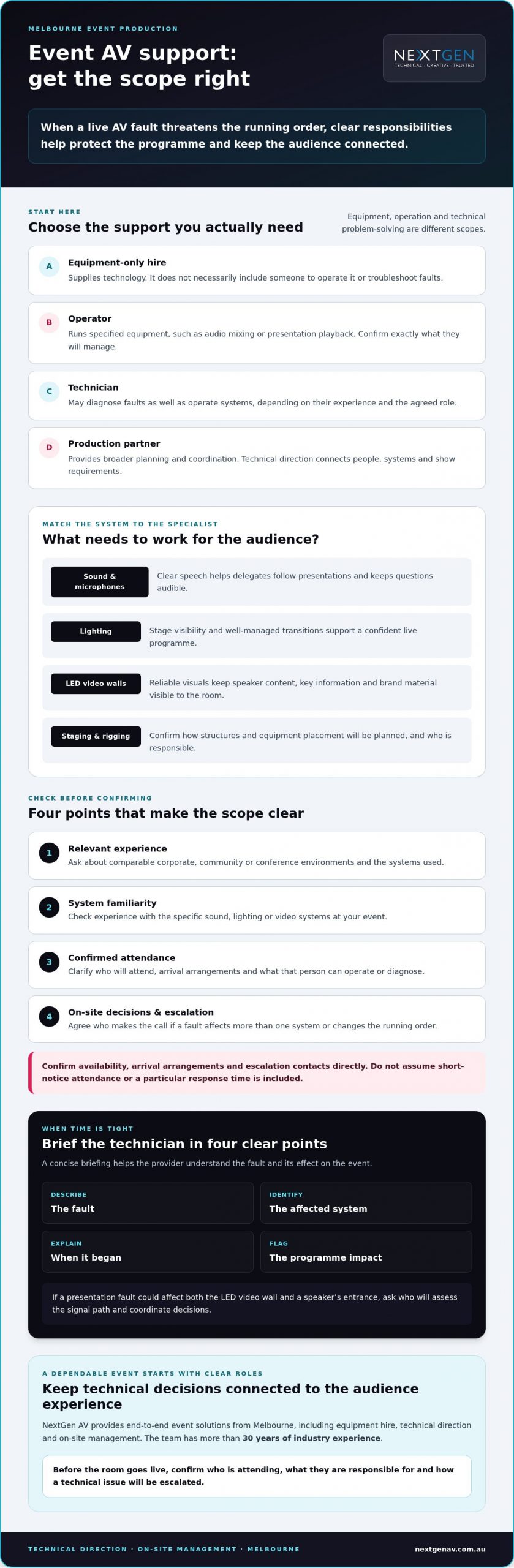
With event av technician hire melbourne, clarify the scope before you commit. Equipment-only hire supplies technology but doesn’t necessarily include someone to operate or troubleshoot it. An operator runs specified equipment; a technician may also diagnose faults, depending on their experience and agreed role. Full event production brings broader planning and coordination around the event’s technical requirements.
Technician, operator or production partner?
An operator might mix audio or run presentation playback, while a technician’s role may also include tracing a failed signal and identifying a practical fix. These responsibilities can overlap, so ask exactly what the person attending will manage. Technical direction coordinates people, systems and show requirements, linking technical decisions to the programme. If audio, lighting, screens and staging need to work together, a production partner may be better placed to manage those connections than an equipment-only supplier.
For urgent support, confirm availability, arrival arrangements and escalation contacts directly with the provider. Don’t assume short-notice attendance or a particular response time is included.
Which event AV systems may need support?
Match the support to the systems in your event plan and the fault’s potential effect on attendees. Technicians don’t all have the same experience across every system, so confirm relevant capabilities and responsibilities.
- Professional sound systems and microphones: Clear speech helps delegates understand presentations and keeps questions audible.
- Lighting: Well-managed event lighting supports visibility on stage and helps transitions feel deliberate.
- LED video walls: Reliable visuals keep key information, speaker content and brand material visible to the room.
- Staging and rigging: Confirm how structures and equipment placement will be planned and who is responsible for the work.
For example, a presentation fault may affect both the content on an LED video wall and the timing of a speaker’s entrance. Ask whether the technician can assess the relevant signal path and equipment, and who will coordinate decisions if more than one area is affected. Clear scope gives you a more dependable plan and lets your team focus on the audience experience.
How to assess an event AV technician’s technical capability
A technician’s experience is most useful when it matches the work in front of them. For event av technician hire melbourne, assess the event format, the systems in use and the faults most likely to disrupt the programme. A conference with presentation playback and audience microphones calls for different practical experience from a production involving complex lighting, LED video walls and staging.
Years in the industry provide context, but they don’t confirm a precise fit. Ask for examples of comparable events and how the proposed technician’s experience relates to your requirements. NextGen AV has more than 30 years of industry experience; confirm who will attend your event and what they’ll be responsible for.
Questions that reveal practical experience
Ask direct questions that show how the technician approaches live conditions. For example: “Have you supported this type of event and these systems?” and “How would you investigate this fault, and who would you escalate it to?” The answers should make responsibilities and decision-making clear before the room is live.
- Which comparable corporate, community or conference environments have you worked in?
- Are you familiar with the specific sound, lighting or video systems at our event?
- Who will attend, what can they operate or diagnose, and who makes decisions if the fault affects multiple systems?
A technician experienced with professional audio may not have the same depth of knowledge in LED video walls or lighting control. Match the person’s stated capabilities to the systems and likely failure points in your brief.
Safety evidence and technical responsibility
Safety documentation should relate to the actual work, not appear as a generic credential list. If the plan includes a structure or event rigging, ask whether a structural engineering certificate is relevant and what documentation applies. Confirm whether a qualified rigger or High-Risk Work Licence is needed for the specific tasks, rather than assuming every event setup requires the same credentials.
Ask which Job Safety Analysis applies to the work and how Test and Tag records relate to the equipment being supplied. These checks help clarify who is responsible for each technical and safety matter before setup begins. They also give you a clearer basis for coordinating with your venue and event team.
Assess the production partner as well as the individual. NextGen AV provides technical direction and on-site management. Review its event production and technical support when deciding whether that broader coordination suits your brief.
What to compare when hiring urgent event AV support in Melbourne
Urgent support isn’t one standard service. Compare what the provider will supply, who will be responsible on site and how they’ll respond if an issue affects the programme. This makes event av technician hire melbourne easier to assess against your event’s format, technical risks and timing.
| Support option | What to confirm | Best suited to |
|---|---|---|
| Equipment-only hire | Which equipment is supplied, who sets it up and who troubleshoots faults? | Events with an experienced team already assigned to operate the systems. |
| Operator booking | Which equipment the operator will run and whether fault diagnosis is included. | A defined operating role, such as managing presentation playback or audio. |
| Managed technical production | Who coordinates connected systems, technical decisions and escalation. | Events where sound, lighting, screens and staging need to work together. |
Check that the provider’s experience matches your event. For a presentation, prioritise clear speech, playback checks and presenter support. A conference may need coordinated microphones, screens, cues and smooth programme transitions. For an outdoor activation, ask how the team will account for site conditions, display requirements and contingency planning.
Compare the details
Ask whether one team can coordinate the sound, lighting and screen requirements, or whether separate providers need to align. Melbourne venue familiarity can be useful, but don’t assume it. Ask whether the team knows your venue and what venue-specific information they need to plan the work.
Confirm urgent availability and response arrangements directly. Ask who will attend, when they can arrive, how to contact them and who makes decisions if the fault affects several systems. A Melbourne base may be relevant to planning, but it doesn’t confirm a particular dispatch time or availability.
Put the scope in writing
Before confirming, document the agreed responsibilities for:
- Arrival and setup, including who connects and checks each system.
- Operation during the event and any troubleshooting included.
- Escalation contacts and what falls outside the technician’s scope.
- Pack-down and handover responsibilities.
Clear boundaries prevent gaps between the equipment supplier, operator, venue and event organiser. If you’re planning connected technical requirements, you can discuss your event AV support requirements with NextGen AV.
How to brief an event AV technician when time is tight
A clear first briefing helps a provider assess whether they can support your event and what information they need. For event av technician hire melbourne, lead with the fault and its effect on the programme, then give the practical details needed to confirm availability, scope and next steps. Share what you know; don’t delay the call to investigate equipment yourself.
Prepare the key details
Use this order for the first conversation. Short, accurate answers help the provider understand the issue and its urgency.
- Event and venue: State the event format, venue name, room or activation location, access instructions and schedule.
- Fault: Describe the symptom in plain language, which system is affected and when the issue began. For example, say whether a microphone has stopped producing sound or presentation playback is no longer appearing on screen.
- Programme impact: Explain what’s happening now and which upcoming moment is affected, such as a speaker presentation, audience questions or a scheduled screen cue.
- AV setup: Identify the affected microphones, professional sound systems, LED screens, lighting or playback equipment. Share known equipment details, signal-flow notes or photographs if you already have them and can provide them safely.
- On-site contact: Give the name and contact details of the person who can meet the technician, coordinate venue access and answer questions.
Also explain the audience needs and key programme moments. A provider can assess a fault more accurately when they know whether clear speech, a visual presentation or a lighting cue is central to the next part of the event.
Agree the escalation plan
Before relying on support, ask the provider to confirm availability, who will attend, what they’ll manage and what happens next. Clarify arrival and access arrangements, the agreed scope, how to escalate an issue beyond that scope, and who will make technical decisions on site. Confirm availability and response arrangements directly rather than assuming them.
Agree who will update presenters, venue staff and the event team if a technical decision affects the running order. Prioritise the elements that keep the programme moving, such as restoring presenter audio or switching to an agreed alternative if screen content is unavailable. A named decision-maker and a clear communication path reduce crossed instructions under pressure.
For support planning that accounts for your technical brief and event context, speak with NextGen AV about your Melbourne event.
Why partner with NextGen AV for Melbourne event tech support
Choosing support is about more than finding someone who can operate equipment. You need a team that understands how technical decisions affect the audience, the programme and the people delivering it. NextGen AV combines event planning, technical direction and on-site management to help organisers coordinate the moving parts behind a polished event.
A production partner beyond equipment hire
NextGen AV provides audio-visual production and equipment hire for corporate and community events, with event solutions available across Australia. Its team brings more than 30 years of industry experience. That background can help inform practical questions about your event format, technical setup and the coordination required on site.
NextGen AV’s Melbourne base is one consideration when discussing equipment and logistics. It doesn’t confirm technician availability or a response time, so check those details for your specific request. Technical direction can connect audio, lighting, LED video walls and staging requirements, while on-site management helps keep responsibilities clear as the programme unfolds. This gives you a production team to coordinate technical details while you focus on presenters and guests.
For event av technician hire melbourne, the value of a production partner is this wider view. The right support considers not just an individual fault, but how resolving it affects the next cue, speaker or audience interaction. Agree the role and scope in advance so the technical team can work in step with your event team.
Confirm the right next step
Share your event date, Melbourne venue, technical issue or production brief, and the systems involved. Ask NextGen AV to confirm current availability, relevant capability, who would attend and the responsibilities included. Clarify escalation arrangements directly, particularly if the request is urgent or short notice. This gives both sides a clear basis for deciding whether the support fits your event.
With the scope understood, you can move forward with greater confidence and keep attention where it belongs: on a seamless experience for your audience. Plan your event AV support with NextGen AV.
Put your event in capable hands
Reliable AV support starts with a clear match between the technician’s skills, your event systems and the risks to the programme. Confirm who will attend, what they’ll manage, whether they’re available and how escalation will work before you rely on support. A precise brief helps the provider assess the issue and agree on practical next steps.
For event av technician hire melbourne, NextGen AV brings more than 30 years of industry experience and provides technical direction and on-site management. If your event involves rigging, structures or electrical equipment, confirm which credentials, safety documents and responsibilities apply to the specific work and agreed scope.
Share your event date, venue, AV setup and support needs to discuss fit and current availability. Discuss your Melbourne event AV requirements with NextGen AV, and take the next step towards a smoothly delivered event with your audience and programme at the centre.
Frequently Asked Questions
Can I hire an event AV technician at short notice in Melbourne?
Short-notice support may be possible, but availability depends on the event date, Melbourne venue, required skills and provider’s schedule. Give the provider a concise brief covering the fault, affected systems, venue access and programme deadline. Ask them to confirm whether they can attend, when, what they’ll manage and how escalation works before you rely on support. Don’t assume emergency call-outs or a particular response time are available.
What does an event AV technician do during a live event?
An event AV technician may set up, operate, monitor or troubleshoot agreed systems during a live event. This could include microphones and sound systems, lighting, screens or playback equipment. Responsibilities depend on the booking and event plan, so confirm which systems they’ll manage before the event starts. Also agree who directs technical decisions and how issues will be escalated, so the team can respond clearly if a fault affects the programme.
Should I hire an AV technician or an event production company?
Choose a technician for a defined operational or troubleshooting requirement; consider a production partner when planning, technical direction, equipment and on-site management need to work together. The right fit depends on how many systems connect and how complex the event is. For example, a single audio support role may have a narrower scope than coordinating conference microphones, screen cues and programme transitions. Ask the provider to set out responsibilities rather than assume every production task is included.
What information should I give an AV technician when reporting a fault?
Share the Melbourne venue, event timing, symptoms, affected system and when the issue began. Explain the programme impact, including what needs to happen next, such as restoring a presenter’s microphone before a speech. Provide equipment details, signal notes or photographs if available and safe to share. Name an on-site contact who can coordinate access and decisions. This briefing helps the provider assess technical fit and confirm whether they can assist.
How do I check an event AV technician’s safety credentials?
Ask which credentials and safety documents apply to the specific work, structure and equipment at your event. Depending on the agreed scope, this may include a structural engineering certificate, Job Safety Analysis, a qualified rigger, a High-Risk Work Licence or Test and Tag records. Don’t assume every item applies to every task. Ask the provider to explain what evidence is relevant and who is responsible for the associated work.
Can a technician support sound, lighting and LED screens at the same event?
Some production teams can coordinate multiple systems, but capability depends on the crew assigned and the agreed scope. Confirm who is responsible for professional audio, lighting and LED screens, how show cues will be coordinated, and whether specialist operators are required. Share the programme and technical setup early so the provider can assess the support needed. Clear responsibilities help connected systems work in step and keep transitions smooth for the audience.
What should an event AV support booking confirm?
Confirm the event date and venue, the technician’s responsibilities, systems covered, access and setup arrangements, operating period, escalation contact and pack-down scope. Ask the provider to document confirmed availability and any limits to the service. Clarify who will make technical decisions and who to contact if a fault falls outside the agreed work. Written responsibilities help prevent assumptions, especially since equipment hire alone doesn’t necessarily include operation or troubleshooting.
What if the best conference audio choice is the one your audience barely notices? At a Melbourne event, silent audio can support concurrent sessions or limit sound spill between presentations, but it works best when the format, audience and production plan align. If you’re assessing silent conference headphone rental melbourne, the question isn’t simply which headphones to hire. It’s how the audio experience will serve your programme, from the first session to the final Q&A.
It’s reasonable to want clear sound and a dependable setup without adding another live-event concern. The right choice depends on your session format, audience needs and venue, as well as how silent audio compares with a conventional sound system. Equipment compatibility, frequency compliance, testing and on-site technical support also deserve attention before you confirm a hire.
This guide compares silent audio options and sets out the details to check, so you can plan with confidence. NextGen AV brings more than 30 years of industry experience and a Melbourne-based team to event audio planning and technical direction. Silent conference headphones aren’t confirmed in the supplied service information, so verify availability, equipment options and support before making them part of your plan.
Key Takeaways
- Match silent audio to your programme and audience, especially when individual listening could support the session format.
- Map speakers, audio sources, mixing and audience movement before choosing equipment, so the full event audio plan works as one system.
- When comparing silent conference headphone rental melbourne options, check confirmed equipment, setup and technical support alongside your event requirements.
- Use a pre-event checklist to coordinate venue access, room layout, delegate flow, testing and equipment handover.
- Choose a production partner for technical direction and event planning, and confirm headphone availability and support before building them into your plan.
Silent conference headphone hire in Melbourne: when does it suit an event?
Silent audio can give a conference more control over what delegates hear, particularly when a programme includes simultaneous content or a venue has competing sound. It isn’t automatically the best fit: the session format, room and audience all matter. If you’re researching silent conference headphone rental melbourne, start with the experience you want delegates to have, then assess which audio approach supports it.
What is silent conference audio?
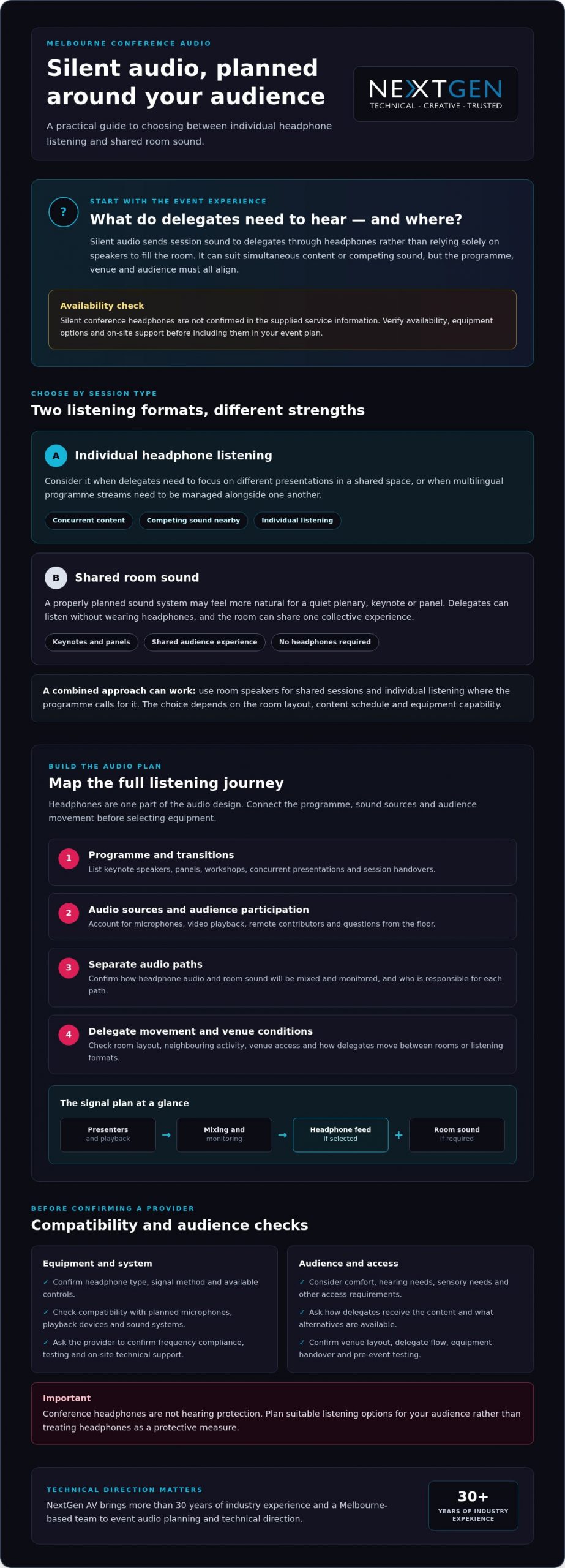
Silent conference audio sends session sound to delegates through headphones, rather than relying solely on speakers to fill the room. The room may feel quieter, while each listener hears the programme through their own headset. Equipment design and features vary by provider, so don’t assume every system offers multiple channels or lets each delegate change settings independently.
The underlying idea of sending audio wirelessly to headphones is also used in silent discos. For background on how silent conference headphones work, this reference explains the related listening format; confirm the specific functions of any conference system with its provider.
Which Melbourne events may benefit?
Consider silent listening when delegates need to focus on different presentations in a shared space, or when multilingual programme streams need to be managed alongside one another. It may also help where adjacent sessions, exhibition activity or other competing sound could make clear listening difficult. These are planning opportunities, not automatic benefits: the room layout, content schedule and equipment capability must work together.
Delegate comfort deserves equal attention. Wearing headphones may not suit everyone, and hearing, sensory or other access needs should inform the format. Ask how delegates will receive the content, what alternatives are available and whether the proposed equipment is suitable for the audience. Don’t treat headphones as hearing protection.
In a quiet plenary, keynote or panel discussion, a properly planned sound system may be the more natural choice. Shared room audio supports a collective experience, lets delegates listen without wearing headphones and can simplify movement between sessions. A conference may also combine approaches, using room speakers for shared sessions and individual listening where the programme calls for it.
For a Melbourne venue, check the actual room and event conditions before deciding. Confirm with the venue how the layout, neighbouring activity and access arrangements affect the plan; don’t assume a format suits a space based on its name or location alone. The strongest choice is the one that keeps content clear, comfortable and accessible for your audience.
How silent conference headphones fit into a complete event audio plan
Headphones are one part of the audio design, not a standalone decision. Before comparing silent conference headphone rental melbourne options, map the programme, presenters, sound sources and delegate movement. This lets your production team establish what needs to be heard, where it needs to be heard and how headphone listening will sit alongside any room sound.
Match the audio setup to the programme
Build an audio schedule that accounts for each session and transition. Note keynote speakers, panels, workshops, wireless microphone use, video playback, remote contributors and planned audience participation such as questions from the floor. Mark any concurrent presentations and identify where delegates move between rooms or listening formats. These details shape the audio plan and help prevent missed cues or unclear handovers.
Where the event also uses room speakers, a front of house engineer can manage the audience-facing mix. The headphone feed and room sound may need separate consideration, depending on the system and session design. Confirm who is mixing and monitoring each audio path, and how presenters, playback and audience questions will reach the intended listeners.
Confirm equipment and compatibility
Separate the event’s confirmed requirements from features a provider still needs to verify. Ask for written confirmation of the headphone type, signal method, available controls and compatibility with the planned microphones, playback devices and sound systems. Don’t assume that a headphone system connects directly to every source or supports independent channel selection. The signal flow should be explained against your actual programme, not just a generic equipment list.
Include operational details in the plan. Confirm who manages charging or battery changes, how equipment is cleaned between users, how headphones are issued and collected, and what happens if a unit or signal fails. Clarify whether setup, testing and on-site operation are included. These are provider-specific arrangements, so get the answers before locking in the run sheet.
A rehearsal and signal check give the team time to trace each audio path, catch compatibility issues and confirm that presenters and delegates can hear the right content before the room fills. Test the full sequence, including microphone handovers, playback, questions and transitions between sessions. A carefully planned technical direction process keeps the audience experience clear while the production team manages complexity behind the scenes.
For a Melbourne event, NextGen AV can help you shape the wider audio plan through event audio planning and technical direction. Confirm headphone availability and the specific support required before making that equipment part of your event brief.
Compare silent headphone hire options before choosing a Melbourne provider
A useful comparison looks beyond the headset. For silent conference headphone rental melbourne, assess how each provider’s confirmed equipment and support fit your programme, venue and audience. The details below are questions to take to providers, not assumed features of any particular system.
What should a rental comparison include?
Ask providers to confirm requirements in writing. Record the information you can verify, and leave unknown specifications as questions rather than filling gaps with assumptions.
| Comparison area | What to confirm | Why it matters |
|---|---|---|
| Equipment and capacity | Confirmed headset quantities, channel arrangements, signal method and compatibility requirements. | Checks whether the proposed setup aligns with delegate numbers and the session plan. |
| Technical setup | Who connects the audio sources, configures the system and tests the complete signal path? | Clarifies how microphones, playback and any room sound will work together. |
| Event support | Whether delivery, setup, testing, on-site operation and pack-down are included, and who is responsible for each task. | Prevents gaps in the run sheet and clarifies the level of production support. |
| Changes and faults | How faults, replacement equipment and late programme changes are handled. | Shows how the plan can respond if the schedule or equipment needs change. |
| Delegate logistics | How headphones are issued, collected, cleaned and managed between sessions. | Helps organisers plan attendee flow and equipment handover. |
Headphones can add practical steps, including distribution, collection and equipment management. Weigh those tasks against the audience need: if concurrent sessions or competing sound make focused listening a priority, the logistics may support a clearer experience. If delegates need to move between sessions, include those transitions in the plan rather than treating equipment handover as an afterthought.
When might conventional sound systems be the better fit?
Shared room audio may better support a keynote, panel or discussion where audience connection and participation matter. It can also suit a layout where delegates need to hear one common programme without managing individual equipment. Consider the venue’s acoustics, room arrangement and audience access needs before deciding; neither format is right for every brief.
Compare the complete service approach, not a list of equipment alone. A clear provider response should connect confirmed capabilities, technical responsibilities and event requirements. NextGen AV provides professional audio systems and technical direction, but silent conference headphones are not confirmed in its supplied service information. Verify availability and the scope of support before including them in your Melbourne event plan.
Plan silent conference headphone hire in Melbourne with a pre-event checklist
A clear run sheet turns a complex audio plan into coordinated tasks. For silent conference headphone rental melbourne, agree on venue access, equipment responsibilities, delegate flow and contingency arrangements with your provider and event team. Put timings and ownership in writing, particularly when several people are handling setup, distribution and technical support.
Use this sequence to carry the plan from the initial brief through to equipment return:
- Set the brief. Share expected delegate numbers, session formats, presenters, playback sources and programme timings. Note concurrent sessions, planned audience participation and any access needs that may affect the listening format.
- Confirm the venue plan. Check access windows, room layout, power and storage arrangements with the venue and event team. Map where equipment will be set up, where delegates will collect and return it, and how people will move between sessions.
- Assign responsibilities. Identify who is responsible for delivery, setup, testing, delegate instructions, distribution, collection and pack-down. Confirm what support is included and who to contact if a fault or programme change arises.
- Verify the system. Ask the provider to confirm headphone quantities, signal method, channel arrangements and compatibility with the actual microphones and playback equipment. Record any unconfirmed details as questions to resolve before the event.
- Test the full programme. Schedule a technical check in the event space before delegates arrive. Use the planned microphones and playback, test listening areas, and walk through presenter handovers, session transitions and any channel changes. Agree who responds to issues and what contingency steps are available.
- Close out and return. Confirm collection timing, equipment handover and the person responsible for checking all items are ready for return. Include these tasks in the event schedule so they don’t compete with attendee departure or venue pack-down.
For wider audio planning, consult a professional sound system hire guide alongside your headphone requirements. The two formats may need to work together, so check how shared room audio, microphones and individual listening will fit the programme. A documented test and clear handover plan help the production team respond precisely while delegates stay focused on the event.
NextGen AV provides professional audio systems and technical direction, but silent conference headphone availability isn’t confirmed in the supplied service information. Discuss your Melbourne event audio plan and confirm headphone availability, setup and support before adding them to your brief.
Work with NextGen AV on a seamless Melbourne conference audio experience
A well-run conference depends on more than a list of equipment. Audio needs to support the programme, the venue and the way delegates take part, while technical direction keeps each element working together. NextGen AV approaches event production as a technical partnership, helping organisers plan the details behind the scenes so attention stays on the event itself.
Production expertise behind the scenes
NextGen AV brings more than 30 years of industry experience to event planning and technical execution. The team delivers events across Australia and operates from a Melbourne-based warehouse, supporting local event requirements with professional audio systems and technical direction.
That experience can help you coordinate audio with the wider production plan, from presenter inputs and room sound to the timing of session changes. For a conference with a demanding programme, clear technical direction helps the production team understand responsibilities and manage moving parts with precision. The result is a more considered experience for delegates and greater confidence for organisers.
Take the next step with your event brief
If you’re exploring silent conference headphone rental melbourne, treat equipment availability as something to confirm, not assume. Silent conference headphones aren’t confirmed in NextGen AV’s supplied service information. The team can discuss your brief and confirm whether the requested equipment and support are available for your event.
To make that conversation useful, share your event date, venue, audience size and session format. Include any concurrent presentations, multilingual requirements, planned audience participation or existing sound systems. Ask the team to confirm headphone availability, equipment options and the scope of setup, testing and on-site support. For wider production requirements, the audio visual hire Melbourne guide can also help you consider how audio fits alongside other event technology.
NextGen AV works with corporate teams, associations, government departments and event organisers, bringing technical planning and production experience to each brief. You’ll have a clearer view of what the event needs and which details still require confirmation before the plan is finalised.
Discuss your Melbourne conference audio requirements with NextGen AV and outline the audience experience you want to create.
Plan your next Melbourne conference with confidence
The right audio format starts with your programme and audience, not a piece of equipment. Decide whether delegates need shared room sound or individual listening, then check how the chosen setup will connect with microphones, playback and session changes. A clear brief, written responsibilities and a full technical test help keep delivery on track.
If you’re considering silent conference headphone rental melbourne, confirm availability, equipment options and the scope of setup and support before including headphones in your plan. NextGen AV’s team brings more than 30 years of industry experience, a Melbourne-based warehouse and event delivery experience across Australia. With professional audio production support and technical direction, the team can help you plan the wider event audio requirements while confirming what’s available for your brief.
Share your event date, venue, audience size and session format to begin a focused conversation. Discuss your Melbourne conference audio requirements and take the next step towards a clear, well-coordinated audience experience.
Frequently Asked Questions
What are silent conference headphones used for?
Silent conference headphones let delegates listen to event audio through headphones instead of relying only on room speakers. Organisers may consider them for concurrent presentations, multilingual sessions or spaces where sound from nearby activity could interfere with listening. The format can help direct attention to a particular session, but capabilities vary by system. Confirm channel arrangements and listener controls with the provider rather than assuming every delegate can select or adjust audio independently.
Can silent headphones work for a corporate conference?
Yes, silent headphones can suit a corporate conference when the programme and audience benefit from individual listening. They may be useful for simultaneous workshops or separate language streams, provided the system fits the venue and session plan. Consider delegate comfort, access needs, equipment handover and how questions or presenter audio will reach listeners. For a keynote or discussion built around shared interaction, room sound may create a more natural experience.
How do I choose a silent headphone rental provider in Melbourne?
Choose a Melbourne provider by comparing confirmed equipment and the complete support plan, not just the headphone description. Ask about available quantities, channel arrangements, signal method and compatibility with your microphones and playback. Clarify who handles setup, testing, on-site operation, faults, replacements and collection. For silent conference headphone rental melbourne, request written answers to outstanding questions so you can match the service to your venue, programme and delegate requirements.
Do silent conference headphones need to be tested before an event?
Yes, test the system before delegates arrive. A technical check with the actual microphones, playback sources and listening areas can reveal connection or coverage issues while there’s still time to address them. Rehearse presenter handovers, session transitions and any channel changes in the planned room layout. Confirm who monitors the system and responds to faults during the event, then include the testing time and responsibilities in the production schedule.
Are silent headphones better than a conference sound system?
Neither option is universally better; the right choice depends on the event brief. Headphones may suit concurrent sessions or situations where individual listening helps separate audio. A conference sound system can support shared attention, audience participation and a more connected keynote or panel experience. Consider room acoustics, layout, delegate movement and access needs, then decide whether one format or a planned combination best serves each part of the programme.
Does NextGen AV offer silent conference headphone rental in Melbourne?
Silent conference headphone availability isn’t confirmed in NextGen AV’s supplied service information, so ask the team to verify it before planning around headphones. NextGen AV provides professional audio systems and technical direction, with more than 30 years of industry experience, a Melbourne-based warehouse and event delivery experience across Australia. The team can discuss your audio brief and confirm whether the requested equipment and support are available for your event.
What information should I give a supplier when enquiring about silent headphone hire?
Share your event date, Melbourne venue, expected audience size, room layout and session format. Include presenter and playback sources, concurrent sessions, language requirements, audience participation and any access considerations. Explain your preferred setup and ask the supplier to confirm equipment quantities, channel options, compatibility, testing, on-site support and return arrangements. This gives the provider the context to assess the request and identify details that need confirmation before you finalise the production plan.
A single flickering LED tile or a sudden burst of audio feedback can instantly shatter the prestige of a high-stakes corporate gala. In an era where the Australian event management market has reached a staggering USD $20.7 billion, the pressure to deliver a technically perfect experience is immense. You feel the weight of these expectations every time you review a complex quote. It’s exhausting to manage multiple technical vendors while worrying about hidden costs or the structural safety of a lighting rig. Finding the best audio visual companies in victoria is about more than just hiring equipment. It’s about securing a proactive partner who treats technical execution as a dedicated craft.
We understand that you want your technology to be invisible so your message can take centre stage. This guide will show you how to vet and select premier AV partners to ensure your 2026 event is both technically flawless and visually prestigious. We’ll examine the essential criteria for professional production, from navigating strict Victorian safety regulations to identifying the technical mastery required for seamless sound, vision, and lighting. By the end, you’ll have a clear roadmap to achieving a spectacular result that impresses every stakeholder.
Key Takeaways
- Understand how the 2026 Victorian event market demands immersive technology and why technical reliability is the foundation of brand prestige.
- Learn to identify the best audio visual companies in victoria by evaluating inventory depth, real-time troubleshooting skills, and strict compliance with local safety standards.
- Discover the specific technical requirements for different event types, from crystal-clear audio at corporate AGMs to cinematic LED backdrops for high-impact galas.
- Master the logistical nuances of Victorian venues, including managing tight Melbourne CBD bump-in windows and the technical hurdles of regional hubs like Geelong or Bendigo.
- Recognise the value of a proactive technical partner who manages complex rigging and staging behind the scenes, allowing you to focus entirely on your event’s vision.
The 2026 Victorian Event Landscape: Why Your AV Choice is Critical
Victoria’s major events calendar continues to set global benchmarks, establishing Melbourne as a premier destination for high-profile gatherings. Audiences attending corporate conferences or high-stakes product launches now expect immersive experiences that captivate them instantly. Because audiovisual (AV) is electronic media that directly shapes human emotion and engagement, standard equipment configurations no longer suffice. A single technical glitch, such as a flickering conference LED screen or an unexpected burst of audio feedback, can instantly dismantle months of meticulous planning. This high-stakes environment means selecting from the best audio visual companies in victoria is a critical decision that directly impacts your brand’s prestige.
The Shift from Equipment Rental to Technical Orchestration
Modern event planners are actively moving away from the stress of managing multiple technical vendors. Relying on basic dry hire, where a supplier simply drops off equipment, leaves your production vulnerable to critical integration failures on site. You don’t just need gear; you require comprehensive technical orchestration. A dedicated technical director acts as the proactive engine behind the scenes, unifying sound systems, event lighting, and high brightness LED displays into a single, synchronized execution. With recent advancements like AI-driven audio optimization becoming the baseline for professional production, you need an elite partner who treats production as a dedicated craft rather than a transactional rental service.
The High Stakes of Victorian Corporate and Government Events
Corporate, association, and government sectors in Melbourne demand absolute precision and flawless compliance. Victorian venues enforce stringent safety standards, meaning your production partner must handle complex compliance logistics like structural engineering certificates, High-Risk Work Licences, and Job Safety Analyses seamlessly behind the scenes. When you partner with seasoned veterans who possess over 30 years of experience navigating Victorian event venues, you eliminate the logistical friction that frequently derails less experienced operators. Flawless technical execution reflects directly on your organisation’s reputation. Rest assured that your event is in capable hands, allowing you to move past the logistical grind and focus entirely on delivering a high-impact experience.
The Gold Standard: 5 Criteria for Top AV Companies
Identifying the best audio visual companies in victoria requires looking past glossy brochures and focusing on technical precision. You need a framework that separates basic equipment hire from true technical excellence. In 2026, the gold standard is defined by five critical pillars: inventory depth, technical mastery, meticulous pre-production, absolute compliance, and proactive partnership. These elements ensure your event follows industry recognized best practices, transforming a simple presentation into a prestigious brand experience that stakeholders won’t forget.
Assessing Inventory and Technology Mastery
Inventory quality isn’t just about having the latest gear; it’s about rigorous maintenance and specific performance capabilities. For 2026, broadcast-quality LED walls must feature a fine pixel pitch and high refresh rates to prevent on-camera flickering during live streams or recordings. Professional sound systems must offer multi-zone coverage to ensure every attendee hears a consistent mix, regardless of their seat. Don’t be afraid to ask about equipment redundancy. The most reliable partners always have on-site backups for critical components like video processors and mixing consoles to ensure the show continues no matter what.
Vetting the Human Element: Technical Direction and Crew
Even the most sophisticated lighting rig is useless without an expert at the helm. The lead technician is the engine of your event, managing the front of house sound and complex visual cues under high pressure. In Victoria, you should look for a dedicated project manager who understands local logistics, such as the strict bump-in windows of Melbourne CBD venues. This human element is what prevents technical failure and ensures your vision is realised without compromise. When the crew takes personal pride in seamless execution, you’re free to focus on your guests.
Safety and compliance are equally vital when evaluating a partner’s technical mastery. In Victoria, any rigger performing work on concert stages must hold a High-Risk Work Licence issued by WorkSafe Victoria. All crew members entering an event site must possess a valid construction induction card, commonly known as a white card. Verified companies will proactively provide a structural engineering certificate for staging and a detailed Job Safety Analysis before a single cable is laid. This level of precision protects your organisation from liability and ensures a safe environment for everyone involved.
Choosing a partner who anticipates these needs before they become problems is the hallmark of elite production. If you’re ready to move past the stress of logistics, exploring integrated technical direction solutions is the first step toward a flawless event. By prioritising proactive problem-solvers over simple order-takers, you ensure your event remains technically flawless from the first sound check to the final pack-down.
Top Categories of AV Excellence: Finding Your Niche Specialist
Not every technical partner is equipped to handle every environment. The best audio visual companies in victoria differentiate themselves by mastering specific niches, from the sterile precision of an AGM to the cinematic energy of a gala dinner. Selecting a specialist who understands the unique pressure points of your category ensures that the technology serves your objectives rather than complicating them. Whether you are launching a new automotive model or hosting a government forum, your choice of partner must reflect the specific technical demands of the space.
Best for High-Stakes Corporate Productions
Corporate conferences and AGMs demand a zero-failure approach to communication. Your message must reach every attendee, whether they are in the front row of a Melbourne ballroom or joining virtually from another continent. This level of reliability requires a sophisticated professional sound system hire strategy that prioritises keynote clarity and eliminates dead zones. In these environments, technical direction becomes the cornerstone of success. It’s the difference between a series of disconnected slides and a cohesive brand experience that flows effortlessly. A dedicated technical director manages the complex interplay between audience engagement software and live streaming feeds, ensuring your presentation remains uninterrupted. Rest assured that when the audio is engineered for precision, your stakeholders can focus entirely on the vision.
Specialists in Immersive Visual Environments
Gala dinners and awards nights require a complete transformation of space to evoke prestige. Creative lighting design can turn a standard Victorian hotel ballroom into a cinematic environment, using texture and colour to guide the audience’s focus. Integrating high-resolution LED video walls creates those high-impact “wow” moments that capture attention and look spectacular on social media. Beyond the visuals, the structural integrity of your environment is paramount. Elite partners provide festival-grade staging and engineered rigging to ensure that every suspended light and screen meets Victorian safety standards. This behind-the-scenes mastery allows the prestige of the final result to take centre stage.
Trade shows and exhibitions demand a different kind of mastery. It’s about high-traffic visibility and seamless screen integration that survives a rigorous three-day schedule. For outdoor community events, the best audio visual companies in victoria deploy weather-rated equipment and large-scale PA systems that maintain audio fidelity against wind and ambient noise. This ensures that even in regional hubs, your production standards remain uncompromising and your audience stays engaged from start to finish.
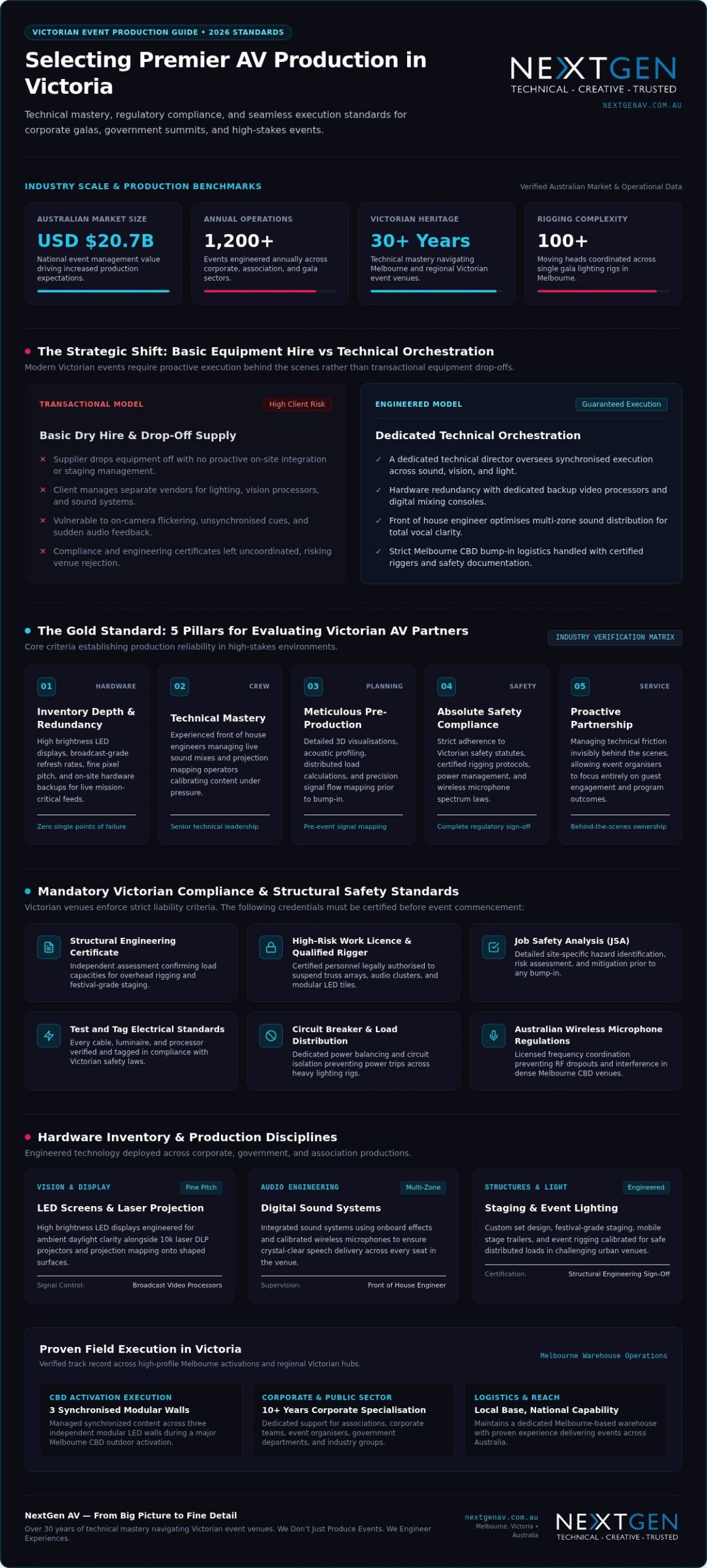
Navigating Victorian Venues: Local Logistics and Technical Hurdles
Execution is dictated by the environment. The best audio visual companies in victoria prove their worth not in the warehouse, but in the loading docks of the CBD and the paddocks of regional hubs. Navigating these spaces requires a proactive partner who understands that a heritage ballroom in the Mornington Peninsula has vastly different power constraints than a purpose-built plenary. Technical mastery involves anticipating these site-specific hurdles long before the first truck arrives, ensuring that the venue’s architecture enhances your event rather than hindering it.
Melbourne CBD and MCEC Logistics
Managing the Melbourne Convention and Exhibition Centre (MCEC) or high-rise CBD ballrooms involves a complex dance of timing. Strict bump-in and pack-down windows mean there’s no room for error. You need a team that coordinates seamlessly with venue-contracted providers to ensure full service event production that respects the venue’s technical specifications. A deep understanding of Melbourne’s traffic and parking constraints prevents delays that could otherwise derail your schedule. This includes managing heavy vehicle access to loading docks and ensuring all crew members are briefed on the specific entry protocols of each precinct.
Regional Victoria: Technical Execution Beyond the City
When your event moves to Geelong, Bendigo, or Ballarat, the logistical stakes change. Working far from a main warehouse requires absolute equipment reliability and a provider with a genuine Victoria-wide service footprint. Regional outdoor locations introduce variables like unpredictable wind loads for staging and unstable power connectivity. Proactive technical direction involves bringing redundant power sources and ensuring all festival-grade staging is secured with the correct ballast and structural engineering certificates. We also account for connectivity hurdles, deploying dedicated satellite or high-gain cellular arrays to ensure your live stream remains stable even in remote areas of the Mornington Peninsula.
Heritage venues present a unique challenge. Delicate architecture and limited power circuits require a light touch and technical mastery. Selecting from the best audio visual companies in victoria means choosing a team that ensures every cable run is discreet and every lighting rig is safely suspended without compromising the venue’s integrity. By strictly adhering to WorkSafe Victoria regulations for event rigging and staging, we protect your brand from liability. Our team handles the Job Safety Analysis and High-Risk Work Licences so you can focus entirely on your vision. If you’re planning a complex activation, you can enquire about our Victorian venue expertise to ensure a flawless execution.
Partnering for Success: NextGen AV Leads Victoria in 2026
True technical orchestration requires a partner who treats live production as a dedicated craft. With over 30 years of experience in Melbourne event production, NextGen AV has engineered solutions for the most prestigious corporate, government, and association gatherings across the state. We don’t just supply gear from a warehouse; we manage the complete technical lifecycle from pre-production CAD drawings to the final pack-down. Our philosophy centers on absorbing the complex logistical stress of staging, rigging, and compliance so that you can remain focused on your event’s core message and your stakeholders.
The NextGen AV Advantage: Mastery and Precision
Our technical directors act as the invisible engine behind your success, working meticulously to ensure a seamless front-of-house execution. We have heavily invested in 2026-standard elite inventory, including high brightness LED displays and AI-integrated audio processing systems that eliminate environmental noise. This commitment to precision is why major corporate teams and government departments trust us with their high-stakes reputation. Having supported everything from complex CBD outdoor activations to massive Melbourne galas involving over 100 moving heads, our seasoned crew possesses the technical mastery required to handle high-pressure live environments without a single glitch.
Start Your Journey to a Flawless Event
Securing a flawless execution begins long before the live audience arrives at the venue. Engaging a professional AV consultation during your early planning stages allows us to map out technical specifications, power distribution loads, and frequency coordination requirements. This proactive approach eliminates hidden costs and ensures your production complies fully with WorkSafe Victoria standards from day one. Whether your project requires a massive conference LED screen setup or a tailored corporate layout, we customize every solution to deliver an unforgettable audience experience.
Your event deserves a technical execution that elevates your brand and leaves a lasting impression on every attendee. For comprehensive solutions tailored to your unique audio visual hire Melbourne requirements, partner with an elite team that takes personal pride in perfection. You can enquire with NextGen AV for your next Victorian event to experience how we translate complex technical logistics into absolute brand prestige.
Elevate Your Vision with Technical Mastery
In 2026, the success of your event hinges on more than just equipment. It requires a partner who understands that technical execution is a dedicated craft. By prioritising inventory depth and rigorous safety compliance, you ensure your brand remains prestigious and protected. Navigating the unique logistical hurdles of Victorian venues demands a team with deep local expertise and a proactive approach to technical direction. As you evaluate the best audio visual companies in victoria, look for a partner that takes personal pride in seamless execution.
NextGen AV brings over 30 years of flawless Victorian event execution to your project. As a preferred partner for major Australian government and corporate bodies, we specialise in Red Dot-standard production and high-resolution LED technology. We meticulously manage the complex logistics behind the scenes so you can focus entirely on your guests. Rest assured that your event is in capable hands, as we engineer an experience that leaves a lasting impression.
Partner with Victoria’s elite AV orchestrators at NextGen AV to transform your next activation into an unforgettable experience. Your vision deserves nothing less than perfection.
Frequently Asked Questions
What is the difference between AV equipment hire and full-service event production?
AV equipment hire is the simple rental of hardware like speakers or screens, often requiring you to manage the setup. Full-service event production is a comprehensive technical orchestration that includes pre-production planning, technical direction, and on-site management. This approach ensures all components like LED video walls and sound systems work in perfect synchronisation. It shifts the technical risk from the organiser to the production partner, ensuring a flawless result.
How much does it cost to hire a professional AV company in Melbourne for a corporate event?
Professional AV costs in Melbourne vary significantly based on venue size, technical complexity, and the duration of your event. Rather than focusing on a single figure, planners should consider the value of technical mastery and risk mitigation. Factors that influence the final quote include high-resolution LED requirements, the number of technical crew needed, and whether you require custom festival-grade staging or rigging. Always request a detailed breakdown to avoid hidden costs.
Do I need to hire a technical director for my conference in Victoria?
A technical director is essential for conferences involving multiple speakers, live streaming, or complex visual transitions. They act as the central orchestrator, managing the front of house engineer and visual cues to ensure a seamless flow. Without this single point of contact, you risk technical silos where sound and vision don’t align. The best audio visual companies in victoria provide this expertise to maintain the prestige of your brand throughout the event.
Can Victorian AV companies handle events in regional areas like Geelong or Ballarat?
Elite production partners maintain a Victoria-wide service footprint, frequently delivering high-impact events in Geelong, Ballarat, and Bendigo. These regional activations require meticulous logistical planning to ensure equipment reliability far from the main warehouse. We account for regional variables such as local power constraints and weather-rated gear for outdoor community festivals. This ensures that your production standards remain uncompromising, regardless of the geographic location within the state.
What are the most common AV mistakes to avoid at high-stakes events?
The most frequent errors include inadequate power distribution, failing to coordinate wireless microphone frequencies, and underestimating bump-in times. Many planners also overlook the importance of equipment redundancy for critical systems like a video processor. Choosing from the best audio visual companies in victoria helps you avoid these pitfalls through proactive site visits and detailed Job Safety Analyses. This technical precision prevents glitches like audio feedback or flickering LED tiles from disrupting your presentation.
How far in advance should I book an AV company for a major Victorian event?
For major corporate galas or large-scale conferences, you should ideally engage a technical partner six to twelve months in advance. This lead time is critical for securing high-demand elite inventory and allowing for thorough pre-production, including CAD drawings and structural engineering assessments. Early booking also ensures that technical directors can collaborate with your team to integrate audience engagement software and creative lighting concepts into the event’s core design.
What technical certifications should a Victorian AV crew hold?
A professional Victorian crew must hold several legal certifications to ensure safety and compliance. Any staff performing event rigging or operating boom-type platforms must possess a High-Risk Work Licence issued by WorkSafe Victoria. Additionally, all workers on an event site must hold a valid construction induction card, or white card. Verified partners will also provide a structural engineering certificate for staging to confirm the structure meets Australian safety standards for a distributed load.
Does NextGen AV provide on-site technical support during the entire event?
NextGen AV provides dedicated, end-to-end technical support from the initial bump-in until the final pack-down is complete. Our team includes technical directors and specialist engineers who remain on-site to manage every cue and troubleshoot in real-time. This proactive presence ensures that your technology remains invisible, allowing you to focus on your vision while we handle the technical precision required for a flawless, high-impact event experience.
