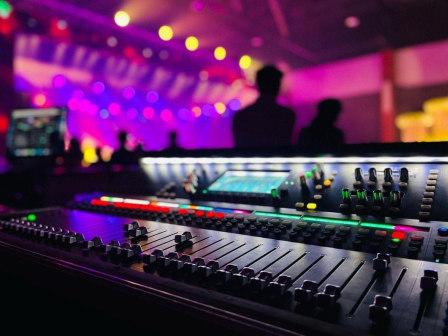



A professional sound check for a corporate event is a choreographed rehearsal of your vision, not just a test of cables and microphones. When research from AVCOM shows that 97% of attendees have become disengaged due to technical issues, with bad audio being the primary culprit, the stakes for your production couldn’t be higher. You’ve likely felt the anxiety of a high-profile keynote being interrupted by a piercing feedback loop or inconsistent volumes that leave your audience strained and distracted.
We believe your focus should remain on the prestige of the event, not the logistics of the gear. This guide promises to help you master the technical rehearsal process, eliminating glitches and ensuring your gala or keynote sounds flawless. We will provide a clear, actionable checklist to help you organise your technical team and speakers with absolute precision. You’ll discover how to coordinate everything from cardioid subwoofers to virtual audio feeds, ensuring every attendee experiences the crisp, professional sound required to make your message resonate.
Key Takeaways
- Understand why a professional sound check for a corporate event is a critical technical rehearsal that safeguards your brand’s reputation and ensures absolute clarity.
- Learn how to choose the ideal microphone for every speaker and why a dedicated operator is the essential engine behind a high-performance digital mixer.
- Follow a proven two-step procedure to verify every signal line and eliminate feedback frequencies, creating a pristine acoustic environment for your audience.
- Gain the confidence to troubleshoot common technical hurdles like ground hum and sibilance before they impact your live or virtual presentation.
- Discover why professional technical direction is the key to orchestrating a flawless result that transcends the limitations of a standard equipment hire.
What is a Sound Check for a Corporate Event and Why is it Critical?
A sound check for a corporate event is far more than a cursory test of equipment; it’s a strategic rehearsal designed to align your vision with the acoustic reality of the venue. To understand What is a Sound Check in a high-stakes professional context, one must view it as the moment where technical precision meets executive performance. This dedicated period involves the meticulous calibration of audio levels, the scanning of wireless frequencies to avoid interference, and the synchronisation of talent with the production crew. While some view it as a simple “check”, it’s actually the foundation of your event’s success.
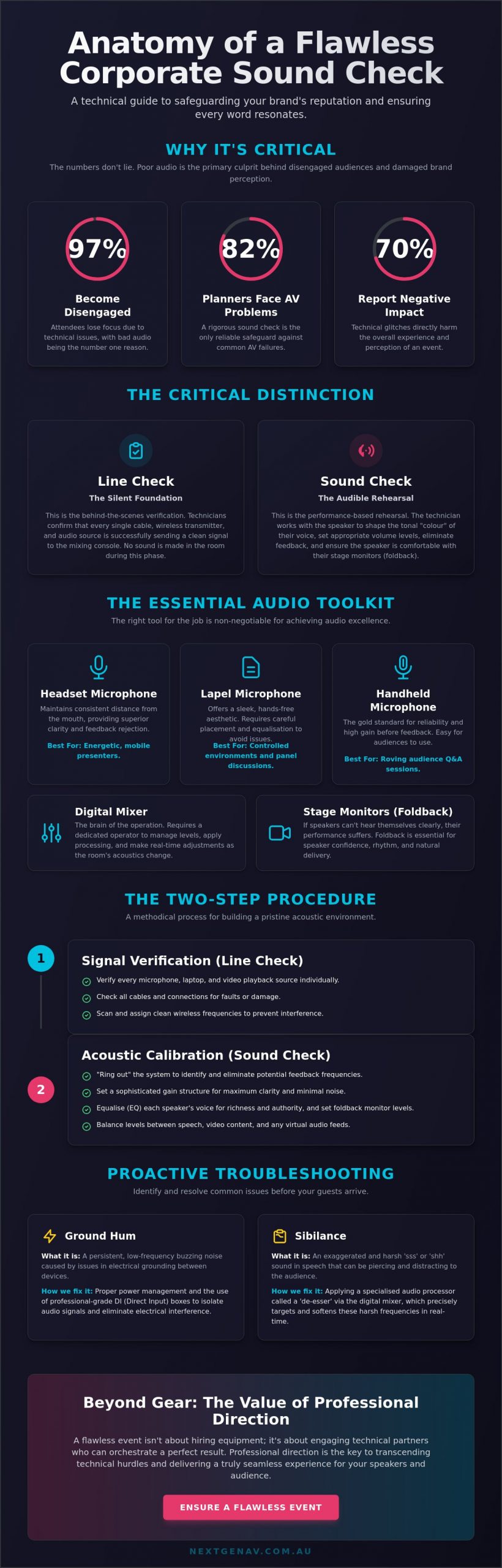
Brand reputation is often won or lost on the quality of the audio. Research by Viju Group shows that 70% of respondents believe technical issues negatively impact the overall experience of an event. In the corporate world, audio isn’t just a utility. It’s an extension of your brand’s voice. When a CEO takes the stage, any hint of feedback or a muffled microphone reflects poorly on the organisation’s attention to detail. MeetingNet research confirms that 82% of event planners encounter AV problems, making a rigorous sound check the only reliable safeguard against becoming part of that statistic.
There’s a vital distinction between a technical line check and a performance-based sound check. A line check is the silent, behind-the-scenes verification that every cable and transmitter is sending a signal to the mixer. The sound check is the audible rehearsal where the technician shapes the “colour” and authority of the speaker’s voice. This process builds immense confidence. When a speaker hears themselves clearly in the foldback monitors, their anxiety dissipates. They can focus on their delivery while the technical team acts as the invisible orchestrators of their success.
The Goals of a Professional Technical Rehearsal
The primary objective is establishing a sophisticated gain structure. This ensures every speaker is heard with crystal clarity without the system straining or hissing. We focus on eliminating environmental noise and managing venue-specific acoustic reflections, which are common in glass-heavy modern boardrooms. Additionally, we ensure seamless transitions between live speech and video content, preventing that jarring volume spike that often occurs when a video starts. Every element is tuned to create a polished, cinematic atmosphere.
When Should the Sound Check Occur?
Timing is everything during the “bump-in” phase. A sound check for a corporate event must be completed before the first guest enters the foyer. In shared Melbourne CBD venues, we often navigate “Quiet Time” requirements where amplified testing is restricted during business hours. We recommend allocating specific 15-minute slots for VIP speakers to familiarise themselves with the stage, while reserving longer blocks for complex panel discussions involving multiple wireless headsets. This methodical approach ensures the technical team and talent are perfectly aligned before the house lights dim.
Essential Audio Components to Organise and Test
Achieving a flawless sound check for a corporate event requires more than just high-end gear; it demands a curated selection of components tailored to your specific venue and presentation style. The journey begins with microphone selection. While lapel microphones offer a sleek, hands-free aesthetic for executives, they can be susceptible to feedback in rooms with challenging acoustics. Headsets provide a superior alternative for energetic keynote speakers who move across the stage, as the capsule remains at a consistent distance from the mouth. For roving Q&A sessions, handheld microphones are the undisputed gold standard, offering reliability and high gain before feedback.
At the heart of every successful production sits the digital mixer. This is the sophisticated brain of your event audio, capable of managing complex routing and processing in real time. It’s a technical powerhouse that requires a dedicated operator who can make micro-adjustments as the room fills with people, which naturally changes the acoustic profile. Without a professional at the helm, even the most expensive Professional Audio Systems can fail to deliver the clarity your brand deserves.
Never overlook the importance of stage monitors, often called foldback. If your CEO cannot hear themselves, they’ll likely over-project or lose their natural rhythm, leading to a strained performance. We also dedicate significant time to testing audio for video content. Embedded clips and animations often have wildly different volume levels; we normalise these during the sound check to prevent jarring transitions that could startle your guests or distort through the house speakers.
Wireless Frequency Management in Melbourne
Melbourne’s high-density areas, particularly Southbank and the Docklands, are notorious for radio frequency (RF) interference. With so many signals competing for space, a standard setup can easily suffer from dropouts or static. We utilise advanced digital wireless systems to ensure secure, interference-free communication. If you’re planning a complex event with multiple presenters, it’s vital to consult a microphone hire Melbourne expert who can perform a site-specific frequency scan before the first word is spoken.
Hybrid Event Audio: The Dual-Mix Challenge
Hybrid events introduce the complex “dual-mix” challenge. The audio mix that sounds perfect in a physical ballroom rarely translates well to a virtual audience on Zoom or a custom streaming platform. We calibrate a dedicated “House Mix” for the in-person attendees while simultaneously engineering a “Stream Mix” that accounts for the compression of online platforms. We also rigorously test the talkback loop. This ensures that remote speakers can hear the on-site MC clearly, allowing for a seamless, natural dialogue that bridges the gap between the physical and digital worlds.
The Step-by-Step Sound Check Procedure
A professional sound check for a corporate event is a choreographed sequence that transforms a collection of high-end equipment into a high-performance engine. It’s the moment where the technical team and the talent find their rhythm. This process isn’t just about making noise; it’s about alignment, precision, and the relentless pursuit of acoustic perfection. We follow a methodical five-step procedure to ensure that when the house lights dim, the audio is the last thing on your mind.
The journey begins with the Line Check. This is the silent foundation where we verify that every physical cable and wireless transmitter is sending a clean signal to the digital mixer. Once the signal paths are confirmed, we move to “Ringing Out” the room. By intentionally pushing the volume of each microphone until it begins to feed back, we identify the specific frequencies that react poorly to the venue’s architecture. We then use precision equalisation to carve out those troublesome frequencies, creating a significant safety buffer for the live production. This ensures that even if a speaker wanders too close to a speaker stack, the audio remains stable and clear.
Talent Calibration is the most critical phase of the sound check for a corporate event. We require speakers to use their “event voice”—the projected, authoritative tone they’ll use during the actual keynote. It’s a common trap for executives to speak softly during a check, only to find their levels are too high when the adrenaline of the gala kicks in. We conclude with Media Integration and a Cue-to-Cue rehearsal. We play every video sting and walk-on track at the intended levels, rehearsing the transitions between multimedia and live speech to ensure the momentum of your programme never falters.
Calibrating the Speaker: The “Walk and Talk”
We encourage every presenter to perform a “walk and talk” across the entire stage area. This helps us identify any “hot spots” where audio might behave differently due to the room’s acoustics. If a speaker plans to move from the lectern to a lapel microphone mid-presentation, we test that transition to ensure the volume remains consistent. This time is also used to establish silent eye-contact cues between the speaker and the AV operator, building a sense of partnership that alleviates on-stage stress.
Managing the Panel Discussion Sound Check
Balancing a panel of four to six microphones simultaneously requires a sophisticated touch to avoid phase cancellation, which can make voices sound hollow or thin. We calibrate auto-mixer parameters to prioritise the active speaker while subtly dipping the levels of others. Finally, we rehearse the roving microphone process for the Q&A. This ensures that when an audience member asks a question, the audio is captured instantly and integrated into the room’s mix without a second of delay.
Troubleshooting Common Audio Glitches Before the Guests Arrive
The final moments before doors open are when the “Invisible Expert” truly shines. This is the critical window where we hunt down the subtle technical gremlins that can derail a polished presentation. A sound check for a corporate event often reveals a persistent “ground hum”, typically caused by electrical noise from a presenter’s laptop or the venue’s own power grid. We neutralise this instantly using high-quality DI boxes with ground-lift capabilities, ensuring the only thing your audience hears is the speaker’s message without the distraction of a low-frequency buzz.
We also focus on the nuances of the human voice. Some speakers have naturally harsh plosives, those popping “P” sounds, or sharp sibilance on “S” sounds that can be jarring through a large PA. Our engineers adjust the EQ settings in real time, using high-pass filters and surgical frequency cuts to smooth out these peaks. It is about creating a velvet-like audio texture that feels prestigious and effortless, allowing the CEO’s message to resonate without technical interference.
Reliability is non-negotiable in high-stakes environments. The 2026 industry standard dictates the use of fresh lithium cells for every wireless unit, providing a consistent voltage that standard alkaline batteries cannot match over a long gala dinner. We also address the “Dead Zone” myth. In L-shaped Melbourne function rooms, we don’t just turn up the volume; we strategically re-position speakers or add delay stacks to eliminate acoustic shadows. This ensures every attendee, regardless of their table position, receives the same crystal-clear experience.
Eliminating Feedback Loops Permanently
Feedback is the piercing result of a loop between the microphone and the speakers. We eliminate this risk through “notching”, a process where we use a parametric equaliser to cut the specific frequencies prone to ringing in that particular room. By keeping microphones behind the main PA line and having an audio engineer proactively ride the faders, we ensure the sound remains stable even when a presenter moves enthusiastically. This proactive management allows the talent to take centre stage with absolute confidence.
Backup Planning: The “What If” Protocol
True technical mastery lies in redundancy. We always place a “wired” microphone at the lectern as a fail-safe, ensuring that the show goes on even in the unlikely event of a wireless frequency conflict. We also rigorously test the backup audio feed for the live stream to ensure virtual attendees never miss a word. Every professional sound system hire should include a comprehensive redundancy plan to safeguard against the unexpected. For total peace of mind during your next high-stakes production, consider partnering with an elite team; discover our Technical Direction solutions to secure a flawless result.
Partnering with a Technical Director for a Flawless Result
While high-end hardware is the foundation of any production, a “dry hire” of equipment represents a significant risk for high-profile corporate events. Without a seasoned expert at the helm, you are simply renting a collection of silent tools. The true value of a Technical Director lies in their ability to act as the “Confident Orchestrator”, harmonising sound, light, and vision into a single, cohesive experience. They anticipate the variables that a checklist cannot cover, ensuring that your executive team feels supported and your brand’s prestige remains untarnished throughout the entire programme.
At NextGen AV, we treat the sound check for a corporate event as a holistic performance rehearsal rather than a mere technical necessity. Our team manages every detail from the initial bump-in to the final cue, allowing you to move past the logistical grind and focus on your guests. We don’t just provide gear; we deliver a dedicated craft that transforms a standard presentation into a cinematic event. Integrating professional audio planning into your initial event brief is the most effective way to secure this level of precision, ensuring that technical requirements are baked into the floor plan and schedule from day one.
The NextGen AV Difference in Melbourne Production
Our team brings over 30 years of experience to every project, having mastered the unique acoustic signatures of Melbourne’s premier venues, from Southbank’s grand ballrooms to the heritage spaces of the CBD. We provide an audio visual equipment list for conferences that is meticulously tailored to your specific room size and attendee count. This bespoke approach is backed by our “Confidence Guarantee”, which means we insist on a comprehensive technical rehearsal for every client. We believe that a flawless result is never an accident; it is the product of rigorous preparation and elite technical direction.
Booking Your Production Partner
To begin your partnership, start by providing a “Technical Rider” to your AV company. This document should outline your speaker count, multimedia requirements, and any hybrid elements. We also advocate for an early site visit to identify potential acoustic challenges, such as glass reflections or power limitations, before they become live issues. This proactive collaboration allows us to act as your invisible expert, driving the success of your event from behind the scenes. Enquire with NextGen AV today to ensure your next corporate keynote or gala is heard with absolute clarity and professional authority.
Orchestrate Your Acoustic Success
Mastering the sound check for a corporate event is the definitive step in moving from a standard meeting to a prestigious production. By treating this technical window as a choreographed rehearsal, you ensure that every executive keynote and gala presentation is delivered with absolute authority. From the initial line check to the surgical removal of feedback frequencies, your meticulous preparation creates the safety buffer required for seamless execution. It’s about more than just audio; it’s about the confidence that flows from knowing your technical team is perfectly aligned with your vision.
Don’t leave your brand’s reputation to chance with unmanaged equipment or a simple dry hire. We bring over 30 years of Melbourne event expertise and a state-of-the-art digital audio inventory to every stage. Trusted by major Australian brands and government bodies, we act as your invisible experts to ensure every word resonates with clarity and impact. Our team thrives under the pressure of live production, allowing you to focus on the prestige of the final result while we manage the engine behind the scenes.
Ensure your next event is flawless—partner with NextGen AV for professional event production.
Take centre stage with the quiet power that comes from professional technical direction. Your vision deserves a voice that is heard perfectly from the first word to the final applause.
Frequently Asked Questions
How long does a sound check for a corporate event usually take?
A standard sound check for a corporate event typically requires 60 to 90 minutes for the technical crew to “ring out” the room and calibrate the system. We then recommend a dedicated 10 to 15 minute window for each keynote speaker to step onto the stage. This allows our engineers to adjust the gain structure for their specific vocal projection, ensuring they sound authoritative without any system hiss or clipping.
Do speakers really need to be present for the sound check?
Their presence is vital because every voice has a unique frequency profile and timbre. While a technician can perform a “line check” with a stand-in, only the actual speaker can help us perfect the EQ settings for their specific delivery style. This time also builds immense on-stage confidence, allowing the presenter to hear the foldback monitors and familiarise themselves with the venue’s unique acoustic signature before the programme begins.
What is the difference between a sound check and a technical rehearsal?
The sound check is a focused period dedicated purely to audio clarity, including microphone levels and frequency management. A technical rehearsal, or “cue-to-cue”, is a holistic run of the entire event. It integrates lighting changes, LED wall transitions, and staging movements alongside the audio. The sound check is the technical foundation, while the technical rehearsal ensures the entire production team is synchronised for a flawless result.
What should I do if my speaker arrives 5 minutes before the event starts?
If a speaker misses their window, our team pivots to a “safe” audio configuration to protect your brand’s reputation. We typically suggest using a handheld microphone instead of a lapel, as handhelds are more resilient to feedback and easier for the engineer to manage on the fly. The audio engineer will perform a “live gain adjustment” during the first few sentences, carefully lifting the levels to ensure the audience hears every word.
Can we do a sound check while guests are having pre-drinks in the same room?
Performing an audible check while guests are present is highly unprofessional and disrupts the event’s prestige. The process of testing feedback limits involves jarring, high-volume frequencies that can startle your attendees. If the schedule is extremely tight, we can perform a “silent check” using headphones and visual meters, though this lacks the absolute precision of a full-volume acoustic calibration performed in an empty room.
How do I handle audio feedback if it happens during the live presentation?
Immediate technical intervention is required to kill the loop between the microphone and the speakers. Our engineers use high-precision notch filters on the digital mixer to “cut” the offending frequency instantly. We also brief speakers during the rehearsal to avoid walking directly in front of the main PA stacks. This proactive education is the most effective way to prevent sudden feedback spikes during a live executive keynote.
What is a “Technical Rider” and do I need one for my event?
A Technical Rider is a vital blueprint that details your exact AV requirements, from the number of headsets to the specific stage layout. For a sound check for a corporate event, this document ensures your production partner arrives with the correct Professional Audio Systems and wireless frequencies pre-configured. It eliminates guesswork during the “bump-in” phase and ensures that the technical team can focus on excellence rather than troubleshooting missing gear.
How does the venue’s ceiling height affect the sound check process?
High ceilings often create significant reverberation, which can make speech sound “muddy” or distant if not managed correctly. During the sound check, we adjust the vertical tilt of our speakers to focus the acoustic energy on the audience area rather than reflecting off the roof. In large Melbourne convention centres, we may also deploy “delay stacks” halfway down the room to maintain crystal-clear audio for guests seated at the back.